

Red risks for a journey to the red planet: The highest priority human health risks for a mission to Mars
Open accessThe DOI matches its Crossref record; 94 of the 96 references it cites were found in a registry or an index; 39 of the 88 sources its claims cite were checked for support.
Abstract
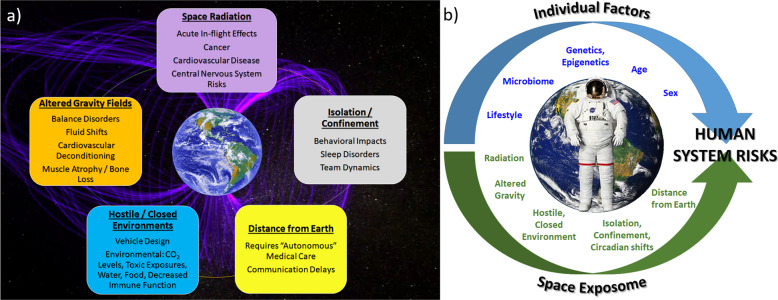
AbstractNASA’s plans for space exploration include a return to the Moon to stay—boots back on the lunar surface with an orbital outpost. This station will be a launch point for voyages to destinations further away in our solar system, including journeys to the red planet Mars. To ensure success of these missions, health and performance risks associated with the unique hazards of spaceflight must be adequately controlled. These hazards—space radiation, altered gravity fields, isolation and confinement, closed environments, and distance from Earth—are linked with over 30 human health risks as documented by NASA’s Human Research Program. The programmatic goal is to develop the tools and technologies to adequately mitigate, control, or accept these risks. The risks ranked as “red” have the highest priority based on both the likelihood of occurrence and the severity of their impact on human health, performance in mission, and long-term quality of life. These include: (1) space radiation health effects of cancer, cardiovascular disease, and cognitive decrements (2) Spaceflight-Associated Neuro-ocular Syndrome (3) behavioral health and performance decrements, and (4) inadequate food and nutrition. Evaluation of the hazards and risks in terms of the space exposome—the total sum of spaceflight and lifetime exposures and how they relate to genetics and determine the whole-body outcome—will provide a comprehensive picture of risk profiles for individual astronauts. In this review, we provide a primer on these “red” risks for the research community. The aim is to inform the development of studies and projects with high potential for generating both new knowledge and technologies to assist with mitigating multisystem risks to crew health during exploratory missions.
Overview
CoChat Summary
## TL;DR
This review identifies NASA HRP’s highest-priority “red” human health risks for Mars-class missions: space radiation effects, Spaceflight-Associated Neuro-ocular Syndrome (SANS), behavioral health/performance decrements, and inadequate food and nutrition. It frames these risks within the “space exposome” and argues that integrated, systems-biology-based mitigation is needed for successful long-duration exploration.
## Key findings
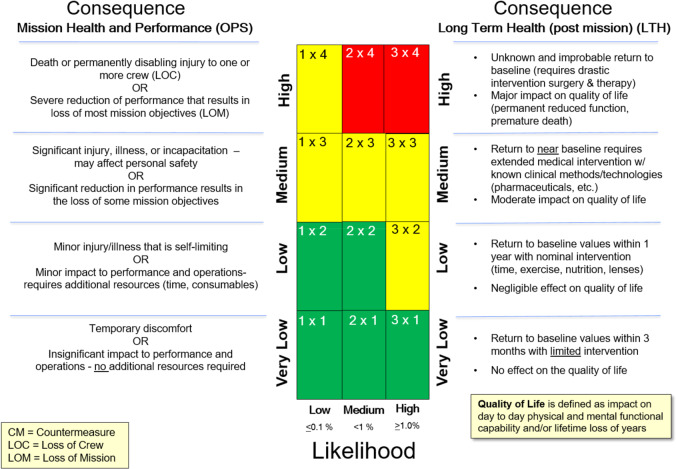
- NASA ranks “red” risks by likelihood and consequence for a design reference mission; the paper states these are the highest-priority risks for crew health and long-term quality of life.
- The four red-risk areas highlighted are: space radiation health effects (including cancer, cardiovascular disease, and cognitive decrements), SANS, behavioral health and performance decrements, and inadequate food and nutrition.
- For space radiation, the paper reports absorbed doses of about 30–120 mGy for 6- to 12-month ISS missions, 100–120 mGy for a 1-year lunar surface stay, and 300–450 mGy for an ~3-year Mars mission (transit plus surface stay).
- For SANS, the paper reports that about 69% of U.S. crewmembers on the ISS experience a >20 µm increase in peripapillary retinal thickness in at least one eye, about 15–20% develop chorioretinal folds, about 16% experience an on-orbit refractive error shift, and about 29% experience posterior eyeball flattening.
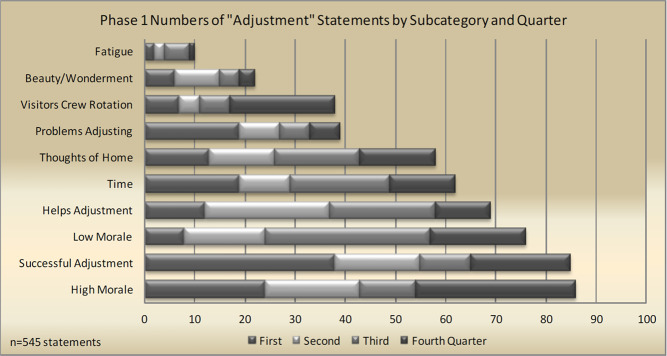
- In a simulated 520-day Mars mission isolation study, 1 of 6 (20%) crew reported depressive symptoms in 93% of mission weeks, and those symptoms reached mild-to-moderate levels in >10% of mission weeks.
## Methods
- This is a review/primer of NASA Human Research Program evidence and risk assessments, not an original experimental study.
- The paper synthesizes NASA HRP evidence reports, ISS flight data, ground analog studies, animal models, and translational research on the space environment and human health.
- The main analytical framework is NASA’s likelihood × consequence (LxC) evidence-based risk approach, together with the “space exposome” concept and HRP’s integrated research strategy.
## Limitations
- The paper explicitly notes that for several risks, especially space radiation CNS effects and SANS, the pathogenesis remains unclear and the evidence base is incomplete.
- It states that no radiation-associated clinically significant operational or long-term CNS deficits have been identified in astronauts at comparable ISS doses, and that translation from animal models to humans is uncertain.
- Evident from the text: this is a narrative review, so it does not present a single unified dataset or perform a meta-analysis; conclusions depend on heterogeneous studies and NASA evidence reports.
Model-written summary. Check it against the paper before relying on it.
Integrity signals
Registry
Cites
Statistics
Figures
Verification
Claims the paper makes
28 Valid · 6 Not valid · 27 Not checked · 48 Own results and interpretations
At least one cited source doesn’t support this claim or points to a different paper, and none confirmed it — see the verdicts below.
In the paper
“Importantly, those that did not lose body mass managed to maintain bone mineral density (discussed below)76.”
§ Red risks for a journey to the red planet: The highest priority human health risks for a mission to Mars > Inadequate food and nutrition
What the sources say
- Disputedcites [76] Smith SM Benefits for bone from resistance exercise and nutrition in long-duration spaceflight: evidence from biochemistry and densitometry J. Bone Miner. Res. 2012 27 1896 1906 10.1002/jbmr.1647 22549960 sourceExperimental — accuracy not yet measured
The Abstract reports that body mass was unchanged after flight in both exercise groups, but the measured bone mineral density outcomes were unchanged from preflight only in the ARED group. The Results likewise distinguish ARED from iRED crewmembers, so maintaining body mass did not, by itself, mean maintaining bone mineral density. (LLM, conf=0.90)
Checked by a reasoning model — may be wrong.
plainstates an association- Asserted: passes — The authors put it forward as true.
- Checkable: passes — It can be checked against evidence.
- Load-bearing: unclear — It is unclear whether the paper’s conclusions depend on it.
- Based: passes — The paper gives a reason why it holds.
- Disputed
The cited sources support only part of this claim — read each source’s verdict below.
In the paper
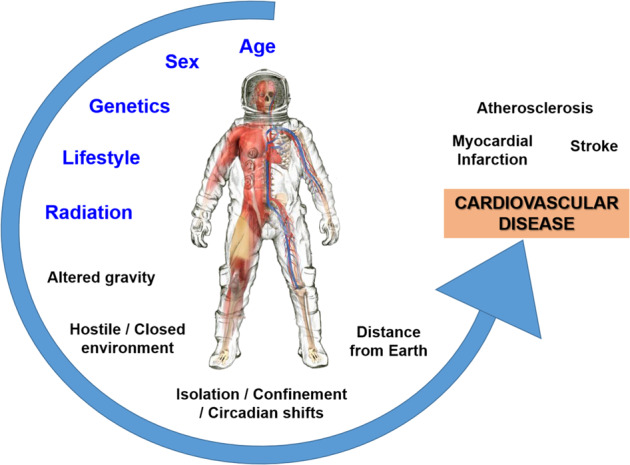
“For cardiovascular disease (CVD), a majority of the evidence comes from radiotherapy cohorts receiving high-dose mediastinal exposures that are associated with an increased risk for heart attack and stroke28.”
§ Red risks for a journey to the red planet: The highest priority human health risks for a mission to Mars > Space radiation health risks > Risk of cardiovascular disease and other degenerative tissue effects from radiation exposure and secondary spaceflight stressors
What the sources say
- Partly supportedcites [28] Sylvester CB Abe J-I Patel ZS Grande-Allen KJ Radiation-induced cardiovascular disease: mechanisms and importance of linear energy transfer Front. Cardiovasc. Med. 2018 5 5 10.3389/fcvm.2018.00005 29445728 PMC5797745 sourceExperimental — accuracy not yet measured
The Introduction (page unavailable) describes radiation-induced CVD as a complication of radiotherapy, especially to the thorax, and identifies coronary artery disease as a long-term effect. Implications on Treatment (page unavailable) says the radiation–CVD link is established in human cohorts. The paper does not establish that a majority of the evidence comes from high-dose mediastinal radiotherapy cohorts or specifically report an increased risk of both heart attack and stroke. (LLM, conf=0.86)
plainstates an association- Asserted: passes — The authors put it forward as true.
- Checkable: passes — It can be checked against evidence.
- Load-bearing: unclear — It is unclear whether the paper’s conclusions depend on it.
- Based: passes — The paper gives a reason why it holds.
- Partly supported
The cited sources support only part of this claim — read each source’s verdict below.
In the paper
“As an example, persistently high levels of oxidative damage are observed in the intestine from mice examined 1 year after exposure to 56Fe-ion radiation compared to gamma radiation and unirradiated controls14,15.”
§ Red risks for a journey to the red planet: The highest priority human health risks for a mission to Mars > Space radiation health risks
What the sources say
- Supportedcites [14] Datta K Suman S Kallakury BVS Fornace AJ Exposure to heavy ion radiation induces persistent oxidative stress in mouse intestine PLoS ONE 2012 7 e42224 10.1371/journal.pone.0042224 22936983 PMC3427298 source
The Abstract states that intestinal tissue and cells were collected one year after irradiation. The Results sections on persistent oxidative stress and oxidative DNA damage report significantly higher ROS and oxidative DNA damage after ⁵⁶Fe irradiation than after γ irradiation or in unirradiated controls. (LLM, conf=0.94)
- Partly supportedcites [15] Kumar S Suman S Fornace AJ Datta K Space radiation triggers persistent stress response, increases senescent signaling, and decreases cell migration in mouse intestine Proc. Natl Acad. Sci. USA 2018 115 E9832 E9841 10.1073/pnas.1807522115 30275302 PMC6196540 sourceExperimental — accuracy not yet measured
The Results section, “Low-Dose 56Fe Radiation Exposure Is Associated with Persistently Increased DNA Damage” (page unavailable), reports more DNA double-strand-break markers at 12 months after 56Fe exposure than after γ-rays or no irradiation. It reports higher staining for 8-oxo-dG, a marker of oxidative DNA damage, only in samples examined at 60 days. Thus, the source supports persistent DNA damage but not the specific claim of measured oxidative damage at one year. (LLM, conf=0.89)
plainstates a cause- Asserted: passes — The authors put it forward as true.
- Checkable: passes — It can be checked against evidence.
- Load-bearing: passes — The paper’s conclusions depend on it.
- Based: passes — The paper gives a reason why it holds.
- Supported
The cited sources support only part of this claim — read each source’s verdict below.
In the paper
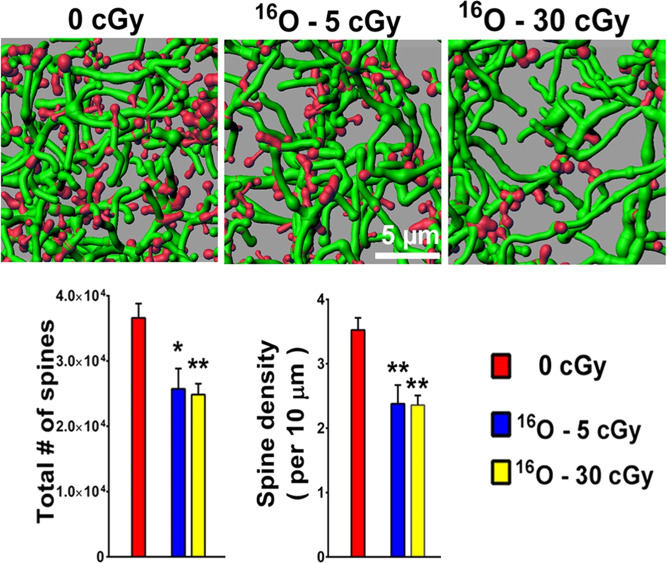
“Rodent studies conducted with HZE ions at low, mission-relevant doses and time frames show a variety of structural and functional alterations to neurons and neural circuits with associated performance deficits39–44.”
§ Red risks for a journey to the red planet: The highest priority human health risks for a mission to Mars > Space radiation health risks > Risk of acute (in-flight) and late CNS effects from space radiation exposure
What the sources say
- Supportedcites [39] Parihar VK Cosmic radiation exposure and persistent cognitive dysfunction Sci. Rep. 2016 6 34774 10.1038/srep34774 27721383 PMC5056393 source
The Results report cognitive performance deficits in mice and rats after low, space-relevant doses of charged particles, including deficits persisting at 12 and 24 weeks. The Results also report reduced dendritic complexity 15 weeks after exposure, and the Discussion links neuronal and synaptic changes with poorer task performance (page numbers unavailable in our copy). (LLM, conf=0.92)
- Not checked — no full text of the sourcecites [40] Parihar VK Persistent nature of alterations in cognition and neuronal circuit excitability after exposure to simulated cosmic radiation in mice Exp. Neurol. 2018 305 44 55 10.1016/j.expneurol.2018.03.009 29540322 source
- Partly supportedcites [41] Hinkle JJ Olschowka JA Love TM Williams JP O’Banion MK Cranial irradiation mediated spine loss is sex-specific and complement receptor-3 dependent in male mice Sci. Rep. 2019 9 18899 10.1038/s41598-019-55366-6 31827187 PMC6906384 sourceExperimental — accuracy not yet measured
The Discussion reports that low-dose heavy-ion exposures altered dendritic complexity and spine density, and the Introduction says neuronal injury and cognitive changes can occur after heavy-ion irradiation. Our copy does not establish that those exposures used mission-relevant time frames or that this paper itself measured performance deficits after HZE exposure; its own experiment used 10 Gy gamma irradiation. (LLM, conf=0.85)
- Supportedcites [42] Liu B Space-like 56Fe irradiation manifests mild, early sex-specific behavioral and neuropathological changes in wildtype and Alzheimer’s-like transgenic mice Sci. Rep. 2019 9 12118 10.1038/s41598-019-48615-1 31431669 PMC6702228 source
The Introduction reports cognitive deficits in rodents after HZE doses as low as 10–20 cGy and discusses effects on neurons and neural tissue. The Discussion describes reported changes in dendritic structure, synaptic function, and plasticity alongside behavioral deficits. This supports the broad claim about rodent studies, although this paper notes that its own early tests found no cognitive decline in wildtype mice. (LLM, conf=0.88)
- Partly supportedcites [43] Raber J Combined Effects of Three High-Energy Charged Particle Beams Important for Space Flight on Brain, Behavioral and Cognitive Endpoints in B6D2F1 Female and Male Mice Front. Physiol. 2019 10 1 15 10.3389/fphys.2019.00179 30914962 PMC6422905 sourceExperimental — accuracy not yet measured
The Discussion (page unavailable) reports impaired object recognition after three-beam irradiation, and the Results report sex-dependent changes in cortical BDNF and CD68. But the paper measures protein levels rather than demonstrating structural or functional alterations to neurons and neural circuits. The Methods also describe rapidly delivered beams, not exposure over mission-relevant time frames. (LLM, conf=0.86)
- Partly supportedcites [44] Rosi S The final frontier: transient microglia reduction after cosmic radiation exposure mitigates cognitive impairments and modulates phagocytic activity Brain Circ. 2018 4 109 113 10.4103/bc.bc_24_18 30450416 PMC6187945 sourceExperimental — accuracy not yet measured
The Introduction reports rodent behavioral deficits accompanied by synaptic alterations after exposure to cosmic-ray particles, and the Irradiation and Memory section links reduced dendritic spine density to cognitive deficits. The paper also discusses low-dose titanium and iron studies and deficits lasting beyond 90 days. It does not establish that the doses and observation time frames across those studies were mission-relevant. (LLM, conf=0.82)
plainstates an association- Asserted: passes — The authors put it forward as true.
- Checkable: passes — It can be checked against evidence.
- Load-bearing: passes — The paper’s conclusions depend on it.
- Based: passes — The paper gives a reason why it holds.
- Supported
Every source the paper cites for this claim was checked and supports it.
In the paper
“For a Mars mission, preliminary estimates suggest that circulatory disease risk may increase the risk of exposure induced death by ~40% compared to cancer alone32.”
§ Red risks for a journey to the red planet: The highest priority human health risks for a mission to Mars > Space radiation health risks > Risk of cardiovascular disease and other degenerative tissue effects from radiation exposure and secondary spaceflight stressors
What the sources say
- Supportedcites [32] Cucinotta FA Kim M-HY Chappell LJ Huff JL How safe is safe enough? Radiation risk for a human mission to Mars PLoS ONE 2013 8 e74988 10.1371/journal.pone.0074988 24146746 PMC3797711 source
The Discussion states that adding circulatory disease risk to cancer risk predictions for Mars missions increased the predicted risk of exposure-induced death (%REID) by about 40%. The Results reports the same comparison for its modeled 940-day Mars missions. (LLM, conf=0.95)
hedgedstates a possible cause- Asserted: passes — The authors put it forward as true.
- Checkable: passes — It can be checked against evidence.
- Load-bearing: unclear — It is unclear whether the paper’s conclusions depend on it.
- Based: passes — The paper gives a reason why it holds.
- Supported
58 more claims · 11 with their cited sources checked
Create a free account to see all 109 claims and to verify the 1 reference still open.
- It may state two separate claims as one. 42
- Probably not a substantial claim. 11
Citations
Cites
Hallmarks of Cancer: The Next Generation
Hanahan, D., & Weinberg, R. A. (2011) · Cell · doi:10.1016/j.cell.2011.02.013 · Cited by 66,590
Risk of Ischemic Heart Disease in Women after Radiotherapy for Breast Cancer
Darby, S. C., Ewertz, M., McGale, P., Bennet, A. M., Blom-Goldman, U., Brønnum, D., Correa, C., Cutter, D., Gagliardi, G., Gigante, B., et al. (2013) · New England Journal of Medicine · doi:10.1056/nejmoa1209825 · Cited by 3,974
Stewart, F. A., Akleyev, A. V., Hauer-Jensen, M., Hendry, J. H., Kleiman, N. J., MacVittie, T. J., Aleman, B. M., Edgar, A. B., Mabuchi, K., Muirhead, C. R., et al. (2012) · Annals of the ICRP · doi:10.1016/j.icrp.2012.02.001 · Cited by 1,604
The exposome: from concept to utility
Wild, C. P. (2012) · International Journal of Epidemiology · doi:10.1093/ije/dyr236 · Cited by 1,416
Hu, S., Marshall, C., Darby, J., Wei, W., Lyons, A. B., & Körner, H. (2018) · Frontiers in Immunology · doi:10.3389/fimmu.2018.00001 · Cited by 973
Mader, T. H., Gibson, C. R., Pass, A. F., Kramer, L. A., Lee, A. G., Fogarty, J., Tarver, W. J., Dervay, J. P., Hamilton, D. R., Sargsyan, A., et al. (2011) · Ophthalmology · doi:10.1016/j.ophtha.2011.06.021 · Cited by 748
Self-citationICRP Publication 119: Compendium of Dose Coefficients based on ICRP Publication 60
Eckerman, K., Harrison, J., Menzel, H.-G., & Clement, C. H. (2012) · Annals of the ICRP · doi:10.1016/j.icrp.2012.06.038 · Cited by 706
Cucinotta, F. A., & Durante, M. (2006) · The Lancet Oncology · doi:10.1016/s1470-2045(06)70695-7 · Cited by 697
Heavy ion carcinogenesis and human space exploration
Durante, M., & Cucinotta, F. A. (2008) · Nature Reviews Cancer · doi:10.1038/nrc2391 · Cited by 578
Editorial: The Role of Calcium Handling in Heart Failure and Heart Failure Associated Arrhythmias
Johnson, D. M., Mugelli, A., & Cerbai, E. (2019) · Frontiers in Physiology · doi:10.3389/fphys.2019.00001 · Cited by 455
Research works printed but not linked: 3
- Cucinotta, F. A., Kim, M.-H. Y. & Chappell, L. J. Space Radiation Cancer Risk Projections and Uncertainties–2012. Vol. 186 (2013).
- Dinges, D. F. et al. PVT on ISS: reaction self-test (RST) from 6-month missions. (Human Research Program Investigators’ Workshop, 2017).
- Stuster, J. Behavioral Issues Associated with Isolation and Confinement: Review and Analysis of Astronaut Journals (NASA Human Research Program NASA/TM-2010-216130, 2016).
Cited by
Role of Apoptosis in Wound Healing and Apoptosis Alterations in Microgravity
Riwaldt, S., Corydon, T. J., Pantalone, D., Sahana, J., Wise, P., Wehland, M., Krüger, M., Melnik, D., Kopp, S., Infanger, M., et al. (2021) · Frontiers in Bioengineering and Biotechnology · doi:10.3389/fbioe.2021.679650 · Cited by 90
Ong, J., Tarver, W. J., Brunstetter, T. J., Mader, T. H., Gibson, C. R., Mason, S. S., & Lee, A. G. (2023) · British Journal of Ophthalmology · doi:10.1136/bjo-2022-322892 · Cited by 91
Self-citationSpace Radiation Protection Countermeasures in Microgravity and Planetary Exploration
Montesinos, C. A., Khalid, R., Cristea, O., Greenberger, J. S., Epperly, M. W., Lemon, J. A., Boreham, D. R., Popov, D., Gorthi, G., Ramkumar, N., et al. (2021) · Life · doi:10.3390/life11080829 · Cited by 99
Ong, J., Tavakkoli, A., Zaman, N., Kamran, S. A., Waisberg, E., Gautam, N., & Lee, A. G. (2022) · npj Microgravity · doi:10.1038/s41526-022-00222-7 · Cited by 75
May the Force Be with You (Or Not): The Immune System under Microgravity
ElGindi, M., Sapudom, J., Ibrahim, I. H., Al‐Sayegh, M., Chen, W., Garcia‐Sabaté, A., & Teo, J. C. M. (2021) · Cells · doi:10.3390/cells10081941 · Cited by 83
Tesei, D., Jewczynko, A., Lynch, A., & Urbaniak, C. (2022) · Life · doi:10.3390/life12040495 · Cited by 88
Tomsia, M., Cieśla, J., Śmieszek, J., Florek, S., Macionga, A. A., Michalczyk, K., & Stygar, D. M. (2024) · Frontiers in Physiology · doi:10.3389/fphys.2024.1284644 · Cited by 137
Jones, C. W., Basner, M., Mollicone, D. J., Mott, C. M., & Dinges, D. F. (2022) · Sleep · doi:10.1093/sleep/zsac006 · Cited by 68
3D Bioprinting in Microgravity: Opportunities, Challenges, and Possible Applications in Space
Ombergen, A. V., Chalupa‐Gantner, F., Chansoria, P., Colosimo, B. M., Costantini, M., Domingos, M. A. N., Dufour, A., Maria, C. D., Gröll, J., Jüngst, T., et al. (2023) · Advanced Healthcare Materials · doi:10.1002/adhm.202300443 · Cited by 75
Genomic Changes Driven by Radiation-Induced DNA Damage and Microgravity in Human Cells
Beheshti, A., McDonald, J. T., Hada, M., Takahashi, A., Mason, C. E., & Mognato, M. (2021) · International Journal of Molecular Sciences · doi:10.3390/ijms221910507 · Cited by 100
How spaceflight challenges human cardiovascular health
Jirak, P., Mirna, M., Rezar, R., Motloch, L. J., Lichtenauer, M., Jordan, J., Binneboessel, S., Tank, J., Limper, U., & Jung, C. (2022) · European Journal of Preventive Cardiology · doi:10.1093/eurjpc/zwac029 · Cited by 70
Biomonitoring and precision health in deep space supported by artificial intelligence
Scott, R. T., Sanders, L., Antonsen, E., Hastings, J. J. A., Park, S.-M., Mackintosh, G., Reynolds, R. J., Hoarfrost, A., Sawyer, A., Greene, C. S., et al. (2023) · Nature Machine Intelligence · doi:10.1038/s42256-023-00617-5 · Cited by 74
RETRACTED: New intranasal and injectable gene therapy for healthy life extension
Jaijyan, D. K., Selariu, A., Cruz-Cosme, R., Tong, M., Yang, S., Stefa, A., Kekich, D., Sadoshima, J., Herbig, U., Tang, Q., et al. (2022) · Proceedings of the National Academy of Sciences · doi:10.1073/pnas.2121499119 · Cited by 57
RetractedHuman challenges to adaptation to extreme professional environments: A systematic review
Roy, B. L., Martin‐Krumm, C., Piñol‐Domenech, N., Dutheil, F., & Trousselard, M. (2023) · Neuroscience & Biobehavioral Reviews · doi:10.1016/j.neubiorev.2023.105054 · Cited by 70
Challenges of Artificial Intelligence in Space Medicine
Waisberg, E., Ong, J., Paladugu, P., Kamran, S. A., Zaman, N., Lee, A. G., & Tavakkoli, A. (2022) · Space Science & Technology · doi:10.34133/2022/9852872 · Cited by 67
Carcinogenesis induced by space radiation: A systematic review
Guo, Z., Zhou, G., & Hu, W. (2022) · Neoplasia · doi:10.1016/j.neo.2022.100828 · Cited by 99
Signatures of muscle disuse in spaceflight and bed rest revealed by single muscle fiber proteomics
Murgia, M., Ciciliot, S., Nagaraj, N., Reggiani, C., Schiaffino, S., Franchi, M. V., Pišot, R., Šimunič, B., Toniolo, L., Blaauw, B., et al. (2022) · PNAS Nexus · doi:10.1093/pnasnexus/pgac086 · Cited by 62
Krukowski, K., Grue, K. A., Becker, M., Elizarraras, E., Frias, E. S., Halvorsen, A. T., Koenig-Zanoff, M., Frattini, V., Nimmagadda, H., Feng, X., et al. (2021) · Science Advances · doi:10.1126/sciadv.abg6702 · Cited by 87
What can biofabrication do for space and what can space do for biofabrication?
Moroni, L., Tabury, K., Stenuit, H., Grimm, D. G., Baatout, S., & Mironov, V. A. (2021) · Trends in biotechnology · doi:10.1016/j.tibtech.2021.08.008 · Cited by 55
Effects of spaceflight on the brain
Seidler, R. D., Mao, X. W., Tays, G. D., Wang, T., & zu Eulenburg, P. (2024) · The Lancet Neurology · doi:10.1016/s1474-4422(24)00224-2 · Cited by 68
Body Protein Sparing in Hibernators: A Source for Biomedical Innovation
Bertile, F., Habold, C., Maho, Y. L., & Giroud, S. (2021) · Frontiers in Physiology · doi:10.3389/fphys.2021.634953 · Cited by 59
Space radiation measurements during the Artemis I lunar mission
George, S. P., Gaza, R., Matthiä, D., Laramore, D., Lehti, J., Campbell-Ricketts, T., Kroupa, M., Stoffle, N., Marsalek, K., Przybyla, B., et al. (2024) · Nature · doi:10.1038/s41586-024-07927-7 · Cited by 47
The effect of long-term spaceflight on drug potency and the risk of medication failure
Reichard, J. F., Phelps, S. E., Lehnhardt, K. R., Young, M., & Easter, B. D. (2023) · npj Microgravity · doi:10.1038/s41526-023-00271-6 · Cited by 59
Perspectives for plant biology in space and analogue environments
Micco, V. D., Aronne, G., Caplin, N., Carnero-Díaz, E., Herranz, R., Horemans, N., Legué, V., Medina, F. J., Pereda‐Loth, V., Schiefloe, M., et al. (2023) · npj Microgravity · doi:10.1038/s41526-023-00315-x · Cited by 56
Aging and putative frailty biomarkers are altered by spaceflight
Camera, A., Tabetah, M., Castañeda, V., Kim, J., Galsinh, A. S., Haro-Vinueza, A., Salinas, I., Seylani, A., Arif, S., Das, S., et al. (2024) · Scientific Reports · doi:10.1038/s41598-024-57948-5 · Cited by 50
Ong, J., Tavakkoli, A., Strangman, G. E., Zaman, N., Kamran, S. A., Zhang, Q., Ivković, V., & Lee, A. G. (2022) · Survey of Ophthalmology · doi:10.1016/j.survophthal.2022.04.004 · Cited by 41
Ong, J., Waisberg, E., Masalkhi, M., Kamran, S. A., Lowry, K., Sarker, P., Zaman, N., Paladugu, P., Tavakkoli, A., & Lee, A. G. (2023) · Brain Sciences · doi:10.3390/brainsci13081148 · Cited by 41
Earth-Based Research Analogs to Investigate Space-Based Health Risks
Cromwell, R. L., Huff, J. L., Simonsen, L. C., & Patel, Z. S. (2021) · New Space · doi:10.1089/space.2020.0048 · Cited by 43
Self-citationMiller, K. B., Mi, K. L., Nelson, G. A., Norman, R. B., Patel, Z. S., & Huff, J. L. (2022) · Frontiers in Physiology · doi:10.3389/fphys.2022.1008640 · Cited by 42
Self-citationTo infinity and beyond: Strategies for fabricating medicines in outer space
Seoane‐Viaño, I., Ong, J. J., Basit, A. W., & Goyanes, Á. (2022) · International Journal of Pharmaceutics X · doi:10.1016/j.ijpx.2022.100121 · Cited by 53
Ong, J., Mader, T. H., Gibson, C. R., Mason, S. S., & Lee, A. G. (2023) · Eye · doi:10.1038/s41433-023-02522-y · Cited by 49
Zarubin, M. P., Azorskaya, T., Kuldoshina, O. A., Alekseev, S., Mitrofanov, S. V., & Kravchenko, E. (2023) · iScience · doi:10.1016/j.isci.2023.106998 · Cited by 35
Spatially resolved multiomics on the neuronal effects induced by spaceflight in mice
Masarapu, Y., Cekanaviciute, E., Andrusivová, Ž., Westholm, J. O., Björklund, Å. K., Fallegger, R., Badia-i-Mompel, P., Boyko, V., Vasisht, S., Saravia-Butler, A., et al. (2024) · Nature Communications · doi:10.1038/s41467-024-48916-8 · Cited by 35
Modeling the Effects of Protracted Cosmic Radiation in a Human Organ‐on‐Chip Platform
Tavakol, D. N., Nash, T. R., Kim, Y., Graney, P. L., Liberman, M., Fleischer, S., Lock, R. I., O'Donnell, A., Andrews, L., Ning, D., et al. (2024) · Advanced Science · doi:10.1002/advs.202401415 · Cited by 41
van den Nieuwenhof, D. W. A., Moroni, L., Chou, J., & Hinkelbein, J. (2024) · npj Microgravity · doi:10.1038/s41526-024-00442-z · Cited by 44
Cardiovascular Disease Risk Modeling for Astronauts: Making the Leap From Earth to Space
Huff, J. L., Plante, I., Blattnig, S. R., Norman, R. B., Little, M. P., Khera, A., Simonsen, L. C., & Patel, Z. S. (2022) · Frontiers in Cardiovascular Medicine · doi:10.3389/fcvm.2022.873597 · Cited by 39
Self-citationOng, J., Zaman, N., Waisberg, E., Kamran, S. A., Lee, A. G., & Tavakkoli, A. (2022) · Wearable Technologies · doi:10.1017/wtc.2022.21 · Cited by 33
Jordan, J., Limper, U., & Tank, J. (2022) · Neurological Sciences · doi:10.1007/s10072-022-05963-7 · Cited by 39
Space radiation damage rescued by inhibition of key spaceflight associated miRNAs
McDonald, J. T., Kim, J., Farmerie, L., Johnson, M. L., Trovão, N. S., Arif, S., Siew, K., Tsoy, S., Bram, Y., Park, J., et al. (2024) · Nature Communications · doi:10.1038/s41467-024-48920-y · Cited by 39
Chauhan, V., Hamada, N., Monceau, V., Ebrahimian, T. G., Adam, N., Wilkins, R. C., Sebastian, S., Patel, Z. S., Huff, J. L., Simonetto, C., et al. (2021) · International Journal of Radiation Biology · doi:10.1080/09553002.2021.1969466 · Cited by 34
Self-citationNeuroprotective agents effective against radiation damage of central nervous system
Lalkovičová, M. (2022) · Neural Regeneration Research · doi:10.4103/1673-5374.335137 · Cited by 32
Gupta, K., Perkerson, R. B., Parsons, T. M., Angom, R., Amerna, D., Burgess, J. D., Ren, Y., McLean, P. J., Mukhopadhyay, D., Vibhute, P. G., et al. (2024) · Stem Cell Research & Therapy · doi:10.1186/s13287-024-03847-5 · Cited by 39
Drago‐Ferrante, R., Fiore, R. D., Karouia, F., Subbannayya, Y., Das, S., Mathyk, B. A., Arif, S., Guevara-Cerdán, A. P., Seylani, A., Galsinh, A. S., et al. (2022) · International Journal of Molecular Sciences · doi:10.3390/ijms23137465 · Cited by 33
Understanding how space travel affects the female reproductive system to the Moon and beyond
Mathyk, B. A., Imudia, A. N., Quaas, A. M., Halıcıgil, C., Karouia, F., Avci, P., Nelson, N. G., Guzeloglu‐Kayisli, O., Denbo, M., Sanders, L., et al. (2024) · npj Women s Health · doi:10.1038/s44294-024-00009-z · Cited by 30
Waisberg, E., Ong, J., Paladugu, P., Kamran, S. A., Zaman, N., Tavakkoli, A., & Lee, A. G. (2023) · European Journal of Ophthalmology · doi:10.1177/11206721231221584 · Cited by 34
Identification of Factors Associated With the Development of Optic Disc Edema During Spaceflight
Pardon, L. P., Greenwald, S. H., Ferguson, C. R., Patel, N. B., Young, M., Laurie, S. S., & Macias, B. R. (2022) · JAMA Ophthalmology · doi:10.1001/jamaophthalmol.2022.4396 · Cited by 33
Space Travel: The Radiation and Microgravity Effects on the Cardiovascular System
Mircea, A. A., Pistritu, D.-V., Fortner, A., Tanca, A., Liehn, E. A., & Bucur, O. (2024) · International Journal of Molecular Sciences · doi:10.3390/ijms252111812 · Cited by 37
Brains in space: impact of microgravity and cosmic radiation on the CNS during space exploration
Wuyts, F. L., Deblieck, C., Vandevoorde, C., & Durante, M. (2025) · Nature reviews. Neuroscience · doi:10.1038/s41583-025-00923-4 · Cited by 40
Cardiovascular, Lymphatic, and Ocular Health in Space
Ly, V., Velichala, S. R., & Hargens, A. R. (2022) · Life · doi:10.3390/life12020268 · Cited by 37
Progress and strategies in advanced aerospace materials for extreme environments: A review
Xie, F., Yang, Y., Ping, Z., Gong, X., Dong, Z., Xu, W., Yu, J., Yao, W., & Dong, Y. (2025) · Acta Astronautica · doi:10.1016/j.actaastro.2025.08.011 · Cited by 29
Soler, I., Yun, S., Reynolds, R. P., Whoolery, C. W., Tran, F. H., Kumar, P. L., Rong, Y., DeSalle, M. J., Gibson, A. D., Stowe, A. M., et al. (2021) · Frontiers in Behavioral Neuroscience · doi:10.3389/fnbeh.2021.722780 · Cited by 28
Marfia, G., Navone, S. E., Guarnaccia, L., Campanella, R., Locatelli, M., Miozzo, M. R., Perelli, P., Morte, G. D., Catamo, L., Tondo, P., et al. (2022) · Journal of Neuroscience Research · doi:10.1002/jnr.25066 · Cited by 27
Stratis, D., Trudel, G., Rocheleau, L., Pelchat, M., & Laneuville, O. (2023) · Frontiers in Immunology · doi:10.3389/fimmu.2023.1171103 · Cited by 33
Bosutti, A., Ganse, B., Maffiuletti, N. A., Wüst, R. C. I., Strijkers, G. J., Sanderson, A. J. R., & Degens, H. (2025) · Experimental Physiology · doi:10.1113/ep092345 · Cited by 33
Mechanism for enhancing the growth of mung bean seedlings under simulated microgravity
Nakajima, S., NAGATA, M., & Ikehata, A. (2021) · npj Microgravity · doi:10.1038/s41526-021-00156-6 · Cited by 27
Modeling sloshing damping for spacecraft: A smoothed particle hydrodynamics application
Kotsarinis, K., Green, M. D., Simonini, A., et al. (2023) · Aerospace Science and Technology · doi:10.1016/j.ast.2022.108090 · Cited by 24
Circadian regulation in aging: Implications for spaceflight and life on earth
Malhan, D., Schoenrock, B., Yalçın, M., Blottner, D., & Relógio, A. (2023) · Aging Cell · doi:10.1111/acel.13935 · Cited by 29
Cognition in zero gravity: Effects of non-terrestrial gravity on human behaviour
Arshad, I., & Ferrè, E. R. (2022) · Quarterly Journal of Experimental Psychology · doi:10.1177/17470218221113935 · Cited by 37
Ainsbury, E. A., Moquet, J., Sun, M., Barnard, S. G. R., Ellender, M., & Lloyd, D. (2021) · International Journal of Radiation Biology · doi:10.1080/09553002.2021.1980629 · Cited by 26
Hybrid methods of radiation shielding against deep-space radiation
Chowdhury, R. P., Stegeman, L., Lund, M., Fry, D. J., Madzunkov, S. M., & Bahadori, A. A. (2023) · Life Sciences in Space Research · doi:10.1016/j.lssr.2023.04.004 · Cited by 37
The Case for Expanding Visual Assessments During Spaceflight
Waisberg, E., Ong, J., Masalkhi, M., et al. (2023) · Prehospital and Disaster Medicine · doi:10.1017/s1049023x23005964 · Cited by 22
Ryu, K., Kang, M., Kim, J., et al. (2024) · Advanced Fiber Materials · doi:10.1007/s42765-024-00432-6 · Cited by 22
Sun, H., Duan, M., Wu, Y., Zeng, Y., Zhao, H., Wu, S., Lin, B., Yang, R., & Tan, G. (2024) · Nexus · doi:10.1016/j.ynexs.2024.100030 · Cited by 26
Cialdai, F., Bolognini, D., Vignali, L., Iannotti, N., Cacchione, S., Magi, A., Balsamo, M., Vukich, M., Neri, G., Donati, A., et al. (2021) · Cellular and Molecular Life Sciences · doi:10.1007/s00018-021-03989-2 · Cited by 25
Artificial Intelligence Applications in Space Medicine
Cheung, H. C., Louche, C. D. D., & Komorowski, M. (2023) · Aerospace Medicine and Human Performance · doi:10.3357/amhp.6178.2023 · Cited by 29
Modeling and countering the effects of cosmic radiation using bioengineered human tissues
Tavakol, D. N., Nash, T. R., Kim, Y., He, S., Fleischer, S., Graney, P. L., Brown, J. A., Liberman, M., Tamargo, M. A., Harken, A. D., et al. (2023) · Biomaterials · doi:10.1016/j.biomaterials.2023.122267 · Cited by 26
Cosmic chronometers: Is spaceflight a catalyst for biological ageing?
Campisi, M., Cannella, L., & Pavanello, S. (2024) · Ageing Research Reviews · doi:10.1016/j.arr.2024.102227 · Cited by 24
Ethical considerations for the age of non-governmental space exploration
Seylani, A., Galsinh, A. S., Tasoula, A., I, A. R., Camera, A., Calleja‐Agius, J., Borg, J., Goel, C., Kim, J., Clark, K. B., et al. (2024) · Nature Communications · doi:10.1038/s41467-023-44357-x · Cited by 22
Sarker, P., Ong, J., Zaman, N., et al. (2023) · Life Sciences in Space Research · doi:10.1016/j.lssr.2023.06.001 · Cited by 20
Melanin protects Cryptococcus neoformans from spaceflight effects
Cordero, R. J. B., Dragotakes, Q., Friello, P. J., & Casadevall, A. (2022) · Environmental Microbiology Reports · doi:10.1111/1758-2229.13078 · Cited by 20
Geotechnical and Shear Behavior of Novel Lunar Regolith Simulants TUBS-M, TUBS-T, and TUBS-I
Windisch, L., Linke, S., Jütte, M., Baasch, J., Kwade, A., Stoll, E., & Schilde, C. (2022) · Materials · doi:10.3390/ma15238561 · Cited by 23
Private Spaceflight: A New Landscape for Dealing with Medical Risk
Griko, Y. V., Loftus, D. J., Štolc, V., & Peletskaya, E. (2022) · Life Sciences in Space Research · doi:10.1016/j.lssr.2022.03.001 · Cited by 23
Han, H., Jia, H., Wang, Y., & Song, J. (2024) · Military Medical Research · doi:10.1186/s40779-024-00570-3 · Cited by 40
Spaceflight Associated Neuro-ocular Syndrome (SANS) and its countermeasures
Nguyen, T. N., Ong, J., Brunstetter, T. J., Gibson, C. R., Macias, B. R., Laurie, S. S., Mader, T. H., Hargens, A. R., Buckey, J. C., Lan, M., et al. (2025) · Progress in Retinal and Eye Research · doi:10.1016/j.preteyeres.2025.101340 · Cited by 27
Self-citationA Modular Reconfigurable Robot for Future Autonomous Extraterrestrial Missions
Romanov, A. M., Yashunskiy, V. D., & Chiu, W. (2021) · IEEE Access · doi:10.1109/access.2021.3124951 · Cited by 18
Scatà, C., Carandina, A., Torre, A. D., Arosio, B., Bellocchi, C., Rodrigues, G. D., Furlan, L., Tobaldini, E., & Montano, N. (2023) · Life · doi:10.3390/life13061229 · Cited by 22
Eye-brain axis in microgravity and its implications for Spaceflight Associated Neuro-ocular Syndrome
Stern, C., Yücel, Y. H., zu Eulenburg, P., Traon, A. P., & Petersen, L. G. (2023) · npj Microgravity · doi:10.1038/s41526-023-00300-4 · Cited by 30
Facing Trauma and Surgical Emergency in Space: Hemorrhagic Shock
Pantalone, D., Chiara, O., Henry, S. M., Cimbanassi, S., Gupta, S. K. S., & Scalea, T. M. (2022) · Frontiers in Bioengineering and Biotechnology · doi:10.3389/fbioe.2022.780553 · Cited by 18
Giri, J., & Moll, G. (2022) · Current Stem Cell Reports · doi:10.1007/s40778-022-00207-y · Cited by 20
The Martian surface radiation environment at solar minimum measured with MSL/RAD
Ehresmann, B., Zeitlin, C. J., Hassler, D. M., Guo, J., Wimmer-Schweingruber, R. F., Berger, T., Matthiä, D., & Reitz, G. (2022) · Icarus · doi:10.1016/j.icarus.2022.115035 · Cited by 20
Poignant, F., Plante, I., Patel, Z. S., Huff, J. L., & Slaba, T. C. (2022) · International Journal of Molecular Sciences · doi:10.3390/ijms23158638 · Cited by 17
Self-citationKozbenko, T., Adam, N., Lai, V., Sandhu, S., Kuan, J., Flores, D., Appleby, M., Parker, H., Hocking, R., Tsaioun, K., et al. (2022) · International Journal of Radiation Biology · doi:10.1080/09553002.2022.2110306 · Cited by 19
Human Physiological Limitations to Long-Term Spaceflight and Living in Space
Winkler, L. H. (2023) · Aerospace Medicine and Human Performance · doi:10.3357/amhp.6190.2023 · Cited by 22
Anatomical considerations for reducing ocular emergencies during spaceflight
Waisberg, E., Ong, J., Masalkhi, M., Lee, A. G., & Berdahl, J. P. (2023) · Irish Journal of Medical Science (1971 -) · doi:10.1007/s11845-023-03407-5 · Cited by 17
Toward countering muscle and bone loss with spaceflight: GSK3 as a potential target
Baranowski, R. W., Braun, J. L., Hockey, B. L., Yumol, J. L., Geromella, M. S., Watson, C. J. F., Kurgan, N., Messner, H. N., Whitley, K. C., MacNeil, A. J., et al. (2023) · iScience · doi:10.1016/j.isci.2023.107047 · Cited by 15
Surgery in the Next Space Missions
Pantalone, D. (2023) · Life · doi:10.3390/life13071477 · Cited by 21
The biomedical challenge associated with the Artemis space program
Bizzarri, M., Gaudenzi, P., & Angeloni, A. (2023) · Acta Astronautica · doi:10.1016/j.actaastro.2023.07.021 · Cited by 19
Kamran, S. A., Hossain, K. F., Ong, J., Waisberg, E., Zaman, N., Baker, S. A., Lee, A. G., & Tavakkoli, A. (2024) · Ophthalmology Science · doi:10.1016/j.xops.2024.100493 · Cited by 19
Muscle stiffness indicating mission crew health in space
Schoenrock, B., Muckelt, P. E., Hastermann, M., Albracht, K., MacGregor, R., Martin, D., Gunga, H.-C., Salanova, M., Stokes, M. J., Warner, M. B., et al. (2024) · Scientific Reports · doi:10.1038/s41598-024-54759-6 · Cited by 18
Fois, M., Diaz‐Artiles, A., Zaman, S. Y., Ridolfi, L., & Scarsoglio, S. (2024) · npj Microgravity · doi:10.1038/s41526-024-00366-8 · Cited by 21
Kamran, S. A., Hossain, K. F., Ong, J., Zaman, N., Waisberg, E., Paladugu, P., Lee, A. G., & Tavakkoli, A. (2024) · npj Microgravity · doi:10.1038/s41526-024-00364-w · Cited by 16
Berardini, M., Gesualdi, L., Morabito, C., Ferranti, F., Reale, A., Zampieri, M., Karpach, K., Tinari, A., Bertuccini, L., Guarnieri, S., et al. (2023) · Cells · doi:10.3390/cells12162106 · Cited by 16
Soares, B., Ong, J., Waisberg, E., Sarker, P., Zaman, N., Tavakkoli, A., & Lee, A. G. (2024) · Life Sciences in Space Research · doi:10.1016/j.lssr.2024.04.004 · Cited by 20
Kumar, A., Rajan, K. S., Bisserier, M., Brojakowska, A., Sebastian, A., Evans, A. C., Coleman, M. A., Mills, P. J., Arakelyan, A., Uchida, S., et al. (2022) · Frontiers in Cardiovascular Medicine · doi:10.3389/fcvm.2022.886689 · Cited by 15
The Diffusion Tensor of Protons at 1 au: Comparing Simulation, Observation, and Theory
Els, P. L., Engelbrecht, N. E., Lang, J. T., & Strauss, D. T. (2024) · The Astrophysical Journal · doi:10.3847/1538-4357/ad7c44 · Cited by 17
Smith, N., Peters, D., Jay, C., Sandal, G. M., Barrett, E., & Wuebker, R. J. (2023) · JMIR Formative Research · doi:10.2196/37784 · Cited by 24
A perspective on tumor radiation resistance following high-LET radiation treatment
Rajpurohit, Y. S., Sharma, D. K., Lal, M., & Soni, I. (2024) · Journal of Cancer Research and Clinical Oncology · doi:10.1007/s00432-024-05757-8 · Cited by 16
Shock and SEP Modeling Study for the 2022 September 5 SEP Event
Kouloumvakos, A., Wijsen, N., Jebaraj, I. C., Afanasiev, A., Lario, D., Cohen, C. M. S., Riley, P., Mitchell, D. G., Ding, Z., Vourlidas, A., et al. (2025) · The Astrophysical Journal · doi:10.3847/1538-4357/ada0be · Cited by 22
Validated space radiation exposure predictions from Earth to Mars during Artemis-I
Slaba, T. C., Rahmanian, S., George, S., Laramore, D., Norbury, J. W., Werneth, C. M., & Zeitlin, C. (2025) · npj Microgravity · doi:10.1038/s41526-025-00459-y · Cited by 11
“The GCR environment represents a continuous low dose-rate exposure, leading to appreciable total doses and multiple highly uncertain health consequences 1 – 5 .”
Countermeasures for Maintaining Cardiovascular Health in Space Missions
Kumar, A., Pramanik, J., Panchal, L., & Prajapati, B. G. (2023) · Current Cardiology Reviews · doi:10.2174/1573403x19666230330083225 · Cited by 17
Metadata
- Authors
- Patel, Z. S., Brunstetter, T. J., Tarver, W. J., Whitmire, A. M., Zwart, S. R., Smith, S. M., & Huff, J. L.
- Affiliations
- KBR (United States) (US)
- National Aeronautics and Space Administration (US)
- Johnson Space Center (US)
- Langley Research Center (US)
- Corresponding author
- Patel, Zarana S.
- Venue
- npj Microgravity
- Published
- 2020-11-05
- Volume
- 6
- Issue
- 1
- Pages
- 33-33
- ISSN
- 2373-8065 (ISSN-L)
- PMC
- PMC7645687
- OpenAlex
- W3094638247
- Cited by
- 373
- References
- 96
- Citations by year
- 2026: 48 · 2025: 79 · 2024: 97 · 2023: 62 · 2022: 62 · 2021: 25
- FWCI
- 4.75
- Type
- journal article
- Language
- en
- Open access
- gold
- doi.org
- Licence
- cc-by
- creativecommons.org/licenses/by/4.0 (tdm)
- creativecommons.org/licenses/by/4.0 (vor)
- Locations
- npj Microgravity (publishedVersion, cc-by)
- PubMed Central (publishedVersion, cc-by)
- PubMed (publishedVersion)
- Funders
- Translational Research Institute for Space Health (TRISH) from the Baylor College of Medicine (The Red Risk School) NASA Human Health and Performance Contract #NNJ15HK11B
- NASA | Johnson Space Center
- NASA | Langley Research Center
- Topics
- Health Sciences › Medicine › Physiology (medical) › Spaceflight effects on biology
- Physical Sciences › Engineering › Aerospace Engineering › Space Exploration and Technology
- Social Sciences › Political Science and International Relations › Space exploration and regulation
- Keywords
- Mars missions, human health risk, space radiation, spaceflight-associated neuro-ocular syndrome, behavioral health, cognitive performance, long-duration spaceflight, lunar base, cardiovascular disease, cancer risk
About these checks
Registry, retraction, Cites and statistics results are computed, not judged, with one exception: a printed reference that no index lists is read once by a model before it counts as a citation error. Claims are extracted by a model and kept only when their quote appears verbatim in the text; each cited source is then checked, with a model’s help, for whether it says what the claim relies on. Those verdicts can be wrong — read the claim’s quote and the cited source before relying on one.
The claim verdicts this report counts are experimental: their accuracy is not yet measured.
A language model drew the claims from the paper on 2026-09-28, under version 3 of the claim definition (model deepseek-v4.1-flash, prompt extract-v3).
A second model labelled each claim on 2026-09-28 (model jev-1.13-20260917, definition revision gold-guideline-v0.2).
Cited sources are checked with a language model’s help (gpt-6-sol).
Statistics and arithmetic are recomputed, not judged.
Confidence bands are shown only for fields calibrated on our annotated test set. None is calibrated yet, so no band is shown.
What counts as a claim ›How we measure confidence ›How we check this ›
Are you an author, or do you see a problem with this page? Request a review
Data sources
Bibliographic data: Semantic Scholar, OpenAlex, Crossref.
Contains information from the Semantic Scholar Academic Graph Datasets, made available under the ODC Attribution License (ODC-BY 1.0).
Semantic Scholar’s data is described in: Kinney, R., et al. (2023). The Semantic Scholar Open Data Platform. arXiv:2301.10140.
