

Hamiltonian simulation with optimal sample complexity
Open accessThe DOI matches its Crossref record; 63 of the 64 references it cites were found in a registry or an index.
Abstract
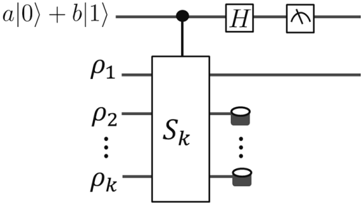
We investigate the sample complexity of Hamiltonian simulation: how many copies of an unknown quantum state are required to simulate a Hamiltonian encoded by the density matrix of that state? We show that the procedure proposed by Lloyd, Mohseni, and Rebentrost [ Nat. Phys. , 10(9):631–633, 2014] is optimal for this task. We further extend their method to the case of multiple input states, showing how to simulate any Hermitian polynomial of the states provided. As applications, we derive optimal algorithms for commutator simulation and orthogonality testing, and we give a protocol for creating a coherent superposition of pure states, when given sample access to those states. We also show that this sample-based Hamiltonian simulation can be used as the basis of a universal model of quantum computation that requires only partial swap operations and simple single-qubit states.
Overview
The claims and statistics of this paper haven’t been checked yet.
Free: it reads the open-access text and checks the first 5 claims that cite a source we can check. Create a free account to check every claim.
Integrity signals
Registry
Cites
Statistics
Figures

Verification
Claims the paper makes
The claims and statistics of this paper haven’t been checked yet.
Free: it reads the open-access text and checks the first 5 claims that cite a source we can check. Create a free account to check every claim.
Claims other papers make about this one
Each is checked against this paper’s own text: does it say what the citing paper says it does?
In the citing paper
“As detailed by Aspuru-Guzik et al. 45 and Dobˇ s´ ıˇ cek et al. 275 , the number of ancilla qubits can be greatly reduced, while maintaining the same precision by using the iterative quantum phase estimation algorithm (IPEA).”
From Quantum Chemistry in the Age of Quantum Computing (2019) · cites this paper as [275]
Self-check
Percentages, sums and reported differences re-computed from the paper’s own numbers.
The self-check needs the paper’s full text.
Citations
Cites
A fast quantum mechanical algorithm for database search
Grover, L. K. (1996) · Proceedings of the twenty-eighth annual ACM symposium on Theory of computing - STOC '96 · doi:10.1145/237814.237866 · Cited by 8,830
Quantum Computation and Quantum Information: 10th Anniversary Edition
Nielsen, M. A., & Chuang, I. L. (2012) · doi:10.1017/cbo9780511976667 · Cited by 8,436
Simulating physics with computers
Feynman, R. P. (1982) · International Journal of Theoretical Physics · doi:10.1007/bf02650179 · Cited by 7,691
Quantum computation with quantum dots
Loss, D., & DiVincenzo, D. P. (1998) · Physical Review A · doi:10.1103/physreva.57.120 · Cited by 6,840 · cited 1×
“In many solid state implementations of quantum computers such as quantum dots [LD98], donor-pairs [Kan98], and electron spins [VYW + 00], the Heisenberg exchange is the natural coupling interaction between qubits.”
BackgroundElementary gates for quantum computation
Barenco, A., Bennett, C. H., Cleve, R., DiVincenzo, D. P., Margolus, N., Shor, P., Sleator, T., Smolin, J. A., & Weinfurter, H. (1995) · Physical Review A · doi:10.1103/physreva.52.3457 · Cited by 4,311 · cited 1×
“While it is beneficial to create computing models that take advantage of this Heisenberg exchange interaction, the Heisenberg interaction is not universal for spin-1/2 systems [BBC + 95].”
MethodA silicon-based nuclear spin quantum computer
Kane, B. E. (1998) · Nature · doi:10.1038/30156 · Cited by 3,779
Quantum Algorithm for Linear Systems of Equations
Harrow, A. W., Hassidim, A., & Lloyd, S. (2009) · Physical Review Letters · doi:10.1103/physrevlett.103.150502 · Cited by 3,325 · cited 1×
“In addition, Hamiltonian simulation has implications for more general computational problems, including adiabatic algorithms [FGGS00], quantum walk algorithms [CCD + 03], and algorithms for systems of linear equations [HHL09].”
MethodLloyd, S. (1996) · Science · doi:10.1126/science.273.5278.1073 · Cited by 3,088 · cited 1×
“Lloyd provided the first formal results on simulation, considering Hamiltonians that consist of sums of non-commuting terms.(1) Other lines of research have focused on simulating sparse Hamiltonians, with a long sequence of work recently culminating in an optimal algorithm(2) (see ref.”
BackgroundQuantum Detection and Estimation Theory
(1976) · Mathematics in Science and Engineering · doi:10.1016/s0076-5392(08)x6017-5 · Cited by 2,426
Quantum Support Vector Machine for Big Data Classification
Rebentrost, P., Mohseni, M., & Lloyd, S. (2014) · Physical Review Letters · doi:10.1103/physrevlett.113.130503 · Cited by 1,951
Cited by
Biamonte, J., Wittek, P., Pancotti, N., Rebentrost, P., Wiebe, N., & Lloyd, S. (2017) · Nature · doi:10.1038/nature23474 · Cited by 4,779
“This quantum BLAS (qBLAS) translates into quantum speedups for a variety of data analysis and machine learning algorithms including linear algebra, least-squares fitting, gradient descent, Newton’s method, principal component analysis, linear, semidefinite, and quadratic programming, topological analysis, and support…”
Quantum Chemistry in the Age of Quantum Computing
Cao, Y., Romero, J., Olson, J. P., Degroote, M., Johnson, P. D., Kieferová, M., Kivlichan, I. D., Menke, T., Peropadre, B., Sawaya, N. P. D., et al. (2019) · Chemical Reviews · doi:10.1021/acs.chemrev.8b00803 · Cited by 1,560
Hamiltonian Simulation by Qubitization
Low, G. H., & Chuang, I. L. (2019) · Quantum · doi:10.22331/q-2019-07-12-163 · Cited by 854
“…the ancilla of some output from a quantum circuit ˆ G , we instead keep this ancilla, leading to an unconditional quadratic improvement in time scaling, and an exponential improvement in error scaling over the sample-based Lloyd, Mohseni, and Rebentrost (LMR) model [32, 28], as summarized in Table.”
MethodSelf-citationGilyén, A., Su, Y., Low, G. H., & Wiebe, N. (2019) · Proceedings of the 51st Annual ACM SIGACT Symposium on Theory of Computing · doi:10.1145/3313276.3316366 · Cited by 542
“This technique can be used in combination with the optimal block-Hamiltonian simulation result Corollary 32, in order to get much better simulation performance, compared to density matrix exponentiation techniques [38, 40] which does not use purification.”
MethodSelf-citationQuantum Algorithms: A Survey of Applications and End-to-end Complexities
Dalzell, A. M., McArdle, S., Berta, M., Bienias, P., Chen, C.-F., Gilyén, A., Hann, C. T., Kastoryano, M. J., Khabiboulline, E. T., Kubica, A., et al. (2023) · RWTH Publications (RWTH Aachen) · doi:10.18154/rwth-2026-02888 · Cited by 363
Quantum Computing: Lecture NotesPreprint
de Wolf, R. (2019) · arXiv (Cornell University) · doi:10.48550/arxiv.1907.09415 · Cited by 225
Hamiltonian Simulation by Uniform Spectral AmplificationPreprint
Low, G. H., & Chuang, I. L. (2017) · arXiv (Cornell University) · doi:10.48550/arxiv.1707.05391 · Cited by 185
“More recent innovations consider matrices that are a linear combination of unitaries [4, 5, 6] or density matrices [7, 8].”
BackgroundSelf-citationQuantum Hopfield neural network
Rebentrost, P., Bromley, T. R., Weedbrook, C., & Lloyd, S. (2018) · Physical Review A · doi:10.1103/physreva.98.042308 · Cited by 178
“Suppose that we are supplied with incomplete data on a neuronal activation pattern such that we only know the values of l d neurons with labels L ⊂ { 1 , 2 , . . . , d } .”
BackgroundMethodInfluentialQuantum Computational Finance: Quantum Algorithm for Portfolio Optimization
Rebentrost, P., & Lloyd, S. (2024) · KI - Künstliche Intelligenz · doi:10.1007/s13218-024-00870-9 · Cited by 94
“( ) A controlled simulation required for phase estimation can be implemented [20, 21].”
Quantum gradient descent and Newton’s method for constrained polynomial optimization
Rebentrost, P., Schuld, M., Wossnig, L., Petruccione, F., & Lloyd, S. (2019) · New Journal of Physics · doi:10.1088/1367-2630/ab2a9e · Cited by 196
“The extension to the controlled simulation as required by phase estimation is done in an overhead that factors in as a constant into the resource requirements [34].”
BackgroundResultMeasurement Protocol for the Entanglement Spectrum of Cold Atoms
Pichler, H., Zhu, G., Seif, A., Zoller, P., & Hafezi, M. (2016) · Physical Review X · doi:10.1103/physrevx.6.041033 · Cited by 114
Quantum linear systems algorithms: a primerPreprint
Dervovic, D., Herbster, M., Mountney, P., Severini, S., Usher, N., & Wossnig, L. (2018) · arXiv (Cornell University) · doi:10.48550/arxiv.1802.08227 · Cited by 157
A Compressed Classical Description of Quantum States
Brandão, F. G. S. L., Kalev, A., Li, T., Lin, C. Y.-Y., Svore, K. M., & Wu, X. (2017) · arXiv (Cornell University) · doi:10.4230/lipics.esa.2018.66 · Cited by 47
Self-citationA survey on the complexity of learning quantum states
Anshu, A., & Arunachalam, S. (2023) · Nature Reviews Physics · doi:10.1038/s42254-023-00662-4 · Cited by 215
Bayesian deep learning on a quantum computer
Zhao, Z., Pozas-Kerstjens, A., Rebentrost, P., & Wittek, P. (2019) · Quantum Machine Intelligence · doi:10.1007/s42484-019-00004-7 · Cited by 63
Quantum Speed-ups for Semidefinite Programming
Brandão, F. G. S. L., & Svore, K. M. (2016) · arXiv (Cornell University) · doi:10.48550/arxiv.1609.05537 · Cited by 21
Quantum Computing: An Overview Across the System StackPreprint
Resch, S., & Karpuzcu, U. R. (2019) · arXiv (Cornell University) · doi:10.48550/arxiv.1905.07240 · Cited by 107
Quantum SDP Solvers: Large Speed-Ups, Optimality, and Applications to Quantum Learning
Brandão, F. G. S. L., Kalev, A., Li, T., Lin, C. Y.-Y., Svore, K. M., & Wu, X. (2019) · DROPS (Schloss Dagstuhl – Leibniz Center for Informatics) · doi:10.4230/lipics.icalp.2019.27 · Cited by 142
“Because of the existence of copies of ρ + and ρ − , we rely on efficient Hamiltonian simulation techniques developed in quantum principle component analysis (PCA) [23] and its follow-up work in [20].”
MethodSelf-citationQuantum Algorithm for Petz Recovery Channels and Pretty Good Measurements
Gilyén, A., Lloyd, S., Marvian, I., Quek, Y., & Wilde, M. M. (2022) · Physical Review Letters · doi:10.1103/physrevlett.128.220502 · Cited by 114
“0401 2 [38] Shelby Kimmel, Cedric Yen-Yu Lin, Guang Hao Low, Maris Ozols, and Theodore J.”
BackgroundMethodNew Quantum Algorithms for Computing Quantum Entropies and Distances
Wang, Q., Guan, J., Liu, J., Zhang, Z., & Ying, M. (2024) · IEEE Transactions on Information Theory · doi:10.1109/tit.2024.3399014 · Cited by 93
Quantum Algorithms: A Survey of Applications and End-to-end Complexities
Dalzell, A. M., McArdle, S., Berta, M., Bienias, P., Chen, C.-F., Gilyén, A., Hann, C. T., Kastoryano, M. J., Khabiboulline, E. T., Kubica, A., et al. (2025) · Cambridge University Press eBooks · doi:10.1017/9781009639651 · Cited by 147
Restrictions on realizable unitary operations imposed by symmetry and locality
Marvian, I. (2022) · Nature Physics · doi:10.1038/s41567-021-01464-0 · Cited by 118
Improved Quantum Algorithms for Fidelity EstimationPreprint
Gilyén, A., & Poremba, A. (2022) · arXiv (Cornell University) · doi:10.48550/arxiv.2203.15993 · Cited by 79
Quantum Algorithm for Fidelity Estimation
Wang, Q., Zhang, Z., Chen, K., Guan, J., Fang, W. S., Liu, J., & Ying, M. (2022) · IEEE Transactions on Information Theory · doi:10.1109/tit.2022.3203985 · Cited by 82
“Moreover, they converted their quantum algorithm for fidelity estimation in the purified quantum access model to the one using Õ(r/ε(12)) identical copies of quantum states based on the technique of density matrix exponentiation [49], [57].”
BackgroundMethodConjugate queries can helpPreprint
Tang, E., Wright, J., & Zhandry, M. (2025) · arXiv (Cornell University) · doi:10.48550/arxiv.2510.07622 · Cited by 63
“Lemma 2.9 follows from applying Lemma 2.10 with ρ ← | ψ ⟩⟨ ψ | , σ ← | φ ⟩⟨ φ | , and t ← π , since By [KLLOY17, Remark 2], this protocol uses O (log( d ) t 2 /δ ) one-and two-qubit gates.”
InfluentialMultivariate trace estimation in constant quantum depth
Quek, Y., Kaur, E., & Wilde, M. M. (2024) · Quantum · doi:10.22331/q-2024-01-10-1220 · Cited by 88
Generative training of quantum Boltzmann machines with hidden unitsPreprint
Wiebe, N., & Wossnig, L. (2019) · arXiv (Cornell University) · doi:10.48550/arxiv.1905.09902 · Cited by 54
“This time we take the simple idea of aproximating the density operator σ v by the series of itself, i.e., σ v ≈ F ( σ v ) := m ′ c m ′ exp ( imπm ′ σ v ) , which we can implement conveniently via sample based Hamiltonian simulation [34, 35].”
BackgroundMethodUnitary Complexity and the Uhlmann Transformation Problem
Bostanci, J., Efron, Y., Metger, T., Poremba, A., Qian, L., & Yuen, H. (2023) · DROPS (Schloss Dagstuhl – Leibniz Center for Informatics) · doi:10.3929/ethz-c-000799854 · Cited by 60
Fast Quantum Algorithms for Trace Distance Estimation
Wang, Q., & Zhang, Z. (2023) · IEEE Transactions on Information Theory · doi:10.1109/tit.2023.3321121 · Cited by 59
Density Matrix Quantum Circuit Simulation via the BSP Machine on Modern GPU Clusters
Li, A., Subasi, O., Yang, X., & Krishnamoorthy, S. (2020) · International Conference for High Performance Computing, Networking, Storage and Analysis (SC) · doi:10.1109/sc41405.2020.00017 · Cited by 62
“Therefore, to simulate quantum circuits for NISQ devices lacking quantum error correction (QEC) support, being able to simulate using density matrix can be crucial, sometimes inevitable [9], [35].”
BackgroundDouble-Bracket Quantum Algorithms for Quantum Imaginary-Time Evolution
Gluza, M., Son, J., Tiang, B. H., Zander, R., Seidel, R., Suzuki, Y., Holmes, Z., & Ng, N. H. Y. (2026) · Physical Review Letters · doi:10.1103/rw81-k8vk · Cited by 59
“The reflection operator can be implemented using the density matrix exponentiation of | 0 ⟩⟨ 0 | . number Here, the cost scalings of the circuit depth and the of copies of quantum states are respectively O ( nθ 2 /ϵ ) and O ( θ 2 /ϵ ) for implementing e − iθρ [134, 135].”
Compiling basic linear algebra subroutines for quantum computers
Zhao, L., Zhao, Z., Rebentrost, P., & Fitzsimons, J. F. (2021) · Quantum Machine Intelligence · doi:10.1007/s42484-021-00048-8 · Cited by 54
Tight Bounds for Quantum Phase Estimation and Related Problems
Mande, N. S., & de Wolf, R. (2026) · Quantum · doi:10.22331/q-2026-06-15-2140 · Cited by 46
“To implement these reflections, we will invoke the result of Lloyd, Mohseni, and Rebentrost [24] (see also [18]), who showed that given a number t > 0 and O ( t 2 /η ) copies of a mixed quantum state ρ , one can implement the unitary e itρ up to error η (in diamond-norm difference between the…”
Quantum Lower Bounds by Sample-to-Query Lifting
Wang, Q., & Zhang, Z. (2025) · SIAM Journal on Computing · doi:10.1137/24m1638616 · Cited by 39
Time-Efficient Quantum Entropy Estimator via Samplizer
Wang, Q., & Zhang, Z. (2025) · IEEE Transactions on Information Theory · doi:10.1109/tit.2025.3576137 · Cited by 35
“Given only independent samples of a quantum state ρ , we can implement the unitary operator e − i ρ t by the method given in [37] and [38], which is called density operator exponentiation or sample-based Hamiltonian simulation.”
InfluentialQuantum Lower Bound for Approximate Counting Via Laurent Polynomials
Aaronson, S., Kothari, R., Kretschmer, W., & Thaler, J. (2018) · DROPS (Schloss Dagstuhl – Leibniz Center for Informatics) · doi:10.4230/lipics.ccc.2020.7 · Cited by 32
Rotationally Invariant Circuits: Universality with the Exchange Interaction and Two Ancilla Qubits
Marvian, I., Liu, H., & Hulse, A. (2024) · Physical Review Letters · doi:10.1103/physrevlett.132.130201 · Cited by 37
Hardening quantum machine learning against adversaries
Wiebe, N., & Kumar, R. S. S. (2018) · New Journal of Physics · doi:10.1088/1367-2630/aae71a · Cited by 27
“Alternatively, one can consider a density matrix query for use in an LMR algorithm for density matrix exponentiation [31, 32] wherein a query to the training data takes the form B | 0 (cid:105) (cid:55)→ ρ where ρ is a density operator that is equivalent the distribution over training vectors.”
BackgroundMethodQuantum algorithms for Uhlmann transformationPreprint
Utsumi, T., Nakata, Y., Wang, Q., & Takagi, R. (2025) · arXiv (Cornell University) · doi:10.48550/arxiv.2509.03619 · Cited by 27
Demonstration of Density Matrix Exponentiation Using a Superconducting Quantum Processor
Kjærgaard, M., Schwartz, M. E., Greene, A., Samach, G., Bengtsson, A., O’Keeffe, M. F., McNally, C. M., Braumüller, J., Kim, D. K., Krantz, P., et al. (2022) · Physical Review X · doi:10.1103/physrevx.12.011005 · Cited by 32
Wave Matrix Lindbladization I: Quantum Programs for Simulating Markovian Dynamics
Patel, D., & Wilde, M. M. (2023) · Open Systems & Information Dynamics · doi:10.1142/s1230161223500105 · Cited by 31
“• In [18], the authors investigated a modified version of the Hamiltonian simulation problem, which they called sample-based Hamiltonian simulation.”
BackgroundStatistical Complexity of Quantum Learning
Banchi, L., Pereira, J. L., Jose, S. T., & Simeone, O. (2024) · Advanced Quantum Technologies · doi:10.1002/qute.202300311 · Cited by 35
“This routine was generalized in [36] to use S copies of ρ+ and S copies of ρ−, with S = O(t2/δ) to simulate e, with H = (ρ+ − ρ−)/2 up a precision δ in the trace norm.”
InfluentialAn invitation to the sample complexity of quantum hypothesis testing
Cheng, H., Datta, N., Liu, N., Nuradha, T., Salzmann, R., & Wilde, M. M. (2025) · npj Quantum Information · doi:10.1038/s41534-025-00980-8 · Cited by 32
“These other problems include quantum fi ngerprinting 102 , orthogonality testing 65 , and also density matrix exponentiation 65,103 .”
Distributed quantum information processing: a review of recent progress
Knörzer, J., Liu, X., Schiffer, B. F., & Tura, J. (2026) · Reports on Progress in Physics · doi:10.1088/1361-6633/ae74e0 · Cited by 29
Interactive Proofs for Synthesizing Quantum States and Unitaries
Rosenthal, G., & Yuen, H. (2021) · DROPS (Schloss Dagstuhl – Leibniz Center for Informatics) · doi:10.4230/lipics.itcs.2022.112 · Cited by 22
A List of Complexity Bounds for Property Testing by Quantum Sample-to-Query LiftingPreprint
Chen, K., Wang, Q., & Zhang, Z. (2025) · arXiv (Cornell University) · doi:10.48550/arxiv.2512.01971 · Cited by 24
“The key observation is that multiple samples of a quantum state ρ (sample complexity) can simulate the quantum unitary transformation e − iρt (query complexity) by density matrix exponentiation [LMR14, KLL + 17, GKP + 25].”
Quantum simulation of colour in perturbative quantum chromodynamics
Chawdhry, H. A., & Pellen, M. (2023) · SciPost Physics · doi:10.21468/scipostphys.15.5.205 · Cited by 22
On Estimating the Trace of Quantum State Powers
Liu, Y., & Wang, Q. (2025) · Society for Industrial and Applied Mathematics eBooks · doi:10.1137/1.9781611978322.28 · Cited by 23
Quantum algorithms for matrix geometric means
Liu, N., Wang, Q., Wilde, M. M., & Zhang, Z. (2025) · npj Quantum Information · doi:10.1038/s41534-025-00973-7 · Cited by 35
“Here,weassumethattheexactvalueoftheentry A j , k isgiveninabinary representation.”
Ghasemian, E., & Tavassoly, M. K. (2021) · Scientific Reports · doi:10.1038/s41598-021-82880-3 · Cited by 24
Wave Matrix Lindbladization II: General Lindbladians, Linear Combinations, and Polynomials
Patel, D., & Wilde, M. M. (2023) · Open Systems & Information Dynamics · doi:10.1142/s1230161223500142 · Cited by 24
“Our results also offer a potential resolution to the open question posed in [22] regarding what other quantum operations, besides Hamiltonian simulation, could be encoded in quantum states and executed privately.”
BackgroundMethodInfluentialSornsaeng, A., Dangniam, N., & Chotibut, T. (2024) · Quantum Machine Intelligence · doi:10.1007/s42484-024-00188-7 · Cited by 21
Resource-efficient algorithm for estimating the trace of quantum state powers
Shin, M., Lee, J., Lee, S., & Jeong, K. (2025) · Quantum · doi:10.22331/q-2025-08-27-1832 · Cited by 25
“We can efficiently estimate Tr( e βρ ) using Theorem 5.1, which has applications in thermodynamics and the density exponentiation algorithm [41, 42, 16].”
InfluentialA Distillation-Teleportation Protocol for Fault-Tolerant QRAM
Dalzell, A. M., Gilyén, A., Hann, C. T., McArdle, S., Salton, G., Nguyen, Q. T., Kubica, A., & Brandão, F. G. S. L. (2025) · Annual Symposium on Foundations of Computer Science · doi:10.1109/focs63196.2025.00008 · Cited by 22
“…of small input fidelity via quantum PCA: Now we show that a gate-efficient procedure inspired by quantum principal component analysis (PCA) [73], [74] requires only two qudits plus three qubits of storage to output the top eigenstate with fidelity at least 2in copies of ρ in in expectation,…”
InfluentialRealizing quantum linear regression with auxiliary qumodes
Zhang, D.-B., Xue, Z., Zhu, S.-L., & Wang, Z. D. (2019) · Physical Review A · doi:10.1103/physreva.99.012331 · Cited by 18
Statistical limits of supervised quantum learning
Ciliberto, C., Rocchetto, A., Rudi, A., & Wossnig, L. (2020) · Physical Review A · doi:10.1103/physreva.102.042414 · Cited by 20
Sample-based Hamiltonian and Lindbladian simulation: non-asymptotic analysis of sample complexity
Go, B., Kwon, H., Park, S., Patel, D., & Wilde, M. M. (2025) · Quantum Science and Technology · doi:10.1088/2058-9565/ae075b · Cited by 24
Double-bracket algorithm for quantum signal processing without post-selection
Suzuki, Y., Tiang, B. H., Son, J., Ng, N. H. Y., Holmes, Z., & Gluza, M. (2025) · Quantum · doi:10.22331/q-2025-12-23-1954 · Cited by 22
Protocol for Implementing Quantum Nonparametric Learning with Trapped Ions
Zhang, D.-B., Zhu, S.-L., & Wang, Z. D. (2020) · Physical Review Letters · doi:10.1103/physrevlett.124.010506 · Cited by 17
Sample-Optimal Quantum Estimators for Pure-State Trace Distance and Fidelity via Samplizer
Wang, Q., & Zhang, Z. (2024) · DROPS (Schloss Dagstuhl – Leibniz Center for Informatics) · doi:10.4230/lipics.icalp.2026.154 · Cited by 21
“Density matrix exponentiation, also called sample-based Hamiltonian simulation, was proposed in [31, 26, 16], which allows us to approximately implement the unitary operator e − iρt by using identical copies of mixed quantum states ρ .”
Simulating non-completely positive actions via exponentiation of Hermitian-preserving maps
Wei, F., Liu, Z., Liu, G., Han, Z., Deng, D.-L., & Liu, Z. (2024) · npj Quantum Information · doi:10.1038/s41534-024-00949-z · Cited by 21
Time-Efficient Quantum Entropy Estimator via Samplizer
Wang, Q., & Zhang, Z. (2024) · DROPS (Schloss Dagstuhl – Leibniz Center for Informatics) · doi:10.4230/lipics.esa.2024.101 · Cited by 15
Parallel Quantum Signal Processing Via Polynomial Factorization
Martyn, J. M., Rossi, Z. M., Cheng, K. Z., Liu, Y., & Chuang, I. L. (2025) · Quantum · doi:10.22331/q-2025-08-27-1834 · Cited by 24
An efficient quantum algorithm for spectral estimation
Steffens, A., Rebentrost, P., Marvian, I., Eisert, J., & Lloyd, S. (2017) · New Journal of Physics · doi:10.1088/1367-2630/aa5e48 · Cited by 15
Quantum Machine Learning For Classical DataPreprint
Wossnig, L. (2021) · arXiv (Cornell University) · doi:10.48550/arxiv.2105.03684 · Cited by 16
On Estimating the Trace of Quantum State Powers
Liu, Y., & Wang, Q. (2026) · IEEE Transactions on Information Theory · doi:10.1109/tit.2026.3683891 · Cited by 15
“Then, we include an e ffi cient implementation of the sam-plizer in [14], which is based on quantum principal component analysis [119], [120] and generalizes [39, Corollary 21] and [121, Theorem 1.1].”
InfluentialQuantum semi-supervised kernel learning
Saeedi, S., Panahi, A., & Arodz, T. J. (2021) · Quantum Machine Intelligence · doi:10.1007/s42484-021-00053-x · Cited by 15
Approximating Hamiltonian dynamics with the Nyström method
Rudi, A., Wossnig, L., Ciliberto, C., Rocchetto, A., Pontil, M., & Severini, S. (2020) · Quantum · doi:10.22331/q-2020-02-20-234 · Cited by 15
Bhattacharyya, S., Pan, I., Mani, A., De, S., Behrman, E., Chakrabarti, S., & Behrman, E. (2020) · De Gruyter eBooks · doi:10.1515/9783110670707 · Cited by 12
Enhancing Optical Imaging via Quantum Computation
Mokeev, A., Saif, B., Lukin, M. D., & Borregaard, J. (2025) · PRX Quantum · doi:10.1103/s94k-929p · Cited by 19
“Decomposing this into a primitive two-qubit gate count results in an additional factor of ∼ ⌈ 2 log( N ) ⌉ [14, 35].”
Accelerating Quantum Algorithms with Precomputation
Huggins, W. J., & McClean, J. R. (2024) · Quantum · doi:10.22331/q-2024-02-22-1264 · Cited by 16
“The entire evolution can be performed using O ( nt 2 /ǫ ) one-and two-qubit gates [29].”
BackgroundMethodInfluentialOptimal Quantum Algorithm for Estimating Fidelity to a Pure StatePreprint
Fang, W. S., & Wang, Q. (2025) · arXiv (Cornell University) · doi:10.4230/lipics.esa.2025.4 · Cited by 11
Quantum approximate algorithm for NP optimization problems with constraints
Ruan, Y., Marsh, S., Xue, X., Li, X., Liu, Z., & Wang, J. (2020) · arXiv · doi:10.48550/arxiv.2002.00943 · Cited by 9
“The detailed simulation procedure can be found in [18].”
Slack-variable approach for variational quantum semidefinite programming
Chen, J., Westerheim, H., Holmes, Z., Luo, I., Nuradha, T., Patel, D., Rethinasamy, S., Wang, K., & Wilde, M. M. (2025) · Physical Review A · doi:10.1103/lwxq-4myj · Cited by 12
The Quantum Supremacy Tsirelson Inequality
Kretschmer, W. (2021) · Quantum · doi:10.22331/q-2021-10-07-560 · Cited by 11
Fast algorithm for quantum polar decomposition and applications
Quek, Y., & Rebentrost, P. (2022) · Physical Review Research · doi:10.1103/physrevresearch.4.013144 · Cited by 11
Quantum speedup of training radial basis function networks
Shao, C. (2019) · Quantum Information and Computation · doi:10.26421/qic19.7-8-6 · Cited by 9
“For simulating density operators, this result is already optimal [35].”
BackgroundSample-efficient estimation of nonlinear quantum state functions
Yao, H., Liu, Y., Lin, T., & Wang, X. (2026) · Communications Physics · doi:10.1038/s42005-026-02710-8 · Cited by 11
“For instance, this trace quantity appears as the normalization factor in Gibbs states and plays a key role in quantum principal component analysis [34] and Hamiltonian simulation [35].”
Quantum Programmable ReflectionsPreprint
Schoute, E., Grinko, D., Subaşı, Y., & Volkoff, T. J. (2024) · arXiv (Cornell University) · doi:10.48550/arxiv.2411.03648 · Cited by 7
On Estimating the Quantum Tsallis Relative EntropyPreprint
Bao, J., Gao, M., & Wang, Q. (2025) · arXiv (Cornell University) · doi:10.48550/arxiv.2510.00752 · Cited by 7
“…we adopt the algorithmic tool called samplizer [WZ25a, WZ25b] that enables us to simulate the aforementioned query-based approach by samples of quantum states 𝜌 and 𝜎 , which is a convenient use of the density matrix exponentiation [LMR14, KLL + 17, GKP + 25] to simulate quantum query algorithms.”
Liu, N., & Wilde, M. M. (2026) · arXiv (Cornell University) · doi:10.48550/arxiv.2603.04061 · Cited by 8
Son, J., Gluza, M., Takagi, R., & Ng, N. H. Y. (2025) · Physical Review Letters · doi:10.1103/physrevlett.134.180602 · Cited by 6
Coble, N. J., & Coudron, M. (2022) · Annual Symposium on Foundations of Computer Science · doi:10.1109/focs52979.2021.00065 · Cited by 15
“We accomplish this through the use of block-encodings, a technique designed for quantum algorithms [GSLW19, LC16, AG19, LMR14, KLL + 17], but used here as a subroutine of a classical simulation algorithm instead.”
MethodMizuno, Y., & Komatsuzaki, T. (2024) · Physical Review Research · doi:10.1103/physrevresearch.6.043031 · Cited by 5
“The necessary number of state copies C for precision ǫ is O (1 /ǫ 2 ) [28].”
BackgroundSingular value transformation for unknown quantum channels
Anonymous, Rossi, Z. M., Taranto, P., & Murao, M. (2026) · Physical Review A · doi:10.1103/321q-k5dh · Cited by 5
“Note that control-U R ( ρ ) can be similarly obtained by replacing ˜ ρ ± with | 1 ⟩⟨ 1 | ⊗ ˜ ρ ± [25].”
Batched quantum state exponentiation and quantum Hebbian learning
Bromley, T. R., & Rebentrost, P. (2019) · Quantum Machine Intelligence · doi:10.1007/s42484-019-00002-9 · Cited by 6
Quantum information outside quantum information
Pozas-Kerstjens, A. (2019) · UPCommons institutional repository (Universitat Politècnica de Catalunya) · doi:10.5821/dissertation-2117-170923 · Cited by 15
On Estimating the Quantum 𝓁_α Distance
Liu, Y., & Wang, Q. (2025) · DROPS (Schloss Dagstuhl – Leibniz Center for Informatics) · doi:10.4230/lipics.esa.2025.106 · Cited by 7
Digital quantum simulations of the nonresonant open Tavis-Cummings model
Sims, A., Patel, D., Philip, A., Rubin, A. H., Bandyopadhyay, R., Radulaski, M., & Wilde, M. M. (2025) · Physical Review Research · doi:10.1103/yflv-3s7t · Cited by 4
“See also [61, 62] for further exposition of DME.”
How to combine three quantum statesPreprint
Ozols, M. (2015) · arXiv (Cornell University) · doi:10.48550/arxiv.1508.00860 · Cited by 4
Self-citationAn Efficient Quantum Algorithm for the Traveling Salesman Problem
Sharma, A., Deshpande, N., Ghosh, S. P., Das, S., & Roy, S. (2025) · Quantum Information and Computation · doi:10.2478/qic-2025-0004 · Cited by 3
Synthesis of energy-conserving quantum circuits with XY interaction
Bai, G., & Marvian, I. (2024) · Quantum Science and Technology · doi:10.1088/2058-9565/ad53fa · Cited by 4
“[22] Shelby Kimmel, Cedric Yen-Yu Lin, Guang Hao Low, Maris Ozols, and Theodore J Yoder.”
BackgroundEfficient Quantum Emulation of Unknown Unitaries
Marvian, I., & Lloyd, S. (2025) · PRX Quantum · doi:10.1103/prxquantum.6.030346 · Cited by 5
Phase estimation with compressed controlled time evolution
Karacan, E. (2026) · Physical Review A · doi:10.1103/j26w-w48j · Cited by 3
“Not only for the QPE, but for many other optimally scaling quantum algorithms, efficiently implementing the controlled time evolution operator constitutes a bottleneck (e.g. ground state preparation through eigenstate filtering [20–22] and block encoding based methods [13, 23, 24]).”
Imaginary Time Evolution and Ground State Preparation Using Unitary Multi-Copy Protocols
Anonymous, Zache, T. V., Pichler, H., & Sadeghpour, H. R. (2026) · PRX Quantum · doi:10.1103/1tf6-bc55 · Cited by 6
Coble, N. J., & Coudron, M. (2020) · Cited by 3
Quantum-Enabled Machine Learning With a Challenge in Clothing Classification With a QSVM Approach
Muthusamy, A., & Daniel, A. (2023) · Advances in computer and electrical engineering book series · doi:10.4018/978-1-6684-7535-5.ch007 · Cited by 2
Towards Quantum Universal Hypothesis Testing
Grootveld, A., Yang, H., Chen, B., Gandikota, V., & Pollack, J. (2025) · IEEE Information Theory Workshop (ITW) · doi:10.1109/itw62417.2025.11240451 · Cited by 2
“5 A. Pure State QUHT We begin by establishing that for symmetric QUHT, we can achieve asymptotically optimal error performance by performing measurements in the eigenbasis of ρ — a result that closely parallels known optimality results for pure state symmetric QHT [38] [33].”
Quantum algorithm for twin extreme learning machine
Ning, T., Yang, Y., & Du, Z. (2023) · Physica Scripta · doi:10.1088/1402-4896/ace485 · Cited by 2
Quantum approximated cloning-assisted density matrix exponentiation
Rodriguez-Grasa, P., Ibarrondo, R., Gonzalez-Conde, J., Ban, Y., Rebentrost, P., & Sanz, M. (2025) · Physical Review Research · doi:10.1103/physrevresearch.7.013264 · Cited by 6
“In [20], this protocol was demonstrated to be optimal in terms of the number of copies needed in the asymptotic limit.”
Influential
Metadata
- Authors
- Kimmel, S., Lin, C. Y.-Y., Low, G. H., Ozols, M., & Yoder, T. J.
- Affiliations
- Joint Center for Quantum Information and Computer Science (US)
- Massachusetts Institute of Technology (US)
- Venue
- npj Quantum Information
- Published
- 2017-03-30
- Volume
- 3
- Issue
- 1
- ISSN
- 2056-6387 (ISSN-L)
- OpenAlex
- W2490964415
- Cited by
- 85
- References
- 64
- Citations by year
- 2026: 4 · 2025: 17 · 2024: 10 · 2023: 9 · 2022: 6 · 2021: 7 · 2020: 9 · 2019: 12 · 2018: 5 · 2017: 4
- FWCI
- 4.90
- Type
- journal article
- Language
- en
- Open access
- gold
- doi.org
- Licence
- cc-by
- creativecommons.org/licenses/by/4.0 (tdm)
- creativecommons.org/licenses/by/4.0 (vor)
- Locations
- npj Quantum Information (publishedVersion, cc-by)
- arXiv (Cornell University) (submittedVersion)
- DSpace@MIT (Massachusetts Institute of Technology) (submittedVersion, cc-by-nc)
- DOAJ (DOAJ: Directory of Open Access Journals) (submittedVersion, cc-by-sa)
- University Libraries (University of Maryland) (submittedVersion)
- Apollo (University of Cambridge) (submittedVersion, cc-by)
- arXiv (Cornell University)
- Digital Repository at the University of Maryland (University of Maryland College Park)
- Apollo (cc-by)
- Funders
- National Science Foundation
- U.S. Department of Defense (32 CFR 168 a)
- Massachusetts Institute of Technology
- Leverhulme Trust (ECF-2015-256)
- European Commission (600700)
- National Defense Science and Engineering Graduate (32 CFR 168a, CFR 168a)
- Army Research Office (32 CFR 168A)
- Topics
- Physical Sciences › Computer Science › Artificial Intelligence › Quantum Computing Algorithms and Architecture
- Physical Sciences › Physics and Astronomy › Atomic and Molecular Physics, and Optics › Quantum Information and Cryptography
- Physical Sciences › Physics and Astronomy › Atomic and Molecular Physics, and Optics › Quantum many-body systems
- Keywords
- Hamiltonian simulation, sample complexity, quantum state tomography, optimal algorithms, Hermitian polynomials, universal quantum computation
About these checks
Registry, retraction, Cites and statistics results are computed, not judged, with one exception: a printed reference that no index lists is read once by a model before it counts as a citation error. Claims are extracted by a model and kept only when their quote appears verbatim in the text; each cited source is then checked, with a model’s help, for whether it says what the claim relies on. Those verdicts can be wrong — read the claim’s quote and the cited source before relying on one.
Statistics and arithmetic are recomputed, not judged.
Confidence bands are shown only for fields calibrated on our annotated test set. None is calibrated yet, so no band is shown.
What counts as a claim ›How we measure confidence ›How we check this ›
Are you an author, or do you see a problem with this page? Request a review
Data sources
Bibliographic data: Semantic Scholar, OpenAlex, Crossref.
Contains information from the Semantic Scholar Academic Graph Datasets, made available under the ODC Attribution License (ODC-BY 1.0).
Semantic Scholar’s data is described in: Kinney, R., et al. (2023). The Semantic Scholar Open Data Platform. arXiv:2301.10140.
