

Hamiltonian simulation with optimal sample complexity
Open accessThe DOI matches its Crossref record; 63 of the 64 references it cites were found in a registry or an index.
Abstract
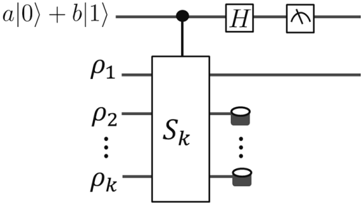
We investigate the sample complexity of Hamiltonian simulation: how many copies of an unknown quantum state are required to simulate a Hamiltonian encoded by the density matrix of that state? We show that the procedure proposed by Lloyd, Mohseni, and Rebentrost [ Nat. Phys. , 10(9):631–633, 2014] is optimal for this task. We further extend their method to the case of multiple input states, showing how to simulate any Hermitian polynomial of the states provided. As applications, we derive optimal algorithms for commutator simulation and orthogonality testing, and we give a protocol for creating a coherent superposition of pure states, when given sample access to those states. We also show that this sample-based Hamiltonian simulation can be used as the basis of a universal model of quantum computation that requires only partial swap operations and simple single-qubit states.
Overview
The claims and statistics of this paper haven’t been checked yet.
Free: it reads the open-access text and checks the first 5 claims that cite a source we can check. Create a free account to check every claim.
Integrity signals
Registry
Cites
Statistics
Figures

Verification
Claims the paper makes
The claims and statistics of this paper haven’t been checked yet.
Free: it reads the open-access text and checks the first 5 claims that cite a source we can check. Create a free account to check every claim.
Claims other papers make about this one
Each is checked against this paper’s own text: does it say what the citing paper says it does?
In the citing paper
“As detailed by Aspuru-Guzik et al. 45 and Dobˇ s´ ıˇ cek et al. 275 , the number of ancilla qubits can be greatly reduced, while maintaining the same precision by using the iterative quantum phase estimation algorithm (IPEA).”
From Quantum Chemistry in the Age of Quantum Computing (2019) · cites this paper as [275]
Self-check
Percentages, sums and reported differences re-computed from the paper’s own numbers.
The self-check needs the paper’s full text.
Citations
Cites
A fast quantum mechanical algorithm for database search
Grover, L. K. (1996) · Proceedings of the twenty-eighth annual ACM symposium on Theory of computing - STOC '96 · doi:10.1145/237814.237866 · Cited by 8,830
Quantum Computation and Quantum Information: 10th Anniversary Edition
Nielsen, M. A., & Chuang, I. L. (2012) · doi:10.1017/cbo9780511976667 · Cited by 8,436
Simulating physics with computers
Feynman, R. P. (1982) · International Journal of Theoretical Physics · doi:10.1007/bf02650179 · Cited by 7,691
Quantum computation with quantum dots
Loss, D., & DiVincenzo, D. P. (1998) · Physical Review A · doi:10.1103/physreva.57.120 · Cited by 6,840 · cited 1×
“In many solid state implementations of quantum computers such as quantum dots [LD98], donor-pairs [Kan98], and electron spins [VYW + 00], the Heisenberg exchange is the natural coupling interaction between qubits.”
BackgroundElementary gates for quantum computation
Barenco, A., Bennett, C. H., Cleve, R., DiVincenzo, D. P., Margolus, N., Shor, P., Sleator, T., Smolin, J. A., & Weinfurter, H. (1995) · Physical Review A · doi:10.1103/physreva.52.3457 · Cited by 4,311 · cited 1×
“While it is beneficial to create computing models that take advantage of this Heisenberg exchange interaction, the Heisenberg interaction is not universal for spin-1/2 systems [BBC + 95].”
MethodA silicon-based nuclear spin quantum computer
Kane, B. E. (1998) · Nature · doi:10.1038/30156 · Cited by 3,779
Quantum Algorithm for Linear Systems of Equations
Harrow, A. W., Hassidim, A., & Lloyd, S. (2009) · Physical Review Letters · doi:10.1103/physrevlett.103.150502 · Cited by 3,325 · cited 1×
“In addition, Hamiltonian simulation has implications for more general computational problems, including adiabatic algorithms [FGGS00], quantum walk algorithms [CCD + 03], and algorithms for systems of linear equations [HHL09].”
MethodLloyd, S. (1996) · Science · doi:10.1126/science.273.5278.1073 · Cited by 3,088 · cited 1×
“Lloyd provided the first formal results on simulation, considering Hamiltonians that consist of sums of non-commuting terms.(1) Other lines of research have focused on simulating sparse Hamiltonians, with a long sequence of work recently culminating in an optimal algorithm(2) (see ref.”
BackgroundQuantum Detection and Estimation Theory
(1976) · Mathematics in Science and Engineering · doi:10.1016/s0076-5392(08)x6017-5 · Cited by 2,426
Quantum Support Vector Machine for Big Data Classification
Rebentrost, P., Mohseni, M., & Lloyd, S. (2014) · Physical Review Letters · doi:10.1103/physrevlett.113.130503 · Cited by 1,951
Gottesman, D., & Chuang, I. L. (1999) · Nature · doi:10.1038/46503 · Cited by 1,860
Quantum computation and quantum information
PAUL, T. (2007) · Mathematical Structures in Computer Science · doi:10.1017/s0960129507006317 · Cited by 1,779
Lie Groups, Lie Algebras, and Their Representations
Varadarajan, V. S. (1984) · Graduate Texts in Mathematics · doi:10.1007/978-1-4612-1126-6 · Cited by 1,739
Quantum amplitude amplification and estimation
Brassard, G., Høyer, P., Mosca, M., & Tapp, A. (2002) · Contemporary Mathematics · doi:10.1090/conm/305/05215 · Cited by 1,680
Quantum principal component analysis
Lloyd, S., Mohseni, M., & Rebentrost, P. (2014) · Nature Physics · doi:10.1038/nphys3029 · Cited by 1,385
Buhrman, H., Cleve, R., Watrous, J., & de Wolf, R. (2001) · Physical Review Letters · doi:10.1103/physrevlett.87.167902 · Cited by 1,190
Universal quantum computation with the exchange interaction
DiVincenzo, D. P., Bacon, D., Kempe, J., Burkard, G., & Whaley, K. B. (2000) · Nature · doi:10.1038/35042541 · Cited by 924 · cited 2×
“Our scheme thus requires n + 1 physical qubits to perform computations on n qubits, in contrast to encoded schemes, of which the simplest require 2 or 3 times the number of physical qubits [DBK + 00, Lev02].”
BackgroundMethodElectron-spin-resonance transistors for quantum computing in silicon-germanium heterostructures
Vrijen, R., Yablonovitch, E., Wang, K., Jiang, H. W., Balandin, A., Roychowdhury, V., Mor, T., & DiVincenzo, D. (2000) · Physical Review A · doi:10.1103/physreva.62.012306 · Cited by 837 · cited 1×
“In many solid state implementations of quantum computers such as quantum dots [LD98], donor-pairs [Kan98], and electron spins [VYW + 00], the Heisenberg exchange is the natural coupling interaction between qubits.”
BackgroundExponential algorithmic speedup by a quantum walk
Childs, A. M., Cleve, R., Deotto, E., Farhi, E., Gutmann, S., & Spielman, D. A. (2003) · Proceedings of the thirty-fifth annual ACM symposium on Theory of computing · doi:10.1145/780542.780552 · Cited by 825 · cited 1×
“In addition, Hamiltonian simulation has implications for more general computational problems, including adiabatic algorithms [FGGS00], quantum walk algorithms [CCD + 03], and algorithms for systems of linear equations [HHL09].”
Method(1996) · Cited by 824
Quantum Teleportation is a Universal Computational Primitive
Gottesman, D., & Chuang, I. L. (1999) · arXiv (Cornell University) · doi:10.48550/arxiv.quant-ph/9908010 · Cited by 778
Optimal Hamiltonian Simulation by Quantum Signal Processing
Low, G. H., & Chuang, I. L. (2017) · Physical Review Letters · doi:10.1103/physrevlett.118.010501 · Cited by 769 · cited 1×
“Other lines of research have focused on simulating sparse Hamiltonians, with a long sequence of work recently culminating in an optimal algorithm [LC16] (see [BCK15] for a more complete history of work in this field).”
BackgroundSelf-citationStatistical decision theory for quantum systems
Holevo, A. S. (1973) · Journal of Multivariate Analysis · doi:10.1016/0047-259x(73)90028-6 · Cited by 645 · cited 1×
“If we have n samples of ρ , and we want to determine whether ρ is ρ ( x ) or ρ ( x + (cid:101) ) , then the maximum probability that we correctly identify ρ is at most [Hol73, Hel76] 1 Now ρ ( x ) and ρ ( x + (cid:101) ) commute, so the trace distance in Eq.”
BackgroundQuantum Computation by Adiabatic Evolution
Farhi, E., Goldstone, J., Gutmann, S., & Sipser, M. (2000) · arXiv · doi:10.48550/arxiv.quant-ph/0001106 · Cited by 536 · cited 1×
“In addition, Hamiltonian simulation has implications for more general computational problems, including adiabatic algorithms [FGGS00], quantum walk algorithms [CCD + 03], and algorithms for systems of linear equations [HHL09].”
MethodQuantum Amplitude Amplification and Estimation
Gilles Brassard, A., Høyer, P., Mosca, M., & Tapp, A. (2000) · doi:10.48550/arxiv.quant-ph/0005055 · Cited by 514
Direct Estimations of Linear and Nonlinear Functionals of a Quantum State
Ekert, A. K., Alves, C. M., Oi, D. K. L., Horodecki, M., Horodecki, P., & Kwek, L. C. (2002) · Physical Review Letters · doi:10.1103/physrevlett.88.217901 · Cited by 427 · cited 1×
“In [EAO + 02] they use the same circuit, but use the measurement outcomes to perform spectrum estimation.”
MethodUniversal Quantum Computation with Spin-1/2Pairs and Heisenberg Exchange
Levy, J. (2002) · Physical Review Letters · doi:10.1103/physrevlett.89.147902 · Cited by 404 · cited 2×
“Our scheme thus requires n + 1 physical qubits to perform computations on n qubits, in contrast to encoded schemes, of which the simplest require 2 or 3 times the number of physical qubits [DBK + 00, Lev02].”
BackgroundMethodQuantum Computation and Information
(2002) · Contemporary Mathematics · doi:10.1090/conm/305 · Cited by 399
Hamiltonian Simulation with Nearly Optimal Dependence on all Parameters
Berry, D. W., Childs, A. M., & Kothari, R. (2015) · 2015 IEEE 56th Annual Symposium on Foundations of Computer Science · doi:10.1109/focs.2015.54 · Cited by 372 · cited 2×
“By the LCU (linear combination of unitaries) algorithm (see e.g. [BCK15], or [Kot14, Theorem 2.4]), e − iS ∆ can be implemented using a constant number of uses of controlled-S , elementary single-qubit rotations, and a single-qubit unitary A satisfying Hence the LMR protocol can be implemented with…”
BackgroundMethodInfluentialQuantum Dot as Spin Filter and Spin Memory
Recher, P., Sukhorukov, E. V., & Loss, D. (2000) · Physical Review Letters · doi:10.1103/physrevlett.85.1962 · Cited by 301 · cited 1×
“Furthermore, there has been much research in the field of quantum dots on how to quickly and reliably prepare a fixed qubit state, e.g. [CV10, FPMU03, HVvB + 04, RSL00].”
BackgroundGate-count estimates for performing quantum chemistry on small quantum computers
Wecker, D., Bauer, B., Clark, B. K., Hastings, M. B., & Troyer, M. (2014) · Physical Review A · doi:10.1103/physreva.90.022305 · Cited by 296
Practical Scheme for Quantum Computation with Any Two-Qubit Entangling Gate
Bremner, M. J., Dawson, C. M., Dodd, J. L., Gilchrist, A., Harrow, A. W., Mortimer, D., Nielsen, M. A., & Osborne, T. J. (2002) · Physical Review Letters · doi:10.1103/physrevlett.89.247902 · Cited by 292 · cited 2×
“A CNOT gate requires a constant number of single-qubit gates as well as a constant number of partial swap gates.(34) Then to bound the error over the course of the algorithm, we require accuracy of O((M +M′)) for each single-qubit gate.”
BackgroundTensor networks and graphical calculus for open quantum systems
Wood, C. J., Biamonte, J., & Cory, D. G. (2015) · Quantum Information and Computation · doi:10.26421/qic15.9-10-3 · Cited by 236
Fixed-Point Quantum Search with an Optimal Number of Queries
Yoder, T. J., Low, G. H., & Chuang, I. L. (2014) · Physical Review Letters · doi:10.1103/physrevlett.113.210501 · Cited by 223
Self-citationO'Donnell, R., & Wright, J. (2016) · Proceedings of the forty-eighth annual ACM symposium on Theory of Computing · doi:10.1145/2897518.2897544 · Cited by 181
Quantum Copy-Protection and Quantum Money
Aaronson, S. (2009) · 2009 24th Annual IEEE Conference on Computational Complexity · doi:10.1109/ccc.2009.42 · Cited by 177 · cited 1×
“This could be seen as a form of quantum copy-protection.(38) See ref.”
BackgroundSample-optimal tomography of quantum states
Haah, J., Harrow, A. W., Ji, Z., Wu, X., & Yu, N. (2017) · IEEE Transactions on Information Theory · doi:10.1109/tit.2017.2719044 · Cited by 171
A Gate-Controlled Bidirectional Spin Filter Using Quantum Coherence
Folk, J., Potok, R. M., Marcus, C. M., & Umansky, V. (2003) · Science · doi:10.1126/science.1078419 · Cited by 157 · cited 1×
“Furthermore, there has been much research in the field of quantum dots on how to quickly and reliably prepare a fixed qubit state, e.g. [CV10, FPMU03, HVvB + 04, RSL00].”
BackgroundQuantum algorithm for linear regression
Wang, G. (2017) · Physical Review A · doi:10.1103/physreva.96.012335 · Cited by 143
Quantum discriminant analysis for dimensionality reduction and classification
Cong, I., & Duan, L. (2016) · New Journal of Physics · doi:10.1088/1367-2630/18/7/073011 · Cited by 132 · cited 1×
“The LMR protocol has applications to many problems in machine learning, e.g. [LMR14, Wan14, RML14, CD15].”
MethodImproving quantum algorithms for quantum chemistry
Hastings, M. B., Wecker, D., Bauer, B., & Troyer, M. (2015) · Quantum Information and Computation · doi:10.26421/qic15.1-2-1 · Cited by 128 · cited 1×
“Feynman’s intuition may soon pay off, as the simulation of Hamiltonians for quantum chemistry looks to be implementable on small to moderately sized quantum computers [HWBT15, WBC + 14].”
BackgroundMathematical and Conceptual Foundations of 20Th-Century Physics
(1984) · North-Holland mathematics studies · doi:10.1016/s0304-0208(08)x7039-2 · Cited by 125
Bounds for small-error and zero-error quantum algorithms
Buhrman, H., Cleve, R., De Wolf, R., & Zalka, C. (2003) · 40th Annual Symposium on Foundations of Computer Science (Cat. No.99CB37039) · doi:10.1109/sffcs.1999.814607 · Cited by 124
Measurement Protocol for the Entanglement Spectrum of Cold Atoms
Pichler, H., Zhu, G., Seif, A., Zoller, P., & Hafezi, M. (2016) · Physical Review X · doi:10.1103/physrevx.6.041033 · Cited by 114 · cited 1×
“It may even be useful in non-solid state systems such as cold, trapped atoms, where it was shown that partial swaps could be implemented using Rydberg interactions or through coupling to a cavity.(36)”
MethodEfficient algorithms in quantum query complexity
Kothari, R. (2014) · UWSpace (University of Waterloo) · Cited by 93
Semiconductor few-electron quantum dot operated as a bipolar spin filter
Hanson, R., Vandersypen, L. M. K., van Beveren, L. H. W., Elzerman, J. M., Vink, I. T., & Kouwenhoven, L. P. (2004) · Physical Review B · doi:10.1103/physrevb.70.241304 · Cited by 93
Sample-optimal tomography of quantum states
Haah, J., Harrow, A. W., Ji, Z., Wu, X., & Yu, N. (2016) · Proceedings of the forty-eighth annual ACM symposium on Theory of Computing · doi:10.1145/2897518.2897585 · Cited by 88 · cited 1×
“Remark 15.”
Creating a Superposition of Unknown Quantum States
Oszmaniec, M., Grudka, A., Horodecki, M., & Wójcik, A. (2016) · Physical Review Letters · doi:10.1103/physrevlett.116.110403 · Cited by 76
On Quantum ObfuscationPreprint
Alagic, G., & Fefferman, B. (2016) · arXiv (Cornell University) · doi:10.48550/arxiv.1602.01771 · Cited by 67 · cited 1×
“See [ML16] for some progress in this direction, and [AF16] for negative results when the encoding is required to be a circuit and not a state. was visiting the University of Maryland and MIT, so he would like to thank both institutions for their hospitality.”
BackgroundCostache, M. V., & Valenzuela, S. O. (2010) · Science · doi:10.1126/science.1196228 · Cited by 62 · cited 1×
“Furthermore, there has been much research in the field of quantum dots on how to quickly and reliably prepare a fixed qubit state, e.g. [CV10, FPMU03, HVvB + 04, RSL00].”
BackgroundExact Kolmogorov and total variation distances between some familiar discrete distributions
Adell, J. A., & Jodrá, P. (2006) · Journal of Inequalities and Applications · doi:10.1155/jia/2006/64307 · Cited by 60 · cited 1×
“Then if n C η / 2 , for a sufficiently small constant C η that depends on η , as long as (cid:101) η , the total variation distance between these two binomial distributions is less than 1/3 (from many sources, e.g. [AJ06]).”
BackgroundUniversal Quantum EmulatorPreprint
Marvian, I., & Lloyd, S. (2016) · arXiv (Cornell University) · doi:10.48550/arxiv.1606.02734 · Cited by 48
Entropy power inequalities for qudits
Audenaert, K. M. R., Datta, N., & Ozols, M. (2016) · Journal of Mathematical Physics · doi:10.1063/1.4950785 · Cited by 39 · cited 1×
“Their protocol is based on a partial swap operation that can also be considered as a finite-dimensional analog of a beamsplitter.(6) An interesting feature of the LMR protocol is that it is agnostic with regard to ρ.”
BackgroundSelf-citationPreskill, J. P. (1999) · Nature · doi:10.1038/46434 · Cited by 36 · cited 1×
“In the spirit of [Pre99, GC99], this suggests interpreting ρ as a “quantum software state”.”
BackgroundEntropy power inequalities for qudits
Audenaert, K., Datta, N., & Ozols, M. (2016) · Apollo (University of Cambridge) · Cited by 27
Self-citationBuilding all time evolutions with rotationally invariant Hamiltonians
Marvian, I., & Mann, R. B. (2008) · Physical Review A · doi:10.1103/physreva.78.022304 · Cited by 24 · cited 1×
“To apply an arbitrary single qubit rotation to accuracy (cid:101) , we need O ( − 1 ) resource states | 0 and | + (cid:105) (this construction is reminiscent of ideas in [MM08]).”
MethodQuantum computation speedup limits from quantum metrological precision bounds
Demkowicz-Dobrzański, R., & Markiewicz, M. (2015) · Physical Review A · doi:10.1103/physreva.91.062322 · Cited by 22 · cited 1×
“While Grover’s search [Gro96] is a well-known quantum mechanical task, it is not often stated in its form as a decision problem, and very rarely [DDM15] as a metrological decision problem, where the inputs are unitaries and the output depends on a property that those unitaries either possess or do…”
BackgroundExperimentally superposing two pure states with partial prior knowledge
Li, K., Long, G., Katiyar, H., Xin, T., Feng, G., Lu, D., & Laflamme, R. (2017) · Physical Review A · doi:10.1103/physreva.95.022334 · Cited by 19 · cited 1×
“22, Theorem 2, and recently implemented experimentally.(23) While our protocol involves only the two input states |ψ1〉 and |ψ2〉, the protocol of ref.”
Harrow, A. W., & Leung, D. (2011) · IEEE Transactions on Information Theory · doi:10.1109/tit.2011.2158468 · Cited by 18 · cited 2×
“It would be interesting to investigate connections of [HL11] with the protocols in our work.”
MethodEfficient quantum tomographyPreprint
O’Donnell, R., & Wright, J. C. (2015) · arXiv (Cornell University) · doi:10.48550/arxiv.1508.01907 · Cited by 11
Quantum Algorithms for Curve Fitting.Preprint
Wang, G. (2014) · arXiv (Cornell University) · Cited by 7
How to combine three quantum statesPreprint
Ozols, M. (2015) · arXiv (Cornell University) · doi:10.48550/arxiv.1508.00860 · Cited by 4
Self-citation(1998) · doi:10.1002/(sici)1521-3978(199806)46:4/5<493::aid-prop493>3.0.co;2-p · cited 2×
“If we solve this problem using Grover’s search and count the number of uses of V and V † required to succeed with probability 1 − (cid:101) , we get the standard complexity Θ ( log ( 1/ (cid:101) ) / √ w ) [BBHT98, BCdWZ99].”
Method
Cited by
Biamonte, J., Wittek, P., Pancotti, N., Rebentrost, P., Wiebe, N., & Lloyd, S. (2017) · Nature · doi:10.1038/nature23474 · Cited by 4,779
“This quantum BLAS (qBLAS) translates into quantum speedups for a variety of data analysis and machine learning algorithms including linear algebra, least-squares fitting, gradient descent, Newton’s method, principal component analysis, linear, semidefinite, and quadratic programming, topological analysis, and support…”
Quantum Chemistry in the Age of Quantum Computing
Cao, Y., Romero, J., Olson, J. P., Degroote, M., Johnson, P. D., Kieferová, M., Kivlichan, I. D., Menke, T., Peropadre, B., Sawaya, N. P. D., et al. (2019) · Chemical Reviews · doi:10.1021/acs.chemrev.8b00803 · Cited by 1,560
Hamiltonian Simulation by Qubitization
Low, G. H., & Chuang, I. L. (2019) · Quantum · doi:10.22331/q-2019-07-12-163 · Cited by 854
“…the ancilla of some output from a quantum circuit ˆ G , we instead keep this ancilla, leading to an unconditional quadratic improvement in time scaling, and an exponential improvement in error scaling over the sample-based Lloyd, Mohseni, and Rebentrost (LMR) model [32, 28], as summarized in Table.”
MethodSelf-citationGilyén, A., Su, Y., Low, G. H., & Wiebe, N. (2019) · Proceedings of the 51st Annual ACM SIGACT Symposium on Theory of Computing · doi:10.1145/3313276.3316366 · Cited by 542
“This technique can be used in combination with the optimal block-Hamiltonian simulation result Corollary 32, in order to get much better simulation performance, compared to density matrix exponentiation techniques [38, 40] which does not use purification.”
MethodSelf-citationQuantum Algorithms: A Survey of Applications and End-to-end Complexities
Dalzell, A. M., McArdle, S., Berta, M., Bienias, P., Chen, C.-F., Gilyén, A., Hann, C. T., Kastoryano, M. J., Khabiboulline, E. T., Kubica, A., et al. (2023) · RWTH Publications (RWTH Aachen) · doi:10.18154/rwth-2026-02888 · Cited by 363
Metadata
- Authors
- Kimmel, S., Lin, C. Y.-Y., Low, G. H., Ozols, M., & Yoder, T. J.
- Affiliations
- Joint Center for Quantum Information and Computer Science (US)
- Massachusetts Institute of Technology (US)
- Venue
- npj Quantum Information
- Published
- 2017-03-30
- Volume
- 3
- Issue
- 1
- ISSN
- 2056-6387 (ISSN-L)
- OpenAlex
- W2490964415
- Cited by
- 85
- References
- 64
- Citations by year
- 2026: 4 · 2025: 17 · 2024: 10 · 2023: 9 · 2022: 6 · 2021: 7 · 2020: 9 · 2019: 12 · 2018: 5 · 2017: 4
- FWCI
- 4.90
- Type
- journal article
- Language
- en
- Open access
- gold
- doi.org
- Licence
- cc-by
- creativecommons.org/licenses/by/4.0 (tdm)
- creativecommons.org/licenses/by/4.0 (vor)
- Locations
- npj Quantum Information (publishedVersion, cc-by)
- arXiv (Cornell University) (submittedVersion)
- DSpace@MIT (Massachusetts Institute of Technology) (submittedVersion, cc-by-nc)
- DOAJ (DOAJ: Directory of Open Access Journals) (submittedVersion, cc-by-sa)
- University Libraries (University of Maryland) (submittedVersion)
- Apollo (University of Cambridge) (submittedVersion, cc-by)
- arXiv (Cornell University)
- Digital Repository at the University of Maryland (University of Maryland College Park)
- Apollo (cc-by)
- Funders
- National Science Foundation
- U.S. Department of Defense (32 CFR 168 a)
- Massachusetts Institute of Technology
- Leverhulme Trust (ECF-2015-256)
- European Commission (600700)
- National Defense Science and Engineering Graduate (32 CFR 168a, CFR 168a)
- Army Research Office (32 CFR 168A)
- Topics
- Physical Sciences › Computer Science › Artificial Intelligence › Quantum Computing Algorithms and Architecture
- Physical Sciences › Physics and Astronomy › Atomic and Molecular Physics, and Optics › Quantum Information and Cryptography
- Physical Sciences › Physics and Astronomy › Atomic and Molecular Physics, and Optics › Quantum many-body systems
- Keywords
- Hamiltonian simulation, sample complexity, quantum state tomography, optimal algorithms, Hermitian polynomials, universal quantum computation
About these checks
Registry, retraction, Cites and statistics results are computed, not judged, with one exception: a printed reference that no index lists is read once by a model before it counts as a citation error. Claims are extracted by a model and kept only when their quote appears verbatim in the text; each cited source is then checked, with a model’s help, for whether it says what the claim relies on. Those verdicts can be wrong — read the claim’s quote and the cited source before relying on one.
Statistics and arithmetic are recomputed, not judged.
Confidence bands are shown only for fields calibrated on our annotated test set. None is calibrated yet, so no band is shown.
What counts as a claim ›How we measure confidence ›How we check this ›
Are you an author, or do you see a problem with this page? Request a review
Data sources
Bibliographic data: Semantic Scholar, OpenAlex, Crossref.
Contains information from the Semantic Scholar Academic Graph Datasets, made available under the ODC Attribution License (ODC-BY 1.0).
Semantic Scholar’s data is described in: Kinney, R., et al. (2023). The Semantic Scholar Open Data Platform. arXiv:2301.10140.
