

Parallel quantum simulation of large systems on small NISQ computers
Open accessThe DOI matches its Crossref record; 36 of the 36 references it cites were found in a registry or an index.
Abstract
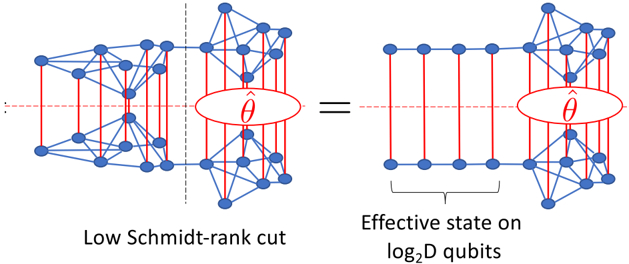
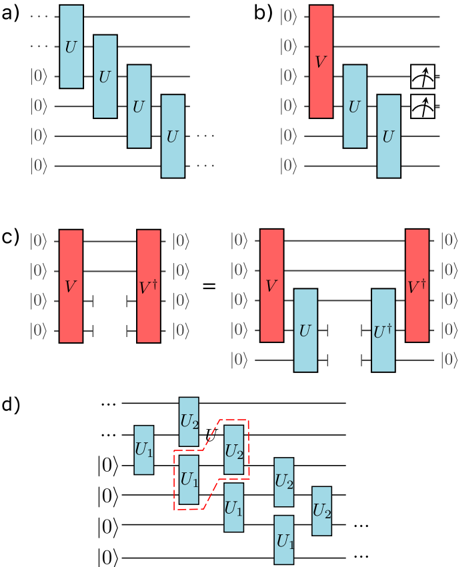
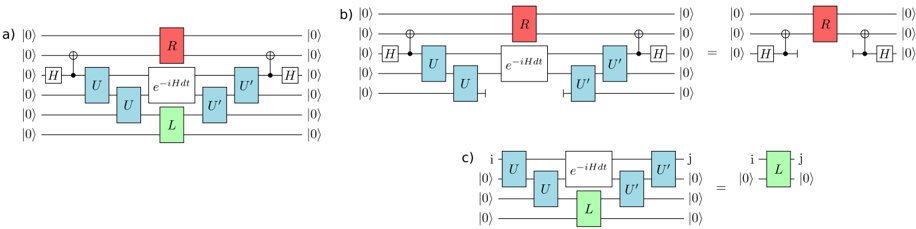
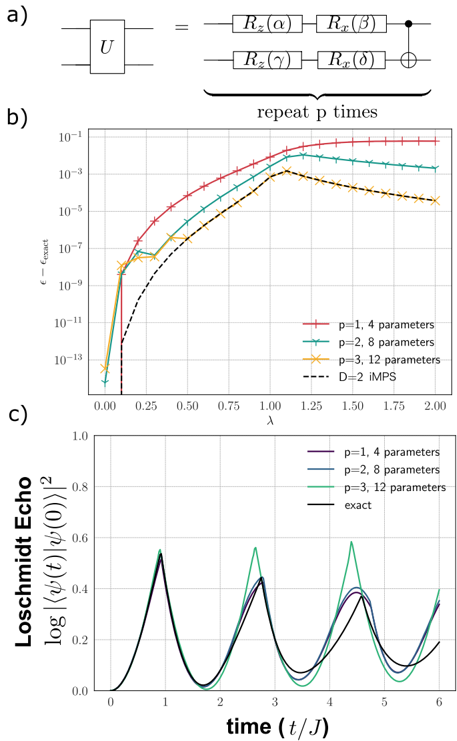
Tensor networks permit computational and entanglement resources to be concentrated in interesting regions of Hilbert space. Implemented on NISQ machines they allow simulation of quantum systems that are much larger than the computational machine itself. This is achieved by parallelising the quantum simulation. Here, we demonstrate this in the simplest case; an infinite, translationally invariant quantum spin chain. We provide Cirq and Qiskit code that translates infinite, translationally invariant matrix product state (iMPS) algorithms to finite-depth quantum circuit machines, allowing the representation, optimisation and evolution of arbitrary one-dimensional systems. The illustrative simulated output of these codes for achievable circuit sizes is given.
Overview
The claims and statistics of this paper haven’t been checked yet.
Free: it reads the open-access text and checks the first 5 claims that cite a source we can check. Create a free account to check every claim.
Integrity signals
Registry
Cites
Statistics
Figures

Verification
Claims the paper makes
The claims and statistics of this paper haven’t been checked yet.
Free: it reads the open-access text and checks the first 5 claims that cite a source we can check. Create a free account to check every claim.
Claims other papers make about this one
Each is checked against this paper’s own text: does it say what the citing paper says it does?
The check wasn’t confident either way, so it gives no verdict — never disputed.
In the citing paper
“Although the parameter-shift rule might resemble a naive finite difference, it evaluates the analytic gradient of the parameter by virtue of the coefficient 1 / sin α .”
From Variational quantum algorithms (2021) · cites this paper as [79]
Experimental — accuracy not yet measured
Self-check
Percentages, sums and reported differences re-computed from the paper’s own numbers.
The self-check needs the paper’s full text.
Citations
Cites
Density matrix formulation for quantum renormalization groups
White, S. R. (1992) · Physical Review Letters · doi:10.1103/physrevlett.69.2863 · Cited by 7,702
The density-matrix renormalization group in the age of matrix product states
Schollwöck, U. (2011) · Annals of Physics · doi:10.1016/j.aop.2010.09.012 · Cited by 4,818
A variational eigenvalue solver on a photonic quantum processor
Peruzzo, A., McClean, J., Shadbolt, P., Yung, M.-H., Zhou, X.-Q., Love, P. J., Aspuru-Guzik, A., & O’Brien, J. L. (2014) · Nature Communications · doi:10.1038/ncomms5213 · Cited by 4,552 · cited 1×
“Innovations for quantum simulation include using these circuits as variational wavefunctions 5 , optimising them stochastically or by phase estimation 6 , and evolving them either by accurate Trotterisation of the evolution operator 7 – 9 or variationally 10 .”
MethodEfficient Classical Simulation of Slightly Entangled Quantum Computations
Vidal, G. (2003) · Physical Review Letters · doi:10.1103/physrevlett.91.147902 · Cited by 2,368
On the product of semi-groups of operators
Trotter, H. F. (1959) · Proceedings of the American Mathematical Society · doi:10.1090/s0002-9939-1959-0108732-6 · Cited by 2,282
Orús, R. (2014) · Annals of Physics · doi:10.1016/j.aop.2014.06.013 · Cited by 2,255
Quantum convolutional neural networks
Cong, I., Choi, S., & Lukin, M. D. (2019) · Nature Physics · doi:10.1038/s41567-019-0648-8 · Cited by 1,517
Thermodynamic limit of density matrix renormalization.
Östlund, S., & Rommer, S. (1995) · Physical Review Letters · doi:10.1103/physrevlett.75.3537 · Cited by 1,077
Cost function dependent barren plateaus in shallow parametrized quantum circuits
Cerezo, M., Sone, A., Volkoff, T., Cincio, L., & Coles, P. J. (2021) · Nature Communications · doi:10.1038/s41467-021-21728-w · Cited by 1,047
Weak ergodicity breaking from quantum many-body scars
Turner, C. J., Michailidis, A. A., Abanin, D. A., Serbyn, M., & Papić, Z. (2018) · Nature Physics · doi:10.1038/s41567-018-0137-5 · Cited by 988
Research works printed but not linked: 6
- Perez-Garcia, D., Verstraete, F., Wolf, M. M. & Cirac, J. I. Matrix product state representations. Quantum Info. Comput. 7, 401-430 (2007).
- Kitaev, A. Y. Quantum measurements and the abelian stabilizer problem. Preprint at arXiv https://arxiv.org/abs/quant-ph/9511026 (1995). · arXiv
- Li, Y. & Benjamin, S. C. Efficient variational quantum simulator incorporating active error minimization. Phys. Rev. X 7, 021050 (2017).
- Smith, A., Jobst, B., Green, A. G. & Pollmann, F. Crossing a topological phase transition with a quantum computer. Preprint at arXiv https://arxiv.org/abs/ 1910.05351v2 (2019).
- Nielsen, M. A. & Chuang, I. L. Quantum Computation and Quantum Information: 10th Anniversary Edition. 10th (Cambridge University Press, 2011).
- Michailidis, A., Turner, C., Papić, Z., Abanin, D. & Serbyn, M. Slow quantum ther- malization and many-body revivals from mixed phase space. Phys. Rev. X 10, 011055 (2020).
Cited by
Variational quantum algorithms
Cerezo, M., Arrasmith, A., Babbush, R., Benjamin, S. C., Endo, S., Fujii, K., McClean, J. R., Mitarai, K., Yuan, X., Cincio, L., et al. (2021) · Nature Reviews Physics · doi:10.1038/s42254-021-00348-9 · Cited by 3,385
Quantum Computing for High-Energy Physics: State of the Art and Challenges
Di Meglio, A., Jansen, K., Tavernelli, I., Alexandrou, C., Arunachalam, S., Bauer, C. W., Borras, K., Carrazza, S., Crippa, A., Croft, V., et al. (2024) · PRX Quantum · doi:10.1103/prxquantum.5.037001 · Cited by 215
“For more information on the identified areas of interest see Section III B. Legend: VQE: Variational Eigensolver; varQITE: variational Imaginary Time evolition; Tortter Dynamics: Time evolution based on trotteried time propagation operator; TN: Tensor Networks; QTN: Quantum Tensor Networks inspired from classical TN;…”
BackgroundInfluentialReal- and Imaginary-Time Evolution with Compressed Quantum Circuits
Lin, S.-H., Dilip, R., Green, A. G., Smith, A., & Pollmann, F. (2021) · PRX Quantum · doi:10.1103/prxquantum.2.010342 · Cited by 206
“The above connection between matrix-product states and quantum circuits is well-known in the community and was recently applied in several works [13, 29, 46].”
BackgroundMethodSelf-citationCutQC: using small Quantum computers for large Quantum circuit evaluations
Tang, W., Tomesh, T., Suchara, M., Larson, J., & Martonosi, M. (2021) · Proceedings of the 26th ACM International Conference on Architectural Support for Programming Languages and Operating Systems · doi:10.1145/3445814.3446758 · Cited by 159
“Several works manually separate small toy circuits with convenient structures as proof-of-concept demonstrations [49, 50].”
BackgroundHardware-efficient variational quantum algorithms for time evolution
Benedetti, M., Fiorentini, M., & Lubasch, M. (2021) · Physical Review Research · doi:10.1103/physrevresearch.3.033083 · Cited by 161
“The same concept is used in the design of noise-robust quantum circuits [34] and to simulate infinite matrix product states on a quantum computer [35].”
BackgroundHardware-efficient variational quantum algorithms for time evolution
Benedetti, M., Fiorentini, M., & Lubasch, M. (2020) · arXiv · doi:10.48550/arxiv.2009.12361 · Cited by 176
“The same concept is used in the design of noise-robust quantum circuits [34] and to simulate infinite matrix product states on a quantum computer [35].”
BackgroundCrossing a topological phase transition with a quantum computer
Smith, A., Jobst, B., Green, A. G., & Pollmann, F. (2022) · Physical Review Research · doi:10.1103/physrevresearch.4.l022020 · Cited by 111
“This allows us to construct the circuit shown in the main text but the connection to infinite MPS is more general and not restricted to bond dimension 2 [30].”
BackgroundInfluentialSelf-citationQubit-Reuse Compilation with Mid-Circuit Measurement and Reset
DeCross, M. P., Chertkov, E., Kohagen, M., & Foss‐Feig, M. (2023) · Physical Review X · doi:10.1103/physrevx.13.041057 · Cited by 167
“These circuits appear naturally when simulating local 1D Hamiltonians, and qubit reuse in such linear circuits has been explored previously in the context of quantum matrix product states [37,41,51 – 53] and their time evolution [12].”
An efficient quantum algorithm for the time evolution of parameterized circuits
Barison, S., Vicentini, F., & Carleo, G. (2021) · Quantum · doi:10.22331/q-2021-07-28-512 · Cited by 110
Decomposition of matrix product states into shallow quantum circuits
Rudolph, M. S., Chen, J., Miller, J. A., Acharya, A., & Perdomo‐Ortiz, A. (2023) · Quantum Science and Technology · doi:10.1088/2058-9565/ad04e6 · Cited by 144
“The conversion of the χ = 2 MPS to a linear layer of two-qubit unitaries is explained in section 2.2 and [28, 41, 43].”
InfluentialHolographic quantum algorithms for simulating correlated spin systems
Foss-Feig, M., Hayes, D., Dreiling, J. M., Figgatt, C., Gaebler, J. P., Moses, S. A., Pino, J. M., & Potter, A. C. (2021) · Physical Review Research · doi:10.1103/physrevresearch.3.033002 · Cited by 100
Quantum Simulation with Hybrid Tensor Networks
Yuan, X., Sun, J., Liu, J., Zhao, Q., & Zhou, Y. (2021) · Physical Review Letters · doi:10.1103/physrevlett.127.040501 · Cited by 124
Fast quantum circuit cutting with randomized measurements
Lowe, A., Medvidović, M., Hayes, A., Riordan, L. J. O. A., Bromley, T. R., Arrazola, J. M., & Killoran, N. (2023) · Quantum · doi:10.22331/q-2023-03-02-934 · Cited by 141
“Related work analyzes hybrid approaches to solving 3SAT [17] and quantum simulation by combining tensor network methods with small quantum devices [5, 61].”
MethodVariational Power of Quantum Circuit Tensor Networks
Haghshenas, R., Gray, J., Potter, A. C., & Chan, G. K. (2022) · Physical Review X · doi:10.1103/physrevx.12.011047 · Cited by 115
Quantum algorithms for quantum dynamics
Miessen, A., Ollitrault, P. J., Tacchino, F., & Tavernelli, I. (2022) · Nature Computational Science · doi:10.1038/s43588-022-00374-2 · Cited by 131
Classically optimized Hamiltonian simulation
Keever, C. M., & Lubasch, M. (2023) · Physical Review Research · doi:10.1103/physrevresearch.5.023146 · Cited by 112
Matrix product state pre-training for quantum machine learning
Dborin, J., Barratt, F., Wimalaweera, V., Wright, L., & Green, A. G. (2022) · Quantum Science and Technology · doi:10.1088/2058-9565/ac7073 · Cited by 130
Self-citationVariational quantum eigensolver with reduced circuit complexity
Zhang, Y., Cincio, Ł., Negre, C. F. A., Czarnik, P., Coles, P. J., Anisimov, P. M., Mniszewski, S. M., Tretiak, S., & Dub, P. A. (2022) · npj Quantum Information · doi:10.1038/s41534-022-00599-z · Cited by 112
Hybrid quantum-classical reservoir computing of thermal convection flow
Pfeffer, P., Heyder, F., & Schumacher, J. (2022) · Physical Review Research · doi:10.1103/physrevresearch.4.033176 · Cited by 99
Quantum simulation with hybrid tensor networks
Yuan, X., Sun, J., Liu, J., Zhao, Q., & Zhou, Y. (2020) · arXiv · doi:10.48550/arxiv.2007.00958 · Cited by 79
Riemannian optimization of isometric tensor networks
Hauru, M., Damme, M. V., & Haegeman, J. (2021) · SciPost Physics · doi:10.21468/scipostphys.10.2.040 · Cited by 107
Data compression for quantum machine learning
Dilip, R., Liu, Y.-J., Smith, A., & Pollmann, F. (2022) · Physical Review Research · doi:10.1103/physrevresearch.4.043007 · Cited by 94
Self-citationSequential Generation of Projected Entangled-Pair States
Wei, Z.-Y., Malz, D., & Cirac, J. I. (2022) · Physical Review Letters · doi:10.1103/physrevlett.128.010607 · Cited by 93
Tensor networks for quantum computing
Berezutskii, A. V., Liu, M., Acharya, A., Ellerbrock, R., Gray, J., Haghshenas, R., He, Z., Khan, A., Kuzmin, V., Lyakh, D. I., et al. (2025) · Nature Reviews Physics · doi:10.1038/s42254-025-00853-1 · Cited by 123
“Moreover, in the context of quantum simulation, parameterizing TNs with quantum gates has been shown to offer an exponential reduction in the number of parameters required to achieve results similar to those of classical TNs 132,135 , which could potentially translate to ML tasks as well.”
Self-correcting quantum many-body control using reinforcement learning with tensor networks
Metz, F., & Bukov, M. (2023) · Nature Machine Intelligence · doi:10.1038/s42256-023-00687-5 · Cited by 84
“Instead, we can use alternative MPS-to-circuit mappings that would lead to at most two-qubit gates in the final circuit (see Supplementary Section 4A for a detailed discussion) 74–80 .”
BackgroundMethodError-mitigated simulation of quantum many-body scars on quantum computers with pulse-level control
Chen, I.-C., Burdick, B., Yao, Y., Orth, P. P., & Iadecola, T. (2022) · Physical Review Research · doi:10.1103/physrevresearch.4.043027 · Cited by 76
Characterizing a non-equilibrium phase transition on a quantum computer
Chertkov, E., Cheng, Z., Potter, A. C., Gopalakrishnan, S., Gatterman, T. M., Gerber, J. A., Gilmore, K., Gresh, D., Hall, A., Hankin, A. M., et al. (2023) · Nature Physics · doi:10.1038/s41567-023-02199-w · Cited by 85
“Unfortunately, it is in general difficult to even check if a general MPO is positive semi-definite 21–23 .”
Tensor networks for quantum machine learning
Rieser, H.-M., Köster, F., & Raulf, A. (2023) · Proceedings of the Royal Society A Mathematical Physical and Engineering Sciences · doi:10.1098/rspa.2023.0218 · Cited by 68
Optimised Trotter decompositions for classical and quantum computing
Ostmeyer, J. (2023) · Journal of Physics A Mathematical and Theoretical · doi:10.1088/1751-8121/acde7a · Cited by 78
Holographic dynamics simulations with a trapped-ion quantum computer
Chertkov, E., Bohnet, J., Francois, D., Gaebler, J., Gresh, D., Hankin, A., Lee, K., Hayes, D., Neyenhuis, B., Stutz, R., et al. (2022) · Nature Physics · doi:10.1038/s41567-022-01689-7 · Cited by 53
Quantum magic and multipartite entanglement in the structure of nuclei
Brökemeier, F., Hengstenberg, S. M., Keeble, J. W. T., Robin, C., Rocco, F., & Savage, M. J. (2025) · Physical Review C · doi:10.1103/physrevc.111.034317 · Cited by 59
Berthusen, N., Trevisan, T. V., Iadecola, T., & Orth, P. P. (2022) · Physical Review Research · doi:10.1103/physrevresearch.4.023097 · Cited by 61
Simulating groundstate and dynamical quantum phase transitions on a superconducting quantum computer
Dborin, J., Wimalaweera, V., Barratt, F., Ostby, E. P., O’Brien, T. E., & Green, A. G. (2022) · Nature Communications · doi:10.1038/s41467-022-33737-4 · Cited by 64
Self-citationMaking Trotterization Adaptive and Energy-Self-Correcting for NISQ Devices and Beyond
Zhao, H., Bukov, M., Heyl, M., & Moessner, R. (2023) · PRX Quantum · doi:10.1103/prxquantum.4.030319 · Cited by 61
Two quantum algorithms for solving the one-dimensional advection–diffusion equation
Ingelmann, J., Bharadwaj, S. S., Pfeffer, P., Sreenivasan, K. R., & Schumacher, J. (2024) · Computers & Fluids · doi:10.1016/j.compfluid.2024.106369 · Cited by 53
“[40].”
Variational Hamiltonian simulation for translational invariant systems via classical pre-processing
Mansuroglu, R., Eckstein, T., Nützel, L., Wilkinson, S. A., & Hartmann, M. J. (2023) · Quantum Science and Technology · doi:10.1088/2058-9565/acb1d0 · Cited by 56
“These alternative methods include randomization [18–23], tensor network techniques [24], variational methods [25–31] and also a non-variational optimization of product formulas if there are only few non-commuting terms in the Hamiltonian [32].”
Modeling Short-Range Microwave Networks to Scale Superconducting Quantum Computation
LaRacuente, N. D., Smith, K. N., Imany, P., Silverman, K. L., & Chong, F. T. (2025) · Quantum · doi:10.22331/q-2025-01-08-1581 · Cited by 52
“…past work has explored extending the capabilities of near-term quantum hardware by employing classical hardware with techniques such as entanglement forging [61], circuit cutting followed by reconstructive post-processing [62], and translating tensor network algorithms to quantum circuits [63].”
Sopena, A., Gordon, M. H., García-Martín, D., Sierra, G., & López, E. (2022) · Quantum · doi:10.22331/q-2022-09-08-796 · Cited by 59
Perturbative Quantum Simulation
Sun, J., Endo, S., Lin, H., Hayden, P. M., Vedral, V., & Yuan, X. (2022) · Physical Review Letters · doi:10.1103/physrevlett.129.120505 · Cited by 48
High-fidelity realization of the AKLT state on a NISQ-era quantum processor
Chen, T., Shen, R., Lee, C. H., & Yang, B. (2023) · SciPost Physics · doi:10.21468/scipostphys.15.4.170 · Cited by 58
“Most recently, MPS-based algorithms have been applied for the investigations of translational-invariant systems [61, 62].”
Variational quantum time evolution without the quantum geometric tensor
Gacon, J., Nys, J., Rossi, R., Woerner, S., & Carleo, G. (2024) · Physical Review Research · doi:10.1103/physrevresearch.6.013143 · Cited by 47
Quantum algorithms for scientific computing
Au-Yeung, R., Camino, B., Rathore, O., & Kendon, V. M. (2024) · Reports on Progress in Physics · doi:10.1088/1361-6633/ad85f0 · Cited by 44
Holographic Quantum Simulation of Entanglement Renormalization Circuits
Anand, S., Hauschild, J., Zhang, Y., Potter, A. C., & Zaletel, M. P. (2023) · PRX Quantum · doi:10.1103/prxquantum.4.030334 · Cited by 43
Pauli path simulations of noisy quantum circuits beyond average case
González-García, G., Cirac, J. I., & Trivedi, R. (2025) · Quantum · doi:10.22331/q-2025-05-05-1730 · Cited by 58
“Such circuits become even less like random circuits if the translational invariance [40–42] or special symmetries [43, 44] of the target many-body Hamiltonian are taken into account.”
Entanglement from Tensor Networks on a Trapped-Ion Quantum Computer
Foss‐Feig, M., Ragole, S., Potter, A. C., Dreiling, J., Figgatt, C., Gaebler, J., Hall, A., Moses, S. A., Pino, J., Spaun, B., et al. (2022) · Physical Review Letters · doi:10.1103/physrevlett.128.150504 · Cited by 39
Probing Geometric Excitations of Fractional Quantum Hall States on Quantum Computers
Kirmani, A. A., Bull, K., Hou, C.-Y., Saravanan, V., Saeed, S. M., Papić, Z., Rahmani, A., & Ghaemi, P. (2022) · Physical Review Letters · doi:10.1103/physrevlett.129.056801 · Cited by 45
Quench dynamics of the Schwinger model via variational quantum algorithms
Nagano, L., Bapat, A., & Bauer, C. (2023) · Physical review. D/Physical review. D. · doi:10.1103/physrevd.108.034501 · Cited by 40
Quantum time dynamics employing the Yang-Baxter equation for circuit compression
Peng, B., Gulania, S., Alexeev, Y., & Govind, N. (2022) · Physical Review A · doi:10.1103/physreva.106.012412 · Cited by 38
“Besides, we note that there are also several other approaches reported recently for compressing quantum circuits for dynamics using both integrable and non-integrable models [41–45].”
Combining matrix product states and noisy quantum computers for quantum simulation
Martin, B. A., Ayral, T., Jamet, F., Rančić, M. J., & Simon, P. (2024) · Physical Review A · doi:10.1103/physreva.109.062437 · Cited by 39
“Algorithms have been proposed and tested to perform real-time simulation of many-body systems on a quantum computer [2, 6–13].”
Efficient MPS representations and quantum circuits from the Fourier modes of classical image data
Jobst, B., Shen, K., Riofrío, C. A., Shishenina, E., & Pollmann, F. (2024) · Quantum · doi:10.22331/q-2024-12-03-1544 · Cited by 37
“The MPS approximation of the quantum state then naturally leads to a linear-depth quantum circuit that only requires a linear number of nearest-neighbor cnot gates and does not require any mid-circuit measurements [24–29].”
InfluentialSelf-citationBarthel, T., & Miao, Q. (2025) · Communications in Mathematical Physics · doi:10.1007/s00220-024-05217-x · Cited by 31
Holographic Simulation of Correlated Electrons on a Trapped-Ion Quantum Processor
Niu, D., Haghshenas, R., Zhang, Y., Foss‐Feig, M., Chan, G. K., & Potter, A. C. (2022) · PRX Quantum · doi:10.1103/prxquantum.3.030317 · Cited by 28
“[6] F Barratt, James Dborin, Matthias Bal, Vid Stojevic, Frank Pollmann, and AG Green, “Parallel quantum simulation of large systems on small nisq computers,” npj Quantum Information 7, 1–7 (2021).”
BackgroundMethodInfluentialProbing Critical States of Matter on a Digital Quantum Computer
Haghshenas, R., Chertkov, E., DeCross, M. P., Gatterman, T. M., Gerber, J. A., Gilmore, K., Gresh, D., Hewitt, N., Horst, C. V., Matheny, M., et al. (2024) · Physical Review Letters · doi:10.1103/physrevlett.133.266502 · Cited by 32
Mineh, L., & Montanaro, A. (2022) · Physical review. B./Physical review. B · doi:10.1103/physrevb.105.125117 · Cited by 32
Replacing Neural Networks by Optimal Analytical Predictors for the Detection of Phase Transitions
Arnold, J., & Schäfer, F. (2022) · Physical Review X · doi:10.1103/physrevx.12.031044 · Cited by 41
Variational Quantum Optimization of Nonlocality in Noisy Quantum Networks
Doolittle, B., Bromley, R. T., Killoran, N., & Chitambar, E. (2023) · IEEE Transactions on Quantum Engineering · doi:10.1109/tqe.2023.3243849 · Cited by 28
“Nevertheless, NISQ devices are predicted to provide simulation advantages in the near-term [27], [95] As an aside, we note that larger networks can be simulated using smaller quantum devices where an exponential increase in the number of circuit evaluations is accrued [96], [97].”
BackgroundQuantum-classical eigensolver using multiscale entanglement renormalization
Miao, Q., & Barthel, T. (2023) · Physical Review Research · doi:10.1103/physrevresearch.5.033141 · Cited by 25
“[43–47].”
Tensor-network-assisted variational quantum algorithm
Huang, J., He, W., Zhang, Y., Wu, Y., Wu, B., & Yuan, X. (2023) · Physical Review A · doi:10.1103/physreva.108.052407 · Cited by 21
“Parametrized quantum circuits, for example, can be designed as classically unrealizable TNs with exponentially large bond dimensions [6–10].”
BackgroundVariational dynamics as a ground-state problem on a quantum computer
Barison, S., Vicentini, F., Cirac, J. I., & Carleo, G. (2022) · Physical Review Research · doi:10.1103/physrevresearch.4.043161 · Cited by 22
Riemannian quantum circuit optimization for Hamiltonian simulation
Kotil, A., Banerjee, R., Huang, Q., & Mendl, C. B. (2024) · Journal of Physics A Mathematical and Theoretical · doi:10.1088/1751-8121/ad2d6e · Cited by 25
“The authors of [13, 14] focus on the best-approximation of the time-dependent quantum state, instead of the over-all time evolution operator considered here.”
BackgroundExploring the Phase Diagram of the quantum one-dimensional ANNNI modelPreprint
Cea, M., Grossi, M., Monaco, S., Rico, E., Tagliacozzo, L., & Vallecorsa, S. (2024) · arXiv (Cornell University) · doi:10.48550/arxiv.2402.11022 · Cited by 20
Time evolution of uniform sequential circuits
Astrakhantsev, N., Lin, S.-H., Pollmann, F., & Smith, A. (2023) · Physical Review Research · doi:10.1103/physrevresearch.5.033187 · Cited by 18
“[16, 21], we consider multi-layered decomposition of the state-unitary with MU > 1.”
BackgroundMethodInfluentialSelf-citationConvergence and Quantum Advantage of Trotterized MERA for Strongly-Correlated Systems
Miao, Q., & Barthel, T. (2025) · Quantum · doi:10.22331/q-2025-02-11-1631 · Cited by 20
Integrable spin chains and the Clifford group
Jones, N. G., & Linden, N. (2022) · Journal of Mathematical Physics · doi:10.1063/5.0095870 · Cited by 18
Simulating the operation of a quantum computer in a dissipative environment
Zhang, S., Chen, Y., & Shi, Q. (2024) · The Journal of Chemical Physics · doi:10.1063/5.0185263 · Cited by 15
Machine learning of reduced quantum channels on noisy intermediate-scale quantum devices
Cemin, G., Cech, M., Weiss, E., Sołtan, S., Braun, D., Lesanovsky, I., & Carollo, F. (2024) · Physical Review A · doi:10.1103/physreva.110.052418 · Cited by 17
“As large-scale fault-tolerant quantum machines may still be years away [1–5], quantum simulation and computation tasks can nowadays be only performed on noisy intermediate-scale quantum (NISQ) devices [6, 7].”
BackgroundMultimodal Deep Representation Learning for Quantum Cross-Platform Verification
Qian, Y., Du, Y., He, Z., Hsieh, M.-H., & Tao, D. (2024) · Physical Review Letters · doi:10.1103/physrevlett.133.130601 · Cited by 24
Probing Phases of Quantum Matter with an Ion-Trap Tensor-Network Quantum Eigensolver
Meth, M., Kuzmin, V., van Bijnen, R., Postler, L., Stricker, R., Blatt, R., Ringbauer, M., Monz, T., Silvi, P., & Schindler, P. (2022) · Physical Review X · doi:10.1103/physrevx.12.041035 · Cited by 22
Entanglement from tensor networks on a trapped-ion QCCD quantum computerPreprint
Foss‐Feig, M., Ragole, S., Potter, A. C., Dreiling, J., Figgatt, C., Gaebler, J., Hall, A., Moses, S. A., Pino, J., Spaun, B., et al. (2021) · arXiv (Cornell University) · doi:10.48550/arxiv.2104.11235 · Cited by 14
Adaptive projected variational quantum dynamics
Linteau, D., Barison, S., Lindner, N. H., & Carleo, G. (2024) · Physical Review Research · doi:10.1103/physrevresearch.6.023130 · Cited by 18
Recycling qubits in near-term quantum computers
Anikeeva, G., Kim, I. H., & Hayden, P. M. (2021) · Physical Review A · doi:10.1103/physreva.103.042613 · Cited by 13
Towards quantum computing of turbulence
Fukagata, K. (2022) · Nature Computational Science · doi:10.1038/s43588-022-00189-1 · Cited by 13
Push-down automata as sequential generators of highly entangled states
Gopalakrishnan, S. (2025) · Journal of Physics A Mathematical and Theoretical · doi:10.1088/1751-8121/adab9f · Cited by 15
“[14] Fergus Barratt, James Dborin, Matthias Bal, Vid Stojevic, Frank Pollmann, and Andrew G Green, “Parallel quantum simulation of large systems on small nisq computers,” npj Quantum Information 7, 79 (2021).”
Metrology of open quantum systems from emitted radiation
Midha, S., & Gopalakrishnan, S. (2025) · Physical Review A · doi:10.1103/gkdm-h2wx · Cited by 15
Qutrit circuits and algebraic relations: A pathway to efficient spin-1 Hamiltonian simulation
Ogunkoya, O., Kim, J., Peng, B., Özgüler, A. B., & Alexeev, Y. (2024) · Physical Review A · doi:10.1103/physreva.109.012426 · Cited by 18
“Similar exploration for the qubit-based circuits have recently become quite active [2, 3, 7, 16, 21, 40, 44, 51].”
BackgroundModular Cluster Circuits for the Variational Quantum Eigensolver
Ghasempouri, S. E., Dueck, G. W., & Baerdemacker, S. D. (2023) · The Journal of Physical Chemistry A · doi:10.1021/acs.jpca.3c03015 · Cited by 12
Typical machine learning datasets as low-depth quantum circuits
Kiwit, F. J., Jobst, B., Luckow, A., Pollmann, F., & Riofrío, C. A. (2025) · Quantum Science and Technology · doi:10.1088/2058-9565/ae0123 · Cited by 11
“While an MPS can be directly mapped to a linear-depth quantum circuit employing multi-qubit gates [55, 71–75], we can further reduce the required number of gates by choosing an MPS-inspired circuit architecture consisting of two-qubit gates only [43–47].”
Self-citationJafarizadeh, A., Pollmann, F., & Gammon-Smith, A. (2025) · Physical Review Research · doi:10.1103/physrevresearch.7.043018 · Cited by 11
“For simulating time evolution, variational algorithms have also been proposed as ways to improve upon simple trotterised evolution by taking inspiration from tensor network approaches and storing the current state in a compressed form as a parametrised quantum circuit [80, 151].”
Self-citationFinite-depth scaling of infinite quantum circuits for quantum critical points
Jobst, B., Smith, A., & Pollmann, F. (2022) · Physical Review Research · doi:10.1103/physrevresearch.4.033118 · Cited by 11
“We can try to quantify the scaling behavior for the circuits analogously to how it was done for MPSs in Ref.”
BackgroundInfluentialSelf-citationShuffle-QUDIO: accelerate distributed VQE with trainability enhancement and measurement reduction
Qian, Y., Du, Y., & Tao, D. (2024) · Quantum Machine Intelligence · doi:10.1007/s42484-024-00167-y · Cited by 10
“The first paradigm is decomposing the primal quantum systems into multiple smaller circuits and running them in parallel (Barratt et al. 2021; DiAdamo et al. 2021).”
InfluentialOptimal parameter configurations for sequential optimization of the variational quantum eigensolver
Endo, K., Sato, Y., Raymond, R., Wada, K., Yamamoto, N., & Watanabe, H. C. (2023) · Physical Review Research · doi:10.1103/physrevresearch.5.043136 · Cited by 12
Quantum medicine: A quantum–mechanical framework for redox biology, disease and precision medicine
Sung, J., & Cheong, J. (2026) · Clinical and Translational Medicine · doi:10.1002/ctm2.70598 · Cited by 7
QuYBE - An Algebraic Compiler for Quantum Circuit Compression
Gulania, S., He, Z., Peng, B., Govind, N., & Alexeev, Y. (2022) · IEEE/ACM Symposium on Edge Computing (SEC) · doi:10.1109/sec54971.2022.00060 · Cited by 7
“Recent exciting ideas include utilizing algebraic † Equal contributions relations to compress and optimize the original circuit for more fault-resilient performance on NISQ devices [12]–[19].”
Near-term distributed quantum computation using mean-field corrections and auxiliary qubits
Gomez, A. M., Patti, T. L., Anandkumar, A., & Yelin, S. F. (2024) · Quantum Science and Technology · doi:10.1088/2058-9565/ad3f45 · Cited by 9
“The quantum tensor network approach uses the framework of tensor networks to identify weakly entangled subgroups and parallelize quantum simulation [41].”
MethodLearning symmetry-protected topological order from trapped-ion experiments
Sadoune, N., Pogorelov, I., Edmunds, C., Giudici, G., Giudice, G., Marciniak, C. D., Ringbauer, M., Monz, T., & Pollet, L. (2026) · Quantum · doi:10.22331/q-2026-05-12-2100 · Cited by 8
“[48] to prepare an infinite-size translational invariant MPS via a finite-depth quantum circuit with local unitaries U ( g ) .”
Probing entanglement scaling across a quantum phase transition on a quantum computer
Miao, Q., Wang, T., Brown, K. R., Barthel, T., & Cetina, M. (2026) · Nature Communications · doi:10.1038/s41467-026-75251-x · Cited by 7
A case study for cyber-attack detection using quantum variational circuits
Moll, M., & Kunczik, L. (2025) · Quantum Machine Intelligence · doi:10.1007/s42484-025-00277-1 · Cited by 9
Sequential quantum simulation of spin chains with a single circuit QED device
Zhang, Y., Jahanbani, S., Riswadkar, A., Shankar, S., & Potter, A. C. (2024) · Physical Review A · doi:10.1103/physreva.109.022606 · Cited by 9
Resource Optimization for Quantum Dynamics with Tensor Networks: Quantum and Classical Algorithms
Dwivedi, A., Lopez-Ruiz, M. A., & Iyengar, S. S. (2024) · The Journal of Physical Chemistry A · doi:10.1021/acs.jpca.4c03407 · Cited by 6
Efficient preparation of the AKLT State with Measurement-based Imaginary Time Evolution
Chen, T., & Byrnes, T. (2024) · Quantum · doi:10.22331/q-2024-12-10-1557 · Cited by 13
“As such, several works have recently discussed creating the state on currently available quantum processors [77–79], including tensor networks-based approaches [80–85], and approaches involving dissipation on a qutrit superconducting array [86].”
Gover, L., Wimalaweera, V., Azad, F., DeCross, M. P., Foss‐Feig, M., & Green, A. G. (2026) · Quantum · doi:10.22331/q-2026-05-20-2109 · Cited by 5
“Furthermore, there is a natural translation from tensor networks to quantum circuits [9, 10, 11, 12, 13], making them good ansatze for use in quantum algorithms.”
Self-citationVariational Quantum Simulation of Valence-Bond Solids
Huerga, D. (2022) · Quantum · doi:10.22331/q-2022-12-13-874 · Cited by 7
Two-dimensional isometric tensor networks on an infinite strip
Wu, Y., Anand, S., Lin, S.-H., Pollmann, F., & Zaletel, M. P. (2023) · Physical review. B./Physical review. B · doi:10.1103/physrevb.107.245118 · Cited by 6
Self-citationConstructing k-local parent Lindbladians for matrix product density operatorsPreprint
Bondarenko, D. (2021) · arXiv (Cornell University) · doi:10.48550/arxiv.2110.13134 · Cited by 5
Functional Matrices on Quantum Computing Simulation
Calvo, H. I. D. L. C., Cuartero, F., Paulet, J. J., Mezzini, M., & Pelayo, F. L. (2023) · Mathematics · doi:10.3390/math11173742 · Cited by 5
Error detection without postselection in adaptive quantum circuits
Chertkov, E., Potter, A. C., Hayes, D., & Foss‐Feig, M. (2026) · Physical Review Research · doi:10.1103/6b14-7wkt · Cited by 4
Sequential Generation of Two-Dimensional Super-Area-Law States with Local Parent Hamiltonian
Zhang, W. (2025) · PRX Quantum · doi:10.1103/t7py-glgv · Cited by 3
Trotterless Simulation of Open Quantum Systems for NISQ Quantum Devices
Burdine, C., & Blair, E. P. (2024) · Advanced Quantum Technologies · doi:10.1002/qute.202400240 · Cited by 5
A dynamical Lie-algebraic framework for Hamiltonian engineering and quantum control
Liang, Y., Xu, R., Li, M.-S., Situ, H., & Zheng, Z. (2026) · New Journal of Physics · doi:10.1088/1367-2630/ae9e67 · Cited by 2
“Question 1 thus seeks efficient methods to realize the direct sum of different DLAs, which can be applied in parallel representations of Hamiltonian-driven dynamics, whether time dependent or time independent, on small noisy intermediate-scale quantum computers [25, 26].”
Operator learning for efficient quantum computation
Over, P., Bengoechea, S., Busilacchi, L. B., Kiffner, M., Rung, T., & Michailidis, A. A. (2026) · Quantum Science and Technology · doi:10.1088/2058-9565/aeb3b0 · Cited by 2
“Along this route, [30] propose a hybrid partitioning scheme to distribute large quantum systems into subsystems, focusing on current hardware, where the recombination happens classically.”
Metadata
- Authors
- Barratt, F., Dborin, J., Bal, M., Stojevic, V., Pollmann, F., & Green, A. G.
- Affiliations
- King's College London (GB)
- London Centre for Nanotechnology (GB)
- Technical University of Munich (DE)
- Corresponding author
- Green, A. G.
- Venue
- npj Quantum Information
- Published
- 2021-05-25
- Volume
- 7
- Issue
- 1
- ISSN
- 2056-6387 (ISSN-L)
- OpenAlex
- W3013339074
- Cited by
- 111
- References
- 29
- Citations by year
- 2026: 5 · 2025: 12 · 2024: 21 · 2023: 29 · 2022: 29 · 2021: 12
- FWCI
- 8.04
- Type
- journal article
- Language
- en
- Open access
- gold
- doi.org
- Licence
- cc-by
- creativecommons.org/licenses/by/4.0 (tdm)
- creativecommons.org/licenses/by/4.0 (vor)
- Locations
- npj Quantum Information (publishedVersion, cc-by)
- arXiv (Cornell University) (submittedVersion)
- DOAJ (DOAJ: Directory of Open Access Journals) (submittedVersion, cc-by-sa)
- UCL Discovery (University College London) (submittedVersion)
- mediaTUM – the media and publications repository of the Technical University Munich (Technical University Munich) (submittedVersion)
- arXiv (Cornell University) (cc-by)
- Funders
- European Commission (HORIZON2020, 771537)
- Deutsche Forschungsgemeinschaft (FOR1807, PO 1370/21, EXC 2111, EXC- 2111390814868, TRR-80, 390814868, 1370/2-1, 2111390814868)
- Engineering and Physical Sciences Research Council (EP/L015242/, EP/L015854/1, EP/S005021/1, EP/L015242/1)
- Topics
- Physical Sciences › Computer Science › Artificial Intelligence › Quantum Computing Algorithms and Architecture
- Physical Sciences › Physics and Astronomy › Atomic and Molecular Physics, and Optics › Quantum many-body systems
- Physical Sciences › Physics and Astronomy › Atomic and Molecular Physics, and Optics › Quantum Information and Cryptography
- Keywords
- quantum simulation, NISQ devices, tensor networks, matrix product states, infinite matrix product states, translationally invariant systems, quantum spin chains, circuit optimization, entanglement
About these checks
Registry, retraction, Cites and statistics results are computed, not judged, with one exception: a printed reference that no index lists is read once by a model before it counts as a citation error. Claims are extracted by a model and kept only when their quote appears verbatim in the text; each cited source is then checked, with a model’s help, for whether it says what the claim relies on. Those verdicts can be wrong — read the claim’s quote and the cited source before relying on one.
Statistics and arithmetic are recomputed, not judged.
Confidence bands are shown only for fields calibrated on our annotated test set. None is calibrated yet, so no band is shown.
What counts as a claim ›How we measure confidence ›How we check this ›
Are you an author, or do you see a problem with this page? Request a review
Data sources
Bibliographic data: Semantic Scholar, OpenAlex, Crossref.
Contains information from the Semantic Scholar Academic Graph Datasets, made available under the ODC Attribution License (ODC-BY 1.0).
Semantic Scholar’s data is described in: Kinney, R., et al. (2023). The Semantic Scholar Open Data Platform. arXiv:2301.10140.
