

Parallel quantum simulation of large systems on small NISQ computers
Open accessThe DOI matches its Crossref record; 36 of the 36 references it cites were found in a registry or an index.
Abstract
Tensor networks permit computational and entanglement resources to be concentrated in interesting regions of Hilbert space. Implemented on NISQ machines they allow simulation of quantum systems that are much larger than the computational machine itself. This is achieved by parallelising the quantum simulation. Here, we demonstrate this in the simplest case; an infinite, translationally invariant quantum spin chain. We provide Cirq and Qiskit code that translates infinite, translationally invariant matrix product state (iMPS) algorithms to finite-depth quantum circuit machines, allowing the representation, optimisation and evolution of arbitrary one-dimensional systems. The illustrative simulated output of these codes for achievable circuit sizes is given.
Overview
The claims and statistics of this paper haven’t been checked yet.
Free: it reads the open-access text and checks the first 5 claims that cite a source we can check. Create a free account to check every claim.
Integrity signals
Registry
Cites
Statistics
Figures

Verification
Claims the paper makes
The claims and statistics of this paper haven’t been checked yet.
Free: it reads the open-access text and checks the first 5 claims that cite a source we can check. Create a free account to check every claim.
Claims other papers make about this one
Each is checked against this paper’s own text: does it say what the citing paper says it does?
The check wasn’t confident either way, so it gives no verdict — never disputed.
In the citing paper
“Although the parameter-shift rule might resemble a naive finite difference, it evaluates the analytic gradient of the parameter by virtue of the coefficient 1 / sin α .”
From Variational quantum algorithms (2021) · cites this paper as [79]
Experimental — accuracy not yet measured
Self-check
Percentages, sums and reported differences re-computed from the paper’s own numbers.
The self-check needs the paper’s full text.
Citations
Cites
Density matrix formulation for quantum renormalization groups
White, S. R. (1992) · Physical Review Letters · doi:10.1103/physrevlett.69.2863 · Cited by 7,702
The density-matrix renormalization group in the age of matrix product states
Schollwöck, U. (2011) · Annals of Physics · doi:10.1016/j.aop.2010.09.012 · Cited by 4,818
A variational eigenvalue solver on a photonic quantum processor
Peruzzo, A., McClean, J., Shadbolt, P., Yung, M.-H., Zhou, X.-Q., Love, P. J., Aspuru-Guzik, A., & O’Brien, J. L. (2014) · Nature Communications · doi:10.1038/ncomms5213 · Cited by 4,552 · cited 1×
“Innovations for quantum simulation include using these circuits as variational wavefunctions 5 , optimising them stochastically or by phase estimation 6 , and evolving them either by accurate Trotterisation of the evolution operator 7 – 9 or variationally 10 .”
MethodEfficient Classical Simulation of Slightly Entangled Quantum Computations
Vidal, G. (2003) · Physical Review Letters · doi:10.1103/physrevlett.91.147902 · Cited by 2,368
On the product of semi-groups of operators
Trotter, H. F. (1959) · Proceedings of the American Mathematical Society · doi:10.1090/s0002-9939-1959-0108732-6 · Cited by 2,282
Orús, R. (2014) · Annals of Physics · doi:10.1016/j.aop.2014.06.013 · Cited by 2,255
Quantum convolutional neural networks
Cong, I., Choi, S., & Lukin, M. D. (2019) · Nature Physics · doi:10.1038/s41567-019-0648-8 · Cited by 1,517
Thermodynamic limit of density matrix renormalization.
Östlund, S., & Rommer, S. (1995) · Physical Review Letters · doi:10.1103/physrevlett.75.3537 · Cited by 1,077
Cost function dependent barren plateaus in shallow parametrized quantum circuits
Cerezo, M., Sone, A., Volkoff, T., Cincio, L., & Coles, P. J. (2021) · Nature Communications · doi:10.1038/s41467-021-21728-w · Cited by 1,047
Weak ergodicity breaking from quantum many-body scars
Turner, C. J., Michailidis, A. A., Abanin, D. A., Serbyn, M., & Papić, Z. (2018) · Nature Physics · doi:10.1038/s41567-018-0137-5 · Cited by 988
Time-Dependent Variational Principle for Quantum Lattices
Haegeman, J., Cirac, J. I., Osborne, T. J., Pižorn, I., Verschelde, H., & Verstraete, F. (2011) · Physical Review Letters · doi:10.1103/physrevlett.107.070601 · Cited by 865
Dynamical Quantum Phase Transitions in the Transverse-Field Ising Model
Heyl, M., Polkovnikov, A., & Kehrein, S. (2013) · Physical Review Letters · doi:10.1103/physrevlett.110.135704 · Cited by 859 · cited 3×
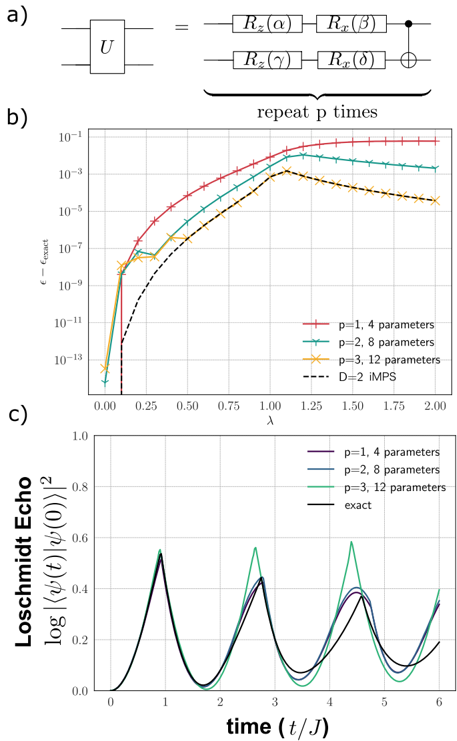
“The Loschmidt echo (fidelity of the time-evolved wavefunction with the initial wavefunction) reveals a dynamical phase transition[24] which provides a non-trivial test for our simulation.”
BackgroundMethodClass of Quantum Many-Body States That Can Be Efficiently Simulated
Vidal, G. (2008) · Physical Review Letters · doi:10.1103/physrevlett.101.110501 · Cited by 847
Progress towards practical quantum variational algorithms
Wecker, D., Hastings, M. B., & Troyer, M. (2015) · Physical Review A · doi:10.1103/physreva.92.042303 · Cited by 716
Optimal quantum circuits for general two-qubit gates
Vatan, F., & Williams, C. (2004) · Physical Review A · doi:10.1103/physreva.69.032315 · Cited by 443
Towards quantum machine learning with tensor networks
Huggins, W., Patil, P., Mitchell, B., Whaley, K. B., & Stoudenmire, E. M. (2019) · Quantum Science and Technology · doi:10.1088/2058-9565/aaea94 · Cited by 366
Sequential Generation of Entangled Multiqubit States
Schön, C., Solano, E., Verstraete, F., Cirac, J. I., & Wolf, M. M. (2005) · Physical Review Letters · doi:10.1103/physrevlett.95.110503 · Cited by 349
Hierarchical quantum classifiers
Grant, E., Benedetti, M., Cao, S., Hallam, A., Lockhart, J., Stojevic, V., Green, A. G., & Severini, S. (2018) · npj Quantum Information · doi:10.1038/s41534-018-0116-9 · Cited by 318
Self-citationComputational complexity of projected entangled pair states
Schuch, N., Wolf, M. M., Verstraete, F., & Cirac, J. I. (2007) · Physical Review Letters · doi:10.1103/physrevlett.98.140506 · Cited by 313
Simulating Large Quantum Circuits on a Small Quantum Computer
Peng, T., Harrow, A. W., Ozols, M., & Wu, X. (2020) · Physical Review Letters · doi:10.1103/physrevlett.125.150504 · Cited by 267
Encoding of matrix product states into quantum circuits of one- and two-qubit gates
Ran, S.-J. (2020) · Physical Review A · doi:10.1103/physreva.101.032310 · Cited by 231
Sequential minimal optimization for quantum-classical hybrid algorithms
Nakanishi, K. M., Fujii, K., & Todo, S. (2020) · Physical Review Research · doi:10.1103/physrevresearch.2.043158 · Cited by 221
Structure optimization for parameterized quantum circuits
Ostaszewski, M., Grant, E., & Benedetti, M. (2019) · arXiv · doi:10.48550/arxiv.1905.09692 · Cited by 214
Real- and Imaginary-Time Evolution with Compressed Quantum Circuits
Lin, S.-H., Dilip, R., Green, A. G., Smith, A., & Pollmann, F. (2021) · PRX Quantum · doi:10.1103/prxquantum.2.010342 · Cited by 206
Self-citationStructure optimization for parameterized quantum circuits
Ostaszewski, M., Grant, E., & Benedetti, M. (2021) · Quantum · doi:10.22331/q-2021-01-28-391 · Cited by 206
Unitary circuits of finite depth and infinite width from quantum channels
Gopalakrishnan, S., & Lamacraft, A. (2019) · Physical Review B · doi:10.1103/physrevb.100.064309 · Cited by 178
Isometric Tensor Network States in Two Dimensions
Zaletel, M. P., & Pollmann, F. (2020) · Physical Review Letters · doi:10.1103/physrevlett.124.037201 · Cited by 138
Self-citationSequential generation of matrix-product states in cavity QED
Schön, C., Hammerer, K., Wolf, M. M., Cirac, J. I., & Solano, E. (2007) · Physical Review A · doi:10.1103/physreva.75.032311 · Cited by 129
Improving quantum algorithms for quantum chemistry
Hastings, M. B., Wecker, D., Bauer, B., & Troyer, M. (2015) · Quantum Information and Computation · doi:10.26421/qic15.1-2-1 · Cited by 128
Suzuki, M. (1993) · Physics Letters A · doi:10.1016/0375-9601(93)90701-z · Cited by 58
Preparing Projected Entangled Pair States on a Quantum Computer
Schwarz, M., Temme, K., & Verstraete, F. (2012) · Physical Review Letters · doi:10.1103/physrevlett.108.110502 · Cited by 49
Innocuous pressure sensation requires A-type afferents but not functional ΡΙΕΖΟ2 channels in humans
Case, L. K., Liljencrantz, J., Madian, N., Necaise, A., Tubbs, J., McCall, M., Bradson, M. L., Szczot, M., Pitcher, M. H., Ghitani, N., et al. (2021) · Nature Communications · doi:10.1038/s41467-021-20939-5 · Cited by 38
Noise-resilient preparation of quantum many-body ground statesPreprint
Kim, I. H. (2017) · arXiv (Cornell University) · doi:10.48550/arxiv.1703.00032 · Cited by 31 · cited 1×
“Here we demonstrate that quantum tensor networks can be used to parallelise quantum simulation of systems that are much larger than available NISQ machines 14 – 16 .”
MethodRobust entanglement renormalization on a noisy quantum computer
Kim, I. H., & Swingle, B. (2017) · arXiv · doi:10.48550/arxiv.1711.07500 · Cited by 29 · cited 2×
“Other tensor networks such as the multi-scale entanglement renormalisation ansatz [28] (MERA) are naturally based upon unitary operators and can be realised on a quantum circuit[29].”
BackgroundFeynman Path Integrals Over Entangled StatesPreprint
Green, A. G., Hooley, C., Keeling, J., & Simon, S. H. (2016) · arXiv (Cornell University) · doi:10.48550/arxiv.1607.01778 · Cited by 24 · cited 3×
“Moreover, the remaining elements of unitaries parametrise the tangent space of the variational manifold[12, 13].”
BackgroundMethodSelf-citationHolographic quantum simulation
Kim, I. H. (2017) · arXiv · doi:10.48550/arxiv.1702.02093 · Cited by 10
Research works printed but not linked: 6
- Perez-Garcia, D., Verstraete, F., Wolf, M. M. & Cirac, J. I. Matrix product state representations. Quantum Info. Comput. 7, 401-430 (2007).
- Kitaev, A. Y. Quantum measurements and the abelian stabilizer problem. Preprint at arXiv https://arxiv.org/abs/quant-ph/9511026 (1995). · arXiv
- Li, Y. & Benjamin, S. C. Efficient variational quantum simulator incorporating active error minimization. Phys. Rev. X 7, 021050 (2017).
- Smith, A., Jobst, B., Green, A. G. & Pollmann, F. Crossing a topological phase transition with a quantum computer. Preprint at arXiv https://arxiv.org/abs/ 1910.05351v2 (2019).
- Nielsen, M. A. & Chuang, I. L. Quantum Computation and Quantum Information: 10th Anniversary Edition. 10th (Cambridge University Press, 2011).
- Michailidis, A., Turner, C., Papić, Z., Abanin, D. & Serbyn, M. Slow quantum ther- malization and many-body revivals from mixed phase space. Phys. Rev. X 10, 011055 (2020).
Cited by
Variational quantum algorithms
Cerezo, M., Arrasmith, A., Babbush, R., Benjamin, S. C., Endo, S., Fujii, K., McClean, J. R., Mitarai, K., Yuan, X., Cincio, L., et al. (2021) · Nature Reviews Physics · doi:10.1038/s42254-021-00348-9 · Cited by 3,385
Quantum Computing for High-Energy Physics: State of the Art and Challenges
Di Meglio, A., Jansen, K., Tavernelli, I., Alexandrou, C., Arunachalam, S., Bauer, C. W., Borras, K., Carrazza, S., Crippa, A., Croft, V., et al. (2024) · PRX Quantum · doi:10.1103/prxquantum.5.037001 · Cited by 215
“For more information on the identified areas of interest see Section III B. Legend: VQE: Variational Eigensolver; varQITE: variational Imaginary Time evolition; Tortter Dynamics: Time evolution based on trotteried time propagation operator; TN: Tensor Networks; QTN: Quantum Tensor Networks inspired from classical TN;…”
BackgroundInfluentialReal- and Imaginary-Time Evolution with Compressed Quantum Circuits
Lin, S.-H., Dilip, R., Green, A. G., Smith, A., & Pollmann, F. (2021) · PRX Quantum · doi:10.1103/prxquantum.2.010342 · Cited by 206
“The above connection between matrix-product states and quantum circuits is well-known in the community and was recently applied in several works [13, 29, 46].”
BackgroundMethodSelf-citationCutQC: using small Quantum computers for large Quantum circuit evaluations
Tang, W., Tomesh, T., Suchara, M., Larson, J., & Martonosi, M. (2021) · Proceedings of the 26th ACM International Conference on Architectural Support for Programming Languages and Operating Systems · doi:10.1145/3445814.3446758 · Cited by 159
“Several works manually separate small toy circuits with convenient structures as proof-of-concept demonstrations [49, 50].”
BackgroundHardware-efficient variational quantum algorithms for time evolution
Benedetti, M., Fiorentini, M., & Lubasch, M. (2021) · Physical Review Research · doi:10.1103/physrevresearch.3.033083 · Cited by 161
“The same concept is used in the design of noise-robust quantum circuits [34] and to simulate infinite matrix product states on a quantum computer [35].”
Background
Metadata
- Authors
- Barratt, F., Dborin, J., Bal, M., Stojevic, V., Pollmann, F., & Green, A. G.
- Affiliations
- King's College London (GB)
- London Centre for Nanotechnology (GB)
- Technical University of Munich (DE)
- Corresponding author
- Green, A. G.
- Venue
- npj Quantum Information
- Published
- 2021-05-25
- Volume
- 7
- Issue
- 1
- ISSN
- 2056-6387 (ISSN-L)
- OpenAlex
- W3013339074
- Cited by
- 111
- References
- 29
- Citations by year
- 2026: 5 · 2025: 12 · 2024: 21 · 2023: 29 · 2022: 29 · 2021: 12
- FWCI
- 8.04
- Type
- journal article
- Language
- en
- Open access
- gold
- doi.org
- Licence
- cc-by
- creativecommons.org/licenses/by/4.0 (tdm)
- creativecommons.org/licenses/by/4.0 (vor)
- Locations
- npj Quantum Information (publishedVersion, cc-by)
- arXiv (Cornell University) (submittedVersion)
- DOAJ (DOAJ: Directory of Open Access Journals) (submittedVersion, cc-by-sa)
- UCL Discovery (University College London) (submittedVersion)
- mediaTUM – the media and publications repository of the Technical University Munich (Technical University Munich) (submittedVersion)
- arXiv (Cornell University) (cc-by)
- Funders
- European Commission (HORIZON2020, 771537)
- Deutsche Forschungsgemeinschaft (FOR1807, PO 1370/21, EXC 2111, EXC- 2111390814868, TRR-80, 390814868, 1370/2-1, 2111390814868)
- Engineering and Physical Sciences Research Council (EP/L015242/, EP/L015854/1, EP/S005021/1, EP/L015242/1)
- Topics
- Physical Sciences › Computer Science › Artificial Intelligence › Quantum Computing Algorithms and Architecture
- Physical Sciences › Physics and Astronomy › Atomic and Molecular Physics, and Optics › Quantum many-body systems
- Physical Sciences › Physics and Astronomy › Atomic and Molecular Physics, and Optics › Quantum Information and Cryptography
- Keywords
- quantum simulation, NISQ devices, tensor networks, matrix product states, infinite matrix product states, translationally invariant systems, quantum spin chains, circuit optimization, entanglement
About these checks
Registry, retraction, Cites and statistics results are computed, not judged, with one exception: a printed reference that no index lists is read once by a model before it counts as a citation error. Claims are extracted by a model and kept only when their quote appears verbatim in the text; each cited source is then checked, with a model’s help, for whether it says what the claim relies on. Those verdicts can be wrong — read the claim’s quote and the cited source before relying on one.
Statistics and arithmetic are recomputed, not judged.
Confidence bands are shown only for fields calibrated on our annotated test set. None is calibrated yet, so no band is shown.
What counts as a claim ›How we measure confidence ›How we check this ›
Are you an author, or do you see a problem with this page? Request a review
Data sources
Bibliographic data: Semantic Scholar, OpenAlex, Crossref.
Contains information from the Semantic Scholar Academic Graph Datasets, made available under the ODC Attribution License (ODC-BY 1.0).
Semantic Scholar’s data is described in: Kinney, R., et al. (2023). The Semantic Scholar Open Data Platform. arXiv:2301.10140.
