

A short dasatinib and quercetin treatment is sufficient to reinstate potent adult neuroregenesis in the aged killifish
Open accessThe DOI matches its Crossref record; 85 of the 85 references it cites were found in a registry or an index.
Abstract
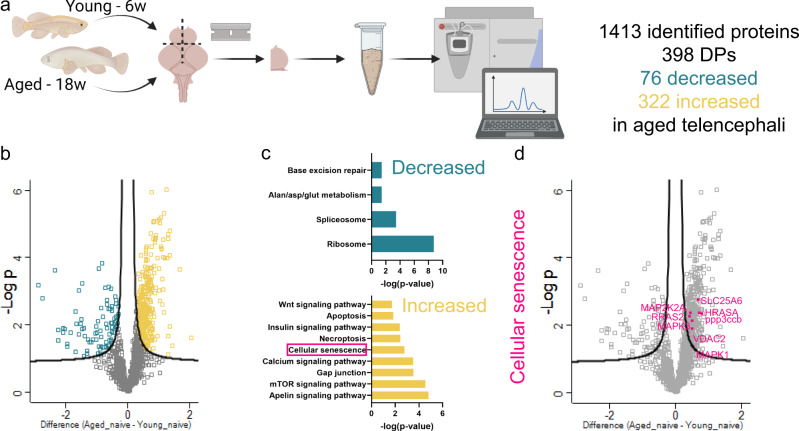
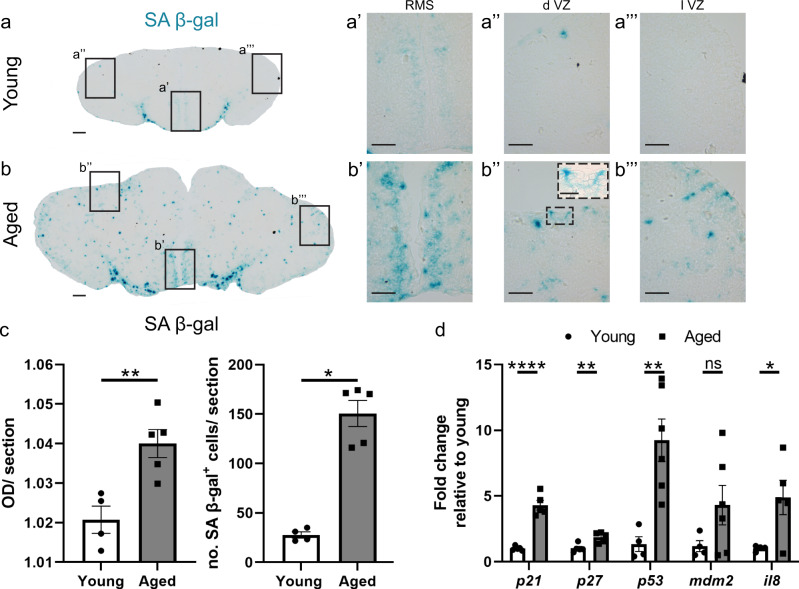
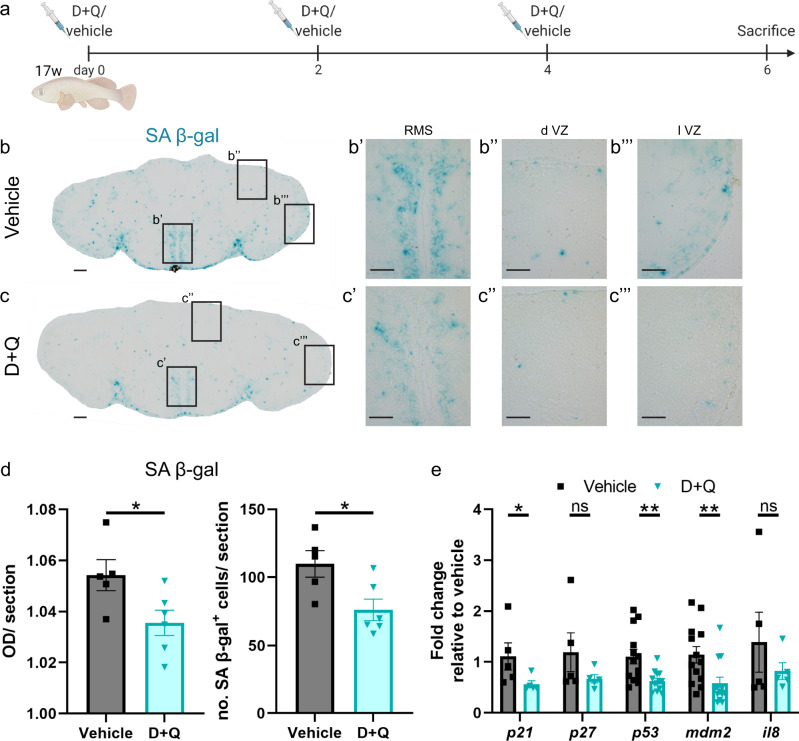
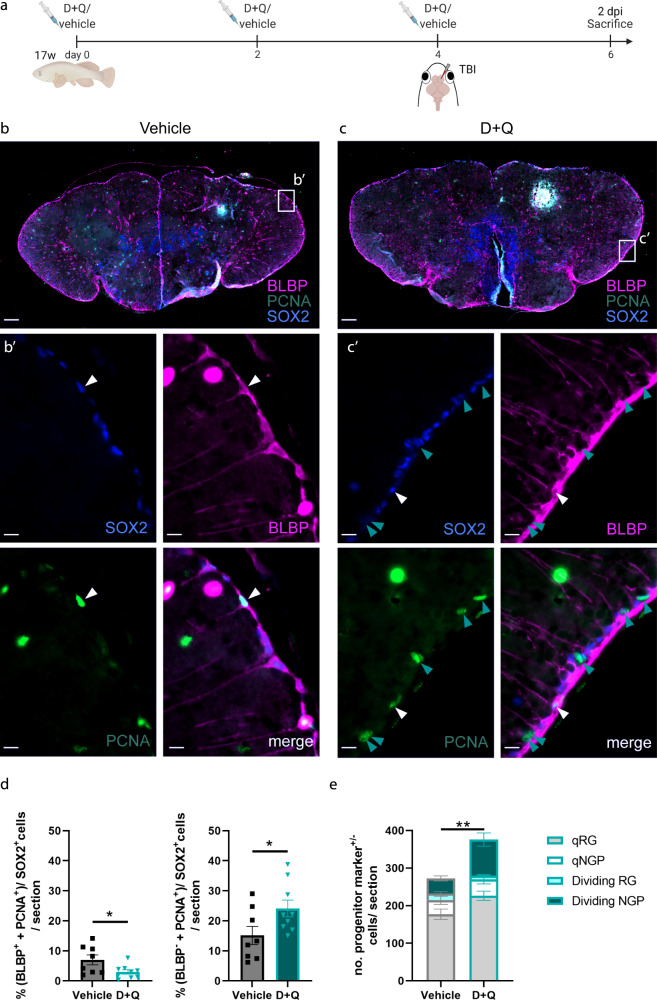
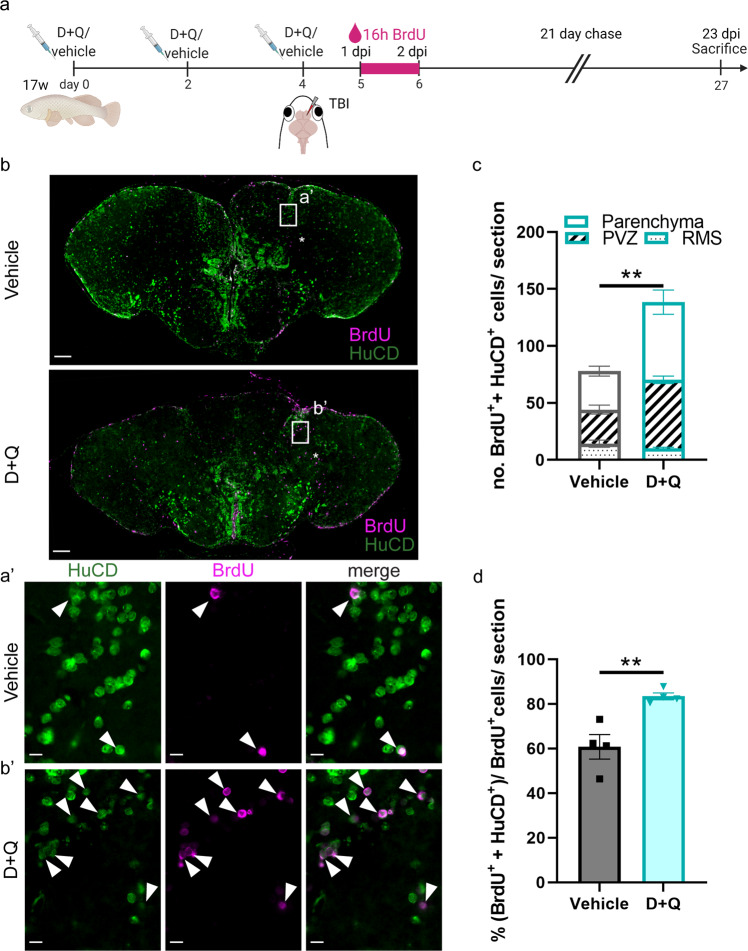
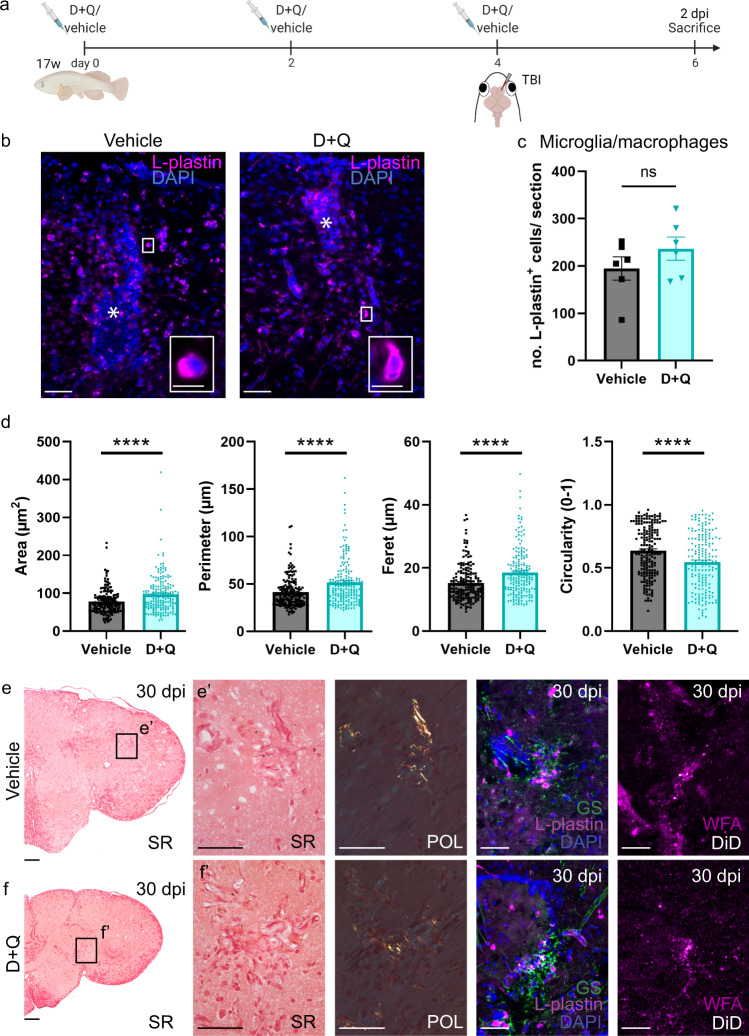
The young African turquoise killifish has a high regenerative capacity, but loses it with advancing age, adopting several aspects of the limited form of mammalian regeneration. We deployed a proteomic strategy to identify pathways that underpin the loss of regenerative power caused by aging. Cellular senescence stood out as a potential brake on successful neurorepair. We applied the senolytic cocktail Dasatinib and Quercetin (D + Q) to test clearance of chronic senescent cells from the aged killifish central nervous system (CNS) as well as rebooting the neurogenic output. Our results show that the entire aged killifish telencephalon holds a very high senescent cell burden, including the parenchyma and the neurogenic niches, which could be diminished by a short-term, late-onset D + Q treatment. Reactive proliferation of non-glial progenitors increased substantially and lead to restorative neurogenesis after traumatic brain injury. Our results provide a cellular mechanism for age-related regeneration resilience and a proof-of-concept of a potential therapy to revive the neurogenic potential in an already aged or diseased CNS.
Overview
The claims and statistics of this paper haven’t been checked yet.
Free: it reads the open-access text and checks the first 5 claims that cite a source we can check. Create a free account to check every claim.
Integrity signals
Registry
Cites
Statistics
Figures
Verification
Claims the paper makes
The claims and statistics of this paper haven’t been checked yet.
Free: it reads the open-access text and checks the first 5 claims that cite a source we can check. Create a free account to check every claim.
Claims other papers make about this one
Each is checked against this paper’s own text: does it say what the citing paper says it does?
In the citing paper
“Cellular senescence is not a mammalian-specific phenomenon but is widespread across the animal kingdom, including vertebrate and invertebrate organisms.”
From Guidelines for minimal information on cellular senescence experimentation in vivo (2024) · cites this paper as [119]
In the citing paper
“Some biochemical markers of senescence, including lack of incorporation of thymidine analogues as a reporter of reduced proliferation or increased ROS abundance and macromolecular oxidative damage, are established for several species119,120,124.”
From Guidelines for minimal information on cellular senescence experimentation in vivo (2024) · cites this paper as [119]
In the citing paper
“Markers of senescence have been detected in birds (e.g., quail114), amphibians (e.g., axolotls115, xenopus116, and newts117), fish (e.g., zebrafish118 and killifish119), and invertebrates (e.g., hydra120 and Drosophila121).”
From Guidelines for minimal information on cellular senescence experimentation in vivo (2024) · cites this paper as [119]
Self-check
Percentages, sums and reported differences re-computed from the paper’s own numbers.
The self-check needs the paper’s full text.
Citations
Cites
The Perseus computational platform for comprehensive analysis of (prote)omics data
Tyanova, S., Temu, T., Sinitcyn, P., Carlson, A., Hein, M. Y., Geiger, T., Mann, M., & Cox, J. (2016) · Nature Methods · doi:10.1038/nmeth.3901 · Cited by 8,803 · cited 1×
“Raw output data from MaxQuant was further analyzed using Perseus v.1.6.15 76 .”
InfluentialSpillantini, M. G., Schmidt, M. L., Lee, V. M.-Y., Trojanowski, J. Q., Jakes, R., & Goedert, M. (1997) · Nature · doi:10.1038/42166 · Cited by 8,382
Szklarczyk, D., Gable, A. L., Nastou, K. C., Lyon, D., Kirsch, R., Pyysalo, S., Doncheva, N. T., Legeay, M., Fang, T., Bork, P., et al. (2021) · Nucleic Acids Research · doi:10.1093/nar/gkaa1074 · Cited by 8,056 · cited 3×
“We performed pathway enrichment analysis on the 398 DPs using STRING 43 .”
InfluentialA biomarker that identifies senescent human cells in culture and in aging skin in vivo.
Dimri, G. P., Lee, X., Basile, G., Acosta, M., Scott, G., Roskelley, C., Medrano, E. E., Linskens, M., Rubelj, I., & Pereira-Smith, O. (1995) · Proceedings of the National Academy of Sciences · doi:10.1073/pnas.92.20.9363 · Cited by 7,477 · cited 1×
“It measures lysosomal β -gal levels at pH 6, which are increased in senescent cells 44,45 .”
Perez-Riverol, Y., Csordas, A., Bai, J., Bernal-Llinares, M., Hewapathirana, S., Kundu, D. J., Inuganti, A., Griss, J., Mayer, G., Eisenacher, M., et al. (2019) · Nucleic Acids Research · doi:10.1093/nar/gky1106 · Cited by 6,693
The senescence-associated secretory phenotype: the dark side of tumor suppression
Coppé, J.-P., Desprez, P.-Y., Krtolica, A., & Campisi, J. (2010) · Annual Review of Pathology: Mechanisms of Disease · doi:10.1146/annurev-pathol-121808-102144 · Cited by 5,206 · cited 4×
“…with senolytics Dasatinib and Quercetin removes senescent cells from the aged killi fi sh telencephalon Senescent cells secrete proteases, chemokines, growth factors and extracellular matrix components, which alter the micro-environment of the tissue 33 and might decrease neurogenic potential.”
InfluentialThe MaxQuant computational platform for mass spectrometry-based shotgun proteomics
Tyanova, S., Temu, T., & Cox, J. (2016) · Nature Protocols · doi:10.1038/nprot.2016.136 · Cited by 4,797
The Achilles' heel of senescent cells: from transcriptome to senolytic drugs
Zhu, Y., Tchkonia, T., Pirtskhalava, T., Gower, A. C., Ding, H., Giorgadze, N., Palmer, A. K., Ikeno, Y., Hubbard, G. B., Lenburg, M., et al. (2015) · Aging Cell · doi:10.1111/acel.12344 · Cited by 2,584 · cited 3×
“Senolytic drugs are compounds that target senescent cell SCAPs causing the senescent cell to undergo apoptosis 47 .”
Senolytics improve physical function and increase lifespan in old age
Xu, M., Pirtskhalava, T., Farr, J. N., Weigand, B. M., Palmer, A. K., Weivoda, M. M., Inman, C. L., Ogrodnik, M. B., Hachfeld, C. M., Fraser, D. G., et al. (2018) · Nature Medicine · doi:10.1038/s41591-018-0092-9 · Cited by 2,287 · cited 2×
“Multiple studies have already illustrated the speci fi city of D + Q to drive senescent cells into apoptosis and report on the increased presence of apoptotic cells shortly after D + Q administration 47,53 – 60 .”
A complex secretory program orchestrated by the inflammasome controls paracrine senescence
Acosta, J. C., Banito, A., Wuestefeld, T., Georgilis, A., Janich, P., Morton, J. P., Athineos, D., Kang, T.-W., Lasitschka, F., Andrulis, M., et al. (2013) · Nature Cell Biology · doi:10.1038/ncb2784 · Cited by 2,278 · cited 1×
“This SASP can also turn neighboring cells senescent in a process called paracrine senescence 34,35 .”
Cited by
Guidelines for minimal information on cellular senescence experimentation in vivo
Ogrodnik, M., Carlos Acosta, J., Adams, P. D., d’Adda di Fagagna, F., Baker, D. J., Bishop, C. L., Chandra, T., Collado, M., Gil, J., Gorgoulis, V., et al. (2024) · Cell · doi:10.1016/j.cell.2024.05.059 · Cited by 376
Emerging insights in senescence: pathways from preclinical models to therapeutic innovations
Mansfield, L., Ramponi, V., Gupta, K., Stevenson, T., Mathew, A. B., Barinda, A. J., Herbstein, F., & Morsli, S. (2024) · npj Aging · doi:10.1038/s41514-024-00181-1 · Cited by 88
Ristori, S., Bertoni, G., Bientinesi, E., & Monti, D. (2025) · Nutrients · doi:10.3390/nu17111837 · Cited by 45
“Meanwhile, in PD, direct evidence of the beneficial effects of D+Q has not been observed, even though some advantages have been shown in aging killifish [245].”
Brain aging and rejuvenation at single-cell resolution
Sun, E., Nagvekar, R., Pogson, A. N., & Brunet, A. (2025) · Neuron · doi:10.1016/j.neuron.2024.12.007 · Cited by 39
Ayana, R., Zandecki, C., houcke, J. V., Mariën, V., Seuntjens, E., & Arckens, L. (2024) · Aging Cell · doi:10.1111/acel.14251 · Cited by 28
“Our bulk proteomics study of the aging killifish telencephalon also showed comparable changes in mTOR, Wnt, and MAPK pathways which is directly linked to cellular senescence and apoptosis (Van houcke et al., 2023 ).”
BackgroundSelf-citation
Metadata
- Authors
- Van houcke, J., Mariën, V., Zandecki, C., Ayana, R., Pepermans, E., Boonen, K., Seuntjens, E., Baggerman, G., & Arckens, L.
- Affiliations
- KU Leuven (BE)
- University of Antwerp (BE)
- ORCID
- Venue
- npj Regenerative Medicine
- Published
- 2023-06-16
- Volume
- 8
- Issue
- 1
- Pages
- 31-31
- ISSN
- 2057-3995 (ISSN-L)
- PMC
- PMC10275874
- OpenAlex
- W4380992199
- Cited by
- 29
- References
- 83
- Citations by year
- 2026: 10 · 2025: 9 · 2024: 9 · 2023: 1
- FWCI
- 3.37
- Type
- journal article
- Language
- en
- Open access
- gold
- doi.org
- Licence
- cc-by
- creativecommons.org/licenses/by/4.0 (tdm)
- creativecommons.org/licenses/by/4.0 (vor)
- Locations
- npj Regenerative Medicine (publishedVersion, cc-by)
- PubMed Central (publishedVersion, cc-by)
- PubMed (publishedVersion)
- Lirias (KU Leuven) (submittedVersion, cc-by)
- DOAJ (DOAJ: Directory of Open Access Journals) (submittedVersion, cc-by-sa)
- Funders
- Fonds Wetenschappelijk Onderzoek (G0C9922N, 1S00318N)
- Onderzoeksraad, KU Leuven (C3/21/012)
- KU Leuven (KA-16-00745)
- Topics
- Life Sciences › Neuroscience › Developmental Neuroscience › Neurogenesis and neuroplasticity mechanisms
- Life Sciences › Biochemistry, Genetics and Molecular Biology › Cell Biology › Telomeres, Telomerase, and Senescence
- Life Sciences › Biochemistry, Genetics and Molecular Biology › Cell Biology › Zebrafish Biomedical Research Applications
- Keywords
- senolytics, cellular senescence, neurogenesis, aging, killifish, nerve regeneration, traumatic brain injury, telencephalon, neurogenic niche, senolytic therapy, central nervous system regeneration
About these checks
Registry, retraction, Cites and statistics results are computed, not judged, with one exception: a printed reference that no index lists is read once by a model before it counts as a citation error. Claims are extracted by a model and kept only when their quote appears verbatim in the text; each cited source is then checked, with a model’s help, for whether it says what the claim relies on. Those verdicts can be wrong — read the claim’s quote and the cited source before relying on one.
Statistics and arithmetic are recomputed, not judged.
Confidence bands are shown only for fields calibrated on our annotated test set. None is calibrated yet, so no band is shown.
What counts as a claim ›How we measure confidence ›How we check this ›
Are you an author, or do you see a problem with this page? Request a review
Data sources
Bibliographic data: Semantic Scholar, OpenAlex, Crossref.
Contains information from the Semantic Scholar Academic Graph Datasets, made available under the ODC Attribution License (ODC-BY 1.0).
Semantic Scholar’s data is described in: Kinney, R., et al. (2023). The Semantic Scholar Open Data Platform. arXiv:2301.10140.
