

The DOI matches its Crossref record; 68 of the 68 references it cites were found in a registry or an index.
The promise of mRNA vaccines: a biotech and industrial perspective
Open accessAbstract
mRNA technologies have the potential to transform areas of medicine, including the prophylaxis of infectious diseases. The advantages for vaccines range from the acceleration of immunogen discovery to rapid response and multiple disease target manufacturing. A greater understanding of quality attributes that dictate translation efficiency, as well as a comprehensive appreciation of the importance of mRNA delivery, are influencing a new era of investment in development activities. The application of translational sciences and growing early-phase clinical experience continue to inform candidate vaccine selection. Here we review the state of the art for the prevention of infectious diseases by using mRNA and pertinent topics to the biotechnology and pharmaceutical industries.
Overview
The claims and statistics of this paper haven’t been checked yet.
Run the check — free, no account needed. It reads the open-access text and checks the sources it cites.
Integrity signals
Registry
Cites
Statistics
Figures
Verification
Claims the paper makes
The claims and statistics of this paper haven’t been checked yet.
Run the check — free, no account needed. It reads the open-access text and checks the sources it cites.
Claims other papers make about this one
Each is checked against this paper’s own text: does it say what the citing paper says it does?
The source backs part of the claim, not all of it — or backs it for a different population, condition or comparison.
In the citing paper
“Messenger RNA (mRNA)-based therapy recently emerged as an effective platform for treatment of infectious diseases and cancer (Jackson et al., 2020; Mascola and Fauci, 2020).”
From A thermostable mRNA vaccine against COVID-19 (2020) · cites this paper as Jackson et al., 2020
Experimental — accuracy not yet measuredThe source backs part of the claim, not all of it — or backs it for a different population, condition or comparison.
In the citing paper
“mRNA vaccines still suffer from decreased efficacy due to poor RNA stability in solution and in vivo and to limited expression of the payload mRNA; these are all pivotal issues that need to be carefully optimized for preclinical and clinical applications3–6.”
From Combinatorial optimization of mRNA structure, stability, and translation for RNA-based therapeutics (2022) · cites this paper as [4]
Experimental — accuracy not yet measured
Self-check
Percentages, sums and reported differences re-computed from the paper’s own numbers.
The self-check needs the paper’s full text.
Citations
Cites
mRNA vaccines — a new era in vaccinology
Pardi, N., Hogan, M. J., Porter, F. W., & Weissman, D. (2018) · Nature Reviews Drug Discovery · doi:10.1038/nrd.2017.243 · Cited by 4,667 · cited 1×
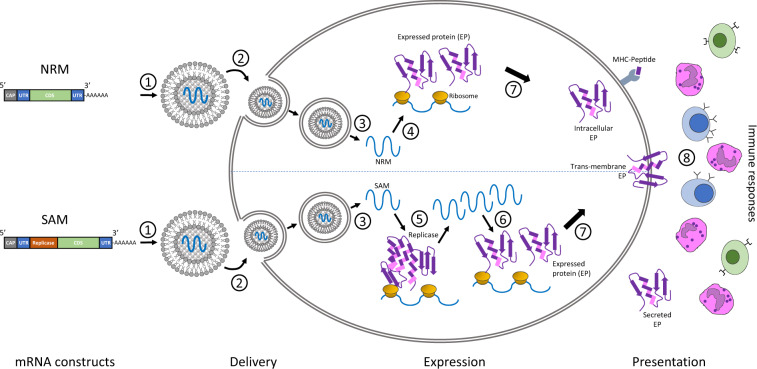
“3 SAM differs with the inclusion of genetic replication machinery derived from positive-stranded mRNA viruses, most commonly from alphaviruses such as Sindbis and Semliki-Forest viruses.”
BackgroundOligoribonucleotide synthesis using T7 RNA polymerase and synthetic DNA templates.
Milligan, J., Groebe, D., Witherell, G. W., & Uhlenbeck, O. (1987) · Nucleic Acids Research · doi:10.1093/nar/15.21.8783 · Cited by 1,971 · cited 1×
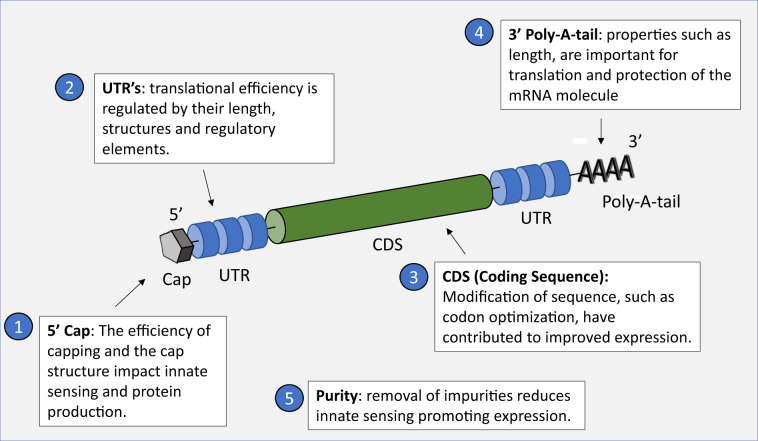
“First, the purity of the mRNA is a crucial determinant of yields, and it is known that the DNA-dependent RNA polymerases yield smaller oligoribonucleotide impurities as a result of abortive initiation events, 11 as well as double-stranded (ds) RNA generated by self-complementary 3′ extension, 12 which can result in ty…”
BackgroundThe Many Pathways of RNA Degradation
Houseley, J. M., & Tollervey, D. W. (2009) · Cell · doi:10.1016/j.cell.2009.01.019 · Cited by 1,220 · cited 1×
“32, 33 This has been an intense area of research in the field, for which lipid nanoparticle (LNP) formulations are currently emerging as a leading category.”
BackgroundDelivering the Messenger: Advances in Technologies for Therapeutic mRNA Delivery
Kowalski, P. S., Rudra, A., Miao, L., & Anderson, D. G. (2019) · Molecular Therapy · doi:10.1016/j.ymthe.2019.02.012 · Cited by 1,127
Codon Optimality Is a Major Determinant of mRNA Stability
Presnyak, V., Alhusaini, N., Chen, Y.-H., Martin, S., Morris, N., Kline, N., Olson, S., Weinberg, D., Baker, K. E., Graveley, B. R., et al. (2015) · Cell · doi:10.1016/j.cell.2015.02.029 · Cited by 1,078 · cited 1×
“49, 50 Additional sites within the mRNA construct are available for optimization as well.”
BackgroundFunctional 5′ UTR mRNA structures in eukaryotic translation regulation and how to find them
Leppek, K., Das, R., & Barna, M. (2018) · Nature Reviews Molecular Cell Biology · doi:10.1038/nrm.2017.103 · Cited by 949
Karikó, K., Muramatsu, H., Ludwig, J., & Weissman, D. (2011) · Nucleic Acids Research · doi:10.1093/nar/gkr695 · Cited by 898
Zika virus protection by a single low-dose nucleoside-modified mRNA vaccination
Pardi, N., Hogan, M. J., Pelc, R. S., Muramatsu, H., Andersen, H., DeMaso, C. R., Dowd, K. A., Sutherland, L. L., Scearce, R. M., Parks, R., et al. (2017) · Nature · doi:10.1038/nature21428 · Cited by 884 · cited 1×
“[41] [42] [43] [44] Much of the focus of the continued development of such LNP carrier systems involves optimization of the ionizable lipid component, with particular focus on the acid dissociation constant (pKa) and fusogenic properties (both of the ionizable component as well as helper lipid[s]), which have been dem…”
BackgroundSabnis, S., Kumarasinghe, E. S., Salerno, T., Mihai, C., Ketova, T., Senn, J. J., Lynn, A., Bulychev, A., McFadyen, I., Chan, J., et al. (2018) · Molecular Therapy · doi:10.1016/j.ymthe.2018.03.010 · Cited by 820 · cited 1×
“[45] [46] [47] [48] Next-generation LNPs may include specific targeting motifs for homing and uptake by professional antigen-presenting cells, such as dendritic cells (DC).”
BackgroundZüst, R., Cervantes-Barragan, L., Habjan, M., Maier, R., Neuman, B. W., Ziebuhr, J., Szretter, K. J., Baker, S. C., Barchet, W., Diamond, M. S., et al. (2011) · Nature Immunology · doi:10.1038/ni.1979 · Cited by 811 · cited 1×
“20 Manufacturers of mRNA vaccines pay careful attention to the choice of enzyme and reaction conditions, in order to catalyze the highest percentage of cap formation.”
Background
Research works printed but not linked: 1
- Wu, M. et al. Effect of mRNA modifications on translational fidelity. in Proc. Poster presented at 6th International mRNA (INTERPLAN Congress, Boston, MA, 2018).
Cited by
Sorted by citations
Mechanisms of SARS-CoV-2 entry into cells
Jackson, C. B., Farzan, M., Chen, B., & Choe, H. (2022) · Nature Reviews Molecular Cell Biology · doi:10.1038/s41580-021-00418-x · Cited by 3,022
mRNA-lipid nanoparticle COVID-19 vaccines: structure and stability
Schoenmaker, L., Witzigmann, D., Kulkarni, J. A., Verbeke, R., Kersten, G., Jiskoot, W., & Crommelin, D. J. A. (2021) · International Journal of Pharmaceutics · doi:10.1016/j.ijpharm.2021.120586 · Cited by 1,566
“After identification of the protective protein antigen(s) and sequencing the corresponding gene(s), the mRNA can be made within weeks (Jackson et al., 2020).”
Immunological considerations for COVID-19 vaccine strategies
Jeyanathan, M., Afkhami, S., Smaill, F., Miller, M. S., Lichty, B. D., & Xing, Z. (2020) · Nature Reviews Immunology · doi:10.1038/s41577-020-00434-6 · Cited by 1,015
The clinical progress of mRNA vaccines and immunotherapies
Barbier, A. J., Jiang, A. Y., Zhang, P., Wooster, R., & Anderson, D. G. (2022) · Nature Biotechnology · doi:10.1038/s41587-022-01294-2 · Cited by 823
mRNA-based therapeutics: powerful and versatile tools to combat diseases
Qin, S., Tang, X., Chen, Y., Chen, K., Fan, N., Xiao, W., Zheng, Q., Li, G., Teng, Y., Wu, M., et al. (2022) · Signal Transduction and Targeted Therapy · doi:10.1038/s41392-022-01007-w · Cited by 852
Metadata
- Authors
- Jackson, N. A. C., Kester, K. E., Casimiro, D., Gurunathan, S., & DeRosa, F.
- Affiliations
- Coalition for Epidemic Preparedness Innovations (US)
- Sanofi (United States) (US)
- Translate Bio (United States) (US)
- Corresponding author
- Jackson, Nicholas A. C.
- Venue
- npj Vaccines
- Published
- 2020-02-04
- Volume
- 5
- Issue
- 1
- Pages
- 11-11
- ISSN
- 2059-0105 (ISSN-L)
- PMC
- PMC7000814
- OpenAlex
- W3004539389
- Cited by
- 498
- References
- 68
- Citations by year
- 2026: 39 · 2025: 54 · 2024: 70 · 2023: 76 · 2022: 110 · 2021: 121 · 2020: 28
- FWCI
- 8.02
- Type
- journal article
- Language
- en
- Open access
- gold
- doi.org
- Locations
- npj Vaccines (publishedVersion, cc-by)
- PubMed Central (publishedVersion, cc-by)
- PubMed (publishedVersion)
- DOAJ (DOAJ: Directory of Open Access Journals) (submittedVersion)
- Topics
- Life Sciences › Biochemistry, Genetics and Molecular Biology › Molecular Biology › RNA Interference and Gene Delivery
- Health Sciences › Medicine › Infectious Diseases › SARS-CoV-2 and COVID-19 Research
- Life Sciences › Immunology and Microbiology › Immunology › Immunotherapy and Immune Responses
- Keywords
- mRNA vaccines, infectious disease prevention, mRNA delivery, vaccine production, translation efficiency, vaccine development, biotechnology industry, pharmaceutical industry
About these checks
Registry, retraction, Cites and statistics results are computed, not judged, with one exception: a printed reference that no index lists is read once by a model before it counts as a citation error. Claims are extracted by a model and kept only when their quote appears verbatim in the text; each cited source is then checked, with a model’s help, for whether it says what the claim relies on. Those verdicts can be wrong — read the claim’s quote and the cited source before relying on one.
Statistics and arithmetic are recomputed, not judged.
Confidence bands are shown only for fields calibrated on our annotated test set. None is calibrated yet, so no band is shown.
What counts as a claim ›How we measure confidence ›How we check this ›
Are you an author, or do you see a problem with this page? Request a review
