

Expert-level detection of pathologies from unannotated chest X-ray images via self-supervised learning
Open accessThe DOI matches its Crossref record; 47 of the 48 references it cites were found in a registry or an index.
Abstract
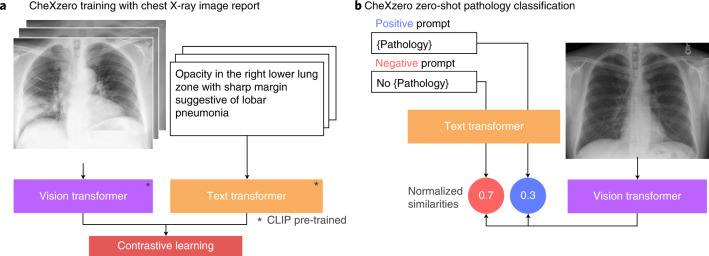
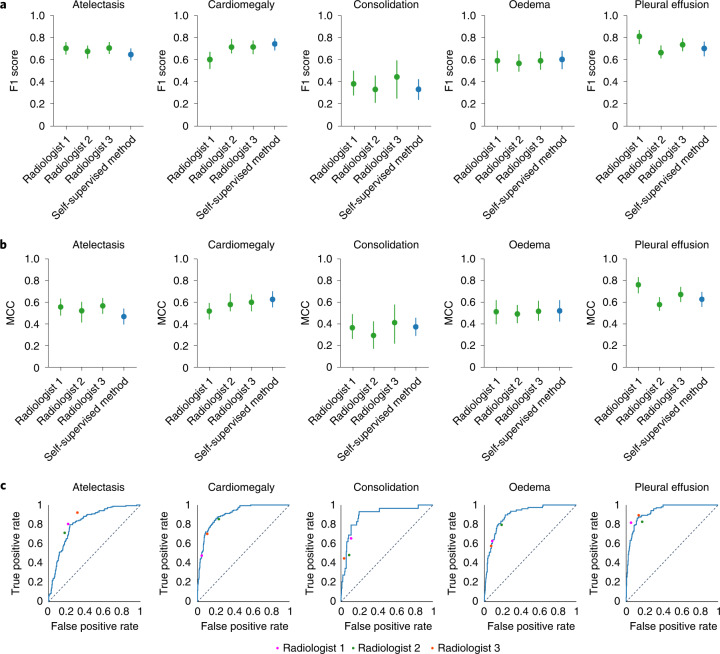
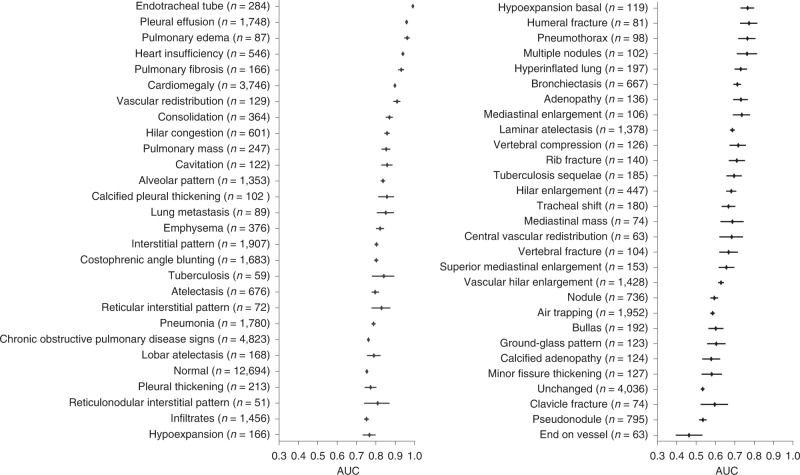
In tasks involving the interpretation of medical images, suitably trained machine-learning models often exceed the performance of medical experts. Yet such a high-level of performance typically requires that the models be trained with relevant datasets that have been painstakingly annotated by experts. Here we show that a self-supervised model trained on chest X-ray images that lack explicit annotations performs pathology-classification tasks with accuracies comparable to those of radiologists. On an external validation dataset of chest X-rays, the self-supervised model outperformed a fully supervised model in the detection of three pathologies (out of eight), and the performance generalized to pathologies that were not explicitly annotated for model training, to multiple image-interpretation tasks and to datasets from multiple institutions.
Overview
The claims and statistics of this paper haven’t been checked yet.
Free: it reads the open-access text and checks the first 5 claims that cite a source we can check. Create a free account to check every claim.
Integrity signals
Registry
Cites
Statistics
Figures
Verification
Claims the paper makes
The claims and statistics of this paper haven’t been checked yet.
Free: it reads the open-access text and checks the first 5 claims that cite a source we can check. Create a free account to check every claim.
Claims other papers make about this one
Each is checked against this paper’s own text: does it say what the citing paper says it does?
The source backs part of the claim, not all of it — or backs it for a different population, condition or comparison.
In the citing paper
“For instance, linking images from chest X-rays to corresponding report text data, and foundation models can alleviate the need for time-consuming and laborious manual annotation while preserving human-level accuracies and outperforming supervised methods18.”
From Large language models and multimodal foundation models for precision oncology (2024) · cites this paper as [18]
Experimental — accuracy not yet measuredThe source backs part of the claim, not all of it — or backs it for a different population, condition or comparison.
In the citing paper
“Although gathering such large datasets will pose a substantial challenge, these data will generally not require costly expert labels, given the success of self-supervision 9,54 .”
From Foundation models for generalist medical artificial intelligence (2023) · cites this paper as [9]
Experimental — accuracy not yet measuredThe cited source says what the claim attributes to it.
In the citing paper
“CheXzero can be applied to detect dozens of diseases in chest X-rays without being trained on explicit labels for these diseases 9 .”
From Foundation models for generalist medical artificial intelligence (2023) · cites this paper as [9]
Self-check
Percentages, sums and reported differences re-computed from the paper’s own numbers.
The self-check needs the paper’s full text.
Citations
Cites
A survey on deep learning in medical image analysis
Litjens, G., Kooi, T., Bejnordi, B. E., Setio, A. A. A., Ciompi, F., Ghafoorian, M., van der Laak, J. A. W. M., van Ginneken, B., & Sánchez, C. I. (2017) · Medical Image Analysis · doi:10.1016/j.media.2017.07.005 · Cited by 15,332
Learning Transferable Visual Models From Natural Language Supervision
Radford, A., Kim, J. W., Hallacy, C., Ramesh, A., Goh, G., Agarwal, S., Sastry, G., Askell, A., Mishkin, P., Clark, J., et al. (2021) · arXiv · doi:10.48550/arxiv.2103.00020 · Cited by 15,293
Momentum Contrast for Unsupervised Visual Representation Learning
He, K., Fan, H., Wu, Y., Xie, S., & Girshick, R. (2020) · 2020 IEEE/CVF Conference on Computer Vision and Pattern Recognition (CVPR) · doi:10.1109/cvpr42600.2020.00975 · Cited by 13,347
A simple framework for contrastive learning of visual representations
Chen, T., Kornblith, S., Norouzi, M., & Hinton, G. (2020) · arXiv · doi:10.48550/arxiv.2002.05709 · Cited by 10,857
Deep learning in medical image analysis
Shen, D., Wu, G., & Suk, H.-I. (2017) · Annual Review of Biomedical Engineering · doi:10.1146/annurev-bioeng-071516-044442 · Cited by 4,968
Liu, P., Yuan, W., Fu, J., Jiang, Z., Hayashi, H., & Neubig, G. (2023) · ACM Computing Surveys · doi:10.1145/3560815 · Cited by 4,361
Liu, P., Yuan, W., Fu, J., Jiang, Z., Hayashi, H., & Neubig, G. (2021) · arXiv · doi:10.48550/arxiv.2107.13586 · Cited by 4,352
A Survey on Deep Transfer Learning
Tan, C., Sun, F., Kong, T., Zhang, W., Yang, C., & Liu, C. (2018) · Lecture Notes in Computer Science · doi:10.1007/978-3-030-01424-7_27 · Cited by 3,165
Understanding deep learning (still) requires rethinking generalization
Zhang, C., Bengio, S., Hardt, M., Recht, B., & Vinyals, O. (2021) · Communications of the ACM · doi:10.1145/3446776 · Cited by 2,400
An overview of deep learning in medical imaging focusing on MRI
Lundervold, A. S., & Lundervold, A. (2019) · Zeitschrift für Medizinische Physik · doi:10.1016/j.zemedi.2018.11.002 · Cited by 2,058
Research works printed but not linked: 5
- Erhan, D., A. Courville, Y. Bengio, and P. Vincent. Why does unsupervised pre-training help deep learning? In Proc. Thirteenth International Conference on Artificial Intelligence and Statistics (eds Teh, Y. W. & Titterington, T.) 9:201–208 (PMLR, 2010).
- Radford, A., Kim, J. W., Hallacy, C., Ramesh, A., Goh, G., Agarwal, S.,... & Sutskever, I. Learning transferable visual models from natural language supervision. In Proc. 38th International Conference on Machine Learning 39:8748–8763 (PMLR, 2021).
- Avdic, A., Marovac, U. & Jankovic, D. Automated labeling of terms in medical reports in Serbian. Turk. J. Electr. Eng. Comput. Sci. 28, 3285–3303 (2020).
- Arjovsky, M.. Out of Distribution Generalization in Machine Learning (ed. Bottou, L.) PhD thesis, New York Univ. https://www.proquest.com/dissertations-theses/out-distribution-generalization-machine-learning/docview/2436913706/se-2 (2020).
- Xian, Y., Lampert, C. H., Schiele, B. & Akata, Z. Zero-shot learning—a comprehensive evaluation of the good, the bad and the ugly. IEEE Trans. Pattern Anal. Mach. Intell. 41, 2251–2265 (2018). 30028691 · DOI · Paper page
Cited by
Items 401–500 of 524
HG-BiCMA: A Hybrid-Gated Attention Network for Multimodal Sinusitis Subtype Classification
Yu, X., Zhang, S., Wu, X., Liu, F., MA, C., & Tang, L. (2025) · International Symposium on Artificial Intelligence for Medicine Sciences (ISAIMS) · doi:10.1145/3777577.3777658
“More recent works, including ConVIRT by Zhang et al. [ 8 ] , MedCLIP by Wang et al. [ 9 ] , and the expert-level self-supervised pre-training by Tiu et al. [ 10 ] , have advanced image-text representation learning.”
Medical Vision Language Model With Multi-granularity Alignment and Learning Data Augmentation
Gao, D., Hua, Y., Zhang, W., & Song, X. (2026) · Lecture notes in computer science · doi:10.1007/978-981-95-5634-2_34
Widiyanto, W. W., Husen, M. N., Pariyasto, S., & Susanto, E. (2026) · Jurnal Teknik Informatika (Jutif) · doi:10.52436/1.jutif.2025.6.6.5570
Chen, X., Tong, L., & Du, B. (2025) · IEEE International Conference on Bioinformatics and Biomedicine (BIBM) · doi:10.1109/bibm66473.2025.11357174
“However, in many applications, obtaining comprehensive one-to-one image–text annotations remains a challenging task, as it requires high costs and expert-level knowledge [3], [4].”
Multi-Scale Feature and Prompt Learning for Few-Shot Medical Image Anomaly Detection
Niaz, A., Umraiz, M., Zaidi, S. F. A., Song, H. C., Akram, F., & Choi, K. N. (2026) · IEEE Access · doi:10.1109/access.2026.3662352
“Tiu et al. [16] demonstrated expert-level pathology detection in chest X-rays using self-supervised CLIP-based learning, achieving high accuracy without annotated data.”
Deep Learning and Machine Learning Approaches for Pneumonia Detection: A Comprehensive Review
Rathour, R., Kumar, P., Hiranwar, U., Bhandarkar, R., Kasrewar, R., & Patle, A. (2025) · International Conference on Advances in Next-Gen Computer Science (ICANCS) · doi:10.1109/icancs65819.2025.11377409
“It achieved a precision of 90.71% in [8], and its effectiveness was further validated by an AUC score of 0.87 in [13], highlighting its excellent classification ability in detecting between typical and pneumonia cases.”
InfluentialShyni, I. D., Manish Dutt, S., & Kabilesh Kumar, R. (2025) · International Conference on Intelligent Computing, Information and Control Systems (ICOIICS) · doi:10.1109/icoiics67115.2025.11389838
“Tiu et al. demonstrated that self-supervised learning on unannotated chest X-rays from such datasets achieves expert-level pathology detection, eliminating reliance on expensive manual labeling while maintaining diagnostic quality [13].”
Zero-Shot Representation Learning for Alzheimer’s Disease MRI via Frozen CLIP
Lin, C.-Y., Farady, I., & Lin, C.-Y. (2025) · International Conference on Computer System, Information Technology, and Electrical Engineering (COSITE) · doi:10.1109/cosite68330.2025.11414325
“Beyond representation learning, zero–shot chest X-ray classification with CLIP–style training demonstrated expert-level detection without manual labels [8].”
A generalizable eye disease detection method based on Zero-Shot Learning
Pan, C., Wang, Y., Jiang, Y., Su, Y., Liao, M., Lu, Y., Li, W., Huang, Y., Luo, Y., Zhang, X., et al. (2026) · Communications Medicine · doi:10.1038/s43856-026-01439-3
SCLiP-Polyp: Sentence-level clinical priors for language-guided polyp segmentation
Li, X., Lu, H., Jia, Y., Han, L., & Zhang, D. (2026) · Biomimetic Intelligence and Robotics · doi:10.1016/j.birob.2026.100329
AHMED, M. S., Hamid, M. A., Monowar, M. M., & Yousuf, M. A. (2026) · Journal of Imaging Informatics in Medicine · doi:10.1007/s10278-026-01914-2
Large‑scale data harmonization of radiology studies via multigranular vision‑language alignment
Li, Z., Wang, Y., Farsiu, S., & Kinahan, P. (2026) · SPIE Medical Imaging: Imaging Informatics for Healthcare, Research, and Applications · doi:10.1117/12.3085934
Machine Learning Approach for Pneumonia Detection from X-Rays Amid H3n2 Virus Spread
Yamunadevi, S., Ariharan., G., Balakumar, K., Deepika, P., & Jose maxitha, J. (2026) · International Conference on Visual Analytics and Data Visualization (ICVADV) · doi:10.1109/icvadv67766.2026.11470430
A Coupling Contrastive Learning with Biggest Margin Trees for Classifying Chest X-ray Images
Do, T., & Vo, T.-T. (2026) · Vietnam Journal of Computer Science · doi:10.1142/s2196888826500089
Joseph, H., & Anitha, J. (2026) · Research on Biomedical Engineering · doi:10.1007/s42600-026-00474-2
“Dual-Branch Encoder Shared CheXFound encoder (Tiu et al. 2022) (89.2 M parameters) processes global (full image) and local (lung-masked) inputs.”
InfluentialJiapeng, H., Haiyun, X., Haunschild, R., Liu, C., & Hu, Z. (2026) · Research Square · doi:10.21203/rs.3.rs-8853208/v1
MedSAM2-CXR: A Box-Latent Framework for Chest X-ray Classification and Report GenerationPreprint
Hakata, Y., Oikawa, M., & Fujisawa, S. (2026) · medRxiv · doi:10.64898/2026.04.20.26351338
CLIPDxNet: A New Frontier in Cross-modal Medical Image Recognition
Wu, C., Bo, H., Wang, B., & Ran, B. (2026) · Journal of Physics Conference Series · doi:10.1088/1742-6596/3212/1/012009
DPA-HiVQA: Enhancing Structured Radiology Reporting with Dual-Path Cross-Attention
Do, N. T., Quang, M. N., & Pham, H. V. (2026) · Machine Learning and Knowledge Extraction · doi:10.3390/make8050113
“For chest X-ray zero-shot evaluation, CheXzero [33], proposed by Tiu et al., demonstrated CLIP-style transfer for pathology classification and has become a strong reference in CXR and VL studies.”
Zhang, J., Liu, S., Luo, X., Lyu, G., & Shen, L. (2026) · IEEE Transactions on Medical Imaging · doi:10.1109/tmi.2026.3690144 · Cited by 2
“Leveraging textual labels to guide visual tasks [27], [28] has thus become a core direction, further accelerated by medical visual foundation models aligning prompts with representations [29], [30].”
HyRA-CXR: a hybrid residual–attention deep network for chest X-ray classification
Farhan, A. S., Manzoor, U., Al-Kubaisi, A., Abdulelah, A. J., Pervez, Z., Mohammd, A. B., & Tareq, W. Z. T. (2026) · Frontiers in Artificial Intelligence · doi:10.3389/frai.2026.1767330 · Cited by 1
“Another limitation is in hyperparameter tuning, with only 23% of existing works describing a systematic hyperparameter optimization process (Tiu et al., 2022).”
Prabhu Shankar, B., Govindharaj, I., Bharath, E., Kumar, K. D., Palpandi, S., & Rajesh, R. (2026) · Journal of Orthopaedic Reports · doi:10.1016/j.jorep.2026.101025
Jin, L., Wang, Y. T., Chen, P., & Liu, C. (2026) · IEEE International Symposium on Biomedical Imaging (ISBI) · doi:10.1109/isbi61048.2026.11515977
“Recent studies have explored two main directions to address these challenges: some employ advanced architecturess[6, 7, 8] for multi-scale modeling, while others utilize self-supervised learning[9, 10] to learn generalizable representations from unlabeled data.”
A Pair-Weighing Strategy for Enhancing Clip Zero-Shot Classification for Chest X-Rays
Altufayli, I., Ciranni, M., Barbano, C. A., Murino, V., & Pastore, V. P. (2026) · IEEE International Symposium on Biomedical Imaging (ISBI) · doi:10.1109/isbi61048.2026.11515561
“CheXzero [9] extended CLIP to the medical domain using paired chest X-rays and clinical reports *Correspondence to Vito.Paolo.Pastore@unige.it from MIMIC-CXR, achieving expert-level multi-label pathology classification without manual labels.”
InfluentialLabel-Efficient Self-Supervised Representation Learning for Chest X-Ray Pathology Classification
Deepa, S., Sharmila, G., Sheetal, Sadhana, S. M., Alli, A., & Thiyagarajan, C. (2026) · International Conference on Current Trends in Advanced Computing (ICCTAC) · doi:10.1109/icctac68277.2026.11524516
Avakian, A. (2026) · Clinical Imaging · doi:10.1016/j.clinimag.2026.110841
MedLAMA: Medical lesion-aware multimodal alignment
Xue, Z., Liu, T., Li, X., & Tong, W. (2026) · Neurocomputing · doi:10.1016/j.neucom.2026.134088
Khan, D. I. U. (2025) · Journal of Artificial Intelligence Machine Learning and Neural Network · doi:10.55529/jaimlnn.51.114.121
Xu, B. C., James, J., & Ryu, A. (2026) · arXiv (Cornell University) · doi:10.48550/arxiv.2605.24771
“…catalyzed domain-specific medical foundation models trained on paired clinical images and text: CheXzero on chest radiographs and clinical reports [8], PubMedCLIP on PubMed Central medical figure–caption pairs [7], PLIP on pathology image–text data from medical social media [9], CONCH on over 1 .”
Prompt reverse learning: enhancing visual language models for medical image recognition
Zhu, S., Zhang, Y., & Tian, X. (2026) · JUSTC · doi:10.52396/justc-2024-0162
Tan, M., Wu, Q., Zhang, B., Ren, G., Nie, J., Xue, Z., Zhan, Y., Zhou, S., Cao, X., & Shen, D. G. (2026) · npj Digital Medicine · doi:10.1038/s41746-026-02713-3
Hu, Z., Chen, X., Ma, M., Liang, B., Zhang, W., Zhang, J., & Tian, S. (2026) · Oncology Advances · doi:10.14218/ona.2026.00006
Vision-Language Models in Medical Applications: A Review
Dasgupta, S., Dave, P., Alam, M. T., Badal, K., Zhang, S., Moradi, H., Siddula, M., & Roy, K. (2026) · IEEE Access · doi:10.1109/access.2026.3704901
“Other applications include CheXzero [40] which is a direct adaptation of CLIP architecture to chest radiographs.”
Thota, S. K., Alenezi, F. S., Polat, K., & Alhudhaif, A. (2026) · Applied Soft Computing · doi:10.1016/j.asoc.2026.115787
Choudhury, S. N., Kolya, A. K., Verma, A. K., Ekbal, A., & Kar, S. (2026) · IEEE Access · doi:10.1109/access.2026.3705565
“In 2022, we witnessed the emergence of LoVT [24], BioViL [25], CheXZero [26], REFERS [27], and ARL [28] to list some.”
Large reasoning models as thinking machines for medicine
Zhou, H.-Y., Rodman, A. M., Liu, P., Rajpurkar, P., Hu, Y., Wong, T. Y., & Topol, E. J. (2026) · Nature Biomedical Engineering · doi:10.1038/s41551-026-01701-y · Cited by 1
“Traditional AI systems typically operate on isolated data types: a dermatology AI analyses skin images, whereas a radiology AI reviews specific imaging studies 36,39 .”
Self-citationMedical Vision-Language Models: Existing Technologies, Clinical Applications and Future Directions
Zou, L., Ma, M., Li, J. B., Chen, H., & Peng, S. (2026) · Sensors · doi:10.3390/s26133998
“GLoRIA [50] 2021 CheXpert AUC = 75.0 - MedCLIP [82] 2022 CheXpert AUC = 74.4 - CheXzero [89] 2022 CheXpert AUC = 88.9 - BiomedCLIP [90] 2023 CheXpert AUC = 67.7 - MedKLIP [85] 2023 CheXpert AUC = 87.9 - KAD [91] 2023 CheXpert AUC = 90.5 - BioViL [92] 2023 CheXpert AUC = 78.9 - CARZero [44] 2024”
InfluentialConfidence-gated cloud-edge cascade triage via variational risk minimization for medical imaging
Yang, X., Zhong, Z., Collins, S., Bernstein, M., Baird, G. L., Healey, T., Atalay, M. K., Jayaraman, M. V., Wang, X., & Jiao, Z. (2026) · Smart Health · doi:10.1016/j.smhl.2026.100689
Encoding Versus Linear Use of Patient Characteristics in Chest X-Ray Foundation Models on MIMIC-CXR
Kim, Y. I., Kim, Y., Nam, Y., Kim, N., & Hong, P. (2026) · Diagnostics · doi:10.3390/diagnostics16132030
“Three CXR-specialized models with pretraining–evaluation overlap (RAD-DINO [23], CheXzero [24], CheSS [25]) were excluded from the primary OR → dependence residual-ization analyses; they enter the encoding and fairness analyses, with CheXzero additionally carried through per-attribute race…”
LiDAR: Liquid Delta-Aware Reporting Interpretable for Longitudinal Chest X-Rays
Anushka, Shastri, A., Wang, P. S. P., & Santosh, K. (2026) · International Journal of Pattern Recognition and Artificial Intelligence · doi:10.1142/s0218001426400173
Lagari, P. L., Farooq, A., Layden, B. T., Pyrros, A. T., & Galanter, W. (2026) · JMIR AI · doi:10.2196/85248
“Recent advancements in artificial intelligence, specifically deep learning (DL) models, offer innovative approaches to disease prediction using imaging data [7,8], such as chest radiographs (CXRs), computed tomography (CT), and retinal images.”
SEUT: Semantic-Aware Multimodal Medical Data Transmission for Multi-Center Collaborative Diagnosis
Yuan, Z.-X., Wang, C., Lai, P.-Y., & Yu, T. (2026) · International Wireless Communications and Mobile Computing Conference (IWCMC) · doi:10.1109/iwcmc69287.2026.11579839
“This paper employs VLM (Qwen-VL) to perform semantic analysis on image data [21] [22], identifying abnormal findings (such as pulmonary opacities, cardiomegaly, pleural effusion) and outputting importance scores ω j ∈ [1 , 10] : 1-3 for normal, 4-6 for mild abnormalities, and 7-10 for significant…”
Dang, X., Li, K., & Heng, P. Y. (2026) · Medical Image Analysis · doi:10.1016/j.media.2026.104189
Beyond the algorithm: nursing as a core foundation for ethical and equitable AI in healthcare
Sun, Y., Li, Y. D., Liu, Y., & Yu, S. (2026) · Cognition Technology & Work · doi:10.1007/s10111-026-00886-1
Optimizing Visual Feature Extraction in Multimodal Transformers for Neuroimaging Classification
Kostova, T., & Gievska, S. (2026) · International Convention on Information and Communication Technology, Electronics and Microelectronics · doi:10.1109/mipro70003.2026.11591941
“Wang et al. [19] and Tiu et al. [20] further showed contrastive pretraining on radiology data enables strong zero-shot performance.”
Dietrich, N. T., & Stubbert, B. (2026) · Clinical Imaging · doi:10.1016/j.clinimag.2026.110895
Shinde, S., Bhalerao, A. P., & Basarimarad, R. (2026) · Procedia Computer Science · doi:10.1016/j.procs.2026.06.389
An Integrated XAI–LLM System for Lung Disease Diagnosis and Report Generation
Memon, F., Kalhoro, M. A., & Keerio, G. (2025) · International Journal of Innovations in Science and Technology · doi:10.33411/ijist/1732
Karim, A., Berquedich, A., Benlahmar, E. H., ELFILALI, S., & Zellou, A. (2026) · Research Square · doi:10.21203/rs.3.rs-10162197/v1
Transparent chest radiograph foundation model enables explainable human disease profiling
Lin, C., Chen, K., Huang, J.-W., Fang, W., Chang, W.-C., Ko, K., Hsu, Y., Lin, C.-S., Lin, S.-H., & Tsai, D. (2026) · npj Digital Medicine · doi:10.1038/s41746-026-02990-y
“Supplementary Data 3 and 4 summarize, for all 1074 prevalent and 1,074 incident phecodes, respectively, the discrimination achieved by (a) CXR embeddings alone, (b) demographic information, (c) CXR embed-dingsplusimagingview,acquisitionposition,patientrace/ethnicity,gender, and age, and (d) the p -values testing the i…”
InfluentialWei, J. (2026) · Scientific Journal of Technology · doi:10.54691/85dt0r63
“[19 ] Generalist medical AI and medical foundation model work has since argued that large models can become adaptable substrates for classification, segmentation, report generation, retrieval, and decision support if they are trained on sufficiently diverse clinical data and evaluated under…”
Adapter-Based Vision–Language Fusion for Skin Cancer Diagnosis Using Synthetic Data
Khan, A., Moon, H., & Noh, W. (2026) · IEEE Transactions on Multimedia · doi:10.1109/tmm.2026.3717487
Advances in AI for detecting pulmonary inflammation and perioperative medicine: a mini-review
Huang, K., Liang, X., Pi, R., Dai, J., Lei, X., & Fang, J. (2026) · Frontiers in Medicine · doi:10.3389/fmed.2026.1865505
“Although perioperative medicine shares overlapping diagnostic needs with general pulmonary care, it presents unique Preoperatively, AI models analyzing routine chest X-rays and electronic health records can provide robust perioperative respiratory risk prediction, identifying patients at high risk for postoperative pu…”
InfluentialChao, T.-H., Wang, C., Lin, C., Lin, C.-S., Chen, T.-W., Lin, S.-H., & Tsai, D. (2026) · International Journal of Medical Sciences · doi:10.7150/ijms.131105
“The foundational neural network architecture employed the CheXzero methodology[13], incorporating dual-encoder systems comprising visual and textual processing components trained on paired radiograph-report datasets.”
Beyond model reporting: data-layer opacity in multi-modal biomedical AI (Preprint)Preprint
Ponnusamy, K., Lenin, R. R., & Amrith Ramakrishnan, D. (2026) · doi:10.2196/preprints.108091
Assessing Utility-Leakage Trade-offs in Coreset Selection for Chest X-Ray Embeddings
Marzullo, A., Cajas, S. A., Celi, L. A., & Momi, E. D. (2026) · ACM International Conference on Bioinformatics, Computational Biology, and Health Informatics (ACM-BCB) · doi:10.1145/3807503.3819381
Shahzadi, I., & Borggrefe, J. (2026) · RöFo - Fortschritte auf dem Gebiet der Röntgenstrahlen und der bildgebenden Verfahren · doi:10.1055/a-2899-1290
Fan, W., Tong, Z., Liu, Y., Qin, J., Han, Z., Gong, H., Liao, C., Liu, X., & Wang, C. (2026) · arXiv (Cornell University) · doi:10.48550/arxiv.2607.25489
“CheXzero, GLoRIA, ConVIRT, BioViL, and related biomedical vision–language models learn transferable representations from paired or weakly paired images and reports 44–48 , whereas MedCLIP is designed to learn from unpaired medical images and texts 49 .”
Label and Compute-Efficient Chest X-ray Diagnosis with BYOL Against SimCLRPreprint
Serrano, A. L. M., Rodrigues, G., Bispo, G. D., Regino, A. G., Bonacin, R., & Meneguette, R. I. (2026) · SSRN Electronic Journal · doi:10.2139/ssrn.7083522
Visual Distribution Anchoring for Efficient Prompt TuningPreprint
Parsa, P., Moayedi, R. Z., & Choi, S. (2026) · arXiv (Cornell University) · doi:10.48550/arxiv.2607.28967
“Medical and remote-sensing methods use pathology-specific or image-conditioned prompts [7, 14, 16], while recent vehicle-surveillance work evaluates task-specific and self-reflective prompts for make and model recognition [10].”
Yi, Z., Xu, J., Hu, Y., Qiu, Z., Li, S., Huang, L., Lv, B., Zhang, L., & Xia, Y. (2026) · Lecture notes in computer science · doi:10.1007/978-3-032-38233-7_15
“Through self-supervised learning (SSL) on massive unlabeled datasets (He et al., 2022; Oquab et al., 2023), FMs learn highly transferable representations for downstream tasks (Xu et al., 2021; Hu et al., 2024, 2025; Polat et al., 2023), driving breakthroughs across various medical domains, including CT (Tang et al., 2…”
Vision–Language Models for Zero- and Few-Shot Anomaly Detection in Chest X-Rays
Ashrafuzzaman, M. (2026) · Jyväskylä University Digital Archive (University of Jyväskylä)
Mehda, R., Oishi, R. A., Alam, T. T., Morol, M. K., & Hui, L. T. (2026) · Frontiers in Digital Health · doi:10.3389/fdgth.2026.1904053
“Both now reach expert or near-expert accuracy on tasks in radiology and ophthalmology, in some cases without any task-specific labels (5 – 7).”
XMedCLIP: A Multimodal Deep Neural Network for Bone Pathology Classification from X-Ray Images
Khac, T. N., & Ly, N. Q. (2026) · Communications in computer and information science · doi:10.1007/978-981-92-2587-3_6
Gestalt-GNN: Multimodal ROI Reasoning for Uncertainty-Aware Chest X-Ray Multi-Label Classification
Vemula, S., & Sinko, A. (2026) · IEEE International Conference on Healthcare Informatics (ICHI) · doi:10.1109/ichi69079.2026.00140
“Vision–language encoders (e.g., GLo-RIA [23], CheXzero [24]) contextualize multimodal performance.”
InfluentialA New Generative Generalised Zero‐Shot Recognition for Chest X‐Ray Images
Zhu, H., Zhang, G., & Wang, Y. (2026) · IET Image Processing · doi:10.1049/ipr2.70431
SVM+-based bidirectional generalized distillation with text-image privileged information for CAD
Qi, T., Zhang, H., Zhang, W., Wang, J., & Shi, J. (2026) · Neurocomputing · doi:10.1016/j.neucom.2026.134789
A Vision-Language Model for Coronary Angiography Interpretation and Clinical Decision SupportPreprint
Li, Z., Sun, Y., Jiang, C., Tan, P., Zhou, Y., Wang, C., Pan, L., Zhang, X., Yang, Z., Yu, Z., et al. (2026) · medRxiv · doi:10.64898/2026.08.11.26360095
UniMod: Enhancing Multi-Modal Medical Diagnosis through Cross-Modality and Within-Modality Alignment
Gu, Z., Lin, W., Zhou, S., Chen, Z., & Wang, S. (2026) · ACM International Conference on Multimedia (ACM MM) · doi:10.1145/3767308.3836116 · Cited by 1
Look What the Probes Dragged In! Real-World Chest X-ray Shortcuts in MedCLIPPreprint
Pedersen, N., Sydendal, R., Cheplygina, V., & Sourget, T. (2026) · arXiv (Cornell University) · doi:10.48550/arxiv.2608.12086
“Three of the models, CXR-CLIP [17], CheXzero [20], and MedCLIP [19], produce predicted probabilities clustered around 0 .”
Evaluation of Clinically Steerable Retinal Image Generation from Foundation Model Latent SpacesPreprint
Skórniewska, Z., & Papież, B. W. (2026) · arXiv (Cornell University) · doi:10.48550/arxiv.2608.13455
“In medical imaging, foundation models have emerged across modalities including brain Magnetic Resonance Imaging [12, 20], chest radiography [18, 11], or retinal imaging [22, 9, 21, 15].”
Waphare, B. B. (2026) · Advanced International Journal for Research · doi:10.63363/aijfr.2026.v07i04.7167
“Foundation models trained at scale on hundreds of thousands of chest radiographs, retinal photographs, dermatoscopic images and histopathology slides now perform at or near specialist level on selected diagnostic tasks [15, 16, 7].”
Aldossary, S. M., Abd-Alhalem, S. M., Algameel, M., & El-Attar, N. E. (2026) · Research Square · doi:10.21203/rs.3.rs-10284358/v1
Liu, Y., Dong, Y., Zhang, G., Wu, Y., Zhang, S., Chen, Y., Cao, R., Wang, R., Yin, C., & Li, Y. (2026) · Frontiers in Cell and Developmental Biology · doi:10.3389/fcell.2026.1863777
“…medical knowledge augmentation, and image-text representation learning, and they are increasingly being explored for radiology reporting and outcome prediction (Wang et al., 2022; Tiu et al., 2022; Bannur et al., 2023; Wu et al., 2023; Shu et al., 2024; Tanno et al., 2025; Zhong et al., 2025).”
Towards Interpretable AI Second Opinions: Foundation Model Heatmaps in RadiologyPreprint
Dack, E., Dai, C., Hoppe, H., Krüselmann, P., Meiler, S., Jutidamrongphan, W., Wang, L., & Tang, K. (2026) · medRxiv · doi:10.64898/2026.08.20.26360908
Comparative Study of CNN, Hybrid, and Transformer Architectures in Medical Image Classification
Elkholy, D. A., Shehata, M. S., & Braun, J. W. (2026) · Journal of Imaging Informatics in Medicine · doi:10.1007/s10278-026-02154-0
Larrea, J. I., Mansilla, L., & Ferrante, E. (2026) · arXiv (Cornell University) · doi:10.48550/arxiv.2608.25810
“We evaluate six chest X-ray foundation models: BioMedCLIP [20], CheXzero [14], CXR-CLIP [18], MedCLIP [17], MedImageInsight [4], and CLIP-base [12] (a general-domain baseline).”
Cao, B., Zhang, Y., Gai, Q., Zhang, M.-Z., Yu, F., Feng, M.-M., Zhang, S.-H., Liu, J.-X., Shi, F., & Lu, J. (2026) · Bioengineering · doi:10.3390/bioengineering13091005
“Some previous student–teacher-based distillation networks focus on learning the mapping across modalities [19,20,25,26].”
Ko, M. K.-L., Gadaleta, M., Topol, E. J., Muse, E. D., & Quer, G. (2026) · The Lancet Digital Health · doi:10.1016/j.landig.2026.101092 · Cited by 1
Augmenting Human Performance with an XR Agent Learning from Online Behavior and BCI Evidence
Li, Z., He, X., Chen, H., Zou, C. C., Bai, S., Yang, B., Wu, M., Ledner, J., Cheng, Y.-J., Yamauchi, A., et al. (2026) · ACM Symposium on User Interface Software and Technology (UIST) · doi:10.1145/3830398.3830615
Ghulam, Z., Mittal, R., & Ukwatta, E. (2026) · arXiv (Cornell University) · doi:10.48550/arxiv.2609.04357
“…binary presence/absence rather than ordinal severity, 6,7 fusing modalities through global embedding concatenation, which collapses spatial identity and precludes localized grounding, 20 or relying on post-hoc saliency methods prone to spatial instability rather than natively extractive attention.”
Moradpour, M., & Hauschild, A.-C. (2026) · arXiv (Cornell University) · doi:10.48550/arxiv.2609.05223
Adaptive Multimodal Fusion in Radiology: Dynamic Balancing of Visual Findings and Clinical ContextPreprint
García, C. M., Vázquez, J. M., & Pachón, V. (2026) · medRxiv · doi:10.64898/2026.09.04.26362226
Principled Bayesian marginalization of uncertain labels in chest X-ray classification
Saha, S., & Das, S. (2026) · Spatial Statistics · doi:10.1016/j.spasta.2026.101037
Rahman, H., Mahmood, T., & Raza, A. (2026) · Journal of Artificial Intelligence for Healthcare Systems · doi:10.68159/u145014357
Anatomy-Aware Hierarchical Contrastive Hashing for Efficient Radiograph Classification and Retrieval
Ahmad, J., Almetnawy, H., Orabi, A., Khan, M., Farman, H., & Ullah, F. (2026) · Technologies · doi:10.3390/technologies14090566
Tsai, M.-H., Veda, J., Leu, J., & Tsai, C. (2026) · Journal of Imaging Informatics in Medicine · doi:10.1007/s10278-026-02133-5
MedCure: Medical Data Curation for Efficient Vision–Language Pretraining
Wang, C., Liu, F., Liu, Y., Chen, Y., Tian, Y., & Fang, L. (2026) · IEEE Transactions on Image Processing · doi:10.1109/tip.2026.3730839
“Early e ff orts such as CheXzero [28] and ConViRT [29] aligned global image-text embeddings, whereas GLORIA [30] and MedAligner [31] further introduced local-level alignment for fine-grained (e.g., pathological image regions and word descriptions) cross-modal learning.”
Konyspayev, D., Kuzenbayev, B., Abatov, N. T., & Alippayeva, D. (2026) · Вестник КазАТК · doi:10.52167/1609-1817-2026-144-3-300-312
MPDRL: difficulty-aware representation learning with medical priors for vision–language pre-training
Liu, J., Tan, Z., Chen, W., & Liu, X. (2026) · Frontiers in Artificial Intelligence · doi:10.3389/frai.2026.1906686
“GLoRIA (Huang et al., 2021) further modeled global–local alignment between image regions and report words for fine-grained representation learning, while CheXzero (Tiu et al., 2022) applied image–report contrastive learning to zero-shot chest X-ray (CXR) pathology classification.”
Med-REDUCE: Representation transfer and efficiency under resolution constraints
Bikia, V., Xu, S. H., Skrika, A., Park, R. M., Fanous, A. H., & Daneshjou, R. (2026) · Medical Image Analysis · doi:10.1016/j.media.2026.104305
Zeng, Q., Guan, Z., Chen, Y., Wu, Z., Li, H., Ma, Q., Lu, Z., He, W., Chen, L., Zhou, W., et al. (2026) · Lecture notes in computer science · doi:10.1007/978-3-032-38260-3_56
Flow-based generative models for neuroimaging: Density estimation and data augmentation
Kothuru, R. T. (2026) · Elsevier eBooks · doi:10.1016/b978-0-443-45010-5.00001-0
From task-specific AI to cardiovascular foundation models: a new era of multimodal interpretation
Ieki, H., Cheng, P. P., Ambrosy, A. P., Kwan, A. C., He, B. D., Assimes, T. L., Zou, J., & Ouyang, D. (2026) · Heart · doi:10.1136/heartjnl-2026-328835
You, J., Gao, Y., & McIntosh, C. (2026) · Lecture notes in computer science · doi:10.1007/978-3-032-37372-4_36
Shibata, S., Nishimori, M., Nishihara, Y., Maeda, E., Iiyama, M., & Shinohara, M. (2026) · European Heart Journal - Digital Health · doi:10.1093/ehjdh/ztag158
“In particular, Contrastive Language–Image Pre-training (CLIP) 18 has gained attention by mapping text and images into a shared semantic space, and its applications in the medical domain have expanded to image–text 19,20 and ECG–text pairs.”
Lee, D. J., Oh, J.-H., Lee, K. M., & Kim, H. (2026) · Journal of the Korean Society of Radiology · doi:10.3348/jksr.2025.0120
Lightweight Vision Transformer Architecture for Brain Tumor Segmentation
Bayat, Z. T., Kordnoori, S., Sabeti, M., & Moradi, E. (2026) · International Clinical Neuroscience Journal · doi:10.22037/icnj.v12i1.51162
Jassar, N. A., Almalkawi, I. T., Al-Hammouri, M. F., Omari, T., & Bataineh, A. S. A. (2026) · Journal of Imaging · doi:10.3390/jimaging12100484
Multimodal Deep Learning Fusion for Lung Cancer Subtype Differentiation from CT and PET ImagingPreprint
author, A. E. C., & Shah, A. N. (2026) · Research Square · doi:10.21203/rs.3.rs-10684839/v1
Metadata
- Authors
- Tiu, E., Talius, E., Patel, P., Langlotz, C. P., Ng, A. Y., & Rajpurkar, P.
- Affiliations
- Harvard University (US)
- Stanford University (US)
- Corresponding author
- Rajpurkar, Pranav
- Venue
- Nature Biomedical Engineering
- Published
- 2022-09-15
- Volume
- 6
- Issue
- 12
- Pages
- 1399-1406
- ISSN
- 2157-846X (ISSN-L)
- PMC
- PMC9792370
- OpenAlex
- W4296027312
- Cited by
- 442
- References
- 43
- Citations by year
- 2026: 130 · 2025: 147 · 2024: 120 · 2023: 45
- FWCI
- 44.36
- Type
- journal article
- Language
- en
- Open access
- hybrid
- doi.org
- Licence
- cc-by
- creativecommons.org/licenses/by/4.0 (tdm)
- creativecommons.org/licenses/by/4.0 (vor)
- Locations
- Nature Biomedical Engineering (publishedVersion, cc-by)
- PubMed Central (publishedVersion, cc-by)
- PubMed (publishedVersion)
- Funders
- National Heart, Lung, and Blood Institute
- Topics
- Health Sciences › Medicine › Radiology, Nuclear Medicine and Imaging › COVID-19 diagnosis using AI
- Health Sciences › Medicine › Health Informatics › Artificial Intelligence in Healthcare and Education
- Health Sciences › Medicine › Radiology, Nuclear Medicine and Imaging › Radiomics and Machine Learning in Medical Imaging
- Keywords
- chest radiography, pathology detection, self-supervised learning, external validation, multi-institutional data, image interpretation, transfer learning
- MeSH terms
- Machine Learning, Supervised Machine Learning, X-Rays
About these checks
Registry, retraction, Cites and statistics results are computed, not judged, with one exception: a printed reference that no index lists is read once by a model before it counts as a citation error. Claims are extracted by a model and kept only when their quote appears verbatim in the text; each cited source is then checked, with a model’s help, for whether it says what the claim relies on. Those verdicts can be wrong — read the claim’s quote and the cited source before relying on one.
Statistics and arithmetic are recomputed, not judged.
Confidence bands are shown only for fields calibrated on our annotated test set. None is calibrated yet, so no band is shown.
What counts as a claim ›How we measure confidence ›How we check this ›
Are you an author, or do you see a problem with this page? Request a review
Data sources
Bibliographic data: Semantic Scholar, OpenAlex, Crossref.
Contains information from the Semantic Scholar Academic Graph Datasets, made available under the ODC Attribution License (ODC-BY 1.0).
Semantic Scholar’s data is described in: Kinney, R., et al. (2023). The Semantic Scholar Open Data Platform. arXiv:2301.10140.
