

Expert-level detection of pathologies from unannotated chest X-ray images via self-supervised learning
Open accessThe DOI matches its Crossref record; 47 of the 48 references it cites were found in a registry or an index.
Abstract
In tasks involving the interpretation of medical images, suitably trained machine-learning models often exceed the performance of medical experts. Yet such a high-level of performance typically requires that the models be trained with relevant datasets that have been painstakingly annotated by experts. Here we show that a self-supervised model trained on chest X-ray images that lack explicit annotations performs pathology-classification tasks with accuracies comparable to those of radiologists. On an external validation dataset of chest X-rays, the self-supervised model outperformed a fully supervised model in the detection of three pathologies (out of eight), and the performance generalized to pathologies that were not explicitly annotated for model training, to multiple image-interpretation tasks and to datasets from multiple institutions.
Overview
The claims and statistics of this paper haven’t been checked yet.
Free: it reads the open-access text and checks the first 5 claims that cite a source we can check. Create a free account to check every claim.
Integrity signals
Registry
Cites
Statistics
Figures
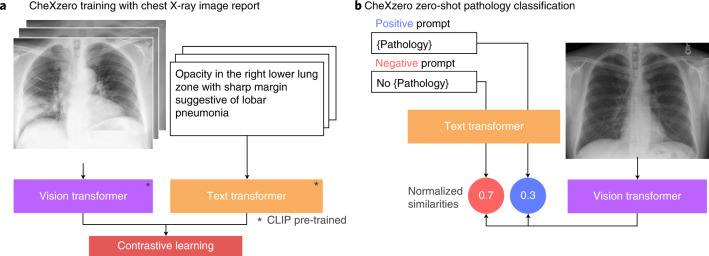
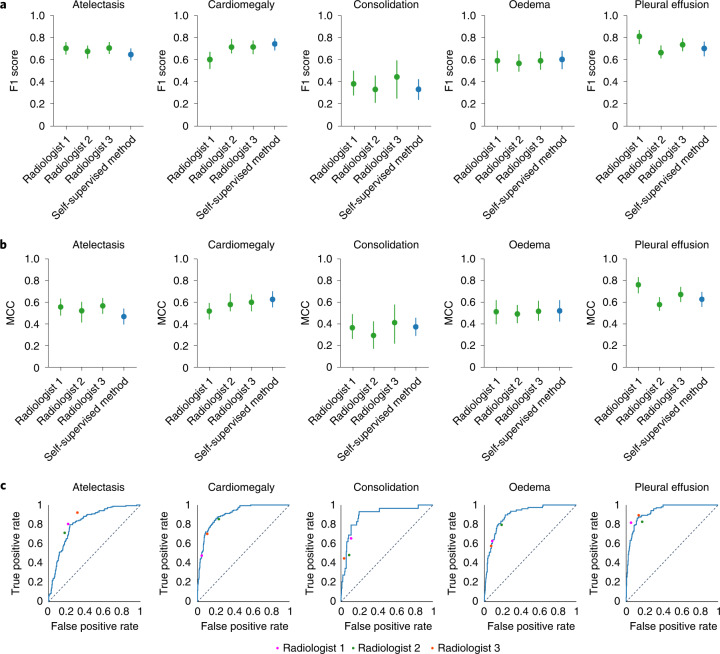
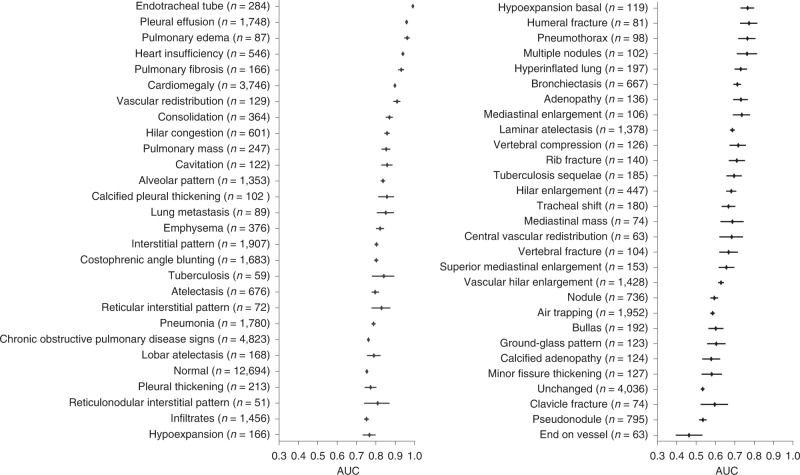
Verification
Claims the paper makes
The claims and statistics of this paper haven’t been checked yet.
Free: it reads the open-access text and checks the first 5 claims that cite a source we can check. Create a free account to check every claim.
Claims other papers make about this one
Each is checked against this paper’s own text: does it say what the citing paper says it does?
The source backs part of the claim, not all of it — or backs it for a different population, condition or comparison.
In the citing paper
“For instance, linking images from chest X-rays to corresponding report text data, and foundation models can alleviate the need for time-consuming and laborious manual annotation while preserving human-level accuracies and outperforming supervised methods18.”
From Large language models and multimodal foundation models for precision oncology (2024) · cites this paper as [18]
Experimental — accuracy not yet measuredThe source backs part of the claim, not all of it — or backs it for a different population, condition or comparison.
In the citing paper
“Although gathering such large datasets will pose a substantial challenge, these data will generally not require costly expert labels, given the success of self-supervision 9,54 .”
From Foundation models for generalist medical artificial intelligence (2023) · cites this paper as [9]
Experimental — accuracy not yet measuredThe cited source says what the claim attributes to it.
In the citing paper
“CheXzero can be applied to detect dozens of diseases in chest X-rays without being trained on explicit labels for these diseases 9 .”
From Foundation models for generalist medical artificial intelligence (2023) · cites this paper as [9]
Self-check
Percentages, sums and reported differences re-computed from the paper’s own numbers.
The self-check needs the paper’s full text.
Citations
Cites
A survey on deep learning in medical image analysis
Litjens, G., Kooi, T., Bejnordi, B. E., Setio, A. A. A., Ciompi, F., Ghafoorian, M., van der Laak, J. A. W. M., van Ginneken, B., & Sánchez, C. I. (2017) · Medical Image Analysis · doi:10.1016/j.media.2017.07.005 · Cited by 15,332
Learning Transferable Visual Models From Natural Language Supervision
Radford, A., Kim, J. W., Hallacy, C., Ramesh, A., Goh, G., Agarwal, S., Sastry, G., Askell, A., Mishkin, P., Clark, J., et al. (2021) · arXiv · doi:10.48550/arxiv.2103.00020 · Cited by 15,293
Momentum Contrast for Unsupervised Visual Representation Learning
He, K., Fan, H., Wu, Y., Xie, S., & Girshick, R. (2020) · 2020 IEEE/CVF Conference on Computer Vision and Pattern Recognition (CVPR) · doi:10.1109/cvpr42600.2020.00975 · Cited by 13,347
A simple framework for contrastive learning of visual representations
Chen, T., Kornblith, S., Norouzi, M., & Hinton, G. (2020) · arXiv · doi:10.48550/arxiv.2002.05709 · Cited by 10,857
Deep learning in medical image analysis
Shen, D., Wu, G., & Suk, H.-I. (2017) · Annual Review of Biomedical Engineering · doi:10.1146/annurev-bioeng-071516-044442 · Cited by 4,968
Liu, P., Yuan, W., Fu, J., Jiang, Z., Hayashi, H., & Neubig, G. (2023) · ACM Computing Surveys · doi:10.1145/3560815 · Cited by 4,361
Liu, P., Yuan, W., Fu, J., Jiang, Z., Hayashi, H., & Neubig, G. (2021) · arXiv · doi:10.48550/arxiv.2107.13586 · Cited by 4,352
A Survey on Deep Transfer Learning
Tan, C., Sun, F., Kong, T., Zhang, W., Yang, C., & Liu, C. (2018) · Lecture Notes in Computer Science · doi:10.1007/978-3-030-01424-7_27 · Cited by 3,165
Understanding deep learning (still) requires rethinking generalization
Zhang, C., Bengio, S., Hardt, M., Recht, B., & Vinyals, O. (2021) · Communications of the ACM · doi:10.1145/3446776 · Cited by 2,400
An overview of deep learning in medical imaging focusing on MRI
Lundervold, A. S., & Lundervold, A. (2019) · Zeitschrift für Medizinische Physik · doi:10.1016/j.zemedi.2018.11.002 · Cited by 2,058
Research works printed but not linked: 5
- Erhan, D., A. Courville, Y. Bengio, and P. Vincent. Why does unsupervised pre-training help deep learning? In Proc. Thirteenth International Conference on Artificial Intelligence and Statistics (eds Teh, Y. W. & Titterington, T.) 9:201–208 (PMLR, 2010).
- Radford, A., Kim, J. W., Hallacy, C., Ramesh, A., Goh, G., Agarwal, S.,... & Sutskever, I. Learning transferable visual models from natural language supervision. In Proc. 38th International Conference on Machine Learning 39:8748–8763 (PMLR, 2021).
- Avdic, A., Marovac, U. & Jankovic, D. Automated labeling of terms in medical reports in Serbian. Turk. J. Electr. Eng. Comput. Sci. 28, 3285–3303 (2020).
- Arjovsky, M.. Out of Distribution Generalization in Machine Learning (ed. Bottou, L.) PhD thesis, New York Univ. https://www.proquest.com/dissertations-theses/out-distribution-generalization-machine-learning/docview/2436913706/se-2 (2020).
- Xian, Y., Lampert, C. H., Schiele, B. & Akata, Z. Zero-shot learning—a comprehensive evaluation of the good, the bad and the ugly. IEEE Trans. Pattern Anal. Mach. Intell. 41, 2251–2265 (2018). 30028691 · DOI · Paper page
Cited by
Items 501–524 of 524
Disease-Aware Visual Token Memory for Chest X-Ray Report Generation with VLMs
Fichadia, R. H. (2026) · IEEE World Conference on Applied Intelligence and Computing (AIC) · doi:10.1109/aic70896.2026.11716964
“Domain-specific pretraining is preferred over a generic CLIP backbone because biomedical contrast (e.g. BioViL [9], CheXzero [10]) yields features markedly more sensitive to pathology cues than natural-image features. b) Disease-conditioned token distillation.”
CXR-CoRe: Two-Stage View- and Section-Aware Study-Level Chest X-ray Report Retrieval
Tian, Y., & Ma, J. (2026) · Journal of Imaging Informatics in Medicine · doi:10.1007/s10278-026-02377-1
Advancing Patient‐Centred AI With Adaptive Machine Learning
Kalogeropoulos, D., Barach, P. R., Downing, A., Verhulst, S., & Lustberg, M. B. (2026) · Cancer Medicine · doi:10.1002/cam4.72371
Foundation Models and Vision-Language Models in Medical Imaging: A Review
Mohsen, S., Lulu, L. M., Eassa, M., Raafat, R., Tawdrous, M. I., & Ibrahim, A. F. (2026) · Computers · doi:10.3390/computers15100707
Foundation Models and Multimodal Learning for Medical Data with Applications in Oncology
Waqas, A., Tripathi, A., Sivaram, S., Ali, F., Kuanar, S., Singh, Y., Ajami, H., Ünal, O., Huo, Y., Elhanashi, A., et al. (2026) · Journal of Imaging Informatics in Medicine · doi:10.1007/s10278-026-02319-x
Language-supervised electrocardiogram interpretation with vision transformer
Zhou, X., 李, 天., Nakamura, K., Hayama, H., Liu, S.-H., Sasano, T., Chen, W., & Zhu, X. (2026) · Health Information Science and Systems · doi:10.1007/s13755-026-00482-7
“This paradigm has demonstrated considerable performance in medical imaging domains including chest radiography [15] and echocardiography [16], yet its application to ECG images remains unexplored.”
When Does Data Augmentation Help with Few Chest-Radiograph Training Patients?
Sariyar, M. (2026) · Mathematics · doi:10.3390/math14203732
Concept-Enhanced Hypergraph-Guided Medical Image Retrieval Using CUI Semantics
Saad, M., Emam, M. H., Sani, M. I., & Momen, S. (2026) · IEEE Access · doi:10.1109/access.2026.3743341
“…scientific image-text pairs [14]; MedCLIP learned from unpaired images and text [15]; BioViL exploited radiology text semantics [16]; GLoRIA learned global and local image-text representations [17]; and CheXzero showed strong zero-shot pathology detection without manual training labels [43].”
Afreen, S., & Kalpana, G. (2026) · International journal of intelligent engineering and systems · doi:10.22266/ijies2026.1130.25
Lee, T.-L. I., Viswanathan, V. S., Kikano, E. G., Lall, N., Volin, J. R., Tsai, H.-C. S., Safdar, N. M., & Harri, P. (2026) · European Journal of Radiology · doi:10.1016/j.ejrad.2026.113318
Li, L. (2026) · Journal of Applied Clinical Medical Physics · doi:10.1002/acm2.70873
“…that large-scale self-supervised CXR pretraining can provide strong trans-ferable image features for multiple downstream tasks, 8,9 CheXzero 39 and MedCLIP 40 show that image-report or medical image-text contrastive learning can improve label-efficient CXR recognition,while BiomedCLIP 10…”
InfluentialCai, Y. (2026) · International Conference on Artificial Intelligence Technologies and Applications (ICAITA) · doi:10.1109/icaita71179.2026.11737020
CoRE: Relating Fine-Grained Chest X-ray Findings in Anatomical ContextPreprint
Kim, M., & Moon, J. H. (2026) · arXiv (Cornell University) · doi:10.48550/arxiv.2610.30584
“Localization baselines are ChEX (M¨uller et al., 2024) and MedGrounder (Zhang et al., 2025); finding-level evaluation on the CI gold standard and exter-nal datasets additionally includes the zero-shot CXR baselines CheXzero (Tiu et al., 2022), RadZero (Park et al., 2025), and CARZero (Lai et al., 2024).”
Yuan, J., Wang, R., Zhao, L., Zhao, J., Li, G., & Kang, Q. (2026) · Information Fusion · doi:10.1016/j.inffus.2026.104906
Gao, E., Cao, Y., Shen, J., & Xu, F. (2026) · Ocean Engineering · doi:10.1016/j.oceaneng.2026.129007
Ramakrishna, P., Strand, J., Song, S., Tavakoli, M. B., Zetumer, S., Majidi, S. P., Jiang, Y., Shen, M., Berni, A., Gregori, G., et al. (2026) · medRxiv · doi:10.64898/2026.10.30.26366929
ConXCLIP: Concept-Enhanced Vision-Language Learning for Chest X-Ray Classification
Nguyen, D.-M., Nguyen-Mau, T., Vo, D.-V., & Huynh, V. (2026) · Communications in computer and information science · doi:10.1007/978-981-92-7652-3_10
AI-Driven Image Recognition for Automating Radiology Diagnostics
Arumugam, M., Arunprasath, T., Dhiravidachelvi, E., Mukkapati, N., Dhanamalar, M., & Dhanraj, J. (2026) · doi:10.1109/icact70625.2026.11748797
Tanczos, T., Pavlovičová, J., Kurilová, V., & Benešová, W. (2026) · Journal of Imaging · doi:10.3390/jimaging12110549
Araujo-Filho, J. D. A. B., Tavora, F., Nascimento, E. C. T., Harada, G., Mayoral, M., & Ginsberg, M. S. (2026) · Clinical Imaging · doi:10.1016/j.clinimag.2026.110982
Winarno, E., Danang, D., Prasetya, F. A., Adhiati, C. S., & Jawad, S. A. (2026) · International Conference on Creative Communication and Innovative Technology (ICCIT) · doi:10.1109/iccit70127.2026.11749002
Diffusion Prior–Driven Vision-Language Adaptation for Few-Shot Medical Anomaly Detection
Li, X., & Shang, M. (2026) · Journal of Imaging Informatics in Medicine · doi:10.1007/s10278-026-02457-2
Hou, K., Liu, W., Huang, Y., Zhang, H., Jin, H., Sun, Y., gao, Y., Li, Z., Zhang, L., Alaa, A. M., et al. (2026) · arXiv (Cornell University) · doi:10.48550/arxiv.2611.05231
Dahiru, I., Adam, B. A., Umar, S. N., & Pal, B. L. (2026) · Research Square · doi:10.21203/rs.3.rs-11444323/v1
Metadata
- Authors
- Tiu, E., Talius, E., Patel, P., Langlotz, C. P., Ng, A. Y., & Rajpurkar, P.
- Affiliations
- Harvard University (US)
- Stanford University (US)
- Corresponding author
- Rajpurkar, Pranav
- Venue
- Nature Biomedical Engineering
- Published
- 2022-09-15
- Volume
- 6
- Issue
- 12
- Pages
- 1399-1406
- ISSN
- 2157-846X (ISSN-L)
- PMC
- PMC9792370
- OpenAlex
- W4296027312
- Cited by
- 442
- References
- 43
- Citations by year
- 2026: 130 · 2025: 147 · 2024: 120 · 2023: 45
- FWCI
- 44.36
- Type
- journal article
- Language
- en
- Open access
- hybrid
- doi.org
- Licence
- cc-by
- creativecommons.org/licenses/by/4.0 (tdm)
- creativecommons.org/licenses/by/4.0 (vor)
- Locations
- Nature Biomedical Engineering (publishedVersion, cc-by)
- PubMed Central (publishedVersion, cc-by)
- PubMed (publishedVersion)
- Funders
- National Heart, Lung, and Blood Institute
- Topics
- Health Sciences › Medicine › Radiology, Nuclear Medicine and Imaging › COVID-19 diagnosis using AI
- Health Sciences › Medicine › Health Informatics › Artificial Intelligence in Healthcare and Education
- Health Sciences › Medicine › Radiology, Nuclear Medicine and Imaging › Radiomics and Machine Learning in Medical Imaging
- Keywords
- chest radiography, pathology detection, self-supervised learning, external validation, multi-institutional data, image interpretation, transfer learning
- MeSH terms
- Machine Learning, Supervised Machine Learning, X-Rays
About these checks
Registry, retraction, Cites and statistics results are computed, not judged, with one exception: a printed reference that no index lists is read once by a model before it counts as a citation error. Claims are extracted by a model and kept only when their quote appears verbatim in the text; each cited source is then checked, with a model’s help, for whether it says what the claim relies on. Those verdicts can be wrong — read the claim’s quote and the cited source before relying on one.
Statistics and arithmetic are recomputed, not judged.
Confidence bands are shown only for fields calibrated on our annotated test set. None is calibrated yet, so no band is shown.
What counts as a claim ›How we measure confidence ›How we check this ›
Are you an author, or do you see a problem with this page? Request a review
Data sources
Bibliographic data: Semantic Scholar, OpenAlex, Crossref.
Contains information from the Semantic Scholar Academic Graph Datasets, made available under the ODC Attribution License (ODC-BY 1.0).
Semantic Scholar’s data is described in: Kinney, R., et al. (2023). The Semantic Scholar Open Data Platform. arXiv:2301.10140.
