

Underestimated burden of per- and polyfluoroalkyl substances in global surface waters and groundwaters
Open accessThe DOI matches its Crossref record; 45 of the 46 references it cites were found in a registry or an index; 7 of the 22 sources its claims cite were checked for support.
Abstract
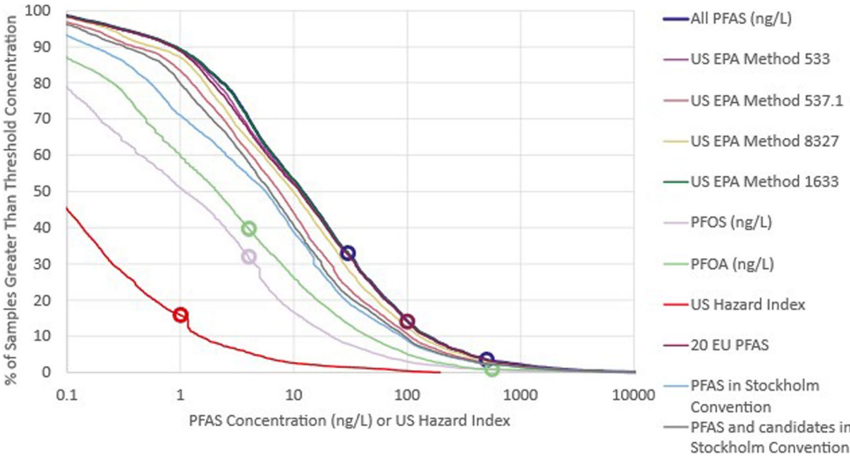
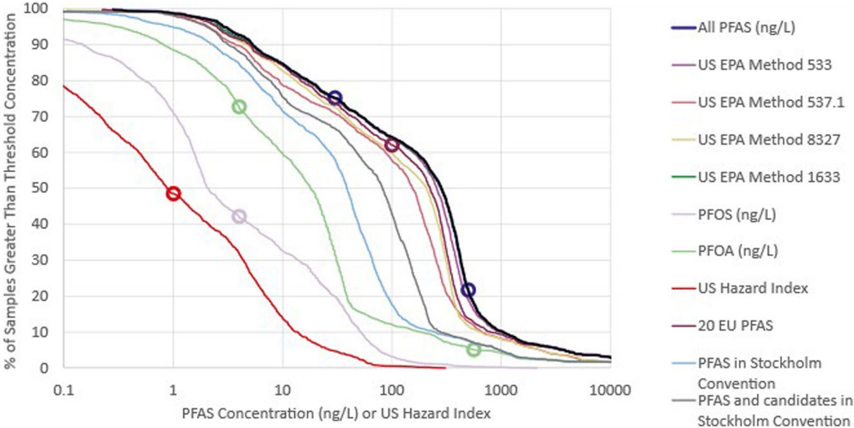
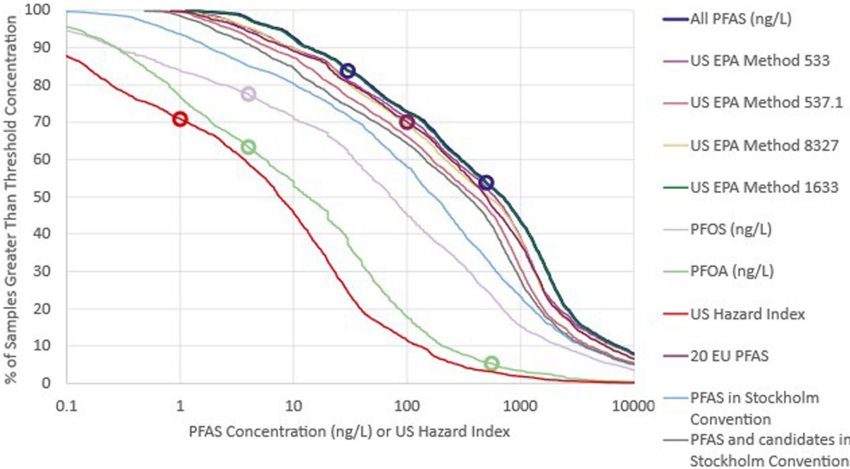
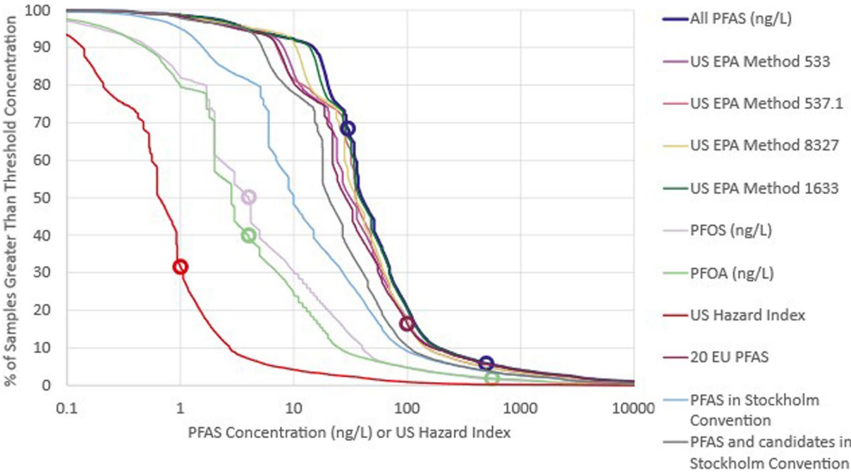
AbstractPer- and polyfluoroalkyl substances (PFAS) are a class of fluorinated chemicals used widely in consumer and industrial products. Their human toxicity and ecosystem impacts have received extensive public, scientific and regulatory attention. Regulatory PFAS guidance is rapidly evolving, with the inclusion of a wider range of PFAS included in advisories and a continued decrease in what is deemed safe PFAS concentrations. In this study we collated PFAS concentration data for over 45,000 surface and groundwater samples from around the world to assess the global extent of PFAS contamination and their potential future environmental burden. Here we show that a substantial fraction of sampled waters exceeds PFAS drinking water guidance values, with the extent of exceedance depending on the jurisdiction and PFAS source. Additionally, current monitoring practices probably underestimate PFAS in the environment given the limited suite of PFAS that are typically quantified but deemed of regulatory concern. An improved understanding of the range of PFAS embodied in consumer and industrial products is required to assess the environmental burden and develop mitigation measures. While PFAS is the focus of this study, it also highlights society’s need to better understand the use, fate and impacts of anthropogenic chemicals.
Overview
CoChat Summary
TL;DR
Collating 48,985 surface and groundwater samples from 367 published papers and government websites, this study finds PFAS contamination is globally pervasive and that a substantial fraction exceeds drinking water guidance values, with exceedance varying by jurisdiction and source. It argues current monitoring underestimates the PFAS burden because typical methods quantify only a limited suite of PFAS.
Key findings
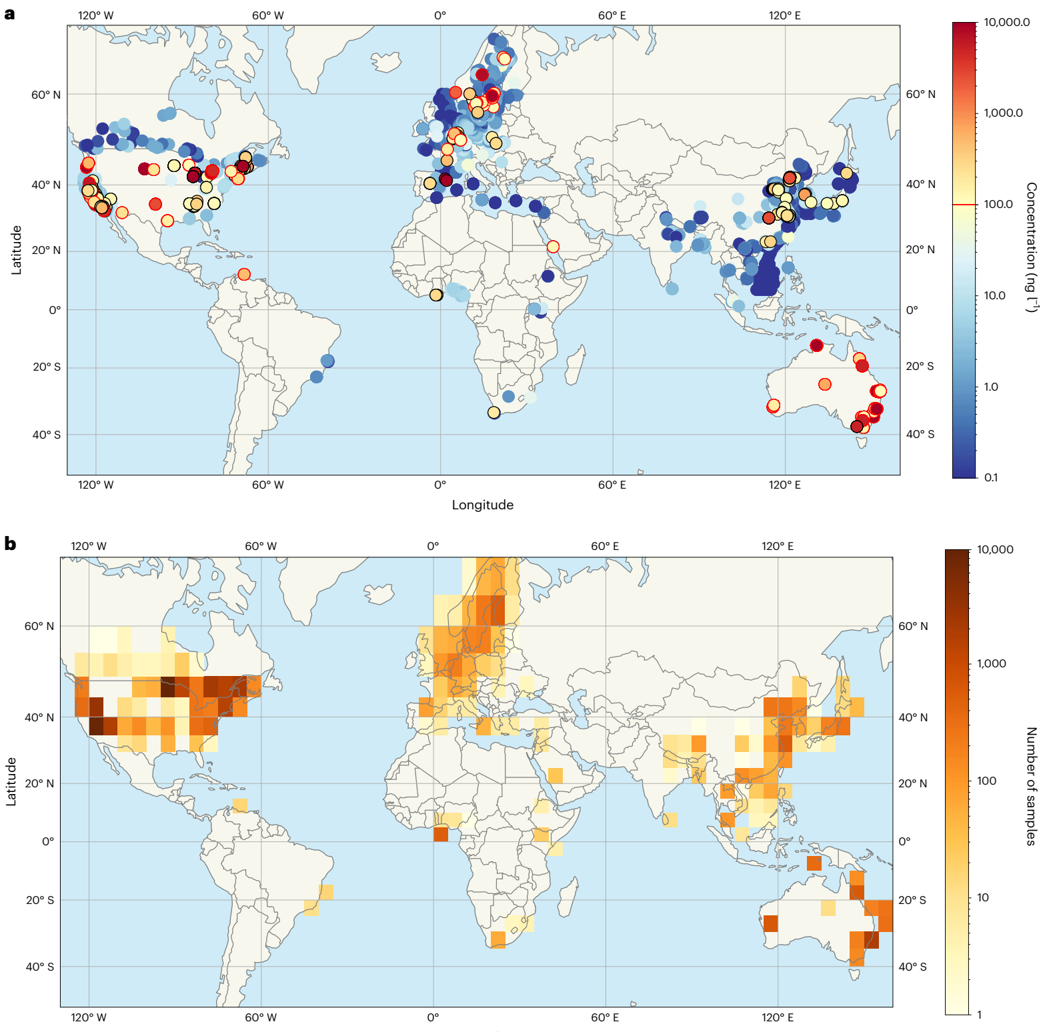
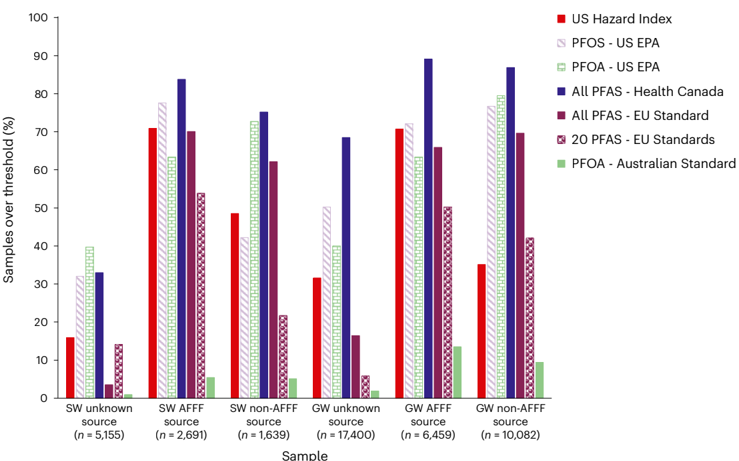
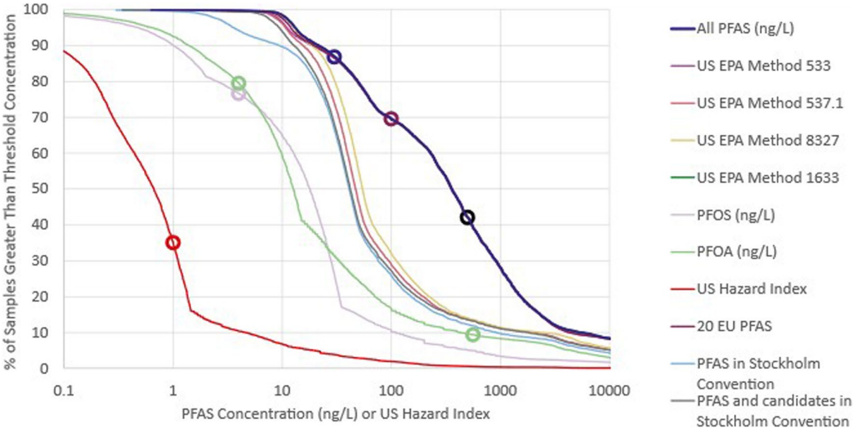
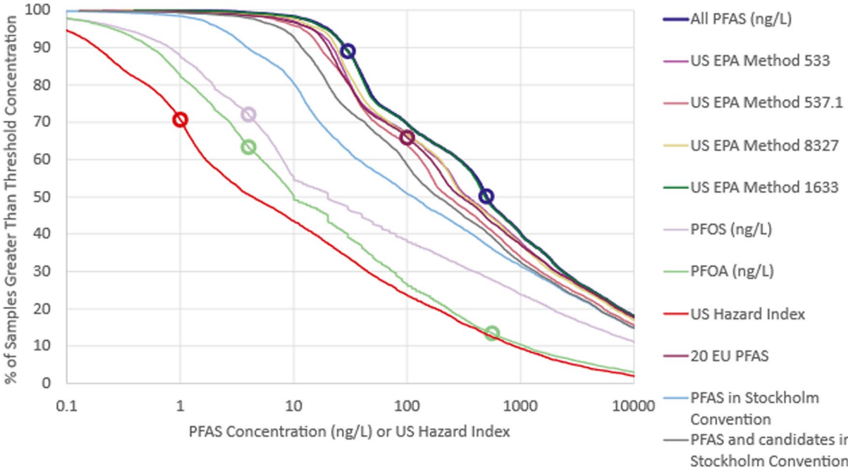
- In groundwater with known AFFF contamination, 71%, 72% and 63% exceeded the proposed US EPA hazard index (n = 6,312), proposed PFOS (n = 6,442) and proposed PFOA (n = 6,447) drinking water regulation, respectively; with no known source, exceedance was still 31%, 50% and 40% (n = 14,905; 15,351; 15,499). Groundwater with no known source exceeded Health Canada’s criteria in 69% but the EU sum of all PFAS criterion (500 ng l⁻¹) in only 6% (n = 16,151); the alternate EU sum of 20 PFAS criterion was exceeded in 16% (n = 16,143).
- Across 33,940 groundwater samples, 57 distinct PFAS were quantified; on average 16 distinct PFAS (maximum 38) were quantified, and no studies quantified FTOH. When two or more FTOH were quantified in consumer products, they represented a median of 58% (n = 365) of total PFAS.
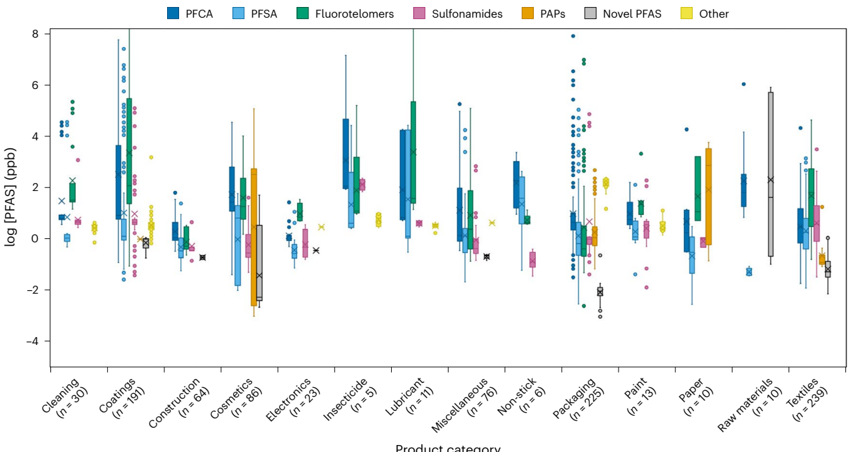
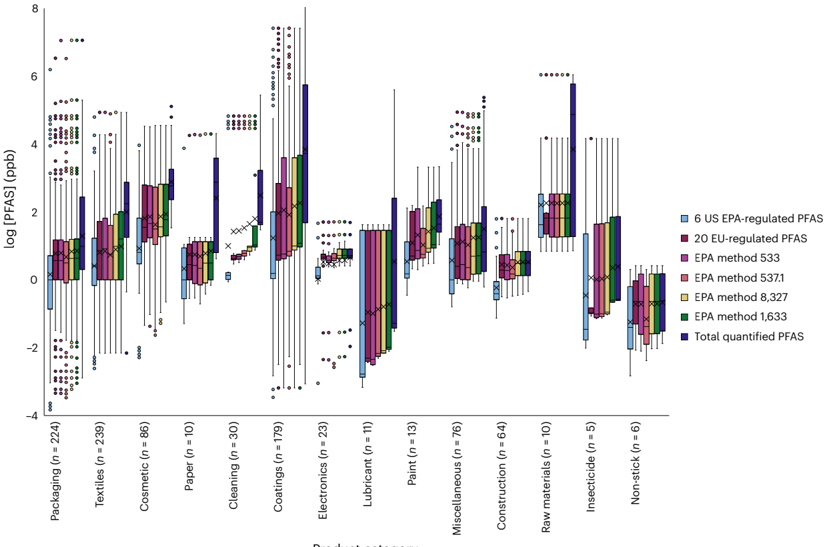
- In 943 non-AFFF consumer products from 38 studies, fluorotelomers represented a median of 72% of total measured PFAS by mass and PFCAs 25%; PAPs were 14%, sulfonamides 7% and PFSAs 4%. Using only EPA draft method 1633 would underestimate fluorotelomers by a factor of 25 and overestimate PFCAs, PFSAs and sulfonamides by factors of 2.8, 2.8 and 4.2, respectively.
- In AFFF, PFOS represented a median 51% of PFAS in historic 3M AFFF (n = 14); fluorotelomers dominated other AFFF (median 93%, n = 83), with FTS at median 73% (n = 69) and FTOH at median 10% (n = 38). EPA method 1633 underrepresents total PFAS in AFFF by a median factor of 2.8.
Methods
- Reviewed and collated 48,985 samples from 367 published papers and government websites to build a global surface- and groundwater PFAS database; also characterized PFAS in 943 non-AFFF consumer products from 38 studies and 148 AFFF samples from 11 studies. Data were collated, compared, analysed and statistically validated using Python scripts and MS Excel.
- Aqueous PFAS concentrations were reported in ng l⁻¹; product data were converted to ppb. Samples below detection limits were assigned a random value between zero and the detection limit using Python (less than 60% of samples were below the detection limit, so substitution was deemed suitable), with a repeat analysis setting BDL to zero. Sources were categorized as known non-AFFF, known AFFF or unknown; exceedance was benchmarked against regulatory or advisory thresholds, using EPA draft method 1633 as a benchmark.
- For mapping, the latitude and longitude of the sampling location were used; where only the country was specified, a random major city in that country was assigned.
Limitations
- Stated: the study is limited to PFAS tested in previous studies, the analytical instruments and methods used, and the locations sampled; sampled locations may have higher PFAS concentrations than unsampled areas because research tends to concentrate where PFAS presence is likely, and high-sampling zones may skew representation.
- Stated: because only a limited suite of PFAS is typically quantified, estimates of environmental burden are likely underestimates, and it is not possible to reliably discuss how well current methods capture the range and mass of PFAS in surface and groundwater. FTOH conclusions are difficult from two studies with relatively few samples.
- Evident from the text: heterogeneous data from 367 papers and government websites, random substitution for BDL values, random city assignment when only country was known, and lack of a standardized TOP assay or US EPA GC/MS/MS aqueous methods for FTOH; detection-limit assumptions affect results, though both BDL approaches concluded that an important fraction of samples exceeds regulatory threshold levels.
Model-written summary. Check it against the paper before relying on it.
Integrity signals
Registry
Cites
Statistics
Figures
Verification
Claims the paper makes
6 Valid · 1 Not valid · 7 Not checked · 60 Own results and interpretations
The cited sources support only part of this claim — read each source’s verdict below.
In the paper
“Studies using the TOP assay to WWTP effluent report a considerable PFAS fraction that go undetected using EPA methods 41,42 .”
§ Underestimated burden of per-and polyfluoroalkyl substances in global surface waters and groundwaters > 20 EU-regulated PFAS
What the sources say
- Partly supportedcites [41] 40. Ye, F. et al. Spatial distribution and importance of potential perfluoroalkyl acid precursors in urban rivers and sewage treatment plant effluent-case study of Tama River, Japan. Water Res. 67, 77-85 (2014). sourceExperimental — accuracy not yet measured
Section 3.2 (p. 9) reports that oxidation revealed additional PFAA precursors in sewage-treatment-plant effluent, averaging 16 ng/L, with a mean oxidation-product-to-original-PFAA ratio of 0.21. The conclusion (p. 10) says commonly measured precursors represented only part of the total. The paper does not compare its findings with EPA methods, so that specific attribution is unsupported. (LLM, conf=0.86)
- Not checked — no full text of the sourcecites [42] 41. Tavasoli, E., Luek, J. L., Malley, J. P. & Mouser, P. J. Distribution and fate of per-and polyfluoroalkyl substances (PFAS) in wastewater treatment facilities. Environ. Sci. Processes Impacts 23, 903-913 (2021). source
- Asserted: passes — The authors put it forward as true.
- Checkable: passes — It can be checked against evidence.
- Load-bearing: passes — The paper’s conclusions depend on it.
- Based: passes — The paper gives a reason why it holds.
- Partly supported
The cited sources support only part of this claim — read each source’s verdict below.
In the paper
“In the 16 urban river samples in China 34 and eight river samples in Bangladesh 33 , FTOH represented a median of 53% of the total PFAS (range of 46 to 62%) and 2% (ranging from 0.9 to 34%), respectively.”
§ Underestimated burden of per-and polyfluoroalkyl substances in global surface waters and groundwaters > 20 EU-regulated PFAS
What the sources say
- Partly supportedcites [33] 32. Morales-McDevitt, M. E. et al. Poly-and perfluorinated alkyl substances in air and water from Dhaka, Bangladesh. Environ. Toxicol. Chem. 41, 334-342 (2022). sourceExperimental — accuracy not yet measured
The Materials and Methods section reports eight water grab samples, and Results and Discussion > Neutral PFAS reports FTOH in water. Our copy does not report a median FTOH share of total PFAS of 2% or a range of 0.9–34%; it also describes sampling sites that include lakes, not only rivers. Page numbers are unavailable in the indexed copy. (LLM, conf=0.85)
plainn = 8- Asserted: passes — The authors put it forward as true.
- Checkable: passes — It can be checked against evidence.
- Load-bearing: unclear — It is unclear whether the paper’s conclusions depend on it.
- Based: passes — The paper gives a reason why it holds.
- Partly supported
The cited sources support only part of this claim — read each source’s verdict below.
In the paper
“A major drawback of the TOP assay is that not all PFAS undergo oxidation to PFCAs or PFSA, particularly the perfluoroether class which transform into unmonitored terminal PFAS 47 .”
§ Underestimated burden of per-and polyfluoroalkyl substances in global surface waters and groundwaters > 20 EU-regulated PFAS
What the sources say
- Partly supportedcites [47] 46. Zhang, C., Hopkins, Z. R., McCord, J., Strynar, M. J. & Knappe, D. R. U. Fate of per-and polyfluoroalkyl ether acids in the total oxidizable precursor assay and implications for the analysis of impacted water. Environ. Sci. Technol. Lett. 6, 662-668 (2019). sourceExperimental — accuracy not yet measured
The Results and Discussion (page not provided) says a TOP assay that monitors only PFCAs and PFSAs can miss a large fraction of PFASs. But it does not show that perfluoroalkyl ether acids transform into unmonitored terminal PFASs: the studied perfluoroalkyl ether acids were stable terminal products, while some polyfluoroalkyl ether acids oxidized to products the authors could not identify. (LLM, conf=0.86)
plainstates a cause- Asserted: passes — The authors put it forward as true.
- Checkable: passes — It can be checked against evidence.
- Load-bearing: passes — The paper’s conclusions depend on it.
- Based: passes — The paper gives a reason why it holds.
- Partly supported
A result the paper reports from its own data — it cites no other source for it, so there is none to check. The quote shows it is in the paper.
In the paper
“Across all products, EPA method 1633 suggests a median distribution of 73% PFCA (n = 781), 11% PFSA (n = 750), 16% fluorotelomers (n = 353), 10% sulfonamides (n = 242) and 0.1% novel PFAS (n = 27), with phosphate-based PFAS not being quantified with this method.”
§ Underestimated burden of per-and polyfluoroalkyl substances in global surface waters and groundwaters > Non-AFFF consumer and industrial products
hedgedn = 781- Asserted: passes — The authors put it forward as true.
- Checkable: passes — It can be checked against evidence.
- Load-bearing: passes — The paper’s conclusions depend on it.
- Based: passes — The paper gives a reason why it holds.
A result the paper states — it cites no source for it, so there is none to check. The quote shows it is in the paper.
In the paper
“However, when there was no known PFAS source, or a known non-AFFF source, the incidence of SW samples exceeding regulatory thresholds was lower.”
§ Underestimated burden of per-and polyfluoroalkyl substances in global surface waters and groundwaters > Extent of global PFAS water contamination
plainstates an association- Asserted: passes — The authors put it forward as true.
- Checkable: passes — It can be checked against evidence.
- Load-bearing: unclear — It is unclear whether the paper’s conclusions depend on it.
- Based: passes — The paper gives a reason why it holds.
37 more claims
Create a free account to see all 74 claims and every source verdict.
- It may state two separate claims as one. 28
- Probably not a substantial claim. 7
Claims other papers make about this one
Each is checked against this paper’s own text: does it say what the citing paper says it does?
The source backs part of the claim, not all of it — or backs it for a different population, condition or comparison.
In the citing paper
“PFASs are detected in groundwater worldwide, often exceeding drinking water guidelines, with both legacy and emerging compounds present even in remote or rural areas [127,128].”
From Industrial Applications, Environmental Fate, Human Exposure, and Health Effects of PFAS (2025) · cites this paper as [127]
Experimental — accuracy not yet measuredThe source backs part of the claim, not all of it — or backs it for a different population, condition or comparison.
In the citing paper
“PFAS exposure is linked to adverse health effects-such as immune, developmental, and metabolic toxicity-and ecosystem risks, especially since many compounds are bioaccumulative and toxic [127,130].”
From Industrial Applications, Environmental Fate, Human Exposure, and Health Effects of PFAS (2025) · cites this paper as [127]
Experimental — accuracy not yet measuredThe source backs part of the claim, not all of it — or backs it for a different population, condition or comparison.
In the citing paper
“A comprehensive global survey published in 2024 analyzed over 45,000 surface and groundwater samples and found that approximately 31% of samples exceeded PFAS thresholds deemed harmful to human health [35].”
From Exposure to Per- and Polyfluoroalkyl Substances (PFASs) in Healthcare: Environmental and Clinical Insights (2025) · cites this paper as [35]
Experimental — accuracy not yet measuredThe source backs part of the claim, not all of it — or backs it for a different population, condition or comparison.
In the citing paper
“A global review by [1] has suggested that the concentrations of PFAS in the paper industries are not significantly different from those in other industrial activities.”
From Investigating the extent of PFAS contamination in the Upper Danube Basin across environmental compartments (2025) · cites this paper as [1]
Experimental — accuracy not yet measuredThe source backs part of the claim, not all of it — or backs it for a different population, condition or comparison.
In the citing paper
“In a hypothetical scenario of environmental PFAS degradation, a cell will approach toxic levels of intracellular fluoride (>100 μM) upon uptake and defluorination of perfluorooctanoic acid from just 10 pL of medium contaminated with 1 ppb of this substance, a value that is observed in PFAS-polluted environmental samples70.”
From The link between ancient microbial fluoride resistance mechanisms and bioengineering organofluorine degradation or synthesis (2024) · cites this paper as [70]
Experimental — accuracy not yet measured
4 more claims about this paper
Create a free account to see every claim other papers make about this one.
Citations
Cites
Buck, R. C., Franklin, J., Berger, U., Conder, J. M., Cousins, I. T., de Voogt, P., Jensen, A. A., Kannan, K., Mabury, S. A., & van Leeuwen, S. P. (2011) · Integrated Environmental Assessment and Management · doi:10.1002/ieam.258 · Cited by 4,641 · cited 3×
“PFAS for AFFF applications have been synthesized by two synthesis processes: electrochemical fluorination and telom-erization 21 .”
Sources, fate and transport of perfluorocarboxylates
Prevedouros, K., Cousins, I. T., Buck, R. C., & Korzeniowski, S. H. (2006) · Environmental Science & Technology · doi:10.1021/es0512475 · Cited by 2,594
Fenton, S. E., Ducatman, A., Boobis, A., DeWitt, J. C., Lau, C., Ng, C., Smith, J. S., & Roberts, S. M. (2020) · Environmental Toxicology and Chemistry · doi:10.1002/etc.4890 · Cited by 2,445
Hu, X. C., Andrews, D. Q., Lindstrom, A. B., Bruton, T. A., Schaider, L. A., Grandjean, P., Lohmann, R., Carignan, C. C., Blum, A., Balan, S. A., et al. (2016) · Environmental Science & Technology Letters · doi:10.1021/acs.estlett.6b00260 · Cited by 1,333 · cited 1×
“Studies have also assessed or compared aqueous phase PFAS concentrations in select regions 19,20 .”
Wang, Z., Cousins, I. T., Scheringer, M., Buck, R. C., & Hungerbühler, K. (2014) · Environment International · doi:10.1016/j.envint.2014.04.013 · Cited by 735 · cited 1×
“All perfluoroalkyl Whereas studies have estimated PFAS production globally 16,17 and quantified PFAS in commercial and industrial products, their fate is still unknown.”
PFAS Molecules: A Major Concern for the Human Health and the Environment
Panieri, E., Baralic, K., Djukic-Cosic, D., Buha Djordjevic, A., & Saso, L. (2022) · Toxics · doi:10.3390/toxics10020044 · Cited by 651
Cousins, I. T., Johansson, J. H., Salter, M. E., Sha, B., & Scheringer, M. (2022) · Environmental Science & Technology · doi:10.1021/acs.est.2c02765 · Cited by 595
Identification of Novel Fluorochemicals in Aqueous Film-Forming Foams Used by the US Military
Place, B. J., & Field, J. A. (2012) · Environmental Science & Technology · doi:10.1021/es301465n · Cited by 543 · cited 1×
“Furthermore, when the TOP assay is applied to AFFF samples, considerable increases in total PFAS mass has been reported 31,32 , as noted in non-AFFF consumer product studies.”
Helsel, D. R. (2006) · Chemosphere · doi:10.1016/j.chemosphere.2006.04.051 · Cited by 505
The High Persistence of PFAS Is Sufficient for Their Management as a Chemical Class
Cousins, I. T., DeWitt, J. C., Glüge, J., Goldenman, G., Herzke, D., Lohmann, R., Ng, C. A., Scheringer, M., & Wang, Z. (2020) · Environmental Science: Processes & Impacts · doi:10.1039/d0em00355g · Cited by 491
Research works printed but not linked: 1
- Official Journal of the European Union (European Parliament & Council of the European Union, 2020).
Cited by
Tshangana, C. S., Nhlengethwa, S. T., Glass, S., Denison, S. B., Kuvarega, A. T., Nkambule, T. T. I., Mamba, B. B., Alvarez, P. J. J., & Muleja, A. A. (2025) · npj Clean Water · doi:10.1038/s41545-025-00457-3 · Cited by 196
“While high levels are usually found near PFAS manufacturing or discharge sites, some level of PFAS is nearly ubiquitous in water sources worldwide 23,24 .”
Stockbridge, R. B., & Wackett, L. P. (2024) · Nature Communications · doi:10.1038/s41467-024-49018-1 · Cited by 80
Fu, K., Huang, J., Luo, F., Fang, Z., Yu, D., Zhang, X., Wang, D., Xing, M., & Luo, J. (2024) · Environmental Science & Technology · doi:10.1021/acs.est.4c06519 · Cited by 151
Zhang, K., Qadeer, A., Chang, S., Tu, X., Shang, H., Khan, M. A., Zhu, Y., Fu, Q., Yu, Y., & Feng, Y. (2025) · Environment International · doi:10.1016/j.envint.2025.109602 · Cited by 69
Hu, J., Xu, Y., Song, X., Miao, Y., Yu, Y., Xiang, W., Huang, M., Wu, W., Liang, K., Zhao, S., et al. (2024) · Journal of Hazardous Materials · doi:10.1016/j.jhazmat.2024.136283 · Cited by 78
Zhang, K., Cheng, P. G., Liu, Y., & Xia, S. (2024) · Water Research · doi:10.1016/j.watres.2024.122276 · Cited by 73
Heavy-Metal Ions Control on PFAS Adsorption on Goethite in Aquatic Systems
Chaudhary, A., Usman, M., Cheng, W., Haderlein, S. B., Boily, J., & Hanna, K. (2024) · Environmental Science & Technology · doi:10.1021/acs.est.4c10068 · Cited by 73
Huang, J., Fu, K., Fang, Z., & Luo, J. (2024) · Water Research · doi:10.1016/j.watres.2024.122937 · Cited by 50
Alsadik, A., Akintunde, O. O., Habibi, H. R., & Achari, G. (2025) · ENVIRONMENTAL SYSTEMS RESEARCH · doi:10.1186/s40068-025-00411-9 · Cited by 71
“…of spatial PFAS concentrations, compiled from the interpretation of all measured data from various sampling sites and circled as red (known Aqueous film forming foam (AFFF) or non-AFFF) or black (unknown sites) on a global map developed in a recent study (Ackerman Grunfeld et al. 2024).”
InfluentialLi, Y., Zhang, Y., Liu, X., Zhou, X., Tao, Y., Fu, Q., Du, M., Qi, L., Zheng, Y., & Wang, D. (2024) · Water Research · doi:10.1016/j.watres.2024.122972 · Cited by 48
Lee, J. C., Smaoui, S., Duffill, J., Marandi, B., & Varzakas, T. H. (2025) · Foods · doi:10.3390/foods14060958 · Cited by 61
Unravelling groundwater–stream connections over the continental United States
Yang, C., Condon, L. E., & Maxwell, R. M. (2025) · Nature Water · doi:10.1038/s44221-024-00366-8 · Cited by 57
“The ability to do not only retrospective analyses but also predictive simulations that include potentially long groundwater flow paths to surface water is important for understanding water quality into the future 32 .”
Jiang, J., Han, D., Xiao, Y., & Song, X. (2024) · Water Research · doi:10.1016/j.watres.2024.122810 · Cited by 39
Chen, T., He, X., Zhang, Q., He, A., Liu, C., Sun, Y., Wei, S., Chen, R., Li, L., Li, J., et al. (2025) · Environmental Science & Technology · doi:10.1021/acs.est.5c03479 · Cited by 41
Dehghani, M., Aghaei, M., Bashardoust, P., Ghalhari, M. R., Nayeri, D., Malekpoor, M., Sheikhi, S., & Shi, Z. (2025) · Environmental Sciences Europe · doi:10.1186/s12302-025-01122-9 · Cited by 55
Fatima, M., Kelso, C., & Hai, F. I. (2025) · Water · doi:10.3390/w17091401 · Cited by 50
Wang, T., Wu, J., Hu, T., Wang, C., Li, S., Li, Z., & Chen, J. (2024) · The Science of The Total Environment · doi:10.1016/j.scitotenv.2024.177668 · Cited by 36
Andrunik, M., & Smol, M. D. (2025) · Water · doi:10.3390/w17192813 · Cited by 38
Huang, J., Fu, K., Liu, H., Zhang, J., & Luo, J. (2025) · Environmental Science & Technology · doi:10.1021/acs.est.5c02960 · Cited by 34
Baqar, M., Chen, H., Yao, Y., & Sun, H. (2024) · Analytical and Bioanalytical Chemistry · doi:10.1007/s00216-024-05643-9 · Cited by 42
“Per-and polyfluoroalkyl substances (PFAS) constitute a diverse class of over 14,000 chemicals that have been widely utilized across various industrial and commercial applications [1].”
Mahofa, E. P., Meragawi, S. E., Vilayatteri, M. A., Dwivedi, S., Panda, M. R., Jovanović, P., van Duin, A. C. T., Freeman, B. D., Tanksale, A., & Majumder, M. (2025) · ACS Nano · doi:10.1021/acsnano.4c15413 · Cited by 35
PFAS: The Journey from Wonder Chemicals to Environmental Nightmares and the Search for Solutions
Perera, D. C., & Meegoda, J. N. (2024) · Applied Sciences · doi:10.3390/app14198611 · Cited by 39
Barber, L. B., Miller, S. A., Blaney, L. M., Bradley, P. M., Faunce, K. E., Fleck, J. A., Frick, M., He, K. F., Hollins, R. D., Lewellyn, C., et al. (2025) · Environmental Science & Technology · doi:10.1021/acs.est.4c12167 · Cited by 32
Arginine Metabolism Reprogramming in Perfluorooctanoic Acid (PFOA)-Induced Liver Injury
Gao, J., Li, T., Guo, W., Yan, M., Liu, J., Yao, X., Lv, M., Ding, Y., Qin, H., Wang, M., et al. (2025) · Environmental Science & Technology · doi:10.1021/acs.est.4c07971 · Cited by 32
The State of the World's Chemical Pollution
Scheringer, M., & Schulz, R. (2025) · Annual Review of Environment and Resources · doi:10.1146/annurev-environ-111523-102318 · Cited by 52
Behroozi, A. H., Meunier, L., Mirahsani, A., Champagne, P., & Koupaie, E. H. (2025) · Journal of Hazardous Materials Advances · doi:10.1016/j.hazadv.2025.100626 · Cited by 52
Wang, Q., Ruan, Y., Shao, Y., Jin, L., Xie, N., Yang, X., Hong, Y., Wang, H., Tsujimoto, A., Yasuhara, M., et al. (2025) · Environmental Science & Technology · doi:10.1021/acs.est.5c02731 · Cited by 31
Yao, J., Shou, Y., Sheng, N., Ma, Y., Pan, Y., Zhao, F., Fang, M., & Dai, J. (2025) · Environmental Science & Technology · doi:10.1021/acs.est.4c13813 · Cited by 27
Characterization of PFOA isomers from PFAS precursors and their reductive defluorination
Sun, J. F., Lorpaiboon, W., Fox, N., Jones, A. M., Ho, J., Manefield, M. J., Kumar, N., O’Carroll, D. M., & Lee, M. J. (2024) · Water Research · doi:10.1016/j.watres.2024.122717 · Cited by 29
Self-citationCharacterization of per- and polyfluoroalkyl substances (PFASs) in Chinese river and lake sediments
Tulcan, R. X. S., Yarlequé, C. M. H., Lü, X., Yeerkenbieke, G., Ochoa‐Herrera, V., Gunarathne, V., & Yánez-Jácome, G. S. (2025) · Journal of Hazardous Materials · doi:10.1016/j.jhazmat.2025.137680 · Cited by 31
Kookana, R. S., Sha, B., Baluyot, J. C., Bowles, K. C., Kah, M., Padhye, L. P., Ying, G., Navarro, D. A., Velarde, M. C., Higgins, C. P., et al. (2025) · Environmental Science Processes & Impacts · doi:10.1039/d5em00396b · Cited by 40
Su, W., Liu, W., Wu, H., Siddique, M. S., Mei, Y., Qiu, Y., Lin, L., Guo, H., & Tang, C. Y. (2025) · Water Research · doi:10.1016/j.watres.2025.124030 · Cited by 28
Xu, N., Pan, Z., Guo, W., Li, S., Li, D., Dong, Y., & Sun, W. (2024) · Water Research · doi:10.1016/j.watres.2024.122010 · Cited by 27
Chen, Y., Cao, D., Li, X., Jia, X., Shi, Y., & Cai, Y. (2025) · Journal of Hazardous Materials · doi:10.1016/j.jhazmat.2025.137372 · Cited by 35
Xian, A., Wei, C., Tang, Z., Zhang, Y., Wang, Q., Han, Z., & Song, X. (2025) · Separation and Purification Technology · doi:10.1016/j.seppur.2025.131851 · Cited by 28
Assessing Per- and Polyfluoroalkyl Substances in Fish Fillet Using Non-Targeted Analyses
Boatman, A. K., Chappel, J. R., Polera, M. E., Dodds, J. N., Belcher, S. M., & Baker, E. S. (2024) · Environmental Science & Technology · doi:10.1021/acs.est.4c04299 · Cited by 24
Zhang, H., Xu, H., Qin, B., Fu, Y., Zhao, Y., Zhao, Y., & Qin, C. (2025) · Environmental Research · doi:10.1016/j.envres.2025.121387 · Cited by 28
bin Ibrahim, M., Li, Y., Danjaji, H. A., & Wang, Y. (2025) · International Journal of Environmental Science and Technology · doi:10.1007/s13762-024-06256-6 · Cited by 26
“Ackerman Grunfeld et al. (2024) and (Olivero-Verbel et al. 2006) expressed their notions that despite the widespread of PFAS compounds in the world, little has been done about the regulatory policies concerning PFAS in Colombia as well as in entire South America.”
Assessing Bivalves as Biomonitors of Per- and Polyfluoroalkyl Substances in Coastal Environments
Jones, S. E., Gutkowski, N., Demick, S., Curello, M., Pavia, A. P., Robuck, A. R., & Li, M. (2025) · Environmental Science & Technology · doi:10.1021/acs.est.4c11215 · Cited by 24
Haimbaugh, A., Meyer, D. N., Connell, M. L., Blount-Pacheco, J., Tolofari, D., Gonzalez, G., Banerjee, D., Norton, J., Miller, C. J., & Baker, T. R. (2024) · International Journal of Environmental Research and Public Health · doi:10.3390/ijerph21121615 · Cited by 21
“PFAS are ubiquitous, mobile and persistent in the environment and human blood across the world [7–11].”
Li, Q., Zhang, L., Zhou, Y., Cui, H., Ren, Y., Gao, S.-H., Wang, A., & Liang, B. (2025) · Environmental Science & Technology · doi:10.1021/acs.est.5c06928 · Cited by 21
Wu, E., Wang, K., Zhou, J., Wang, J., Liu, Z., Yan, H., Zhu, X., & Chen, B. (2025) · Environmental Science & Technology · doi:10.1021/acs.est.4c10654 · Cited by 27
He, Z., Plassmann, M. M., Cousins, I. T., & Benskin, J. P. (2024) · Environmental Science & Technology Letters · doi:10.1021/acs.estlett.4c00774 · Cited by 31
Unveiling PFAS hazard in European surface waters using an interpretable machine-learning model
Zhao, L., Chen, J., Wen, J., Li, Y., Zhang, Y., Wu, Q., & Yu, G. (2025) · Environment International · doi:10.1016/j.envint.2025.109504 · Cited by 29
Electrochemical remediation of PFAS by Boron-Doped Diamond electrodes: A review
Tasca, A. L., Uwayezu, J. N., Carabante, I., & Kumpienė, J. (2025) · Journal of environmental chemical engineering · doi:10.1016/j.jece.2025.117044 · Cited by 22
Simonetti, F., Brillarelli, S., Agostini, M., Mancini, M., Gioia, V., Murtas, S., & Migliorati, V. (2025) · Environmental Pollution · doi:10.1016/j.envpol.2025.126402 · Cited by 28
Recent progress in current and emerging techniques for the detection of PFAS – the forever chemicals
Chugh, V., Gaskin, P., & Zhang, W. (2026) · Sensors & Diagnostics · doi:10.1039/d5sd00166h · Cited by 30
The Landscape of PFAS Contamination in the United States: Sources and Spatial Patterns
Garrett, K. K., Say, V., Ciaranca, S., Brown, P., Haberlack, E., Hopkins, C. A., Lengefeld, M. R., & Cordner, A. (2025) · Environmental Science & Technology · doi:10.1021/acs.est.4c14474 · Cited by 30
Han, M., Qin, C., & Gao, Y. (2025) · New Contaminants · doi:10.48130/newcontam-0025-0007 · Cited by 28
Activating PFAS to Unlock Efficient Defluorination
Luo, S., Xie, Z., Xiong, X., Bai, L., Wang, H., & Wei, Z. (2025) · Environmental Science & Technology · doi:10.1021/acs.est.5c07242 · Cited by 22
Distribution patterns and influencing factors of PFAS in soils: A meta-analysis
Yang, X., Song, C., Ren, M., Kong, Y., & Cui, X. (2025) · Environmental Research · doi:10.1016/j.envres.2025.121806 · Cited by 22
Industrial Applications, Environmental Fate, Human Exposure, and Health Effects of PFAS
Hasan, M., Habib, A., Alam, M., Islam, S., & Halim, E. (2025) · Pollutants · doi:10.3390/pollutants5040043 · Cited by 21
“…issues are critical due to the significant health and ecological concerns associated with PFAS, as PFAS exposure is linked to adverse health effects—such as immune, developmental, and metabolic toxicity—and ecosystem risks, especially since many compounds are bioaccumulative and toxic [127,130].”
Wei, Z., Liu, J., Wang, N., & Wei, K. (2024) · Environmental Research · doi:10.1016/j.envres.2024.120092 · Cited by 19
Comparative evaluation of PFAS-selective adsorbents in hard-to-treat residual waste streams
(2025) · doi:10.1016/j.cej.2025.161983 · Cited by 19
Wu, N., Yu, J., Jie, Y., Lu, Y., Pang, Y., Liu, X., Wang, J., Yu, A., Xiao, W. H., & Tang, L. (2025) · Frontiers of Environmental Science & Engineering · doi:10.1007/s11783-025-2041-4 · Cited by 19
Zeeshan, M., Tabraiz, S., Hashmi, S. I., Iqbal, A., Dittmann, D., Abbas, Z., MacLeod, C. L., & Ruhl, A. S. (2025) · Bioresource Technology Reports · doi:10.1016/j.biteb.2025.102077 · Cited by 28
Liu, L., An, X., Bai, J., Zhang, Y., Lan, H., Liu, H., & Qu, J. (2025) · Nature Water · doi:10.1038/s44221-025-00489-6 · Cited by 26
Panta Rhei: a decade of progress in research on change in hydrology and society
Kreibich, H., Sivapalan, M., AghaKouchak, A., Addor, N., Aksoy, H., Arheimer, B., Arnbjerg‐Nielsen, K., Castro, C. V., Cudennec, C., de Brito, M. M., et al. (2025) · Hydrological Sciences Journal · doi:10.1080/02626667.2025.2469762 · Cited by 23
MacKeown, H., Magi, E., Carro, M. D., & Benedetti, B. (2024) · The Science of The Total Environment · doi:10.1016/j.scitotenv.2024.176764 · Cited by 24
Assessing PFAS in drinking water: Insights from the Czech Republic's risk-based monitoring approach
Kožíšek, F., Dvořáková, D., Kotal, F., Jeligová, H., Mayerová, L., Svobodová, V., Jurikova, M., Gomersall, V., & Pulkrábová, J. (2024) · Chemosphere · doi:10.1016/j.chemosphere.2024.143969 · Cited by 18
Noori, M., Gupta, P., Hellgardt, K., & Min, B. (2024) · Current Opinion in Environmental Science & Health · doi:10.1016/j.coesh.2024.100588 · Cited by 24
Li, J., Li, X., Zhu, Y. Y., Wang, L., Ren, S., An, R., Zhang, Q., & Wang, G. (2024) · Emerging contaminants · doi:10.1016/j.emcon.2024.100431 · Cited by 22
Liu, B., Chen, J., You, Y., & Sun, M. (2024) · Water Research · doi:10.1016/j.watres.2024.122915 · Cited by 31
Gang, D., Li, Z., Yu, H., Hu, C., & Qu, J. (2025) · Environmental Science & Technology · doi:10.1021/acs.est.5c02692 · Cited by 17
Yu, Q., Cai, L., Liu, H., Hu, Z., Wu, H., Chen, X., Ren, C., & Zhang, J. (2025) · Journal of Water Process Engineering · doi:10.1016/j.jwpe.2025.108065 · Cited by 18
Guo, Y., Hua, Y., Chen, X., Li, Y., Chen, C., & Dai, X. (2025) · Journal of Hazardous Materials · doi:10.1016/j.jhazmat.2025.139989 · Cited by 22
Chambial, P., Thakur, N., Kushawaha, J., & Kumar, R. (2025) · The Science of The Total Environment · doi:10.1016/j.scitotenv.2025.178803 · Cited by 23
What do emerging PFAS tell us that the classic ones did not? Insights from in vitro assays
Cunha, M., Bortot, C., Santovito, G., Nardi, A., Soares, A. M. V. M., Gil, A. M., & Freitas, R. (2025) · Marine Pollution Bulletin · doi:10.1016/j.marpolbul.2025.118490 · Cited by 16
Renella, G., Carletti, P., & Masi, A. (2025) · Sustainability · doi:10.3390/su17020510 · Cited by 18
Lin, Z.-W., Kim, S., Dyakiv, Y., Gedangoni, E. F. P., Packman, A. I., Helbling, D. E., Getzinger, G. J., & Dichtel, W. R. (2025) · Journal of the American Chemical Society · doi:10.1021/jacs.5c09865 · Cited by 19
Jafarinejad, S., He, J., & Wang, D. (2025) · Frontiers of Environmental Science & Engineering · doi:10.1007/s11783-025-1940-8 · Cited by 14
Wei, Z., Wei, K., Yang, M., Ying, M., Yin, Z., Wang, N., & Zhang, L. (2024) · Ecotoxicology and Environmental Safety · doi:10.1016/j.ecoenv.2024.117395 · Cited by 16
Challenges and Opportunities in PFAS Waste Management for Semiconductor Manufacturing
Gokhale, D., Cerrón-Calle, G. A., Kim-Fu, M. L., Flores, K., Santiago, A. R., Tsai, S.-W., Aga, D. S., Aich, N., Diallo, M. S., Doudrick, K., et al. (2026) · Environmental Science & Technology · doi:10.1021/acs.est.5c10109 · Cited by 21
New sorbents for removing forever chemicals need standardized reporting
Su, Z., Yang, Z., Liu, K., Yu, C., Guo, J., & Zhang, C. (2025) · Nature Reviews Materials · doi:10.1038/s41578-025-00795-1 · Cited by 14
“PFAS have been widely detected across various waste streams, including drinking water, groundwater, municipal wastewater, industrial wastewater and leachate of landfill and compost 2,5–7 .”
Horst, R. J., & Forner‐Cuenca, A. (2024) · Current Opinion in Chemical Engineering · doi:10.1016/j.coche.2024.101053 · Cited by 14
Briassoulis, G., Ilia, S., & Briassouli, E. (2025) · Life · doi:10.3390/life15071057 · Cited by 15
Chaudhary, A., Usman, M., Mašek, O., Haderlein, S. B., & Hanna, K. (2025) · Journal of Water Process Engineering · doi:10.1016/j.jwpe.2025.107875 · Cited by 16
Estrada-Movilla, E., Castillo-Sáenz, J., Valdez, B. S., Ortiz-Pérez, Á., Beltrán‐Partida, E., Salvador‐Carlos, J., & Puello-Polo, E. (2025) · Catalysts · doi:10.3390/catal15070653 · Cited by 19
Veciana, A., Steiner, S., Tang, Q., Pustovalov, V., Llacer‐Wintle, J., Wu, J., Chen, X., Trust Manyiwa, Ultra, V. U., Garcia‐Cirera, B., et al. (2024) · Small Science · doi:10.1002/smsc.202400337 · Cited by 17
Kumar, R., Rose, P. K., Sharma, P. K., Lamba, J., Kumar, M., & Bhattacharya, P. (2025) · Current Opinion in Chemical Engineering · doi:10.1016/j.coche.2025.101125 · Cited by 15
Gao, B., Wu, L., Li, S., Yang, J., Dou, M., Chang, G., & Li, X. (2024) · Journal of Hazardous Materials · doi:10.1016/j.jhazmat.2024.136698 · Cited by 14
Hou, G., Zhang, R., Zhao, T., Fang, M., Niu, L., Lei, Q., Li, Q., Chen, N., Tang, Z., Zhao, X., et al. (2025) · Water Research · doi:10.1016/j.watres.2025.125240 · Cited by 16
Luo, J., Luo, F., Li, H., Mao, C., Pan, Y., Fang, Z., Yu, D., Liu, H., & Fu, K. (2025) · Angewandte Chemie International Edition · doi:10.1002/anie.202514746 · Cited by 31
Global ecological and health risks of PFAS in surface soil
Wei, M., Chen, Z., Yang, K., Cao, L., Qiu, C., Zhou, L., Shi, Z., & Chen, S. (2025) · Environment International · doi:10.1016/j.envint.2025.109925 · Cited by 18
Liu, M., Xiong, G., Ke, Y., Wang, X., Zhu, X., Yu, N., Zhai, P., Wu, J., Wu, J., & Wei, S. (2025) · Environmental Science & Technology · doi:10.1021/acs.est.5c03460 · Cited by 18
Bird’s-eye view of per- and polyfluoroalkyl substances pollution research in the African hydrosphere
Mukonza, S. S., & Chaukura, N. (2025) · npj Clean Water · doi:10.1038/s41545-025-00495-x · Cited by 17
Fu, K., & Luo, J. (2025) · Water Research · doi:10.1016/j.watres.2025.125095 · Cited by 16
Accumulation of perfluoroalkyl acids as forever chemicals in Antarctic waters
Trilla-Prieto, N., Dachs, J., Iriarte, J., Berrojalbiz, N., Colomer-Vidal, P., Casas, G., Garcia‐Garin, O., Vila‐Costa, M., & Jiménez, B. (2025) · Communications Earth & Environment · doi:10.1038/s43247-025-02535-3 · Cited by 17
Umar, A. Y., Soltanighias, T., Orsini, L., & Abdallah, M. A. (2025) · Environmental Pollution and Management · doi:10.1016/j.epm.2025.07.003 · Cited by 14
Cimpean, I. A., Paun, I. C., Pirvu, F., Iancu, V. I., & Chiriac, F. L. (2025) · Journal of Xenobiotics · doi:10.3390/jox15030081 · Cited by 16
“Relying solely on theoretical risk assessments may not accurately predict PFAS contamination in specific water sources [25].”
Li, J., Sha, H., Ye, R., Zhang, P., Chen, S., Zhu, G., & Tan, W. (2024) · Water · doi:10.3390/w16233527 · Cited by 12
Sharma, B. M., Cousins, I. T., Arp, H. P. H., & Scheringer, M. (2026) · Environmental Science & Technology · doi:10.1021/acs.est.5c14777 · Cited by 17
Hubert, M., Bonnet, B., Hale, S. E., Sørmo, E., Cornelissen, G., Ahrens, L., & Arp, H. P. H. (2025) · Journal of Hazardous Materials · doi:10.1016/j.jhazmat.2025.138662 · Cited by 10
(2025) · doi:10.1038/s44221-025-00458-z · Cited by 10
Yogarathinam, L. T., Baig, U., Waheed, A., & Aljundi, I. H. (2025) · Journal of environmental chemical engineering · doi:10.1016/j.jece.2025.115470 · Cited by 14
Li, B., Zhang, P., Li, Z., et al. (2025) · Desalination · doi:10.1016/j.desal.2025.118539 · Cited by 10
Wu, K., Tang, A., Zhang, X., Zhou, S., Wu, N., Tao, J., Chen, Y., Yang, G., Zhou, H., & You, M. (2025) · Ecotoxicology and Environmental Safety · doi:10.1016/j.ecoenv.2025.118519 · Cited by 11
Lv, Z., Ouyang, B., Zheng, C., Xu, S., Gan, C., Zhou, L., Tong, L., & Shi, J. (2025) · Journal of Hazardous Materials · doi:10.1016/j.jhazmat.2025.139485 · Cited by 12
Cartron, J. E., Gadek, C. R., Dunnum, J. L., Witt, C. C., Campbell, M., Romero, S. J., Johnson, A. B., Kutz, J. N., Wolf, C., Choyke, S. J., et al. (2025) · Environmental Research · doi:10.1016/j.envres.2025.121872 · Cited by 12
Zhang, J., Ma, X., Li, M., Wang, Z., Jiang, N., Liu, Y., & Wu, F. (2025) · Atmospheric chemistry and physics · doi:10.5194/acp-25-14735-2025 · Cited by 9
Metadata
- Authors
- Ackerman Grunfeld, D., Gilbert, D., Hou, J., Jones, A. M., Lee, M. J., Kibbey, T. C. G., & O’Carroll, D. M.
- Affiliations
- UNSW Sydney (AU)
- University of Oklahoma (US)
- Corresponding author
- O’Carroll, Denis M.
- Venue
- Nature Geoscience
- Published
- 2024-04
- Volume
- 17
- Issue
- 4
- Pages
- 340-346
- ISSN
- 1752-0894 (ISSN-L)
- 1752-0908
- OpenAlex
- W4394580279
- Semantic Scholar
- a5934fdaf4c8849591159ba3a6cbc53c7dab3b7a
- Cited by
- 403
- References
- 38
- Citations by year
- 2026: 193 · 2025: 173 · 2024: 37
- FWCI
- 52.90
- Type
- journal article
- Language
- en
- Open access
- hybrid
- doi.org
- Licence
- cc-by
- creativecommons.org/licenses/by/4.0 (tdm)
- creativecommons.org/licenses/by/4.0 (vor, 7 d)
- Locations
- Nature Geoscience (publishedVersion, cc-by)
- Funders
- The Australian Government Research Training Program (RTP) Scholarship is acknowledged for the provision of candidature funding.
- Topics
- Physical Sciences › Environmental Science › Environmental Chemistry › Per- and polyfluoroalkyl substances research
- Physical Sciences › Environmental Science › Water Science and Technology › Fluoride Effects and Removal
- Physical Sciences › Environmental Science › Health, Toxicology and Mutagenesis › Chemical Analysis and Environmental Impact
- Keywords
- per- and polyfluoroalkyl substances, PFAS contamination, surface water, groundwater, environmental load, monitoring practices, anthropogenic chemicals, PFAS sources
About these checks
Registry, retraction, Cites and statistics results are computed, not judged, with one exception: a printed reference that no index lists is read once by a model before it counts as a citation error. Claims are extracted by a model and kept only when their quote appears verbatim in the text; each cited source is then checked, with a model’s help, for whether it says what the claim relies on. Those verdicts can be wrong — read the claim’s quote and the cited source before relying on one.
The claim verdicts this report counts are experimental: their accuracy is not yet measured.
A language model drew the claims from the paper on 2026-10-11, under version 3 of the claim definition (model deepseek-v4.1-flash, prompt extract-v3).
A second model labelled each claim on 2026-10-11 (model jev-1.13-20260917, definition revision gold-guideline-v0.2).
Cited sources are checked with a language model’s help (gpt-6-sol).
Statistics and arithmetic are recomputed, not judged.
Confidence bands are shown only for fields calibrated on our annotated test set. None is calibrated yet, so no band is shown.
What counts as a claim ›How we measure confidence ›How we check this ›
Are you an author, or do you see a problem with this page? Request a review
Data sources
Bibliographic data: Semantic Scholar, OpenAlex, Crossref.
Contains information from the Semantic Scholar Academic Graph Datasets, made available under the ODC Attribution License (ODC-BY 1.0).
Semantic Scholar’s data is described in: Kinney, R., et al. (2023). The Semantic Scholar Open Data Platform. arXiv:2301.10140.
