

Underestimated burden of per- and polyfluoroalkyl substances in global surface waters and groundwaters
Open accessThe DOI matches its Crossref record; 45 of the 46 references it cites were found in a registry or an index; 7 of the 22 sources its claims cite were checked for support.
Abstract
AbstractPer- and polyfluoroalkyl substances (PFAS) are a class of fluorinated chemicals used widely in consumer and industrial products. Their human toxicity and ecosystem impacts have received extensive public, scientific and regulatory attention. Regulatory PFAS guidance is rapidly evolving, with the inclusion of a wider range of PFAS included in advisories and a continued decrease in what is deemed safe PFAS concentrations. In this study we collated PFAS concentration data for over 45,000 surface and groundwater samples from around the world to assess the global extent of PFAS contamination and their potential future environmental burden. Here we show that a substantial fraction of sampled waters exceeds PFAS drinking water guidance values, with the extent of exceedance depending on the jurisdiction and PFAS source. Additionally, current monitoring practices probably underestimate PFAS in the environment given the limited suite of PFAS that are typically quantified but deemed of regulatory concern. An improved understanding of the range of PFAS embodied in consumer and industrial products is required to assess the environmental burden and develop mitigation measures. While PFAS is the focus of this study, it also highlights society’s need to better understand the use, fate and impacts of anthropogenic chemicals.
Overview
CoChat Summary
TL;DR
Collating 48,985 surface and groundwater samples from 367 published papers and government websites, this study finds PFAS contamination is globally pervasive and that a substantial fraction exceeds drinking water guidance values, with exceedance varying by jurisdiction and source. It argues current monitoring underestimates the PFAS burden because typical methods quantify only a limited suite of PFAS.
Key findings
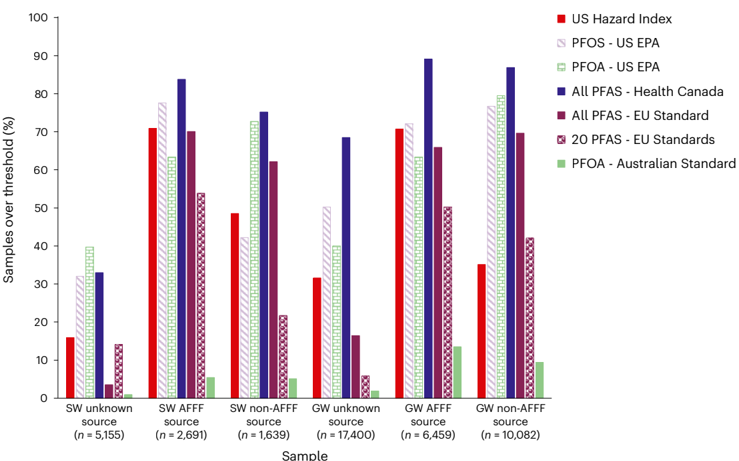
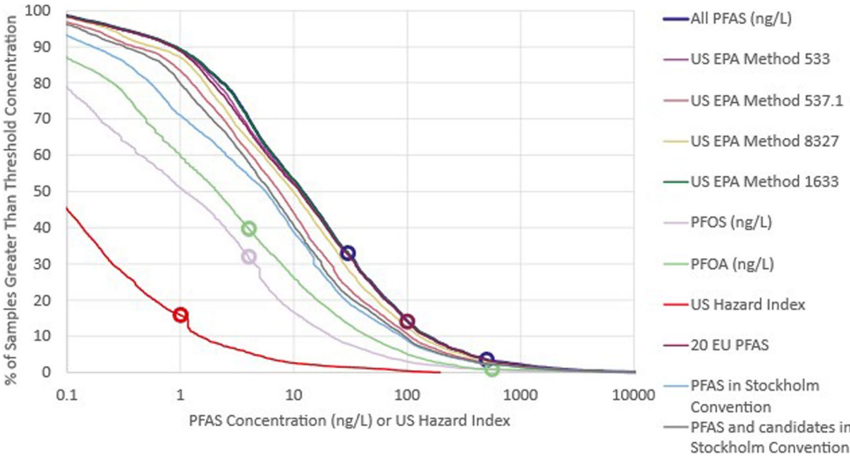
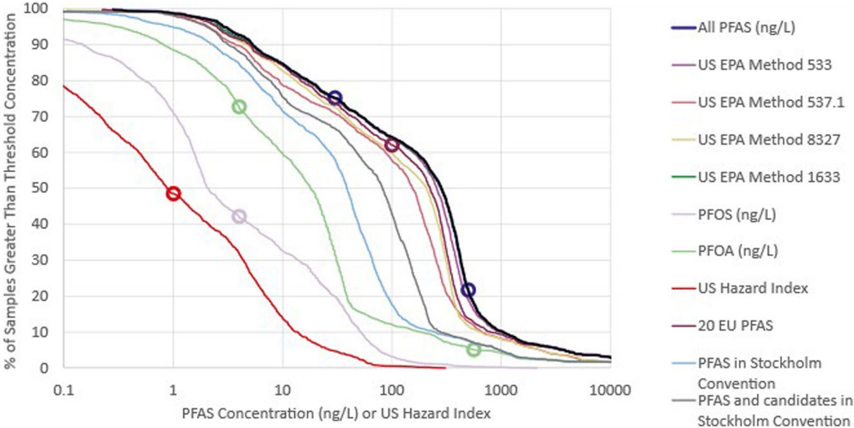
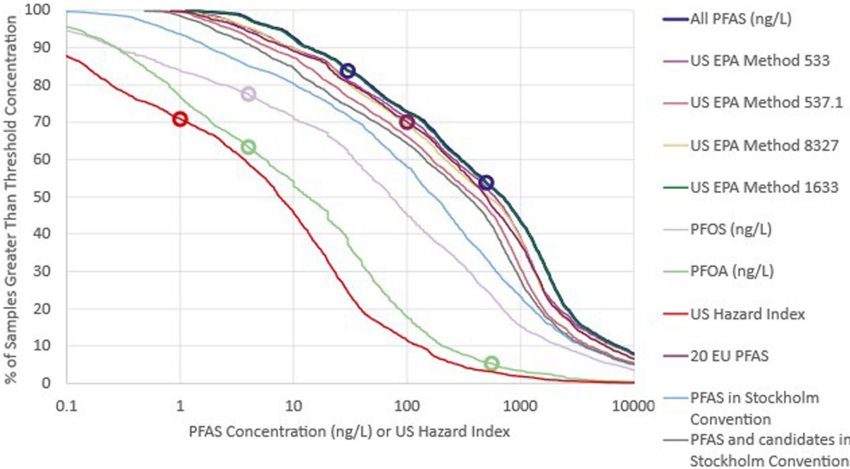
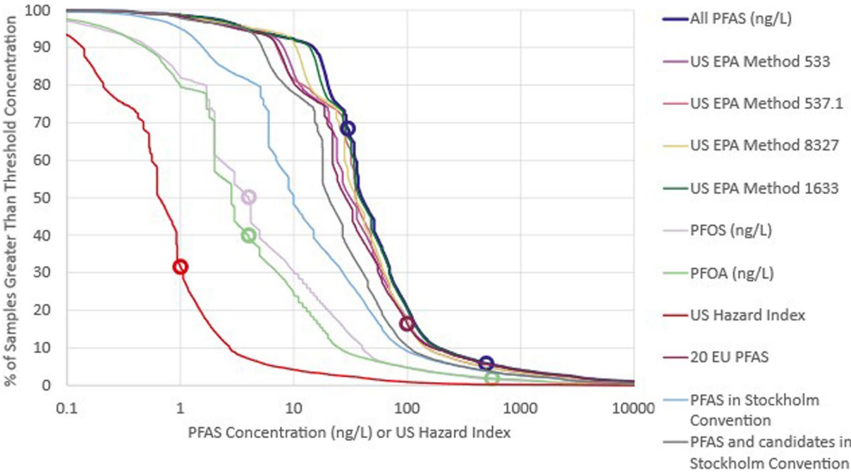
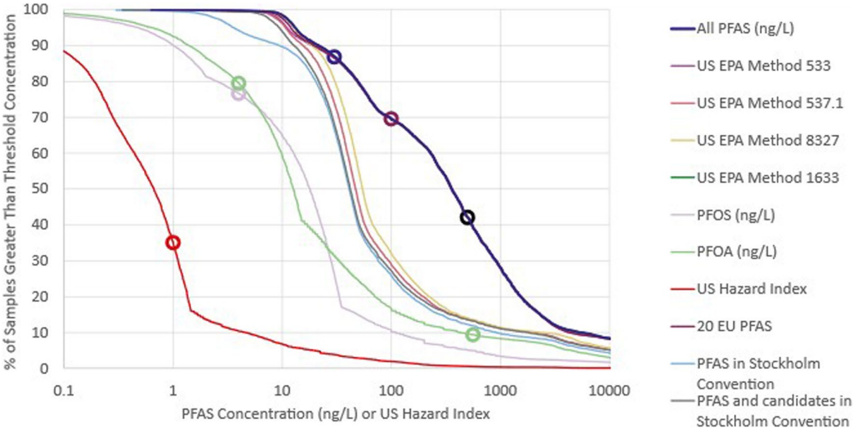
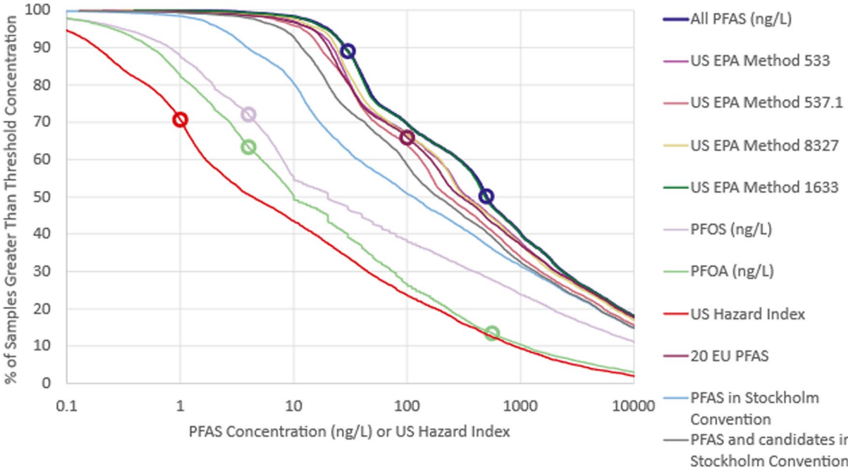
- In groundwater with known AFFF contamination, 71%, 72% and 63% exceeded the proposed US EPA hazard index (n = 6,312), proposed PFOS (n = 6,442) and proposed PFOA (n = 6,447) drinking water regulation, respectively; with no known source, exceedance was still 31%, 50% and 40% (n = 14,905; 15,351; 15,499). Groundwater with no known source exceeded Health Canada’s criteria in 69% but the EU sum of all PFAS criterion (500 ng l⁻¹) in only 6% (n = 16,151); the alternate EU sum of 20 PFAS criterion was exceeded in 16% (n = 16,143).
- Across 33,940 groundwater samples, 57 distinct PFAS were quantified; on average 16 distinct PFAS (maximum 38) were quantified, and no studies quantified FTOH. When two or more FTOH were quantified in consumer products, they represented a median of 58% (n = 365) of total PFAS.
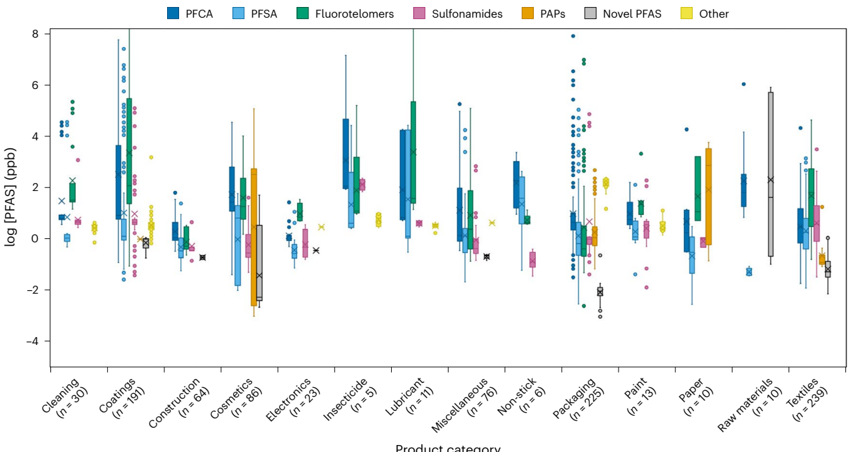
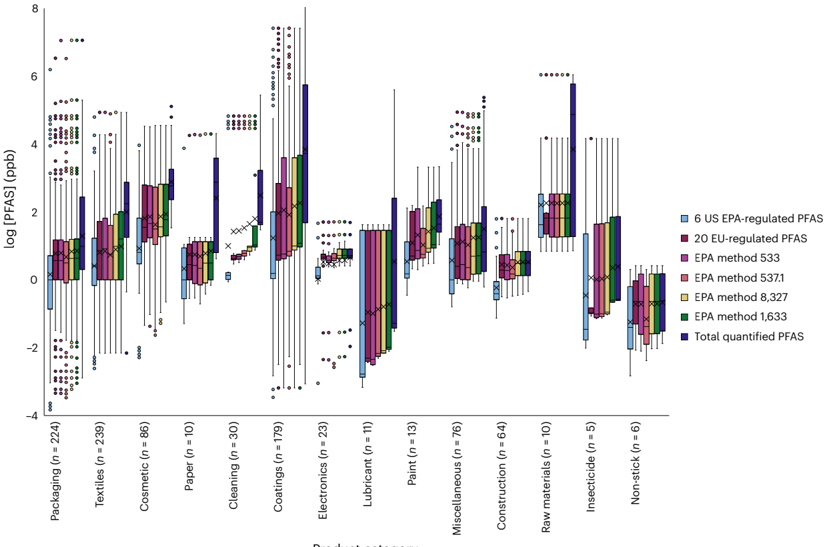
- In 943 non-AFFF consumer products from 38 studies, fluorotelomers represented a median of 72% of total measured PFAS by mass and PFCAs 25%; PAPs were 14%, sulfonamides 7% and PFSAs 4%. Using only EPA draft method 1633 would underestimate fluorotelomers by a factor of 25 and overestimate PFCAs, PFSAs and sulfonamides by factors of 2.8, 2.8 and 4.2, respectively.
- In AFFF, PFOS represented a median 51% of PFAS in historic 3M AFFF (n = 14); fluorotelomers dominated other AFFF (median 93%, n = 83), with FTS at median 73% (n = 69) and FTOH at median 10% (n = 38). EPA method 1633 underrepresents total PFAS in AFFF by a median factor of 2.8.
Methods
- Reviewed and collated 48,985 samples from 367 published papers and government websites to build a global surface- and groundwater PFAS database; also characterized PFAS in 943 non-AFFF consumer products from 38 studies and 148 AFFF samples from 11 studies. Data were collated, compared, analysed and statistically validated using Python scripts and MS Excel.
- Aqueous PFAS concentrations were reported in ng l⁻¹; product data were converted to ppb. Samples below detection limits were assigned a random value between zero and the detection limit using Python (less than 60% of samples were below the detection limit, so substitution was deemed suitable), with a repeat analysis setting BDL to zero. Sources were categorized as known non-AFFF, known AFFF or unknown; exceedance was benchmarked against regulatory or advisory thresholds, using EPA draft method 1633 as a benchmark.
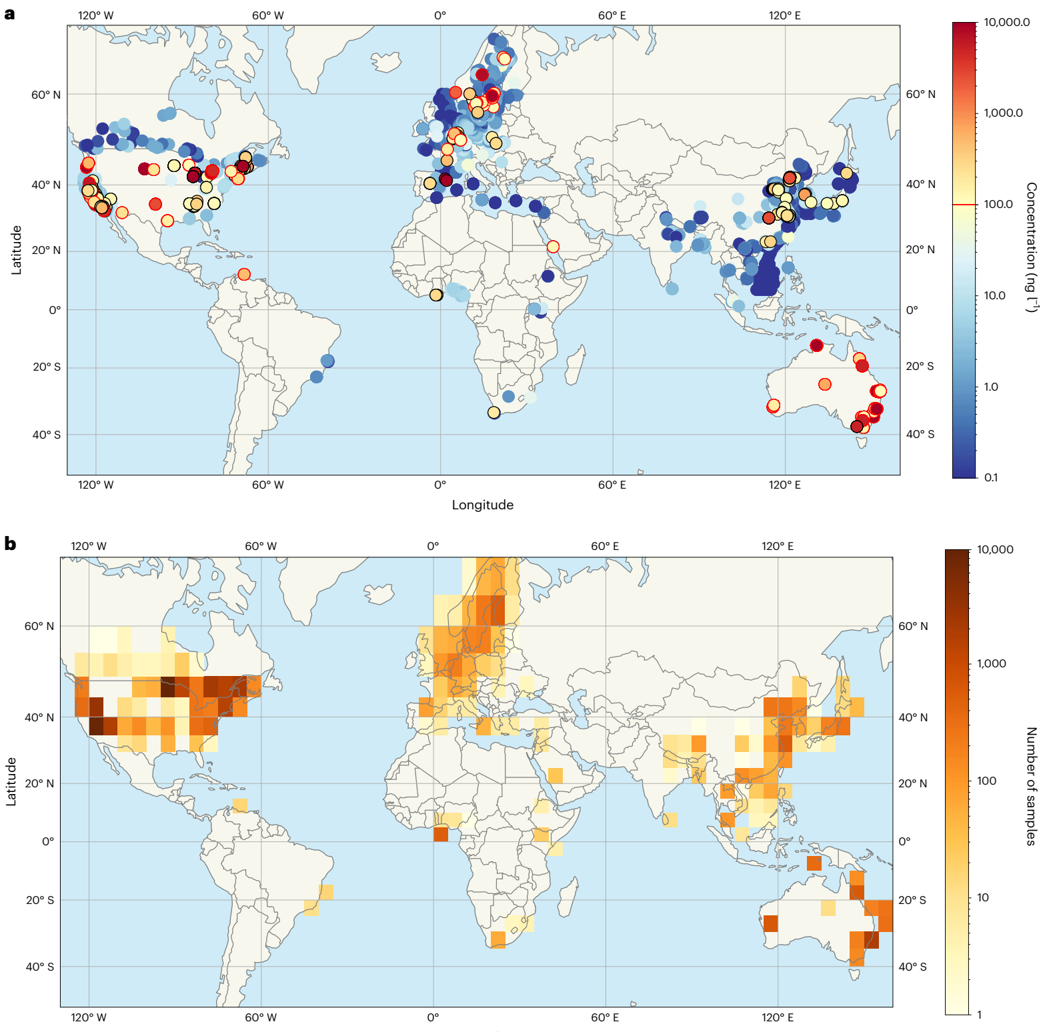
- For mapping, the latitude and longitude of the sampling location were used; where only the country was specified, a random major city in that country was assigned.
Limitations
- Stated: the study is limited to PFAS tested in previous studies, the analytical instruments and methods used, and the locations sampled; sampled locations may have higher PFAS concentrations than unsampled areas because research tends to concentrate where PFAS presence is likely, and high-sampling zones may skew representation.
- Stated: because only a limited suite of PFAS is typically quantified, estimates of environmental burden are likely underestimates, and it is not possible to reliably discuss how well current methods capture the range and mass of PFAS in surface and groundwater. FTOH conclusions are difficult from two studies with relatively few samples.
- Evident from the text: heterogeneous data from 367 papers and government websites, random substitution for BDL values, random city assignment when only country was known, and lack of a standardized TOP assay or US EPA GC/MS/MS aqueous methods for FTOH; detection-limit assumptions affect results, though both BDL approaches concluded that an important fraction of samples exceeds regulatory threshold levels.
Model-written summary. Check it against the paper before relying on it.
Integrity signals
Registry
Cites
Statistics
Figures
Verification
Claims the paper makes
6 Valid · 1 Not valid · 7 Not checked · 60 Own results and interpretations
The cited sources support only part of this claim — read each source’s verdict below.
In the paper
“Studies using the TOP assay to WWTP effluent report a considerable PFAS fraction that go undetected using EPA methods 41,42 .”
§ Underestimated burden of per-and polyfluoroalkyl substances in global surface waters and groundwaters > 20 EU-regulated PFAS
What the sources say
- Partly supportedcites [41] 40. Ye, F. et al. Spatial distribution and importance of potential perfluoroalkyl acid precursors in urban rivers and sewage treatment plant effluent-case study of Tama River, Japan. Water Res. 67, 77-85 (2014). sourceExperimental — accuracy not yet measured
Section 3.2 (p. 9) reports that oxidation revealed additional PFAA precursors in sewage-treatment-plant effluent, averaging 16 ng/L, with a mean oxidation-product-to-original-PFAA ratio of 0.21. The conclusion (p. 10) says commonly measured precursors represented only part of the total. The paper does not compare its findings with EPA methods, so that specific attribution is unsupported. (LLM, conf=0.86)
- Not checked — no full text of the sourcecites [42] 41. Tavasoli, E., Luek, J. L., Malley, J. P. & Mouser, P. J. Distribution and fate of per-and polyfluoroalkyl substances (PFAS) in wastewater treatment facilities. Environ. Sci. Processes Impacts 23, 903-913 (2021). source
- Asserted: passes — The authors put it forward as true.
- Checkable: passes — It can be checked against evidence.
- Load-bearing: passes — The paper’s conclusions depend on it.
- Based: passes — The paper gives a reason why it holds.
- Partly supported
The cited sources support only part of this claim — read each source’s verdict below.
In the paper
“In the 16 urban river samples in China 34 and eight river samples in Bangladesh 33 , FTOH represented a median of 53% of the total PFAS (range of 46 to 62%) and 2% (ranging from 0.9 to 34%), respectively.”
§ Underestimated burden of per-and polyfluoroalkyl substances in global surface waters and groundwaters > 20 EU-regulated PFAS
What the sources say
- Partly supportedcites [33] 32. Morales-McDevitt, M. E. et al. Poly-and perfluorinated alkyl substances in air and water from Dhaka, Bangladesh. Environ. Toxicol. Chem. 41, 334-342 (2022). sourceExperimental — accuracy not yet measured
The Materials and Methods section reports eight water grab samples, and Results and Discussion > Neutral PFAS reports FTOH in water. Our copy does not report a median FTOH share of total PFAS of 2% or a range of 0.9–34%; it also describes sampling sites that include lakes, not only rivers. Page numbers are unavailable in the indexed copy. (LLM, conf=0.85)
plainn = 8- Asserted: passes — The authors put it forward as true.
- Checkable: passes — It can be checked against evidence.
- Load-bearing: unclear — It is unclear whether the paper’s conclusions depend on it.
- Based: passes — The paper gives a reason why it holds.
- Partly supported
The cited sources support only part of this claim — read each source’s verdict below.
In the paper
“A major drawback of the TOP assay is that not all PFAS undergo oxidation to PFCAs or PFSA, particularly the perfluoroether class which transform into unmonitored terminal PFAS 47 .”
§ Underestimated burden of per-and polyfluoroalkyl substances in global surface waters and groundwaters > 20 EU-regulated PFAS
What the sources say
- Partly supportedcites [47] 46. Zhang, C., Hopkins, Z. R., McCord, J., Strynar, M. J. & Knappe, D. R. U. Fate of per-and polyfluoroalkyl ether acids in the total oxidizable precursor assay and implications for the analysis of impacted water. Environ. Sci. Technol. Lett. 6, 662-668 (2019). sourceExperimental — accuracy not yet measured
The Results and Discussion (page not provided) says a TOP assay that monitors only PFCAs and PFSAs can miss a large fraction of PFASs. But it does not show that perfluoroalkyl ether acids transform into unmonitored terminal PFASs: the studied perfluoroalkyl ether acids were stable terminal products, while some polyfluoroalkyl ether acids oxidized to products the authors could not identify. (LLM, conf=0.86)
plainstates a cause- Asserted: passes — The authors put it forward as true.
- Checkable: passes — It can be checked against evidence.
- Load-bearing: passes — The paper’s conclusions depend on it.
- Based: passes — The paper gives a reason why it holds.
- Partly supported
A result the paper reports from its own data — it cites no other source for it, so there is none to check. The quote shows it is in the paper.
In the paper
“Across all products, EPA method 1633 suggests a median distribution of 73% PFCA (n = 781), 11% PFSA (n = 750), 16% fluorotelomers (n = 353), 10% sulfonamides (n = 242) and 0.1% novel PFAS (n = 27), with phosphate-based PFAS not being quantified with this method.”
§ Underestimated burden of per-and polyfluoroalkyl substances in global surface waters and groundwaters > Non-AFFF consumer and industrial products
hedgedn = 781- Asserted: passes — The authors put it forward as true.
- Checkable: passes — It can be checked against evidence.
- Load-bearing: passes — The paper’s conclusions depend on it.
- Based: passes — The paper gives a reason why it holds.
A result the paper states — it cites no source for it, so there is none to check. The quote shows it is in the paper.
In the paper
“However, when there was no known PFAS source, or a known non-AFFF source, the incidence of SW samples exceeding regulatory thresholds was lower.”
§ Underestimated burden of per-and polyfluoroalkyl substances in global surface waters and groundwaters > Extent of global PFAS water contamination
plainstates an association- Asserted: passes — The authors put it forward as true.
- Checkable: passes — It can be checked against evidence.
- Load-bearing: unclear — It is unclear whether the paper’s conclusions depend on it.
- Based: passes — The paper gives a reason why it holds.
37 more claims
Create a free account to see all 74 claims and every source verdict.
- It may state two separate claims as one. 28
- Probably not a substantial claim. 7
Claims other papers make about this one
Each is checked against this paper’s own text: does it say what the citing paper says it does?
The source backs part of the claim, not all of it — or backs it for a different population, condition or comparison.
In the citing paper
“PFASs are detected in groundwater worldwide, often exceeding drinking water guidelines, with both legacy and emerging compounds present even in remote or rural areas [127,128].”
From Industrial Applications, Environmental Fate, Human Exposure, and Health Effects of PFAS (2025) · cites this paper as [127]
Experimental — accuracy not yet measuredThe source backs part of the claim, not all of it — or backs it for a different population, condition or comparison.
In the citing paper
“PFAS exposure is linked to adverse health effects-such as immune, developmental, and metabolic toxicity-and ecosystem risks, especially since many compounds are bioaccumulative and toxic [127,130].”
From Industrial Applications, Environmental Fate, Human Exposure, and Health Effects of PFAS (2025) · cites this paper as [127]
Experimental — accuracy not yet measuredThe source backs part of the claim, not all of it — or backs it for a different population, condition or comparison.
In the citing paper
“A comprehensive global survey published in 2024 analyzed over 45,000 surface and groundwater samples and found that approximately 31% of samples exceeded PFAS thresholds deemed harmful to human health [35].”
From Exposure to Per- and Polyfluoroalkyl Substances (PFASs) in Healthcare: Environmental and Clinical Insights (2025) · cites this paper as [35]
Experimental — accuracy not yet measuredThe source backs part of the claim, not all of it — or backs it for a different population, condition or comparison.
In the citing paper
“A global review by [1] has suggested that the concentrations of PFAS in the paper industries are not significantly different from those in other industrial activities.”
From Investigating the extent of PFAS contamination in the Upper Danube Basin across environmental compartments (2025) · cites this paper as [1]
Experimental — accuracy not yet measuredThe source backs part of the claim, not all of it — or backs it for a different population, condition or comparison.
In the citing paper
“In a hypothetical scenario of environmental PFAS degradation, a cell will approach toxic levels of intracellular fluoride (>100 μM) upon uptake and defluorination of perfluorooctanoic acid from just 10 pL of medium contaminated with 1 ppb of this substance, a value that is observed in PFAS-polluted environmental samples70.”
From The link between ancient microbial fluoride resistance mechanisms and bioengineering organofluorine degradation or synthesis (2024) · cites this paper as [70]
Experimental — accuracy not yet measured
4 more claims about this paper
Create a free account to see every claim other papers make about this one.
Citations
Cites
Buck, R. C., Franklin, J., Berger, U., Conder, J. M., Cousins, I. T., de Voogt, P., Jensen, A. A., Kannan, K., Mabury, S. A., & van Leeuwen, S. P. (2011) · Integrated Environmental Assessment and Management · doi:10.1002/ieam.258 · Cited by 4,641 · cited 3×
“PFAS for AFFF applications have been synthesized by two synthesis processes: electrochemical fluorination and telom-erization 21 .”
Sources, fate and transport of perfluorocarboxylates
Prevedouros, K., Cousins, I. T., Buck, R. C., & Korzeniowski, S. H. (2006) · Environmental Science & Technology · doi:10.1021/es0512475 · Cited by 2,594
Fenton, S. E., Ducatman, A., Boobis, A., DeWitt, J. C., Lau, C., Ng, C., Smith, J. S., & Roberts, S. M. (2020) · Environmental Toxicology and Chemistry · doi:10.1002/etc.4890 · Cited by 2,445
Hu, X. C., Andrews, D. Q., Lindstrom, A. B., Bruton, T. A., Schaider, L. A., Grandjean, P., Lohmann, R., Carignan, C. C., Blum, A., Balan, S. A., et al. (2016) · Environmental Science & Technology Letters · doi:10.1021/acs.estlett.6b00260 · Cited by 1,333 · cited 1×
“Studies have also assessed or compared aqueous phase PFAS concentrations in select regions 19,20 .”
Wang, Z., Cousins, I. T., Scheringer, M., Buck, R. C., & Hungerbühler, K. (2014) · Environment International · doi:10.1016/j.envint.2014.04.013 · Cited by 735 · cited 1×
“All perfluoroalkyl Whereas studies have estimated PFAS production globally 16,17 and quantified PFAS in commercial and industrial products, their fate is still unknown.”
PFAS Molecules: A Major Concern for the Human Health and the Environment
Panieri, E., Baralic, K., Djukic-Cosic, D., Buha Djordjevic, A., & Saso, L. (2022) · Toxics · doi:10.3390/toxics10020044 · Cited by 651
Cousins, I. T., Johansson, J. H., Salter, M. E., Sha, B., & Scheringer, M. (2022) · Environmental Science & Technology · doi:10.1021/acs.est.2c02765 · Cited by 595
Identification of Novel Fluorochemicals in Aqueous Film-Forming Foams Used by the US Military
Place, B. J., & Field, J. A. (2012) · Environmental Science & Technology · doi:10.1021/es301465n · Cited by 543 · cited 1×
“Furthermore, when the TOP assay is applied to AFFF samples, considerable increases in total PFAS mass has been reported 31,32 , as noted in non-AFFF consumer product studies.”
Helsel, D. R. (2006) · Chemosphere · doi:10.1016/j.chemosphere.2006.04.051 · Cited by 505
The High Persistence of PFAS Is Sufficient for Their Management as a Chemical Class
Cousins, I. T., DeWitt, J. C., Glüge, J., Goldenman, G., Herzke, D., Lohmann, R., Ng, C. A., Scheringer, M., & Wang, Z. (2020) · Environmental Science: Processes & Impacts · doi:10.1039/d0em00355g · Cited by 491
Research works printed but not linked: 1
- Official Journal of the European Union (European Parliament & Council of the European Union, 2020).
Cited by
Items 301–388 of 388
Silva, G., Cunha, M., Soares, A. M. V. M., Aga, D. S., & Freitas, R. (2026) · Environmental Pollution · doi:10.1016/j.envpol.2026.128662 · Cited by 1
Kan, X., Zhang, S., Sarkar, S., Liu, J., & Sun, M. (2026) · Water Research · doi:10.1016/j.watres.2026.126746
Xia, Y., Shen, J., Li, T., Lv, Z., Xiao, R., Huang, Q., Gao, M., Ding, Y., Feng, H., & Chen, R. (2026) · Environmental Pollution · doi:10.1016/j.envpol.2026.129106
Jafarinejad, S., Chelliapan, S., Nayak, J., & Magalingam, P. (2026) · Current Opinion in Environmental Science & Health · doi:10.1016/j.coesh.2026.100750
Pang, Y., Wang, Z., Liu, Y. L., Feng, C., Song, Y., Cao, S., Wang, D., Zhang, L., Lü, P., & Yu, L. (2026) · Toxicology · doi:10.1016/j.tox.2026.154532
Foley, E. A., Campbell, L. E., Harris, I. K., & Chen, H. (2026) · International Journal of Environmental Science and Technology · doi:10.1007/s13762-026-07128-x
Li, G., Bao, Y., Wu, D., Wang, X., He, Y., Yu, Q., Ren, H., & Geng, J. (2026) · Environmental Science & Technology · doi:10.1021/acs.est.5c13335
Skjennum, K. A., Mulder, J., Breedveld, G. D., et al. (2026) · SSRN Electronic Journal · doi:10.2139/ssrn.6174208
Scalable superhydrophobic textiles with “wash to dryness” effect via fluoride- free emulsionPreprint
Wang, C., Zhang, X., Pang, H., et al. (2025) · SSRN Electronic Journal · doi:10.2139/ssrn.5971470
Guo, Y., Liu, R., Ding, Y., Wang, H., & Dai, X. (2026) · Water · doi:10.3390/w18182319
Yang, L., Hu, T., Zhang, D., et al. (2026) · Water Research · doi:10.1016/j.watres.2026.126495
Jian, T., Li, B., Chen, C., Zhao, L., Cai, X., Lin, H., & Guan, X. (2026) · Critical Reviews in Environmental Science and Technology · doi:10.1080/10643389.2026.2713103
Lin, Z., Chernysheva, L. V., Serpa, M., Herckès, P., Doudrick, K., & Westerhoff, P. K. (2026) · npj Emerging Contaminants · doi:10.1038/s44454-026-00042-4
Současný stav sledování vybraných PFAS v povrchových vodách v České republice
Marešová, D., Očenášková, V., Mičaník, T., Pospíchalová, D., Juranová, E., Bohadlová, E., & Chrastina, D. (2025) · Vodohospodářské technicko-ekonomické informace · doi:10.46555/vtei.2025.09.004
Quantitative Spatial Analysis of PFAS in Nine Biological Tissues from Mouse via MALDI-TIMS-MSI
Nikolopoulou, V., Stem, A. D., Alayyoub, M., Vasiliou, V., & Aalizadeh, R. (2026) · Environmental Science & Technology · doi:10.1021/acs.est.5c14803 · Cited by 2
The magnetic removal of PFAS from water − from molecules to microplastics
Voß, J., Rockmann, L., Meyer, V., Unterweger, H., Bröse, D., Heinen, L., Müller, L., Gaß, H., Stein, R., Dreyer, L. S., et al. (2026) · Materials Today · doi:10.1016/j.mattod.2026.103471
Liu, Y., Wang, P., Hu, J., Zhang, Y., Xu, Y., Huang, L., Zhang, K., Sun, B., Huang, S., Shi, Y., et al. (2026) · Environmental Science & Technology · doi:10.1021/acs.est.6c06067 · Cited by 1
Rapid detection of perfluorinated compounds in tap water using confined methanol
Zhang, X., Piao, H., Cui, M., Jin, X., Tong, M., Li, D., & Zou, Y. (2026) · Journal of Chromatography A · doi:10.1016/j.chroma.2026.466718
Manzoor, R., Sultan, M., CAIRNS, S. C., Robertson, I., Holliman, P. J., & Junaid, M. (2026) · Advances in chemical pollution, environmental management and protection · doi:10.1016/bs.apmp.2026.02.002
PFAS mitigation is a drinking-water system-design challenge: lessons from contrasting architectures
Efraim, R. B., Leube, P., Futterlieb, M., Futterlieb, M., Chaudhary, M., Vogel, C., Panglisch, S., Nir, O., & Ronen, A. (2026) · npj Emerging Contaminants · doi:10.1038/s44454-026-00061-1
Reactive molecular dynamics approach to PFAS plasma oxidation in water
Richard, A., Brault, P., Froloff, N., Aubry, O., Hong, D., & Rabat, H. (2025) · Open Plasma Science · doi:10.46298/ops.15754
Yang, B., Xiao, G., Li, D., Lan, S., Wang, W., Li, J., & Zhu, D. (2026) · Colloids and Surfaces A Physicochemical and Engineering Aspects · doi:10.1016/j.colsurfa.2026.141029
Guo, P., Hua, Z., Wang, P., & Yu, L. H. (2026) · Water Research · doi:10.1016/j.watres.2026.126490
Li, A., Tian, D., Guo, Y., Zhang, X., Zhang, S., Cheng, L., Wang, L., Zhang, Y., & Fu, N. (2026) · Separation and Purification Technology · doi:10.1016/j.seppur.2026.138703
Cao, J., Xue, Z.-P., Zhang, H., Zhu, H., & Li, M. (2026) · Water Science and Engineering · doi:10.1016/j.wse.2026.08.001
A novel In ₂ O ₃ nanorods/graphene heterostructure for enhanced photocatalysis
Liu, J., Hou, B., You, Z., Ou, K., & Xia, Y. (2026) · Nanotechnology · doi:10.1088/1361-6528/ae423a
Martin, J. H., & Pegler, J. L. (2026) · Journal of Hazardous Materials Letters · doi:10.1016/j.hazl.2026.100182
Shi-jie, S., Mei, Z., Huang, T., Gao, Y., Huang, L., Liu, J. J., Jing, N., Zhong, Y., Ma, J., Wen, C., et al. (2026) · Environmental Science & Technology · doi:10.1021/acs.est.6c02449 · Cited by 5
Jiang, Y., Zhang, H., Ge, Y., & Huang, J. (2026) · Environmental Pollution · doi:10.1016/j.envpol.2026.129006
Wei, Q., Zhu, X., Liu, Y., et al. (2026) · Journal of the American Chemical Society · doi:10.1021/jacs.6c01463
Liu, X., Huang, D., Zhang, Z., Zhang, L., Lin, X., Yan, C., Chen, M., Nie, R., Gao, B., Ma, W., et al. (2026) · Environmental Pollution · doi:10.1016/j.envpol.2026.128660
Zhao, L., Cappelli, F., Belova, L., Buytaert, J., Groffen, T., Yin, S., Liu, W., Bervoets, L., & Covaci, A. (2026) · Environmental Science & Technology · doi:10.1021/acs.est.6c08194 · Cited by 1
Adsorption of Short-Chain PFAS on Functionalized Graphene: A Density Functional Theory StudyPreprint
Berdiyorov, G. R., Al-Gaashani, R., Aïssa, B., Mahmoud, K. A., & Alyasi, H. (2026) · SSRN Electronic Journal · doi:10.2139/ssrn.6616215
Replacement of Legacy Per‐ and Polyfluoroalkyl Substances
Singh, R., Ganguly, A., Ahn, Y., & Ray, S. S. (2025) · Wiley eBooks · doi:10.1002/9781394343935.ch16 · Cited by 1
Zhao, Y., Xie, M., Luo, J., Wei, Y., Wang, Q., Xu, Y., Shi, M., Zhang, L., & Chai, L. (2026) · Chemical Communications · doi:10.1039/d6cc03980d
Groundwater resources assessment in the Mirandiba sedimentary Basin at NE Brazil
da Silva, T. R., Lima, M. M. C., Martins, T., Costa, W. D., Albuquerque, M. S. C., & Galvão, M. J. D. T. G. (2025) · Applied Geochemistry · doi:10.1016/j.apgeochem.2025.106572
Yang, H., He, W., Li, D., Wan, Y., Zheng, J., Ren, W., Wan, Y., & Ouyang, E. (2025) · Water Research · doi:10.1016/j.watres.2025.124764 · Cited by 5
Zhou, Y., Tao, J., Tang, W., Huang, F., Min, F. A. N., Liu, F., Dong, F., & Qu, S. (2026) · Journal of environmental chemical engineering · doi:10.1016/j.jece.2026.124712
Wang, W., Guan, R., Wang, Q., Xiong, L., He, A., Bai, L., Li, Z., Lu, C. P., Zhang, S., Zhao, C., et al. (2026) · Environmental Science & Technology · doi:10.1021/acs.est.5c15723
Bounds, J. G., Renyer, A., Ford, J., Ravindra, K., DeVito, M. J., Hughes, M. F., Wehmas, L. C., Brennan, A. A., Wetmore, B. A., & MacMillan, D. K. (2025) · Toxics · doi:10.3390/toxics13121022 · Cited by 1
Barber, L. B., Miller, S. A., Blaney, L. M., et al. (2025) · Maryland Shared Open Access Repository (USMAI Consortium) · doi:10.13016/m2euen-wtsl
Rihn, A., Bajgain, P., Labbé, N., & Kamboj, G. (2026) · Journal of Agriculture and Food Research · doi:10.1016/j.jafr.2026.102646
Wei, Z., Liu, X., Kümmel, S., Wang, B., Zhan, M., Ma, L., Zhang, J., Yi, K., Yao, X., Vogt, C., et al. (2026) · Critical Reviews in Environmental Science and Technology · doi:10.1080/10643389.2026.2709020
Groffen, T., Lodi, G., Ndayishimiye, J., Buhungu, S., Nduwimana, L., Niyoyitungiye, L., & Schoelynck, J. (2026) · Toxics · doi:10.3390/toxics14020123
Rapid Detection of Perfluorinated Compounds in Tap Water Using Confined MethanolPreprint
Zhang, X., Piao, H., Cui, M., Jin, X., Tong, M., Li, D., & Zou, Y. (2025) · SSRN Electronic Journal · doi:10.2139/ssrn.5576237
Song, Y., Li, R., Sun, X., Chen, H., Mao, G., Zou, L., Ji, X., Han, H., Zhu, H., Yue, Z., et al. (2026) · Journal of Hazardous Materials · doi:10.1016/j.jhazmat.2026.141428 · Cited by 2
Zhi, Y., Gu, K., Zhang, M., Tan, F., Lou, Z., Zhang, C., Zhong, D., Chen, Y., & He, Q. (2026) · Separation and Purification Technology · doi:10.1016/j.seppur.2026.136789 · Cited by 1
Field Monitoring of PFAS: Current Trends and Emerging Challenges in Japan
Nomiyama, K. (2026) · Journal of Environmental Chemistry · doi:10.5985/jec.36.s34
de Falco, G., & Post, G. B. (2026) · Elsevier eBooks · doi:10.1016/b978-0-443-43856-1.00016-2
Koongolla, J. B., Egodawatta, P., Goonetilleke, A., & Ayoko, G. A. (2026) · Journal of Hazardous Materials · doi:10.1016/j.jhazmat.2026.143434
Chu, K. H., & Guibal, E. (2026) · Journal of Molecular Liquids · doi:10.1016/j.molliq.2026.129922
Qu, H., Li, H., Gu, X., Chen, G., Hui, K., Sun, C., Yuan, Y., & Tan, W. (2026) · Environmental Research · doi:10.1016/j.envres.2026.124807 · Cited by 1
Chemical pollution reshapes food web responses to species loss
Sun, P., Chen, L., Wu, X., Zhou, H., & Wu, B. (2026) · Water Research · doi:10.1016/j.watres.2026.126604
Jiang, T., Li, H., Chen, J., Bai, X., Yuan, S., Yu, W., Liang, S., Duan, H., Hu, J., Hou, H., et al. (2026) · Environmental Science & Technology Letters · doi:10.1021/acs.estlett.6c00490 · Cited by 1
Mahofa, E. P., Meragawi, S. E., Vilayatteri, M. A., Dwivedi, S., Tabor, R. F., Tanksale, A., & Majumder, M. (2026) · Journal of Membrane Science · doi:10.1016/j.memsci.2026.126033 · Cited by 1
Eid, S., Lemaoui, T., Darwish, A. S., Kumar, M., BANAT, F. A., AlFantazi, A., Hasan, S. W., & AlNashef, I. M. (2026) · Chemical Engineering Journal · doi:10.1016/j.cej.2026.181650
Li, Y., Guo, X., Leng, Q., Bai, Y., & Zhao, X. (2026) · Journal of Hazardous Materials · doi:10.1016/j.jhazmat.2026.142343 · Cited by 2
Mammino, L. (2026) · Elsevier eBooks · doi:10.1016/b978-0-443-13417-3.00003-2
Garofalo, E. E. N., de Freitas, J. G., Shinzato, M. C., & Hirata, R. (2026) · Elsevier eBooks · doi:10.1016/b978-0-443-36731-1.00014-5
Choudhary, M., Martin, A., Alulema-Pullupaxi, P., Hatinoglu, D., Mensah, K., Ghaznavi, S. M., Smith, S. M., & Apul, O. G. (2026) · Journal of Chemical Education · doi:10.1021/acs.jchemed.5c01319
PFAS disclosure practices of Dutch listed companies: An exploratory study
Deviv'e, O. I. , & Thijssens, T. (2026) · Maandblad Voor Accountancy en Bedrijfseconomie · doi:10.5117/mab.100.186120 · Cited by 1
Zhang, Y., Wang, Y., Yang, Q., Yang, L., Yang, X., Zhao, X., & Zhao, S. (2026) · Environmental Pollution · doi:10.1016/j.envpol.2026.128247
Mayor, M. P., Díaz-Alejo, N., Botella, N. B., & Saquete, M. D. (2026) · Chemosphere · doi:10.1016/j.chemosphere.2026.144855
Szulc, W., Gawronski, S., Gancarczyk, D., Szulc, W., Rutkowska, B., & Majder–Łopatka, M. (2026) · Environmental Science and Pollution Research · doi:10.1007/s11356-026-38041-y
TENDENCIAS Y PERSPECTIVAS SOBRE PFAS EN AGUA POTABLE Y SU REGULACIÓN
Hoyos-Alayo, W. M. (2026) · Nativa · doi:10.31413/nat.v14i2.20377 · Cited by 1
Ding, R., Ding, Z., Ferreira, R. P., Chen, Y., & Chen, J. (2026) · ACM SIGKDD Conference on Knowledge Discovery and Data Mining (KDD) · doi:10.1145/3770855.3819013
Soil health assessment using buried cotton underpants with the help of 1000 citizen scientists
Bender, S. F., Bürge, D., Bragazza, L., Knop, E., Masson, S., Peter, N., Demarmels, R., Mueller, D., Imhof, A., Viviani, P., et al. (2026) · Plants People Planet · doi:10.1002/ppp3.70259 · Cited by 1
Barnor, B., Curtis, C. J., Pillay, K., Eshun, A., & Essumang, D. (2026) · Water Air & Soil Pollution · doi:10.1007/s11270-026-09990-4
Awais, M., Chen, Y., Bibi, S., Wu, J., Zhang, W., Tlili, I., & Hu, J. (2026) · Biosensors and Bioelectronics · doi:10.1016/j.bios.2026.118756 · Cited by 1
Prasetya, K. D., You, S.-J., Lee, C., Jiang, J., & Wang, Y. F. (2026) · Journal of Water Process Engineering · doi:10.1016/j.jwpe.2026.110446 · Cited by 1
Song, X., Qiu, X., Fu, L. P., Xia, Y., Chen, X., Xiang, Y., & Zeng, G. (2026) · Desalination · doi:10.1016/j.desal.2026.120477 · Cited by 1
Chen, S., Li, T., Pan, W., Bai, T., Li, P., & Zheng, Y. (2026) · Chemical Engineering Science · doi:10.1016/j.ces.2026.124684 · Cited by 2
Fatima, M., Kelso, C., & Hai, F. I. (2026) · Environmental Science and Pollution Research · doi:10.1007/s11356-026-38084-1
Niu, K., Li, J., Zhang, R., Chang, Y., Zhang, Z., Zhu, X., Wang, Y., & Liu, M. (2026) · Chemical Science · doi:10.1039/d6sc05754c
Li, J., Boxall, A. B. A., Swan, C., Hoeks, S., Lai, R. W. S., Wilkinson, J. L., Altinbag, R. C., Arrhenius, Å., Ashauer, R., Backhaus, T., et al. (2026) · Water Research · doi:10.1016/j.watres.2026.126481 · Cited by 3
Li, Z., Yu, H., Gang, D., Lu, Q., Ji, H., Mu, J., Zheng, X., Qi, J. Y., Hu, C., & Qu, J. (2026) · Journal of Hazardous Materials · doi:10.1016/j.jhazmat.2026.142184
Ran, X., Qin, H., Zhang, R., Li, Q., Cai, M. H., Yao, D., Li, Y., & Mao, S. (2026) · Applied Catalysis B: Environmental · doi:10.1016/j.apcatb.2026.127304
Wu, K., Zeng, H., Chen, J., Yao, S., An, W., & Zhou, Q. (2026) · Journal of Hazardous Materials · doi:10.1016/j.jhazmat.2026.143240
Sustainable chemistry in pharma: Pfizer green chemistry team's perspective
Allais, C., Arat, S., Colberg, J. C., Fernández, D. F., González‐Esguevillas, M., Kumar, R., Lee, J. W., Livada, J., Mack, C. E., Piper, J. L., et al. (2026) · RSC Sustainability · doi:10.1039/d5su00761e
Facet-dependent adsorption of PFOS and 6:2 Cl-PFESA onto hematite surfaces
Xia, P., Yang, C., Wang, X. L., Jian, J., Liang, L., O’Carroll, D. M., & He, F. (2026) · Environmental Pollution · doi:10.1016/j.envpol.2026.128770 · Cited by 1
Self-citationShen, Y., Xu, G., Gao, G., et al. (2026) · Environmental Science & Technology · doi:10.1021/acs.est.6c04782
Yan, Q., Tang, C.-W., Wang, W., Tang, J.-Y., Wang, Y., & Wang, Y.-Y. (2026) · Research Square · doi:10.21203/rs.3.rs-10733297/v1
Tri, D. V., Quan, D. N., & Luu, T. L. (2026) · Case Studies in Chemical and Environmental Engineering · doi:10.1016/j.cscee.2026.101489
Groffen, T., Drenckhan, W., Prinsen, E., & Jansen, M. A. (2026) · Aquatic Toxicology · doi:10.1016/j.aquatox.2026.108002
Chen, X., Ouyang, W., Liu, S., Zhang, H., Mu, D., Tang, J., & Huang, Z. (2026) · Water Research · doi:10.1016/j.watres.2026.126641 · Cited by 1
Metadata
- Authors
- Ackerman Grunfeld, D., Gilbert, D., Hou, J., Jones, A. M., Lee, M. J., Kibbey, T. C. G., & O’Carroll, D. M.
- Affiliations
- UNSW Sydney (AU)
- University of Oklahoma (US)
- Corresponding author
- O’Carroll, Denis M.
- Venue
- Nature Geoscience
- Published
- 2024-04
- Volume
- 17
- Issue
- 4
- Pages
- 340-346
- ISSN
- 1752-0894 (ISSN-L)
- 1752-0908
- OpenAlex
- W4394580279
- Semantic Scholar
- a5934fdaf4c8849591159ba3a6cbc53c7dab3b7a
- Cited by
- 403
- References
- 38
- Citations by year
- 2026: 193 · 2025: 173 · 2024: 37
- FWCI
- 52.90
- Type
- journal article
- Language
- en
- Open access
- hybrid
- doi.org
- Licence
- cc-by
- creativecommons.org/licenses/by/4.0 (tdm)
- creativecommons.org/licenses/by/4.0 (vor, 7 d)
- Locations
- Nature Geoscience (publishedVersion, cc-by)
- Funders
- The Australian Government Research Training Program (RTP) Scholarship is acknowledged for the provision of candidature funding.
- Topics
- Physical Sciences › Environmental Science › Environmental Chemistry › Per- and polyfluoroalkyl substances research
- Physical Sciences › Environmental Science › Water Science and Technology › Fluoride Effects and Removal
- Physical Sciences › Environmental Science › Health, Toxicology and Mutagenesis › Chemical Analysis and Environmental Impact
- Keywords
- per- and polyfluoroalkyl substances, PFAS contamination, surface water, groundwater, environmental load, monitoring practices, anthropogenic chemicals, PFAS sources
About these checks
Registry, retraction, Cites and statistics results are computed, not judged, with one exception: a printed reference that no index lists is read once by a model before it counts as a citation error. Claims are extracted by a model and kept only when their quote appears verbatim in the text; each cited source is then checked, with a model’s help, for whether it says what the claim relies on. Those verdicts can be wrong — read the claim’s quote and the cited source before relying on one.
The claim verdicts this report counts are experimental: their accuracy is not yet measured.
A language model drew the claims from the paper on 2026-10-11, under version 3 of the claim definition (model deepseek-v4.1-flash, prompt extract-v3).
A second model labelled each claim on 2026-10-11 (model jev-1.13-20260917, definition revision gold-guideline-v0.2).
Cited sources are checked with a language model’s help (gpt-6-sol).
Statistics and arithmetic are recomputed, not judged.
Confidence bands are shown only for fields calibrated on our annotated test set. None is calibrated yet, so no band is shown.
What counts as a claim ›How we measure confidence ›How we check this ›
Are you an author, or do you see a problem with this page? Request a review
Data sources
Bibliographic data: Semantic Scholar, OpenAlex, Crossref.
Contains information from the Semantic Scholar Academic Graph Datasets, made available under the ODC Attribution License (ODC-BY 1.0).
Semantic Scholar’s data is described in: Kinney, R., et al. (2023). The Semantic Scholar Open Data Platform. arXiv:2301.10140.
