

A manifesto for reproducible science
Open accessThe DOI matches its Crossref record; 91 of the 92 references it cites were found in a registry or an index.
Abstract
Improving the reliability and efficiency of scientific research will increase the credibility of the published scientific literature and accelerate discovery. Here we argue for the adoption of measures to optimize key elements of the scientific process: methods, reporting and dissemination, reproducibility, evaluation and incentives. There is some evidence from both simulations and empirical studies supporting the likely effectiveness of these measures, but their broad adoption by researchers, institutions, funders and journals will require iterative evaluation and improvement. We discuss the goals of these measures, and how they can be implemented, in the hope that this will facilitate action toward improving the transparency, reproducibility and efficiency of scientific research.
Overview
The claims and statistics of this paper haven’t been checked yet.
Free: it reads the open-access text and checks the first 5 claims that cite a source we can check. Create a free account to check every claim.
Integrity signals
Registry
Cites
Statistics
Figures
Verification
Claims the paper makes
The claims and statistics of this paper haven’t been checked yet.
Free: it reads the open-access text and checks the first 5 claims that cite a source we can check. Create a free account to check every claim.
Claims other papers make about this one
Each is checked against this paper’s own text: does it say what the citing paper says it does?
The source backs part of the claim, not all of it — or backs it for a different population, condition or comparison.
In the citing paper
“Furthermore, thorough documentation and recording improve the transparency and efficiency of scientific research, can be used to improve reproducibility, and enable work to be repeated (Baker, 2016a,b; Munafo et al., 2017).”
From Guidance document on Good cell and tissue culture practice 2.0 (GCCP 2.0) (2021) · cites this paper as Munafo et al., 2017
Experimental — accuracy not yet measuredThe cited source says what the claim attributes to it.
In the citing paper
“Furthermore, sample sizes are often underpowered (4-6), at times leading to conclusions that do not hold up with larger-sized replications or metaanalyses (7).”
From Generic language in scientific communication (2019) · cites this paper as [6]
The cited source says what the claim attributes to it.
In the citing paper
“Accordingly, there is growing recognition that data availability is a critical feature of an efficient, progressive, and ultimately self-correcting scientific ecosystem that generates credible findings [1–3].”
From Data availability, reusability, and analytic reproducibility: evaluating the impact of a mandatory open data policy at the journal Cognition (2018) · cites this paper as [2]
The cited source says what the claim attributes to it.
In the citing paper
“Open data alone are clearly not enough to achieve the benefits envisaged by proponents of data sharing [2].”
From Data availability, reusability, and analytic reproducibility: evaluating the impact of a mandatory open data policy at the journal Cognition (2018) · cites this paper as [2]
The cited source says what the claim attributes to it.
In the citing paper
“Some journals have heeded the growing calls for adoption of transparent and reproducible research practices and introduced new policies to implement change [1,2].”
From Data availability, reusability, and analytic reproducibility: evaluating the impact of a mandatory open data policy at the journal Cognition (2018) · cites this paper as [2]
5 more claims about this paper
Create a free account to see every claim other papers make about this one.
Self-check
Percentages, sums and reported differences re-computed from the paper’s own numbers.
The self-check needs the paper’s full text.
Citations
Cites
Liberati, A., Altman, D. G., Tetzlaff, J., Mulrow, C., Gøtzsche, P. C., Ioannidis, J. P. A., Clarke, M., Devereaux, P. J., Kleijnen, J., & Moher, D. (2009) · PLoS Medicine · doi:10.1371/journal.pmed.1000100 · Cited by 28,164 · cited 1×
“There are also guidelines for improving the reporting of research planning; for example, the Preferred Reporting Items for Systematic Reviews and Meta-analyses ( PRISMA) statement for reporting of systematic reviews and meta-analyses 59 , and PRISMA-P for protocols of systematic reviews 60 .”
Self-citationCONSORT 2010 Statement: updated guidelines for reporting parallel group randomised trials
the CONSORT Group, Schulz, K. F., Altman, D. G., & Moher, D. (2010) · BMC Medicine · doi:10.1186/1741-7015-8-18 · Cited by 13,371
Shamseer, L., Moher, D., Clarke, M., Ghersi, D., Liberati, A., Petticrew, M., Shekelle, P., Stewart, L. A., & the PRISMA-P Group (2015) · BMJ · doi:10.1136/bmj.g7647 · Cited by 13,120
Why Most Published Research Findings Are False
Ioannidis, J. P. A. (2005) · PLoS Medicine · doi:10.1371/journal.pmed.0020124 · Cited by 10,505
Self-citationCONSORT 2010 Statement: updated guidelines for reporting parallel group randomised trials
Schulz, K. F., Altman, D. G., Moher, D., & for the CONSORT Group (2010) · BMJ · doi:10.1136/bmj.c332 · Cited by 9,329 · cited 1×
“For example, the Consolidated Standards of Reporting Trials (CONSORT) statement provides guidance for clear, complete and accurate reporting of randomized controlled trials 55–57 .”
The file drawer problem and tolerance for null results.
Rosenthal, R. (1979) · Psychological Bulletin · doi:10.1037/0033-2909.86.3.638 · Cited by 9,068 · cited 1×
“Publication bias 47 , also known as the file drawer problem 48 , refers to the fact that many more studies are conducted than published.”
Power failure: why small sample size undermines the reliability of neuroscience
Button, K. S., Ioannidis, J. P. A., Mokrysz, C., Nosek, B. A., Flint, J., Robinson, E. S. J., & Munafò, M. R. (2013) · Nature Reviews Neuroscience · doi:10.1038/nrn3475 · Cited by 7,641 · cited 3×
“Studies of statistical power persistently find it to be below (sometimes well below) 50%, across both time and the different disciplines studied 2,35,36 .”
Self-citationConfirmation Bias: A Ubiquitous Phenomenon in Many Guises
Nickerson, R. S. (1998) · Review of General Psychology · doi:10.1037/1089-2680.2.2.175 · Cited by 7,267
Simmons, J. P., Nelson, L. D., & Simonsohn, U. (2011) · Psychological Science · doi:10.1177/0956797611417632 · Cited by 6,567
Self-citationWhy Most Published Research Findings Are False
Ioannidis, J. P. A. (2005) · CHANCE · doi:10.1080/09332480.2005.10722754 · Cited by 4,702 · cited 1×
“N a t u r e H u m a n Be h aviou r 1 (1) , 0 0 2 1.”
Self-citation
Research works printed but not linked: 1
- Simmons, J. P., Nelson, L. D. & Simonsohn, U. A 21 word solution. Preprint at 10.2139/ssrn.2160588(2012). · doi:10.2139/ssrn.2160588(2012
Cited by
Items 301–400 of 1,030
Kiran, M., Xie, Y., Anjum, N., Ball, G., Pierscionek, B. K., & Russell, D. (2025) · Frontiers in Digital Health · doi:10.3389/fdgth.2025.1557467 · Cited by 109
Guidelines for conducting research studies with the autism community.
Gowen, E., Taylor, R., Bleazard, T., Greenstein, A., Baimbridge, P., & Poole, D. (2019) · PubMed · Cited by 169
Michie, S., & Johnston, M. (2017) · Implementation Science · doi:10.1186/s13012-017-0660-2 · Cited by 83
Wilsdon, J., Bar‐Ilan, J., Frodeman, R., Lex, E., Peters, I., & Wouters, P. F. (2017) · Leiden Repository (Leiden University) · doi:10.2777/337729 · Cited by 122
Reproducibility in Machine Learning-based Research: Overview, Barriers and Drivers
Semmelrock, H., Ross-Hellauer, T., Kopeinik, S., Theiler, D., Haberl, A., Thalmann, S., & Kowald, D. (2024) · arXiv · doi:10.48550/arxiv.2406.14325 · Cited by 88
No evidence that economic inequality moderates the effect of income on generosity
Schmukle, S. C., Korndörfer, M., & Egloff, B. (2019) · Proceedings of the National Academy of Sciences · doi:10.1073/pnas.1807942116 · Cited by 94
Opportunities for increased reproducibility and replicability of developmental neuroimaging
Klapwijk, E. T., van den Bos, W., Tamnes, C. K., Raschle, N. M., & Mills, K. L. (2020) · Developmental Cognitive Neuroscience · doi:10.1016/j.dcn.2020.100902 · Cited by 92
A Taxonomy of Transparency in Science
Elliott, K. C. (2020) · Canadian Journal of Philosophy · doi:10.1017/can.2020.21 · Cited by 86
The impact of sample size on the reproducibility of voxel-based lesion-deficit mappings
Lorca-Puls, D. L., Gajardo-Vidal, A., White, J., Seghier, M. L., Leff, A. P., Green, D. W., Crinion, J. T., Ludersdorfer, P., Hope, T. M. H., Bowman, H., et al. (2018) · Neuropsychologia · doi:10.1016/j.neuropsychologia.2018.03.014 · Cited by 82
Science as behaviour: Using a behaviour change approach to increase uptake of open science
Norris, E., & O’Connor, D. B. (2019) · Psychology & Health · doi:10.1080/08870446.2019.1679373 · Cited by 81
Parker, S. K., Andrei, D. M., & den Broeck, A. V. (2019) · Journal of Applied Psychology · doi:10.1037/apl0000383 · Cited by 91
Practical Reproducibility in Geography and Geosciences
Nüst, D., & Pebesma, E. J. (2020) · Annals of the American Association of Geographers · doi:10.1080/24694452.2020.1806028 · Cited by 85
Empirical evidence of widespread exaggeration bias and selective reporting in ecology
Kimmel, K. A., Avolio, M. L., & Ferraro, P. J. (2023) · Nature Ecology & Evolution · doi:10.1038/s41559-023-02144-3 · Cited by 94
Current research practices on pro-environmental behavior: A survey of environmental psychologists
Brick, C., Nielsen, K. S., Berger, S., Henn, L., Wolske, K. S., Lange, F., Hanss, D., Bauer, J. M., Aldoh, A., Sachisthal, M. S. M., et al. (2024) · Journal of Environmental Psychology · doi:10.1016/j.jenvp.2024.102375 · Cited by 94
Legate, N., Weinstein, N., & Przybylski, A. K. (2018) · Journal of Youth and Adolescence · doi:10.1007/s10964-018-0962-y · Cited by 91
The quest for an optimal alpha
Miller, J. O., & Ulrich, R. (2019) · PLoS ONE · doi:10.1371/journal.pone.0208631 · Cited by 90
Balancing Open Science and Data Privacy in the Water Sciences
Zipper, S. C., Whitney, K. S., Deines, J. M., Befus, K. M., Bhatia, U., Albers, S. J., Beecher, J. A., Brelsford, C. M., Garcia, M., Gleeson, T., et al. (2019) · Water Resources Research · doi:10.1029/2019wr025080 · Cited by 89
Data management and sharing in neuroimaging: Practices and perceptions of MRI researchers
Borghi, J., & Gulick, A. E. V. (2018) · PLoS ONE · doi:10.1371/journal.pone.0200562 · Cited by 91
Wolfers, T., Rokicki, J., Alnæs, D., Berthet, P., Agartz, I., Kia, S. M., Kaufmann, T., Zabihi, M., Moberget, T., Melle, I. S., et al. (2021) · Human Brain Mapping · doi:10.1002/hbm.25386 · Cited by 87
Closing the knowledge‐action gap in conservation with open science
Roche, D. G., O’Dea, R. E., Kerr, K. A., Rytwinski, T., Schuster, R. H., Nguyen, V. M., Young, N., Bennett, J., & Cooke, S. J. (2021) · Conservation Biology · doi:10.1111/cobi.13835 · Cited by 91
brainlife.io: a decentralized and open-source cloud platform to support neuroscience research
Hayashi, S., Caron, B. A., Heinsfeld, A. S., Vinci‐Booher, S., McPherson, B., Bullock, D. N., Bertò, G., Niso, G., Hanekamp, S., Levitas, D. J., et al. (2024) · Nature Methods · doi:10.1038/s41592-024-02237-2 · Cited by 100
Cargo-cult Statistics and Scientific Crisis
Stark, P. B., & Saltelli, A. (2018) · Significance · doi:10.1111/j.1740-9713.2018.01174.x · Cited by 103
Improving transparency and scientific rigor in academic publishing
Prager, E. M., Chambers, K. E., Plotkin, J. L., McArthur, D. L., Bandrowski, A. E., Bansal, N., Martone, M. E., Bergstrom, H. C., Bespalov, A., & Graf, C. (2019) · Journal of Neuroscience Research · doi:10.1002/jnr.24340 · Cited by 83
Cegarra, J., Valéry, B., Avril, E., Calmettes, C., & Navarro, J. (2020) · Behavior Research Methods · doi:10.3758/s13428-020-01364-w · Cited by 97
Generalizable brain network markers of major depressive disorder across multiple imaging sites
Yamashita, A., Sakai, Y., Yamada, T., Yahata, N., Kunimatsu, A., Okada, N., Itahashi, T., Hashimoto, R., Mizuta, H., Ichikawa, N., et al. (2020) · PLoS Biology · doi:10.1371/journal.pbio.3000966 · Cited by 96
A survey on how preregistration affects the research workflow: better science but more work
Sarafoglou, A., Kovács, M., Bakos, B. E., Wagenmakers, E., & Aczél, B. (2022) · Royal Society Open Science · doi:10.1098/rsos.211997 · Cited by 95
Self-citationEmotional eating is learned not inherited in children, regardless of obesity risk
Herle, M., Fildes, A., & Llewellyn, C. H. (2018) · Pediatric Obesity · doi:10.1111/ijpo.12428 · Cited by 90
Towards open, reliable, and transparent ecology and evolutionary biology
O’Dea, R. E., Parker, T. H., Chee, Y. E., Čulina, A., Drobniak, S. M., Duncan, D. H., Fidler, F. M., Gould, E., Ihle, M., Kelly, C. D., et al. (2021) · BMC Biology · doi:10.1186/s12915-021-01006-3 · Cited by 87
Mitigating Illusory Results through Preregistration in Education
Gehlbach, H., & Robinson, C. D. (2017) · Journal of Research on Educational Effectiveness · doi:10.1080/19345747.2017.1387950 · Cited by 84
Tell me more! assessing interactions with social robots from speech
Laban, G., George, J.-N., Morrison, V., & Cross, E. S. (2020) · Paladyn, Journal of Behavioral Robotics · doi:10.1515/pjbr-2021-0011 · Cited by 81
Video can make behavioural science more reproducible
Gilmore, R. O., & Adolph, K. E. (2017) · Nature Human Behaviour · doi:10.1038/s41562-017-0128 · Cited by 81
Longform recordings of everyday life: Ethics for best practices
Cychosz, M., Romeo, R., Soderstrom, M., Scaff, C., Ganek, H., Cristia, A., Casillas, M., de Barbaro, K., Bang, J. Y., & Weisleder, A. (2020) · Behavior Research Methods · doi:10.3758/s13428-020-01365-9 · Cited by 72
Changing Behavior Using Social Cognitive Theory
Łuszczyńska, A., & Schwarzer, R. (2020) · Cambridge University Press eBooks · doi:10.1017/9781108677318.003 · Cited by 104
The thresholding problem and variability in the EEG graph network parameters
Adamovich, T., Zakharov, I., Олеговна, Т. А., & Malykh, S. B. (2022) · Scientific Reports · doi:10.1038/s41598-022-22079-2 · Cited by 88
Digital open science—Teaching digital tools for reproducible and transparent research
Toelch, U., & Ostwald, D. (2018) · PLOS Biology · doi:10.1371/journal.pbio.2006022 · Cited by 80
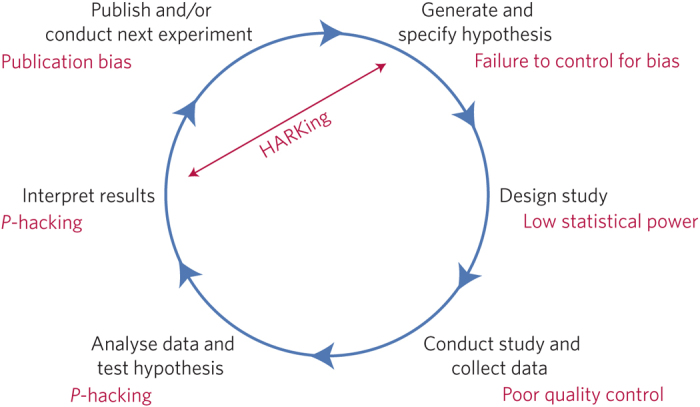
“We discussed how preregistration potentially prevents p - hacking [16] and Hypothesising After Results are Known (HARKing) [17], two major threats for the reproducibility of science [18].”
BackgroundStress and cognition: A user’s guide to designing and interpreting studies
Shields, G. S. (2020) · Psychoneuroendocrinology · doi:10.1016/j.psyneuen.2019.104475 · Cited by 80
S&T indicators in the wild: Contextualization and participation for responsible metrics
Ràfols, I. (2018) · Research Evaluation · doi:10.1093/reseval/rvy030 · Cited by 94
Gieseler, K., Loschelder, D. D., & Friese, M. (2019) · Springer eBooks · doi:10.1007/978-3-030-13788-5_1 · Cited by 86
Pre-registration: Weighing costs and benefits for researchers
Logg, J. M., & Dorison, C. A. (2021) · Organizational Behavior and Human Decision Processes · doi:10.1016/j.obhdp.2021.05.006 · Cited by 91
Bo, K., Kraynak, T. E., Kwon, M., Sun, M. M. C., Gianaros, P. J., & Wager, T. D. (2024) · Nature Neuroscience · doi:10.1038/s41593-024-01605-7 · Cited by 85
Biomedical researchers’ perspectives on the reproducibility of research
Cobey, K. D., Ebrahimzadeh, S., Page, M. J., Thibault, R. T., Nguyen, P., Abu-Dalfa, F., & Moher, D. (2024) · PLoS Biology · doi:10.1371/journal.pbio.3002870 · Cited by 88
Nutrition Education and Dietary Behavior Change Games: A Scoping Review
Baranowski, T., Ryan, C., Hoyos-Cespedes, A., & Lu, A. S. (2018) · Games for Health Journal · doi:10.1089/g4h.2018.0070 · Cited by 92
Journal Data Sharing Policies and Statistical Reporting Inconsistencies in Psychology
Nuijten, M. B., Borghuis, J., Veldkamp, C. L. S., Dominguez-Alvarez, L., van Assen, M. A. L. M., & Wicherts, J. M. (2017) · Collabra: Psychology · doi:10.1525/collabra.102 · Cited by 79
“Research that aims to do so, such as this paper, adds to a growing body of literature on “meta-science” (Ioannidis, Fanelli, Dunne, & Goodman, 2015; Munafò et al., 2017).”
BackgroundThe empirical replicability of task-based fMRI as a function of sample size
Bossier, H., Roels, S. P., Seurinck, R., Banaschewski, T., Barker, G. J., Bokde, A. L. W., Quinlan, E. B., Desrivières, S., Flor, H., Grigis, A., et al. (2020) · NeuroImage · doi:10.1016/j.neuroimage.2020.116601 · Cited by 87
Peled-Avron, L., Abu-Akel, A., & Shamay-Tsoory, S. (2020) · Neuroscience & Biobehavioral Reviews · doi:10.1016/j.neubiorev.2020.04.023 · Cited by 71
Promoting Open Science: A Holistic Approach to Changing Behaviour
Robson, S. G., Baum, M. A., Beaudry, J. L., Beitner, J., Brohmer, H., Chin, J. M., Jaśko, K., Kouros, C. D., Laukkonen, R., Moreau, D., et al. (2021) · Collabra Psychology · doi:10.1525/collabra.30137 · Cited by 87
A protocol for reproducible functional diversity analyses
Palacio, F. X., Callaghan, C. T., Cardoso, P., Hudgins, E. J., Jarzyna, M. A., Ottaviani, G., Riva, F., Graco‐Roza, C., Shirey, V. M., & Mammola, S. (2022) · Ecography · doi:10.1111/ecog.06287 · Cited by 81
Kurath, J., & Mata, R. (2018) · Neuroscience & Biobehavioral Reviews · doi:10.1016/j.neubiorev.2018.05.003 · Cited by 90
Hardwicke, T. E., & Ioannidis, J. P. A. (2018) · PLOS ONE · doi:10.1371/journal.pone.0201856 · Cited by 78
Self-citationRoberts, C. A., Jones, A., Sumnall, H., Gage, S. H., & Montgomery, C. (2020) · European Neuropsychopharmacology · doi:10.1016/j.euroneuro.2020.07.002 · Cited by 78
The replication crisis: How might philosophy and theory of psychology be of use?
Morawski, J. G. (2019) · Journal of Theoretical and Philosophical Psychology · doi:10.1037/teo0000129 · Cited by 78
Graduate Biomedical Science Education Needs a New Philosophy
Bosch, G., & Casadevall, A. (2017) · mBio · doi:10.1128/mbio.01539-17 · Cited by 87
Increasing the statistical power of animal experiments with historical control data
Bonapersona, V., Hoijtink, H., RELACS, Sarabdjitsingh, R. A., & Joëls, M. (2021) · Nature Neuroscience · doi:10.1038/s41593-020-00792-3 · Cited by 90
Researcher degrees of freedom in phonetic research
Roettger, T. B. (2019) · Laboratory Phonology Journal of the Association for Laboratory Phonology · doi:10.5334/labphon.147 · Cited by 81
Bozkurt, S., Cahan, E. M., Seneviratne, M. G., Sun, R., Lossio-Ventura, J. A., Ioannidis, J. P. A., & Hernandez-Boussard, T. (2020) · Journal of the American Medical Informatics Association · doi:10.1093/jamia/ocaa164 · Cited by 65
Self-citationFox, J., Pearce, K. E., Massanari, A. L., Riles, J. M., Szulc, Ł., Ranjit, Y. S., Trevisan, F., Soriano, C. R., Jessica Vitak, B., Arora, P., et al. (2021) · Journal of Communication · doi:10.1093/joc/jqab029 · Cited by 96
Laurinavichyute, A., Yadav, H., & Vasishth, S. (2022) · Journal of Memory and Language · doi:10.1016/j.jml.2022.104332 · Cited by 88
Keating, D. M., & Totzkay, D. (2019) · Annals of the International Communication Association · doi:10.1080/23808985.2019.1632218 · Cited by 77
IMPACT: Studies in Language, Culture and Society
(2013) · Impact · doi:10.1075/impact · Cited by 76
Replicability and replication in the humanities
Peels, R. (2019) · Research Integrity and Peer Review · doi:10.1186/s41073-018-0060-4 · Cited by 80
Open science and public trust in science: Results from two studies
Rosman, T., Bošnjak, M., Silber, H., Koßmann, J., & Heycke, T. (2022) · Public Understanding of Science · doi:10.1177/09636625221100686 · Cited by 84
Zipper, S. C., Farmer, W. H., Brookfield, A. E., Ajami, H., Reeves, H. W., Wardropper, C. B., Hammond, J. C., Gleeson, T., & Deines, J. M. (2022) · JAWRA Journal of the American Water Resources Association · doi:10.1111/1752-1688.12998 · Cited by 80
Improving reproducibility by using high-throughput observational studies with empirical calibration
Schuemie, M. J., Ryan, P. B., Hripcsak, G., Madigan, D., & Suchard, M. A. (2018) · Philosophical Transactions of the Royal Society A: Mathematical, Physical and Engineering Sciences · doi:10.1098/rsta.2017.0356 · Cited by 74
“Although many solutions have been proposed, including preregistering studies, open science, team research and better reporting, adoption of these solutions is still lacking [3,4].”
BackgroundGagné, N., & Franzen, L. (2023) · Swiss Psychology Open · doi:10.5334/spo.34 · Cited by 79
Open Science Is Liberating and Can Foster Creativity
Frankenhuis, W. E., & Nettle, D. (2018) · Perspectives on Psychological Science · doi:10.1177/1745691618767878 · Cited by 81
Flis, I. (2019) · Theory & psychology · doi:10.1177/0959354319835322 · Cited by 51
Self‐control in crows, parrots and nonhuman primates
Miller, R., Boeckle, M., Jelbert, S. A., Frohnwieser, A., Wascher, C. A. F., & Clayton, N. S. (2019) · Wiley Interdisciplinary Reviews Cognitive Science · doi:10.1002/wcs.1504 · Cited by 78
Is the Deliberate Practice View Defensible? A Review of Evidence and Discussion of Issues
Hambrick, D. Z., Macnamara, B. N., & Oswald, F. L. (2020) · Frontiers in Psychology · doi:10.3389/fpsyg.2020.01134 · Cited by 85
Algermissen, J., & Mehler, D. M. A. (2018) · Journal of Neurophysiology · doi:10.1152/jn.00765.2017 · Cited by 70
Gardner, B., Rebar, A. L., & Lally, P. J. (2020) · Cambridge University Press eBooks · doi:10.1017/9781108677318.041 · Cited by 85
The role of expertise and culture in visual art appreciation
Darda, K. M., & Cross, E. S. (2022) · Scientific Reports · doi:10.1038/s41598-022-14128-7 · Cited by 86
Replicator degrees of freedom allow publication of misleading failures to replicate
Bryan, C. J., Yeager, D. S., & O’Brien, J. (2019) · Proceedings of the National Academy of Sciences · doi:10.1073/pnas.1910951116 · Cited by 84
Elliot, A. J. (2018) · Review of General Psychology · doi:10.1037/gpr0000170 · Cited by 79
Diveica, V., Koldewyn, K., & Binney, R. J. (2021) · NeuroImage · doi:10.1016/j.neuroimage.2021.118702 · Cited by 77
Understanding experiments and research practices for reproducibility: an exploratory study
Samuel, S., & König‐Ries, B. (2021) · PeerJ · doi:10.7717/peerj.11140 · Cited by 76
Bastiaanssen, T. F. S., Quinn, T. P., & Loughman, A. (2023) · Nature Mental Health · doi:10.1038/s44220-023-00148-3 · Cited by 76
Siepe, B. S., Bartos̆, F., Morris, T. P., Boulesteix, A., Heck, D. W., & Pawel, S. (2024) · Psychological Methods · doi:10.1037/met0000695 · Cited by 92
Predictive coding and stochastic resonance as fundamental principles of auditory phantom perception.
Schilling, A., Sedley, W., Gerum, R., Metzner, C., Tziridis, K., Maier, A., Schulze, H., Zeng, F.-G., Friston, K. J., & Krauss, P. (2023) · Brain · doi:10.1093/brain/awad255 · Cited by 70
Thorn, J. C., Davies, C. F., Brookes, S. T., Noble, S. M., Dritsaki, M., Gray, E., Hughes, D. A., Mihaylova, B., Petrou, S., Ridyard, C., et al. (2021) · Value in Health · doi:10.1016/j.jval.2020.10.002 · Cited by 70
“Concerns over the credibility of clinical trial and other scientific results have led to calls for adopting measures designed to improve conduct and reporting of studies.(19) The suite of documentation that is now associated with RCTs (including the protocol, SAP, data-sharing requirements, and reporting of results) a…”
Improving transparency and scientific rigor in academic publishing
Prager, E. M., Chambers, K. E., Plotkin, J. L., McArthur, D. L., Bandrowski, A. E., Bansal, N., Martone, M. E., Bergstrom, H. C., Bespalov, A., & Graf, C. (2019) · Brain and Behavior · doi:10.1002/brb3.1141 · Cited by 60
Schoemann, M., O’Hora, D. P., Dale, R. A. C., & Scherbaum, S. (2020) · Psychonomic Bulletin & Review · doi:10.3758/s13423-020-01851-3 · Cited by 77
The impact of using biased performance metrics on software defect prediction research
Yao, J., & Shepperd, M. (2021) · Information and Software Technology · doi:10.1016/j.infsof.2021.106664 · Cited by 74
Lewis, A. S. L., Woelmer, W. M., Wander, H. L., Howard, D. W., Smith, J. W., McClure, R. P., Lofton, M. E., Hammond, N. W., Corrigan, R. S., Thomas, R. Q., et al. (2021) · Ecological Applications · doi:10.1002/eap.2500 · Cited by 75
Psychedelic Research and the Need for Transparency: Polishing Alice’s Looking Glass
Petranker, R., Anderson, T., & Farb, N. (2020) · Frontiers in Psychology · doi:10.3389/fpsyg.2020.01681 · Cited by 69
SIGIR Initiative to Implement ACM Artifact Review and Badging
Ferro, N., & Kelly, D. (2018) · ACM SIGIR Forum · doi:10.1145/3274784.3274786 · Cited by 69
Amid, C., Pakseresht, N., Silvester, N. C., Jayathilaka, S., Lund, O., Dynovski, L. D., Pataki, B., Visontai, D., Xavier, B. B., Alako, B., et al. (2019) · Database · doi:10.1093/database/baz136 · Cited by 70
Replication and Reproducibility in Cross-Cultural Psychology
Milfont, T. L., & Klein, R. A. (2018) · Journal of Cross-Cultural Psychology · doi:10.1177/0022022117744892 · Cited by 73
Guidelines for planning and conducting high-quality research and testing on animals
Smith, A. J. (2020) · Laboratory Animal Research · doi:10.1186/s42826-020-00054-0 · Cited by 71
Imagining the “open” university: Sharing scholarship to improve research and education
McKiernan, E. C. (2017) · PLoS Biology · doi:10.1371/journal.pbio.1002614 · Cited by 80
Rosenfeld, D. L., Balcetis, E., Bastian, B. B., Berkman, E. T., Bosson, J. K., Brannon, T. N., Burrow, A. L., Cameron, C. D., Chen, S., Cook, J., et al. (2021) · Perspectives on Psychological Science · doi:10.1177/1745691621999374 · Cited by 72
Bošnjak, M., Fiebach, C. J., Mellor, D. T., Mueller, S., O'Connor, D. B., Oswald, F. L., & Sokol, R. I. (2022) · American Psychologist · doi:10.1037/amp0000879 · Cited by 77
The effectiveness of pre-performance routines in sports: a meta-analysis
Rupprecht, A. G. O., Tran, U. S., & Gröpel, P. (2021) · International Review of Sport and Exercise Psychology · doi:10.1080/1750984x.2021.1944271 · Cited by 77
A reproducible systematic map of research on the illusory truth effect
Henderson, E. L., Westwood, S. J., & Simons, D. J. (2022) · Psychonomic Bulletin & Review · doi:10.3758/s13423-021-01995-w · Cited by 51
The Neurocognition of Translation and Interpreting
García, A. M. (2019) · Benjamins translation library · doi:10.1075/btl.147 · Cited by 82
Generalizability is not optional: insights from a cross-cultural study of social discounting
Tiokhin, L., Hackman, J., Munira, S., Jesmin, K., & Hruschka, D. (2019) · Royal Society Open Science · doi:10.1098/rsos.181386 · Cited by 57
Predator Control Needs a Standard of Unbiased Randomized Experiments With Cross-Over Design
Treves, A., Krofel, M., Ohrens, O., & van Eeden, L. M. (2019) · Frontiers in Ecology and Evolution · doi:10.3389/fevo.2019.00462 · Cited by 71
Data quality over data quantity in computational cognitive neuroscience
Kolossa, A., & Kopp, B. (2018) · NeuroImage · doi:10.1016/j.neuroimage.2018.01.005 · Cited by 68
Changing Behavior Using Self-Determination Theory
Hagger, M. S., Hankonen, N. E., Chatzisarantis, N. L. D., & Ryan, R. M. (2020) · Cambridge University Press eBooks · doi:10.1017/9781108677318.008 · Cited by 87
The evolution of instrument selection for inclusion in core outcome sets at OMERACT: Filter 2.2
Maxwell, L. J., Beaton, D., Boers, M., D’Agostino, M. A., Conaghan, P. G., Grosskleg, S., Shea, B., Bingham, C. O., Boonen, A. E. R. C. H., Christensen, R., et al. (2021) · Seminars in Arthritis and Rheumatism · doi:10.1016/j.semarthrit.2021.08.011 · Cited by 71
Fecher, B., Friesike, S., Hebing, M., & Linek, S. B. (2017) · Humanities and Social Sciences Communications · doi:10.1057/palcomms.2017.51 · Cited by 72
Metadata
- Authors
- Munafò, M. R., Nosek, B. A., Bishop, D. V. M., Button, K. S., Chambers, C. D., Percie du Sert, N., Simonsohn, U., Wagenmakers, E.-J., Ware, J. J., & Ioannidis, J. P. A.
- Affiliations
- Center for Open Science (US)
- University of Oxford (GB)
- University of Bath (GB)
- University of Pennsylvania (US)
- University of Amsterdam (NL)
- CHDI Foundation (US)
- Stanford Medicine (US)
- ORCID
- Venue
- Nature Human Behaviour
- Published
- 2017-01-10
- Volume
- 1
- Issue
- 1
- Pages
- 0021-0021
- ISSN
- 2397-3374 (ISSN-L)
- PMC
- PMC7610724
- OpenAlex
- W2570760970
- Cited by
- 3,397
- References
- 92
- Citations by year
- 2026: 286 · 2025: 249 · 2024: 357 · 2023: 331 · 2022: 389 · 2021: 365 · 2020: 451 · 2019: 468 · 2018: 334 · 2017: 160
- FWCI
- 622.57
- Type
- journal article
- Language
- en
- Open access
- hybrid
- doi.org
- Licence
- cc-by
- creativecommons.org/licenses/by/4.0 (tdm)
- creativecommons.org/licenses/by/4.0 (vor)
- Locations
- Nature Human Behaviour (publishedVersion, cc-by)
- PubMed Central (publishedVersion, cc-by)
- PubMed (publishedVersion)
- ORCA Online Research @Cardiff (Cardiff University) (acceptedVersion)
- Explore Bristol Research (submittedVersion, cc-by)
- RePEc: Research Papers in Economics (submittedVersion)
- UvA-DARE (University of Amsterdam) (submittedVersion, cc-by)
- Data Archiving and Networked Services (DANS) (submittedVersion, other-oa)
- Funders
- Laura and John Arnold Foundation
- Wellcome Trust (082498/Z/07/Z, 082498)
- United Kingdom Clinical Research Collaboration
- Government of the United Kingdom
- Cancer Research UK
- National Institute for Health and Care Research
- British Heart Foundation
- National Centre for the Replacement, Refinement and Reduction of Animals in Research (NC3RS001)
- University of Bristol (MC_UU_12013, MC_UU_12013/6)
- Medical Research Council (MC_UU_12013, MC_UU_12013/6)
- Biotechnology and Biological Sciences Research Council (BB/K008277/1, BB/N019660/1)
- Economic and Social Research Council
- Topics
- Social Sciences › Library and Information Sciences › Academic Publishing and Open Access
- Social Sciences › Decision Sciences › Information Systems and Management › Scientific Computing and Data Management
- Social Sciences › Business, Management and Accounting › Management of Technology and Innovation › Research, Science, and Academia
- Keywords
- reproducible research, research reliability, research transparency, research efficiency, research evaluation, research incentives, research dissemination, reporting guidelines, scholarly publishing, research funding
About these checks
Registry, retraction, Cites and statistics results are computed, not judged, with one exception: a printed reference that no index lists is read once by a model before it counts as a citation error. Claims are extracted by a model and kept only when their quote appears verbatim in the text; each cited source is then checked, with a model’s help, for whether it says what the claim relies on. Those verdicts can be wrong — read the claim’s quote and the cited source before relying on one.
Statistics and arithmetic are recomputed, not judged.
Confidence bands are shown only for fields calibrated on our annotated test set. None is calibrated yet, so no band is shown.
What counts as a claim ›How we measure confidence ›How we check this ›
Are you an author, or do you see a problem with this page? Request a review
Data sources
Bibliographic data: Semantic Scholar, OpenAlex, Crossref.
Contains information from the Semantic Scholar Academic Graph Datasets, made available under the ODC Attribution License (ODC-BY 1.0).
Semantic Scholar’s data is described in: Kinney, R., et al. (2023). The Semantic Scholar Open Data Platform. arXiv:2301.10140.
