

A manifesto for reproducible science
Open accessThe DOI matches its Crossref record; 91 of the 92 references it cites were found in a registry or an index.
Abstract
Improving the reliability and efficiency of scientific research will increase the credibility of the published scientific literature and accelerate discovery. Here we argue for the adoption of measures to optimize key elements of the scientific process: methods, reporting and dissemination, reproducibility, evaluation and incentives. There is some evidence from both simulations and empirical studies supporting the likely effectiveness of these measures, but their broad adoption by researchers, institutions, funders and journals will require iterative evaluation and improvement. We discuss the goals of these measures, and how they can be implemented, in the hope that this will facilitate action toward improving the transparency, reproducibility and efficiency of scientific research.
Overview
The claims and statistics of this paper haven’t been checked yet.
Free: it reads the open-access text and checks the first 5 claims that cite a source we can check. Create a free account to check every claim.
Integrity signals
Registry
Cites
Statistics
Figures
Verification
Claims the paper makes
The claims and statistics of this paper haven’t been checked yet.
Free: it reads the open-access text and checks the first 5 claims that cite a source we can check. Create a free account to check every claim.
Claims other papers make about this one
Each is checked against this paper’s own text: does it say what the citing paper says it does?
The source backs part of the claim, not all of it — or backs it for a different population, condition or comparison.
In the citing paper
“Furthermore, thorough documentation and recording improve the transparency and efficiency of scientific research, can be used to improve reproducibility, and enable work to be repeated (Baker, 2016a,b; Munafo et al., 2017).”
From Guidance document on Good cell and tissue culture practice 2.0 (GCCP 2.0) (2021) · cites this paper as Munafo et al., 2017
Experimental — accuracy not yet measuredThe cited source says what the claim attributes to it.
In the citing paper
“Furthermore, sample sizes are often underpowered (4-6), at times leading to conclusions that do not hold up with larger-sized replications or metaanalyses (7).”
From Generic language in scientific communication (2019) · cites this paper as [6]
The cited source says what the claim attributes to it.
In the citing paper
“Accordingly, there is growing recognition that data availability is a critical feature of an efficient, progressive, and ultimately self-correcting scientific ecosystem that generates credible findings [1–3].”
From Data availability, reusability, and analytic reproducibility: evaluating the impact of a mandatory open data policy at the journal Cognition (2018) · cites this paper as [2]
The cited source says what the claim attributes to it.
In the citing paper
“Open data alone are clearly not enough to achieve the benefits envisaged by proponents of data sharing [2].”
From Data availability, reusability, and analytic reproducibility: evaluating the impact of a mandatory open data policy at the journal Cognition (2018) · cites this paper as [2]
The cited source says what the claim attributes to it.
In the citing paper
“Some journals have heeded the growing calls for adoption of transparent and reproducible research practices and introduced new policies to implement change [1,2].”
From Data availability, reusability, and analytic reproducibility: evaluating the impact of a mandatory open data policy at the journal Cognition (2018) · cites this paper as [2]
5 more claims about this paper
Create a free account to see every claim other papers make about this one.
Self-check
Percentages, sums and reported differences re-computed from the paper’s own numbers.
The self-check needs the paper’s full text.
Citations
Cites
Liberati, A., Altman, D. G., Tetzlaff, J., Mulrow, C., Gøtzsche, P. C., Ioannidis, J. P. A., Clarke, M., Devereaux, P. J., Kleijnen, J., & Moher, D. (2009) · PLoS Medicine · doi:10.1371/journal.pmed.1000100 · Cited by 28,164 · cited 1×
“There are also guidelines for improving the reporting of research planning; for example, the Preferred Reporting Items for Systematic Reviews and Meta-analyses ( PRISMA) statement for reporting of systematic reviews and meta-analyses 59 , and PRISMA-P for protocols of systematic reviews 60 .”
Self-citationCONSORT 2010 Statement: updated guidelines for reporting parallel group randomised trials
the CONSORT Group, Schulz, K. F., Altman, D. G., & Moher, D. (2010) · BMC Medicine · doi:10.1186/1741-7015-8-18 · Cited by 13,371
Shamseer, L., Moher, D., Clarke, M., Ghersi, D., Liberati, A., Petticrew, M., Shekelle, P., Stewart, L. A., & the PRISMA-P Group (2015) · BMJ · doi:10.1136/bmj.g7647 · Cited by 13,120
Why Most Published Research Findings Are False
Ioannidis, J. P. A. (2005) · PLoS Medicine · doi:10.1371/journal.pmed.0020124 · Cited by 10,505
Self-citationCONSORT 2010 Statement: updated guidelines for reporting parallel group randomised trials
Schulz, K. F., Altman, D. G., Moher, D., & for the CONSORT Group (2010) · BMJ · doi:10.1136/bmj.c332 · Cited by 9,329 · cited 1×
“For example, the Consolidated Standards of Reporting Trials (CONSORT) statement provides guidance for clear, complete and accurate reporting of randomized controlled trials 55–57 .”
The file drawer problem and tolerance for null results.
Rosenthal, R. (1979) · Psychological Bulletin · doi:10.1037/0033-2909.86.3.638 · Cited by 9,068 · cited 1×
“Publication bias 47 , also known as the file drawer problem 48 , refers to the fact that many more studies are conducted than published.”
Power failure: why small sample size undermines the reliability of neuroscience
Button, K. S., Ioannidis, J. P. A., Mokrysz, C., Nosek, B. A., Flint, J., Robinson, E. S. J., & Munafò, M. R. (2013) · Nature Reviews Neuroscience · doi:10.1038/nrn3475 · Cited by 7,641 · cited 3×
“Studies of statistical power persistently find it to be below (sometimes well below) 50%, across both time and the different disciplines studied 2,35,36 .”
Self-citationConfirmation Bias: A Ubiquitous Phenomenon in Many Guises
Nickerson, R. S. (1998) · Review of General Psychology · doi:10.1037/1089-2680.2.2.175 · Cited by 7,267
Simmons, J. P., Nelson, L. D., & Simonsohn, U. (2011) · Psychological Science · doi:10.1177/0956797611417632 · Cited by 6,567
Self-citationWhy Most Published Research Findings Are False
Ioannidis, J. P. A. (2005) · CHANCE · doi:10.1080/09332480.2005.10722754 · Cited by 4,702 · cited 1×
“N a t u r e H u m a n Be h aviou r 1 (1) , 0 0 2 1.”
Self-citation
Research works printed but not linked: 1
- Simmons, J. P., Nelson, L. D. & Simonsohn, U. A 21 word solution. Preprint at 10.2139/ssrn.2160588(2012). · doi:10.2139/ssrn.2160588(2012
Cited by
Items 201–300 of 1,030
Evolution of prosocial behaviours in multilayer populations
Su, Q., McAvoy, A., Mori, Y., & Plotkin, J. B. (2022) · Nature Human Behaviour · doi:10.1038/s41562-021-01241-2 · Cited by 160
ISRIA statement: ten-point guidelines for an effective process of research impact assessment
Adam, P., Ovseiko, P. V., Grant, J., Graham, K. E. R., Boukhris, O. F., Dowd, A.-M., Balling, G. V., Christensen, R. N., Pollitt, A., Taylor, M., et al. (2018) · Health Research Policy and Systems · doi:10.1186/s12961-018-0281-5 · Cited by 146
Liu, Z., Huang, R., Roberts, R., & Tong, W. (2019) · Trends in Pharmacological Sciences · doi:10.1016/j.tips.2018.12.001 · Cited by 123
Grain-size distribution unmixing using the R package EMMAgeo
Dietze, E., & Dietze, M. C. (2019) · E&G Quaternary Science Journal · doi:10.5194/egqsj-68-29-2019 · Cited by 135
Value-based attentional capture affects multi-alternative decision making
Gluth, S., Spektor, M. S., & Rieskamp, J. (2018) · eLife · doi:10.7554/elife.39659 · Cited by 140
Zebhauser, P. T., Hohn, V. D., & Ploner, M. (2022) · Pain · doi:10.1097/j.pain.0000000000002825 · Cited by 143
Almaatouq, A., Griffiths, T. L., Suchow, J. W., Whiting, M. E., Evans, J. A., & Watts, D. J. (2022) · Behavioral and Brain Sciences · doi:10.1017/s0140525x22002874 · Cited by 181
Towards wide-scale adoption of open science practices: The role of open science communities
Armeni, K., Brinkman, L., Carlsson, R., Eerland, A., Fijten, R., Fondberg, R., Heininga, V. E., Heunis, S., Koh, W. Q., Masselink, M., et al. (2021) · Science and Public Policy · doi:10.1093/scipol/scab039 · Cited by 110
Application of network methods for understanding mental disorders: pitfalls and promise
Guloksuz, S., Pries, L.-K., & van Os, J. (2017) · Psychological Medicine · doi:10.1017/s0033291717001350 · Cited by 125
Particle Targeting in Complex Biological Media
Dai, Q., Bertleff‐Zieschang, N., Braunger, J. A., Björnmalm, M., Cortez‐Jugo, C., & Caruso, F. (2017) · Advanced Healthcare Materials · doi:10.1002/adhm.201700575 · Cited by 140
Nutrition and the ageing brain: Moving towards clinical applications
Flanagan, E. C., Lamport, D. J., Brennan, L., Burnet, P. W. J., Calabrese, V., Cunnane, S. C., de Wilde, M. C., Dye, L., Farrimond, J. A., Lombardo, N. B. E., et al. (2020) · Ageing Research Reviews · doi:10.1016/j.arr.2020.101079 · Cited by 139
Reproducibility in systems biology modelling
Tiwari, K., Kananathan, S., Roberts, M. G., Meyer, J. P., Sharif Shohan, M. U., Xavier, A., Maire, M., Zyoud, A., Men, J., Ng, S., et al. (2021) · Molecular Systems Biology · doi:10.15252/msb.20209982 · Cited by 131
LIONESS Lab – A Free Web-Based Platform for Conducting Interactive Experiments Online
Giamattei, M., Yahosseini, K. S., Gächter, S., & Molleman, L. (2019) · Journal of the Economic Science Association · doi:10.1007/s40881-020-00087-0 · Cited by 159
Bayesian statistics and modelling
van de Schoot, R., Depaoli, S. A., Gelman, A., King, R., Kramer, B. M. R., Märtens, K., Tadesse, M. G., Vannucci, M., Willemsen, J. E., & Yau, C. (2021) · Nature Reviews Methods Primers · doi:10.1038/s43586-020-00003-0 · Cited by 155
Sharp, G. C., Lawlor, D. A., & Richardson, S. S. (2018) · Social Science & Medicine · doi:10.1016/j.socscimed.2018.07.035 · Cited by 128
Gene set enrichment for reproducible science: comparison of CERNO and eight other algorithms
Zyla, J., Marczyk, M., Domaszewska, T., Kaufmann, S. H. E., Polanska, J., & Weiner, J. (2019) · Bioinformatics · doi:10.1093/bioinformatics/btz447 · Cited by 122
What Is Evaluation?: Perspectives of How Evaluation Differs (or Not) From Research
Wanzer, D. L. (2020) · American Journal of Evaluation · doi:10.1177/1098214020920710 · Cited by 140
Minno, A. D., Gelzo, M., Caterino, M., Costanzo, M., Ruoppolo, M., & Castaldo, G. (2022) · International Journal of Molecular Sciences · doi:10.3390/ijms23095213 · Cited by 134
Triangulating Evidence through the Inclusion of Genetically Informed Designs
Munafò, M. R., Higgins, J. P. T., & Smith, G. D. (2021) · Cold Spring Harbor Perspectives in Medicine · doi:10.1101/cshperspect.a040659 · Cited by 125
Dekhtiar, J., Durupt, A., Bricogne, M., Eynard, B., Rowson, H., & Kiritsis, D. (2018) · Computers in Industry · doi:10.1016/j.compind.2018.04.005 · Cited by 136
Consortium for Transparency in Exercise Science (COTES) Collaborators, Caldwell, A. R., Vigotsky, A. D., Tenan, M. S., Radel, R., Mellor, D. T., Kreutzer, A., Lahart, I. M., Mills, J. P., & Boisgontier, M. P. (2020) · Sports Medicine · doi:10.1007/s40279-019-01227-1 · Cited by 114
Community geography: Toward a disciplinary framework
Shannon, J., Hankins, K., Shelton, T., Bosse, A. J., Scott, D., Block, D., Fischer, H. A., Eaves, L. E., Jung, J.-K., Robinson, J., et al. (2020) · Progress in Human Geography · doi:10.1177/0309132520961468 · Cited by 132
Publishing Multimethod Research in AMJ: A Review and Best-Practice Recommendations
Wellman, N. M., Tröster, C., Grimes, M. G., Roberson, Q. M., Rink, F. A., & Gruber, M. B. (2023) · Academy of Management Journal · doi:10.5465/amj.2023.4004 · Cited by 125
Within-subject mediation analysis for experimental data in cognitive psychology and neuroscience
Vuorre, M., & Bolger, N. (2018) · Behavior Research Methods · doi:10.3758/s13428-017-0980-9 · Cited by 107
Ten steps to get started in Genome Assembly and Annotation
Angel, V. D. D., Hjerde, E., Sterck, L., Capella-Gutiérrez, S., Notredame, C., Pettersson, O. V., Amselem, J., Bouri, L., Bocs, S., Klopp, C., et al. (2018) · F1000Research · doi:10.12688/f1000research.13598.1 · Cited by 155
Nieuwland, M. S. (2019) · Neuroscience & Biobehavioral Reviews · doi:10.1016/j.neubiorev.2018.11.019 · Cited by 121
Packaging Data Analytical Work Reproducibly Using R (and Friends)
Marwick, B., Boettiger, C., & Mullen, L. (2018) · The American Statistician · doi:10.1080/00031305.2017.1375986 · Cited by 108
P-hacking and publication bias interact to distort meta-analytic effect size estimates
Friese, M., & Frankenbach, J. (2020) · Psychological Methods · doi:10.1037/met0000246 · Cited by 122
Quantifying Support for the Null Hypothesis in Psychology: An Empirical Investigation
Aczél, B., Pálfi, B., Szollosi, A., Kovács, M., Szászi, B., Szécsi, P., Zrubka, M., Gronau, Q. F., van den Bergh, D., & Wagenmakers, E. (2018) · Advances in Methods and Practices in Psychological Science · doi:10.1177/2515245918773742 · Cited by 137
Self-citationHow to Crack Pre-registration: Toward Transparent and Open Science
Yamada, Y. (2018) · Frontiers in Psychology · doi:10.3389/fpsyg.2018.01831 · Cited by 114
Beyond genomics: understanding exposotypes through metabolomics
Rattray, N. J. W., Deziel, N. C., Wallach, J. D., Khan, S. A., Vasiliou, V., Ioannidis, J. P. A., & Johnson, C. H. (2018) · Human Genomics · doi:10.1186/s40246-018-0134-x · Cited by 131
Self-citationLaban, G., Kappas, A., Morrison, V., & Cross, E. S. (2024) · International Journal of Social Robotics · doi:10.1007/s12369-023-01076-z · Cited by 119
Romano, Y., Sesia, M., & Candès, E. (2020) · Journal of the American Statistical Association · doi:10.1080/01621459.2019.1660174 · Cited by 107
Beyond the “Third Wave of Positive Psychology”: Challenges and Opportunities for Future Research
Wissing, M. P. (2022) · Frontiers in Psychology · doi:10.3389/fpsyg.2021.795067 · Cited by 136
Reproducibility in machine‐learning‐based research: Overview, barriers, and drivers
Semmelrock, H., Ross‐Hellauer, T., Kopeinik, S., Theiler, D., Haberl, A., Thalmann, S., & Kowald, D. (2025) · AI Magazine · doi:10.1002/aaai.70002 · Cited by 118
Benvenuti, M., Wright, M. F., Naslund, J. A., & Miers, A. C. (2023) · Current Psychology · doi:10.1007/s12144-023-04254-4 · Cited by 140
Adjusting for Batch Effects in DNA Methylation Microarray Data, a Lesson Learned
Price, E. M., & Robinson, W. P. (2018) · Frontiers in Genetics · doi:10.3389/fgene.2018.00083 · Cited by 129
Rodd, J. M. (2023) · Journal of Memory and Language · doi:10.1016/j.jml.2023.104472 · Cited by 134
Jones, A., McGrath, E., Robinson, E., Houben, K., Nederkoorn, C., & Field, M. (2018) · Journal of Consulting and Clinical Psychology · doi:10.1037/ccp0000312 · Cited by 119
On the relevance of data science for flight delay research: a systematic review
de Carvalho, L. S., Sternberg, A., Gonçalves, L. M., Cruz, A. B., Soares, J., Brandão, D. N., Carvalho, D., & Ogasawara, E. (2020) · Transport Reviews · doi:10.1080/01441647.2020.1861123 · Cited by 130
Traceability for Trustworthy AI: A Review of Models and Tools
Mora-Cantallops, M., Sánchez-Alonso, S., García-Barriocanal, E., & Sicilia, M.-A. (2021) · Big Data and Cognitive Computing · doi:10.3390/bdcc5020020 · Cited by 91
Credibility Beyond Replicability: Improving the Four Validities in Psychological Science
Vazire, S., Schiavone, S. R., & Bottesini, J. G. (2022) · Current Directions in Psychological Science · doi:10.1177/09637214211067779 · Cited by 129
Changing Behavior Using the Health Action Process Approach
Schwarzer, R., & Hamilton, K. (2020) · The Handbook of Behavior Change · doi:10.1017/9781108677318.007 · Cited by 102
MENKVELD, A. J., DREBER, A., HOLZMEISTER, F., HUBER, J., JOHANNESSON, M., KIRCHLER, M., NEUSÜß, S., RAZEN, M., WEITZEL, U., ABAD‐DÍAZ, D., et al. (2024) · The Journal of Finance · doi:10.1111/jofi.13337 · Cited by 113
Masur, P. K., DiFranzo, D. J., & Bazarova, N. N. (2021) · PLoS ONE · doi:10.1371/journal.pone.0254670 · Cited by 133
Open and reproducible neuroimaging: From study inception to publication
Niso, G., Botvinik‐Nezer, R., Appelhoff, S., de la Vega, A. I., Estéban, O., Etzel, J. A., Finc, K., Ganz, M., Gau, R., Halchenko, Y. O., et al. (2022) · NeuroImage · doi:10.1016/j.neuroimage.2022.119623 · Cited by 127
Survey of open science practices and attitudes in the social sciences
Ferguson, J., Littman, R., Christensen, G., Paluck, E. L., Swanson, N., Wang, Z., Miguel, E. A., Birke, D. J., & Pezzuto, J.-H. (2023) · Nature Communications · doi:10.1038/s41467-023-41111-1 · Cited by 135
A methodological synthesis and meta-analysis of judgment tasks in second language research
Plonsky, L., Marsden, E. J., Crowther, D., Gass, S. M., & Spinner, P. (2019) · Second language Research · doi:10.1177/0267658319828413 · Cited by 121
Designing a rigorous microscopy experiment: Validating methods and avoiding bias
Jost, A. P.-T., & Waters, J. C. (2019) · The Journal of Cell Biology · doi:10.1083/jcb.201812109 · Cited by 116
Grieder, S., & Steiner, M. D. (2021) · Behavior Research Methods · doi:10.3758/s13428-021-01581-x · Cited by 126
Methods for Heart Rate Variability Biofeedback (HRVB): A Systematic Review and Guidelines
Lalanza, J. F., Lorente, S., Bullich, R., García, C., Losilla, J.-M., & Capdevila, L. (2023) · Applied Psychophysiology and Biofeedback · doi:10.1007/s10484-023-09582-6 · Cited by 117
Best Practice Recommendations for Replicating Experiments in Public Administration
Walker, R. M., Brewer, G. A., Lee, M. J., Petrovsky, N., & van Witteloostuijn, A. C. (2018) · Journal of Public Administration Research and Theory · doi:10.1093/jopart/muy047 · Cited by 118
Mesquida, C., Murphy, J., Lakens, D., & Warne, J. P. (2022) · Royal Society Open Science · doi:10.1098/rsos.220946 · Cited by 118
Neurobiological and Cognitive Profile of Young Binge Drinkers: a Systematic Review and Meta-Analysis
Lees, B., Mewton, L., Stapinski, L. A., Squeglia, L. M., Rae, C. D., & Teesson, M. (2019) · Neuropsychology Review · doi:10.1007/s11065-019-09411-w · Cited by 109
“Thus, replication of design and findings across more diverse samples in research laboratories from other countries is encouraged in order to improve both the comparability and robustness of these findings (Open Science Collaboration, 2015;Munafò et al., 2017).”
OpenCASA: A new open-source and scalable tool for sperm quality analysis
Alquézar-Baeta, C., Gimeno‐Martos, S., Miguel-Jiménez, S., Santolaria, P., Yániz, J. L., Palacín, I., Casao, A., Cebrián-Pérez, J. Á., Muiño-Blanco, T., & Pérez‐Pé, R. (2019) · PLoS Computational Biology · doi:10.1371/journal.pcbi.1006691 · Cited by 109
Dreyer, M., Chefneux, L., Goldberg, A., von Heimburg, J., Patrignani, N., Schofield, M., & Shilling, C. (2017) · Sustainability · doi:10.3390/su9101719 · Cited by 120
Practical Solutions for Sharing Data and Materials From Psychological Research
Gilmore, R. O., Kennedy, J. L., & Adolph, K. E. (2018) · Advances in Methods and Practices in Psychological Science · doi:10.1177/2515245917746500 · Cited by 94
Trepanowski, J. F., & Ioannidis, J. P. A. (2018) · Advances in Nutrition · doi:10.1093/advances/nmy014 · Cited by 105
Self-citationNeural Dynamics of Shooting Decisions and the Switch from Freeze to Fight
Hashemi, M. M., Gladwin, T. E., de Valk, N. M., Zhang, W., Kaldewaij, R., van Ast, V. A., Koch, S. B. J., Klumpers, F., & Roelofs, K. (2019) · Scientific Reports · doi:10.1038/s41598-019-40917-8 · Cited by 124
Music Training and Nonmusical Abilities
Schellenberg, E. G., & Lima, C. F. (2023) · Annual Review of Psychology · doi:10.1146/annurev-psych-032323-051354 · Cited by 132
The five pillars of computational reproducibility: bioinformatics and beyond
Ziemann, M., Poulain, P., & Bora, A. (2023) · Briefings in Bioinformatics · doi:10.1093/bib/bbad375 · Cited by 124
Reproducibility and Replicability in Geographical Analysis
Kedron, P., Frazier, A. E., Trgovac, A. B., Nelson, T., & Fotheringham, A. S. (2021) · Geographical Analysis · doi:10.1111/gean.12221 · Cited by 94
Kinds of Replication: Examining the Meanings of “Conceptual Replication” and “Direct Replication”
Derksen, M., & Morawski, J. G. (2022) · Perspectives on Psychological Science · doi:10.1177/17456916211041116 · Cited by 120
Computational Models for Calcium-Mediated Astrocyte Functions
Manninen, T., Havela, R., & Linne, M. (2018) · Frontiers in Computational Neuroscience · doi:10.3389/fncom.2018.00014 · Cited by 114
The Dozen Things Experimental Economists Should Do (More of)
Czibor, E., Jimenez‐Gomez, D., & List, J. A. (2019) · Southern Economic Journal · doi:10.1002/soej.12392 · Cited by 118
Timing is everything: Dance aesthetics depend on the complexity of movement kinematics
Orlandi, A., Cross, E. S., & Orgs, G. (2020) · Cognition · doi:10.1016/j.cognition.2020.104446 · Cited by 108
Guidance document on Good cell and tissue culture practice 2.0 (GCCP 2.0)
Pamies, D. (2021) · ALTEX · doi:10.14573/altex.2111011 · Cited by 100
Whaley, P., Aiassa, E., Beausoleil, C., Beronius, A., Bilotta, G., Boobis, A., de Vries, R., Hanberg, A., Hoffmann, S., Hunt, N., et al. (2020) · Environment International · doi:10.1016/j.envint.2020.105926 · Cited by 91
Reproducibility and research integrity: the role of scientists and institutions
Diaba‐Nuhoho, P., & Amponsah-Offeh, M. (2021) · BMC Research Notes · doi:10.1186/s13104-021-05875-3 · Cited by 111
Marwick, B., Barton, C. M., Bates, L., Bollwerk, E., Bocinsky, R. K., Carter, A. K., Conrad, C., Costa, S., Crema, E. R., Davies, B., et al. (2017) · doi:10.31235/osf.io/72n8g · Cited by 17
Mindfulness induction and cognition: A systematic review and meta-analysis
Gill, L.-N., Renault, R., Campbell, E., Rainville, P., & Khoury, B. (2020) · Consciousness and Cognition · doi:10.1016/j.concog.2020.102991 · Cited by 98
Calibrating the Scientific Ecosystem Through Meta-Research
Hardwicke, T. E., Serghiou, S., Janiaud, P., Danchev, V., Crüwell, S., Goodman, S. N., & Ioannidis, J. P. A. (2020) · Annual Review of Statistics and Its Application · doi:10.1146/annurev-statistics-031219-041104 · Cited by 98
Self-citationUpon the Shoulders of Giants: Open-Source Hardware and Software in Analytical Chemistry
Dryden, M. D. M., Fobel, R., Fobel, C., & Wheeler, A. R. (2017) · Analytical Chemistry · doi:10.1021/acs.analchem.7b00485 · Cited by 97
Statistical methods and resources for biomarker discovery using metabolomics
Anwardeen, N. R., Diboun, I., Mokrab, Y., Al-Thani, A., & Elrayess, M. A. (2023) · BMC Bioinformatics · doi:10.1186/s12859-023-05383-0 · Cited by 105
Burke, L. M., Sharma, A. P., Heikura, I. A., Forbes, S. F., Holloway, M., McKay, A. K. A., Bone, J. L., Leckey, J. J., Welvaert, M., & Ross, M. L. (2020) · PLOS ONE · doi:10.1371/journal.pone.0234027 · Cited by 96
Suchak, T., Aliu, A. E., Harrison, C., Zwiggelaar, R., Geifman, N., & Spick, M. (2025) · PLOS Biology · doi:10.1371/journal.pbio.3003152 · Cited by 95
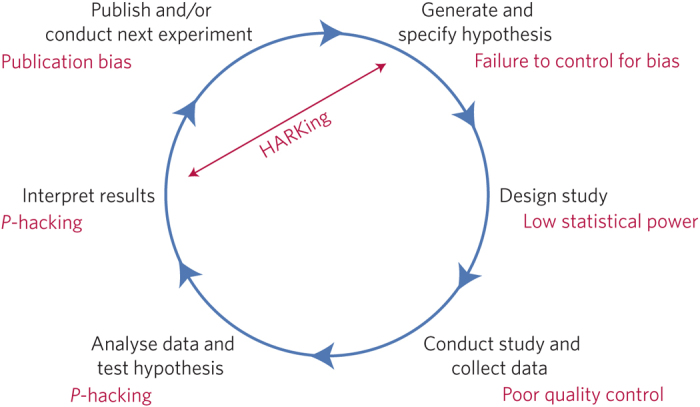
“In addition, the ability to generate large numbers of machine-learning models allows for rapid post-hoc investigation of alternative hypotheses, should the main a priori hypothesis not be supported (a form of hypothesizing after the results are known, or HARKing) [10–12].”
Progress toward openness, transparency, and reproducibility in cognitive neuroscience
Gilmore, R. O., Diaz, M. T., Wyble, B. A., & Yarkoni, T. (2017) · Annals of the New York Academy of Sciences · doi:10.1111/nyas.13325 · Cited by 95
A Guide for Calculating Study-Level Statistical Power for Meta-Analyses
Quintana, D. S. (2023) · Advances in Methods and Practices in Psychological Science · doi:10.1177/25152459221147260 · Cited by 95
“In light of these factors, the contribution of low statistical power to the reproducibility crisis in the psychological sciences has become increasingly recognized (Button et al., 2013; Munafò et al., 2017; Walum et al., 2016).”
BackgroundReproducibility in Neuroimaging Analysis: Challenges and Solutions
Botvinik‐Nezer, R., & Wager, T. D. (2022) · Biological Psychiatry Cognitive Neuroscience and Neuroimaging · doi:10.1016/j.bpsc.2022.12.006 · Cited by 118
Predicting the replicability of social science lab experiments
Altmejd, A., Dreber, A., Forsell, E., Huber, J., Imai, T., Johannesson, M., Kirchler, M., Nave, G., & Camerer, C. (2019) · PLOS ONE · doi:10.1371/journal.pone.0225826 · Cited by 95
Wallach, J. D., Wang, K., Zhang, A. D., Cheng, D., Nardini, H. K. G., Lin, H., Bracken, M. B., Desai, M. M., Krumholz, H. M., & Ross, J. S. (2020) · BMJ · doi:10.1136/bmj.l7078 · Cited by 102
Did awarding badges increase data sharing in BMJ Open? A randomized controlled trial
Rowhani-Farid, A., Aldcroft, A., & Barnett, A. G. (2020) · Royal Society Open Science · doi:10.1098/rsos.191818 · Cited by 88
Using consumption and reward simulations to increase the appeal of plant-based foods
Papies, E. K., Johannes, N., Daneva, T., Semyte, G., & Kauhanen, L.-L. (2020) · Appetite · doi:10.1016/j.appet.2020.104812 · Cited by 99
Still in Need of Norms: The State of the Data in Citizen Science
Bowser, A., Cooper, C. B., de Sherbinin, A., Wiggins, A., Brenton, P., Chuang, T., Faustman, E. M., Haklay, M., & Meloche, M. (2020) · Citizen Science Theory and Practice · doi:10.5334/cstp.303 · Cited by 112
Metascience as a Scientific Social Movement
Peterson, D., & Panofsky, A. L. (2023) · Minerva · doi:10.1007/s11024-023-09490-3 · Cited by 119
Bertram, M. G., Sundin, J., Roche, D. G., Sánchez‐Tójar, A., Thoré, E. S. J., & Brodin, T. (2023) · Current Biology · doi:10.1016/j.cub.2023.05.036 · Cited by 107
BCPT 2026 Policy for Experimental and Clinical Studies
Tveden‐Nyborg, P., Bergmann, T. K., Jessen, N., Simonsen, U., & Lykkesfeldt, J. (2025) · Basic & Clinical Pharmacology & Toxicology · doi:10.1111/bcpt.70159 · Cited by 104
The Power and Politics of Engineering Education Research Design: Saving the ‘Small N’
Slaton, A. E., & Pawley, A. L. (2018) · Engineering Studies · doi:10.1080/19378629.2018.1550785 · Cited by 98
Perceived publication pressure in Amsterdam: Survey of all disciplinary fields and academic ranks
Haven, T. L., Bouter, L. M., Smulders, Y. M., & Tijdink, J. K. (2019) · PLoS ONE · doi:10.1371/journal.pone.0217931 · Cited by 97
Nielson, D. M., Keren, H., O’Callaghan, G., Jackson, S. M., Douka, I., Vidal-Ribas, P., Pornpattananangkul, N., Camp, C. C., Gorham, L. S., Wei, C., et al. (2021) · Biological Psychiatry · doi:10.1016/j.biopsych.2020.06.012 · Cited by 87
Examining Design Choices of Questionnaires in VR User Studies
Alexandrovsky, D., Putze, S., Bonfert, M., Höffner, S., Michelmann, P., Wenig, D., Malaka, R., & Smeddinck, J. D. (2020) · CHI Conference on Human Factors in Computing Systems · doi:10.1145/3313831.3376260 · Cited by 105
O’Keeffe, C., & McNally, S. (2021) · Review Journal of Autism and Developmental Disorders · doi:10.1007/s40489-021-00286-3 · Cited by 104
Alexander, N., Kirschbaum, C., Wankerl, M., Stauch, B. J., Stalder, T., Steudte-Schmiedgen, S., Muehlhan, M., & Miller, R. (2018) · Psychoneuroendocrinology · doi:10.1016/j.psyneuen.2018.01.020 · Cited by 90
Actionable recommendations for narrowing the science-practice gap in open science
Aguinis, H., Banks, G. C., Rogelberg, S. G., & Cascio, W. F. (2020) · Organizational Behavior and Human Decision Processes · doi:10.1016/j.obhdp.2020.02.007 · Cited by 80
Presence-only and Presence-absence Data for Comparing Species Distribution Modeling Methods
Elith, J., Graham, C., Valavi, R., Abegg, M., Bruce, C., Ford, A., Guisan, A., Hijmans, R. J., Huettmann, F., Lohmann, L., et al. (2020) · Biodiversity Informatics · doi:10.17161/bi.v15i2.13384 · Cited by 88
Promoting trust in research and researchers: How open science and research integrity are intertwined
Haven, T. L., Gopalakrishna, G., Tijdink, J. K., van der Schot, D., & Bouter, L. M. (2022) · BMC Research Notes · doi:10.1186/s13104-022-06169-y · Cited by 103
Kaplan, G., Mitman, K., & Violante, G. L. (2020) · Journal of Public Economics · doi:10.1016/j.jpubeco.2020.104176 · Cited by 103
The island rule: An assessment of biases and research trends
Lokatis, S., & Jeschke, J. M. (2018) · Journal of Biogeography · doi:10.1111/jbi.13160 · Cited by 93
A beginner’s guide to rigor and reproducibility in fluorescence imaging experiments
Lee, J., & Kitaoka, M. (2018) · Molecular Biology of the Cell · doi:10.1091/mbc.e17-05-0276 · Cited by 96
Heterogeneity in effect size estimates
Holzmeister, F., Johannesson, M., BOHM, R. M., Dreber, A., Huber, J., & Kirchler, M. (2024) · Proceedings of the National Academy of Sciences · doi:10.1073/pnas.2403490121 · Cited by 104
Metadata
- Authors
- Munafò, M. R., Nosek, B. A., Bishop, D. V. M., Button, K. S., Chambers, C. D., Percie du Sert, N., Simonsohn, U., Wagenmakers, E.-J., Ware, J. J., & Ioannidis, J. P. A.
- Affiliations
- Center for Open Science (US)
- University of Oxford (GB)
- University of Bath (GB)
- University of Pennsylvania (US)
- University of Amsterdam (NL)
- CHDI Foundation (US)
- Stanford Medicine (US)
- ORCID
- Venue
- Nature Human Behaviour
- Published
- 2017-01-10
- Volume
- 1
- Issue
- 1
- Pages
- 0021-0021
- ISSN
- 2397-3374 (ISSN-L)
- PMC
- PMC7610724
- OpenAlex
- W2570760970
- Cited by
- 3,397
- References
- 92
- Citations by year
- 2026: 286 · 2025: 249 · 2024: 357 · 2023: 331 · 2022: 389 · 2021: 365 · 2020: 451 · 2019: 468 · 2018: 334 · 2017: 160
- FWCI
- 622.57
- Type
- journal article
- Language
- en
- Open access
- hybrid
- doi.org
- Licence
- cc-by
- creativecommons.org/licenses/by/4.0 (tdm)
- creativecommons.org/licenses/by/4.0 (vor)
- Locations
- Nature Human Behaviour (publishedVersion, cc-by)
- PubMed Central (publishedVersion, cc-by)
- PubMed (publishedVersion)
- ORCA Online Research @Cardiff (Cardiff University) (acceptedVersion)
- Explore Bristol Research (submittedVersion, cc-by)
- RePEc: Research Papers in Economics (submittedVersion)
- UvA-DARE (University of Amsterdam) (submittedVersion, cc-by)
- Data Archiving and Networked Services (DANS) (submittedVersion, other-oa)
- Funders
- Laura and John Arnold Foundation
- Wellcome Trust (082498/Z/07/Z, 082498)
- United Kingdom Clinical Research Collaboration
- Government of the United Kingdom
- Cancer Research UK
- National Institute for Health and Care Research
- British Heart Foundation
- National Centre for the Replacement, Refinement and Reduction of Animals in Research (NC3RS001)
- University of Bristol (MC_UU_12013, MC_UU_12013/6)
- Medical Research Council (MC_UU_12013, MC_UU_12013/6)
- Biotechnology and Biological Sciences Research Council (BB/K008277/1, BB/N019660/1)
- Economic and Social Research Council
- Topics
- Social Sciences › Library and Information Sciences › Academic Publishing and Open Access
- Social Sciences › Decision Sciences › Information Systems and Management › Scientific Computing and Data Management
- Social Sciences › Business, Management and Accounting › Management of Technology and Innovation › Research, Science, and Academia
- Keywords
- reproducible research, research reliability, research transparency, research efficiency, research evaluation, research incentives, research dissemination, reporting guidelines, scholarly publishing, research funding
About these checks
Registry, retraction, Cites and statistics results are computed, not judged, with one exception: a printed reference that no index lists is read once by a model before it counts as a citation error. Claims are extracted by a model and kept only when their quote appears verbatim in the text; each cited source is then checked, with a model’s help, for whether it says what the claim relies on. Those verdicts can be wrong — read the claim’s quote and the cited source before relying on one.
Statistics and arithmetic are recomputed, not judged.
Confidence bands are shown only for fields calibrated on our annotated test set. None is calibrated yet, so no band is shown.
What counts as a claim ›How we measure confidence ›How we check this ›
Are you an author, or do you see a problem with this page? Request a review
Data sources
Bibliographic data: Semantic Scholar, OpenAlex, Crossref.
Contains information from the Semantic Scholar Academic Graph Datasets, made available under the ODC Attribution License (ODC-BY 1.0).
Semantic Scholar’s data is described in: Kinney, R., et al. (2023). The Semantic Scholar Open Data Platform. arXiv:2301.10140.
