

A manifesto for reproducible science
Open accessThe DOI matches its Crossref record; 91 of the 92 references it cites were found in a registry or an index.
Abstract
Improving the reliability and efficiency of scientific research will increase the credibility of the published scientific literature and accelerate discovery. Here we argue for the adoption of measures to optimize key elements of the scientific process: methods, reporting and dissemination, reproducibility, evaluation and incentives. There is some evidence from both simulations and empirical studies supporting the likely effectiveness of these measures, but their broad adoption by researchers, institutions, funders and journals will require iterative evaluation and improvement. We discuss the goals of these measures, and how they can be implemented, in the hope that this will facilitate action toward improving the transparency, reproducibility and efficiency of scientific research.
Overview
The claims and statistics of this paper haven’t been checked yet.
Free: it reads the open-access text and checks the first 5 claims that cite a source we can check. Create a free account to check every claim.
Integrity signals
Registry
Cites
Statistics
Figures
Verification
Claims the paper makes
The claims and statistics of this paper haven’t been checked yet.
Free: it reads the open-access text and checks the first 5 claims that cite a source we can check. Create a free account to check every claim.
Claims other papers make about this one
Each is checked against this paper’s own text: does it say what the citing paper says it does?
The source backs part of the claim, not all of it — or backs it for a different population, condition or comparison.
In the citing paper
“Furthermore, thorough documentation and recording improve the transparency and efficiency of scientific research, can be used to improve reproducibility, and enable work to be repeated (Baker, 2016a,b; Munafo et al., 2017).”
From Guidance document on Good cell and tissue culture practice 2.0 (GCCP 2.0) (2021) · cites this paper as Munafo et al., 2017
Experimental — accuracy not yet measuredThe cited source says what the claim attributes to it.
In the citing paper
“Furthermore, sample sizes are often underpowered (4-6), at times leading to conclusions that do not hold up with larger-sized replications or metaanalyses (7).”
From Generic language in scientific communication (2019) · cites this paper as [6]
The cited source says what the claim attributes to it.
In the citing paper
“Accordingly, there is growing recognition that data availability is a critical feature of an efficient, progressive, and ultimately self-correcting scientific ecosystem that generates credible findings [1–3].”
From Data availability, reusability, and analytic reproducibility: evaluating the impact of a mandatory open data policy at the journal Cognition (2018) · cites this paper as [2]
The cited source says what the claim attributes to it.
In the citing paper
“Open data alone are clearly not enough to achieve the benefits envisaged by proponents of data sharing [2].”
From Data availability, reusability, and analytic reproducibility: evaluating the impact of a mandatory open data policy at the journal Cognition (2018) · cites this paper as [2]
The cited source says what the claim attributes to it.
In the citing paper
“Some journals have heeded the growing calls for adoption of transparent and reproducible research practices and introduced new policies to implement change [1,2].”
From Data availability, reusability, and analytic reproducibility: evaluating the impact of a mandatory open data policy at the journal Cognition (2018) · cites this paper as [2]
5 more claims about this paper
Create a free account to see every claim other papers make about this one.
Self-check
Percentages, sums and reported differences re-computed from the paper’s own numbers.
The self-check needs the paper’s full text.
Citations
Cites
Liberati, A., Altman, D. G., Tetzlaff, J., Mulrow, C., Gøtzsche, P. C., Ioannidis, J. P. A., Clarke, M., Devereaux, P. J., Kleijnen, J., & Moher, D. (2009) · PLoS Medicine · doi:10.1371/journal.pmed.1000100 · Cited by 28,164 · cited 1×
“There are also guidelines for improving the reporting of research planning; for example, the Preferred Reporting Items for Systematic Reviews and Meta-analyses ( PRISMA) statement for reporting of systematic reviews and meta-analyses 59 , and PRISMA-P for protocols of systematic reviews 60 .”
Self-citationCONSORT 2010 Statement: updated guidelines for reporting parallel group randomised trials
the CONSORT Group, Schulz, K. F., Altman, D. G., & Moher, D. (2010) · BMC Medicine · doi:10.1186/1741-7015-8-18 · Cited by 13,371
Shamseer, L., Moher, D., Clarke, M., Ghersi, D., Liberati, A., Petticrew, M., Shekelle, P., Stewart, L. A., & the PRISMA-P Group (2015) · BMJ · doi:10.1136/bmj.g7647 · Cited by 13,120
Why Most Published Research Findings Are False
Ioannidis, J. P. A. (2005) · PLoS Medicine · doi:10.1371/journal.pmed.0020124 · Cited by 10,505
Self-citationCONSORT 2010 Statement: updated guidelines for reporting parallel group randomised trials
Schulz, K. F., Altman, D. G., Moher, D., & for the CONSORT Group (2010) · BMJ · doi:10.1136/bmj.c332 · Cited by 9,329 · cited 1×
“For example, the Consolidated Standards of Reporting Trials (CONSORT) statement provides guidance for clear, complete and accurate reporting of randomized controlled trials 55–57 .”
The file drawer problem and tolerance for null results.
Rosenthal, R. (1979) · Psychological Bulletin · doi:10.1037/0033-2909.86.3.638 · Cited by 9,068 · cited 1×
“Publication bias 47 , also known as the file drawer problem 48 , refers to the fact that many more studies are conducted than published.”
Power failure: why small sample size undermines the reliability of neuroscience
Button, K. S., Ioannidis, J. P. A., Mokrysz, C., Nosek, B. A., Flint, J., Robinson, E. S. J., & Munafò, M. R. (2013) · Nature Reviews Neuroscience · doi:10.1038/nrn3475 · Cited by 7,641 · cited 3×
“Studies of statistical power persistently find it to be below (sometimes well below) 50%, across both time and the different disciplines studied 2,35,36 .”
Self-citationConfirmation Bias: A Ubiquitous Phenomenon in Many Guises
Nickerson, R. S. (1998) · Review of General Psychology · doi:10.1037/1089-2680.2.2.175 · Cited by 7,267
Simmons, J. P., Nelson, L. D., & Simonsohn, U. (2011) · Psychological Science · doi:10.1177/0956797611417632 · Cited by 6,567
Self-citationWhy Most Published Research Findings Are False
Ioannidis, J. P. A. (2005) · CHANCE · doi:10.1080/09332480.2005.10722754 · Cited by 4,702 · cited 1×
“N a t u r e H u m a n Be h aviou r 1 (1) , 0 0 2 1.”
Self-citation1,500 scientists lift the lid on reproducibility
Baker, M. (2016) · Nature · doi:10.1038/533452a · Cited by 4,209
Cluster failure: why fMRI inferences for spatial extent have inflated false-positive rates
Eklund, A., Nichols, T. E., & Knutsson, H. (2016) · Proceedings of the National Academy of Sciences · doi:10.1073/pnas.1602413113 · Cited by 3,487 · cited 1×
“What was previously taken for granted may be questioned, such as widely used statistical methods; for example, the most popular methods and software for spatial extent analysis in fMRI imaging were recently shown to produce unacceptably high false-positive rates 74 .”
Statistical tests, P values, confidence intervals, and power: a guide to misinterpretations
Greenland, S., Senn, S. J., Rothman, K. J., Carlin, J. B., Poole, C., Goodman, S. N., & Altman, D. G. (2016) · European Journal of Epidemiology · doi:10.1007/s10654-016-0149-3 · Cited by 3,200
Improving the Quality of Reporting of Randomized Controlled Trials: The CONSORT Statement
Begg, C. (1996) · JAMA · doi:10.1001/jama.1996.03540080059030 · Cited by 3,127
Promoting an open research culture
Nosek, B. A., Alter, G., Banks, G. C., Borsboom, D., Bowman, S. D., Breckler, S. J., Buck, S., Chambers, C. D., Chin, G., Christensen, G., et al. (2015) · Science · doi:10.1126/science.aab2374 · Cited by 2,708 · cited 2×
“The Transparency and Openness Promotion (TOP) guidelines offer standards as a basis for journals and funders to incentivize or require greater transparency in planning and reporting of research 54 .”
Self-citationMeasuring the Prevalence of Questionable Research Practices With Incentives for Truth Telling
John, L. K., Loewenstein, G., & Prelec, D. (2012) · Psychological Science · doi:10.1177/0956797611430953 · Cited by 2,239
CONSORT 2010 statement: Updated guidelines for reporting parallel group randomised trials
Schulz, K. F., Altman, D. G., & Moher, D. (2010) · Journal of Pharmacology and Pharmacotherapeutics · doi:10.4103/0976-500x.72352 · Cited by 2,165
HARKing: Hypothesizing after the results are known
Kerr, N. L. (1998) · Personality and Social Psychology Review · doi:10.1207/s15327957pspr0203_4 · Cited by 1,989
The statistical power of abnormal-social psychological research: A review.
Cohen, J. (1962) · The Journal of Abnormal and Social Psychology · doi:10.1037/h0045186 · Cited by 1,824
Experimenter Effects in Behavioral Research
McGuigan, F. J., & Rosenthal, R. (1968) · The American Journal of Psychology · doi:10.2307/1420816 · Cited by 1,621
Increasing value and reducing waste in research design, conduct, and analysis
Ioannidis, J. P. A., Greenland, S., Hlatky, M. A., Khoury, M. J., Macleod, M. R., Moher, D., Schulz, K. F., & Tibshirani, R. (2014) · The Lancet · doi:10.1016/s0140-6736(13)62227-8 · Cited by 1,597
Self-citationPublication bias in the social sciences: Unlocking the file drawer
Franco, A., Malhotra, N., & Simonovits, G. (2014) · Science · doi:10.1126/science.1255484 · Cited by 1,542 · cited 1×
“Studies that obtain positive and novel results are more likely to be published than studies that obtain negative results or report replications of prior results 47,49,50 .”
P-curve: A key to the file-drawer.
Simonsohn, U., Nelson, L. D., & Simmons, J. P. (2014) · Journal of Experimental Psychology: General · doi:10.1037/a0033242 · Cited by 1,500
Self-citationSterne, J. A. C. (2001) · BMJ · doi:10.1136/bmj.322.7280.226 · Cited by 1,466
How to increase value and reduce waste when research priorities are set
Chalmers, I., Bracken, M. B., Djulbegovic, B., Garattini, S., Grant, J., Gülmezoglu, A. M., Howells, D. W., Ioannidis, J. P. A., & Oliver, S. (2014) · The Lancet · doi:10.1016/s0140-6736(13)62229-1 · Cited by 1,436
Self-citationReducing waste from incomplete or unusable reports of biomedical research
Glasziou, P., Altman, D. G., Bossuyt, P., Boutron, I., Clarke, M., Julious, S., Michie, S., Moher, D., & Wager, E. (2014) · The Lancet · doi:10.1016/s0140-6736(13)62228-x · Cited by 1,319
Nosek (2012) · doi:10.1177/1745691612459058 · Cited by 1,301 · cited 2×
“Positive, novel and clean results are more likely to be published than negative results, replications and results with loose ends; as a consequence, researchers are incentivized to produce the former, even at the cost of accuracy 40 .”
Investigating Variation in Replicability: A “Many Labs” Replication Project
Klein, R. A., Ratliff, K. A., Vianello, M., Adams, R. B., Bahník, Š., Bernstein, M. J., Bocian, K., Brandt, M. J., Brooks, B., Brumbaugh, C. C., et al. (2014) · Social Psychology · doi:10.1027/1864-9335/a000178 · Cited by 1,208
Self-citationExperimenter Effects in Behavioral Research.
Titchener, J. L. (1967) · Archives of Internal Medicine · doi:10.1001/archinte.1967.00300050109027 · Cited by 1,194
Reproducibility in Science: Improving the Standard for Basic and Preclinical Research
Begley, C. G., & Ioannidis, J. P. A. (2015) · Circulation Research · doi:10.1161/circresaha.114.303819 · Cited by 1,035
Self-citationConsequences of prejudice against the null hypothesis.
Greenwald, A. G. (1975) · Psychological Bulletin · doi:10.1037/h0076157 · Cited by 1,022 · cited 1×
“Studies that obtain positive and novel results are more likely to be published than studies that obtain negative results or report replications of prior results 47,49,50 .”
Biomedical research: increasing value, reducing waste.
Macleod, M. R., Michie, S., Roberts, I., Dirnagl, U., Chalmers, I., Ioannidis, J. P. A., Salman, R. A.-S., Chan, A.-W., & Glasziou, P. (2014) · The Lancet · doi:10.1016/s0140-6736(13)62329-6 · Cited by 1,003
Self-citationSterling, T. D. (1959) · Journal of the American Statistical Association · doi:10.1080/01621459.1959.10501497 · Cited by 964 · cited 2×
“Studies that obtain positive and novel results are more likely to be published than studies that obtain negative results or report replications of prior results 47,49,50 .”
Increasing value and reducing waste: addressing inaccessible research
Chan, A.-W., Song, F., Vickers, A., Jefferson, T., Dickersin, K., Gøtzsche, P. C., Krumholz, H. M., Ghersi, D., & van der Worp, H. B. (2014) · The Lancet · doi:10.1016/s0140-6736(13)62296-5 · Cited by 887
The natural selection of bad science
Smaldino, P. E., & McElreath, R. (2016) · Royal Society Open Science · doi:10.1098/rsos.160384 · Cited by 860 · cited 2×
“These incentives ultimately increase the likelihood of false positives in the published literature 71 .”
Kilkenny, C., Parsons, N., Kadyszewski, E., Festing, M. F. W., Cuthill, I. C., Fry, D., Hutton, J., & Altman, D. G. (2009) · PLoS ONE · doi:10.1371/journal.pone.0007824 · Cited by 860 · cited 1×
“For the ARRIVE (Animal Research: Reporting of In Vivo Experiments) guidelines 80 , studies comparing the reporting of ARRIVE items in specific fields of research before and after the guidelines were published report mixed results 81–83 .”
How to Make More Published Research True
Ioannidis, J. P. A. (2014) · PLoS Medicine · doi:10.1371/journal.pmed.1001747 · Cited by 760 · cited 1×
“Equally, these proposals are not an exhaustive list; there are many other nascent and maturing ideas for making research practices more efficient and reliable 73 .”
Self-citationReplications in Psychology Research: How Often Do They Really Occur?
Makel, M. C., Plucker, J. A., & Hegarty, B. (2012) · Perspectives on Psychological Science · doi:10.1177/1745691612460688 · Cited by 750 · cited 1×
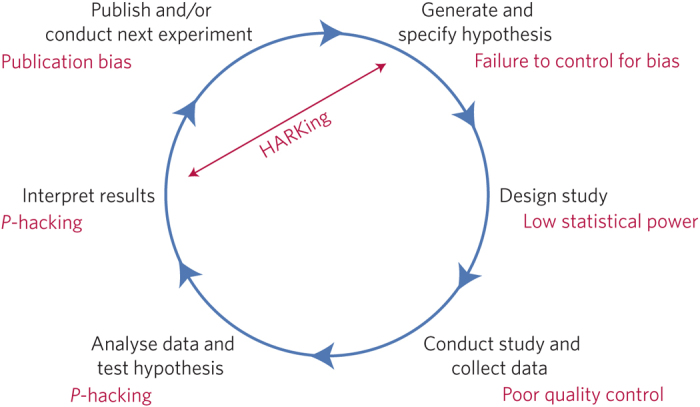
“5 , hypothesizing after the results are known (HARKing) 7 , poor study design, low statistical power 2 , analytical flexibility 51 , P -hacking 4 , publication bias 3 and lack of data sharing 6 .”
Do studies of statistical power have an effect on the power of studies?
Sedlmeier, P., & Gigerenzer, G. (1989) · Psychological Bulletin · doi:10.1037/0033-2909.105.2.309 · Cited by 748 · cited 2×
“Studies of statistical power persistently find it to be below (sometimes well below) 50%, across both time and the different disciplines studied 2,35,36 .”
“Positive” results increase down the Hierarchy of the Sciences
Fanelli, D. (2010) · PLoS ONE · doi:10.1371/journal.pone.0010068 · Cited by 734
Registered Reports: A Method to Increase the Credibility of Published Results
Nosek, B. A., & Lakens, D. (2014) · Social Psychology · doi:10.1027/1864-9335/a000192 · Cited by 716
Self-citationKidwell, M. C., Lazarević, L. B., Baranski, E., Hardwicke, T. E., Piechowski, S., Falkenberg, L.-S., Kennett, C., Slowik, A., Sonnleitner, C., Hess-Holden, C., et al. (2016) · PLOS Biology · doi:10.1371/journal.pbio.1002456 · Cited by 700
Self-citationStatistical Power, Sample Size, and Their Reporting in Randomized Controlled Trials
Moher, D. (1994) · JAMA: The Journal of the American Medical Association · doi:10.1001/jama.1994.03520020048013 · Cited by 608
Registered Reports: A new publishing initiative at Cortex
Chambers, C. D. (2013) · Cortex · doi:10.1016/j.cortex.2012.12.016 · Cited by 570
Self-citationThe poor availability of psychological research data for reanalysis.
Wicherts, J. M., Borsboom, D., Kats, J., & Molenaar, D. (2006) · American Psychologist · doi:10.1037/0003-066x.61.7.726 · Cited by 543 · cited 3×
“5 , hypothesizing after the results are known (HARKing) 7 , poor study design, low statistical power 2 , analytical flexibility 51 , P -hacking 4 , publication bias 3 and lack of data sharing 6 .”
Increasing value and reducing waste in biomedical research regulation and management
Salman, R. A.-S., Beller, E., Kagan, J., Hemminki, E., Phillips, R. S., Savulescu, J., Macleod, M., Wisely, J., & Chalmers, I. (2014) · The Lancet · doi:10.1016/s0140-6736(13)62297-7 · Cited by 534
Meta-research: Evaluation and Improvement of Research Methods and Practices
Ioannidis, J. P. A., Fanelli, D., Dunne, D. D., & Goodman, S. N. (2015) · PLOS Biology · doi:10.1371/journal.pbio.1002264 · Cited by 495 · cited 1×
“The field of metascience (or metaresearch) is growing rapidly, with over 2,000 relevant publications accruing annually 16 .”
Self-citationMany Labs 3: Evaluating participant pool quality across the academic semester via replication
Ebersole, C. R., Atherton, O. E., Belanger, A. L., Skulborstad, H. M., Allen, J. M., Banks, J. B., Baranski, E., Bernstein, M. J., Bonfiglio, D. B. V., Boucher, L., et al. (2016) · Journal of Experimental Social Psychology · doi:10.1016/j.jesp.2015.10.012 · Cited by 468 · cited 1×
“The Many Labs projects illustrate this potential in the social and behavioural sciences, with dozens of laboratories implementing the same research protocol to obtain highly precise estimates of effect sizes, and evaluate variability across samples and settings 44,45 .”
Self-citationThe secret lives of experiments: Methods reporting in the fMRI literature
Carp, J. (2012) · NeuroImage · doi:10.1016/j.neuroimage.2012.07.004 · Cited by 457
Pre-registration in social psychology—A discussion and suggested template
van 't Veer, A. E., & Giner-Sorolla, R. (2016) · Journal of Experimental Social Psychology · doi:10.1016/j.jesp.2016.03.004 · Cited by 439
On the Plurality of (Methodological) Worlds: Estimating the Analytic Flexibility of fMRI Experiments
Carp, J. (2012) · Frontiers in Neuroscience · doi:10.3389/fnins.2012.00149 · Cited by 381
Scientific Utopia: I. Opening Scientific Communication
Nosek, B. A., & Bar-Anan, Y. (2012) · Psychological Inquiry · doi:10.1080/1047840x.2012.692215 · Cited by 368
Self-citationPublic Availability of Published Research Data in High-Impact Journals
Alsheikh-Ali, A. A., Qureshi, W., Al-Mallah, M. H., & Ioannidis, J. P. A. (2011) · PLoS ONE · doi:10.1371/journal.pone.0024357 · Cited by 363 · cited 1×
“In reality, science often lacks openness: many published articles are not available to people without a personal or institutional subscription, and most data, materials and code supporting research outcomes are not made accessible, for example, in a public repository (refs 63,64; Box 5).”
Self-citationReproducible Research Practices and Transparency across the Biomedical Literature
Iqbal, S. A., Wallach, J. D., Khoury, M. J., Schully, S. D., & Ioannidis, J. P. A. (2016) · PLOS Biology · doi:10.1371/journal.pbio.1002333 · Cited by 310 · cited 1×
“In reality, science often lacks openness: many published articles are not available to people without a personal or institutional subscription, and most data, materials and code supporting research outcomes are not made accessible, for example, in a public repository (refs 63,64; Box 5).”
Self-citationBaker, D., Lidster, K., Sottomayor, A., & Amor, S. (2014) · PLoS Biology · doi:10.1371/journal.pbio.1001756 · Cited by 305
How scientists fool themselves – and how they can stop
Nuzzo, R. (2015) · Nature · doi:10.1038/526182a · Cited by 296
The Peer Reviewers' Openness Initiative: incentivizing open research practices through peer review
Morey, R. D., Chambers, C. D., Etchells, P. J., Harris, C. R., Hoekstra, R., Lakens, D., Lewandowsky, S., Morey, C. C., Newman, D. P., Schönbrodt, F. D., et al. (2016) · Royal Society Open Science · doi:10.1098/rsos.150547 · Cited by 284
Self-citationPatel, C. J., Burford, B., & Ioannidis, J. P. A. (2015) · Journal of Clinical Epidemiology · doi:10.1016/j.jclinepi.2015.05.029 · Cited by 274
Self-citationOpen peer review: a randomised controlled trial
Walsh, E., Rooney, M., Appleby, L., & Wilkinson, G. (2000) · British Journal of Psychiatry · doi:10.1192/bjp.176.1.47 · Cited by 261
Eich, E. (2014) · Psychological Science · doi:10.1177/0956797613512465 · Cited by 255
Stevens, A., Shamseer, L., Weinstein, E., Yazdi, F., Turner, L., Thielman, J., Altman, D. G., Hirst, A., Hoey, J., Palepu, A., et al. (2014) · BMJ · doi:10.1136/bmj.g3804 · Cited by 242 · cited 1×
“In medicine there is strong evidence for the effectiveness of CONSORT guidelines — journals that do not endorse the CONSORT statement show poorer reporting quality compared with endorsing journals 79 .”
Blind analysis: Hide results to seek the truth
MacCoun, R., & Perlmutter, S. (2015) · Nature · doi:10.1038/526187a · Cited by 218 · cited 1×
“In some physical sciences this approach has been extended to include deliberate perturbations in or masking of data to allow data preparation (for example, identification of outliers) to proceed without the analyst being able to see the corresponding results 30 .”
Current Incentives for Scientists Lead to Underpowered Studies with Erroneous Conclusions
Higginson, A. D., & Munafò, M. R. (2016) · PLOS Biology · doi:10.1371/journal.pbio.2000995 · Cited by 192
Translation of Broca's 1865 Report: Localization of Speech in the Third Left Frontal Convolution
Berker, E. A. (1986) · Archives of Neurology · doi:10.1001/archneur.1986.00520100069017 · Cited by 192
de Groot, A. D. (2014) · Acta Psychologica · doi:10.1016/j.actpsy.2014.02.001 · Cited by 188
Ensuring the integrity of clinical practice guidelines: a tool for protecting patients
Lenzer, J., Hoffman, J. R., Furberg, C. D., & Ioannidis, J. P. A. (2013) · BMJ · doi:10.1136/bmj.f5535 · Cited by 187
Self-citationPreprints for the life sciences
Berg, J. M., Bhalla, N., Bourne, P. E., Chalfie, M., Drubin, D. G., Fraser, J. S., Greider, C. W., Hendricks, M., Jones, C., Kiley, R., et al. (2016) · Science · doi:10.1126/science.aaf9133 · Cited by 176
Underreporting in Psychology Experiments: Evidence From a Study Registry
Franco, A., Malhotra, N., & Simonovits, G. (2016) · Social Psychological and Personality Science · doi:10.1177/1948550615598377 · Cited by 117
Ten Simple Rules for Effective Statistical Practice
Kass, R. E., Caffo, B. S., Davidian, M., Meng, X.-L., Yu, B., & Reid, N. (2016) · PLOS Computational Biology · doi:10.1371/journal.pcbi.1004961 · Cited by 113 · cited 1×
“As recently highlighted, “asking questions at the design stage can save headaches at the analysis stage: careful data collection can greatly simplify analysis and make it more rigorous” 77 .”
Schweinsberg, M., Madan, N., Vianello, M., Sommer, S. A., Jordan, J., Tierney, W., Awtrey, E., Zhu, L. L., Diermeier, D., Heinze, J. E., et al. (2016) · Journal of Experimental Social Psychology · doi:10.1016/j.jesp.2015.10.001 · Cited by 108
Self-citationContent area experts as authors: helpful or harmful for systematic reviews and meta-analyses?
Gotzsche, P. C., & Ioannidis, J. P. A. (2012) · BMJ · doi:10.1136/bmj.e7031 · Cited by 105
Self-citationModelling the effects of subjective and objective decision making in scientific peer review
Park, I.-U., Peacey, M. W., & Munafò, M. R. (2014) · Nature · doi:10.1038/nature12786 · Cited by 103 · cited 1×
“However, more diverse evaluation processes are now emerging, allowing the collective wisdom of the scientific community to be harnessed 66 .”
A Concerted Appeal for International Cooperation in Preclinical Stroke Research
Dirnagl, U., Hakim, A., Macleod, M., Fisher, M., Howells, D., Alan, S. M., Steinberg, G., Planas, A., Boltze, J., Savitz, S., et al. (2013) · Stroke · doi:10.1161/strokeaha.113.000734 · Cited by 102
Assessing the Contributions of John Snow to Epidemiology
Paneth, N. (2004) · Epidemiology · doi:10.1097/01.ede.0000135915.94799.00 · Cited by 93
Etter, J., Burri, M., & Stapleton, J. (2007) · Addiction · doi:10.1111/j.1360-0443.2007.01822.x · Cited by 89
Article Commentary: On the Persistence of Low Power in Psychological Science
Vankov, I., Bowers, J., & Munafò, M. R. (2014) · Quarterly Journal of Experimental Psychology · doi:10.1080/17470218.2014.885986 · Cited by 82
Bath, P. M. W., Macleod, M. R., & Green, A. R. (2009) · International Journal of Stroke · doi:10.1111/j.1747-4949.2009.00386.x · Cited by 82
Developing a reporting guideline for social and psychological intervention trials
Mayo-Wilson, E., Grant, S., Hopewell, S., Macdonald, G., Moher, D., & Montgomery, P. (2013) · Trials · doi:10.1186/1745-6215-14-242 · Cited by 78
Gulin, J. E. N., Rocco, D. M., & García-Bournissen, F. (2015) · PLOS Neglected Tropical Diseases · doi:10.1371/journal.pntd.0004194 · Cited by 66
Button, K. S., Bal, L., Clark, A., & Shipley, T. (2016) · BMC Psychology · doi:10.1186/s40359-016-0167-7 · Cited by 58
Self-citationAccuracy of Effect Size Estimates from Published Psychological Research
Brand, A., Bradley, M. T., Best, L. A., & Stoica, G. (2008) · Perceptual and Motor Skills · doi:10.2466/pms.106.2.645-649 · Cited by 55
Panagiotou, O. A., & Ioannidis, J. P. A. (2012) · Journal of Clinical Epidemiology · doi:10.1016/j.jclinepi.2012.01.008 · Cited by 53
Self-citationMcnutt, M. K. (2016) · Science · doi:10.1126/science.aag2359 · Cited by 46
Scientific rigor and the art of motorcycle maintenance
Munafò, M., Noble, S., Browne, W. J., Brunner, D., Button, K., Ferreira, J., Holmans, P., Langbehn, D., Lewis, G., Lindquist, M., et al. (2014) · Nature Biotechnology · doi:10.1038/nbt.3004 · Cited by 43
Self-citationMilidonis, X., Marshall, I., Macleod, M. R., & Sena, E. S. (2015) · Stroke · doi:10.1161/strokeaha.114.007560 · Cited by 42
Etter, J.-F., & Stapleton, J. (2009) · Journal of Clinical Epidemiology · doi:10.1016/j.jclinepi.2008.09.015 · Cited by 40
Developing a Reporting Guideline for Social and Psychological Intervention Trials
Grant, S., Montgomery, P., Hopewell, S., Macdonald, G. M., Moher, D., & Mayo‐Wilson, E. (2013) · Research on Social Work Practice · doi:10.1177/1049731513498118 · Cited by 29
Adherence to ARRIVE Guidelines in Chinese Journal Reports on Neoplasms in Animals
Liu, Y., Zhao, X., Mai, Y., Li, X., Wang, J., Chen, L., Mu, J., jin, G., Gou, H., Sun, W., et al. (2016) · PLoS ONE · doi:10.1371/journal.pone.0154657 · Cited by 24
Heininga, V. E., Oldehinkel, A. J., Veenstra, R., & Nederhof, E. (2015) · PLOS ONE · doi:10.1371/journal.pone.0125383 · Cited by 23
Discovery of Pulsars: A Graduate Student's Story
Wade, N. J. (1975) · Science · doi:10.1126/science.189.4200.358 · Cited by 21
Levenson, T. (2015) · Cited by 8
Research works printed but not linked: 1
- Simmons, J. P., Nelson, L. D. & Simonsohn, U. A 21 word solution. Preprint at 10.2139/ssrn.2160588(2012). · doi:10.2139/ssrn.2160588(2012
Cited by
Reporting animal research: Explanation and elaboration for the ARRIVE guidelines 2.0
Percie du Sert, N., Ahluwalia, A., Alam, S., Avey, M. T., Baker, M., Browne, W. J., Clark, A., Cuthill, I. C., Dirnagl, U., Emerson, M., et al. (2020) · PLOS Biology · doi:10.1371/journal.pbio.3000411 · Cited by 2,677
Reproducible brain-wide association studies require thousands of individuals
Marek, S., Tervo-Clemmens, B., Calabro, F. J., Montez, D. F., Kay, B. P., Hatoum, A. S., Donohue, M. R., Foran, W., Miller, R. L., Hendrickson, T. J., et al. (2022) · Nature · doi:10.1038/s41586-022-04492-9 · Cited by 1,928
Sanderson, E., Glymour, M. M., Holmes, M. V., Kang, H., Morrison, J., Munafò, M. R., Palmer, T., Schooling, C. M., Wallace, C., Zhao, Q., et al. (2022) · Nature Reviews Methods Primers · doi:10.1038/s43586-021-00092-5 · Cited by 2,229
The preregistration revolution
Nosek, B. A., Ebersole, C. R., DeHaven, A. C., & Mellor, D. T. (2018) · Proceedings of the National Academy of Sciences · doi:10.1073/pnas.1708274114 · Cited by 1,998
Self-citationBioconda: sustainable and comprehensive software distribution for the life sciences
The Bioconda Team, Grüning, B., Dale, R., Sjödin, A., Chapman, B. A., Rowe, J., Tomkins-Tinch, C. H., Valieris, R., & Köster, J. (2018) · Nature Methods · doi:10.1038/s41592-018-0046-7 · Cited by 1,641
Metadata
- Authors
- Munafò, M. R., Nosek, B. A., Bishop, D. V. M., Button, K. S., Chambers, C. D., Percie du Sert, N., Simonsohn, U., Wagenmakers, E.-J., Ware, J. J., & Ioannidis, J. P. A.
- Affiliations
- Center for Open Science (US)
- University of Oxford (GB)
- University of Bath (GB)
- University of Pennsylvania (US)
- University of Amsterdam (NL)
- CHDI Foundation (US)
- Stanford Medicine (US)
- ORCID
- Venue
- Nature Human Behaviour
- Published
- 2017-01-10
- Volume
- 1
- Issue
- 1
- Pages
- 0021-0021
- ISSN
- 2397-3374 (ISSN-L)
- PMC
- PMC7610724
- OpenAlex
- W2570760970
- Cited by
- 3,397
- References
- 92
- Citations by year
- 2026: 286 · 2025: 249 · 2024: 357 · 2023: 331 · 2022: 389 · 2021: 365 · 2020: 451 · 2019: 468 · 2018: 334 · 2017: 160
- FWCI
- 622.57
- Type
- journal article
- Language
- en
- Open access
- hybrid
- doi.org
- Licence
- cc-by
- creativecommons.org/licenses/by/4.0 (tdm)
- creativecommons.org/licenses/by/4.0 (vor)
- Locations
- Nature Human Behaviour (publishedVersion, cc-by)
- PubMed Central (publishedVersion, cc-by)
- PubMed (publishedVersion)
- ORCA Online Research @Cardiff (Cardiff University) (acceptedVersion)
- Explore Bristol Research (submittedVersion, cc-by)
- RePEc: Research Papers in Economics (submittedVersion)
- UvA-DARE (University of Amsterdam) (submittedVersion, cc-by)
- Data Archiving and Networked Services (DANS) (submittedVersion, other-oa)
- Funders
- Laura and John Arnold Foundation
- Wellcome Trust (082498/Z/07/Z, 082498)
- United Kingdom Clinical Research Collaboration
- Government of the United Kingdom
- Cancer Research UK
- National Institute for Health and Care Research
- British Heart Foundation
- National Centre for the Replacement, Refinement and Reduction of Animals in Research (NC3RS001)
- University of Bristol (MC_UU_12013, MC_UU_12013/6)
- Medical Research Council (MC_UU_12013, MC_UU_12013/6)
- Biotechnology and Biological Sciences Research Council (BB/K008277/1, BB/N019660/1)
- Economic and Social Research Council
- Topics
- Social Sciences › Library and Information Sciences › Academic Publishing and Open Access
- Social Sciences › Decision Sciences › Information Systems and Management › Scientific Computing and Data Management
- Social Sciences › Business, Management and Accounting › Management of Technology and Innovation › Research, Science, and Academia
- Keywords
- reproducible research, research reliability, research transparency, research efficiency, research evaluation, research incentives, research dissemination, reporting guidelines, scholarly publishing, research funding
About these checks
Registry, retraction, Cites and statistics results are computed, not judged, with one exception: a printed reference that no index lists is read once by a model before it counts as a citation error. Claims are extracted by a model and kept only when their quote appears verbatim in the text; each cited source is then checked, with a model’s help, for whether it says what the claim relies on. Those verdicts can be wrong — read the claim’s quote and the cited source before relying on one.
Statistics and arithmetic are recomputed, not judged.
Confidence bands are shown only for fields calibrated on our annotated test set. None is calibrated yet, so no band is shown.
What counts as a claim ›How we measure confidence ›How we check this ›
Are you an author, or do you see a problem with this page? Request a review
Data sources
Bibliographic data: Semantic Scholar, OpenAlex, Crossref.
Contains information from the Semantic Scholar Academic Graph Datasets, made available under the ODC Attribution License (ODC-BY 1.0).
Semantic Scholar’s data is described in: Kinney, R., et al. (2023). The Semantic Scholar Open Data Platform. arXiv:2301.10140.
