

Global evidence of extreme intuitive moral prejudice against atheists
Open accessThe DOI matches its Crossref record; 36 of the 36 references it cites were found in a registry or an index; 6 of the 49 sources its claims cite were checked for support.
Abstract
A cross-cultural study shows that people intuitively link immorality with atheism across 13 diverse countries, regardless of their own religious beliefs.
Overview
CoChat Summary
TL;DR
In a 13-country cross-cultural experiment (N=3256), participants were much more likely to make a conjunction error for an atheist target than for a religious target when judging an extreme immoral act, indicating strong intuitive moral distrust of atheists. The effect persisted after adjusting for demographics and country-level variation, and appeared even among atheist participants, though it varied by country and was weakest in Finland.
Key findings
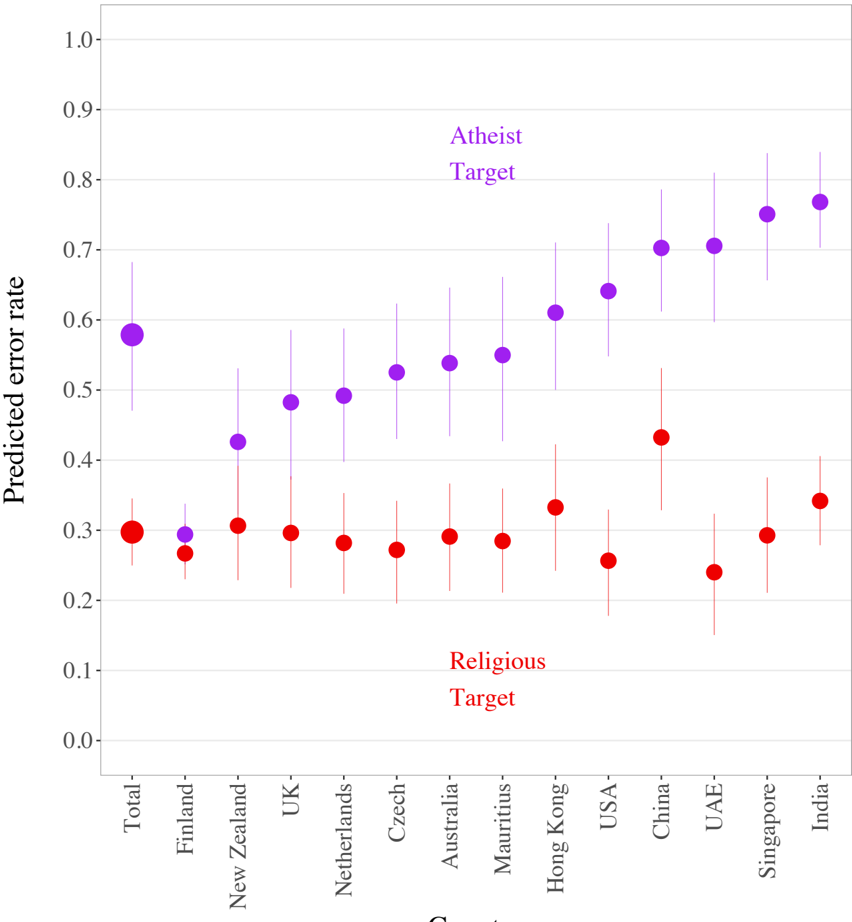
- Across the full sample, the model predicted a conjunction error rate of 0.58 for atheist targets versus 0.30 for religious targets, with RR = 1.96 [1.53, 2.37] and posterior probability > .999 that atheist-target errors exceeded religious-target errors.
- In the raw descriptive statistics, 35.9% made errors in the control condition versus 64.1% in the atheist condition (χ² = 163.512, df = 1, Φ = .225, p < .001).
- The sample included 3256 participants from 13 countries, after dropping 13% inattentive participants; the median country sample size was 162 (range 129–993).
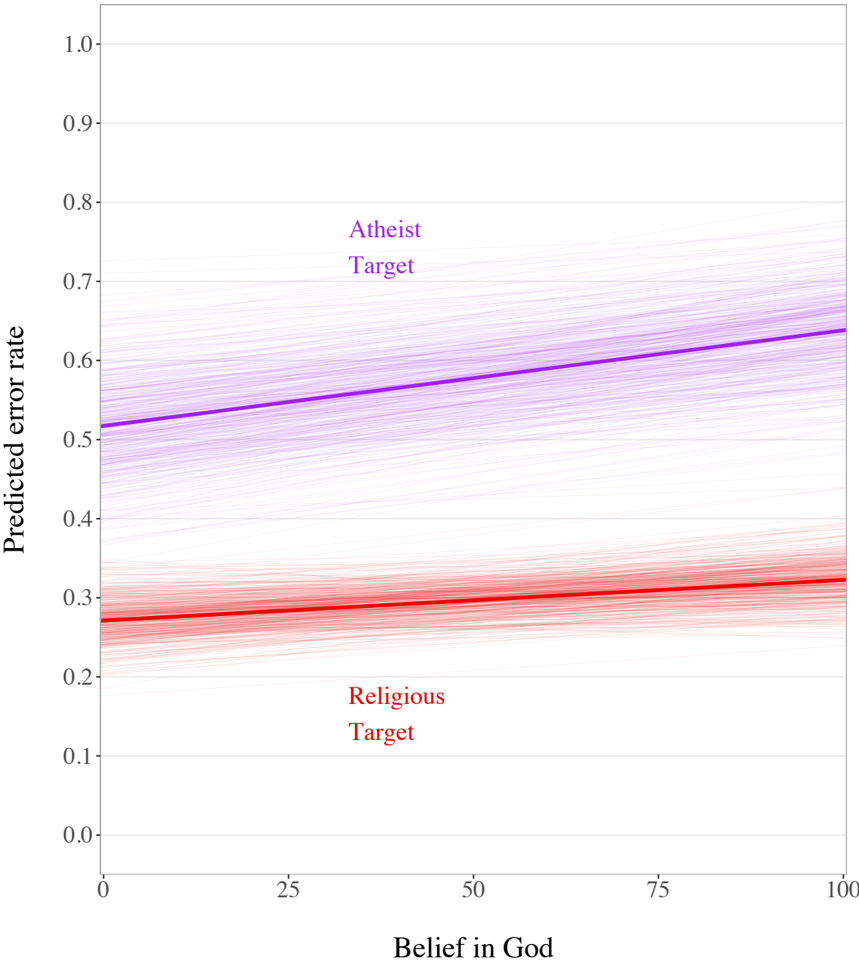
- Anti-atheist prejudice appeared among atheists too: among participants rating belief in God at 0/100, the model predicted 0.52 error probability for atheist targets versus 0.28 for religious targets, with RR = 1.91 [1.41, 2.48] and posterior probability > .999.
- Country differences were substantial: the effect was weakest in Finland (e.g., total predicted atheist-target error 0.29 vs religious 0.27, pr(A > R) = .822 at mean belief), while many other countries showed posterior probabilities >.999.
Methods
- Cross-cultural experiment run by local teams in 13 countries on 5 continents; participants answered a representativeness-heuristic conjunction task plus distractor items, an attention check, and demographics.
- Main task: read a vignette about a man who tortures animals and murders five homeless people, then chose whether he was more probably a teacher or a teacher and either does not believe in any gods or is a religious believer (between-subjects manipulation).
- Analysis used Bayesian hierarchical/multilevel modeling in R with random country intercepts and random country slopes for target (atheist vs believer), adjusting for standardized belief in God, age, gender, and subjective socioeconomic status.
Limitations
- The paper states that the sample is not universal in its effect: anti-atheist prejudice was “culturally widespread though not universal”, with clear country heterogeneity.
- The paper notes that the primary cross-cultural study was preregistered, but the three follow-up studies were not.
- Evident from the text: the main manipulation used an extreme moral-violation vignette and a forced-choice conjunction task, so the findings speak to intuitive judgments in this paradigm rather than direct measures of overt prejudice or real-world behavior.
Model-written summary. Check it against the paper before relying on it.
Integrity signals
Registry
Cites
Statistics
Figures
Verification
Claims the paper makes
5 Valid · 0 Not valid · 20 Not checked · 56 Own results and interpretations
The sources with a verdict support this claim; the rest weren’t checked yet, have no full text we could read, or their verdicts aren’t rated yet.
In the paper
“Modern investigations reflect this perceived link between belief in gods and morality, as recent small sample studies in North America suggest deep moral suspicion of individuals who do not believe in gods 13,19 .”
What the sources say
- Not checked — no full text of the sourcecites [13] Gervais, W. M., Shariff, A. F. & Norenzayan, A. Do you believe in atheists? Distrust is central to anti-atheist prejudice. J. Pers. Soc. Psychol. 101, 1189–1206 (2011). source
- Supportedcites [19] Gervais, W. M. Everything is permitted? People intuitively judge immorality as representative of atheists. PLoS ONE 9, e92302 (2014). source
The General Discussion says American participants intuitively associated immoral acts with atheists and were skeptical of atheist morality specifically because atheists do not believe in God. The Participants section describes modest-sized experimental groups, with a recruitment target of at least 30 people per cell. No page numbers are available in our copy. (LLM, conf=0.91)
hedged- Asserted: passes — The authors put it forward as true.
- Checkable: passes — It can be checked against evidence.
- Load-bearing: passes — The paper’s conclusions depend on it.
- Based: passes — The paper gives a reason why it holds.
Every source the paper cites for this claim was checked and supports it.
In the paper
“Higher conjunction fallacy rates (picking option B) in the atheist condition indicate that people intuitively view serial murder as more representative of atheists than of religious believers 19 .”
What the sources say
- Supportedcites [19] Gervais, W. M. Everything is permitted? People intuitively judge immorality as representative of atheists. PLoS ONE 9, e92302 (2014). source
The General Method says conjunction-error rates index how representative participants intuitively find a description of different groups. The Results report higher error rates for targets who do not believe in God than for the listed religious groups and conclude that serial murder was seen as representative of atheists. (LLM, conf=0.94)
hedgedstates a cause- Asserted: passes — The authors put it forward as true.
- Checkable: passes — It can be checked against evidence.
- Load-bearing: passes — The paper’s conclusions depend on it.
- Based: passes — The paper gives a reason why it holds.
- Supported
A result the paper reports from its own data — it cites no other source for it, so there is none to check. The quote shows it is in the paper.
In the paper
“Notably, anti-atheist prejudice was even evident among atheist participants around the world.”
plainn = 3,256- Asserted: passes — The authors put it forward as true.
- Checkable: passes — It can be checked against evidence.
- Load-bearing: passes — The paper’s conclusions depend on it.
- Based: passes — The paper gives a reason why it holds.
A result the paper reports from its own data — it cites no other source for it, so there is none to check. The quote shows it is in the paper.
In the paper
“Consistent with cultural evolutionary theories of religion and morality, people in most-but not all-countries viewed extreme moral violations as representative of atheists.”
plainn = 3,256- Asserted: passes — The authors put it forward as true.
- Checkable: passes — It can be checked against evidence.
- Load-bearing: passes — The paper’s conclusions depend on it.
- Based: passes — The paper gives a reason why it holds.
A result the paper reports from its own data — it cites no other source for it, so there is none to check. The quote shows it is in the paper.
In the paper
“Thus, while anti-atheist prejudice varies strongly by country, such prejudice is largely robust across the spectrum of participant religiosity within countries; both high and low believers are about twice as likely to commit conjunction errors for atheist targets than for religious targets (Figure 2).”
plain- Asserted: passes — The authors put it forward as true.
- Checkable: passes — It can be checked against evidence.
- Load-bearing: passes — The paper’s conclusions depend on it.
- Based: passes — The paper gives a reason why it holds.
32 more claims
Create a free account to see all 81 claims and to verify the 4 references still open.
- Probably not a substantial claim. 28
- It may state two separate claims as one. 22
- The quote only partly states this claim. 1
Claims other papers make about this one
Each is checked against this paper’s own text: does it say what the citing paper says it does?
The source backs part of the claim, not all of it — or backs it for a different population, condition or comparison.
In the citing paper
“Specifically, religiosity is positively related to antipathy toward atheists [7, 8], racial minorities [12], and homosexuals [14].”
From The amoral atheist? A cross-national examination of cultural, motivational, and cognitive antecedents of disbelief, and their implications for morality (2021) · cites this paper as [8]
Experimental — accuracy not yet measuredThe cited source says what the claim attributes to it.
In the citing paper
“There is a widespread cross-cultural stereotype suggesting that atheists are untrustworthy and lack a moral compass.”
From The amoral atheist? A cross-national examination of cultural, motivational, and cognitive antecedents of disbelief, and their implications for morality (2021) · cites this paper as [8]
The cited source says what the claim attributes to it.
In the citing paper
“Psychologists have recently started to examine why people have such antipathy toward atheists, and the findings strongly suggest that prejudice against atheists is driven by distrust [4–8].”
From The amoral atheist? A cross-national examination of cultural, motivational, and cognitive antecedents of disbelief, and their implications for morality (2021) · cites this paper as [8]
The cited source says what the claim attributes to it.
In the citing paper
“A recent study found strong evidence for the negative stereotype about atheists as immoral in 11 out of 13 countries investigated, and this stereotype was subscribed to even by atheists themselves [8].”
From The amoral atheist? A cross-national examination of cultural, motivational, and cognitive antecedents of disbelief, and their implications for morality (2021) · cites this paper as [8]
Citations
Cites
The weirdest people in the world?
Henrich, J., Heine, S. J., & Norenzayan, A. (2010) · Behavioral and Brain Sciences · doi:10.1017/s0140525x0999152x · Cited by 12,641
WEIRD languages have misled us, too
Majid, A., & Levinson, S. C. (2010) · Behavioral and Brain Sciences · doi:10.1017/s0140525x1000018x · Cited by 4,076
Extensional versus intuitive reasoning: The conjunction fallacy in probability judgment.
Tversky, A., & Kahneman, D. (1983) · Psychological Review · doi:10.1037/0033-295x.90.4.293 · Cited by 3,991
Sacred and secular religion and politics worldwide
Norris, P., & Inglehart, R. (2004) · Cited by 2,259
Social evaluation by preverbal infants
Hamlin, J. K., Wynn, K., & Bloom, P. (2007) · Nature · doi:10.1038/nature06288 · Cited by 1,566
The cultural niche: Why social learning is essential for human adaptation
Boyd, R., Richerson, P. J., & Henrich, J. (2011) · Proceedings of the National Academy of Sciences · doi:10.1073/pnas.1100290108 · Cited by 1,303
Why We (Usually) Don't Have to Worry About Multiple Comparisons
Gelman, A., Hill, J., & Yajima, M. (2012) · Journal of Research on Educational Effectiveness · doi:10.1080/19345747.2011.618213 · Cited by 1,274
Statistical Rethinking: A Bayesian Course with Examples in R and Stan
McElreath, R. L. (2015) · Helmholtz Centre for Ocean Research Kiel (GEOMAR) · Cited by 996
The cultural evolution of prosocial religions
Norenzayan, A., Shariff, A. F., Gervais, W. M., Willard, A. K., McNamara, R. A., Slingerland, E., & Henrich, J. (2016) · Behavioral and Brain Sciences · doi:10.1017/s0140525x14001356 · Cited by 934
Self-citationAtheists as “other”: Moral boundaries and cultural membership in American society
Edgell, P., Gerteis, J., & Hartmann, D. (2006) · American Sociological Review · doi:10.1177/000312240607100203 · Cited by 914
Research works printed but not linked: 1
- Dostoevsky, F. The Brothers Karamazov 12th edn (Farrar, Straus & Giroux, 2002).
Cited by
Items 101–200 of 295
Religion for Atheists? Transhumanism, Mindfulness, and Atheist Churches
Frost, J. (2021) · Cambridge University Press eBooks · doi:10.1017/9781108562324.059 · Cited by 3
Purzycki, B. G., & Sosis, R. H. (2021) · Cambridge University Press eBooks · doi:10.1017/9781108562324.054 · Cited by 3
Zamușinski, A. (2025) · Secularism and Nonreligion · doi:10.5334/snr.211 · Cited by 3
Religion, (Rechts‑)Populismus und Demokratie – Versuch einer theoretischen Verhältnisbestimmung
Hidalgo, O. (2018) · Zeitschrift für Religion Gesellschaft und Politik · doi:10.1007/s41682-018-0031-0 · Cited by 6
Slima, Y. B. (2021) · Cambridge University Press eBooks · doi:10.1017/9781108562324.052 · Cited by 3
Gervais, W. M., McKay, R., Brown-Iannuzzi, J. L., Ross, R. M., Pennycook, G., Jong, J., & Lanman, J. A. (2024) · PsyArXiv (OSF Preprints) · doi:10.31234/osf.io/nv2ge · Cited by 4
Self-citationSeeing Religious Faith as Essential to Morality Predicts Deconversion Guilt
Bounds, E. M., Abrams, S., Jackson, J. C., Vonasch, A. J., & Gray, K. J. (2025) · International Journal for the Psychology of Religion · doi:10.1080/10508619.2025.2491893 · Cited by 3
“People around the world intuitively associate atheists with immoral behavior (Gervais et al., 2011, 2017), and the moral cost of atheism is highest among believers who endorse Divine Command Theory (Simpson et al., 2016).”
McKinnon, A. M. (2021) · Cambridge University Press eBooks · doi:10.1017/9781108562324.026 · Cited by 2
Yang, F. (2021) · Cambridge University Press eBooks · doi:10.1017/9781108562324.045 · Cited by 2
ElBassiouny, A., Ayala, R., & Sircy, K. (2021) · Analyses of Social Issues and Public Policy · doi:10.1111/asap.12286 · Cited by 3
Selfishness and consumer ethics: Does (non)religiosity matter?
Arli, D. I., & Tjiptono, F. (2022) · Journal of Philanthropy and Marketing · doi:10.1002/nvsm.1751 · Cited by 4
McKillop, H. (2023) · Journal of Religion and Popular Culture · doi:10.3138/jrpc.2022-0024 · Cited by 2
Cohen, A., Dunlea, J. P., & Solomon, L. H. (2023) · Religions · doi:10.3390/rel14070821 · Cited by 3
Nash, D. S. (2021) · Cambridge University Press eBooks · doi:10.1017/9781108562324.028 · Cited by 2
Barnett, C. B. (2021) · Cambridge University Press eBooks · doi:10.1017/9781108562324.042 · Cited by 2
Aruta, J. J. B. R., Dumaop, D. E., Policarpio, M. R., & Aquino, J. B. S. (2022) · Asian Journal of Psychiatry · doi:10.1016/j.ajp.2022.103083 · Cited by 2
Hanson, R. (2016) · Oxford University Press eBooks · doi:10.1093/oso/9780198754626.003.0015 · Cited by 2
Counting the Nonreligious: A critical survey of new measuresPreprint
Coleman, T. J., III, & Jong, J. (2019) · PsyArXiv (OSF Preprints) · doi:10.31234/osf.io/7zmpt · Cited by 3
Schiavone, S. R. (2018) · University of Kentucky Libraries · doi:10.13023/etd.2018.276 · Cited by 1
Self-citationCOLLINS, J. R. (2021) · Cambridge University Press eBooks · doi:10.1017/9781108562324.012 · Cited by 1
Seventeenth- and Eighteenth-Century France
Kors, A. C. (2021) · Cambridge University Press eBooks · doi:10.1017/9781108562324.014 · Cited by 1
Krop, H. A. (2021) · Cambridge University Press eBooks · doi:10.1017/9781108562324.013 · Cited by 1
Li, L. (2021) · Cambridge University Press eBooks · doi:10.1017/9781108562324.044 · Cited by 2
Malik, S. A. (2021) · Cambridge University Press eBooks · doi:10.1017/9781108562324.017 · Cited by 2
Whitmarsh, T. (2021) · Cambridge University Press eBooks · doi:10.1017/9781108562324.006 · Cited by 1
Coalitional psychology and the evolution of nationalistic cultures
Sijilmassi, A., Safra, L., & Baumard, N. (2024) · Behavioral and Brain Sciences · doi:10.1017/s0140525x2400133x · Cited by 1
Developing Secular, Non-Dominant Moral Capital in Nonbeliever Communities
Rabinowitz, A. (2024) · Educational Studies · doi:10.1080/00131946.2024.2433786 · Cited by 3
“…Bramlett, 2012; Brown-Iannuzzi et al., 2018; Craig, n.d.; Frazer et al., 2020a, 2020b, 2021; Gallup, 2019; Gervais et al., 2011; Gervais, 2013, 2014; Gervais et al., 2017; International Humanist & Ethical Union, 2021; Pew Research Center, 2019; Prager, 2017; Putnam et al., 2012; Simpson & Rios,…”
InfluentialSocial Psychological Approaches to the Study of Religion
Brenner, P. S., & Stewart, E. M. (2025) · Handbooks of sociology and social research · doi:10.1007/978-3-031-93138-3_16 · Cited by 4
Rabinovitch, A., & Parzuchowski, M. (2025) · Journal of Environmental Psychology · doi:10.1016/j.jenvp.2025.102780 · Cited by 1
Belief in karma: how beliefs about moral causality shape social behavior
White, C. (2025) · Trends in Cognitive Sciences · doi:10.1016/j.tics.2025.09.013 · Cited by 2
Karim, M., Clobert, M., & Saroglou, V. (2025) · International Journal for the Psychology of Religion · doi:10.1080/10508619.2025.2594850 · Cited by 1
“…possibly at the detriment of other ones (e.g., universal care and tolerance, fairness/justice, human rights), may, in our opinion, explain why in people’s stereotypes, overall, atheists and nonbelievers (as a generic term) tend to be perceived as less moral broadly speaking (Gervais et al., 2017).”
Cragun, R. T. (2026) · International Journal for the Psychology of Religion · doi:10.1080/10508619.2026.2675189 · Cited by 1
“Given the voluminous prior research showing that people tend to associate atheists with immorality (Gervais et al., 2017), it may be the case that Bergstrom and Chasteen’s methods increased the odds that people would find differences between atheists/agnostics and Christians.”
Lindstedt, I. (2021) · Cambridge University Press eBooks · doi:10.1017/9781108562324.010 · Cited by 1
Bhattacharya, R. (2021) · Cambridge University Press eBooks · doi:10.1017/9781108562324.008 · Cited by 1
Atheism in India: Twentieth Century and Beyond
Thomas, R. (2021) · Cambridge University Press eBooks · doi:10.1017/9781108562324.046 · Cited by 1
Igwe, L. (2021) · Cambridge University Press eBooks · doi:10.1017/9781108562324.053 · Cited by 1
Logan, I. (2021) · Cambridge University Press eBooks · doi:10.1017/9781108562324.009 · Cited by 1
Hallin, N., Västfjäll, D., & Andersson, G. (2022) · BMC Psychology · doi:10.1186/s40359-022-00927-0 · Cited by 3
“Many Swedes are members of the Church of Sweden and participate in rituals such as baptism and funerals, despite not believing in God.”
BackgroundInfluential‘So Help Me God’? Does oath swearing in courtroom scenarios impact trial outcomes?
McKay, R., Gervais, W. M., & Davis, C. J. (2023) · British Journal of Psychology · doi:10.1111/bjop.12651 · Cited by 3
“In a cross-national study spanning 13 diverse nations, Gervais et al. (2017) confirmed that distrust of atheists is pervasive and intuitive even for non-believers.”
Self-citationDumaop, D. E., Aruta, J. J. B. R., Policarpio, M. R., Aquino, J. B. S., Siao, A. M., & Cabantog, J. M. (2023) · Stigma and Health · doi:10.1037/sah0000468 · Cited by 1
Religious Faith Influences Morality in People: Motivations and Contradictions
Deng, B. (2023) · SHS Web of Conferences · doi:10.1051/shsconf/202317905007 · Cited by 1
“Another contradiction that further blurs the distinctions between these opposing camps is Gervais et al. (2017)’s results, where the researchers found that, despite religious individuals being more morally prejudiced against atheists, both believers and atheists perceived good deeds to be less…”
InfluentialTo Accept or Reject? Hindu and Muslim Children’s Views of Religious, Moral, and Conventional Norms
Srinivasan, M., & Dahl, A. (2024) · Journal of Cognition and Development · doi:10.1080/15248372.2024.2346105 · Cited by 1
“This may help make sense of why religious people are sometimes viewed as being more moral than atheists (Gervais et al., 2017): compared to atheists, religious people have additional, religious motivations for adhering to moral norms.”
Nagasawa, Y. (2024) · Oxford University Press eBooks · doi:10.1093/oso/9780198901884.003.0006 · Cited by 1
Speed, D., Nason, K., & Sturdy-white, A. (2024) · Secularism and Nonreligion · doi:10.5334/snr.183 · Cited by 1
Intuitive moral bias favors the religiously faithful
Dayer, A., Aswamenakul, C., Turner, M. A., Nicolay, S., Wang, E., Shurik, K., & Holbrook, C. (2024) · Scientific Reports · doi:10.1038/s41598-024-67960-4 · Cited by 2
Interfaith prejudice in the United States: The role of social identity complexity
Bergstrom, V. N. Z., & Chasteen, A. L. (2025) · Archive for the Psychology of Religion · doi:10.1177/00846724241309922 · Cited by 2
“Research has consistently shown a pervasive link between atheists and perceptions of immorality and this link has been replicated cross-culturally using different methodologies (Bergstrom & Chasteen, 2024; Bergstrom et al., 2022; Gervais et al., 2017).”
Violent CRED s toward Out-Groups Increase Trustworthiness: Preliminary Experimental Evidence
Řezníček, D., & Kundt, R. (2020) · Journal of Cognition and Culture · doi:10.1163/15685373-12340084 · Cited by 1
Hartmann, N. (2021) · Cambridge University Press eBooks · doi:10.1017/9781108562324.007 · Cited by 1
Howard, S. (2022) · International Journal of Psychology · doi:10.1002/ijop.12837 · Cited by 2
Are Those Who Believe in God Really More Prosocial?Preprint
Stagnaro, M. N., Arechar, A. A., & Rand, D. G. (2018) · SSRN Electronic Journal · doi:10.2139/ssrn.3160453 · Cited by 1
Advancing the Cognitive Science of Religion through Replication and Open SciencePreprint
Hoogeveen, S., & van Elk, M. (2021) · doi:10.31234/osf.io/r2pyq · Cited by 1
Self-citationKiszkiel, Ł., Sowa, P., Laskowski, P. P., Łowicki, P., Alimowski, M., Moniuszko-Malinowska, A. M., Szczerbiński, Ł., Sołomacha, S., Talomt-Kaminski, K., & Kamiński, K. A. (2023) · Research Square · doi:10.21203/rs.3.rs-2646487/v1 · Cited by 1
Adults Show Positive Moral Evaluations of Curiosity about ReligionPreprint
White, C., Mosley, A. J., & Heiphetz, L. (2023) · doi:10.31234/osf.io/y6kvn · Cited by 1
Czarna, A. Z., Zdunek, R. R., & Sedikides, C. (2025) · Springer eBooks · doi:10.1007/978-3-031-38971-9_831-1 · Cited by 1
The Moral Motivations of Negative Attitudes toward Transgender PersonsPreprint
Hatch, H., & Harton, H. C. (2017) · OSF Preprints (OSF Preprints) · doi:10.17605/osf.io/q5ngc
Segregation in Religion NetworksPreprint
Hu, J., Zhang, Q.-M., & Zhou, T. (2018) · arXiv (Cornell University) · doi:10.48550/arxiv.1802.06721
Fear of economic policies may be domain-specific, and social emotions can explain why
Chowdhury, A., & Yu, R. (2018) · Behavioral and Brain Sciences · doi:10.1017/s0140525x18000328
RELIGION AND MORALITY: PARADOXES OF INTERDEPENDENCE
Stepanova, E. A. (2018) · Research Yearbook Institute of Philosophy and Law Ural Branch of the Russian Academy of Sciences · doi:10.17506/ryipl.2016.18.2.2139 · Cited by 1
Kreiner, A. (2019) · J.B. Metzler eBooks · doi:10.1007/978-3-476-04735-9_19
Nordic Issue: Eclectic, Non-WEIRD, and Culturally Sensitive
Visuri, I. (2020) · Journal for the Cognitive Science of Religion · doi:10.1558/jcsr.42612 · Cited by 1
Bias against Atheists and Religious Persons in Sweden
Hallin, N., Västfjäll, D., & Andersson, G. (2020) · Journal for the Cognitive Science of Religion · doi:10.1558/jcsr.41002 · Cited by 1
Moss, A. J., Fitzpatrick, J., & O’Brien, L. T. (2020) · International Journal for the Psychology of Religion · doi:10.1080/10508619.2020.1815993 · Cited by 1
“If religious belief encourages prosociality, trust, and cooperation, then there is a problem for atheists – people who reject the idea of a watchful god (Gervais et al., 2011, 2017; Gervais, 2013).”
BackgroundMethodInfluentialPreliminary Evidence for Aversion to Atheists in Long-Term Mating DomainsPreprint
Brown, M. (2021) · doi:10.31234/osf.io/gu7xy
Nonreligion, Atheism, & Mental HealthPreprint
Farias, M., & Coleman, T. J., III (2020) · doi:10.31234/osf.io/gh7rw
How Atheist Scientists Approach Meaning and Morality
Ecklund, E. H., & Johnson, D. R. (2021) · Oxford University Press eBooks · doi:10.1093/oso/9780197539163.003.0007
Why Study Atheism among Scientists?
Ecklund, E. H., & Johnson, D. R. (2021) · Oxford University Press eBooks · doi:10.1093/oso/9780197539163.003.0001
“Tried and Found Wanting”: How Atheist Scientists Explain Religious Transitions
Ecklund, E. H., & Johnson, D. R. (2021) · Oxford University Press eBooks · doi:10.1093/oso/9780197539163.003.0002
“I Am Not Like Richard”: Modernist Atheist Scientists
Ecklund, E. H., & Johnson, D. R. (2021) · Oxford University Press eBooks · doi:10.1093/oso/9780197539163.003.0003
From Rhetoric to Reality: Why Religious Believers Should Give Atheist Scientists a Chance
Ecklund, E. H., & Johnson, D. R. (2021) · Oxford University Press eBooks · doi:10.1093/oso/9780197539163.003.0008
Ties That Bind: Culturally Religious Atheists
Ecklund, E. H., & Johnson, D. R. (2021) · Oxford University Press eBooks · doi:10.1093/oso/9780197539163.003.0004
Ecklund, E. H., & Johnson, D. R. (2021) · Oxford University Press eBooks · doi:10.1093/oso/9780197539163.003.0005
What Atheist Scientists Think about Science
Ecklund, E. H., & Johnson, D. R. (2021) · Oxford University Press eBooks · doi:10.1093/oso/9780197539163.003.0006
Charles Darwin and the Darwinians
Lightman, B. V. (2021) · Cambridge University Press eBooks · doi:10.1017/9781108562324.022
Whylly, S. (2021) · Cambridge University Press eBooks · doi:10.1017/9781108562324.005
Luehrmann, S., & Smolkin, V. (2021) · Cambridge University Press eBooks · doi:10.1017/9781108562324.047 · Cited by 2
Block, T., & Marks, L. (2021) · Cambridge University Press eBooks · doi:10.1017/9781108562324.051
Bullivant, S. (2021) · Cambridge University Press eBooks · doi:10.1017/9781108562324.060
Lennox, J. G. (2021) · Cambridge University Press eBooks · doi:10.1017/9781108562324.037
Gericke, J. (2021) · Cambridge University Press eBooks · doi:10.1017/9781108562324.004 · Cited by 1
Frede, V. (2021) · Cambridge University Press eBooks · doi:10.1017/9781108562324.027
Histories of Atheism: Key Questions and Disputes
Alexander, N. G. (2021) · Cambridge University Press eBooks · doi:10.1017/9781108562324.003 · Cited by 1
Freethinkers, Atheists, and Anticlericals: Spanish American Struggles for Independence
Alonso, G. (2021) · Cambridge University Press eBooks · doi:10.1017/9781108562324.025
Kölbl‐Ebert, M. (2021) · Cambridge University Press eBooks · doi:10.1017/9781108562324.021
Intersectional Atheisms: Race, Gender, and Sexuality
Brewster, M. E., Motulsky, W., & Chan, A. (2021) · Cambridge University Press eBooks · doi:10.1017/9781108562324.058
John Stuart Mill on Religion, Utility, and Morality
López, R. (2021) · Cambridge University Press eBooks · doi:10.1017/9781108562324.020
Atheism and Postmodern Philosophies
Hyman, G. (2021) · Cambridge University Press eBooks · doi:10.1017/9781108562324.036
Linguistic History of the Terms ‘Atheism’ and ‘Atheist’
Durkin, P. (2021) · Cambridge University Press eBooks · doi:10.1017/9781108562324.002
Hewitt, M. A. (2021) · Cambridge University Press eBooks · doi:10.1017/9781108562324.023
Karila, S. (2021) · Cambridge University Press eBooks · doi:10.1017/9781108562324.031 · Cited by 1
Early African American Secularism
Cameron, C. (2021) · Cambridge University Press eBooks · doi:10.1017/9781108562324.032
Lives of Jesus and Historico-critical Skepticism
Morrow, J. L. (2021) · Cambridge University Press eBooks · doi:10.1017/9781108562324.018
표소래, & Kim, A.-H. (2012) · Korean Journal of Special Education · Cited by 2
Shook, J. R. (2021) · Cambridge University Press eBooks · doi:10.1017/9781108562324.034
McKenzie, G. (2021) · Cambridge University Press eBooks · doi:10.1017/9781108562324.043
Foster, G. D. (2021) · Cambridge University Press eBooks · doi:10.1017/9781108562324.035
Pennock, R. T. (2021) · Cambridge University Press eBooks · doi:10.1017/9781108562324.038
Watt, P. (2021) · Cambridge University Press eBooks · doi:10.1017/9781108562324.040
Ruse, M. (2021) · Cambridge University Press eBooks · doi:10.1017/9781108562324.001
Maréchaux, X. (2021) · Cambridge University Press eBooks · doi:10.1017/9781108562324.024
Stob, P. (2021) · Cambridge University Press eBooks · doi:10.1017/9781108562324.030
Metadata
- Authors
- Gervais, W. M., Xygalatas, D., McKay, R. T., van Elk, M., Buchtel, E. E., Aveyard, M., Schiavone, S. R., Dar-Nimrod, I., Svedholm-Häkkinen, A. M., Riekki, T., Klocová, E. K., Ramsay, J. E., & Bulbulia, J.
- Affiliations
- University of Kentucky (US)
- University of Connecticut (US)
- Royal Holloway University of London (GB)
- Education University of Hong Kong (HK)
- American University of Sharjah (AE)
- University of Helsinki (FI)
- Masaryk University (CZ)
- Singapore University of Social Sciences (SG)
- Victoria University of Wellington (NZ)
- Corresponding author
- Gervais, Will M.
- ORCID
- Venue
- Nature Human Behaviour
- Published
- 2017-08-07
- Volume
- 1
- Issue
- 8
- ISSN
- 2397-3374 (ISSN-L)
- OpenAlex
- W2743438787
- Semantic Scholar
- 9dee009a24b442857b45d575a1a08af51f0d5cbc
- Cited by
- 292
- References
- 35
- Citations by year
- 2026: 5 · 2025: 26 · 2024: 33 · 2023: 18 · 2022: 15 · 2021: 103 · 2020: 21 · 2019: 12 · 2018: 14 · 2017: 10
- FWCI
- 8.96
- Type
- journal article
- Language
- en
- Update notices
- correction (2018-05-18)
- Open access
- green
- hdl.handle.net
- Licence
- cc-by-nc-nd
- www.springernature.com/gp/researchers/text-and-data-mining (tdm)
- www.springernature.com/gp/researchers/text-and-data-mining (vor)
- Locations
- Nature Human Behaviour (publishedVersion)
- ResearchOnline - JCU (James Cook University) (submittedVersion)
- UvA-DARE (University of Amsterdam) (submittedVersion, cc-by-nc-nd)
- RePEc: Research Papers in Economics (submittedVersion)
- Työväentutkimus Vuosikirja (submittedVersion, other-oa)
- OSF Preprints (OSF Preprints) (submittedVersion, cc-by)
- OSF Preprints (OSF Preprints) (submittedVersion)
- Data Archiving and Networked Services (DANS) (submittedVersion, other-oa)
- Funders
- John Templeton Foundation (48275, 52257)
- Aarhus Universitet
- Macquarie University
- Royal Society Te Apārangi (VUW1321)
- Centre of Excellence in Cognition and its Disorders, Australian Research Council
- Templeton World Charity Foundation (52257)
- Topics
- Life Sciences › Neuroscience › Cognitive Neuroscience › Psychology of Moral and Emotional Judgment
- Social Sciences › Sociology and Political Science › Religion and Society Interactions
- Social Sciences › Sociology and Political Science › Social and Intergroup Psychology
- Keywords
- moral prejudice, atheists, religion and morality, secularism, cross-cultural comparison, parochialism, intergroup conflict
About these checks
Registry, retraction, Cites and statistics results are computed, not judged, with one exception: a printed reference that no index lists is read once by a model before it counts as a citation error. Claims are extracted by a model and kept only when their quote appears verbatim in the text; each cited source is then checked, with a model’s help, for whether it says what the claim relies on. Those verdicts can be wrong — read the claim’s quote and the cited source before relying on one.
The claim verdicts this report counts are experimental: their accuracy is not yet measured.
A language model drew the claims from the paper on 2026-10-10, under version 3 of the claim definition (model deepseek-v4.1-flash, prompt extract-v3).
A second model labelled each claim on 2026-10-10 (model jev-1.13-20260917, definition revision gold-guideline-v0.2).
Cited sources are checked with a language model’s help (gpt-6-sol).
Statistics and arithmetic are recomputed, not judged.
Confidence bands are shown only for fields calibrated on our annotated test set. None is calibrated yet, so no band is shown.
What counts as a claim ›How we measure confidence ›How we check this ›
Are you an author, or do you see a problem with this page? Request a review
Data sources
Bibliographic data: Semantic Scholar, OpenAlex, Crossref.
Contains information from the Semantic Scholar Academic Graph Datasets, made available under the ODC Attribution License (ODC-BY 1.0).
Semantic Scholar’s data is described in: Kinney, R., et al. (2023). The Semantic Scholar Open Data Platform. arXiv:2301.10140.
