

Global evidence of extreme intuitive moral prejudice against atheists
Open accessThe DOI matches its Crossref record; 36 of the 36 references it cites were found in a registry or an index; 6 of the 49 sources its claims cite were checked for support.
Abstract
A cross-cultural study shows that people intuitively link immorality with atheism across 13 diverse countries, regardless of their own religious beliefs.
Overview
CoChat Summary
TL;DR
In a 13-country cross-cultural experiment (N=3256), participants were much more likely to make a conjunction error for an atheist target than for a religious target when judging an extreme immoral act, indicating strong intuitive moral distrust of atheists. The effect persisted after adjusting for demographics and country-level variation, and appeared even among atheist participants, though it varied by country and was weakest in Finland.
Key findings
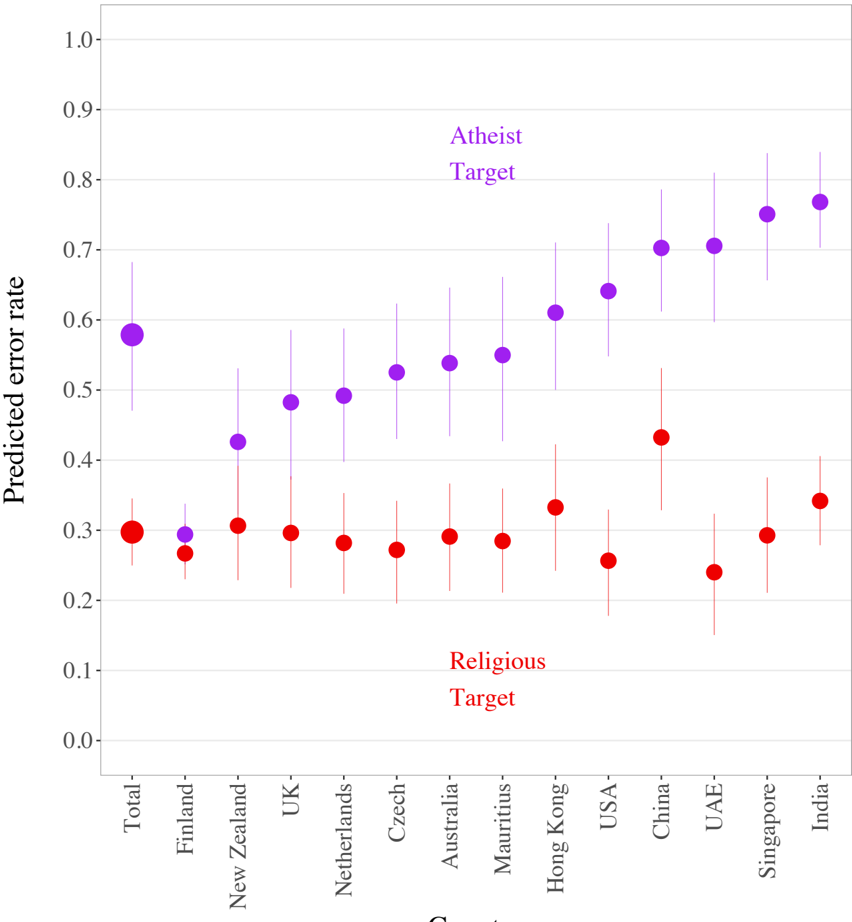
- Across the full sample, the model predicted a conjunction error rate of 0.58 for atheist targets versus 0.30 for religious targets, with RR = 1.96 [1.53, 2.37] and posterior probability > .999 that atheist-target errors exceeded religious-target errors.
- In the raw descriptive statistics, 35.9% made errors in the control condition versus 64.1% in the atheist condition (χ² = 163.512, df = 1, Φ = .225, p < .001).
- The sample included 3256 participants from 13 countries, after dropping 13% inattentive participants; the median country sample size was 162 (range 129–993).
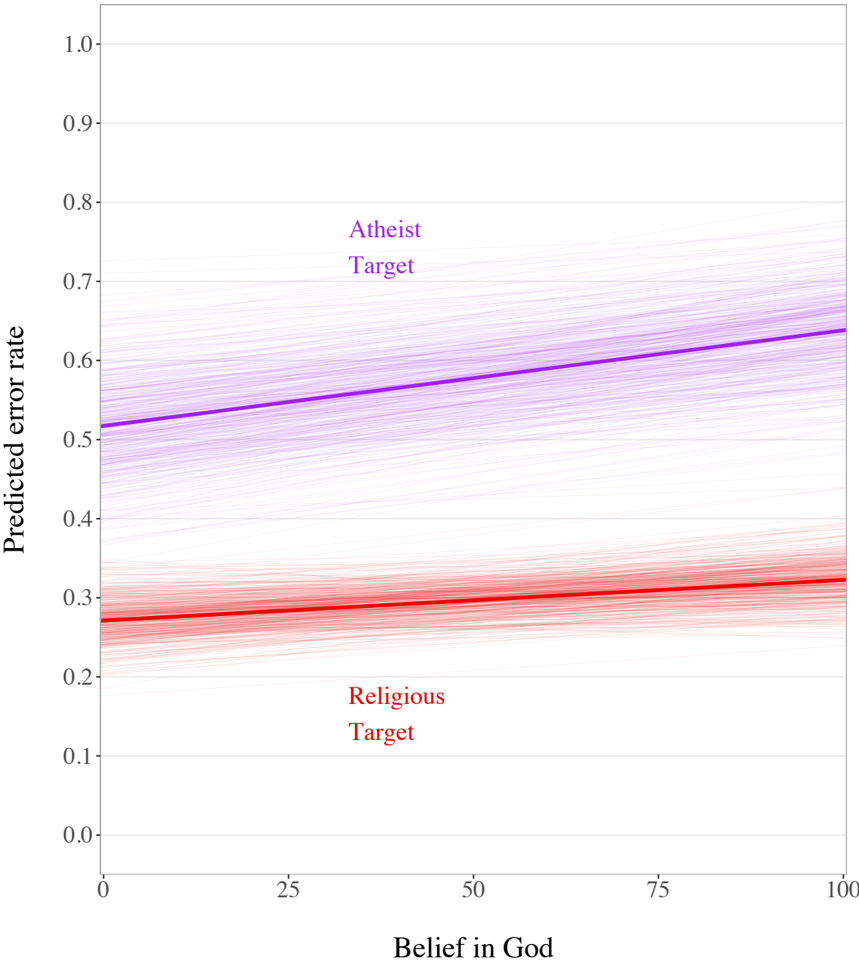
- Anti-atheist prejudice appeared among atheists too: among participants rating belief in God at 0/100, the model predicted 0.52 error probability for atheist targets versus 0.28 for religious targets, with RR = 1.91 [1.41, 2.48] and posterior probability > .999.
- Country differences were substantial: the effect was weakest in Finland (e.g., total predicted atheist-target error 0.29 vs religious 0.27, pr(A > R) = .822 at mean belief), while many other countries showed posterior probabilities >.999.
Methods
- Cross-cultural experiment run by local teams in 13 countries on 5 continents; participants answered a representativeness-heuristic conjunction task plus distractor items, an attention check, and demographics.
- Main task: read a vignette about a man who tortures animals and murders five homeless people, then chose whether he was more probably a teacher or a teacher and either does not believe in any gods or is a religious believer (between-subjects manipulation).
- Analysis used Bayesian hierarchical/multilevel modeling in R with random country intercepts and random country slopes for target (atheist vs believer), adjusting for standardized belief in God, age, gender, and subjective socioeconomic status.
Limitations
- The paper states that the sample is not universal in its effect: anti-atheist prejudice was “culturally widespread though not universal”, with clear country heterogeneity.
- The paper notes that the primary cross-cultural study was preregistered, but the three follow-up studies were not.
- Evident from the text: the main manipulation used an extreme moral-violation vignette and a forced-choice conjunction task, so the findings speak to intuitive judgments in this paradigm rather than direct measures of overt prejudice or real-world behavior.
Model-written summary. Check it against the paper before relying on it.
Integrity signals
Registry
Cites
Statistics
Figures
Verification
Claims the paper makes
5 Valid · 0 Not valid · 20 Not checked · 56 Own results and interpretations
The sources with a verdict support this claim; the rest weren’t checked yet, have no full text we could read, or their verdicts aren’t rated yet.
In the paper
“Modern investigations reflect this perceived link between belief in gods and morality, as recent small sample studies in North America suggest deep moral suspicion of individuals who do not believe in gods 13,19 .”
What the sources say
- Not checked — no full text of the sourcecites [13] Gervais, W. M., Shariff, A. F. & Norenzayan, A. Do you believe in atheists? Distrust is central to anti-atheist prejudice. J. Pers. Soc. Psychol. 101, 1189–1206 (2011). source
- Supportedcites [19] Gervais, W. M. Everything is permitted? People intuitively judge immorality as representative of atheists. PLoS ONE 9, e92302 (2014). source
The General Discussion says American participants intuitively associated immoral acts with atheists and were skeptical of atheist morality specifically because atheists do not believe in God. The Participants section describes modest-sized experimental groups, with a recruitment target of at least 30 people per cell. No page numbers are available in our copy. (LLM, conf=0.91)
hedged- Asserted: passes — The authors put it forward as true.
- Checkable: passes — It can be checked against evidence.
- Load-bearing: passes — The paper’s conclusions depend on it.
- Based: passes — The paper gives a reason why it holds.
Every source the paper cites for this claim was checked and supports it.
In the paper
“Higher conjunction fallacy rates (picking option B) in the atheist condition indicate that people intuitively view serial murder as more representative of atheists than of religious believers 19 .”
What the sources say
- Supportedcites [19] Gervais, W. M. Everything is permitted? People intuitively judge immorality as representative of atheists. PLoS ONE 9, e92302 (2014). source
The General Method says conjunction-error rates index how representative participants intuitively find a description of different groups. The Results report higher error rates for targets who do not believe in God than for the listed religious groups and conclude that serial murder was seen as representative of atheists. (LLM, conf=0.94)
hedgedstates a cause- Asserted: passes — The authors put it forward as true.
- Checkable: passes — It can be checked against evidence.
- Load-bearing: passes — The paper’s conclusions depend on it.
- Based: passes — The paper gives a reason why it holds.
- Supported
A result the paper reports from its own data — it cites no other source for it, so there is none to check. The quote shows it is in the paper.
In the paper
“Notably, anti-atheist prejudice was even evident among atheist participants around the world.”
plainn = 3,256- Asserted: passes — The authors put it forward as true.
- Checkable: passes — It can be checked against evidence.
- Load-bearing: passes — The paper’s conclusions depend on it.
- Based: passes — The paper gives a reason why it holds.
A result the paper reports from its own data — it cites no other source for it, so there is none to check. The quote shows it is in the paper.
In the paper
“Consistent with cultural evolutionary theories of religion and morality, people in most-but not all-countries viewed extreme moral violations as representative of atheists.”
plainn = 3,256- Asserted: passes — The authors put it forward as true.
- Checkable: passes — It can be checked against evidence.
- Load-bearing: passes — The paper’s conclusions depend on it.
- Based: passes — The paper gives a reason why it holds.
A result the paper reports from its own data — it cites no other source for it, so there is none to check. The quote shows it is in the paper.
In the paper
“Thus, while anti-atheist prejudice varies strongly by country, such prejudice is largely robust across the spectrum of participant religiosity within countries; both high and low believers are about twice as likely to commit conjunction errors for atheist targets than for religious targets (Figure 2).”
plain- Asserted: passes — The authors put it forward as true.
- Checkable: passes — It can be checked against evidence.
- Load-bearing: passes — The paper’s conclusions depend on it.
- Based: passes — The paper gives a reason why it holds.
32 more claims
Create a free account to see all 81 claims and to verify the 4 references still open.
- Probably not a substantial claim. 28
- It may state two separate claims as one. 22
- The quote only partly states this claim. 1
Claims other papers make about this one
Each is checked against this paper’s own text: does it say what the citing paper says it does?
The source backs part of the claim, not all of it — or backs it for a different population, condition or comparison.
In the citing paper
“Specifically, religiosity is positively related to antipathy toward atheists [7, 8], racial minorities [12], and homosexuals [14].”
From The amoral atheist? A cross-national examination of cultural, motivational, and cognitive antecedents of disbelief, and their implications for morality (2021) · cites this paper as [8]
Experimental — accuracy not yet measuredThe cited source says what the claim attributes to it.
In the citing paper
“There is a widespread cross-cultural stereotype suggesting that atheists are untrustworthy and lack a moral compass.”
From The amoral atheist? A cross-national examination of cultural, motivational, and cognitive antecedents of disbelief, and their implications for morality (2021) · cites this paper as [8]
The cited source says what the claim attributes to it.
In the citing paper
“Psychologists have recently started to examine why people have such antipathy toward atheists, and the findings strongly suggest that prejudice against atheists is driven by distrust [4–8].”
From The amoral atheist? A cross-national examination of cultural, motivational, and cognitive antecedents of disbelief, and their implications for morality (2021) · cites this paper as [8]
The cited source says what the claim attributes to it.
In the citing paper
“A recent study found strong evidence for the negative stereotype about atheists as immoral in 11 out of 13 countries investigated, and this stereotype was subscribed to even by atheists themselves [8].”
From The amoral atheist? A cross-national examination of cultural, motivational, and cognitive antecedents of disbelief, and their implications for morality (2021) · cites this paper as [8]
Citations
Cites
The weirdest people in the world?
Henrich, J., Heine, S. J., & Norenzayan, A. (2010) · Behavioral and Brain Sciences · doi:10.1017/s0140525x0999152x · Cited by 12,641
WEIRD languages have misled us, too
Majid, A., & Levinson, S. C. (2010) · Behavioral and Brain Sciences · doi:10.1017/s0140525x1000018x · Cited by 4,076
Extensional versus intuitive reasoning: The conjunction fallacy in probability judgment.
Tversky, A., & Kahneman, D. (1983) · Psychological Review · doi:10.1037/0033-295x.90.4.293 · Cited by 3,991
Sacred and secular religion and politics worldwide
Norris, P., & Inglehart, R. (2004) · Cited by 2,259
Social evaluation by preverbal infants
Hamlin, J. K., Wynn, K., & Bloom, P. (2007) · Nature · doi:10.1038/nature06288 · Cited by 1,566
The cultural niche: Why social learning is essential for human adaptation
Boyd, R., Richerson, P. J., & Henrich, J. (2011) · Proceedings of the National Academy of Sciences · doi:10.1073/pnas.1100290108 · Cited by 1,303
Why We (Usually) Don't Have to Worry About Multiple Comparisons
Gelman, A., Hill, J., & Yajima, M. (2012) · Journal of Research on Educational Effectiveness · doi:10.1080/19345747.2011.618213 · Cited by 1,274
Statistical Rethinking: A Bayesian Course with Examples in R and Stan
McElreath, R. L. (2015) · Helmholtz Centre for Ocean Research Kiel (GEOMAR) · Cited by 996
The cultural evolution of prosocial religions
Norenzayan, A., Shariff, A. F., Gervais, W. M., Willard, A. K., McNamara, R. A., Slingerland, E., & Henrich, J. (2016) · Behavioral and Brain Sciences · doi:10.1017/s0140525x14001356 · Cited by 934
Self-citationAtheists as “other”: Moral boundaries and cultural membership in American society
Edgell, P., Gerteis, J., & Hartmann, D. (2006) · American Sociological Review · doi:10.1177/000312240607100203 · Cited by 914
Research works printed but not linked: 1
- Dostoevsky, F. The Brothers Karamazov 12th edn (Farrar, Straus & Giroux, 2002).
Cited by
Items 201–295 of 295
Olson, D. Z. (2021) · Cambridge University Press eBooks · doi:10.1017/9781108562324.029
Weir, T. H. (2021) · Cambridge University Press eBooks · doi:10.1017/9781108562324.048
Chant, S. R. (2021) · Cambridge University Press eBooks · doi:10.1017/9781108562324.033
Ruse, M. (2021) · Cambridge University Press eBooks · doi:10.1017/9781108562324.061
Chalfant, E. (2021) · Cambridge University Press eBooks · doi:10.1017/9781108562324.050
Ruse, M. (2021) · Cambridge University Press eBooks · doi:10.1017/9781108562324.062
Clark, A. (2021) · Cambridge University Press eBooks · doi:10.1017/9781108562324.019
Richards, R. A. (2021) · Cambridge University Press eBooks · doi:10.1017/9781108562324.041
Cotter, C. R. (2021) · Cambridge University Press eBooks · doi:10.1017/9781108562324.055 · Cited by 1
Ryrie, A. (2021) · Cambridge University Press eBooks · doi:10.1017/9781108562324.011
Tate, A. (2021) · Cambridge University Press eBooks · doi:10.1017/9781108562324.039
Hanson, R. (2016) · Oxford University Press eBooks · doi:10.1093/oso/9780198754626.003.0024
Hanson, R. (2016) · Oxford University Press eBooks · doi:10.1093/oso/9780198754626.003.0034
Hanson, R. (2016) · Oxford University Press eBooks · doi:10.1093/oso/9780198754626.003.0028
Hanson, R. (2016) · Oxford University Press eBooks · doi:10.1093/oso/9780198754626.003.0029
Hanson, R. (2016) · Oxford University Press eBooks · doi:10.1093/oso/9780198754626.003.0023
Hanson, R. (2016) · Oxford University Press eBooks · doi:10.1093/oso/9780198754626.003.0006
Hanson, R. (2016) · Oxford University Press eBooks · doi:10.1093/oso/9780198754626.003.0017
Hanson, R. (2016) · Oxford University Press eBooks · doi:10.1093/oso/9780198754626.003.0035
Hanson, R. (2016) · Oxford University Press eBooks · doi:10.1093/oso/9780198754626.003.0014
Hanson, R. (2016) · Oxford University Press eBooks · doi:10.1093/oso/9780198754626.003.0010
Hanson, R. (2016) · Oxford University Press eBooks · doi:10.1093/oso/9780198754626.003.0022
Hanson, R. (2016) · Oxford University Press eBooks · doi:10.1093/oso/9780198754626.003.0026
Hanson, R. (2016) · Oxford University Press eBooks · doi:10.1093/oso/9780198754626.003.0020
Hanson, R. (2016) · Oxford University Press eBooks · doi:10.1093/oso/9780198754626.003.0016
Hanson, R. (2016) · Oxford University Press eBooks · doi:10.1093/oso/9780198754626.003.0008
Hanson, R. (2016) · Oxford University Press eBooks · doi:10.1093/oso/9780198754626.003.0033
Hanson, R. (2016) · Oxford University Press eBooks · doi:10.1093/oso/9780198754626.003.0032
Hanson, R. (2016) · Oxford University Press eBooks · doi:10.1093/oso/9780198754626.003.0009
Hanson, R. (2016) · Oxford University Press eBooks · doi:10.1093/oso/9780198754626.003.0013
Hanson, R. (2016) · Oxford University Press eBooks · doi:10.1093/oso/9780198754626.003.0019
Hanson, R. (2016) · Oxford University Press eBooks · doi:10.1093/oso/9780198754626.003.0036
Hanson, R. (2016) · Oxford University Press eBooks · doi:10.1093/oso/9780198754626.003.0030
Hanson, R. (2016) · Oxford University Press eBooks · doi:10.1093/oso/9780198754626.003.0007
Hanson, R. (2016) · Oxford University Press eBooks · doi:10.1093/oso/9780198754626.003.0038
Hanson, R. (2016) · Oxford University Press eBooks · doi:10.1093/oso/9780198754626.003.0027
Hanson, R. (2016) · Oxford University Press eBooks · doi:10.1093/oso/9780198754626.003.0039
Hanson, R. (2016) · Oxford University Press eBooks · doi:10.1093/oso/9780198754626.003.0004
Hanson, R. (2016) · Oxford University Press eBooks · doi:10.1093/oso/9780198754626.003.0012
Hanson, R. (2016) · Oxford University Press eBooks · doi:10.1093/oso/9780198754626.003.0040
Podolinská, T. Z., & Majo, J. (2022) · Slovenský národopis · doi:10.31577/sn.2022.4.37 · Cited by 5
God’s Not Dead As Philosophy: Trying to Prove God Exists
Johnson, D. K. (2023) · Springer eBooks · doi:10.1007/978-3-319-97134-6_116-1
Benevolent God Concepts and Past Kind Behaviors Induce Generosity Toward Outgroups
Lee, Y.-E., Payir, A., & Heiphetz, L. (2023) · Social Cognition · doi:10.1521/soco.2023.41.4.321
Gotta Have Faith: The Effect of Organizational Religiosity on Firm Competitive Positioning
Lief, D. (2024) · AEA Randomized Controlled Trials · doi:10.1257/rct.12854-1.0
Perceptions of and behaviour toward religious people and atheists in Sweden and the USA
Hallin, N. (2024) · Linköping studies in behavioural science · doi:10.3384/9789180756846 · Cited by 1
Nagasawa, Y. (2024) · Oxford University Press eBooks · doi:10.1093/oso/9780198901884.002.0007
Nagasawa, Y. (2024) · Oxford University Press eBooks · doi:10.1093/oso/9780198901884.003.0001
The Problem of Evil for Axiarchists
Nagasawa, Y. (2024) · Oxford University Press eBooks · doi:10.1093/oso/9780198901884.003.0005
Nagasawa, Y. (2024) · Oxford University Press eBooks · doi:10.1093/oso/9780198901884.003.0012
Nagasawa, Y. (2024) · Oxford University Press eBooks · doi:10.1093/oso/9780198901884.003.0007
The Problem of Evil: Its Structure and Important Variations
Nagasawa, Y. (2024) · Oxford University Press eBooks · doi:10.1093/oso/9780198901884.003.0002 · Cited by 1
The Problem of Systemic Evil for Atheists/Non-Theists
Nagasawa, Y. (2024) · Oxford University Press eBooks · doi:10.1093/oso/9780198901884.003.0008
The Problem of Evil for Pantheists
Nagasawa, Y. (2024) · Oxford University Press eBooks · doi:10.1093/oso/9780198901884.003.0004
Nagasawa, Y. (2024) · Oxford University Press eBooks · doi:10.1093/oso/9780198901884.002.0003
Nagasawa, Y. (2024) · Oxford University Press eBooks · doi:10.1093/oso/9780198901884.002.0004
Nagasawa, Y. (2024) · Oxford University Press eBooks · doi:10.1093/oso/9780198901884.003.0010
The Advantages that Traditional Theists Enjoy
Nagasawa, Y. (2024) · Oxford University Press eBooks · doi:10.1093/oso/9780198901884.003.0009
The Problem of Evil as a Problem of Axiological Expectation Mismatch
Nagasawa, Y. (2024) · Oxford University Press eBooks · doi:10.1093/oso/9780198901884.003.0003
Responses to the Problem of Impermanence
Nagasawa, Y. (2024) · Oxford University Press eBooks · doi:10.1093/oso/9780198901884.003.0011
Ecklund, E. H., & Johnson, D. R. (2021) · Oxford University Press eBooks · doi:10.1093/oso/9780197539163.005.0001
Ecklund, E. H., & Johnson, D. R. (2021) · Oxford University Press eBooks · doi:10.1093/oso/9780197539163.002.0006
Ecklund, E. H., & Johnson, D. R. (2021) · Oxford University Press eBooks · doi:10.1093/oso/9780197539163.002.0003
Shifting themes in the cognitive and evolutionary sciences of religionPreprint
Cigán, J., Krátký, J., Kundt, R., Klocová, E. K., Lang, M., & Nenadalová, J. (2024) · doi:10.31219/osf.io/efrw3
Self-citationMcKay, R., Price, M. E., Ross, R. M., Watts, J., Cristofori, I., Hoogeveen, S., Shaver, J. H., Sosis, R. H., & Wildman, W. J. (2024) · Religion Brain & Behavior · doi:10.1080/2153599x.2024.2356389
“A key strand of my recent work on this topic has looked at the underpinnings, and consequences, of moral prejudice against the non-religious (Gervais et al., 2017, 2024).”
BackgroundSelf-citationAtheists and Christians can be Discerned from their Faces
Pitts, G. S., & Rule, N. O. (2024) · Journal of Nonverbal Behavior · doi:10.1007/s10919-024-00467-8
“Indeed, they are often viewed more harshly than other groups (Pew Research Center, 2019a) and subject to widespread distrust and aversion (Gervais, 2013; Gervais et al., 2017; Harper, 2007; Simpson & Rios, 2016, 2017).”
God’s Not Dead as Philosophy: Trying to Prove God Exists
Johnson, D. K. (2024) · Springer eBooks · doi:10.1007/978-3-031-24685-2_116
Łowicki, P., & Barker, S. B. (2024) · Archive for the Psychology of Religion · doi:10.1177/00846724241279441 · Cited by 1
“In addition, cross-cultural studies also clearly indicate that prejudice against atheists is deeply rooted and highly prevalent, even in countries with relatively high levels of secularization (Gervais et al., 2017).”
Snell, A., & Burt, M. (2024) · Springer eBooks · doi:10.1007/978-3-031-38971-9_934-1 · Cited by 1
Solidarity of Sisters: Moral Politics in the Polish Left-Wing Discourse about LGBTQIA+
Ciołkosz, M. (2024) · Studia Religiologica · doi:10.4467/20844077sr.23.011.19999
Building a developmental science of redemption
Yonas, D., & Solomon, L. H. (2025) · Developmental Review · doi:10.1016/j.dr.2024.101183
Religion: Evolutionary Foundation for
Ko, N. F., & Li, N. P. (2025) · Springer eBooks · doi:10.1007/978-3-031-38971-9_1747-1
Demczuk, A., & Chammas, E. (2025) · Springer eBooks · doi:10.1007/978-3-031-38971-9_858-1
Risk Communication and Stories
Morris, B. S. (2025) · Springer eBooks · doi:10.1007/978-981-96-1289-5_10
Lambert, J. T., Kinrade, C., Wahlers, D. E., Hall, B. T., & Hart, W. (2025) · Self and Identity · doi:10.1080/15298868.2025.2485459 · Cited by 2
“…a negative attitude for signaling purposes, they are likely to justify this negative view, which could involve more negative perceptions of atheists being distrustful (Schiavone & Gervais, 2017), sexually permissive (Lambert et al., 2023), and at odds with their moral values (Gervais et al., 2017).”
InfluentialAtheistsPreprint
Schiavone, S. R., & Gervais, W. M. (2017) · PsyArXiv (OSF Preprints) · doi:10.31234/osf.io/ryp6g_v1
Self-citationMorality: Religious and Nonreligious
Stiehl, M. M., Rowatt, W. C., & Tsang, J.-A. C. (2025) · Springer eBooks · doi:10.1007/978-3-031-38971-9_376-1
Schnell, T. (2025) · Springer eBooks · doi:10.1007/978-3-662-70097-6_7
Zuckerman, P., & Myers, S. (2025) · Secularism and Nonreligion · doi:10.5334/snr.221
Christians Have More Self-Compassion Than Atheists—But Also More Grandiose (Not Fragile) Narcissism
Magee, M. W. (2025) · Pastoral Psychology · doi:10.1007/s11089-025-01239-x
From drowning to debunking: the cognitive science of religion's role in unraveling religious beliefs
McKay, R., Levy, N. L., van Elk, M., & Ross, R. M. (2025) · Religion Brain & Behavior · doi:10.1080/2153599x.2025.2474391
“Perhaps CSR might affect agents’ explicit beliefs, leaving their implicit beliefs relatively untouched (see Gervais et al., 2017 and Gervais et al., in press, for evidence that even athe-ists seem to manifest responses suggestive of a positive evaluation of religious belief).”
Self-citationShifting themes in the cognitive and evolutionary sciences of religion
Cigán, J., Krátký, J., Kundt, R., Klocová, E. K., Lang, M., & Nenadalová, J. (2025) · Religion Brain & Behavior · doi:10.1080/2153599x.2025.2474397
“The study samples in CESR research are diverse geographically and demographically and include several large-scale studies (see, e.g., Gervais et al., 2017; Hoogeveen et al., 2023; Lang et al., 2019; Purzycki et al., 2016; Van Mulukom et al., 2023).”
Self-citationAre religious people more moral?
Xygalatas, D. (2017) · The Conversation · doi:10.64628/aai.64wscvjgd · Cited by 7
Self-citationApakah orang yang religius lebih bermoral?
Xygalatas, D. (2017) · The Conversation · doi:10.64628/aan.ud7umxmjw
Self-citationReply to Quillien: Intuitive preferences and interpretive humility in intentionality judgments
Gervais, W. M., McKay, R., Brown-Iannuzzi, J. L., et al. (2025) · Proceedings of the National Academy of Sciences · doi:10.1073/pnas.2518353122
Self-citationReligion: Evolutionary Foundation for
Ko, N. F., & Li, N. P. (2025) · Springer eBooks · doi:10.1007/978-3-031-38971-9_1747-2
Seizing the Power of Religion to Shape Purpose
Toosi, N. R., Wellman, J. D., & Wilkins, C. L. (2025) · Cambridge University Press eBooks · doi:10.1017/9781009407427.010
Poonamallee, L. (2021) · Emerald Group Publishing Limited eBooks · doi:10.1108/978-1-64802-432-020251016
Hanson, R. (2016) · Oxford University Press eBooks · doi:10.1093/oso/9780198754626.002.0001
Hanson, R. (2016) · Oxford University Press eBooks · doi:10.1093/oso/9780198754626.002.0002
Survey-Software Implicit Association Tests: A Methodological and Empirical AnalysisPreprint
Isenberg, N., Chakroff, A., Aguilar, S. J., LaBouff, J. P., Carpenter, T., Kouril, M., Pullig, C., & Pogacar, R. (2020) · OSF Preprints (OSF Preprints)
Wormley, A. S., Stefaniak, A., Hollingshead, S. J., & Wohl, M. J. A. (2026) · Group Processes & Intergroup Relations · doi:10.1177/13684302261438589
“Nevertheless, we would suspect that this model would hold across cultural and religious contexts because past work has demonstrated that even atheists in secular societies implicitly hold religion in high regard (Gervais et al., 2017, 2025).”
Visuri, I., & Svensson, J. (2026) · Religion & Education · doi:10.1080/15507394.2026.2716456
“People with such non-religious worldviews similarly deserve respect and understanding, as they too may encounter prejudice (Gervais et al 2017).”
Katz, M., Caluori, N., & Pasek, M. H. (2026) · Personality and Social Psychology Bulletin · doi:10.1177/01461672261477891
Partisanship and openness to nonreligious candidates for elective office in the United States
Golebiowska, E. A. (2026) · Politics and Religion · doi:10.1017/s1755048326100522
Moral Grounds Without God: Moral Reasoning, Meaning, and the Social Life of Nonbelievers in Pakistan
., S., & Rasool, D. F. (2023) · International Journal of Research in Social Sciences and Humanities · doi:10.37648/ijrssh.v13i03.036
Metadata
- Authors
- Gervais, W. M., Xygalatas, D., McKay, R. T., van Elk, M., Buchtel, E. E., Aveyard, M., Schiavone, S. R., Dar-Nimrod, I., Svedholm-Häkkinen, A. M., Riekki, T., Klocová, E. K., Ramsay, J. E., & Bulbulia, J.
- Affiliations
- University of Kentucky (US)
- University of Connecticut (US)
- Royal Holloway University of London (GB)
- Education University of Hong Kong (HK)
- American University of Sharjah (AE)
- University of Helsinki (FI)
- Masaryk University (CZ)
- Singapore University of Social Sciences (SG)
- Victoria University of Wellington (NZ)
- Corresponding author
- Gervais, Will M.
- ORCID
- Venue
- Nature Human Behaviour
- Published
- 2017-08-07
- Volume
- 1
- Issue
- 8
- ISSN
- 2397-3374 (ISSN-L)
- OpenAlex
- W2743438787
- Semantic Scholar
- 9dee009a24b442857b45d575a1a08af51f0d5cbc
- Cited by
- 292
- References
- 35
- Citations by year
- 2026: 5 · 2025: 26 · 2024: 33 · 2023: 18 · 2022: 15 · 2021: 103 · 2020: 21 · 2019: 12 · 2018: 14 · 2017: 10
- FWCI
- 8.96
- Type
- journal article
- Language
- en
- Update notices
- correction (2018-05-18)
- Open access
- green
- hdl.handle.net
- Licence
- cc-by-nc-nd
- www.springernature.com/gp/researchers/text-and-data-mining (tdm)
- www.springernature.com/gp/researchers/text-and-data-mining (vor)
- Locations
- Nature Human Behaviour (publishedVersion)
- ResearchOnline - JCU (James Cook University) (submittedVersion)
- UvA-DARE (University of Amsterdam) (submittedVersion, cc-by-nc-nd)
- RePEc: Research Papers in Economics (submittedVersion)
- Työväentutkimus Vuosikirja (submittedVersion, other-oa)
- OSF Preprints (OSF Preprints) (submittedVersion, cc-by)
- OSF Preprints (OSF Preprints) (submittedVersion)
- Data Archiving and Networked Services (DANS) (submittedVersion, other-oa)
- Funders
- John Templeton Foundation (48275, 52257)
- Aarhus Universitet
- Macquarie University
- Royal Society Te Apārangi (VUW1321)
- Centre of Excellence in Cognition and its Disorders, Australian Research Council
- Templeton World Charity Foundation (52257)
- Topics
- Life Sciences › Neuroscience › Cognitive Neuroscience › Psychology of Moral and Emotional Judgment
- Social Sciences › Sociology and Political Science › Religion and Society Interactions
- Social Sciences › Sociology and Political Science › Social and Intergroup Psychology
- Keywords
- moral prejudice, atheists, religion and morality, secularism, cross-cultural comparison, parochialism, intergroup conflict
About these checks
Registry, retraction, Cites and statistics results are computed, not judged, with one exception: a printed reference that no index lists is read once by a model before it counts as a citation error. Claims are extracted by a model and kept only when their quote appears verbatim in the text; each cited source is then checked, with a model’s help, for whether it says what the claim relies on. Those verdicts can be wrong — read the claim’s quote and the cited source before relying on one.
The claim verdicts this report counts are experimental: their accuracy is not yet measured.
A language model drew the claims from the paper on 2026-10-10, under version 3 of the claim definition (model deepseek-v4.1-flash, prompt extract-v3).
A second model labelled each claim on 2026-10-10 (model jev-1.13-20260917, definition revision gold-guideline-v0.2).
Cited sources are checked with a language model’s help (gpt-6-sol).
Statistics and arithmetic are recomputed, not judged.
Confidence bands are shown only for fields calibrated on our annotated test set. None is calibrated yet, so no band is shown.
What counts as a claim ›How we measure confidence ›How we check this ›
Are you an author, or do you see a problem with this page? Request a review
Data sources
Bibliographic data: Semantic Scholar, OpenAlex, Crossref.
Contains information from the Semantic Scholar Academic Graph Datasets, made available under the ODC Attribution License (ODC-BY 1.0).
Semantic Scholar’s data is described in: Kinney, R., et al. (2023). The Semantic Scholar Open Data Platform. arXiv:2301.10140.
