

Global evidence of extreme intuitive moral prejudice against atheists
Open accessThe DOI matches its Crossref record; 36 of the 36 references it cites were found in a registry or an index; 6 of the 49 sources its claims cite were checked for support.
Abstract
A cross-cultural study shows that people intuitively link immorality with atheism across 13 diverse countries, regardless of their own religious beliefs.
Overview
CoChat Summary
TL;DR
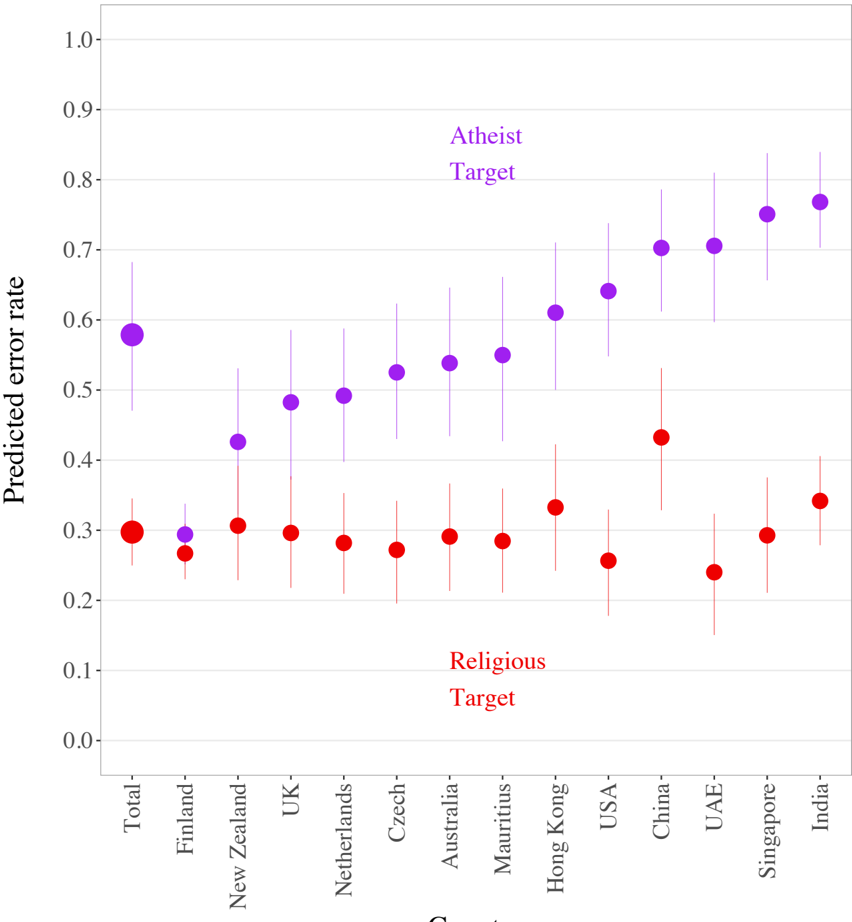
In a 13-country cross-cultural experiment (N=3256), participants were much more likely to make a conjunction error for an atheist target than for a religious target when judging an extreme immoral act, indicating strong intuitive moral distrust of atheists. The effect persisted after adjusting for demographics and country-level variation, and appeared even among atheist participants, though it varied by country and was weakest in Finland.
Key findings
- Across the full sample, the model predicted a conjunction error rate of 0.58 for atheist targets versus 0.30 for religious targets, with RR = 1.96 [1.53, 2.37] and posterior probability > .999 that atheist-target errors exceeded religious-target errors.
- In the raw descriptive statistics, 35.9% made errors in the control condition versus 64.1% in the atheist condition (χ² = 163.512, df = 1, Φ = .225, p < .001).
- The sample included 3256 participants from 13 countries, after dropping 13% inattentive participants; the median country sample size was 162 (range 129–993).
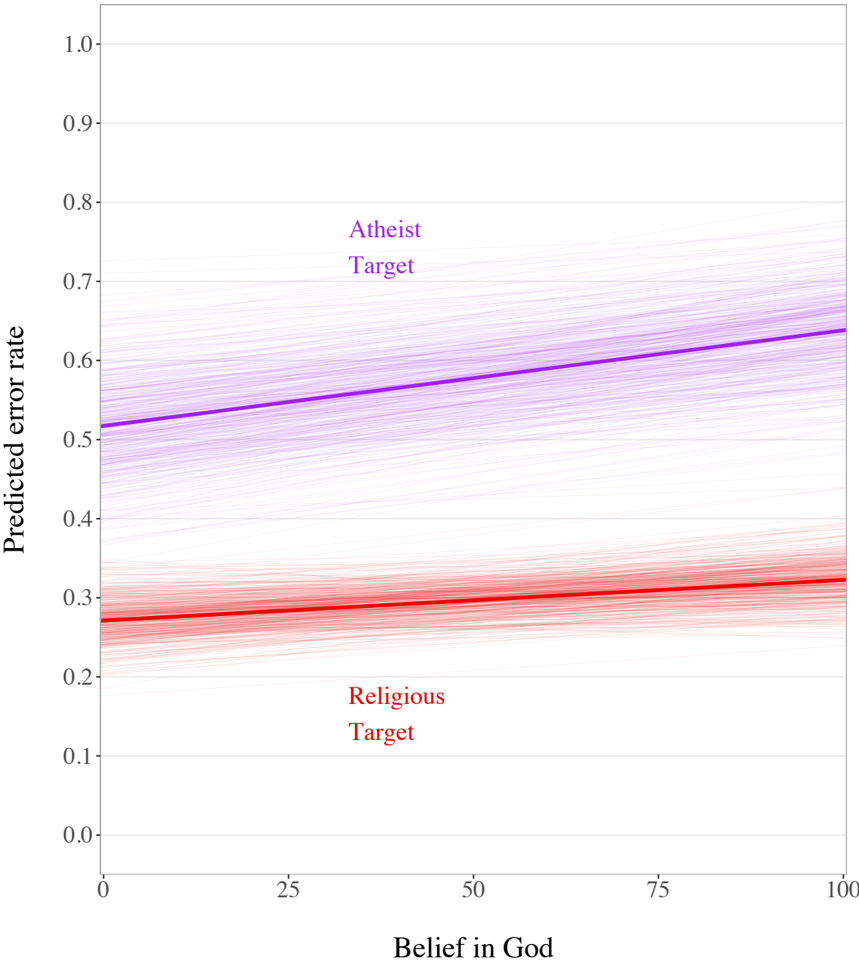
- Anti-atheist prejudice appeared among atheists too: among participants rating belief in God at 0/100, the model predicted 0.52 error probability for atheist targets versus 0.28 for religious targets, with RR = 1.91 [1.41, 2.48] and posterior probability > .999.
- Country differences were substantial: the effect was weakest in Finland (e.g., total predicted atheist-target error 0.29 vs religious 0.27, pr(A > R) = .822 at mean belief), while many other countries showed posterior probabilities >.999.
Methods
- Cross-cultural experiment run by local teams in 13 countries on 5 continents; participants answered a representativeness-heuristic conjunction task plus distractor items, an attention check, and demographics.
- Main task: read a vignette about a man who tortures animals and murders five homeless people, then chose whether he was more probably a teacher or a teacher and either does not believe in any gods or is a religious believer (between-subjects manipulation).
- Analysis used Bayesian hierarchical/multilevel modeling in R with random country intercepts and random country slopes for target (atheist vs believer), adjusting for standardized belief in God, age, gender, and subjective socioeconomic status.
Limitations
- The paper states that the sample is not universal in its effect: anti-atheist prejudice was “culturally widespread though not universal”, with clear country heterogeneity.
- The paper notes that the primary cross-cultural study was preregistered, but the three follow-up studies were not.
- Evident from the text: the main manipulation used an extreme moral-violation vignette and a forced-choice conjunction task, so the findings speak to intuitive judgments in this paradigm rather than direct measures of overt prejudice or real-world behavior.
Model-written summary. Check it against the paper before relying on it.
Integrity signals
Registry
Cites
Statistics
Figures
Verification
Claims the paper makes
5 Valid · 0 Not valid · 20 Not checked · 56 Own results and interpretations
The sources with a verdict support this claim; the rest weren’t checked yet, have no full text we could read, or their verdicts aren’t rated yet.
In the paper
“Modern investigations reflect this perceived link between belief in gods and morality, as recent small sample studies in North America suggest deep moral suspicion of individuals who do not believe in gods 13,19 .”
What the sources say
- Not checked — no full text of the sourcecites [13] Gervais, W. M., Shariff, A. F. & Norenzayan, A. Do you believe in atheists? Distrust is central to anti-atheist prejudice. J. Pers. Soc. Psychol. 101, 1189–1206 (2011). source
- Supportedcites [19] Gervais, W. M. Everything is permitted? People intuitively judge immorality as representative of atheists. PLoS ONE 9, e92302 (2014). source
The General Discussion says American participants intuitively associated immoral acts with atheists and were skeptical of atheist morality specifically because atheists do not believe in God. The Participants section describes modest-sized experimental groups, with a recruitment target of at least 30 people per cell. No page numbers are available in our copy. (LLM, conf=0.91)
hedged- Asserted: passes — The authors put it forward as true.
- Checkable: passes — It can be checked against evidence.
- Load-bearing: passes — The paper’s conclusions depend on it.
- Based: passes — The paper gives a reason why it holds.
Every source the paper cites for this claim was checked and supports it.
In the paper
“Higher conjunction fallacy rates (picking option B) in the atheist condition indicate that people intuitively view serial murder as more representative of atheists than of religious believers 19 .”
What the sources say
- Supportedcites [19] Gervais, W. M. Everything is permitted? People intuitively judge immorality as representative of atheists. PLoS ONE 9, e92302 (2014). source
The General Method says conjunction-error rates index how representative participants intuitively find a description of different groups. The Results report higher error rates for targets who do not believe in God than for the listed religious groups and conclude that serial murder was seen as representative of atheists. (LLM, conf=0.94)
hedgedstates a cause- Asserted: passes — The authors put it forward as true.
- Checkable: passes — It can be checked against evidence.
- Load-bearing: passes — The paper’s conclusions depend on it.
- Based: passes — The paper gives a reason why it holds.
- Supported
A result the paper reports from its own data — it cites no other source for it, so there is none to check. The quote shows it is in the paper.
In the paper
“Notably, anti-atheist prejudice was even evident among atheist participants around the world.”
plainn = 3,256- Asserted: passes — The authors put it forward as true.
- Checkable: passes — It can be checked against evidence.
- Load-bearing: passes — The paper’s conclusions depend on it.
- Based: passes — The paper gives a reason why it holds.
A result the paper reports from its own data — it cites no other source for it, so there is none to check. The quote shows it is in the paper.
In the paper
“Consistent with cultural evolutionary theories of religion and morality, people in most-but not all-countries viewed extreme moral violations as representative of atheists.”
plainn = 3,256- Asserted: passes — The authors put it forward as true.
- Checkable: passes — It can be checked against evidence.
- Load-bearing: passes — The paper’s conclusions depend on it.
- Based: passes — The paper gives a reason why it holds.
A result the paper reports from its own data — it cites no other source for it, so there is none to check. The quote shows it is in the paper.
In the paper
“Thus, while anti-atheist prejudice varies strongly by country, such prejudice is largely robust across the spectrum of participant religiosity within countries; both high and low believers are about twice as likely to commit conjunction errors for atheist targets than for religious targets (Figure 2).”
plain- Asserted: passes — The authors put it forward as true.
- Checkable: passes — It can be checked against evidence.
- Load-bearing: passes — The paper’s conclusions depend on it.
- Based: passes — The paper gives a reason why it holds.
32 more claims
Create a free account to see all 81 claims and to verify the 4 references still open.
- Probably not a substantial claim. 28
- It may state two separate claims as one. 22
- The quote only partly states this claim. 1
Claims other papers make about this one
Each is checked against this paper’s own text: does it say what the citing paper says it does?
The source backs part of the claim, not all of it — or backs it for a different population, condition or comparison.
In the citing paper
“Specifically, religiosity is positively related to antipathy toward atheists [7, 8], racial minorities [12], and homosexuals [14].”
From The amoral atheist? A cross-national examination of cultural, motivational, and cognitive antecedents of disbelief, and their implications for morality (2021) · cites this paper as [8]
Experimental — accuracy not yet measuredThe cited source says what the claim attributes to it.
In the citing paper
“There is a widespread cross-cultural stereotype suggesting that atheists are untrustworthy and lack a moral compass.”
From The amoral atheist? A cross-national examination of cultural, motivational, and cognitive antecedents of disbelief, and their implications for morality (2021) · cites this paper as [8]
The cited source says what the claim attributes to it.
In the citing paper
“Psychologists have recently started to examine why people have such antipathy toward atheists, and the findings strongly suggest that prejudice against atheists is driven by distrust [4–8].”
From The amoral atheist? A cross-national examination of cultural, motivational, and cognitive antecedents of disbelief, and their implications for morality (2021) · cites this paper as [8]
The cited source says what the claim attributes to it.
In the citing paper
“A recent study found strong evidence for the negative stereotype about atheists as immoral in 11 out of 13 countries investigated, and this stereotype was subscribed to even by atheists themselves [8].”
From The amoral atheist? A cross-national examination of cultural, motivational, and cognitive antecedents of disbelief, and their implications for morality (2021) · cites this paper as [8]
Citations
Cites
The weirdest people in the world?
Henrich, J., Heine, S. J., & Norenzayan, A. (2010) · Behavioral and Brain Sciences · doi:10.1017/s0140525x0999152x · Cited by 12,641
WEIRD languages have misled us, too
Majid, A., & Levinson, S. C. (2010) · Behavioral and Brain Sciences · doi:10.1017/s0140525x1000018x · Cited by 4,076
Extensional versus intuitive reasoning: The conjunction fallacy in probability judgment.
Tversky, A., & Kahneman, D. (1983) · Psychological Review · doi:10.1037/0033-295x.90.4.293 · Cited by 3,991
Sacred and secular religion and politics worldwide
Norris, P., & Inglehart, R. (2004) · Cited by 2,259
Social evaluation by preverbal infants
Hamlin, J. K., Wynn, K., & Bloom, P. (2007) · Nature · doi:10.1038/nature06288 · Cited by 1,566
The cultural niche: Why social learning is essential for human adaptation
Boyd, R., Richerson, P. J., & Henrich, J. (2011) · Proceedings of the National Academy of Sciences · doi:10.1073/pnas.1100290108 · Cited by 1,303
Why We (Usually) Don't Have to Worry About Multiple Comparisons
Gelman, A., Hill, J., & Yajima, M. (2012) · Journal of Research on Educational Effectiveness · doi:10.1080/19345747.2011.618213 · Cited by 1,274
Statistical Rethinking: A Bayesian Course with Examples in R and Stan
McElreath, R. L. (2015) · Helmholtz Centre for Ocean Research Kiel (GEOMAR) · Cited by 996
The cultural evolution of prosocial religions
Norenzayan, A., Shariff, A. F., Gervais, W. M., Willard, A. K., McNamara, R. A., Slingerland, E., & Henrich, J. (2016) · Behavioral and Brain Sciences · doi:10.1017/s0140525x14001356 · Cited by 934
Self-citationAtheists as “other”: Moral boundaries and cultural membership in American society
Edgell, P., Gerteis, J., & Hartmann, D. (2006) · American Sociological Review · doi:10.1177/000312240607100203 · Cited by 914
Research works printed but not linked: 1
- Dostoevsky, F. The Brothers Karamazov 12th edn (Farrar, Straus & Giroux, 2002).
Cited by
Survey-software implicit association tests: A methodological and empirical analysis
Carpenter, T. P., Pogacar, R., Pullig, C., Kouril, M., Aguilar, S., LaBouff, J., Isenberg, N., & Chakroff, A. (2019) · Behavior Research Methods · doi:10.3758/s13428-019-01293-3 · Cited by 310
“We chose atheists because prejudice towards atheists is common and associated with belief in God (Gervais, Shariff, & Norenzayan, 2011; Gervais et al., 2017).”
BackgroundFolk-economic beliefs: An evolutionary cognitive model
Boyer, P., & Petersen, M. B. (2018) · Behavioral and Brain Sciences · doi:10.1017/s0140525x17001960 · Cited by 137
Discriminatory attitudes against unvaccinated people during the pandemic
Bor, A., Jørgensen, F., & Petersen, M. B. (2023) · Nature · doi:10.1038/s41586-022-05607-y · Cited by 123
Levy, N. L. (2020) · Synthese · doi:10.1007/s11229-020-02653-9 · Cited by 129
Analytic atheism: A cross-culturally weak and fickle phenomenon?
Gervais, W. M., van Elk, M., Xygalatas, D., McKay, R. T., Aveyard, M., Buchtel, E. E., Dar-Nimrod, I., Klocová, E. K., Ramsay, J. E., Riekki, T., et al. (2018) · Judgment and Decision Making · doi:10.1017/s1930297500007701 · Cited by 88
Self-citationMoral disciplining: The cognitive and evolutionary foundations of puritanical morality
Fitouchi, L., André, J., & Baumard, N. (2022) · Behavioral and Brain Sciences · doi:10.1017/s0140525x22002047 · Cited by 124
‘Atheism is not the problem. The problem is being a woman’. Atheist women and reasonable feminism
Trzebiatowska, M. (2018) · Journal of Gender Studies · doi:10.1080/09589236.2018.1523053 · Cited by 86
“In this case, atheism stands for empathy and solidarity, rather than selfishness and immorality atheists are sometimes charged with (Gervais et al., 2017; Edgell et al. 2016; Hammer, Cragun, Hwang, & Smith, 2012).”
BackgroundMcPhetres, J., Jong, J., & Zuckerman, M. (2020) · Social Psychological and Personality Science · doi:10.1177/1948550620923239 · Cited by 89
“On the other hand, moral prejudice against atheists seems to be a crossculturally robust phenomenon (Gervais et al., 2017).”
BackgroundSupernatural punishment beliefs as cognitively compelling tools of social control
Fitouchi, L., & Singh, M. (2021) · Current Opinion in Psychology · doi:10.1016/j.copsyc.2021.09.022 · Cited by 87
The Age of Em: Work, Love, and Life when Robots Rule the Earth
Hanson, R. (2016) · doi:10.1093/oso/9780198754626.001.0001 · Cited by 218
Analytic atheism: A cross-culturally weak and fickle phenomenon?
Gervais, W. M., van Elk, M., Xygalatas, D., McKay, R., Aveyard, M., BUCHTEL, E. E., Dar-Nimrod, I., Kundtová Klocová, E., Ramsay, J., Riekki, T., et al. (2017) · doi:10.31234/osf.io/92r8x · Cited by 60
“, 2016), while others appear to be relatively stable (Gervais et al., 2017).”
BackgroundMethodSelf-citationSimpson, A., & Morrison, K. R. (2019) · Public Understanding of Science · doi:10.1177/0963662519871881 · Cited by 63
Dimensions of religiousness and their connection to racial, ethnic, and atheist prejudices
Rowatt, W. C., & Al‐Kire, R. L. (2020) · Current Opinion in Psychology · doi:10.1016/j.copsyc.2020.08.022 · Cited by 71
Religious People Are Trusted Because They Are Viewed as Slow Life-History Strategists
Moon, J. W., Krems, J. A., & Cohen, A. B. (2018) · Psychological Science · doi:10.1177/0956797617753606 · Cited by 62
“This finding is consistent with recent research suggesting that nonreligious individuals associate atheism with immorality, albeit to a lesser extent than more religious individuals (Gervais et al., 2017).”
ResultStudying Religion and Language Teaching and Learning: Building a Subfield
Han, H. (2018) · Modern Language Journal · doi:10.1111/modl.12486 · Cited by 61
White, C. J. M., & Norenzayan, A. (2019) · Advances in Experimental Social Psychology · doi:10.1016/bs.aesp.2019.03.001 · Cited by 54
Tsang, J.-A. C., Al‐Kire, R. L., & Ratchford, J. L. (2020) · Current Opinion in Psychology · doi:10.1016/j.copsyc.2020.08.025 · Cited by 71
Newson, M., Buhrmester, M. D., Xygalatas, D., & Whitehouse, H. (2021) · Journal for the Cognitive Science of Religion · doi:10.1558/jcsr.38413 · Cited by 78
“2018), and lead or join larger teams to design cross-cultural projects (Gervais et al. 2017; Purzycki et al. 2016).”
BackgroundSelf-citationBig Gods in small places: the Random Allocation Game in Mauritius
Xygalatas, D., Kotherová, S., Maňo, P., Kundt, R., Cigán, J., Klocová, E. K., & Lang, M. (2017) · Religion Brain & Behavior · doi:10.1080/2153599x.2016.1267033 · Cited by 49
Self-citationMoral and religious convictions: Are they the same or different things?
Skitka, L. J., Hanson, B. E., Washburn, A. N., & Mueller, A. B. (2018) · PLoS ONE · doi:10.1371/journal.pone.0199311 · Cited by 45
Christianity as a Concealable Stigmatized Identity (CSI) among Biology Graduate Students
Barnes, M. E., Maas, S. A., Roberts, J. A., & Brownell, S. E. (2021) · CBE—Life Sciences Education · doi:10.1187/cbe.20-09-0213 · Cited by 76
“One unique cultural characteristic of academic biology is an emphasis on secular values, whereas in the general public there is a pervasive, and often extreme, bias against secularism and atheism (Gervais et al., 2011, 2017).”
BackgroundAtheist horns and religious halos: Mental representations of atheists and theists.
Brown-Iannuzzi, J. L., McKee, S. E., & Gervais, W. M. (2018) · Journal of Experimental Psychology General · doi:10.1037/xge0000376 · Cited by 60
Self-citationWhat do nonreligious nonbelievers believe in? Secular worldviews around the world.
van Mulukom, V., Turpin, H., Haimila, R., Purzycki, B. G., Bendixen, T., Klocová, E. K., Řezníček, D., Coleman, T. J., III, SEVİNÇ, K., Maraldi, E. D. O., et al. (2023) · Psychology of Religion and Spirituality · doi:10.1037/rel0000480 · Cited by 55
Self-citationPractical Methodological Reform Needs Good Theory
Gervais, W. M. (2021) · Perspectives on Psychological Science · doi:10.1177/1745691620977471 · Cited by 57
Self-citationThe Problem of Evil for Atheists
Nagasawa, Y. (2024) · doi:10.1093/oso/9780198901884.001.0001 · Cited by 43
Experimental Manipulations of Personal Control do Not Increase Illusory Pattern Perception
van Elk, M., & Lodder, P. (2018) · Collabra Psychology · doi:10.1525/collabra.155 · Cited by 49
“Beyond the measures reported above, we also included an unrelated task consisting of the representativeness heuristic, which is reported elsewhere (Gervais et al., 2017).”
MethodSelf-citationStåhl, T. (2021) · PLOS ONE · doi:10.1371/journal.pone.0246593 · Cited by 35
“Although cross-cultural stereotypes suggest that atheists lack a moral compass [8], no studies to date have systematically examined to what extent disbelievers’ and believers’ conceptualizations of morality are distinct.”
The religiosity gender gap in 14 diverse societies
Vardy, T., Moya, C., Placek, C. D., Apicella, C. L., Bolyanatz, A., Cohen, E. E. A., Handley, C., Klocová, E. K., LESOROGOL, C. K., Mathew, S., et al. (2022) · Religion Brain & Behavior · doi:10.1080/2153599x.2021.2006292 · Cited by 42
“Second, irreligiosity can confer social costs; even in many secular societies people exhibit an intuitive moral prejudice against non-believers (Gervais et al., 2017).”
BackgroundSelf-citationBelief in God: Why People Believe, and Why They Don’t
Mercier, B., Kramer, S. R., & Shariff, A. (2018) · Current Directions in Psychological Science · doi:10.1177/0963721418754491 · Cited by 42
“Around the world, people show considerable prejudice against nonbelievers (Gervais et al., 2017), and majorities consider belief necessary for morality (Pew Research Center, 2014).”
BackgroundThe Boundaries of Trust: Cross-Religious and Cross-Ethnic Field Experiments in Mauritius
Shaver, J. H., Lang, M., Krátký, J., Klocová, E. K., Kundt, R., & Xygalatas, D. (2018) · Evolutionary Psychology · doi:10.1177/1474704918817644 · Cited by 37
“…research finds little evidence of a religious in-group in New Zealand, a society with high rates of unbelief (Shaver, Troughton, et al., 2016), and the religious congruence fallacy (that religious people are more prosocial) appears inversely related to rates of atheism (Gervais et al., 2017).”
BackgroundInfluentialSelf-citationMoon, J. W., Krems, J. A., & Cohen, A. B. (2021) · Social Psychological and Personality Science · doi:10.1177/1948550620982703 · Cited by 37
“Second, we also added moral vignettes—the serial killer vignette used by Gervais et al. (2017), as well as a positive version that mirrored it (e.g., feeding the homeless instead of killing them).”
BackgroundMethodResultInfluentialvan Elk, M. (2019) · Personality and Individual Differences · doi:10.1016/j.paid.2019.04.014 · Cited by 35
Self-citationReligion, parochialism and intuitive cooperation
İşler, O., Yılmaz, O., & Maule, A. J. (2021) · Nature Human Behaviour · doi:10.1038/s41562-020-01014-3 · Cited by 37
An introduction to atheism, agnosticism, and nonreligious worldviews.
Coleman, T. J., III, Hood, R. W., & Streib, H. (2018) · Psychology of Religion and Spirituality · doi:10.1037/rel0000213 · Cited by 33
McNaughton, D. L., & Purdie, D. (2021) · Cambridge University Press eBooks · doi:10.1017/9781108562324.016 · Cited by 28
Varieties of Atheism in Science
Ecklund, E. H., & Johnson, D. R. (2021) · doi:10.1093/oso/9780197539163.001.0001 · Cited by 33
Prosocial religions as folk-technologies of mutual policingPreprint
Fitouchi, L., Singh, M., André, J., et al. (2023) · doi:10.31234/osf.io/qdhka · Cited by 26
Lindeman, M., Marin, P., Schjoedt, U., & van Elk, M. (2020) · International Journal for the Psychology of Religion · doi:10.1080/10508619.2020.1746984 · Cited by 25
Self-citationWorlds apart? Atheist, agnostic, and humanist worldviews in three European countries.
Schnell, T., de Boer, E. M., & Alma, H. A. (2021) · Psychology of Religion and Spirituality · doi:10.1037/rel0000446 · Cited by 25
“Because the reported studies were all conducted in the United States, a country with a high degree of prejudice against atheists (Gervais et al., 2017), we were unable to deduce hypotheses concerning concealment and disclosure in European countries.”
Advancing the Cognitive Science of Religion through Replication and Open Science
Hoogeveen, S., & van Elk, M. (2021) · Journal for the Cognitive Science of Religion · doi:10.1558/jcsr.39039 · Cited by 25
Self-citationImproving Statistical Analysis in Team Science: The Case of a Bayesian Multiverse of Many Labs 4Preprint
Hoogeveen, S., Berkhout, S. W., Gronau, Q. F., et al. (2020) · doi:10.31234/osf.io/cb9er · Cited by 21
Political Bias against Atheists: Talk Shows Targeting Arabic-Speaking Audiences
Khazaal, N., Itani, M., & Abdallah, S. (2023) · Religions · doi:10.3390/rel14070883 · Cited by 23
Moral disciplining: The cognitive and evolutionary foundations of puritanical moralityPreprint
Graham, J., Atari, M., Dehghani, M., & Haidt, J. (2021) · Behavioral and Brain Sciences · doi:10.31234/osf.io/2stcv · Cited by 49
Brown, M. (2021) · Journal of Social and Personal Relationships · doi:10.1177/02654075211045051 · Cited by 17
“Pervasive negative attitudes toward atheism could have undermined the value of any benefits in STM that would favor mates interested in promiscuity (Gervais et al., 2017).”
BackgroundInfluentialWhy do the godless prosper? Modeling the cognitive and coalitional mechanisms that promote atheism.
Shults, F. L., Gore, R. J., Lemos, C. M., & Wildman, W. J. (2018) · Psychology of Religion and Spirituality · doi:10.1037/rel0000198 · Cited by 21
“Despite widespread prejudice toward atheists (Gervais et al., 2017), research suggests that in many contexts they are better at resisting cognitive biases, have higher levels of (analytical) intelligence, and are less parochial in their altruistic attitudes and behaviors toward outgroup members…”
BackgroundAtheism in US and UK Newspapers: Negativity about Non-Belief and Non-Believers
van der Veen, A. M., & Bleich, E. (2021) · Religions · doi:10.3390/rel12050291 · Cited by 21
Segregation in religion networks
Hu, J., Zhang, Q.-M., & Zhou, T. (2019) · EPJ Data Science · doi:10.1140/epjds/s13688-019-0184-x · Cited by 20
Religious diversity in science: Stereotypical and counter-stereotypical social identities
Sharp, C. A., Leicht, C., Morrison, K. R., Zarzeczna, N., & Elsdon‐Baker, F. (2021) · Group Processes & Intergroup Relations · doi:10.1177/1368430220987598 · Cited by 20
“This method has been used to assess stereotyping in similar contexts with regard to both atheists (Gervais et al., 2017) and scientists (Rutjens & Heine, 2016).”
MethodBrown, J. E., van Mulukom, V., Charles, S. J., & Farias, M. (2023) · Psychology of Religion and Spirituality · doi:10.1037/rel0000447 · Cited by 28
Ruse, M. (2021) · Cambridge University Press eBooks · doi:10.1017/9781108562324.015 · Cited by 17
Modeling the Effects of Religious Belief and Affiliation on Prosociality
Galen, L. W., Gore, R. J., & Shults, F. L. (2021) · Secularism and Nonreligion · doi:10.5334/snr.128 · Cited by 18
Belief in karma is associated with perceived (but not actual) trustworthiness
Ong, H. H., Evans, A. M., Nelissen, R. M. A., & van Beest, I. (2022) · Judgment and Decision Making · doi:10.1017/s1930297500009141 · Cited by 17
“More specifically, people who believe in God (and, more generally, follow organized religions) are perceived as more trustworthy than atheists (Gervais et al., 2011; Gervais et al., 2017).”
Opposition to short-term mating predicts anti-atheist prejudice
Moon, J. W., Krems, J. A., & Cohen, A. B. (2020) · Personality and Individual Differences · doi:10.1016/j.paid.2020.110136 · Cited by 13
Commitment and impersonation: A reputation-based theory of principled behaviorPreprint
Singh, M., & Hoffman, M. (2021) · PsyArXiv (OSF Preprints) · doi:10.31234/osf.io/ua57r · Cited by 28
Trust and Trustworthiness of Christians, Muslims, and Atheists/Agnostics in the United States
Thunström, L., Ritten, C. J., Bastian, C. T., Minton, E. A., & Zhappassova, D. (2021) · Journal for the Scientific Study of Religion · doi:10.1111/jssr.12692 · Cited by 20
Schiavone, S. R., & Gervais, W. M. (2017) · Social and Personality Psychology Compass · doi:10.1111/spc3.12365 · Cited by 18
Self-citationvan Nieuwkerk, C. (2021) · Radboud Repository (Radboud University) · doi:10.1017/9781108562324 · Cited by 12
Counting the Nonreligious: A Critical Review of New Measures
Coleman, T. J., III, & Jong, J. (2020) · Springer eBooks · doi:10.1007/978-3-030-52140-0_5 · Cited by 17
Are those who believe in God really more prosocial?
Stagnaro, M. N., Arechar, A. A., & Rand, D. G. (2019) · Religion Brain & Behavior · doi:10.1080/2153599x.2019.1695656 · Cited by 14
“Further, the absence of belief is associated with increased perceptions of lying and moral depravity, and elicits strong aversion (Gervais, Shariff, & Norenzayan, 2011) – even from those who themselves identify as non-believers (Gervais et al., 2017).”
BackgroundSupernatural punishment beliefs as cognitively compelling tools of social controlPreprint
Fitouchi, L., & Singh, M. (2021) · doi:10.31234/osf.io/vejac · Cited by 10
The awe-prosociality relationship: evidence for the role of context
Ejova, A., Krátký, J., Klocová, E. K., Kundt, R., Cigán, J., Kotherová, S., Bulbulia, J. A., & Gray, R. D. (2021) · Religion Brain & Behavior · doi:10.1080/2153599x.2021.1940254 · Cited by 14
Self-citationHanson, R. (2016) · Oxford University Press eBooks · doi:10.1093/oso/9780198754626.003.0021 · Cited by 11
Eternal outgroups: Afterlife beliefs predict prejudice
Reece, G. A., Tongeren, D. R. V., & Cappellen, P. V. (2023) · Personality and Individual Differences · doi:10.1016/j.paid.2023.112352 · Cited by 9
In God We Distrust: Christian Nationalism and Anti‐Atheist Attitude
Nie, F. (2023) · Journal for the Scientific Study of Religion · doi:10.1111/jssr.12886 · Cited by 12
Distrusted disclosures: Deception drives anti-transgender but not anti-atheist prejudice
Totton, R. R., Morrison, K. R., & Shogren, N. (2023) · Frontiers in Psychology · doi:10.3389/fpsyg.2022.1006107 · Cited by 12
“Despite increased identification, both groups continue to be perceived as highly untrustworthy (Gervais et al., 2011; Franks and Scherr, 2014; Huffaker and Kwon, 2016; Gervais et al., 2017; Grove et al., 2020) and face high levels of social stigma (Anderson, 2020; Rios et al.”
BackgroundPsychology: Atheism and moral intuitions
Cohen, A. B., & Moon, J. W. (2017) · Nature Human Behaviour · doi:10.1038/s41562-017-0157 · Cited by 13
Perceived Morality and Antiatheist Prejudice: A Replication and Extension
Simpson, A., McCurrie, C. H., & Morrison, K. R. (2019) · International Journal for the Psychology of Religion · doi:10.1080/10508619.2019.1568142 · Cited by 11
“…there is a “constraint on generality” (see Simons, Shoda, & Lindsay, 2017): Despite evidence that perceived immorality undergirds antiatheist prejudice across diverse cultures (Gervais et al., 2017), we don’t know whether Care foundationmorality is central to this phenomenon in other cultures.”
BackgroundInfluentialReligious Complexity and Intergroup Bias
Sharp, C. A., Shariff, A., & LaBouff, J. P. (2019) · International Journal for the Psychology of Religion · doi:10.1080/10508619.2019.1635856 · Cited by 13
“…States (Edgell, Gerteis, & Hartmann, 2006), a finding that appears to be largely driven by intuitive perceptions of atheists being less trustworthy and moral than other groups (Gervais, Shariff, & Norenzayan, 2011), and that persists even across more secularized countries (Gervais et al., 2017).”
BackgroundLove thy Neighbour… or not: Christians, but not Atheists, Show High In-Group Favoritism
Speed, D., & Brewster, M. E. (2021) · Secularism and Nonreligion · doi:10.5334/snr.136 · Cited by 9
Religious signaling and prosociality: A review of the literature
Northover, S. B., Quillien, T., Conroy‐Beam, D., & Cohen, A. B. (2024) · Evolution and Human Behavior · doi:10.1016/j.evolhumbehav.2024.06.002 · Cited by 19
Measuring supernatural belief implicitly using the Affect Misattribution Procedure
Ross, R. M., Brown-Iannuzzi, J. L., Gervais, W. M., Jong, J., Lanman, J. A., McKay, R., & Pennycook, G. (2019) · Religion Brain & Behavior · doi:10.1080/2153599x.2019.1619620 · Cited by 12
“An additional difficulty for using selfreport measures is that questions about supernatural belief can be especially sensitive: atheism is frequently associated with immorality (Edgell, Hartmann, Stewart, & Gerteis, 2016; Gervais, Shariff, & Norenzayan, 2011; Gervais et al., 2017) and, as a consequence, people might o…”
BackgroundSelf-citation‘Non-Religion’ as Part of the ‘Religion’ Category in International Human Rights
Nixon, A. G. (2020) · Religions · doi:10.3390/rel11020079 · Cited by 18
“For example, Gervais et al. (2017) argue that there is evidence from around the globe that supports the presence of prejudice against atheists.”
BackgroundGervais, W. M., McKay, R., Brown-Iannuzzi, J. L., Ross, R. M., Pennycook, G., Jong, J., & Lanman, J. A. (2025) · Proceedings of the National Academy of Sciences · doi:10.1073/pnas.2404720122 · Cited by 9
“Similarly, our prior work using the representativeness heuristic is consistent with the possibility that there is substantial intuitive distrust of atheists, even among atheists in nonreligious societies ( 19 )—as well as with other possible explanations.”
InfluentialSelf-citationAlper, S., Bayrak, F., & Yılmaz, O. (2021) · Personality and Individual Differences · doi:10.1016/j.paid.2021.111070 · Cited by 9
“Group bias includes parochialism (i.e., ingroup favoritism and outgroup discrimination; Ginges, Hansen, & Norenzayan, 2009) and moral distrust and prejudice against outgroups (i.e., atheists), even in secular societies (Gervais et al., 2017).”
BackgroundRitual Form and Ritual Choice among Mauritian Hindus
Maňo, P., & Xygalatas, D. (2022) · Slovenský národopis · doi:10.31577/sn.2022.2.18 · Cited by 11
“Religiosity is widely regarded as a socially desirable trait (Purzycki et al., 2018), and atheism is often considered a moral deficit (Gervais et al., 2017).”
BackgroundSelf-citationHoogeveen, S., Haaf, J. M., Bulbulia, J. A., Ross, R. M., McKay, R., Altay, S., Bendixen, T., Berniûnas, R., Cheshin, A., Gentili, C., et al. (2020) · doi:10.31234/osf.io/sf8ez · Cited by 6
Self-citationShackleford, C. M., Pasek, M. H., Vishkin, A., & Ginges, J. (2021) · PsyArXiv (OSF Preprints) · doi:10.1016/j.jesp.2023.104551 · Cited by 8
“This speculation is consistent with cross-cultural findings that people show more distrust of atheists, and hold more positive moral stereotypes of theists compared to atheists (Gervais et al., 2011; Gervais et al., 2017).”
Improving Statistical Analysis in Team Science: The Case of a Bayesian Multiverse of Many Labs 4
Hoogeveen, S., Berkhout, S. W., Gronau, Q. F., Wagenmakers, E., & Haaf, J. M. (2023) · Advances in Methods and Practices in Psychological Science · doi:10.1177/25152459231182318 · Cited by 25
“Additional demonstrations of the Bayesian hierarchical modeling approach for team-science efforts can be found in Hoogeveen, Haaf, et al. (2022), Gervais et al. (2017), Tierney et al. (2021), and Tierney et al. (2022).”
Harnessing religious teachings to reduce sexual prejudice
Wilkins, C. L., & Martin, L. A. (2022) · Journal of Moral Education · doi:10.1080/03057240.2022.2110047 · Cited by 6
“Across the world, many believe that religion is necessary for the expression of good, and bias against atheists is driven by their perceived immorality (Gervais et al., 2017).”
BackgroundMorality Development and Its Influence on Emotion, Attitudes, and Decision Making
Rook, S. M., Stephenson, N., Ortega, J. I. Á., de Calvo, M. P. C., & Iyer‐Eimerbrink, P. A. (2021) · Psychology · doi:10.4236/psych.2021.1210104 · Cited by 12
Morality as Fuel for Violence? Disentangling the Role of Religion in Violent Conflict
Cousar, K. A., Carnes, N. C., & Kimel, S. Y. (2021) · Social Cognition · doi:10.1521/soco.2021.39.1.166 · Cited by 5
Of Pride and Prejudice—A Cross-National Exploration of Atheists’ National Pride
Bechert, I. (2021) · Religions · doi:10.3390/rel12080648 · Cited by 6
“…belief has been discussed for a long time, from the ancient Chinese philosopher Mozi to Plato and Dostoyevsky (for a more detailed overview, see Gervais et al. 2017) until the present, where the question “Can you be good without God” does not seem to lose its relevance in American public…”
BackgroundPost‐Critical Belief Scale and Scripture as Predictors of Prejudice
Grove, R. C., Hall, D. L., Rubenstein, A. X., & Terrell, H. K. (2019) · Journal for the Scientific Study of Religion · doi:10.1111/jssr.12594 · Cited by 9
“…prejudice have included ethnic and racial out-groups (see Hall, Matz, and Wood 2010; Klein, Lühr, and Streib 2018 for reviews), as well as value-violating out-groups, such as gay individuals (see Whitley 2009 for a review) and atheists (Gervais et al. 2017; Gervais, Shariff, and Norenzayan 2011).”
BackgroundThe Nordic and Baltic Countries
Taira, T., Remmel, A., & Jansson, A. (2021) · Cambridge University Press eBooks · doi:10.1017/9781108562324.049 · Cited by 8
Religion, conspiracy theory and consumer ethics: a moderated mediation analysis
Arli, D. I. (2022) · Marketing Intelligence & Planning · doi:10.1108/mip-03-2022-0111 · Cited by 7
Explaining the existential: scientific and religious explanations play different functional rolesPreprint
Davoodi, T., & Lombrozo, T. (2020) · OSF Preprints (OSF Preprints) · doi:10.31219/osf.io/ws79n · Cited by 5
Faithless Found: Replication and Extension of Gervais (2011)
Mackey, C. D., Gallihugh, B., Morrison, K. R., & Gervais, W. M. (2025) · International Journal for the Psychology of Religion · doi:10.1080/10508619.2025.2491901 · Cited by 4
“Anti-atheist prejudice has been documented around the world (Gervais et al., 2017), and even atheists intuitively see atheists as immoral (Gervais, 2014; Gervais et al., 2017; but see Mallinas & Conway, 2022).”
Self-citationMak, M. H. (2024) · Applied Corpus Linguistics · doi:10.1016/j.acorp.2024.100111 · Cited by 6
Edwards, B. A., Barker, M., Barnes, M. E., & Brownell, S. E. (2025) · Journal of Microbiology and Biology Education · doi:10.1128/jmbe.00016-25 · Cited by 5
Launonen, L. (2021) · European Journal for Philosophy of Religion · doi:10.24204/ejpr.2021.3398 · Cited by 10
The Limits of Antiatheist Prejudice: Social Perception of Those Who Harm Animals
Rabinovitch, A., Cantarero, K., & Szocik, K. (2023) · Social Psychology · doi:10.1027/1864-9335/a000516 · Cited by 3
Adults Show Positive Moral Evaluations of Curiosity About Religion
White, C., Mosley, A. J., & Solomon, L. H. (2023) · Social Psychological and Personality Science · doi:10.1177/19485506231195915 · Cited by 4
“Part of the reason for different social inferences regarding scientific versus religious information-seeking may be that religious beliefs can signal identity, morality, and group commitments (Gervais et al., 2017; Sharp & Leicht, 2020; Sosis & Alcorta, 2003).”
Religion as a natural laboratory for understanding human behavior
Moon, J. W. (2024) · Archive for the Psychology of Religion · doi:10.1177/00846724241255131 · Cited by 8
“Using the conjunction fallacy—a method that can assess intuitive associations relying on the representativeness heuristic (Gervais et al., 2011, 2017; Tversky & Kahneman, 1983)—we replicated findings showing that people intuitively associate serial murder with athe-ism, but not with religiousness…”
Beneath the Surface: A Critique of the Common Survey Model in the Study of Nonreligion
Järnefelt, E. (2020) · Secularism and Nonreligion · doi:10.5334/snr.106 · Cited by 8
“…should be regarded by any study using a survey method but they are particularly relevant for the research that relates with a topic like nonreligion that is known to cause social stigma in various cultures (see e.g., Cragun et al., 2012; Edgell, Gerteis & Hartmann, 2006; Gervais et al., 2017).”
BackgroundPaleček, M., & Tazlar, T. (2021) · Religions · doi:10.3390/rel12090707 · Cited by 6
“Our findings also support the idea that anyone who is connected with the “BornAgain” church increases her or his trustworthiness and impression of incorruptibility (McKay and Whitehouse 2015; Shariff et al. 2014, 2016; Gervais et al. 2017).”
ResultSlyke, J. A. V. (2021) · Evolutionary Psychological Science · doi:10.1007/s40806-021-00286-w · Cited by 5
Question framing and sensitivity to consequences in sacrificial moral dilemmas
Navarick, D. J. (2020) · The Journal of Social Psychology · doi:10.1080/00224545.2020.1749019 · Cited by 5
The Internet and the Social Media Revolution
Taira, T. (2021) · Cambridge University Press eBooks · doi:10.1017/9781108562324.056 · Cited by 5
The Atheist Spring? Emerging Non-belief in the Islamic World
van Nieuwkerk, K. (2021) · Cambridge University Press eBooks · doi:10.1017/9781108562324.057 · Cited by 7
What do non-religious non-believers believe in? Secular worldviews around the worldPreprint
van Mulukom, V., Turpin, H., Haimila, R., et al. (2021) · doi:10.31234/osf.io/gtcem · Cited by 4
Self-citation
Metadata
- Authors
- Gervais, W. M., Xygalatas, D., McKay, R. T., van Elk, M., Buchtel, E. E., Aveyard, M., Schiavone, S. R., Dar-Nimrod, I., Svedholm-Häkkinen, A. M., Riekki, T., Klocová, E. K., Ramsay, J. E., & Bulbulia, J.
- Affiliations
- University of Kentucky (US)
- University of Connecticut (US)
- Royal Holloway University of London (GB)
- Education University of Hong Kong (HK)
- American University of Sharjah (AE)
- University of Helsinki (FI)
- Masaryk University (CZ)
- Singapore University of Social Sciences (SG)
- Victoria University of Wellington (NZ)
- Corresponding author
- Gervais, Will M.
- ORCID
- Venue
- Nature Human Behaviour
- Published
- 2017-08-07
- Volume
- 1
- Issue
- 8
- ISSN
- 2397-3374 (ISSN-L)
- OpenAlex
- W2743438787
- Semantic Scholar
- 9dee009a24b442857b45d575a1a08af51f0d5cbc
- Cited by
- 292
- References
- 35
- Citations by year
- 2026: 5 · 2025: 26 · 2024: 33 · 2023: 18 · 2022: 15 · 2021: 103 · 2020: 21 · 2019: 12 · 2018: 14 · 2017: 10
- FWCI
- 8.96
- Type
- journal article
- Language
- en
- Update notices
- correction (2018-05-18)
- Open access
- green
- hdl.handle.net
- Licence
- cc-by-nc-nd
- www.springernature.com/gp/researchers/text-and-data-mining (tdm)
- www.springernature.com/gp/researchers/text-and-data-mining (vor)
- Locations
- Nature Human Behaviour (publishedVersion)
- ResearchOnline - JCU (James Cook University) (submittedVersion)
- UvA-DARE (University of Amsterdam) (submittedVersion, cc-by-nc-nd)
- RePEc: Research Papers in Economics (submittedVersion)
- Työväentutkimus Vuosikirja (submittedVersion, other-oa)
- OSF Preprints (OSF Preprints) (submittedVersion, cc-by)
- OSF Preprints (OSF Preprints) (submittedVersion)
- Data Archiving and Networked Services (DANS) (submittedVersion, other-oa)
- Funders
- John Templeton Foundation (48275, 52257)
- Aarhus Universitet
- Macquarie University
- Royal Society Te Apārangi (VUW1321)
- Centre of Excellence in Cognition and its Disorders, Australian Research Council
- Templeton World Charity Foundation (52257)
- Topics
- Life Sciences › Neuroscience › Cognitive Neuroscience › Psychology of Moral and Emotional Judgment
- Social Sciences › Sociology and Political Science › Religion and Society Interactions
- Social Sciences › Sociology and Political Science › Social and Intergroup Psychology
- Keywords
- moral prejudice, atheists, religion and morality, secularism, cross-cultural comparison, parochialism, intergroup conflict
About these checks
Registry, retraction, Cites and statistics results are computed, not judged, with one exception: a printed reference that no index lists is read once by a model before it counts as a citation error. Claims are extracted by a model and kept only when their quote appears verbatim in the text; each cited source is then checked, with a model’s help, for whether it says what the claim relies on. Those verdicts can be wrong — read the claim’s quote and the cited source before relying on one.
The claim verdicts this report counts are experimental: their accuracy is not yet measured.
A language model drew the claims from the paper on 2026-10-10, under version 3 of the claim definition (model deepseek-v4.1-flash, prompt extract-v3).
A second model labelled each claim on 2026-10-10 (model jev-1.13-20260917, definition revision gold-guideline-v0.2).
Cited sources are checked with a language model’s help (gpt-6-sol).
Statistics and arithmetic are recomputed, not judged.
Confidence bands are shown only for fields calibrated on our annotated test set. None is calibrated yet, so no band is shown.
What counts as a claim ›How we measure confidence ›How we check this ›
Are you an author, or do you see a problem with this page? Request a review
Data sources
Bibliographic data: Semantic Scholar, OpenAlex, Crossref.
Contains information from the Semantic Scholar Academic Graph Datasets, made available under the ODC Attribution License (ODC-BY 1.0).
Semantic Scholar’s data is described in: Kinney, R., et al. (2023). The Semantic Scholar Open Data Platform. arXiv:2301.10140.
