

Measuring the impact of COVID-19 vaccine misinformation on vaccination intent in the UK and USA
Open accessPublished version of a preprint
The DOI matches its Crossref record; 56 of the 59 references it cites were found in a registry or an index; 25 of the 36 sources its claims cite were checked for support.
Abstract
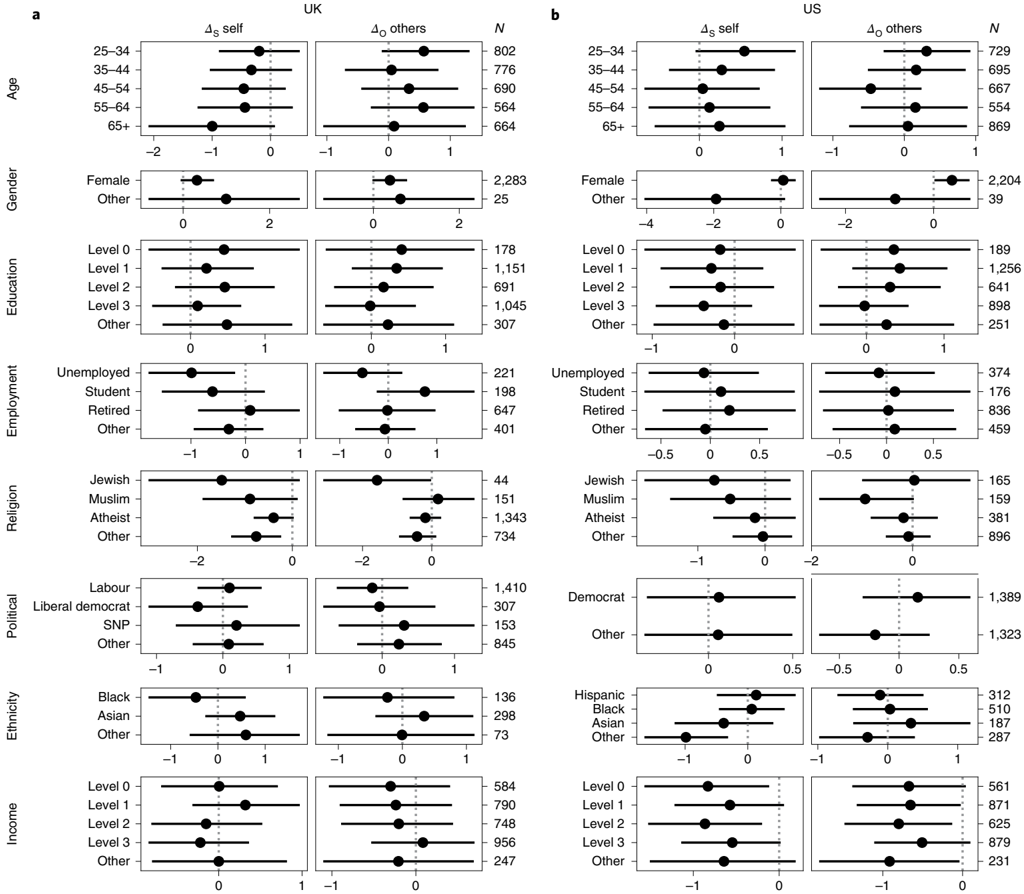
Widespread acceptance of a vaccine for severe acute respiratory syndrome coronavirus 2 (SARS-CoV-2) will be the next major step in fighting the coronavirus disease 2019 (COVID-19) pandemic, but achieving high uptake will be a challenge and may be impeded by online misinformation. To inform successful vaccination campaigns, we conducted a randomized controlled trial in the UK and the USA to quantify how exposure to online misinformation around COVID-19 vaccines affects intent to vaccinate to protect oneself or others. Here we show that in both countries-as of September 2020-fewer people would 'definitely' take a vaccine than is likely required for herd immunity, and that, relative to factual information, recent misinformation induced a decline in intent of 6.2 percentage points (95th percentile interval 3.9 to 8.5) in the UK and 6.4 percentage points (95th percentile interval 4.0 to 8.8) in the USA among those who stated that they would definitely accept a vaccine. We also find that some sociodemographic groups are differentially impacted by exposure to misinformation. Finally, we show that scientific-sounding misinformation is more strongly associated with declines in vaccination intent.
Overview
CoChat Summary
## TL;DR
In a randomized controlled survey experiment of 8,001 adults in the UK and USA, exposure to COVID-19 vaccine misinformation reduced stated willingness to vaccinate compared with factual information. The effect was about 6 percentage points among those who initially said they would “definitely” accept a vaccine, and some sociodemographic groups were differentially affected.
## Key findings
- Before exposure, only 54.1% of respondents in the UK and 42.5% in the USA said they would “definitely” accept a COVID-19 vaccine for themselves; for protecting others, the figures were 63.7% in the UK and 53.3% in the USA.
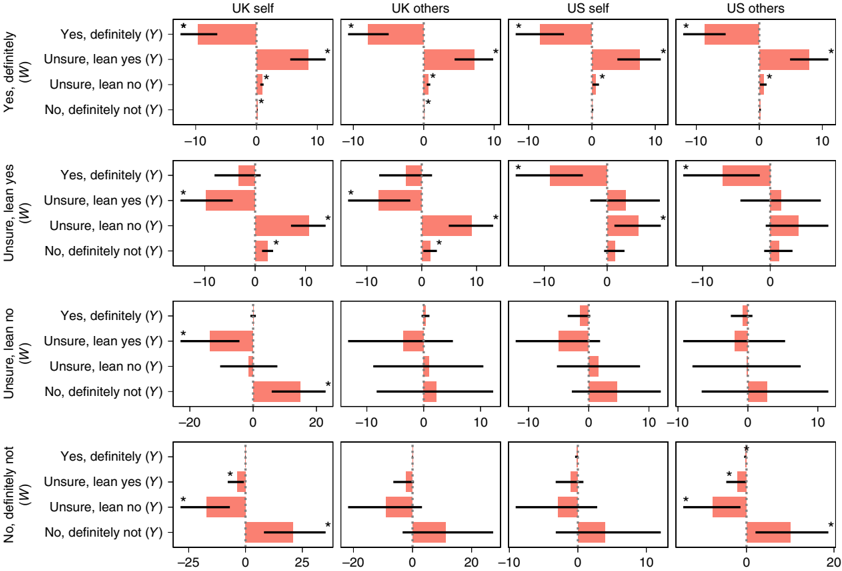
- Exposure to misinformation reduced the share answering “yes, definitely” by 6.2 percentage points in the UK (95% PI 3.9 to 8.5) and 6.4 percentage points in the USA (95% PI 4.0 to 8.8) for self-protection; for protecting others the decreases were 5.7 points in the UK (95% PI 3.5 to 7.9) and 6.5 points in the USA (95% PI 4.1 to 8.8).
- Misinformation also shifted respondents toward lower-intent categories: in the UK, for self-protection there was an increase of 2.7 points in “unsure, but leaning towards no” and 3.3 points in “no, definitely not”; in the USA, there was a 2.3-point rise in “unsure, but leaning towards no.”
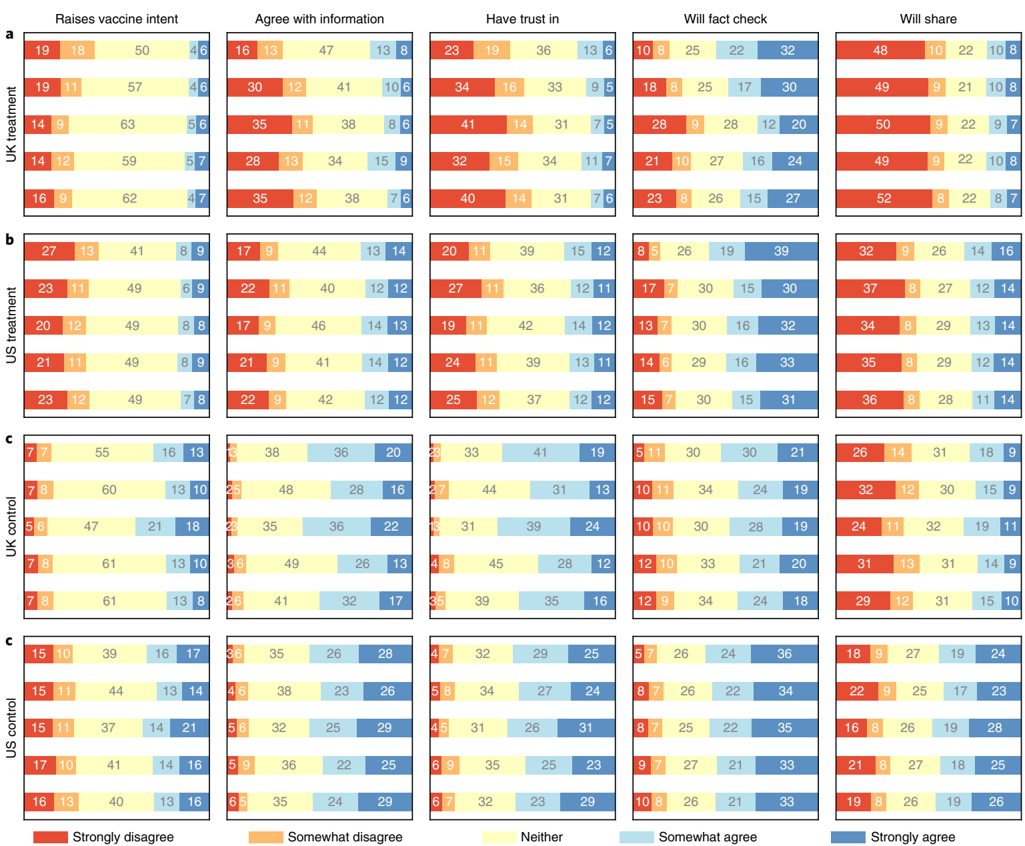
- Scientific-sounding misinformation was more damaging: the paper reports that the misinformation image with the strongest association with reduced intent had weight 0.42 in the UK (95% PI 0.28 to 0.56) and 0.41 in the USA (95% PI 0.25 to 0.58), and that around a quarter of respondents found some misinformation agreeable or trustworthy.
## Methods
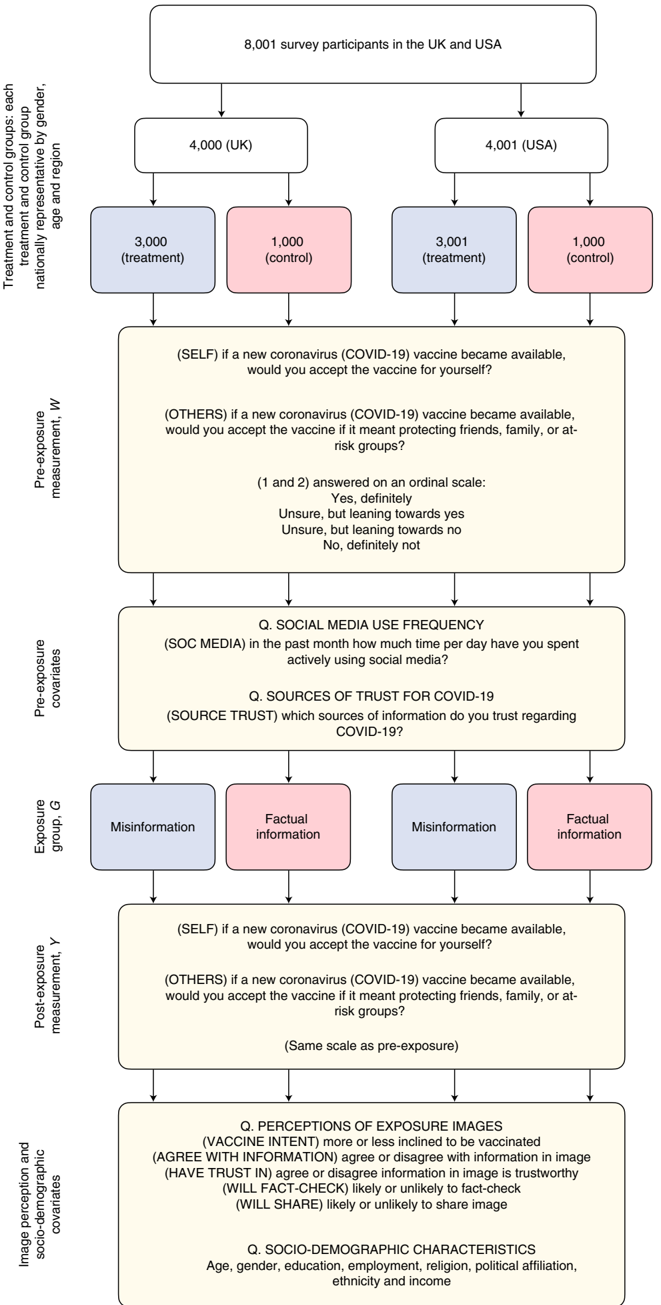
- Quantitative cross-sectional pre-post randomized controlled survey experiment in the UK and USA, fielded 7–14 September 2020.
- 8,001 respondents recruited via an online panel: 4,000 in the UK and 4,001 in the USA; within each country, 75% were assigned to misinformation and 25% to factual-information control.
- Respondents reported vaccination intent on a four-point ordered scale before and after exposure, for both self-protection and protecting others; analysis used hierarchical Bayesian ordered logistic regression with treatment effects, heterogeneous treatment effects, and image-impact models estimated via Hamiltonian Monte Carlo / NUTS in PyStan.
## Limitations
- The paper states that the design does not replicate a real-world social media platform environment, and that results are unlikely to be representative of real-world uptake rates.
- The authors state that the study does not allow causal inferences about different kinds of vaccine messaging from the post-exposure perception measures, and that they were limited in the type and volume of misinformation presented.
- Evident from the text: the sample was an online panel and respondents who did not participate simply did not complete the survey; the authors also note possible technological-literacy biases in this sampling mode.
Model-written summary. Check it against the paper before relying on it.
Integrity signals
Registry
Cites
Statistics
Figures


Verification
Claims the paper makes
14 Valid · 1 Not valid · 5 Not checked · 82 Own results and interpretations
The cited sources support only part of this claim — read each source’s verdict below.
In the paper
“Here we show that in both countries-as of September 2020-fewer people would 'definitely' take a vaccine than is likely required for herd immunity”
What the sources say
- Partly supportedcites [15] Kwok, K. O., Lai, F., Wei, W. I., Wong, S. Y. S. & Tang, J. W. T. Herd immunity—estimating the level required to halt the COVID-19 epidemics in affected countries. J. Infect. 80, e32–e33 (2020). sourceExperimental — accuracy not yet measured
The paper’s main text gives a formula for the minimum population immunity needed to halt spread, and Table 1 estimates thresholds for countries using data as of 13 March 2020. It does not report September 2020 vaccine willingness, whether people would ‘definitely’ take a vaccine, or a comparison between willingness and those thresholds in the two countries. (LLM, conf=0.88)
- Supportedcites [16] Sanche, S. et al. High contagiousness and rapid spread of severe acute respiratory syndrome coronavirus 2. Emerg. Infect. Dis. 26, 1470–1477 (2020). source
The Results section (‘Implications for Intervention Strategies’; page unavailable) estimates that more than 82% of the population would need immunity to stop transmission at R0 = 5.7. That supports the herd-immunity benchmark attributed to this source. The two-country September 2020 vaccine-willingness comparison is introduced as the citing authors’ own finding (‘Here we show’), not as a finding of this paper. (LLM, conf=0.87)
plain- Asserted: passes — The authors put it forward as true.
- Checkable: passes — It can be checked against evidence.
- Load-bearing: passes — The paper’s conclusions depend on it.
- Based: passes — The paper gives a reason why it holds.
- Partly supported
The cited sources support only part of this claim — read each source’s verdict below.
In the paper
“Under these current plausible COVID-19 vaccine acceptance rates, possible levels of existing protective immunity-though it is unclear whether post-infection immunity confers long-term immunity 29 and the rapidly evolving nature of misinformation surrounding the pandemic 23,30 , it is unclear whether vaccination will reach the levels required for herd immunity.”
What the sources say
- Supportedcites [29] Altmann, D. M., Douek, D. C. & Boyton, R. J. What policy makers need to know about COVID-19 protective immunity. Lancet 395, 1527–1529 (2020). source
The paper’s discussion of how long COVID-19 immunity might last says immunity could wane and that evidence extending only a little beyond one year offers little reassurance about longer-term protection. In the citing sentence, this source is attached to the uncertainty about long-term post-infection immunity, not to vaccine acceptance or misinformation. (LLM, conf=0.91)
- Partly supportedcites [23] Pennycook, G., McPhetres, J., Zhang, Y., Lu, J. G. & Rand, D. G. Fighting COVID-19 misinformation on social media: experimental evidence for a scalable accuracy-nudge intervention. Psychol. Sci. 31, 770–780 (2020). sourceExperimental — accuracy not yet measured
The citation is attached to the statement about pandemic misinformation, not the citing authors’ conclusion about herd immunity. The paper’s Abstract says COVID-19 misinformation has proliferated and takes many forms, but it does not establish that the misinformation is rapidly evolving. (LLM, conf=0.78)
- Supportedcites [30] Zarocostas, J. How to fight an infodemic. Lancet 395, 676 (2020). source
The citation is attached to the rapidly changing misinformation surrounding COVID-19, not to the citing authors’ conclusion about vaccination and herd immunity. In “How to fight an infodemic,” the paper describes misinformation spreading rapidly through social media and says its amplification makes timely responses a challenge. (LLM, conf=0.90)
hedged- Asserted: passes — The authors put it forward as true.
- Checkable: passes — It can be checked against evidence.
- Load-bearing: passes — The paper’s conclusions depend on it.
- Based: passes — The paper gives a reason why it holds.
- Supported
The cited sources support only part of this claim — read each source’s verdict below.
In the paper
“While large-scale vaccine rejection threatens herd immunity goals, large-scale acceptance with local vaccine rejection can also have negative consequences for community (herd) immunity, as clustering of non-vaccinators can disproportionately increase the needed percentage of vaccination coverage to achieve herd immunity in adjacent geographical regions and encourage epidemic spread 24 .”
What the sources say
- Partly supportedcites [24] Salathé, M. & Bonhoeffer, S. The effect of opinion clustering on disease outbreaks. J. R. Soc. Interface 5, 1505–1508 (2008). sourceExperimental — accuracy not yet measured
The Results and Discussion (pp. not specified) report that clusters of unvaccinated people can undermine herd immunity, increase outbreak probability, and mean that vaccination-coverage estimates needed to avoid outbreaks are too low. The Discussion also says infection can spread from one susceptible cluster to another. The paper does not specifically find that clustering raises the coverage percentage needed in adjacent geographical regions. (LLM, conf=0.86)
plainstates a cause- Asserted: passes — The authors put it forward as true.
- Checkable: passes — It can be checked against evidence.
- Load-bearing: unclear — It is unclear whether the paper’s conclusions depend on it.
- Based: passes — The paper gives a reason why it holds.
- Partly supported
The cited sources that could be checked couldn’t confirm or dispute this claim.
In the paper
“In the UK, this contrasted with more memetic imaging (for example, 'striking images with text superimposed on top' 42 ) which showed far weaker associations (images 3 and 4 in Supplementary Table 1).”
What the sources say
- Could not verifycites [42] Lazer, D. M. J. et al. The science of fake news. Science 359, 1094–1096 (2018). sourceExperimental — accuracy not yet measured
Citation 42 is attached to the description of memetic images, not to the UK association results, which the citing sentence attributes to its own Supplementary Table 1. Our copy discusses fake-news exposure and impact (Prevalence and Impact, p. 3), but searches for the quoted phrase and for memetic images or text-overlaid images found no passage defining them that way. (LLM, conf=0.77)
plainstates an association- Asserted: passes — The authors put it forward as true.
- Checkable: passes — It can be checked against evidence.
- Load-bearing: unclear — It is unclear whether the paper’s conclusions depend on it.
- Based: passes — The paper gives a reason why it holds.
- Could not verify
A result the paper reports from its own data — it cites no other source for it, so there is none to check. The quote shows it is in the paper.
In the paper
“while in the USA it was image 1 (Supplementary Table 1), with weight 0.41 (95% PI 0.25 to 0.58).”
plainstates an association- Asserted: passes — The authors put it forward as true.
- Checkable: passes — It can be checked against evidence.
- Load-bearing: passes — The paper’s conclusions depend on it.
- Based: passes — The paper gives a reason why it holds.
- Rests on an assumption not shown here.
52 more claims
Create a free account to see all 102 claims and to verify the 3 references still open.
- It may state two separate claims as one. 23
- Probably not a substantial claim. 32
- The quote only partly states this claim. 1
Claims other papers make about this one
Each is checked against this paper’s own text: does it say what the citing paper says it does?
The cited source says what the claim attributes to it.
In the citing paper
“Other research has found a causal link between exposure to vaccine misinformation and reduced intentions to get vaccinated (Loomba et al. 2021).”
From Social Media and Morality. (2024) · cites this paper as Loomba et al. 2021
In the citing paper
“belief in misinformation about coronavirus disease 2019 (COVID-19) has been linked to reduced willingness to get vaccinated against the disease and lower intentions to comply with public health measures (2, 3).”
From Psychological inoculation improves resilience against misinformation on social media (2022) · cites this paper as [3]
In the citing paper
“At the same time, misinformation about both technologies is already circulating among the public that can and should be targeted in a debunking intervention (e.g., Loomba et al., 2021;Wang & Song, 2020).”
From How to debunk misinformation? An experimental online study investigating text structures and headline formats (2023) · cites this paper as Loomba et al., 2021
Self-check
Percentages, sums and reported differences re-computed from the paper’s own numbers.
Each contradiction between two passages listed here was confirmed by an independent check.
Rated minor: it would not touch a result — a value no result rests on, a p-value that stays on the same side of the significance level, or a conflict that is clerical, resolved elsewhere in the paper, or outside its own findings.
In the paper
§ Methods
“Ethical approval for this study was obtained by the London School of Hygiene and Tropical Medicine ethics committee on 15 June 2020 with reference 22647.”
§ Human research participants
“Approval for this study was obtained by the LSHTM ethics committee on 15 June 2020 with reference 22130.”
Citations
Cites
A pneumonia outbreak associated with a new coronavirus of probable bat origin
Zhou, P., Yang, X.-L., Wang, X.-G., Hu, B., Zhang, L., Zhang, W., Si, H.-R., Zhu, Y., Li, B., Huang, C.-L., et al. (2020) · Nature · doi:10.1038/s41586-020-2012-7 · Cited by 21,969
Inference from iterative simulation using multiple sequences
Gelman, A., & Rubin, D. B. (1992) · Statistical Science · doi:10.1214/ss/1177011136 · Cited by 16,627
Estimating causal effects of treatments in randomized and nonrandomized studies
Rubin, D. B. (1974) · Journal of Educational Psychology · doi:10.1037/h0037350 · Cited by 9,436
The spread of true and false news online
Vosoughi, S., Roy, D., & Aral, S. (2018) · Science · doi:10.1126/science.aap9559 · Cited by 8,847
Statistics and Causal Inference
Holland, P. W. (1986) · Journal of the American Statistical Association · doi:10.1080/01621459.1986.10478354 · Cited by 5,293
The proximal origin of SARS-CoV-2
Andersen, K. G., Rambaut, A., Lipkin, W. I., Holmes, E. C., & Garry, R. F. (2020) · Nature Medicine · doi:10.1038/s41591-020-0820-9 · Cited by 5,081
Voysey, M., Clemens, S. A. C., Madhi, S. A., Weckx, L. Y., Folegatti, P. M., Aley, P. K., Angus, B., Baillie, V. L., Barnabas, S. L., Bhorat, Q. E., et al. (2021) · The Lancet · doi:10.1016/s0140-6736(20)32661-1 · Cited by 4,616
Regression Models for Ordinal Data
McCullagh, P. (1980) · Journal of the Royal Statistical Society Series B: Statistical Methodology · doi:10.1111/j.2517-6161.1980.tb01109.x · Cited by 4,453
Lazer, D. M. J., Baum, M. A., Benkler, Y., Berinsky, A. J., Greenhill, K. M., Menczer, F., Metzger, M. J., Nyhan, B., Pennycook, G., Rothschild, D., et al. (2018) · Science · doi:10.1126/science.aao2998 · Cited by 4,160
An mRNA Vaccine against SARS-CoV-2 — Preliminary Report
Jackson, L. A., Anderson, E. J., Rouphael, N. G., Roberts, P. C., Makhene, M., Coler, R. N., McCullough, M. P., Chappell, J. D., Denison, M. R., Stevens, L. J., et al. (2020) · New England Journal of Medicine · doi:10.1056/nejmoa2022483 · Cited by 3,406
Research works printed but not linked: 2
- Pfizer. Pfizer and BioNTech conclude phase 3 study of COVID-19 vaccine candidate, meeting all primary efficacy endpoints https://www.pfizer.com/news/press-release/press-release-detail/pfizer-and-biontech-conclude-phase-3-study-covid-19-vaccine (2020).
- Graham, M. & Coppock, A. Asking about attitude change. Public Opinion Quarterly (in the press).
Cited by
Items 1,001–1,100 of 1,802
Santana-Armas, M., Vázquez-Cancela, O., Ferreiro-Cadahia, I., Peiteado-Romay, C., Lorenzo-Fuente, D., Fernández-Pérez, C., & Vázquez-Lago, J. M. (2025) · Vaccines · doi:10.3390/vaccines14010009 · Cited by 5
Inoculation Strategies for Misinformation Resistance: A Multidimensional Intervention Approach
Yang, Y., Hu, W., Zhou, J., & Xiang, H. (2025) · International Journal of Human-Computer Interaction · doi:10.1080/10447318.2025.2607550 · Cited by 4
Wang, C. H., Jones, J., Hilliard, M. E., Tully, C., Monaghan, M. C., Marks, B. E., Hildebrandt, T., & Streisand, R. M. (2022) · Journal of Pediatric Psychology · doi:10.1093/jpepsy/jsac048 · Cited by 4
Cybulski, M., Wojszel, Z. B., Wojszel, A., Jahel, S., Sliwinska, P., & Krajewska-Kułak, E. (2022) · Vaccines · doi:10.3390/vaccines10111918 · Cited by 3
Recognising and addressing health misinformation in nursing practice
Sharman, J. (2023) · Primary Health Care · doi:10.7748/phc.2023.e1791 · Cited by 3
Gist Knowledge and Misinformation Acceptance: An Application of Fuzzy Trace Theory
Hwang, Y., & Jeong, S. (2023) · Health Communication · doi:10.1080/10410236.2023.2197306 · Cited by 3
Willingness to COVID-19 vaccination: Empirical evidence from EU
Rahman, I. U., Austin, A., & Nelson, N. (2023) · Heliyon · doi:10.1016/j.heliyon.2023.e15776 · Cited by 4
Mbamalu, O. N., Surendran, S., Nampoothiri, V., Bonaconsa, C., Edathadathil, F., Zhu, N., Carter, V., Lambert, H., Tarrant, C., Ahmad, R., et al. (2023) · PLOS Global Public Health · doi:10.1371/journal.pgph.0001078 · Cited by 3
Societal Implications of Recommendation Systems: A Technical Perspective
Gonçalves-Sá, J., & Pinheiro, F. L. (2023) · Law, governance and technology series · doi:10.1007/978-3-031-41264-6_3 · Cited by 8
Makwana, M. N., Shekhda, H. J., & Rupani, M. P. (2024) · BMC Health Services Research · doi:10.1186/s12913-024-10885-5 · Cited by 4
Distrust and COVID-19 vaccine hesitancy in Sweden
Rönnerstrand, B. (2024) · Routledge eBooks · doi:10.4324/9781003305859-5 · Cited by 3
Misinformation Resilient Search Rankings with Webgraph-Based Interventions
Carragher, P., Williams, E., & Carley, K. M. (2024) · ACM Transactions on Intelligent Systems and Technology · doi:10.1145/3670410 · Cited by 6
Vaccine-related misinformation and attitude toward COVID-19 vaccination in Japan
Furuse, Y., & Tabuchi, T. (2026) · Frontiers in Public Health · doi:10.3389/fpubh.2026.1805589 · Cited by 5
A COVID-19 Paradox of Communication, Ignorance, and Vaccination Intention
Kim, N., & Kim, J.-N. (2024) · SAGE Open · doi:10.1177/21582440241275654 · Cited by 3
Patrick-Smith, M., Emary, K. R. W., Hodgson, S. H. C., Thomas, T. M., Naudé, R. T. W., Stuart, A. S. V., Henry, J. A., English, M. R., Moore, M., Douglas, N., et al. (2024) · Vaccine · doi:10.1016/j.vaccine.2024.126391 · Cited by 3
Lofaro, R. J., Entress, R. M., & Liu, G. (2024) · Public Administration · doi:10.1111/padm.13040 · Cited by 3
A review of SARS-CoV-2 virology, vaccines, variants and their impact on the COVID-19 pandemic
Hirahata, T., Quraish, R. U., Quraish, A. U., & Quraish, S. U. (2024) · Reviews in Medical Microbiology · doi:10.1097/mrm.0000000000000393 · Cited by 5
Delusion-proneness predicts COVID-19 vaccination behavior
Acar, K., Karagiannidou, A., Olsson, A., van Prooijen, J., Balter, L. J. T., Axelsson, J., Ingvar, M., Lebedev, A. V., & Petrović, P. (2024) · Frontiers in Psychiatry · doi:10.3389/fpsyt.2024.1450429 · Cited by 3
Grygarová, D., Havlík, M., Adámek, P., Horáček, J., Juríčková, V., Hlinka, J., & Kesner, L. (2025) · JMIR Infodemiology · doi:10.2196/62913 · Cited by 6
Sharevski, F., Loop, J. V., Jachim, P., Devine, A., & Pieroni, E. (2025) · CHI Conference on Human Factors in Computing Systems · doi:10.1145/3706598.3713516 · Cited by 4
Yu, N., Li, J., Wang, W., & Miller, A. N. (2025) · Journal of Public Health · doi:10.1093/pubmed/fdaf069 · Cited by 6
Barri, S., Al-Dahir, S., Heyer, K., Taylor, A., Khalil, A., Belkhouche, M., Bonvillain, B.-A., Caldwell, K., Surcouf, H., Hamed, I., et al. (2025) · Frontiers in Public Health · doi:10.3389/fpubh.2025.1593861 · Cited by 5
Sentinel node approach to monitoring online COVID-19 misinformation
Osborne, M., Malloy, S. S., Nisbet, E. C., Bond, R. M., & Tien, J. H. (2022) · Scientific Reports · doi:10.1038/s41598-022-12450-8 · Cited by 8
Direct‐to‐consumer advertising and the advancement of the quadruple aim: A narrative review
Khokhar, B., Weathers, S., & Mattingly, T. J. (2022) · JACCP JOURNAL OF THE AMERICAN COLLEGE OF CLINICAL PHARMACY · doi:10.1002/jac5.1599 · Cited by 3
Buturoiu, R., Udrea, G., Dumitrache, A. C., & Corbu, N. (2021) · Central European Journal of Communication · doi:10.51480/1899-5101.14.2(29).3 · Cited by 5
Houlden, S., Veletsianos, G., Hodson, J., Reid, D., & Thompson, C. P. (2022) · Health Education · doi:10.1108/he-05-2021-0073 · Cited by 4
A values-driven approach to vaccine hesitancy conversations
North, Z., Smit, A. T., & Jenkins, L. S. (2022) · South African Family Practice · doi:10.4102/safp.v64i1.5419 · Cited by 5
Attitudes Towards Science During the Covid-19 Pandemic: A Psychological Network Approach
Wingen, T., Lecuona, O. Z., & Dohle, S. (2022) · European Journal of Health Communication · doi:10.47368/ejhc.2022.105 · Cited by 4
Twitter Sentiment Analysis towards COVID-19 Vaccines: A Case Study in New York City
Kitchat, K., Limjumroonrat, K., & Surasak, T. (2021) · IEEE International Conference on Technology, Engineering, Management for Societal Impact using Marketing, Entrepreneurship and Talent (TEMSMET) · doi:10.1109/temsmet53515.2021.9768700 · Cited by 3
Reagu, S. M., Mohan, S., Awwad, J. T., & Alabdulla, M. (2022) · Epidemiology and Health · doi:10.4178/epih.e2022056 · Cited by 3
How to overcome hesitancy for COVID-19 and other vaccines
Mayo (2022) · The Journal of Family Practice · doi:10.12788/jfp.0443 · Cited by 5
Desinformación y vacunas en redes: Comportamiento de los bulos en Twitter
Vivó, J. M. N., Grandío-Pérez, M. D. M., Villar-Rodríguez, G., Martín, A. G., & Camacho, D. (2022) · Revista Latina de Comunicación Social · doi:10.4185/rlcs-2022-1820 · Cited by 18
Health Security, Vaccine Hesitancy and Post-Truth: A Case of COVID-19 in Pakistan
Arif, H., & Bakare, N. A. (2022) · Journal of Asian and African Studies · doi:10.1177/00219096221130344 · Cited by 6
Motivating factors for tourists to adopt and recommend vaccine tourism
Ractham, P., Land, J. K., Chen, C., & Kaewkitipong, L. (2022) · Cogent Social Sciences · doi:10.1080/23311886.2022.2154034 · Cited by 3
Yamaguchi, S., & Tanihara, T. (2023) · Global Knowledge, Memory and Communication · doi:10.1108/gkmc-12-2022-0287 · Cited by 8
Goodenough, A. E., MacTavish, L. M., MacTavish, D., & Hart, A. G. (2023) · World · doi:10.3390/world4020015 · Cited by 3
Hashim, A., & Taha, Y. (2023) · Global Health Science and Practice · doi:10.9745/ghsp-d-22-00447 · Cited by 3
Chew, H. E., & Chong, Y. K. (2023) · Mobile communication in Asia · doi:10.1007/978-94-024-2225-2_9 · Cited by 5
Hernández‐Vásquez, A., Vargas‐Fernández, R., & Rojas‐Roque, C. (2023) · Vaccines · doi:10.3390/vaccines11071195 · Cited by 3
Goto, R., Kawachi, I. I., Kondo, N., & Inoue, K. (2023) · Annals of Epidemiology · doi:10.1016/j.annepidem.2023.07.003 · Cited by 3
IRMA: the 335-million-word Italian coRpus for studying MisinformAtion
Carrella, F., Miani, A., & Lewandowsky, S. (2023) · Conference of the European Chapter of the Association for Computational Linguistics · doi:10.18653/v1/2023.eacl-main.171 · Cited by 9
Security Aspects of Hybrid War, COVID-19 Pandemic and Cyber-Social Vulnerabilities
Briggs, C. M., Danyk, Y., & Малярчук, Т. (2021) · Connections The Quarterly Journal · doi:10.11610/connections.20.3-4.03 · Cited by 5
Hope, health and cure: the meanings of the vaccine against COVID-19
Melo, C. D. F., Ferreira, M. P. A., Costa, Í. M., Lins, S., & Eberhardt, A. C. (2023) · Psico-USF · doi:10.1590/1413-82712023280310 · Cited by 4
COVID-19 and Psychological Distress in Africa: Communitarian Perspectives
Ndasauka, Y. (2023) · Routledge eBooks · doi:10.4324/9781003425861 · Cited by 5
Vaccination policy and mortality from COVID-19 in the European Union
Agostini, E., Bloise, F., & Tancioni, M. (2024) · Econometrics Journal · doi:10.1093/ectj/utae005 · Cited by 8
Filter-based Stance Network for Rumor Verification
Li, J., Bin, Y., Ma, Y., Yang, Y., Huang, Z. H., & Chua, T. (2024) · ACM Transactions on Information Systems · doi:10.1145/3649462 · Cited by 8
A majority-based learning system for detecting misinformation
Kao, H., Tu, Y.-J., Huang, Y.-H. J., & Strader, T. J. (2024) · Behaviour and Information Technology · doi:10.1080/0144929x.2024.2326562 · Cited by 3
Transferring Structure Knowledge: A New Task to Fake News Detection towards Cold-Start Propagation
Wei, L., Hu, D., Zhou, W. J., & Hu, S. (2024) · IEEE International Conference on Acoustics Speech and Signal Processing · doi:10.1109/icassp48485.2024.10447588 · Cited by 7
Lu, L., Xu, J., Wei, J., & Shults, F. L. (2024) · Natural Hazards Review · doi:10.1061/nhrefo.nheng-1994 · Cited by 4
Huang, L., Hu, W., Jiang, Y., & Hong, W. (2024) · Human Vaccines & Immunotherapeutics · doi:10.1080/21645515.2024.2344290 · Cited by 5
Sallam, M., Kareem, N., & Alkurtas, M. (2024) · Preventive Medicine Reports · doi:10.1016/j.pmedr.2024.102791 · Cited by 12
Carrasco-Farré, C. (2024) · Business & Society · doi:10.1177/00076503241255343 · Cited by 7
Ahmad, A. R., & Bali, A. O. (2024) · Global Transitions · doi:10.1016/j.glt.2024.05.003 · Cited by 6
Rahman, A., Mohammadi, E., & Alhoori, H. (2024) · Natural Language Processing Journal · doi:10.1016/j.nlp.2024.100085 · Cited by 3
Béchard, B., Gramaccia, J. A., Gagnon, D., Laouan-Sidi, E. A., Dubé, È., Ouimet, M., de Hemptinne, D., & Tremblay, S. (2024) · JMIR Formative Research · doi:10.2196/52871 · Cited by 5
Weitzman, E. R., Alegria, M. M., Caplan, A. L., Dowling, D., Evans, J., Fisher, C. E., Jordan, A., Kossowsky, J., Landau, M., Larson, H. J., et al. (2024) · Vaccine · doi:10.1016/j.vaccine.2024.126324 · Cited by 6
Self-citationHoward, M. C. (2024) · British Journal of Health Psychology · doi:10.1111/bjhp.12753 · Cited by 3
Maduku, D. K. (2024) · Social Marketing Quarterly · doi:10.1177/15245004241289383 · Cited by 4
Bots against Bias: Critical Next Steps for Human–Robot Interaction*
Seaborn, K. (2024) · Cambridge University Press eBooks · doi:10.1017/9781009386708.023 · Cited by 5
Maintaining Immunizations for Vaccine-Preventable Diseases in a Changing World
Baidya, A., Willens, V., Wonodi, C. B., & Moss, W. J. (2024) · Annual Review of Public Health · doi:10.1146/annurev-publhealth-071723-111427 · Cited by 12
Vaccine Knowledge and Acceptance Among Hadzabe Hunter‐Gatherers in Tanzania
Shattuck, E. C., Forman, J., Shiju, S., Herlosky, K. N., Mabulla, I. A., & Crittenden, A. N. (2025) · American Journal of Human Biology · doi:10.1002/ajhb.70007 · Cited by 4
Biopolitics at the Nexus of Chronic and Infectious Diseases
Brantly, N. D. (2025) · Journal of Bioethical Inquiry · doi:10.1007/s11673-024-10405-4 · Cited by 6
COVID-19 vaccination intention in the Western Pacific Region – insights from Japan
Poon, P. K.-M. (2021) · The Lancet Regional Health - Western Pacific · doi:10.1016/j.lanwpc.2021.100245 · Cited by 3
Bhondve, A. S., Ingawale, S., & Rajapurkar, N. D. (2021) · The Journal of Clinical and Scientific Research · doi:10.4103/jcsr.jcsr_38_21 · Cited by 3
“When did you decide to receive the Covid-19 vaccine?” Survey in a high-volume vaccination center
Maréchal, M. L., Batel, A., Bouvier, S., Mahdhaoui, H., Margotton, M., Vittoz, J.-P., Brudieu, É., Chevallier, C., Bedouch, P., Touati, S., et al. (2021) · Human Vaccines & Immunotherapeutics · doi:10.1080/21645515.2021.2013081 · Cited by 4
Choo, E. K. (2022) · BMJ · doi:10.1136/bmj.o197 · Cited by 3
Knowledge and attitudes of pregnant women about Coronavirus vaccines in Turkiye
Odabaş, R. K., Demir, R., & TAŞPINAR, A. (2022) · Journal of Obstetrics and Gynaecology · doi:10.1080/01443615.2022.2144174 · Cited by 6
Bennett, B., Freckelton, I. R., & Wolf, G. (2023) · Oxford University Press eBooks · doi:10.1093/oso/9780192896742.003.0004 · Cited by 3
Examining the framing of ‘COVID-19 vaccines’: A corpus-based investigation of Malaysian newspapers
Malik, N. A., Shak, M. S. Y., & Hasni, N. A. (2023) · Studies in English Language and Education · doi:10.24815/siele.v10i2.25883 · Cited by 6
Daten-Fairness in einer globalisierten Welt
Engert, S., Kropf, J., Uhlmann, M., Friedewald, M., Roßnagel, A., Neuburger, R., Bieker, F., & Hornung, G. (2023) · Nomos Verlagsgesellschaft mbH & Co. KG eBooks · doi:10.5771/9783748938743 · Cited by 3
Bitzer, E., & Schaefer, C. (2023) · Springer Reference Pflege, Therapie, Gesundheit · doi:10.1007/978-3-662-62800-3_88-1 · Cited by 3
Salibi, N. J. E., Abdulrahim, S., Haddad, M. E., et al. (2024) · Vaccine · doi:10.1016/j.vaccine.2024.02.054 · Cited by 3
COVID-19 research and publishing: Advance ambitiously, but cautiously, in 2021
Independent researcher, P. O. B. 7., & da Silva, J. A. T. (2021) · Indian Journal of Science and Technology · doi:10.17485/ijst/v14i10.92 · Cited by 4
The seductive allure of technical language and its effect on covid-19 vaccine beliefs and intentions
Silas, J., Jones, A., Weiss‐Cohen, L., & Ayton, P. (2021) · Vaccine · doi:10.1016/j.vaccine.2021.11.027 · Cited by 4
Valickas, G., Švedas, G., Vanagaitė, K., & Barysė, D. (2021) · Teisė · doi:10.15388/teise.2021.121.1 · Cited by 4
COVID-19 vaccine acceptance among refugees in Bidibidi refugee settlement, Northern Uganda
Kisaakye, P., Bukuluki, P., & Matovu, J. K. B. (2022) · Journal of Global Health Reports · doi:10.29392/001c.33053 · Cited by 3
Capturing Time Dynamics From Speech Using Neural Networks for Surgical Mask Detection
Liu, S., Mallol-Ragolta, A., Yan, T., Qian, K., Parada‐Cabaleiro, E., Hu, B., & Schuller, B. W. (2022) · IEEE Journal of Biomedical and Health Informatics · doi:10.1109/jbhi.2022.3173128 · Cited by 8
COVID-19 Vaccination Strategies Considering Hesitancy Using Particle-Based Epidemic Simulation
Karabay, A., Kuzdeuov, A., & Varol, H. A. (2021) · Annual International Conference of the IEEE Engineering in Medicine and Biology Society (EMBC) · doi:10.1109/embc46164.2021.9630797 · Cited by 5
Infodemic Challenges During COVID-19 Pandemic and the Strategies to Deal with Them: A Review Article
Aslani, N., Behmanesh, A., Davoodi, F., Garavand, A., & Shams, R. (2022) · Archives of Clinical Infectious Diseases · doi:10.5812/archcid-127022 · Cited by 3
Chowdhury, K., Haque, M., Etando, A., Kumar, S., Lugova, H., Shahwan, M. J., Škrbić, R., Jairoun, A. A., & Godman, B. (2022) · Advances in Human Biology · doi:10.4103/aihb.aihb_60_22 · Cited by 3
Thanapluetiwong, S., Chansirikarnjana, S., Charernwat, P., Saranburut, K., & Ittasakul, P. (2022) · Vaccines · doi:10.3390/vaccines10101748 · Cited by 3
(2023) · Nature Human Behaviour · doi:10.1038/s41562-023-01627-4 · Cited by 3
Sánchez, E. D. L. C., Moreno‐Llamas, A., Mendiola, J., Mayor, J. G., Torres-Cantero, A. M., & Devine, E. B. (2023) · European Journal of Public Health · doi:10.1093/eurpub/ckad115 · Cited by 3
The Agenda-Setting Power of Fake News
Yeoman, F., & Morris, K. (2022) · Springer eBooks · doi:10.1007/978-3-031-11976-7_18 · Cited by 5
Cooperation and Acting for the Greater Good During the COVID-19 Pandemic
Capraro, V., Boggio, P. S., BOHM, R. M., Perc, M., & Sjåstad, H. (2023) · Oxford University Press eBooks · doi:10.1093/oso/9780197615133.003.0013 · Cited by 16
Learning in a Post-Truth WorldPreprint
Mostagir, M., & Siderius, J. (2021) · SSRN Electronic Journal · doi:10.2139/ssrn.3879174 · Cited by 3
Age as a Moderator of Health Outcomes and Trust in Physicians and the Healthcare System
Katz, E. (2021) · The Research Repository @ WVU (West Virginia University) · doi:10.33915/etd.8331 · Cited by 7
The Information Ecosystem of Online Groups with Anti- and Pro-vaccine Views on FacebookPreprint
Kim, S., & Kim, K. (2021) · arXiv (Cornell University) · doi:10.48550/arxiv.2108.06641 · Cited by 4
Misinformation and the Mindsponge mechanism of trustPreprint
Le, T.-T., Nguyen, M., & Vuong, Q. (2021) · doi:10.31219/osf.io/m9sj3 · Cited by 3
McManus, I. C., Woolf, K., Martin, C., Nellums, L. B., Guyatt, A. L., Melbourne, C., Bryant, L., Gupta, A., John, C., Tobin, M. D., et al. (2021) · medRxiv · doi:10.1101/2021.12.08.21267421 · Cited by 3
Zhang, R., Qiao, S., McKeever, B. W., Olatosi, B., & Li, X. (2022) · medRxiv · doi:10.1101/2022.03.21.22272728 · Cited by 5
Ngonghala, C. N., Taboe, H. B., & Gumel, A. B. (2022) · Research Square · doi:10.21203/rs.3.rs-1420446/v1 · Cited by 3
Predictors of COVID-19 vaccine uptake: An online longitudinal study of US Veterans and non-VeteransPreprint
Thorpe, A., Fagerlin, A., Drews, F. A., et al. (2022) · medRxiv · doi:10.1101/2022.04.19.22273818 · Cited by 3
Investigating the Impact of Anti-Vaccine News on SARS-CoV-2 Vaccine IntentionsPreprint
Bronstein, M. V., Kummerfeld, E., MacDonald, A. W., & Vinogradov, S. (2022) · SSRN Electronic Journal · doi:10.2139/ssrn.3936927 · Cited by 2
Lockyer, B., Moss, R. H., Endacott, C., et al. (2022) · medRxiv · doi:10.1101/2022.06.24.22276852 · Cited by 3
Anino, C. O., Wandera, I., Masimba, Z. O., et al. (2023) · medRxiv · doi:10.1101/2023.01.16.23284598 · Cited by 3
Can Media Literacy Interventions Improve Fake News Discernment? A Meta-AnalysisPreprint
Lu, C. F., Hu, B., Bao, M.-M., Bi, C., & Ju, X. (2023) · SSRN Electronic Journal · doi:10.2139/ssrn.4377372 · Cited by 3
Hamed, A. A. (2023) · Preprints.org · doi:10.20944/preprints202304.0350.v1 · Cited by 2
Hamed, A. A. (2023) · Preprints.org · doi:10.20944/preprints202304.0350.v2 · Cited by 3
Thinking Clearly About MisinformationPreprint
Tay, L. Q., Lewandowsky, S., Hurlstone, M. J., et al. (2023) · doi:10.31234/osf.io/ke5pg · Cited by 3
Metadata
- Authors
- Loomba, S., de Figueiredo, A., Piatek, S. J., de Graaf, K., & Larson, H. J.
- Affiliations
- Imperial College London (GB)
- London School of Hygiene & Tropical Medicine (GB)
- University of Antwerp (BE)
- Corresponding author
- Larson, Heidi J.
- Venue
- Nature Human Behaviour
- Published
- 2021-02-05
- Volume
- 5
- Issue
- 3
- Pages
- 337-348
- ISSN
- 2397-3374 (ISSN-L)
- OpenAlex
- W3128392043
- Semantic Scholar
- fad25c63595eefecba05d0b6a34163f54deb9a62
- Cited by
- 1,800
- References
- 59
- Citations by year
- 2026: 175 · 2025: 206 · 2024: 277 · 2023: 379 · 2022: 500 · 2021: 256
- FWCI
- 489.51
- Type
- journal article
- Language
- en
- Update notices
- Open access
- bronze
- doi.org
- Licence
- www.springernature.com/gp/researchers/text-and-data-mining (tdm)
- www.springernature.com/gp/researchers/text-and-data-mining (vor)
- Locations
- Nature Human Behaviour (publishedVersion)
- PubMed (publishedVersion)
- LSHTM Research Online (London School of Hygiene and Tropical Medicine) (acceptedVersion)
- RePEc: Research Papers in Economics (submittedVersion)
- Topics
- Social Sciences › Sociology and Political Science › Misinformation and Its Impacts
- Social Sciences › Health › Vaccine Coverage and Hesitancy
- Social Sciences › Communication › Communication and COVID-19 Impact
- Keywords
- COVID-19 vaccines, vaccine misinformation, vaccination intention, vaccine hesitancy, online misinformation, herd immunity, sociodemographic differences, vaccine acceptance
- MeSH terms
- COVID-19, SARS-CoV-2, COVID-19 Vaccines, Adolescent, Adult, Aged, Communication, Female, United Kingdom, Humans, Health Knowledge, Attitudes, Practice, Male, Middle Aged, United States, Health Behavior, Internet, Immunity, Herd, Intention, Young Adult
About these checks
Registry, retraction, Cites and statistics results are computed, not judged, with one exception: a printed reference that no index lists is read once by a model before it counts as a citation error. Claims are extracted by a model and kept only when their quote appears verbatim in the text; each cited source is then checked, with a model’s help, for whether it says what the claim relies on. Those verdicts can be wrong — read the claim’s quote and the cited source before relying on one.
The claim verdicts this report counts are experimental: their accuracy is not yet measured.
A language model drew the claims from the paper on 2026-10-10, under version 3 of the claim definition (model deepseek-v4.1-flash, prompt extract-v3).
A second model labelled each claim on 2026-10-10 (model jev-1.13-20260917, definition revision gold-guideline-v0.2).
Cited sources are checked with a language model’s help (gpt-6-sol).
Statistics and arithmetic are recomputed, not judged.
Confidence bands are shown only for fields calibrated on our annotated test set. None is calibrated yet, so no band is shown.
What counts as a claim ›How we measure confidence ›How we check this ›
Are you an author, or do you see a problem with this page? Request a review
Data sources
Bibliographic data: Semantic Scholar, OpenAlex, Crossref.
Contains information from the Semantic Scholar Academic Graph Datasets, made available under the ODC Attribution License (ODC-BY 1.0).
Semantic Scholar’s data is described in: Kinney, R., et al. (2023). The Semantic Scholar Open Data Platform. arXiv:2301.10140.
