

Measuring the impact of COVID-19 vaccine misinformation on vaccination intent in the UK and USA
Open accessPublished version of a preprint
The DOI matches its Crossref record; 56 of the 59 references it cites were found in a registry or an index; 25 of the 36 sources its claims cite were checked for support.
Abstract
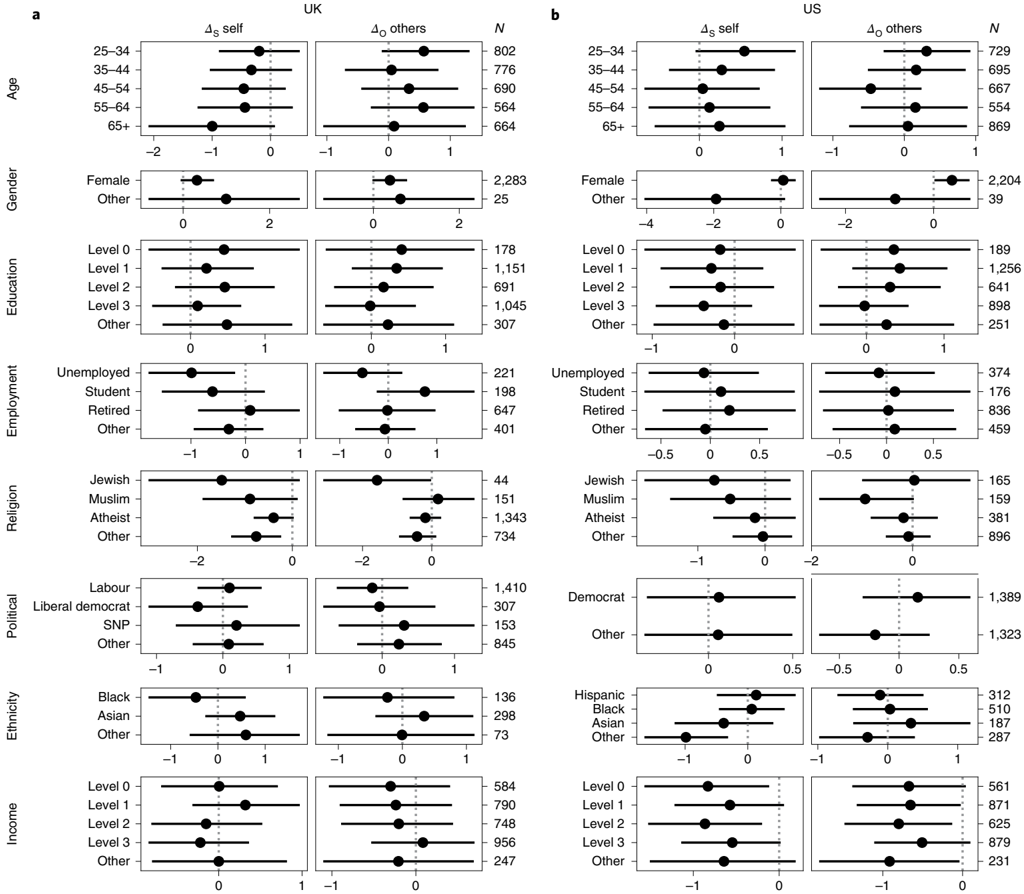
Widespread acceptance of a vaccine for severe acute respiratory syndrome coronavirus 2 (SARS-CoV-2) will be the next major step in fighting the coronavirus disease 2019 (COVID-19) pandemic, but achieving high uptake will be a challenge and may be impeded by online misinformation. To inform successful vaccination campaigns, we conducted a randomized controlled trial in the UK and the USA to quantify how exposure to online misinformation around COVID-19 vaccines affects intent to vaccinate to protect oneself or others. Here we show that in both countries-as of September 2020-fewer people would 'definitely' take a vaccine than is likely required for herd immunity, and that, relative to factual information, recent misinformation induced a decline in intent of 6.2 percentage points (95th percentile interval 3.9 to 8.5) in the UK and 6.4 percentage points (95th percentile interval 4.0 to 8.8) in the USA among those who stated that they would definitely accept a vaccine. We also find that some sociodemographic groups are differentially impacted by exposure to misinformation. Finally, we show that scientific-sounding misinformation is more strongly associated with declines in vaccination intent.
Overview
CoChat Summary
## TL;DR
In a randomized controlled survey experiment of 8,001 adults in the UK and USA, exposure to COVID-19 vaccine misinformation reduced stated willingness to vaccinate compared with factual information. The effect was about 6 percentage points among those who initially said they would “definitely” accept a vaccine, and some sociodemographic groups were differentially affected.
## Key findings
- Before exposure, only 54.1% of respondents in the UK and 42.5% in the USA said they would “definitely” accept a COVID-19 vaccine for themselves; for protecting others, the figures were 63.7% in the UK and 53.3% in the USA.
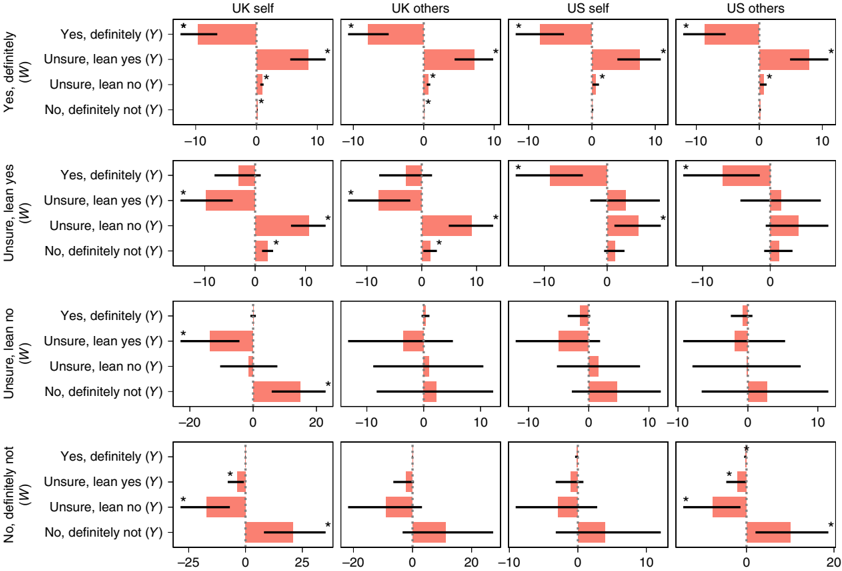
- Exposure to misinformation reduced the share answering “yes, definitely” by 6.2 percentage points in the UK (95% PI 3.9 to 8.5) and 6.4 percentage points in the USA (95% PI 4.0 to 8.8) for self-protection; for protecting others the decreases were 5.7 points in the UK (95% PI 3.5 to 7.9) and 6.5 points in the USA (95% PI 4.1 to 8.8).
- Misinformation also shifted respondents toward lower-intent categories: in the UK, for self-protection there was an increase of 2.7 points in “unsure, but leaning towards no” and 3.3 points in “no, definitely not”; in the USA, there was a 2.3-point rise in “unsure, but leaning towards no.”
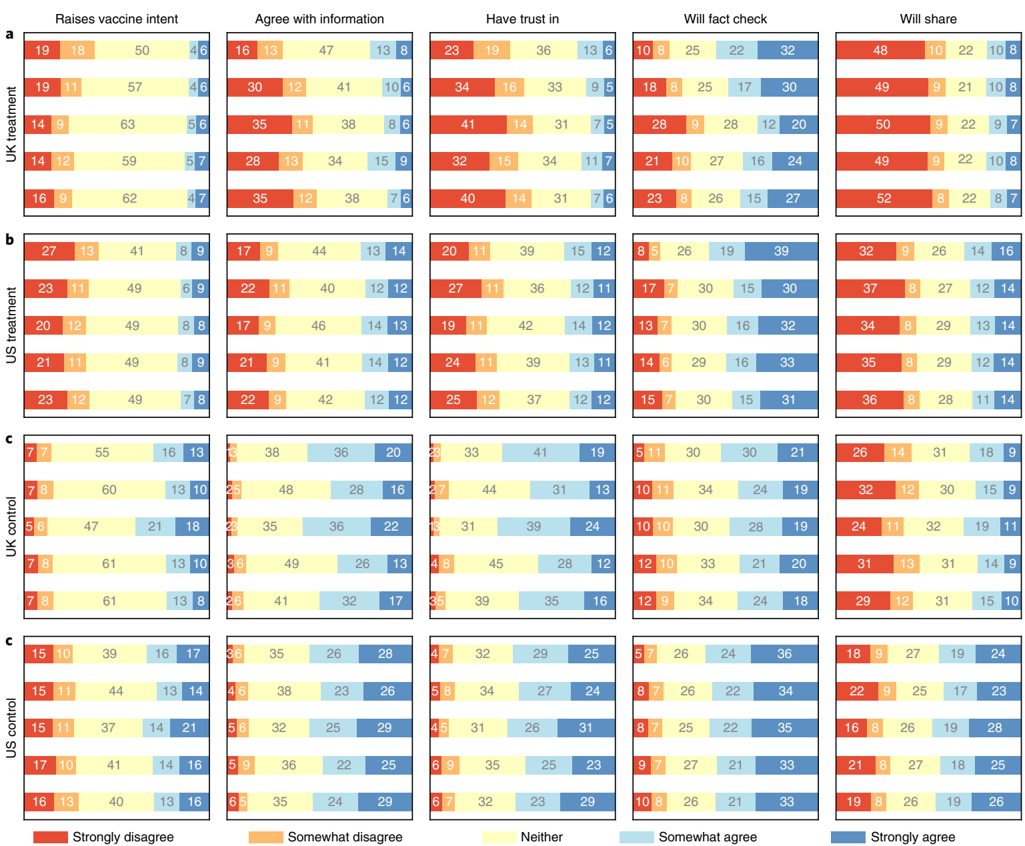
- Scientific-sounding misinformation was more damaging: the paper reports that the misinformation image with the strongest association with reduced intent had weight 0.42 in the UK (95% PI 0.28 to 0.56) and 0.41 in the USA (95% PI 0.25 to 0.58), and that around a quarter of respondents found some misinformation agreeable or trustworthy.
## Methods
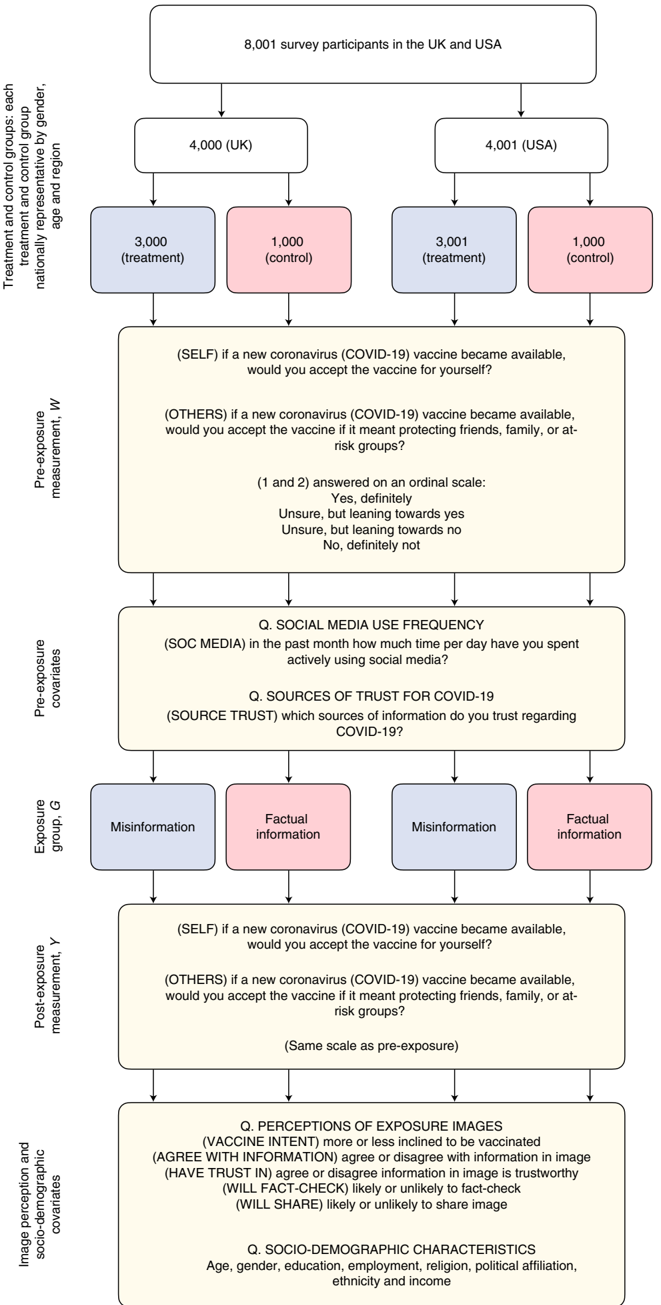
- Quantitative cross-sectional pre-post randomized controlled survey experiment in the UK and USA, fielded 7–14 September 2020.
- 8,001 respondents recruited via an online panel: 4,000 in the UK and 4,001 in the USA; within each country, 75% were assigned to misinformation and 25% to factual-information control.
- Respondents reported vaccination intent on a four-point ordered scale before and after exposure, for both self-protection and protecting others; analysis used hierarchical Bayesian ordered logistic regression with treatment effects, heterogeneous treatment effects, and image-impact models estimated via Hamiltonian Monte Carlo / NUTS in PyStan.
## Limitations
- The paper states that the design does not replicate a real-world social media platform environment, and that results are unlikely to be representative of real-world uptake rates.
- The authors state that the study does not allow causal inferences about different kinds of vaccine messaging from the post-exposure perception measures, and that they were limited in the type and volume of misinformation presented.
- Evident from the text: the sample was an online panel and respondents who did not participate simply did not complete the survey; the authors also note possible technological-literacy biases in this sampling mode.
Model-written summary. Check it against the paper before relying on it.
Integrity signals
Registry
Cites
Statistics
Figures


Verification
Claims the paper makes
14 Valid · 1 Not valid · 5 Not checked · 82 Own results and interpretations
The cited sources support only part of this claim — read each source’s verdict below.
In the paper
“Here we show that in both countries-as of September 2020-fewer people would 'definitely' take a vaccine than is likely required for herd immunity”
What the sources say
- Partly supportedcites [15] Kwok, K. O., Lai, F., Wei, W. I., Wong, S. Y. S. & Tang, J. W. T. Herd immunity—estimating the level required to halt the COVID-19 epidemics in affected countries. J. Infect. 80, e32–e33 (2020). sourceExperimental — accuracy not yet measured
The paper’s main text gives a formula for the minimum population immunity needed to halt spread, and Table 1 estimates thresholds for countries using data as of 13 March 2020. It does not report September 2020 vaccine willingness, whether people would ‘definitely’ take a vaccine, or a comparison between willingness and those thresholds in the two countries. (LLM, conf=0.88)
- Supportedcites [16] Sanche, S. et al. High contagiousness and rapid spread of severe acute respiratory syndrome coronavirus 2. Emerg. Infect. Dis. 26, 1470–1477 (2020). source
The Results section (‘Implications for Intervention Strategies’; page unavailable) estimates that more than 82% of the population would need immunity to stop transmission at R0 = 5.7. That supports the herd-immunity benchmark attributed to this source. The two-country September 2020 vaccine-willingness comparison is introduced as the citing authors’ own finding (‘Here we show’), not as a finding of this paper. (LLM, conf=0.87)
plain- Asserted: passes — The authors put it forward as true.
- Checkable: passes — It can be checked against evidence.
- Load-bearing: passes — The paper’s conclusions depend on it.
- Based: passes — The paper gives a reason why it holds.
- Partly supported
The cited sources support only part of this claim — read each source’s verdict below.
In the paper
“Under these current plausible COVID-19 vaccine acceptance rates, possible levels of existing protective immunity-though it is unclear whether post-infection immunity confers long-term immunity 29 and the rapidly evolving nature of misinformation surrounding the pandemic 23,30 , it is unclear whether vaccination will reach the levels required for herd immunity.”
What the sources say
- Supportedcites [29] Altmann, D. M., Douek, D. C. & Boyton, R. J. What policy makers need to know about COVID-19 protective immunity. Lancet 395, 1527–1529 (2020). source
The paper’s discussion of how long COVID-19 immunity might last says immunity could wane and that evidence extending only a little beyond one year offers little reassurance about longer-term protection. In the citing sentence, this source is attached to the uncertainty about long-term post-infection immunity, not to vaccine acceptance or misinformation. (LLM, conf=0.91)
- Partly supportedcites [23] Pennycook, G., McPhetres, J., Zhang, Y., Lu, J. G. & Rand, D. G. Fighting COVID-19 misinformation on social media: experimental evidence for a scalable accuracy-nudge intervention. Psychol. Sci. 31, 770–780 (2020). sourceExperimental — accuracy not yet measured
The citation is attached to the statement about pandemic misinformation, not the citing authors’ conclusion about herd immunity. The paper’s Abstract says COVID-19 misinformation has proliferated and takes many forms, but it does not establish that the misinformation is rapidly evolving. (LLM, conf=0.78)
- Supportedcites [30] Zarocostas, J. How to fight an infodemic. Lancet 395, 676 (2020). source
The citation is attached to the rapidly changing misinformation surrounding COVID-19, not to the citing authors’ conclusion about vaccination and herd immunity. In “How to fight an infodemic,” the paper describes misinformation spreading rapidly through social media and says its amplification makes timely responses a challenge. (LLM, conf=0.90)
hedged- Asserted: passes — The authors put it forward as true.
- Checkable: passes — It can be checked against evidence.
- Load-bearing: passes — The paper’s conclusions depend on it.
- Based: passes — The paper gives a reason why it holds.
- Supported
The cited sources support only part of this claim — read each source’s verdict below.
In the paper
“While large-scale vaccine rejection threatens herd immunity goals, large-scale acceptance with local vaccine rejection can also have negative consequences for community (herd) immunity, as clustering of non-vaccinators can disproportionately increase the needed percentage of vaccination coverage to achieve herd immunity in adjacent geographical regions and encourage epidemic spread 24 .”
What the sources say
- Partly supportedcites [24] Salathé, M. & Bonhoeffer, S. The effect of opinion clustering on disease outbreaks. J. R. Soc. Interface 5, 1505–1508 (2008). sourceExperimental — accuracy not yet measured
The Results and Discussion (pp. not specified) report that clusters of unvaccinated people can undermine herd immunity, increase outbreak probability, and mean that vaccination-coverage estimates needed to avoid outbreaks are too low. The Discussion also says infection can spread from one susceptible cluster to another. The paper does not specifically find that clustering raises the coverage percentage needed in adjacent geographical regions. (LLM, conf=0.86)
plainstates a cause- Asserted: passes — The authors put it forward as true.
- Checkable: passes — It can be checked against evidence.
- Load-bearing: unclear — It is unclear whether the paper’s conclusions depend on it.
- Based: passes — The paper gives a reason why it holds.
- Partly supported
The cited sources that could be checked couldn’t confirm or dispute this claim.
In the paper
“In the UK, this contrasted with more memetic imaging (for example, 'striking images with text superimposed on top' 42 ) which showed far weaker associations (images 3 and 4 in Supplementary Table 1).”
What the sources say
- Could not verifycites [42] Lazer, D. M. J. et al. The science of fake news. Science 359, 1094–1096 (2018). sourceExperimental — accuracy not yet measured
Citation 42 is attached to the description of memetic images, not to the UK association results, which the citing sentence attributes to its own Supplementary Table 1. Our copy discusses fake-news exposure and impact (Prevalence and Impact, p. 3), but searches for the quoted phrase and for memetic images or text-overlaid images found no passage defining them that way. (LLM, conf=0.77)
plainstates an association- Asserted: passes — The authors put it forward as true.
- Checkable: passes — It can be checked against evidence.
- Load-bearing: unclear — It is unclear whether the paper’s conclusions depend on it.
- Based: passes — The paper gives a reason why it holds.
- Could not verify
A result the paper reports from its own data — it cites no other source for it, so there is none to check. The quote shows it is in the paper.
In the paper
“while in the USA it was image 1 (Supplementary Table 1), with weight 0.41 (95% PI 0.25 to 0.58).”
plainstates an association- Asserted: passes — The authors put it forward as true.
- Checkable: passes — It can be checked against evidence.
- Load-bearing: passes — The paper’s conclusions depend on it.
- Based: passes — The paper gives a reason why it holds.
- Rests on an assumption not shown here.
52 more claims
Create a free account to see all 102 claims and to verify the 3 references still open.
- It may state two separate claims as one. 23
- Probably not a substantial claim. 32
- The quote only partly states this claim. 1
Claims other papers make about this one
Each is checked against this paper’s own text: does it say what the citing paper says it does?
The cited source says what the claim attributes to it.
In the citing paper
“Other research has found a causal link between exposure to vaccine misinformation and reduced intentions to get vaccinated (Loomba et al. 2021).”
From Social Media and Morality. (2024) · cites this paper as Loomba et al. 2021
In the citing paper
“belief in misinformation about coronavirus disease 2019 (COVID-19) has been linked to reduced willingness to get vaccinated against the disease and lower intentions to comply with public health measures (2, 3).”
From Psychological inoculation improves resilience against misinformation on social media (2022) · cites this paper as [3]
In the citing paper
“At the same time, misinformation about both technologies is already circulating among the public that can and should be targeted in a debunking intervention (e.g., Loomba et al., 2021;Wang & Song, 2020).”
From How to debunk misinformation? An experimental online study investigating text structures and headline formats (2023) · cites this paper as Loomba et al., 2021
Self-check
Percentages, sums and reported differences re-computed from the paper’s own numbers.
Each contradiction between two passages listed here was confirmed by an independent check.
Rated minor: it would not touch a result — a value no result rests on, a p-value that stays on the same side of the significance level, or a conflict that is clerical, resolved elsewhere in the paper, or outside its own findings.
In the paper
§ Methods
“Ethical approval for this study was obtained by the London School of Hygiene and Tropical Medicine ethics committee on 15 June 2020 with reference 22647.”
§ Human research participants
“Approval for this study was obtained by the LSHTM ethics committee on 15 June 2020 with reference 22130.”
Citations
Cites
A pneumonia outbreak associated with a new coronavirus of probable bat origin
Zhou, P., Yang, X.-L., Wang, X.-G., Hu, B., Zhang, L., Zhang, W., Si, H.-R., Zhu, Y., Li, B., Huang, C.-L., et al. (2020) · Nature · doi:10.1038/s41586-020-2012-7 · Cited by 21,969
Inference from iterative simulation using multiple sequences
Gelman, A., & Rubin, D. B. (1992) · Statistical Science · doi:10.1214/ss/1177011136 · Cited by 16,627
Estimating causal effects of treatments in randomized and nonrandomized studies
Rubin, D. B. (1974) · Journal of Educational Psychology · doi:10.1037/h0037350 · Cited by 9,436
The spread of true and false news online
Vosoughi, S., Roy, D., & Aral, S. (2018) · Science · doi:10.1126/science.aap9559 · Cited by 8,847
Statistics and Causal Inference
Holland, P. W. (1986) · Journal of the American Statistical Association · doi:10.1080/01621459.1986.10478354 · Cited by 5,293
The proximal origin of SARS-CoV-2
Andersen, K. G., Rambaut, A., Lipkin, W. I., Holmes, E. C., & Garry, R. F. (2020) · Nature Medicine · doi:10.1038/s41591-020-0820-9 · Cited by 5,081
Voysey, M., Clemens, S. A. C., Madhi, S. A., Weckx, L. Y., Folegatti, P. M., Aley, P. K., Angus, B., Baillie, V. L., Barnabas, S. L., Bhorat, Q. E., et al. (2021) · The Lancet · doi:10.1016/s0140-6736(20)32661-1 · Cited by 4,616
Regression Models for Ordinal Data
McCullagh, P. (1980) · Journal of the Royal Statistical Society Series B: Statistical Methodology · doi:10.1111/j.2517-6161.1980.tb01109.x · Cited by 4,453
Lazer, D. M. J., Baum, M. A., Benkler, Y., Berinsky, A. J., Greenhill, K. M., Menczer, F., Metzger, M. J., Nyhan, B., Pennycook, G., Rothschild, D., et al. (2018) · Science · doi:10.1126/science.aao2998 · Cited by 4,160
An mRNA Vaccine against SARS-CoV-2 — Preliminary Report
Jackson, L. A., Anderson, E. J., Rouphael, N. G., Roberts, P. C., Makhene, M., Coler, R. N., McCullough, M. P., Chappell, J. D., Denison, M. R., Stevens, L. J., et al. (2020) · New England Journal of Medicine · doi:10.1056/nejmoa2022483 · Cited by 3,406
Research works printed but not linked: 2
- Pfizer. Pfizer and BioNTech conclude phase 3 study of COVID-19 vaccine candidate, meeting all primary efficacy endpoints https://www.pfizer.com/news/press-release/press-release-detail/pfizer-and-biontech-conclude-phase-3-study-covid-19-vaccine (2020).
- Graham, M. & Coppock, A. Asking about attitude change. Public Opinion Quarterly (in the press).
Cited by
Pennycook, G., & Rand, D. G. (2021) · Trends in Cognitive Sciences · doi:10.1016/j.tics.2021.02.007 · Cited by 1,360
“Consider, for example, the rise of COVID-19 misinformation in 2020 – classifiers trained to detect largely political content were likely unequipped to be effective for novel false and misleading claims relating to health.”
BackgroundInfluentialCOVID-19 vaccine acceptance and hesitancy in low- and middle-income countries
(2021) · doi:10.1038/s41591-021-01454-y · Cited by 1,105
(2021) · doi:10.1101/2021.03.11.21253419 · Cited by 1,105
Lack of Trust, Conspiracy Beliefs, and Social Media Use Predict COVID-19 Vaccine Hesitancy
Jennings, W., Stoker, G., Bunting, H., Valgarðsson, V. O., Gaskell, J., Devine, D., McKay, L., & Mills, M. C. (2021) · Vaccines · doi:10.3390/vaccines9060593 · Cited by 671
“Our findings offer further support to the evidence that trust and conspiracy beliefs predict vaccine hesitancy, both generally and for COVID-19 specifically [4,6,8,11,13].”
Misinformation: susceptibility, spread, and interventions to immunize the public
van der Linden, S. (2022) · Nature Medicine · doi:10.1038/s41591-022-01713-6 · Cited by 570
Psychological inoculation improves resilience against misinformation on social media
Roozenbeek, J., van der Linden, S., Goldberg, B., Rathje, S., & Lewandowsky, S. (2022) · Science Advances · doi:10.1126/sciadv.abo6254 · Cited by 472
Petherick, A., Goldszmidt, R., Andrade, E. B., Furst, R., Hale, T., Pott, A., & Wood, A. (2021) · Nature Human Behaviour · doi:10.1038/s41562-021-01181-x · Cited by 456
Behavioural nudges increase COVID-19 vaccinations
Dai, H., Saccardo, S., Han, M. A., Roh, L., Raja, N., Vangala, S., Modi, H., Pandya, S., Sloyan, M., & Croymans, D. M. (2021) · Nature · doi:10.1038/s41586-021-03843-2 · Cited by 462
Revisiting COVID-19 vaccine hesitancy around the world using data from 23 countries in 2021
Lazarus, J. V., Wyka, K., White, T. M., Picchio, C. A., Rabin, K., Ratzan, S. C., Parsons Leigh, J., Hu, J., & El-Mohandes, A. (2022) · Nature Communications · doi:10.1038/s41467-022-31441-x · Cited by 449
A survey of COVID-19 vaccine acceptance across 23 countries in 2022
Lazarus, J. V., Wyka, K., White, T. M., Picchio, C. A., Gostin, L. O., Larson, H. J., Rabin, K., Ratzan, S. C., Kamarulzaman, A., & El-Mohandes, A. (2023) · Nature Medicine · doi:10.1038/s41591-022-02185-4 · Cited by 439
Self-citationCOVID-19 Vaccine Hesitancy—A Scoping Review of Literature in High-Income Countries
Aw, J., Seng, J. J. B., Seah, S. S. Y., & Low, L. L. (2021) · Vaccines · doi:10.3390/vaccines9080900 · Cited by 421
An epidemic of uncertainty: rumors, conspiracy theories and vaccine hesitancy
Pertwee, E., Simas, C., & Larson, H. J. (2022) · Nature Medicine · doi:10.1038/s41591-022-01728-z · Cited by 354
Self-citationCOVID-19 Vaccine–Related Discussion on Twitter: Topic Modeling and Sentiment Analysis
Lyu, J. C., Han, E. L., & Luli, G. K. (2021) · Journal of Medical Internet Research · doi:10.2196/24435 · Cited by 337
“However, previous research on COVID-19 vaccines did not touch on these topics [16,18-21].”
Nguyen, L. H., Joshi, A. D., Drew, D. A., Merino, J., Ma, W., Lo, C.-H., Kwon, S., Wang, K., Graham, M. S., Polidori, L., et al. (2022) · Nature Communications · doi:10.1038/s41467-022-28200-3 · Cited by 332
Monetary incentives increase COVID-19 vaccinations
Campos-Mercade, P., Meier, A. N., Schneider, F. H., Meier, S., Pope, D., & Wengström, E. (2021) · Science · doi:10.1126/science.abm0475 · Cited by 306
Allington, D., McAndrew, S., Moxham-Hall, V., & Duffy, B. (2023) · Psychological Medicine · doi:10.1017/s0033291721001434 · Cited by 300
Vaccine Hesitancy: Contemporary Issues and Historical Background
Nuwarda, R. F., Ramzan, I., Weekes, L., & Kayser, V. (2022) · Vaccines · doi:10.3390/vaccines10101595 · Cited by 282
Lockyer, B., Islam, S., Rahman, A., Dickerson, J., Pickett, K., Sheldon, T., Wright, J., McEachan, R., Sheard, L., & the Bradford Institute for Health Research Covid‐19 Scientific Advisory Group (2021) · Health Expectations · doi:10.1111/hex.13240 · Cited by 281
Misinformation of COVID-19 vaccines and vaccine hesitancy
Lee, S. K., Sun, J., Jang, S., & Connelly, S. (2022) · Scientific Reports · doi:10.1038/s41598-022-17430-6 · Cited by 269
Freeman, D., Loe, B. S., Yu, L.-M., Freeman, J., Chadwick, A., Vaccari, C., Shanyinde, M., Harris, V., Waite, F., Rosebrock, L., et al. (2021) · The Lancet Public Health · doi:10.1016/s2468-2667(21)00096-7 · Cited by 262
Online misinformation is linked to early COVID-19 vaccination hesitancy and refusal
Pierri, F., Perry, B. L., DeVerna, M. R., Yang, K.-C., Flammini, A., Menczer, F., & Bryden, J. (2022) · Scientific Reports · doi:10.1038/s41598-022-10070-w · Cited by 264
Pennycook, G., & Rand, D. G. (2022) · Nature Communications · doi:10.1038/s41467-022-30073-5 · Cited by 270
“…companies, and policy makers. during the Starting with “ fake news ” 2016 U.S. Presidential Election 1 , and redoubling during the COVID-19 pandemic 2 – 4 and the aftermath of the 2020 U.S. Presidential election 5 – 7 , there has been widespread concern about the circulation of false and…”
BackgroundTrent, M., Seale, H., Chughtai, A. A., Salmon, D., & MacIntyre, C. R. (2022) · Vaccine · doi:10.1016/j.vaccine.2021.06.048 · Cited by 257
Pennycook, G., McPhetres, J., Bago, B., & Rand, D. G. (2022) · Personality and Social Psychology Bulletin · doi:10.1177/01461672211023652 · Cited by 242
“Furthermore, there is evidence that misinformation about COVID-19 has proliferated (Loomba et al., 2021), suggesting that belief in harmful misperceptions may be contributing to this problem (Enders et al., 2020).”
BackgroundSentiment Analysis for Fake News Detection
Alonso, M. A., Vilares, D., Gómez-Rodríguez, C., & Vilares, J. (2021) · Electronics · doi:10.3390/electronics10111348 · Cited by 239
“Fake news is spreading across all spheres: science [32–34]; art [35,36]; finance [37–39]; marketing [40–42]; politics [43–45]; security [46–48]; defense [49,50]; civil protection [51–53]; and health [54–57], including recent sensitive topics such as vaccines [58,59] and COVID-19 [59–62].”
BackgroundPoliticization and COVID-19 vaccine resistance in the U.S.
(2022) · Progress in Molecular Biology and Translational Science · doi:10.1016/bs.pmbts.2021.10.002 · Cited by 234
“influenced by information, the current state of the epidemic, and a variety of individual-level characteristics.(41)”
Bots and Misinformation Spread on Social Media: Implications for COVID-19
Himelein-Wachowiak, M., Giorgi, S., Devoto, A., Rahman, M., Ungar, L., Schwartz, H. A., Epstein, D. H., Leggio, L., & Curtis, B. (2021) · Journal of Medical Internet Research · doi:10.2196/26933 · Cited by 228
Qorib, M., Oladunni, T., Denis, M., Ososanya, E., & Cotae, P. (2023) · Expert Systems with Applications · doi:10.1016/j.eswa.2022.118715 · Cited by 225
“4 on historical and geographical data (Loomba et al., 2021), (McClain et al.”
Psychological Inoculation against Misinformation: Current Evidence and Future Directions
Traberg, C. S., Roozenbeek, J., & van der Linden, S. (2022) · The ANNALS of the American Academy of Political and Social Science · doi:10.1177/00027162221087936 · Cited by 224
Online misinformation and vaccine hesitancy
Garett, R., & Young, S. D. (2021) · Translational Behavioral Medicine · doi:10.1093/tbm/ibab128 · Cited by 221
“exposed to factual COVID-19 information [33].”
Zuboff, S. (2022) · Organization Theory · doi:10.1177/26317877221129290 · Cited by 209
“…became available, the focus of information corruption shifted to anti-vaccine campaigns, obstructing the most vital public health solutions to the COVID-19 pandemic (Germani & BillerAndorno, 2020; Loomba et al., 2021; Perri et al. v. Robinhood Markets, Inc. et al., 2021; Wilson & Wiysonge, 2020).”
BackgroundNan, X., Wang, Y., & Thier, K. (2022) · Social Science & Medicine · doi:10.1016/j.socscimed.2022.115398 · Cited by 202
Understanding and combatting misinformation across 16 countries on six continents
Arechar, A. A., Allen, J., Berinsky, A. J., Cole, R., Epstein, Z., Garimella, K., Gully, A., Lu, J. G., Ross, R. M., Stagnaro, M. N., et al. (2023) · Nature Human Behaviour · doi:10.1038/s41562-023-01641-6 · Cited by 188
Resolving content moderation dilemmas between free speech and harmful misinformation
Kozyreva, A., Herzog, S. M., Lewandowsky, S., Hertwig, R., Lorenz-Spreen, P., Leiser, M., & Reifler, J. (2023) · Proceedings of the National Academy of Sciences · doi:10.1073/pnas.2210666120 · Cited by 166
Murphy, L., Markey, K., O' Donnell, C., Moloney, M., & Doody, O. (2021) · Archives of Psychiatric Nursing · doi:10.1016/j.apnu.2021.05.002 · Cited by 166
Sharing of misinformation is habitual, not just lazy or biased
Ceylan, G., Anderson, I. A., & Wood, W. (2023) · Proceedings of the National Academy of Sciences · doi:10.1073/pnas.2216614120 · Cited by 155
“Most recently, misinformation has hindered acceptance of COVID-19 vaccines and mitigation measures (1).”
BackgroundMisunderstanding the harms of online misinformation
Budak, C., Nyhan, B., Rothschild, D. M., Thorson, E., & Watts, D. J. (2024) · Nature · doi:10.1038/s41586-024-07417-w · Cited by 156
Vaccine Hesitancy and Exposure to Misinformation: a Survey Analysis
Neely, S. R., Eldredge, C. E., Ersing, R. L., & Remington, C. L. (2021) · Journal of General Internal Medicine · doi:10.1007/s11606-021-07171-z · Cited by 165
Xiao, J., Cheung, J. K., Wu, P., Ni, M. Y., Cowling, B. J., & Liao, Q. (2022) · The Lancet Regional Health - Western Pacific · doi:10.1016/j.lanwpc.2022.100441 · Cited by 163
“12,13 In view of the unstable situation of the global pandemic, the emerge of SARS-CoV-2 Variants of Concern, and the development of new COVID-19 vaccines, the major vaccine hesitant groups and factors associated with vaccine hesitancy could also change over time.”
Critical Ignoring as a Core Competence for Digital Citizens
Kozyreva, A., Wineburg, S., Lewandowsky, S., & Hertwig, R. (2023) · Current Directions in Psychological Science · doi:10.1177/09637214221121570 · Cited by 147
“The “infodemic” of misinformation and calculated disinformation about COVID-19 not only pol-lutes the Web with false and dubious information, but also undermines citizens’ health literacy, fosters vaccine hesitancy, and cultivates detrimental outcomes for individuals and society.”
BackgroundCOVID‐19 vaccinations: The unknowns, challenges, and hopes
Mohamed, K., Rzymski, P., Islam, M. S., Makuku, R., Mushtaq, A., Khan, A., Ivanovska, M., Makka, S. A., Hashem, F., Marquez, L. P., et al. (2021) · Journal of Medical Virology · doi:10.1002/jmv.27487 · Cited by 170
“Reduced available data of safety and efficiency also contributed to this scenario.(110) Vaccines are used as prophylactic, given before the infection in an individual, recruiting a more robust immune system to produce potent multi‐targeted attacks against viruses.”
BackgroundMurray, C. J. L., & Piot, P. K. (2021) · JAMA · doi:10.1001/jama.2021.2828 · Cited by 158
Misinformation and COVID-19 vaccine hesitancy
Zimmerman, T., Shiroma, K., Fleischmann, K. R., Xie, B., Jia, C., Verma, N., & Lee, M. K. (2022) · Vaccine · doi:10.1016/j.vaccine.2022.11.014 · Cited by 182
“Misinformation was present and prominent during the COVID-19 pandemic [2,3,26,27].”
BackgroundInfluentialNomura, S., Eguchi, A., Yoneoka, D., Kawashima, T., Tanoue, Y., Murakami, M., Sakamoto, H., Maruyama‐Sakurai, K., Gilmour, S., Shi, S., et al. (2021) · The Lancet Regional Health - Western Pacific · doi:10.1016/j.lanwpc.2021.100223 · Cited by 161
A systematic review of communication interventions for countering vaccine misinformation
Whitehead, H. S., French, C. E., Caldwell, D. M., Letley, L. H., & Mounier‐Jack, S. (2023) · Vaccine · doi:10.1016/j.vaccine.2022.12.059 · Cited by 182
“Exposure to misinformation has been shown to decrease intent to accept a vaccine [13], highlighting the importance of identifying strategies that can effectively counter misinformation.”
Overcoming COVID-19 vaccine hesitancy among ethnic minorities: A systematic review of UK studies
Hussain, B., Latif, A., Timmons, S., Nkhoma, K. B., & Nellums, L. B. (2022) · Vaccine · doi:10.1016/j.vaccine.2022.04.030 · Cited by 155
“[26] found that individuals from Black ethnic groups were less likely to reject the vaccine upon exposure to misinformation, relative to factual information to protect self and others, while participants from Asian ethnic backgrounds were more likely to decline the vaccine upon exposure to misinformation, relative to…”
Quantifying the impact of misinformation and vaccine-skeptical content on Facebook
Allen, J. N. L., Watts, D. J., & Rand, D. G. (2024) · Science · doi:10.1126/science.adk3451 · Cited by 261
Countering Misinformation: Evidence, Knowledge Gaps, and Implications of Current Interventions
Roozenbeek, J., Culloty, E., & Suiter, J. (2023) · European Psychologist · doi:10.1027/1016-9040/a000492 · Cited by 189
Kisa, S., & Kisa, A. (2024) · Journal of Medical Internet Research · doi:10.2196/56931 · Cited by 132
“It also directly impacted public health measures, as evidenced by lower intent to accept COVID-19 vaccines [11], reduced adherence to official health guidelines [25], and noncompliance with basic preventive measures such as handwashing [4].”
InfluentialThe Perception and Attitudes toward COVID-19 Vaccines: A Cross-Sectional Study in Poland
Rzymski, P., Zeyland, J., Poniedziałek, B., Małecka, I., & Wysocki, J. (2021) · Vaccines · doi:10.3390/vaccines9040382 · Cited by 143
Dubé, È., & MacDonald, N. E. (2022) · Nature Reviews Nephrology · doi:10.1038/s41581-022-00571-2 · Cited by 140
Wang, Y., & Liu, Y. (2021) · Preventive Medicine Reports · doi:10.1016/j.pmedr.2021.101673 · Cited by 139
“…due to the lack of survey period or inconsistent measurement of vaccine acceptance (Baack et al., 2021; Pogue et al., 2020; Bleakley et al., 2021; Meier et al., 2021; Loomba et al., 2021; Salmon et al., 2021; Kreps et al., 2021; Kricorian et al., 2021; Kricorian et al., 2021; Neely et al., 2021).”
(Why) Is Misinformation a Problem?
Adams, Z., Osman, M., Bechlivanidis, C., & Meder, B. (2023) · Perspectives on Psychological Science · doi:10.1177/17456916221141344 · Cited by 215
“…virus, COVID-19; Bode & Vraga, 2017; Bronstein et al., 2021; Galanis et al., 2021; Gangarosa et al., 1998; Greene & Murphy, 2021; Joslyn et al., 2021; Kadenko et al., 2021; Loomba et al., 2021; Mug˘alog˘lu et al., 2022; van der Linden et al., 2020; Van Prooijen et al., 2021; Xiao & Wong, 2020).”
BackgroundZhao, S., Hu, S., Zhou, X., Song, S., Wang, Q., Zheng, H., Zhang, Y., & Hou, Z. (2023) · JMIR Public Health and Surveillance · doi:10.2196/40201 · Cited by 125
“In addition, the unemployed were less likely to trust misinformation than the employed in the UK [91].”
InfluentialBuilding Human Values into Recommender Systems: An Interdisciplinary Synthesis
Stray, J., Halevy, A., Assar, P., Hadfield-Menell, D., Boutilier, C., Ashar, A., Bakalar, C., Beattie, L., Ekstrand, M., Leibowicz, C., et al. (2024) · ACM Transactions on Recommender Systems · doi:10.1145/3632297 · Cited by 122
“…COVID-19 misinfo has been common on social media globally, especially early in the pandemic (Al-Zaman, 2021; Brennen et al., 2020) and there is evidence that suggests misinformation has contributed to the spread of the virus via reduced vaccination rates (Loomba et al., 2021; Pinna et al., 2021).”
BackgroundRoozenbeek, J., Freeman, A. L. J., & van der Linden, S. (2021) · Psychological Science · doi:10.1177/09567976211024535 · Cited by 121
Kerr, J. R., Freeman, A. L. J., Marteau, T. M., & van der Linden, S. (2021) · Vaccines · doi:10.3390/vaccines9040379 · Cited by 153
“[56] report that exposure to a range of factual information about potential COVID-19 vaccines has no effect on vaccine intentions, while COVID-19 vaccine misinformation decreases vaccination intentions.”
BackgroundCarey, J. M., Guess, A. M., Loewen, P. J., Merkley, E., Nyhan, B., Phillips, J. B., & Reifler, J. (2022) · Nature Human Behaviour · doi:10.1038/s41562-021-01278-3 · Cited by 118
“381); Great Britain wave 3: t(3,169) = –7.”
BackgroundInfluential“Fake news”, religion, and COVID-19 vaccine hesitancy in India, Pakistan, and Bangladesh
Kanozia, R., & Arya, R. (2021) · Media Asia · doi:10.1080/01296612.2021.1921963 · Cited by 148
“Loomba et al. (2021) observed that as of September 2020, only 54.1% and 42.5% of participants in the USA and the UK, respectively, would “definitely” take coronavirus vaccine.”
BackgroundInfluentialA synthesis of evidence for policy from behavioural science during COVID-19
Ruggeri, K., Stock, F., Haslam, S. A., Capraro, V., Boggio, P. S., Ellemers, N., Cichocka, A. K., Douglas, K. M., Rand, D. G., van der Linden, S., et al. (2023) · Nature · doi:10.1038/s41586-023-06840-9 · Cited by 144
“However, direct causal evidence was relatively scarce 73 .”
BackgroundOnline searches to evaluate misinformation can increase its perceived veracity
Aslett, K., Sanderson, Z., Godel, W., Persily, N., Nagler, J., & Tucker, J. A. (2024) · Nature · doi:10.1038/s41586-023-06883-y · Cited by 117
“Concern over the impact of misinformation has continued to grow, as high levels of belief in misinformation have threatened democratic legitimacy in the United States 1 and global public health during the COVID-19 pandemic 2 .”
BackgroundAccuracy and social motivations shape judgements of (mis)information
Rathje, S., Roozenbeek, J., Van Bavel, J. J., & van der Linden, S. (2023) · Nature Human Behaviour · doi:10.1038/s41562-023-01540-w · Cited by 110
“Numerous studies suggest that misinformation exposure 1 may reduce support for climate change 5,6 and the COVID-19 vaccine 7,8 , and that the mere repetition of misinformation can increase belief in it 9,10 .”
Van Bavel, J. J., Robertson, C. E., del Rosario, K., Rasmussen, J., & Rathje, S. (2024) · Annual Review of Psychology · doi:10.1146/annurev-psych-022123-110258 · Cited by 121
Khairat, S., Zou, B., & Adler‐Milstein, J. (2022) · American Journal of Infection Control · doi:10.1016/j.ajic.2021.12.013 · Cited by 128
“This conclusion is consistent with prior research showing that individuals with higher education levels have higher levels of knowledge of the COVID-19 vaccine,30 and that lack of knowledge around the COVID-19 vaccine are associated with lower levels of intent to vaccinate in the US and in the UK.31,32 A nuanced asses…”
Examining the impact of sharing COVID-19 misinformation online on mental health
Verma, G., Bhardwaj, A., Aledavood, T., De Choudhury, M., & Kumar, S. (2022) · Scientific Reports · doi:10.1038/s41598-022-11488-y · Cited by 112
Behavioural interventions to reduce vaccine hesitancy driven by misinformation on social media
Ruggeri, K., Vanderslott, S., Yamada, Y., Argyris, Y. A., Većkalov, B., Boggio, P. S., Fallah, M. P., Stock, F., & Hertwig, R. (2024) · BMJ · doi:10.1136/bmj-2023-076542 · Cited by 151
“21 26-30 These challenges remain today.”
Aslett, K., Guess, A. M., Bonneau, R., Nagler, J., & Tucker, J. A. (2022) · Science Advances · doi:10.1126/sciadv.abl3844 · Cited by 102
“3 of 10 the most commonly studied phenomenon (6), which can result from direct exposure to online misinformation (32, 33).”
BackgroundCOVID-19 vaccine acceptance among adults in four major US metropolitan areas and nationwide
El-Mohandes, A. A. E., White, T. M., Wyka, K., Rauh, L. D., Rabin, K. H., Kimball, S. H., Ratzan, S. C., & Lazarus, J. V. (2021) · Scientific Reports · doi:10.1038/s41598-021-00794-6 · Cited by 117
Communicating doctors’ consensus persistently increases COVID-19 vaccinations
Bartoš, V., Bauer, M., Cahlíková, J., & Chytilová, J. (2022) · Nature · doi:10.1038/s41586-022-04805-y · Cited by 130
Paul, E., & Fancourt, D. E. (2022) · The Lancet Regional Health - Europe · doi:10.1016/j.lanepe.2022.100317 · Cited by 116
Roozenbeek, J., Maertens, R., Herzog, S. M., Geers, M., Kurvers, R. H. J. M., Sultan, M., & van der Linden, S. (2022) · Judgment and Decision Making · doi:10.1017/s1930297500003570 · Cited by 145
“A large variety of assessment tools have been developed to measure misinformation susceptibility (Loomba et al., 2021; Maertens, Götz, et al., 2022), investigate predictors of why people fall for misinformation (Pennycook & Rand, 2019; 2020; Van Bavel et al.”
BackgroundMaertens, R., Götz, F. M., Golino, H. F., Roozenbeek, J., Schneider, C. R., Kyrychenko, Y., Kerr, J. R., Stieger, S., McClanahan, W. P., Drabot, K., et al. (2023) · Behavior Research Methods · doi:10.3758/s13428-023-02124-2 · Cited by 104
“For instance, conspiracy theories about the coronavirus disease 2019 (COVID-19) vaccines have been linked to increased vaccine hesitancy and a decline in vaccination intentions (Hotez et al., 2021; Loomba et al., 2021; Roozenbeek et al., 2020).”
BackgroundTrust and COVID-19 vaccine hesitancy
Carrieri, V., Guthmuller, S., & Wübker, A. (2023) · Scientific Reports · doi:10.1038/s41598-023-35974-z · Cited by 122
Prominent misinformation interventions reduce misperceptions but increase scepticism
Hoes, E., Aitken, B., Zhang, J., Gackowski, T., & Wojcieszak, M. (2024) · Nature Human Behaviour · doi:10.1038/s41562-024-01884-x · Cited by 204
“Similarly, false information claiming that COVID vaccines are harmful may have led to clusters of communities refusing effective vaccines for pandemic mitigation 1,2 .”
Pennycook, G., McPhetres, J., Bago, B., & Rand, D. G. (2020) · doi:10.31234/osf.io/zhjkp · Cited by 95
Social media behavior is associated with vaccine hesitancy
Rathje, S., He, J. K., Roozenbeek, J., Van Bavel, J. J., & van der Linden, S. (2022) · PNAS Nexus · doi:10.1093/pnasnexus/pgac207 · Cited by 100
“For instance, endorsement of COVID-19 misinformation is associated with reduced intentions to get vaccinated for COVID-19 (9, 10, 11), and exposure to COVID-19 misinformation can lead to a causal reduction in intentions to receive the vaccine (12).”
BackgroundFazel, M. S., Puntis, S., White, S. R., Townsend, A., Mansfield, K. L., Viner, R., Herring, J., Pollard, A. J., & Freeman, D. H. (2021) · EClinicalMedicine · doi:10.1016/j.eclinm.2021.101144 · Cited by 108
“Furthermore, misinformation, both online and offline, has been shown to directly impact on vaccination confidence and intent [35].”
BackgroundInternet use and subsequent health and well-being in older adults: An outcome-wide analysis
Nakagomi, A., Shiba, K., Kawachi, I. I., Ide, K., Nagamine, Y., Kondo, N., Hanazato, M., & Kondo, K. (2022) · Computers in Human Behavior · doi:10.1016/j.chb.2021.107156 · Cited by 111
Conspiracy beliefs prospectively predict health behavior and well-being during a pandemic
van Prooijen, J., Etienne, T. W., Kutiyski, Y., & Krouwel, A. P. M. (2021) · Psychological Medicine · doi:10.1017/s0033291721004438 · Cited by 114
“Since the start of the global coronavirus disease 2019 (Covid-19) pandemic, conspiracy theories about the corona virus have proliferated on the Internet and social media (Loomba, de Figueiredo, Piatek, de Graaf, & Larson, 2021; Pennycook & Rand, 2021).”
Human Cooperation and the Crises of Climate Change, COVID-19, and Misinformation
Lange, P. A. M. V., & Rand, D. G. (2021) · Annual Review of Psychology · doi:10.1146/annurev-psych-020821-110044 · Cited by 129
Emphasize personal health benefits to boost COVID-19 vaccination rates
Ashworth, M., Thunström, L., Cherry, T. L., Newbold, S. C., & Finnoff, D. (2021) · Proceedings of the National Academy of Sciences · doi:10.1073/pnas.2108225118 · Cited by 97
“Con-servatives are more hesitant and have particularly individualistic worldview (16, 22).”
Bergen, N., Kirkby, K., Fuertes, C. V., Schlotheuber, A., Menning, L., Feely, S. M., O’Brien, K. L., & Hosseinpoor, A. R. (2022) · The Lancet Global Health · doi:10.1016/s2214-109x(22)00520-4 · Cited by 109
“25 Vaccine hesitancy, a phenomenon of growing interest before and throughout the COVID-19 pandemic, is inherently complex and context-specific, and subject to variation across time, place, and vaccines.”
Deepfakes and scientific knowledge dissemination
Doss, C., Mondschein, J., Shu, D., Wolfson, T., Kopecky, D., Fitton-Kane, V. A., Bush, L., & Tucker, C. (2023) · Scientific Reports · doi:10.1038/s41598-023-39944-3 · Cited by 90
Interventions to Mitigate COVID-19 Misinformation: A Systematic Review and Meta-Analysis
Janmohamed, K., Walter, N., Nyhan, K., Khoshnood, K., Tucker, J. D., Sangngam, N., Altice, F. L., Ding, Q., Wong, A., Schwitzky, Z. M., et al. (2021) · Journal of Health Communication · doi:10.1080/10810730.2021.2021460 · Cited by 104
Tan, M., Straughan, P. T., & Cheong, G. (2022) · Social Science & Medicine · doi:10.1016/j.socscimed.2022.114767 · Cited by 94
Technique-based inoculation against real-world misinformation
Roozenbeek, J., Traberg, C. S., & van der Linden, S. (2022) · Royal Society Open Science · doi:10.1098/rsos.211719 · Cited by 126
“During the COVID-19 pandemic, misinformation and conspiracy theories have proliferated widely online and have been linked to diminished willingness to follow health guidance measures and reduced intentions to get vaccinated [3,4].”
BackgroundInfodemic, Institutional Trust, and COVID-19 Vaccine Hesitancy: A Cross-National Survey
Chen, X., Lee, W., & Lin, F. (2022) · International Journal of Environmental Research and Public Health · doi:10.3390/ijerph19138033 · Cited by 111
“The adverse impact of exposure to COVID-19 misinformation on vaccine intent has been well documented in prior studies [9].”
BackgroundSocial Media for Public Health: Framework for Social Media–Based Public Health Campaigns
Hunt, I. D. V., & Linos, E. (2022) · Journal of Medical Internet Research · doi:10.2196/42179 · Cited by 123
“…to influence health attitudes; in a randomized controlled trial assessing the effect of web-based misinformation on COVID-19 vaccine intentions, recent exposure to misinformation decreased vaccine intent by 6.4% among participants who previously stated they would definitely accept a vaccine [19].”
InfluentialCarrasco-Farré, C. (2022) · Humanities and Social Sciences Communications · doi:10.1057/s41599-022-01174-9 · Cited by 84
“This is important because scientific-sounding misinformation is strongly associated with declines in vaccination intent (Loomba et al., 2021).”
BackgroundGoldsmith, L. P., Rowland-Pomp, M., Hanson, K., Deal, A., Crawshaw, A. F., Hayward, S. E., Knights, F., Carter, J., Ahmad, A., Razai, M. S., et al. (2022) · BMJ Open · doi:10.1136/bmjopen-2022-061896 · Cited by 96
YouTube as a source of misinformation on COVID-19 vaccination: a systematic analysis
Li, H. O., Pastukhova, E., Brandts‐Longtin, O., Tan, M. G., & Kirchhof, M. G. (2022) · BMJ Global Health · doi:10.1136/bmjgh-2021-008334 · Cited by 103
Wang, Q., Hu, S., Du, F., Zang, S., Xing, Y., Qu, Z., Zhang, X., Lin, L. K., & Hou, Z. (2021) · Communications Medicine · doi:10.1038/s43856-022-00177-6 · Cited by 94
Ishimaru, T., Okawara, M., Ando, H., Hino, A., Nagata, T., Tateishi, S., Tsuji, M., Matsuda, S., Fujino, Y., & for the CORoNaWork Project (2021) · Human Vaccines & Immunotherapeutics · doi:10.1080/21645515.2021.1947098 · Cited by 82
“Our study was conducted in December 2020, right after the start of the COVID-19 vaccination program in the UK and the US, and the media coverage of adverse effects was exaggerated.(35,36) Another reason is that people of working age have been found to be less willing to get the COVID-19 vaccine compared with older adu…”
ResultAlonso, M. Á., Vilares, D., Gómez‐Rodríguez, C., & Vilares, J. (2013) · Electronics · doi:10.3390/electronics · Cited by 83
Ishizumi, A., Kolis, J., Abad, N., Prybylski, D., Brookmeyer, K. A., Voegeli, C., Wardle, C., & Chiou, H. (2024) · The Lancet Public Health · doi:10.1016/s2468-2667(24)00031-8 · Cited by 79
COVID-19 vaccine brand hesitancy and other challenges to vaccination in the Philippines
Amit, A. M. L., Pepito, V. C. F., Sumpaico-Tanchanco, L., & Dayrit, M. M. (2022) · PLOS Global Public Health · doi:10.1371/journal.pgph.0000165 · Cited by 96
“These are hugely shaped by exposure to (mis)information spread by networks, by key health figures and institutions, and through the media [36–39].”
Raman, R., Nair, V. K., Nedungadi, P., Sahu, A. K., Kowalski, R. M., Ramanathan, S., & Achuthan, K. (2024) · Heliyon · doi:10.1016/j.heliyon.2024.e24727 · Cited by 134
“This is further emphasized by their high citation-per-year ratios, such as Loomba et al. [53], with 323 citations in a single year, indicative of the timely and societal relevance attributed to this subset of research.”
BackgroundInfluentialSex and Gender in COVID-19 Vaccine Research: Substantial Evidence Gaps Remain
Vassallo, A. J., Shajahan, S., Harris, K., Hallam, L., Hockham, C., Womersley, K., Woodward, M., & Sheel, M. (2021) · Frontiers in Global Women s Health · doi:10.3389/fgwh.2021.761511 · Cited by 84
“One current example is vaccine hesitancy and the slow uptake in some regions (73, 74).”
BackgroundOn the Disposition to Think Analytically: Four Distinct Intuitive-Analytic Thinking Styles
Newton, C., Feeney, J. R., & Pennycook, G. (2023) · Personality and Social Psychology Bulletin · doi:10.1177/01461672231154886 · Cited by 138
“Numerous reports have documented the apparent spread and negative consequences of COVID-19 misinfor-mation (Enders et al., 2020; Loomba et al., 2021; Montagni et al., 2021).”
BackgroundLeung, K. S. M., Wu, J. T. K., & Leung, G. M. (2021) · The Lancet Public Health · doi:10.1016/s2468-2667(21)00167-5 · Cited by 85
Metadata
- Authors
- Loomba, S., de Figueiredo, A., Piatek, S. J., de Graaf, K., & Larson, H. J.
- Affiliations
- Imperial College London (GB)
- London School of Hygiene & Tropical Medicine (GB)
- University of Antwerp (BE)
- Corresponding author
- Larson, Heidi J.
- Venue
- Nature Human Behaviour
- Published
- 2021-02-05
- Volume
- 5
- Issue
- 3
- Pages
- 337-348
- ISSN
- 2397-3374 (ISSN-L)
- OpenAlex
- W3128392043
- Semantic Scholar
- fad25c63595eefecba05d0b6a34163f54deb9a62
- Cited by
- 1,800
- References
- 59
- Citations by year
- 2026: 175 · 2025: 206 · 2024: 277 · 2023: 379 · 2022: 500 · 2021: 256
- FWCI
- 489.51
- Type
- journal article
- Language
- en
- Update notices
- Open access
- bronze
- doi.org
- Licence
- www.springernature.com/gp/researchers/text-and-data-mining (tdm)
- www.springernature.com/gp/researchers/text-and-data-mining (vor)
- Locations
- Nature Human Behaviour (publishedVersion)
- PubMed (publishedVersion)
- LSHTM Research Online (London School of Hygiene and Tropical Medicine) (acceptedVersion)
- RePEc: Research Papers in Economics (submittedVersion)
- Topics
- Social Sciences › Sociology and Political Science › Misinformation and Its Impacts
- Social Sciences › Health › Vaccine Coverage and Hesitancy
- Social Sciences › Communication › Communication and COVID-19 Impact
- Keywords
- COVID-19 vaccines, vaccine misinformation, vaccination intention, vaccine hesitancy, online misinformation, herd immunity, sociodemographic differences, vaccine acceptance
- MeSH terms
- COVID-19, SARS-CoV-2, COVID-19 Vaccines, Adolescent, Adult, Aged, Communication, Female, United Kingdom, Humans, Health Knowledge, Attitudes, Practice, Male, Middle Aged, United States, Health Behavior, Internet, Immunity, Herd, Intention, Young Adult
About these checks
Registry, retraction, Cites and statistics results are computed, not judged, with one exception: a printed reference that no index lists is read once by a model before it counts as a citation error. Claims are extracted by a model and kept only when their quote appears verbatim in the text; each cited source is then checked, with a model’s help, for whether it says what the claim relies on. Those verdicts can be wrong — read the claim’s quote and the cited source before relying on one.
The claim verdicts this report counts are experimental: their accuracy is not yet measured.
A language model drew the claims from the paper on 2026-10-10, under version 3 of the claim definition (model deepseek-v4.1-flash, prompt extract-v3).
A second model labelled each claim on 2026-10-10 (model jev-1.13-20260917, definition revision gold-guideline-v0.2).
Cited sources are checked with a language model’s help (gpt-6-sol).
Statistics and arithmetic are recomputed, not judged.
Confidence bands are shown only for fields calibrated on our annotated test set. None is calibrated yet, so no band is shown.
What counts as a claim ›How we measure confidence ›How we check this ›
Are you an author, or do you see a problem with this page? Request a review
Data sources
Bibliographic data: Semantic Scholar, OpenAlex, Crossref.
Contains information from the Semantic Scholar Academic Graph Datasets, made available under the ODC Attribution License (ODC-BY 1.0).
Semantic Scholar’s data is described in: Kinney, R., et al. (2023). The Semantic Scholar Open Data Platform. arXiv:2301.10140.
