

Measuring the impact of COVID-19 vaccine misinformation on vaccination intent in the UK and USA
Open accessPublished version of a preprint
The DOI matches its Crossref record; 56 of the 59 references it cites were found in a registry or an index; 25 of the 36 sources its claims cite were checked for support.
Abstract
Widespread acceptance of a vaccine for severe acute respiratory syndrome coronavirus 2 (SARS-CoV-2) will be the next major step in fighting the coronavirus disease 2019 (COVID-19) pandemic, but achieving high uptake will be a challenge and may be impeded by online misinformation. To inform successful vaccination campaigns, we conducted a randomized controlled trial in the UK and the USA to quantify how exposure to online misinformation around COVID-19 vaccines affects intent to vaccinate to protect oneself or others. Here we show that in both countries-as of September 2020-fewer people would 'definitely' take a vaccine than is likely required for herd immunity, and that, relative to factual information, recent misinformation induced a decline in intent of 6.2 percentage points (95th percentile interval 3.9 to 8.5) in the UK and 6.4 percentage points (95th percentile interval 4.0 to 8.8) in the USA among those who stated that they would definitely accept a vaccine. We also find that some sociodemographic groups are differentially impacted by exposure to misinformation. Finally, we show that scientific-sounding misinformation is more strongly associated with declines in vaccination intent.
Overview
CoChat Summary
## TL;DR
In a randomized controlled survey experiment of 8,001 adults in the UK and USA, exposure to COVID-19 vaccine misinformation reduced stated willingness to vaccinate compared with factual information. The effect was about 6 percentage points among those who initially said they would “definitely” accept a vaccine, and some sociodemographic groups were differentially affected.
## Key findings
- Before exposure, only 54.1% of respondents in the UK and 42.5% in the USA said they would “definitely” accept a COVID-19 vaccine for themselves; for protecting others, the figures were 63.7% in the UK and 53.3% in the USA.
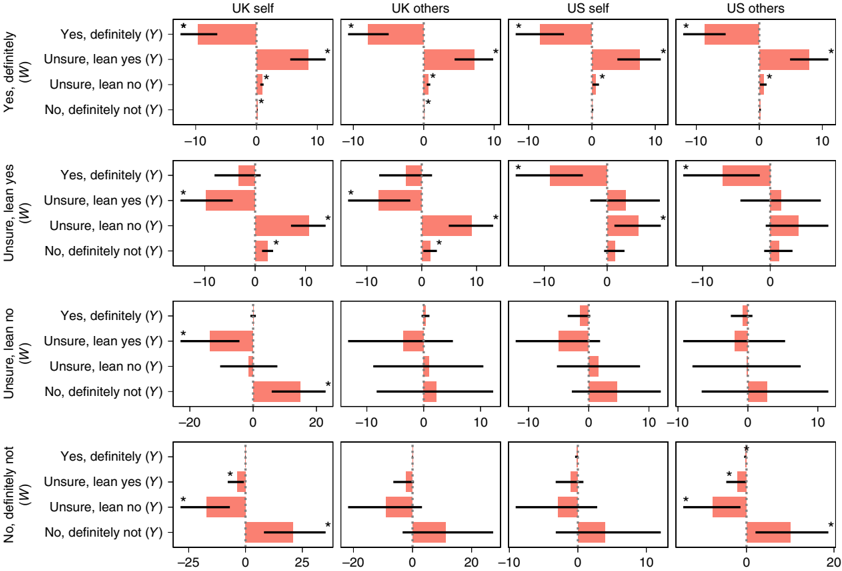
- Exposure to misinformation reduced the share answering “yes, definitely” by 6.2 percentage points in the UK (95% PI 3.9 to 8.5) and 6.4 percentage points in the USA (95% PI 4.0 to 8.8) for self-protection; for protecting others the decreases were 5.7 points in the UK (95% PI 3.5 to 7.9) and 6.5 points in the USA (95% PI 4.1 to 8.8).
- Misinformation also shifted respondents toward lower-intent categories: in the UK, for self-protection there was an increase of 2.7 points in “unsure, but leaning towards no” and 3.3 points in “no, definitely not”; in the USA, there was a 2.3-point rise in “unsure, but leaning towards no.”
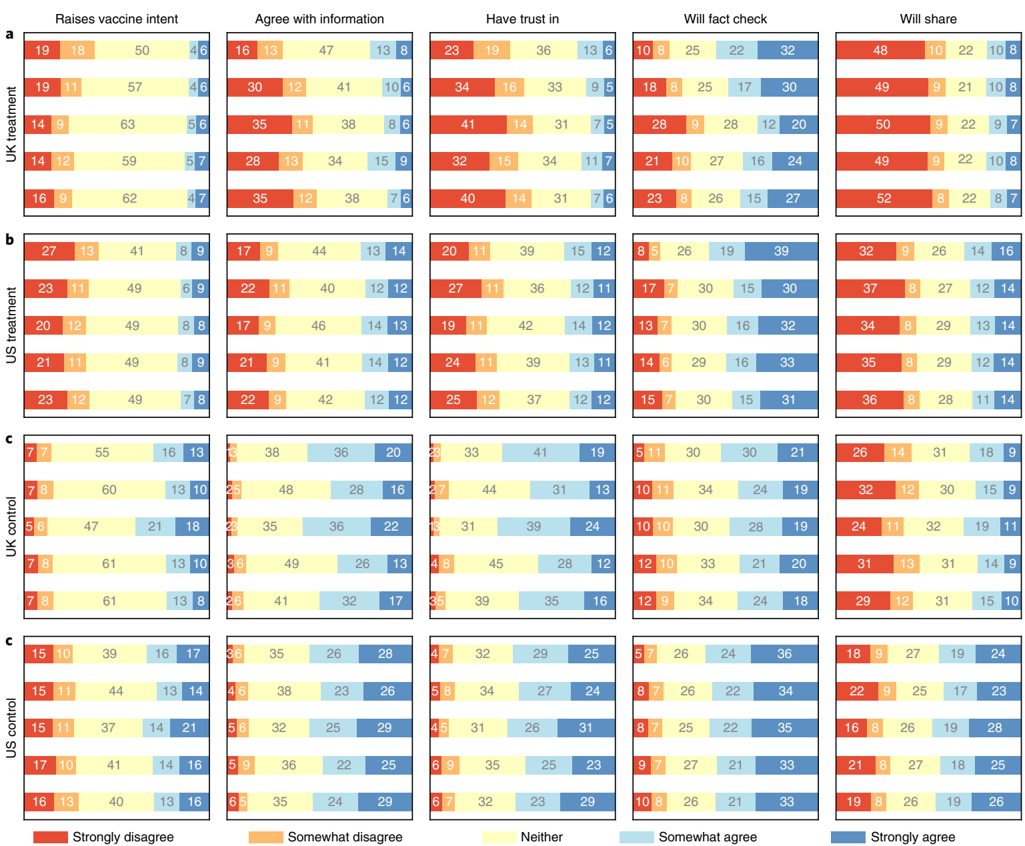
- Scientific-sounding misinformation was more damaging: the paper reports that the misinformation image with the strongest association with reduced intent had weight 0.42 in the UK (95% PI 0.28 to 0.56) and 0.41 in the USA (95% PI 0.25 to 0.58), and that around a quarter of respondents found some misinformation agreeable or trustworthy.
## Methods
- Quantitative cross-sectional pre-post randomized controlled survey experiment in the UK and USA, fielded 7–14 September 2020.
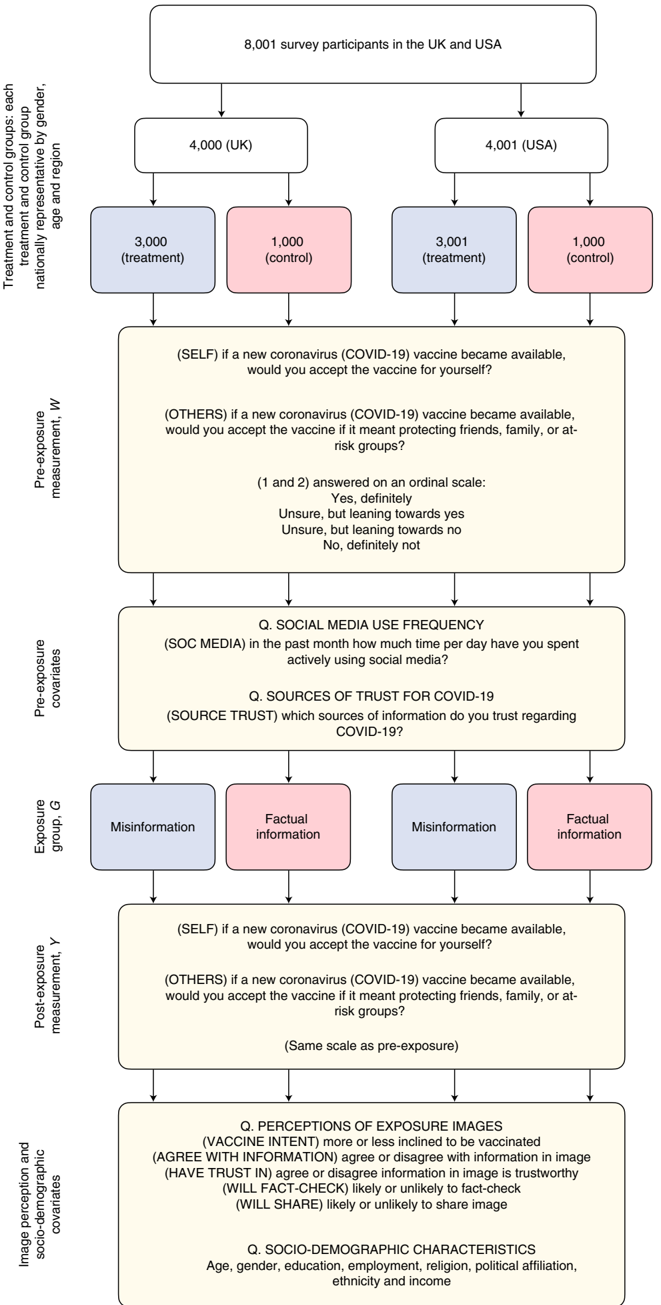
- 8,001 respondents recruited via an online panel: 4,000 in the UK and 4,001 in the USA; within each country, 75% were assigned to misinformation and 25% to factual-information control.
- Respondents reported vaccination intent on a four-point ordered scale before and after exposure, for both self-protection and protecting others; analysis used hierarchical Bayesian ordered logistic regression with treatment effects, heterogeneous treatment effects, and image-impact models estimated via Hamiltonian Monte Carlo / NUTS in PyStan.
## Limitations
- The paper states that the design does not replicate a real-world social media platform environment, and that results are unlikely to be representative of real-world uptake rates.
- The authors state that the study does not allow causal inferences about different kinds of vaccine messaging from the post-exposure perception measures, and that they were limited in the type and volume of misinformation presented.
- Evident from the text: the sample was an online panel and respondents who did not participate simply did not complete the survey; the authors also note possible technological-literacy biases in this sampling mode.
Model-written summary. Check it against the paper before relying on it.
Integrity signals
Registry
Cites
Statistics
Figures


Verification
Claims the paper makes
14 Valid · 1 Not valid · 5 Not checked · 82 Own results and interpretations
The cited sources support only part of this claim — read each source’s verdict below.
In the paper
“Here we show that in both countries-as of September 2020-fewer people would 'definitely' take a vaccine than is likely required for herd immunity”
What the sources say
- Partly supportedcites [15] Kwok, K. O., Lai, F., Wei, W. I., Wong, S. Y. S. & Tang, J. W. T. Herd immunity—estimating the level required to halt the COVID-19 epidemics in affected countries. J. Infect. 80, e32–e33 (2020). sourceExperimental — accuracy not yet measured
The paper’s main text gives a formula for the minimum population immunity needed to halt spread, and Table 1 estimates thresholds for countries using data as of 13 March 2020. It does not report September 2020 vaccine willingness, whether people would ‘definitely’ take a vaccine, or a comparison between willingness and those thresholds in the two countries. (LLM, conf=0.88)
- Supportedcites [16] Sanche, S. et al. High contagiousness and rapid spread of severe acute respiratory syndrome coronavirus 2. Emerg. Infect. Dis. 26, 1470–1477 (2020). source
The Results section (‘Implications for Intervention Strategies’; page unavailable) estimates that more than 82% of the population would need immunity to stop transmission at R0 = 5.7. That supports the herd-immunity benchmark attributed to this source. The two-country September 2020 vaccine-willingness comparison is introduced as the citing authors’ own finding (‘Here we show’), not as a finding of this paper. (LLM, conf=0.87)
plain- Asserted: passes — The authors put it forward as true.
- Checkable: passes — It can be checked against evidence.
- Load-bearing: passes — The paper’s conclusions depend on it.
- Based: passes — The paper gives a reason why it holds.
- Partly supported
The cited sources support only part of this claim — read each source’s verdict below.
In the paper
“Under these current plausible COVID-19 vaccine acceptance rates, possible levels of existing protective immunity-though it is unclear whether post-infection immunity confers long-term immunity 29 and the rapidly evolving nature of misinformation surrounding the pandemic 23,30 , it is unclear whether vaccination will reach the levels required for herd immunity.”
What the sources say
- Supportedcites [29] Altmann, D. M., Douek, D. C. & Boyton, R. J. What policy makers need to know about COVID-19 protective immunity. Lancet 395, 1527–1529 (2020). source
The paper’s discussion of how long COVID-19 immunity might last says immunity could wane and that evidence extending only a little beyond one year offers little reassurance about longer-term protection. In the citing sentence, this source is attached to the uncertainty about long-term post-infection immunity, not to vaccine acceptance or misinformation. (LLM, conf=0.91)
- Partly supportedcites [23] Pennycook, G., McPhetres, J., Zhang, Y., Lu, J. G. & Rand, D. G. Fighting COVID-19 misinformation on social media: experimental evidence for a scalable accuracy-nudge intervention. Psychol. Sci. 31, 770–780 (2020). sourceExperimental — accuracy not yet measured
The citation is attached to the statement about pandemic misinformation, not the citing authors’ conclusion about herd immunity. The paper’s Abstract says COVID-19 misinformation has proliferated and takes many forms, but it does not establish that the misinformation is rapidly evolving. (LLM, conf=0.78)
- Supportedcites [30] Zarocostas, J. How to fight an infodemic. Lancet 395, 676 (2020). source
The citation is attached to the rapidly changing misinformation surrounding COVID-19, not to the citing authors’ conclusion about vaccination and herd immunity. In “How to fight an infodemic,” the paper describes misinformation spreading rapidly through social media and says its amplification makes timely responses a challenge. (LLM, conf=0.90)
hedged- Asserted: passes — The authors put it forward as true.
- Checkable: passes — It can be checked against evidence.
- Load-bearing: passes — The paper’s conclusions depend on it.
- Based: passes — The paper gives a reason why it holds.
- Supported
The cited sources support only part of this claim — read each source’s verdict below.
In the paper
“While large-scale vaccine rejection threatens herd immunity goals, large-scale acceptance with local vaccine rejection can also have negative consequences for community (herd) immunity, as clustering of non-vaccinators can disproportionately increase the needed percentage of vaccination coverage to achieve herd immunity in adjacent geographical regions and encourage epidemic spread 24 .”
What the sources say
- Partly supportedcites [24] Salathé, M. & Bonhoeffer, S. The effect of opinion clustering on disease outbreaks. J. R. Soc. Interface 5, 1505–1508 (2008). sourceExperimental — accuracy not yet measured
The Results and Discussion (pp. not specified) report that clusters of unvaccinated people can undermine herd immunity, increase outbreak probability, and mean that vaccination-coverage estimates needed to avoid outbreaks are too low. The Discussion also says infection can spread from one susceptible cluster to another. The paper does not specifically find that clustering raises the coverage percentage needed in adjacent geographical regions. (LLM, conf=0.86)
plainstates a cause- Asserted: passes — The authors put it forward as true.
- Checkable: passes — It can be checked against evidence.
- Load-bearing: unclear — It is unclear whether the paper’s conclusions depend on it.
- Based: passes — The paper gives a reason why it holds.
- Partly supported
The cited sources that could be checked couldn’t confirm or dispute this claim.
In the paper
“In the UK, this contrasted with more memetic imaging (for example, 'striking images with text superimposed on top' 42 ) which showed far weaker associations (images 3 and 4 in Supplementary Table 1).”
What the sources say
- Could not verifycites [42] Lazer, D. M. J. et al. The science of fake news. Science 359, 1094–1096 (2018). sourceExperimental — accuracy not yet measured
Citation 42 is attached to the description of memetic images, not to the UK association results, which the citing sentence attributes to its own Supplementary Table 1. Our copy discusses fake-news exposure and impact (Prevalence and Impact, p. 3), but searches for the quoted phrase and for memetic images or text-overlaid images found no passage defining them that way. (LLM, conf=0.77)
plainstates an association- Asserted: passes — The authors put it forward as true.
- Checkable: passes — It can be checked against evidence.
- Load-bearing: unclear — It is unclear whether the paper’s conclusions depend on it.
- Based: passes — The paper gives a reason why it holds.
- Could not verify
A result the paper reports from its own data — it cites no other source for it, so there is none to check. The quote shows it is in the paper.
In the paper
“while in the USA it was image 1 (Supplementary Table 1), with weight 0.41 (95% PI 0.25 to 0.58).”
plainstates an association- Asserted: passes — The authors put it forward as true.
- Checkable: passes — It can be checked against evidence.
- Load-bearing: passes — The paper’s conclusions depend on it.
- Based: passes — The paper gives a reason why it holds.
- Rests on an assumption not shown here.
52 more claims
Create a free account to see all 102 claims and to verify the 3 references still open.
- It may state two separate claims as one. 23
- Probably not a substantial claim. 32
- The quote only partly states this claim. 1
Claims other papers make about this one
Each is checked against this paper’s own text: does it say what the citing paper says it does?
The cited source says what the claim attributes to it.
In the citing paper
“Other research has found a causal link between exposure to vaccine misinformation and reduced intentions to get vaccinated (Loomba et al. 2021).”
From Social Media and Morality. (2024) · cites this paper as Loomba et al. 2021
In the citing paper
“belief in misinformation about coronavirus disease 2019 (COVID-19) has been linked to reduced willingness to get vaccinated against the disease and lower intentions to comply with public health measures (2, 3).”
From Psychological inoculation improves resilience against misinformation on social media (2022) · cites this paper as [3]
In the citing paper
“At the same time, misinformation about both technologies is already circulating among the public that can and should be targeted in a debunking intervention (e.g., Loomba et al., 2021;Wang & Song, 2020).”
From How to debunk misinformation? An experimental online study investigating text structures and headline formats (2023) · cites this paper as Loomba et al., 2021
Self-check
Percentages, sums and reported differences re-computed from the paper’s own numbers.
Each contradiction between two passages listed here was confirmed by an independent check.
Rated minor: it would not touch a result — a value no result rests on, a p-value that stays on the same side of the significance level, or a conflict that is clerical, resolved elsewhere in the paper, or outside its own findings.
In the paper
§ Methods
“Ethical approval for this study was obtained by the London School of Hygiene and Tropical Medicine ethics committee on 15 June 2020 with reference 22647.”
§ Human research participants
“Approval for this study was obtained by the LSHTM ethics committee on 15 June 2020 with reference 22130.”
Citations
Cites
A pneumonia outbreak associated with a new coronavirus of probable bat origin
Zhou, P., Yang, X.-L., Wang, X.-G., Hu, B., Zhang, L., Zhang, W., Si, H.-R., Zhu, Y., Li, B., Huang, C.-L., et al. (2020) · Nature · doi:10.1038/s41586-020-2012-7 · Cited by 21,969
Inference from iterative simulation using multiple sequences
Gelman, A., & Rubin, D. B. (1992) · Statistical Science · doi:10.1214/ss/1177011136 · Cited by 16,627
Estimating causal effects of treatments in randomized and nonrandomized studies
Rubin, D. B. (1974) · Journal of Educational Psychology · doi:10.1037/h0037350 · Cited by 9,436
The spread of true and false news online
Vosoughi, S., Roy, D., & Aral, S. (2018) · Science · doi:10.1126/science.aap9559 · Cited by 8,847
Statistics and Causal Inference
Holland, P. W. (1986) · Journal of the American Statistical Association · doi:10.1080/01621459.1986.10478354 · Cited by 5,293
The proximal origin of SARS-CoV-2
Andersen, K. G., Rambaut, A., Lipkin, W. I., Holmes, E. C., & Garry, R. F. (2020) · Nature Medicine · doi:10.1038/s41591-020-0820-9 · Cited by 5,081
Voysey, M., Clemens, S. A. C., Madhi, S. A., Weckx, L. Y., Folegatti, P. M., Aley, P. K., Angus, B., Baillie, V. L., Barnabas, S. L., Bhorat, Q. E., et al. (2021) · The Lancet · doi:10.1016/s0140-6736(20)32661-1 · Cited by 4,616
Regression Models for Ordinal Data
McCullagh, P. (1980) · Journal of the Royal Statistical Society Series B: Statistical Methodology · doi:10.1111/j.2517-6161.1980.tb01109.x · Cited by 4,453
Lazer, D. M. J., Baum, M. A., Benkler, Y., Berinsky, A. J., Greenhill, K. M., Menczer, F., Metzger, M. J., Nyhan, B., Pennycook, G., Rothschild, D., et al. (2018) · Science · doi:10.1126/science.aao2998 · Cited by 4,160
An mRNA Vaccine against SARS-CoV-2 — Preliminary Report
Jackson, L. A., Anderson, E. J., Rouphael, N. G., Roberts, P. C., Makhene, M., Coler, R. N., McCullough, M. P., Chappell, J. D., Denison, M. R., Stevens, L. J., et al. (2020) · New England Journal of Medicine · doi:10.1056/nejmoa2022483 · Cited by 3,406
Research works printed but not linked: 2
- Pfizer. Pfizer and BioNTech conclude phase 3 study of COVID-19 vaccine candidate, meeting all primary efficacy endpoints https://www.pfizer.com/news/press-release/press-release-detail/pfizer-and-biontech-conclude-phase-3-study-covid-19-vaccine (2020).
- Graham, M. & Coppock, A. Asking about attitude change. Public Opinion Quarterly (in the press).
Cited by
Items 601–700 of 1,802
Weng, Y., Lu, D., Bollyky, J., Jain, V., Desai, M., Lindan, C., Boothroyd, D. B., Judson, T. J., Doernberg, S. B., Holubar, M. K., et al. (2021) · Vaccines · doi:10.3390/vaccines9121406 · Cited by 13
Gao, H., Zhao, Q., Ning, C., Guo, D., Wu, J., & Li, L. (2021) · International Journal of Environmental Research and Public Health · doi:10.3390/ijerph19010241 · Cited by 12
“The sources causing vaccine hesitancy might come from a lack of information and distrust in governments, doctors, medical institutions, and media [52,53].”
BackgroundBurger, M. N., Mayer, M., & Steimanis, I. (2022) · PLoS ONE · doi:10.1371/journal.pone.0270666 · Cited by 14
Choi, Y.-J., Lee, J., & Paek, S. Y. (2022) · International Journal of Environmental Research and Public Health · doi:10.3390/ijerph19169914 · Cited by 14
“In particular, in accordance with existing findings, we confirmed that misinformation exacerbated individuals’ negative views on the vaccines [66,67].”
ResultDistinct spreading patterns induced by coexisting channels in information spreading dynamics
Wu, J., Xu, K., Zhang, X., & Zheng, M. (2022) · Chaos An Interdisciplinary Journal of Nonlinear Science · doi:10.1063/5.0102380 · Cited by 12
Montagni, I., Pouymayou, A., Pereira, E., Tzourio, C., Schück, S., Texier, N., González-Caballero, J. L., & The CONFINS Group (2022) · Journal of Medical Internet Research · doi:10.2196/39220 · Cited by 14
Kour, P., Gele, A. A., Aambø, A. K., Qureshi, S. A., Sheikh, N. S., Vedaa, Ø., & Indseth, T. (2022) · Frontiers in Public Health · doi:10.3389/fpubh.2022.994125 · Cited by 14
“A study on the impact of vaccine misinformation in the UK and the US suggests that some migrant communities may be more susceptible to COVID-19 vaccine misinformation, particularly where language barriers and social exclusion contribute to a deficit of accurate and accessible information (27).”
BackgroundWang, Y., Thier, K., Ntiri, S. O., Quinn, S. C., Adebamowo, C., & Nan, X. (2023) · Health Communication · doi:10.1080/10410236.2023.2179711 · Cited by 12
“Loomba et al. (2021) examined the impact of COVID-19 vaccine misinfor-mation in the UK and the US, finding that exposure to vaccine misinformation, relative to factual information, led to a decline in COVID-19 vaccination intentions.”
BackgroundResultRudloff, J. P., Hutmacher, F., & Appel, M. (2023) · Scientific Reports · doi:10.1038/s41598-023-31079-9 · Cited by 14
When reality bites: Local deaths and vaccine take-up
Giulietti, C., Vlassopoulos, M., & Zénou, Y. (2023) · European Economic Review · doi:10.1016/j.euroecorev.2023.104463 · Cited by 12
Kessler, S. H., & Humprecht, E. (2023) · Digital Health · doi:10.1177/20552076231177131 · Cited by 15
Intention to Vaccinate against COVID-19 in Adolescents: A Systematic Review
Tan, S. Y., Oka, P., & Tan, N. C. (2023) · Vaccines · doi:10.3390/vaccines11081393 · Cited by 12
“Adolescents could also be more skeptical regarding vaccine effectiveness and safety due to the exaggerated information they encounter on social media [57–59].”
BackgroundTalavera, I., Ghobadian, A., Troise, C., & Bresciani, S. (2023) · Technovation · doi:10.1016/j.technovation.2023.102851 · Cited by 17
Motta, M., Hwang, J., & Stecula, D. (2024) · Health Communication · doi:10.1080/10410236.2023.2254583 · Cited by 11
“…pandemic as a serious public health crisis, more likely to refuse the COVID-19 vaccine, and less likely to engage in protective health behaviors like mask wearing and social distancing (Bridgman et al., 2020; Enders et al., 2020; Farhart et al., 2022; Loomba et al., 2021; Motta & Callaghan, 2020).”
Zhou, X., Song, S., Zhang, Y., & Hou, Z. (2023) · Journal of Medical Internet Research · doi:10.2196/49753 · Cited by 16
“Misinformation and rumors were also widespread, especially on social media platforms, which may exacerbate the concerns about vaccine safety and effectiveness [7,47,53,54].”
The role of perceived minority-group status in the conspiracy beliefs of factual majority groups
Gundersen, A. B., van der Linden, S., Piksa, M., Morzy, M., Piasecki, J., Ryguła, R., Gwiaździński, P., Noworyta, K., & Kunst, J. R. (2023) · Royal Society Open Science · doi:10.1098/rsos.221036 · Cited by 12
“For example, conspiracy beliefs have been linked to the resurgence of vaccinepreventable diseases [1], anti-science attitudes [2] and promotion of prejudice [3].”
COVID-19 Vaccination: crucial roles and opportunities for the mental health professionals
Banerjee, D., Mukhopadhyay, S., Asmeen, M. S., & Javed, A. (2021) · Cambridge Prisms Global Mental Health · doi:10.1017/gmh.2021.25 · Cited by 12
“In a recent randomized controlled trial conducted both in the USA and UK, fewer people were shown likely to be ‘definitely’ accepting a vaccine for herd immunity, and ‘scientific-sounding’ misinformation, especially when repetitive, it was shown to reduce vaccination intent (Loomba et al., 2021).”
BackgroundThe effects of self-generated and other-generated eWOM in inoculating against misinformation
Dai, Y. H., Jia, W., Fu, L., Sun, M., & Jiang, L. (2022) · Telematics and Informatics · doi:10.1016/j.tele.2022.101835 · Cited by 14
Savoia, E., Harriman, N. W., Piltch-Loeb, R. N., Bonetti, M., Toffolutti, V., & Testa, M. A. (2022) · Preprints.org · doi:10.20944/preprints202203.0283.v1 · Cited by 11
Rosenthal, A., Motta, M., & Farhart, C. E. (2021) · SocArXiv (OSF Preprints) · doi:10.31235/osf.io/wjq4a · Cited by 11
Wang, Y., Thier, K., & Nan, X. (2022) · OSF Preprints (OSF Preprints) · doi:10.31219/osf.io/7te56 · Cited by 12
Information disorder’s impact on adolescents: publication trends and recommendations
Irwanto, I., Bahfiarti, T., Unde, A. A., & Sonni, A. F. (2025) · Frontiers in Communication · doi:10.3389/fcomm.2025.1495536 · Cited by 19
References to unbiased sources increase the helpfulness of community fact-checks
Solovev, K., & Pröllochs, N. (2025) · Scientific Reports · doi:10.1038/s41598-025-09372-6 · Cited by 27
“Verification performed by experts typically delivers reliable results but grapples with scalability owing to the scarcity of professional fact-checkers.”
Cheng, Z., Ruktanonchai, N., Wesolowski, A., Pei, S., Wang, J., Cockings, S., Tatem, A. J., & Lai, S. (2025) · Infectious Diseases of Poverty · doi:10.1186/s40249-025-01378-6 · Cited by 23
“Consequently, the proliferation of anti-intellectualism [12, 23] and vaccine misinformation [76–78] through social media can undermine vaccination campaigns, eventually contributing to increased morbidity and mortality during health crises.”
Orlandi, L. B., Veronesi, G., & Zardini, A. (2022) · Information and Organization · doi:10.1016/j.infoandorg.2022.100409 · Cited by 15
Lee, H., Leng, C.-H., & Chan, T. (2022) · PLoS ONE · doi:10.1371/journal.pone.0270349 · Cited by 13
“Moreover, according to [3, 59, 60], misinformation is more strongly associated with declines in vaccination intent, and susceptibility to misinformation and vaccine hesitancy lead to a reduced likelihood to comply with health guidance measures.”
BackgroundAlderotti, G., Corvo, M. F., Buscemi, P., Stacchini, L., Giorgetti, D., Lorini, C., Bonaccorsi, G., Pinilla, M. J. C., & Lastrucci, V. (2023) · Vaccines · doi:10.3390/vaccines11020223 · Cited by 13
Winters, M., Christie, S., Lepage, C., Malik, A. A., Bokemper, S., Abeyesekera, S., Boye, B., Moini, M., Jamil, Z., Tariq, T., et al. (2023) · PLOS Global Public Health · doi:10.1371/journal.pgph.0002357 · Cited by 14
Zhang, L., & Jiang, S. (2024) · Health Communication · doi:10.1080/10410236.2023.2300902 · Cited by 15
“Misperceptions revolving around misinformation would trigger reluctance to enacting positive preventive behaviors, leading to deeper health crises (e.g., Loomba et al., 2021).”
Curnock, M., Nembhard, D., Smith, R., Sambrook, K., Hobman, E. V., Mankad, A., PERT, P. L., & Chamberland, E. (2024) · PLoS ONE · doi:10.1371/journal.pone.0308252 · Cited by 14
Debunking COVID-19 vaccine misinformation with an audio drama in Ghana, a randomized control trial
Winters, M., Christie, S., Melchinger, H. C., Iddrisu, I., Hassan, H. A., Ewart, E., Mosley, L., Alhassan, R., Shani, N., Nyamuame, D., et al. (2025) · Scientific Reports · doi:10.1038/s41598-025-92731-0 · Cited by 13
“In health emergencies such as disease outbreaks this may be particularly problematic, as it could increase vaccine hesitancy, obstruct containment measures and cause misallocation of resources 3,4,26–29 .”
Jheng, Y.-L., de Cruys, S. V., Brabandere, L. D., Maertens, K., & Poels, K. (2025) · Scientific Reports · doi:10.1038/s41598-025-98709-2 · Cited by 15
“Indeed, the pandemic has shown that people invoke misinformation to support risky behavior (refusing to wear masks or to get vaccinations) that may endanger their own or other people’s health 6 .”
Can deepfakes manipulate us? Assessing the evidence via a critical scoping review
Ching, D., Twomey, J., Aylett, M. P., Quayle, M., Linehan, C., & Murphy, G. (2025) · PLoS ONE · doi:10.1371/journal.pone.0320124 · Cited by 27
“Research on the COVID-19 pandemic has shown that misinformation exposure from social media has induced a decline in intent to be vaccinated [45].”
Kumar, R., Bairwa, M. C., Beniwal, K., & Kant, R. (2021) · Journal of Education and Health Promotion · doi:10.4103/jehp.jehp_327_21 · Cited by 14
“[31] Further, earlier work reported that some religious groups were differently impacted by exposure to misinformation about the vaccine.[32] However, preliminary analysis shows more participants in not intent to vaccinate or dilemma to go for vaccination in all religious groups but could not reach a level of signific…”
BackgroundCousins, E., de Vries, K., & Dening, K. H. (2021) · Dementia · doi:10.1177/14713012211059021 · Cited by 14
“Consequently, divisions in society have been evident, often fuelled by misinformation, resulting in the population expressing different views towards compulsory masks and vaccines, which has further exacerbated pre-existing social polarisation (Loomba et al., 2021).”
BackgroundRussian Troll Vaccine Misinformation Dissemination on Twitter: The Role of Political Partisanship
Yan, K., Barbati, J. L., Duncan, K. L., Warner, E. L., & Rains, S. A. (2022) · Health Communication · doi:10.1080/10410236.2021.2021692 · Cited by 10
“More recently, Loomba et al. (2021) found that exposure to online COVID-19 vaccine misinformation reduced people’s intention to accept the vaccine.”
BackgroundA BIBLIOMETRIC ANALYSIS ON THE DISSEMINATION OF COVID -19 VACCINE MISINFORMATION ON SOCIAL MEDIA
Mahajan, R., & Gupta, P. (2021) · Journal of Content Community and Communication · doi:10.31620/jccc.12.21/18 · Cited by 10
“Several pieces of research investigate the changing trend of public willingness to accept the vaccine, influenced by information (or misinformation) trending on social media platforms (Loomba et al., 2021).”
BackgroundGesualdo, F., Parisi, L., Croci, I., Comunello, F., Parente, A., Russo, L., Campagna, I., Lanfranchi, B., Rota, M. C., Filia, A., et al. (2022) · Frontiers in Public Health · doi:10.3389/fpubh.2022.824465 · Cited by 12
“Moreover, social media are a means to share stories, opinions and emotions that may have an impact on health behaviors, including the intention to vaccinate (8).”
BackgroundAlbatineh, A. N., Dalvand, P., Aslani, M., Sarıtaş, S., Baghi, V., & Gheshlagh, R. G. (2022) · Tropical Medicine and Health · doi:10.1186/s41182-022-00453-0 · Cited by 13
“1% have been fully vaccinated (received all doses) [17].”
BackgroundBalcaen, P., Buts, C., Bois, C. D., & Tkacheva, O. (2022) · Journal of Behavioral and Experimental Economics · doi:10.1016/j.socec.2022.101968 · Cited by 12
“…et al., 2021; Yang et al., 2021) and (3) how disinformation impacts individual compliance with government COVID-19 guidelines and willingness to get vaccinated (Dib, Maraud, Chauvin, & Launay, 2021; Kreps & Kriner, 2020; Loomba et al., 2021; Roozenbeek et al., 2020; Wilson & Wiysonge, 2021).”
BackgroundResultInfluentialVaccinEU: COVID-19 Vaccine Conversations on Twitter in French, German and Italian
Giovanni, M. D., Pierri, F., Torres-Lugo, C., & Brambilla, M. (2022) · Proceedings of the International AAAI Conference on Web and Social Media · doi:10.1609/icwsm.v16i1.19374 · Cited by 25
“2020) of misleading information about the virus spreading online, and it has been shown that online misinformation might negatively influence individuals’ opinion towards getting vaccinated (Pierri et al. 2021a; Loomba et al. 2021).”
BackgroundTowards QR Code Health Systems Amid COVID-19: Lessons Learnt from Other QR Code Digital Technologies
Mbunge, E., Ndumiso, N., Kavu, T. D., Dandajena, K., Batani, J., & Fashoto, S. G. (2022) · Springer series on bio- and neurosystems · doi:10.1007/978-3-031-10031-4_7 · Cited by 13
How Trust in Cancer Information Has Changed in the Era of COVID-19: Patterns by Race and Ethnicity
Bispo, J. B., Douyon, A., Ashad‐Bishop, K. C., Balise, R. R., & Kobetz, E. N. (2023) · Journal of Health Communication · doi:10.1080/10810730.2022.2117439 · Cited by 11
Organizations affect their employees' vaccine readiness: A self‐perception theory perspective
Roswag, M., Häusser, J. A., Hadi, S. A., Hubert, P., & Mojzisch, A. (2023) · Applied Psychology Health and Well-Being · doi:10.1111/aphw.12457 · Cited by 14
Kappes, H. B., Toma, M., Balu, R., Burnett, R., Chen, N., Johnson, R., Leight, J., Omer, S. B., Safran, E., Steffel, M., et al. (2023) · Behavioral Science & Policy · doi:10.1177/23794607231192690 · Cited by 14
“By the beginning of 2022, the situation had reversed in the United States, and hesitancy and resistance to vaccination were reported at home and abroad.(45) The OES evaluations show how vaccination uptake interventions can be rapidly and rigorously evaluated at a large scale.”
BackgroundCheng, L., Kong, J., Xie, X., et al. (2024) · Scientific Reports · doi:10.1038/s41598-024-61028-z · Cited by 10
Wang, H., Zhou, X., Jiang, T., Wang, X., Lu, J., & Jin-lin, L. (2021) · Human Vaccines & Immunotherapeutics · doi:10.1080/21645515.2021.1989914 · Cited by 13
“Since the first case was reported in December 2019, coronavirus disease 2019 (COVID-19) has spread rapidly around the world, causing an unprecedented global public and economic crisis.(1,2) On March 11, 2020, the World Health Organization (WHO) declared COVID-19 as a worldwide pandemic.”
BackgroundKennedy, E. B., Jensen, E. A., & Jensen, A. M. (2022) · Frontiers in Communication · doi:10.3389/fcomm.2021.736195 · Cited by 10
A multidisciplinary effort to increase COVID-19 vaccination among the older adults
Moosa, A., Yi, W. M. S., Jaw, M. H., Tan, Q., Tse, W.-C., Loke, C. Y., Guan, E., Ng, C., Wai, A. K., Koh, Y. L., et al. (2022) · Frontiers in Public Health · doi:10.3389/fpubh.2022.904161 · Cited by 11
Yang, A., Jieun, S., Kim, H. M., Zhou, A. Y., Liu, W., Huang-Isherwood, K. M., Jang, E., Sun, J., Lee, E., Yafei, Z., et al. (2022) · Social Science Computer Review · doi:10.1177/08944393221128940 · Cited by 13
“Misinformation about COVID-19 vaccines is particularly damaging, as it reduces a population ’ s vaccination intentions, thus making it dif fi cult to reach herd immunity required to protect public health and resume normalcy (Loomba et al., 2021).”
BackgroundPanahi, Y., Einollahi, B., Beiraghdar, F., Darvishi, M., Fathi, S., Javanbakht, M., Shafiee, S., & Akhavan‐Sigari, R. (2022) · Frontiers in Immunology · doi:10.3389/fimmu.2022.947602 · Cited by 10
“Evidence of positive vaccination along with more effective public health communication strategies can be capable of boosting public trust and countering COVID-19 vaccine misinformation (11, 12).”
BackgroundIntuition, reason, and conspiracy beliefsPreprint
Binnendyk, J., & Pennycook, G. (2022) · doi:10.31234/osf.io/su3nq · Cited by 9
Covid-19 Spillover Effects onto General Vaccine AttitudesPreprint
Trujillo, K. L., Green, J., Safarpour, A., et al. (2022) · doi:10.31219/osf.io/w7mq5 · Cited by 10
Why Misinformation Must Not Be IgnoredPreprint
Ecker, U. K. H., Tay, L. Q., Roozenbeek, J., et al. (2024) · doi:10.31234/osf.io/8a6cj · Cited by 10
Correction by distraction: how high-tempo music enhances medical experts’ debunking TikTok videos
Li, M., Li, G., & Yang, S. (2024) · Journal of Computer-Mediated Communication · doi:10.1093/jcmc/zmae007 · Cited by 24
Fake News on Social Media: Predicting Which Media Format Influences Fake News Most on Facebook
Demuyakor, J., & Opata, E. M. (2022) · Journal of Intelligent Communication · doi:10.54963/jic.v2i1.56 · Cited by 9
“have reached unprecedented levels when the production of COVID-19 vaccines started and during the inoculations of the COVID-19 vaccines, which eventually compelled the World health organization to issue a red alert on social media “infordemic” ([3,4]).”
BackgroundMeehan, A. A., Aarvig, K., Kashani, M., et al. (2022) · Journal of Public Health Management and Practice · doi:10.1097/phh.0000000000001619 · Cited by 9
“2% decline in vaccine intent.(12) Thus, there are opportunities to leverage social media”
BackgroundMésinformation et comportements en santé dans le contexte de la pandémie de Covid-19
Baranes, E., Guillon, M., & Kergall, P. (2022) · Annales des Mines - Responsabilité et environnement · doi:10.3917/re1.108.0036 · Cited by 9
Man, S. S., Wen, H., Zhao, L., & So, B. C. L. (2023) · Healthcare · doi:10.3390/healthcare11182589 · Cited by 11
“However, when people were subjected to scientific-sounding misinformation, their intention to vaccinate declined significantly [17].”
Susceptibility to misinformation about COVID-19 vaccines: A signal detection analysis
Nahon, L. S., Ng, N. L., & Gawronski, B. (2024) · Journal of Experimental Social Psychology · doi:10.1016/j.jesp.2024.104632 · Cited by 18
“Although vaccines are among the safest and most economical measures in our medical repertoire (Bloom et al., 2014), misinformation about COVID-19 vaccines has contributed to this state of affairs by undermining vaccine acceptance (Enders et al., 2020; Loomba et al., 2021; Schmid & Betsch, 2022).”
BackgroundOladapo, R. K., Obidiro, O. P., Oyetola, A. B., Olajide, A., Oladapo, M. O., Lawrence, U. S., Hasan, M. M., Islam, Z., Mustapha, A. A., Osuagwu‐Nwogu, E., et al. (2024) · The International Journal of Health Planning and Management · doi:10.1002/hpm.3834 · Cited by 13
Zhou, H.-Y., Li, Y., Li, J., Meng, J., & Wu, A. (2024) · The Innovation Medicine · doi:10.59717/j.xinn-med.2024.100091 · Cited by 19
Measuring receptivity to misinformation at scale on a social media platform
Tokita, C. K., Aslett, K., Godel, W., Sanderson, Z., Tucker, J. A., Nagler, J., Persily, N., & Bonneau, R. (2024) · PNAS Nexus · doi:10.1093/pnasnexus/pgae396 · Cited by 24
“…have increased distrust of public health officials, weakened responses to the pandemic, and increased skepticism of the COVID-19 vaccine (86, 87). c Tables S1 – S5 list the articles used in the study by veracity, source type/learn, topic, and article slant; the method by which the articles…”
MethodCan GPT-4 Models Detect Misleading Visualizations?
Alexander, J., Nanda, P., Yang, K.-C., & Sarvghad, A. (2024) · Visualization · doi:10.1109/vis55277.2024.00029 · Cited by 26
“For example, during the COVID-19 pandemic, exposure to misleading visualizations and mis-information reduced some people’s willingness to vaccinate [24] and comply with other preventative measures such as wearing masks [29].”
The Impact of COVID-19 on DTP3 Vaccination Coverage in Europe (2012–2023)
Aguinaga-Ontoso, I., Guillén-Aguinaga, S., Guillén-Aguinaga, L., Alas-Brun, R., Guillen-Aguinaga, M., Onambele, L., Aguinaga-Ontoso, E., Rayón-Valpuesta, E., & Guillén‐Grima, F. (2024) · Vaccines · doi:10.3390/vaccines13010006 · Cited by 10
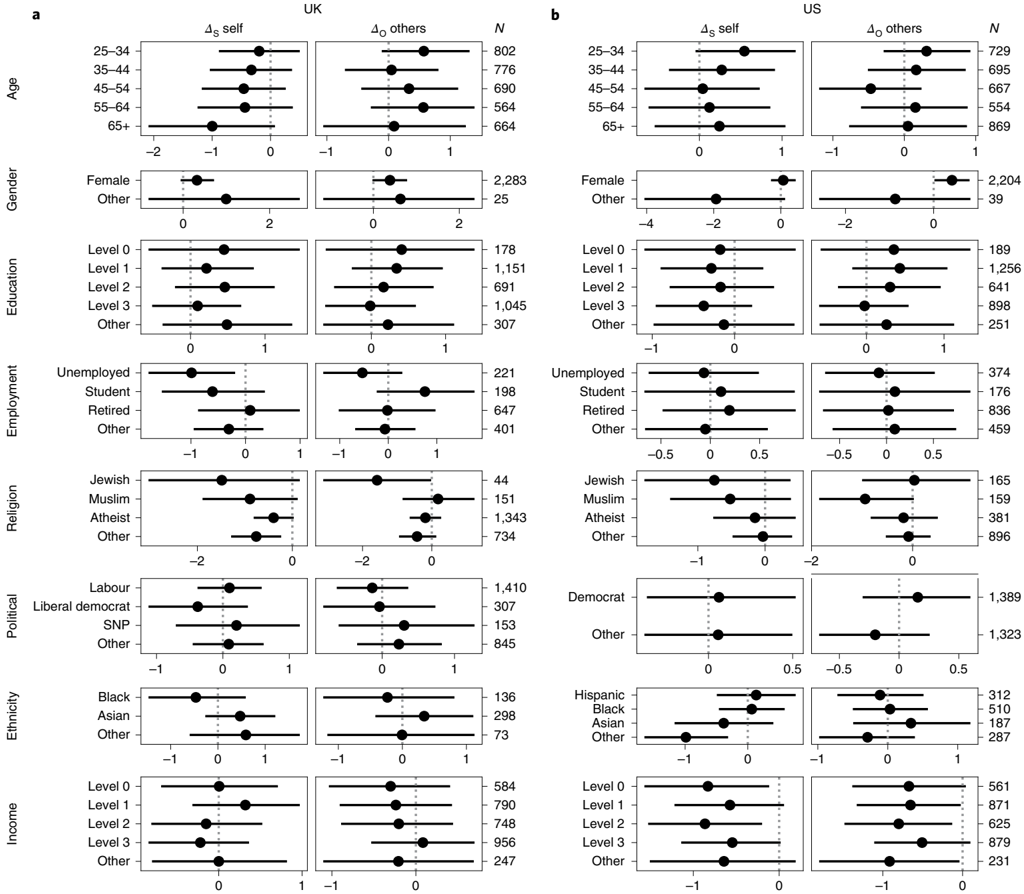
“Misinformation affects different sociodemographic groups in varying ways, with females, lower-income groups, and some ethnic minorities more susceptible to altered vaccination intentions [7].”
Kim, J., Wang, Z., Shi, H., Ling, H.-K., & Evans, J. A. (2025) · Nature Communications · doi:10.1038/s41467-025-55868-0 · Cited by 20
“These actions range from buying and selling stocks 2 and avoidance of vaccines 3 to the attempted coup and occupation of the U.S. Capitol by rioters 4 .”
COVID-19 and influenza vaccine Hesitancy among adults hospitalized in the United States, 2019–2022
Khan, A., Zhu, Y., Babcock, H. M., Busse, L. W., Duggal, A., Exline, M. C., Gaglani, M., Gibbs, K. W., Gong, M. N., Ginde, A. A., et al. (2025) · Vaccine · doi:10.1016/j.vaccine.2025.126806 · Cited by 9
Evaluation of Douyin Short Videos on Mammography in China: Quality and Reliability Analysis
Yang, H., Zhu, C., Zhou, C., Huang, R., Huang, L., Chen, P., Zhu, S., Wang, H., & Zhu, C. (2025) · JMIR Cancer · doi:10.2196/59483 · Cited by 12
Liu, L., Cai, C.-R., Zhang, S.-P., & Li, B.-Q. (2025) · Physica A Statistical Mechanics and its Applications · doi:10.1016/j.physa.2025.130534 · Cited by 12
“The spread of misinformation leads to poor utilization of vaccines [20, 21], while accurate information about descriptive norms can increase intentions to accept vaccines [22].”
Trust issues: Adolescents' epistemic vigilance towards online sources
Brown, P. R., & Gummerum, M. (2025) · British Journal of Developmental Psychology · doi:10.1111/bjdp.12559 · Cited by 16
“Most participants also struggled to know how to proceed if they were faced with more than one website with conflicting information.”
Supporting Human Raters with the Detection of Harmful Content Using Large Language Models
Thomas, K., Kelley, P. G., Tao, D. D. J., Meiklejohn, S., Vallis, O., Tan, S., Bratanič, B., Ferreira, F. T., Eranti, V., & Bursztein, E. (2025) · IEEE Symposium on Security and Privacy (S&P) · doi:10.1109/sp61157.2025.00082 · Cited by 29
“Researchers have explored some of the most pressing categories of harmful content, including hate speech and harassment [37], [47], [51], violent extrem-ism [9], misinformation [24], [31], and child safety [4], [44]; as well as the idiosyncrasies of policies across platforms [41], [48].”
Ryan, G. W., Askelson, N. M., Miotto, M. B., et al. (2021) · Journal of Adolescent Health · doi:10.1016/j.jadohealth.2021.11.025 · Cited by 9
“Unfortunately, COVID-19 vaccination has had similar backlash amidst negative, politicized public perceptions [4].”
The Enthusiasts and the Reluctants of COVID-19 Vaccine Uptake: A Cluster Analysis
Lee, A. Y., Wang, J., Böckenholt, U., Lee, L., Ohme, R. K., Reykowska, D., & Yeung, C. W. M. (2021) · Journal of the Association for Consumer Research · doi:10.1086/718458 · Cited by 10
Priebe, J., Silber, H., Beuthner, C., & Pötzschke, S. (2022) · BMC Public Health · doi:10.1186/s12889-022-12725-9 · Cited by 10
Factors Associated With COVID-19 Behavioral Intentions: Findings From an Online Survey
Lama, Y., Budenz, A., Gaysynsky, A., Iles, I. A., & Chou, W. S. (2022) · American Journal of Health Promotion · doi:10.1177/08901171221093036 · Cited by 11
“Additionally, the proliferation of health information online, including the spread of misinformation, exacerbates existing reluctance to engage in preventive behaviors.(8,9) Furthermore, vaccine hesitancy has undermined efforts to control the pandemic.”
BackgroundWeinzierl, M., Hopfer, S., & Harabagiu, S. M. (2022) · Journal of Behavioral Medicine · doi:10.1007/s10865-022-00328-z · Cited by 12
“…across HPV and COVID-19 yet never in this social media vaccine frame-stance context at this scale (Calo et al., 2021; Head et al., 2018; Jamison et al., 2020; Kim et al., 2020; Loomba et al., 2021; Massey et al., 2020; Sundstrom et al., 2021; Van der Linden et al., 2016; Zimet et al., 2013).”
BackgroundAn Epidemic Model with Pro and Anti-vaccine Groups
Harari, G. S., & Monteiro, L. H. A. (2022) · Acta Biotheoretica · doi:10.1007/s10441-022-09443-5 · Cited by 15
“Thus, the reduction in vaccine acceptance found in surveys conducted in the USA in 2020 (Lin et al.”
BackgroundInfluentialFischer, V. (2022) · Progress in brain research · doi:10.1016/bs.pbr.2022.07.004 · Cited by 21
Trust and vaccination intentions: Evidence from Lithuania during the COVID-19 pandemic
Galdikiene, L., Jaraitė, J., & Kajackaite, A. (2022) · PLoS ONE · doi:10.1371/journal.pone.0278060 · Cited by 11
“We also find that beliefs in false information play a significant role in predicting vaccination intentions, which is in line with the findings of other studies [59–61].”
Bhardwaj, V., Martel, C., & Rand, D. G. (2023) · Harvard Kennedy School Misinformation Review · doi:10.37016/mr-2020-113 · Cited by 9
“presidential election (Pennycook & Rand, 2021), exposure to online misinformation about COVID-19 vaccines has decreased vaccination intent (Loomba et al., 2021), and misinformation on social media has been linked to increasing political cynicism (Lee & Jones-Jang, 2022).”
BackgroundA two-regime analysis of the COVID-19 vaccine distribution process
Hegde, S. J., Mahmassani, H. S., & Smilowitz, K. R. (2023) · Journal of Humanitarian Logistics and Supply Chain Management · doi:10.1108/jhlscm-10-2021-0106 · Cited by 10
Vaccination games and imitation dynamics with memory
Kyrychko, Y. N., & Blyuss, K. B. (2023) · Chaos An Interdisciplinary Journal of Nonlinear Science · doi:10.1063/5.0143184 · Cited by 9
Cavaliere, D., Fenza, G., Loia, V., & Nota, F. D. (2023) · International Journal of Interactive Multimedia and Artificial Intelligence · doi:10.9781/ijimai.2023.02.003 · Cited by 12
Talking Abortion (Mis)information with ChatGPT on TikTok
Sharevski, F., Loop, J. V., Jachim, P., Devine, A., & Pieroni, E. (2023) · IEEE European Symposium on Security and Privacy Workshops (EuroS&PW) · doi:10.1109/eurospw59978.2023.00071 · Cited by 21
“[18-20] 8 (16%) [21-30] 25 (50%) [31-40] 11 (22%) [41-50] 3 (6%) [51-60] 2 (4%) [61+] 1 (2%)”
BackgroundKhalaf, M. A., & Shehata, A. M. K. (2023) · BMC Psychology · doi:10.1186/s40359-023-01425-7 · Cited by 11
COVID-19 and Historic Influenza Vaccinations in the United States: A Comparative Analysis
Mirpuri, P., & Rovin, R. (2021) · Vaccines · doi:10.3390/vaccines9111284 · Cited by 10
“The COVID-19 vaccine has uniquely faced politicization and has been the subject of rampant misinformation [26].”
BackgroundGiannitrapani, K. F., Brown‐Johnson, C. G., Connell, N. B., Yano, E. M., Singer, S. J., Giannitrapani, S., Thanassi, W. T., & Lorenz, K. (2022) · Journal of General Internal Medicine · doi:10.1007/s11606-022-07439-y · Cited by 9
“Individuals delaying vaccination reported concern related to COVID-19 vaccines rooted in rapid vaccine development, novelty of the technology, inconsistent messaging, and social media misinformation.(4,5) Interestingly, despite high exposure risks, health literacy, and obligations to protect patients, some healthcare…”
BackgroundDNA-influenced automated behavior detection on twitter through relative entropy
Gilmary, R., Akila, V., Vaiyapuri, G., & Balamurali, D. (2022) · Scientific Reports · doi:10.1038/s41598-022-11854-w · Cited by 11
“According to an analysis on a known bot dataset, nearly 66% of profiles spreading misinformation on COVID-19 are bots 5 .”
BackgroundInfluentialBarua, Z. (2022) · Human Arenas · doi:10.1007/s42087-022-00291-w · Cited by 11
“Though social networks are viewed as a structural determinant of health, the misinformation regarding the COVID-19 on social networks is so vast (Loomba et al., 2021) that Tedros Adhanom Ghebreyesus, Director-General of the World Health Organization (WHO), was compelled to declare the COVID-19…”
Awaidy, S. T. A., Siyabi, H. A., Khatiwada, M., Siyabi, A. A., Mukhaini, S. A., Dochez, C., Giron, D., Langrial, S. U., & Mahomed, O. H. (2022) · Journal of Infection and Public Health · doi:10.1016/j.jiph.2022.06.005 · Cited by 12
“There are many misconceptions and wrong impressions amongst HCWs with respect to the COVID-19 vaccine [7].”
Akbar, M. B., Singh, L., Deshpande, S., & Amoncar, N. (2022) · Health Marketing Quarterly · doi:10.1080/07359683.2022.2092325 · Cited by 10
Sentiment Analysis of COVID-19 Vaccination Responses From Twitter Using Ensemble Learning
Ismail, Q., Obeidat, R., Alissa, K., & Al-Sobh, E. (2022) · International Conference on Information and Communication Systems (ICICS) · doi:10.1109/icics55353.2022.9811132 · Cited by 9
“It is mainly driven by the anti-vaccine misinformation and conspiracy theories that have been circulating on social media since the release of the first vaccine [6].”
BackgroundKandasamy, S., Ariyarajah, A., Limbachia, J., et al. (2022) · BMJ Open · doi:10.1136/bmjopen-2022-061619 · Cited by 9
Wake, A. D. (2022) · Interdisciplinary Perspectives on Infectious Diseases · doi:10.1155/2022/2443785 · Cited by 12
“However, achieving high uptake will be a challenge and may be impeded by online misinformation and attaining significant uptake will be a contest [99].”
BackgroundMachado, D. F. T., de Siqueira, A. F., Shimizu, N. R., & Gitahy, L. (2022) · Frontiers in Communication · doi:10.3389/fcomm.2022.1037432 · Cited by 13
“Spreading misinformation and conspiracy theories during a health crisis can pose significant risks to public health and public trust (Freeman et al., 2020; Loomba et al., 2021).”
BackgroundAcceptability of COVID-19 vaccination among healthcare workers in Sudan
Khairy, A., Mahgoub, E. A. A., Nimir, M., Ahmed, M., Jubara, M., Jubara, M., Altayab, D., & Ahmed, A. (2023) · Eastern Mediterranean Health Journal · doi:10.26719/emhj.23.061 · Cited by 13
Chopra, H., Vashishtha, A., Pal, R., Ashima, Tyagi, A., & Sethi, T. (2023) · JMIR Infodemiology · doi:10.2196/34315 · Cited by 18
Communicating public health during COVID-19, implications for vaccine rollout
Bloomfield, P. S., Magnusson, J., Walsh, M. L., & Naylor, A. (2021) · Big Data & Society · doi:10.1177/20539517211023534 · Cited by 12
“Intergroup differences in attitudes towards vaccine uptake have been identified (Robertson et al., 2021) and it is clear that different age brackets and demographics have different susceptibilities to vaccine misinformation, which in turn influences hesitancy (Loomba et al., 2021).”
BackgroundIncreasing COVID-19 Vaccination Intentions: A Field Experiment on Psychological OwnershipPreprint
Keppeler, F., Sievert, M., & Jilke, S. (2021) · SSRN Electronic Journal · doi:10.2139/ssrn.3905470 · Cited by 9
Kosiyaporn, H., Netrpukdee, C., Pangkariya, N., Chandrasiri, O., & Tangcharoensathien, V. (2023) · PLoS ONE · doi:10.1371/journal.pone.0276238 · Cited by 11
“Measurement The questionnaire comprised five sections: 1) demography (gender, age, education, occupation, place of residence, religion, health status, village health volunteer status (responses are multiple choices except age); 2) vaccine acceptance (multiple choices of yes/no/uncertainty); 3) have heard or seen infor…”
Background
Metadata
- Authors
- Loomba, S., de Figueiredo, A., Piatek, S. J., de Graaf, K., & Larson, H. J.
- Affiliations
- Imperial College London (GB)
- London School of Hygiene & Tropical Medicine (GB)
- University of Antwerp (BE)
- Corresponding author
- Larson, Heidi J.
- Venue
- Nature Human Behaviour
- Published
- 2021-02-05
- Volume
- 5
- Issue
- 3
- Pages
- 337-348
- ISSN
- 2397-3374 (ISSN-L)
- OpenAlex
- W3128392043
- Semantic Scholar
- fad25c63595eefecba05d0b6a34163f54deb9a62
- Cited by
- 1,800
- References
- 59
- Citations by year
- 2026: 175 · 2025: 206 · 2024: 277 · 2023: 379 · 2022: 500 · 2021: 256
- FWCI
- 489.51
- Type
- journal article
- Language
- en
- Update notices
- Open access
- bronze
- doi.org
- Licence
- www.springernature.com/gp/researchers/text-and-data-mining (tdm)
- www.springernature.com/gp/researchers/text-and-data-mining (vor)
- Locations
- Nature Human Behaviour (publishedVersion)
- PubMed (publishedVersion)
- LSHTM Research Online (London School of Hygiene and Tropical Medicine) (acceptedVersion)
- RePEc: Research Papers in Economics (submittedVersion)
- Topics
- Social Sciences › Sociology and Political Science › Misinformation and Its Impacts
- Social Sciences › Health › Vaccine Coverage and Hesitancy
- Social Sciences › Communication › Communication and COVID-19 Impact
- Keywords
- COVID-19 vaccines, vaccine misinformation, vaccination intention, vaccine hesitancy, online misinformation, herd immunity, sociodemographic differences, vaccine acceptance
- MeSH terms
- COVID-19, SARS-CoV-2, COVID-19 Vaccines, Adolescent, Adult, Aged, Communication, Female, United Kingdom, Humans, Health Knowledge, Attitudes, Practice, Male, Middle Aged, United States, Health Behavior, Internet, Immunity, Herd, Intention, Young Adult
About these checks
Registry, retraction, Cites and statistics results are computed, not judged, with one exception: a printed reference that no index lists is read once by a model before it counts as a citation error. Claims are extracted by a model and kept only when their quote appears verbatim in the text; each cited source is then checked, with a model’s help, for whether it says what the claim relies on. Those verdicts can be wrong — read the claim’s quote and the cited source before relying on one.
The claim verdicts this report counts are experimental: their accuracy is not yet measured.
A language model drew the claims from the paper on 2026-10-10, under version 3 of the claim definition (model deepseek-v4.1-flash, prompt extract-v3).
A second model labelled each claim on 2026-10-10 (model jev-1.13-20260917, definition revision gold-guideline-v0.2).
Cited sources are checked with a language model’s help (gpt-6-sol).
Statistics and arithmetic are recomputed, not judged.
Confidence bands are shown only for fields calibrated on our annotated test set. None is calibrated yet, so no band is shown.
What counts as a claim ›How we measure confidence ›How we check this ›
Are you an author, or do you see a problem with this page? Request a review
Data sources
Bibliographic data: Semantic Scholar, OpenAlex, Crossref.
Contains information from the Semantic Scholar Academic Graph Datasets, made available under the ODC Attribution License (ODC-BY 1.0).
Semantic Scholar’s data is described in: Kinney, R., et al. (2023). The Semantic Scholar Open Data Platform. arXiv:2301.10140.
