

A systematic review of worldwide causal and correlational evidence on digital media and democracy
Open accessThe DOI matches its Crossref record; 514 of the 531 references it cites were found in a registry or an index, and 9 are not checked yet; 29 of the 150 sources its claims cite were checked for support.
Abstract
One of today's most controversial and consequential issues is whether the global uptake of digital media is causally related to a decline in democracy. We conducted a systematic review of causal and correlational evidence (N = 496 articles) on the link between digital media use and different political variables. Some associations, such as increasing political participation and information consumption, are likely to be beneficial for democracy and were often observed in autocracies and emerging democracies. Other associations, such as declining political trust, increasing populism and growing polarization, are likely to be detrimental to democracy and were more pronounced in established democracies. While the impact of digital media on political systems depends on the specific variable and system in question, several variables show clear directions of associations. The evidence calls for research efforts and vigilance by governments and civil societies to better understand, design and regulate the interplay of digital media and democracy.
Verified 2026-11-25 · 9 references not checked yet
Overview
CoChat Summary
TL;DR
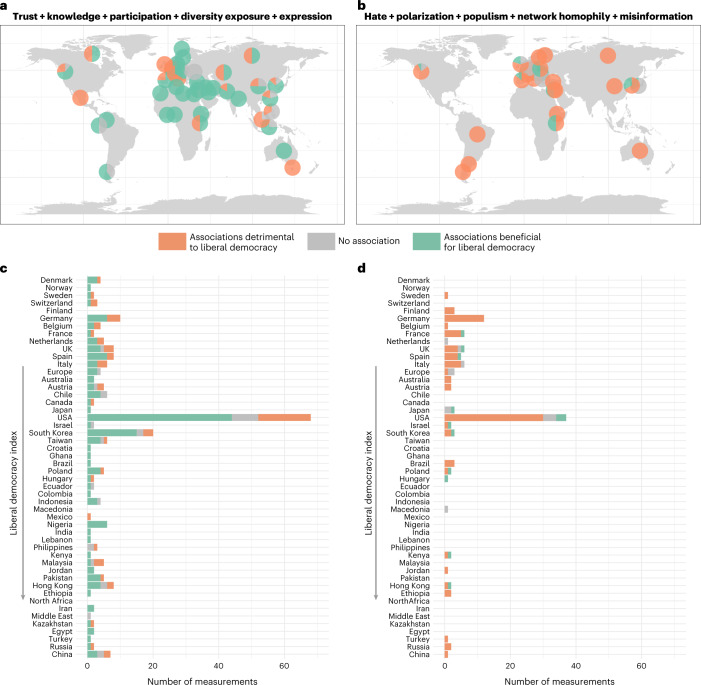
This systematic review synthesized 496 articles on digital media and democracy and found a mixed but concerning pattern: digital media is associated with more political participation and knowledge, but also with lower trust, more polarization, and more populism. The authors conclude that digital media is a double-edged sword whose effects depend on political context, with beneficial associations more common in emerging democracies and detrimental ones more pronounced in established democracies.
Key findings
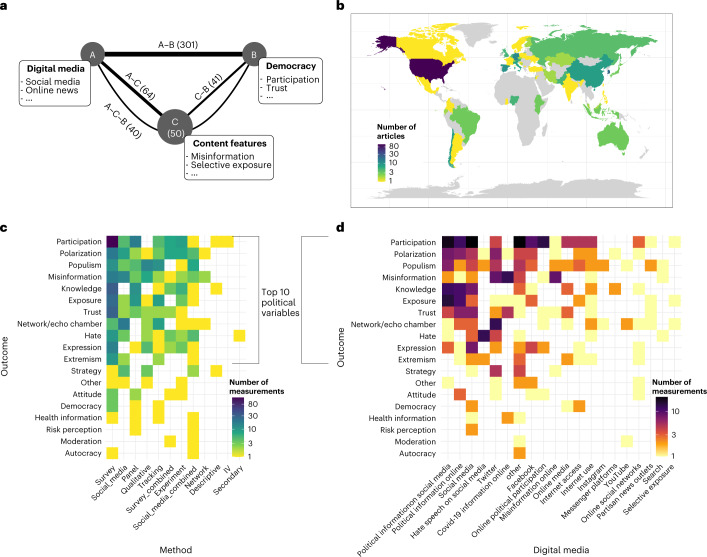
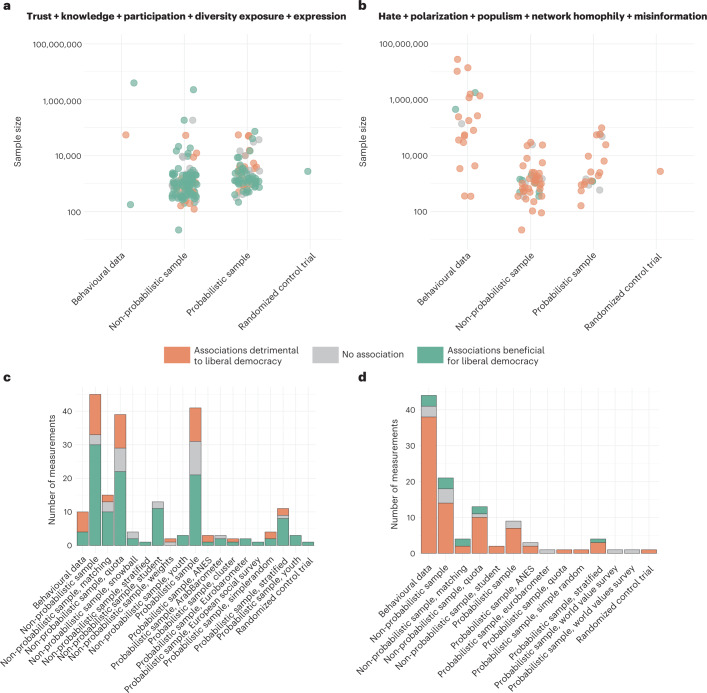
- The review included N = 496 articles; across the ten most frequently studied political variables, the authors counted N = 354 associations.
- Participation was mostly beneficial: correlational evidence and causal analyses generally found that digital media use is associated with increased political participation and mobilization, including voting, turnout, protest, and online participation.
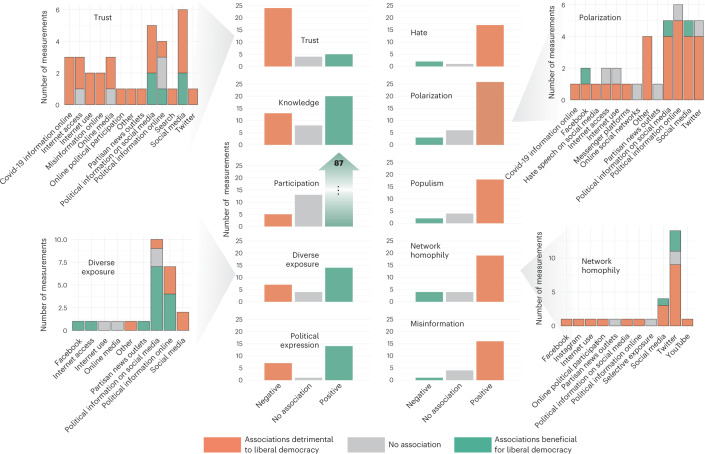
- Trust, polarization, and populism were mostly detrimental: the large majority of reported associations with trust were negative for democracy; most articles found detrimental associations for polarization; and panel surveys, tracking data, and linked survey/social media studies consistently found digital media use associated with higher populism.
- Political knowledge and news exposure were more often beneficial, but the evidence was less clear; the review also found that social media and search engines can diversify news diets, while social networks often become more ideologically homogeneous.
Methods
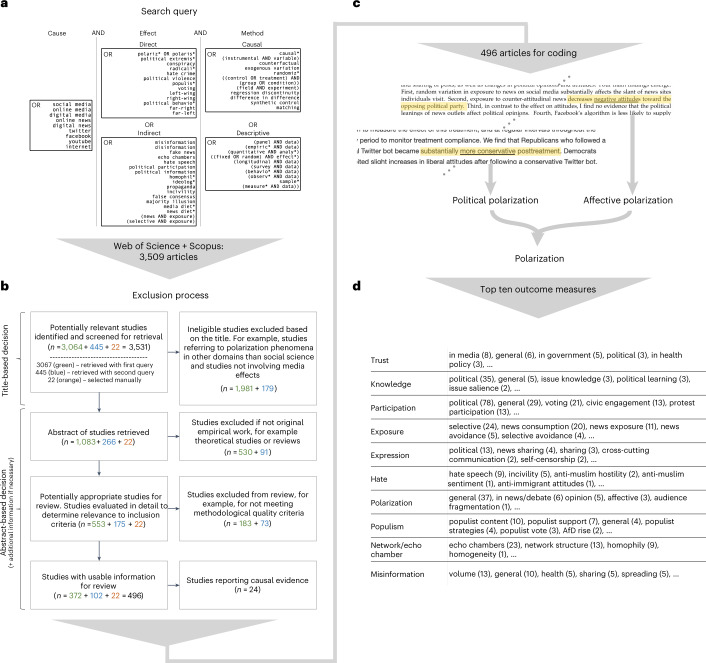
- Systematic review following MOOSE Guidelines; protocol was pre-registered on OSF and articles were searched in Scopus and Web of Science.
- Included only original, empirical, English-language journal articles published before 15 September 2021; excluded conceptual/theoretical work, simulations, small-N lab experiments, small-N student surveys (N < 100), and studies not examining effects of digital media on democracy.
- After screening 3,509 records and adding 22 articles from reference checking, the final sample was 496 articles; the authors used inductive coding of digital media and political outcome variables and, because of heterogeneous methods, did not calculate meta-analytic effect sizes.
Limitations
- The paper states that the evidence base was highly heterogeneous, so the authors had to collapse diverse variables into broad categories and could not make a quantitative comparison across the full sample.
- The authors note a limitation in baseline interpretation: for several outcomes there is no clear benchmark for what counts as desirable political behavior, especially for phenomena such as homophily, misinformation, hate speech, and exposure to diverse news.
- Evidence is likely uneven across topics and contexts: the review found unequal numbers of studies across outcomes, and it notes gaps such as under-studied regions (for example, Africa) and limited methods–variable combinations.
Model-written summary. Check it against the paper before relying on it.
Integrity signals
Registry
Cites
Statistics
Figures
Verification
Claims the paper makes
19 Valid · 5 Not valid · 42 Not checked · 132 Own results and interpretations
The cited sources support only part of this claim — read each source’s verdict below.
In the paper
“During the COVID-19 pandemic, digital media use was reported to be negatively associated with trust in vaccines85,86.”
§ A systematic review of worldwide causal and correlational evidence on digital media and democracy > Results > Effects on key political variables
What the sources say
- Partly supportedcites [85] Carrieri V Madio L Principe F Vaccine hesitancy and (fake) news: quasi-experimental evidence from Italy Health Econ. 2019 28 1377 1382 10.1002/hec.3937 31429153 PMC6851894 sourceExperimental — accuracy not yet measured
The Conclusions report that greater access to nontraditional media through broadband coverage was associated with lower child immunization rates in Italy after a 2012 court ruling. The Methods and Data section identifies the study period as 2006–2016. The paper does not report digital media use or trust in vaccines during the COVID-19 pandemic. (LLM, conf=0.87)
- Not checked — no full text of the sourcecites [86] Casara B Suitner C Bettinsoli M Viral suspicions: vaccine hesitancy in the web 2.0 J. Exp. Psychol. Appl. 2019 25 354 371 10.1037/xap0000211 30816729 source
plainstates an association- Asserted: passes — The authors put it forward as true.
- Checkable: passes — It can be checked against evidence.
- Load-bearing: unclear — It is unclear whether the paper’s conclusions depend on it.
- Based: passes — The paper gives a reason why it holds.
- Partly supported
Every source the paper cites for this claim was checked and supports it.
In the paper
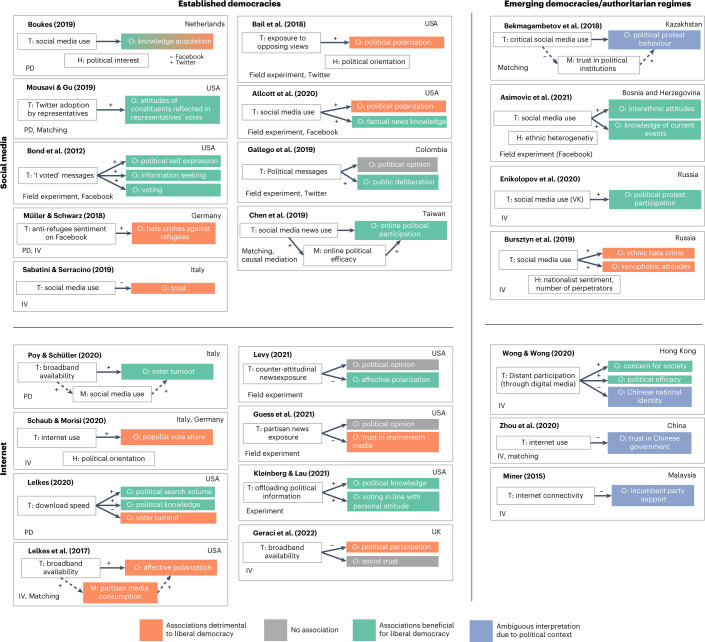
“A field experiment in the United States that set browser defaults to partisan media outlets37 found a long-term loss of trust in mainstream media.”
§ A systematic review of worldwide causal and correlational evidence on digital media and democracy > Results > Effects on key political variables
What the sources say
- Supportedcites [37] Guess AM Barberá P Munzert S Yang J The consequences of online partisan media Proc. Natl Acad. Sci. USA 2021 118 e2013464118 10.1073/pnas.2013464118 33782116 PMC8040813 source
The Discussion describes an intervention urging participants to set partisan news sites as browser homepages. The Results report reduced trust in mainstream media about five months later for both Fox News and HuffPost groups, with effects that appeared durable at one year, although the Fox News effect then fell short of conventional statistical significance. (LLM, conf=0.90)
plainstates a cause- Asserted: passes — The authors put it forward as true.
- Checkable: passes — It can be checked against evidence.
- Load-bearing: unclear — It is unclear whether the paper’s conclusions depend on it.
- Based: passes — The paper gives a reason why it holds.
- Supported
The sources with a verdict support this claim; the rest weren’t checked yet, have no full text we could read, or their verdicts aren’t rated yet.
In the paper
“Increasing polarization was also linked to exposure to viewpoints opposed to one’s own on social media feeds69,123.”
§ A systematic review of worldwide causal and correlational evidence on digital media and democracy > Results > Effects on key political variables
What the sources say
- Supportedcites [69] Bail CA Exposure to opposing views on social media can increase political polarization Proc. Natl Acad. Sci. USA 2018 115 9216 9221 10.1073/pnas.1804840115 30154168 PMC6140520 source
The Results report that Republicans exposed to opposing views through a Twitter bot expressed significantly more conservative views afterward, supporting the stated link. The effect among Democrats was not statistically significant; the Discussion cautions against generalizing the finding to all settings. (LLM, conf=0.88)
- Not checked yetcites [123] Kibet A Ward S Socially networked heterogeneity: the influence of WhatsApp as a social networking site on polarisation in Kenya Afr. Journal. Stud. 2018 39 42 66 source
Checked before — its earlier verdict is held back until a new check runs.
plainstates an association- Asserted: passes — The authors put it forward as true.
- Checkable: passes — It can be checked against evidence.
- Load-bearing: unclear — It is unclear whether the paper’s conclusions depend on it.
- Based: passes — The paper gives a reason why it holds.
- Supported
Every source the paper cites for this claim was checked and supports it.
In the paper
“This was also the case for an experimental treatment that exposed users to opposing views on Twitter69.”
§ A systematic review of worldwide causal and correlational evidence on digital media and democracy > Results > Effects on key political variables
What the sources say
- Supportedcites [69] Bail CA Exposure to opposing views on social media can increase political polarization Proc. Natl Acad. Sci. USA 2018 115 9216 9221 10.1073/pnas.1804840115 30154168 PMC6140520 source
The Abstract reports that Republicans expressed substantially more conservative views after following a bot sharing opposing views on Twitter. Democrats shifted slightly in the same polarizing direction, but that effect was not statistically significant; the claim does not assert an increase for every participant. (LLM, conf=0.88)
plainstates a cause- Asserted: passes — The authors put it forward as true.
- Checkable: passes — It can be checked against evidence.
- Load-bearing: passes — The paper’s conclusions depend on it.
- Based: passes — The paper gives a reason why it holds.
- Supported
The sources with a verdict support this claim; the rest weren’t checked yet, have no full text we could read, or their verdicts aren’t rated yet.
In the paper
“Most articles found detrimental associations between digital media and different forms of political polarization114–118.”
§ A systematic review of worldwide causal and correlational evidence on digital media and democracy > Results > Effects on key political variables
What the sources say
- Not checked — no full text of the sourcecites [114] Adam S Haussler T Schmid-Petri H Reber U Coalitions and counter-coalitions in online contestation: an analysis of the German and British climate change debate New Media 2019 21 2671 2690 10.1177/1461444819855966 source
- Supportedcites [115] North, S., Piwek, L. & Joinson, A. Battle for Britain: analyzing events as drivers of political tribalism in Twitter discussions of Brexit. Policy Internet13, 185–208 (2020). source
In Theoretical and Practical Implications (page unavailable), the authors report that political events triggered increases in tribalism on Twitter and that, over time, Twitter users became increasingly polarized. This supports the paper’s inclusion among articles finding a detrimental association; this single study does not itself establish the citing sentence’s count of “most articles.” (LLM, conf=0.87)
- Not checked — no full text of the sourcecites [116] Bryson B Polarizing the middle: internet exposure and public opinion Int. J. Sociol. Soc. Policy 2019 40 99 113 10.1108/IJSSP-09-2019-0181 source
- Not checked — no full text of the sourcecites [117] Lee C Shin J Hong A Does social media use really make people politically polarized? Direct and indirect effects of social media use on political polarization in South Korea Telemat. Inform. 2018 35 245 254 10.1016/j.tele.2017.11.005 source
- Supportedcites [118] Cho J Ahmed S Keum H Choi Y Lee J Influencing myself: self-reinforcement through online political expression Commun. Res. 2018 45 83 111 10.1177/0093650216644020 source
The Discussion (page unavailable) reports that greater use of social media for political expression was associated with opinions aligning more closely with party identification. It also suggests that online political expression may contribute to wider opinion polarization. This paper supports the cited sentence as one example; the count implied by “most articles” is the citing authors’ synthesis across sources. (LLM, conf=0.87)
plainstates an association- Asserted: passes — The authors put it forward as true.
- Checkable: passes — It can be checked against evidence.
- Load-bearing: passes — The paper’s conclusions depend on it.
- Based: passes — The paper gives a reason why it holds.
88 more claims · 5 with their cited sources checked
Create a free account to see all 198 claims and to verify the 32 references still open.
- Probably not a substantial claim. 66
- It may state two separate claims as one. 47
Claims other papers make about this one
Each is checked against this paper’s own text: does it say what the citing paper says it does?
The source backs part of the claim, not all of it — or backs it for a different population, condition or comparison.
In the citing paper
“The use of this power to generate commercial revenue for social media platforms, for example, has contributed to the rise in polarisation and extremist views observed in many parts of the world.21”
From Threats by artificial intelligence to human health and human existence (2023) · cites this paper as [21]
Experimental — accuracy not yet measuredThe cited source says what the claim attributes to it.
In the citing paper
“Affective polarization: which captures the degree of emotional divides between groups, such as hostility or negative sentiments toward opposing ideologies [4] was studied by many studies that focused on group or user behavior.”
From A systematic review of echo chamber research: comparative analysis of conceptualizations, operationalizations, and varying outcomes (2025) · cites this paper as [4]
In the citing paper
“Moreover, recent research suggests that the psychological impact of social media appears to be very different in the Global North versus the Global South (Ghai et al. 2023), or in established democracies versus less-established democracies (Lorenz-Spreen et al. 2023).”
From Social Media and Morality. (2024) · cites this paper as Lorenz-Spreen et al. 2023
Self-check
Percentages, sums and reported differences re-computed from the paper’s own numbers.
Self-check results appear here once an independent check has confirmed them.
Cited works that were retracted
Works this paper cites that were later retracted, from the retraction notices publishers deposit. Major when the notice came out before this paper was published.
A note, not an issue: for example, a cited work that was retracted only after this paper was published, which its authors could not have known.
In the paper
“Germani, F. & Biller-Andorno, N. The anti-vaccination infodemic on social media: a behavioral analysis. PLoS ONE 16, e0247642 (2021).”
Cited work 10.1371/journal.pone.0247642 · retracted 2022-12-22 · notice 10.1371/journal.pone.0279796 · this paper published 2022-11-07
Citations
Cites
1 retracted
The anti-vaccination infodemic on social media: A behavioral analysis
Germani, F., & Biller-Andorno, N. (2021) · PLOS ONE · doi:10.1371/journal.pone.0247642 · Cited by 316
RetractedPreferred Reporting Items for Systematic Reviews and Meta-Analyses: The PRISMA Statement
Moher, D., Liberati, A., Tetzlaff, J., Altman, D. G., & The PRISMA Group (2009) · PLoS Medicine · doi:10.1371/journal.pmed.1000097 · Cited by 64,042
Preferred reporting items for systematic reviews and meta-analyses: The PRISMA statement
Moher, D., Liberati, A., Tetzlaff, J., Altman, D. G., & the PRISMA Group* (2009) · Annals of Internal Medicine · doi:10.7326/0003-4819-151-4-200908180-00135 · Cited by 37,554
Mostly Harmless Econometrics: An Empiricist's Companion
Angrist, J. D., & Pischke, J.-S. (2009) · doi:10.1515/9781400829828 · Cited by 9,467
Social Media and Fake News in the 2016 Election
Allcott, H., & Gentzkow, M. (2017) · Journal of Economic Perspectives · doi:10.1257/jep.31.2.211 · Cited by 6,767
Mostly Harmless Econometrics: An Empiricist's Companion
Angrist, J. D., & Pischke, J.-S. (2008) · doi:10.2307/j.ctvcm4j72 · Cited by 5,051
A general approach to causal mediation analysis.
Imai, K., Keele, L., & Tingley, D. (2010) · Psychological Methods · doi:10.1037/a0020761 · Cited by 4,143
The Origins and Consequences of Affective Polarization in the United States
Iyengar, S., Lelkes, Y., Levendusky, M., Malhotra, N., & Westwood, S. J. (2019) · Annual Review of Political Science · doi:10.1146/annurev-polisci-051117-073034 · Cited by 3,603 · cited 1×
“Participation political (78), general (29), voting (21), civic engagement (13), protest participation (13), .”
BackgroundA 61-million-person experiment in social influence and political mobilization
Bond, R. M., Fariss, C. J., Jones, J. J., Kramer, A. D. I., Marlow, C., Settle, J. E., & Fowler, J. H. (2012) · Nature · doi:10.1038/nature11421 · Cited by 2,575
Gusenbauer, M., & Haddaway, N. R. (2020) · Research Synthesis Methods · doi:10.1002/jrsm.1378 · Cited by 2,379
Research works printed but not linked: 44
- Habermas J Überlegungen und hypothesen zu einem erneuten strukturwandel der politischen öffentlichkeit Leviathan 2021 470 470 500
- Coppedge, M. et al. Varieties of Democracy: Measuring Two Centuries of Political Change (Cambridge Univ. Press, 2020).
- The Sveriges Riksbank Prize in Economic Sciences in Memory of Alfred Nobel 2021 (NobelPrize.org, 2022). 23367862
- Placek M Can the internet aid democratic consolidation? Online news and legitimacy in Central and Eastern Europe Int. J. Commun. 2018 12 2810 2831
- Min, G., Yu, Z. & Li, F. Analysis of moral deviation in netnews post-bumping. In Proc. 12th International Conference on Innovation and Management (eds Wang, Y. & Xu, H.) 1222–1226 (Wuhan University of Technology Press, 2015).
- Alam A Adnan HM Kotamjani SS Examining the impact of using social networks on political knowledge and political attitude by iranian university students J. Komun. Malays. J. Commun. 2019 35 125 140
- Doroshenko L Far-right parties in the European Union and media populism: a comparative analysis of 10 countries during European Parliament elections Int. J. Commun. 2018 12 3186 3206
- Barnidge M Macafee T Alvarez G Rojas H Citizenship and political participation in Colombia: how orientations toward citizenship associate with political and civic behaviors Int. J. Commun. 2014 8 1831 1850
- Kubin E von Sikorski C The role of (social) media in political polarization: a systematic review Ann. Int. Commun. Assoc. 2021 45 188 206
- Park I Lee D Understanding news-sharing across different platforms: the effects of newsworthiness and gratifications from news-sharing Inf. Res. 2020 25 882
- Machackova H Tkaczyk M The effect of media and political beliefs and attitudes on trust in political institutions: a multilevel analysis on data from 21 European countries. Commun. Today 2020 11 64 82
- Kwak N Lane DS Zhu Q Lee SS Weeks BE Political rumor communication on instant messaging platforms: relationships with political participation and knowledge Int. J. Commun. 2020 14 5663 5685
- Powers E Koliska M Guha P ‘Shouting matches and echo chambers’: perceived identity threats and political self-censorship on social media Int. J. Commun. 2019 13 3630 3649
- Adegbola O Gearhart S Examining the relationship between media use and political engagement: a comparative study among the United States, Kenya, and Nigeria Int. J. Commun. 2019 13 1231 1251
- Liu Y-I Online and offline communication and political knowledge and participation in presidential campaigns: effects of geographical context Int. J. Commun. 2019 13 1438 1461
- Wen N Wei R Examining effects of informational use of social media platforms and social capital on civic engagement regarding genetically modified foods in China Int. J. Commun. 2018 12 3729 3750
- Quenette AM Velasquez A Shifting demographics: understanding how ethnically diverse networks influence Latinos’ political uses of social media and offline political engagement Int. J. Commun. 2018 12 4839 4859
- Zhang N Skoric MM Media use and environmental engagement: examining differential gains from news media and social media Int. J. Commun. 2018 12 380 403
- Kim Y Chen H-T Discussion network heterogeneity matters: examining a moderated mediation model of social media use and civic engagement Int. J. Commun. 2015 9 2344 2365
- Popova, O. & Negrov, E. Political communication of youth in the internet space: effects on influence on political consciousness and behavior. In Proc. International Conference "Internet and Modern Society" Vol. 2813 (eds Bolgov. R. V. et al.) 181–195 (RWTH Aachen Univ., 2021).
- Serhan F Elareshi M New media and hate speech: a study of university students in Jordan Opcion 2020 36 166 184
- Riikonen, R., Huhtinen, A.-M. & Norri-Sederholm, T. Not a problem for me: young men’s conceptions of their social media use and false information. In Proc. 7th European Conference on Social Media (eds Karpasitis, C. & Varda, C.) 240–245 (Academic Conferences International, 2020). https://www.scopus.com/inward/record.uri?eid=2-s2.0-85097756848&doi=10.34190%2fESM.20.031&partnerID=40&md5=debc7038da814e1795cf153561edf5a3 · doi:10.34190/esm.20.031
- Kim H Kim Y Lee D Understanding the role of social media in political participation: integrating political knowledge and bridging social capital from the social cognitive approach Int. J. Commun. 2020 14 4803 4824
- Steffan D Visual self-presentation strategies of political candidates on social media platforms: a comparative study Int. J. Commun. 2020 14 3096 3118
- Jones M Propaganda, fake news, and fake trends: the weaponization of Twitter bots in the Gulf crisis Int. J. Commun. 2019 13 1389 1415
- Emamjomehzadeh S Masoudnia H Rahbarqazi M The role of online social media in peoples political orientations and tendency to participate in presidential elections Teor. Praksa 2018 55 666 683
- Mohamad B Dauda S Halim H Youth offline political participation: trends and role of social media J. Komun. Malays. J. Commun. 2018 34 172 192
- Lee S The role of social media in protest participation: the case of candlelight vigils in South Korea Int. J. Commun. 2018 12 1523 1540
- Olise F Level of Acceptance of News Stories on Social Media Platforms Among Youth in Nigeria J. Komun. Malays. J. Commun. 2021 37 210 225
- Santini R Salles D Tucci G When machine behavior targets future voters: the use of social bots to test narratives for political campaigns in Brazil Int. J. Commun. 2021 15 1220 1243
- Choi J Cross-cutting scanning, integrating, and interacting: dimensions of cross-cutting exposure on social media and political participation Int. J. Commun. 2021 15 1595 1616
- Gerosa T Gui M Hargittai E Nguyen M (Mis)informed during COVID-19: how education level and information sources contribute to knowledge gaps Int. J. Commun. 2021 15 2196 2217
- Sihombing SO Pramono R The integration of social media to the theory of planned behavior: a case study in Indonesia J. Asian Finance Econ. Bus. 2021 8 445 454
- van Erkel PFA Van Aelst P Why dont we learn from social media? Studying effects of and mechanisms behind social media news use on general surveillance political knowledge Polit. Commun. 2021 38 407 425 10.1080/10584609.2020.1784328 · DOI · Paper page
- Miao H Media use and political participation in China: taking three national large-n surveys as examples Asian J. Public Opin. Res. 2019 7 1 22
- Jeroense T Luimers J Jacobs K Spierings N Political social media use and its linkage to populist and postmaterialist attitudes and vote intention in the Netherlands Eur. Polit. Sci. 2022 21 193 215 10.1057/s41304-020-00306-6 · DOI · Paper page
- Levy R Social media, news consumption, and polarization: evidence from a field experiment Am. Econ. Rev 2021 111 831 870 10.1257/aer.20191777 · DOI · Paper page
- Bryson BP Polarizing the middle: internet exposure and public opinion Int. J. Sociol. Soc. Policy 2020 40 99 113 10.1108/IJSSP-09-2019-0181 · DOI · Paper page
- Schumann S Boer D Hanke K Liu J Social media use and support for populist radical right parties: assessing exposure and selection effects in a two-wave panel study Inf. Commun. Soc. 2021 24 921 940 10.1080/1369118X.2019.1668455 · DOI · Paper page
- Lee S Xenos M Incidental news exposure via social media and political participation: evidence of reciprocal effects New Media Soc. 2022 24 178 201 10.1177/1461444820962121 · DOI · Paper page
- Imran, M. S., Fatima, M. & Kosar, G. Connectivism: e-learning of democratic values on social media public spheres. In 2017 International Conference on Information and Communication Technologies (ICICT) 82–89 (IEEE, 2017). · DOI · Paper page
- Yarchi M Baden C Kligler-Vilenchik N Political polarization on the digital sphere: a cross-platform, over-time analysis of interactional, positional, and affective polarization on social media Polit. Commun. 2021 38 98 139 10.1080/10584609.2020.1785067 · DOI · Paper page
- Strauß N Huber B Gil de Zúñiga H Yes, I saw it – but didn’t read it…” a cross-country study, exploring relationships between incidental news exposure and news use across platforms Digit. Journal. 2020 8 1181 1205 · DOI · Paper page
- Mueller K Schwarz C Fanning the flames of hate: social media and hate crime J. Eur. Econ. Assoc. 2021 19 2131 2167 10.1093/jeea/jvaa045 · DOI · Paper page
Cited by
Items 301–347 of 347
Kozyreva, A., Lorenz-Spreen, P., Herzog, S., Ecker, U., Lewandowsky, S., Hertwig, R., Ali, A., Bak-Coleman, J., Barzilai, S., Basol, M., et al. (2024) · MPG.PuRe (Max Planck Society)
Self-citationChen, Q., Pamirzad, Q. H., & Nabil, N. A. (2026) · Journal of Information Technology & Politics · doi:10.1080/19331681.2026.2680315
La polarisation, poison des démocraties
Gauvrit, N. (2026) · Cerveau & Psycho · doi:10.3917/cerpsy.188.0034
Chiriatti, A., Castiglioni, F., & Conrad, M. (2026) · De Gruyter eBooks · doi:10.1515/9783112222874-009
Digital Democracy Platforms and Participatory Outcomes: Scoping Review with ☸️SAIMSARA
SAIMSARA (2026) · SAIMSARA Journal · doi:10.62487/saimsara83270bae
Exposure to news and political content on TikTok: A Case Study Around the 2024 US Election
Ge, C., Gautam, N., Vajjhala, S., Ng, C., Hasell, A., & Tomkins, S. (2026) · ACM Conference on Fairness, Accountability, and Transparency (FAccT) · doi:10.1145/3805689.3812207 · Cited by 1
“However, the political information people are exposed to in social media is often more politically partisan and less factually accurate than information produced by professional news organizations, contributing to rising distrust in democratic institutions [8, 40].”
Xin, J., & Zhang, H. (2026) · Complexity · doi:10.1155/cplx/4899778
Kiddle, R., Kroon, A. C., Welbers, K., & Trilling, D. (2026) · New Media & Society · doi:10.1177/14614448261445423 · Cited by 2
Wie dezentrale Social-Media-Plattformen künftig eine unabhängige Alternative bieten können
Staschen, B., Foerster, S., Freihse, C., et al. (2026) · Springer eBooks · doi:10.1007/978-3-658-51771-7_8
null, D. (2026) · Science Development · doi:10.11648/j.scidev.20260702.17
The good, the bad, and the obscure: Exploring uses of generative AI in the global 2024 elections
Gulbrandsen, I. T., Just, S. N., & Peters, C. (2026) · New Media & Society · doi:10.1177/14614448261445574 · Cited by 1
Tang, R., Burnley, B. R., & Vraga, E. K. (2026) · New Media & Society · doi:10.1177/14614448261448547
Disinformation, Democracy and the Myth of the Informed Citizen
Dolan, C. (2026) · Revista de Estudios Globales Análisis Histórico y Cambio Social · doi:10.6018/reg.721501
From infodemics to collective resistance: populist mobilisation and health consequences
Wang, Y. (2026) · Health Economics Policy and Law · doi:10.1017/s1744133126100589
Emotions, social media, and politics: a scoping review
Kaskeleviciute, R., Nanz, A., Dietrich, I., & Matthes, J. (2026) · Annals of the International Communication Association · doi:10.1093/anncom/wlag035 · Cited by 1
Bodroža, B. (2026) · Springer eBooks · doi:10.1007/978-3-031-52643-5_56-1
A Community Data Trustee for Sensitive Data Sharing in Far-Right Online Research
Rau, J. P., Jungmann, N., Fürneisen, M., Wiedemann, G., Schulze, H., & Siegers, P. (2026) · Media and Communication · doi:10.17645/mac.11946
“Research attention has shifted from early hopes of online democratization (Castells, 2013) toward concerns over polarization, disinformation, and the increasing visibility and activity of extremist movements online, particularly the far‐right (Lorenz‐Spreen et al., 2023).”
1192.5 Online Political Participation in Elections: A Longitudinal Case Study of Denmark 2007–22
Jensen, J. L. (2026) · De Gruyter eBooks · doi:10.1515/9783111386034-011
Wirkungen politischer Kommunikation
Lübke, S., & Haßler, J. (2026) · Springer eBooks · doi:10.1007/978-3-658-46851-4_20-1
The Trust Erosive Effects of Cyberattacks
Moreno, M. O., & Haarkötter, H. (2026) · Medien - Aufklärung - Kritik · doi:10.1007/978-3-658-52212-4_2
Pleasure, Z. H., Pleasants, E., Danaux, J., Hassan, A., Scales, D. A., Gómez, A. M., & Kavanaugh, M. L. (2026) · Contraception · doi:10.1016/j.contraception.2026.111570 · Cited by 1
Cedeño-Cedeño, N. C. (2026) · Innova Science Journal · doi:10.63618/omd/isj/v4/n3/343
Minimizing Misinformation Spread Through Targeted Prebunking in Social Networks
Furutani, S., Shibahara, T., Akiyama, M., & Aida, M. (2026) · IEEE Transactions on Network Science and Engineering · doi:10.1109/tnse.2026.3719287 · Cited by 1
“The spread of misinformation distorts elections by manipulating individual opinions and fueling political polarization, thereby undermining the integrity of democratic systems [1], [2].”
Boulianne, S., & Earl, J. (2026) · Science Advances · doi:10.1126/sciadv.aea8409
“We also include statistics about whether relationships were positive or negative (see table A2), following other meta-analyses ( 50 ).”
Mapping Global Digital Political Inequality
Lane, D. S., Gagrčin, E., & Pan, Y. Q. (2026) · Cambridge University Press eBooks · doi:10.1017/9781009514187
Toward a nuanced understanding of internet use and trust in local government in the Chinese context
Liu, C., & Liu, H. (2026) · Telecommunications Policy · doi:10.1016/j.telpol.2026.103297
The Returns to Viral Media: The Case of US Campaign Contributions
Boeken, J., Draca, M., Mastrorocco, N., & Ornaghi, A. (2026) · Journal of the European Economic Association · doi:10.1093/jeea/jvag045 · Cited by 1
Advancing AI , Virtue Enhancement, and the Need for Niebuhrian Virtues of Moral Vigilance
Peterson, G. R. (2026) · Journal of Religious Ethics · doi:10.1111/jore.70029
Bonin, H. (2026) · International Political Science Review · doi:10.1177/01925121261466179
Twi-XL: An Infrastructure for Cross-Media Research in the Netherlands
Maxwell-Fraser, D. A., Baas, I. M., Burkhardt, S., Eisele, O., Kroon, A. C., Bood, R. J., Geldermans, I., Ham, S., Jansen, M., Klein, R., et al. (2026) · Media and Communication · doi:10.17645/mac.12018
“Over the last decades, various social and cultural phenomena such as polarization, radicalization, and activist movements have been researched and understood in connection with the rise of digital media (Lorenz‐Spreen et al., 2022; van Dijck et al., 2018).”
Zavala, F. O. M., Cedeño, R. N. M., Cedeño, J. F. M., et al. (2026) · Ciencia Interdisciplinaria Internacional · doi:10.70577/cieninter.v4i3.61
Napoli, P. M., Caplan, R., & Rogerson, K. (2026) · De Gruyter eBooks · doi:10.1515/9783111317595-001
Jensen, K. S., Hansen, T. M., Rasmussen, J. S., Karg, S. T., Cook, J., Walker, I., & Lindekilde, L. E. (2026) · Journal of Information Technology & Politics · doi:10.1080/19331681.2026.2720554 · Cited by 1
Naranjo-Vinueza, A., Martín, S. C., González, M. C., & Moreno, P. N.-B. (2026) · Frontiers in Political Science · doi:10.3389/fpos.2026.1850023
Comparación de dietas artesanales (FEDNA/ Brasileñas) y comercial en pollos en crecimiento
Lucero, D. N. A., Castro, A. E. B., Yagual, M. B. F., et al. (2026) · Ciencia Interdisciplinaria Internacional · doi:10.70577/cieninter.v4i3.73
Lefevere, J., Matthieu, J., & Jacobs, L. (2026) · Electoral Studies · doi:10.1016/j.electstud.2026.103129
Engaging citizens? The role of negativity and incivility on politicians’ social media
Muraille, J., & Poljak, Ž. (2026) · Acta Politica · doi:10.1057/s41269-026-00430-z
Do algorithmic information environments mark the end of media effects research?
Freiling, I., Ohme, J., Villanueva, I. I., & Scheufele, D. A. (2026) · Annals of the International Communication Association · doi:10.1093/anncom/wlag042
Algorithmisierte Medienumgebungen
Kümpel, A. S., & Fischer, M. (2026) · Springer eBooks · doi:10.1007/978-3-658-46851-4_33-1
Toward an integrated and globally equitable understanding of political polarization
Falkenberg, M., Cinelli, M., Galeazzi, A., Bail, C. A., Benito, R. M., Bruns, A., Gruzd, A. A., Lazer, D., Lee, J. K., McCoy, J., et al. (2026) · Nature Communications · doi:10.1038/s41467-026-76110-5 · Cited by 16
“…for recent trends in polarization – claims of social media ’ s negative impacts are often anecdotal, or based on correlational evidence 120 , and there are substantial differences across countries in the extent to which social…”
Does Listening to Trustworthy News Affect Political Attitudes and Trust?
Barberá, P., Guess, A. M., Munzert, S., & Yang, J. (2026) · Political Behavior · doi:10.1007/s11109-026-10193-0
In Real Life: How Online Communities Shape Society Offline
Oksanen, A., Celuch, M., Oksa, R., & Savolainen, I. (2026) · Springer eBooks · doi:10.1007/978-3-031-52643-5_77-1
Algorithmic systems, human agency and the future of platform research
Hosseinmardi, H., Dutta, U., Rothschild, D. M., & Watts, D. J. (2026) · Nature Computational Science · doi:10.1038/s43588-026-01038-1
Popping misinformation bubbles: persona-informed style-based messaging in Facebook ad experiments
Lee, J., Booth, E., Farid, H., & Rizoiu, M.-A. (2026) · Journal of Computational Social Science · doi:10.1007/s42001-026-00493-0
“Digital media, more generally, have already had widespread political impacts: Lorenz-Spreen et al. [7 ] find both correlational and causal evidence that the introduction of digital media into established democracies, such as the United States, contributes to the “declining political trust,…”
Digital Populism and Elections in Brazil
Cesarino, L. (2026) · Springer eBooks · doi:10.1007/978-3-031-77500-0_26-1
Strategic Social Media Management for NGOs
Danyi, C. J., & Chaudhri, V. A. (2026) · Springer eBooks · doi:10.1007/978-981-10-7035-8_72-2
ICT development and youth civil-political participation: global evidence (2010–2022)
Ko, J., Xin, C., Kelly, A. M., et al. (2026) · International Journal of Adolescence and Youth · doi:10.1080/02673843.2026.2740734
Metadata
- Authors
- Lorenz-Spreen, P., Oswald, L., Lewandowsky, S., & Hertwig, R.
- Affiliations
- Max Planck Institute for Human Development (DE)
- Hertie School (DE)
- The University of Western Australia (AU)
- Corresponding author
- Lorenz-Spreen, Philipp
- Venue
- Nature Human Behaviour
- Published
- 2022-11-07
- Volume
- 7
- Issue
- 1
- Pages
- 74-101
- ISSN
- 2397-3374 (ISSN-L)
- PMC
- PMC9883171
- OpenAlex
- W4308433048
- Cited by
- 348
- References
- 526
- Citations by year
- 2026: 109 · 2025: 90 · 2024: 70 · 2023: 72 · 2022: 7
- FWCI
- 15.09
- Type
- journal article
- Language
- en
- Open access
- hybrid
- doi.org
- Licence
- cc-by
- creativecommons.org/licenses/by/4.0 (tdm)
- creativecommons.org/licenses/by/4.0 (vor)
- Locations
- Nature Human Behaviour (publishedVersion, cc-by)
- PubMed Central (publishedVersion, cc-by)
- PubMed (publishedVersion)
- Bristol Research (University of Bristol) (publishedVersion, cc-by)
- OPUS 4 (Zuse Institute Berlin) (submittedVersion)
- UWA Profiles and Research Repository (UWA) (submittedVersion, cc-by)
- Explore Bristol Research (submittedVersion, cc-by)
- Funders
- Alexander von Humboldt-Stiftung
- Volkswagen Foundation
- Max-Planck-Gesellschaft
- Studienstiftung des Deutschen Volkes
- Topics
- Social Sciences › Communication › Social Media and Politics
- Social Sciences › Sociology and Political Science › Media Influence and Politics
- Social Sciences › Sociology and Political Science › Misinformation and Its Impacts
- Keywords
- digital media, democracy, political participation, public trust in government, populism, political polarization, information consumption, authoritarian regimes, new democracies, advanced democracies, digital media regulation
- MeSH terms
- Democracy, Government, Humans, Politics, Causality, Internet
About these checks
Registry, retraction, Cites and statistics results are computed, not judged, with one exception: a printed reference that no index lists is read once by a model before it counts as a citation error. Claims are extracted by a model and kept only when their quote appears verbatim in the text; each cited source is then checked, with a model’s help, for whether it says what the claim relies on. Those verdicts can be wrong — read the claim’s quote and the cited source before relying on one.
The claim verdicts this report counts are experimental: their accuracy is not yet measured.
A language model drew the claims from the paper on 2026-10-10, under version 3 of the claim definition (model deepseek-v4.1-flash, prompt extract-v3).
A second model labelled each claim on 2026-10-10 (model jev-1.13-20260917, definition revision gold-guideline-v0.2).
Cited sources are checked with a language model’s help (gpt-6-sol).
Statistics and arithmetic are recomputed, not judged.
Confidence bands are shown only for fields calibrated on our annotated test set. None is calibrated yet, so no band is shown.
What counts as a claim ›How we measure confidence ›How we check this ›
Are you an author, or do you see a problem with this page? Request a review
Data sources
Bibliographic data: Semantic Scholar, OpenAlex, Crossref.
Contains information from the Semantic Scholar Academic Graph Datasets, made available under the ODC Attribution License (ODC-BY 1.0).
Semantic Scholar’s data is described in: Kinney, R., et al. (2023). The Semantic Scholar Open Data Platform. arXiv:2301.10140.
