

Gut microbiome signatures of vegan, vegetarian and omnivore diets and associated health outcomes across 21,561 individuals
Open accessThe DOI matches its Crossref record; 61 of the 61 references it cites were found in a registry or an index.
Abstract
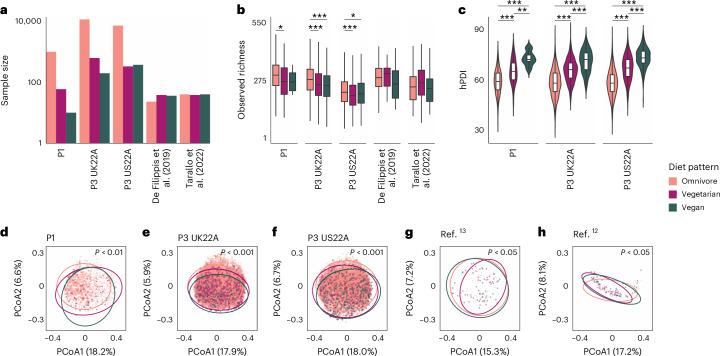
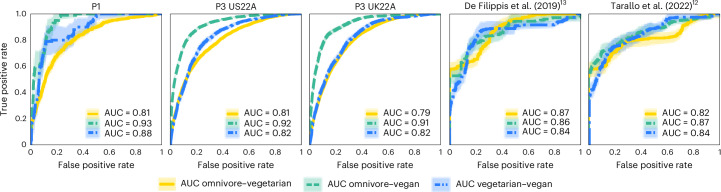
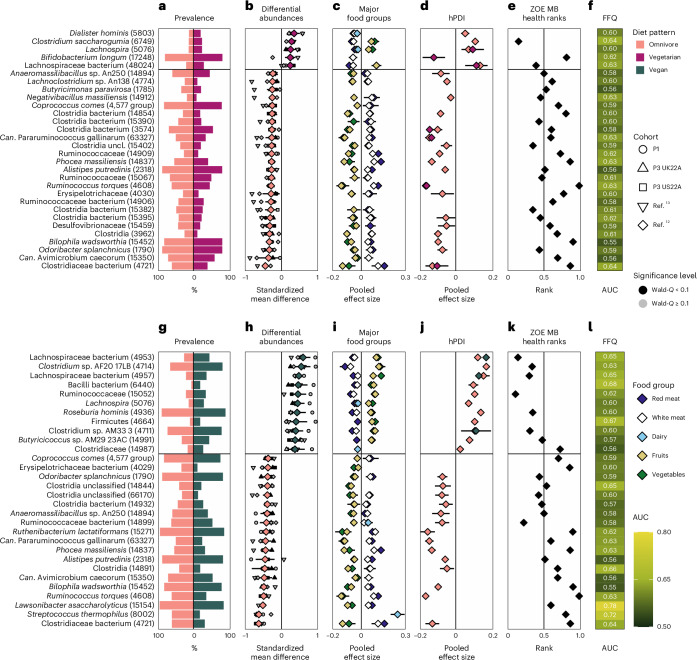
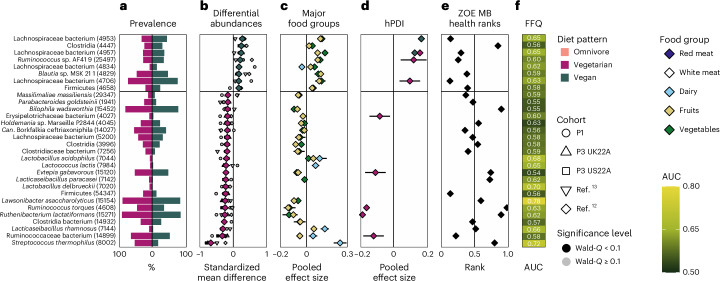
As plant-based diets gain traction, interest in their impacts on the gut microbiome is growing. However, little is known about diet-pattern-specific metagenomic profiles across populations. Here we considered 21,561 individuals spanning 5 independent, multinational, human cohorts to map how differences in diet pattern (omnivore, vegetarian and vegan) are reflected in gut microbiomes. Microbial profiles distinguished these common diet patterns well (mean AUC = 0.85). Red meat was a strong driver of omnivore microbiomes, with corresponding signature microbes (for example, Ruminococcus torques , Bilophila wadsworthia and Alistipes putredinis ) negatively correlated with host cardiometabolic health. Conversely, vegan signature microbes were correlated with favourable cardiometabolic markers and were enriched in omnivores consuming more plant-based foods. Diet-specific gut microbes partially overlapped with food microbiomes, especially with dairy microbes, for example, Streptococcus thermophilus , and typical soil microbes in vegans. The signatures of common western diet patterns can support future nutritional interventions and epidemiology.
Overview
The claims and statistics of this paper haven’t been checked yet.
Free: it reads the open-access text and checks the first 5 claims that cite a source we can check. Create a free account to check every claim.
Integrity signals
Registry
Cites
Statistics
Figures
Verification
Claims the paper makes
The claims and statistics of this paper haven’t been checked yet.
Free: it reads the open-access text and checks the first 5 claims that cite a source we can check. Create a free account to check every claim.
Claims other papers make about this one
Each is checked against this paper’s own text: does it say what the citing paper says it does?
The cited source doesn’t support the claim as written.
In the citing paper
“A recent study of ∼24,000 participants found individuals who consumed both meat and plants had higher levels of Alistipes putredinis, Bilophila wadsworthia, and Roseburia torques, all of which have been linked to inflammatory bowel disease and an overall decrease in SCFAs.”
From Microbiota-centered interventions to boost immune checkpoint blockade therapies (2025) · cites this paper as Fackelmann et al., 2025
Checked by a reasoning model — may be wrong.
Experimental — accuracy not yet measuredIn the citing paper
“Western-style, high-fat, animal-based diets promote bile-tolerant, pro-inflammatory taxa (e.g., Alistipes, Bilophila wadsworthia, R. torques), reduce diversity, deplete Prevotella, and expand Proteobacteria, driving barrier dysfunction, endotoxemia, and chronic inflammation.77–80”
From Gut dysbiosis in oncology: a risk factor for immunoresistance (2026) · doi:10.1038/s41422-025-01212-6 · cites this paper as [79]
In the citing paper
“In contrast, participants who adhered to a vegan diet had higher abundance of species in the Lachnospiraceae family, Butyricicoccus spp., and Roseburia hominis, all of which have roles in fiber degradation and SCFA production (Fackelmann et al., 2025).”
From Microbiota-centered interventions to boost immune checkpoint blockade therapies (2025) · cites this paper as Fackelmann et al., 2025
Self-check
Percentages, sums and reported differences re-computed from the paper’s own numbers.
The self-check needs the paper’s full text.
Citations
Cites
Food in the Anthropocene: the EAT–Lancet Commission on healthy diets from sustainable food systems
Willett, W., Rockström, J., Loken, B., Springmann, M., Lang, T., Vermeulen, S., Garnett, T., Tilman, D., DeClerck, F., Wood, A., et al. (2019) · The Lancet · doi:10.1016/s0140-6736(18)31788-4 · Cited by 10,880 · cited 3×
“Consequently, there is increased interest in diets with higher fractions of plant-based foods that decrease both risk of disease and negative environmental impacts 2,4 .”
Afshin, A., Sur, P. J., Fay, K. A., Cornaby, L., Ferrara, G., Salama, J. S., Mullany, E. C., Abate, K. H., Abbafati, C., Abebe, Z., et al. (2019) · The Lancet · doi:10.1016/s0140-6736(19)30041-8 · Cited by 5,811 · cited 1×
“Globally, poor diets low in unprocessed, plant-based foods cause more deaths than any other risk factor, with cardiovascular disease, cancers and type 2 diabetes as the leading causes of diet-related deaths 1 .”
Gut microbiota in human metabolic health and disease
Fan, Y., & Pedersen, O. (2021) · Nature Reviews Microbiology · doi:10.1038/s41579-020-0433-9 · Cited by 4,724 · cited 4×
“These species have been previously implicated in inflammatory diseases such as inflammatory bowel disease, colorectal cancer and an overall decrease in SCFAs, and were more likely to be associated with negative cardiometabolic health outcomes 19–21 .”
InfluentialEnvironment dominates over host genetics in shaping human gut microbiota
Rothschild, D., Weissbrod, O., Barkan, E., Kurilshikov, A., Korem, T., Zeevi, D., Costea, P. I., Godneva, A., Kalka, I. N., Bar, N., et al. (2018) · Nature · doi:10.1038/nature25973 · Cited by 2,859 · cited 1×
“1d–h and Supplementary Table 8 with additional distance metrics; Methods), with the variation in beta diversity explained by diet pattern aligning with previous studies 16 .”
Gut microbiome and health: mechanistic insights
de Vos, W. M., Tilg, H., Van Hul, M., & Cani, P. D. (2022) · Gut · doi:10.1136/gutjnl-2021-326789 · Cited by 2,388 · cited 6×
“For example, the breakdown of certain animal proteins is linked to the synthesis of gut microbial trimethylamine (TMA), which is oxidized in the liver to trimethylamine N-oxide (TMAO) 6 .”
InfluentialMicrobial degradation of complex carbohydrates in the gut
Flint, H. J., Scott, K. P., Duncan, S. H., Louis, P., & Forano, E. (2012) · Gut Microbes · doi:10.4161/gmic.19897 · Cited by 2,331
Beghini, F., McIver, L. J., Blanco-Míguez, A., Dubois, L., Asnicar, F., Maharjan, S., Mailyan, A., Manghi, P., Scholz, M., Thomas, A. M., et al. (2021) · eLife · doi:10.7554/elife.65088 · Cited by 2,303
Self-citation(2020) · doi:10.1101/2020.11.19.388223 · Cited by 2,303
Pasolli, E., Asnicar, F., Manara, S., Zolfo, M., Karcher, N., Armanini, F., Beghini, F., Manghi, P., Tett, A., Ghensi, P., et al. (2019) · Cell · doi:10.1016/j.cell.2019.01.001 · Cited by 1,591
Self-citationBlanco-Míguez, A., Beghini, F., Cumbo, F., McIver, L. J., Thompson, K. N., Zolfo, M., Manghi, P., Dubois, L., Huang, K. D., Thomas, A. M., et al. (2023) · Nature Biotechnology · doi:10.1038/s41587-023-01688-w · Cited by 1,442 · cited 2×
“These microbes were organized into SGBs that represent not only known species (for which reference genomes exist), but also unknown species currently described only by metagenome-assembled genomes (MAGs), thus expanding the resolution of taxonomic profiling 55,56 .”
InfluentialSelf-citationPopulation genomics of Klebsiella pneumoniae
Wyres, K. L., Lam, M. M. C., & Holt, K. E. (2020) · Nature Reviews Microbiology · doi:10.1038/s41579-019-0315-1 · Cited by 1,160
Satija, A., Bhupathiraju, S. N., Rimm, E. B., Spiegelman, D., Chiuve, S. E., Borgi, L., Willett, W. C., Manson, J. E., Sun, Q., & Hu, F. B. (2016) · PLOS Medicine · doi:10.1371/journal.pmed.1002039 · Cited by 1,069
Thomas, A. M., Manghi, P., Asnicar, F., Pasolli, E., Armanini, F., Zolfo, M., Beghini, F., Manara, S., Karcher, N., Pozzi, C., et al. (2019) · Nature Medicine · doi:10.1038/s41591-019-0405-7 · Cited by 1,030 · cited 1×
“TMAO has been implicated in various (cardio)vascular diseases and is a potential contributing factor in colorectal cancer 9 .”
Self-citationBiddle, A., Stewart, L., Blanchard, J., & Leschine, S. (2013) · Diversity · doi:10.3390/d5030627 · Cited by 1,025
Asnicar, F., Berry, S. E., Valdes, A. M., Nguyen, L. H., Piccinno, G., Drew, D. A., Leeming, E., Gibson, R., Le Roy, C., Khatib, H. A., et al. (2021) · Nature Medicine · doi:10.1038/s41591-020-01183-8 · Cited by 995
Self-citationHealthful and Unhealthful Plant-Based Diets and the Risk of Coronary Heart Disease in U.S. Adults
Satija, A., Bhupathiraju, S. N., Spiegelman, D., Chiuve, S. E., Manson, J. E., Willett, W., Rexrode, K. M., Rimm, E. B., & Hu, F. B. (2017) · Journal of the American College of Cardiology · doi:10.1016/j.jacc.2017.05.047 · Cited by 991 · cited 1×
“Eighteen food groups were derived from and combined on the basis of the FFQ, segregated into quintiles and assigned positive or reverse scores 54 .”
Green, R., Allen, L. H., Bjørke-Monsen, A.-L., Brito, A., Guéant, J.-L., Miller, J. W., Molloy, A. M., Nexo, E., Stabler, S., Toh, B.-H., et al. (2017) · Nature Reviews Disease Primers · doi:10.1038/nrdp.2017.40 · Cited by 970 · cited 1×
“The former is of particular note, since its precursors are derived from animal sources absent in vegan diets, making vitamin B 12 supplementation necessary for vegans 52 .”
Human postprandial responses to food and potential for precision nutrition
Berry, S. E., Valdes, A. M., Drew, D. A., Asnicar, F., Mazidi, M., Wolf, J., Capdevila, J., Hadjigeorgiou, G., Davies, R., Al Khatib, H., et al. (2020) · Nature Medicine · doi:10.1038/s41591-020-0934-0 · Cited by 932 · cited 1×
“…short-term dietary patterns, we opted to base any analyses using food consumption data on FFQs, which have been extensively validated over time and in publications 10,11 , and refer researchers to adopt a MEDI-based approach for studies lacking proper FFQs or as an additional validation tool.”
Self-citationMultiple health and environmental impacts of foods
Clark, M. A., Springmann, M., Hill, J., & Tilman, D. (2019) · Proceedings of the National Academy of Sciences · doi:10.1073/pnas.1906908116 · Cited by 862
Machine Learning Meta-analysis of Large Metagenomic Datasets: Tools and Biological Insights
Pasolli, E., Truong, D. T., Malik, F., Waldron, L., & Segata, N. (2016) · PLOS Computational Biology · doi:10.1371/journal.pcbi.1004977 · Cited by 659 · cited 1×
“In addition, diet patterns were highly distinguishable based on quantitative gut microbial profiles when using machine learning classifiers 17 .”
Self-citationThe Gut Microbiota in Inflammatory Bowel Disease
Qiu, P., Ishimoto, T., Fu, L., Zhang, J., Zhang, Z., & Liu, Y. (2022) · Frontiers in Cellular and Infection Microbiology · doi:10.3389/fcimb.2022.733992 · Cited by 591
Bilophila wadsworthia aggravates high fat diet induced metabolic dysfunctions in mice
Natividad, J. M., Lamas, B., Pham, H. P., Michel, M.-L., Rainteau, D., Bridonneau, C., da Costa, G., van Hylckama Vlieg, J., Sovran, B., Chamignon, C., et al. (2018) · Nature Communications · doi:10.1038/s41467-018-05249-7 · Cited by 542
Accessible, curated metagenomic data through ExperimentHub
Pasolli, E., Schiffer, L., Manghi, P., Renson, A., Obenchain, V., Truong, D. T., Beghini, F., Malik, F., Ramos, M., Dowd, J. B., et al. (2017) · Nature Methods · doi:10.1038/nmeth.4468 · Cited by 514
Self-citationGeirnaert, A., Calatayud, M., Grootaert, C., Laukens, D., Devriese, S., Smagghe, G., De Vos, M., Boon, N., & Van de Wiele, T. (2017) · Scientific Reports · doi:10.1038/s41598-017-11734-8 · Cited by 451
De Filippis, F., Pasolli, E., Tett, A., Tarallo, S., Naccarati, A., De Angelis, M., Neviani, E., Cocolin, L., Gobbetti, M., Segata, N., et al. (2019) · Cell Host & Microbe · doi:10.1016/j.chom.2019.01.004 · Cited by 397
Self-citationNew insights in the molecular biology and physiology of revealed by comparative genomics
HOLS, P., HANCY, F., FONTAINE, L., GROSSIORD, B., PROZZI, D., LEBLONDBOURGET, N., DECARIS, B., BOLOTIN, A., DELORME, C., & DUSKOEHRLICH, S. (2005) · FEMS Microbiology Reviews · doi:10.1016/j.femsre.2005.04.008 · Cited by 354
Vegans, vegetarians, fish-eaters and meat-eaters in the UK show discrepant environmental impacts
Scarborough, P., Clark, M., Cobiac, L., Papier, K., Knuppel, A., Lynch, J., Harrington, R., Key, T., & Springmann, M. (2023) · Nature Food · doi:10.1038/s43016-023-00795-w · Cited by 328
Corrêa, T. A. F., Rogero, M. M., Hassimotto, N. M. A., & Lajolo, F. M. (2019) · Frontiers in Nutrition · doi:10.3389/fnut.2019.00188 · Cited by 316
Nitrogen Fixation in Wheat Provided by Klebsiella pneumoniae 342
Iniguez, A. L., Dong, Y., & Triplett, E. W. (2004) · Molecular Plant-Microbe Interactions® · doi:10.1094/mpmi.2004.17.10.1078 · Cited by 315
Machine learning for microbiologists
Asnicar, F., Thomas, A. M., Passerini, A., Waldron, L., & Segata, N. (2024) · Nature Reviews Microbiology · doi:10.1038/s41579-023-00984-1 · Cited by 256
Self-citationStreptococcus thermophilus strains: Multifunctional lactic acid bacteria
Iyer, R., Tomar, S. K., Uma Maheswari, T., & Singh, R. (2010) · International Dairy Journal · doi:10.1016/j.idairyj.2009.10.005 · Cited by 220
A Metabolic Node in Action: Chorismate-Utilizing Enzymes in Microorganisms
Dosselaere, F., & Vanderleyden, J. (2001) · Critical Reviews in Microbiology · doi:10.1080/20014091096710 · Cited by 202
Human gut symbiont roseburia hominis promotes and regulates innate immunity
Patterson, A. M., Mulder, I. E., Travis, A. J., Lan, A., Cerf-Bensussan, N., Gaboriau-Routhiau, V., Garden, K., Logan, E., Delday, M. I., Coutts, A. G. P., et al. (2017) · Frontiers in Immunology · doi:10.3389/fimmu.2017.01166 · Cited by 192
Assembly of hundreds of novel bacterial genomes from the chicken caecum
Glendinning, L., Stewart, R. D., Pallen, M. J., Watson, K. A., & Watson, M. (2020) · Genome Biology · doi:10.1186/s13059-020-1947-1 · Cited by 177
Watanabe, F., Yabuta, Y., Tanioka, Y., & Bito, T. (2013) · Journal of Agricultural and Food Chemistry · doi:10.1021/jf401545z · Cited by 173
de Crécy-Lagard, V., El Yacoubi, B., de la Garza, R., Noiriel, A., & Hanson, A. D. (2007) · BMC Genomics · doi:10.1186/1471-2164-8-245 · Cited by 167
Unexplored microbial diversity from 2,500 food metagenomes and links with the human microbiome.
Carlino, N., Blanco-Míguez, A., Punčochář, M., Mengoni, C., Pinto, F., Tatti, A., Manghi, P., Armanini, F., Avagliano, M., Barcenilla, C., et al. (2024) · Cell · doi:10.1016/j.cell.2024.07.039 · Cited by 146 · cited 3×
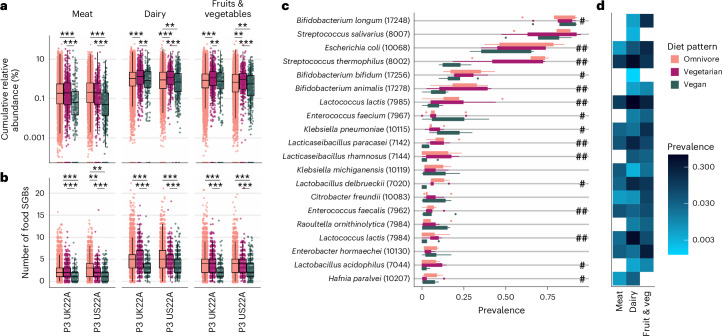
“…now, our results suggest the potential for diet patterns to select for gut microbes, but gut microbes might be derived directly from food itself 32 , as may be the case for S. thermophilus , a common dairy component 27,33 that we found to be one of the most differentiating SGBs between diet…”
InfluentialSelf-citationRaoultella ornithinolytica: Emergence and Resistance
Hajjar, R., Ambaraghassi, G., Sebajang, H., Schwenter, F., & Su, S. H. (2020) · Infection and Drug Resistance · doi:10.2147/idr.s191387 · Cited by 124
Chang, S.-C., Shen, M., Liu, C., Pu, C., Hu, J., & Huang, C. (2020) · Oncology Letters · doi:10.3892/ol.2020.12190 · Cited by 119
Cardiometabolic health, diet and the gut microbiome: a meta-omics perspective
Valles-Colomer, M., Menni, C., Berry, S. E., Valdes, A. M., Spector, T. D., & Segata, N. (2023) · Nature Medicine · doi:10.1038/s41591-023-02260-4 · Cited by 114 · cited 1×
“The gut microbiome plays an integral role in human health that can be modified by diet 5 .”
Self-citationStool microRNA profiles reflect different dietary and gut microbiome patterns in healthy individuals
Tarallo, S., Ferrero, G., Filippis, F. D., Francavilla, A., Pasolli, E., Panero, V., Cordero, F., Segata, N., Grioni, S., Pensa, R. G., et al. (2021) · Gut · doi:10.1136/gutjnl-2021-325168 · Cited by 98
Self-citationManghi, P., Bhosle, A., Wang, K., Marconi, R., Selma‐Royo, M., Ricci, L., Asnicar, F., Golzato, D., Ma, W., Hang, D., et al. (2024) · Nature Microbiology · doi:10.1038/s41564-024-01858-9 · Cited by 91
Self-citationBlanco‐Míguez, A., Gálvez, E. J. C., Pasolli, E., Filippis, F. D., Amend, L., Huang, K. D., Manghi, P., Lesker, T.-R., Riedel, T., Cova, L., et al. (2023) · Cell Host & Microbe · doi:10.1016/j.chom.2023.09.013 · Cited by 90
Self-citationAn integrated study of threonine-pathway enzyme kinetics in Escherichia coli
Chassagnole, C., RAÏS, B., QUENTIN, E., Fell, D. A., & Mazat, J. (2001) · Biochemical Journal · doi:10.1042/0264-6021:3560415 · Cited by 83
Nagy, P. L., Marolewski, A. E., Benkovic, S. J., & Zalkin, H. (1995) · Journal of Bacteriology · doi:10.1128/jb.177.5.1292-1298.1995 · Cited by 83
Sources and Sinks of Serine in Nutrition, Health, and Disease
Handzlik, M. K., & Metallo, C. M. (2023) · Annual Review of Nutrition · doi:10.1146/annurev-nutr-061021-022648 · Cited by 81
The nutrient requirements of Lactobacillus acidophilus LA-5 and their application to fermented milk
Li, M., Li, S., Liu, G., Fan, X., Qiao, Y., Zhang, A., Lin, Y., Zhao, X., Huang, K., & Feng, Z. G. (2020) · Journal of Dairy Science · doi:10.3168/jds.2020-18953 · Cited by 76
Citrobacter freundii fitness during bloodstream infection
Anderson, M. T., Mitchell, L. A., Zhao, L., & Mobley, H. L. T. (2018) · Scientific Reports · doi:10.1038/s41598-018-30196-0 · Cited by 75
The diagnostic and prognostic potential of gut bacteria in inflammatory bowel disease
Ocansey, D. K. W., Hang, S., Yuan, X., Qian, H., Zhou, M., Olovo, C. V., Zhang, X., & Mao, F. (2023) · Gut Microbes · doi:10.1080/19490976.2023.2176118 · Cited by 75
Liu, D., Chen, L., Zhu, X., Wang, Y., Xuan, Y., Liu, X., Chen, L., & Duan, Y. (2018) · Frontiers in Microbiology · doi:10.3389/fmicb.2018.01134 · Cited by 71
Accessible, curated metagenomic data through ExperimentHubPreprint
Pasolli, E., Schiffer, L., Manghi, P., et al. (2017) · bioRxiv (Cold Spring Harbor Laboratory) · doi:10.1101/103085 · Cited by 65
Self-citationWicaksono, W. A., Cernava, T., Wassermann, B., Abdelfattah, A., Soto-Giron, M. J., Toledo, G. V., Virtanen, S. M., Knip, M., Hyöty, H., & Berg, G. (2023) · Gut Microbes · doi:10.1080/19490976.2023.2258565 · Cited by 65
Gene-Enzyme Relationships of Aromatic Acid Biosynthesis in Bacillus subtilis
Hoch, J. A., & Nester, E. W. (1973) · Journal of Bacteriology · doi:10.1128/jb.116.1.59-66.1973 · Cited by 52
Ranawat, B., Bachani, P., Singh, A., & Mishra, S. (2021) · Current Microbiology · doi:10.1007/s00284-021-02368-1 · Cited by 52
Metagenomic estimation of dietary intake from human stool
Diener, C., Holscher, H. D., Filek, K., Corbin, K. D., Moissl-Eichinger, C., & Gibbons, S. M. (2025) · Nature Metabolism · doi:10.1038/s42255-025-01220-1 · Cited by 38
Weber, M., & Fuchs, T. M. (2022) · Microbiology Spectrum · doi:10.1128/spectrum.02013-22 · Cited by 28
Kamathewatta, K., Bushell, R., Rafa, F., Browning, G., Billman-Jacobe, H., & Marenda, M. (2020) · Antimicrobial Resistance & Infection Control · doi:10.1186/s13756-020-00828-0 · Cited by 27
Rehr, B., & Klemme, J.-H. (1989) · Antonie van Leeuwenhoek · doi:10.1007/bf00443745 · Cited by 14
Metagenomic estimation of dietary intake from human stoolPreprint
Diener, C., & Gibbons, S. M. (2024) · bioRxiv (Cold Spring Harbor Laboratory) · doi:10.1101/2024.02.02.578701 · Cited by 13
Unexplored microbial diversity from 2,500 food metagenomes and links with the human microbiome
Carlino, N. (2024) · doi:10.52843/cassyni.86q9t6 · Cited by 8
Self-citationMamphogoro, T. P., Kamutando, C. N., Maboko, M. M., Babalola, O. O., & Aiyegoro, O. A. (2023) · Microbiology Resource Announcements · doi:10.1128/mra.01237-22 · Cited by 2
Research works printed but not linked: 1
- Asnicar, F. et al. Gut microbiome species indicative of cardiometabolic health are modulated by diet in large and interventional cohorts of over 34,000 individuals. Preprint at bioRxiv (in the press).
Cited by
Gut micro-organisms associated with health, nutrition and dietary interventions
Asnicar, F., Manghi, P., Fackelmann, G., Baldanzi, G., Bakker, E., Ricci, L., Piccinno, G., Piperni, E., Mladenović, K., Amati, F., et al. (2025) · Nature · doi:10.1038/s41586-025-09854-7 · Cited by 82
Self-citationHuman microbiome acquisition and transmission
Heidrich, V., Valles‐Colomer, M., & Segata, N. (2025) · Nature Reviews Microbiology · doi:10.1038/s41579-025-01166-x · Cited by 56
Self-citationMohr, A. E., Mach, N., Pugh, J. N., Grosicki, G. J., Allen, J. M., Karl, J. P., & Whisner, C. M. (2025) · FEMS Microbiology Reviews · doi:10.1093/femsre/fuaf037 · Cited by 40
Sardá, F. A. H., Giuntini, E. B., de Oliveira, A. F., de Souza, G. S. F., do Prado, S. B. R., Taddei, C. R., TADINI, C. C., Bittinger, K. L., Bushman, F. D., de Menezes, E. W., et al. (2025) · npj Biofilms and Microbiomes · doi:10.1038/s41522-025-00817-4 · Cited by 37
Integrative systems biology approaches for analyzing microbiome dysbiosis and species interactions
Rehman, S. S. U., Nasar, M. I., Mesquita, C. S., Khodor, S. A., Notebaart, R. A., Ott, S., Mundra, S., Arasardanam, R. P., Muhammad, K., & Alam, M. T. (2025) · Briefings in Bioinformatics · doi:10.1093/bib/bbaf323 · Cited by 37
Metadata
- Authors
- Fackelmann, G., Manghi, P., Carlino, N., Heidrich, V., Piccinno, G., Ricci, L., Piperni, E., Arrè, A., Bakker, E., Creedon, A. C., Francis, L., Capdevila Pujol, J., Davies, R., Wolf, J., Bermingham, K. M., Berry, S. E., Spector, T. D., Asnicar, F., & Segata, N.
- Affiliations
- University of Trento (IT)
- ZOE (United Kingdom) (GB)
- King's College London (GB)
- Corresponding author
- Segata, Nicola
- ORCID
- Venue
- Nature Microbiology
- Published
- 2025-01-06
- Volume
- 10
- Issue
- 1
- Pages
- 41-52
- ISSN
- 2058-5276 (ISSN-L)
- PMC
- PMC11726441
- OpenAlex
- W4406114912
- Cited by
- 142
- References
- 59
- Citations by year
- 2026: 83 · 2025: 58
- FWCI
- 42.15
- Type
- journal article
- Language
- en
- Open access
- hybrid
- doi.org
- Licence
- cc-by
- creativecommons.org/licenses/by/4.0 (tdm)
- creativecommons.org/licenses/by/4.0 (vor)
- Locations
- Nature Microbiology (publishedVersion, cc-by)
- PubMed Central (publishedVersion, cc-by)
- PubMed (publishedVersion)
- Iris (University of Trento) (submittedVersion, cc-by)
- Funders
- Government of the United Kingdom
- UK Research and Innovation (101084642)
- European Commission (101152592, ECS00000043, 716575, 964590, 825410, 101045015, HORIZON2020, 818368, 101084642)
- European Climate, Infrastructure and Environment Executive Agency
- National Institutes of Health (1u01ca230551-01a1, 1U01CA230551)
- HORIZON EUROPE Framework Programme (101084642, 818368)
- National Cancer Institute (1U01CA230551, U01 CA230551)
- NextGenerationEU
- Topics
- Life Sciences › Biochemistry, Genetics and Molecular Biology › Molecular Biology › Gut microbiota and health
- Health Sciences › Medicine › Public Health, Environmental and Occupational Health › Nutritional Studies and Diet
- Life Sciences › Biochemistry, Genetics and Molecular Biology › Genetics › Nutrition, Genetics, and Disease
- Keywords
- gut microbiota, plant-based diet, vegan diet, vegetarian diet, omnivorous diet, diet patterns, red meat consumption, cardiometabolic health, microbial signatures, soil microbes, Streptococcus thermophilus, Ruminococcus torques, Bilophila wadsworthia, Alistipes putredinis, Western diet
- MeSH terms
- Vegans, Diet, Vegan, Gastrointestinal Microbiome, Adult, Bacteria, Diet, Female, Humans, Male, Middle Aged, Diet, Vegetarian, Cohort Studies, Metagenomics
About these checks
Registry, retraction, Cites and statistics results are computed, not judged, with one exception: a printed reference that no index lists is read once by a model before it counts as a citation error. Claims are extracted by a model and kept only when their quote appears verbatim in the text; each cited source is then checked, with a model’s help, for whether it says what the claim relies on. Those verdicts can be wrong — read the claim’s quote and the cited source before relying on one.
Statistics and arithmetic are recomputed, not judged.
Confidence bands are shown only for fields calibrated on our annotated test set. None is calibrated yet, so no band is shown.
What counts as a claim ›How we measure confidence ›How we check this ›
Are you an author, or do you see a problem with this page? Request a review
Data sources
Bibliographic data: Semantic Scholar, OpenAlex, Crossref.
Contains information from the Semantic Scholar Academic Graph Datasets, made available under the ODC Attribution License (ODC-BY 1.0).
Semantic Scholar’s data is described in: Kinney, R., et al. (2023). The Semantic Scholar Open Data Platform. arXiv:2301.10140.
