

Shared control of a 16 semiconductor quantum dot crossbar array
Open accessThe DOI matches its Crossref record; 50 of the 50 references it cites were found in a registry or an index.
Abstract
The efficient control of a large number of qubits is one of the most challenging aspects for practical quantum computing. Current approaches in solid-state quantum technology are based on brute-force methods, where each and every qubit requires at least one unique control line—an approach that will become unsustainable when scaling to the required millions of qubits. Here, inspired by random-access architectures in classical electronics, we introduce the shared control of semiconductor quantum dots to efficiently operate a two-dimensional crossbar array in planar germanium. We tune the entire array, comprising 16 quantum dots, to the few-hole regime. We then confine an odd number of holes in each site to isolate an unpaired spin per dot. Moving forward, we demonstrate on a vertical and a horizontal double quantum dot a method for the selective control of the interdot coupling and achieve a tunnel coupling tunability over more than 10 GHz. The operation of a quantum electronic device with fewer control terminals than tunable experimental parameters represents a compelling step forward in the construction of scalable quantum technology.
Overview
The claims and statistics of this paper haven’t been checked yet.
Free: it reads the open-access text and checks the first 5 claims that cite a source we can check. Create a free account to check every claim.
Integrity signals
Registry
Cites
Statistics
Figures
Verification
Claims the paper makes
The claims and statistics of this paper haven’t been checked yet.
Free: it reads the open-access text and checks the first 5 claims that cite a source we can check. Create a free account to check every claim.
Self-check
Percentages, sums and reported differences re-computed from the paper’s own numbers.
The self-check needs the paper’s full text.
Citations
Cites
Quantum computation with quantum dots
Loss, D., & DiVincenzo, D. P. (1998) · Physical Review A · doi:10.1103/physreva.57.120 · Cited by 6,840 · cited 5×
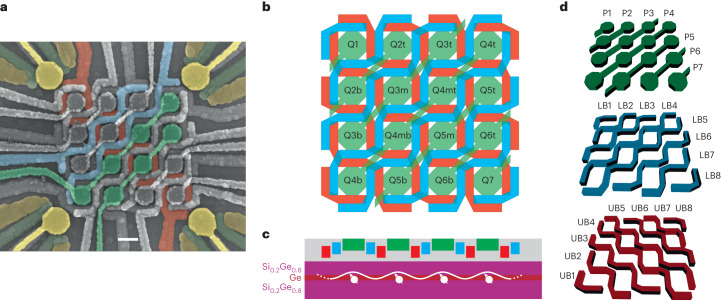
“We use two barrier layers (with gates UB i and LB i , where i ∈ [1, 8]) to control the interdot tunnel couplings, and exploit a layer of plunger lines (P i , where i ∈ [1, 7]) to vary the on-site energies (Fig.”
BackgroundMethodInfluentialSurface codes: Towards practical large-scale quantum computation
Fowler, A. G., Mariantoni, M., Martinis, J. M., & Cleland, A. N. (2012) · Physical Review A · doi:10.1103/physreva.86.032324 · Cited by 3,059
Spins in few-electron quantum dots
Hanson, R., Kouwenhoven, L. P., Petta, J. R., Tarucha, S., & Vandersypen, L. M. K. (2007) · Reviews of Modern Physics · doi:10.1103/revmodphys.79.1217 · Cited by 2,665 · cited 2×
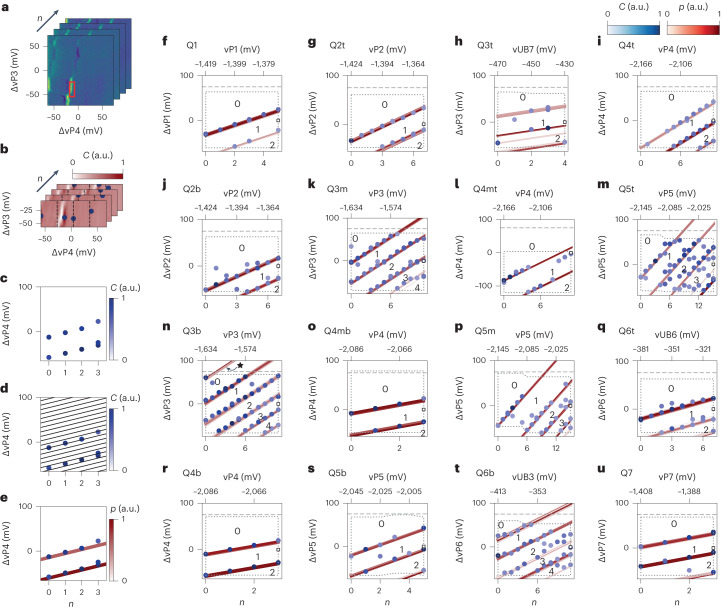
“In this configuration, we also prove the ability to prepare all the quantum dots in the odd-charge occupation, as a key step for the confinement of an unpaired spin in each site 18,19 .”
BackgroundMethodQuantum error correction for quantum memories
Terhal, B. M. (2015) · Reviews of Modern Physics · doi:10.1103/revmodphys.87.307 · Cited by 1,354
Zwanenburg, F. A., Dzurak, A. S., Morello, A., Simmons, M. Y., Hollenberg, L. C. L., Klimeck, G., Rogge, S., Coppersmith, S. N., & Eriksson, M. A. (2013) · Reviews of Modern Physics · doi:10.1103/revmodphys.85.961 · Cited by 1,210
On a Pin Versus Block Relationship For Partitions of Logic Graphs
Landman, B. S., & Russo, R. L. (1971) · IEEE Transactions on Computers · doi:10.1109/t-c.1971.223159 · Cited by 714 · cited 1×
“A key enabler has been the ability to control such a large number of components with only a few hundred to a few thousand control lines 5,6 .”
BackgroundInterfacing spin qubits in quantum dots and donors—hot, dense, and coherent
Vandersypen, L. M. K., Bluhm, H., Clarke, J. S., Dzurak, A. S., Ishihara, R., Morello, A., Reilly, D. J., Schreiber, L. R., & Veldhorst, M. (2017) · npj Quantum Information · doi:10.1038/s41534-017-0038-y · Cited by 624
Self-citationMaurand, R., Jehl, X., Kotekar-Patil, D., Corna, A., Bohuslavskyi, H., Laviéville, R., Hutin, L., Barraud, S., Vinet, M., Sanquer, M., et al. (2016) · Nature Communications · doi:10.1038/ncomms13575 · Cited by 604 · cited 1×
“Advanced semiconductor qubit systems are based on complementary-metal–oxide–semiconductor-compatible materials and even foundry manufactured qubits have been realized 11,12 .”
BackgroundQuantum logic with spin qubits crossing the surface code threshold
Xue, X., Russ, M., Samkharadze, N., Undseth, B., Sammak, A., Scappucci, G., & Vandersypen, L. M. K. (2022) · Nature · doi:10.1038/s41586-021-04273-w · Cited by 524
Self-citationUniversal control of a six-qubit quantum processor in silicon
Philips, S. G. J., Mądzik, M. T., Amitonov, S. V., de Snoo, S. L., Russ, M., Kalhor, N., Volk, C., Lawrie, W. I. L., Brousse, D., Tryputen, L., et al. (2022) · Nature · doi:10.1038/s41586-022-05117-x · Cited by 410
Self-citation
Research works printed but not linked: 1
- Harvey-Collard P High-fidelity single-shot readout for a spin qubit via an enhanced latching mechanism Phys. Rev. X 2018 8 021046
Cited by
Items 101–164 of 164
Kovach, T. J., Schug, D., Wolfe, M. A., MacQuarrie, E. R., Walsh, P. J., Eskandari, O. M., Benson, J. H., Friesen, M. G., Eriksson, M. A., & Zwolak, J. P. (2025) · Physical Review Applied · doi:10.1103/vbtg-fws9 · Cited by 9
“Importantly, the sample used to demonstrate BATIS is kept at around 1.3 K , which is about 10 times warmer than other typical devices [23, 24].”
InfluentialFASQuiC: Flexible Architecture for Scalable Spin Qubit Control
Toubeix, M., Guthmuller, È., Evans, A., Faurie, A., & Meunier, T. (2024) · IEEE Transactions on Quantum Engineering · doi:10.1109/tqe.2024.3409811 · Cited by 5
“For instance, applying a swap gate to 24 pairs of spin qubits [38] would require 248 waveform parameters and instructions (1.2 kB) with FASQuiC, whereas AWG-based architectures would need 210 kB of data.”
BackgroundMethodInfluentialLai, C.-C., Tsai, T., Kuo, D. M.-T., Lin, H., & Li, P.-W. (2024) · IEEE Electron Device Letters · doi:10.1109/led.2024.3435536 · Cited by 3
“…sensitivity of SETs or SHTs. Si-and Ge-QD SETs/SHTs have been implemented using the gate-defined QDs and confinement barriers that are elec-trostatically created by applying bias voltages to plunger-gates and barrier-gates, respectively, over Si/Ge quantum well and nanowire structures [1], [2].”
MethodElectrical readout of spins in the absence of spin blockade
von Horstig, F.-E., Peri, L., Ciriano-Tejel, V. N., Barraud, S., Robinson, J. W. A., Benito, M., Martins, F., & González-Zalba, M. F. (2025) · npj Quantum Information · doi:10.1038/s41534-025-01102-0 · Cited by 7
“Energy fi ltering, for example, uses the difference in tunnel rates to a charge reservoir of Zeeman-split spins states con fi ned to a quantum dot (QD) (or impurity) 7 whereas spin blockade (SB) uses quantum selection rules to inhibit tun-nelling between two-particle states with different spin…”
Proposed Five-Electron Charge Quadrupole Qubit
Caporaletti, J. H., & Kestner, J. P. (2025) · Physical Review Letters · doi:10.1103/l1x2-n2w9 · Cited by 2
Kuo, D. M.-T. (2025) · Nanoscale · doi:10.1039/d5nr02677f · Cited by 2
Hole spin splitting in a Ge quantum dot with finite barriers
Wang, J., Hu, X., & Fotso, H. F. (2025) · Physical review. B./Physical review. B · doi:10.1103/xrqt-xrnm · Cited by 2
Overhead in Quantum Circuits with Time-Multiplexed Qubit Control
Richter, M., Strandberg, I., Gasparinetti, S., & Kockum, A. F. (2026) · PRX Quantum · doi:10.1103/82cj-lfzy · Cited by 9
“To address this challenge, on-chip signal routing or multiplexing can be used to reduce wiring complexity and enable practical scaling of both superconducting-and semiconductor-based quantum computing platforms [86, 87].”
Strain Engineering of Ge Quantum Wells in Planar Ge/Si 1 − x Ge x Heterostructures
Nigro, A., Vogel, A., Ruiz‐Caridad, A., Weibel, V. J., Orfatti, D. N., Trautvetter, J., Hofmann, A., Rurali, R., & Zardo, I. (2025) · Advanced Materials Interfaces · doi:10.1002/admi.202500620 · Cited by 2
Effect of disorder and strain on the operation of planar Ge hole spin qubits
Sarkar, A., Chowdhury, P., Hu, X., Saraiva, A., Dzurak, A. S., Hamilton, A. R., Rahman, R., & Culcer, D. (2025) · npj Quantum Information · doi:10.1038/s41534-025-01130-w · Cited by 10
“Strained Ge QWs in undoped heterostructures have been at the forefront of the recent experimental effort in holes 29,54 , ranging from universal single qubit and two-qubit logic 31,79,80 , singlet-triplet holequbit 77 ,afour-qubitgermaniumprocessor 81 tosharedcontrolofalarge crossbar QD array 82 .”
Kim, Y., Lee, H., Park, J., Cho, S., & So, H. (2026) · Materials & Design · doi:10.1016/j.matdes.2026.116701 · Cited by 3
Flux-tunable hybridization in a double quantum dot interferometer
Prosko, C. G., Kulesh, I., Chan, M., Han, L., Xiao, D., Thomas, C., Manfra, M. J., Goswami, S., & Malinowski, F. K. (2024) · SciPost Physics · doi:10.21468/scipostphys.17.3.074 · Cited by 2
“Meanwhile, tunneling may depend on flux in two-dimensional QD arrays for quantum processors [ 17, 18 ] or quantum simulation [ 5, 19, 20 ] , since coherent tunneling can occur across chains of QDs [ 21 ] .”
BackgroundImpact of surface passivation on the electrical stability of strained germanium devices
李, Z.-H. 宗. L., 王, M.-L. 茂. W., 孔, Z.-Z. 真. K., 王, G.-L. 桂. W., 康, Y. 原. K., Xu, Y.-Q., 吴, R. 睿. W., Hao, T.-Y., 魏, Z.-C. 泽. W., Wang, B., et al. (2025) · Chinese Physics B · doi:10.1088/1674-1056/add4de · Cited by 4
Naifar, A., & Hasanirokh, K. (2025) · Applied Physics A · doi:10.1007/s00339-025-08784-5 · Cited by 2
A Scalable Low-Latency FPGA Architecture for Spin Qubit Control Through Direct Digital Synthesis
Toubeix, M., Guthmuller, È., Evans, A., & Meunier, T. (2024) · Design, Automation, and Test in Europe · doi:10.23919/date58400.2024.10546620 · Cited by 2
“2) to 24 pairs of spin qubits [3] would require 248 waveform parameters and instructions (1.2 KB) with our architecture while AWG-based architectures would need 210 KB of data.”
MethodInfluentialLai, C.-C., Chiu, Y.-W., Wang, I.-H., Tsai, T., Chen, J.-W., Wang, Y.-H., Chang, M.-C. F., Lin, H., & Li, P.-W. (2024) · IEEE Symposium on VLSI Technology and Circuits (VLSI Technology and Circuits) · doi:10.1109/vlsitechnologyandcir46783.2024.10631509 · Cited by 1
Effect of interface trap charge on Coulomb oscillation in MOS-type quantum dots
Asai, H., Iizuka, S., Hattori, J., Fukuda, K., Ikegami, T., Oka, H., Inaba, T., Shitakata, S., Kato, K., Nakayama, T., et al. (2025) · Japanese Journal of Applied Physics · doi:10.35848/1347-4065/adabee · Cited by 2
Crosstalk analysis in single hole-spin qubits within highly anisotropic g -tensors
Hajati, Y., Heinz, I., & Burkard, G. (2025) · Physical Review Research · doi:10.1103/qzn2-l71q · Cited by 1
Exciton qubit on spatial states of a triple quantum dot
Tsukanov, A. V. (2025) · Optical and Quantum Electronics · doi:10.1007/s11082-025-08337-3 · Cited by 1
“Low-dimensional semiconductor structures based on quantum wells, quantum dots and implanted donor atoms are of great interest for quantum information technologies (Diguna et al. 2018; Borsoi et al. 2024).”
Liu, Y. R., Wang, D., Song, L., Li, J., Pei, T., Luo, J., & Yuan, G. (2025) · Semiconductor Science and Technology · doi:10.1088/1361-6641/ae0515 · Cited by 1
“…strategic importance of Ge platforms is further amplified by recent progress in overcoming challenges for quantum computing based on semiconductors: 99.97% single-qubit gate fidelity [23], a four-qubits quantum processor [24], and efficient control of 16 quantum dots integration architecture [25].”
InfluentialNeural network based nodal structure optimization for interacting fermionic systems
Freitas, W., de Abreu, B. R., & Vitiello, S. A. (2025) · Physical review. B./Physical review. B · doi:10.1103/x6cj-b6lj · Cited by 3
Yonjali, Y. K., Studenikin, S., Myronov, M., Waldron, P. D., Tait, R. N., & Mnaymneh, K. (2025) · APL Quantum · doi:10.1063/5.0293106 · Cited by 1
Optimal array geometries for kinetic magnetism and Nagaoka polarons
Hernandez-Cepeda, N., & Ulloa, S. E. (2026) · Physical review. B./Physical review. B · doi:10.1103/51bm-vxbn · Cited by 1
“These structures have enabled measurements of spin correlations [26], control over individual electron spins [27], exploration of quantum phase transitions in square arrays [28], electron number manipulation in crossbar arrays [29], and recent investigation of excitations in QD ladders [30].”
Extending qubit coherence time via hybrid dynamical decoupling
Yao, Q., Zhang, J., Zhang, W., & Lee, C. (2026) · Physical Review A · doi:10.1103/rj8c-tv95 · Cited by 1
AI-enhanced tuning of quantum dot Hamiltonians toward Majorana modes
Krawczyk, M., & Pawłowski, J. (2026) · Physical Review Applied · doi:10.1103/xkbl-ctwn · Cited by 1
“At the same time, a different strategy for machine learning (ML)-assisted autotuning of QD-based quantum simulators [20–22] using transport measurements is gaining significant interest [23–27].”
Emerging materials for chiral recognition by nanoscale optical sensors
Bedair, A., Algethami, F. K., Hamed, M., & Mansour, F. R. (2026) · Microchemical Journal · doi:10.1016/j.microc.2026.119234 · Cited by 1
Co-packaged optics for high-performance computing and artificial intelligence
Kim, B., Choi, S. H., Zograf, G., Yoo, Y. J., Baek, Y., Kim, S., Kim, J., Kim, J., Chae, S. H., Kim, H., et al. (2026) · Nature Electronics · doi:10.1038/s41928-026-01681-6 · Cited by 8
Semiconductor quantum computing
ZHANG, J., Li, H.-O., & Guo, G. (2023) · Scientia Sinica Informationis · doi:10.1360/ssi-2023-0333 · Cited by 1
Resonant Coulomb interaction of excitonic and charge qubits on quantum dots
Tsukanov, A. V. (2024) · Optical and Quantum Electronics · doi:10.1007/s11082-024-07412-5 · Cited by 1
Fast Virtual Gate Extraction For Silicon Quantum Dot Devices
Che, S., Oh, S., Qin, H., Liu, Y., Sigillito, A. J., & Li, G. (2024) · ACM/IEEE Design Automation Conference (DAC) · doi:10.1145/3649329.3655923 · Cited by 4
Role of anisotropic confining potential and elliptical driving in dynamics of a Ge hole qubit
Dey, B., & Schliemann, J. (2025) · Journal of Physics Condensed Matter · doi:10.1088/1361-648x/adb927 · Cited by 1
“Ge hole qubits have shown significant advancements in recent years [13–17] highlighted by the demonstration of single-and two-qubit control [18–21], singlet-triplet encoding [22], four-qubit processor [23] and successful charge control in a sixteen-dot array [24].”
Tunnel-optical electron transitions in an asymmetric double quantum dot under correction field
Tsukanov, A. V., & Kateev, I. Y. (2025) · Laser Physics Letters · doi:10.1088/1612-202x/ade078 · Cited by 1
Dressed basis sets for the modeling of exchange interactions in double quantum dots
Rodríguez, M. J., Rodríguez-Mena, E. A., Kalo, A. F., & Niquet, Y. (2025) · Physical review. B./Physical review. B · doi:10.1103/fc5b-5xbx · Cited by 6
Yananose, K., Park, C., & Son, Y. (2026) · Physical review. B./Physical review. B · doi:10.1103/yfqy-6235 · Cited by 3
“Despite impressive progress in quantum information applications us-ing QD arrays [9–11], significant challenges still remain in achieving their large-scale arrangements with uniform electronic properties [6] and their controlled on-demand reconfigurations [12, 13] — capabilities that are more…”
Exciton Transport in a Germanium Quantum Dot LadderPreprint
Hsiao, T.-K., Fariña, P. C., Oosterhout, S. D., Jirovec, D., Zhang, X., van Diepen, C. J., Lawrie, W. I. L., Wang, C.-A., Sammak, A., Scappucci, G., et al. (2023) · arXiv (Cornell University) · doi:10.3929/ethz-b-000666040
Self-citationPeri, L., Oakes, G. A., Cochrane, L., Ford, C. J. B., & González-Zalba, M. F. (2023) · arXiv (Cornell University) · doi:10.17863/cam.106951
Veste, G., Rodríguez-Mena, E. A., Martínez, B., Sklénard, B., Li, J., & Niquet, Y. (2023) · International Conference on Simulation of Semiconductor Processes and Devices · doi:10.23919/sispad57422.2023.10319558
Towards Scalable Cryogenic Quantum Dot Biasing Using Memristor-Based Dc SourcesPreprint
Mouny, P.-A., Dawant, R., Dufour, P., Valdenaire, M., Ecoffey, S., Pioro-Ladrière, M., Beilliard, Y., & Drouin, D. (2024) · SSRN Electronic Journal · doi:10.2139/ssrn.4814534
Transport and Localization in Quantum Dot Chains with Fluctuations: A Simple Probabilistic Model
Lazzús, J. A. (2024) · Physics of the Solid State · doi:10.1134/s1063783424600584
Bersano, F., Martinolli, N., Bouquet, I., Ghini, M., Collette, E., Žaper, L., Braakman, F., Poggio, M., Luisier, M., & Ionescu, A. M. (2025) · IEEE Journal of the Electron Devices Society · doi:10.1109/jeds.2025.3545661
“These advancements have been demonstrated in 2D and 1D qubit arrays in planar structures, such as 28 Si/SiGe heterostructures [2] and planar Ge [3], as well as in Si metal-oxide-semiconductor (MOS) architectures inspired by nano-CMOS technology, including bulk silicon FinFETs [4] and fully-depleted…”
Quantum algorithm compiler for architectures with semiconductor spin qubits
Tadokoro, M., Matsuoka, R., & Kodera, T. (2025) · EPJ Quantum Technology · doi:10.1140/epjqt/s40507-025-00384-9
Lai, C.-C., Tsai, T., Lin, H., & Li, P.-W. (2025) · Silicon Nanoelectronics Workshop (SNW) · doi:10.23919/snw65111.2025.11097226
Negative exchange interaction in Si quantum dot arrays via valley-phase induced Z 2 gauge field
Woods, B. D. (2025) · Physical review. B./Physical review. B · doi:10.1103/x2jk-714n · Cited by 1
Switchable spin–photon coupling with hole spins in single-quantum dots
Sagaseta, C., Calderón, M. J., & Abadillo-Uriel, J. C. (2026) · Materials for Quantum Technology · doi:10.1088/2633-4356/ae4087 · Cited by 1
“Recent progress includes four-and ten-qubit Ge processors [20, 21] and shared control across a 16-dot device [22].”
Comparison of spin-qubit architectures for quantum error-correcting codes
Gutiérrez, M., Rojas-Arias, J. S., Obando, D., & Chang, C. Y. (2026) · Physical Review A · doi:10.1103/qlw3-xk2f · Cited by 5
“While implementing 2D surface code in a spin-based system requires advanced manufacturing, such a layout could be realized in silicon [61] and other semiconductor materials [62–64].”
Li, P.-W. (2025) · IEEE Electron Devices Magazine · doi:10.1109/med.2025.3577179
Tsukanov, A. V., & Kateev, I. Y. (2025) · Laser Physics Letters · doi:10.1088/1612-202x/ae2458
Thermal circuit model for silicon quantum-dot array structures
Utsugi, T., Kusuno, N., Kuno, T., Lee, N., Yanagi, I., Mine, T., Saito, S., Hisamoto, D., Tsuchiya, R., & Mizuno, H. (2026) · APL Quantum · doi:10.1063/5.0299263
Rapid 2-D Complex Capacitance Estimation Enables Real-Time Design of Impedance-Based Sensors
Qi, R., Rouwhorst, E., Yntema, D. R., & Cao, M. (2026) · IEEE Transactions on Instrumentation and Measurement · doi:10.1109/tim.2026.3661692
“At the quantum frontier, attofarad-resolution gate-to-channel capacitances tune qubit energy levels in quantum-dot processors [11], while radio frequency reflectometry registers the spin state of a single electron through a capacitively coupled sensor gate [12].”
Impact of leakage on the dynamics of an ST 0 qubit implemented in a double quantum dot device
del Moral, J. O., Larrarte, O. S., Dastbasteh, R., Martínez, J. E., & Otxoa, R. M. (2026) · Physical review. B./Physical review. B · doi:10.1103/6p7p-w1lc · Cited by 2
Disorder-independent hole-spin manipulation by hopping
Martínez, B., Sempere-Sanchis, A., Abadillo-Uriel, J. C., & Niquet, Y. (2026) · Physical Review Applied · doi:10.1103/qwgc-mwzn · Cited by 5
“To alleviate this overhead, shared-control architectures have been proposed, in which a reduced set of control lines is multiplexed across multiple qubits [31, 32].”
Site-controlled Ge hut wire-based multiple quantum dots with integrated charge sensing capability
Leng, J., Gao, F., Zhou, Y.-C., Wang, C., Jiang, H.-T., Wu, Z., Cao, G., Zhang, J., Li, H.-O., & guo, G. (2026) · Nanoscale · doi:10.1039/d5nr04259c
Hutchins-Delgado, T. A., Gangwal, S., Akwabli, S., Bradicich, A., Petluru, P., Stanchu, H. V., Acharya, S., Scott, R. C., Rosson, N., Povolotskyi, M., et al. (2026) · Small Science · doi:10.1002/smsc.202500589 · Cited by 1
Kushwaha, M. S. (2026) · Solid state physics · doi:10.1016/bs.ssp.2025.11.001
Reconfigurable oxide nanoelectronics by tip-induced electron delocalization
Huang, C., Ma, C., Ha, M., Shang, L., Chen, Z., Xiao, Q., Qin, Z., Liu, D., Wang, H., Qiu, D., et al. (2026) · Physical Review Applied · doi:10.1103/pv6m-63fz
“Traditional top-down lithography methods involving masking and etching have achieved some success in patterning specific lattices in semiconductors [1–3].”
Myronov, M., Yonjali, Y. K., Mnaymneh, K., & Studenikin, S. (2026) · APL Quantum · doi:10.1063/5.0332643 · Cited by 1
Reconstructing quantum dot charge stability diagrams with diffusion models
Hernandes, V., Rogers, J., Koch, R., Spriggs, T., Undseth, B., Chatterjee, A., Vandersypen, L. M. K., & Greplová, E. (2026) · Machine Learning Science and Technology · doi:10.1088/2632-2153/ae8070 · Cited by 2
“In these systems, quantum information is encoded in the spin degree of freedom of confined charge carriers, and device operation relies on precise electrostatic control over multiple gate voltages.”
Quantum Non-Markovian Hatano-Nelson Model
Anonymous, Hanai, R., Vu, T. V., Hayakawa, H., & Purkayastha, A. (2026) · Physical Review Letters · doi:10.1103/wsvz-mstf · Cited by 3
Predicting charge stability in donor spin-qubit arrays in silicon
Anonymous, Philippopoulos, P., Beaudoin, F., & Guo, H. (2026) · Physical Review Applied · doi:10.1103/vrkm-4x3p
Mitigating residual exchange coupling in resonant singlet-triplet qubits
Anonymous, Torres-Leal, F., & Nichol, J. M. (2026) · Physical Review Applied · doi:10.1103/gjn5-kc41 · Cited by 3
“Such high-voltage pulses can disrupt the linear-regime gate virtualization, as described by the crosstalk matrix that captures capacitive coupling between all metallic gates [15, 21, 22, 59– 61].”
Fast readout of quantum dot spin qubits via Andreev spins
Anonymous, Laubscher, K., Vecchio, P. D., Chatterjee, A., Fatemi, V., & Bosco, S. (2026) · Physical Review Applied · doi:10.1103/qcch-2hhy · Cited by 7
Theory of spin qubits and the path to scalability
McIntyre, Z. M., Sarkar, A., & Loss, D. (2026) · New Journal of Physics · doi:10.1088/1367-2630/ae973f · Cited by 6
Device Design of Material-Defined Ge Quantum Dots/Si-Based Barriers for Charge Stability and Sensing
Tsai, T., Wang, I.-H., Chiu, Y.-W., Lai, C.-C., Kuo, D. M.-T., Lin, H., & Li, P.-W. (2026) · IEEE Journal of the Electron Devices Society · doi:10.1109/jeds.2026.3731214
“To date, sixteen-QD crossbar array [27] and ten-qubit [24] hole-spin array in Ge have been demonstrated using gate-defined approaches.”
In-plane optimal qubit operation with control fidelities exceeding 99%
Anonymous, Kong, Z., Ma, R.-L., Jiang, H.-T., Li, A.-R., Zhong, Y., Wu, Z.-T., Zheng, R., Wang, G., Cao, G., et al. (2026) · Physical Review Applied · doi:10.1103/fw9y-ylsv
“…in developing hole spin qubits based on strained germanium quantum wells, highlighting the demonstration of high fidelity single-and two-qubit gate [12–15], long coherence time up to 17.6 µ s [16], fast qubit con-trol surpassing 100 MHz [12] and the implementation of multi-qubit arrays [17, 18].”
Influential
Metadata
- Authors
- Borsoi, F., Hendrickx, N. W., John, V., Meyer, M., Motz, S., van Riggelen, F., Sammak, A., de Snoo, S. L., Scappucci, G., & Veldhorst, M.
- Affiliations
- QuTech (NL)
- Netherlands Organisation for Applied Scientific Research (NL)
- Corresponding author
- Borsoi, Francesco
- Veldhorst, Menno
- ORCID
- Venue
- Nature Nanotechnology
- Published
- 2023-08-28
- Volume
- 19
- Issue
- 1
- Pages
- 21-27
- ISSN
- 1748-3387 (ISSN-L)
- 1748-3395
- PMC
- PMC10796274
- OpenAlex
- W4386221797
- Semantic Scholar
- 7e49d5e7837f977adaf7ce83afc428bd6af25cbe
- Cited by
- 165
- References
- 50
- Citations by year
- 2026: 31 · 2025: 66 · 2024: 52 · 2023: 16
- FWCI
- 19.13
- Type
- journal article
- Language
- en
- Open access
- hybrid
- doi.org
- Licence
- cc-by
- creativecommons.org/licenses/by/4.0 (tdm)
- creativecommons.org/licenses/by/4.0 (vor)
- Locations
- Nature Nanotechnology (publishedVersion, cc-by)
- PubMed Central (publishedVersion, cc-by)
- PubMed (publishedVersion)
- arXiv (Cornell University) (submittedVersion)
- TNO Repository (submittedVersion)
- Research Repository (Delft University of Technology) (submittedVersion, cc-by)
- arXiv (Cornell University) (cc-by)
- Funders
- United States Department of Defense | United States Army | U.S. Army Research, Development and Engineering Command | Army Research Office (W911NF-17-1-0274)
- Topics
- Physical Sciences › Physics and Astronomy › Condensed Matter Physics › Quantum and electron transport phenomena
- Physical Sciences › Physics and Astronomy › Atomic and Molecular Physics, and Optics › Semiconductor Quantum Structures and Devices
- Physical Sciences › Engineering › Electrical and Electronic Engineering › Advancements in Semiconductor Devices and Circuit Design
- Keywords
- shared control, semiconductor quantum dots, crossbar arrays, germanium, unpaired spins, double quantum dot, interdot tunnel coupling, scalable quantum computing, qubit control
About these checks
Registry, retraction, Cites and statistics results are computed, not judged, with one exception: a printed reference that no index lists is read once by a model before it counts as a citation error. Claims are extracted by a model and kept only when their quote appears verbatim in the text; each cited source is then checked, with a model’s help, for whether it says what the claim relies on. Those verdicts can be wrong — read the claim’s quote and the cited source before relying on one.
Statistics and arithmetic are recomputed, not judged.
Confidence bands are shown only for fields calibrated on our annotated test set. None is calibrated yet, so no band is shown.
What counts as a claim ›How we measure confidence ›How we check this ›
Are you an author, or do you see a problem with this page? Request a review
Data sources
Bibliographic data: Semantic Scholar, OpenAlex, Crossref.
Contains information from the Semantic Scholar Academic Graph Datasets, made available under the ODC Attribution License (ODC-BY 1.0).
Semantic Scholar’s data is described in: Kinney, R., et al. (2023). The Semantic Scholar Open Data Platform. arXiv:2301.10140.
