

Shared control of a 16 semiconductor quantum dot crossbar array
Open accessThe DOI matches its Crossref record; 50 of the 50 references it cites were found in a registry or an index.
Abstract
The efficient control of a large number of qubits is one of the most challenging aspects for practical quantum computing. Current approaches in solid-state quantum technology are based on brute-force methods, where each and every qubit requires at least one unique control line—an approach that will become unsustainable when scaling to the required millions of qubits. Here, inspired by random-access architectures in classical electronics, we introduce the shared control of semiconductor quantum dots to efficiently operate a two-dimensional crossbar array in planar germanium. We tune the entire array, comprising 16 quantum dots, to the few-hole regime. We then confine an odd number of holes in each site to isolate an unpaired spin per dot. Moving forward, we demonstrate on a vertical and a horizontal double quantum dot a method for the selective control of the interdot coupling and achieve a tunnel coupling tunability over more than 10 GHz. The operation of a quantum electronic device with fewer control terminals than tunable experimental parameters represents a compelling step forward in the construction of scalable quantum technology.
Overview
The claims and statistics of this paper haven’t been checked yet.
Free: it reads the open-access text and checks the first 5 claims that cite a source we can check. Create a free account to check every claim.
Integrity signals
Registry
Cites
Statistics
Figures
Verification
Claims the paper makes
The claims and statistics of this paper haven’t been checked yet.
Free: it reads the open-access text and checks the first 5 claims that cite a source we can check. Create a free account to check every claim.
Self-check
Percentages, sums and reported differences re-computed from the paper’s own numbers.
The self-check needs the paper’s full text.
Citations
Cites
Quantum computation with quantum dots
Loss, D., & DiVincenzo, D. P. (1998) · Physical Review A · doi:10.1103/physreva.57.120 · Cited by 6,840 · cited 5×
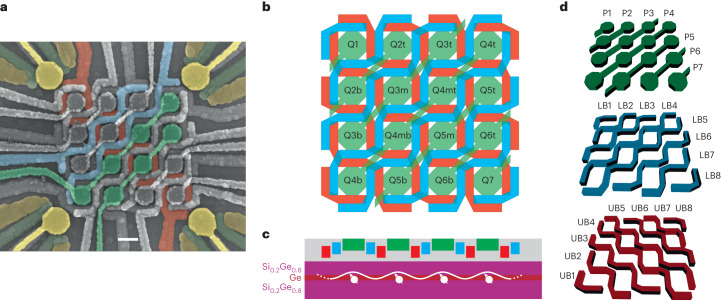
“We use two barrier layers (with gates UB i and LB i , where i ∈ [1, 8]) to control the interdot tunnel couplings, and exploit a layer of plunger lines (P i , where i ∈ [1, 7]) to vary the on-site energies (Fig.”
BackgroundMethodInfluentialSurface codes: Towards practical large-scale quantum computation
Fowler, A. G., Mariantoni, M., Martinis, J. M., & Cleland, A. N. (2012) · Physical Review A · doi:10.1103/physreva.86.032324 · Cited by 3,059
Spins in few-electron quantum dots
Hanson, R., Kouwenhoven, L. P., Petta, J. R., Tarucha, S., & Vandersypen, L. M. K. (2007) · Reviews of Modern Physics · doi:10.1103/revmodphys.79.1217 · Cited by 2,665 · cited 2×
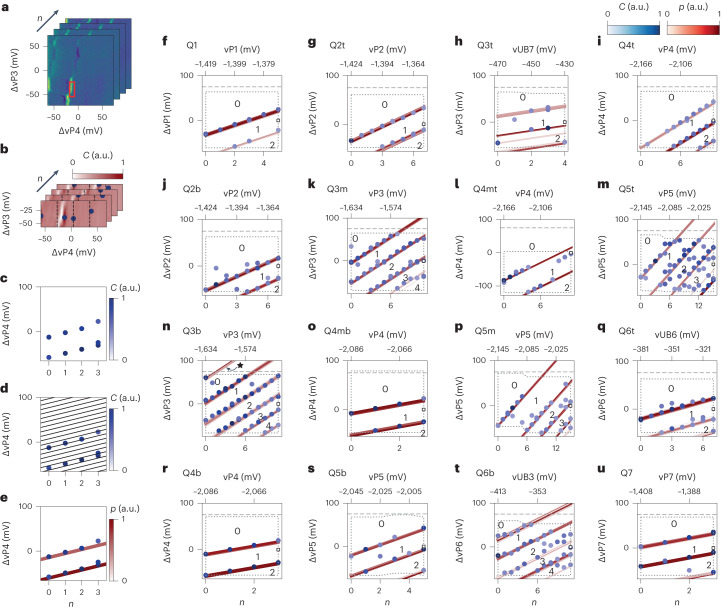
“In this configuration, we also prove the ability to prepare all the quantum dots in the odd-charge occupation, as a key step for the confinement of an unpaired spin in each site 18,19 .”
BackgroundMethodQuantum error correction for quantum memories
Terhal, B. M. (2015) · Reviews of Modern Physics · doi:10.1103/revmodphys.87.307 · Cited by 1,354
Zwanenburg, F. A., Dzurak, A. S., Morello, A., Simmons, M. Y., Hollenberg, L. C. L., Klimeck, G., Rogge, S., Coppersmith, S. N., & Eriksson, M. A. (2013) · Reviews of Modern Physics · doi:10.1103/revmodphys.85.961 · Cited by 1,210
On a Pin Versus Block Relationship For Partitions of Logic Graphs
Landman, B. S., & Russo, R. L. (1971) · IEEE Transactions on Computers · doi:10.1109/t-c.1971.223159 · Cited by 714 · cited 1×
“A key enabler has been the ability to control such a large number of components with only a few hundred to a few thousand control lines 5,6 .”
BackgroundInterfacing spin qubits in quantum dots and donors—hot, dense, and coherent
Vandersypen, L. M. K., Bluhm, H., Clarke, J. S., Dzurak, A. S., Ishihara, R., Morello, A., Reilly, D. J., Schreiber, L. R., & Veldhorst, M. (2017) · npj Quantum Information · doi:10.1038/s41534-017-0038-y · Cited by 624
Self-citationMaurand, R., Jehl, X., Kotekar-Patil, D., Corna, A., Bohuslavskyi, H., Laviéville, R., Hutin, L., Barraud, S., Vinet, M., Sanquer, M., et al. (2016) · Nature Communications · doi:10.1038/ncomms13575 · Cited by 604 · cited 1×
“Advanced semiconductor qubit systems are based on complementary-metal–oxide–semiconductor-compatible materials and even foundry manufactured qubits have been realized 11,12 .”
BackgroundQuantum logic with spin qubits crossing the surface code threshold
Xue, X., Russ, M., Samkharadze, N., Undseth, B., Sammak, A., Scappucci, G., & Vandersypen, L. M. K. (2022) · Nature · doi:10.1038/s41586-021-04273-w · Cited by 524
Self-citationUniversal control of a six-qubit quantum processor in silicon
Philips, S. G. J., Mądzik, M. T., Amitonov, S. V., de Snoo, S. L., Russ, M., Kalhor, N., Volk, C., Lawrie, W. I. L., Brousse, D., Tryputen, L., et al. (2022) · Nature · doi:10.1038/s41586-022-05117-x · Cited by 410
Self-citationA four-qubit germanium quantum processor
Hendrickx, N. W., Lawrie, W. I. L., Russ, M., van Riggelen, F., de Snoo, S. L., Schouten, R. N., Sammak, A., Scappucci, G., & Veldhorst, M. (2021) · Nature · doi:10.1038/s41586-021-03332-6 · Cited by 405
Self-citationSilicon CMOS architecture for a spin-based quantum computer
Veldhorst, M., Eenink, H. G. J., Yang, C. H., & Dzurak, A. S. (2017) · Nature Communications · doi:10.1038/s41467-017-01905-6 · Cited by 398
Self-citationThe germanium quantum information route
Scappucci, G., Kloeffel, C., Zwanenburg, F. A., Loss, D., Myronov, M., Zhang, J.-J., De Franceschi, S., Katsaros, G., & Veldhorst, M. (2020) · Nature Reviews Materials · doi:10.1038/s41578-020-00262-z · Cited by 382 · cited 1×
“…the gate fanout in the third dimension 27 can mitigate this issue (Supplementary Note 4). quality and uniformity of strained germanium quantum wells 17 , by introducing an elegant gate layout based on diagonal plunger lines and double-barrier gates, as well as by establishing a method that…”
MethodSelf-citationQubits made by advanced semiconductor manufacturing
Zwerver, A. M. J., Krähenmann, T., Watson, T. F., Lampert, L., George, H. C., Pillarisetty, R., Bojarski, S. A., Amin, P., Amitonov, S. V., Boter, J. M., et al. (2022) · Nature Electronics · doi:10.1038/s41928-022-00727-9 · Cited by 364 · cited 5×
“12 and”
BackgroundMethodInfluentialSelf-citationSemiconductor qubits in practice
Chatterjee, A., Stevenson, P., De Franceschi, S., Morello, A., de Leon, N. P., & Kuemmeth, F. (2021) · Nature Reviews Physics · doi:10.1038/s42254-021-00283-9 · Cited by 359 · cited 2×
“The development of spin qubits in semiconductor quantum dots has been strongly inspired by classical semiconductor technology 8–10 .”
BackgroundQuantum simulation of a Fermi–Hubbard model using a semiconductor quantum dot array
Hensgens, T., Fujita, T., Janssen, L., Li, X., Van Diepen, C. J., Reichl, C., Wegscheider, W., Das Sarma, S., & Vandersypen, L. M. K. (2017) · Nature · doi:10.1038/nature23022 · Cited by 352 · cited 1×
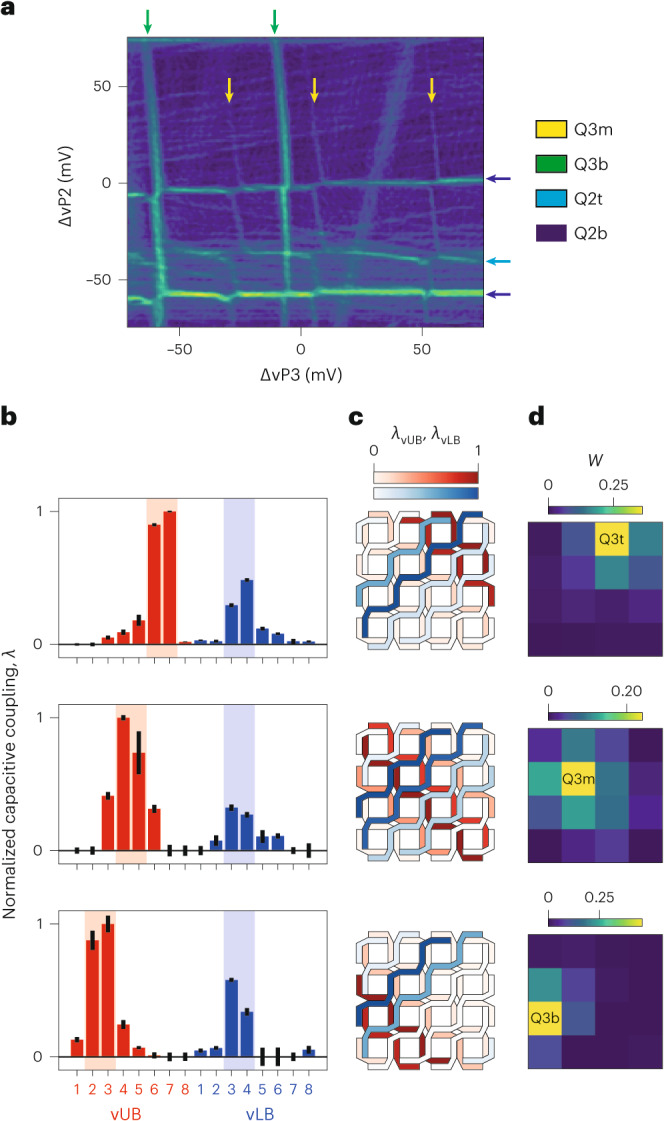
“Such virtual gates are defined to eliminate crosstalk with the charge sensors and to independently control the on-site energies 23,24 (Supplementary Fig.”
BackgroundCMOS-based cryogenic control of silicon quantum circuits
Xue, X., Patra, B., van Dijk, J. P. G., Samkharadze, N., Subramanian, S., Corna, A., Paquelet Wuetz, B., Jeon, C., Sheikh, F., Juarez-Hernandez, E., et al. (2021) · Nature · doi:10.1038/s41586-021-03469-4 · Cited by 306 · cited 1×
“In addition, it is anticipated that the small qubit footprint and compatibility with (cryo-)complementary metal–oxide–semiconductor electronics will open up avenues to build integrated quantum circuits 13,14 .”
BackgroundSelf-citationGate-count estimates for performing quantum chemistry on small quantum computers
Wecker, D., Bauer, B., Clark, B. K., Hastings, M. B., & Troyer, M. (2014) · Physical Review A · doi:10.1103/physreva.90.022305 · Cited by 296
Scalable Gate Architecture for a One-Dimensional Array of Semiconductor Spin Qubits
Zajac, D. M., Hazard, T. M., Mi, X., Nielsen, E., & Petta, J. R. (2016) · Physical Review Applied · doi:10.1103/physrevapplied.6.054013 · Cited by 291 · cited 1×
“17) 43 .”
Shuttling a single charge across a one-dimensional array of silicon quantum dots
Mills, A. R., Zajac, D. M., Gullans, M. J., Schupp, F. J., Hazard, T. M., & Petta, J. R. (2019) · Nature Communications · doi:10.1038/s41467-019-08970-z · Cited by 283 · cited 2×
“Such virtual gates are defined to eliminate crosstalk with the charge sensors and to independently control the on-site energies 23,24 (Supplementary Fig.”
BackgroundMethodFast two-qubit logic with holes in germanium
Hendrickx, N. W., Franke, D. P., Sammak, A., Scappucci, G., & Veldhorst, M. (2020) · Nature · doi:10.1038/s41586-019-1919-3 · Cited by 279
Self-citationA crossbar network for silicon quantum dot qubits
Li, R., Petit, L., Franke, D. P., Dehollain, J. P., Helsen, J., Steudtner, M., Thomas, N. K., Yoscovits, Z. R., Singh, K. J., Wehner, S., et al. (2018) · Science Advances · doi:10.1126/sciadv.aar3960 · Cited by 274
Self-citationElectron Cotunneling in a Semiconductor Quantum Dot
De Franceschi, S., Sasaki, S., Elzerman, J. M., van der Wiel, W. G., Tarucha, S., & Kouwenhoven, L. P. (2001) · Physical Review Letters · doi:10.1103/physrevlett.86.878 · Cited by 258
CMOS-based cryogenic control of silicon quantum circuits
Xue, X., Patra, B., van Dijk, J. P. G., Samkharadze, N., Subramanian, S., Corna, A., Wuetz, B. P., Jeon, C., Sheikh, F., Juarez-Hernandez, E., et al. (2020) · RePEc: Research Papers in Economics · Cited by 248
Self-citationA surface code quantum computer in silicon
Hill, C. D., Peretz, E., Hile, S. J., House, M. G., Fuechsle, M., Rogge, S., Simmons, M. Y., & Hollenberg, L. C. L. (2015) · Science Advances · doi:10.1126/sciadv.1500707 · Cited by 245 · cited 1×
“To enable the efficient control of large qubit architectures with a sustainable number of control lines, proposals of architectures inspired by classical random-access systems have been put forward 15,16 .”
MethodA crossbar network for silicon quantum dot qubits
Li, R., Petit, L., Franke, D. P., Dehollain, J. P., Helsen, J., Steudtner, M., Thomas, N. K., Yoscovits, Z. R., Singh, K. J., Wehner, S., et al. (2018) · Leiden Repository (Leiden University) · Cited by 234
Self-citationDifferential Charge Sensing and Charge Delocalization in a Tunable Double Quantum Dot
DiCarlo, L., Lynch, H. J., Johnson, A. C., Childress, L. I., Crockett, K., Marcus, C. M., Hanson, M. P., & Gossard, A. C. (2004) · Physical Review Letters · doi:10.1103/physrevlett.92.226801 · Cited by 191 · cited 2×
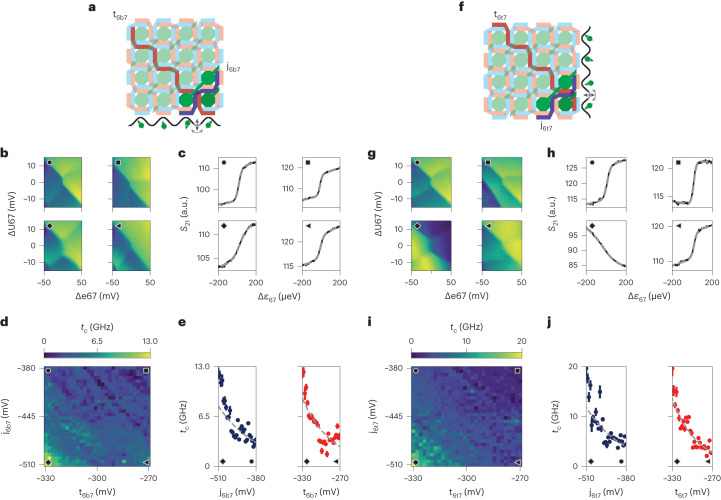
“At values of (t 6b7 , j 6b7 ) = (−270, −380) mV, the coupling is virtually OFF, but our method is inherently not accurate for t c ≤ 3 GHz, because thermal energy dominates the broadening of the polarization line 31,37 .”
MethodProbing quantum devices with radio-frequency reflectometry
Vigneau, F., Fedele, F., Chatterjee, A., Reilly, D. J., Kuemmeth, F., González-Zalba, M. F., Laird, E. A., & Ares, N. (2023) · Applied Physics Reviews · doi:10.1063/5.0088229 · Cited by 183
Modern applications of machine learning in quantum sciencesPreprint
Dawid, A., Arnold, J., Requena, B., Gresch, A., Płodzień, M., Donatella, K., Nicoli, K. A., Stornati, P., Koch, R., Büttner, M., et al. (2022) · arXiv (Cornell University) · doi:10.48550/arxiv.2204.04198 · Cited by 181
Silicon CMOS architecture for a spin-based quantum computer
Veldhorst, M., Eenink, H. G. J., Yang, C. H., & Dzurak, A. S. (2017) · RePEc: Research Papers in Economics · Cited by 166
Self-citationShallow and Undoped Germanium Quantum Wells: A Playground for Spin and Hybrid Quantum Technology
Sammak, A., Sabbagh, D., Hendrickx, N. W., Lodari, M., Wuetz, B. P., Tosato, A., Yeoh, L. A., Bollani, M., Virgilio, M., Schubert, M. A., et al. (2019) · Advanced Functional Materials · doi:10.1002/adfm.201807613 · Cited by 145 · cited 1×
“The device is fabricated on a Ge/SiGe heterostructure where a 16-nm-thick germanium quantum well with a maximum hole mobility of 2.5 × 10 5 cm 2 V −1 s −1 is buried 55 nm below the semiconductor/oxide interface 25,40 .”
MethodInfluentialSelf-citationQuantum dot arrays in silicon and germanium
Lawrie, W. I. L., Eenink, H. G. J., Hendrickx, N. W., Boter, J. M., Petit, L., Amitonov, S. V., Lodari, M., Paquelet Wuetz, B., Volk, C., Philips, S. G. J., et al. (2020) · Applied Physics Letters · doi:10.1063/5.0002013 · Cited by 140 · cited 1×
“29–32).”
Self-citationGate-controlled quantum dots and superconductivity in planar germanium
Hendrickx, N. W., Franke, D. P., Sammak, A., Kouwenhoven, M., Sabbagh, D., Yeoh, L., Li, R., Tagliaferri, M. L. V., Virgilio, M., Capellini, G., et al. (2018) · Nature Communications · doi:10.1038/s41467-018-05299-x · Cited by 138 · cited 1×
“First, 30-nm-thick Pt ohmic contacts are patterned via electron-beam lithography, evaporated and diffused in the heterostructure following an etching step to remove the oxidized Si cap layer 41,42 .”
MethodSelf-citationMachine learning enables completely automatic tuning of a quantum device faster than human experts
Moon, H., Lennon, D. T., Kirkpatrick, J., van Esbroeck, N. M., Camenzind, L. C., Yu, L., Vigneau, F., Zumbühl, D. M., Briggs, G. A. D., Osborne, M. A., et al. (2020) · Nature Communications · doi:10.1038/s41467-020-17835-9 · Cited by 124 · cited 1×
“To track specific transition lines in complex multidot charge stability diagrams, we have defined an algorithm based on an image correlation analysis, which may be refined by machine learning methods 26,34–36 .”
MethodLoading a quantum-dot based “Qubyte” register
Volk, C., Zwerver, A. M. J., Mukhopadhyay, U., Eendebak, P. T., van Diepen, C. J., Dehollain, J. P., Hensgens, T., Fujita, T., Reichl, C., Wegscheider, W., et al. (2019) · npj Quantum Information · doi:10.1038/s41534-019-0146-y · Cited by 115 · cited 2×
“To bring the device in the 16-quantum-dot configuration, we identify an alternative strategy to the tune-up methods established for individually controlled quantum dot devices 22 .”
MethodFast two-qubit logic with holes in germanium
Hendrickx, N. W., Franke, D. P., Sammak, A., Scappucci, G., & Veldhorst, M. (2019) · TNO Repository · Cited by 115
Self-citationA blueprint for building a quantum computer
Van Meter, R., & Horsman, D. (2013) · Communications of the ACM · doi:10.1145/2494568 · Cited by 114
Gate-controlled quantum dots and superconductivity in planar germanium
Hendrickx, N. W., Franke, D. P., Sammak, A., Kouwenhoven, M., Sabbagh, D., Yeoh, L. A., Li, R., Tagliaferri, M. L. V., Virgilio, M., Capellini, G., et al. (2018) · RePEc: Research Papers in Economics · Cited by 114
Self-citationLow percolation density and charge noise with holes in germanium
Lodari, M., Hendrickx, N. W., Lawrie, W. I. L., Hsiao, T.-K., Vandersypen, L. M. K., Sammak, A., Veldhorst, M., & Scappucci, G. (2021) · Materials for Quantum Technology · doi:10.1088/2633-4356/abcd82 · Cited by 87
Self-citationCoherent control of individual electron spins in a two-dimensional quantum dot array
Mortemousque, P.-A., Chanrion, E., Jadot, B., Flentje, H., Ludwig, A., Wieck, A. D., Urdampilleta, M., Bäuerle, C., & Meunier, T. (2021) · Nature Nanotechnology · doi:10.1038/s41565-020-00816-w · Cited by 85
Rent’s rule and extensibility in quantum computing
Franke, D. P., Clarke, J. S., Vandersypen, L. M. K., & Veldhorst, M. (2019) · Microprocessors and Microsystems · doi:10.1016/j.micpro.2019.02.006 · Cited by 80
Self-citationA Flexible Design Platform for Si/SiGe Exchange-Only Qubits with Low Disorder
Ha, W., Ha, S. D., Choi, M. D., Tang, Y., Schmitz, A. E., Levendorf, M. P., Lee, K., Chappell, J. M., Adams, T. S., Hulbert, D. R., et al. (2022) · Nano Letters · doi:10.1021/acs.nanolett.1c03026 · Cited by 76
Automated tuning of inter-dot tunnel coupling in double quantum dots
van Diepen, C. J., Eendebak, P. T., Buijtendorp, B. T., Mukhopadhyay, U., Fujita, T., Reichl, C., Wegscheider, W., & Vandersypen, L. M. K. (2018) · Applied Physics Letters · doi:10.1063/1.5031034 · Cited by 70
Spin Relaxation Benchmarks and Individual Qubit Addressability for Holes in Quantum Dots
Lawrie, W. I. L., Hendrickx, N. W., van Riggelen, F., Rimbach-Russ, M., Petit, L., Sammak, A., Scappucci, G., & Veldhorst, M. (2020) · Nano Letters · doi:10.1021/acs.nanolett.0c02589 · Cited by 69 · cited 1×
“In this configuration, we also prove the ability to prepare all the quantum dots in the odd-charge occupation, as a key step for the confinement of an unpaired spin in each site 18,19 .”
BackgroundSelf-citationHard superconducting gap in germanium
Tosato, A., Levajac, V., Wang, J., Boor, C. J., Borsoi, F., Botifoll, M., Borja, C., Martí‐Sánchez, S., Arbiol, J., Sammak, A., et al. (2023) · Communications Materials · doi:10.1038/s43246-023-00351-w · Cited by 68 · cited 1×
“First, 30-nm-thick Pt ohmic contacts are patterned via electron-beam lithography, evaporated and diffused in the heterostructure following an etching step to remove the oxidized Si cap layer 41,42 .”
MethodSelf-citationToward Robust Autotuning of Noisy Quantum dot Devices
Ziegler, J., McJunkin, T., Joseph, E. S., Kalantre, S. S., Harpt, B., Savage, D. E., Lagally, M. G., Eriksson, M. A., Taylor, J. M., & Zwolak, J. P. (2022) · Physical Review Applied · doi:10.1103/physrevapplied.17.024069 · Cited by 43 · cited 1×
“To track specific transition lines in complex multidot charge stability diagrams, we have defined an algorithm based on an image correlation analysis, which may be refined by machine learning methods 26,34–36 .”
MethodRay-Based Framework for State Identification in Quantum Dot Devices
Zwolak, J. P., McJunkin, T., Kalantre, S. S., Neyens, S. F., MacQuarrie, E. R., Eriksson, M. A., & Taylor, J. M. (2021) · PRX Quantum · doi:10.1103/prxquantum.2.020335 · Cited by 40
Tunable Coupling and Isolation of Single Electrons in Silicon Metal-Oxide-Semiconductor Quantum Dots
Eenink, H. G. J., Petit, L., Lawrie, W. I. L., Clarke, J. S., Vandersypen, L. M. K., & Veldhorst, M. (2019) · Nano Letters · doi:10.1021/acs.nanolett.9b03254 · Cited by 39 · cited 1×
“At values of (t 6b7 , j 6b7 ) = (−270, −380) mV, the coupling is virtually OFF, but our method is inherently not accurate for t c ≤ 3 GHz, because thermal energy dominates the broadening of the polarization line 31,37 .”
MethodSelf-citationCharge state hysteresis in semiconductor quantum dots
Yang, C. H., Rossi, A., Lai, N. S., Leon, R., Lim, W. H., & Dzurak, A. S. (2014) · Applied Physics Letters · doi:10.1063/1.4901218 · Cited by 32 · cited 3×
“To track specific transition lines in complex multidot charge stability diagrams, we have defined an algorithm based on an image correlation analysis, which may be refined by machine learning methods 26,34–36 .”
MethodDataset underlying the manuscript: Shared control of a 16 semiconductor quantum dot crossbar arrayPreprint
Borsoi, F., Hendrickx, N. W., John, V., M., Motz, S., van Riggelen, F., Sammak, A., de Snoo, S. L., Scappucci, G., & Veldhorst, M. (2022) · Zenodo (CERN European Organization for Nuclear Research) · doi:10.5281/zenodo.7077894 · Cited by 1
Self-citation
Research works printed but not linked: 1
- Harvey-Collard P High-fidelity single-shot readout for a spin qubit via an enhanced latching mechanism Phys. Rev. X 2018 8 021046
Cited by
Probing single electrons across 300-mm spin qubit wafers
Neyens, S., Zietz, O. K., Watson, T. F., Luthi, F., Nethwewala, A., George, H. C., Henry, E., Islam, M., Wagner, A. J., Borjans, F., et al. (2024) · Nature · doi:10.1038/s41586-024-07275-6 · Cited by 178
Operating semiconductor quantum processors with hopping spins
Wang, C.-A., John, V., Tidjani, H., Yu, C. X., Ivlev, A., Déprez, C., van Riggelen, F., Woods, B. D., Hendrickx, N. W., Lawrie, W. I. L., et al. (2024) · Science · doi:10.1126/science.ado5915 · Cited by 109
Self-citationSweet-spot operation of a germanium hole spin qubit with highly anisotropic noise sensitivity
Hendrickx, N. W., Massai, L., Mergenthaler, M., Schupp, F. J., Paredes, S., Bedell, S. W., Salis, G., & Fuhrer, A. (2024) · Nature Materials · doi:10.1038/s41563-024-01857-5 · Cited by 158
Self-citationRecent advances in hole-spin qubits
Fang, Y., Philippopoulos, P., Culcer, D., Coish, W. A., & Chesi, S. (2023) · Materials for Quantum Technology · doi:10.1088/2633-4356/acb87e · Cited by 102
“Efficient strategies to control a larger number of qubits, such as a 4 × 4 array [129], are being developed.”
MethodColloquium : Advances in automation of quantum dot devices control
Zwolak, J. P., & Taylor, J. M. (2023) · Reviews of Modern Physics · doi:10.1103/revmodphys.95.011006 · Cited by 87
Metadata
- Authors
- Borsoi, F., Hendrickx, N. W., John, V., Meyer, M., Motz, S., van Riggelen, F., Sammak, A., de Snoo, S. L., Scappucci, G., & Veldhorst, M.
- Affiliations
- QuTech (NL)
- Netherlands Organisation for Applied Scientific Research (NL)
- Corresponding author
- Borsoi, Francesco
- Veldhorst, Menno
- ORCID
- Venue
- Nature Nanotechnology
- Published
- 2023-08-28
- Volume
- 19
- Issue
- 1
- Pages
- 21-27
- ISSN
- 1748-3387 (ISSN-L)
- 1748-3395
- PMC
- PMC10796274
- OpenAlex
- W4386221797
- Cited by
- 165
- References
- 50
- Citations by year
- 2026: 31 · 2025: 66 · 2024: 52 · 2023: 16
- FWCI
- 19.13
- Type
- journal article
- Language
- en
- Open access
- hybrid
- doi.org
- Licence
- cc-by
- creativecommons.org/licenses/by/4.0 (tdm)
- creativecommons.org/licenses/by/4.0 (vor)
- Locations
- Nature Nanotechnology (publishedVersion, cc-by)
- PubMed Central (publishedVersion, cc-by)
- PubMed (publishedVersion)
- arXiv (Cornell University) (submittedVersion)
- TNO Repository (submittedVersion)
- Research Repository (Delft University of Technology) (submittedVersion, cc-by)
- arXiv (Cornell University) (cc-by)
- Funders
- United States Department of Defense | United States Army | U.S. Army Research, Development and Engineering Command | Army Research Office (W911NF-17-1-0274)
- Topics
- Physical Sciences › Physics and Astronomy › Condensed Matter Physics › Quantum and electron transport phenomena
- Physical Sciences › Physics and Astronomy › Atomic and Molecular Physics, and Optics › Semiconductor Quantum Structures and Devices
- Physical Sciences › Engineering › Electrical and Electronic Engineering › Advancements in Semiconductor Devices and Circuit Design
- Keywords
- shared control, semiconductor quantum dots, crossbar arrays, germanium, unpaired spins, double quantum dot, interdot tunnel coupling, scalable quantum computing, qubit control
About these checks
Registry, retraction, Cites and statistics results are computed, not judged, with one exception: a printed reference that no index lists is read once by a model before it counts as a citation error. Claims are extracted by a model and kept only when their quote appears verbatim in the text; each cited source is then checked, with a model’s help, for whether it says what the claim relies on. Those verdicts can be wrong — read the claim’s quote and the cited source before relying on one.
Statistics and arithmetic are recomputed, not judged.
Confidence bands are shown only for fields calibrated on our annotated test set. None is calibrated yet, so no band is shown.
What counts as a claim ›How we measure confidence ›How we check this ›
Are you an author, or do you see a problem with this page? Request a review
Data sources
Bibliographic data: Semantic Scholar, OpenAlex, Crossref.
Contains information from the Semantic Scholar Academic Graph Datasets, made available under the ODC Attribution License (ODC-BY 1.0).
Semantic Scholar’s data is described in: Kinney, R., et al. (2023). The Semantic Scholar Open Data Platform. arXiv:2301.10140.
