

Dairying enabled Early Bronze Age Yamnaya steppe expansions
Open accessThe DOI matches its Crossref record; 59 of the 60 references it cites were found in a registry or an index, and 1 are not checked yet; none of the 63 sources its claims cite is checked for support yet.
Abstract
During the Early Bronze Age, populations of the western Eurasian steppe expanded across an immense area of northern Eurasia. Combined archaeological and genetic evidence supports widespread Early Bronze Age population movements out of the Pontic–Caspian steppe that resulted in gene flow across vast distances, linking populations of Yamnaya pastoralists in Scandinavia with pastoral populations (known as the Afanasievo) far to the east in the Altai Mountains 1,2 and Mongolia 3. Although some models hold that this expansion was the outcome of a newly mobile pastoral economy characterized by horse traction, bulk wagon transport 4–6 and regular dietary dependence on meat and milk 5, hard evidence for these economic features has not been found. Here we draw on proteomic analysis of dental calculus from individuals from the western Eurasian steppe to demonstrate a major transition in dairying at the start of the Bronze Age. The rapid onset of ubiquitous dairying at a point in time when steppe populations are known to have begun dispersing offers critical insight into a key catalyst of steppe mobility. The identification of horse milk proteins also indicates horse domestication by the Early Bronze Age, which provides support for its role in steppe dispersals. Our results point to a potential epicentre for horse domestication in the Pontic–Caspian steppe by the third millennium bc, and offer strong support for the notion that the novel exploitation of secondary animal products was a key driver of the expansions of Eurasian steppe pastoralists by the Early Bronze Age.
Checked 2026-11-24 · 1 reference not checked yet
Overview
CoChat Summary
TL;DR
Proteomic analysis of dental calculus from 56 steppe individuals shows a marked shift to ubiquitous ruminant dairying at the Eneolithic-to-Early Bronze Age transition, alongside the earliest identified horse milk proteins. The authors argue this secondary-products economy, including horse domestication, was a key catalyst for Yamnaya steppe expansions.
Key findings
- Of 56 ancient dental calculus samples tested, 55 were successfully extracted and 48 of 55 (87%) had strong preservation signals. Eneolithic individuals mostly lacked dairy evidence (10 out of 11, 92%), whereas Early Bronze Age individuals overwhelmingly showed dairy consumption (15 out of 16, 94%); Middle–Late Bronze Age samples were also largely positive for ruminant milk (15 of 19).
- Dairy proteins identified included β-lactoglobulin (BLG), α-S1-casein, α-S2-casein and α-lactalbumin, with taxonomic attributions to Ovis, Capra and Bos, though many peptides were only specific to higher levels such as Pecora. Equus milk peptides from BLGI were found in 2 of 17 Early Bronze Age individuals, both from Krivyanskiy 9 (3305 to 2633 calibrated years bc); the two Botai individuals sampled lacked dairy evidence.
- The authors interpret the results as evidence for a major dairying transition at the start of the Bronze Age, support for horse domestication by the Early Bronze Age, and a potential Pontic–Caspian epicentre for horse domestication by the third millennium bc.
- The findings are presented as strong support for a secondary products revolution in the Eurasian steppe, with animal traction, dairying and horse domestication together transforming Pontic–Caspian economies and enabling Yamnaya expansions; the authors state they cannot offer direct insight into horse riding or traction.
Methods
- Dental calculus was sampled from 56 individuals dating between 4600 and 1700 bc: 19 Eneolithic individuals from 5 sites, 35 Bronze Age individuals from 20 sites divided into Early Bronze Age and Middle–Late Bronze Age groups, plus 2 individuals from Botai.
- Proteins were extracted using modified filter-aided sample preparation for “Z” samples and single-pot solid-phase enhanced sample preparation for “DA” samples, then analysed by LC–MS/MS. Peptides were searched with Mascot against Swiss-Prot plus a curated milk protein database and processed with MS-MARGE; thresholds included protein false-discovery rate under 5%, peptide false-discovery rate under 2%, at least two peptide spectral matches per protein, and e-value below 0.01. Preservation was assessed with the Oral Signature Screening Database.
- Radiocarbon chronologies used Bayesian modelling in OxCal v.4.4 with the ReSources mixing model to estimate freshwater protein contributions and a freshwater radiocarbon reservoir offset prior of 0–1,000 years. The paper states that no statistical methods were used to predetermine sample size, experiments were not randomized, and investigators were not blinded.
Limitations
- Stated: no statistical methods were used to predetermine sample size; experiments were not randomized; investigators were not blinded to allocation during experiments and outcome assessment.
- Stated: the single Eneolithic Khvalynsk individual with possible cattle dairy evidence is equivocal because only casein peptides were found, BLG was lacking, and only one possible deamidation site limited authenticity assessment; the two Botai samples are insufficient for broad conclusions; the horse milk finding is said to require further sampling and analysis; and the data cannot directly address horse riding or traction.
- Evident from the text: sample sizes are small for some periods and sites, taxonomic resolution is often limited to higher levels such as Pecora, and preservation assessment required a lowered threshold for Eneolithic samples, which may affect comparability across periods.
Model-written summary. Check it against the paper before relying on it.
Integrity signals
Registry
Cites
Statistics
Figures
Verification
Claims the paper makes
0 Valid · 0 Not valid · 30 Not checked · 48 Own results and interpretations
A result the paper reports from its own data — it cites no other source for it, so there is none to check. The quote shows it is in the paper.
In the paper
“Additionally, within the two identified casein peptides, there is only one possible amino acid deamidation site, which renders any estimation of the antiquity of these peptides exceedingly challenging.”
§ Dairying enabled Early Bronze Age Yamnaya steppe expansions > Main
plainstates a causeSingle case- Asserted: passes — The authors put it forward as true.
- Checkable: passes — It can be checked against evidence.
- Load-bearing: unclear — It is unclear whether the paper’s conclusions depend on it.
- Based: passes — The paper gives a reason why it holds.
A result the paper reports from its own data — it cites no other source for it, so there is none to check. The quote shows it is in the paper.
In the paper
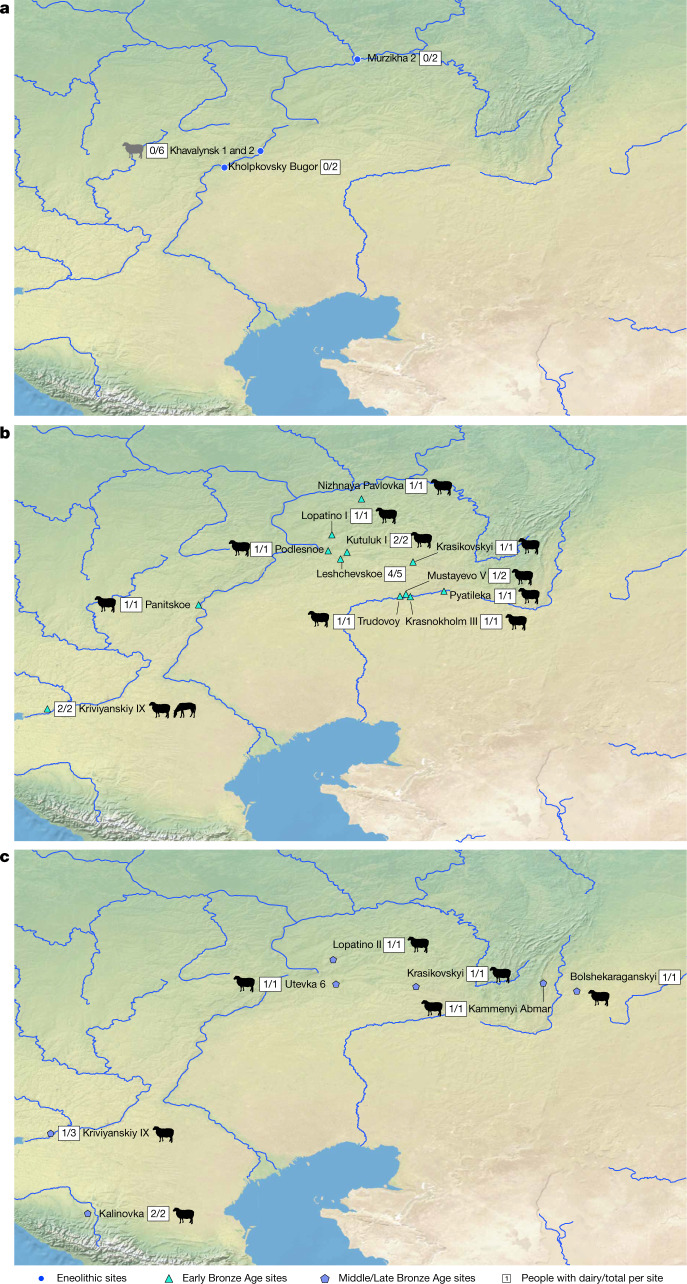
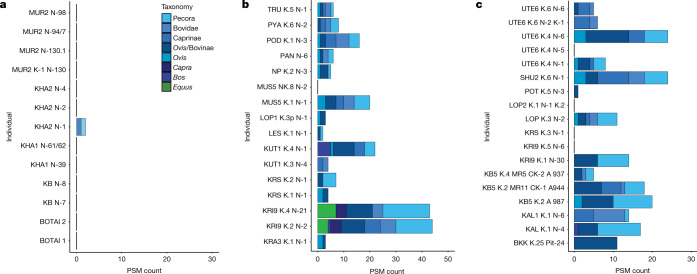
“For the Early Bronze Age individuals (dating to the onset of the Yamnaya cultural horizon), dairy peptides were recovered from 15 of the 16 individual calculus samples we analysed (Fig. 1b, 2b).”
§ Dairying enabled Early Bronze Age Yamnaya steppe expansions > Main
plainn = 15- Asserted: passes — The authors put it forward as true.
- Checkable: passes — It can be checked against evidence.
- Load-bearing: passes — The paper’s conclusions depend on it.
- Based: passes — The paper gives a reason why it holds.
A result the paper reports from its own data — it cites no other source for it, so there is none to check. The quote shows it is in the paper.
In the paper
“Similar to the Early Bronze Age, we identified BLG, α-S1-casein and α-S2-casein, as well as the whey protein α-lactalbumin.”
§ Dairying enabled Early Bronze Age Yamnaya steppe expansions > Main
plainn = 19- Asserted: passes — The authors put it forward as true.
- Checkable: passes — It can be checked against evidence.
- Load-bearing: unclear — It is unclear whether the paper’s conclusions depend on it.
- Based: passes — The paper gives a reason why it holds.
In the paper
“Our study of dental calculus from the Eneolithic site of Botai to the east, where early horse milking has been suggested by lipid analysis (albeit equivocally44), did not yield milk proteins.”
§ Dairying enabled Early Bronze Age Yamnaya steppe expansions > Main
What the sources say
- Not checked yetcites [44] Didier, J. C. In and Outside the Square: The Sky and the Power of Belief in Ancient China and the World, c. 4500 BC-AD 200 (Sino-Platonic Papers 192) (3 vols) (ed. Mair, V. H.) (2009).
plainn = 2- Asserted: passes — The authors put it forward as true.
- Checkable: passes — It can be checked against evidence.
- Load-bearing: passes — The paper’s conclusions depend on it.
- Based: passes — The paper gives a reason why it holds.
A result the paper reports from its own data — it cites no other source for it, so there is none to check. The quote shows it is in the paper.
In the paper
“Here we draw on proteomic analysis of dental calculus from individuals from the western Eurasian steppe to demonstrate a major transition in dairying at the start of the Bronze Age.”
§ Dairying enabled Early Bronze Age Yamnaya steppe expansions > Abstract
boosted- Asserted: passes — The authors put it forward as true.
- Checkable: passes — It can be checked against evidence.
- Load-bearing: passes — The paper’s conclusions depend on it.
- Based: passes — The paper gives a reason why it holds.
- Rests on 2 assumptions not shown here.
21 more claims
Create a free account to see all 78 claims and to verify the 58 references still open.
- Probably not a substantial claim. 29
- It may state two separate claims as one. 34
Self-check
Percentages, sums and reported differences re-computed from the paper’s own numbers.
Each contradiction between two passages listed here was confirmed by an independent check.
Rated minor: it would not touch a result — a value no result rests on, a p-value that stays on the same side of the significance level, or a conflict that is clerical, resolved elsewhere in the paper, or outside its own findings.
In the paper
§ Dairying enabled Early Bronze Age Yamnaya steppe expansions > Main
“dairy peptides were recovered from 15 of the 16 individual calculus samples we analysed”
§ Dairying enabled Early Bronze Age Yamnaya steppe expansions > Main
“we identified Equus milk peptides from the protein BLGI in 2 of 17 Early Bronze Age individuals”
Citations
Cites
Bayesian Analysis of Radiocarbon Dates
Bronk Ramsey, C. (2009) · Radiocarbon · doi:10.1017/s0033822200033865 · Cited by 8,725
Perkins, D. N., Pappin, D. J. C., Creasy, D. M., & Cottrell, J. S. (1999) · Electrophoresis · doi:10.1002/(sici)1522-2683(19991201)20:18<3551::aid-elps3551>3.0.co;2-2 · Cited by 8,203
The IntCal20 Northern Hemisphere Radiocarbon Age Calibration Curve (0–55 cal kBP)
Reimer, P. J., Austin, W. E. N., Bard, E., Bayliss, A., Blackwell, P. G., Bronk Ramsey, C., Butzin, M., Cheng, H., Edwards, R. L., Friedrich, M., et al. (2020) · Radiocarbon · doi:10.1017/rdc.2020.41 · Cited by 7,900
Discussion Reporting of 14 C Data
Stuiver, M., & Polach, H. A. (1977) · Radiocarbon · doi:10.1017/s0033822200003672 · Cited by 5,640
A cross-platform toolkit for mass spectrometry and proteomics
Chambers, M. C., Maclean, B., Burke, R., Amodei, D., Ruderman, D. L., Neumann, S., Gatto, L., Fischer, B., Pratt, B., Egertson, J., et al. (2012) · Nature Biotechnology · doi:10.1038/nbt.2377 · Cited by 4,093
Massive migration from the steppe was a source for Indo-European languages in Europe
Haak, W., Lazaridis, I., Patterson, N., Rohland, N., Mallick, S., Llamas, B., Brandt, G., Nordenfelt, S., Harney, E., Stewardson, K., et al. (2015) · Nature · doi:10.1038/nature14317 · Cited by 1,940
Self-citationPopulation genomics of Bronze Age Eurasia
Allentoft, M. E., Sikora, M., Sjögren, K.-G., Rasmussen, S., Rasmussen, M., Stenderup, J., Damgaard, P. B., Schroeder, H., Ahlström, T., Vinner, L., et al. (2015) · Nature · doi:10.1038/nature14507 · Cited by 1,550
Self-citationGenome-wide patterns of selection in 230 ancient Eurasians
Mathieson, I., Lazaridis, I., Rohland, N., Mallick, S., Patterson, N., Roodenberg, S. A., Harney, E., Stewardson, K., Fernandes, D., Novak, M., et al. (2015) · Nature · doi:10.1038/nature16152 · Cited by 1,515
Self-citationPeer Reviewed: Characterizing Aquatic Dissolved Organic Matter
Leenheer, J. A., & Croué, J.-P. (2003) · Environmental Science & Technology · doi:10.1021/es032333c · Cited by 1,242
The Earliest Horse Harnessing and Milking
Outram, A. K., Stear, N. A., Bendrey, R., Olsen, S., Kasparov, A., Zaibert, V., Thorpe, N., & Evershed, R. P. (2009) · Science · doi:10.1126/science.1168594 · Cited by 736
Self-citation
Research works printed but not linked: 1
- Wang CC Ancient human genome-wide data from a 3000-year interval in the Caucasus corresponds with eco-geographic regions Nat. Commun. 2019 10 590 10.1038/s41467-018-08220-8 30713341 PMC6360191 · DOI · Paper page
Cited by
Widespread horse-based mobility arose around 2200 bce in Eurasia
Librado, P., Tressières, G., Chauvey, L., Fages, A., Khan, N., Schiavinato, S., Tonasso‐Calvière, L., Kusliy, M. A., Gaunitz, C., Liu, X., et al. (2024) · Nature · doi:10.1038/s41586-024-07597-5 · Cited by 137
First bioanthropological evidence for Yamnaya horsemanship
Trautmann, M., Frînculeasa, A., Preda-Bălănică, B., Petruneac, M., Focşăneanu, M., Alexandrov, S., Atanassova, N., Włodarczak, P., Podsiadło, M., Dani, J., et al. (2023) · Science Advances · doi:10.1126/sciadv.ade2451 · Cited by 116
Self-citationArchaeology and the Genetic Revolution in European Prehistory
Kristiansen, K. (2022) · Cambridge University Press eBooks · doi:10.1017/9781009228701 · Cited by 114
Emergence and intensification of dairying in the Caucasus and Eurasian steppes
Scott, A., Reinhold, S., Hermes, T. R., Kalmykov, A., Belinskiy, A. B., Buzhilova, A., Berezina, N., Kantorovich, А. R., Maslov, V. Е., Guliyev, F., et al. (2022) · Nature Ecology & Evolution · doi:10.1038/s41559-022-01701-6 · Cited by 90
Self-citationRethinking the evidence for early horse domestication at Botai
Taylor, W. T. T., & Barrón-Ortiz, C. I. (2021) · Scientific Reports · doi:10.1038/s41598-021-86832-9 · Cited by 80
Self-citationPrehistoric population expansion in Central Asia promoted by the Altai Holocene Climatic Optimum
Xiang, L., Huang, X., Sun, M., Panizzo, V. N., Huang, C., Zheng, M., Chen, X., & Chen, F. (2023) · Nature Communications · doi:10.1038/s41467-023-38828-4 · Cited by 78
Ancient DNA and migrations: New understandings and misunderstandings
Anthony, D. W. (2023) · Journal of Anthropological Archaeology · doi:10.1016/j.jaa.2023.101508 · Cited by 65
Self-citationPreserving the food preservation legacy
Knorr, D., & Augustin, M. A. (2022) · Critical Reviews in Food Science and Nutrition · doi:10.1080/10408398.2022.2065459 · Cited by 60
Tang, L., Wilkin, S., Richter, K. K., Bleasdale, M., Fernandes, R. J., He, Y., Li, S., Petraglia, M. D., Scott, A., Teoh, F. K. Y., et al. (2023) · Science Advances · doi:10.1126/sciadv.adf0345 · Cited by 53
Self-citationOutram, A. K. (2023) · Frontiers in Environmental Archaeology · doi:10.3389/fearc.2023.1134068 · Cited by 53
Self-citationMiller, A. V., Wilkin, S., Hendy, J., Turbat, T., Batsukh, D., Bayarkhuu, N., Giscard, P.-H., Bemmann, J. H., Bayarsaikhan, J., Miller, B. K., et al. (2022) · PLoS ONE · doi:10.1371/journal.pone.0265775 · Cited by 50
Self-citationAncient genomics and the origin, dispersal, and development of domestic sheep
Daly, K. G., Mullin, V. E., Hare, A. J., Halpin, Á., Mattiangeli, V., Teasdale, M. D., Rossi, C., Geiger, S., Krebs, S., Međugorac, I., et al. (2025) · Science · doi:10.1126/science.adn2094 · Cited by 48
Bronze Fish: Marine Resources and the Bronze Age Economy
Hudson, M. J., & Fernández, I. M. M. (2023) · Old World Journal of Ancient Africa and Eurasia · doi:10.1163/26670755-20230006 · Cited by 44
The Population History of Domestic Sheep Revealed by Paleogenomes
Kaptan, D., Atağ, G., Vural, K. B., Miranda, P. M., Akbaba, A., Yüncü, E., Александрович, Б. А., Abazari, M. F., Yorulmaz, S., Kazancı, D. D., et al. (2024) · Molecular Biology and Evolution · doi:10.1093/molbev/msae158 · Cited by 42
Genomic perspectives on human dispersals during the Holocene
Stoneking, M., Arias, L., Liu, D., Oliveira, S., Pugach, I., & Rodriguez, J. J. R. B. (2023) · Proceedings of the National Academy of Sciences · doi:10.1073/pnas.2209475119 · Cited by 40
Evans, M., Lundy, J., Lucquin, A., Hagan, R. W., Kowalski, Ł., Wilczyński, J., Bickle, P., Adamczak, K., Craig, O. E., Robson, H. K., et al. (2023) · Royal Society Open Science · doi:10.1098/rsos.230124 · Cited by 33
Permafrost preservation reveals proteomic evidence for yak milk consumption in the 13th century
Miller, A. V., Wilkin, S., Bayarsaikhan, J., Ramsøe, A. D., Clark, J., Byambadorj, B., Vanderwarf, S., Vanwezer, N., Haruda, A. F., Fernandes, R. J., et al. (2023) · Communications Biology · doi:10.1038/s42003-023-04723-3 · Cited by 32
Self-citationThe rise and transformation of Bronze Age pastoralists in the Caucasus
Ghalichi, A., Reinhold, S., Rohrlach, A. B., Kalmykov, A., Childebayeva, A., He, Y. H., Aron, F., Semerau, L., Bastert-Lamprichs, K., Belinskiy, A. B., et al. (2024) · Nature · doi:10.1038/s41586-024-08113-5 · Cited by 24
Rouse, L. М., Dupuy, P. N. D., & Brite, E. B. (2022) · Journal of Anthropological Archaeology · doi:10.1016/j.jaa.2022.101438 · Cited by 22
Pham, V. D., Xu, Z. S., Simpson, D. J. W., Zhang, J. S., & Gänzle, M. G. (2024) · Applied and Environmental Microbiology · doi:10.1128/aem.01892-24 · Cited by 21
Dong, G., Du, L., Liu, R., Li, Y., & Chen, F. (2023) · The Innovation Geoscience · doi:10.59717/j.xinn-geo.2023.100038 · Cited by 21
Social dominance orientation: The motivational basis of intergroup inequality
Ho, A. K., Kteily, N., Sheehy-Skeffington, J. A., & Thomsen, L. (2025) · Advances in experimental social psychology · doi:10.1016/bs.aesp.2025.04.003 · Cited by 20
Outram, A. K., Bendrey, R., Evershed, R. P., Orlando, L., & Zaibert, V. F. (2021) · Figshare · doi:10.5281/zenodo.5142603 · Cited by 19
Self-citationLactase deficiency in Russia: multiethnic genetic study
Kovalenko, E. V., Vergasova, E., Shoshina, O., Popov, I., Ilinskaya, A. Y., Kim, A., Plotnikov, N. A., Barenbaum, I., Elmuratov, A. U., Ilinsky, V. V., et al. (2023) · European Journal of Clinical Nutrition · doi:10.1038/s41430-023-01294-8 · Cited by 17
Wilkin, S., Hommel, P. N., Miller, A. V., Boivin, N. L., Pedergnana, A., Shishlina, N., & Анатольевич, Т. В. (2023) · iScience · doi:10.1016/j.isci.2023.107482 · Cited by 17
Self-citationPeng, M., Yan-hu, L., Shen, Q., Zhang, X.-H., Dong, J., Li, J., Zhao, H., Zhang, H., Zhang, X., He, Y., et al. (2023) · BMC Biology · doi:10.1186/s12915-023-01707-x · Cited by 16
Contribution of cultural heritage values to steppe conservation on ancient burial mounds of Eurasia
Déak, B., Bede, Á., Rádai, Z., Dembicz, I., Apostolova, I., Batáry, P., Gallé, R., Tóth, C., Dózsai, J., Moysiyenko, I. I., et al. (2023) · Conservation Biology · doi:10.1111/cobi.14148 · Cited by 15
Kyselý, R., & Peške, L. (2022) · Archeologické rozhledy · doi:10.35686/ar.2022.15 · Cited by 15
Curious case of the history of fermented milk: tangible evidence
Sakandar, H. A., & Zhang, H. (2022) · Science Bulletin · doi:10.1016/j.scib.2022.07.013 · Cited by 14
Palomo, I. R., Nair, B., Chiang, Y., Dekker, J. A. A., Dartigues, B., Mackie, M., Evans, M., Macleod, R., Olsen, J. V., & Collins, M. J. (2024) · Peer Community Journal · doi:10.24072/pcjournal.491 · Cited by 14
The prehistoric origins of the domestic horse and horseback riding
Niskanen, M. (2023) · Bulletins et Mémoires de la Société d anthropologie de Paris · doi:10.4000/bmsap.11881 · Cited by 14
Diversification in Feeding Pattern of Livestock in Early Bronze Age Northwestern China
Qiu, M., Li, H., Lu, M., Yang, Y., Zhang, S., Li, R., Chen, G., & Ren, L. (2022) · Frontiers in Ecology and Evolution · doi:10.3389/fevo.2022.908131 · Cited by 13
Spectra without stories: reporting 94% dark and unidentified ancient proteomes
Chiang, Y., Welker, F., & Collins, M. J. (2024) · Open Research Europe · doi:10.12688/openreseurope.17225.1 · Cited by 13
Tracing horseback riding and transport in the human skeleton
Hosek, L., James, R. J., & Taylor, W. T. T. (2024) · Science Advances · doi:10.1126/sciadv.ado9774 · Cited by 13
Self-citationDiverse dietary practices across the Early Bronze Age ‘Kura-Araxes culture’ in the South Caucasus
Manoukian, N., Whelton, H. L., Dunne, J., Badalyan, R., Smith, A. T., Simonyan, H., Rothman, M. S., Bobokhyan, A. A., Hovsepyan, R., Avetisyan, P. S., et al. (2022) · PLoS ONE · doi:10.1371/journal.pone.0278345 · Cited by 13
Pedergnana, A., Grossmann, J., Turck, R., Goujon, A., Rühli, F. J., Wilkin, S., Eppenberger, P., & Lehn, C. (2025) · Scientific Reports · doi:10.1038/s41598-025-10103-0 · Cited by 12
Self-citationEvans, M., Hagan, R. W., Boyd, O. J., Bondetti, M., Craig, O. E., Collins, M. J., & Hendy, J. (2024) · Royal Society Open Science · doi:10.1098/rsos.240610 · Cited by 12
A New Framework for Quantifying Prehistoric Grave Wealth
Nørtoft, M. (2022) · Journal of Computer Applications in Archaeology · doi:10.5334/jcaa.86 · Cited by 12
Niger-Congo archaeolinguistics, including Bantu
Bostoen, K. A. G., Coutros, P. R., & Schlebusch, C. M. (2025) · Oxford University Press eBooks · doi:10.1093/oxfordhb/9780192868350.013.30 · Cited by 11
Chen, F., Zhao, X., Yue, W., Wang, S., Zhang, Y., Chen, Y., Hu, M., Esper, J., Büntgen, U., Ljungqvist, F. C., et al. (2026) · Proceedings of the National Academy of Sciences · doi:10.1073/pnas.2513573123 · Cited by 11
Frachetti, M. D., Cosmo, N. D., Esper, J., Khalidi, L., Mauelshagen, F., Oppenheimer, C., Rohland, E., & Büntgen, U. (2023) · Science Advances · doi:10.1126/sciadv.adj3142 · Cited by 11
Álvarez‐Vena, A., Marín-Arroyo, A. B., Álvarez‐Lao, D. J., Laplana, C., Arriolabengoa, M., Ballesteros, D., Aranburu, A., Lasa, P. B., Astorqui, Á., & Díaz-Casado, Y. (2023) · Palaeogeography Palaeoclimatology Palaeoecology · doi:10.1016/j.palaeo.2023.111476 · Cited by 10
Rassadnikov, A. Y. (2022) · International Journal of Paleopathology · doi:10.1016/j.ijpp.2022.05.003 · Cited by 10
Open science, communication, and collaboration for the future of palaeoproteomics
Dekker, J. A. A., Peters, C., Winter, R. M., Collins, M. J., Dickinson, M. R., Harvey, V. L., Hill, E., Nair, B., Tsutaya, T., Viñas-Caron, L. C., et al. (2025) · Peer Community Journal · doi:10.24072/pcjournal.576 · Cited by 9
The Milky Way: Mobility and Economy at the Turn of the 3rd Millennium in Southern Central Europe
Dunne, J., Szilágyi, M., Casanova, E., Griffiths, S., Knowles, T. D. J., Evershed, R. P., & Hofmann, D. (2023) · Proceedings of the Prehistoric Society · doi:10.1017/ppr.2023.3 · Cited by 9
Fonseca, B., Freeman, C. L., & Collins, M. J. (2022) · Chemical Physics · doi:10.1016/j.chemphys.2022.111602 · Cited by 9
The Characteristics, Distribution, Function, and Origin of Alternative Lateral Horse Gaits
Vincelette, A. (2023) · Animals · doi:10.3390/ani13162557 · Cited by 9
Déak, B., Bede, Á., Süveges, K., Dózsai, J., Ormsby, A. A., Dixon, A. R., & Valkó, O. (2024) · Human Ecology · doi:10.1007/s10745-024-00515-3 · Cited by 9
A History of East Baltic through Language Contact
Jakob, A. (2023) · BRILL eBooks · doi:10.1163/9789004686472 · Cited by 9
Mitochondrial DNA Footprints from Western Eurasia in Modern Mongolia
Cardinali, I., Bodner, M., Capodiferro, M. R., Amory, C., Rambaldi Migliore, N., Gomez, E. J., Myagmar, E., Dashzeveg, T., Carano, F., Woodward, S. R., et al. (2022) · Frontiers in Genetics · doi:10.3389/fgene.2021.819337 · Cited by 8
Leveraging palaeoproteomics to address conservation and restoration agendas
Peters, C., Richter, K. K., Svenning, J., & Boivin, N. L. (2022) · iScience · doi:10.1016/j.isci.2022.104195 · Cited by 8
Self-citationMetaproteomic approaches to ancient foodways: A review
Evans, M. (2025) · Journal of Archaeological Science · doi:10.1016/j.jas.2025.106211 · Cited by 8
Antonosyan, M., Hill, E., Jodry, M., Amano, N., Brown, S., Rick, T. C., & Boivin, N. L. (2024) · Frontiers in Mammal Science · doi:10.3389/fmamm.2024.1399358 · Cited by 8
Self-citationLi, Y., Zhang, D., Zhang, Y., Sun, A., Li, X., Huang, X., Zhang, Y., & Li, Y. (2024) · Palaeogeography Palaeoclimatology Palaeoecology · doi:10.1016/j.palaeo.2024.112466 · Cited by 7
The mystery of early milk consumption in Europe
Wilkin, S. (2022) · Nature · doi:10.1038/d41586-022-02041-y · Cited by 7
Self-citationHoneychurch, W., Fan, R., Rogers, L., Hall, M. E., Amartuvshin, C., Byambatseren, B., Pleuger-Dreibrodt, S., Khatanbaatar, D., Myagmar, E., Houle, J., et al. (2025) · Journal of Archaeological Method and Theory · doi:10.1007/s10816-024-09691-4 · Cited by 7
Kaliff, A., & Østigård, T. (2022) · Uppsala University Publications (Uppsala University) · Cited by 7
The Oxford Handbook of Archaeology and Language
Robbeets, M., & Hudson, M. (2025) · Oxford University Press eBooks · doi:10.1093/oxfordhb/9780192868350.001.0001 · Cited by 6
Pan, J., Liu, X., Baca, M., Tonasso‐Calvière, L., Schiavinato, S., Chauvey, L., Tressières, G., Perdereau, A., Aury, J., Oliveira, P. H., et al. (2024) · Molecular Ecology · doi:10.1111/mec.17527 · Cited by 6
Self-citationVondrovský, V., Hrnčíř, V., Hlásek, D., Chvojka, O., Květina, P., Šída, P., John, J., Pokorný, P., & Ptáková, M. (2025) · Journal of Archaeological Research · doi:10.1007/s10814-025-09216-x · Cited by 6
Uchida‐Fukuhara, Y., Shimamura, S., Sawafuji, R., Nishiuchi, T., Yoneda, M., Ishida, H., Matsumura, H., & Tsutaya, T. (2024) · Scientific Reports · doi:10.1038/s41598-024-55779-y · Cited by 6
Zhang, Y., Wang, J., Yi, C., Su, Y., Yin, Z. C., Zhang, S., Li, J., Stoneking, M., Yang, J., Wang, K., et al. (2025) · Cell Genomics · doi:10.1016/j.xgen.2025.100855 · Cited by 6
Horse genetics, archaeology, and the beginning of riding
Anthony, D. W., Trautmann, M., & Heyd, V. (2026) · Science Advances · doi:10.1126/sciadv.ady7336 · Cited by 6
Self-citationVesakoski, O., Salmela, E., & Piezonka, H. (2025) · Oxford University Press eBooks · doi:10.1093/oxfordhb/9780192868350.013.19 · Cited by 5
Sino-Tibetan archaeolinguistics
Bradley, D. T. C., Li, L., Ning, C., & Martello, R. D. (2025) · Oxford University Press eBooks · doi:10.1093/oxfordhb/9780192868350.013.22 · Cited by 5
The archaeolinguistics of Kalahari Basin area languages
Güldemann, T., Smith, A. B., & Bajić, V. (2025) · Oxford University Press eBooks · doi:10.1093/oxfordhb/9780192868350.013.31 · Cited by 5
World Prehistory and Archaeology: Pathways Through Time
Chazan, M. (2021) · Routledge eBooks · doi:10.4324/9780367815271 · Cited by 5
Bowern, C., Llamas, B., Miceli, L., Tobler, R., & Veth, P. (2025) · Oxford University Press eBooks · doi:10.1093/oxfordhb/9780192868350.013.27 · Cited by 4
Gill, H., Seidualy, M., Lee, J., Lee, J., Moon, H., Walter, A., Bianco, R. A., Kurmangaliev, A. K., Рахманкулов, Е., Самашев, З., et al. (2025) · Science Advances · doi:10.1126/sciadv.adw8219 · Cited by 4
Intensive pastoralism facilitated the rise of the Tang Dynasty in China
Zhang, J., Huang, X., Wang, N., Jiang, L., Min, R., Liu, X., Zhu, Z., Ren, X., Luo, D., & Zhang, B. (2025) · Vegetation History and Archaeobotany · doi:10.1007/s00334-025-01057-4 · Cited by 4
Anubis: a multi-level authentication scale for ancient proteins using random forest classificationPreprint
Chiang, Y., Nair, B., Ramsøe, M., Ravnsborg, T., Jensen, O. N., & Collins, M. J. (2024) · bioRxiv (Cold Spring Harbor Laboratory) · doi:10.1101/2024.11.15.623824 · Cited by 4
Evans, M. (2026) · PLoS ONE · doi:10.1371/journal.pone.0339465 · Cited by 4
Nay to Prey: Challenging the View of Horses as a “Prey” Species
Steklis, N. G., Peñaherrera‐Aguirre, M., & Steklis, H. D. (2025) · Animals · doi:10.3390/ani15050641 · Cited by 4
Indo-Slavic Lexical Isoglosses and the Prehistoric Dispersal of Indo-Iranian
Palmér, A. I. (2025) · BRILL eBooks · doi:10.1163/9789004731851 · Cited by 4
Historical comparative linguistics and language classification
Barlow, R., & Campbell, L. R. (2025) · Oxford University Press eBooks · doi:10.1093/oxfordhb/9780192868350.013.3 · Cited by 3
Bayesian phylogenetics for language prehistory— and archaeology
Heggarty, P., & Powell, A. (2025) · Oxford University Press eBooks · doi:10.1093/oxfordhb/9780192868350.013.11 · Cited by 3
Archaeolinguistics of Papuan languages
Schapper, A., Gaffney, D., & Brucato, N. (2025) · Oxford University Press eBooks · doi:10.1093/oxfordhb/9780192868350.013.26 · Cited by 3
Austronesian archaeolinguistics
Spriggs, M., Geraghty, P., & Liu, Y.-C. (2025) · Oxford University Press eBooks · doi:10.1093/oxfordhb/9780192868350.013.25 · Cited by 3
Cultural reconstruction: How to infer the cultural environment of ancestral speakers
Epps, P. L., & Khanina, O. (2025) · Oxford University Press eBooks · doi:10.1093/oxfordhb/9780192868350.013.5 · Cited by 3
Wichmann, S. (2025) · Oxford University Press eBooks · doi:10.1093/oxfordhb/9780192868350.013.6 · Cited by 3
Riccomi, G., Rosselli, L., Marchesi, M., Guidi, F., Taloni, M., Ricci, G., Pellegrino, C., & Wilkin, S. (2025) · Journal of Proteomics · doi:10.1016/j.jprot.2025.105503 · Cited by 3
Self-citationExtended pre-domestication horse lineage survival in the Carpathian Basin
Dicső, Z., Szabó, G., Bozi, R., Borbély, N., Heltai, B., Kulcsár, G., Mende, B. G., Kiss, V., Szécsényi‐Nagy, A., & Gerber, D. (2025) · Acta Archaeologica · doi:10.1556/072.2025.00036 · Cited by 3
Pecnik, J., Miller, A., Panse, C., Kunz, L., Dittmann, A., Johnson, J. A., Владимирович, М. С., Litvinova, L., Andrukh, S., Toschev, G., et al. (2026) · PLoS ONE · doi:10.1371/journal.pone.0339464 · Cited by 3
Self-citationFonseca, B., Freeman, C. L., & Collins, M. J. (2024) · bioRxiv (Cold Spring Harbor Laboratory) · doi:10.1101/2024.09.13.612646 · Cited by 3
Indo-European archaeolinguistics
Lubotsky, A., & Pronk, T. (2025) · Oxford University Press eBooks · doi:10.1093/oxfordhb/9780192868350.013.18 · Cited by 2
Archaeolinguistics: Combining archaeology, genes, and language
Robbeets, M. (2025) · Oxford University Press eBooks · doi:10.1093/oxfordhb/9780192868350.013.1 · Cited by 2
Pagel, M. D. (2025) · Oxford University Press eBooks · doi:10.1093/oxfordhb/9780192868350.013.2 · Cited by 2
Archaeolinguistics and the languages of hunter-gatherers
Evans, N. (2025) · Oxford University Press eBooks · doi:10.1093/oxfordhb/9780192868350.013.13 · Cited by 2
Transeurasian archaeolinguistics
Robbeets, M., Hudson, M. J., & Ning, C. (2025) · Oxford University Press eBooks · doi:10.1093/oxfordhb/9780192868350.013.20 · Cited by 2
Archaeolinguistics of language families and contact areas of Amazonia
van Gijn, R., Arias, L., & de Souza, J. G. (2025) · Oxford University Press eBooks · doi:10.1093/oxfordhb/9780192868350.013.34 · Cited by 2
Muinais-DNA: Avain menneisyyteen
Nordfors, U., & Meriluoto, M. (2025) · doi:10.21435/tl.298 · Cited by 2
Non-random mutations and directed evolution
Melkikh, A. V. (2026) · Biosystems · doi:10.1016/j.biosystems.2026.105820 · Cited by 2
Maritime networks as a vector for early farming/language dispersals: A comparative review
Hudson, M. J., Uchiyama, J., Zancan, C., Šukelj, K., Bernabé, R. C., Bjørn, R., Bausch, I. R., & Fernández, I. M. M. (2025) · Quaternary Environments and Humans · doi:10.1016/j.qeh.2025.100066 · Cited by 2
Power, Gender, and Mobility: Aspects of Indo-European Society
Ginevra, R., Höfler, S., Olsen, B. A., & Jacquet, J. B. (2024) · Copenhagen studies in Indo-European. · doi:10.55069/oty12028 · Cited by 2
Ding, L., Wang, L., Lyu, Q., Yang, Q., & Yang, Y. (2025) · Archaeological and Anthropological Sciences · doi:10.1007/s12520-025-02241-3 · Cited by 2
Іванова, С. (2023) · Sprawozdania Archeologiczne · doi:10.23858/sa/75.2023.1.3438 · Cited by 2
Morvan, M., & Matuzevičiūtė, G. M. (2026) · bioRxiv (Cold Spring Harbor Laboratory) · doi:10.64898/2026.04.03.716286 · Cited by 2
Atsenova, N., Palova, N., Mehandjyiski, I., Neov, B., Radoslavov, G., & Hristov, P. I. (2021) · Journal of Equine Veterinary Science · doi:10.1016/j.jevs.2021.103830 · Cited by 2
Prehistoric language change in social context
Bakker, P. (2025) · Oxford University Press eBooks · doi:10.1093/oxfordhb/9780192868350.013.8 · Cited by 1
Han, J. (2023) · Chinese Science Bulletin (Chinese Version) · doi:10.1360/tb-2023-0545 · Cited by 1
Metadata
- Authors
- Wilkin, S., Ventresca Miller, A., Fernandes, R., Spengler, R., Taylor, W. T.-T., Brown, D. R., Reich, D., Kennett, D. J., Culleton, B. J., Kunz, L., Fortes, C., Kitova, A., Kuznetsov, P., Epimakhov, A., Zaibert, V. F., Outram, A. K., Kitov, E., Khokhlov, A., Anthony, D., & Boivin, N.
- Affiliations
- University of Zurich (CH)
- Masaryk University (CZ)
- Max Planck Institute of Geoanthropology (DE)
- University of Colorado Boulder (US)
- Hartwick College (US)
- Broad Institute (US)
- University of California, Santa Barbara (US)
- Pennsylvania State University (US)
- Russian Academy of Sciences (RU)
- Samara State University of Social Sciences and Education (RU)
- South Ural State University (RU)
- Al-Farabi Kazakh National University (KZ)
- University of Exeter (GB)
- Harvard University (US)
- Smithsonian Institution (US)
- Corresponding author
- Wilkin, Shevan
- Boivin, Nicole
- ORCID
- Venue
- Nature
- Published
- 2021-09-15
- Volume
- 598
- Issue
- 7882
- Pages
- 629-633
- ISSN
- 0028-0836 (ISSN-L)
- 1476-4687
- PMC
- PMC8550948
- OpenAlex
- W3201494818
- Cited by
- 184
- References
- 58
- Citations by year
- 2026: 32 · 2025: 68 · 2024: 24 · 2023: 29 · 2022: 25 · 2021: 6
- FWCI
- 37.16
- Type
- journal article
- Language
- en
- Open access
- hybrid
- doi.org
- Licence
- cc-by
- creativecommons.org/licenses/by/4.0 (tdm)
- creativecommons.org/licenses/by/4.0 (vor)
- Locations
- Nature (publishedVersion, cc-by)
- Oxford University Research Archive (ORA) (University of Oxford) (publishedVersion, public-domain)
- Europe PMC (PubMed Central) (publishedVersion, cc-by)
- PubMed Central (publishedVersion, cc-by)
- PubMed (publishedVersion)
- Repository for Publications and Research Data (ETH Zurich) (publishedVersion, cc-by)
- RePEc: Research Papers in Economics (submittedVersion)
- Griffith Research Online (submittedVersion, cc-by)
- Zurich Open Repository and Archive (University of Zurich) (submittedVersion, cc-by)
- ETH Zürich Research Collection (cc-by)
- Zurich Open Repository and Archive (University of Zurich)
- Funders
- Howard Hughes Medical Institute
- Max-Planck-Gesellschaft
- Topics
- Social Sciences › Archeology › Archaeology and ancient environmental studies
- Social Sciences › Arts and Humanities › Archeology (arts and humanities) › Ancient and Medieval Archaeology Studies
- Life Sciences › Biochemistry, Genetics and Molecular Biology › Genetics › Forensic and Genetic Research
- Keywords
- dairy production, Early Bronze Age, Yamnaya, steppe pastoralism, horse domestication, steppe expansion, horse traction
- MeSH terms
- Domestication, Animals, Archaeology, Asia, Dairying, Dental Calculus, Europe, Horses, Humans, Milk, Proteome, History, Ancient, Gene Flow, Human Migration, Grassland
About these checks
Registry, retraction, Cites and statistics results are computed, not judged, with one exception: a printed reference that no index lists is read once by a model before it counts as a citation error. Claims are extracted by a model and kept only when their quote appears verbatim in the text; each cited source is then checked, with a model’s help, for whether it says what the claim relies on. Those verdicts can be wrong — read the claim’s quote and the cited source before relying on one.
A language model drew the claims from the paper on 2026-11-24, under version 3 of the claim definition (model deepseek-v4.1-flash, prompt extract-v3).
A second model labelled each claim on 2026-11-24 (model jev-1.13-20260917, definition revision gold-guideline-v0.2).
Statistics and arithmetic are recomputed, not judged.
Confidence bands are shown only for fields calibrated on our annotated test set. None is calibrated yet, so no band is shown.
What counts as a claim ›How we measure confidence ›How we check this ›
Are you an author, or do you see a problem with this page? Request a review
Data sources
Bibliographic data: Semantic Scholar, OpenAlex, Crossref.
Contains information from the Semantic Scholar Academic Graph Datasets, made available under the ODC Attribution License (ODC-BY 1.0).
Semantic Scholar’s data is described in: Kinney, R., et al. (2023). The Semantic Scholar Open Data Platform. arXiv:2301.10140.
