

Dairying enabled Early Bronze Age Yamnaya steppe expansions
Open accessThe DOI matches its Crossref record; 59 of the 60 references it cites were found in a registry or an index, and 1 are not checked yet; none of the 63 sources its claims cite is checked for support yet.
Abstract
During the Early Bronze Age, populations of the western Eurasian steppe expanded across an immense area of northern Eurasia. Combined archaeological and genetic evidence supports widespread Early Bronze Age population movements out of the Pontic–Caspian steppe that resulted in gene flow across vast distances, linking populations of Yamnaya pastoralists in Scandinavia with pastoral populations (known as the Afanasievo) far to the east in the Altai Mountains 1,2 and Mongolia 3. Although some models hold that this expansion was the outcome of a newly mobile pastoral economy characterized by horse traction, bulk wagon transport 4–6 and regular dietary dependence on meat and milk 5, hard evidence for these economic features has not been found. Here we draw on proteomic analysis of dental calculus from individuals from the western Eurasian steppe to demonstrate a major transition in dairying at the start of the Bronze Age. The rapid onset of ubiquitous dairying at a point in time when steppe populations are known to have begun dispersing offers critical insight into a key catalyst of steppe mobility. The identification of horse milk proteins also indicates horse domestication by the Early Bronze Age, which provides support for its role in steppe dispersals. Our results point to a potential epicentre for horse domestication in the Pontic–Caspian steppe by the third millennium bc, and offer strong support for the notion that the novel exploitation of secondary animal products was a key driver of the expansions of Eurasian steppe pastoralists by the Early Bronze Age.
Checked 2026-11-24 · 1 reference not checked yet
Overview
CoChat Summary
TL;DR
Proteomic analysis of dental calculus from 56 steppe individuals shows a marked shift to ubiquitous ruminant dairying at the Eneolithic-to-Early Bronze Age transition, alongside the earliest identified horse milk proteins. The authors argue this secondary-products economy, including horse domestication, was a key catalyst for Yamnaya steppe expansions.
Key findings
- Of 56 ancient dental calculus samples tested, 55 were successfully extracted and 48 of 55 (87%) had strong preservation signals. Eneolithic individuals mostly lacked dairy evidence (10 out of 11, 92%), whereas Early Bronze Age individuals overwhelmingly showed dairy consumption (15 out of 16, 94%); Middle–Late Bronze Age samples were also largely positive for ruminant milk (15 of 19).
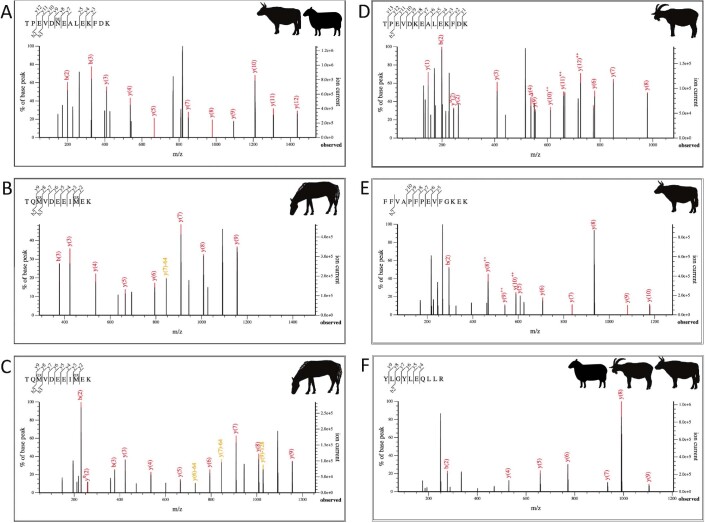
- Dairy proteins identified included β-lactoglobulin (BLG), α-S1-casein, α-S2-casein and α-lactalbumin, with taxonomic attributions to Ovis, Capra and Bos, though many peptides were only specific to higher levels such as Pecora. Equus milk peptides from BLGI were found in 2 of 17 Early Bronze Age individuals, both from Krivyanskiy 9 (3305 to 2633 calibrated years bc); the two Botai individuals sampled lacked dairy evidence.
- The authors interpret the results as evidence for a major dairying transition at the start of the Bronze Age, support for horse domestication by the Early Bronze Age, and a potential Pontic–Caspian epicentre for horse domestication by the third millennium bc.
- The findings are presented as strong support for a secondary products revolution in the Eurasian steppe, with animal traction, dairying and horse domestication together transforming Pontic–Caspian economies and enabling Yamnaya expansions; the authors state they cannot offer direct insight into horse riding or traction.
Methods
- Dental calculus was sampled from 56 individuals dating between 4600 and 1700 bc: 19 Eneolithic individuals from 5 sites, 35 Bronze Age individuals from 20 sites divided into Early Bronze Age and Middle–Late Bronze Age groups, plus 2 individuals from Botai.
- Proteins were extracted using modified filter-aided sample preparation for “Z” samples and single-pot solid-phase enhanced sample preparation for “DA” samples, then analysed by LC–MS/MS. Peptides were searched with Mascot against Swiss-Prot plus a curated milk protein database and processed with MS-MARGE; thresholds included protein false-discovery rate under 5%, peptide false-discovery rate under 2%, at least two peptide spectral matches per protein, and e-value below 0.01. Preservation was assessed with the Oral Signature Screening Database.
- Radiocarbon chronologies used Bayesian modelling in OxCal v.4.4 with the ReSources mixing model to estimate freshwater protein contributions and a freshwater radiocarbon reservoir offset prior of 0–1,000 years. The paper states that no statistical methods were used to predetermine sample size, experiments were not randomized, and investigators were not blinded.
Limitations
- Stated: no statistical methods were used to predetermine sample size; experiments were not randomized; investigators were not blinded to allocation during experiments and outcome assessment.
- Stated: the single Eneolithic Khvalynsk individual with possible cattle dairy evidence is equivocal because only casein peptides were found, BLG was lacking, and only one possible deamidation site limited authenticity assessment; the two Botai samples are insufficient for broad conclusions; the horse milk finding is said to require further sampling and analysis; and the data cannot directly address horse riding or traction.
- Evident from the text: sample sizes are small for some periods and sites, taxonomic resolution is often limited to higher levels such as Pecora, and preservation assessment required a lowered threshold for Eneolithic samples, which may affect comparability across periods.
Model-written summary. Check it against the paper before relying on it.
Integrity signals
Registry
Cites
Statistics
Figures
Verification
Claims the paper makes
0 Valid · 0 Not valid · 30 Not checked · 48 Own results and interpretations
A result the paper reports from its own data — it cites no other source for it, so there is none to check. The quote shows it is in the paper.
In the paper
“Additionally, within the two identified casein peptides, there is only one possible amino acid deamidation site, which renders any estimation of the antiquity of these peptides exceedingly challenging.”
§ Dairying enabled Early Bronze Age Yamnaya steppe expansions > Main
plainstates a causeSingle case- Asserted: passes — The authors put it forward as true.
- Checkable: passes — It can be checked against evidence.
- Load-bearing: unclear — It is unclear whether the paper’s conclusions depend on it.
- Based: passes — The paper gives a reason why it holds.
A result the paper reports from its own data — it cites no other source for it, so there is none to check. The quote shows it is in the paper.
In the paper
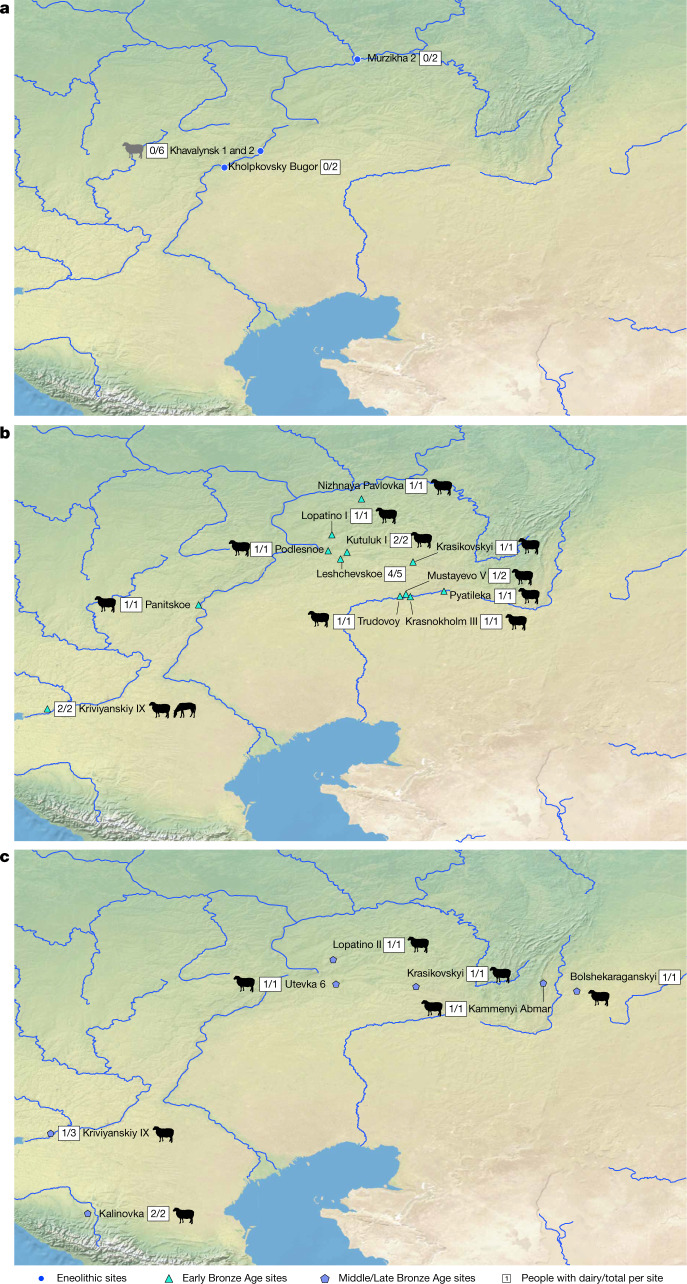
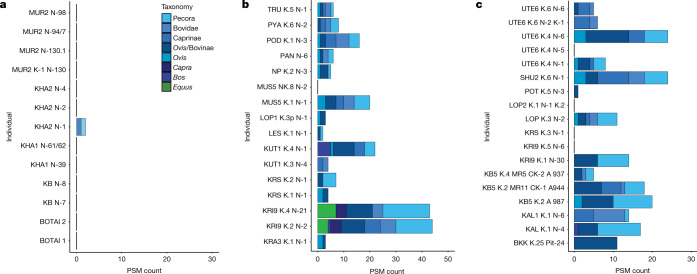
“For the Early Bronze Age individuals (dating to the onset of the Yamnaya cultural horizon), dairy peptides were recovered from 15 of the 16 individual calculus samples we analysed (Fig. 1b, 2b).”
§ Dairying enabled Early Bronze Age Yamnaya steppe expansions > Main
plainn = 15- Asserted: passes — The authors put it forward as true.
- Checkable: passes — It can be checked against evidence.
- Load-bearing: passes — The paper’s conclusions depend on it.
- Based: passes — The paper gives a reason why it holds.
A result the paper reports from its own data — it cites no other source for it, so there is none to check. The quote shows it is in the paper.
In the paper
“Similar to the Early Bronze Age, we identified BLG, α-S1-casein and α-S2-casein, as well as the whey protein α-lactalbumin.”
§ Dairying enabled Early Bronze Age Yamnaya steppe expansions > Main
plainn = 19- Asserted: passes — The authors put it forward as true.
- Checkable: passes — It can be checked against evidence.
- Load-bearing: unclear — It is unclear whether the paper’s conclusions depend on it.
- Based: passes — The paper gives a reason why it holds.
In the paper
“Our study of dental calculus from the Eneolithic site of Botai to the east, where early horse milking has been suggested by lipid analysis (albeit equivocally44), did not yield milk proteins.”
§ Dairying enabled Early Bronze Age Yamnaya steppe expansions > Main
What the sources say
- Not checked yetcites [44] Didier, J. C. In and Outside the Square: The Sky and the Power of Belief in Ancient China and the World, c. 4500 BC-AD 200 (Sino-Platonic Papers 192) (3 vols) (ed. Mair, V. H.) (2009).
plainn = 2- Asserted: passes — The authors put it forward as true.
- Checkable: passes — It can be checked against evidence.
- Load-bearing: passes — The paper’s conclusions depend on it.
- Based: passes — The paper gives a reason why it holds.
A result the paper reports from its own data — it cites no other source for it, so there is none to check. The quote shows it is in the paper.
In the paper
“Here we draw on proteomic analysis of dental calculus from individuals from the western Eurasian steppe to demonstrate a major transition in dairying at the start of the Bronze Age.”
§ Dairying enabled Early Bronze Age Yamnaya steppe expansions > Abstract
boosted- Asserted: passes — The authors put it forward as true.
- Checkable: passes — It can be checked against evidence.
- Load-bearing: passes — The paper’s conclusions depend on it.
- Based: passes — The paper gives a reason why it holds.
- Rests on 2 assumptions not shown here.
21 more claims
Create a free account to see all 78 claims and to verify the 57 references still open.
- Probably not a substantial claim. 29
- It may state two separate claims as one. 34
Self-check
Percentages, sums and reported differences re-computed from the paper’s own numbers.
Each contradiction between two passages listed here was confirmed by an independent check.
Rated minor: it would not touch a result — a value no result rests on, a p-value that stays on the same side of the significance level, or a conflict that is clerical, resolved elsewhere in the paper, or outside its own findings.
In the paper
§ Dairying enabled Early Bronze Age Yamnaya steppe expansions > Main
“dairy peptides were recovered from 15 of the 16 individual calculus samples we analysed”
§ Dairying enabled Early Bronze Age Yamnaya steppe expansions > Main
“we identified Equus milk peptides from the protein BLGI in 2 of 17 Early Bronze Age individuals”
Citations
Cites
Bayesian Analysis of Radiocarbon Dates
Bronk Ramsey, C. (2009) · Radiocarbon · doi:10.1017/s0033822200033865 · Cited by 8,725
Perkins, D. N., Pappin, D. J. C., Creasy, D. M., & Cottrell, J. S. (1999) · Electrophoresis · doi:10.1002/(sici)1522-2683(19991201)20:18<3551::aid-elps3551>3.0.co;2-2 · Cited by 8,203
The IntCal20 Northern Hemisphere Radiocarbon Age Calibration Curve (0–55 cal kBP)
Reimer, P. J., Austin, W. E. N., Bard, E., Bayliss, A., Blackwell, P. G., Bronk Ramsey, C., Butzin, M., Cheng, H., Edwards, R. L., Friedrich, M., et al. (2020) · Radiocarbon · doi:10.1017/rdc.2020.41 · Cited by 7,900
Discussion Reporting of 14 C Data
Stuiver, M., & Polach, H. A. (1977) · Radiocarbon · doi:10.1017/s0033822200003672 · Cited by 5,640
A cross-platform toolkit for mass spectrometry and proteomics
Chambers, M. C., Maclean, B., Burke, R., Amodei, D., Ruderman, D. L., Neumann, S., Gatto, L., Fischer, B., Pratt, B., Egertson, J., et al. (2012) · Nature Biotechnology · doi:10.1038/nbt.2377 · Cited by 4,093
Massive migration from the steppe was a source for Indo-European languages in Europe
Haak, W., Lazaridis, I., Patterson, N., Rohland, N., Mallick, S., Llamas, B., Brandt, G., Nordenfelt, S., Harney, E., Stewardson, K., et al. (2015) · Nature · doi:10.1038/nature14317 · Cited by 1,940
Self-citationPopulation genomics of Bronze Age Eurasia
Allentoft, M. E., Sikora, M., Sjögren, K.-G., Rasmussen, S., Rasmussen, M., Stenderup, J., Damgaard, P. B., Schroeder, H., Ahlström, T., Vinner, L., et al. (2015) · Nature · doi:10.1038/nature14507 · Cited by 1,550
Self-citationGenome-wide patterns of selection in 230 ancient Eurasians
Mathieson, I., Lazaridis, I., Rohland, N., Mallick, S., Patterson, N., Roodenberg, S. A., Harney, E., Stewardson, K., Fernandes, D., Novak, M., et al. (2015) · Nature · doi:10.1038/nature16152 · Cited by 1,515
Self-citationPeer Reviewed: Characterizing Aquatic Dissolved Organic Matter
Leenheer, J. A., & Croué, J.-P. (2003) · Environmental Science & Technology · doi:10.1021/es032333c · Cited by 1,242
The Earliest Horse Harnessing and Milking
Outram, A. K., Stear, N. A., Bendrey, R., Olsen, S., Kasparov, A., Zaibert, V., Thorpe, N., & Evershed, R. P. (2009) · Science · doi:10.1126/science.1168594 · Cited by 736
Self-citationThe Horse, the Wheel, and Language
Anthony, D. W. (2007) · Princeton University Press eBooks · doi:10.1515/9780691292601 · Cited by 732
Self-citationThe formation of human populations in South and Central Asia
Narasimhan, V. M., Patterson, N., Moorjani, P., Rohland, N., Bernardos, R., Mallick, S., Lazaridis, I., Nakatsuka, N., Olalde, I., Lipson, M., et al. (2019) · Science · doi:10.1126/science.aat7487 · Cited by 648
Self-citationEarliest evidence for cheese making in the sixth millennium bc in northern Europe
Salque, M., Bogucki, P. I., Pyzel, J., Sobkowiak-Tabaka, I., Grygiel, R., Szmyt, M., & Evershed, R. P. (2013) · Nature · doi:10.1038/nature11698 · Cited by 511
Genomic insights into the formation of human populations in East Asia
Wang, C.-C., Yeh, H.-Y., Popov, A. N., Zhang, H.-Q., Matsumura, H., Sirak, K., Cheronet, O., Kovalev, A., Rohland, N., Kim, A. M., et al. (2021) · Nature · doi:10.1038/s41586-021-03336-2 · Cited by 408
Self-citationThe secondary exploitation of animals in the Old World
Sherratt, A. (1983) · World Archaeology · doi:10.1080/00438243.1983.9979887 · Cited by 406
The first horse herders and the impact of early Bronze Age steppe expansions into Asia
de Barros Damgaard, P., Martiniano, R., Kamm, J., Moreno-Mayar, J. V., Kroonen, G., Peyrot, M., Barjamovic, G., Rasmussen, S., Zacho, C., Baimukhanov, N., et al. (2018) · Science · doi:10.1126/science.aar7711 · Cited by 370
Self-citationMultiregional Emergence of Mobile Pastoralism and Nonuniform Institutional Complexity across Eurasia
Frachetti, M. D. (2012) · Current Anthropology · doi:10.1086/663692 · Cited by 370
The Making of Bronze Age Eurasia
Kohl, P. L. (2007) · Cambridge University Press eBooks · doi:10.1017/cbo9780511618468 · Cited by 368
Fernandes, R., Millard, A. R., Brabec, M., Nadeau, M.-J., & Grootes, P. (2014) · PLoS ONE · doi:10.1371/journal.pone.0087436 · Cited by 363
Self-citationA Dynamic 6,000-Year Genetic History of Eurasia’s Eastern Steppe
Jeong, C., Wang, K., Wilkin, S., Taylor, W. T. T., Miller, B. K., Bemmann, J. H., Stahl, R., Chiovelli, C., Knolle, F., Ulziibayar, S., et al. (2020) · Cell · doi:10.1016/j.cell.2020.10.015 · Cited by 328
Self-citationAncient genomes revisit the ancestry of domestic and Przewalski’s horses
Gaunitz, C., Fages, A., Hanghøj, K., Albrechtsen, A., Khan, N., Schubert, M., Seguin-Orlando, A., Owens, I. J., Felkel, S., Bignon-Lau, O., et al. (2018) · Science · doi:10.1126/science.aao3297 · Cited by 298
Self-citationThe Secondary Products Revolution: the past, the present and the future
Greenfield, H. J. (2010) · World Archaeology · doi:10.1080/00438240903429722 · Cited by 264
Wang, C.-C., Reinhold, S., Kalmykov, A., Wissgott, A., Brandt, G., Jeong, C., Cheronet, O., Ferry, M., Harney, E., Keating, D., et al. (2019) · Nature Communications · doi:10.1038/s41467-018-08220-8 · Cited by 223
Self-citationBronze Age population dynamics and the rise of dairy pastoralism on the eastern Eurasian steppe
Jeong, C., Wilkin, S., Amgalantugs, T., Bouwman, A. S., Taylor, W. T. T., Hagan, R. W., Bromage, S., Tsolmon, S., Trachsel, C., Grossmann, J., et al. (2018) · Proceedings of the National Academy of Sciences · doi:10.1073/pnas.1813608115 · Cited by 195
Self-citationAnthony, D. W. (2008) · doi:10.1515/9781400831104 · Cited by 180
Self-citationBotai and the Origins of Horse Domestication
Levine, M. A. (1999) · Journal of Anthropological Archaeology · doi:10.1006/jaar.1998.0332 · Cited by 166
The Kurgan culture and the Indo-Europeanization of Europe
Gimbutas, M., Dexter, M. R., & Jones-Bley, K. (1997) · Institute for the Study of Man eBooks · Cited by 166
The Indo-European Homeland from Linguistic and Archaeological Perspectives
Anthony, D. W., & Ringe, D. (2015) · Annual Review of Linguistics · doi:10.1146/annurev-linguist-030514-124812 · Cited by 165
Self-citationAncient proteins from ceramic vessels at Çatalhöyük West reveal the hidden cuisine of early farmers
Hendy, J., Colonese, A. C., Franz, I., Fernandes, R., Fischer, R., Orton, D., Lucquin, A., Spindler, L., Anvari, J., Stroud, E., et al. (2018) · Nature Communications · doi:10.1038/s41467-018-06335-6 · Cited by 159
Self-citationDairy pastoralism sustained eastern Eurasian steppe populations for 5,000 years
Wilkin, S., Ventresca Miller, A., Taylor, W. T. T., Miller, B. K., Hagan, R. W., Bleasdale, M., Scott, A., Gankhuyg, S., Ramsøe, A., Uliziibayar, S., et al. (2020) · Nature Ecology & Evolution · doi:10.1038/s41559-020-1120-y · Cited by 155
Self-citationFernandes, R., Grootes, P., Nadeau, M., & Nehlich, O. (2015) · American Journal of Physical Anthropology · doi:10.1002/ajpa.22788 · Cited by 147
Self-citationOutram, A. K., Kasparov, A., Stear, N. A., Varfolomeev, V., Usmanova, E. R., & Evershed, R. P. (2012) · Journal of Archaeological Science · doi:10.1016/j.jas.2012.02.009 · Cited by 109
Self-citationBurger, J., Link, V., Blöcher, J., Schulz, A., Sell, C., Pochon, Z., Diekmann, Y., Žegarac, A., Hofmanová, Z., Winkelbach, L., et al. (2020) · Current Biology · doi:10.1016/j.cub.2020.08.033 · Cited by 108
Frachetti, M., & Benecke, N. (2009) · Antiquity · doi:10.1017/s0003598x00099324 · Cited by 90
Towards a refined chronology for the Bronze Age of the southern Urals, Russia
Hanks, B. K., Epimakhov, A. V., & Renfrew, A. C. (2007) · Antiquity · doi:10.1017/s0003598x00095235 · Cited by 89
Self-citationAncient proteins provide evidence of dairy consumption in eastern Africa
Bleasdale, M., Richter, K. K., Janzen, A., Brown, S., Scott, A., Zech, J., Wilkin, S., Wang, K., Schiffels, S., Desideri, J., et al. (2021) · Nature Communications · doi:10.1038/s41467-020-20682-3 · Cited by 87
Self-citationBendrey, R. (2011) · Pastoralism Research Policy and Practice · doi:10.1186/2041-7136-1-8 · Cited by 85
B-Fabric: the Swiss Army Knife for life sciences
Türker, C., Akal, F., Joho, D., Panse, C., Barkow-Oesterreicher, S., Rehrauer, H., & Schlapbach, R. (2010) · Proceedings of the 13th International Conference on Extending Database Technology · doi:10.1145/1739041.1739135 · Cited by 83
Ventresca Miller, A. R., & Makarewicz, C. A. (2019) · Scientific Reports · doi:10.1038/s41598-018-35758-w · Cited by 78
A Simple(R) Model to Predict the Source of Dietary Carbon in Individual Consumers
Fernandes, R. (2016) · Archaeometry · doi:10.1111/arcm.12193 · Cited by 70
Self-citationNew insights into Neolithic milk consumption through proteomic analysis of dental calculus
Charlton, S., Ramsøe, A., Collins, M., Craig, O. E., Fischer, R., Alexander, M., & Speller, C. F. (2019) · Archaeological and Anthropological Sciences · doi:10.1007/s12520-019-00911-7 · Cited by 69
The Eneolithic cemetery at Khvalynsk on the Volga River
Anthony, D. W., Khokhlov, A. A., Agapov, S. A., Agapov, D. S., Schulting, R., Olalde, Í., & Reich, D. (2022) · Praehistorische Zeitschrift · doi:10.1515/pz-2022-2034 · Cited by 64
Self-citationThe Secondary Products Revolution, Horse-Riding, and Mounted Warfare
Anthony, D. W., & Brown, D. R. (2011) · Journal of World Prehistory · doi:10.1007/s10963-011-9051-9 · Cited by 59
Self-citationHanks, B., Miller, A. V., Judd, M., Epimakhov, A., Razhev, D., & Privat, K. (2018) · Journal of Archaeological Science · doi:10.1016/j.jas.2018.06.006 · Cited by 49
Self-citationEarly Pastoral Economies and Herding Transitions in Eastern Eurasia
Taylor, W. T. T., Clark, J., Bayarsaikhan, J., Tuvshinjargal, T., Jobe, J. T., Fitzhugh, W., Kortum, R., Spengler, R. N., Shnaider, S., Seersholm, F. V., et al. (2020) · Scientific Reports · doi:10.1038/s41598-020-57735-y · Cited by 46
Self-citationPrehistoric Mobility and Diet in the West Eurasian Steppes 3500 to 300 BC: An Isotopic Approach
Gerling, C. (2015) · doi:10.1515/9783110311211 · Cited by 45
Paleoecology, Subsistence, and14C Chronology of the Eurasian Caspian Steppe Bronze Age
Shishlina, N. I., Zazovskaya, E. P., van der Plicht, J., Hedges, R. E. M., Sevastyanov, V. S., & Chichagova, O. A. (2009) · Radiocarbon · doi:10.1017/s0033822200055879 · Cited by 41
Eurasian Steppe Chariots and Social Complexity During the Bronze Age
Chechushkov, I. V., & Epimakhov, A. V. (2018) · Journal of World Prehistory · doi:10.1007/s10963-018-9124-0 · Cited by 41
Self-citationAssessing the degradation of ancient milk proteins through site-specific deamidation patterns
Ramsøe, A., Crispin, M., Mackie, M., McGrath, K., Fischer, R., Demarchi, B., Collins, M. J., Hendy, J., & Speller, C. (2021) · Scientific Reports · doi:10.1038/s41598-021-87125-x · Cited by 40
Appropriating Innovations: Entangled Knowledge in Eurasia, 5000‒1500 BCE
Stockhammer, P. W., & MARAN, J. (2017) · Oxbow Books · doi:10.2307/j.ctt1vgw6v1 · Cited by 38
Knipper, C., Reinhold, S., Gresky, J., Berezina, N., Gerling, C., Pichler, S. L., Buzhilova, A. P., Kantorovich, A. R., Maslov, V. E., Petrenko, V. G., et al. (2020) · PLOS ONE · doi:10.1371/journal.pone.0239861 · Cited by 30
Modern Freshwater Reservoir Offsets in the Eurasian Steppe: Implications for Archaeology
Svyatko, S. V., Reimer, P. J., & Schulting, R. (2017) · Radiocarbon · doi:10.1017/rdc.2017.11 · Cited by 27
A Bronze Age Landscape in the Russian Steppes: The Samara Valley Project
Anthony, D. W., Brown, D. R., Mochalov, O. D., Khokhlov, A. A., & Kuznetsov, P. (2016) · Cotsen Institute of Archaeology Press eBooks · doi:10.2307/j.ctvdjrq7b · Cited by 23
Self-citationMileto, S., Kaiser, E., Rassamakin, Y., & Evershed, R. P. (2017) · Journal of Archaeological Science: Reports · doi:10.1016/j.jasrep.2017.03.028 · Cited by 14
Stable Isotope Analysis of Neolithic to Late Bronze Age Populations in the Samara Valley
Schulting, R. J., & Richards, M. P. (2016) · A Bronze Age Landscape in the Russian Steppes · doi:10.2307/j.ctvdjrq7b.13 · Cited by 13
The Lebyazhinka Burial Ground (Middle Volga Region, Russia): New 14C Dates and the Reservoir Effect
Shishlina, N., van der Plicht, J., & Александрович, Т. М. (2017) · Radiocarbon · doi:10.1017/rdc.2017.94 · Cited by 10
Differing modes of animal exploitation in North-Pontic Eneolithic and Bronze Age Societies
Mileto, S., Kaiser, E., Rassamakin, Y., Whelton, H., & Evershed, R. P. (2017) · STAR: Science & Technology of Archaeological Research · doi:10.1080/20548923.2018.1443547 · Cited by 7
Oral Signature Screening Database for Palaeoproteomic Analyses of Dental Calculus
Bleasdale, M., Boivin, N. L., & Richter, K. K. (2020) · Zenodo (CERN European Organization for Nuclear Research) · doi:10.5281/zenodo.3698270 · Cited by 7
Self-citationThe Samara Valley in the Bronze Age: A Review of Archaeological Discoveries
Kuznetsov, P., Mochalov, O. D., & Anthony, D. W. (2016) · Cotsen Institute of Archaeology Press eBooks · doi:10.2307/j.ctvdjrq7b.10 · Cited by 5
Self-citationOral Signature Screening Database for Palaeoproteomic Analyses of Dental Calculus
Bleasdale, M., Boivin, N., & Richter, K. K. (2020) · Zenodo · doi:10.5281/zenodo.3698271
Self-citation
Research works printed but not linked: 1
- Wang CC Ancient human genome-wide data from a 3000-year interval in the Caucasus corresponds with eco-geographic regions Nat. Commun. 2019 10 590 10.1038/s41467-018-08220-8 30713341 PMC6360191 · DOI · Paper page
Cited by
Widespread horse-based mobility arose around 2200 bce in Eurasia
Librado, P., Tressières, G., Chauvey, L., Fages, A., Khan, N., Schiavinato, S., Tonasso‐Calvière, L., Kusliy, M. A., Gaunitz, C., Liu, X., et al. (2024) · Nature · doi:10.1038/s41586-024-07597-5 · Cited by 137
First bioanthropological evidence for Yamnaya horsemanship
Trautmann, M., Frînculeasa, A., Preda-Bălănică, B., Petruneac, M., Focşăneanu, M., Alexandrov, S., Atanassova, N., Włodarczak, P., Podsiadło, M., Dani, J., et al. (2023) · Science Advances · doi:10.1126/sciadv.ade2451 · Cited by 116
Self-citationArchaeology and the Genetic Revolution in European Prehistory
Kristiansen, K. (2022) · Cambridge University Press eBooks · doi:10.1017/9781009228701 · Cited by 114
Emergence and intensification of dairying in the Caucasus and Eurasian steppes
Scott, A., Reinhold, S., Hermes, T. R., Kalmykov, A., Belinskiy, A. B., Buzhilova, A., Berezina, N., Kantorovich, А. R., Maslov, V. Е., Guliyev, F., et al. (2022) · Nature Ecology & Evolution · doi:10.1038/s41559-022-01701-6 · Cited by 90
Self-citationRethinking the evidence for early horse domestication at Botai
Taylor, W. T. T., & Barrón-Ortiz, C. I. (2021) · Scientific Reports · doi:10.1038/s41598-021-86832-9 · Cited by 80
Self-citation
Metadata
- Authors
- Wilkin, S., Ventresca Miller, A., Fernandes, R., Spengler, R., Taylor, W. T.-T., Brown, D. R., Reich, D., Kennett, D. J., Culleton, B. J., Kunz, L., Fortes, C., Kitova, A., Kuznetsov, P., Epimakhov, A., Zaibert, V. F., Outram, A. K., Kitov, E., Khokhlov, A., Anthony, D., & Boivin, N.
- Affiliations
- University of Zurich (CH)
- Masaryk University (CZ)
- Max Planck Institute of Geoanthropology (DE)
- University of Colorado Boulder (US)
- Hartwick College (US)
- Broad Institute (US)
- University of California, Santa Barbara (US)
- Pennsylvania State University (US)
- Russian Academy of Sciences (RU)
- Samara State University of Social Sciences and Education (RU)
- South Ural State University (RU)
- Al-Farabi Kazakh National University (KZ)
- University of Exeter (GB)
- Harvard University (US)
- Smithsonian Institution (US)
- Corresponding author
- Wilkin, Shevan
- Boivin, Nicole
- ORCID
- Venue
- Nature
- Published
- 2021-09-15
- Volume
- 598
- Issue
- 7882
- Pages
- 629-633
- ISSN
- 0028-0836 (ISSN-L)
- 1476-4687
- PMC
- PMC8550948
- OpenAlex
- W3201494818
- Cited by
- 184
- References
- 58
- Citations by year
- 2026: 32 · 2025: 68 · 2024: 24 · 2023: 29 · 2022: 25 · 2021: 6
- FWCI
- 37.16
- Type
- journal article
- Language
- en
- Open access
- hybrid
- doi.org
- Licence
- cc-by
- creativecommons.org/licenses/by/4.0 (tdm)
- creativecommons.org/licenses/by/4.0 (vor)
- Locations
- Nature (publishedVersion, cc-by)
- Oxford University Research Archive (ORA) (University of Oxford) (publishedVersion, public-domain)
- Europe PMC (PubMed Central) (publishedVersion, cc-by)
- PubMed Central (publishedVersion, cc-by)
- PubMed (publishedVersion)
- Repository for Publications and Research Data (ETH Zurich) (publishedVersion, cc-by)
- RePEc: Research Papers in Economics (submittedVersion)
- Griffith Research Online (submittedVersion, cc-by)
- Zurich Open Repository and Archive (University of Zurich) (submittedVersion, cc-by)
- ETH Zürich Research Collection (cc-by)
- Zurich Open Repository and Archive (University of Zurich)
- Funders
- Howard Hughes Medical Institute
- Max-Planck-Gesellschaft
- Topics
- Social Sciences › Archeology › Archaeology and ancient environmental studies
- Social Sciences › Arts and Humanities › Archeology (arts and humanities) › Ancient and Medieval Archaeology Studies
- Life Sciences › Biochemistry, Genetics and Molecular Biology › Genetics › Forensic and Genetic Research
- Keywords
- dairy production, Early Bronze Age, Yamnaya, steppe pastoralism, horse domestication, steppe expansion, horse traction
- MeSH terms
- Domestication, Animals, Archaeology, Asia, Dairying, Dental Calculus, Europe, Horses, Humans, Milk, Proteome, History, Ancient, Gene Flow, Human Migration, Grassland
About these checks
Registry, retraction, Cites and statistics results are computed, not judged, with one exception: a printed reference that no index lists is read once by a model before it counts as a citation error. Claims are extracted by a model and kept only when their quote appears verbatim in the text; each cited source is then checked, with a model’s help, for whether it says what the claim relies on. Those verdicts can be wrong — read the claim’s quote and the cited source before relying on one.
A language model drew the claims from the paper on 2026-11-24, under version 3 of the claim definition (model deepseek-v4.1-flash, prompt extract-v3).
A second model labelled each claim on 2026-11-24 (model jev-1.13-20260917, definition revision gold-guideline-v0.2).
Statistics and arithmetic are recomputed, not judged.
Confidence bands are shown only for fields calibrated on our annotated test set. None is calibrated yet, so no band is shown.
What counts as a claim ›How we measure confidence ›How we check this ›
Are you an author, or do you see a problem with this page? Request a review
Data sources
Bibliographic data: Semantic Scholar, OpenAlex, Crossref.
Contains information from the Semantic Scholar Academic Graph Datasets, made available under the ODC Attribution License (ODC-BY 1.0).
Semantic Scholar’s data is described in: Kinney, R., et al. (2023). The Semantic Scholar Open Data Platform. arXiv:2301.10140.
