

The DOI matches its Crossref record; 2 of the 2 references it cites were found in a registry or an index.
Cancer risk across mammals
Abstract
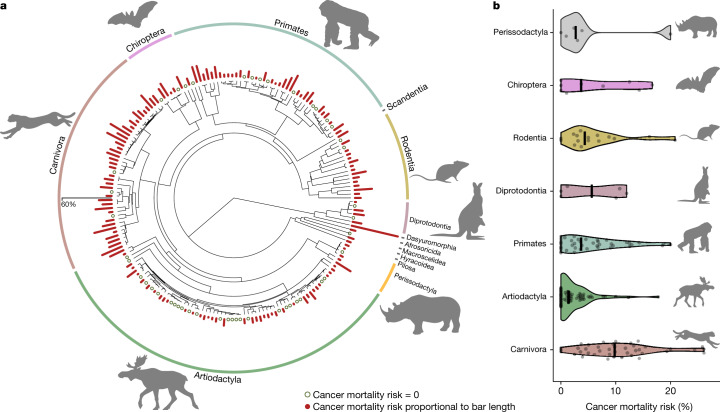
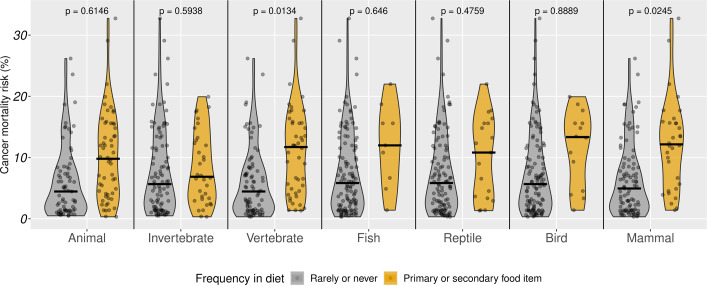
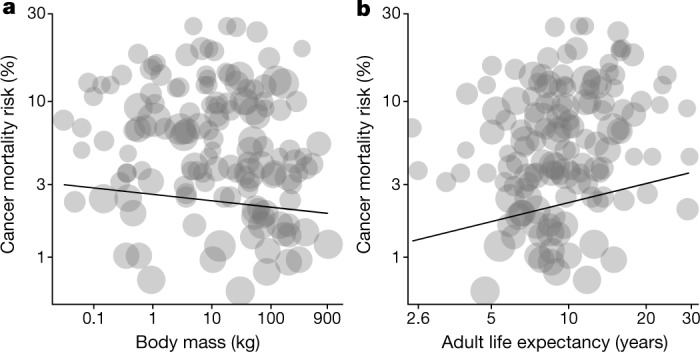
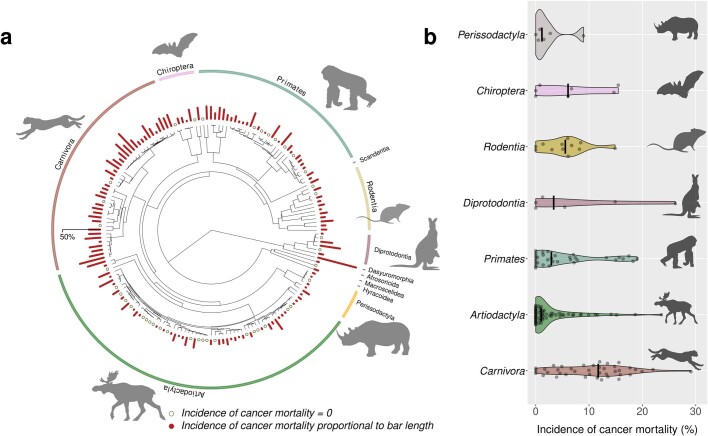
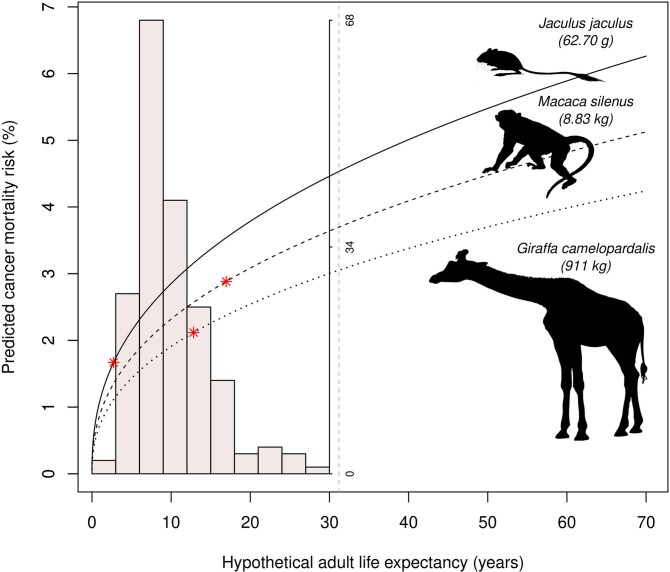
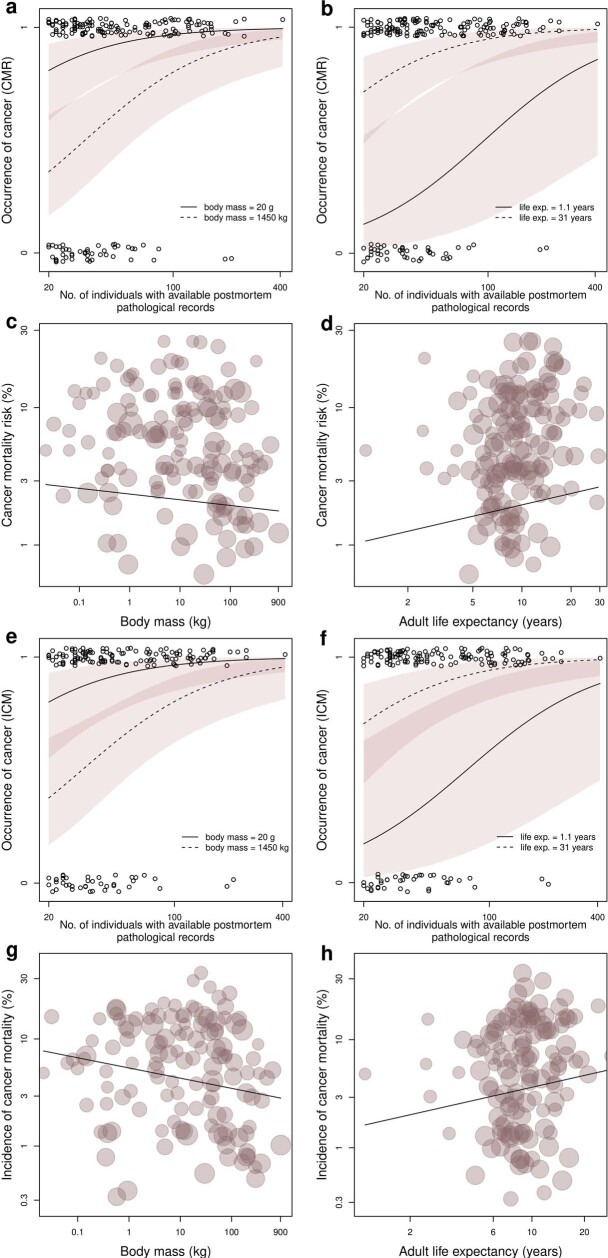
Cancer is a ubiquitous disease of metazoans, predicted to disproportionately affect larger, long-lived organisms owing to their greater number of cell divisions, and thus increased probability of somatic mutations 1,2 . While elevated cancer risk with larger body size and/or longevity has been documented within species 3–5 , Peto’s paradox indicates the apparent lack of such an association among taxa 6 . Yet, unequivocal empirical evidence for Peto’s paradox is lacking, stemming from the difficulty of estimating cancer risk in non-model species. Here we build and analyse a database on cancer-related mortality using data on adult zoo mammals (110,148 individuals, 191 species) and map age-controlled cancer mortality to the mammalian tree of life. We demonstrate the universality and high frequency of oncogenic phenomena in mammals and reveal substantial differences in cancer mortality across major mammalian orders. We show that the phylogenetic distribution of cancer mortality is associated with diet, with carnivorous mammals (especially mammal-consuming ones) facing the highest cancer-related mortality. Moreover, we provide unequivocal evidence for the body size and longevity components of Peto’s paradox by showing that cancer mortality risk is largely independent of both body mass and adult life expectancy across species. These results highlight the key role of life-history evolution in shaping cancer resistance and provide major advancements in the quest for natural anticancer defences.
Overview
The claims and statistics of this paper haven’t been checked yet.
Run the check — free, no account needed. It reads the open-access text and checks the sources it cites.
Integrity signals
Registry
Cites
Statistics
Figures
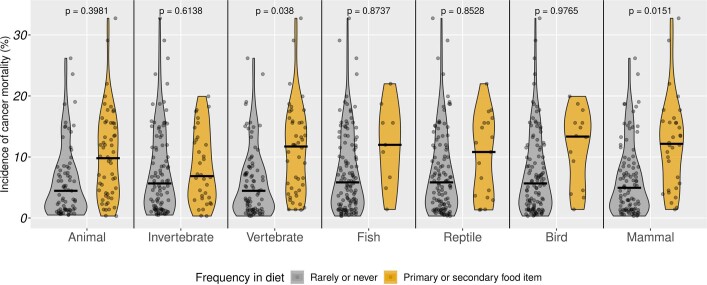
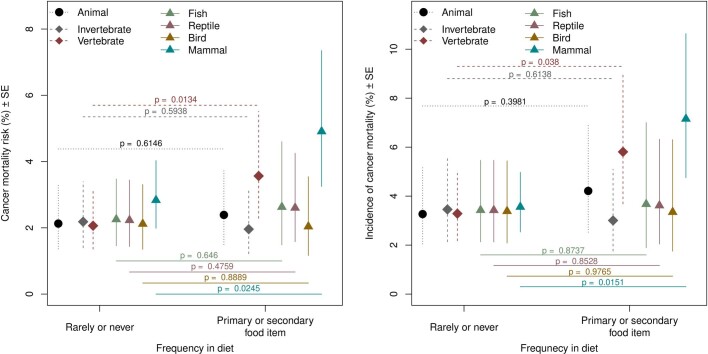
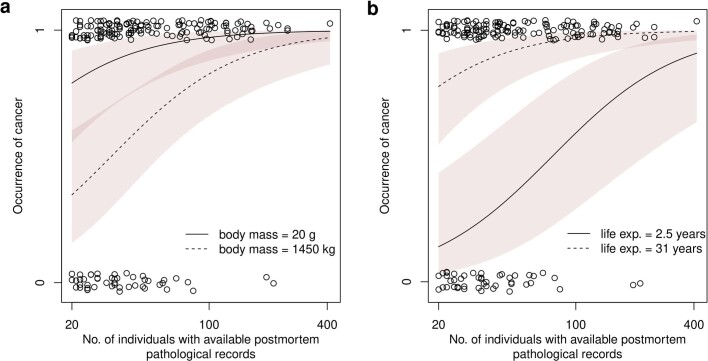
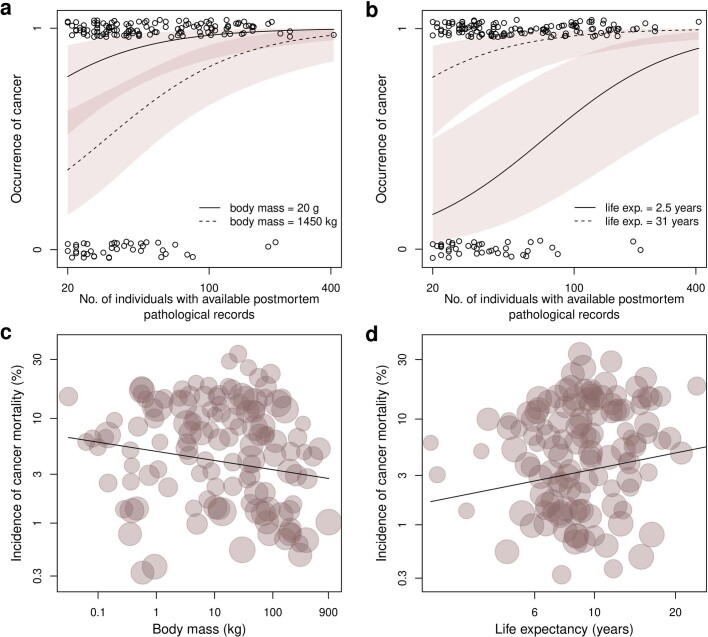
Verification
Claims the paper makes
The claims and statistics of this paper haven’t been checked yet.
Run the check — free, no account needed. It reads the open-access text and checks the sources it cites.
Claims other papers make about this one
Each is checked against this paper’s own text: does it say what the citing paper says it does?
The cited source says what the claim attributes to it.
In the citing paper
“However, there appears to be no correlation between body mass and cancer risk across species21,22.”
From Somatic mutation rates scale with lifespan across mammals (2022) · cites this paper as [22]
Self-check
Percentages, sums and reported differences re-computed from the paper’s own numbers.
The self-check needs the paper’s full text.
Citations
Cites
Mechanisms of DNA damage, repair, and mutagenesis
Chatterjee, N., & Walker, G. C. (2017) · Environmental and Molecular Mutagenesis · doi:10.1002/em.22087 · Cited by 2,039 · cited 1×
“During the course of the organisms’ lifetime and owing to various mutational processes, cell lineages tend to accumulate mutations 7,8 .”
Host and viral traits predict zoonotic spillover from mammals
Olival, K. J., Hosseini, P. R., Zambrana-Torrelio, C., Ross, N., Bogich, T. L., & Daszak, P. (2017) · Nature · doi:10.1038/nature22975 · Cited by 1,130
Research works printed but not linked: 38
- Leroi, A. M., Koufopanou, V. & Burt, A. Cancer selection. Nat. Rev. Cancer 3, 226–231 (2003). · DOI
- Armitage, P. & Doll, R. The age distribution of cancer and a multi-stage theory of carcinogenesis. Br. J. Cancer 8, 1–12 (1954). · DOI · Paper page
- Wirén, S. et al. Pooled cohort study on height and risk of cancer and cancer death. Cancer Causes Control 25, 151–159 (2014). · DOI
- Fleming, J. M., Creevy, K. E. & Promislow, D. E. L. Mortality in North American dogs from 1984 to 2004: an investigation into age-, size-, and breed-related causes of death. J. Vet. Intern. Med. 25, 187–198 (2011). · DOI
- Nunney, L. Lineage selection and the evolution of multistage carcinogenesis. Proc. R. Soc. B 266, 493–498 (1999). · DOI
- Couzin-Frankel, J. The bad luck of cancer. Science 347, 12 (2015). · DOI
- Nunney, L. The real war on cancer: the evolutionary dynamics of cancer suppression. Evol. Appl. 6, 11–19 (2013). · DOI
- Nunney, L. Size matters: height, cell number and a person’s risk of cancer. Proc. R. Soc. B 285, 20181743 (2018). · DOI
- Caulin, A. F. & Maley, C. C. Peto’s paradox: evolution’s prescription for cancer prevention. Trends Ecol. Evol. 26, 175–182 (2011). · DOI
- Nunney, L., Maley, C. C., Breen, M., Hochberg, M. E. & Schiffman, J. D. Peto’s paradox and the promise of comparative oncology. Philos. Trans. R. Soc. B 370, 20140177 (2015). · DOI
- Peto, R. Epidemiology, multistage models, and short-term mutagenicity tests. Int. J. Epidemiol. 45, 621–637 (2016). · DOI · Paper page
- Boddy, A. M. et al. Lifetime cancer prevalence and life history traits in mammals. Evol. Med. Public Health 2020, 187–195 (2020). · DOI
- Møller, A. P., Erritzøe, J. & Soler, J. J. Life history, immunity, Peto’s paradox and tumours in birds. J. Evol. Biol. 30, 960–967 (2017). · DOI
- Abegglen, L. M. et al. Potential mechanisms for cancer resistance in elephants and comparative cellular response to DNA damage in humans. JAMA 314, 1850–1860 (2015). · DOI · Paper page
- Tollis, M. et al. Elephant genomes reveal accelerated evolution in mechanisms underlying disease defenses. Mol. Biol. Evol. 38, 3606–3620 (2021). · DOI
- Conde, D. A. et al. Data gaps and opportunities for comparative and conservation biology. Proc. Natl Acad. Sci. USA 116, 9658–9664 (2019). · DOI
- Ronget, V. & Gaillard, J. M. Assessing ageing patterns for comparative analyses of mortality curves: going beyond the use of maximum longevity. Funct. Ecol. 34, 65–75 (2020). · DOI
- Tidière, M. et al. Comparative analyses of longevity and senescence reveal variable survival benefits of living in zoos across mammals. Sci. Rep. 6, 36361 (2016). · DOI
- Revell, L. J. phytools: an R package for phylogenetic comparative biology (and other things). Methods Ecol. Evol. 3, 217–223 (2012). · DOI
- Moresco, A. et al. Taxonomic distribution of neoplasia among non-domestic felid species under managed care. Animals 10, 2376 (2020). · DOI
- Harrenstien, L. A. et al. Mammary cancer in captive wild felids and risk factors for its development: a retrospective study of the clinical behavior of 31 cases. J. Zoo Wildl. Med. 27, 468–476 (1996).
- Munson, L. & Moresco, A. Comparative pathology of mammary gland cancers in domestic and wild animals. Breast Disease 28, 7–21 (2007). · DOI
- Chao, A. et al. Meat consumption and risk of colorectal cancer. JAMA 293, 172–182 (2005). · DOI
- Kelly, B. C., Ikonomou, M. G., Blair, J. D., Morin, A. E. & Gobas, F. A. P. C. Food web-specific biomagnification of persistent organic pollutants. Science 317, 236–239 (2007). · DOI · Paper page
- Pesavento, P. A., Agnew, D., Keel, M. K. & Woolard, K. D. Cancer in wildlife: patterns of emergence. Nat. Rev. Cancer 18, 646–661 (2018). · DOI
- Bogolyubova, A. V. Human oncogenic viruses: old facts and new hypotheses. Mol. Biol. 53, 767–775 (2019). · DOI
- Khatami, A. et al. Bovine leukemia virus (BLV) and risk of breast cancer: a systematic review and meta-analysis of case-control studies. Infect. Agents Cancer 15, 48 (2020). · DOI
- Kissling, W. D. et al. Establishing macroecological trait datasets: digitalization, extrapolation, and validation of diet preferences in terrestrial mammals worldwide. Ecol. Evol. 4, 2913–2930 (2014). · DOI
- Ley, R. E. et al. Evolution of mammals and their gut microbes. Science 320, 1647–1651 (2008). · DOI · Paper page
- Seluanov, A., Gladyshev, V. N., Vijg, J. & Gorbunova, V. Mechanisms of cancer resistance in long-lived mammals. Nat. Rev. Cancer 18, 433–441 (2018). · DOI
- Herrera-Álvarez, S., Karlsson, E., Ryder, O. A., Lindblad-Toh, K. & Crawford, A. J. How to make a rodent giant: genomic basis and tradeoffs of gigantism in the capybara, the world’s largest rodent. Mol. Biol. Evol. 38, 1715–1730 (2021). · DOI
- Albuquerque, T. A. F., Drummond do Val, L., Doherty, A. & de Magalhães, J. P. From humans to hydra: patterns of cancer across the tree of life. Biol. Rev. 93, 1715–1734 (2018). · DOI
- Giraudeau, M., Sepp, T., Ujvari, B., Ewald, P. W. & Thomas, F. Human activities might influence oncogenic processes in wild animal populations. Nat. Ecol. Evol. 2, 1065–1070 (2018). · DOI
- Upham, N. S., Esselstyn, J. A. & Jetz, W. Inferring the mammal tree: species-level sets of phylogenies for questions in ecology, evolution, and conservation. PLoS Biol. 17, e3000494 (2019). · DOI
- Sukumaran, J. & Holder, M. T. DendroPy: a Python library for phylogenetic computing. Bioinformatics 26, 1569–1571 (2010). · DOI
- Ives, A. R. R2s for correlated data: phylogenetic models, LMMs, and GLMMs. Syst. Biol. 68, 234–251 (2018). · DOI
- Paradis, E., Claude, J. & Strimmer, K. APE: Analyses of Phylogenetics and Evolution in R language. Bioinformatics 20, 289–290 (2004). · DOI · Paper page
- Warton, D. I. & Hui, F. K. C. The arcsine is asinine: the analysis of proportions in ecology. Ecology 92, 3–10 (2011). · DOI
Cited by
Sorted by citations
Somatic mutation rates scale with lifespan across mammals
Cagan, A., Baez-Ortega, A., Brzozowska, N., Abascal, F., Coorens, T. H. H., Sanders, M. A., Lawson, A. R. J., Harvey, L. M. R., Bhosle, S., Jones, D., et al. (2022) · Nature · doi:10.1038/s41586-022-04618-z · Cited by 481
Science-Driven Nutritional Interventions for the Prevention and Treatment of Cancer
Montégut, L., de Cabo, R., Zitvogel, L., & Kroemer, G. (2022) · Cancer Discovery · doi:10.1158/2159-8290.cd-22-0504 · Cited by 38
Øgelund Nielsen, R., Mastromonaco, G., Roy, S., Schad Eebes, K., Fienieg, E., Sliwa, A., Müller, P., Roe, S., Dorsey, C., Fazio, J., et al. (2026) · Biological Conservation · doi:10.1016/j.biocon.2026.111773 · Cited by 3
Metadata
- Authors
- Vincze, O., Colchero, F., Lemaître, J.-F., Conde, D. A., Pavard, S., Bieuville, M., Urrutia, A. O., Ujvari, B., Boddy, A. M., Maley, C. C., Thomas, F., & Giraudeau, M.
- Venue
- Nature
- Published
- 2021-12-22
- Volume
- 601
- Issue
- 7892
- Pages
- 263-267
- ISSN
- 0028-0836
- 1476-4687
- PMC
- PMC8755536
- Cited by
- 226
- References
- 2
- Language
- en
About these checks
Registry, retraction, Cites and statistics results are computed, not judged, with one exception: a printed reference that no index lists is read once by a model before it counts as a citation error. Claims are extracted by a model and kept only when their quote appears verbatim in the text; each cited source is then checked, with a model’s help, for whether it says what the claim relies on. Those verdicts can be wrong — read the claim’s quote and the cited source before relying on one.
Statistics and arithmetic are recomputed, not judged.
Confidence bands are shown only for fields calibrated on our annotated test set. None is calibrated yet, so no band is shown.
What counts as a claim ›How we measure confidence ›How we check this ›
Are you an author, or do you see a problem with this page? Request a review
