

Universal control of a six-qubit quantum processor in silicon
Open accessThe DOI matches its Crossref record; 64 of the 64 references it cites were found in a registry or an index.
Abstract
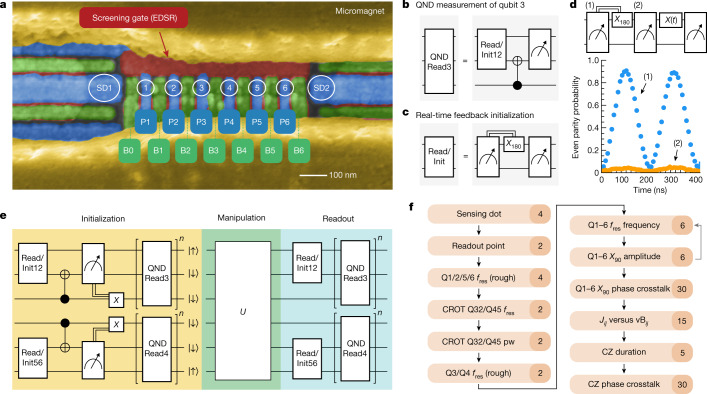
Future quantum computers capable of solving relevant problems will require a large number of qubits that can be operated reliably 1 . However, the requirements of having a large qubit count and operating with high fidelity are typically conflicting. Spins in semiconductor quantum dots show long-term promise 2,3 but demonstrations so far use between one and four qubits and typically optimize the fidelity of either single- or two-qubit operations, or initialization and readout 4–11 . Here, we increase the number of qubits and simultaneously achieve respectable fidelities for universal operation, state preparation and measurement. We design, fabricate and operate a six-qubit processor with a focus on careful Hamiltonian engineering, on a high level of abstraction to program the quantum circuits, and on efficient background calibration, all of which are essential to achieve high fidelities on this extended system. State preparation combines initialization by measurement and real-time feedback with quantum-non-demolition measurements. These advances will enable testing of increasingly meaningful quantum protocols and constitute a major stepping stone towards large-scale quantum computers.
Overview
The claims and statistics of this paper haven’t been checked yet.
Free: it reads the open-access text and checks the first 5 claims that cite a source we can check. Create a free account to check every claim.
Integrity signals
Registry
Cites
Statistics
Figures
Verification
Claims the paper makes
The claims and statistics of this paper haven’t been checked yet.
Free: it reads the open-access text and checks the first 5 claims that cite a source we can check. Create a free account to check every claim.
Self-check
Percentages, sums and reported differences re-computed from the paper’s own numbers.
The self-check needs the paper’s full text.
Citations
Cites
Quantum supremacy using a programmable superconducting processor
Arute, F., Arya, K., Babbush, R., Bacon, D., Bardin, J. C., Barends, R., Biswas, R., Boixo, S., Brandao, F. G. S. L., Buell, D. A., et al. (2019) · Nature · doi:10.1038/s41586-019-1666-5 · Cited by 7,720 · cited 1×
“Nevertheless, spin qubits currently lag behind in scale when compared to superconducting, trapped ions and photonic platforms, which have demonstrated control of several dozen qubits 16–18 .”
BackgroundQuantum computational advantage using photons
Zhong, H.-S., Wang, H., Deng, Y.-H., Chen, M.-C., Peng, L.-C., Luo, Y.-H., Qin, J., Wu, D., Ding, X., Hu, Y., et al. (2020) · Science · doi:10.1126/science.abe8770 · Cited by 2,405 · cited 1×
“Nevertheless, spin qubits currently lag behind in scale when compared to superconducting, trapped ions and photonic platforms, which have demonstrated control of several dozen qubits 16–18 .”
BackgroundGreenberger, D. M., Horne, M. A., & Zeilinger, A. (1989) · Bell’s Theorem, Quantum Theory and Conceptions of the Universe · doi:10.1007/978-94-017-0849-4_10 · Cited by 1,513
Trapped-ion quantum computing: Progress and challenges
Bruzewicz, C. D., Chiaverini, J., McConnell, R., & Sage, J. M. (2019) · Applied Physics Reviews · doi:10.1063/1.5088164 · Cited by 1,483 · cited 1×
“…shows that, in scaling up, maintaining the quality of the control requires substantial effort, particularly, for instance, to deal with the denser motional spectrum in trapped ions 23 , to avert crosstalk in superconducting circuits 24 or to avoid increased losses in photonic circuits 25 .”
BackgroundZwanenburg, F. A., Dzurak, A. S., Morello, A., Simmons, M. Y., Hollenberg, L. C. L., Klimeck, G., Rogge, S., Coppersmith, S. N., & Eriksson, M. A. (2013) · Reviews of Modern Physics · doi:10.1103/revmodphys.85.961 · Cited by 1,210
An addressable quantum dot qubit with fault-tolerant control-fidelity
Veldhorst, M., Hwang, J. C. C., Yang, C. H., Leenstra, A. W., de Ronde, B., Dehollain, J. P., Muhonen, J. T., Hudson, F. E., Itoh, K. M., Morello, A., et al. (2014) · Nature Nanotechnology · doi:10.1038/nnano.2014.216 · Cited by 940
Self-citationA quantum-dot spin qubit with coherence limited by charge noise and fidelity higher than 99.9%
Yoneda, J., Takeda, K., Otsuka, T., Nakajima, T., Delbecq, M. R., Allison, G., Honda, T., Kodera, T., Oda, S., Hoshi, Y., et al. (2018) · Nature Nanotechnology · doi:10.1038/s41565-017-0014-x · Cited by 900 · cited 1×
“• Following [13], we aim at a maximal decoherence gradient (|z ∂z |+ | ∂Bz ∂y |) of 0.”
MethodCurrent Rectification by Pauli Exclusion in a Weakly Coupled Double Quantum Dot System
Ono, K., Austing, D. G., Tokura, Y., & Tarucha, S. (2002) · Science · doi:10.1126/science.1070958 · Cited by 801 · cited 1×
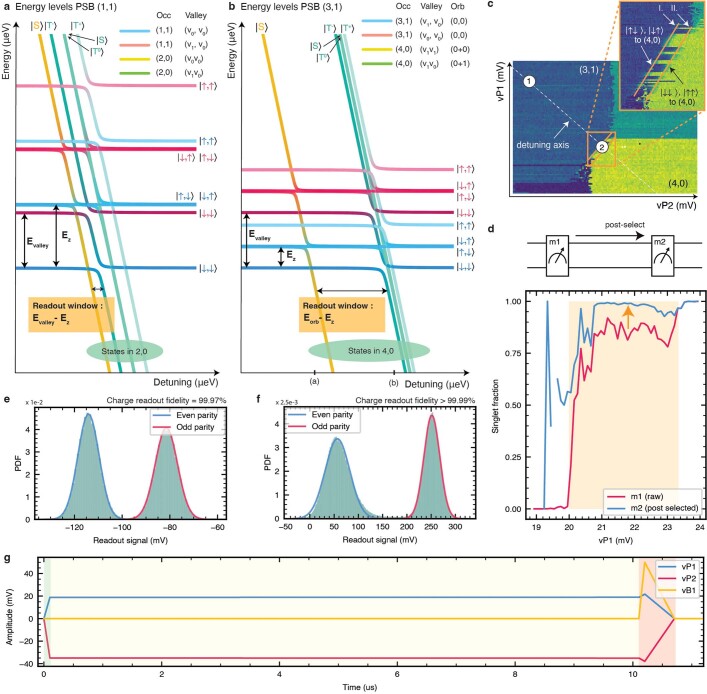
“PSB readout is a method used to convert a spin state to a more easily detectable charge state 58 .”
MethodA programmable two-qubit quantum processor in silicon
Watson, T. F., Philips, S. G. J., Kawakami, E., Ward, D. R., Scarlino, P., Veldhorst, M., Savage, D. E., Lagally, M. G., Friesen, M., Coppersmith, S. N., et al. (2018) · Nature · doi:10.1038/nature25766 · Cited by 741 · cited 2×
“…measured across the six-dot array have state fidelity ranging from 88% to 96%, which is considerably higher than the Bell state fidelities of 78% to 89% (all state preparation and measurement (SPAM) corrected, see Methods) reported on two-qubit quantum dot devices just a few years ago 42,44,45 .”
BackgroundSelf-citationInterfacing spin qubits in quantum dots and donors—hot, dense, and coherent
Vandersypen, L. M. K., Bluhm, H., Clarke, J. S., Dzurak, A. S., Ishihara, R., Morello, A., Reilly, D. J., Schreiber, L. R., & Veldhorst, M. (2017) · npj Quantum Information · doi:10.1038/s41534-017-0038-y · Cited by 624 · cited 1×
“To scale beyond, we envision networks of local registers [6, 7], connected together with quantum coherent links.”
BackgroundSelf-citationRoads towards fault-tolerant universal quantum computation
Campbell, E. T., Terhal, B. M., & Vuillot, C. (2017) · Nature · doi:10.1038/nature23460 · Cited by 596
Quantum circuits with many photons on a programmable nanophotonic chip
Arrazola, J. M., Bergholm, V., Brádler, K., Bromley, T. R., Collins, M. J., Dhand, I., Fumagalli, A., Gerrits, T., Goussev, A., Helt, L. G., et al. (2021) · Nature · doi:10.1038/s41586-021-03202-1 · Cited by 567
Resonantly driven CNOT gate for electron spins
Zajac, D. M., Sigillito, A. J., Russ, M., Borjans, F., Taylor, J. M., Burkard, G., & Petta, J. R. (2018) · Science · doi:10.1126/science.aao5965 · Cited by 552 · cited 1×
“…measured across the six-dot array have state fidelity ranging from 88% to 96%, which is considerably higher than the Bell state fidelities of 78% to 89% (all state preparation and measurement (SPAM) corrected, see Methods) reported on two-qubit quantum dot devices just a few years ago 42,44,45 .”
BackgroundQuantum logic with spin qubits crossing the surface code threshold
Xue, X., Russ, M., Samkharadze, N., Undseth, B., Sammak, A., Scappucci, G., & Vandersypen, L. M. K. (2022) · Nature · doi:10.1038/s41586-021-04273-w · Cited by 524 · cited 2×
“For small semiconductor spin qubit systems, state-of-the-art single-qubit gate fidelities exceed 99.9% 5,26,27 and two-qubit gates well above 99% fidelity have been demonstrated recently 6–8 , 10 .”
BackgroundMethodInfluentialSelf-citationElectrical control of a long-lived spin qubit in a Si/SiGe quantum dot
Kawakami, E., Scarlino, P., Ward, D. R., Braakman, F. R., Savage, D. E., Lagally, M. G., Friesen, M., Coppersmith, S. N., Eriksson, M. A., & Vandersypen, L. M. K. (2014) · Nature Nanotechnology · doi:10.1038/nnano.2014.153 · Cited by 504 · cited 1×
“Si/SiGe devices have hindered progress in the past 37 , but in this device all valley splittings are in the range of 100–300 μeV (Supplementary Information).”
BackgroundSelf-citationFast universal quantum gate above the fault-tolerance threshold in silicon
Noiri, A., Takeda, K., Nakajima, T., Kobayashi, T., Sammak, A., Scappucci, G., & Tarucha, S. (2022) · Nature · doi:10.1038/s41586-021-04182-y · Cited by 471
Self-citationQuantum circuits with many photons on a programmable nanophotonic chip
Arrazola, J. M., Bergholm, V., Brádler, K., Bromley, T. R., Collins, M. J., Dhand, I., Fumagalli, A., Gerrits, T., Goussev, A., Helt, L. G., et al. (2021) · RePEc: Research Papers in Economics · Cited by 463
Taylor, J. M., Engel, H.-A., Dür, W., Yacoby, A., Marcus, C. M., Zoller, P., & Lukin, M. D. (2005) · Nature Physics · doi:10.1038/nphys174 · Cited by 433
A four-qubit germanium quantum processor
Hendrickx, N. W., Lawrie, W. I. L., Russ, M., van Riggelen, F., de Snoo, S. L., Schouten, R. N., Sammak, A., Scappucci, G., & Veldhorst, M. (2021) · Nature · doi:10.1038/s41586-021-03332-6 · Cited by 405 · cited 2×
“Spins in semiconductor quantum dots show long-term promise 2,3 but demonstrations so far use between one and four qubits and typically optimize the fidelity of either single-or two-qubit operations, or initialization and readout 4–11 .”
BackgroundMethodSelf-citationSilicon CMOS architecture for a spin-based quantum computer
Veldhorst, M., Eenink, H. G. J., Yang, C. H., & Dzurak, A. S. (2017) · Nature Communications · doi:10.1038/s41467-017-01905-6 · Cited by 398 · cited 1×
“Scaling further will require additional elements such as cross-bar addressing to control dense two-dimensional arrays 48,49 and on-chip quantum links to connect local quantum registers together 3,50–52 .”
BackgroundSelf-citationFidelity benchmarks for two-qubit gates in silicon
Huang, W., Yang, C. H., Chan, K. W., Tanttu, T., Hensen, B., Leon, R. C. C., Fogarty, M. A., Hwang, J. C. C., Hudson, F. E., Itoh, K. M., et al. (2019) · Nature · doi:10.1038/s41586-019-1197-0 · Cited by 370 · cited 1×
“…measured across the six-dot array have state fidelity ranging from 88% to 96%, which is considerably higher than the Bell state fidelities of 78% to 89% (all state preparation and measurement (SPAM) corrected, see Methods) reported on two-qubit quantum dot devices just a few years ago 42,44,45 .”
BackgroundQubits made by advanced semiconductor manufacturing
Zwerver, A. M. J., Krähenmann, T., Watson, T. F., Lampert, L., George, H. C., Pillarisetty, R., Bojarski, S. A., Amin, P., Amitonov, S. V., Boter, J. M., et al. (2022) · Nature Electronics · doi:10.1038/s41928-022-00727-9 · Cited by 364 · cited 1×
“…path topractical large-scale quantum computation, electron spin qubits in semiconductor quantum dots 12 show promise because of their inherent potential for scaling through their small size 13,14 , long-lived coherence 4 and compatibility with advanced semiconductor manufacturing techniques 15 .”
BackgroundSelf-citationFault-tolerant control of an error-corrected qubit
Egan, L., Debroy, D. M., Noel, C., Risinger, A., Zhu, D., Biswas, D., Newman, M., Li, M., Brown, K. R., Cetina, M., et al. (2021) · Nature · doi:10.1038/s41586-021-03928-y · Cited by 348
Two-qubit silicon quantum processor with operation fidelity exceeding 99%
Mills, A. R., Guinn, C. R., Gullans, M. J., Sigillito, A. J., Feldman, M. M., Nielsen, E., & Petta, J. R. (2022) · Science Advances · doi:10.1126/sciadv.abn5130 · Cited by 329
Scalable Gate Architecture for a One-Dimensional Array of Semiconductor Spin Qubits
Zajac, D. M., Hazard, T. M., Mi, X., Nielsen, E., & Petta, J. R. (2016) · Physical Review Applied · doi:10.1103/physrevapplied.6.054013 · Cited by 291 · cited 1×
“For longer one-dimensional arrays, we would place a sensing dot alongside the qubit array every 3 qubit dots [1].”
MethodA crossbar network for silicon quantum dot qubits
Li, R., Petit, L., Franke, D. P., Dehollain, J. P., Helsen, J., Steudtner, M., Thomas, N. K., Yoscovits, Z. R., Singh, K. J., Wehner, S., et al. (2018) · Science Advances · doi:10.1126/sciadv.aar3960 · Cited by 274 · cited 1×
“Scaling further will require additional elements such as cross-bar addressing to control dense two-dimensional arrays 48,49 and on-chip quantum links to connect local quantum registers together 3,50–52 .”
BackgroundSelf-citationGate-Defined Quantum Dots in Intrinsic Silicon
Angus, S. J., Ferguson, A. J., Dzurak, A. S., & Clark, R. G. (2007) · Nano Letters · doi:10.1021/nl070949k · Cited by 241
Precision tomography of a three-qubit donor quantum processor in silicon
Mądzik, M. T., Asaad, S., Youssry, A., Joecker, B., Rudinger, K. M., Nielsen, E., Young, K. C., Proctor, T. J., Baczewski, A. D., Laucht, A., et al. (2022) · Nature · doi:10.1038/s41586-021-04292-7 · Cited by 241 · cited 2×
“By comparison, using semiconductor spin qubits, partial 19 and universal 11 control of up to four qubits was achieved and entanglement of up to three qubits was quantified 9,10,20 .”
BackgroundMethodInfluentialSelf-citationA crossbar network for silicon quantum dot qubits
Li, R., Petit, L., Franke, D. P., Dehollain, J. P., Helsen, J., Steudtner, M., Thomas, N. K., Yoscovits, Z. R., Singh, K. J., Wehner, S., et al. (2018) · Leiden Repository (Leiden University) · Cited by 234
Self-citationSilicon qubit fidelities approaching incoherent noise limits via pulse engineering
Yang, C. H., Chan, K. W., Harper, R., Huang, W., Evans, T., Hwang, J. C. C., Hensen, B., Laucht, A., Tanttu, T., Hudson, F. E., et al. (2019) · Nature Electronics · doi:10.1038/s41928-019-0234-1 · Cited by 201
Fast adiabatic qubit gates using onlyσzcontrol
Martinis, J. M., & Geller, M. R. (2014) · Physical Review A · doi:10.1103/physreva.90.022307 · Cited by 195
Initialization by Measurement of a Superconducting Quantum Bit Circuit
Ristè, D., van Leeuwen, J. G., Ku, H.-S., Lehnert, K. W., & DiCarlo, L. (2012) · Physical Review Letters · doi:10.1103/physrevlett.109.050507 · Cited by 178
Quantum error correction with silicon spin qubits
Takeda, K., Noiri, A., Nakajima, T., Kobayashi, T., & Tarucha, S. (2022) · Nature · doi:10.1038/s41586-022-04986-6 · Cited by 172 · cited 2×
“By comparison, using semiconductor spin qubits, partial 19 and universal 11 control of up to four qubits was achieved and entanglement of up to three qubits was quantified 9,10,20 .”
BackgroundMethodSilicon CMOS architecture for a spin-based quantum computer
Veldhorst, M., Eenink, H. G. J., Yang, C. H., & Dzurak, A. S. (2017) · RePEc: Research Papers in Economics · Cited by 166
Self-citationFidelity benchmarks for two-qubit gates in silicon
Huang, W., Yang, C. H., Chan, K. W., Tanttu, T., Hensen, B., Leon, R. C. C., Fogarty, M. A., Hwang, J. C. C., Hudson, F. E., Itoh, K. M., et al. (2019) · RePEc: Research Papers in Economics · Cited by 155
Entanglement in a solid-state spin ensemble
Simmons, S., Brown, R. M., Riemann, H., Abrosimov, N. V., Becker, P., Pohl, H.-J., Thewalt, M. L. W., Itoh, K. M., & Morton, J. J. L. (2011) · Nature · doi:10.1038/nature09696 · Cited by 148
A reconfigurable gate architecture for Si/SiGe quantum dots
Zajac, D. M., Hazard, T. M., Mi, X., Wang, K., & Petta, J. R. (2015) · Applied Physics Letters · doi:10.1063/1.4922249 · Cited by 147
Quantum dot arrays in silicon and germanium
Lawrie, W. I. L., Eenink, H. G. J., Hendrickx, N. W., Boter, J. M., Petit, L., Amitonov, S. V., Lodari, M., Paquelet Wuetz, B., Volk, C., Philips, S. G. J., et al. (2020) · Applied Physics Letters · doi:10.1063/5.0002013 · Cited by 140 · cited 2×
“33 .”
BackgroundSelf-citationSimultaneous single-qubit driving of semiconductor spin qubits at the fault-tolerant threshold
Lawrie, W. I. L., Rimbach-Russ, M., van Riggelen, F., Hendrickx, N. W., de Snoo, S. L., Sammak, A., Scappucci, G., Helsen, J., & Veldhorst, M. (2023) · Nature Communications · doi:10.1038/s41467-023-39334-3 · Cited by 138
Self-citationQuantum computing with semiconductor spins
Vandersypen, L. M. K., & Eriksson, M. A. (2019) · Physics Today · doi:10.1063/pt.3.4270 · Cited by 132 · cited 1×
“On the path topractical large-scale quantum computation, electron spin qubits in semiconductor quantum dots 12 show promise because of their inherent potential for scaling through their small size 13,14 , long-lived coherence 4 and compatibility with advanced semiconductor manufacturing techniques…”
BackgroundSelf-citationExperimental Signature of Phonon-Mediated Spin Relaxation in a Two-Electron Quantum Dot
Meunier, T., Vink, I. T., van Beveren, L. H. W., Tielrooij, K., Hanson, R., Koppens, F. H. L., Tranitz, H.-P., Wegscheider, W., Kouwenhoven, L. P., & Vandersypen, L. M. K. (2007) · Physical Review Letters · doi:10.1103/physrevlett.98.126601 · Cited by 127 · cited 1×
“…X , Y and Z stand for the Pauli operators, I for the identity and ZZ is shorthand for the tensor product of two Pauli Z operators, and so on), given that the effect of the flip-flop terms of the spin exchange interaction is suppressed because of the differences in the qubit splittings 41 .”
BackgroundSelf-citationSpiderweb Array: A Sparse Spin-Qubit Array
Boter, J. M., Dehollain, J. P., van Dijk, J. P. G., Xu, Y., Hensgens, T., Versluis, R., Naus, H. W. L., Clarke, J. S., Veldhorst, M., Sebastiano, F., et al. (2022) · Physical Review Applied · doi:10.1103/physrevapplied.18.024053 · Cited by 125
Self-citationUniversal logic with encoded spin qubits in silicon
Weinstein, A. J., Reed, M. D., Jones, A. M., Andrews, R. W., Barnes, D., Blumoff, J. Z., Euliss, L. E., Eng, K., Fong, B. H., Ha, S. D., et al. (2023) · Nature · doi:10.1038/s41586-023-05777-3 · Cited by 124 · cited 1×
“In a six-dot linear array, two qubits encoded in the state of three spins each were operated 21 and spin exchange oscillations in a 3 × 3 array have been reported 22 .”
BackgroundHigh-fidelity quantum gates in Si/SiGe double quantum dots
Russ, M., Zajac, D. M., Sigillito, A. J., Borjans, F., Taylor, J. M., Petta, J. R., & Burkard, G. (2018) · Physical Review B · doi:10.1103/physrevb.97.085421 · Cited by 115 · cited 1×
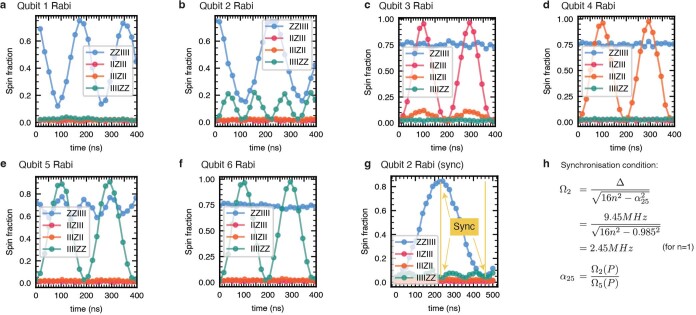
“We used the synchronization condition 53,54 to choose Rabi frequencies for the single-qubit gates for which the qubit that suffers crosstalk does not undergo a net rotation while the target qubit is rotated by 90 degrees or multiples thereof (Extended Data Fig.”
MethodLoading a quantum-dot based “Qubyte” register
Volk, C., Zwerver, A. M. J., Mukhopadhyay, U., Eendebak, P. T., van Diepen, C. J., Dehollain, J. P., Hensgens, T., Fujita, T., Reichl, C., Wegscheider, W., et al. (2019) · npj Quantum Information · doi:10.1038/s41534-019-0146-y · Cited by 115 · cited 1×
“These parameters are controlled independently through linear combinations of gate voltages, known as virtual gates 36 .”
BackgroundSelf-citationQuantum tomography of an entangled three-qubit state in silicon
Takeda, K., Noiri, A., Nakajima, T., Yoneda, J., Kobayashi, T., & Tarucha, S. (2021) · Nature Nanotechnology · doi:10.1038/s41565-021-00925-0 · Cited by 109 · cited 1×
“By comparison, using semiconductor spin qubits, partial 19 and universal 11 control of up to four qubits was achieved and entanglement of up to three qubits was quantified 9,10,20 .”
MethodFast and High-Fidelity State Preparation and Measurement in Triple-Quantum-Dot Spin Qubits
Blumoff, J., Pan, A., Keating, T., Andrews, R. W., Barnes, D. W., Brecht, T., Croke, E. T., Euliss, L. E., Fast, J., Jackson, C. A. C., et al. (2022) · PRX Quantum · doi:10.1103/prxquantum.3.010352 · Cited by 91
Pauli spin blockade in undoped Si/SiGe two-electron double quantum dots
Borselli, M. G., Eng, K., Croke, E. T., Maune, B. M., Huang, B., Ross, R. S., Kiselev, A. A., Deelman, P. W., Alvarado-Rodriguez, I., Schmitz, A. E., et al. (2011) · Applied Physics Letters · doi:10.1063/1.3623479 · Cited by 85 · cited 1×
“…path topractical large-scale quantum computation, electron spin qubits in semiconductor quantum dots 12 show promise because of their inherent potential for scaling through their small size 13,14 , long-lived coherence 4 and compatibility with advanced semiconductor manufacturing techniques 15 .”
BackgroundCoherent control of individual electron spins in a two-dimensional quantum dot array
Mortemousque, P.-A., Chanrion, E., Jadot, B., Flentje, H., Ludwig, A., Wieck, A. D., Urdampilleta, M., Bäuerle, C., & Meunier, T. (2021) · Nature Nanotechnology · doi:10.1038/s41565-020-00816-w · Cited by 85 · cited 1×
“In a six-dot linear array, two qubits encoded in the state of three spins each were operated 21 and spin exchange oscillations in a 3 × 3 array have been reported 22 .”
BackgroundRadio-Frequency-Detected Fast Charge Sensing in Undoped Silicon Quantum Dots
Noiri, A., Takeda, K., Yoneda, J., Nakajima, T., Kodera, T., & Tarucha, S. (2020) · Nano Letters · doi:10.1021/acs.nanolett.9b03847 · Cited by 84 · cited 1×
“The background of the measured signal depends on the inductance of the surface-mount inductor, the capacitance to ground 29,56,57 and the resistance to ground of the RF readout circuit.”
BackgroundHigh-performance superconducting quantum processors via laser annealing of transmon qubits
Zhang, E. J., Srinivasan, S., Sundaresan, N., Bogorin, D. F., Martin, Y., Hertzberg, J. B., Timmerwilke, J., Pritchett, E. J., Yau, J.-B., Wang, C., et al. (2022) · Science Advances · doi:10.1126/sciadv.abi6690 · Cited by 83 · cited 1×
“…shows that, in scaling up, maintaining the quality of the control requires substantial effort, particularly, for instance, to deal with the denser motional spectrum in trapped ions 23 , to avert crosstalk in superconducting circuits 24 or to avoid increased losses in photonic circuits 25 .”
BackgroundRapid High-Fidelity Spin-State Readout in Si / Si - Ge Quantum Dots via rf Reflectometry
Connors, E. J., Nelson, J., & Nichol, J. M. (2020) · Physical Review Applied · doi:10.1103/physrevapplied.13.024019 · Cited by 76 · cited 2×
“By comparison, using semiconductor spin qubits, control of up to four qubits was achieved [9] and entanglement of up to three qubits was quantified [10, 11, 12].”
MethodMicromagnets for coherent control of spin-charge qubit in lateral quantum dots
Pioro-Ladrière, M., 都倉, 康., Obata, T., Kubo, T., & Tarucha, S. (2007) · Applied Physics Letters · doi:10.1063/1.2430906 · Cited by 70 · cited 2×
“On the path to practical large-scale quantum computation, electron spin qubits in semiconductor quantum dots [1] show promise due to their inherent potential for scaling through their small size [2, 3], long-lived coherence [4] and compatibility with advanced semiconductor manufacturing techniques [5].”
BackgroundMethodOptimized electrical control of a Si/SiGe spin qubit in the presence of an induced frequency shift
Takeda, K., Yoneda, J., Otsuka, T., Nakajima, T., Delbecq, M. R., Allison, G., Hoshi, Y., Usami, N., Itoh, K. M., Oda, S., et al. (2018) · npj Quantum Information · doi:10.1038/s41534-018-0105-z · Cited by 69
Fault-Tolerant Operation of a Quantum Error-Correction Code
Egan, L., Debroy, D. M., Noel, C., Risinger, A., Zhu, D., Biswas, D., Newman, M., Li, M., Brown, K. R., Cetina, M., et al. (2020) · arXiv · doi:10.48550/arxiv.2009.11482 · Cited by 65
Crosstalk analysis for single-qubit and two-qubit gates in spin qubit arrays
Heinz, I., & Burkard, G. (2021) · Physical review. B./Physical review. B · doi:10.1103/physrevb.104.045420 · Cited by 61 · cited 1×
“We used the synchronization condition 53,54 to choose Rabi frequencies for the single-qubit gates for which the qubit that suffers crosstalk does not undergo a net rotation while the target qubit is rotated by 90 degrees or multiples thereof (Extended Data Fig.”
MethodObata, T., Pioro-Ladrière, M., 都倉, 康., Shin, Y., Kubo, T., Yoshida, K., Taniyama, T., & Tarucha, S. (2010) · Physical Review B · doi:10.1103/physrevb.81.085317 · Cited by 58 · cited 4×
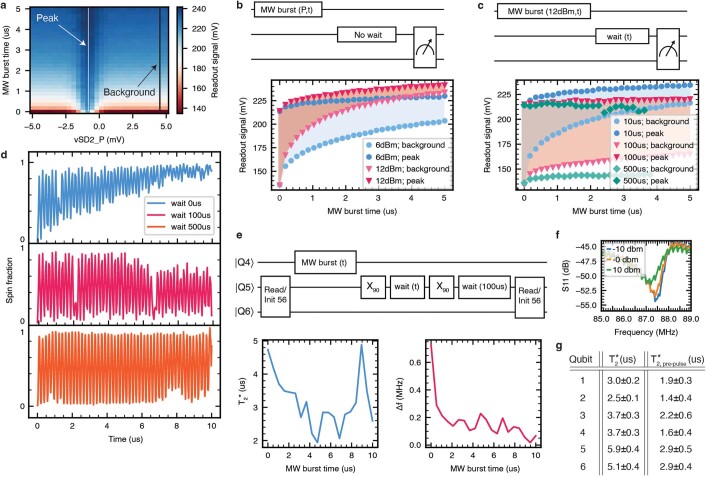
“When microwaves are applied to the EDSR line of the sample, several qubit properties change by an amount that depends on the applied driving power and the duty cycle of applying power versus no power.”
MethodInfluentialRepetitive Quantum Nondemolition Measurement and Soft Decoding of a Silicon Spin Qubit
Xue, X., D’Anjou, B., Watson, T. F., Ward, D. R., Savage, D. E., Lagally, M. G., Friesen, M. G., Coppersmith, S. N., Eriksson, M. A., Coish, W. A., et al. (2020) · Physical Review X · doi:10.1103/physrevx.10.021006 · Cited by 56 · cited 1×
“1b) 5,38 .”
Self-citationSimultaneous Operations in a Two-Dimensional Array of Singlet-Triplet Qubits
Fedele, F., Chatterjee, A., Fallahi, S., Gardner, G. C., Manfra, M. J., & Kuemmeth, F. (2021) · PRX Quantum · doi:10.1103/prxquantum.2.040306 · Cited by 42 · cited 1×
“By comparison, using semiconductor spin qubits, partial 19 and universal 11 control of up to four qubits was achieved and entanglement of up to three qubits was quantified 9,10,20 .”
MethodRobust and fragile entanglement of three qubits: Relation to permutation symmetry
Rajagopal, A. K., & Rendell, R. W. (2002) · Physical Review A · doi:10.1103/physreva.65.032328 · Cited by 38 · cited 1×
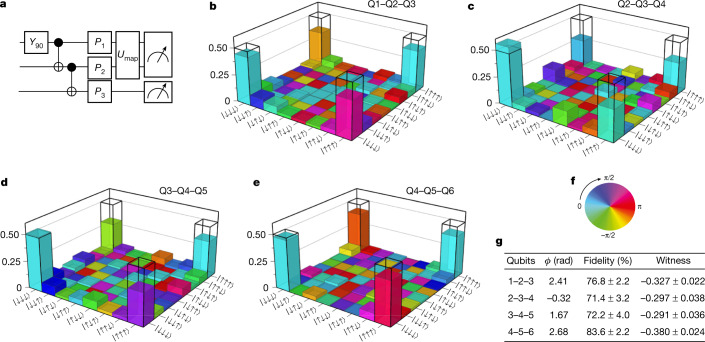
“As a final characterization of the qubit control across the array, we prepare Greenberger–Horne–Zeilinger (GHZ) states, which are the most delicate entangled states of three qubits 46,47 .”
MethodRadio-Frequency Reflectometry in Silicon-Based Quantum Dots
Liu, Y. Y., Philips, S. G. J., Orona, L., Samkharadze, N., McJunkin, T., MacQuarrie, E. R., Eriksson, M. A., Vandersypen, L. M. K., & Yacoby, A. (2021) · Physical Review Applied · doi:10.1103/physrevapplied.16.014057 · Cited by 38 · cited 5×
“The same data set from [10] analyzed without readout correction yields 45.”
BackgroundMethodInfluentialSelf-citationCrawford, O., Cruise, J. R., Mertig, N., & González-Zalba, M. F. (2023) · npj Quantum Information · doi:10.1038/s41534-023-00679-8 · Cited by 31
Do micromagnets expose spin qubits to charge and Johnson noise?
Kha, A., Joynt, R., & Culcer, D. (2015) · Applied Physics Letters · doi:10.1063/1.4934693 · Cited by 27 · cited 1×
“We expect spin coherence to be limited by charge noise coupled in by the micromagnet 40 .”
BackgroundSimultaneous driving of semiconductor spin qubits at the fault-tolerant thresholdPreprint
Lawrie, W. I. L., Russ, M., van Riggelen, F., et al. (2021) · arXiv (Cornell University) · Cited by 9
Self-citation
Research works printed but not linked: 1
- Harvey-Collard P High-fidelity single-shot readout for a spin qubit via an enhanced latching mechanism Phys. Rev. X 2018 8 021046
Cited by
Review of performance metrics of spin qubits in gated semiconducting nanostructures
Stano, P., & Loss, D. (2022) · Nature Reviews Physics · doi:10.1038/s42254-022-00484-w · Cited by 165
Quantum error correction with silicon spin qubits
Takeda, K., Noiri, A., Nakajima, T., Kobayashi, T., & Tarucha, S. (2022) · Nature · doi:10.1038/s41586-022-04986-6 · Cited by 172
Probing single electrons across 300-mm spin qubit wafers
Neyens, S., Zietz, O. K., Watson, T. F., Luthi, F., Nethwewala, A., George, H. C., Henry, E., Islam, M., Wagner, A. J., Borjans, F., et al. (2024) · Nature · doi:10.1038/s41586-024-07275-6 · Cited by 178
“Today, integrated spin qubit arrays have reached sizes of six quantum dots 9,15 , with larger quantum dot platforms in 1D (refs.”
InfluentialSelf-citationShared control of a 16 semiconductor quantum dot crossbar array
Borsoi, F., Hendrickx, N. W., John, V., Meyer, M., Motz, S., van Riggelen, F., Sammak, A., de Snoo, S. L., Scappucci, G., & Veldhorst, M. (2024) · Nature Nanotechnology · doi:10.1038/s41565-023-01491-3 · Cited by 165
Self-citationNoisy intermediate-scale quantum computers
Cheng, B., Deng, X., Gu, X. Q., He, Y., Hu, G., Huang, P., Li, J., Lin, B., Lu, D., Lu, Y., et al. (2023) · Frontiers of Physics · doi:10.1007/s11467-022-1249-z · Cited by 182
Metadata
- Authors
- Philips, S. G. J., Mądzik, M. T., Amitonov, S. V., de Snoo, S. L., Russ, M., Kalhor, N., Volk, C., Lawrie, W. I. L., Brousse, D., Tryputen, L., Wuetz, B. P., Sammak, A., Veldhorst, M., Scappucci, G., & Vandersypen, L. M. K.
- Affiliations
- QuTech (NL)
- Netherlands Organisation for Applied Scientific Research (NL)
- Corresponding author
- Vandersypen, Lieven M. K.
- ORCID
- Venue
- Nature
- Published
- 2022-09-28
- Volume
- 609
- Issue
- 7929
- Pages
- 919-924
- ISSN
- 0028-0836 (ISSN-L)
- 1476-4687
- PMC
- PMC9519456
- OpenAlex
- W4297473634
- Cited by
- 410
- References
- 64
- Citations by year
- 2026: 58 · 2025: 117 · 2024: 121 · 2023: 94 · 2022: 20
- FWCI
- 36.09
- Type
- journal article
- Language
- en
- Open access
- hybrid
- doi.org
- Licence
- cc-by
- creativecommons.org/licenses/by/4.0 (tdm)
- creativecommons.org/licenses/by/4.0 (vor)
- Locations
- Nature (publishedVersion, cc-by)
- PubMed Central (publishedVersion, cc-by)
- PubMed (publishedVersion)
- arXiv (Cornell University) (submittedVersion)
- TNO Repository (submittedVersion)
- OSTI OAI (U.S. Department of Energy Office of Scientific and Technical Information) (submittedVersion)
- RePEc: Research Papers in Economics (submittedVersion)
- Research Repository (Delft University of Technology) (submittedVersion)
- Data Archiving and Networked Services (DANS) (submittedVersion, cc-by)
- arXiv (Cornell University) (cc-by)
- Funders
- U.S. Department of Energy (DE‐FG02‐, FG0203ER46028, DEFG0203ER46028)
- Keysight Technologies
- Nederlandse Organisatie voor Wetenschappelijk Onderzoek (NWA.1292.19.194)
- Army Research Office (W911NF‐17‐1‐0274, W911NF, W911NF1210607)
- H2020 Marie Skłodowska-Curie Actions (676108)
- Topics
- Physical Sciences › Physics and Astronomy › Condensed Matter Physics › Quantum and electron transport phenomena
- Physical Sciences › Physics and Astronomy › Atomic and Molecular Physics, and Optics › Semiconductor Quantum Structures and Devices
- Physical Sciences › Computer Science › Artificial Intelligence › Quantum Computing Algorithms and Architecture
- Keywords
- silicon quantum dots, semiconductor spin qubits, Hamiltonian engineering, background calibration, real-time feedback, quantum non-demolition measurement, state preparation and measurement, gate fidelity
About these checks
Registry, retraction, Cites and statistics results are computed, not judged, with one exception: a printed reference that no index lists is read once by a model before it counts as a citation error. Claims are extracted by a model and kept only when their quote appears verbatim in the text; each cited source is then checked, with a model’s help, for whether it says what the claim relies on. Those verdicts can be wrong — read the claim’s quote and the cited source before relying on one.
Statistics and arithmetic are recomputed, not judged.
Confidence bands are shown only for fields calibrated on our annotated test set. None is calibrated yet, so no band is shown.
What counts as a claim ›How we measure confidence ›How we check this ›
Are you an author, or do you see a problem with this page? Request a review
Data sources
Bibliographic data: Semantic Scholar, OpenAlex, Crossref.
Contains information from the Semantic Scholar Academic Graph Datasets, made available under the ODC Attribution License (ODC-BY 1.0).
Semantic Scholar’s data is described in: Kinney, R., et al. (2023). The Semantic Scholar Open Data Platform. arXiv:2301.10140.
