

Universal logic with encoded spin qubits in silicon
Open accessThe DOI matches its Crossref record; 69 of the 70 references it cites were found in a registry or an index.
Abstract
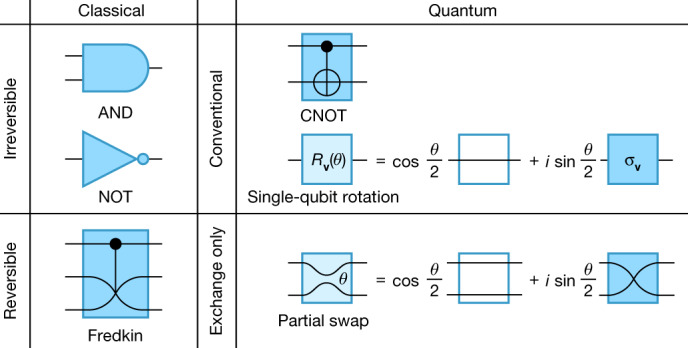
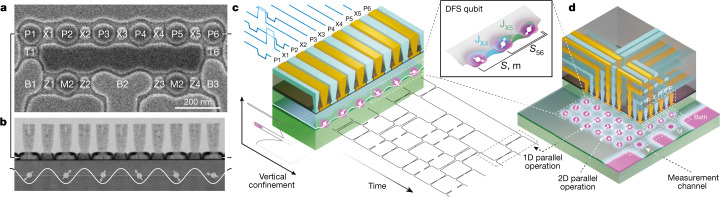
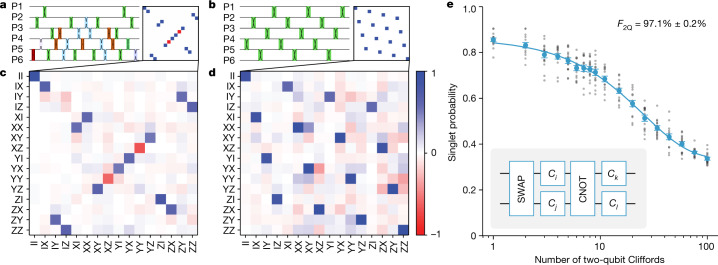
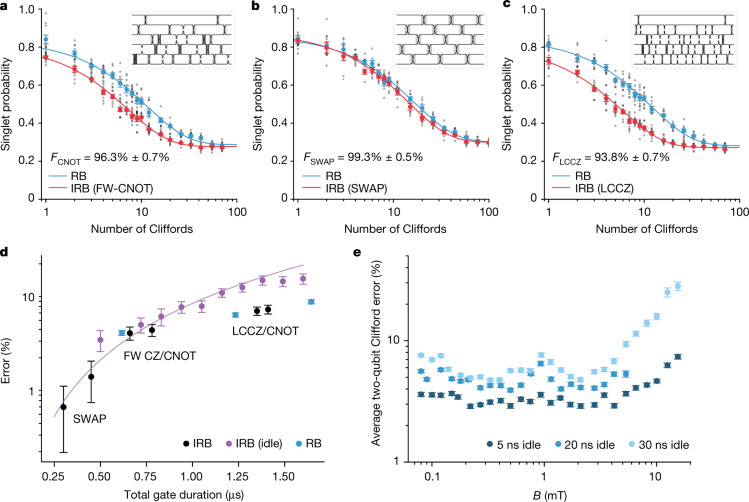
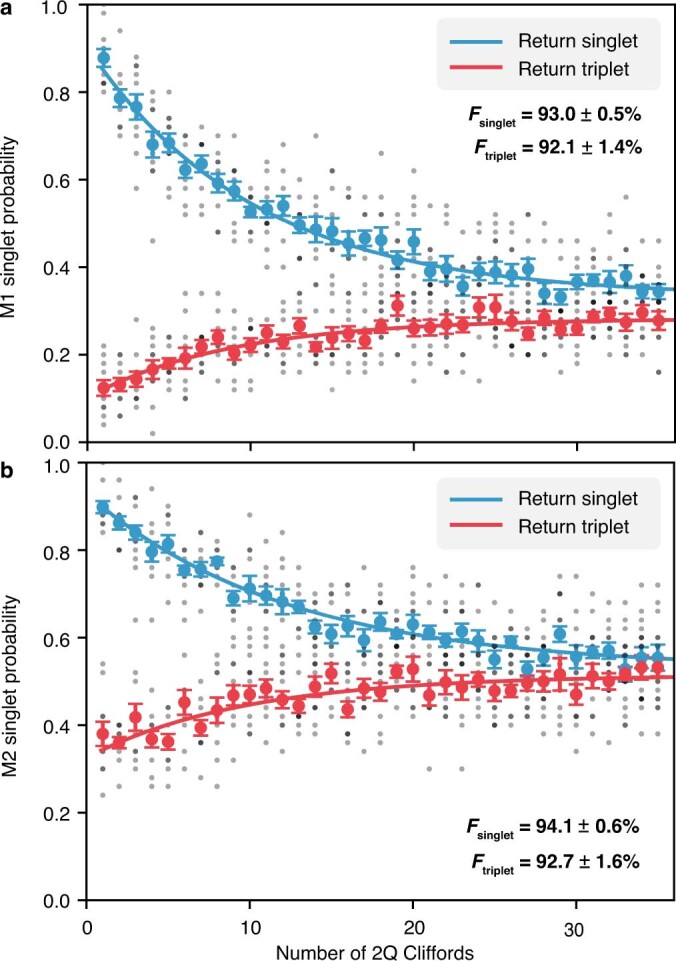
Quantum computation features known examples of hardware acceleration for certain problems, but is challenging to realize because of its susceptibility to small errors from noise or imperfect control. The principles of fault tolerance may enable computational acceleration with imperfect hardware, but they place strict requirements on the character and correlation of errors 1 . For many qubit technologies 2–21 , some challenges to achieving fault tolerance can be traced to correlated errors arising from the need to control qubits by injecting microwave energy matching qubit resonances. Here we demonstrate an alternative approach to quantum computation that uses energy-degenerate encoded qubit states controlled by nearest-neighbour contact interactions that partially swap the spin states of electrons with those of their neighbours. Calibrated sequences of such partial swaps, implemented using only voltage pulses, allow universal quantum control while bypassing microwave-associated correlated error sources 1,22–28 . We use an array of six 28 Si/SiGe quantum dots, built using a platform that is capable of extending in two dimensions following processes used in conventional microelectronics 29 . We quantify the operational fidelity of universal control of two encoded qubits using interleaved randomized benchmarking 30 , finding a fidelity of 96.3% ± 0.7% for encoded controlled NOT operations and 99.3% ± 0.5% for encoded SWAP. The quantum coherence offered by enriched silicon 5–9,16,18,20,22,27,29,31–37 , the all-electrical and low-crosstalk-control of partial swap operations 1,22–28 and the configurable insensitivity of our encoding to certain error sources 28,33,34,38 all combine to offer a strong pathway towards scalable fault tolerance and computational advantage.
Overview
The claims and statistics of this paper haven’t been checked yet.
Free: it reads the open-access text and checks the first 5 claims that cite a source we can check. Create a free account to check every claim.
Integrity signals
Registry
Cites
Statistics
Figures
Verification
Claims the paper makes
The claims and statistics of this paper haven’t been checked yet.
Free: it reads the open-access text and checks the first 5 claims that cite a source we can check. Create a free account to check every claim.
Self-check
Percentages, sums and reported differences re-computed from the paper’s own numbers.
The self-check needs the paper’s full text.
Citations
Cites
Quantum supremacy using a programmable superconducting processor
Arute, F., Arya, K., Babbush, R., Bacon, D., Bardin, J. C., Barends, R., Biswas, R., Boixo, S., Brandao, F. G. S. L., Buell, D. A., et al. (2019) · Nature · doi:10.1038/s41586-019-1666-5 · Cited by 7,720
Elementary gates for quantum computation
Barenco, A., Bennett, C. H., Cleve, R., DiVincenzo, D. P., Margolus, N., Shor, P., Sleator, T., Smolin, J. A., & Weinfurter, H. (1995) · Physical Review A · doi:10.1103/physreva.52.3457 · Cited by 4,311
Blais, A., Huang, R.-S., Wallraff, A., Girvin, S. M., & Schoelkopf, R. J. (2004) · Physical Review A · doi:10.1103/physreva.69.062320 · Cited by 2,989
Circuit quantum electrodynamics
Blais, A., Grimsmo, A. L., Girvin, S. M., & Wallraff, A. (2021) · Reviews of Modern Physics · doi:10.1103/revmodphys.93.025005 · Cited by 1,931
Fredkin, E., & Toffoli, T. (1982) · International Journal of Theoretical Physics · doi:10.1007/bf01857727 · Cited by 1,896
Zanardi, P., & Rasetti, M. (1997) · Physical Review Letters · doi:10.1103/physrevlett.79.3306 · Cited by 1,315
Randomized benchmarking of quantum gates
Knill, E., Leibfried, D., Reichle, R., Britton, J., Blakestad, R. B., Jost, J. D., Langer, C., Ozeri, R., Seidelin, S., & Wineland, D. J. (2008) · Physical Review A · doi:10.1103/physreva.77.012307 · Cited by 1,019 · cited 1×
“Randomized benchmarking (RB) is our preferred method of characterizing gate performance since it is fast, simple, relatively insensitive to SPAM error, and requires measurement of only one qubit [28, 29].”
MethodUniversal quantum computation with the exchange interaction
DiVincenzo, D. P., Bacon, D., Kempe, J., Burkard, G., & Whaley, K. B. (2000) · Nature · doi:10.1038/35042541 · Cited by 924 · cited 2×
“Though EO control was proposed over twenty years ago [16], experimental demonstration of encoded entangling operations has waited for the availability of fullyfunctional six-dot devices.”
BackgroundA quantum-dot spin qubit with coherence limited by charge noise and fidelity higher than 99.9%
Yoneda, J., Takeda, K., Otsuka, T., Nakajima, T., Delbecq, M. R., Allison, G., Honda, T., Kodera, T., Oda, S., Hoshi, Y., et al. (2018) · Nature Nanotechnology · doi:10.1038/s41565-017-0014-x · Cited by 900
Programmable Quantum Simulations of Spin Systems with Trapped Ions
Monroe, C., Campbell, W. C., Duan, L. M., Gong, Z. X., Gorshkov, A. V., Hess, P., Islam, R., Kim, K., Linke, N., Pagano, G., et al. (2019) · arXiv · doi:10.48550/arxiv.1912.07845 · Cited by 806 · cited 1×
“This is in part because the EO modality, unlike most other qubit systems [23, 24], does not require a new physical mechanism to generate entanglement between encoded qubits.”
Background
Research works printed but not linked: 4
- Xue X Benchmarking gate fidelities in a Si/SiGe two-qubit device Phys. Rev. X 2019 9 021011
- Burkard, G., Ladd, T. D., Nichol, J. M., Pan, A. & Petta, J. R. Semiconductor spin qubits. Rev. Mod. Phys. (in the press); preprint available at https://arxiv.org/abs/2112.08863. · arXiv
- Fong BH Wandzura SM Universal quantum computation and leakage reduction in the 3-qubit decoherence free subsystem Quantum Info. Comput. 2011 11 1003 1018
- Jordan SP Permutational quantum computing Quantum Info. Comput. 2010 10 470 497
Cited by
Items 101–124 of 124
Ballast Charges for Semiconductor Spin Qubits
Choi, Y., Nichol, J. M., & Barnes, E. (2025) · Physical Review Letters · doi:10.1103/81qt-48bl · Cited by 2
“They have reached the fidelities needed for fault-tolerant operation [2–5] and are also compatible with CMOS manufacturing infrastructure [6, 7].”
BackgroundScaling Quantum-Dot-Qubit Systems
Bishop, N. C. (2025) · Physics · doi:10.1103/physics.18.88
Lung Cancer in the Era of Precision Oncology
Othman, O., & Mohammed, A. (2025) · International Journal of Pathology and Biomarkers · doi:10.71428/ijpb.2025.0104
Negative exchange interaction in Si quantum dot arrays via valley-phase induced Z 2 gauge field
Woods, B. D. (2025) · Physical review. B./Physical review. B · doi:10.1103/x2jk-714n · Cited by 1
Guo, A.-L., Zhu, X., & Ren, Y. (2025) · Physics Letters A · doi:10.1016/j.physleta.2025.131037 · Cited by 2
Jenga-Krotov algorithm: Efficient compilation of multiqubit gates for exchange-only qubits
Wu, J., He, G., Zhuo, W., Fu, Q., & Wang, X. (2025) · Physical Review Research · doi:10.1103/1x1x-j1xl
“Among the various physical platforms under development, semiconductor-based spin qubits stand out for their scalability, long coherence times, and compatibility with industrial fabrication processes [6–15].”
In situ control of hole-spin driving mechanisms
Geyer, S., Eggli, R. S., dos Santos, C., Carballido, M. J., Stano, P., Loss, D., Zumbühl, D. M., Warburton, R. J., & Kuhlmann, A. V. (2026) · Physical Review Research · doi:10.1103/f1hx-nk4s · Cited by 2
Direct dispersive signature of Pauli spin blockade with voltage bias
Svab, S., Eggli, R. S., Patlatiuk, T., Carballido, M. J., Kwon, P. C., Trüssel, D. A., Li, A., Bakkers, E. P. A. M., Kuhlmann, A. V., & Zumbühl, D. M. (2026) · Physical Review Applied · doi:10.1103/8jmt-m432
Robust composite two-qubit gates for silicon-based spin qubits
Yu, Y.-Y., Zhang, G.-H., He, Y.-J., Wu, J., Song, X., & Wang, D. (2026) · Physical Review Applied · doi:10.1103/t8xj-6c5m
Rabi oscillations induced by nonresonant gyrating drive
Kolok, B., & Pályi, A. (2026) · Physical review. B./Physical review. B · doi:10.1103/ffkk-q3g3
Leakage-Protected Idle Operation of a Triangular Exchange-Only Spin Qubit
Broz, J., Hoke, J. C., Acuna, E., & Petta, J. R. (2026) · PRX Quantum · doi:10.1103/sljc-cmdw · Cited by 3
Spin-photons interface and quantum gates for spins in carbon nanotubes
Neukelmance, B. (2024) · theses.fr (ABES) · doi:10.70675/81330814z0190z4f2dza227zb50e198f8e5b · Cited by 1
Mohamed, A.-B. A., Jaradat, E. K., Khedr, A. N., & Alharbi, S. S. (2026) · The European Physical Journal Plus · doi:10.1140/epjp/s13360-026-07607-7 · Cited by 2
Clarifying the physical origin of long-period charge fluctuations in Si fin-type quantum dots
Oka, H., Asai, H., Kato, K., Inaba, T., Shitakata, S., Iizuka, S., Chiashi, Y., Kobayashi, Y., Yui, H., Nagano, S., et al. (2026) · Japanese Journal of Applied Physics · doi:10.35848/1347-4065/ae611c
Single-shot in situ readout of a spin qubit unit cell
Hamonic, P., Toubeix, M., Haas, G., Nath, J., Dartiailh, M., Martínez, B., Bertrand, B., Niebojewski, H., Vinet, M., Bäuerle, C., et al. (2026) · Nature Electronics · doi:10.1038/s41928-026-01654-9 · Cited by 7
Mitigating residual exchange coupling in resonant singlet-triplet qubits
Anonymous, Torres-Leal, F., & Nichol, J. M. (2026) · Physical Review Applied · doi:10.1103/gjn5-kc41 · Cited by 3
“Encoding quantum information in the joint state of more than one spin enables low-frequency control [17, 29–33], high-fidelity single-shot readout [33–38], and encoding in decoherence-free sub-spaces [39–42].”
Multimodal deep learning for automated atomic qubits fabrication in silicon
Cui, Y.-W., Wu, K., Wu, P., Yang, L.-Y.-L., Duan, M., Wang, G.-Y., Shi, K., Lyu, Y., Huang, P.-H., Xin, T., et al. (2026) · Machine Learning: Science and Technology · doi:10.1088/2632-2153/ae8e30
Underdog ‘spin qubits’ leap forward in race to a useful quantum computer
Garisto, D. (2026) · Nature · doi:10.1038/d41586-026-02357-z
Exchange interaction in gate-defined quantum dots beyond the Hubbard model
Anonymous, Bethke, P., Shehata, M. M. E. K., Simion, G., Wolfe, M. A., Botzem, T., McNeil, R. P. G., Ritzmann, J., Ludwig, A., Wieck, A. D., et al. (2026) · Physical review. B./Physical review. B · doi:10.1103/fb37-f7ky · Cited by 2
rf quantum capacitance parametric amplifier
Kass, A. E., Harlech-Jones, B., Jin, C. T., Watson, J. D., Gardner, G. C., Fallahi, S., Manfra, M. J., Ohki, T., & Reilly, D. J. (2026) · Physical Review Applied · doi:10.1103/3146-fgdw
Stability of Tripartite Entangled State in Spin Trimer Coupled to a Magnetic Ion
Kim, C.-I., Jong, C.-H., So, T.-S., Yun, C.-S., & Kang, C.-J. (2026) · Physics of the Solid State · doi:10.1134/s1063783425602711
Epitaxial growth of strain relaxed SiGe layers grown with GeCl4 for SiGe on nothing
Shimura, Y., Kuwazuru, H., Porret, C., Wang, D., Yamamoto, K., & Loo, R. (2026) · Materials Science in Semiconductor Processing · doi:10.1016/j.mssp.2026.111176
Electron-mediated coupling schemes between nuclear-spin qudits in silicon
Anonymous, Xu, F., Xiang, Y., Zhang, S., Song, J., Zhai, Y., Duan, M., Pan, T., Tian, Z., Wang, G., et al. (2026) · Physical Review Applied · doi:10.1103/mr2x-jt6m
Design of π-Conjugated Donor-Bridge-Acceptor Radicals for Molecular Qudit Applications
Sun, Q., Brédas, J., & Coropceanu, V. (2026) · ACS Central Science · doi:10.1021/acscentsci.6c01275
Metadata
- Authors
- Weinstein, A. J., Reed, M. D., Jones, A. M., Andrews, R. W., Barnes, D., Blumoff, J. Z., Euliss, L. E., Eng, K., Fong, B. H., Ha, S. D., Hulbert, D. R., Jackson, C. A. C., Jura, M., Keating, T. E., Kerckhoff, J., Kiselev, A. A., Matten, J., Sabbir, G., Smith, A., Wright, J., Rakher, M. T., Ladd, T. D., & Borselli, M. G.
- Affiliations
- HRL Laboratories (United States) (US)
- Corresponding author
- Weinstein, Aaron J.
- Ladd, Thaddeus D.
- ORCID
- Venue
- Nature
- Published
- 2023-02-06
- Volume
- 615
- Issue
- 7954
- Pages
- 817-822
- ISSN
- 0028-0836 (ISSN-L)
- 1476-4687
- PMC
- PMC10060158
- OpenAlex
- W4319312371
- Semantic Scholar
- 2b0b88e0e96c3110b24ae9ca155126a48f980bee
- Cited by
- 124
- References
- 68
- Citations by year
- 2026: 24 · 2025: 46 · 2024: 34 · 2023: 17
- FWCI
- 14.16
- Type
- journal article
- Language
- en
- Open access
- hybrid
- doi.org
- Licence
- cc-by
- creativecommons.org/licenses/by/4.0 (tdm)
- creativecommons.org/licenses/by/4.0 (vor)
- Locations
- Nature (publishedVersion, cc-by)
- PubMed Central (publishedVersion, cc-by)
- PubMed (publishedVersion)
- arXiv (Cornell University) (submittedVersion)
- RePEc: Research Papers in Economics (submittedVersion)
- arXiv (Cornell University)
- Topics
- Physical Sciences › Physics and Astronomy › Condensed Matter Physics › Quantum and electron transport phenomena
- Physical Sciences › Computer Science › Artificial Intelligence › Quantum Computing Algorithms and Architecture
- Physical Sciences › Physics and Astronomy › Atomic and Molecular Physics, and Optics › Quantum Information and Cryptography
- Keywords
- encoded qubits, spin qubits, silicon quantum dots, Si/SiGe quantum dots, fault tolerance, correlated errors, randomized benchmarking, quantum coherence
About these checks
Registry, retraction, Cites and statistics results are computed, not judged, with one exception: a printed reference that no index lists is read once by a model before it counts as a citation error. Claims are extracted by a model and kept only when their quote appears verbatim in the text; each cited source is then checked, with a model’s help, for whether it says what the claim relies on. Those verdicts can be wrong — read the claim’s quote and the cited source before relying on one.
Statistics and arithmetic are recomputed, not judged.
Confidence bands are shown only for fields calibrated on our annotated test set. None is calibrated yet, so no band is shown.
What counts as a claim ›How we measure confidence ›How we check this ›
Are you an author, or do you see a problem with this page? Request a review
Data sources
Bibliographic data: Semantic Scholar, OpenAlex, Crossref.
Contains information from the Semantic Scholar Academic Graph Datasets, made available under the ODC Attribution License (ODC-BY 1.0).
Semantic Scholar’s data is described in: Kinney, R., et al. (2023). The Semantic Scholar Open Data Platform. arXiv:2301.10140.
