

Universal logic with encoded spin qubits in silicon
Open accessThe DOI matches its Crossref record; 69 of the 70 references it cites were found in a registry or an index.
Abstract
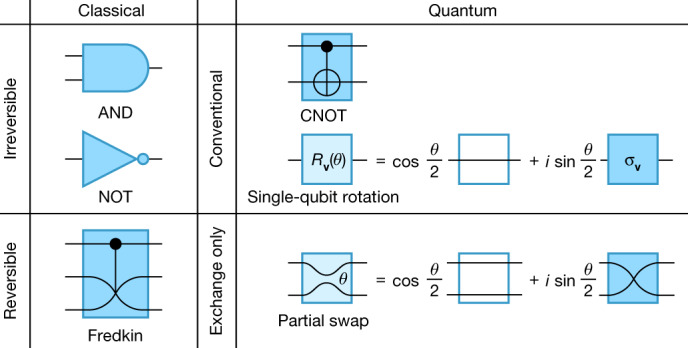
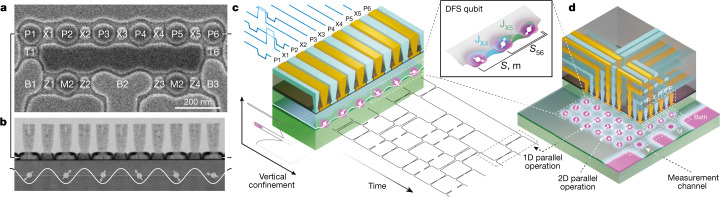
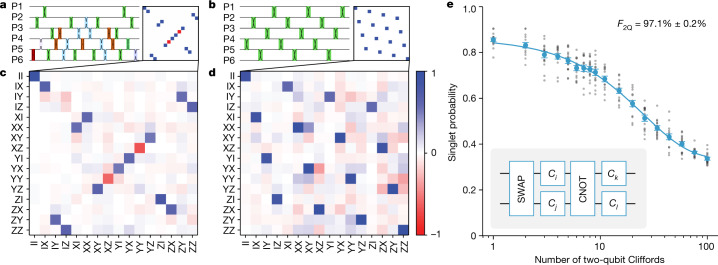
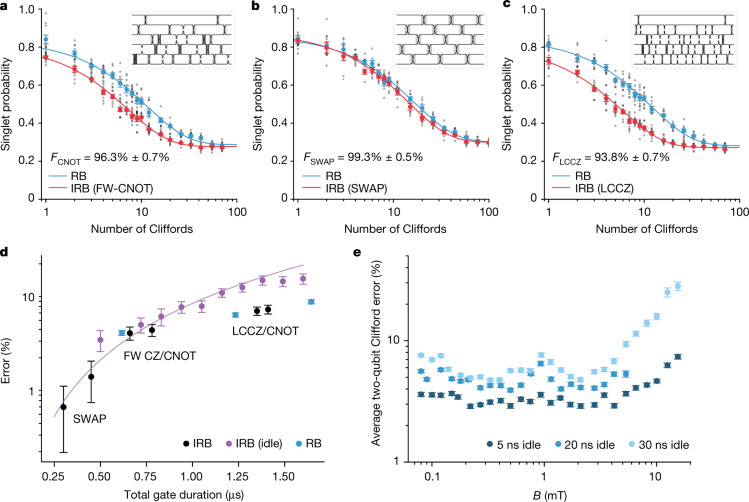
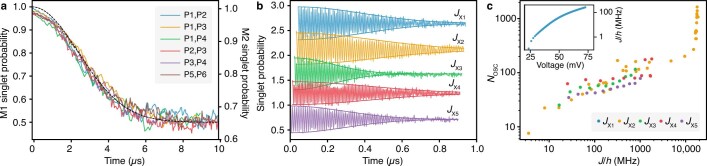
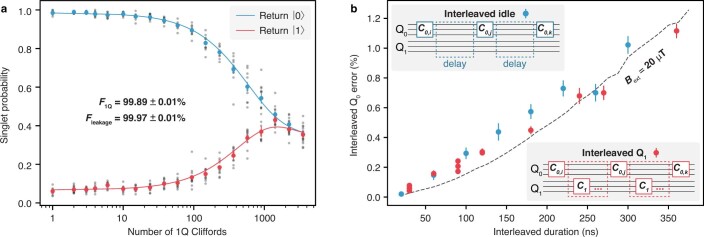
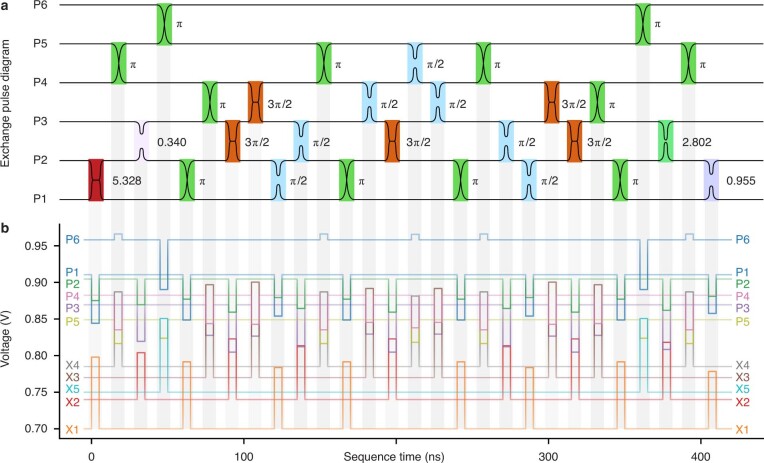
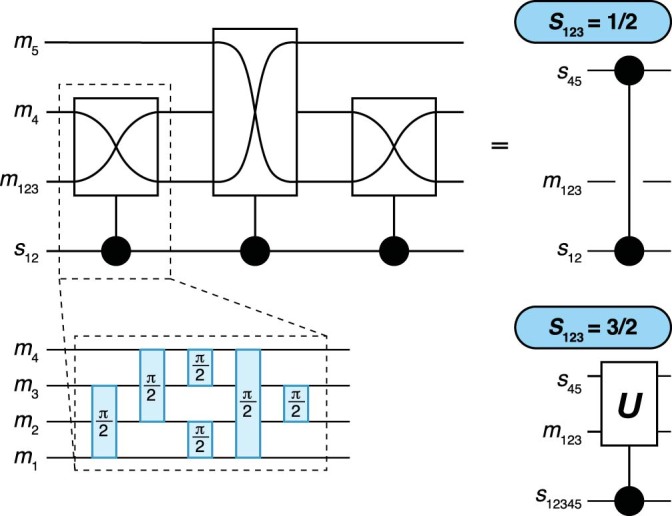
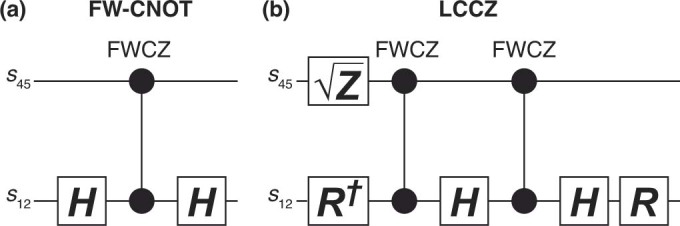
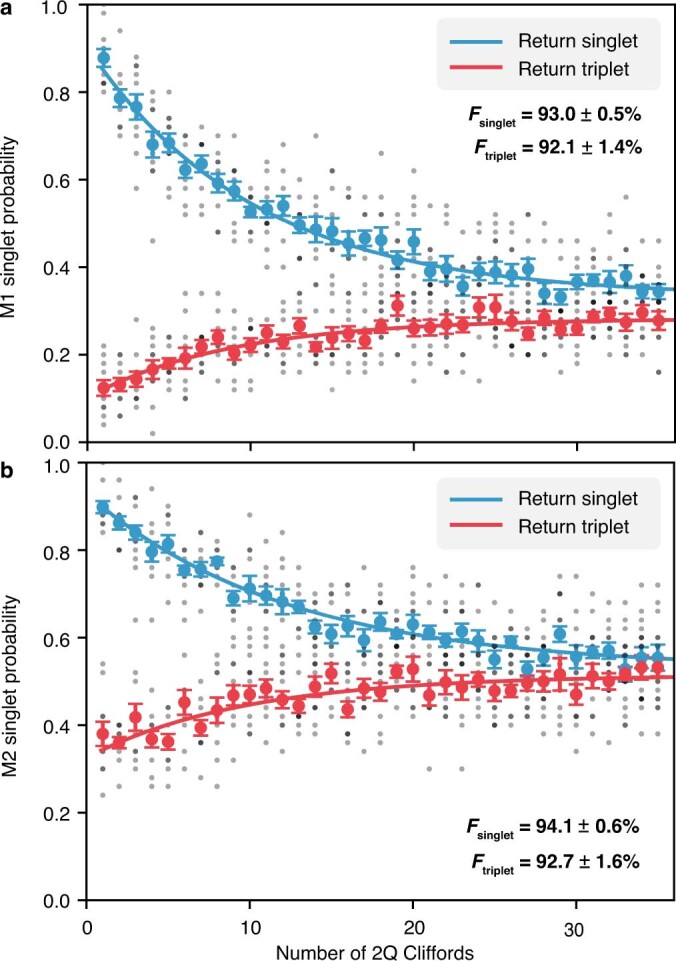
Quantum computation features known examples of hardware acceleration for certain problems, but is challenging to realize because of its susceptibility to small errors from noise or imperfect control. The principles of fault tolerance may enable computational acceleration with imperfect hardware, but they place strict requirements on the character and correlation of errors 1 . For many qubit technologies 2–21 , some challenges to achieving fault tolerance can be traced to correlated errors arising from the need to control qubits by injecting microwave energy matching qubit resonances. Here we demonstrate an alternative approach to quantum computation that uses energy-degenerate encoded qubit states controlled by nearest-neighbour contact interactions that partially swap the spin states of electrons with those of their neighbours. Calibrated sequences of such partial swaps, implemented using only voltage pulses, allow universal quantum control while bypassing microwave-associated correlated error sources 1,22–28 . We use an array of six 28 Si/SiGe quantum dots, built using a platform that is capable of extending in two dimensions following processes used in conventional microelectronics 29 . We quantify the operational fidelity of universal control of two encoded qubits using interleaved randomized benchmarking 30 , finding a fidelity of 96.3% ± 0.7% for encoded controlled NOT operations and 99.3% ± 0.5% for encoded SWAP. The quantum coherence offered by enriched silicon 5–9,16,18,20,22,27,29,31–37 , the all-electrical and low-crosstalk-control of partial swap operations 1,22–28 and the configurable insensitivity of our encoding to certain error sources 28,33,34,38 all combine to offer a strong pathway towards scalable fault tolerance and computational advantage.
Overview
The claims and statistics of this paper haven’t been checked yet.
Free: it reads the open-access text and checks the first 5 claims that cite a source we can check. Create a free account to check every claim.
Integrity signals
Registry
Cites
Statistics
Figures
Verification
Claims the paper makes
The claims and statistics of this paper haven’t been checked yet.
Free: it reads the open-access text and checks the first 5 claims that cite a source we can check. Create a free account to check every claim.
Self-check
Percentages, sums and reported differences re-computed from the paper’s own numbers.
The self-check needs the paper’s full text.
Citations
Cites
Quantum supremacy using a programmable superconducting processor
Arute, F., Arya, K., Babbush, R., Bacon, D., Bardin, J. C., Barends, R., Biswas, R., Boixo, S., Brandao, F. G. S. L., Buell, D. A., et al. (2019) · Nature · doi:10.1038/s41586-019-1666-5 · Cited by 7,720
Elementary gates for quantum computation
Barenco, A., Bennett, C. H., Cleve, R., DiVincenzo, D. P., Margolus, N., Shor, P., Sleator, T., Smolin, J. A., & Weinfurter, H. (1995) · Physical Review A · doi:10.1103/physreva.52.3457 · Cited by 4,311
Blais, A., Huang, R.-S., Wallraff, A., Girvin, S. M., & Schoelkopf, R. J. (2004) · Physical Review A · doi:10.1103/physreva.69.062320 · Cited by 2,989
Circuit quantum electrodynamics
Blais, A., Grimsmo, A. L., Girvin, S. M., & Wallraff, A. (2021) · Reviews of Modern Physics · doi:10.1103/revmodphys.93.025005 · Cited by 1,931
Fredkin, E., & Toffoli, T. (1982) · International Journal of Theoretical Physics · doi:10.1007/bf01857727 · Cited by 1,896
Zanardi, P., & Rasetti, M. (1997) · Physical Review Letters · doi:10.1103/physrevlett.79.3306 · Cited by 1,315
Randomized benchmarking of quantum gates
Knill, E., Leibfried, D., Reichle, R., Britton, J., Blakestad, R. B., Jost, J. D., Langer, C., Ozeri, R., Seidelin, S., & Wineland, D. J. (2008) · Physical Review A · doi:10.1103/physreva.77.012307 · Cited by 1,019 · cited 1×
“Randomized benchmarking (RB) is our preferred method of characterizing gate performance since it is fast, simple, relatively insensitive to SPAM error, and requires measurement of only one qubit [28, 29].”
MethodUniversal quantum computation with the exchange interaction
DiVincenzo, D. P., Bacon, D., Kempe, J., Burkard, G., & Whaley, K. B. (2000) · Nature · doi:10.1038/35042541 · Cited by 924 · cited 2×
“Though EO control was proposed over twenty years ago [16], experimental demonstration of encoded entangling operations has waited for the availability of fullyfunctional six-dot devices.”
BackgroundA quantum-dot spin qubit with coherence limited by charge noise and fidelity higher than 99.9%
Yoneda, J., Takeda, K., Otsuka, T., Nakajima, T., Delbecq, M. R., Allison, G., Honda, T., Kodera, T., Oda, S., Hoshi, Y., et al. (2018) · Nature Nanotechnology · doi:10.1038/s41565-017-0014-x · Cited by 900
Programmable Quantum Simulations of Spin Systems with Trapped Ions
Monroe, C., Campbell, W. C., Duan, L. M., Gong, Z. X., Gorshkov, A. V., Hess, P., Islam, R., Kim, K., Linke, N., Pagano, G., et al. (2019) · arXiv · doi:10.48550/arxiv.1912.07845 · Cited by 806 · cited 1×
“This is in part because the EO modality, unlike most other qubit systems [23, 24], does not require a new physical mechanism to generate entanglement between encoded qubits.”
Background
Research works printed but not linked: 4
- Xue X Benchmarking gate fidelities in a Si/SiGe two-qubit device Phys. Rev. X 2019 9 021011
- Burkard, G., Ladd, T. D., Nichol, J. M., Pan, A. & Petta, J. R. Semiconductor spin qubits. Rev. Mod. Phys. (in the press); preprint available at https://arxiv.org/abs/2112.08863. · arXiv
- Fong BH Wandzura SM Universal quantum computation and leakage reduction in the 3-qubit decoherence free subsystem Quantum Info. Comput. 2011 11 1003 1018
- Jordan SP Permutational quantum computing Quantum Info. Comput. 2010 10 470 497
Cited by
Burkard, G., Ladd, T. D., Pan, A., Nichol, J. M., & Petta, J. R. (2023) · Reviews of Modern Physics · doi:10.1103/revmodphys.95.025003 · Cited by 715
Self-citationUniversal control of a six-qubit quantum processor in silicon
Philips, S. G. J., Mądzik, M. T., Amitonov, S. V., de Snoo, S. L., Russ, M., Kalhor, N., Volk, C., Lawrie, W. I. L., Brousse, D., Tryputen, L., et al. (2022) · Nature · doi:10.1038/s41586-022-05117-x · Cited by 410
“In a six-dot linear array, two qubits encoded in the state of three spins each were operated 21 and spin exchange oscillations in a 3 × 3 array have been reported 22 .”
BackgroundProbing single electrons across 300-mm spin qubit wafers
Neyens, S., Zietz, O. K., Watson, T. F., Luthi, F., Nethwewala, A., George, H. C., Henry, E., Islam, M., Wagner, A. J., Borjans, F., et al. (2024) · Nature · doi:10.1038/s41586-024-07275-6 · Cited by 178
“8 and 9.”
InfluentialOperating semiconductor quantum processors with hopping spins
Wang, C.-A., John, V., Tidjani, H., Yu, C. X., Ivlev, A., Déprez, C., van Riggelen, F., Woods, B. D., Hendrickx, N. W., Lawrie, W. I. L., et al. (2024) · Science · doi:10.1126/science.ado5915 · Cited by 109
An elementary review on basic principles and developments of qubits for quantum computing
Chae, E., Choi, J., & Kim, J. (2024) · Nano Convergence · doi:10.1186/s40580-024-00418-5 · Cited by 120
“Ongoing research is actively exploring new quantum computing platforms, including solid-based options comprising quantum dots and silicon, which are known for their seamless integration with existing technologies [67].”
BackgroundThe SpinBus architecture for scaling spin qubits with electron shuttling
Künne, M., Willmes, A., Oberländer, M., Gorjaew, C., Teske, J. D., Bhardwaj, H., Beer, M., Kammerloher, E., Otten, R., Seidler, I., et al. (2024) · Nature Communications · doi:10.1038/s41467-024-49182-4 · Cited by 133
12-Spin-Qubit Arrays Fabricated on a 300 mm Semiconductor Manufacturing Line
George, H. C., Mądzik, M. T., Henry, E., Wagner, A. J., Islam, M. M., Borjans, F., Connors, E. J., Corrigan, J., Curry, M., Harper, M. K., et al. (2024) · Nano Letters · doi:10.1021/acs.nanolett.4c05205 · Cited by 139
“A more scalable approach that still incorporates EBL, but replaces lift-off with etching processes [13] has successfully been used to demonstrate high-fidelity qubit operations [14].”
Colloquium : Advances in automation of quantum dot devices control
Zwolak, J. P., & Taylor, J. M. (2023) · Reviews of Modern Physics · doi:10.1103/revmodphys.95.011006 · Cited by 87
Assessment of the errors of high-fidelity two-qubit gates in silicon quantum dots
Tanttu, T., Lim, W. H., Huang, J. Y., Stuyck, N. D., Gilbert, W., Su, R. Y., Feng, M., Cifuentes, J. D., Seedhouse, A. E., Seritan, S., et al. (2024) · Nature Physics · doi:10.1038/s41567-024-02614-w · Cited by 96
“Exchange-based entangling gates between silicon spin qubits have only recently matured enough to achieve high-fidelity operation 10–14 .”
Industry-compatible silicon spin-qubit unit cells exceeding 99% fidelity
Steinacker, P., Stuyck, N. D., Lim, W. H., Tanttu, T., Feng, M., Serrano, S., Nickl, A., Candido, M., Cifuentes, J. D., Vahapoglu, E., et al. (2025) · Nature · doi:10.1038/s41586-025-09531-9 · Cited by 187
Universal control of four singlet–triplet qubits
Zhang, X., Morozova, E., Rimbach-Russ, M., Jirovec, D., Hsiao, T.-K., Fariña, P. C., Wang, C.-A., Oosterhout, S. D., Sammak, A., Scappucci, G., et al. (2024) · Nature Nanotechnology · doi:10.1038/s41565-024-01817-9 · Cited by 69
“A six-dot linear array was also used to achieve universal control of two qubits that are each encoded in a subspace of three electron spins distributed over three dots [15].”
Hotter is Easier: Unexpected Temperature Dependence of Spin Qubit Frequencies
Undseth, B., Pietx-Casas, O., Raymenants, E., Mehmandoost, M., Mądzik, M. T., Philips, S. G. J., de Snoo, S. L., Michalak, D. J., Amitonov, S. V., Tryputen, L., et al. (2023) · Physical Review X · doi:10.1103/physrevx.13.041015 · Cited by 86
Voltage control of multiferroic magnon torque for reconfigurable logic-in-memory
Chai, Y., Liang, Y., Xiao, C., Wang, Y., Li, B., Jiang, D., Pal, P., Tang, Y., Chen, H., Zhang, Y., et al. (2024) · Nature Communications · doi:10.1038/s41467-024-50372-3 · Cited by 55
“Related magnon modes can also change due to strain effect.”
Rapid single-shot parity spin readout in a silicon double quantum dot with fidelity exceeding 99%
Takeda, K., Noiri, A., Nakajima, T., Camenzind, L. C., Kobayashi, T., Sammak, A., Scappucci, G., & Tarucha, S. (2024) · npj Quantum Information · doi:10.1038/s41534-024-00813-0 · Cited by 60
Spin-qubit control with a milli-kelvin CMOS chip
Bartee, S. K., Gilbert, W., Zuo, K., Das, K., Tanttu, T., Yang, C. H., Stuyck, N. D., Pauka, S., Su, R. Y., Lim, W. H., et al. (2025) · Nature · doi:10.1038/s41586-025-09157-x · Cited by 51
“17), alleviating some of the burden of engineering lowest electron temperatures.”
Braiding-based quantum control of a Majorana qubit built from quantum dots
Boross, P., & Pályi, A. (2024) · Physical review. B./Physical review. B · doi:10.1103/physrevb.109.125410 · Cited by 44
Peña, L. F., Koepke, J., Dycus, J. H., Mounce, A. M., Baczewski, A., Jacobson, N. T., & Bussmann, E. (2024) · npj Quantum Information · doi:10.1038/s41534-024-00827-8 · Cited by 35
“[12] Aaron J Weinstein, Matthew D Reed, Aaron M Jones, Reed W Andrews, David Barnes, Jacob Z Blumoff, Larken E Euliss, Kevin Eng, Bryan Fong, Sieu D Ha, et al.”
Single-Electron Spin Qubits in Silicon for Quantum Computing
Hu, G., Huang, W., Cai, R., Wang, L., Yang, C. H., Cao, G., Xue, X., Huang, P., & He, Y. (2025) · Intelligent Computing · doi:10.34133/icomputing.0115 · Cited by 33
Tuning Arrays with Rays: Physics-Informed Tuning of Quantum Dot Charge States
Ziegler, J., Luthi, F., Ramsey, M., Borjans, F., Zheng, G., & Zwolak, J. P. (2023) · Physical Review Applied · doi:10.1103/physrevapplied.20.034067 · Cited by 42
“Advantages of this platform include a small device footprint [4–7], compatibility with industrial semiconductor fabrication techniques [4–6], and potential for operation with baseband pulses [7].”
BackgroundCoherent control of a triangular exchange-only spin qubit
Acuna, E., Broz, J., Shyamsundar, K., Mei, A. B., Feeney, C. P., Smetanka, V., Davis, T., Lee, K., Choi, M. D., Boyd, B., et al. (2024) · Physical Review Applied · doi:10.1103/physrevapplied.22.044057 · Cited by 31
Self-citationCompromise-free scaling of qubit speed and coherence
Carballido, M. J., Svab, S., Eggli, R. S., Patlatiuk, T., Kwon, P. C., Schuff, J., Kaiser, R. M., Camenzind, L. C., Li, A., Ares, N., et al. (2025) · Nature Communications · doi:10.1038/s41467-025-62614-z · Cited by 39
“Their success is attributed to their competitive coherence times 4,5 , the demonstration of robust multi-qubit operations 6 – 8 , coherent spin control above 1 K 9 – 12 and their compatibility with industrial fabrication techniques 13 – 15 .”
Cavity-Mediated Entanglement of Parametrically Driven Spin Qubits via Sidebands
Srinivasa, V., Taylor, J. M., & Petta, J. R. (2024) · PRX Quantum · doi:10.1103/prxquantum.5.020339 · Cited by 28
An 11-qubit atom processor in silicon
Edlbauer, H., Wang, J., Huq, A. M. S., Thorvaldson, I., Jones, M. T., Misha, S. H., Pappas, W. J., Moehle, C. M., Hsueh, Y., Bornemann, H., et al. (2025) · Nature · doi:10.1038/s41586-025-09827-w · Cited by 49
Decay-protected superconducting qubit with fast control enabled by integrated on-chip filters
Sah, A., Kundu, S., Suominen, H., Chen, Q., & Möttönen, M. (2024) · Communications Physics · doi:10.1038/s42005-024-01733-3 · Cited by 21
Pipeline quantum processor architecture for silicon spin qubits
Patomäki, S. M., González-Zalba, M. F., Fogarty, M. A., Cai, Z., Benjamin, S. C., & Morton, J. J. L. (2024) · npj Quantum Information · doi:10.1038/s41534-024-00823-y · Cited by 28
“…high B 0 fi elds, B 0 ≈ 1 T, see “ Z -rotation gates with Stark-shifted g-factors ” , (ii) it is not compro-misedbylowvalley-orbitsplitting 53,55,59 and(iii)thereadoutpulsingprotocol is simpler since it does not require the state preparation of the ancilla spin 60 , making it more amenable to…”
Modular Autonomous Virtualization System for Two-Dimensional Semiconductor Quantum Dot Arrays
Rao, A. S., Buterakos, D. L., van Straaten, B., John, V., Yu, C. X., Oosterhout, S. D., Stehouwer, L. E. A., Scappucci, G., Veldhorst, M., Borsoi, F., et al. (2025) · Physical Review X · doi:10.1103/physrevx.15.021034 · Cited by 38
Zhou, Z. G., Li, Y., Wu, Z., Ma, X., Fan, S., & Huang, S. (2024) · Journal of Semiconductors · doi:10.1088/1674-4926/24050043 · Cited by 16
Meunier, T., Daval, N., Perruchot, F., & Vinet, M. (2025) · The European Physical Journal A · doi:10.1140/epja/s10050-025-01514-8 · Cited by 15
“They differ in terms of the type of charges, the number of charges and the number of quantum dots needed to define a qubit (for example exchange-only qubits [19] or hybrid qubits [20].”
Fast Universal Entangling Gate for Superconducting Quantum ComputersPreprint
AbuGhanem, M., Homid, A. H., Hendy, A. S., Obada, A. ‐. F., & Eleuch, H. (2024) · SSRN Electronic Journal · doi:10.2139/ssrn.4726035 · Cited by 14
Full-Permutation Dynamical Decoupling in Triple-Quantum-Dot Spin Qubits
Sun, B., Brecht, T., Fong, B. H., Akmal, M., Blumoff, J., Cain, T. A., Carter, F. W., Finestone, D. H., Fireman, M. N., Ha, W., et al. (2024) · PRX Quantum · doi:10.1103/prxquantum.5.020356 · Cited by 23
“The NZ1y sequence has proven exceptionally helpful in validating our error model for this qubit, and expect its continued utility as exchange-only qubits improve thanks to advancements such as the SLEDGE architecture [24, 32].”
MethodSelf-citationDynamically generated decoherence-free subspaces and subsystems on superconducting qubits
Quiroz, G., Pokharel, B., Boen, J., Tewala, L., Tripathi, V., Williams, D., Wu, L.-A., Titum, P., Schultz, K., & Lidar, D. A. (2024) · Reports on Progress in Physics · doi:10.1088/1361-6633/ad6805 · Cited by 27
“We note as an aside, that this forms the basis for universal quantum computation using just the Heisenberg interaction [79, 87, 88], specifically in quantum dot systems [76, 86, 89].”
Autonomous bootstrapping of quantum dot devices
Zubchenko, A., Middlebrooks, D., Rasmussen, T., Lausen, L., Kuemmeth, F., Chatterjee, A., & Zwolak, J. P. (2025) · Physical Review Applied · doi:10.1103/physrevapplied.23.014072 · Cited by 20
Hybrid Quantum Systems with Artificial Atoms in Solid State
Chia, C., Huang, D., Leong, V., Kong, J. F., & Goh, K. E. J. (2024) · Advanced Quantum Technologies · doi:10.1002/qute.202300461 · Cited by 17
Single-Step High-Fidelity Three-Qubit Gates by Anisotropic Chiral Interactions
Nguyen, M. T. P., Rimbach-Russ, M., Vandersypen, L. M. K., & Bosco, S. (2025) · PRX Quantum · doi:10.1103/kp8s-py9m · Cited by 19
Capacitive crosstalk in gate-based dispersive sensing of spin qubits
Kelly, E. G., Orekhov, A., Hendrickx, N. W., Mergenthaler, M., Schupp, F. J., Paredes, S., Eggli, R. S., Kuhlmann, A. V., Harvey-Collard, P., Fuhrer, A., et al. (2023) · Applied Physics Letters · doi:10.1063/5.0177857 · Cited by 10
A wireless terahertz cryogenic interconnect that minimizes heat-to-information transfer
Wang, J., Harris, I., Ibrahim, M. I., Englund, D. R., & Han, R. (2025) · Nature Electronics · doi:10.1038/s41928-025-01355-9 · Cited by 17
Coherence limit due to hyperfine interaction with nuclei in the barrier material of Si spin qubits
Cvitkovich, L., Stano, P., Wilhelmer, C., Waldhoer, D., Loss, D., Niquet, Y., & Grasser, T. (2024) · Physical Review Applied · doi:10.1103/physrevapplied.22.064089 · Cited by 20
Tunable p–n junction barriers in few-electron bilayer graphene quantum dots
Jing, F., Qin, G., Zhang, Z., Song, X., & Guo, G. (2023) · Applied Physics Letters · doi:10.1063/5.0165593 · Cited by 7
High-fidelity sub-microsecond single-shot electron spin readout above 3.5 K
Geng, H., Kiczynski, M., Timofeev, A., Osika, E. N., Keith, D., Rowlands, J., Kranz, L., Rahman, R., Chung, Y., Keizer, J. G., et al. (2025) · Nature Communications · doi:10.1038/s41467-025-58279-3 · Cited by 9
Noise correlations in an atom-based quantum dot array
Donnelly, M. B., Rowlands, J., Kranz, L., Hsueh, Y., Chung, Y., Timofeev, A. V., Geng, H., Singh-Gregory, P., Gorman, S. K., Keizer, J. G., et al. (2025) · Physical Review Applied · doi:10.1103/kr2l-c97c · Cited by 18
Rimbach-Russ, M., John, V., van Straaten, B., & Bosco, S. (2025) · Physical Review Letters · doi:10.1103/mvtj-zhrl · Cited by 20
“XO qubits have shown high-fidelity single-and two-qubit gates, readout, and state initialization [57].”
Liang, Z.-X., Chen, J.-T., Zhao, Y.-Y., Li, W., Zhou, J., & Duan, X. (2026) · Microsystems & Nanoengineering · doi:10.1038/s41378-025-01131-x · Cited by 7
“Elevated structural density is pivotal for enhancing the integration density of quantum computing chips, a pre-requisite for realizing large-scale quantum systems 1,2 .”
Quantum error detection in a silicon quantum processor
Zhang, C., Li, C., Tian, Z., Jiang, Y., Xu, F., Zhang, S., Wang, H., Zhang, Y.-N., Bai, X., Zhao, B., et al. (2026) · Nature Electronics · doi:10.1038/s41928-025-01557-1 · Cited by 20
Zhang, S., Deng, X., Wang, Y., Wu, Y., Liu, J., Li, Z., Cai, J., & Wang, C. (2023) · Scientia Sinica Chimica · doi:10.1360/ssc-2023-0146 · Cited by 8
Coupling a high-Q resonator to a spin qubit with all-electrical control
Eggli, R. S., Patlatiuk, T., Kelly, E. G., Orekhov, A., Salis, G., Warburton, R. J., Zumbühl, D. M., & Kuhlmann, A. V. (2025) · Physical Review Research · doi:10.1103/physrevresearch.7.013197 · Cited by 11
“…from academic proof-of-principle experiments towards industrially fabricated systems [4] with rising qubit counts, the growing number of gate electrodes will require vias to interconnect metallization layers during the back-end-of-line processing [45] which likely increases capacitive crosstalk.”
Flip-Chip-Based Fast Inductive Parity Readout of a Planar Superconducting Island
Hinderling, M., ten Kate, S. C., Haxell, D. Z., Coraiola, M., Paredes, S., Cheah, E., Křížek, F., Schott, R., Wegscheider, W., Sabonis, D., et al. (2024) · PRX Quantum · doi:10.1103/prxquantum.5.030337 · Cited by 11
Fast Quantum Gates for Exchange-Only Qubits Using Simultaneous Exchange Pulses
Heinz, I., Borjans, F., Curry, M., Kotlyar, R., Luthi, F., Mądzik, M. T., Mohiyaddin, F. A., Bishop, N. C., & Burkard, G. (2025) · PRX Quantum · doi:10.1103/njq3-fcdd · Cited by 16
Valley splitting correlations across a silicon quantum well containing germanium
Marcks, J. C., Eagen, E., Brann, E., Losert, M. P., Oh, T., Reily, J., Wang, C., Keith, D., Mohiyaddin, F. A., Luthi, F., et al. (2025) · Nature Communications · doi:10.1038/s41467-025-67325-z · Cited by 31
Gargiulo, R., Passarelli, G., Lucignano, P., & Russomanno, A. (2024) · Physical review. B./Physical review. B · doi:10.1103/physrevb.109.174310 · Cited by 11
“The experimental implementation of the partial swap – that is our swap far from the solvable point – is discussed in detail in [73].”
BackgroundRandomized benchmarking with leakage errors
Chen, Y.-H., & Baldwin, C. H. (2025) · Physical Review Research · doi:10.1103/j8sz-6ws9 · Cited by 12
“[25].”
Operating two exchange-only qubits in parallel
Mądzik, M. T., Luthi, F., Guerreschi, G. G., Mohiyaddin, F. A., Borjans, F., Chadwick, J. D., Curry, M., Ziegler, J., Atanasov, S. E., Bavdaz, P. L., et al. (2025) · Nature · doi:10.1038/s41586-025-09767-5 · Cited by 39
“Single-qubit gates are implemented as compositions of 1-4 exchange pulses [16] of the respective qubit, and two-qubit gates are implemented as compositions of 9-28 exchange pulses, depending on qubit connectivity and operation to be implemented [17, 31] (see Methods).”
InfluentialA digitally controlled silicon quantum processing unit
Members of the HRL Quantum Team and Collaborators, Abraham, M., Acuna, E., Adams, T. S., Akmal, M., Alfaro, M. R., Alvarado, I., Amontree, J., Andrews, C., Andrews, R. W., et al. (2026) · Nature · doi:10.1038/s41586-026-10754-7 · Cited by 64
“CNOT sequences [2, 3, 7], composed of 37 pulses in 45 timesteps, are characterized with an interleaved BRB variant ( see SI: “Blind randomized benchmarking (BRB)” ).”
InfluentialSelf-citationHighly Tunable 2D Silicon Quantum Dot Array with Coupling beyond Nearest Neighbors
Wang, N., Kang, J., Lu, W.-L., Wang, S., Wang, Y.-J., Li, H.-O., Cao, G., Wang, B., & Guo, G. (2024) · Nano Letters · doi:10.1021/acs.nanolett.4c02345 · Cited by 10
“17–20 Additionally, quantum dot systems, offering extensive and electrical in-situ tunability of device parameters, have demonstrated their capabilities for quantum simulation, including studies of Mott-Hubbard physics 21–23 and quantum magnetism 24 in linear QD arrays.”
BackgroundA 2 × 2 Quantum Dot Array in Silicon with Fully Tunable Pairwise Interdot Coupling
Lim, W. H., Tanttu, T., Youn, T., Huang, J. Y., Serrano, S., Dickie, A., Yianni, S. A., Hudson, F. E., Escott, C. C., Yang, C. H., et al. (2025) · Nano Letters · doi:10.1021/acs.nanolett.4c06264 · Cited by 9
Ultrafast switchable spin-orbit coupling for silicon spin qubits via spin valves
Cai, R., Li, F.-G., Wang, B., Li, H.-O., Cao, G., & Guo, G. (2025) · Physical Review Applied · doi:10.1103/physrevapplied.23.024048 · Cited by 4
Mitigation of exchange crosstalk in dense quantum dot arrays
Jirovec, D., Fariña, P. C., Reale, S., Oosterhout, S. D., Zhang, X., de Snoo, S. L., Sammak, A., Scappucci, G., Veldhorst, M., & Vandersypen, L. M. K. (2025) · Physical Review Applied · doi:10.1103/qgnt-n527 · Cited by 15
Estakhri, N. M., Warren, A., Economou, S. E., & Barnes, E. (2024) · Physical Review Research · doi:10.1103/physrevresearch.6.043029 · Cited by 7
Theory of charge stability diagrams in coupled quantum dot qubits
Foulk, N. L., & Sarma, S. D. (2024) · Physical review. B./Physical review. B · doi:10.1103/physrevb.110.205428 · Cited by 6
“Quantum dot based semiconductor spin qubits [1, 2] are a promising candidate for scalable quantum computing, benefitting from long coherence times [3–5], fast gate operations [6–9], and integration possibilities with the existing semiconductor industry [10–12].”
Experimental Online Quantum Dots Charge Autotuning Using Neural Networks
Yon, V., Galaup, B., Rohrbacher, C., Rivard, J., Morel, A., Leclerc, D., Godfrin, C., Li, R., Kubicek, S., Greve, K. D., et al. (2025) · Nano Letters · doi:10.1021/acs.nanolett.4c04889 · Cited by 6
Universal logical operations in a silicon quantum processor
Zhang, C., Xu, F., Zhang, S., Duan, M., Zhong, D., Bai, X., Wang, H., Huang, C., Deng, Y., Gao, M., et al. (2026) · Nature Nanotechnology · doi:10.1038/s41565-026-02140-1 · Cited by 12
Combining multiplexed gate-based readout and isolated CMOS quantum dot arrays
Hamonic, P., Nurizzo, M., Nath, J., Dartiailh, M., El-Homsy, V., Fragnol, M., Martínez, B., Julliard, P.-L., Paz, B. C., Ouvrier-Buffet, M., et al. (2025) · Nature Communications · doi:10.1038/s41467-025-61556-w · Cited by 8
“By facilitating the integration of a larger number of qubits 6 – 10 , semiconductor spin qubit arrays should enable complex computations and enhance problem-solving capabilities.”
Implementation of single-qubit gates with two rotations around axes in a plane
Shim, Y.-P., Takyi, E., Fei, J., Oh, S., Hu, X., & Friesen, M. G. (2025) · APL Quantum · doi:10.1063/5.0267247 · Cited by 5
Global–Local Cooperative Optimization in Photonic Inverse Design Algorithms
Li, M., Wang, T., Zhang, Y., Shen, Y., Yang, J., Zhang, K., Pan, D., & Xin, M. (2025) · Photonics · doi:10.3390/photonics12070725 · Cited by 4
Latched readout for the quantum dot hybrid qubit
Corrigan, J., Dodson, J. P., Thorgrimsson, B., Neyens, S. F., Knapp, T. J., McJunkin, T., Coppersmith, S. N., & Eriksson, M. A. (2023) · Applied Physics Letters · doi:10.1063/5.0130865 · Cited by 6
Quantum computation by spin-parity measurements with encoded spin qubits
Brooks, M., & Tahan, C. (2023) · Physical review. B./Physical review. B · doi:10.1103/physrevb.108.035206 · Cited by 5
Short two-qubit pulse sequences for exchange-only spin qubits in two-dimensional layouts
Chadwick, J. D., Guerreschi, G. G., Luthi, F., Mądzik, M. T., Mohiyaddin, F. A., Prabhu, P., Schmitz, A. T., Litteken, A., Premaratne, S., Bishop, N. C., et al. (2025) · Physical Review A · doi:10.1103/physreva.111.052616 · Cited by 8
Kang, H. H., Rosen, I. T., Hays, M., Grover, J. A., & Oliver, W. D. (2025) · Physical Review Applied · doi:10.1103/physrevapplied.23.044055 · Cited by 7
“Beingspin qubits, EO qubits naturally interact via electron-exchange interactions, offering a straightforward mechanism for two-qubit gates between adjacent qubits [44].”
Singlet-Triplet and Exchange-Only Flopping-Mode Spin Qubits
Stastny, S., & Burkard, G. (2025) · PRX Quantum · doi:10.1103/v1b6-r6jm · Cited by 6
Diverse set of two-qubit gates for spin qubits in semiconductor quantum dots
Ni, M., Ma, R.-L., Kong, Z., Chu, N., Zhu, S.-K., Wang, C., Li, A.-R., Liao, W.-Z., Cao, G., Wang, G., et al. (2025) · Physical Review Applied · doi:10.1103/physrevapplied.23.024065 · Cited by 5
Minimal state-preparation times for silicon spin qubits
Long, C. K., Mayhall, N. J., Economou, S. E., Barnes, E., Barnes, C. H. W., Martins, F., Arvidsson-Shukur, D. R. M., & Mertig, N. (2025) · npj Quantum Information · doi:10.1038/s41534-025-01027-8 · Cited by 10
Single shot latched readout of a quantum dot qubit using barrier gate pulsing
Park, S., Benson, J., Corrigan, J., Dodson, J. P., Coppersmith, S. N., Friesen, M. G., & Eriksson, M. A. (2025) · npj Quantum Information · doi:10.1038/s41534-025-01094-x · Cited by 5
Pauli spin blockade in a resonant triple quantum dot molecule
Shim, Y.-P. (2022) · Journal of Applied Physics · doi:10.1063/5.0098716 · Cited by 5
An Assessment of U.S.-Allied Nations' Industrial Bases in Quantum Technology
Parker, E., Silberglitt, R., Gonzales, D., Sanchez, N., Lee, J. W., Rand, L., Schmid, J., Dortmans, P., & Eusebi, C. A. (2023) · RAND Corporation eBooks · doi:10.7249/rra2055-1 · Cited by 5
Electrical readout of spins in the absence of spin blockade
von Horstig, F.-E., Peri, L., Ciriano-Tejel, V. N., Barraud, S., Robinson, J. W. A., Benito, M., Martins, F., & González-Zalba, M. F. (2025) · npj Quantum Information · doi:10.1038/s41534-025-01102-0 · Cited by 7
“Thismechanismlimitsthe magnetic fi eldsatwhichSBcanbeperformedintransportmeasurementsto B δ o = ð g μ B Þ 20 , while in charge-sensing experiments, it limits the size of the voltage window in which SB can be detected 52 .”
The SpinBus Architecture: Scaling Spin Qubits with Electron ShuttlingPreprint
Künne, M., Willmes, A., Oberländer, M., Gorjaew, C., Teske, J. D., Bhardwaj, H., Beer, M., Kammerloher, E., Otten, R., Seidler, I., et al. (2023) · arXiv (Cornell University) · doi:10.48550/arxiv.2306.16348 · Cited by 3
Variational quantum compiling for three-qubit-gate design in quantum dots
Zhou, Y., He, H., Pang, F., Lyu, H., Zhang, Y., & Chen, X. (2025) · Physical Review A · doi:10.1103/physreva.111.042616 · Cited by 3
Singlet-Only Always-On Gapless Exchange Qubits with Baseband Control
Foulk, N. L., Hoffman, S., Laubscher, K., & Sarma, S. D. (2025) · Physical Review Letters · doi:10.1103/j1hn-k5m8 · Cited by 11
“Consequently, while conventional EO qubits suffer from poor qubit fidelities as the magnetic field is increased beyond ∼ 1 mT [15], larger global magnetic fields can be applied to SAGE qubits.”
Young, S. M., Brickson, M. I., Petta, J. R., & Jacobson, N. T. (2025) · Physical Review Applied · doi:10.1103/j4ww-lt1l · Cited by 4
Valley splitting in Si/SiGe heterostructures from first principles
Cvitkovich, L., Salamone, T., Wilhelmer, C., Martínez, B., Grasser, T., & Niquet, Y. (2026) · Physical review. B./Physical review. B · doi:10.1103/frx3-41bz · Cited by 4
Correcting on-chip distortion of control pulses with silicon spin qubits
Ni, M., Ma, R.-L., Kong, Z., 楚, N. 凝. C., Liao, W.-Z., Zhu, S.-K., Wang, C., 罗, G. 刚. L., Liu, D., 曹, G. 刚. C., et al. (2024) · Chinese Physics B · doi:10.1088/1674-1056/ad8db1 · Cited by 3
Averting Multi-Qubit Burst Errors in Surface Code Magic State Factories
Chadwick, J. D., Kang, C., Viszlai, J., Lin, S. F., & Chong, F. T. (2024) · IEEE International Conference on Quantum Computing and Engineering (QCE) · doi:10.1109/qce60285.2024.00128 · Cited by 10
“[30] at most 1 erasure, and a [[7 , 1 , 3]] code that can correct at most 2 simultaneous erasures.”
BackgroundIvanova-Rohling, V. N., Rohling, N., & Burkard, G. (2025) · EPJ Quantum Technology · doi:10.1140/epjqt/s40507-025-00363-0 · Cited by 7
“1) and obtain a sequence beating the one actually implemented in [13] with respect to sequential total gate time, see Sect.”
InfluentialDenisov, A. O., Fuchs, G., Oh, S. W., & Petta, J. R. (2023) · PRX Quantum · doi:10.1103/prxquantum.4.030309 · Cited by 2
Brackmann, V., Neul, M., Friedrich, M., Langheinrich, W., Simon, M., Muster, P., Pregl, S., Demmler, A., Hanisch, N., Lederer, M., et al. (2023) · European Mask and Lithography Conference (EMLC) · doi:10.1117/12.2675943 · Cited by 2
A user-centric quantum benchmarking test suite and evaluation framework
Liu, W., Wang, F., Lin, H., & Shang, J. (2023) · Quantum Information Processing · doi:10.1007/s11128-023-04154-3 · Cited by 3
Multiferroic Magnon Spin-Torque Based Reconfigurable Logic-In-MemoryPreprint
Nan, T., Chai, Y., Liang, Y., Xiao, C., Wang, Y., Li, B., Jiang, D., Pal, P., Tang, Y., Chen, H., et al. (2023) · Research Square · doi:10.21203/rs.3.rs-3280079/v1 · Cited by 2
Wang, Y., Wang, T., & Zhu, X. (2024) · Entropy · doi:10.3390/e26050379 · Cited by 2
“Recently, there have been significant advancements in high-fidelity single-qubit and two-qubit gate operations [3–5], as well as in the universal control of multiple-qubit processors [6–8].”
BackgroundResonator-activated entangling gates for spin qubits in quantum dots
He, W.-Q., Liu, J.-R., & Zhu, X. (2025) · Physical Review A · doi:10.1103/xx7c-36f5 · Cited by 1
Compilation Techniques for Spin Qubits in a Shuttling Bus Architecture
Escofet, P., Семенов, А. А., Murphy, N., Blokhina, E., Abadal, S., Alarcón, E., & Almudéver, C. G. (2025) · IEEE International Symposium on Circuits and Systems proceedings · doi:10.1109/iscas56072.2025.11044097 · Cited by 2
“In this architecture, the compilation process begins by decomposing the input quantum circuit into the basis gates of the system, which we assume to be ( rx , rz , h , cz ) [26], [27].”
Spin qubit shuttling between coupled quantum dots with inhomogeneous Landé g tensors
Liu, Z.-H., Liu, X., & Xu, H. Q. (2026) · Physical review. B./Physical review. B · doi:10.1103/2yvw-xdy3 · Cited by 1
Demonstration of an always-on exchange-only spin qubit
Broz, J., Hoke, J. C., Acuna, E., & Petta, J. R. (2026) · Nature Communications · doi:10.1038/s41467-026-70943-w · Cited by 11
“…to further mitigate leakage error sources, but at the cost of even longer sequence lengths, such as the 16-pulse single-qubit gates designed to dynamically decouple magnetic and charge noise [20], or the 44-pulse leakage-controlled two-qubit gates which suppress spreading of leakage errors [19].”
Dani, O., Hussein, R., Bayer, J. C., Pierz, K., Kohler, S., & Haug, R. J. (2024) · Physical review. B./Physical review. B · doi:10.1103/physrevb.109.l121404 · Cited by 1
“The concept of quantum computing based on spins in coupled quantum dots was proposed 25 years ago [1] and appears to be within reach of applications nowadays [2–4].”
BackgroundDressed basis sets for the modeling of exchange interactions in double quantum dots
Rodríguez, M. J., Rodríguez-Mena, E. A., Kalo, A. F., & Niquet, Y. (2025) · Physical review. B./Physical review. B · doi:10.1103/fc5b-5xbx · Cited by 6
Sah, A., Ranadive, A., Suominen, H., Chen, Q., & Möttönen, M. (2024) · Zenodo (CERN European Organization for Nuclear Research) · doi:10.5281/zenodo.11234842 · Cited by 1
Universal Quantum Logic through Spin Swapping
Berkowitz, R. J. (2023) · Physics · doi:10.1103/physics.16.46
Najdi, M. A., Mudhafer, A., Al-Mukh, J. M., & Jassem, H. A. (2024) · Journal of Magnetism and Magnetic Materials · doi:10.1016/j.jmmm.2024.171930
Inverse exciton spin orientation due to trion formation in modulation doped quantum wells
Kotova, L. V., Платонов, А. В., & Kochereshko, V. P. (2024) · Solid State Communications · doi:10.1016/j.ssc.2024.115496
“Currently, electron spin storage and spin control appear to be one of the most promising directions for quantum computing [7].”
BackgroundLimitations on the maximal level of entanglement of two singlet–triplet qubits in GaAs quantum dots
Bragar, I., & Cywiński, Ł. (2024) · Quantum Information Processing · doi:10.1007/s11128-024-04407-9
“In this paper, we consider a more involved protocol from Ref.”
Li, Y.-C., Chang, C.-H., Wu, Y.-J., Liao, C.-Y., & Li, J. (2025) · Applied Physics Letters · doi:10.1063/5.0245929
Metadata
- Authors
- Weinstein, A. J., Reed, M. D., Jones, A. M., Andrews, R. W., Barnes, D., Blumoff, J. Z., Euliss, L. E., Eng, K., Fong, B. H., Ha, S. D., Hulbert, D. R., Jackson, C. A. C., Jura, M., Keating, T. E., Kerckhoff, J., Kiselev, A. A., Matten, J., Sabbir, G., Smith, A., Wright, J., Rakher, M. T., Ladd, T. D., & Borselli, M. G.
- Affiliations
- HRL Laboratories (United States) (US)
- Corresponding author
- Weinstein, Aaron J.
- Ladd, Thaddeus D.
- ORCID
- Venue
- Nature
- Published
- 2023-02-06
- Volume
- 615
- Issue
- 7954
- Pages
- 817-822
- ISSN
- 0028-0836 (ISSN-L)
- 1476-4687
- PMC
- PMC10060158
- OpenAlex
- W4319312371
- Semantic Scholar
- 2b0b88e0e96c3110b24ae9ca155126a48f980bee
- Cited by
- 124
- References
- 68
- Citations by year
- 2026: 24 · 2025: 46 · 2024: 34 · 2023: 17
- FWCI
- 14.16
- Type
- journal article
- Language
- en
- Open access
- hybrid
- doi.org
- Licence
- cc-by
- creativecommons.org/licenses/by/4.0 (tdm)
- creativecommons.org/licenses/by/4.0 (vor)
- Locations
- Nature (publishedVersion, cc-by)
- PubMed Central (publishedVersion, cc-by)
- PubMed (publishedVersion)
- arXiv (Cornell University) (submittedVersion)
- RePEc: Research Papers in Economics (submittedVersion)
- arXiv (Cornell University)
- Topics
- Physical Sciences › Physics and Astronomy › Condensed Matter Physics › Quantum and electron transport phenomena
- Physical Sciences › Computer Science › Artificial Intelligence › Quantum Computing Algorithms and Architecture
- Physical Sciences › Physics and Astronomy › Atomic and Molecular Physics, and Optics › Quantum Information and Cryptography
- Keywords
- encoded qubits, spin qubits, silicon quantum dots, Si/SiGe quantum dots, fault tolerance, correlated errors, randomized benchmarking, quantum coherence
About these checks
Registry, retraction, Cites and statistics results are computed, not judged, with one exception: a printed reference that no index lists is read once by a model before it counts as a citation error. Claims are extracted by a model and kept only when their quote appears verbatim in the text; each cited source is then checked, with a model’s help, for whether it says what the claim relies on. Those verdicts can be wrong — read the claim’s quote and the cited source before relying on one.
Statistics and arithmetic are recomputed, not judged.
Confidence bands are shown only for fields calibrated on our annotated test set. None is calibrated yet, so no band is shown.
What counts as a claim ›How we measure confidence ›How we check this ›
Are you an author, or do you see a problem with this page? Request a review
Data sources
Bibliographic data: Semantic Scholar, OpenAlex, Crossref.
Contains information from the Semantic Scholar Academic Graph Datasets, made available under the ODC Attribution License (ODC-BY 1.0).
Semantic Scholar’s data is described in: Kinney, R., et al. (2023). The Semantic Scholar Open Data Platform. arXiv:2301.10140.
