

Universal logic with encoded spin qubits in silicon
Open accessThe DOI matches its Crossref record; 69 of the 70 references it cites were found in a registry or an index.
Abstract
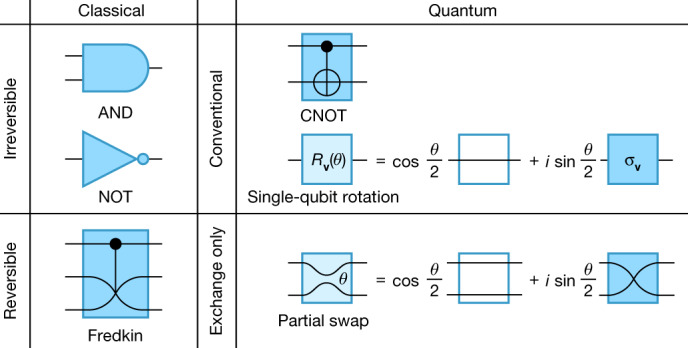
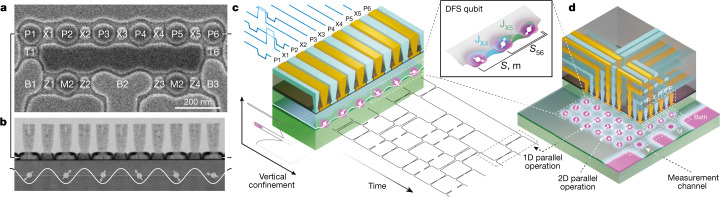
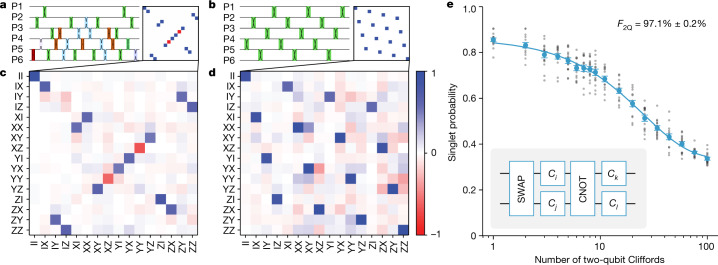
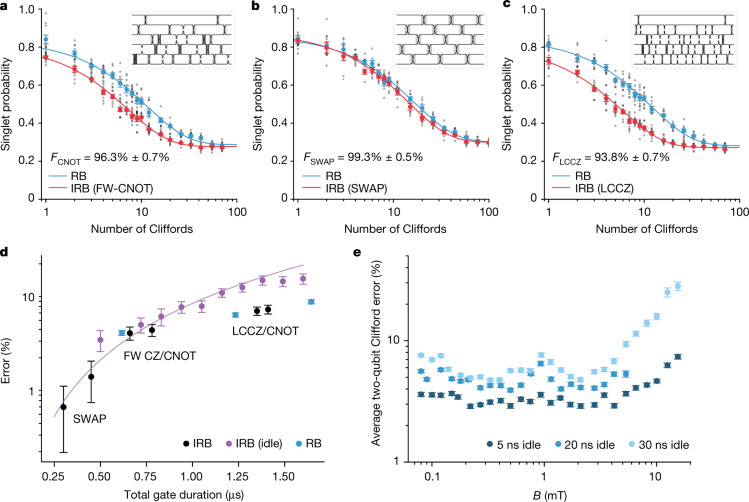
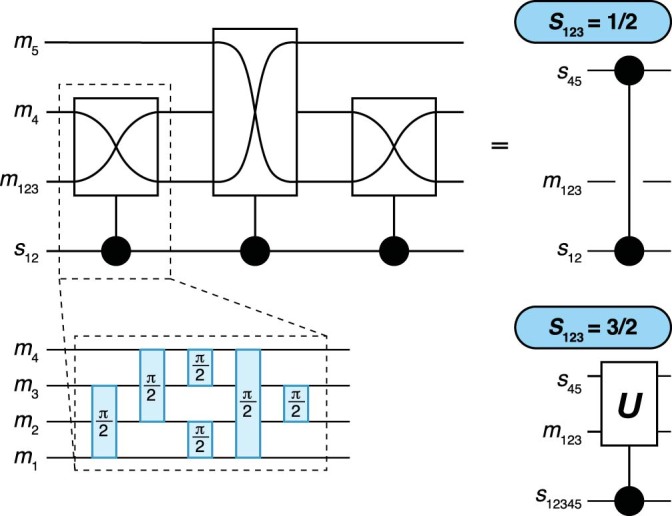
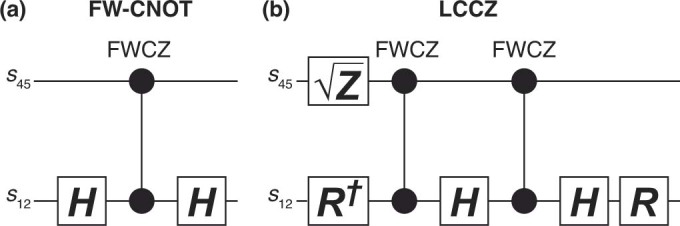
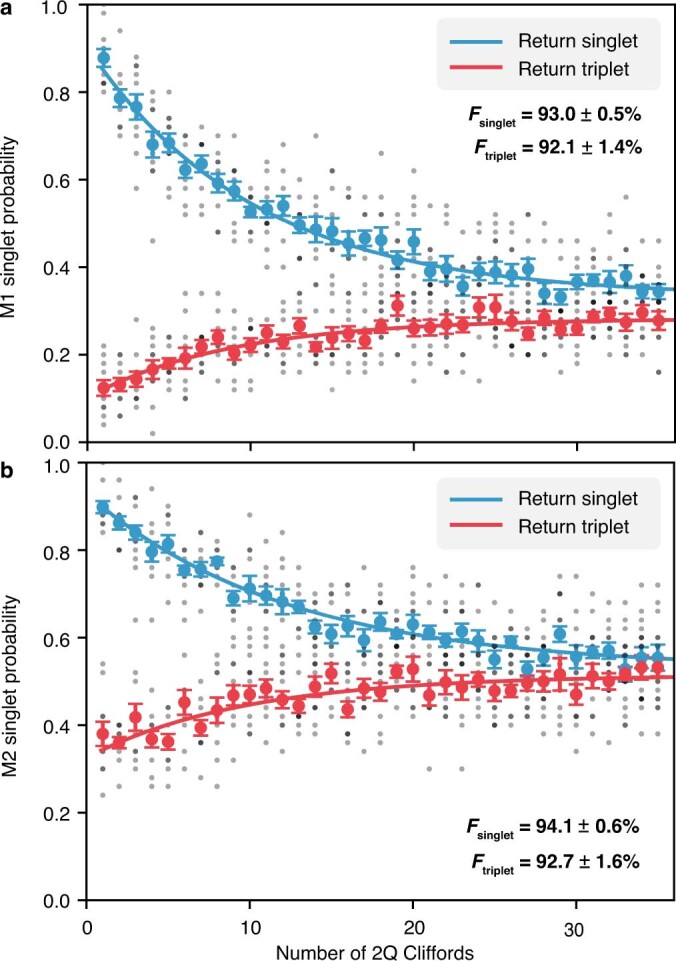
Quantum computation features known examples of hardware acceleration for certain problems, but is challenging to realize because of its susceptibility to small errors from noise or imperfect control. The principles of fault tolerance may enable computational acceleration with imperfect hardware, but they place strict requirements on the character and correlation of errors 1 . For many qubit technologies 2–21 , some challenges to achieving fault tolerance can be traced to correlated errors arising from the need to control qubits by injecting microwave energy matching qubit resonances. Here we demonstrate an alternative approach to quantum computation that uses energy-degenerate encoded qubit states controlled by nearest-neighbour contact interactions that partially swap the spin states of electrons with those of their neighbours. Calibrated sequences of such partial swaps, implemented using only voltage pulses, allow universal quantum control while bypassing microwave-associated correlated error sources 1,22–28 . We use an array of six 28 Si/SiGe quantum dots, built using a platform that is capable of extending in two dimensions following processes used in conventional microelectronics 29 . We quantify the operational fidelity of universal control of two encoded qubits using interleaved randomized benchmarking 30 , finding a fidelity of 96.3% ± 0.7% for encoded controlled NOT operations and 99.3% ± 0.5% for encoded SWAP. The quantum coherence offered by enriched silicon 5–9,16,18,20,22,27,29,31–37 , the all-electrical and low-crosstalk-control of partial swap operations 1,22–28 and the configurable insensitivity of our encoding to certain error sources 28,33,34,38 all combine to offer a strong pathway towards scalable fault tolerance and computational advantage.
Overview
The claims and statistics of this paper haven’t been checked yet.
Free: it reads the open-access text and checks the first 5 claims that cite a source we can check. Create a free account to check every claim.
Integrity signals
Registry
Cites
Statistics
Figures
Verification
Claims the paper makes
The claims and statistics of this paper haven’t been checked yet.
Free: it reads the open-access text and checks the first 5 claims that cite a source we can check. Create a free account to check every claim.
Self-check
Percentages, sums and reported differences re-computed from the paper’s own numbers.
The self-check needs the paper’s full text.
Citations
Cites
Quantum supremacy using a programmable superconducting processor
Arute, F., Arya, K., Babbush, R., Bacon, D., Bardin, J. C., Barends, R., Biswas, R., Boixo, S., Brandao, F. G. S. L., Buell, D. A., et al. (2019) · Nature · doi:10.1038/s41586-019-1666-5 · Cited by 7,720
Elementary gates for quantum computation
Barenco, A., Bennett, C. H., Cleve, R., DiVincenzo, D. P., Margolus, N., Shor, P., Sleator, T., Smolin, J. A., & Weinfurter, H. (1995) · Physical Review A · doi:10.1103/physreva.52.3457 · Cited by 4,311
Blais, A., Huang, R.-S., Wallraff, A., Girvin, S. M., & Schoelkopf, R. J. (2004) · Physical Review A · doi:10.1103/physreva.69.062320 · Cited by 2,989
Circuit quantum electrodynamics
Blais, A., Grimsmo, A. L., Girvin, S. M., & Wallraff, A. (2021) · Reviews of Modern Physics · doi:10.1103/revmodphys.93.025005 · Cited by 1,931
Fredkin, E., & Toffoli, T. (1982) · International Journal of Theoretical Physics · doi:10.1007/bf01857727 · Cited by 1,896
Zanardi, P., & Rasetti, M. (1997) · Physical Review Letters · doi:10.1103/physrevlett.79.3306 · Cited by 1,315
Randomized benchmarking of quantum gates
Knill, E., Leibfried, D., Reichle, R., Britton, J., Blakestad, R. B., Jost, J. D., Langer, C., Ozeri, R., Seidelin, S., & Wineland, D. J. (2008) · Physical Review A · doi:10.1103/physreva.77.012307 · Cited by 1,019 · cited 1×
“Randomized benchmarking (RB) is our preferred method of characterizing gate performance since it is fast, simple, relatively insensitive to SPAM error, and requires measurement of only one qubit [28, 29].”
MethodUniversal quantum computation with the exchange interaction
DiVincenzo, D. P., Bacon, D., Kempe, J., Burkard, G., & Whaley, K. B. (2000) · Nature · doi:10.1038/35042541 · Cited by 924 · cited 2×
“Though EO control was proposed over twenty years ago [16], experimental demonstration of encoded entangling operations has waited for the availability of fullyfunctional six-dot devices.”
BackgroundA quantum-dot spin qubit with coherence limited by charge noise and fidelity higher than 99.9%
Yoneda, J., Takeda, K., Otsuka, T., Nakajima, T., Delbecq, M. R., Allison, G., Honda, T., Kodera, T., Oda, S., Hoshi, Y., et al. (2018) · Nature Nanotechnology · doi:10.1038/s41565-017-0014-x · Cited by 900
Programmable Quantum Simulations of Spin Systems with Trapped Ions
Monroe, C., Campbell, W. C., Duan, L. M., Gong, Z. X., Gorshkov, A. V., Hess, P., Islam, R., Kim, K., Linke, N., Pagano, G., et al. (2019) · arXiv · doi:10.48550/arxiv.1912.07845 · Cited by 806 · cited 1×
“This is in part because the EO modality, unlike most other qubit systems [23, 24], does not require a new physical mechanism to generate entanglement between encoded qubits.”
BackgroundProgrammable quantum simulations of spin systems with trapped ions
Monroe, C., Campbell, W. C., Duan, L.-M., Gong, Z.-X., Gorshkov, A. V., Hess, P. W., Islam, R., Kim, K., Linke, N. M., Pagano, G., et al. (2021) · Reviews of Modern Physics · doi:10.1103/revmodphys.93.025001 · Cited by 802 · cited 1×
“This is in part because the EO modality, unlike most other qubit systems [23, 24], does not require a new physical mechanism to generate entanglement between encoded qubits.”
BackgroundElectron spin coherence exceeding seconds in high-purity silicon
Tyryshkin, A. M., Tojo, S., Morton, J. J. L., Riemann, H., Abrosimov, N. V., Becker, P., Pohl, H.-J., Schenkel, T., Thewalt, M. L. W., Itoh, K. M., et al. (2012) · Nature Materials · doi:10.1038/nmat3182 · Cited by 713 · cited 1×
“com times [4, 5], indicating the potential for environmental isolation.”
BackgroundInterfacing spin qubits in quantum dots and donors—hot, dense, and coherent
Vandersypen, L. M. K., Bluhm, H., Clarke, J. S., Dzurak, A. S., Ishihara, R., Morello, A., Reilly, D. J., Schreiber, L. R., & Veldhorst, M. (2017) · npj Quantum Information · doi:10.1038/s41534-017-0038-y · Cited by 624
Theory of decoherence-free fault-tolerant universal quantum computation
Kempe, J., Bacon, D., Lidar, D. A., & Whaley, K. B. (2001) · Physical Review A · doi:10.1103/physreva.63.042307 · Cited by 533
Quantum logic with spin qubits crossing the surface code threshold
Xue, X., Russ, M., Samkharadze, N., Undseth, B., Sammak, A., Scappucci, G., & Vandersypen, L. M. K. (2022) · Nature · doi:10.1038/s41586-021-04273-w · Cited by 524 · cited 1×
“This could in principle be mitigated with increased averaging and self-consistent gateset tomography [10, 26, 27], but we do not explore that here.”
BackgroundScalable noise estimation with random unitary operators
Emerson, J., Alicki, R., & Życzkowski, K. (2005) · Journal of Optics B: Quantum and Semiclassical Optics · doi:10.1088/1464-4266/7/10/021 · Cited by 502 · cited 1×
“Randomized benchmarking (RB) is our preferred method of characterizing gate performance since it is fast, simple, relatively insensitive to SPAM error, and requires measurement of only one qubit [28, 29].”
MethodFast universal quantum gate above the fault-tolerance threshold in silicon
Noiri, A., Takeda, K., Nakajima, T., Kobayashi, T., Sammak, A., Scappucci, G., & Tarucha, S. (2022) · Nature · doi:10.1038/s41586-021-04182-y · Cited by 471
Efficient Measurement of Quantum Gate Error by Interleaved Randomized Benchmarking
Magesan, E., Gambetta, J. M., Johnson, B. R., Ryan, C. A., Chow, J. M., Merkel, S. T., da Silva, M. P., Keefe, G. A., Rothwell, M. B., Ohki, T. A., et al. (2012) · Physical Review Letters · doi:10.1103/physrevlett.109.080505 · Cited by 428
Universal control of a six-qubit quantum processor in silicon
Philips, S. G. J., Mądzik, M. T., Amitonov, S. V., de Snoo, S. L., Russ, M., Kalhor, N., Volk, C., Lawrie, W. I. L., Brousse, D., Tryputen, L., et al. (2022) · Nature · doi:10.1038/s41586-022-05117-x · Cited by 410
A four-qubit germanium quantum processor
Hendrickx, N. W., Lawrie, W. I. L., Russ, M., van Riggelen, F., de Snoo, S. L., Schouten, R. N., Sammak, A., Scappucci, G., & Veldhorst, M. (2021) · Nature · doi:10.1038/s41586-021-03332-6 · Cited by 405
Silicon CMOS architecture for a spin-based quantum computer
Veldhorst, M., Eenink, H. G. J., Yang, C. H., & Dzurak, A. S. (2017) · Nature Communications · doi:10.1038/s41467-017-01905-6 · Cited by 398
Qubits made by advanced semiconductor manufacturing
Zwerver, A. M. J., Krähenmann, T., Watson, T. F., Lampert, L., George, H. C., Pillarisetty, R., Bojarski, S. A., Amin, P., Amitonov, S. V., Boter, J. M., et al. (2022) · Nature Electronics · doi:10.1038/s41928-022-00727-9 · Cited by 364
Universal Fault-Tolerant Quantum Computation on Decoherence-Free Subspaces
Bacon, D., Kempe, J., Lidar, D. A., & Whaley, K. B. (2000) · Physical Review Letters · doi:10.1103/physrevlett.85.1758 · Cited by 362
Quantum simulation of a Fermi–Hubbard model using a semiconductor quantum dot array
Hensgens, T., Fujita, T., Janssen, L., Li, X., Van Diepen, C. J., Reichl, C., Wegscheider, W., Das Sarma, S., & Vandersypen, L. M. K. (2017) · Nature · doi:10.1038/nature23022 · Cited by 352
Charge Noise Spectroscopy Using Coherent Exchange Oscillations in a Singlet-Triplet Qubit
Dial, O. E., Shulman, M. D., Harvey, S. P., Bluhm, H., Umansky, V., & Yacoby, A. (2013) · Physical Review Letters · doi:10.1103/physrevlett.110.146804 · Cited by 345 · cited 1×
“The accessibility of this operation point in a SiGe accumulation mode device, where the exchange energy asymptotes to the double-dot orbital splitting and loses sensitivity to control voltages and noise [21], can be attributed to the large gate action of the SLEDGE design.”
BackgroundTwo-qubit silicon quantum processor with operation fidelity exceeding 99%
Mills, A. R., Guinn, C. R., Gullans, M. J., Sigillito, A. J., Feldman, M. M., Nielsen, E., & Petta, J. R. (2022) · Science Advances · doi:10.1126/sciadv.abn5130 · Cited by 329
CMOS-based cryogenic control of silicon quantum circuits
Xue, X., Patra, B., van Dijk, J. P. G., Samkharadze, N., Subramanian, S., Corna, A., Paquelet Wuetz, B., Jeon, C., Sheikh, F., Juarez-Hernandez, E., et al. (2021) · Nature · doi:10.1038/s41586-021-03469-4 · Cited by 306
Reduced Sensitivity to Charge Noise in Semiconductor Spin Qubits via Symmetric Operation
Reed, M. D., Maune, B. M., Andrews, R. W., Borselli, M. G., Eng, K., Jura, M. P., Kiselev, A. A., Ladd, T. D., Merkel, S. T., Milosavljevic, I., et al. (2016) · Physical Review Letters · doi:10.1103/physrevlett.116.110402 · Cited by 297
Self-citationSelf-consistent quantum process tomography
Merkel, S. T., Gambetta, J. M., Smolin, J. A., Poletto, S., Córcoles, A. D., Johnson, B. R., Ryan, C. A., & Steffen, M. (2013) · Physical Review A · doi:10.1103/physreva.87.062119 · Cited by 294 · cited 3×
“We rst characterize both operations using quantum process tomography (QPT) [25] as initial con rmation that we are performing the intended encoded gates, shown in Fig.”
MethodInfluentialShuttling a single charge across a one-dimensional array of silicon quantum dots
Mills, A. R., Zajac, D. M., Gullans, M. J., Schupp, F. J., Hazard, T. M., & Petta, J. R. (2019) · Nature Communications · doi:10.1038/s41467-019-08970-z · Cited by 283 · cited 1×
“Demonstrations with silicon qubits include single-spin control via electron-dipole-spin resonance [8], initialization and read-out of entangled spin states [9], entangling operations between two single-spin qubits using exchange [10–12], and charge shuttling in arrays as large as nine dots [13, 14].”
MethodCMOS-based cryogenic control of silicon quantum circuits
Xue, X., Patra, B., van Dijk, J. P. G., Samkharadze, N., Subramanian, S., Corna, A., Wuetz, B. P., Jeon, C., Sheikh, F., Juarez-Hernandez, E., et al. (2020) · RePEc: Research Papers in Economics · Cited by 248
Self-consistent measurement and state tomography of an exchange-only spin qubit
Medford, J., Beil, J., Taylor, J. M., Bartlett, S. D., Doherty, A. C., Rashba, E. I., DiVincenzo, D. P., Lu, H., Gossard, A. C., & Marcus, C. M. (2013) · Nature Nanotechnology · doi:10.1038/nnano.2013.168 · Cited by 243
Isotopically enhanced triple-quantum-dot qubit
Eng, K., Ladd, T. D., Smith, A., Borselli, M. G., Kiselev, A. A., Fong, B. H., Holabird, K. S., Hazard, T. M., Huang, B., Deelman, P. W., et al. (2015) · Science Advances · doi:10.1126/sciadv.1500214 · Cited by 242
Self-citationPrecision tomography of a three-qubit donor quantum processor in silicon
Mądzik, M. T., Asaad, S., Youssry, A., Joecker, B., Rudinger, K. M., Nielsen, E., Young, K. C., Proctor, T. J., Baczewski, A. D., Laucht, A., et al. (2022) · Nature · doi:10.1038/s41586-021-04292-7 · Cited by 241 · cited 1×
“This could in principle be mitigated with increased averaging and self-consistent gateset tomography [10, 26, 27], but we do not explore that here.”
BackgroundQuantum error correction with silicon spin qubits
Takeda, K., Noiri, A., Nakajima, T., Kobayashi, T., & Tarucha, S. (2022) · Nature · doi:10.1038/s41586-022-04986-6 · Cited by 172
Silicon CMOS architecture for a spin-based quantum computer
Veldhorst, M., Eenink, H. G. J., Yang, C. H., & Dzurak, A. S. (2017) · RePEc: Research Papers in Economics · Cited by 166
Gate fidelity and coherence of an electron spin in an Si/SiGe quantum dot with micromagnet
Kawakami, E., Jullien, T., Scarlino, P., Ward, D. R., Savage, D. E., Lagally, M. G., Dobrovitski, V. V., Friesen, M., Coppersmith, S. N., Eriksson, M. A., et al. (2016) · Proceedings of the National Academy of Sciences · doi:10.1073/pnas.1603251113 · Cited by 164
Coherent spin qubit transport in silicon
Yoneda, J., Huang, W., Feng, M., Yang, C. H., Chan, K. W., Tanttu, T., Gilbert, W., Leon, R. C. C., Hudson, F. E., Itoh, K. M., et al. (2021) · Nature Communications · doi:10.1038/s41467-021-24371-7 · Cited by 163
Electron Spin Decoherence in Isotope-Enriched Silicon
Witzel, W. M., Carroll, M. S., Morello, A., Cywiński, Ł., & Sarma, S. D. (2010) · Physical Review Letters · doi:10.1103/physrevlett.105.187602 · Cited by 151
Conveyor-mode single-electron shuttling in Si/SiGe for a scalable quantum computing architecture
Seidler, I., Struck, T., Xue, R., Focke, N., Trellenkamp, S., Bluhm, H., & Schreiber, L. R. (2022) · npj Quantum Information · doi:10.1038/s41534-022-00615-2 · Cited by 151
Benchmarking Gate Fidelities in a Si/SiGe Two-Qubit Device
Xue, X., Watson, T. F., Helsen, J., Ward, D. R., Savage, D. E., Lagally, M. G., Coppersmith, S. N., Eriksson, M. A., Wehner, S., & Vandersypen, L. M. K. (2019) · Physical Review X · doi:10.1103/physrevx.9.021011 · Cited by 133
Low-frequency spin qubit energy splitting noise in highly purified 28Si/SiGe
Struck, T., Hollmann, A., Schauer, F., Fedorets, O., Schmidbauer, A., Sawano, K., Riemann, H. P., Abrosimov, N. V., Cywiński, Ł., Bougeard, D., et al. (2020) · npj Quantum Information · doi:10.1038/s41534-020-0276-2 · Cited by 130
Spiderweb Array: A Sparse Spin-Qubit Array
Boter, J. M., Dehollain, J. P., van Dijk, J. P. G., Xu, Y., Hensgens, T., Versluis, R., Naus, H. W. L., Clarke, J. S., Veldhorst, M., Sebastiano, F., et al. (2022) · Physical Review Applied · doi:10.1103/physrevapplied.18.024053 · Cited by 125
Controlling Spin-Orbit Interactions in Silicon Quantum Dots Using Magnetic Field Direction
Tanttu, T., Hensen, B., Chan, K. W., Yang, C. H., Huang, W., Fogarty, M. A., Hudson, F. E., Itoh, K. M., Culcer, D., Laucht, A., et al. (2019) · Physical Review X · doi:10.1103/physrevx.9.021028 · Cited by 122
General Framework for Randomized Benchmarking
Helsen, J., Roth, I., Onorati, E., Werner, A. H., & Eisert, J. (2022) · PRX Quantum · doi:10.1103/prxquantum.3.020357 · Cited by 122
Charge-noise spectroscopy of Si/SiGe quantum dots via dynamically-decoupled exchange oscillations
Connors, E. J., Nelson, J., Edge, L. F., & Nichol, J. M. (2022) · Nature Communications · doi:10.1038/s41467-022-28519-x · Cited by 122
A silicon metal-oxide-semiconductor electron spin-orbit qubit
Jock, R. M., Jacobson, N. T., Harvey-Collard, P., Mounce, A. M., Srinivasa, V., Ward, D. R., Anderson, J., Manginell, R., Wendt, J. R., Rudolph, M., et al. (2018) · Nature Communications · doi:10.1038/s41467-018-04200-0 · Cited by 109
SiGe quantum wells with oscillating Ge concentrations for quantum dot qubits
McJunkin, T., Harpt, B., Feng, Y. C., Losert, M. P., Rahman, R., Dodson, J. P., Wolfe, M. A., Savage, D. E., Lagally, M. G., Coppersmith, S. N., et al. (2022) · Nature Communications · doi:10.1038/s41467-022-35510-z · Cited by 108
Fast and High-Fidelity State Preparation and Measurement in Triple-Quantum-Dot Spin Qubits
Blumoff, J., Pan, A., Keating, T., Andrews, R. W., Barnes, D. W., Brecht, T., Croke, E. T., Euliss, L. E., Fast, J., Jackson, C. A. C., et al. (2022) · PRX Quantum · doi:10.1103/prxquantum.3.010352 · Cited by 91
Self-citationSingle-electron operations in a foundry-fabricated array of quantum dots
Ansaloni, F., Chatterjee, A., Bohuslavskyi, H., Bertrand, B., Hutin, L., Vinet, M., & Kuemmeth, F. (2020) · Nature Communications · doi:10.1038/s41467-020-20280-3 · Cited by 86 · cited 1×
“Fabrication of larger arrays should also follow yield-enhancement trajectories established by the silicon-based classical microelectronics industry as designs are improved [6, 7].”
BackgroundCoherent control of individual electron spins in a two-dimensional quantum dot array
Mortemousque, P.-A., Chanrion, E., Jadot, B., Flentje, H., Ludwig, A., Wieck, A. D., Urdampilleta, M., Bäuerle, C., & Meunier, T. (2021) · Nature Nanotechnology · doi:10.1038/s41565-020-00816-w · Cited by 85
Quantifying error and leakage in an encoded Si/SiGe triple-dot qubit
Andrews, R. W., Jones, C., Reed, M. D., Jones, A. M., Ha, S. D., Jura, M. P., Kerckhoff, J., Levendorf, M., Meenehan, S., Merkel, S. T., et al. (2019) · Nature Nanotechnology · doi:10.1038/s41565-019-0500-4 · Cited by 80 · cited 10×
“The blind randomized benchmarking measurement [1] yields an average single qubit gate error of (1:1 0:1) 10 3 and leakage error of (3 1) 10 4 .”
BackgroundMethodInfluentialSelf-citationA Flexible Design Platform for Si/SiGe Exchange-Only Qubits with Low Disorder
Ha, W., Ha, S. D., Choi, M. D., Tang, Y., Schmitz, A. E., Levendorf, M. P., Lee, K., Chappell, J. M., Adams, T. S., Hulbert, D. R., et al. (2022) · Nano Letters · doi:10.1021/acs.nanolett.1c03026 · Cited by 76 · cited 4×
“Three recent advances enabled the result we report on here: the Single Layer EtchDefined Gate Electrode (SLEDGE) process [18] for making high-yielding devices, the use of narrow Si/Si0.”
BackgroundMethodInfluentialSelf-citationHow to efficiently select an arbitrary Clifford group element
Koenig, R., & Smolin, J. A. (2014) · Journal of Mathematical Physics · doi:10.1063/1.4903507 · Cited by 72 · cited 1×
“We generate two-qubit Cliffords via standard compilation rules [30] using the FW-CNOT entangling gate, the aforementioned SWAP gate, and single-qubit Cliffords.”
MethodProbing quantum processor performance with pyGSTi
Nielsen, E., Rudinger, K., Proctor, T., Russo, A., Young, K., & Blume-Kohout, R. (2020) · Quantum Science and Technology · doi:10.1088/2058-9565/ab8aa4 · Cited by 67 · cited 1×
“This could in principle be mitigated with increased averaging and self-consistent gateset tomography [10, 26, 27], but we do not explore that here.”
BackgroundCoherent Control and Spectroscopy of a Semiconductor Quantum Dot Wigner Molecule
Corrigan, J., Dodson, J. P., Ercan, H. E., Abadillo-Uriel, J. C., Thorgrimsson, B., Knapp, T. J., Holman, N., McJunkin, T., Neyens, S. F., MacQuarrie, E. R., et al. (2021) · Physical Review Letters · doi:10.1103/physrevlett.127.127701 · Cited by 52
Undoped accumulation-mode Si/SiGe quantum dots
Borselli, M. G., Eng, K., Ross, R. S., Hazard, T. M., Holabird, K. S., Huang, B., Kiselev, A. A., Deelman, P. W., Warren, L. D., Milosavljevic, I., et al. (2015) · Nanotechnology · doi:10.1088/0957-4484/26/37/375202 · Cited by 50
Self-citationRealization of high-fidelity CZ and ZZ-free iSWAP gates with a tunable coupler
Sung, Y., Ding, L., Braumüller, J., Vepsäläinen, A. P., Kannan, B., Kjærgaard, M., Greene, A., Samach, G., McNally, C., Kim, D. K., et al. (2020) · DSpace@MIT (Massachusetts Institute of Technology) · doi:10.48550/arxiv.2011.01261 · Cited by 46
Probing resonating valence bonds on a programmable germanium quantum simulator
Wang, C.-A., Déprez, C., Tidjani, H., Lawrie, W. I. L., Hendrickx, N. W., Sammak, A., Scappucci, G., & Veldhorst, M. (2023) · npj Quantum Information · doi:10.1038/s41534-023-00727-3 · Cited by 42
Programmable Quantum Simulations of Bosonic Systems with Trapped Ions
Katz, O., & Monroe, C. (2023) · Physical Review Letters · doi:10.1103/physrevlett.131.033604 · Cited by 42
Detuning Axis Pulsed Spectroscopy of Valley-Orbital States in Si / Si - Ge Quantum Dots
Chen, E. H., Raach, K., Pan, A., Kiselev, A. A., Acuna, E., Blumoff, J. Z., Brecht, T., Choi, M. D., Ha, W., Hulbert, D. R., et al. (2021) · Physical Review Applied · doi:10.1103/physrevapplied.15.044033 · Cited by 41
Self-citationMagnetic Gradient Fluctuations from Quadrupolar 73Ge in Si / SiGe Exchange-Only Qubits
Kerckhoff, J., Sun, B., Fong, B. H., Jones, C., Kiselev, A. A., Barnes, D. W., Noah, R. S., Acuna, E., Akmal, M., Ha, S. D., et al. (2021) · PRX Quantum · doi:10.1103/prxquantum.2.010347 · Cited by 35 · cited 6×
“This effect is stronger in earlier devices employing aluminum metal [20], but is much weaker in the present device due to the non- or weakly-superconducting TiN gates used in the SLEDGE process [18].”
BackgroundInfluentialSelf-citationExchange-only dynamical decoupling in the three-qubit decoherence free subsystem
West, J. R., & Fong, B. H. (2012) · New Journal of Physics · doi:10.1088/1367-2630/14/8/083002 · Cited by 31 · cited 3×
“A sequence in which this is done exactly effectively decouples low-frequency magnetic noise [33, 34]; the 15-pulse SWAP shown only partially completes such a permutative dynamical decoupling operation.”
BackgroundSelf-citationHyperfine-induced decay in triple quantum dots
Ladd, T. D. (2012) · Physical Review B · doi:10.1103/physrevb.86.125408 · Cited by 30 · cited 2×
“averaged measurement projection decays to a value associated with the predicted mixture of encoded and nonencoded states: 1/2 probability to the initial singlet |0, 1/2;m123〉, 1/6 to the encoded triplet |1, 1/2;m123〉, and 1/3 to the leaked state |1, 3/2;m123〉 [32].”
BackgroundSelf-citationA new FDSOI spin qubit platform with 40nm effective control pitch
Bédécarrats, T., Paz, B. C., Diaz, B. M., Niebojewski, H., Bertrand, B., Rambal, N., Comboroure, C., Sarrazin, A., Boulard, F., Guyez, E. M. C., et al. (2021) · Technical digest - International Electron Devices Meeting/Technical digest · doi:10.1109/iedm19574.2021.9720497 · Cited by 26
Resonant exchange operation in triple-quantum-dot qubits for spin–photon transduction
Pan, A., Keating, T., Gyure, M. F., Pritchett, E., Quinn, S., Ross, R. S., Ladd, T. D., & Kerckhoff, J. (2020) · Quantum Science and Technology · doi:10.1088/2058-9565/ab86c9 · Cited by 25
Self-citationRandomized Benchmarking as Convolution: Fourier Analysis of Gate Dependent Errors
Merkel, S. T., Pritchett, E. J., & Fong, B. H. (2021) · Quantum · doi:10.22331/q-2021-11-16-581 · Cited by 25
Self-citationFull-Permutation Dynamical Decoupling in Triple-Quantum-Dot Spin Qubits
Sun, B., Brecht, T., Fong, B. H., Akmal, M., Blumoff, J., Cain, T. A., Carter, F. W., Finestone, D. H., Fireman, M. N., Ha, W., et al. (2024) · PRX Quantum · doi:10.1103/prxquantum.5.020356 · Cited by 23 · cited 3×
“A sequence in which this is done exactly effectively decouples low-frequency magnetic noise [33, 34]; the 15-pulse SWAP shown only partially completes such a permutative dynamical decoupling operation.”
BackgroundSelf-citationSimple derivation of the Fong-Wandzura pulse sequence
Zeuch, D., & Bonesteel, N. E. (2016) · Physical Review A · doi:10.1103/physreva.93.010303 · Cited by 17 · cited 1×
“2% and the FW controlledNOT gate [17, 19] (FW-CNOT) with 96.”
BackgroundFull-permutation dynamical decoupling in triple-quantum-dot spin qubitsPreprint
Sun, B., Brecht, T., Fong, B. H., et al. (2022) · arXiv (Cornell University) · doi:10.48550/arxiv.2208.11784 · Cited by 1 · cited 3×
“A sequence in which this is done exactly effectively decouples low-frequency magnetic noise [33, 34]; the 15-pulse SWAP shown only partially completes such a permutative dynamical decoupling operation.”
BackgroundSelf-citation
Research works printed but not linked: 4
- Xue X Benchmarking gate fidelities in a Si/SiGe two-qubit device Phys. Rev. X 2019 9 021011
- Burkard, G., Ladd, T. D., Nichol, J. M., Pan, A. & Petta, J. R. Semiconductor spin qubits. Rev. Mod. Phys. (in the press); preprint available at https://arxiv.org/abs/2112.08863. · arXiv
- Fong BH Wandzura SM Universal quantum computation and leakage reduction in the 3-qubit decoherence free subsystem Quantum Info. Comput. 2011 11 1003 1018
- Jordan SP Permutational quantum computing Quantum Info. Comput. 2010 10 470 497
Cited by
Burkard, G., Ladd, T. D., Pan, A., Nichol, J. M., & Petta, J. R. (2023) · Reviews of Modern Physics · doi:10.1103/revmodphys.95.025003 · Cited by 715
Self-citationUniversal control of a six-qubit quantum processor in silicon
Philips, S. G. J., Mądzik, M. T., Amitonov, S. V., de Snoo, S. L., Russ, M., Kalhor, N., Volk, C., Lawrie, W. I. L., Brousse, D., Tryputen, L., et al. (2022) · Nature · doi:10.1038/s41586-022-05117-x · Cited by 410
“In a six-dot linear array, two qubits encoded in the state of three spins each were operated 21 and spin exchange oscillations in a 3 × 3 array have been reported 22 .”
BackgroundProbing single electrons across 300-mm spin qubit wafers
Neyens, S., Zietz, O. K., Watson, T. F., Luthi, F., Nethwewala, A., George, H. C., Henry, E., Islam, M., Wagner, A. J., Borjans, F., et al. (2024) · Nature · doi:10.1038/s41586-024-07275-6 · Cited by 178
“8 and 9.”
InfluentialOperating semiconductor quantum processors with hopping spins
Wang, C.-A., John, V., Tidjani, H., Yu, C. X., Ivlev, A., Déprez, C., van Riggelen, F., Woods, B. D., Hendrickx, N. W., Lawrie, W. I. L., et al. (2024) · Science · doi:10.1126/science.ado5915 · Cited by 109
An elementary review on basic principles and developments of qubits for quantum computing
Chae, E., Choi, J., & Kim, J. (2024) · Nano Convergence · doi:10.1186/s40580-024-00418-5 · Cited by 120
“Ongoing research is actively exploring new quantum computing platforms, including solid-based options comprising quantum dots and silicon, which are known for their seamless integration with existing technologies [67].”
Background
Metadata
- Authors
- Weinstein, A. J., Reed, M. D., Jones, A. M., Andrews, R. W., Barnes, D., Blumoff, J. Z., Euliss, L. E., Eng, K., Fong, B. H., Ha, S. D., Hulbert, D. R., Jackson, C. A. C., Jura, M., Keating, T. E., Kerckhoff, J., Kiselev, A. A., Matten, J., Sabbir, G., Smith, A., Wright, J., Rakher, M. T., Ladd, T. D., & Borselli, M. G.
- Affiliations
- HRL Laboratories (United States) (US)
- Corresponding author
- Weinstein, Aaron J.
- Ladd, Thaddeus D.
- ORCID
- Venue
- Nature
- Published
- 2023-02-06
- Volume
- 615
- Issue
- 7954
- Pages
- 817-822
- ISSN
- 0028-0836 (ISSN-L)
- 1476-4687
- PMC
- PMC10060158
- OpenAlex
- W4319312371
- Semantic Scholar
- 2b0b88e0e96c3110b24ae9ca155126a48f980bee
- Cited by
- 124
- References
- 68
- Citations by year
- 2026: 24 · 2025: 46 · 2024: 34 · 2023: 17
- FWCI
- 14.16
- Type
- journal article
- Language
- en
- Open access
- hybrid
- doi.org
- Licence
- cc-by
- creativecommons.org/licenses/by/4.0 (tdm)
- creativecommons.org/licenses/by/4.0 (vor)
- Locations
- Nature (publishedVersion, cc-by)
- PubMed Central (publishedVersion, cc-by)
- PubMed (publishedVersion)
- arXiv (Cornell University) (submittedVersion)
- RePEc: Research Papers in Economics (submittedVersion)
- arXiv (Cornell University)
- Topics
- Physical Sciences › Physics and Astronomy › Condensed Matter Physics › Quantum and electron transport phenomena
- Physical Sciences › Computer Science › Artificial Intelligence › Quantum Computing Algorithms and Architecture
- Physical Sciences › Physics and Astronomy › Atomic and Molecular Physics, and Optics › Quantum Information and Cryptography
- Keywords
- encoded qubits, spin qubits, silicon quantum dots, Si/SiGe quantum dots, fault tolerance, correlated errors, randomized benchmarking, quantum coherence
About these checks
Registry, retraction, Cites and statistics results are computed, not judged, with one exception: a printed reference that no index lists is read once by a model before it counts as a citation error. Claims are extracted by a model and kept only when their quote appears verbatim in the text; each cited source is then checked, with a model’s help, for whether it says what the claim relies on. Those verdicts can be wrong — read the claim’s quote and the cited source before relying on one.
Statistics and arithmetic are recomputed, not judged.
Confidence bands are shown only for fields calibrated on our annotated test set. None is calibrated yet, so no band is shown.
What counts as a claim ›How we measure confidence ›How we check this ›
Are you an author, or do you see a problem with this page? Request a review
Data sources
Bibliographic data: Semantic Scholar, OpenAlex, Crossref.
Contains information from the Semantic Scholar Academic Graph Datasets, made available under the ODC Attribution License (ODC-BY 1.0).
Semantic Scholar’s data is described in: Kinney, R., et al. (2023). The Semantic Scholar Open Data Platform. arXiv:2301.10140.
