

Foundation models for generalist medical artificial intelligence
Open accessThe DOI matches its Crossref record; 69 of the 70 references it cites were found in a registry or an index; 23 of the 33 sources its claims cite were checked for support.
Abstract
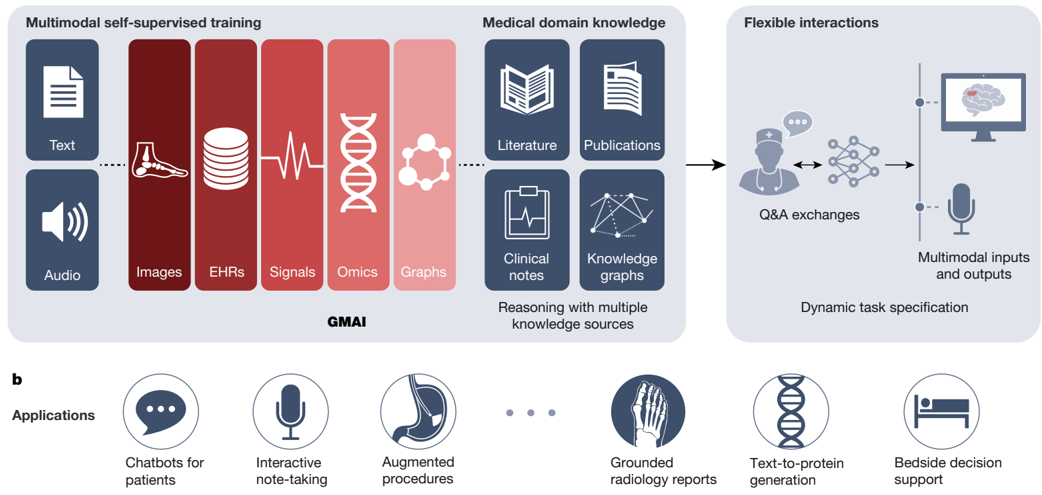
The exceptionally rapid development of highly flexible, reusable artificial intelligence (AI) models is likely to usher in newfound capabilities in medicine. We propose a new paradigm for medical AI, which we refer to as generalist medical AI (GMAI). GMAI models will be capable of carrying out a diverse set of tasks using very little or no task-specific labelled data. Built through self-supervision on large, diverse datasets, GMAI will flexibly interpret different combinations of medical modalities, including data from imaging, electronic health records, laboratory results, genomics, graphs or medical text. Models will in turn produce expressive outputs such as free-text explanations, spoken recommendations or image annotations that demonstrate advanced medical reasoning abilities. Here we identify a set of high-impact potential applications for GMAI and lay out specific technical capabilities and training datasets necessary to enable them. We expect that GMAI-enabled applications will challenge current strategies for regulating and validating AI devices for medicine and will shift practices associated with the collection of large medical datasets. This review discusses generalist medical artificial intelligence, identifying potential applications and setting out specific technical capabilities and training datasets necessary to enable them, as well as highlighting challenges to its implementation.
Overview
CoChat Summary
TL;DR
The paper proposes generalist medical AI (GMAI), a class of foundation models that would use self-supervision on large, diverse medical data to perform dynamically specified tasks, flexibly combine modalities, and reason with formal medical knowledge. It outlines six high-impact use cases and argues that GMAI will require new approaches to validation, regulation, bias auditing, privacy, and data collection.
Key findings
- Defines GMAI by three capabilities: dynamic task specification, flexible multimodal inputs/outputs, and formal representation of medical knowledge for advanced reasoning; existing models such as GPT-3 or PaLM show some medical reasoning but are not multimodal and do not reliably generate factual statements.
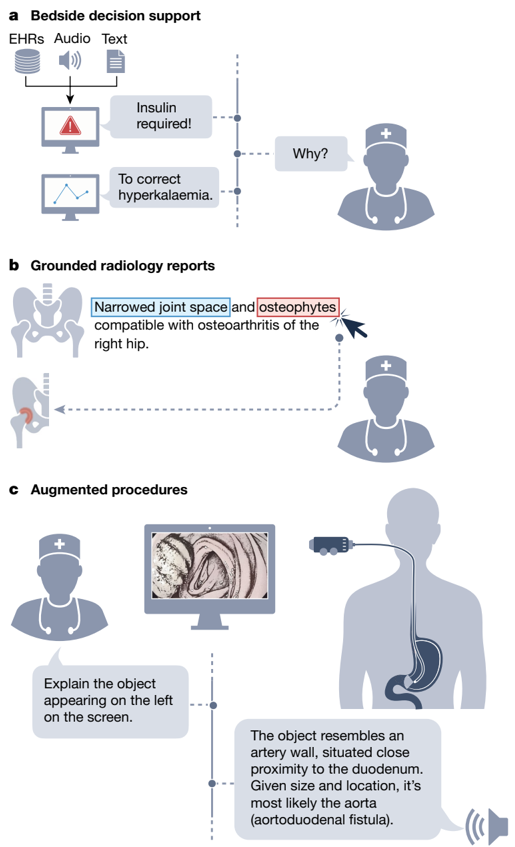
- Proposes six use cases: grounded radiology reports, augmented procedures, bedside decision support, chatbots for patients, text-to-protein generation, and interactive note-taking.
- Notes current medical AI is narrow: of more than 500 FDA-approved AI models for clinical medicine, most were approved for only 1 or 2 narrow tasks; CheXzero can detect dozens of diseases in chest X-rays without explicit labels; GPT-3 powered more than 300 apps within months of release.
- Flags scale and cost: PaLM, a 540-billion-parameter model, required an estimated 8.4 million hours’ worth of tensor processing unit v4 chips, using roughly 3,000 to 6,000 chips at a time, amounting to millions of dollars; training each model has been estimated to generate up to hundreds of tons of CO₂ equivalent; one study recommended 20 times more tokens than parameters for optimal performance.
Methods
- Perspective/review article; no primary data, sample, or experimental analysis.
- Synthesizes recent foundation-model advances and proposes the GMAI paradigm, identifying technical capabilities, training-data needs, use cases, and challenges.
- Draws on cited prior work and examples (e.g., GPT-3, Gato, CheXzero, PaLM) rather than new experiments.
Limitations
- Stated: GMAI will be uniquely difficult to validate because it can carry out previously unseen tasks, making failure modes hard to anticipate; social bias can increase with model scale; privacy risks include memorization of training data and prompt attacks; scale brings high computational, financial, and environmental costs; verification may require multidisciplinary panels; data collection/access and regulatory/liability frameworks are unresolved.
- Evident from the text: no GMAI model is built or empirically evaluated here; the use cases are prospective and illustrative; many capabilities depend on future advances in multimodal self-supervision, in-context learning, and medical knowledge integration.
Model-written summary. Check it against the paper before relying on it.
Integrity signals
Registry
Cites
Statistics
Figures
Verification
Claims the paper makes
17 Valid · 3 Not valid · 5 Not checked · 59 Own results and interpretations
The cited sources support only part of this claim — read each source’s verdict below.
In the paper
“They can acquire biases during training, when datasets either underrepresent certain groups of patients or contain harmful correlations 44,45 .”
§ Perspective Foundation models for generalist medical artificial intelligence > Social biases.
What the sources say
- Partly supportedcites [44] 44. Chung, H. W. et al. Scaling instruction-finetuned language models. Preprint at https:// arxiv.org/abs/2210.11416 (2022). sourceExperimental — accuracy not yet measured
The Mechanism of bias section (pp. 4–5) shows that the model learned to predict health care costs, which were correlated with race differently from health needs, producing racial bias. The paper does not identify underrepresentation of patient groups in training data as a cause of the bias it studied. (LLM, conf=0.87)
- Not matchedcites [45] 45. Kung, T. H. et al. Performance of ChatGPT on USMLE: potential for AI-assisted medical education using large language models. PLoS Dig. Health 2, 2 (2023).
Its entry has no title and year that we can search by.
plainstates a cause- Asserted: passes — The authors put it forward as true.
- Checkable: passes — It can be checked against evidence.
- Load-bearing: passes — The paper’s conclusions depend on it.
- Based: passes — The paper gives a reason why it holds.
- Partly supported
The cited sources support only part of this claim — read each source’s verdict below.
In the paper
“Individual models can now achieve state-of-the-art performance on a wide variety of problems, ranging from answering questions about texts to describing images and playing video games [2][3][4] .”
What the sources say
- Not matchedcites [2] 2. Yang, X. et al. A large language model for electronic health records. npj Digit. Med. 5, 194 (2022).
We searched by its title and found no matching paper.
- Partly supportedcites [3] 3. Food and Drug Administration. Artificial intelligence and machine learning (AI/ML)-enabled medical devices. FDA https://www.fda.gov/medical-devices/software-medical-device- samd/artificial-intelligence-and-machine-learning-aiml-enabled-medical-devices (2022). sourceExperimental — accuracy not yet measured
Section 3.1 (p. 7) reports that Flamingo outperforms previous zero- and few-shot methods across 16 vision-language benchmarks and exceeds fine-tuned state of the art on six tasks. Table 6 (p. 30) includes image scene description, supporting that example. The cited paper does not establish the sentence’s examples of answering questions about texts or playing video games. (LLM, conf=0.86)
- Partly supportedcites [4] 4. Acosta, J. N., Falcone, G. J., Rajpurkar, P. & Topol, E. J. Multimodal biomedical AI. Nat. Med. 28, 1773-1784 (2022). sourceExperimental — accuracy not yet measured
The Introduction (pp. 1–2) describes one model performing diverse vision and language tasks and reports the top overall score on the GRIT benchmark. The Results (p. 10) report state-of-the-art performance on A-OKVQA and strong image captioning, but say its NLP results lag behind state-of-the-art models. Related Work (p. 11) mentions another model's Atari button presses; it does not establish state-of-the-art video-game performance for Unified-IO. (LLM, conf=0.88)
plain- Asserted: passes — The authors put it forward as true.
- Checkable: passes — It can be checked against evidence.
- Load-bearing: passes — The paper’s conclusions depend on it.
- Based: passes — The paper gives a reason why it holds.
- Not matched
The cited sources support only part of this claim — read each source’s verdict below.
In the paper
“Furthermore, building on recent retrieval-based approaches, GMAI can retrieve relevant context from existing databases, in the form of articles, images or entire previous cases 19,20 .”
§ Perspective Foundation models for generalist medical artificial intelligence > Medical domain knowledge
What the sources say
- Partly supportedcites [19] 19. Guha Roy, A. et al. Does your dermatology classifier know what it doesn't know? Detecting the long-tail of unseen conditions. Med. Image Anal. 75, 102274 (2022). sourceExperimental — accuracy not yet measured
The Introduction (p. 1) describes Retro retrieving similar text from a large database, and the training-dataset section (p. 3) includes Wikipedia articles among its text sources. The paper does not establish that GMAI can retrieve images or entire previous medical cases; it supports the retrieval-based approach, but not those extensions. (LLM, conf=0.88)
- Partly supportedcites [20] 20. Radford, A. et al. Robust speech recognition via large-scale weak supervision. Preprint at https://arxiv.org/abs/2212.04356 (2022). sourceExperimental — accuracy not yet measured
The Introduction (p. 1) says REALM retrieves relevant documents from a corpus such as Wikipedia, supporting the article-retrieval part. Future Work (p. 9) proposes image retrieval as a possible extension, not an existing capability. The paper does not establish that GMAI retrieves images or entire previous cases. (LLM, conf=0.88)
plainstates a cause- Asserted: passes — The authors put it forward as true.
- Checkable: passes — It can be checked against evidence.
- Load-bearing: passes — The paper’s conclusions depend on it.
- Based: passes — The paper gives a reason why it holds.
- Partly supported
The cited sources support only part of this claim — read each source’s verdict below.
In the paper
“Models will be able to solve previously unseen problems simply by having new tasks explained to them (dynamic task specification), without needing to be retrained 3,5 .”
What the sources say
- Partly supportedcites [3] 3. Food and Drug Administration. Artificial intelligence and machine learning (AI/ML)-enabled medical devices. FDA https://www.fda.gov/medical-devices/software-medical-device- samd/artificial-intelligence-and-machine-learning-aiml-enabled-medical-devices (2022). sourceExperimental — accuracy not yet measured
The Introduction says Flamingo is designed to adapt to new vision-language tasks without fine-tuning, and the Contributions passage says it performs multimodal tasks from a few input/output examples. That supports adaptation without retraining, but not the broader claim that GMAI models can solve previously unseen problems simply by having tasks explained to them: Flamingo's demonstrated scope is narrower, and its task specification generally uses examples rather than an explanation alone. (LLM, conf=0.84)
- Not matchedcites [5] 5. Krishnan, R., Rajpurkar, P. & Topol, E. J. Self-supervised learning in medicine and healthcare. Nat. Biomed. Eng. 6, 1346-1352 (2022).
We searched by its title and found no matching paper.
plainstates a cause- Asserted: passes — The authors put it forward as true.
- Checkable: passes — It can be checked against evidence.
- Load-bearing: passes — The paper’s conclusions depend on it.
- Based: passes — The paper gives a reason why it holds.
- Partly supported
Every source the paper cites for this claim was checked and supports it.
In the paper
“CheXzero can be applied to detect dozens of diseases in chest X-rays without being trained on explicit labels for these diseases 9 .”
§ Perspective Foundation models for generalist medical artificial intelligence > Applicability.
What the sources say
- Supportedcites [9] 9. Vaswani, A. et al. Attention is all you need. In Advances in Neural Information Processing Systems (eds Guyon, I. et al.) 30, 5998-6008 (2017). source
The Main section describes CheXzero as a zero-shot chest X-ray classifier that needs no explicit pathology labels during training. The Results report an AUC of at least 0.700 for 38 of 57 radiographic findings evaluated on the PadChest test set, supporting the claim that it can detect dozens of conditions. (LLM, conf=0.90)
plainstates a cause- Asserted: passes — The authors put it forward as true.
- Checkable: passes — It can be checked against evidence.
- Load-bearing: unclear — It is unclear whether the paper’s conclusions depend on it.
- Based: passes — The paper gives a reason why it holds.
- Supported
32 more claims · 2 with their cited sources checked
Create a free account to see all 84 claims and to verify the 2 references still open.
- Probably not a substantial claim. 35
- It may state two separate claims as one. 25
Claims other papers make about this one
Each is checked against this paper’s own text: does it say what the citing paper says it does?
The source backs part of the claim, not all of it — or backs it for a different population, condition or comparison.
In the citing paper
“First, these models are predominantly pretrained using vision-only modeling57,59,60, which neglects not only rich supervisory signals found in pathology reports but also precludes multimodal capabilities such as zero-shot visual-language understanding and cross-model retrieval—a fundamental hallmark in foundation models84,85.”
From A multimodal whole-slide foundation model for pathology (2025) · cites this paper as [85]
Experimental — accuracy not yet measuredThe source backs part of the claim, not all of it — or backs it for a different population, condition or comparison.
In the citing paper
“Barriers to the clinical implementation of LLMs include their susceptibility to hallucinations, the absence of reliable references [13].”
From Diagnostic performance of Prof. Valmed, ChatGPT-5 Thinking, and OpenEvidence in rheumatology: A comparative evaluation (2026) · cites this paper as [13]
Experimental — accuracy not yet measuredThe cited source says what the claim attributes to it.
In the citing paper
“The emergence of (medical) foundational models (Moor et al., 2023), which are generally multimodal, is expected to accelerate research in optimal data fusion further.”
From Navigating the landscape of multimodal AI in medicine: A scoping review on technical challenges and clinical applications (2025) · cites this paper as Moor et al., 2023
The cited source says what the claim attributes to it.
In the citing paper
“Moor et al. introduced a paradigm for foundation model application in medical AI, named generalist medical AI (GMAI) [16].”
From Challenges in AI-driven Biomedical Multimodal Data Fusion and Analysis (2025) · cites this paper as [16]
The cited source says what the claim attributes to it.
In the citing paper
“Moor et al. proposed a framework of the GMAI, a foundation model designed to handle most clinical tasks, aiming to provide high-quality medical support to both patients and clinicians [16].”
From Challenges in AI-driven Biomedical Multimodal Data Fusion and Analysis (2025) · cites this paper as [16]
6 more claims about this paper
Create a free account to see every claim other papers make about this one.
Self-check
Percentages, sums and reported differences re-computed from the paper’s own numbers.
Each contradiction between two passages listed here was confirmed by an independent check.
Rated minor: it would not touch a result — a value no result rests on, a p-value that stays on the same side of the significance level, or a conflict that is clerical, resolved elsewhere in the paper, or outside its own findings.
In the paper
§ Perspective Foundation models for generalist medical artificial intelligence > Conclusion
“The presented example is inspired by a case report 58 .Image of the fistula in panel c adapted from ref. 58, CC BY 3.0.”
§ Perspective Foundation models for generalist medical artificial intelligence > References
“50. Vegunta, R., Vegunta, R. & Kutti Sridharan, G. Secondary aortoduodenal fistula presenting as gastrointestinal bleeding and fungemia. Cureus 11, e5575 (2019).”
Citations
Cites
Vaswani, A., Shazeer, N., Parmar, N., Uszkoreit, J., Jones, L., Gomez, A. N., Kaiser, L., & Polosukhin, I. (2017) · arXiv · doi:10.48550/arxiv.1706.03762 · Cited by 120,404
BERT: Pre-training of Deep Bidirectional Transformers for Language Understanding
Devlin, J., Chang, M.-W., Lee, K., & Toutanova, K. (2019) · Proceedings of the 2019 Conference of the North American Chapter of the Association for Computational Linguistics: Human Language Technologies, Volume 1 (Long and Short Papers) · doi:10.18653/v1/n19-1423 · Cited by 54,325
Highly accurate protein structure prediction with AlphaFold
Jumper, J., Evans, R., Pritzel, A., Green, T., Figurnov, M., Ronneberger, O., Tunyasuvunakool, K., Bates, R., Žídek, A., Potapenko, A., et al. (2021) · Nature · doi:10.1038/s41586-021-03819-2 · Cited by 43,764 · cited 1×
“There have already been early efforts to develop foundation models for biological sequences 33,34 , including RFdiffusion, which generates proteins on the basis of simple specifications (for example, a binding target) 35 .”
BackgroundHigh-Resolution Image Synthesis with Latent Diffusion Models
Rombach, R., Blattmann, A., Lorenz, D., Esser, P., & Ommer, B. (2022) · 2022 IEEE/CVF Conference on Computer Vision and Pattern Recognition (CVPR) · doi:10.1109/cvpr52688.2022.01042 · Cited by 20,302 · cited 2×
“For certain use cases (for example, chatbots), GMAI models can be stored on central compute clusters maintained by organizations with deep technical expertise, as DALL-E or GPT-3 are.”
BackgroundLearning Transferable Visual Models From Natural Language Supervision
Radford, A., Kim, J. W., Hallacy, C., Ramesh, A., Goh, G., Agarwal, S., Sastry, G., Askell, A., Mishkin, P., Clark, J., et al. (2021) · arXiv · doi:10.48550/arxiv.2103.00020 · Cited by 15,293 · cited 2×
“These include the rise of multimodal architectures 13 and self-supervised learning techniques 14 that dispense with explicit labels (for example, language modelling 15 and contrastive learning 16 ), as well as the advent of in-context learning capabilities 5 .”
BackgroundSudlow, C., Gallacher, J., Allen, N., Beral, V., Burton, P., Danesh, J., Downey, P., Elliott, P., Green, J., Landray, M., et al. (2015) · PLOS Medicine · doi:10.1371/journal.pmed.1001779 · Cited by 12,728 · cited 1×
“Large-scale data-sharing efforts, such as the MIMIC (Medical Information Mart for Intensive Care) database 55 or the UK Biobank 56 , will play a critical role in GMAI, and they should be extended to underrepresented countries to create larger, richer and more inclusive training datasets.”
BackgroundAdvances in Neural Information Processing Systems 14: Proceedings of the 2001 Conference
(2002) · The MIT Press eBooks · doi:10.7551/mitpress/1120.001.0001 · Cited by 8,890
Dissecting racial bias in an algorithm used to manage the health of populations
Obermeyer, Z., Powers, B., Vogeli, C., & Mullainathan, S. (2019) · Science · doi:10.1126/science.aax2342 · Cited by 7,137 · cited 1×
“They can acquire biases during training, when datasets either under-represent certain groups of patients or contain harmful correlations 44,45 .”
BackgroundUniProt: the universal protein knowledgebase
The UniProt Consortium (2017) · Nucleic Acids Research · doi:10.1093/nar/gkw1099 · Cited by 4,436
Training language models to follow instructions with human feedback
Ouyang, L., Wu, J., Jiang, X., Almeida, D., Wainwright, C. L., Mishkin, P., Zhang, C., Agarwal, S., Slama, K., Ray, A., et al. (2022) · arXiv · doi:10.48550/arxiv.2203.02155 · Cited by 4,208 · cited 1×
“Such feedback can then be used to improve model behaviour, following the example of InstructGPT, a model created by using human feedback to refine GPT-3 through reinforcement learning 41 .”
Method
Research works printed but not linked: 2
- Reed, S. et al. A generalist agent. In Transactions on Machine Learning Research (2022). This study presented Gato, a generalist model that can carry out a variety of tasks across modalities such as chatting, captioning images, playing video games and controlling a robot arm.
- Brown, T. et al. Language models are few-shot learners. In Advances in Neural Information Processing Systems (eds Larochelle, H. et al.) 33, 1877–1901 (2020). This study presented the language model GPT-3 and discovered that large language models can carry out in-context learning.
Cited by
Items 1,501–1,600 of 1,962
Zhang, B., Wang, Y., Fang, Y., Wang, Y., & Feng, M. (2026) · Cell Reports Physical Science · doi:10.1016/j.xcrp.2026.103222
Advancing Lung Cancer Imaging with Self-Supervised Foundation Models
Varona, D. (2026) · Radiology Imaging Cancer · doi:10.1148/rycan.260078
Virtual medicine: medical AI in human health and diseases
Zhang, C., Wang, F.-X., Tang, X., Li, J.-L., Ding, N., Hong, Y., Song, P., Bai, L., & Su, J. (2026) · Military Medical Research · doi:10.1016/j.mmr.2026.100012 · Cited by 5
“Multimodal medical AI models can not only improve diagnostic accuracy but also assist doctors in making better decisions [71].”
HoloTrauma 3X Triadic AI Co reasoning for robot assisted emergency maxillofacial reconstruction
Zhou, Q., Liu, Y., Wang, C., Wang, L., Chen, Z., Chen, Y., Yang, C., Liu, D., Zhang, Y., Zheng, J., et al. (2026) · npj Digital Medicine · doi:10.1038/s41746-026-02573-x
“Three global random seeds 17, 23, 42 were used to characterize stochastic variance.”
InfluentialExplainable AI for Personalized Diagnosis and Treatment Planning in Multi-Modal Healthcare Data
Dhumpati, R., Chakravarthi, M. A., Bhavani, G. N., Princy, J. J., S, A. T., & Peneti, S. (2026) · IEEE International Conference on Interdisciplinary Approaches in Technology and Management for Social Innovation (IATMSI) · doi:10.1109/iatmsi68868.2026.11465297
“Parallel to that, medical foundation models like Med-PaLM have strong medical reasoning capabilities but are not implemented to offer end-to-end clinical decision support (Singhal et al., Nature) [10].”
Developping and exploring the interest of deep learning approaches in the field of multi-omics data
Beaude, A. (2024) · theses.fr (ABES) · doi:10.70675/717fb1ffz8eaaz47d6z88c4zec38f96c9ae2
Monroy, L. C. R., Mayr, M., Mill, L., Köstler, H., & Maier, A. (2026) · Lecture notes in computer science · doi:10.1007/978-3-032-16370-7_19
Representation learning of multimodal and longitudinal data for renal transplantation monitoring
Milecki, L. (2024) · theses.fr (ABES) · doi:10.70675/8478bb39za27fz4524z8e86z5df6c7d2fc00 · Cited by 3
Automatic state representation and goal selection in unsupervised reinforcement learning
Castanet, N. (2025) · theses.fr (ABES) · doi:10.70675/a7e98d33z1351z4cfczb78fz8814c0d72ffe
Breast cancer recurrence risk prediction based on MIL
Chen, J., & Xu, H. (2026) · Frontiers in Medicine · doi:10.3389/fmed.2026.1746041 · Cited by 1
Deep learning methods for localization, segmentation and robustness in medical imaging
Laousy, O. (2024) · theses.fr (ABES) · doi:10.70675/4ffc4285z667dz430czb4d9za731fb5f4d27 · Cited by 2
Role of Artificial Intelligence and Machine Learning in Diagnosing Knee Lesions: Where Are We Now?
Velitsikakis, P.-A., Altsitzioglou, P., Serenidis, D., Konstantas, O., Koulouvaris, P., Mastrokalos, D. S., & Koulalis, D. (2026) · Cureus · doi:10.7759/cureus.106869 · Cited by 1
“The development of foundation models and large language models specifically trained on medical imaging data may enable more sophisticated diagnostic capabilities and improved generalizability across different clinical scenarios [34].”
Recent Advances in Deep Learning with Applications in Data Fusion and Agriculture
Ray, D., Hajihosseini, M., & Pyne, S. (2025) · Springer eBooks · doi:10.1007/978-981-95-5175-0_15
Du, Y., Jacome, D., & Wang, J. (2026) · Fire · doi:10.3390/fire9040161 · Cited by 1
Perspective on Bias in Biomedical AI: Preventing Downstream Healthcare Disparities
Rosen‐Zvi, M., Kan‐Tor, Y., Danziger, M. M., Ferretti, A., Aula-Blasco, J., Falcão, J., Shamir, R., Marcus-Kalish, M., & Muszkat, M. (2026) · IEEE International Conference on Digital Health (ICDH) · doi:10.1109/icdh72779.2026.00018
“These models are driving new paradigms in medical AI, such as the generalist medical AI paradigm [37], which seeks to replace task-specific models with a unified system capable of handling diverse clinical tasks across multiple data modalities, and the virtual cell paradigm [6], which seeks to…”
Bastida, M. D., Vázquez, R. A. P., & Pérez, R. B. (2026) · SN Computer Science · doi:10.1007/s42979-026-04896-8
TCSS: Traceable Contributory Secret Sharing for Secure Multi-Tenant AI Model Serving
Huang, Y., Meng, X., & Wei, L. (2025) · International Conference on Communication and Network Security (ICCNS) · doi:10.1145/3789456.3789480
Zehra, I., Ali, S., & Lee, S. W. (2026) · Journal for Healthcare Quality · doi:10.1097/jhq.0000000000000524 · Cited by 3
Radiogenomic landscape of the hallmarks of cancer
Zhang, G., Guo, Y., Yang, Y., Li, T., Gong, B., Lou, J., Li, Y., Peng, S., Liu, C., Yuan, X., et al. (2026) · Biomarker Research · doi:10.1186/s40364-026-00920-4
“…of large language models and multimodal foundation models has further expanded the application boundaries of artificial intelligence in medicine, enabling the joint processing of images, tables, and text in ways that more closely resemble real-world clinical decision-making workflows [362].”
Kang, D., Yuan, L., Feng, J., Grzybowski, A. E., & Jin, K. (2026) · Acta Ophthalmologica · doi:10.1111/aos.70136
Xiang, T., & Hu, Z. (2026) · Journal of Imaging Informatics in Medicine · doi:10.1007/s10278-026-01964-6
Wei, W., & Yuan, Y. (2026) · IEEE Transactions on Medical Imaging · doi:10.1109/tmi.2026.3687158 · Cited by 1
“R ECENT advances in medical imaging can be attributed to the development of foundation models [1], [2], which are large-scale neural networks pre-trained on massive, diverse datasets.”
Guo, H., Liang, Y., Cheng, X., Ellington, C. N., Xie, P., Song, L., & Xing, E. P. (2026) · bioRxiv (Cold Spring Harbor Laboratory) · doi:10.64898/2026.04.20.719735 · Cited by 1
“This bottleneck is particularly evident in biomedicine, a field characterized by diverse experimental tasks and inherently imperfect data [11, 12, 13].”
MyDigitalHealth: Rethinking the health data management
Zeiser, F. A., de Mello, B. H., Vanin, F. N. D. S., Righi, R. D. R., Rigo, S. J., Ramos, G. D. O., Antunes, R. S., & da Costa, C. A. (2026) · Smart Health · doi:10.1016/j.smhl.2026.100660
Vissapragada, S., Sahu, V., Gupta, G. R., et al. (2025) · doi:10.1145/3799830.3799860
Fu, Z., Chen, C., & Zhang, K. (2026) · Biomedical Signal Processing and Control · doi:10.1016/j.bspc.2026.110376
Conclusion and future directions in multimodal data fusion in healthcare
Singh, A., Singh, K. S., & Dhull, A. (2026) · Elsevier eBooks · doi:10.1016/b978-0-443-44025-0.00020-6
Chang, Y.-H., Wang, N., Xie, Y.-J., Zhong, J., Zhang, Q., Shao, Z.-G., & Xiao, S. (2026) · Measurement science and technology · doi:10.1088/1361-6501/ae6474
“Moor et al [13] launched general medical AI that could perform automatic arrhythmia classification, demonstrating the potential of deep learning in medical AI.”
Privacy-Aware Synthetic Tabular Data Generation for Healthcare: Application to Sepsis Detection
Macias-Fassio, E., Morales, A., Pruenza, C., Fiérrez, J., & Espósito, C. (2026) · Bioengineering · doi:10.3390/bioengineering13050511 · Cited by 3
“One of the primary obstacles is the difficulty in accessing large-scale and diverse datasets [14].”
Large language surgery in the era of AI and digital standards
Guni, A., Collins, G. S., Darzi, A. W., & Ashrafian, H. (2026) · International Journal of Surgery · doi:10.1097/js9.0000000000005360
Andreassen, O. A., Heimer, H., Aarsland, D., et al. (2026) · Nature Medicine · doi:10.1038/s41591-026-04575-4
Tian, Y., Wang, S., Zhang, R., Chen, Z., Jiang, Y., Li, C., Zhu, X., Yan, F., Hu, Q., Wang, X., et al. (2025) · IEEE/CVF International Conference on Computer Vision (ICCV) · doi:10.1109/iccv51701.2025.01917 · Cited by 10
“…regions to achieve adjustable privacy levels; Medical Semantics Extraction , which leverages pre-trained medical foundation models (MFMs) [74, 117] to extract semantic-rich medical features; Image Re-Synthesis , which employs a diffusion model [42, 86] to synthesize de-identified images,…”
Toward precise carbon management: current status, gaps and future directions
Wei, F., Zhang, J., Wang, L., Jia, L., Chen, J., Wu, J., Wei, M., & Huang, Y. (2026) · Frontiers of Earth Science · doi:10.1007/s11707-025-1205-7
“This training approach allows for subsequent fine-tuning with smaller, task-specific data sets, thereby reducing the need for extensive labeled data (Moor et al., 2023).”
TxConformal: Controlling False Discoveries in AI-Driven Therapeutic DiscoveryPreprint
Jin, Y., Huang, K., Diamant, N., Buchholz, K. R., Rutherford, S. T., Skelton, N. J., Biancalani, T., Scalia, G., Leskovec, J., & Candès, E. J. (2026) · bioRxiv (Cold Spring Harbor Laboratory) · doi:10.64898/2026.04.27.721076 · Cited by 3
“From this point of view, continued advances in foundation models across biochemical modalities, driven by pretraining on large-scale data 68,69 , are expected to enhance the quality of these representations.”
Self-citationProbMED: A Probabilistic Framework for Medical Multimodal Binding
Gao, Y., Kim, S., You, J., & McIntosh, C. (2025) · IEEE/CVF International Conference on Computer Vision (ICCV) · doi:10.1109/iccv51701.2025.01875 · Cited by 4
“Although the study was conducted on natural images, the potential of multimodal training in the medical domain is significant [39, 45, 47, 51, 58].”
Recent Breakthroughs in Artificial Intelligence for Dermatology
Tavangari, S., Mankidy, A., & Janfaza, S. (2026) · Studies in computational intelligence · doi:10.1007/978-3-032-17975-3_4
Kokol, P., Vošner, H. B., Završnik, J., & Žlahtič, B. (2026) · Information · doi:10.3390/info17050444
Toward Foundation Models in Cardiology
Barzilai, D. H., Gorenshtein, A., Barash, Y., et al. (2026) · Canadian Journal of Cardiology · doi:10.1016/j.cjca.2026.04.030
AI-assisted placenta pathology in clinical use: barriers and opportunities
Walker, E. C., Huang, Y., Glastonbury, C. A., O'Hara, K. P., Fraser, A., Gordijn, S. J., Ernst, L. M., & Nellåker, C. (2026) · Placenta · doi:10.1016/j.placenta.2026.05.006
Çalışkan, Y. K., Başak, F., & Erdem, O. (2026) · Surgery · doi:10.1016/j.surg.2026.110319 · Cited by 1
Exploring drug mechanisms through single‐cell proteomics
Sun, Y., Liu, R., Mu, J., Zhang, L., & Wang, Y. (2026) · British Journal of Pharmacology · doi:10.1111/bph.70487
Han, X., & Wang, D. (2026) · International Conference on Artificial Intelligence, Digital Media Technology and Social Computing (ICAIDS) · doi:10.1145/3806262.3806328
“The adaptive research on GAI and TCM’s unique”fuzzy logic”and”holistic view”is still in its infancy, which constitutes the important theoretical entry point of this study [12].”
Generative Edge AI in Healthcare and Management: A Case Study
Parwani, P., & Sharma, V. (2026) · Advances in computational intelligence and robotics book series · doi:10.4018/979-8-3373-7340-9.ch013
Yu, Z., Liu, Y., & Chen, Q.-C. (2026) · Engineering applications of artificial intelligence · doi:10.1016/j.engappai.2026.115017 · Cited by 3
A physiology-guided temporal graph learning approach for intensive care mortality prediction
Joseph, J., & Judy, M. V. (2026) · Healthcare Analytics · doi:10.1016/j.health.2026.100467 · Cited by 1
ScalarNet: Learning retrieval-optimized scalar embeddings for efficient image storage and search
Leonard, U., Ding, X., & Malemia, M. T. (2026) · Pattern Recognition · doi:10.1016/j.patcog.2026.113799
A Unified Multi-Task Learning Framework for Ultrasound Image Analysis
Ling, H., Wu, J., Tong, S., & Zhang, L. (2026) · IEEE International Symposium on Biomedical Imaging (ISBI) · doi:10.1109/isbi61048.2026.11515474
Beyond accuracy: advancing LLM evaluation in clinical neurology toward real-world decision support
Shankar, R., & Xu, Q. (2026) · Neurological Sciences · doi:10.1007/s10072-026-09125-x
“Recent developments in multimodal LLMs capable of jointly processing text and medical images [ 3 ] suggest that future evaluations should assess models on integrated case presentations that more closely mirror the complexity of clinical decision-making.”
Understanding the Transfer Limits of Vision Foundation Models
Huang, S., Wang, Y., Thorley, N., Ng, A., Saeed, S. U., Emberton, M., Punwani, S., Kasivisvanathan, V., Barratt, D. C., Alexander, D. C., et al. (2026) · IEEE International Symposium on Biomedical Imaging (ISBI) · doi:10.1109/isbi61048.2026.11515767 · Cited by 3
“By contrast, for current vision foundation models (VFMs), the relationship between pretraining objectives and down-stream tasks is much less straightforward [3, 4, 5, 6].”
DINOv2-Enhanced Dual-View Unimatch for Joint Carotid Plaque Segmentation and Classification
Qi, Y., Mou, L., Li, Z., & Han, X. (2026) · IEEE International Symposium on Biomedical Imaging (ISBI) · doi:10.1109/isbi61048.2026.11515387
“Traditional single-view, fully supervised methods fail to leverage cross-view cues or unlabeled data [4], and the integration of foundation models into dual-view frameworks remains under-explored [5].”
Purba, T. S. (2026) · bioRxiv (Cold Spring Harbor Laboratory) · doi:10.64898/2026.05.19.726151
“In medicine and the biosciences, such representations can be used in general medical artificial intelligence [1], biomolecule structure prediction [2], and multiomics [3] and cell biology [3–6].”
Zhang, Y., Mali, S. A., khan, D., Amirrajab, S., Ibor, E., Jiménez-Pastor, A., Ribas, G., Flor-Arnal, S., Zerunian, M., Aubé, C., et al. (2026) · Insights into Imaging · doi:10.1186/s13244-026-02296-3 · Cited by 1
“While the strong feature representation of foundation models may have mitigated some of these effects [41, 42], further validation in larger, multi-institutional cohorts, and independent external datasets are warranted.”
The Emerging Role of Artificial Intelligence in Advancing Molecular Precision Medicine for Cancer
Cerchia, C., & Lavecchia, A. (2026) · Cancer drug discovery and develogment/Cancer drug discovery and development · doi:10.1007/978-3-032-24071-2_13
Avakian, A. (2026) · Clinical Imaging · doi:10.1016/j.clinimag.2026.110841
Pescol, F., Buonocore, T. M., Tibollo, V., Failla, G., Traversi, E., Rovere, M. T. L., Sacchi, L., Ricciardi, W., & Bellazzi, R. (2026) · International Journal of Medical Informatics · doi:10.1016/j.ijmedinf.2026.106509 · Cited by 1
Toward trustworthy healthcare AI: designing academic research for translation readiness
Hekler, A., & Buettner, F. (2026) · Molecular Systems Biology · doi:10.1038/s44320-026-00219-4
“Unlike conventional medical AI systems, which operate within narrow, well-de fi ned domains, foundation models exhibit emergent behaviors and generate plausible, yet potentially dangerous, medical content that resists conventional validation approaches (Moor et al, 2023).”
Cross-material catalyst discovery via deep learning
Moon, J., Yoo, S., Shim, J., Heo, S., Kim, J. H., Bootharaju, M. S., Lee, K.-S., Ryu, J., Sung, Y., & Hyeon, T. (2026) · Nature Materials · doi:10.1038/s41563-026-02622-6 · Cited by 7
Nosa-Ihaza, E. A., Edeh, E. C., Wol, W. B. G., & Okenwa, E. (2026) · Journal of the Egyptian National Cancer Institute · doi:10.1186/s43046-026-00371-w · Cited by 2
“Multimodal imaging (CT, MRI, and PET/CT) is used to predict tumour behaviour, recurrence, and response using machine learning models [30].”
InfluentialRetrieval-Augmented AI for Interpreting ICH Quality Guidelines and Product Control Strategies
Petrova, E., Georgiev, I., Stoyanov, N., & Kolev, P. (2026) · Pharmacophore · doi:10.51847/fgaycls0yd
Saravi, B., Winkler, I., Singh, D. D., Lommen, J., Wilkat, M., Schorn, L., Vollmer, A., Vollmer, M., Kübler, N., Sproll, C. K., et al. (2026) · BMC Oral Health · doi:10.1186/s12903-026-08644-5 · Cited by 2
“Multimodal large language models (LLMs) are rapidly entering clinical workflows, with commercial systems from Google, OpenAI, and Anthropic now capable of interpreting medical images alongside textual patient data [1, 2].”
Yu, X., & Qianqian, Y. (2026) · Neuropsychiatric Disease and Treatment · doi:10.2147/ndt.s614952
“8 Meanwhile, interpretability should be treated as a design goal rather than a post-hoc consideration, especially in studies aimed at clarifying mechanisms or stratification.”
Text-guided few-shot liver and tumor segmentation
Chen, H., Xu, A., Zhang, L., Ouyang, M., Zhu, Z., & Wang, J. (2026) · Frontiers in Digital Health · doi:10.3389/fdgth.2026.1823870
“By jointly learning visual and textual representations, models such as CLIP [46] and its medical extensions enable alignment between image features and high-level semantic concepts [47, 48], offering a form of representation that is more invariant to acquisition-specific variations.”
AI and Foundation Models in ART: A Medical Engineering Perspective
Liu, M., Guo, F.-Y., & Chang, T. A. (2026) · Fertility & Reproduction · doi:10.1142/s2661318226300059 · Cited by 1
Liu, L., Huo, C., Beccia, A. L., Richmond, T. K., & Austin, S. B. (2026) · International Journal of Health Geographics · doi:10.1186/s12942-026-00474-6 · Cited by 1
“Work on generalist medical AI has also argued that foundation models can support multiple modalities and tasks with limited supervision, including the curation and synthesis of health information when paired with governance and evaluation frameworks [16].”
Hsieh, P. N., Agrawal, P., Alok, A., Kumar, S., Ramanathan, C., Murthy, V. L., Varma, N., Nagarajan, V., Ambrosy, A. P., Ramsis, M., et al. (2026) · European Heart Journal - Digital Health · doi:10.1093/ehjdh/ztag080
“18,19 ECG foundational models have yet to achieve the performance of large language models in diagnosing LVSD, yet efforts are underway to harness their generalizability to develop demographic-agnostic AI-ECG models, which perform well across clinical settings.”
Foundation Model-Driven Auto-Annotation: A Multi-Modal Toolbox for General-Purpose Data Labeling*
Ntampakis, N., Tziolas, G., Dimitriadis, V., Vasilakis, C., Tsiamitas, G., Markakis, A., Kolokouris, C., Argyriou, V., & Sarigiannidis, P. (2026) · IEEE Conference on Artificial Intelligence (CAI) · doi:10.1109/cai68641.2026.11536544
“Foundation models represent a transformative development in artificial intelligence, demonstrating unprecedented capabilities for zero-shot and few-shot learning across diverse domains [1].”
Garg, V. K., Verma, P., & Das, D. (2026) · Journal of Modelling in Management · doi:10.1108/jm2-07-2025-0357 · Cited by 1
Harnessing Deep Computational Intelligence for Smart Healthcare Decision-Making
Darwish, D. A. M., Allah, S. M. A., Ahmed, N. K., & Ali, R. A. (2026) · International Conference on Artificial Intelligence, Systems, and Emerging Technologies (ICAISET) · doi:10.1109/icaiset66439.2026.11541353
“When compared to single-modality analysis, cross-modal models have the ability to identify subtle patterns of disease that cannot be identified by single-modality analysis [34, 35].”
Predicting Observations of Aircraft Induced Persistent Contrails With Satellite Sounding Fusion Data
Gutierrez-Nolasco, S., Cook, E., Bell, D., Sridhar, B., SMITH, W., & David, D. (2026) · AIAA AVIATION Forum · doi:10.2514/6.2026-4675
Defending Against Inference-Time Role Drift Attacks on Agentic AI in Healthcare
Fahim, S. Y., Hossain, M. A., & Liu, W. (2026) · IEEE International Conference on Secure IoT, Assured and Trusted Computing (SATC) · doi:10.1109/satc69565.2026.11542519
“Unlike rule-based automation systems, these agents leverage large language models (LLMs) to interpret unstructured clinical requests, decompose complex tasks, and invoke APIs across heterogeneous EHR systems [2].”
Sharma, K., Sharma, P., & Sharma, P. (2026) · Indian Heart Journal · doi:10.1016/j.ihj.2026.06.002 · Cited by 4
Will AI impoverish creativity? A virtue ethics response to the rush towards automation
Panagopoulos, A., & Sideri, K. (2026) · Journal of Responsible Innovation · doi:10.1080/23299460.2026.2676316
Patel, A., Khand, Y., Vallamchetla, S. K., Li, P., Tao, C., & Cheung, J. (2026) · doi:10.2196/preprints.104092
Yang, W., Li, S., Du, Y., Chen, M., Yang, F., Zhang, F., Zhao, J., Li, Y., & Xu, X. (2026) · npj Digital Medicine · doi:10.1038/s41746-026-02729-9
Multimodal AI-assisted diagnosis and management of myocardial infarction
Üçdal, M. T., & Ekingen, E. (2026) · International Journal of Cardiology Innovations · doi:10.1016/j.ijci.2026.100007
Clinical artificial intelligence applications of vision-language foundation models
Thirunavukarasu, A. J., Li, S. Y., Qin, P., Nie, D., Sanghera, R., Lim, E., Yu, J., & Zhang, L. (2026) · PLOS Digital Health · doi:10.1371/journal.pdig.0001453
“Through their inherent multimodality, VLMs offer opportunities to reduce the workload borne by clinicians and even to expand the capabilities and function of healthcare professions [3].”
AI in Pulmonary Imaging: Advances in Detection, Quantification, and Clinical Integration
Tamboli, M. M., Deshmukh, V., Chunkhare, M., & Jadhav, S. (2026) · Advances in computational intelligence and robotics book series · doi:10.4018/979-8-3373-7759-9.ch009
Pucher, G., Dada, A., Agbodoyetin, A., Nensa, F., Schuler, M., Reinhardt, H. C., Kleesiek, J., & Sauer, C. M. (2026) · Artificial Intelligence in Medicine · doi:10.1016/j.artmed.2026.103473 · Cited by 1
Sun, K., Liu, T., Wang, X., Wang, L., Sun, F., & Dong, J. (2026) · Intelligent Medicine · doi:10.1016/j.imed.2026.06.001
LMFNet: A Lightweight Multimodal Fusion Network for Early Chronic Disease Detection on Edge Devices
Chowdhury, A. A., Tuhin, G. S. A., Hasan, M., & Nath, S. (2026) · IEEE International Conference on Quantum Photonics, Artificial Intelligence & Networking (QPAIN) · doi:10.1109/qpain69676.2026.11546626
“Foundation models for medical AI have demonstrated remarkable generalist capabilities across diverse clinical tasks [14], and large language models have shown the ability to encode substantial clinical knowledge [15].”
Cheng, Y., Zhou, C., Wang, P., Liu, H., & Han, Y. (2026) · Global Health & Medicine · doi:10.35772/ghm.2026.01058 · Cited by 1
Wang, J., Galis, Z. S., Zhang, T., Luo, Y., Sra, A., Niu, X., Shen, J. C., Xie, Q., & Weiss, J. C. (2026) · medRxiv · doi:10.64898/2026.06.10.26355420
Zhao, J., Li, L., Lin, Z., Luo, M., Yun, D., Wen, J., Liu, L., Li, J. S., Xu, F., Xie, S., et al. (2026) · British Journal of Ophthalmology · doi:10.1136/bjo-2025-328559 · Cited by 1
“13 UDA, a branch of transfer learning, mitigates domain shifts between source and target domains by aligning shared structures or latent representations.”
Jiang, L., Chen, J., Lu, L., Peng, X., Liu, L., He, J., & Xu, J. (2026) · JMIR AI · doi:10.2196/86864 · Cited by 2
“Second, conventional error taxonomies (eg, knowledge gaps and logical errors) fail to capture domain-specific deficiencies in medical contexts [11].”
[R.H.J.M.K. and S.M.H. contributed equally to this work.]
Zöller, N., Berger, J., Lin, I., Fu, N., Komarneni, J., Barabucci, G., Laskowski, K., Shia, V., Harack, B., Chu, E., et al. (2025) · MPG.PuRe (Max Planck Society)
FairGen: preference-aligned diffusion for demographically equitable medical image synthesis
Li, Z., Zhang, R., Tan, Z., Aizenstein, H. J., Hu, J., & Chen, T. (2026) · npj Digital Medicine · doi:10.1038/s41746-026-02868-z · Cited by 1
“Itwouldalsobeusefultotest whetherthesameideascarryovertonewermedicalfoundationmodelsand toprivacy-preservingsettingssuchasfederatedlearning 68,69 .”
Ling, Z., Tang, Z., Wu, J., Rui, D., & Zhang, Z. (2026) · Genes & Diseases · doi:10.1016/j.gendis.2026.102304
Robot-Assisted Oral Examination: Challenges and Innovations
Ge, Y., Wang, W., Zhao, T., Liu, D., Fan, S., Liu, P., Li, W., Sun, H., & Liu, X. (2026) · International Dental Journal · doi:10.1016/j.identj.2026.109670
Fei, F., 叶璐, Rao, J., Liang, Z., Yang, J., Zou, Y., & Jiang, L. (2026) · Frontiers in Cell and Developmental Biology · doi:10.3389/fcell.2026.1871740 · Cited by 1
“Sixth, we did not include multimodal inputs (e.g., images), which may better reflect future clinical use cases of generalist medical artificial intelligence systems (Huo et al., 2025c; Moor et al., 2023).”
A multimodal generative model for structured and unstructured electronic health records
Sivarajkumar, S., Zhang, H., Ji, Y., Bilalpur, M., Wu, X., Li, C., Kwak, M. G., Visweswaran, S., & Wang, Y. (2026) · npj Health Systems · doi:10.1038/s44401-026-00095-y · Cited by 5
“EHRs often contain other data types like medical images (radiology scans), waveforms (ECG, EEG), and possibly genomics 36,37 .”
Construction of a Large Language Model for Integrated Energy Systems
Chen, C., Lin, X., Zhou, Z., & Jin, Z. (2026) · Asia Energy and Electrical Engineering Symposium (AEEES) · doi:10.1109/aeees69423.2026.11556623
“Moor et al. [5] proposed a general-purpose medical artificial intelligence capable of handling diverse healthcare tasks through self-supervised learning on large-scale datasets.”
Alecu, A. A. (2026) · Bioengineering · doi:10.3390/bioengineering13060683 · Cited by 1
“Foundation biomedical models may further reshape deployment-oriented system design by enabling transferable pretrained representations spanning imaging, clinical records, molecular data, physiological signals, and multimodal biomedical corpora [71,72].”
Synthetic data generation: challenges and perspectives for gastrointestinal medicine
Gatoula, P., Iakovidis, D. K., Diamantis, D. E., Thambawita, V. L., de Lange, T., & Koulaouzidis, A. (2026) · Nature Reviews Gastroenterology & Hepatology · doi:10.1038/s41575-026-01216-6
Zhang, Y., Shao, Z., Wei, Z., Liu, C., Sun, Z., Liu, L., Xin, R., Ge, Y., Wang, C., Ding, G.-M., et al. (2026) · Visual Computing for Industry Biomedicine and Art · doi:10.1186/s42492-026-00221-5
“The development of foundation models for medical imaging has been constrained by limited dataset size [21, 31].”
Artificial intelligence in neurovascular surgery: advancing diagnosis, treatment, and outcomes
Li, L., Zhang, Z., & Zong, L. (2026) · Frontiers in Surgery · doi:10.3389/fsurg.2026.1841708
Artificial intelligence: A catalyst for the modernization of traditional Chinese medicine
董介正, Li, S., Chen, S., & Qiu, L. (2026) · Intelligence-Based Medicine · doi:10.1016/j.ibmed.2026.100415
Navigating maritime emergencies with large models: A lifecycle-oriented review
Xu, J., Yang, Q., Yang, Z., Gao, Y., Yang, K., & Jiang, J. (2026) · Engineering applications of artificial intelligence · doi:10.1016/j.engappai.2026.115411
Sun, Y., Wang, X., Jia, Y., Imoto, S., Li, F., Li, C., & Song, J. (2026) · Briefings in Bioinformatics · doi:10.1093/bib/bbag329
“With the distinction between specialist and generalist foundation models in medical artificial intelligence (AI) [ 23], and extending the benchmarking framework proposed for GFMs [ 24], GFMs can be categorized based on the scope of pre-training and the specific task, including (i)…”
Metadata
- Authors
- Moor, M., Banerjee, O., Abad, Z. S. H., Krumholz, H. M., Leskovec, J., Topol, E. J., & Rajpurkar, P.
- Affiliations
- Stanford University (US)
- Harvard University (US)
- University of Toronto (CA)
- Yale New Haven Hospital (US)
- Scripps Research Institute (US)
- Corresponding author
- Topol, Eric J.
- Rajpurkar, Pranav
- ORCID
- Venue
- Nature
- Published
- 2023-04-12
- Volume
- 616
- Issue
- 7956
- Pages
- 259-265
- ISSN
- 0028-0836 (ISSN-L)
- 1476-4687
- OpenAlex
- W4365143687
- Semantic Scholar
- 9faa2b0e5cb93f20df0555c3c350fab0b2eccf3a
- Cited by
- 2,028
- References
- 50
- Citations by year
- 2026: 753 · 2025: 645 · 2024: 445 · 2023: 181
- FWCI
- 23.78
- Type
- journal article
- Language
- en
- Open access
- hybrid
- doi.org
- Licence
- cc-by
- www.springernature.com/gp/researchers/text-and-data-mining (tdm)
- www.springernature.com/gp/researchers/text-and-data-mining (vor)
- Locations
- Nature (publishedVersion, cc-by)
- PubMed (publishedVersion)
- RePEc: Research Papers in Economics (submittedVersion)
- Funders
- National Science Foundation (1934578, 1835598, UL1TR001114, 1918940)
- National Institutes of Health (UL1TR001114)
- Defense Advanced Research Projects Agency (HR00112190039, N660011924033)
- Advanced Research Projects Agency
- Multidisciplinary University Research Initiative
- Wu Tsai Neurosciences Institute, Stanford University
- National Human Genome Research Institute (U54HG010426)
- National Institute of Neurological Disorders and Stroke (R61NS11865)
- National Center for Advancing Translational Sciences (grant UL1TR001114)
- Army Research Office (W911NF-16-1-0342, W911NF-16-1-, W911NF)
- Topics
- Health Sciences › Medicine › Health Informatics › Artificial Intelligence in Healthcare and Education
- Physical Sciences › Computer Science › Artificial Intelligence › Machine Learning in Healthcare
- Physical Sciences › Computer Science › Computer Vision and Pattern Recognition › Multimodal Machine Learning Applications
- Keywords
- foundation models, self-supervised learning, multimodal medical data, medical reasoning, explainable AI, health data collection, artificial intelligence in healthcare
- MeSH terms
- Unsupervised Machine Learning, Artificial Intelligence, Diagnostic Imaging, Humans, Medicine, Genomics, Electronic Health Records, Datasets as Topic
About these checks
Registry, retraction, Cites and statistics results are computed, not judged, with one exception: a printed reference that no index lists is read once by a model before it counts as a citation error. Claims are extracted by a model and kept only when their quote appears verbatim in the text; each cited source is then checked, with a model’s help, for whether it says what the claim relies on. Those verdicts can be wrong — read the claim’s quote and the cited source before relying on one.
The claim verdicts this report counts are experimental: their accuracy is not yet measured.
A language model drew the claims from the paper on 2026-10-10, under version 3 of the claim definition (model deepseek-v4.1-flash, prompt extract-v3).
A second model labelled each claim on 2026-10-10 (model jev-1.13-20260917, definition revision gold-guideline-v0.2).
Cited sources are checked with a language model’s help (gpt-6-sol).
Statistics and arithmetic are recomputed, not judged.
Confidence bands are shown only for fields calibrated on our annotated test set. None is calibrated yet, so no band is shown.
What counts as a claim ›How we measure confidence ›How we check this ›
Are you an author, or do you see a problem with this page? Request a review
Data sources
Bibliographic data: Semantic Scholar, OpenAlex, Crossref.
Contains information from the Semantic Scholar Academic Graph Datasets, made available under the ODC Attribution License (ODC-BY 1.0).
Semantic Scholar’s data is described in: Kinney, R., et al. (2023). The Semantic Scholar Open Data Platform. arXiv:2301.10140.
