

Foundation models for generalist medical artificial intelligence
Open accessThe DOI matches its Crossref record; 69 of the 70 references it cites were found in a registry or an index; 23 of the 33 sources its claims cite were checked for support.
Abstract
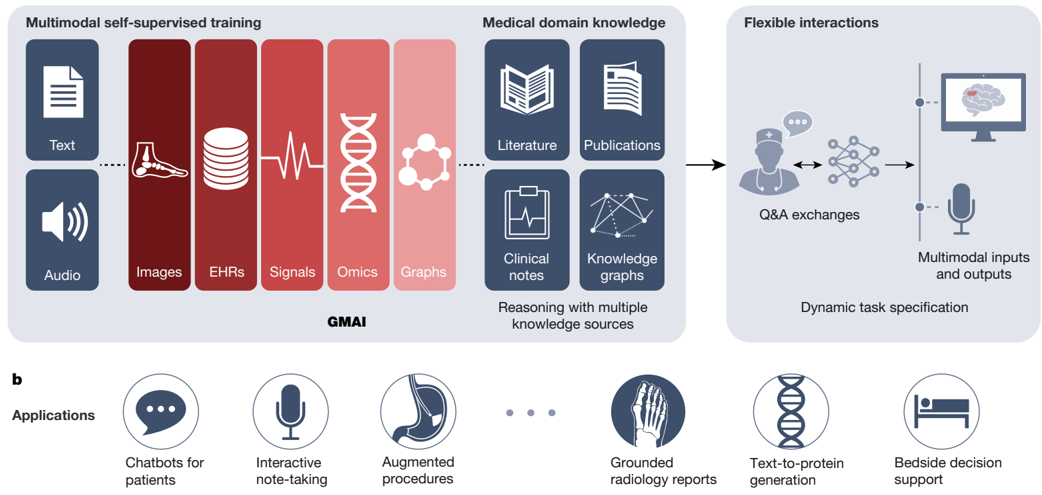
The exceptionally rapid development of highly flexible, reusable artificial intelligence (AI) models is likely to usher in newfound capabilities in medicine. We propose a new paradigm for medical AI, which we refer to as generalist medical AI (GMAI). GMAI models will be capable of carrying out a diverse set of tasks using very little or no task-specific labelled data. Built through self-supervision on large, diverse datasets, GMAI will flexibly interpret different combinations of medical modalities, including data from imaging, electronic health records, laboratory results, genomics, graphs or medical text. Models will in turn produce expressive outputs such as free-text explanations, spoken recommendations or image annotations that demonstrate advanced medical reasoning abilities. Here we identify a set of high-impact potential applications for GMAI and lay out specific technical capabilities and training datasets necessary to enable them. We expect that GMAI-enabled applications will challenge current strategies for regulating and validating AI devices for medicine and will shift practices associated with the collection of large medical datasets. This review discusses generalist medical artificial intelligence, identifying potential applications and setting out specific technical capabilities and training datasets necessary to enable them, as well as highlighting challenges to its implementation.
Overview
CoChat Summary
TL;DR
The paper proposes generalist medical AI (GMAI), a class of foundation models that would use self-supervision on large, diverse medical data to perform dynamically specified tasks, flexibly combine modalities, and reason with formal medical knowledge. It outlines six high-impact use cases and argues that GMAI will require new approaches to validation, regulation, bias auditing, privacy, and data collection.
Key findings
- Defines GMAI by three capabilities: dynamic task specification, flexible multimodal inputs/outputs, and formal representation of medical knowledge for advanced reasoning; existing models such as GPT-3 or PaLM show some medical reasoning but are not multimodal and do not reliably generate factual statements.
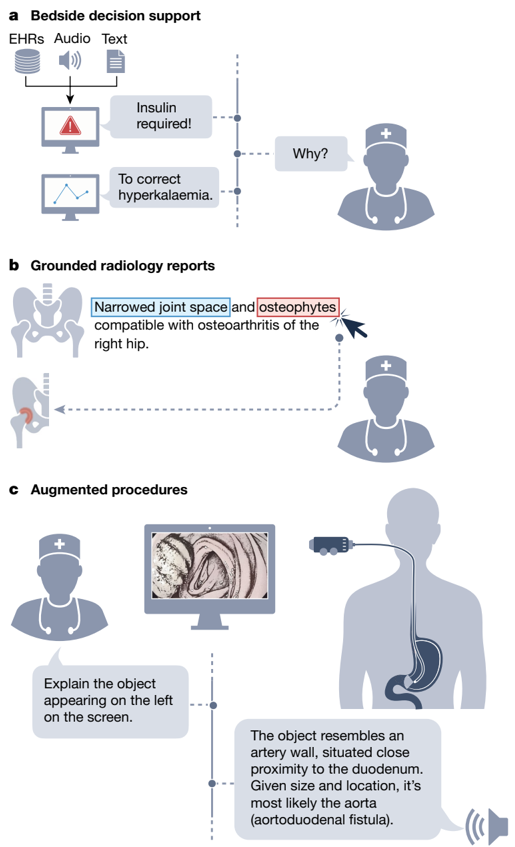
- Proposes six use cases: grounded radiology reports, augmented procedures, bedside decision support, chatbots for patients, text-to-protein generation, and interactive note-taking.
- Notes current medical AI is narrow: of more than 500 FDA-approved AI models for clinical medicine, most were approved for only 1 or 2 narrow tasks; CheXzero can detect dozens of diseases in chest X-rays without explicit labels; GPT-3 powered more than 300 apps within months of release.
- Flags scale and cost: PaLM, a 540-billion-parameter model, required an estimated 8.4 million hours’ worth of tensor processing unit v4 chips, using roughly 3,000 to 6,000 chips at a time, amounting to millions of dollars; training each model has been estimated to generate up to hundreds of tons of CO₂ equivalent; one study recommended 20 times more tokens than parameters for optimal performance.
Methods
- Perspective/review article; no primary data, sample, or experimental analysis.
- Synthesizes recent foundation-model advances and proposes the GMAI paradigm, identifying technical capabilities, training-data needs, use cases, and challenges.
- Draws on cited prior work and examples (e.g., GPT-3, Gato, CheXzero, PaLM) rather than new experiments.
Limitations
- Stated: GMAI will be uniquely difficult to validate because it can carry out previously unseen tasks, making failure modes hard to anticipate; social bias can increase with model scale; privacy risks include memorization of training data and prompt attacks; scale brings high computational, financial, and environmental costs; verification may require multidisciplinary panels; data collection/access and regulatory/liability frameworks are unresolved.
- Evident from the text: no GMAI model is built or empirically evaluated here; the use cases are prospective and illustrative; many capabilities depend on future advances in multimodal self-supervision, in-context learning, and medical knowledge integration.
Model-written summary. Check it against the paper before relying on it.
Integrity signals
Registry
Cites
Statistics
Figures
Verification
Claims the paper makes
17 Valid · 3 Not valid · 5 Not checked · 59 Own results and interpretations
The cited sources support only part of this claim — read each source’s verdict below.
In the paper
“They can acquire biases during training, when datasets either underrepresent certain groups of patients or contain harmful correlations 44,45 .”
§ Perspective Foundation models for generalist medical artificial intelligence > Social biases.
What the sources say
- Partly supportedcites [44] 44. Chung, H. W. et al. Scaling instruction-finetuned language models. Preprint at https:// arxiv.org/abs/2210.11416 (2022). sourceExperimental — accuracy not yet measured
The Mechanism of bias section (pp. 4–5) shows that the model learned to predict health care costs, which were correlated with race differently from health needs, producing racial bias. The paper does not identify underrepresentation of patient groups in training data as a cause of the bias it studied. (LLM, conf=0.87)
- Not matchedcites [45] 45. Kung, T. H. et al. Performance of ChatGPT on USMLE: potential for AI-assisted medical education using large language models. PLoS Dig. Health 2, 2 (2023).
Its entry has no title and year that we can search by.
plainstates a cause- Asserted: passes — The authors put it forward as true.
- Checkable: passes — It can be checked against evidence.
- Load-bearing: passes — The paper’s conclusions depend on it.
- Based: passes — The paper gives a reason why it holds.
- Partly supported
The cited sources support only part of this claim — read each source’s verdict below.
In the paper
“Individual models can now achieve state-of-the-art performance on a wide variety of problems, ranging from answering questions about texts to describing images and playing video games [2][3][4] .”
What the sources say
- Not matchedcites [2] 2. Yang, X. et al. A large language model for electronic health records. npj Digit. Med. 5, 194 (2022).
We searched by its title and found no matching paper.
- Partly supportedcites [3] 3. Food and Drug Administration. Artificial intelligence and machine learning (AI/ML)-enabled medical devices. FDA https://www.fda.gov/medical-devices/software-medical-device- samd/artificial-intelligence-and-machine-learning-aiml-enabled-medical-devices (2022). sourceExperimental — accuracy not yet measured
Section 3.1 (p. 7) reports that Flamingo outperforms previous zero- and few-shot methods across 16 vision-language benchmarks and exceeds fine-tuned state of the art on six tasks. Table 6 (p. 30) includes image scene description, supporting that example. The cited paper does not establish the sentence’s examples of answering questions about texts or playing video games. (LLM, conf=0.86)
- Partly supportedcites [4] 4. Acosta, J. N., Falcone, G. J., Rajpurkar, P. & Topol, E. J. Multimodal biomedical AI. Nat. Med. 28, 1773-1784 (2022). sourceExperimental — accuracy not yet measured
The Introduction (pp. 1–2) describes one model performing diverse vision and language tasks and reports the top overall score on the GRIT benchmark. The Results (p. 10) report state-of-the-art performance on A-OKVQA and strong image captioning, but say its NLP results lag behind state-of-the-art models. Related Work (p. 11) mentions another model's Atari button presses; it does not establish state-of-the-art video-game performance for Unified-IO. (LLM, conf=0.88)
plain- Asserted: passes — The authors put it forward as true.
- Checkable: passes — It can be checked against evidence.
- Load-bearing: passes — The paper’s conclusions depend on it.
- Based: passes — The paper gives a reason why it holds.
- Not matched
The cited sources support only part of this claim — read each source’s verdict below.
In the paper
“Furthermore, building on recent retrieval-based approaches, GMAI can retrieve relevant context from existing databases, in the form of articles, images or entire previous cases 19,20 .”
§ Perspective Foundation models for generalist medical artificial intelligence > Medical domain knowledge
What the sources say
- Partly supportedcites [19] 19. Guha Roy, A. et al. Does your dermatology classifier know what it doesn't know? Detecting the long-tail of unseen conditions. Med. Image Anal. 75, 102274 (2022). sourceExperimental — accuracy not yet measured
The Introduction (p. 1) describes Retro retrieving similar text from a large database, and the training-dataset section (p. 3) includes Wikipedia articles among its text sources. The paper does not establish that GMAI can retrieve images or entire previous medical cases; it supports the retrieval-based approach, but not those extensions. (LLM, conf=0.88)
- Partly supportedcites [20] 20. Radford, A. et al. Robust speech recognition via large-scale weak supervision. Preprint at https://arxiv.org/abs/2212.04356 (2022). sourceExperimental — accuracy not yet measured
The Introduction (p. 1) says REALM retrieves relevant documents from a corpus such as Wikipedia, supporting the article-retrieval part. Future Work (p. 9) proposes image retrieval as a possible extension, not an existing capability. The paper does not establish that GMAI retrieves images or entire previous cases. (LLM, conf=0.88)
plainstates a cause- Asserted: passes — The authors put it forward as true.
- Checkable: passes — It can be checked against evidence.
- Load-bearing: passes — The paper’s conclusions depend on it.
- Based: passes — The paper gives a reason why it holds.
- Partly supported
The cited sources support only part of this claim — read each source’s verdict below.
In the paper
“Models will be able to solve previously unseen problems simply by having new tasks explained to them (dynamic task specification), without needing to be retrained 3,5 .”
What the sources say
- Partly supportedcites [3] 3. Food and Drug Administration. Artificial intelligence and machine learning (AI/ML)-enabled medical devices. FDA https://www.fda.gov/medical-devices/software-medical-device- samd/artificial-intelligence-and-machine-learning-aiml-enabled-medical-devices (2022). sourceExperimental — accuracy not yet measured
The Introduction says Flamingo is designed to adapt to new vision-language tasks without fine-tuning, and the Contributions passage says it performs multimodal tasks from a few input/output examples. That supports adaptation without retraining, but not the broader claim that GMAI models can solve previously unseen problems simply by having tasks explained to them: Flamingo's demonstrated scope is narrower, and its task specification generally uses examples rather than an explanation alone. (LLM, conf=0.84)
- Not matchedcites [5] 5. Krishnan, R., Rajpurkar, P. & Topol, E. J. Self-supervised learning in medicine and healthcare. Nat. Biomed. Eng. 6, 1346-1352 (2022).
We searched by its title and found no matching paper.
plainstates a cause- Asserted: passes — The authors put it forward as true.
- Checkable: passes — It can be checked against evidence.
- Load-bearing: passes — The paper’s conclusions depend on it.
- Based: passes — The paper gives a reason why it holds.
- Partly supported
Every source the paper cites for this claim was checked and supports it.
In the paper
“CheXzero can be applied to detect dozens of diseases in chest X-rays without being trained on explicit labels for these diseases 9 .”
§ Perspective Foundation models for generalist medical artificial intelligence > Applicability.
What the sources say
- Supportedcites [9] 9. Vaswani, A. et al. Attention is all you need. In Advances in Neural Information Processing Systems (eds Guyon, I. et al.) 30, 5998-6008 (2017). source
The Main section describes CheXzero as a zero-shot chest X-ray classifier that needs no explicit pathology labels during training. The Results report an AUC of at least 0.700 for 38 of 57 radiographic findings evaluated on the PadChest test set, supporting the claim that it can detect dozens of conditions. (LLM, conf=0.90)
plainstates a cause- Asserted: passes — The authors put it forward as true.
- Checkable: passes — It can be checked against evidence.
- Load-bearing: unclear — It is unclear whether the paper’s conclusions depend on it.
- Based: passes — The paper gives a reason why it holds.
- Supported
32 more claims · 2 with their cited sources checked
Create a free account to see all 84 claims and to verify the 2 references still open.
- Probably not a substantial claim. 35
- It may state two separate claims as one. 25
Claims other papers make about this one
Each is checked against this paper’s own text: does it say what the citing paper says it does?
The source backs part of the claim, not all of it — or backs it for a different population, condition or comparison.
In the citing paper
“First, these models are predominantly pretrained using vision-only modeling57,59,60, which neglects not only rich supervisory signals found in pathology reports but also precludes multimodal capabilities such as zero-shot visual-language understanding and cross-model retrieval—a fundamental hallmark in foundation models84,85.”
From A multimodal whole-slide foundation model for pathology (2025) · cites this paper as [85]
Experimental — accuracy not yet measuredThe source backs part of the claim, not all of it — or backs it for a different population, condition or comparison.
In the citing paper
“Barriers to the clinical implementation of LLMs include their susceptibility to hallucinations, the absence of reliable references [13].”
From Diagnostic performance of Prof. Valmed, ChatGPT-5 Thinking, and OpenEvidence in rheumatology: A comparative evaluation (2026) · cites this paper as [13]
Experimental — accuracy not yet measuredThe cited source says what the claim attributes to it.
In the citing paper
“The emergence of (medical) foundational models (Moor et al., 2023), which are generally multimodal, is expected to accelerate research in optimal data fusion further.”
From Navigating the landscape of multimodal AI in medicine: A scoping review on technical challenges and clinical applications (2025) · cites this paper as Moor et al., 2023
The cited source says what the claim attributes to it.
In the citing paper
“Moor et al. introduced a paradigm for foundation model application in medical AI, named generalist medical AI (GMAI) [16].”
From Challenges in AI-driven Biomedical Multimodal Data Fusion and Analysis (2025) · cites this paper as [16]
The cited source says what the claim attributes to it.
In the citing paper
“Moor et al. proposed a framework of the GMAI, a foundation model designed to handle most clinical tasks, aiming to provide high-quality medical support to both patients and clinicians [16].”
From Challenges in AI-driven Biomedical Multimodal Data Fusion and Analysis (2025) · cites this paper as [16]
6 more claims about this paper
Create a free account to see every claim other papers make about this one.
Self-check
Percentages, sums and reported differences re-computed from the paper’s own numbers.
Each contradiction between two passages listed here was confirmed by an independent check.
Rated minor: it would not touch a result — a value no result rests on, a p-value that stays on the same side of the significance level, or a conflict that is clerical, resolved elsewhere in the paper, or outside its own findings.
In the paper
§ Perspective Foundation models for generalist medical artificial intelligence > Conclusion
“The presented example is inspired by a case report 58 .Image of the fistula in panel c adapted from ref. 58, CC BY 3.0.”
§ Perspective Foundation models for generalist medical artificial intelligence > References
“50. Vegunta, R., Vegunta, R. & Kutti Sridharan, G. Secondary aortoduodenal fistula presenting as gastrointestinal bleeding and fungemia. Cureus 11, e5575 (2019).”
Citations
Cites
Vaswani, A., Shazeer, N., Parmar, N., Uszkoreit, J., Jones, L., Gomez, A. N., Kaiser, L., & Polosukhin, I. (2017) · arXiv · doi:10.48550/arxiv.1706.03762 · Cited by 120,404
BERT: Pre-training of Deep Bidirectional Transformers for Language Understanding
Devlin, J., Chang, M.-W., Lee, K., & Toutanova, K. (2019) · Proceedings of the 2019 Conference of the North American Chapter of the Association for Computational Linguistics: Human Language Technologies, Volume 1 (Long and Short Papers) · doi:10.18653/v1/n19-1423 · Cited by 54,325
Highly accurate protein structure prediction with AlphaFold
Jumper, J., Evans, R., Pritzel, A., Green, T., Figurnov, M., Ronneberger, O., Tunyasuvunakool, K., Bates, R., Žídek, A., Potapenko, A., et al. (2021) · Nature · doi:10.1038/s41586-021-03819-2 · Cited by 43,764 · cited 1×
“There have already been early efforts to develop foundation models for biological sequences 33,34 , including RFdiffusion, which generates proteins on the basis of simple specifications (for example, a binding target) 35 .”
BackgroundHigh-Resolution Image Synthesis with Latent Diffusion Models
Rombach, R., Blattmann, A., Lorenz, D., Esser, P., & Ommer, B. (2022) · 2022 IEEE/CVF Conference on Computer Vision and Pattern Recognition (CVPR) · doi:10.1109/cvpr52688.2022.01042 · Cited by 20,302 · cited 2×
“For certain use cases (for example, chatbots), GMAI models can be stored on central compute clusters maintained by organizations with deep technical expertise, as DALL-E or GPT-3 are.”
BackgroundLearning Transferable Visual Models From Natural Language Supervision
Radford, A., Kim, J. W., Hallacy, C., Ramesh, A., Goh, G., Agarwal, S., Sastry, G., Askell, A., Mishkin, P., Clark, J., et al. (2021) · arXiv · doi:10.48550/arxiv.2103.00020 · Cited by 15,293 · cited 2×
“These include the rise of multimodal architectures 13 and self-supervised learning techniques 14 that dispense with explicit labels (for example, language modelling 15 and contrastive learning 16 ), as well as the advent of in-context learning capabilities 5 .”
BackgroundSudlow, C., Gallacher, J., Allen, N., Beral, V., Burton, P., Danesh, J., Downey, P., Elliott, P., Green, J., Landray, M., et al. (2015) · PLOS Medicine · doi:10.1371/journal.pmed.1001779 · Cited by 12,728 · cited 1×
“Large-scale data-sharing efforts, such as the MIMIC (Medical Information Mart for Intensive Care) database 55 or the UK Biobank 56 , will play a critical role in GMAI, and they should be extended to underrepresented countries to create larger, richer and more inclusive training datasets.”
BackgroundAdvances in Neural Information Processing Systems 14: Proceedings of the 2001 Conference
(2002) · The MIT Press eBooks · doi:10.7551/mitpress/1120.001.0001 · Cited by 8,890
Dissecting racial bias in an algorithm used to manage the health of populations
Obermeyer, Z., Powers, B., Vogeli, C., & Mullainathan, S. (2019) · Science · doi:10.1126/science.aax2342 · Cited by 7,137 · cited 1×
“They can acquire biases during training, when datasets either under-represent certain groups of patients or contain harmful correlations 44,45 .”
BackgroundUniProt: the universal protein knowledgebase
The UniProt Consortium (2017) · Nucleic Acids Research · doi:10.1093/nar/gkw1099 · Cited by 4,436
Training language models to follow instructions with human feedback
Ouyang, L., Wu, J., Jiang, X., Almeida, D., Wainwright, C. L., Mishkin, P., Zhang, C., Agarwal, S., Slama, K., Ray, A., et al. (2022) · arXiv · doi:10.48550/arxiv.2203.02155 · Cited by 4,208 · cited 1×
“Such feedback can then be used to improve model behaviour, following the example of InstructGPT, a model created by using human feedback to refine GPT-3 through reinforcement learning 41 .”
Method
Research works printed but not linked: 2
- Reed, S. et al. A generalist agent. In Transactions on Machine Learning Research (2022). This study presented Gato, a generalist model that can carry out a variety of tasks across modalities such as chatting, captioning images, playing video games and controlling a robot arm.
- Brown, T. et al. Language models are few-shot learners. In Advances in Neural Information Processing Systems (eds Larochelle, H. et al.) 33, 1877–1901 (2020). This study presented the language model GPT-3 and discovered that large language models can carry out in-context learning.
Cited by
Items 1,001–1,100 of 1,962
Chen, Z. S., Lu, B., & Wu, W. (2025) · IEEE Signal Processing Magazine · doi:10.1109/msp.2025.3595320 · Cited by 6
“…frontier for modeling brain functions, dysfunctions, and interventions in psychiatric and neurological disorders based on the virtual brain twin ■ development of explainable foundation models built upon the knowledge graph network [99] that allows zero-shot prediction to accommodate rare events.”
Saita, K., Mine, Y., & Amano, S. (2026) · BMC Medical Education · doi:10.1186/s12909-025-08542-4 · Cited by 2
“Artificial Intelligence (AI)-driven technologies have catalyzed a paradigm shift in medical and healthcare professional education [1, 2].”
Bhavani, S. V., & Hu, X. (2026) · Critical Care Medicine · doi:10.1097/ccm.0000000000007019 · Cited by 5
Drug and Dosage Recommendation Based on Explainable Generative AI Using Patient-Specific Modeling
Dağlarlı, E. (2026) · IEEE Access · doi:10.1109/access.2026.3657398 · Cited by 7
“…still an enormous gap that calls for the development of advanced methods that are capable of interweaving different patient data in a seamless manner, making a data-driven analysis understandable and thereby giving clinicians the opportunity to select the best therapeutic option [22], [23], [24].”
Qiqi, K., & Ban, Y. (2026) · Frontiers in Oncology · doi:10.3389/fonc.2026.1745519 · Cited by 7
“Pre-trained on vast, unlabeled datasets using self-supervised learning, these models learn rich, generalizable representations of medical images (54 – 56).”
Deep learning in biology faces a transferability crisis
O’Shea-Wheller, T. A., & Murray, K. I. (2026) · PLoS Biology · doi:10.1371/journal.pbio.3003656 · Cited by 2
“The utility of such “foundation models” lies in their ability to address broad downstream applications in areas such as species recognition [1], diagnostic imaging [2], and industrial fault detection [3].”
CKD-EHR: Clinical Knowledge Distillation for Electronic Health Records
Wang, J., Ling, H., Zhang, L., Zhang, L., Wang, F., Gao, Y., & Li, Z. (2026) · Biomedical Signal Processing and Control · doi:10.1016/j.bspc.2026.110090 · Cited by 4
Voigtländer, H., Schmitz, F., Strauss, D. S., Kauczor, H. ‐., Voigtlander, S., Sauerwein, S., & Sedaghat, S. (2026) · Frontiers in Oncology · doi:10.3389/fonc.2026.1674509 · Cited by 2
Sirago, G., Calò, F., Vinci, A., Visci, P., Solarino, B., Dell'Erba, A. S., & Ferorelli, D. (2026) · Journal of Medical Systems · doi:10.1007/s10916-026-02363-8 · Cited by 12
Zhou, L., Zeng, W., Chen, Z., Jiang, M., & Du, Y. (2026) · Asia Pacific Journal of Marketing and Logistics · doi:10.1108/apjml-08-2025-1731 · Cited by 3
Eastwood, C., Lim, N., Durie, R., Rue, B. D., Bifet, A., & Reed, C. B. (2026) · JDS Communications · doi:10.3168/jdsc.2025-0961 · Cited by 4
Training-Free Test-Time Improvement for Explainable Medical Image Classification
He, H., Tang, J., Zhu, L., Li, K., & Lu, Y. (2025) · Lecture notes in computer science · doi:10.1007/978-3-032-05185-1_61 · Cited by 3
Bias Patterns in the Application of LLMs for Clinical Decision Support
Poulain, R., Adiba, F. I., Fayyaz, H., & Beheshti, R. (2026) · Delaware Journal of Public Health · doi:10.32481/djph.2026.03.10 · Cited by 76
“Example applications include using LLMs for disease diagnosis, patient triage, and planning treatments [38].”
MethodFoundation models for brain imaging: A systematic review
Ghamizi, S., Kanli, G., Deng, Y., Palissot, V., Perquin, M., & Keunen, O. (2026) · NeuroImage · doi:10.1016/j.neuroimage.2026.121877 · Cited by 11
Lau, L. D. W., Tran, V., Chapman, W. W., Morgan, V. A., Scardamaglia, L., Ross, G., & Wong, C. C. (2026) · International Journal of Dermatology · doi:10.1111/ijd.70418 · Cited by 2
Huang, H., Ding, K., Zhu, D., Cheng, Q., Huang, X., Huang, X., Wang, S., & Shao, Z. (2026) · Geo-spatial Information Science · doi:10.1080/10095020.2026.2646372 · Cited by 7
Development and validation of the Oxford Attitudes to Artificial Intelligence in Medicine Scale
Kantor, J., Morrison, M., Ko, J., Semenov, Y. R., & Fortgang, R. G. (2026) · JAAD International · doi:10.1016/j.jdin.2026.04.005 · Cited by 2
POYRAZER, M., Yağcı, H., & Erten, R. (2026) · Frontiers in Medicine · doi:10.3389/fmed.2026.1815982 · Cited by 4
“More recently, the field has shifted from training task-specific classifiers towards leveraging pretrained foundation models whose representations can be adapted to downstream clinical tasks with substantially less labelled data (7, 8).”
Medical multimodal large language models: A survey
Xiao, H., Hui, N., Xu, Y. D., Li, Z., & Peng, J. (2026) · Information Fusion · doi:10.1016/j.inffus.2026.104386 · Cited by 5
Jafarinezhad, O., Zhang, Q., Rezai, R., Noaeen, M., Shachak, A., Far, B. H., & Abad, Z. S. H. (2026) · Artificial Intelligence in Medicine · doi:10.1016/j.artmed.2026.103422 · Cited by 2
Self-citationLiu, N., Han, G., Gu, Q., Zhang, Y., & Chen, M. M. (2026) · Cell Death and Disease · doi:10.1038/s41419-026-08769-z · Cited by 5
Zhang, Z., Mascagni, P., Reinke, A., BACKER, P. D., Bogaert, W., Mezzina, M., Donoho, D. A., & Kolbinger, F. R. (2026) · Annual Review of Biomedical Engineering · doi:10.1146/annurev-bioeng-110824-114236 · Cited by 11
Baseline Method of the Foundation Model Challenge for Ultrasound Image Analysis
Deng, B., Tang, Y., Li, J., Huang, Y. Q., Wang, L., Zhang, Y. S., Zhan, Y., Lu, H., Zhang, X., & Bai, J. (2026) · IEEE International Symposium on Biomedical Imaging (ISBI) · doi:10.1109/isbi61048.2026.11515398 · Cited by 6
“Recently, the success of Foundation Models in computer vision, such as the Segment Anything Model (SAM) [4], has inspired the development of Generalist Medical AI [5].”
A Clinical Decision Support System for Post-Surgical Cardiovascular Remote Monitoring
Pylarinou, C., Koletsis, E. N., Mulita, F., Leivaditis, V., Liolis, E., Gortzis, L. G., & Mavrilas, D. (2026) · Clinics and Practice · doi:10.3390/clinpract16050093 · Cited by 2
“This traceability is important for clinical adoption: a surgeon needs not just a risk estimate but a visible reasoning chain that can be examined and, if necessary, challenged [6].”
Hsiao, Y.-C., Hung, K.-H., Yeh, C., Chen, Y., Ko, T., Lai, C.-F., Lin, L. Y., Chang, W., Tsao, Y., Lin, M. M.-W., et al. (2026) · Heart · doi:10.1136/heartjnl-2025-327462 · Cited by 2
Singh, Y., Himeur, Y., Farrelly, C., Kadzue, P. K.-M. T., Rozenblit, J., Kunovac, A., Pappas, I. C., Choudhary, A., Salehi, S., Atalla, S., et al. (2026) · Bioengineering · doi:10.3390/bioengineering13060638 · Cited by 5
“…language models (LLMs) are increasingly relevant to biomedical imaging AI because they can support report-context integration, clinical knowledge extraction, multimodal reasoning, radiology report structuring, literature synthesis, and the construction of text-informed knowledge graphs [44–46].”
From black-box to clinical reasoning: CARE-MD a novel framework for Self-eXplainable skin lesions
Kandpal, K. C., & Verma, P. (2026) · Computer Methods and Programs in Biomedicine · doi:10.1016/j.cmpb.2026.109478 · Cited by 2
Uddin, K. N., Ghose, P., Njie, E., Mahmood, N., Kumar, N., Haque, M. A., Gaur, L., Li, A., & Mallik, S. (2026) · Neuroscience · doi:10.1016/j.neuroscience.2026.05.036 · Cited by 2
Duan, N., Zhao, X., Wu, Z., Yuan, D., Peng, S., Cui, K., Yu, Z., Yang, W., Wei, W., Chi, W., et al. (2026) · British Journal of Ophthalmology · doi:10.1136/bjo-2025-328860 · Cited by 2
“Similar conclusions are also reported by Moor et al and Wang et al , that AI chatbots achieved high accuracy in structured diagnostic reasoning, 26 27 particularly in areas requiring image interpretation, but demonstrated variability in prognosis across oncology, cardiology and ophthalmology…”
Haupt, M., Weiss, D., Bellersen, T., & Maurer, M. H. (2026) · Scientific Reports · doi:10.1038/s41598-026-58763-w · Cited by 4
Ang, M. Y., Chen, L., Song, L., Lipovich, L., & Choo, S. W. (2026) · Life · doi:10.3390/life16061032 · Cited by 2
“Large language models are artificial intelligence systems designed to process and generate text based on statistical patterns learned from large training datasets [9].”
Generative Artificial Intelligence and Large Language Models in Clinical Oncology
Yu, Y., Zhao, Z., Wang, Z., Lin, R., Tan, Y., Chen, Y., Li, T., Baptista‐Hon, D. T., Zhang, X., Wu, C., et al. (2026) · MedComm · doi:10.1002/mco2.70833 · Cited by 4
Lau, G. R., Kasturiratna, K. T. A. S., Goh, A. Y. H., Tong, E. M. W., & Hartanto, A. (2026) · Computers in Human Behavior Reports · doi:10.1016/j.chbr.2026.101186 · Cited by 19
Understanding the Barriers to Translating Artificial Intelligence into the Clinical Laboratory
Neale, M. H., Wong, C., Kreuter, D., Taylor, J. G., & Sivapalaratnam, S. (2026) · European Journal of Internal Medicine · doi:10.1016/j.ejim.2026.107029 · Cited by 2
Albadawi, E. A., Embaby, E. M., AlQumaizi, K. I., Elsaid, M. A. E., Dawood, A. F., & Eldesoqui, M. B. (2026) · Clinical Anatomy · doi:10.1002/ca.70177 · Cited by 3
The digital therapist? LLMs and the future of clinical dialogue
Shi, E. R., Pei, R., & Barceló-Coblijn, L. (2026) · Language and Health · doi:10.1016/j.laheal.2026.100086 · Cited by 5
Tutorial: guidance on the use of large language models for medical research
Jin, Q., Wan, N., Leaman, R., Tian, S., Wang, Z., Yang, Y., Wang, Z., Xiong, G., Lai, P.-T., Zhu, Q. L., et al. (2026) · Nature Protocols · doi:10.1038/s41596-026-01408-z · Cited by 16
AI for science: Progress, challenges, and perspectives
Xu, Y., Shao, Z., Liu, X., Li, Y., An, Z., Fu, C., Huang, C., Zhang, L., Gao, F., Li, J., et al. (2026) · The Innovation · doi:10.1016/j.xinn.2026.101530 · Cited by 16
Qi, X., Wang, Y., Yang, X.-F., Ren, L., Liu, W., Benedict, S., Xiao, Y., Xing, L., & Naqa, I. E. (2026) · Medical Physics (Lancaster) · doi:10.1002/mp.70616 · Cited by 3
Safety and security of large language models in healthcare
Clusmann, J., Freyer, O., Ostermann, M., Ferber, D., Laleh, N. G., Hilgers, L., Kolbinger, F. R., Schneider, C. V., Downing, A., Wekenborg, M., et al. (2026) · Nature · doi:10.1038/s41586-026-10687-1 · Cited by 8
Application of Artificial Intelligence on Painting Therapy
He, Y. (2023) · Frontiers in Art Research · doi:10.25236/far.2023.051103 · Cited by 1
Metric-Independent Mitigation of Unpredefined Bias in Machine Classification
Tang, Z., Lu, T., & Li, T. (2024) · Intelligent Computing · doi:10.34133/icomputing.0083 · Cited by 2
Chen, J. L., Stumpe, M. C., & Cohen, E. E. W. (2024) · JCO Clinical Cancer Informatics · doi:10.1200/cci.24.00011 · Cited by 2
Virtual Reality Image Creation in the Era of Artificial Intelligence
Zhang, A. (2024) · Lecture notes in computer science · doi:10.1007/978-3-031-61359-3_9 · Cited by 3
Letter: Shifting focus—From ChatGPT to specialised medical LLMs
Wang, S., Kinoshita, S., & Yokoyama, H. (2024) · Alimentary Pharmacology & Therapeutics · doi:10.1111/apt.18121 · Cited by 2
ADT ‐ UNet : An Innovative Algorithm for Glioma Segmentation in MR Images
Liu, Z., Jiawei, W., Ye, J., Bian, X., Qiwei, W., Li, R., & Zhu, Y. (2024) · International Journal of Imaging Systems and Technology · doi:10.1002/ima.23150 · Cited by 2
“With significant advancements in foundational models and multimodal data fusion techniques [43], future investigations will focus on validating the proposed method using multicenter medical datasets and exploring the integration of diverse modalities in glioma segmentation prediction.”
Liu, L., Zhou, H., Wang, X., Wen, F., Zhang, G., Yu, J., Shen, H., & Huang, R. (2024) · Frontiers in Public Health · doi:10.3389/fpubh.2024.1405533 · Cited by 2
Integrating VAI-Assisted Quantified CXRs and Multimodal Data to Assess the Risk of Mortality
Chen, Y.-C., Fang, W., Lin, C., Tsai, D., Hsiang, C.-W., Chang, C.-K., Ko, K., Huang, G.-S., Lee, Y., & Lin, C. S. (2024) · Journal of Imaging Informatics in Medicine · doi:10.1007/s10278-024-01247-y · Cited by 3
“The foundation model is a type of DLM pre-trained on large database and capable of applying knowledge to other downstream tasks [23].”
Charting the future of cardiology with large language model artificial intelligence
Wehbe, R. M. (2024) · Nature Reviews Cardiology · doi:10.1038/s41569-024-01105-y · Cited by 5
“However, this approach might not be necessary — evidence is emerging that gener-alist foundational models can outperform domain-specific models 14 .”
Improving Rare-Word Recognition of Whisper in Zero-Shot Settings
Jogi, Y., Aggarwal, V., Nair, S. S., Verma, Y., & Kubba, A. (2024) · IEEE Spoken Language Technology Workshop (SLT) · doi:10.1109/slt61566.2024.10832199 · Cited by 5
“Hence, such an open-source model serves as a foundational model in the domain of speech and has been used “out of the box” in a variety of applications [3, 4, 5].”
Zhang, W., Yu, T., Wang, R., Xie, J., Trucco, E., Zheng, W., & Yang, X. (2025) · IEEE Transactions on Multimedia · doi:10.1109/tmm.2025.3543109 · Cited by 13
“…intelligence (AI) has demonstrated outstanding achievements in various fields, especially with the recent emergence of foundation models [1], [2], [3], such as image classification [4], [5], [6], [7], object detection [8], [9], semantic segmentation [10], [11], [12], and natural language…”
Artificial intelligence for abdominopelvic trauma imaging: trends, gaps, and future directions
Dreizin, D., Cheng, C., Liao, C., Jindal, A., & Colak, E. (2025) · Abdominal Radiology · doi:10.1007/s00261-025-04816-z · Cited by 3
“Generalist medical foundation AI models [88] have begun to surface over the past few years at an ever-increasing pace and we appear to have very recently reached a hockey-stick inflection in the use of this technology.”
Yuan, H., Zhu, M., Yang, R., Liu, H., Li, I., & Hong, C. (2025) · Health care science · doi:10.1002/hcs2.70009 · Cited by 9
“Specifically, we implemented three ‐ layer multilayer perceptron (MLP ‐ 3) models with intermediate layers of 512 and 256 neurons, using representations generated by foundation models as inputs [60].”
End-to-end breast cancer radiotherapy planning via LMMs with consistency embedding
Kim, K., Oh, Y., Park, S. J., Byun, H. K., Lee, J., Kim, J. S., Kim, Y. B., & Ye, J. C. (2025) · Medical Image Analysis · doi:10.1016/j.media.2025.103646 · Cited by 9
“R Ecently, the emergence of a new generation of AI models inspired by the large language models (LLMs), known as foundation models, marks a significant departure from previous paradigms [1].”
A perspective on developing foundation models for analyzing spatial transcriptomic data
Liu, T., Hao, M., Liu, X., & Zhao, H. (2025) · Quantitative Biology · doi:10.1002/qub2.70010 · Cited by 4
“Foundation models (FMs) [1], within the scope of deep learning, are defined as models pretrained with large ‐ scale corpus data and can be utilized to address various problems (known as downstream applications) [2–4].”
Zhang, J., Sun, Y., Rong, Y., Li, H., Jiang, B., Zhao, C., & Liu, H. (2025) · Aesthetic Plastic Surgery · doi:10.1007/s00266-025-05103-4 · Cited by 4
“In addition, some professors emphasized that patient-facing must communicate effectively with non-technical audiences by using simple and clear language without compromising content accuracy [5].”
InfluentialThe Importance of PET Quantification for Prognosis and Treatment Response Monitoring
Abgral, R., Bailly, C., Boellaard, R., Bourhis, D., & Carlier, T. (2025) · PET Clinics · doi:10.1016/j.cpet.2025.07.007 · Cited by 3
Perspective on utilizing foundation models for laboratory automation in materials research
Hatakeyama‐Sato, K., Nishida, T., Kitamura, K., Ushiku, Y., TAKAHASHI, K., Nabae, Y., & Hayakawa, T. (2025) · Science and Technology of Advanced Materials Methods · doi:10.1080/27660400.2025.2582379 · Cited by 8
“The key technology for flexible adaptation to various sample types, devices, communication standards, and databases lies in highly versatile AI agents and foundation models for robots, which have gained significant attention in recent years [25,84].”
A foundation model for sleep-based risk stratification and clinical outcomes
Bilal, E., Araújo, M., Beck, K. L., Heinzinger, C. M., Ghosn, S., Saab, C. Y., Foldvary‐Schaefer, N., Rogers, J. L., & Mehra, R. (2026) · Nature Communications · doi:10.1038/s41467-026-75326-9 · Cited by 6
“By learning broad, general-purpose physiologic representations, they can be adapted with minimal additional training to downstream tasks 11 .”
Di, H., & Wen, Y. (2023) · The Journal of Urology · doi:10.1097/ju.0000000000003655 · Cited by 2
ChatGPT et au-delà avec l’intelligence artificielle en santé : des leçons à tirer
Thiébaut, R., Hejblum, B. P., Mougin, F., Tzourio, C., & Richert, L. E. (2023) · Revue du Rhumatisme · doi:10.1016/j.rhum.2023.07.007 · Cited by 2
Bang, S., Wang, H., Kim, H., Choi, M. H., Cha, J., Choi, Y. J., & Hong, S. (2023) · Applied Sciences · doi:10.3390/app132011345 · Cited by 2
Künstliche Intelligenz in der onkologischen Chirurgie
Schulze, A., Bodenstedt, S., Distler, M., Weitz, J., Speidel, S., & Wagner, M. (2024) · Die Onkologie · doi:10.1007/s00761-024-01486-2 · Cited by 1
Lesion-Aware Open Set Medical Image Recognition with Domain Shift
Xu, Y., Zhao, R.-W., & Feng, R. (2024) · IEEE International Conference on Acoustics Speech and Signal Processing · doi:10.1109/icassp48485.2024.10447937 · Cited by 2
“Note that the recently emerging foundation models [13] show strong abilities to generalize to unseen data based on large-scale and large-sized model pre-training.”
BackgroundKünstliche Intelligenz in der Registerforschung
Rupp, M., Pawelczyk, J., & Niemeyer, P. (2024) · Arthroskopie · doi:10.1007/s00142-024-00671-0 · Cited by 2
Chiu, H., Sun, C., Liu, Y.-L., Sue, Y., & Yeh, P. (2024) · Current Psychology · doi:10.1007/s12144-024-06136-9 · Cited by 2
“Indeed, the AI-assisted determination of the predictive power regarding the accuracy of different parameters has been gaining popularity in clinical applications (Moor et al., 2023; Rocheteau, 2023; Sun et al., 2023).”
Similarity index of ex-Gaussian reaction time signaturesPreprint
Manjarrez, E., DeLuna-Castruita, A., Lizárraga-Cortés, V., & Flores, A. (2023) · bioRxiv (Cold Spring Harbor Laboratory) · doi:10.1101/2023.05.29.542684 · Cited by 2
“The similarity index algorithms have gained popularity recently thanks to the advances in the artificial intelligence (AI) field (Brown et al., 2020), which could have important applications in a generalist medical AI (Moor et al., 2023).”
Backgroundde Weerd, H. A., Guala, D., Gustafsson, M., Synnergren, J., Tegner, J. N., Lubovac-Pilav, Z., & Magnusson, R. (2023) · bioRxiv (Cold Spring Harbor Laboratory) · doi:10.1101/2023.10.03.560661 · Cited by 2
“This challenge is now renewed in the recent context of the emergence of foundational models in bioscience based on single-cell genomics data [43].”
BackgroundExploratory electronic health record analysis with ehrapyPreprint
Heumos, L., Ehmele, P., Treis, T., zu Belzen, J. U., Namsaraeva, A., Horlava, N., Shitov, V. A., Zhang, X., Zappia, L., Knoll, R., et al. (2023) · medRxiv · doi:10.1101/2023.12.11.23299816 · Cited by 2
“…49 , a unified framework for whole-slide image analysis in pathology, and scvi-tools 50 which provides data loaders for loading tensors from AnnData objects into PyTorch 51 or Jax arrays 52 to facilitate the development of generalizing foundational models for medical artificial intelligence 53 .”
MethodMachine learning enabled prediction of digital biomarkers from whole slide histopathology imagesPreprint
McCaw, Z. R., Shcherbina, A., Shah, Y., Huang, D., Elliott, S. E., Szabó, P. M., Dulken, B., Holland, S. J., Tagari, P. C., Light, D., et al. (2024) · medRxiv · doi:10.1101/2024.01.06.24300926 · Cited by 6
“Specifically, we begin by training a pan-solid tumor H&E foundation model (similar to [9, 17, 18]; also see [19]), learning a universal featurization of tissue H&E images.”
MethodLutsker, G., Rossman, H., Godneva, N., & Segal, E. (2024) · medRxiv · doi:10.1101/2024.03.17.24304415 · Cited by 5
“[Moor et al., 2023].”
BackgroundThe Economics of AI Foundation Models: Openness, Competition, and GovernancePreprint
Xu, F., Wang, X., Chen, W., & Xie, K. (2024) · SSRN Electronic Journal · doi:10.2139/ssrn.4999355 · Cited by 27
Patil, D. (2025) · SSRN Electronic Journal · doi:10.2139/ssrn.5057430 · Cited by 5
Ayhan, M. S., Ong, A. Y., Ruffell, E., Wagner, S. K., Merle, D. A., & Keane, P. A. (2025) · medRxiv · doi:10.1101/2025.03.09.25323618 · Cited by 2
“Foundation models trained on broad, multimodal data have demonstrated impressive performance in diverse scenarios (1–5) and hold promise as general-purpose solutions adaptable to various clinical tasks (6).”
Li, Y., Carrillo‐Pérez, F., Owaifeer, A. M. A., Alawad, M. A., & Gevaert, O. (2025) · medRxiv · doi:10.1101/2025.04.22.25326210 · Cited by 4
“…methods, Self-Supervised Learning (SSL) methods have recently gained popularity in medical imaging and have been considered an important technique in building generalist medical AI due to their reduced reliance on extensive labeled datasets (Moor et al. 2023; C. Zhang, Zheng, and Gu 2023).”
ImmuneFM: Pre-training Foundation Model from Cytometry Data for Immunology ResearchPreprint
Ding, S., Bhattacharya, S., & Butte, A. J. (2025) · bioRxiv (Cold Spring Harbor Laboratory) · doi:10.1101/2025.07.09.664020 · Cited by 4
“For example, a biomedicine foundation model can be used for disease diagnosis, clinical decision support, scientific discovery, etc 18 .”
HEIMDALL: Disentangling tokenizer design for robust transfer in single-cell foundation modelsPreprint
Haber, E., Alam, S., Ho, N., Liu, R., Trop, E., Liang, S., Yang, M., Krieger, S., & Ma, J. (2025) · bioRxiv (Cold Spring Harbor Laboratory) · doi:10.1101/2025.11.09.687403 · Cited by 6
“Foundation models are transforming biology, enabling breakthroughs in protein structure prediction [1], genomics [2], and clinical medicine [3].”
Pârvulescu, L., Livadariu, D., Bacu, V. I., Nandra, C. I., Ştefănuţ, T., & Contributors, W. O. C. (2025) · bioRxiv (Cold Spring Harbor Laboratory) · doi:10.64898/2025.12.29.696807 · Cited by 5
Auditing medical multi-agent AI reveals risks of false consensus
Zhu, Y., Gu, L., Wang, Z., Sang, H., Sui, D., Tang, W., Mi, L., Wang, Y., Gao, J., Yao, L., et al. (2025) · arXiv · doi:10.48550/arxiv.2510.10185 · Cited by 17
Daumke, P., Haverkamp, C., Heckmann, S., Kuper, M., Müller, A., Oemig, F., Ripperger, U., Sabutsch, S., Sander, A., & Schulz, S. (2024) · Springer eBooks · doi:10.1007/978-3-658-43236-2_41 · Cited by 1
The Most Disruptive Near-Term Use of AI in Cancer Care: Patient Empowerment Through Software Agents
Nothaft, F. A., & Power, B. (2024) · AI in Precision Oncology · doi:10.1089/aipo.2024.0027 · Cited by 2
“14 The Solution Concept: Applying AI Through Software Agents to Enable Patients and Caregivers to Be Copilots If we apply Clayton Christensen ’ s theory of disruptive innovation 27 and Moor et al. ’ s 50 three common patterns for generalist medical AIs to the patient challenges articulated earlier, we can envision an…”
MetaPath Chat: multimodal generative artificial intelligence chatbot for clinical pathology
Chen, H., Lin, R., & Yu, Y. (2024) · MedComm · doi:10.1002/mco2.769 · Cited by 2
Innovation in Medical Application Based on Artificial Intelligence (AI) by Cutting-Edge Technologies
Nour, S. M., Abdelwahab, M., Mahmoud, M. S., et al. (2025) · Practice, progress, and proficiency in sustainability · doi:10.4018/979-8-3693-7117-6.ch003 · Cited by 1
Khan, S. A., & Gunasekera, C. D. (2025) · Eye · doi:10.1038/s41433-025-03605-8 · Cited by 3
“This could potentially be utilized in aiding the clinical practice which could bring a significant change and revolutionize the future of clinical medicine [10, 11].”
Multimodal Retrieval Method for Images and Diagnostic Reports Using Cross-Attention
Sata, I., Amagasaki, M., & Kiyama, M. (2025) · AI · doi:10.3390/ai6020038 · Cited by 5
Niriella, M. A., Premaratna, P., Senanayake, M., Kodisinghe, S., Dassanayake, U. B., Dassanayake, A. S., Ediriweera, D. S., & de Silva, H. J. (2025) · Expert Review of Gastroenterology & Hepatology · doi:10.1080/17474124.2025.2471874 · Cited by 2
“LLM’s unsupervised machine learning capacity, evolving model architectures and datasets drive their evolutionary capacity to handle more complex data at higher speeds and superior precision [4,5].”
Introduction of federated learning
Li, X., Xu, Z., & Fu, H. (2025) · Elsevier eBooks · doi:10.1016/b978-0-44-323641-9.00008-x · Cited by 1
Development of deep learning models for motion artifact mitigation in wearable PPG devices
Lee, M., Gao, Y., Wu, J., McIntosh, C., & Franklin, D. (2025) · Biophotonics in Exercise Science, Sports Medicine, Health Monitoring Technologies, and Wearables · doi:10.1117/12.3039622 · Cited by 4
“This model architecture has also become very popular due to its ability to translate to various deep learning tasks such as medical image, time-series analysis, and has been the backbone of many foundational models [7], [8], [9], [10].”
Artificial Intelligence Applications in Oral and Maxillofacial Medicine
Uribe, S. E. (2025) · Springer eBooks · doi:10.1007/978-3-031-84047-0_3 · Cited by 3
Huber, M., Binder, P., & Frohmann, M. (2025) · Lecture notes in computer science · doi:10.1007/978-3-031-86651-7_15 · Cited by 1
Uvaliyev, A., & Chan, L. L.-H. (2025) · Applied Sciences · doi:10.3390/app15094963 · Cited by 2
A Retrieval-Augmented Dialogue Framework for Multimodal Medical Consultation
Zhang, X., & Zhang, Y. (2024) · IEEE/WIC/ACM International Conference on Web Intelligence and Intelligent Agent Technology (WI-IAT) · doi:10.1109/wi-iat62293.2024.00099 · Cited by 1
Yuan, Z., Xia, S., Yao, Z., Zhou, J., Yu, J., & Wu, G. (2025) · Biomedical Signal Processing and Control · doi:10.1016/j.bspc.2025.108017 · Cited by 2
Artificial Intelligence in Orthodontics Diagnosis and Treatment
Majstorović, N. V., & Dimitrijević, S. (2025) · Lecture notes in networks and systems · doi:10.1007/978-3-031-95197-8_7 · Cited by 1
Generative AI and Health Care: Brief Survey
Rada, R. (2025) · Computer · doi:10.1109/mc.2025.3564446 · Cited by 1
Lightweight Depthwise Separable U-Net for Laptop-Based Abdominal Multi-organ Segmentation
Cheng, H., Tang, M., Zhang, Y., Lei, R., & Yang, M. (2025) · Lecture notes in computer science · doi:10.1007/978-3-031-96202-8_10 · Cited by 1
Ruizhe, 刘. L., Zijia, 王. W., & Lin, H. (2025) · Acta Optica Sinica · doi:10.3788/aos250928 · Cited by 1
The Expanding Landscape of Neural Architectures and Their Impact in Biomedicine
Zhang, Z. F., Zhan, H., Wu, T., Burns, R., Hundal, J., & Costa, H. A. (2025) · Annual Review of Biomedical Data Science · doi:10.1146/annurev-biodatasci-103023-050856 · Cited by 1
Smart Telemedicine: Leveraging IoT to Transform Remote Healthcare Monitoring and Access
Arena, F., Pau, G., Salerno, V. M., Ruggieri, M., Ricciardello, A., Scuro, C., & Collotta, M. (2025) · IEEE International Workshop on Metrology for Living Environment (MetroLivEnv) · doi:10.1109/metrolivenv64961.2025.11106989 · Cited by 1
“This capability is bolstered by modern telecommunication systems, which support seamless communication between patients and healthcare providers, thereby overcoming geographical barriers [13], [14].”
scYeast: a biological-knowledge-guided foundation model on yeast single-cell transcriptomics
Fan, X., Liao, W., Xiao, L., Yan, X., & Lu, H. (2026) · Synthetic and Systems Biotechnology · doi:10.1016/j.synbio.2026.05.014 · Cited by 1
“Recently, foundation models, typically built on the Transformer architecture at their core, have significantly advanced the research in natural language processing and life sciences [1].”
Metadata
- Authors
- Moor, M., Banerjee, O., Abad, Z. S. H., Krumholz, H. M., Leskovec, J., Topol, E. J., & Rajpurkar, P.
- Affiliations
- Stanford University (US)
- Harvard University (US)
- University of Toronto (CA)
- Yale New Haven Hospital (US)
- Scripps Research Institute (US)
- Corresponding author
- Topol, Eric J.
- Rajpurkar, Pranav
- ORCID
- Venue
- Nature
- Published
- 2023-04-12
- Volume
- 616
- Issue
- 7956
- Pages
- 259-265
- ISSN
- 0028-0836 (ISSN-L)
- 1476-4687
- OpenAlex
- W4365143687
- Semantic Scholar
- 9faa2b0e5cb93f20df0555c3c350fab0b2eccf3a
- Cited by
- 2,028
- References
- 50
- Citations by year
- 2026: 753 · 2025: 645 · 2024: 445 · 2023: 181
- FWCI
- 23.78
- Type
- journal article
- Language
- en
- Open access
- hybrid
- doi.org
- Licence
- cc-by
- www.springernature.com/gp/researchers/text-and-data-mining (tdm)
- www.springernature.com/gp/researchers/text-and-data-mining (vor)
- Locations
- Nature (publishedVersion, cc-by)
- PubMed (publishedVersion)
- RePEc: Research Papers in Economics (submittedVersion)
- Funders
- National Science Foundation (1934578, 1835598, UL1TR001114, 1918940)
- National Institutes of Health (UL1TR001114)
- Defense Advanced Research Projects Agency (HR00112190039, N660011924033)
- Advanced Research Projects Agency
- Multidisciplinary University Research Initiative
- Wu Tsai Neurosciences Institute, Stanford University
- National Human Genome Research Institute (U54HG010426)
- National Institute of Neurological Disorders and Stroke (R61NS11865)
- National Center for Advancing Translational Sciences (grant UL1TR001114)
- Army Research Office (W911NF-16-1-0342, W911NF-16-1-, W911NF)
- Topics
- Health Sciences › Medicine › Health Informatics › Artificial Intelligence in Healthcare and Education
- Physical Sciences › Computer Science › Artificial Intelligence › Machine Learning in Healthcare
- Physical Sciences › Computer Science › Computer Vision and Pattern Recognition › Multimodal Machine Learning Applications
- Keywords
- foundation models, self-supervised learning, multimodal medical data, medical reasoning, explainable AI, health data collection, artificial intelligence in healthcare
- MeSH terms
- Unsupervised Machine Learning, Artificial Intelligence, Diagnostic Imaging, Humans, Medicine, Genomics, Electronic Health Records, Datasets as Topic
About these checks
Registry, retraction, Cites and statistics results are computed, not judged, with one exception: a printed reference that no index lists is read once by a model before it counts as a citation error. Claims are extracted by a model and kept only when their quote appears verbatim in the text; each cited source is then checked, with a model’s help, for whether it says what the claim relies on. Those verdicts can be wrong — read the claim’s quote and the cited source before relying on one.
The claim verdicts this report counts are experimental: their accuracy is not yet measured.
A language model drew the claims from the paper on 2026-10-10, under version 3 of the claim definition (model deepseek-v4.1-flash, prompt extract-v3).
A second model labelled each claim on 2026-10-10 (model jev-1.13-20260917, definition revision gold-guideline-v0.2).
Cited sources are checked with a language model’s help (gpt-6-sol).
Statistics and arithmetic are recomputed, not judged.
Confidence bands are shown only for fields calibrated on our annotated test set. None is calibrated yet, so no band is shown.
What counts as a claim ›How we measure confidence ›How we check this ›
Are you an author, or do you see a problem with this page? Request a review
Data sources
Bibliographic data: Semantic Scholar, OpenAlex, Crossref.
Contains information from the Semantic Scholar Academic Graph Datasets, made available under the ODC Attribution License (ODC-BY 1.0).
Semantic Scholar’s data is described in: Kinney, R., et al. (2023). The Semantic Scholar Open Data Platform. arXiv:2301.10140.
