

Faster sorting algorithms discovered using deep reinforcement learning
Open accessThe DOI matches its Crossref record; 64 of the 64 references it cites were found in a registry or an index.
Abstract
Fundamental algorithms such as sorting or hashing are used trillions of times on any given day 1. As demand for computation grows, it has become critical for these algorithms to be as performant as possible. Whereas remarkable progress has been achieved in the past 2, making further improvements on the efficiency of these routines has proved challenging for both human scientists and computational approaches. Here we show how artificial intelligence can go beyond the current state of the art by discovering hitherto unknown routines. To realize this, we formulated the task of finding a better sorting routine as a single-player game. We then trained a new deep reinforcement learning agent, AlphaDev, to play this game. AlphaDev discovered small sorting algorithms from scratch that outperformed previously known human benchmarks. These algorithms have been integrated into the LLVM standard C++ sort library 3. This change to this part of the sort library represents the replacement of a component with an algorithm that has been automatically discovered using reinforcement learning. We also present results in extra domains, showcasing the generality of the approach.
Overview
The claims and statistics of this paper haven’t been checked yet.
Free: it reads the open-access text and checks the first 5 claims that cite a source we can check. Create a free account to check every claim.
Integrity signals
Registry
Cites
Statistics
Figures
Verification
Claims the paper makes
The claims and statistics of this paper haven’t been checked yet.
Free: it reads the open-access text and checks the first 5 claims that cite a source we can check. Create a free account to check every claim.
Self-check
Percentages, sums and reported differences re-computed from the paper’s own numbers.
The self-check needs the paper’s full text.
Citations
Cites
Vaswani, A., Shazeer, N., Parmar, N., Uszkoreit, J., Jones, L., Gomez, A. N., Kaiser, L., & Polosukhin, I. (2017) · arXiv · doi:10.48550/arxiv.1706.03762 · Cited by 120,404
Language Models are Few-Shot Learners
Brown, T. B., Mann, B., Ryder, N., Subbiah, M., Kaplan, J., Dhariwal, P., Neelakantan, A., Shyam, P., Sastry, G., Askell, A., et al. (2020) · arXiv · doi:10.48550/arxiv.2005.14165 · Cited by 23,372 · cited 1×
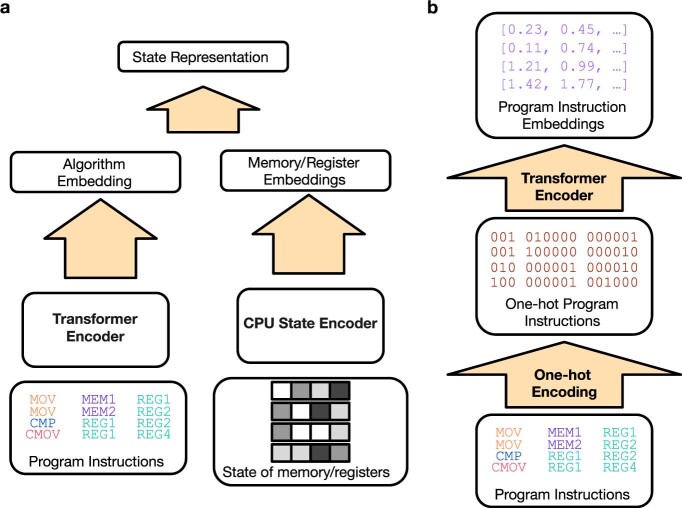
“Transformers are natural text encoders and have had much success with language models recently 14,34,41 .”
BackgroundMastering the game of Go with deep neural networks and tree search
Silver, D., Huang, A., Maddison, C. J., Guez, A., Sifre, L., van den Driessche, G., Schrittwieser, J., Antonoglou, I., Panneershelvam, V., Lanctot, M., et al. (2016) · Nature · doi:10.1038/nature16961 · Cited by 15,612
Self-citationA general reinforcement learning algorithm that masters chess, shogi, and Go through self-play
Silver, D., Hubert, T., Schrittwieser, J., Antonoglou, I., Lai, M., Guez, A., Lanctot, M., Sifre, L., Kumaran, D., Graepel, T., et al. (2018) · Science · doi:10.1126/science.aar6404 · Cited by 3,562 · cited 2×
“AlphaZero 33 is an RL algorithm that leverages MCTS as a policy improvement operator.”
MethodSelf-citationEvaluating Large Language Models Trained on Code
Chen, M., Tworek, J., Jun, H., Yuan, Q., Pinto, H. P. D. O., Kaplan, J., Edwards, H., Burda, Y., Joseph, N., Brockman, G., et al. (2021) · arXiv · doi:10.48550/arxiv.2107.03374 · Cited by 1,436
Mastering Atari, Go, chess and shogi by planning with a learned model
Schrittwieser, J., Antonoglou, I., Hubert, T., Simonyan, K., Sifre, L., Schmitt, S., Guez, A., Lockhart, E., Hassabis, D., Graepel, T., et al. (2020) · RePEc: Research Papers in Economics · Cited by 1,310
Self-citationMastering Atari, Go, chess and shogi by planning with a learned model
Schrittwieser, J., Antonoglou, I., Hubert, T., Simonyan, K., Sifre, L., Schmitt, S., Guez, A., Lockhart, E., Hassabis, D., Graepel, T., et al. (2020) · Nature · doi:10.1038/s41586-020-03051-4 · Cited by 1,214 · cited 3×
“Then, the true dynamics or dynamics network (for MuZero) as well as the prediction network f pred ( h t ) are used to simulate several trajectories that fill out a search tree, by sampling state transitions.”
MethodInfluentialSelf-citationMastering Atari, Go, Chess and Shogi by Planning with a Learned Model
Schrittwieser, J., Antonoglou, I., Hubert, T., Simonyan, K., Sifre, L., Schmitt, S., Guez, A., Lockhart, E., Hassabis, D., Graepel, T., et al. (2019) · arXiv · doi:10.48550/arxiv.1911.08265 · Cited by 1,214
Self-citationCompetition-level code generation with AlphaCode
Li, Y., Choi, D., Chung, J., Kushman, N., Schrittwieser, J., Leblond, R., Eccles, T., Keeling, J., Gimeno, F., Dal Lago, A., et al. (2022) · Science · doi:10.1126/science.abq1158 · Cited by 1,043
Self-citationCompetition-Level Code Generation with AlphaCode
Li, Y., Choi, D., Chung, J., Kushman, N., Schrittwieser, J., Leblond, R., Eccles, T., Keeling, J., Gimeno, F., Lago, A. D., et al. (2022) · arXiv · doi:10.48550/arxiv.2203.07814 · Cited by 1,043
Self-citation
Research works printed but not linked: 11
- Cormen, T. H. et al. Introduction to Algorithms (MIT Press, 2022).
- Chen, X., Liu, C. & Song, D. Towards synthesizing complex programs from input-output examples. In Proc. International Conference on Learning Representations (ICLR, 2018).
- Mehlhorn, K., Sanders, P. & Sanders, P. Algorithms and Data Structures: The Basic Toolbox Vol. 55. (Springer, 2008).
- Irvine, K. R. et al. Assembly Language for Intel-Based Computers (Prentice Hall, 2003).
- Sutton, R. S. & Barto, A. G. Reinforcement Learning: An Introduction 2nd edn (MIT Press, 2018).
- Maillard, O.-A., Ryabko, D. & Munos, R. Selecting the state-representation in reinforcement learning. Adv. Neural Inform. Proc. Syst.24, 2627–2635 (2011).
- Hahn, G. J. & Meeker, W. Q. Statistical Intervals: A Guide for Practitioners Vol. 92 (John Wiley & Sons, 2011).
- Warren, H. S. Hacker’s Delight (Pearson Education, 2013).
- Chen, X., Liu, C. & Song, D. Execution-guided neural program synthesis. In Proc. International Conference on Learning Representations (ICLR, 2018).
- Chen, X., Song, D. & Tian, Y. Latent execution for neural program synthesis beyond domain-specific languages. Adv. Neural Inform. Proc. Syst.34, 22196–22208 (2021).
- Ellis, K., Solar-Lezama, A. & Tenenbaum, J. Sampling for Bayesian program learning. Adv. Neural Inform. Proc. Syst.29, 1297–1305 (2016).
Cited by
Items 101–200 of 407
Learning a Decision Tree Algorithm with Transformers
Zhuang, Y., Liu, L., Singh, C., Shang, J., & Gao, J. (2024) · Transactions on machine learning research · doi:10.48550/arxiv.2402.03774 · Cited by 10
Ultrafast Probabilistic Neuron in an Artificial Spin Ice for Robust Deep Neural Networks
Liang, Z., Bu, T., Lyu, Z., Liu, Z., Hrabec, A., Wang, L., Dou, Y., Ding, J., Ge, P., Yang, W., et al. (2024) · Advanced Functional Materials · doi:10.1002/adfm.202417334 · Cited by 9
Efficient training of unitary optical neural networks
Lu, K., & Guo, X. (2023) · Optics Express · doi:10.1364/oe.500544 · Cited by 9
Introduction to AlgogensPreprint
Shachar, A. (2024) · OSF Preprints (OSF Preprints) · doi:10.31219/osf.io/r2e6c · Cited by 9
Auxiliary Task-Based Deep Reinforcement Learning for Quantum Control
Zhou, S., Ma, H., Kuang, S., & Dong, D. (2025) · IEEE Transactions on Cybernetics · doi:10.1109/tcyb.2024.3521300 · Cited by 9
FormulaCode: Evaluating Agentic Optimization on Large CodebasesPreprint
Sehgal, A., Hou, J., Sarkar, A., Mantripragada, I., Chaudhuri, S., Sun, J. J., & Yue, Y. (2026) · arXiv (Cornell University) · doi:10.48550/arxiv.2603.16011 · Cited by 9
Zhang, G., Wang, J., Zhang, L., Dang, Q., Wang, L., & Xing, K. (2024) · IEEE Transactions on Evolutionary Computation · doi:10.1109/tevc.2024.3519774 · Cited by 9
Optimizing Large Language Models to Expedite the Development of Smart ContractsPreprint
Dade, N. O. O., Lartey-Quaye, M., Odonkor, E. T.-K., & Ammah, P. (2023) · arXiv (Cornell University) · doi:10.48550/arxiv.2310.05178 · Cited by 8
Zhao, F., & Yu, J. (2025) · Applied Soft Computing · doi:10.1016/j.asoc.2025.114277 · Cited by 8
Detailed Balance in Large-Language-Model-Driven Agents
Song, Z.-Y., Cao, Q.-H., Luo, M.-X., & Zhu, H. X. (2026) · PRX Intelligence · doi:10.1103/kwx6-clqd · Cited by 8
Optimizing Automatic Differentiation with Deep Reinforcement Learning
Lohoff, J., & Neftci, E. (2024) · JuSER (Forschungszentrum Jülich) · doi:10.48550/arxiv.2406.05027 · Cited by 8
Global Optimization for Combinatorial Geometry Problems Revisited in the Era of LLMs
Berthold, T., Kamp, D., Mexi, G., Pokutta, S., & Pólik, I. (2026) · Lecture notes in computer science · doi:10.1007/978-3-032-34519-6_10 · Cited by 8
The Time is Here for Just-in-Time Systems: Challenges and OpportunitiesPreprint
Liu, S., Krentsel, A., Agarwal, S., Cemri, M., Mao, Z., Ponnapalli, S., Dimakis, A. G., Ratnasamy, S., Zaharia, M., Parameswaran, A., et al. (2026) · arXiv (Cornell University) · doi:10.48550/arxiv.2605.24096 · Cited by 8
Graph based multi-agent reinforcement learning with evolutionary population for cooperation
Peng, K., Qi, H., & Ma, T. (2025) · Neural Networks · doi:10.1016/j.neunet.2025.108437 · Cited by 8
Correctness isn’t Efficiency: Runtime Memory Divergence in LLM-Generated Code
Rajput, P. K., Song, Y., Bonkoungou, A. A., Olatunji, I. E., Kaboré, A. K., Klein, J., & Bissyandé, T. F. (2026) · IEEE/ACM International Conference on Software Engineering: Software Engineering in Practice (ICSE-SEIP) · doi:10.1145/3786583.3786908 · Cited by 7
MadEvolve: evolutionary optimization of cosmological algorithms with large language models
Li, T., 臧, S.-H. 诗. Z., & Münchmeyer, M. (2026) · Machine Learning Science and Technology · doi:10.1088/2632-2153/ae7e3b · Cited by 7
LLM-Guided Search for Deletion-Correcting Codes
Weindel, F., & Heckel, R. (2026) · Transactions on machine learning research · doi:10.48550/arxiv.2504.00613 · Cited by 7
Controlling human causal inference through in silico task design
Lee, J. H., Heo, S., & Lee, S. W. (2024) · Cell Reports · doi:10.1016/j.celrep.2024.113702 · Cited by 7
Understanding and Diagnosing Deep Reinforcement LearningPreprint
Korkmaz, E. (2024) · arXiv (Cornell University) · doi:10.48550/arxiv.2406.16979 · Cited by 7
Jia, C., Yu, T., & Song, Z. (2024) · The Journal of Supercomputing · doi:10.1007/s11227-024-06681-x · Cited by 7
AutoNumerics-Zero: Automated Discovery of State-of-the-Art Mathematical FunctionsPreprint
Real, E., Rossini, M., de Souza, C., Garg, M., Firsching, M., Le, Q. V., Chen, Y., Verghese, A., Cubuk, E. D., & Park, D. H. (2023) · arXiv (Cornell University) · doi:10.48550/arxiv.2312.08472 · Cited by 7
RLLTE: Long-Term Evolution Project of Reinforcement Learning
Yuan, M., Zhang, Z., Xu, Y., Luo, S., Li, B., Jin, X., & Zeng, W. (2025) · Proceedings of the AAAI Conference on Artificial Intelligence · doi:10.1609/aaai.v39i28.35378 · Cited by 7
Discovering expert-level Nash equilibrium algorithms with large language models
Li, H., Li, D., & Deng, X. (2026) · Nature Communications · doi:10.1038/s41467-026-74003-1 · Cited by 6
Chen, H., Tang, Y., Wan, W., Matsushita, M., Takahashi, J., Kotaka, T., & Harada, K. (2026) · The International Journal of Robotics Research · doi:10.1177/02783649261430363 · Cited by 6
Zhao, F., Yu, J., Wang, L., & Yu, Y. (2026) · IEEE Transactions on Systems Man and Cybernetics Systems · doi:10.1109/tsmc.2025.3649526 · Cited by 6
Causal reinforcement learning for train scheduling on single-track railway networks
Yang, F., Liu, J., Li, J., Liu, L., Wang, S., Li, W., & Ni, S. (2025) · Transportation Research Part C Emerging Technologies · doi:10.1016/j.trc.2025.105215 · Cited by 6
The AutoResearch Moment: From Experimenter to Research DirectorPreprint
He, C., Zhou, X., Wang, D., Xu, H., Liu, W., & Miao, C. (2026) · Preprints.org · doi:10.20944/preprints202603.1329.v1 · Cited by 6
Srivastava, K., Dash, S., Cory-Wright, R., Trager, B., Cornelio, C., & Horesh, L. (2025) · arXiv (Cornell University) · doi:10.48550/arxiv.2509.23004 · Cited by 6
Study and improvement of search algorithms in two-players perfect information gamesPreprint
Cohen-Solal, Q. (2025) · arXiv (Cornell University) · doi:10.48550/arxiv.2505.09639 · Cited by 6
Performance Analysis of Efficient Sorting Algorithms in Big Data Processing
Li, Y. (2025) · Procedia Computer Science · doi:10.1016/j.procs.2025.05.026 · Cited by 6
Self-citationCyber Shadows: Neutralizing Security Threats with AI and Targeted Policy MeasuresPreprint
Schmitt, M., & Koutroumpis, P. (2025) · SSRN Electronic Journal · doi:10.2139/ssrn.5081091 · Cited by 5
Iterative improvements from feedback for language modelsPreprint
Li, Y. (2023) · doi:10.14293/pr2199.000220.v1 · Cited by 5
Self-citationBeyond the Node: Clade-level Selection for Efficient MCTS in Automatic Heuristic DesignPreprint
Lai, K., Lai, Y., & Liu, H.-L. (2026) · arXiv (Cornell University) · doi:10.48550/arxiv.2602.00549 · Cited by 5
Misconduct in Post-Selections and Deep Learning
Weng, J. (2024) · International Conference on Control, Robotics and Cybernetics (CRC) · doi:10.1109/crc60659.2023.10488526 · Cited by 5
Multiagent Gumbel MuZero: Efficient Planning in Combinatorial Action Spaces
Hao, X., Hao, J., Xiao, C., Li, K., Li, D., & Zheng, Y. (2024) · Proceedings of the AAAI Conference on Artificial Intelligence · doi:10.1609/aaai.v38i11.29121 · Cited by 5
Reining‐In the Spring‐Slider With Reinforcement Learning
Schultz, R. (2025) · Journal of Geophysical Research Solid Earth · doi:10.1029/2024jb029697 · Cited by 5
Shen, J., Wang, B., Rao, Z., Yao, C., Zhang, Z., Wang, B., Tian, Y., Cai, L., Bao, D., & Wang, G. (2026) · Acta Materialia · doi:10.1016/j.actamat.2026.122133 · Cited by 5
Code Optimization Chain-of-Thought: Structured Understanding and Self-Checking
Xu, Q., Yang, D., & Zhang, L. (2024) · International Conference on Artificial Intelligence, Big Data and Algorithms (CAIBDA) · doi:10.1145/3690407.3690479 · Cited by 5
Using Common Random Numbers for Simulation-based Planning with RolloutsPreprint
Yadav, S., Maliakkal, F. J., Khadilkar, H., & Kalyanakrishnan, S. (2026) · arXiv (Cornell University) · doi:10.48550/arxiv.2605.04732 · Cited by 5
Reinforcement learning for in silico determination of adsorbate—substrate structures
Lourenço, M. P., Hostaš, J., Bellinger, C., Tchagang, A., & Salahub, D. R. (2024) · Journal of Computational Chemistry · doi:10.1002/jcc.27322 · Cited by 5
Tadashi: Enabling AI-Based Automated Code Generation With Guaranteed CorrectnessPreprint
Vatai, E., Валентинович, Д. А., Ivanov, I. R., Batista, J. E., Ren, Y., & Wahib, M. (2024) · arXiv (Cornell University) · doi:10.48550/arxiv.2410.03210 · Cited by 5
ECDSA.Fail: Open Autoresearch for Optimizing Elliptic-Curve Point Addition in Shor's AlgorithmPreprint
Long, J., Pender, T., Huang, Z., Santos, M. B., Singh, S. K., Naskręcki, B., Wonka, B., Dallaire-Demers, P.-L., Giannicola, F., Paschoarelli, R. M. L., et al. (2026) · arXiv (Cornell University) · doi:10.48550/arxiv.2609.09582 · Cited by 5
Trust-Region Twisted Policy ImprovementPreprint
de Vries, J. A., He, J., Oren, Y., & Spaan, M. T. J. (2025) · arXiv (Cornell University) · doi:10.48550/arxiv.2504.06048 · Cited by 5
Dynamic Stability of LLM-Generated CodePreprint
Rajput, P., Bonkoungou, A. A., Song, Y., Kaboré, A. K., Olatunji, I. E., Klein, J., & Bissyande, T. (2025) · arXiv (Cornell University) · doi:10.48550/arxiv.2511.07463 · Cited by 5
Close-range Air Combat Autonomous Maneuver Decision-Making of UAV Based on TD3-Transformer
Yang, Q., Li, D., Huang, J., Zhou, P., & Zhang, S. (2025) · International Journal of Aeronautical and Space Sciences · doi:10.1007/s42405-025-01079-2 · Cited by 5
Speed Up Your Code: Progressive Code Acceleration Through Bidirectional Tree Editing
Zhang, L., Wang, J., Zhang, M., Cao, G., Shi, E., Mayuchi, M., Yu, J., Liu, H., Li, J., & Zhang, M. (2025) · Proceedings of the conference - Association for Computational Linguistics. Meeting · doi:10.18653/v1/2025.acl-long.1387 · Cited by 5
LLMSynthor: Macro-Aligned Micro-Records Synthesis with Large Language Models
Tang, Y., Kong, M., He, J., Nie, T., Ma, W., & Sun, L. (2026) · ACM SIGKDD Conference on Knowledge Discovery and Data Mining (KDD) · doi:10.1145/3770855.3818965 · Cited by 5
A survey of heuristics for matrix bandwidth reduction
de Oliveira, S. L. G. (2025) · Computer Science Review · doi:10.1016/j.cosrev.2025.100724 · Cited by 5
A heuristic search algorithm for discovering large Condorcet domainsPreprint
Zhou, B., & Riis, S. K. (2023) · Queen Mary Research Online (Queen Mary University of London) · doi:10.48550/arxiv.2303.06524 · Cited by 5
Miao, Q., & Wang, F. (2024) · SpringerBriefs in service science · doi:10.1007/978-3-031-67419-8_2 · Cited by 4
MCTS-Based Policy Improvement for Reinforcement Learning
Csippán, G., Péter, I., Kővári, B., & Bécsi, T. (2025) · Machine Learning and Knowledge Extraction · doi:10.3390/make7030098 · Cited by 2
Programming with neural surrogates of programs
Renda, A., Ding, Y., & Carbin, M. (2021) · ACM SIGPLAN International Symposium on New Ideas, New Paradigms, and Reflections on Programming and Software (Onward!) · doi:10.1145/3486607.3486748 · Cited by 4
Lv, P. (2024) · Measurement Sensors · doi:10.1016/j.measen.2024.101241 · Cited by 4
Multi-Criteria Decision Making in Complex Decision Environments
Vasegaard, A. E. (2023) · VBN Forskningsportal (Aalborg Universitet) · doi:10.54337/aau561817671 · Cited by 4
Automating approximation analysis for Nash equilibria algorithms in two-player games
Deng, X., Li, D., & Li, H. (2025) · Information and Computation · doi:10.1016/j.ic.2025.105362 · Cited by 4
Zhang, T. J., Yang, Y., Huang, Y., Lu, S., Schölkopf, B., & Jin, Z. (2025) · Preprints.org · doi:10.20944/preprints202508.1640.v2 · Cited by 4
On the geometry and topology of representations: the manifolds of modular addition
Moisescu-Pareja, G., McCracken, G., Wiltzer, H., Létourneau, V., Daniels, C., Precup, D., & Love, J. (2025) · International Conference on Learning Representations · doi:10.48550/arxiv.2512.25060 · Cited by 4
Tackling Decision Processes with Non-Cumulative Objectives using Reinforcement Learning
Nägele, M., Ollé, J., Fösel, T., Zen, R. A. M., & Marquardt, F. (2026) · Transactions on machine learning research · doi:10.48550/arxiv.2405.13609 · Cited by 4
Verified Neural Compressed SensingPreprint
Bunel, R., Dvijotham, K., Kumar, M. P., Palma, A. D., & Stanforth, R. (2024) · arXiv (Cornell University) · doi:10.48550/arxiv.2405.04260 · Cited by 4
Aly, A. G., Jensen, A., & ElAarag, H. (2025) · ACM Southeast Regional Conference (ACMSE) · doi:10.1145/3696673.3723083 · Cited by 3
Péter, I., Kővári, B., & Bécsi, T. (2025) · Electronics · doi:10.3390/electronics14030443 · Cited by 2
Reconfigurable Mott electronics for homogeneous neuromorphic platform
杨, Z. 振. Y., 路, Y.-M. 英. L., & 杨, Y.-C. 玉. Y. (2023) · Chinese Physics B · doi:10.1088/1674-1056/ad02e8 · Cited by 3
Aithal, P. S. (2025) · Poornaprajna International Journal of Teaching & Research Case Studies (PIJTRCS) · doi:10.64818/pijtrcs.3107.8494.0020 · Cited by 3
Teodorescu, L. (2023) · theses.fr (ABES) · doi:10.70675/08e0bf33z987fz4ff6zbdd7zbf6cf87e81f0 · Cited by 3
CDRL: Certification-Driven Reinforcement Learning for Neutrino Flavor Model DiscoveryPreprint
Jha, P., Rudolph, J., Knapp-Pérez, V., Fieg, M., Ghosh, A., & Ganesh, V. (2026) · arXiv (Cornell University) · doi:10.48550/arxiv.2608.20686 · Cited by 3
Clustering-Based Weight Orthogonalization for Stabilizing Deep Reinforcement Learning
Ma, G., Zhang, Y., Dai, Y., Hao, G., Chen, Y., & Yu, S. (2025) · International Joint Conference on Neural Networks (IJCNN) · doi:10.1109/ijcnn64981.2025.11227331 · Cited by 3
An efficient heuristic search algorithm for discovering large Condorcet domains
Zhou, B., & Riis, S. K. (2025) · 4OR · doi:10.1007/s10288-025-00583-1 · Cited by 3
Optimizing ground state preparation protocols with autoresearchPreprint
Calderón, L. M., Gonthier, J. F., Gustín, I., Bernales, V., & Aspuru‐Guzik, A. (2026) · arXiv (Cornell University) · doi:10.48550/arxiv.2604.25610 · Cited by 3
FormulaOne: Measuring the Depth of Algorithmic Reasoning Beyond Competitive ProgrammingPreprint
Beniamini, G., Dor, Y., Vinnikov, A., Peled, S. G., Weinstein, O., Sharir, O., Wies, N., Nussbaum, T., Ben-Shaul, I., Zekharya, T., et al. (2025) · arXiv (Cornell University) · doi:10.48550/arxiv.2507.13337 · Cited by 3
Vaart, P. V. D., Spaan, M. T. J., & Yorke‐Smith, N. (2025) · Proceedings of the AAAI Conference on Artificial Intelligence · doi:10.1609/aaai.v39i20.35393 · Cited by 3
Particle Monte Carlo Tree SearchPreprint
Oren, Y., Vadocz, V., de Vries, J. A., Böhmer, W., Spaan, M. T. J., & Baier, H. (2026) · arXiv (Cornell University) · doi:10.48550/arxiv.2605.08982 · Cited by 3
Ning, J., Zhong, S., Li, X., & Zeng, J. (2026) · arXiv (Cornell University) · doi:10.48550/arxiv.2609.09219 · Cited by 3
Can language agents be alternatives to PPO? A Preliminary Empirical Study On OpenAI GymPreprint
Sheng, J., Huang, Z., Shen, C., Li, W., Hua, Y., Jin, B., Zha, H., & Wang, X. (2023) · arXiv (Cornell University) · doi:10.48550/arxiv.2312.03290 · Cited by 3
Reinforcement Learning for Impartial Games and Complex Combinatorial Optimisation Problems
Zhou, B. (2024) · Queen Mary Research Online (Queen Mary University of London) · Cited by 3
Counterexample-Guided Repair of Reinforcement Learning Systems Using Safety CriticsPreprint
Boetius, D., & Leue, S. (2024) · arXiv (Cornell University) · doi:10.48550/arxiv.2405.15430 · Cited by 3
Twice Sequential Monte Carlo for Tree SearchPreprint
Oren, Y., de Vries, J. A., van der Vaart, P. R., Spaan, M. T. J., & Böhmer, W. (2025) · arXiv (Cornell University) · doi:10.48550/arxiv.2511.14220 · Cited by 3
Toward Agents That Reason About Their ComputationPreprint
Orenstein, A., Chen, J. J., Santos, G. A. D., Sapara, B., & Bowling, M. (2025) · arXiv (Cornell University) · doi:10.48550/arxiv.2510.22833 · Cited by 3
Yang, X., Li, W., Sheng, J., Hua, Y., Chen, H., Shen, C., & Wang, X. (2026) · Findings of the Association for Computational Linguistics: ACL (Findings of ACL) · doi:10.18653/v1/2026.findings-acl.654 · Cited by 3
Park, Y., Chung, H., & Jang, I. (2025) · ACM International Conference on Information and Knowledge Management (CIKM) · doi:10.1145/3746252.3760848 · Cited by 3
Lu, Y. P., Liu, W., Wang, T., Xie, H., & He, X. (2025) · International Journal of Low-Carbon Technologies · doi:10.1093/ijlct/ctaf050 · Cited by 3
μRL: Discovering Transient Execution Vulnerabilities Using Reinforcement LearningPreprint
Tol, M. C., Derya, K., & Sunar, B. (2025) · arXiv (Cornell University) · doi:10.48550/arxiv.2502.14307 · Cited by 3
Pangu-Agent: A Fine-Tunable Generalist Agent with Structured Reasoning
Christianos, F., Papoudakis, G., Zimmer, M., Coste, T., Wu, Z., Chen, J., Khandelwal, K., Doran, J., Feng, X., Liu, J., et al. (2023) · arXiv · doi:10.48550/arxiv.2312.14878 · Cited by 2
“Both model-based and model-free deep RL methodologies have shown significant achievements, such as AlphaZero’s board game proficiency [2], improved sorting and multiplication algorithms [3, 4], drone racing championships [5] and plasma control in fusion reactors [6].”
MethodPoleg-Polsky, A. (2026) · Nature Communications · doi:10.1038/s41467-026-70288-4 · Cited by 2
Counter-productivity and suspicion: two arguments against talking about the AGI control problem
Stenseke, J. (2025) · Philosophical Studies · doi:10.1007/s11098-025-02379-9 · Cited by 2
The Luckiest Network Gives the Average Error on Disjoint Tests: Experiments
Wu, X., & Weng, J. (2024) · International Conference on Artificial Intelligence in Electronics Engineering (AIEE) · doi:10.1145/3658835.3658839 · Cited by 2
Universal computation is intrinsic to language model decodingPreprint
Lewandowski, A., Machado, M. C., & Schuurmans, D. (2026) · arXiv (Cornell University) · doi:10.48550/arxiv.2601.08061 · Cited by 2
DeepMind AI creates algorithms that sort data faster than those built by people
Hutson, M. (2023) · Nature · doi:10.1038/d41586-023-01883-4 · Cited by 2
Rossi, L., & Winands, M. H. M. (2025) · AI in Civil Engineering · doi:10.1007/s43503-025-00073-7 · Cited by 2
Xu, A., Jian, L., Yin, Y., & Zhang, N. (2025) · ACM Transactions on Recommender Systems · doi:10.1145/3654806 · Cited by 2
Improving Zero-Shot Coordination with Diversely Rewarded Partner Agents
Wu, P., Yang, Z., & Yang, P. (2024) · International Joint Conference on Neural Networks (IJCNN) · doi:10.1109/ijcnn60899.2024.10649945 · Cited by 2
Godela, R. (2026) · International Journal of Computing and Artificial Intelligence · doi:10.33545/27076571.2026.v7.i7a.358 · Cited by 2
Kosar, T., Kovačević, Ž., Mernik, M., & Slivnik, B. (2023) · Mathematics · doi:10.3390/math11173744 · Cited by 2
Cognitive Escape Reinforcement Learning for Complex Decision Making
Zhao, S., Wu, Q., Zhou, F., Zhang, H., Huang, Y., & Ma, K. (2025) · IEEE Transactions on Vehicular Technology · doi:10.1109/tvt.2025.3597537 · Cited by 2
Large Language Model Based Agent for Automated Discovery in Computational PhysicsPreprint
Lin, H., Liu, C., & Yan, G. (2026) · arXiv (Cornell University) · doi:10.48550/arxiv.2606.14266 · Cited by 2
Fernando, R. (2024) · Translational systems sciences · doi:10.1007/978-981-99-9730-5_6 · Cited by 2
Optimizing WebAssembly Bytecode for IoT Devices Using Deep Reinforcement Learning
Gong, K., Yang, R., Li, H., Gao, Y. C., & Dong, W. (2025) · ACM Transactions on Internet Technology · doi:10.1145/3731451 · Cited by 2
Reasoning Algorithmically in Graph Neural NetworksPreprint
Numeroso, D. (2024) · arXiv (Cornell University) · doi:10.48550/arxiv.2402.13744 · Cited by 2
Spatial reasoning and planning for deep embodied agents
Ishida, S. (2024) · arXiv (Cornell University) · doi:10.5287/ora-0nexmdyo0 · Cited by 2
Provable Convergence Guarantees for Constrained Inverse Reinforcement Learning
Renard, T. (2023) · Infoscience (Ecole Polytechnique Fédérale de Lausanne) · Cited by 2
Xiong, X., Wang, H., Wu, K., Yang, Z., Zhao, H., Wang, H., Liu, H., & Xiong, D. (2026) · doi:10.36227/techrxiv.177155935.57684125/v1 · Cited by 2
Metadata
- Authors
- Mankowitz, D. J., Michi, A., Zhernov, A., Gelmi, M., Selvi, M., Paduraru, C., Leurent, E., Iqbal, S., Lespiau, J.-B., Ahern, A., Köppe, T., Millikin, K., Gaffney, S., Elster, S., Broshear, J., Gamble, C., Milan, K., Tung, R., Hwang, M., Cemgil, T., Barekatain, M., Li, Y., Mandhane, A., Hubert, T., Schrittwieser, J., Hassabis, D., Kohli, P., Riedmiller, M., Vinyals, O., & Silver, D.
- Affiliations
- Google DeepMind (United Kingdom) (GB)
- Google (United States) (US)
- Corresponding author
- Mankowitz, Daniel J.
- ORCID
- Venue
- Nature
- Published
- 2023-06-07
- Volume
- 618
- Issue
- 7964
- Pages
- 257-263
- ISSN
- 0028-0836 (ISSN-L)
- 1476-4687
- PMC
- PMC10247365
- OpenAlex
- W4379739787
- Semantic Scholar
- 13f775d1b7f9de1168b5d37a2622ee1938bf43cd
- Cited by
- 177
- References
- 58
- Citations by year
- 2026: 38 · 2025: 68 · 2024: 53 · 2023: 18
- FWCI
- 16.66
- Type
- journal article
- Language
- en
- Open access
- hybrid
- doi.org
- Licence
- cc-by
- creativecommons.org/licenses/by/4.0 (tdm)
- creativecommons.org/licenses/by/4.0 (vor)
- Locations
- Nature (publishedVersion, cc-by)
- PubMed Central (publishedVersion, cc-by)
- PubMed (publishedVersion)
- RePEc: Research Papers in Economics (submittedVersion)
- Funders
- DeepMind
- Topics
- Physical Sciences › Computer Science › Artificial Intelligence › Evolutionary Algorithms and Applications
- Physical Sciences › Computer Science › Artificial Intelligence › Artificial Intelligence in Games
- Physical Sciences › Computer Science › Information Systems › Software Engineering Research
- Keywords
- algorithm discovery, sorting algorithms, deep reinforcement learning, C++ standard library, performance optimization
About these checks
Registry, retraction, Cites and statistics results are computed, not judged, with one exception: a printed reference that no index lists is read once by a model before it counts as a citation error. Claims are extracted by a model and kept only when their quote appears verbatim in the text; each cited source is then checked, with a model’s help, for whether it says what the claim relies on. Those verdicts can be wrong — read the claim’s quote and the cited source before relying on one.
Statistics and arithmetic are recomputed, not judged.
Confidence bands are shown only for fields calibrated on our annotated test set. None is calibrated yet, so no band is shown.
What counts as a claim ›How we measure confidence ›How we check this ›
Are you an author, or do you see a problem with this page? Request a review
Data sources
Bibliographic data: Semantic Scholar, OpenAlex, Crossref.
Contains information from the Semantic Scholar Academic Graph Datasets, made available under the ODC Attribution License (ODC-BY 1.0).
Semantic Scholar’s data is described in: Kinney, R., et al. (2023). The Semantic Scholar Open Data Platform. arXiv:2301.10140.
