

Faster sorting algorithms discovered using deep reinforcement learning
Open accessThe DOI matches its Crossref record; 64 of the 64 references it cites were found in a registry or an index.
Abstract
Fundamental algorithms such as sorting or hashing are used trillions of times on any given day 1. As demand for computation grows, it has become critical for these algorithms to be as performant as possible. Whereas remarkable progress has been achieved in the past 2, making further improvements on the efficiency of these routines has proved challenging for both human scientists and computational approaches. Here we show how artificial intelligence can go beyond the current state of the art by discovering hitherto unknown routines. To realize this, we formulated the task of finding a better sorting routine as a single-player game. We then trained a new deep reinforcement learning agent, AlphaDev, to play this game. AlphaDev discovered small sorting algorithms from scratch that outperformed previously known human benchmarks. These algorithms have been integrated into the LLVM standard C++ sort library 3. This change to this part of the sort library represents the replacement of a component with an algorithm that has been automatically discovered using reinforcement learning. We also present results in extra domains, showcasing the generality of the approach.
Overview
The claims and statistics of this paper haven’t been checked yet.
Free: it reads the open-access text and checks the first 5 claims that cite a source we can check. Create a free account to check every claim.
Integrity signals
Registry
Cites
Statistics
Figures
Verification
Claims the paper makes
The claims and statistics of this paper haven’t been checked yet.
Free: it reads the open-access text and checks the first 5 claims that cite a source we can check. Create a free account to check every claim.
Self-check
Percentages, sums and reported differences re-computed from the paper’s own numbers.
The self-check needs the paper’s full text.
Citations
Cites
Vaswani, A., Shazeer, N., Parmar, N., Uszkoreit, J., Jones, L., Gomez, A. N., Kaiser, L., & Polosukhin, I. (2017) · arXiv · doi:10.48550/arxiv.1706.03762 · Cited by 120,404
Language Models are Few-Shot Learners
Brown, T. B., Mann, B., Ryder, N., Subbiah, M., Kaplan, J., Dhariwal, P., Neelakantan, A., Shyam, P., Sastry, G., Askell, A., et al. (2020) · arXiv · doi:10.48550/arxiv.2005.14165 · Cited by 23,372 · cited 1×
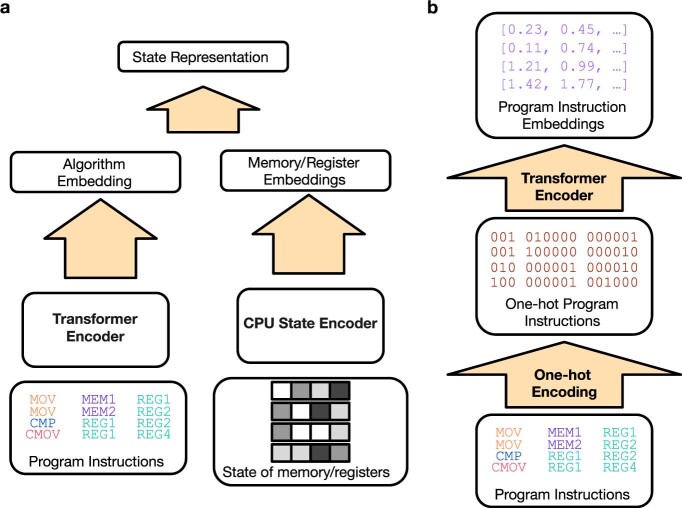
“Transformers are natural text encoders and have had much success with language models recently 14,34,41 .”
BackgroundMastering the game of Go with deep neural networks and tree search
Silver, D., Huang, A., Maddison, C. J., Guez, A., Sifre, L., van den Driessche, G., Schrittwieser, J., Antonoglou, I., Panneershelvam, V., Lanctot, M., et al. (2016) · Nature · doi:10.1038/nature16961 · Cited by 15,612
Self-citationA general reinforcement learning algorithm that masters chess, shogi, and Go through self-play
Silver, D., Hubert, T., Schrittwieser, J., Antonoglou, I., Lai, M., Guez, A., Lanctot, M., Sifre, L., Kumaran, D., Graepel, T., et al. (2018) · Science · doi:10.1126/science.aar6404 · Cited by 3,562 · cited 2×
“AlphaZero 33 is an RL algorithm that leverages MCTS as a policy improvement operator.”
MethodSelf-citationEvaluating Large Language Models Trained on Code
Chen, M., Tworek, J., Jun, H., Yuan, Q., Pinto, H. P. D. O., Kaplan, J., Edwards, H., Burda, Y., Joseph, N., Brockman, G., et al. (2021) · arXiv · doi:10.48550/arxiv.2107.03374 · Cited by 1,436
Mastering Atari, Go, chess and shogi by planning with a learned model
Schrittwieser, J., Antonoglou, I., Hubert, T., Simonyan, K., Sifre, L., Schmitt, S., Guez, A., Lockhart, E., Hassabis, D., Graepel, T., et al. (2020) · RePEc: Research Papers in Economics · Cited by 1,310
Self-citationMastering Atari, Go, chess and shogi by planning with a learned model
Schrittwieser, J., Antonoglou, I., Hubert, T., Simonyan, K., Sifre, L., Schmitt, S., Guez, A., Lockhart, E., Hassabis, D., Graepel, T., et al. (2020) · Nature · doi:10.1038/s41586-020-03051-4 · Cited by 1,214 · cited 3×
“Then, the true dynamics or dynamics network (for MuZero) as well as the prediction network f pred ( h t ) are used to simulate several trajectories that fill out a search tree, by sampling state transitions.”
MethodInfluentialSelf-citationMastering Atari, Go, Chess and Shogi by Planning with a Learned Model
Schrittwieser, J., Antonoglou, I., Hubert, T., Simonyan, K., Sifre, L., Schmitt, S., Guez, A., Lockhart, E., Hassabis, D., Graepel, T., et al. (2019) · arXiv · doi:10.48550/arxiv.1911.08265 · Cited by 1,214
Self-citationCompetition-level code generation with AlphaCode
Li, Y., Choi, D., Chung, J., Kushman, N., Schrittwieser, J., Leblond, R., Eccles, T., Keeling, J., Gimeno, F., Dal Lago, A., et al. (2022) · Science · doi:10.1126/science.abq1158 · Cited by 1,043
Self-citationCompetition-Level Code Generation with AlphaCode
Li, Y., Choi, D., Chung, J., Kushman, N., Schrittwieser, J., Leblond, R., Eccles, T., Keeling, J., Gimeno, F., Lago, A. D., et al. (2022) · arXiv · doi:10.48550/arxiv.2203.07814 · Cited by 1,043
Self-citation
Research works printed but not linked: 11
- Cormen, T. H. et al. Introduction to Algorithms (MIT Press, 2022).
- Chen, X., Liu, C. & Song, D. Towards synthesizing complex programs from input-output examples. In Proc. International Conference on Learning Representations (ICLR, 2018).
- Mehlhorn, K., Sanders, P. & Sanders, P. Algorithms and Data Structures: The Basic Toolbox Vol. 55. (Springer, 2008).
- Irvine, K. R. et al. Assembly Language for Intel-Based Computers (Prentice Hall, 2003).
- Sutton, R. S. & Barto, A. G. Reinforcement Learning: An Introduction 2nd edn (MIT Press, 2018).
- Maillard, O.-A., Ryabko, D. & Munos, R. Selecting the state-representation in reinforcement learning. Adv. Neural Inform. Proc. Syst.24, 2627–2635 (2011).
- Hahn, G. J. & Meeker, W. Q. Statistical Intervals: A Guide for Practitioners Vol. 92 (John Wiley & Sons, 2011).
- Warren, H. S. Hacker’s Delight (Pearson Education, 2013).
- Chen, X., Liu, C. & Song, D. Execution-guided neural program synthesis. In Proc. International Conference on Learning Representations (ICLR, 2018).
- Chen, X., Song, D. & Tian, Y. Latent execution for neural program synthesis beyond domain-specific languages. Adv. Neural Inform. Proc. Syst.34, 22196–22208 (2021).
- Ellis, K., Solar-Lezama, A. & Tenenbaum, J. Sampling for Bayesian program learning. Adv. Neural Inform. Proc. Syst.29, 1297–1305 (2016).
Cited by
Items 301–400 of 407
Modeling network evolution by multi-agent reinforcement learning
Li, D., Lin, T., Bao, Z., Gu, B., Zhang, Y., Yang, F., Sun, Y. W., Du, Z., & Holme, P. (2026) · Nature Communications · doi:10.1038/s41467-026-75382-1
Zeng, Y., Long, X., Zhang, H., Wang, Y., Sha, Z., & Tan, Q. (2026) · Swarm and Evolutionary Computation · doi:10.1016/j.swevo.2026.102566
Towards building model-based reinforcement learning agents that effectively adapt and generalize
Alver, S. (2025) · eScholarship@McGill (McGill) · doi:10.82308/14139
Scaling Multi-Agent Systems with Prospect-State Propagation
Chen, Z., Chen, M., & Karray, F. (2026) · Findings of the Association for Computational Linguistics: EMNLP (Findings of EMNLP) · doi:10.18653/2026.findings-emnlp.1585
Testing Cyber Power Theory in the AI Domain: Strategic Problems and Response ValidityPreprint
Thurnherr, L. (2026) · SSRN Electronic Journal · doi:10.2139/ssrn.6747880
Zhang, T. J., Yang, Y., Huang, Y., Lu, S., Schölkopf, B., & Jin, Z. (2025) · Preprints.org · doi:10.20944/preprints202508.1640.v1
Scalable Custom Instruction Identification using Graph Neural Networks and Reinforcement LearningPreprint
Hussein, E., Waschneck, B., & Mayr, C. (2025) · doi:10.36227/techrxiv.174702136.65195692/v1
Task Specialization Fine-Tuning for Contextual Reinforcement LearningPreprint
Zhou, J., Cho, J.-H., Zhou, T., Zheng, H., Zhang, J., Dong, R., Ma, Y., & Wu, C. (2026) · arXiv (Cornell University) · doi:10.48550/arxiv.2608.17180
OptiCom : A Unified Framework for State-Conditioned Composition in LLM-Driven OptimizationPreprint
Wei, C., Liu, S., Liu, L., Sun, N., Chen, B., He, Y., Jiang, B., Yu, F., & Shu, Y. (2026) · arXiv (Cornell University) · doi:10.48550/arxiv.2609.37221
When Algorithmic Exploration Becomes Cheap: A Case Study of Agentic Research in EDAPreprint
Zhu, K., Deng, Y., Hao, X., Jiang, L., Jiang, Z., Lan, C., Song, B., Su, P., & Wang, Y. (2026) · arXiv (Cornell University) · doi:10.48550/arxiv.2610.10129
AI Agent Swarms as Researchers: Progress, Challenges, and Open QuestionsPreprint
Gusev, S., & Neira, D. E. B. (2026) · arXiv · doi:10.48550/arxiv.2609.35719
Can Large Language Models Reinvent Foundational Algorithms?Preprint
Zhao, J., Luo, H., Wang, Y., Cao, Y., Sheng, P., & He, T. (2026) · arXiv (Cornell University) · doi:10.48550/arxiv.2604.05716
Beiträge zum Einsatz von Algorithmen des bestärkenden Lernens in der Echtwelt-Robotik
Gronauer, S., Diepold, K. C. 2. J., & München, T. U. (2024)
Programmation Génétique Cartésienne pour la Segmentation d'Images Biomédicales
Cortacero, K. (2023) · theses.fr (ABES) · doi:10.70675/79918042zfaa6z4f0az998az8effa75120a6
Qiu, X., Cao, H., Yang, L., Pang, J., Chang, Z., Wang, Z., Li, Y., LIU, D., Zhang, L., Tang, H., et al. (2026) · Chinese Journal of Traumatology · doi:10.1016/j.cjtee.2026.05.001
Self-citationA Scenario-Based Evaluation of CRQC+AI Vulnerability Spectrum for TLS 1.3 Cryptographic DependenciesPreprint
Grover, N., Haile, M., Pedersen, B., Uner, E., & Erickson, B. J. (2026) · arXiv (Cornell University) · doi:10.48550/arxiv.2608.23785
Xenoid Intelligence: AGI, Technological Cognition, and the Governance of Non-Human Cognitive Form
Chaib-draa, B. (n.d.) · PhilPapers (PhilPapers Foundation)
Moreno Urrea, F. A. (2023) · Digital Repository (Polytechnic University of Cartagena)
Motion Planning for Driverless Shuttles, Passenger Cars, and Trucks
Hartmannsgruber, A. (2025) · Refubium (Universitätsbibliothek der Freien Universität Berlin) · doi:10.17169/refubium-50243
Learning to Discover Iterative Spectral AlgorithmsPreprint
Liu, Z., Balabanov, O., Yang, Y. L., & Mahoney, M. W. (2026) · arXiv (Cornell University) · doi:10.48550/arxiv.2602.09530
Xiong, J., Liu, X., Wang, R., Liu, Z., Zhou, Y., Yan, Y., & Yang, Y. (2026) · arXiv (Cornell University) · doi:10.48550/arxiv.2605.18004
Discovering Lattice Reduction Strategies via Self-PlayPreprint
Malhou, M., Lauter, K., & Perret, L. (2026) · arXiv (Cornell University) · doi:10.48550/arxiv.2606.15301
Chen, W., Chen, J., Lin, Z., & Vong, C. (2026) · arXiv (Cornell University) · doi:10.48550/arxiv.2608.00981
ForgeStencil: Automating Per-Case Stencil Specialization from Kernels to 100+ Real ApplicationsPreprint
Chen, Y., Li, Y., Wan, W., Gan, L., Yang, G., & Liu, Z. (2026) · arXiv · doi:10.48550/arxiv.2609.06694
Self-citationOptiArena: Can LLMs Improve Executable Algorithms under Fixed Resource Budgets?
Peng, W., & Wang, X. (2026) · Findings of the Association for Computational Linguistics: EMNLP (Findings of EMNLP) · doi:10.18653/2026.findings-emnlp.692
Network World Models as Environments for Algorithm Design on Complex SystemsPreprint
Alagharu, R., Pu, H., Memon, Z., Song, X., Hu, Y., & Zhao, L. (2026) · arXiv (Cornell University) · doi:10.48550/arxiv.2610.01048
Agentic Verified Optimization of Real-World SoftwarePreprint
Ye, Z., Ghai, U., Qin, Z., Song, D., & Kong, S. (2026) · arXiv (Cornell University) · doi:10.48550/arxiv.2610.30188
SpecPilot: Autonomous Algorithm Discovery and Systems Optimization for Speculative DecodingPreprint
Li, K., Chai, W., Liang, Y., Hu, Y., Xu, S., Pan, Y., Zheng, W. X., Ramchandran, K., Keutzer, K., & Jiao, J. (2026) · arXiv (Cornell University) · doi:10.48550/arxiv.2611.02501
HPC-Bench: A Comprehensive Benchmark for High Performance Computing CodesPreprint
Cui, B., Yin, J., Ramesh, T., Lim, L., Hernandez, O., & Zhou, K.-R. (2026) · arXiv (Cornell University) · doi:10.48550/arxiv.2611.02752
Where to Search: Measure the Prior-Structured Search Space of LLM AgentsPreprint
Song, Z.-Y. (2025) · arXiv (Cornell University) · doi:10.48550/arxiv.2510.14846
QuantumMind: Constraint-Grounded Agentic Reasoning for Speedup Analysis in Quantum ComputingPreprint
Zuo, Y., Fu, Z., Nie, Z., Zhu, Z., & Wang, H. (2026) · arXiv (Cornell University) · doi:10.48550/arxiv.2608.07743
Task Agnostic Architecture for Algorithm Induction via Implicit CompositionPreprint
Sindhi, S. J., & Budvytis, I. (2024) · arXiv (Cornell University) · doi:10.48550/arxiv.2404.02450
On Zero-Shot Reinforcement Learning
Jeen, S. (2024) · arXiv (Cornell University) · doi:10.17863/cam.121637
Maes, L. (2023) · Papyrus : Institutional Repository (Université de Montréal) · doi:10.71781/10059
Contextual cues for deep learning models of code
Shrivastava, D. (2023) · Papyrus : Institutional Repository (Université de Montréal) · doi:10.71781/10146
Selbstreflektierendes Deep Learning für sequentielle Entscheidungsprobleme
Pirnay, J., Grimm, D. G., & München, T. U. (2025) · mediaTUM (Technical University of Munich)
Questioning the Experimental Protocol in Two Nobel Prizes
Weng, J., Schmidt, C., Wang, D., & Xie, M. (2025) · International Conference on Artificial Intelligence and Digital Ethics (ICAIDE) · doi:10.1109/icaide65466.2025.11189692
(2024) · Directory of Open access Books (OAPEN Foundation)
Khudhair, K. M., & Khudhair, B. M. (2026) · Algorithms · doi:10.3390/a19090805
Wang, L. (2025) · Procedia Computer Science · doi:10.1016/j.procs.2025.04.411
Distributed security resource allocation strategy based on deep reinforcement learning
Liu, T. (2025) · Journal of Computational Methods in Sciences and Engineering · doi:10.1177/14727978251364445
Model of models -- Part 1Preprint
Komarovsky, S. (2023) · arXiv (Cornell University) · doi:10.48550/arxiv.2308.04600
Scientist World: Grow a Research World for AI-ScientistsPreprint
Lu, T., Konan, S., & Liu, Z. (2026) · arXiv (Cornell University) · doi:10.48550/arxiv.2611.08478
On Resilient Communication, Computation Task Distribution and Scaling under Uncertainty
Latzko, J. V. (2025) · Qucosa (Saxon State and University Library Dresden)
Na, X., Guo, L., Xi, C., Wang, Y., & Shan, C. (2025) · IEEE International Conference on Smart Innovations in Systems, Infrastructure, Mechanical, Power, AI and Computing Technologies (SISIMPACT) · doi:10.1109/sisimpact67725.2025.11439379
CDA-MBPO:Corrected Data Aggregation for Model-Based Policy Optimization
Du, X., Zhong, S., Ying, W., Wang, Y., & Gong, S. (2024) · IEEE International Conference on Acoustics Speech and Signal Processing · doi:10.1109/icassp48485.2024.10446392
AI-Generated Distributed Algorithms: Paving the Way for More Dependable Distributed Systems
Vaz, D., Matos, D. R., Pardal, M. L., & Correia, M. P. (2025) · European Dependable Computing Conference · doi:10.1109/edcc-c66476.2025.00014
ReLATE: Accelerating Tensor Decomposition via Safe and Efficient Learning of Sparse EncodingsPreprint
Helal, A. E., Checconi, F., Laukemann, J., Soh, Y., Tithi, J. J., Petrini, F., & Choi, J. (2025) · arXiv (Cornell University) · doi:10.48550/arxiv.2509.00280
AnAlphaZero Agent for Just 4 Fun, a Non-Deterministic Game with Imperfect Information
Gastegger, M. (2024) · reposiTUm (TU Wien) · doi:10.34726/hss.2024.115042
Feldmann, J. D. M., & Osório, F. S. (2023) · doi:10.11606/003245257
Racing Against Automation: Dynamic Incentives When AI Can Preempt the HumanPreprint
Chen, Y., Tian, F., Xiao, Y., & Zhu, Y. (2026) · SSRN Electronic Journal · doi:10.2139/ssrn.6960301
Artificial intelligence-based automated algorithm discovery: A systematic literature review
Tasarsu, M., Tokmak, A. V., & Catal, C. (2026) · Applied Soft Computing · doi:10.1016/j.asoc.2026.116823
EvoTADASHI: Genetic Programming for High-Performance Code Optimization
Batista, J. E., Vatai, E., Валентинович, Д. А., & Wahib, M. (2026) · Lecture notes in computer science · doi:10.1007/978-3-032-23604-3_3
Cornelio, C., Srivastava, K., Dash, S., Cory-Wright, R., Trager, B., & Horesh, L. (2026) · Research Square · doi:10.21203/rs.3.rs-8424165/v1
Lu, W., Liu, R., Du, H., & Yi, X. (2026) · arXiv (Cornell University) · doi:10.48550/arxiv.2610.24835
Laia, F., Wau, F. T., & Manurung, J. (2025) · Jurnal Mandiri IT · doi:10.35335/mandiri.v14i1.401
Learning particle dynamics: from diffusion to interactions
Fernández-Fernández, G. (2025) · UPCommons institutional repository (Universitat Politècnica de Catalunya) · doi:10.5821/dissertation-2117-448803
Temporal dynamics in emergent communication
Lipinski, O. (2025) · ePrints Soton (University of Southampton)
Optimizing the quantum stack: a machine learning approach
Fitzek, D. (2024) · Chalmers Research (Chalmers University of Technology)
Learning to Act Beyond Language: Expanded Action Spaces for Sequential Decision-Making with LLMs
Yue, Z., Wang, W., Zhan, Y., Li, J., Dahlmeier, D., & Johansson, F. (2026) · Findings of the Association for Computational Linguistics: EMNLP (Findings of EMNLP) · doi:10.18653/2026.findings-emnlp.2275
Reinforcement learning-driven fine-grained IR optimisation for deep learning workloads
He, G. (2026) · Apollo (University of Cambridge) · doi:10.17863/cam.133804
Efficient and Practical Privacy-Preserving Face Recognition Protocol
Zhang, J., & Zhang, Y. (2024) · Communications in computer and information science · doi:10.1007/978-981-96-0151-6_18
Neural-guided heuristic tree search for deep bidirectional decision-making: a survey
Zhao, D., Tu, S., & Xu, L. (2026) · Artificial Intelligence Review · doi:10.1007/s10462-026-11675-7
Ma, L., Wang, H., Zhang, X., Yuan, Y., & Yuan, X. (2026) · Environmental Earth Sciences · doi:10.1007/s12665-026-12971-9
Artificial Intelligence Algorithms for Large Economic and Computer Games
Li, Z. (2024) · Deep Blue (University of Michigan) · doi:10.7302/22887
Agentic evolution of physically constrained foundation modelsPreprint
Zhang, J., Sun, W., Wang, C., Li, S., Che, C., Han, C., Meng, D., Yang, J., Wang, Y., & Hou, R. (2026) · arXiv (Cornell University) · doi:10.48550/arxiv.2606.25532
A Review of Emerging Technologies in Robotic Arm for Sorting Applications
Joseph, O. I., Ayodeji, S. P., & Adeyeri, M. K. (2026) · International Journal of Sustainable Construction Engineering and Technology (Universiti Tun Hussein Onn Malaysia)
A Systematic Study of Sorting Algorithms in Modern Architectures
COLUCCI, A. (2023) · Electronic Theses and Dissertations Repository (University of Pisa)
When Do Skills Help Reinforcement Learning? A Theoretical Analysis of Temporal AbstractionsPreprint
Li, Z., Poesia, G., & Solar-Lezama, A. (2024) · arXiv (Cornell University) · doi:10.48550/arxiv.2406.07897
Generating environments and pre-training agents for efficient reinforcement learning
Jelley, A. (2025) · ERA · doi:10.7488/era/6431
Super Intelligence and General IntelligencePreprint
Zohourianshahzadi, Z. (2026) · SSRN Electronic Journal · doi:10.2139/ssrn.7550638
CEDAR: Agent-Orchestrated Tree Search for Goal-Directed Optimization of Complex Systems
Tian, Y. (2026) · Conference on Artificial Life (ALIFE) · doi:10.1162/isal.a.1003
Begam, S., & Yadav, K. K. (2024) · The International Journal of Engineering and Science · doi:10.9790/1813-13123236
Begam, S., & Nayak, A. (2025) · International Journal for Research in Applied Science and Engineering Technology · doi:10.22214/ijraset.2025.71579
Athya, T. (2025) · International Journal for Research in Applied Science and Engineering Technology · doi:10.22214/ijraset.2025.71999
DISCOVERING SEARCH ALGORITHM IN ARRAYS WITH DEEP REINFORCEMENT LEARNING
Kabdolla, T., & Yeliussizov, D. (2026) · Universum Technical sciences · doi:10.32743/unitech.2026.145.4.22435
PARALLEL DEQUE-FREE PARTITION DUAL-DEQUE MERGE SORTING ALGORITHM
Ketchaya, S., & Rattanatranurak, A. (2024) · Journal of Southwest Jiaotong University · doi:10.35741/issn.0258-2724.59.2.32
Towards Faster Matrix Diagonalization with Graph Isomorphism Networks and the AlphaZero FrameworkPreprint
Zollicoffer, G., Bhatta, K., Bhattarai, M., Romero, P., Negre, C. F. A., Niklasson, A. M. N., & Adedoyin, A. A. (2024) · arXiv (Cornell University) · doi:10.48550/arxiv.2407.00779
Time Complexity Optimization of Data Sorting Using Super Sort Algorithm Method
Raoda, & Ilham, A. A. (2024) · International Conference on Intelligent Cybernetics Technology & Applications (ICICyTA) · doi:10.1109/icicyta64807.2024.10913159
The Segregated and Hybrid TBPSA algorithm with applications in SRF test pattern scheduling
Bulhac, M.-O., & Croitoru, E. N. (2025) · Genetic and Evolutionary Computation Conference Companion (GECCO Companion) · doi:10.1145/3712255.3726577
Zhao, R., Shuid, A. N., Wang, Z., & Ding, L. (2025) · Journal of Artificial Intelligence and Technology · doi:10.37965/jait.2025.0718
Learning to Update: Using Reinforcement Learning to Discover Policies for List Update
Quaye, I. A. (2024) · DSpace@MIT (Massachusetts Institute of Technology)
The Future of Data Sorting: Integrating AI for Enhanced Efficiency and Accuracy
Mezied, A. A., & Abu-Naser, S. S. (2025) · PhilPapers (PhilPapers Foundation)
Meta aprendizaje de la señal de entrenamiento para entornos con refuerzos dispersos
Pappalardo, O. (2024) · Repositorio Digital Institucional de la Universidad de Buenos Aires (Universidad de Buenos Aires)
SymMaP: Improving Computational Efficiency in Linear Solvers through Symbolic PreconditioningPreprint
Wang, H., Wang, J., Ma, M., Shao, H., & Liu, H. (2025) · arXiv (Cornell University) · doi:10.48550/arxiv.2510.24170
Campoy García, D. (2024) · UPCommons institutional repository (Universitat Politècnica de Catalunya)
Exploratory Wargaming with a “Superhuman” Tactician in the Team : A Controlled Experiment
Bell, N., Brynielsson, J., Cohen, M., Collander-Brown, S., Elg, J., Ericsson, L., Ivari, J., Limér, C., & Mannberg, N. (2025) · Försvarshögskolans publikationsdatabas
Emergent in–place, comparison–based sorting in deep Q-networks
Shiga, K., Ozawa, K., & Yamazaki, K. (2026) · Knowledge-Based Systems · doi:10.1016/j.knosys.2025.115254
Optimizing Sorting Efficiency Through MaTe: A Digit-Based Algorithm for Large-Scale Datasets
Kumar, P., & Nongmeikapam, K. (2025) · International Conference on Information Systems and Computer Networks (ISCON) · doi:10.1109/iscon65210.2025.11340985
Highly Parallel Sorting Network Verification Using FPGAs
Papaphilippou, P. (2026) · Chips · doi:10.3390/chips5010005
Black box meta-learning intrinsic rewards for sparse-reward environments
Pappalardo, O., Santos, J. M., & Ramele, R. (2024) · El Servicio de Difusión de la Creación Intelectual (National University of La Plata)
Morishita, T., & Terufumi, M. (2026) · Terrestrial Environment Research Center (University of Tsukuba) · doi:10.15068/0002023067
Optimised Fitness Functions for Automated Improvement of Software’s Execution Time
Bouras, D. S., Hanna, C., & Petke, J. (2026) · Lecture notes in computer science · doi:10.1007/978-3-032-24839-8_4
Developing a Negative Fractional CountingSort Algorithm for Fast Real Number Sorting
Sarker, D., Gomes, D., Dey, T., Hasan, M. M., & Nandi, D. (2025) · AIUB Journal of Science and Engineering (AJSE) · doi:10.53799/gh76b857
UPSORT: Design and Analysis of Processing-in-Memory Sorting Algorithms using UPMEM
Valdivieso, I. V., Pavón, J., Rojas, C., Rubio, J. C., Ramirez, M., Villa, L., Valero, M., Ünsal, O., & Cristal, A. (2026) · IEEE International Symposium on Performance Analysis of Systems and Software (ISPASS) · doi:10.1109/ispass69572.2026.00032
Uzlah, L. I., Statiswaty, S., & Nangi, J. (2026) · Simtek jurnal sistem informasi dan teknik komputer · doi:10.51876/simtek.v11i1.1772
Machine Learning-Based Resolution of Strategic Conflicts in U-Space Airspaces
González, M., Amarillo, S., Tejedor, J. V. B., & Sanchis, A. (2026) · EASN International Conference on Innovation in Aviation & Space Towards Sustainability Today & Tomorrow · doi:10.3390/engproc2026133186
Optimized N-deque partition dual-deque merge string sorting algorithm
Ketchaya, S., & Rattanatranurak, A. (2026) · Scientific Reports · doi:10.1038/s41598-026-46549-z
Metadata
- Authors
- Mankowitz, D. J., Michi, A., Zhernov, A., Gelmi, M., Selvi, M., Paduraru, C., Leurent, E., Iqbal, S., Lespiau, J.-B., Ahern, A., Köppe, T., Millikin, K., Gaffney, S., Elster, S., Broshear, J., Gamble, C., Milan, K., Tung, R., Hwang, M., Cemgil, T., Barekatain, M., Li, Y., Mandhane, A., Hubert, T., Schrittwieser, J., Hassabis, D., Kohli, P., Riedmiller, M., Vinyals, O., & Silver, D.
- Affiliations
- Google DeepMind (United Kingdom) (GB)
- Google (United States) (US)
- Corresponding author
- Mankowitz, Daniel J.
- ORCID
- Venue
- Nature
- Published
- 2023-06-07
- Volume
- 618
- Issue
- 7964
- Pages
- 257-263
- ISSN
- 0028-0836 (ISSN-L)
- 1476-4687
- PMC
- PMC10247365
- OpenAlex
- W4379739787
- Semantic Scholar
- 13f775d1b7f9de1168b5d37a2622ee1938bf43cd
- Cited by
- 177
- References
- 58
- Citations by year
- 2026: 38 · 2025: 68 · 2024: 53 · 2023: 18
- FWCI
- 16.66
- Type
- journal article
- Language
- en
- Open access
- hybrid
- doi.org
- Licence
- cc-by
- creativecommons.org/licenses/by/4.0 (tdm)
- creativecommons.org/licenses/by/4.0 (vor)
- Locations
- Nature (publishedVersion, cc-by)
- PubMed Central (publishedVersion, cc-by)
- PubMed (publishedVersion)
- RePEc: Research Papers in Economics (submittedVersion)
- Funders
- DeepMind
- Topics
- Physical Sciences › Computer Science › Artificial Intelligence › Evolutionary Algorithms and Applications
- Physical Sciences › Computer Science › Artificial Intelligence › Artificial Intelligence in Games
- Physical Sciences › Computer Science › Information Systems › Software Engineering Research
- Keywords
- algorithm discovery, sorting algorithms, deep reinforcement learning, C++ standard library, performance optimization
About these checks
Registry, retraction, Cites and statistics results are computed, not judged, with one exception: a printed reference that no index lists is read once by a model before it counts as a citation error. Claims are extracted by a model and kept only when their quote appears verbatim in the text; each cited source is then checked, with a model’s help, for whether it says what the claim relies on. Those verdicts can be wrong — read the claim’s quote and the cited source before relying on one.
Statistics and arithmetic are recomputed, not judged.
Confidence bands are shown only for fields calibrated on our annotated test set. None is calibrated yet, so no band is shown.
What counts as a claim ›How we measure confidence ›How we check this ›
Are you an author, or do you see a problem with this page? Request a review
Data sources
Bibliographic data: Semantic Scholar, OpenAlex, Crossref.
Contains information from the Semantic Scholar Academic Graph Datasets, made available under the ODC Attribution License (ODC-BY 1.0).
Semantic Scholar’s data is described in: Kinney, R., et al. (2023). The Semantic Scholar Open Data Platform. arXiv:2301.10140.
