

Health system-scale language models are all-purpose prediction engines
Open accessThe DOI matches its Crossref record; 38 of the 38 references it cites were found in a registry or an index.
Abstract
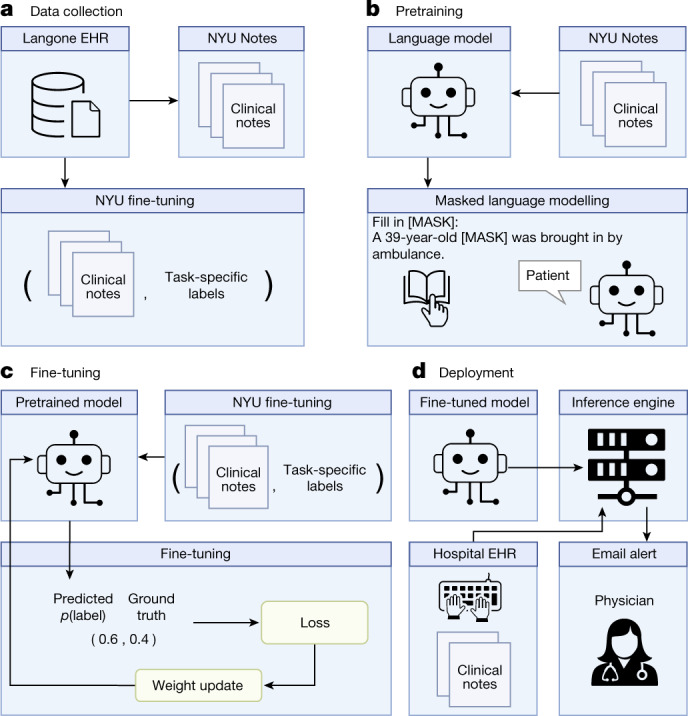
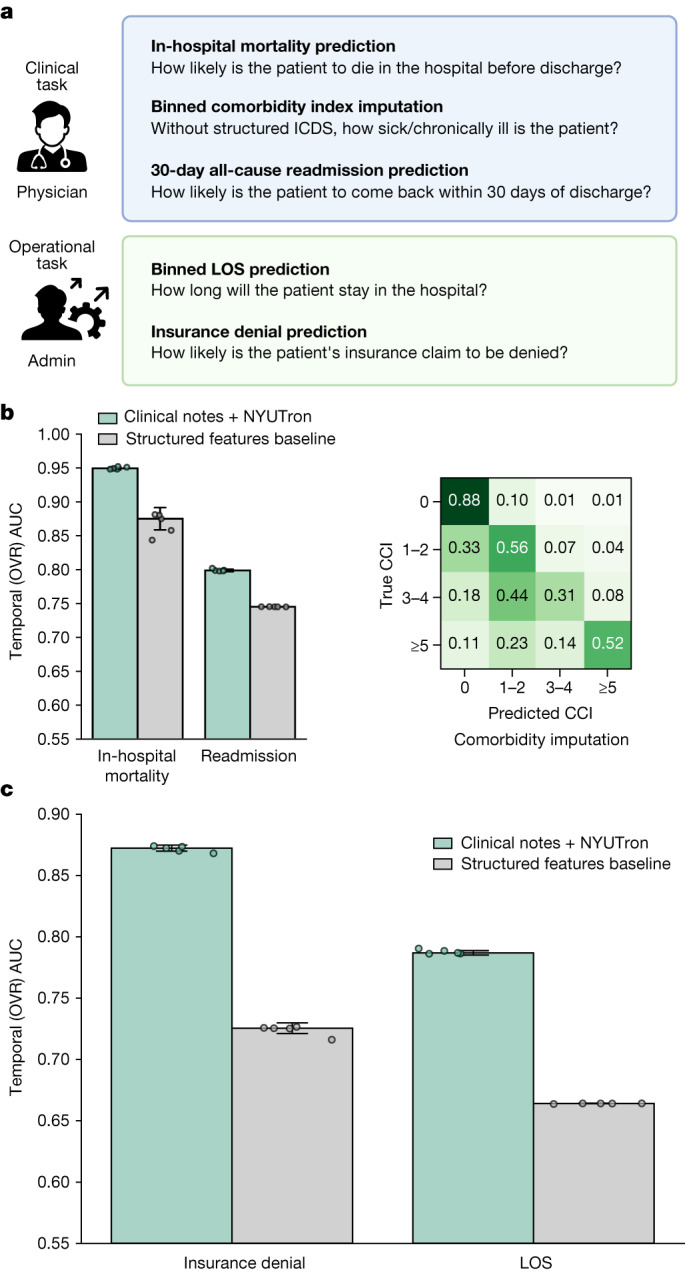
Physicians make critical time-constrained decisions every day. Clinical predictive models can help physicians and administrators make decisions by forecasting clinical and operational events. Existing structured data-based clinical predictive models have limited use in everyday practice owing to complexity in data processing, as well as model development and deployment 1–3 . Here we show that unstructured clinical notes from the electronic health record can enable the training of clinical language models, which can be used as all-purpose clinical predictive engines with low-resistance development and deployment. Our approach leverages recent advances in natural language processing 4,5 to train a large language model for medical language (NYUTron) and subsequently fine-tune it across a wide range of clinical and operational predictive tasks. We evaluated our approach within our health system for five such tasks: 30-day all-cause readmission prediction, in-hospital mortality prediction, comorbidity index prediction, length of stay prediction, and insurance denial prediction. We show that NYUTron has an area under the curve (AUC) of 78.7–94.9%, with an improvement of 5.36–14.7% in the AUC compared with traditional models. We additionally demonstrate the benefits of pretraining with clinical text, the potential for increasing generalizability to different sites through fine-tuning and the full deployment of our system in a prospective, single-arm trial. These results show the potential for using clinical language models in medicine to read alongside physicians and provide guidance at the point of care.
Overview
The claims and statistics of this paper haven’t been checked yet.
Free: it reads the open-access text and checks the first 5 claims that cite a source we can check. Create a free account to check every claim.
Integrity signals
Registry
Cites
Statistics
Figures
Verification
Claims the paper makes
The claims and statistics of this paper haven’t been checked yet.
Free: it reads the open-access text and checks the first 5 claims that cite a source we can check. Create a free account to check every claim.
Claims other papers make about this one
Each is checked against this paper’s own text: does it say what the citing paper says it does?
The source backs part of the claim, not all of it — or backs it for a different population, condition or comparison.
In the citing paper
“Large Language Models (LLMs) have attained human-level accuracy on medical question-answer (QA) benchmarks.”
From Limitations of large language models in clinical problem-solving arising from inflexible reasoning (2025) · cites this paper as [4]
Experimental — accuracy not yet measuredThe cited source says what the claim attributes to it.
In the citing paper
“However, fine-tuned LLMs have been shown to solve real-world problems such as predicting clinical outcomes just based on unstructured text data in EHRs13.”
From Large language models and multimodal foundation models for precision oncology (2024) · cites this paper as [13]
The check wasn’t confident either way, so it gives no verdict — never disputed.
In the citing paper
“These AI systems facilitate real-time image analysis, providing the surgeon with enhanced visualizations of the surgical site and critical anatomical structures, thus improving decision-making and reducing intraoperative risks.102”
From A foundational architecture for AI agents in healthcare (2025) · cites this paper as [102]
Experimental — accuracy not yet measuredThe check wasn’t confident either way, so it gives no verdict — never disputed.
In the citing paper
“Thus, the streamlined incorporation of these regulatory requirements into business processes via the QMS assures enduring safety, effectiveness, ethicality, regulatory compliance, and alignment with organizational and user needs as AI-enabled methodologies, such as LLMs, evolve10.”
From Implementing quality management systems to close the AI translation gap and facilitate safe, ethical, and effective health AI solutions (2023) · cites this paper as [10]
Experimental — accuracy not yet measuredIn the citing paper
“NYUTron has an AUC of 78.7-94.9%.”
From Edge AI for Early Detection of Chronic Diseases and the Spread of Infectious Diseases: Opportunities, Challenges, and Future Directions (2023) · cites this paper as [77]
1 more claim about this paper
Create a free account to see every claim other papers make about this one.
Self-check
Percentages, sums and reported differences re-computed from the paper’s own numbers.
The self-check needs the paper’s full text.
Citations
Cites
Adam: A Method for Stochastic Optimization
Kingma, D. P., & Ba, J. (2014) · arXiv · doi:10.48550/arxiv.1412.6980 · Cited by 98,946
Scikit-learn: Machine Learning in Python
Pedregosa, F., Varoquaux, G., Gramfort, A., Michel, V., Thirion, B., Grisel, O., Blondel, M., Müller, A., Nothman, J., Louppe, G., et al. (2012) · arXiv · doi:10.48550/arxiv.1201.0490 · Cited by 71,016
XGBoost: A Scalable Tree Boosting System
Chen, T., & Guestrin, C. (2016) · Proceedings of the 22nd ACM SIGKDD International Conference on Knowledge Discovery and Data Mining · doi:10.1145/2939672.2939785 · Cited by 54,569
Charlson, M. E., Pompei, P., Ales, K. L., & MacKenzie, C. R. (1987) · Journal of Chronic Diseases · doi:10.1016/0021-9681(87)90171-8 · Cited by 49,742
APACHE II: A severity of disease classification system
KNAUS, W. A., DRAPER, E. A., WAGNER, D. P., & ZIMMERMAN, J. E. (1985) · Critical Care Medicine · doi:10.1097/00003246-198510000-00009 · Cited by 13,664
Scaling Laws for Neural Language Models
Kaplan, J., McCandlish, S., Henighan, T., Brown, T. B., Chess, B., Child, R., Gray, S., Radford, A., Wu, J., & Amodei, D. (2020) · arXiv · doi:10.48550/arxiv.2001.08361 · Cited by 9,550 · cited 1×
“Our approach leverages recent advances in natural language processing that suggest that sufficiently scaled, self-supervised LLMs can out-perform strongly supervised approaches on non-medical predictive tasks 4,5,13 .”
MethodMIMIC-III, a freely accessible critical care database
Johnson, A. E. W., Pollard, T. J., Shen, L., Lehman, L.-W. H., Feng, M., Ghassemi, M., Moody, B., Szolovits, P., Anthony Celi, L., & Mark, R. G. (2016) · Scientific Data · doi:10.1038/sdata.2016.35 · Cited by 8,141
Transection of the oesophagus for bleeding oesophageal varices
Pugh, R. N. H., Murray-Lyon, I. M., Dawson, J. L., Pietroni, M. C., & Williams, R. (1973) · Journal of British Surgery · doi:10.1002/bjs.1800600817 · Cited by 7,941
Le Gall, J.-R. (1993) · JAMA: The Journal of the American Medical Association · doi:10.1001/jama.270.24.2957 · Cited by 7,773
APACHE II: a severity of disease classification system.
Knaus, W. A., Draper, E. S., Wagner, D. P., & Zimmerman, J. E. (1985) · PubMed · Cited by 6,034
Research works printed but not linked: 9
- Devlin, J., Chang, M.-W., Lee, K. & Toutanova, K. BERT: pre-training of deep bidirectional transformers for language understanding. in Proc. 2019 NAACL: Human Language Technologies (eds Burstein, J., Doran, C. & Solorio, T.) 4171-4186 (Association for Computational Linguistics, 2019).
- Brown, T. B. et al. Language models are few-shot learners. in Proc. NeurIPS (eds Wallach, H. et al.) 1877-1901 (Neural Information Processing Systems, 2020).
- Child, C. G. & Turcotte, J. G. Surgery and portal hypertension. Major Prob. Clin. Surg. 1, 1-85 (1964).
- van Walraven, C., Wong, J. & Forster, A. J. LACE+ index: extension of a validated index to predict early death or urgent readmission after hospital discharge using administrative data. Open Med. 6, 80-90 (2012).
- Perez, E., Kiela, D. & Cho, K. True few-shot learning with language models. in Proc. NeurIPS (eds Ranzato, M. et al.) 11054-11070 (Neural Information Processing Systems, 2021).
- Wolf, T. et al. Transformers: state-of-the-art natural language processing. in Proc. 2020 EMNLP (eds Webber, B., Cohn, T., He, Y. & Liu, Y.) 38-45 (Association for Computational Linguistics, 2020).
- Loshchilov, I. & Hutter, F. Decoupled weight decay regularization. ICLR https://openreview.net/ forum?id=Bkg6RiCqY7 (2019).
- NCBI Literature Resources. Download PubMed data. https://pubmed.ncbi.nlm.nih.gov/ download/ (2022).
- National Library of Medicine. PubMed Central: PMC article datasets. https://www.ncbi. nlm.nih.gov/pmc/tools/textmining/ (2022).
Cited by
A whole-slide foundation model for digital pathology from real-world data
Xu, H., Usuyama, N., Bagga, J., Zhang, S., Rao, R., Naumann, T., Wong, C., Gero, Z., González, J., Gu, Y., et al. (2024) · Nature · doi:10.1038/s41586-024-07441-w · Cited by 921
The TRIPOD-LLM reporting guideline for studies using large language models
Gallifant, J., Afshar, M., Ameen, S., Aphinyanaphongs, Y., Chen, S., Cacciamani, G., Demner-Fushman, D., Dligach, D., Daneshjou, R., Fernandes, C., et al. (2025) · Nature Medicine · doi:10.1038/s41591-024-03425-5 · Cited by 615
“The rapid advancements in LLMs have stretched existing regulatory and governance structures to their limits, exposing a patchwork of solutions that do not fully encompass the nuances of these all-purpose models 6–8 .”
Self-citationZack, T., Lehman, E., Suzgun, M., Rodriguez, J. A., Celi, L. A., Gichoya, J., Jurafsky, D., Szolovits, P., Bates, D. W., Abdulnour, R.-E. E., et al. (2024) · The Lancet Digital Health · doi:10.1016/s2589-7500(23)00225-x · Cited by 510
The application of large language models in medicine: A scoping review
Meng, X., Yan, X., Zhang, K., Liu, D., Cui, X., Yang, Y., Zhang, M., Cao, C., Wang, J., Wang, X., et al. (2024) · iScience · doi:10.1016/j.isci.2024.109713 · Cited by 414
A study of generative large language model for medical research and healthcare
Peng, C., Yang, X., Chen, A., Smith, K. E., PourNejatian, N., Costa, A. B., Martin, C., Flores, M. G., Zhang, Y., Magoc, T., et al. (2023) · npj Digital Medicine · doi:10.1038/s41746-023-00958-w · Cited by 408
“A recent study 32 examined an LLM developed at New York University, i.e., NYUTron, and our previously developed Gator-Tron 15 for prediction of readmission, in-hospital mortality, comorbidity, length of stay, and insurance denial, demonstrating the potential utility of LLMs in healthcare.”
Self-citationCurrent applications and challenges in large language models for patient care: a systematic review
Busch, F., Hoffmann, L., Rueger, C., van Dijk, E. H., Kader, R., Ortiz-Prado, E., Makowski, M. R., Saba, L., Hadamitzky, M., Kather, J. N., et al. (2025) · Communications Medicine · doi:10.1038/s43856-024-00717-2 · Cited by 358
Systematic Review of Large Language Models for Patient Care: Current Applications and Challenges
(2024) · doi:10.1101/2024.03.04.24303733 · Cited by 356
Comparing ChatGPT and GPT-4 performance in USMLE soft skill assessments
Brin, D., Sorin, V., Vaid, A., Soroush, A., Glicksberg, B. S., Charney, A. W., Nadkarni, G., & Klang, E. (2023) · Scientific Reports · doi:10.1038/s41598-023-43436-9 · Cited by 319
Empowering biomedical discovery with AI agents
Gao, S., Fang, A., Huang, Y., Giunchiglia, V., Noori, A., Schwarz, J. R., Ektefaie, Y., Kondic, J., & Zitnik, M. (2024) · Cell · doi:10.1016/j.cell.2024.09.022 · Cited by 315
Large language models empowered agent-based modeling and simulation: a survey and perspectives
Gao, C., Lan, X., Li, N., Yuan, Y., Ding, J., Zhou, Z., Xu, F., & Li, Y. (2024) · Humanities and Social Sciences Communications · doi:10.1057/s41599-024-03611-3 · Cited by 294
Mental-LLM: Leveraging Large Language Models for Mental Health Prediction via Online Text Data
Xu, X., Yao, B., Dong, Y., Gabriel, S., Yu, H., Hendler, J., Ghassemi, M., Dey, A. K., & Wang, D. (2024) · Proceedings of the ACM on Interactive, Mobile, Wearable and Ubiquitous Technologies · doi:10.1145/3643540 · Cited by 278
Self-citationLarge language models for scientific discovery in molecular property prediction
Zheng, Y., Koh, H. Y., Ju, J., Nguyen, A. T. N., May, L. T., Webb, G. I., & Pan, S. (2025) · Nature Machine Intelligence · doi:10.1038/s42256-025-00994-z · Cited by 258
Large Models for Time Series and Spatio-Temporal Data: A Survey and Outlook
Jin, M., Kong, Y., Liang, Y., Zhang, C., Xue, S., Wang, X., Zhang, J., Wang, Y., Chen, H., Li, X., et al. (2026) · ACM Computing Surveys · doi:10.1145/3821637 · Cited by 251
Medical large language models are vulnerable to data-poisoning attacks
Alber, D. A., Yang, Z., Alyakin, A., Yang, E., Rai, S., Valliani, A. A., Zhang, J., Rosenbaum, G. R., Amend-Thomas, A. K., Kurland, D. B., et al. (2025) · Nature Medicine · doi:10.1038/s41591-024-03445-1 · Cited by 242
“As LLMs are increasingly deployed in healthcare settings 9,16,17 , their susceptibility to online misinformation presents significant risks that must be investigated.”
Self-citationA Survey of Large Language Models in Medicine: Progress, Application, and Challenge
Zhou, H., Liu, F., Gu, B., Zou, X., Huang, J., Wu, J., Li, Y., Chen, S. S., Zhou, P., Liu, J., et al. (2023) · arXiv · doi:10.48550/arxiv.2311.05112 · Cited by 240
“Discussion Even though using LLMs for clinical report generation or summarization has been proven to be more complete and more accurate than the human counterpart [139], there are still concerns with hallucination, as well as a tendency to approach inputs with a literal view instead of an…”
BackgroundAI generates covertly racist decisions about people based on their dialect
Hofmann, V., Kalluri, P. R., Jurafsky, D., & King, S. (2024) · Nature · doi:10.1038/s41586-024-07856-5 · Cited by 233
“12 and 13 and Supplementary Tables 15 and 16).”
Foundation Models for Time Series Analysis: A Tutorial and Survey
Liang, Y., Wen, H., Nie, Y., Jiang, Y., Jin, M., Song, D., Pan, S., & Wen, Q. (2024) · Proceedings of the 30th ACM SIGKDD Conference on Knowledge Discovery and Data Mining · doi:10.1145/3637528.3671451 · Cited by 225
Concepts and applications of digital twins in healthcare and medicine
Zhang, K., Zhou, H.-Y., Baptista‐Hon, D. T., Gao, Y., Liu, X., Oermann, E. K., Xu, S. H., Jin, S., Zhang, J., Sun, Z., et al. (2024) · Patterns · doi:10.1016/j.patter.2024.101028 · Cited by 225
Self-citationA guide to artificial intelligence for cancer researchers
Perez-Lopez, R., Ghaffari Laleh, N., Mahmood, F., & Kather, J. N. (2024) · Nature Reviews Cancer · doi:10.1038/s41568-024-00694-7 · Cited by 211
“For example, the medicine-specific LLM NYUTron was specifically trained on patient electronic health records (EHRs), enabling it to predict clinical outcomes 121 .”
Current AI technologies in cancer diagnostics and treatment
Tiwari, A., Mishra, S., & Kuo, T.-R. (2025) · Molecular Cancer · doi:10.1186/s12943-025-02369-9 · Cited by 207
“The dataset is more than twice the size of TCGA in patient count and over five times larger in tile volume, providing a robust foundation for model training [70].”
Advances in molecular pathology and therapy of non-small cell lung cancer
Huang, Q., Li, Y., Huang, Y., Wu, J., Bao, W., Xue, C., Li, X., Dong, S., Dong, Z., & Hu, S. (2025) · Signal Transduction and Targeted Therapy · doi:10.1038/s41392-025-02243-6 · Cited by 197
Automated Real-World Data Integration Improves Cancer Outcome Prediction
Jee, J., Fong, C., Pichotta, K., Tran, T. N., Luthra, A., Waters, M., Fu, C., Altoe, M., Liu, S.-Y., Maron, S. B., et al. (2024) · Nature · doi:10.1038/s41586-024-08167-5 · Cited by 188
Zero shot health trajectory prediction using transformer
Renc, P., Jia, Y., Samir, A. E., Wąs, J., Li, Q., Bates, D. W., & Sitek, A. (2024) · npj Digital Medicine · doi:10.1038/s41746-024-01235-0 · Cited by 189
Foundation models and intelligent decision-making: Progress, challenges, and perspectives
Huang, J., Xu, Y., Wang, Q., Wang, Q., Liang, X., Wang, F., Zhang, Z., Wei, W., Zhang, B., Huang, L., et al. (2025) · The Innovation · doi:10.1016/j.xinn.2025.100948 · Cited by 192
A generalist medical language model for disease diagnosis assistance
Liu, X., Liu, H., Yang, G., Jiang, Z., Cui, S., Zhang, Z., Wang, H., Tao, L., Sun, Y., Song, Z., et al. (2025) · Nature Medicine · doi:10.1038/s41591-024-03416-6 · Cited by 183
Self-citationDecker, H., Trang, K., Ramirez, J., Colley, A., Pierce, L., Coleman, M., Bongiovanni, T., Melton, G. B., & Wick, E. (2023) · JAMA Network Open · doi:10.1001/jamanetworkopen.2023.36997 · Cited by 178
Ge, J., Sun, S., Owens, J., Galvez, V., Gologorskaya, O., Lai, J. C., Pletcher, M. J., & Lai, K. (2024) · Hepatology · doi:10.1097/hep.0000000000000834 · Cited by 178
Multiple Physics Pretraining for Physical Surrogate ModelsPreprint
McCabe, M., Blancard, B. R.-S., Parker, L., Ohana, R., Cranmer, M., Bietti, A., Eickenberg, M., Golkar, S., Krawezik, G. P., Lanusse, F., et al. (2023) · arXiv (Cornell University) · doi:10.48550/arxiv.2310.02994 · Cited by 176
Self-citationLy, C. O., Unnikrishnan, B., Tadic, T., Patel, T., Duhamel, J., Kandel, S., Moayedi, Y., Brudno, M., Hope, A. J., Ross, H. J., et al. (2024) · npj Digital Medicine · doi:10.1038/s41746-024-01118-4 · Cited by 175
Next-generation agentic AI for transforming healthcare
Karunanayake, N. (2025) · Informatics and Health · doi:10.1016/j.infoh.2025.03.001 · Cited by 165
Wang, L., Wan, Z., Ni, C., Song, Q., Li, Y., Clayton, E., Malin, B., & Yin, Z. (2024) · Journal of Medical Internet Research · doi:10.2196/22769 · Cited by 165
“…[37,39], including tasks such as adapting clinical guidelines for diagnosis, treatment, and disease management [38], summarizing medical notes [19,23,41], assisting in writing medical case reports [16,22,24-26, 35], and ChatGPT proved beneficial for summarizing research papers as well [17].”
Digital twins as global learning health and disease models for preventive and personalized medicine
Li, X., Loscalzo, J., Mahmud, A. K. M. F., Aly, D. M., Rzhetsky, A., Žitnik, M., & Benson, M. (2025) · Genome Medicine · doi:10.1186/s13073-025-01435-7 · Cited by 152
Foundation models for fast, label-free detection of glioma infiltration
Kondepudi, A., Pekmezci, M., Hou, X., Scotford, K., Jiang, C., Rao, A. T., Harake, E. S., Chowdury, A., Al‐Holou, W. N., Wang, L., et al. (2024) · Nature · doi:10.1038/s41586-024-08169-3 · Cited by 151
Empowering Time Series Analysis with Large Language Models: A Survey
Jiang, Y., Pan, Z., Zhang, X., Garg, S., Schneider, A., Nevmyvaka, Y., & Song, D. (2024) · International Joint Conference on Artificial Intelligence · doi:10.24963/ijcai.2024/895 · Cited by 146
The generative era of medical AI
Fahrner, J., Chen, E., Topol, E. J., & Rajpurkar, P. (2025) · Cell · doi:10.1016/j.cell.2025.05.018 · Cited by 145
LLM-assisted systematic review of large language models in clinical medicine
Chen, S. F., Alyakin, A., Seas, A., Yang, E., Choi, J. J., Lee, J. V., Chen, A. L., Warman, P. I., Bitolas, R., Steele, R. J., et al. (2026) · Nature Medicine · doi:10.1038/s41591-026-04229-5 · Cited by 147
Self-citationReichenpfader, D., Müller, H., & Denecke, K. (2024) · npj Digital Medicine · doi:10.1038/s41746-024-01219-0 · Cited by 140
Large language models for structured reporting in radiology: past, present, and future
Busch, F., Hoffmann, L., dos Santos, D. P., Makowski, M. R., Saba, L., Prucker, P., Hadamitzky, M., Navab, N., Kather, J. N., Truhn, D., et al. (2024) · European Radiology · doi:10.1007/s00330-024-11107-6 · Cited by 134
Large language models for drug discovery and development
Zheng, Y., Koh, H. Y., Ju, J., Yang, M., May, L. T., Webb, G. I., Li, L., Pan, S., & Church, G. M. (2025) · Patterns · doi:10.1016/j.patter.2025.101346 · Cited by 134
Artificial intelligence: revolutionizing cardiology with large language models
Boonstra, M., Weissenbacher, D., Moore, J. H., Gonzalez-Hernandez, G., & Asselbergs, F. (2024) · European Heart Journal · doi:10.1093/eurheartj/ehad838 · Cited by 84
Transparent medical image AI via an image–text foundation model grounded in medical literature
Kim, C., Gadgil, S. U., DeGrave, A. J., Omiye, J. A., Cai, Z. R., Daneshjou, R., & Lee, S.-I. (2024) · Nature Medicine · doi:10.1038/s41591-024-02887-x · Cited by 125
“For instance, recently proposed updates to CLIP solve technical issues—such as failure to account for synonyms—by leveraging external medical databases 59 or knowledge embedded in large language models 60,61 , and our core idea of concept annotation is readily adaptable to these updates.”
Revolutionizing Health Care: The Transformative Impact of Large Language Models in Medicine
Zhang, K., Meng, X., Yan, X., Ji, J., Liu, J., Xu, H., Zhang, H., Liu, D., Wang, J., Wang, X., et al. (2025) · Journal of Medical Internet Research · doi:10.2196/59069 · Cited by 124
Reconciling privacy and accuracy in AI for medical imaging
Ziller, A., Mueller, T. T., Stieger, S., Feiner, L., Brandt, J., Braren, R., Rueckert, D., & Kaissis, G. A. (2024) · Nature Machine Intelligence · doi:10.1038/s42256-024-00858-y · Cited by 116
Multiple Physics Pretraining for Spatiotemporal Surrogate Models
McCabe, M., Blancard, B. R.-S., Parker, L., Ohana, R., Cranmer, M., Bietti, A., Eickenberg, M., Golkar, S., Krawezik, G. P., Lanusse, F., et al. (2024) · neural information processing systems · doi:10.52202/079017-3791 · Cited by 122
Self-citationBadidi, E. (2023) · Future Internet · doi:10.3390/fi15110370 · Cited by 113
Assessing GPT-4 multimodal performance in radiological image analysis
Brin, D., Sorin, V., Barash, Y., Konen, E., Glicksberg, B. S., Nadkarni, G. N., & Klang, E. (2024) · European Radiology · doi:10.1007/s00330-024-11035-5 · Cited by 112
Ong, J. C. L., Seng, B. J. J., Law, J. Z. F., Low, L. L., Kwa, A. L. H., Giacomini, K. M., & Ting, D. S. W. (2024) · Cell Reports Medicine · doi:10.1016/j.xcrm.2023.101356 · Cited by 111
CPLLM: Clinical prediction with large language models
Shoham, O. B., & Rappoport, N. (2023) · PLOS Digital Health · doi:10.1371/journal.pdig.0000680 · Cited by 76
Augmented non-hallucinating large language models as medical information curators
Gilbert, S., Kather, J. N., & Hogan, A. (2024) · npj Digital Medicine · doi:10.1038/s41746-024-01081-0 · Cited by 111
Pretraining a foundation model for generalizable fluorescence microscopy-based image restoration
Ma, C., Tan, W., He, R., & Yan, B. (2024) · Nature Methods · doi:10.1038/s41592-024-02244-3 · Cited by 109
Buess, L., Keicher, M., Navab, N., Maier, A., & Arasteh, S. T. (2025) · Biomedical Engineering Letters · doi:10.1007/s13534-025-00497-1 · Cited by 109
Englhardt, Z., Ma, C., Morris, M. E., Chang, C.-C., Xu, X., Qin, L., McDuff, D., Liu, X., Patel, S., & Iyer, V. (2024) · Proceedings of the ACM on Interactive Mobile Wearable and Ubiquitous Technologies · doi:10.1145/3659604 · Cited by 110
Self-citationHallmarks of artificial intelligence contributions to precision oncology
Chang, T., Park, S., Schäffer, A. A., Jiang, P., & Ruppin, E. (2025) · Nature Cancer · doi:10.1038/s43018-025-00917-2 · Cited by 99
Human–AI collectives most accurately diagnose clinical vignettes
Zöller, N., Berger, J., Lin, I., Fu, N., Komarneni, J., Barabucci, G., Laskowski, K., Shia, V., Harack, B., Chu, E. A., et al. (2025) · Proceedings of the National Academy of Sciences · doi:10.1073/pnas.2426153122 · Cited by 98
Application of large language models in medicine
Liu, F., Zhou, H., Gu, B., Zou, X., Huang, J., Wu, J., Li, Y., Chen, S. S., Hua, Y., Zhou, P., et al. (2025) · Nature Reviews Bioengineering · doi:10.1038/s44222-025-00279-5 · Cited by 94
Triola, M. M., & Rodman, A. (2025) · Academic Medicine · doi:10.1097/acm.0000000000005963 · Cited by 92
Large language models for the mental health community: framework for translating code to care
Malgaroli, M., Schultebraucks, K., Myrick, K., Loch, A., Ospina-Pinillos, L., Choudhury, T., Kotov, R., de Choudhury, M., & Torous, J. (2025) · The Lancet Digital Health · doi:10.1016/s2589-7500(24)00255-3 · Cited by 64
Large language models for preventing medication direction errors in online pharmacies
Pais, C., Liu, J., Voigt, R., Gupta, V., Wade, E., & Bayati, M. (2024) · Nature Medicine · doi:10.1038/s41591-024-02933-8 · Cited by 89
Large Language Models for Forecasting and Anomaly Detection: A Systematic Literature Review
Su, J., Jiang, C., Jin, X., Qiao, Y., Xiao, T., Ma, H., Wei, R., Jing, Z., Xu, J., & Lin, J. (2024) · arXiv · doi:10.48550/arxiv.2402.10350 · Cited by 87
Artificial intelligence-based biomarkers for treatment decisions in oncology
Ligero, M., Nahhas, O. S. M. E., Aldea, M. D., & Kather, J. N. (2025) · Trends in cancer · doi:10.1016/j.trecan.2024.12.001 · Cited by 84
Glicksberg, B. S., Timsina, P., Patel, D., Sawant, A., Vaid, A., Raut, G., Charney, A. W., Apakama, D., Carr, B. G., Freeman, R., et al. (2024) · Journal of the American Medical Informatics Association · doi:10.1093/jamia/ocae103 · Cited by 82
Natural Language Processing in medicine and ophthalmology: A review for the 21st-century clinician
Rojas-Carabali, W. A., Agrawal, R., Gutiérrez-Sinisterra, L., Baxter, S. L., Cifuentes‐González, C., Wei, Y. C., Abisheganaden, J. A., Kannapiran, P., Wong, S., Lee, B. T. K., et al. (2024) · Asia-Pacific Journal of Ophthalmology · doi:10.1016/j.apjo.2024.100084 · Cited by 82
Performance of Large Language Models on Medical Oncology Examination Questions
Longwell, J. B., Hirsch, I., Binder, F., Gonzalez Conchas, G. A., Mau, D., Jang, R., Krishnan, R. G., & Grant, R. C. (2024) · JAMA Network Open · doi:10.1001/jamanetworkopen.2024.17641 · Cited by 81
The transition from genomics to phenomics in personalized population health
Yurkovich, J. T., Evans, S. J., Rappaport, N., Boore, J. L., Lovejoy, J. C., Price, N. D., & Hood, L. (2023) · Nature Reviews Genetics · doi:10.1038/s41576-023-00674-x · Cited by 82
Transparency of medical artificial intelligence systems
Kim, C., Gadgil, S. U., & Lee, S. (2025) · Nature Reviews Bioengineering · doi:10.1038/s44222-025-00363-w · Cited by 83
Large language models and multimodal foundation models for precision oncology
Truhn, D., Eckardt, J.-N., Ferber, D., & Kather, J. N. (2024) · npj Precision Oncology · doi:10.1038/s41698-024-00573-2 · Cited by 79
“Thisis due to the widespread introduction of electronic health records (EHRs), advances in medical imaging, and the integration of large-scale genomic analyses into clinical routine.”
BackgroundOpportunities and risks of large language models in psychiatry
Obradovich, N., Khalsa, S. S., Khan, W. U., Suh, J., Perlis, R. H., Ajilore, O., & Paulus, M. P. (2024) · NPP—Digital Psychiatry and Neuroscience · doi:10.1038/s44277-024-00010-z · Cited by 79
Artificial intelligence in liver cancer — new tools for research and patient management
Caldéraro, J., Žigutytė, L., Truhn, D., Jaffe, A., & Kather, J. N. (2024) · Nature Reviews Gastroenterology & Hepatology · doi:10.1038/s41575-024-00919-y · Cited by 80
Limitations of large language models in clinical problem-solving arising from inflexible reasoning
Kim, J., Podlasek, A., Shidara, K., Liu, F., Alaa, A., & Bernardo, D. (2025) · Scientific Reports · doi:10.1038/s41598-025-22940-0 · Cited by 78
“LLMs have demonstrated high accuracy on the United States Medical Licensing Exam (USMLE)[3], USMLE-styled question banks[4, 5, 6], subspecialty medical board examinations[7, 8], and clinical reasoning benchmarks validated for physicians[9].”
Shao, J., Ma, J., Yu, Y., Zhang, S., Wang, W., Li, W., & Wang, C. (2024) · The Innovation · doi:10.1016/j.xinn.2024.100648 · Cited by 78
Qilin-Med: Multi-stage Knowledge Injection Advanced Medical Large Language ModelPreprint
Ye, Q., Liu, J., Chong, D., Zhou, P., Hua, Y., Liu, F., Cao, M., Wang, Z., Cheng, X., Zhu, L., et al. (2023) · arXiv (Cornell University) · doi:10.48550/arxiv.2310.09089 · Cited by 78
Self-citationDu, X., Zhou, Z., Wang, Y., Chuang, Y.-W., Li, Y., Yang, R. C., Zhang, W., Wang, X., Chen, X., Guan, H., et al. (2026) · Journal of the American Medical Informatics Association · doi:10.1093/jamia/ocaf233 · Cited by 73
Yuan, M., Bao, P., Yuan, J., Shen, Y., Chen, Z., Xie, Y., Zhao, J., Li, Q., Chen, Y., Zhang, L., et al. (2024) · Medicine Plus · doi:10.1016/j.medp.2024.100030 · Cited by 70
Mastrodicasa, D., van Assen, M., Huisman, M., Leiner, T., Williamson, E. E., Nicol, E. D., Allen, B. D., Saba, L., Vliegenthart, R., & Hanneman, K. (2025) · Radiology · doi:10.1148/radiol.240516 · Cited by 69
Advancing real-time infectious disease forecasting using large language models
Du, H., Zhao, Y., Zhao, J., Xu, S., Lin, X., Chen, Y., Gardner, L., & Yang, H. (2025) · Nature Computational Science · doi:10.1038/s43588-025-00798-6 · Cited by 71
Kanithi, P., Christophe, C., Pimentel, M. A., Raha, T., Munjal, P., Saadi, N., Javed, H. A., Maslenkova, S., Hayat, N., Rajan, R., et al. (2026) · Transactions on machine learning research · doi:10.48550/arxiv.2409.07314 · Cited by 68
Multiple stakeholders drive diverse interpretability requirements for machine learning in healthcare
Imrie, F., Davis, R. A., & van der Schaar, M. (2023) · Nature Machine Intelligence · doi:10.1038/s42256-023-00698-2 · Cited by 66
Empowering personalized pharmacogenomics with generative AI solutions
(2024) · doi:10.1093/jamia/ocae039 · Cited by 65
New horizons at the interface of artificial intelligence and translational cancer research
Yates, J., & Allen, E. M. V. (2025) · Cancer Cell · doi:10.1016/j.ccell.2025.03.018 · Cited by 63
Large Language Models are Zero-Shot Next Location Predictors
Beneduce, C., Lepri, B., & Luca, M. (2025) · IEEE Access · doi:10.1109/access.2025.3565297 · Cited by 64
Medical large language models are susceptible to targeted misinformation attacks
Han, T., Nebelung, S., Khader, F., Wang, T., Müller-Franzes, G., Kuhl, C., Försch, S., Kleesiek, J., Haarburger, C., Bressem, K. K., et al. (2024) · npj Digital Medicine · doi:10.1038/s41746-024-01282-7 · Cited by 62
A foundation model for human-AI collaboration in medical literature mining
Wang, Z., Cao, L., Jin, Q., Chan, J., Wan, N., Afzali, B., Cho, H.-J., Choi, C.-I., Emamverdi, M., Gill, M. K., et al. (2025) · Nature Communications · doi:10.1038/s41467-025-62058-5 · Cited by 64
Han, C., Kim, D. W., Kim, S., You, S. C., Park, J. Y., Bae, S., & Yoon, D. (2024) · iScience · doi:10.1016/j.isci.2024.109022 · Cited by 63
Graph Artificial Intelligence in Medicine
Johnson, R., Li, M. M., Noori, A., Queen, O., & Žitnik, M. (2024) · Annual Review of Biomedical Data Science · doi:10.1146/annurev-biodatasci-110723-024625 · Cited by 62
Subramanian, C. R., Yang, D. A., & Khanna, R. R. (2024) · JAMA Network Open · doi:10.1001/jamanetworkopen.2024.0347 · Cited by 62
Overgaard, S. M., Graham, M. G., Brereton, T., Pencina, M. J., Halamka, J. D., Vidal, D. E., & Economou-Zavlanos, N. J. (2023) · npj Digital Medicine · doi:10.1038/s41746-023-00968-8 · Cited by 59
“Thus, the streamlined incorporation of these regulatory requirements into business processes via the QMS assures enduring safety, effectiveness, ethicality, regulatory compliance, and alignment with organizational and user needs as AI-enabled methodologies, such as LLMs, evolve 10 .”
Large language models in psychiatry: Opportunities and challenges
Volkmer, S., Meyer-Lindenberg, A., & Schwarz, E. (2024) · Psychiatry Research · doi:10.1016/j.psychres.2024.116026 · Cited by 59
Zero-Shot Clinical Trial Patient Matching with LLMs
Wornow, M., Lozano, A., Dash, D., Jindal, J., Mahaffey, K. W., & Shah, N. H. (2025) · NEJM AI · doi:10.1056/aics2400360 · Cited by 59
Ong, J. C. L., Jin, L., Elangovan, K., Lim, G. Y. S., Lim, D. Y. Z., Sng, G. G. R., Ke, Y. H., Tung, J. Y. M., Zhong, R. J., Koh, C. M. Y., et al. (2025) · Cell Reports Medicine · doi:10.1016/j.xcrm.2025.102323 · Cited by 58
Medical Ethics of Large Language Models in Medicine
Ong, J. C. L., Chang, S. Y.-H., William, W., Butte, A. J., Shah, N. H., Chew, L. S. T., Liu, N., Doshi-Velez, F., Lu, W., Savulescu, J., et al. (2024) · NEJM AI · doi:10.1056/aira2400038 · Cited by 58
Freeman, S., Wang, A., Saraf, S., Potts, E., McKimm, A., Coiera, E. W., & Magrabi, F. (2025) · JMIR Research Protocols · doi:10.2196/75702 · Cited by 58
A Survey of Scientific Large Language Models: From Data Foundations to Agent FrontiersPreprint
Hu, M., Ma, C., Li, W., Xu, W., Wu, J., Hu, J., Li, T., Zhuang, G., Liu, J., Lu, Y., et al. (2025) · arXiv (Cornell University) · doi:10.48550/arxiv.2508.21148 · Cited by 60
Self-citationChatGPT for digital pathology research
Omar, M., Ullanat, V., Loda, M. F., Marchionni, L., & Umeton, R. (2024) · The Lancet Digital Health · doi:10.1016/s2589-7500(24)00114-6 · Cited by 59
Unraveling Spatio-Temporal Foundation Models via the Pipeline Lens: A Comprehensive Review
Fang, Y., Miao, H., Liang, Y., Deng, L., Cui, Y., Zeng, X., Xia, Y., Zhao, Y. L., Pedersen, T. B., Jensen, C. N., et al. (2026) · IEEE Transactions on Knowledge and Data Engineering · doi:10.1109/tkde.2026.3651536 · Cited by 58
Large Language Models for More Efficient Reporting of Hospital Quality Measures
Boussina, A., Krishnamoorthy, R., Quintero, K., Joshi, S., Wardi, G., Pour, H., Hilbert, N., Malhotra, A., Hogarth, M., Sitapati, A. M., et al. (2024) · NEJM AI · doi:10.1056/aics2400420 · Cited by 55
Look Once to Hear: Target Speech Hearing with Noisy Examples
Veluri, B., Itani, M., Chen, T., Yoshioka, T., & Gollakota, S. (2024) · CHI Conference on Human Factors in Computing Systems · doi:10.1145/3613904.3642057 · Cited by 56
Can Large Language Models abstract Medical Coded Language?Preprint
Lee, S. A., & Lindsey, T. (2024) · arXiv (Cornell University) · doi:10.13140/rg.2.2.25266.11201 · Cited by 55
Shi, W., Xu, R., Zhuang, Y., Yu, Y., Zhang, J., Wu, H., Zhu, Y., Ho, J. C., Yang, C., & Wang, M. D. (2024) · Proceedings of the 2024 Conference on Empirical Methods in Natural Language Processing · doi:10.18653/v1/2024.emnlp-main.1245 · Cited by 54
“Alternatively, an autonomous agent could facilitate clinicians to communicate with EHRs in nat-ural languages, translating clinical questions into machine-interpretable queries, planning a sequence of actions, and ultimately delivering the final responses.”
BackgroundLiu, X., Wu, J., Shao, A., Shen, W., Ye, P., Wang, Y., Ye, J., Jin, K., & Yang, J. (2024) · Journal of Medical Internet Research · doi:10.2196/51926 · Cited by 52
Self-citationBRIDGE: benchmarking large language models for understanding real-world clinical practice texts
Wu, J., Gu, B., Zhou, R., Xie, K., Snyder, D., Jiang, Y., Carducci, V., Wyss, R., Desai, R. J., Alsentzer, E., et al. (2026) · Nature Biomedical Engineering · doi:10.1038/s41551-026-01719-2 · Cited by 51
Metadata
- Authors
- Jiang, L. Y., Liu, X. C., Nejatian, N. P., Nasir-Moin, M., Wang, D., Abidin, A., Eaton, K., Riina, H. A., Laufer, I., Punjabi, P., Miceli, M., Kim, N. C., Orillac, C., Schnurman, Z., Livia, C., Weiss, H., Kurland, D., Neifert, S., Dastagirzada, Y., Kondziolka, D., Cheung, A. T. M., Yang, G., Cao, M., Flores, M., Costa, A. B., Aphinyanaphongs, Y., Cho, K., & Oermann, E. K.
- Affiliations
- NYU Langone Health (US)
- Nvidia (United States) (US)
- Canadian Institute for Advanced Research (CA)
- Corresponding author
- Oermann, Eric Karl
- ORCID
- Jiang, Lavender Yao
- Nasir-Moin, Mustafa
- Wang, Duo
- Abidin, Anas
- Eaton, Kevin
- Riina, Howard Antony
- Laufer, Ilya
- Kim, Nora C.
- Schnurman, Zane
- Livia, Christopher
- Weiss, Hannah
- Kurland, David
- Neifert, Sean
- Dastagirzada, Yosef
- Kondziolka, Douglas
- Cheung, Alexander T. M.
- Cao, Ming
- Flores, Mona
- Costa, Anthony B.
- Aphinyanaphongs, Yindalon
- Cho, Kyunghyun
- Oermann, Eric Karl
- Venue
- Nature
- Published
- 2023-06-07
- Volume
- 619
- Issue
- 7969
- Pages
- 357-362
- ISSN
- 0028-0836 (ISSN-L)
- 1476-4687
- PMC
- PMC10338337
- OpenAlex
- W4379769651
- Semantic Scholar
- 1645e93f34ce34c0ff248a7349bf757a416c5312
- Cited by
- 460
- References
- 34
- Citations by year
- 2026: 101 · 2025: 163 · 2024: 158 · 2023: 37
- FWCI
- 43.09
- Type
- journal article
- Language
- en
- Open access
- hybrid
- doi.org
- Licence
- cc-by
- creativecommons.org/licenses/by/4.0 (tdm)
- creativecommons.org/licenses/by/4.0 (vor)
- Locations
- Nature (publishedVersion, cc-by)
- PubMed Central (publishedVersion, cc-by)
- PubMed (publishedVersion)
- RePEc: Research Papers in Economics (submittedVersion)
- Funders
- W. M. Keck Foundation
- National Cancer Institute (P30CA016087)
- Topics
- Physical Sciences › Computer Science › Artificial Intelligence › Machine Learning in Healthcare
- Health Sciences › Medicine › Health Informatics › Artificial Intelligence in Healthcare and Education
- Health Sciences › Health Professions › Health Information Management › Artificial Intelligence in Healthcare
- Keywords
- clinical language models, large language models, electronic health records, unstructured clinical notes, 30-day readmission prediction, in-hospital mortality prediction, comorbidity index, length of stay prediction, fine-tuning, clinical decision support
- MeSH terms
- Clinical Decision-Making, Clinical Trials as Topic, Humans, Length of Stay, Natural Language Processing, Patient Readmission, Physicians, Comorbidity, Hospital Mortality, Point-of-Care Systems, Insurance Coverage, Area Under Curve, Electronic Health Records
About these checks
Registry, retraction, Cites and statistics results are computed, not judged, with one exception: a printed reference that no index lists is read once by a model before it counts as a citation error. Claims are extracted by a model and kept only when their quote appears verbatim in the text; each cited source is then checked, with a model’s help, for whether it says what the claim relies on. Those verdicts can be wrong — read the claim’s quote and the cited source before relying on one.
Statistics and arithmetic are recomputed, not judged.
Confidence bands are shown only for fields calibrated on our annotated test set. None is calibrated yet, so no band is shown.
What counts as a claim ›How we measure confidence ›How we check this ›
Are you an author, or do you see a problem with this page? Request a review
Data sources
Bibliographic data: Semantic Scholar, OpenAlex, Crossref.
Contains information from the Semantic Scholar Academic Graph Datasets, made available under the ODC Attribution License (ODC-BY 1.0).
Semantic Scholar’s data is described in: Kinney, R., et al. (2023). The Semantic Scholar Open Data Platform. arXiv:2301.10140.
