

High-threshold and low-overhead fault-tolerant quantum memory
Open accessThe DOI matches its Crossref record; 81 of the 82 references it cites were found in a registry or an index; 23 of the 34 sources its claims cite were checked for support.
Abstract
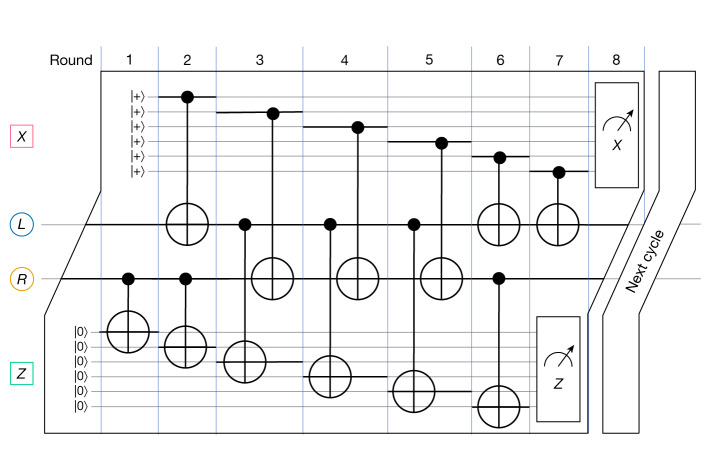
The accumulation of physical errors 1–3 prevents the execution of large-scale algorithms in current quantum computers. Quantum error correction 4 promises a solution by encoding k logical qubits onto a larger number n of physical qubits, such that the physical errors are suppressed enough to allow running a desired computation with tolerable fidelity. Quantum error correction becomes practically realizable once the physical error rate is below a threshold value that depends on the choice of quantum code, syndrome measurement circuit and decoding algorithm 5 . We present an end-to-end quantum error correction protocol that implements fault-tolerant memory on the basis of a family of low-density parity-check codes 6 . Our approach achieves an error threshold of 0.7% for the standard circuit-based noise model, on par with the surface code 7–10 that for 20 years was the leading code in terms of error threshold. The syndrome measurement cycle for a length- n code in our family requires n ancillary qubits and a depth-8 circuit with CNOT gates, qubit initializations and measurements. The required qubit connectivity is a degree-6 graph composed of two edge-disjoint planar subgraphs. In particular, we show that 12 logical qubits can be preserved for nearly 1 million syndrome cycles using 288 physical qubits in total, assuming the physical error rate of 0.1%, whereas the surface code would require nearly 3,000 physical qubits to achieve said performance. Our findings bring demonstrations of a low-overhead fault-tolerant quantum memory within the reach of near-term quantum processors.
Overview
CoChat Summary
## TL;DR
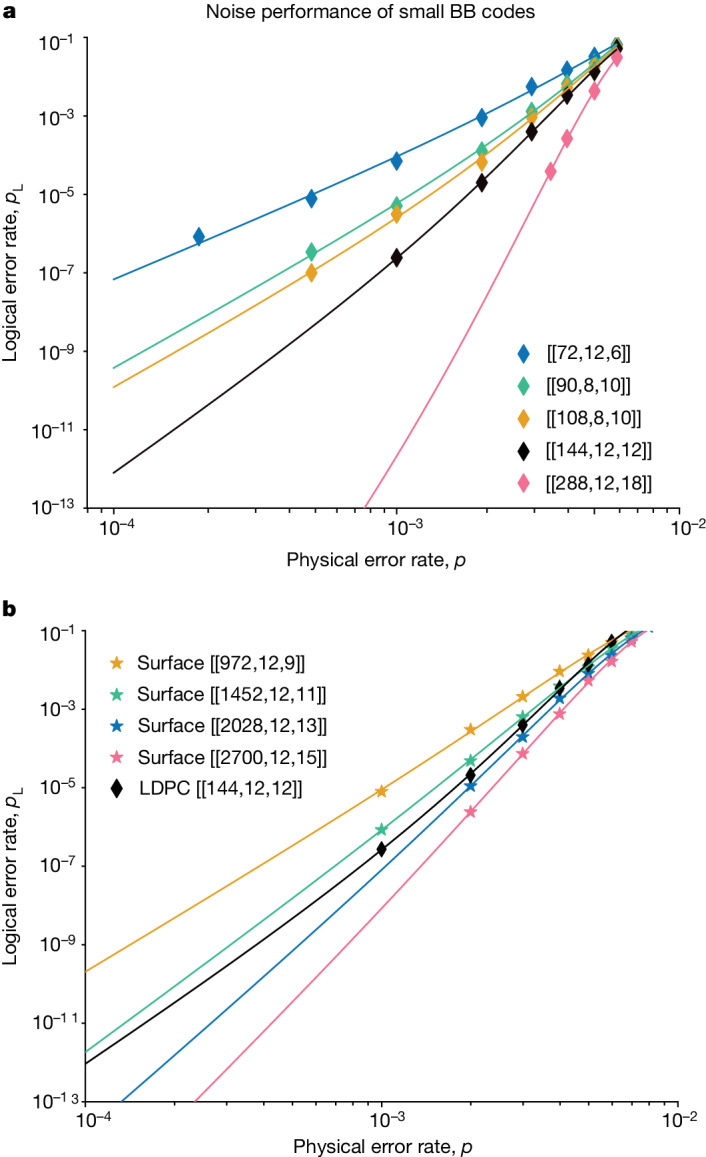
The paper presents a family of bivariate bicycle (BB) LDPC quantum codes and an end-to-end fault-tolerant memory protocol with low overhead. In numerical simulations, the authors report an error threshold/pseudo-threshold of about 0.7% and show that a 12-logical-qubit code can be preserved for nearly 1 million syndrome cycles using 288 physical qubits at physical error rate 0.1%.
## Key findings
- The proposed BB codes have weight-6 check operators, degree-6 Tanner graphs, and thickness 2, meaning their connectivity can be split into two edge-disjoint planar subgraphs.
- The authors report an error threshold close to 0.7% for the standard circuit-based noise model, “on par with the surface code” and exceeding other high-rate LDPC codes known to them.
- For the [[144, 12, 12]] code, they state a net encoding rate of 1/24 and that it can preserve 12 logical qubits for nearly 1 million syndrome cycles using 288 physical qubits at physical error rate 0.1%.
- Compared with separate surface-code patches, they report about a 10× reduction in physical-qubit overhead for the distance-12 BB code in the example they analyze.
## Methods
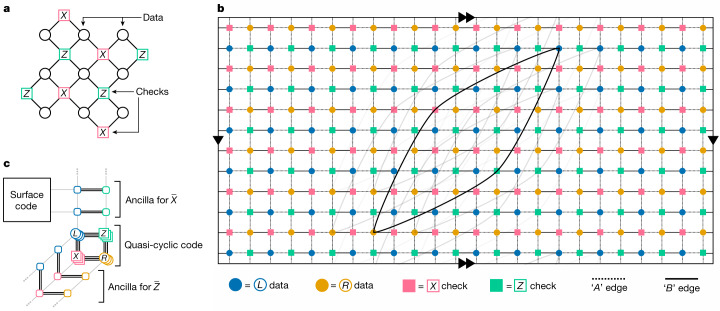
- The paper introduces bivariate bicycle (BB) stabilizer codes defined from pairs of bivariate polynomials/matrices \(A\) and \(B\), yielding CSS codes with \(n=2\ell m\) data qubits and six-qubit check operators.
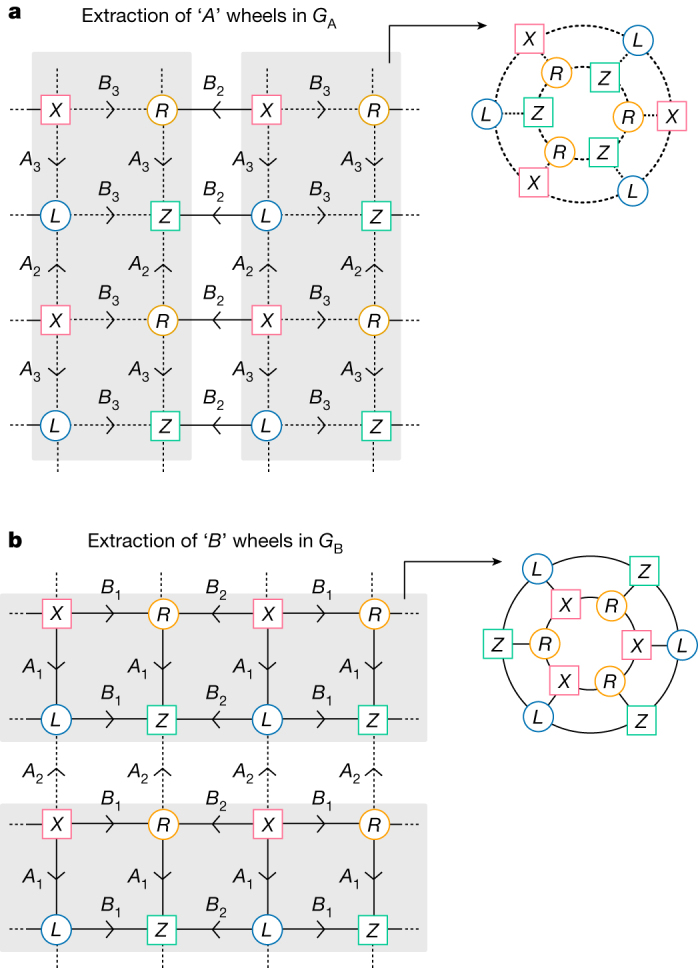
- They analyze code structure through the Tanner graph, proving results about connectivity, toric layouts, and thickness-2 planar decompositions of the graph.
- Performance is evaluated with an end-to-end fault-tolerant memory protocol under a circuit-based noise model where each operation fails independently with probability \(p\), using a BP-OSD decoder adapted to circuit noise and numerical simulations of logical error rates.
## Limitations
- The authors explicitly note that it remains unclear whether the code examples can be scaled up while retaining the high encoding rate in the limit of large code length.
- They also state that optimization of the code layout satisfying specific hardware constraints is left for future work.
- Evident from the text: the reported performance is based on numerical simulations and, for lower error rates, extrapolation/fitting, rather than a hardware demonstration.
Model-written summary. Check it against the paper before relying on it.
Integrity signals
Registry
Cites
Statistics
Figures
Verification
Claims the paper makes
12 Valid · 9 Not valid · 10 Not checked · 61 Own results and interpretations
The cited sources support only part of this claim — read each source’s verdict below.
In the paper
“on par with the surface code7–10 that for 20 years was the leading code in terms of error threshold”
- Also stated in: § Main · hedged
“which is nearly the same as the error threshold of the surface code49”
§ High-threshold and low-overhead fault-tolerant quantum memory > Abstract The accumulation of physical errors1–3 prevents the execution of large-scale algorithms in current quantum computers. Quantum error correction4 promises a solution by encoding k logical qubits onto a larger number n of physical qubits, such that the physical errors are suppressed enough to allow running a desired computation with tolerable fidelity. Quantum error correction becomes practically realizable once the physical error rate is below a threshold value that depends on the choice of quantum code, syndrome measurement circuit and decoding algorithm5. We present an end-to-end quantum error correction protocol that implements fault-tolerant memory on the basis of a family of low-density parity-check codes6. Our approach achieves an error threshold of 0.7% for the standard circuit-based noise model, on par with the surface code7–10 that for 20 years was the leading code in terms of error threshold. The syndrome measurement cycle for a length-n code in our family requires n ancillary qubits and a depth-8 circuit with CNOT gates, qubit initializations and measurements. The required qubit connectivity is a degree-6 graph composed of two edge-disjoint planar subgraphs. In particular, we show that 12 logical qubits can be preserved for nearly 1 million syndrome cycles using 288 physical qubits in total, assuming the physical error rate of 0.1%, whereas the surface code would require nearly 3,000 physical qubits to achieve said performance. Our findings bring demonstrations of a low-overhead fault-tolerant quantum memory within the reach of near-term quantum processors.
What the sources say
- Partly supportedcites [7] Kitaev, A. Y. Fault-tolerant quantum computation by anyons. Ann. Phys. 303, 2–30 (2003); preprint at 10.48550/arXiv.quant-ph/9707021 (1997). sourceExperimental — accuracy not yet measured
The section on toric codes (p. 4) says they work below an error threshold, supporting the comparison’s premise that this code has a threshold. But the Abstract (p. 1) says the threshold was not known and gives estimates from 1/300 to 10^-6; it does not establish that a 0.7% threshold is on par with it or that it led other codes for 20 years. (LLM, conf=0.82)
- Partly supportedcites [8] Bravyi, S. B. & Kitaev, A. Y. Quantum codes on a lattice with boundary. Preprint at 10.48550/arXiv.quant-ph/9811052 (1998). sourceExperimental — accuracy not yet measured
The Abstract (pp. 1–2) describes a lattice code with boundaries and local stabilizers, supporting the citation’s identification of a surface code. The copy gives code distance and the number of errors the code can correct (p. 4), but it does not give an error-rate threshold or establish that 0.7% is comparable to it. (LLM, conf=0.82)
- Partly supportedcites [9] Dennis, E., Kitaev, A., Landahl, A. & Preskill, J. Topological quantum memory. J. Math. Phys. 43, 4452–4505 (2002). 10.1063/1.1499754 sourceExperimental — accuracy not yet measured
The paper analyzes surface-code error thresholds: §F (p. 17) gives a lower bound of 1.14% when data and measurement error probabilities are equal. It does not give 0.7% as the surface-code threshold, so it supports the comparison’s subject but not the specific numerical equivalence. Its 2002 text also cannot establish the citing sentence’s retrospective claim of 20 years of leadership. (LLM, conf=0.85)
- Supportedcites [10] Fowler, A. G., Stephens, A. M. & Groszkowski, P. High-threshold universal quantum computation on the surface code. Phys. Rev. A 80, 052312 (2009). 10.1103/PhysRevA.80.052312 source
Section VIII (p. 15) reports a numerical surface-code threshold of approximately 0.6%, and the conclusion (p. 16) repeats that value. A threshold of 0.7% is therefore on par with the threshold this paper reports. (LLM, conf=0.91)
- Not matchedcites [49] Groszkowski, P., Fowler, A. & Stephens, A. M. High-threshold surface code quantum computing: threshold calculation. In Proc. APS March Meeting Abstracts W17–002 (APS, 2009).
Its entry has no title and year that we can search by.
plain- Asserted: passes — The authors put it forward as true.
- Checkable: passes — It can be checked against evidence.
- Load-bearing: passes — The paper’s conclusions depend on it.
- Based: passes — The paper gives a reason why it holds.
- Also stated in: § Main · hedged
The cited sources support only part of this claim — read each source’s verdict below.
In the paper
“The required qubit connectivity is a degree-6 graph composed of two edge-disjoint planar subgraphs.”
- Also stated in: § Main · plain
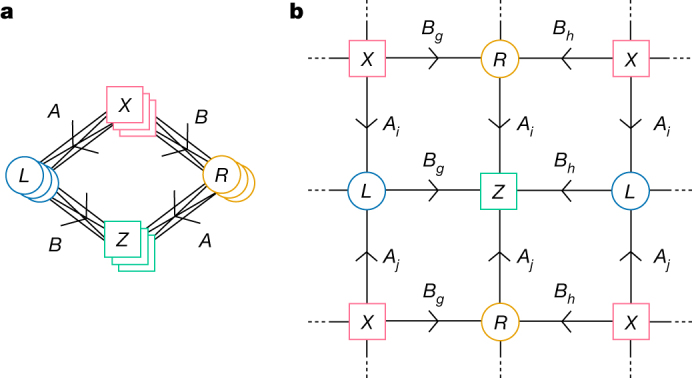
“The Tanner graph of any BB code has vertex degree six and graph thickness29 equal to two, which means it can be decomposed into two edge-disjoint planar subgraphs (Methods).”
- Also stated in: § Main · plain
“Although the qubit connectivity graph is not locally embeddable into a 2D grid, it can be decomposed into two planar degree-3 subgraphs.”
§ High-threshold and low-overhead fault-tolerant quantum memory > Abstract The accumulation of physical errors1–3 prevents the execution of large-scale algorithms in current quantum computers. Quantum error correction4 promises a solution by encoding k logical qubits onto a larger number n of physical qubits, such that the physical errors are suppressed enough to allow running a desired computation with tolerable fidelity. Quantum error correction becomes practically realizable once the physical error rate is below a threshold value that depends on the choice of quantum code, syndrome measurement circuit and decoding algorithm5. We present an end-to-end quantum error correction protocol that implements fault-tolerant memory on the basis of a family of low-density parity-check codes6. Our approach achieves an error threshold of 0.7% for the standard circuit-based noise model, on par with the surface code7–10 that for 20 years was the leading code in terms of error threshold. The syndrome measurement cycle for a length-n code in our family requires n ancillary qubits and a depth-8 circuit with CNOT gates, qubit initializations and measurements. The required qubit connectivity is a degree-6 graph composed of two edge-disjoint planar subgraphs. In particular, we show that 12 logical qubits can be preserved for nearly 1 million syndrome cycles using 288 physical qubits in total, assuming the physical error rate of 0.1%, whereas the surface code would require nearly 3,000 physical qubits to achieve said performance. Our findings bring demonstrations of a low-overhead fault-tolerant quantum memory within the reach of near-term quantum processors.
What the sources say
- Partly supportedcites [29] Tremblay, M. A., Delfosse, N. & Beverland, M. E. Constant-overhead quantum error correction with thin planar connectivity. Phys. Rev. Lett. 129, 050504 (2022). 35960553 10.1103/PhysRevLett.129.050504 sourceExperimental — accuracy not yet measured
Proposition 1 (p. 2) supports partitioning a low-degree connectivity graph into planar subgraphs. For degree 6, it guarantees a layout with at most three planar layers, not the claimed two. The passages about hypergraph product codes do not identify BB codes or establish their degree-6 connectivity. (LLM, conf=0.87)
plain- Asserted: passes — The authors put it forward as true.
- Checkable: passes — It can be checked against evidence.
- Load-bearing: passes — The paper’s conclusions depend on it.
- Based: passes — The paper gives a reason why it holds.
- Also stated in: § Main · plain
Every source the paper cites for this claim was checked and supports it.
In the paper
“Recent progress in the study of LDPC codes suggests that they can achieve quantum fault tolerance with a much higher encoding efficiency29.”
§ High-threshold and low-overhead fault-tolerant quantum memory > Main
What the sources say
- Supportedcites [29] Tremblay, M. A., Delfosse, N. & Beverland, M. E. Constant-overhead quantum error correction with thin planar connectivity. Phys. Rev. Lett. 129, 050504 (2022). 35960553 10.1103/PhysRevLett.129.050504 source
On p. 1, the paper says some quantum LDPC codes can achieve arbitrarily low logical error rates with a constant ratio of tens of physical qubits per logical qubit, potentially reducing qubit overhead by more than an order of magnitude compared with surface codes. It also reports a circuit-noise threshold for a positive-rate code family, supporting the claim's qualified statement about fault tolerance and encoding efficiency. (LLM, conf=0.93)
hedgedstates a possible cause- Asserted: passes — The authors put it forward as true.
- Checkable: passes — It can be checked against evidence.
- Load-bearing: passes — The paper’s conclusions depend on it.
- Based: passes — The paper gives a reason why it holds.
- Supported
Every source the paper cites for this claim was checked and supports it.
In the paper
“The latter were shown39,40 to be asymptotically ‘good’ in the sense of offering a constant encoding rate and linear distance: a parameter quantifying the number of correctable errors.”
§ High-threshold and low-overhead fault-tolerant quantum memory > Main
What the sources say
- Supportedcites [39] Panteleev, P. & Kalachev, G. Asymptotically good quantum and locally testable classical LDPC codes. In Proc. 54th Annual ACM SIGACT Symposium on Theory of Computing 375–388 (ACM, 2022). source
The Introduction (Theorem 2) states that for every R ∈ (0,1) and finite field F_q there is an explicit family of quantum LDPC codes with parameters [n, ⌊Rn⌋, d = Θ(n)]_q as n → ∞, i.e. constant rate and linear distance — an affirmative answer to the qLDPC conjecture. The same Introduction explains that these quantum CSS codes are built by taking the G-lifted product of expander/Tanner codes T(Γ;h) ("such codes can be used with the G-lifted product to obtain a 3-term chain complex C, which can also be considered as a quantum CSS code"), and §1.8 explicitly licenses calling Tanner complexes 'Tanner codes'. So the attributed point — quantum codes of Tanner type being asymptotically good with constant rate and linear distance — is stated by this paper. (LLM, conf=0.85)
- Supportedcites [40] Leverrier, A. & Zémor, G. Quantum Tanner codes. In Proc. 2022 IEEE 63rd Annual Symposium on Foundations of Computer Science (FOCS) 872–883 (IEEE, 2022). source
The Contributions section (p. 2) states that, under sufficient expansion and robustness conditions, the construction yields asymptotically good quantum LDPC codes with constant rate and linear minimum distance. This directly supports the attributed claim. (LLM, conf=0.95)
plainstates an association- Asserted: passes — The authors put it forward as true.
- Checkable: passes — It can be checked against evidence.
- Load-bearing: passes — The paper’s conclusions depend on it.
- Based: passes — The paper gives a reason why it holds.
- Supported
Every source the paper cites for this claim was checked and supports it.
In the paper
“As shown in Fig. 1c, extensions of the Tanner graph leveraging techniques by Cohen et al.50 enable fault-tolerant measurement operations involving an ancillary surface code.”
§ High-threshold and low-overhead fault-tolerant quantum memory > Main
What the sources say
- Supportedcites Cohen et al.50 Cohen, L. Z., Kim, I. H., Bartlett, S. D. & Brown, B. J. Low-overhead fault-tolerant quantum computing using long-range connectivity. Sci. Adv.10.1126/sciadv.abn1717 (2022). PMC10926894 35594359 source
The Results section (‘Logical CSS measurement’; page unavailable) describes extending a Tanner graph with an ancilla system to measure logical operators fault-tolerantly. The sentence attributes that technique to Cohen et al.; its reference to an ancillary surface code describes the citing authors’ application, not a claim that Cohen et al. used one. (LLM, conf=0.88)
plainstates a cause- Asserted: passes — The authors put it forward as true.
- Checkable: passes — It can be checked against evidence.
- Load-bearing: passes — The paper’s conclusions depend on it.
- Based: passes — The paper gives a reason why it holds.
- Supported
54 more claims · 2 with their cited sources checked
Create a free account to see all 92 claims and every source verdict.
- Probably not a substantial claim. 23
- It may state two separate claims as one. 12
- The quote only partly states this claim. 2
Citations
Cites
Quantum Computation and Quantum Information
Nielsen, M. A., Chuang, I., & Grover, L. K. (2002) · American Journal of Physics · doi:10.1119/1.1463744 · Cited by 21,895
Quantum supremacy using a programmable superconducting processor
Arute, F., Arya, K., Babbush, R., Bacon, D., Bardin, J. C., Barends, R., Biswas, R., Boixo, S., Brandao, F. G. S. L., Buell, D. A., et al. (2019) · Nature · doi:10.1038/s41586-019-1666-5 · Cited by 7,720 · cited 1×
“This new gate is also similar to the gates used by Google Quantum AI 57 , which have shown that a square lattice arrangement is possible.”
MethodFault-tolerant quantum computation by anyons
Kitaev, A. Y. (2003) · Annals of Physics · doi:10.1016/s0003-4916(02)00018-0 · Cited by 7,238 · cited 3×
“This resulted in the development of the surface code 7–10 that offers a high error threshold close to 1%, fast decoding algorithms and compatibility with the existing quantum processors relying on two-dimensional (2D) square lattice qubit connectivity.”
BackgroundMethodInfluentialScheme for reducing decoherence in quantum computer memory
Shor, P. W. (1995) · Physical Review A · doi:10.1103/physreva.52.r2493 · Cited by 4,479 · cited 2×
“The possibility of quantum fault tolerance is well-established 4 .”
BackgroundLloyd, S. (1996) · Science · doi:10.1126/science.273.5278.1073 · Cited by 3,088 · cited 1×
“It is believed that a scalable functioning quantum computer may help solve computational problems in such areas as scientific discovery, materials research, chemistry, and drug design, to name a few [2, 3, 4, 5].”
BackgroundGood quantum error-correcting codes exist
Calderbank, A. R., & Shor, P. W. (1996) · Physical Review A · doi:10.1103/physreva.54.1098 · Cited by 2,516 · cited 2×
“The length of the inner cycle is equal to the order of the matrix A A T 3 2 that is the transpose of A A T 3 2 considered earlier.”
BackgroundDennis, E., Kitaev, A., Landahl, A., & Preskill, J. (2002) · Journal of Mathematical Physics · doi:10.1063/1.1499754 · Cited by 1,768 · cited 1×
“The sources of noise include imperfections in qubits, materials used, controlling apparatus, state preparation and measurement errors and a variety of external factors ranging from local man-made, such as stray electromagnetic fields, to those inherent to the Universe, such as cosmic rays.”
BackgroundImproved simulation of stabilizer circuits
Aaronson, S., & Gottesman, D. (2004) · Physical Review A · doi:10.1103/physreva.70.052328 · Cited by 1,515 · cited 1×
“Since the circuit involves only Clifford operations, its action can be compactly described using stabilizer tableau [49].”
BackgroundDennis, E., Kitaev, A., Landahl, A., & Preskill, J. (2001) · CERN Document Server (European Organization for Nuclear Research) · Cited by 1,485
Quantum computations: algorithms and error correction
Kitaev, A. Y. (1997) · Russian Mathematical Surveys · doi:10.1070/rm1997v052n06abeh002155 · Cited by 1,424 · cited 1×
“The first proposals for quantum error correction, such as concatenated codes [16, 17, 18], focused on demonstrating the theoretical possibility of error suppression.”
Background
Research works printed but not linked: 1
- Groszkowski, P., Fowler, A. & Stephens, A. M. High-threshold surface code quantum computing: threshold calculation. In Proc. APS March Meeting Abstracts W17–002 (APS, 2009).
Cited by
Items 101–200 of 443
Modeling error correction with Lindblad dynamics and approximate channels
Schwartzman-Nowik, Z., Shirizly, L., & Landa, H. (2025) · Physical Review A · doi:10.1103/physreva.111.022613 · Cited by 17
“However, practical, large-scale quantum computers would require over-coming open challenges related to quantum error correction [1–8].”
Classical product code constructions for quantum Calderbank-Shor-Steane codes
Ostrev, D., Orsucci, D., Lázaro, F., & Matuz, B. (2024) · Quantum · doi:10.22331/q-2024-07-22-1420 · Cited by 27
“These techniques have culminated in the seminal result of constructing the first known families of asymptotically good quantum LDPC codes, i.e. having constant stabiliser weight, constant rate, and linearly growing minimum distance [11].”
BackgroundMethodSoft syndrome iterative decoding of quantum LDPC codes and hardware architectures
Raveendran, N., Valls, J., Pradhan, A. K., Rengaswamy, N., García-Herrero, F., & Vasic, B. V. (2023) · EPJ Quantum Technology · doi:10.1140/epjqt/s40507-023-00201-1 · Cited by 11
“Hardware-efficient fault-tolerant quantum computation demonstrations using high-rate QLDPC codes are exciting and also compatible with recently demon-© strated experimental capabilities [10–12].”
BackgroundHybrid Cat-Transmon Architecture for Scalable, Hardware-Efficient Quantum Error Correction
Hann, C. T., Noh, K., Putterman, H., Matheny, M. H., Iverson, J. K., Fang, M. T., Chamberland, C., Painter, O. J., & Brandão, F. G. S. L. (2025) · PRX Quantum · doi:10.1103/75x7-5ysv · Cited by 24
Quantum State Transfer via a Multimode Resonator
He, Y., & Zhang, Y.-X. (2025) · Physical Review Letters · doi:10.1103/physrevlett.134.023602 · Cited by 16
QRLaXAI: quantum representation learning and explainable AI
Don, A. K. K., & Khalil, I. (2025) · Quantum Machine Intelligence · doi:10.1007/s42484-025-00253-9 · Cited by 21
“Giant big data companies, pioneers in quantum computing, have made substantial progress in quantum error correction—a critical factor for achieving fault-tolerant quantum computing and real quantum speedup (Wootton and Loss 2012; Bravyi et al. 2024).”
Yang, S., & Calderbank, R. (2025) · Quantum · doi:10.22331/q-2025-04-07-1693 · Cited by 26
“IBM has proposed partitioning the Tanner graph into multiple planar subgraphs, where the count of these subgraphs, termed “thickness,” influences the implementation efficiency of QLDPC codes [55].”
Generalized Toric Codes on Twisted Tori for Quantum Error Correction
Liang, Z., Liu, K., Song, H., & Chen, Y.-A. (2025) · PRX Quantum · doi:10.1103/rmy6-9n89 · Cited by 76
“…− 3 x − 1 y − 3 x 3 y − 1 x 3 y − 1 x 3 y − 1 (0 , 12) (6 , 0) 121212 [[144 , 12 , 12]] x − 1 y 3 x 3 y − 1 (0 , 12) (6 , 0) 121212 x − 1 y 3 x 3 y − 1 (0 , 12) (8 , 2) 10.67 [[196 , 6 , 18 196 , 6 , 18 196 , 6 , 18]] anyons take the form where a ( x, y ) records the location where B p is violated.”
InfluentialVoss, L., Xian, S. J., Haug, T., & Bharti, K. (2025) · Physical Review A · doi:10.1103/ll5p-z88p · Cited by 37
“[19] introduced codes with weight-6 stabilizer checks which can be encoded into a bi-planar toric layout.”
InfluentialResource Analysis of Low-Overhead Transversal Architectures for Reconfigurable Atom Arrays
Zhou, H., Duckering, C., Zhao, C., Bluvstein, D., Cain, M., Kubica, A., Wang, S.-T., & Lukin, M. D. (2025) · Proceedings - International Symposium on Computer Architecture/Proceedings · doi:10.1145/3695053.3731039 · Cited by 75
“It is worth noting that this space-time saving is competitive that achieved by recent advances in qLDPC codes [15, 64, 123, 138], even without considering the extra overhead for performing computation [27, 28, 116, 138, 139], and the savings between the methods can likely be combined in the future.”
InfluentialTeleportation and Entanglement Swapping of Continuous Quantum Variables of Microwave Radiation
Abdo, B., Shanks, W., Jinka, O., Rozen, J., & Orcutt, J. S. (2025) · Physical Review X · doi:10.1103/9cpm-kr4h · Cited by 12
“Building superconducting quantum computers capable of running error correction codes [1] and solving applied computational problems that are intractable using classical computation [2, 3] would require the formation of a hierarchy of quantum networks, which integrate thousands of quantum modules…”
Quantum Computing for Genomics: Conceptual Challenges and Practical Perspectives
Maurizio, A., & Mazzola, G. (2025) · PRX Life · doi:10.1103/h49j-bsc6 · Cited by 23
“[3, 32, 33] Two promising methods to achieve error correction in superconducting qubit platforms are the “surface” code (pursued by Google)[30, 31] and the “bicycle” code (pursued by IBM)[34, 35].”
Modular architectures and entanglement schemes for error-corrected distributed quantum computation
Singh, S., Gu, F., de Bone, S., Villaseñor, E., Elkouss, D., & Borregaard, J. (2025) · npj Quantum Information · doi:10.1038/s41534-025-01146-2 · Cited by 46
“Inparticular, codes that could offer reduced qubit overhead, such as the recently introduced quantum low-density parity check (qLDPC) family known as the Bivariate Bicycle (BB) codes, by IBM 54 .”
Fault-Tolerant Stabilizer Measurements in Surface Codes with Three-Qubit Gates
Old, J., Tasler, S., Hartmann, M. J., & Müller, M. (2025) · Physical Review Letters · doi:10.1103/sblg-fbq4 · Cited by 16
Old, J., Rispler, M., & Müller, M. (2024) · Quantum Science and Technology · doi:10.1088/2058-9565/ad5eb6 · Cited by 19
“Several proposals on circuit constructions and implementation of QLDPC codes with constrained connectivity in mind have been formulated [22– 24] and code constructions that explicitly leverage hardware capabilities like modularity are also considered [25].”
BackgroundHuang, S., & Puri, S. (2024) · Physical Review A · doi:10.1103/physreva.110.012453 · Cited by 21
Time-Efficient Logical Operations on Quantum Low-Density Parity Check Codes
Zhang, G., & Li, Y. (2025) · Physical Review Letters · doi:10.1103/physrevlett.134.070602 · Cited by 56
“Furthermore, numerical results indicate that qLDPC codes can tolerate relatively high physical error rates [9–11].”
Farooq, M., Zafar, A., & Samad, A. (2025) · Telecommunication Systems · doi:10.1007/s11235-025-01276-0 · Cited by 7
Quantum Benchmarking via Random Dynamical Quantum Maps
Volya, D., & Mishra, P. (2024) · IEEE International Conference on Quantum Computing and Engineering (QCE) · doi:10.1109/qce60285.2024.00152 · Cited by 6
Demonstrating quantum error mitigation on logical qubits
Zhang, A., Xie, H., Gao, Y., Yang, J., Bao, Z., Zhu, Z., Chen, J., Wang, N., Zhang, C., Zhong, J., et al. (2025) · Nature Communications · doi:10.1038/s41467-025-67768-4 · Cited by 53
“Additionally, for high-encoding-rate quantum error correction codes, such as certain quantum low-density parity-check (qLDPC) codes, logical errors may involve multi-qubit correlations, making the measurement impractical 22,23 (see Supplementary Note 2).”
Fault-tolerant logical Clifford gates from code automorphisms
Sayginel, H., Koutsioumpas, S., Webster, M. A., Rajput, A., & Browne, D. (2024) · PRX Quantum · doi:10.1103/vf7v-cpq9 · Cited by 53
“The order of the group generated by the grid translation automorphisms and the ZX-duality identified in [11] is denoted Aut IBM and is the same as the number of physical qubits of the code.”
InfluentialLogical qubits with erasure conversion using metastable neutral atoms
Zhang, B., Liu, G., Bornet, G., Horvath, S. P., Peng, P., Ma, S., Huang, S., Puri, S., & Thompson, J. D. (2026) · Nature Physics · doi:10.1038/s41567-026-03309-0 · Cited by 57
“At the same time, advances in the design of quantum error-correcting codes and fault-tolerant circuits 9–11 and quantum algorithms 12–14 have reduced the apparent computational cost of running large-scale algorithms for real-world applications.”
Rimbach-Russ, M., John, V., van Straaten, B., & Bosco, S. (2025) · Physical Review Letters · doi:10.1103/mvtj-zhrl · Cited by 20
“However, we note that using a sparse qubit occupation combined with hopping or shuttling interconnects [18, 61] or conveying the full qubit [62, 63], novel and more efficient low-density-parity-check codes may be implemented [64, 65].”
Quantum error correction for long chains of trapped ions
Ye, M., & Delfosse, N. (2025) · Quantum · doi:10.22331/q-2025-11-27-1920 · Cited by 43
“Fitting formulas for logical error rates of important code families such as surface codes and BB6 codes were studied under the parallel circuit model [8, 9, 24].”
InfluentialAnonymous, Zalcman, A., Gidney, C., Broughton, M., Khattar, T., Neven, H., Bergamaschi, T., Drake, J., & Boneh, D. (2026) · PRX Quantum · doi:10.1103/j3xf-bw18 · Cited by 70
Universal quantum processors in spin systems via robust local pulse sequences
Votto, M., Zeiher, J., & Vermersch, B. (2024) · Quantum · doi:10.22331/q-2024-10-29-1513 · Cited by 16
“Note finally that our protocol can be naturally applied to more general quantum error correcting codes, such as the LDPC codes [66], which are raising recent interest.”
Zhang, Z., Gokhale, P., & Larson, J. M. (2025) · Physical Review A · doi:10.1103/physreva.111.012619 · Cited by 13
“Optimization challenges persist, however, hindering the production of ideal (large) devices with good connectivity, such as the native devices required for square grid structures for the surface code [15] or the degree-6 connectivity needed for advanced codes [18].”
Low-Cost Noise Reduction for Clifford Circuits
Delfosse, N., & Tham, E. (2025) · Physical Review Letters · doi:10.1103/physrevlett.134.090603 · Cited by 21
Cluster Decomposition for Improved Erasure Decoding of Quantum LDPC Codes
Yao, H., Gökduman, M., & Pfister, H. D. (2025) · IEEE Journal on Selected Areas in Information Theory · doi:10.1109/jsait.2025.3578597 · Cited by 12
“From the standpoint of practical implementation, Bravyi et al. [10] have also shown that some bivariate bicycle codes can be laid out on a two-dimensional grid with some transversal edges between them, which is well-suited for architectures based on superconducting qubits.”
‘A truly remarkable breakthrough’: Google’s new quantum chip achieves accuracy milestone
Castelvecchi, D. (2024) · Nature · doi:10.1038/d41586-024-04028-3 · Cited by 6
Low-overhead fault-tolerant quantum computation by gauging logical operators
Williamson, D. J., & Yoder, T. J. (2026) · Nature Physics · doi:10.1038/s41567-026-03220-8 · Cited by 139
Self-citationBerthusen, N. F., Tan, S. J. S., Huang, E., & Gottesman, D. (2025) · PRX Quantum · doi:10.1103/ps3r-wf84 · Cited by 18
“Alterna-tively, the outer HGP code could be replaced with alternative qLDPC codes, such as bivariate bicycle codes [74], or lifted product codes [80, 81], among others.”
Exact Decoding of Quantum Error-Correcting Codes
Cao, H., Zhao, S. J., Feng, D., Shen, Z., Yan, H., Su, T., Sun, W., Xu, H., Pan, F. P., Yu, H., et al. (2025) · Physical Review Letters · doi:10.1103/physrevlett.134.190603 · Cited by 21
A universal circuit set using the S3 quantum double
Chen, L., Ren, Y., Fan, R., & Jaffe, A. M. (2025) · npj Quantum Information · doi:10.1038/s41534-025-01063-4 · Cited by 21
Zhang, J., Chen, Z., Wang, Y., Lu, B.-H., Zhang, H., Li, J., Duan, P., Wu, Y.-C., & Guo, G. (2025) · npj Quantum Information · doi:10.1038/s41534-025-01118-6 · Cited by 17
Kumar, S., Singh, S. S., Bathla, G., Sharma, S., & Chahal, M. (2026) · Information Fusion · doi:10.1016/j.inffus.2026.104159 · Cited by 12
On the optimality of quantum circuit initial mapping using reinforcement learning
Amer, N. E., Gomaa, W. E., Kimura, K. R., Ueda, K., & El-Mahdy, A. (2024) · EPJ Quantum Technology · doi:10.1140/epjqt/s40507-024-00225-1 · Cited by 9
“While IBM has recently proposed a quantum chip with more than 1000 qubits [2], these qubits are still error prone and IBM is now shifting to designing fewer error-corrected qubits using a recent promising error-correcting codes [3].”
BackgroundNetwork Operations Scheduling for Distributed Quantum Computing
Chandra, N. K., Kaur, E., & Seshadreesan, K. P. (2024) · IEEE International Conference on Trust, Privacy and Security in Intelligent Systems and Applications (TPS-ISA) · doi:10.1109/tps-isa62245.2024.00068 · Cited by 12
“The field of quantum computing continues to make giant strides in terms of inventions of novel applications with provable speedups [1], novel schemes for error correction and fault tolerance [2], and maturing hardware technologies with improved coherence times of qubits and gate fidelities [3].”
Accelerating two-dimensional electronic spectroscopy simulations with a probe qubit protocol
Guimarães, J. D., Lim, J., Vasilevskiy, M. I., Huelga, S. F., & Plenio, M. B. (2025) · Physical Review Research · doi:10.1103/physrevresearch.7.023130 · Cited by 8
“The development of efficient quantum error correction protocols [41, 42] and improved quantum hardware [43, 44] further enhances the feasibility of such simulations.”
Minimal time robust control for two superconducting qubits
George, N., Allen, J. L., Kosut, R. L., & Ginossar, E. (2025) · Scientific Reports · doi:10.1038/s41598-025-32747-8 · Cited by 11
“999, the encoding overhead for many error-correcting codes can be dramatically reduced [94, 89, 95].”
Check-Agnosia based Post-Processor for Message-Passing Decoding of Quantum LDPC Codes
Crest, J. D., García-Herrero, F., Mhalla, M., Savin, V., & Valls, J. (2024) · Quantum · doi:10.22331/q-2024-05-02-1334 · Cited by 19
“Compared to other families of quantum error correction codes, qLDPC codes may reduce the physical qubit overhead, while protecting a larger number of logical qubits, so higher code rates can be obtained with similar or better error-correction performance [5–9].”
BackgroundHeralding entangled optical photons from a microwave quantum processor
Haug, T. H., Kockum, A. F., & Laer, R. V. (2024) · Physical Review Applied · doi:10.1103/physrevapplied.22.034068 · Cited by 8
“Alternative microwave approaches using tailored delay lines [54] and LDPC codes [53] are, similar to microwave-optics devices, in an early stage of development.”
BackgroundAfiouni, F., Sabeh, R. E., Nishimura, N., Hajj, I. E., Mouawad, A. E., & Cooper, A. (2025) · Physical Review A · doi:10.1103/2rds-k4n9 · Cited by 10
Coprime Bivariate Bicycle Codes and Their Layouts on Cold Atoms
Wang, M., & Mueller, F. (2026) · Quantum · doi:10.22331/q-2026-02-23-2009 · Cited by 44
“In [5], the authors restricted the polynomials to shapes of a ( x, y ) = x a + y b + y c b ( x, y ) = y d + x e + x f .”
InfluentialDegenerate quantum erasure decoding
Kuo, K.-Y., & Ouyang, Y. (2026) · npj Quantum Information · doi:10.1038/s41534-026-01212-3 · Cited by 16
“A recent breakthrough by IBM significantly reduce qubit overhead (1 − ) compared to surface codes, using non-zero rate QLDPC codes—specifically bivariate bicycle codes— highlighting their non-vanishing rate and potential for nearly 2D layouts [ 16 ] .”
Effect of correlated errors on quantum memory
Bagewadi, S., & Chatterjee, A. (2025) · Physical Review A · doi:10.1103/hg2r-py13 · Cited by 6
SwitchQNet: Optimizing Distributed Quantum Computing for Quantum Data Centers with Switch Networks
Zhang, H., Xu, Y., Hu, H., Yin, K., Shapourian, H., Zhao, J., Kompella, R. R., Nejabati, R., & Ding, Y. (2025) · Proceedings - International Symposium on Computer Architecture/Proceedings · doi:10.1145/3695053.3731046 · Cited by 17
“The EPR pairs can be stored with a low resource overhead [16, 62] to prevent from decoherence, until participating syndrome measurements [39].”
Thresholds for Postselected Quantum Error Correction from Statistical Mechanics
English, L., Williamson, D. J., & Bartlett, S. D. (2025) · Physical Review Letters · doi:10.1103/nh49-52y2 · Cited by 25
Qudit vs. qubit: Simulated performance of error-correction codes in higher dimensions
Keppens, J., Eggerickx, Q., Levajac, V., Simion, G., & Sorée, B. (2025) · Physical Review A · doi:10.1103/2w52-qd2j · Cited by 15
“Efforts to address these problems involve research into linear high-distance Low-Density-Parity-Check (LDPC) codes [5, 6], and Non-Abelian codes [7, 8].”
Zhang, T., Wu, M., Cohen, S. R., Xin, L., Das, D., Multani, K., Peard, N., Valente-Feliciano, A.-M., Welander, P. B., Safavi‐Naeini, A. H., et al. (2025) · Physical Review Applied · doi:10.1103/4b8v-qdcj · Cited by 12
Universal Adapters between Quantum Low-Density Parity Check Codes
Swaroop, E., Jochym-O'Connor, T., & Yoder, T. J. (2026) · PRX Quantum · doi:10.1103/1g44-jp62 · Cited by 103
Self-citationSuperconducting qubit-resonator quantum processor with effective all-to-all connectivity
Renger, M., Verjauw, J., Wurz, N., Hosseinkhani, A., Ockeloen-Korppi, C. F., Liu, W., Rath, A., Thapa, M., Vigneau, F., Wybo, E., et al. (2026) · Physical Review Research · doi:10.1103/8x68-cx1w · Cited by 26
Quantum Error Detection in Qubit-Resonator Star Architecture
Vigneau, F., Majumder, S., Rath, A., Parrado-Rodríguez, P., Pereira, F. R. F., Ku, H.-S., Šimkovic, F., Pogorzalek, S., Jones, T., Wurz, N., et al. (2025) · PRX Quantum · doi:10.1103/8m33-wn4g · Cited by 13
“…qubits fits well the stabilizers of surface code [5–8], there are other stabilizer circuits and codes such as planar color codes [9] and qLDPC codes [10, 11], which could outperform surface code on other QPU architectures in terms of logical error rate for a given number of physical qubits [12].”
Comparison of variational quantum eigensolvers in light nuclei
Carrasco-Codina, M., Costa, E., Romero, A. M., Menéndez, J., & Rios, A. (2025) · Physical Review C · doi:10.1103/17n2-xh6k · Cited by 18
Fault-tolerant quantum memory using low-depth random circuit codes
Nelson, J., Bentsen, G. S., Flammia, S., & Gullans, M. (2023) · Physical Review Research · doi:10.1103/physrevresearch.7.013040 · Cited by 7
Low-fidelity entanglement distillation with FIMAX
Popp, C., Sutter, T. C., & Hiesmayr, B. C. (2025) · International Journal of Quantum Information · doi:10.1142/s0219749925500170 · Cited by 6
LSQCA: Resource-Efficient Load/Store Architecture for Limited-Scale Fault-Tolerant Quantum Computing
Kobori, T., Suzuki, Y., Ueno, Y., Tanimoto, T., Todo, S., & Tokunaga, Y. (2025) · IEEE International Symposium on High-Performance Computer Architecture (HPCA) · doi:10.1109/hpca61900.2025.00033 · Cited by 26
“Xu et al. [67] and Bravyi et al. [14] proposed an idea of using two QEC codes with different properties.”
Distributed Quantum Error Correction Based on Hyperbolic Floquet Codes
Sutcliffe, E., Jonnadula, B., Gall, C. L., Moylett, A. E., & Westoby, C. M. (2025) · IEEE International Conference on Quantum Computing and Engineering (QCE) · doi:10.1109/qce65121.2025.00076 · Cited by 52
“Small examples of quantum LDPC codes have also been explicitly developed with high pseudo-thresholds and encoding rates [27].”
Low-Depth Quantum Error Correction via Three-Qubit Gates in Rydberg Atom Arrays
Pecorari, L., Jandura, S., & Pupillo, G. (2025) · Physical Review Letters · doi:10.1103/yj1m-wj7f · Cited by 15
Reliable quantum memories with unreliable components
Nayak, A. K., Chitambar, E., & Varshney, L. R. (2024) · Physical Review A · doi:10.1103/physreva.110.032423 · Cited by 5
“Bivariate bicycle (BB) quantum LDPC codes [24], provide a high-rate alternative to the surface codes in the non-asymptotic (in the number of physical qubits) setting.”
BackgroundMethodInfluentialVittal, S., Javadi-Abhari, A., Cross, A. W., Bishop, L. S., & Qureshi, M. K. (2024) · IEEE/ACM International Symposium on Microarchitecture (MICRO) · doi:10.1109/micro61859.2024.00059 · Cited by 18
“Planarity: All FPNs listed above are biplanar , much like bi-variate bicycle codes [5] and the hyperbolic floquet codes [26].”
Self-citationRate Adjustable Bivariate Bicycle Codes for Quantum Error Correction
Wang, M., & Mueller, F. (2024) · IEEE International Conference on Quantum Computing and Engineering (QCE) · doi:10.1109/qce60285.2024.10331 · Cited by 11
“In [1], the authors restricted the polynomials as follows: Each polynomial has 3 terms and can be written as as A i is the power of x or y , which are permutation matrices.”
Calibrating quantum gates up to 52 qubits in a superconducting processor
Fan, D., Liu, G., Li, S., Gong, M., Wu, D., Zhang, Y., Zha, C., Chen, F., Cao, S., Ye, Y., et al. (2025) · npj Quantum Information · doi:10.1038/s41534-025-00983-5 · Cited by 19
“Typical quantum encoding schemes like surface codes 9,10 or, more generally, quantum low-density-parity-check codes 40 , involve tens or even hundreds of qubits.”
Bothara, G., Das, S., Salunkhe, K. V., Chand, M., Deshmukh, J., Patankar, M. P., & Vijay, R. (2025) · APL Quantum · doi:10.1063/5.0255892 · Cited by 13
FQsun: A Configurable Wave Function-Based Quantum Emulator for Power-Efficient Quantum Simulations
Hai, V. T., Le, V. T. D., Pham, H. L., Nguyen, Q. C., & Nakashima, Y. (2025) · IEEE Access · doi:10.1109/access.2025.3573313 · Cited by 7
“Numerous researchers have developed real quantum devices successfully, such as IBM Quantum [5], Google Quantum AI [6], and QuEra [7]; some even claim to have achieved ‘‘quantum supremacy’’.”
Synchronization for Fault-Tolerant Quantum Computers
Maurya, S., & Tannu, S. (2025) · Proceedings - International Symposium on Computer Architecture/Proceedings · doi:10.1145/3695053.3730991 · Cited by 20
“While our evaluations are restricted to patch-based encodings using the surface code and Lattice Surgery due to their well-understood and well-defined properties, the problem we are addressing will hold true for other QEC codes such as color codes [30] and qLDPC codes [9].”
InfluentialSecurity analysis of ensemble-based quantum token protocol under advanced attacks
Bauerhenne, B., Tsunaki, L., Thieme, J., Naydenov, B., & Singer, K. (2025) · Quantum Science and Technology · doi:10.1088/2058-9565/ae03e7 · Cited by 8
Ensemble-based quantum token protocol benchmarked on IBM quantum processors
Tsunaki, L., Bauerhenne, B., Xibraku, M., Garcia, M. E., Singer, K., & Naydenov, B. (2025) · Quantum Science and Technology · doi:10.1088/2058-9565/ae03e6 · Cited by 4
Li, Z., Grabowska, D. M., & Savage, M. J. (2025) · Quantum · doi:10.22331/q-2025-09-29-1865 · Cited by 52
“[ 12– 62 , matter in the Despite recent demonstrations of systems with a small number of error-corrected logical qubits [103–105] and promising results from simulations that used more than 100 qubits [106– 113], NISQ-era digital quantum computers remain limited in the quality of their entangling…”
Exact results on finite size corrections for surface codes tailored to biased noise
Xiao, Y., Srivastava, B., & Granath, M. (2024) · Quantum · doi:10.22331/q-2024-09-11-1468 · Cited by 11
“…developments, new error correcting codes that cater to hardware specificities such as low qubit connectivity [31–34], or biased single-qubit noise profiles [35–42], as well as codes with a higher density of logical qubits per physical qubit [43–45], are being developed and explored theoretically.”
BackgroundInterleaved Logical Qubits in Atom Arrays
Viszlai, J., Lin, S. F., Dangwal, S., Bradley, C. E., Ramesh, V., Baker, J. M., Bernien, H., & Chong, F. T. (2025) · IEEE International Symposium on High-Performance Computer Architecture (HPCA) · doi:10.1109/hpca61900.2025.00030 · Cited by 9
“Other architectures of atom arrays [55] or multi-layered superconducting chips necessary for recent work on qLDPC codes [11], [67] could also be viable future platforms for interleaved logical qubits.”
Fast, Robust, and Laser-Free Universal Entangling Gates for Trapped-Ion Quantum Computing
Nünnerich, M., Cohen, D., Barthel, P., Huber, P. H., Niroomand, D., Retzker, A., & Wunderlich, C. (2025) · Physical Review X · doi:10.1103/physrevx.15.021079 · Cited by 20
Minami, S., Nakaji, K., Suzuki, Y., Aspuru‐Guzik, A., & Kadowaki, T. (2025) · Digital Discovery · doi:10.1039/d5dd00138b · Cited by 24
Qudit-based quantum error-correcting codes from irreducible representations of SU( d )
Uy, R. F., & Gangloff, D. A. (2025) · Physical Review A · doi:10.1103/6z3t-96t9 · Cited by 11
“Good quantum error-correcting codes are thus vital to the realization of the full potential of quantum computers [5, 6].”
Logical entanglement distribution between distant two-dimensional array qubits
Maeda, Y., Suzuki, Y., Kobayashi, T., Yamamoto, T., Tokunaga, Y., & Fujii, K. (2026) · Physical Review Research · doi:10.1103/m9gc-n3dl · Cited by 4
“Fault-tolerant implementation of qLDPC codes typically relies on advanced technologies such as fast and reliable optical tweezers [21] or long-range interconnects between super-conducting qubits [22], which must achieve physical error rates below threshold.”
Tile Codes: High-Efficiency Quantum Codes on a Lattice with Boundary
Steffan, V., Choe, S. H., Breuckmann, N. P., Pereira, F. R. F., & Eberhardt, J. N. (2025) · Physical Review Letters · doi:10.1103/l4mx-l3xx · Cited by 37
Stateless Hash-Based Signatures for Post-Quantum Security Keys
Crespo, R. A. G. (2025) · Lecture notes in computer science · doi:10.1007/978-3-032-01806-9_10 · Cited by 4
“Shor’s algorithm [52] and recent advances in quantum computing [18] [20] jeopar-dize the security of most widely used asymmetric cryptosystems.”
Universal Graph Representation of Stabilizer Codes
Khesin, A. B., Lu, J. Z., & Shor, P. W. (2025) · PRX Quantum · doi:10.1103/1gjs-2rhx · Cited by 20
Jin, X. Y., Parrott, Z., Cicak, K., Kotler, S., Lecocq, F., Teufel, J., Aumentado, J., Kapit, E., & Simmonds, R. W. (2025) · Physical Review Applied · doi:10.1103/kmls-lgp5 · Cited by 24
A Review of Formal Methods in Quantum-Circuit Verification
Govindankutty, A. (2026) · Electronics · doi:10.3390/electronics15051125 · Cited by 4
Neural Decoders for Universal Quantum Algorithms
Ataides, J. P. B., Gu, A., Yelin, S. F., & Lukin, M. D. (2026) · PRX Intelligence · doi:10.1103/vjn1-mbxl · Cited by 28
“It can be extended to other classes of codes, including high-rate quantum LDPC codes [75].”
Intermediate qutrit-assisted Toffoli gate decomposition with quantum error correction
Majumdar, R., Saha, A., Chakrabarti, A., & Sur‐Kolay, S. (2024) · Quantum Information Processing · doi:10.1007/s11128-023-04251-3 · Cited by 4
Flying-cat parity checks for quantum error correction
McIntyre, Z. M., & Coish, W. A. (2024) · Physical Review Research · doi:10.1103/physrevresearch.6.023247 · Cited by 3
“Theflexible qubit connectivity enabled by the use of propagating light pulses could also provide an avenue towards realizing the nonlocal interactions required by certain quantum low-density parity-check codes [81–85].”
BackgroundHigh-Threshold, Low-Overhead and Single-Shot Decodable Fault-Tolerant Quantum Memory
Scruby, T. R., Hillmann, T., & Roffe, J. (2026) · PRX Quantum · doi:10.1103/67xf-zdjb · Cited by 48
“First, we note that our results in conjunction with the confinement profile (table II) suggest that the bivariate bicycle codes of [12] could also be single-shot decodable.”
InfluentialToward Quantum CSS-T Codes from Sparse Matrices
Camps-Moreno, E., López, H. H., Matthews, G. L., & McMillon, E. (2024) · doi:10.1109/isit-w61686.2024.10591766 · Cited by 6
“In recent work, such codes have been demon-Camps-Moreno strated for constant-overhead fault-tolerant quantum computation [9] and to rival surface codes [10], which were introduced in [11].”
BackgroundSolving quantum chemistry problems on quantum computers
Liegener, K., Morsch, O., & Pupillo, G. (2024) · Physics today · doi:10.1063/pt.qoys.tiuw · Cited by 3
Protocols for intermodule two-qubit gates mediated by time-bin encoded photons
McIntyre, Z. M., & Coish, W. A. (2025) · Physical Review Research · doi:10.1103/xwyt-1ck7 · Cited by 4
“…[25, 26], implementing transversal encoded two-qubit gates [27], reducing the impact of cosmic-ray events on encoded information [28], or as a means of establishing the non-planar connectivity required for certain quantum error correcting codes (quantum low-density parity check codes) [29–32].”
Thirty years of quantum computing
Divincenzo, D. P. (2025) · Quantum Science and Technology · doi:10.1088/2058-9565/ade0e4 · Cited by 7
“This is precisely what IBM has explored carefully in recent theoretical work (Bravyi et al 2024).”
POSTER: Stealthy SWAP-Based Side-Channel Attack on Multi-Tenant Quantum Cloud Systems
Lee, W. J. B., Wang, S., Dutta, S., Maouaki, W. E., & Chattopadhyay, A. (2025) · ACM Asia Conference on Computer and Communications Security (ASIA CCS) · doi:10.1145/3708821.3735339 · Cited by 3
“Quantum computing has witnessed significant advancements in recent years [1, 2], driven by hardware breakthroughs [7], new circuits for various applications [4, 11] and increased accessibility through cloud services such as IBM Quantum, AWS Braket, and Microsoft Azure.”
Quantum low-density parity-check codes for erasure-biased atomic quantum processors
Pecorari, L., & Pupillo, G. (2025) · Physical Review A · doi:10.1103/mgkt-ctv8 · Cited by 16
Planar Quantum Low-Density Parity-Check Codes with Open Boundaries
Liang, Z., Eberhardt, J. N., & Chen, Y.-A. (2025) · PRX Quantum · doi:10.1103/qv65-vmzr · Cited by 41
“1% [29].”
LeBlond, T., Groszkowski, P., Lietz, J. G., Seck, C. M., & Bennink, R. S. (2025) · Physical Review Research · doi:10.1103/ktb3-gcxr · Cited by 12
“…studies due to its high threshold under circuit-level noise and nearest-neighbor connectivity [10–12], but its high-qubit overhead and vanishing encoding rate have led many to search for protocols involving constant-rate quantum low-density parity check (qLDPC) or concatenated codes [13–16].”
Hsin, P.-S., Kobayashi, R., & Zhu, G. (2025) · PRX Quantum · doi:10.1103/hkgn-hhqx · Cited by 26
“In order to get non-Clifford gates, one has to use (6+1)D toric codes or color codes proposed by Bombin et al [5], which requires a space overhead N = O ( kd 3 ), where N and k represent the number of physical and logical qubits while d is the code distance.”
MethodApproaching Quantum Utility by Leveraging Quantum Software Stack
Tsymbalista, M., Maksymenko, M., & Katernyak, I. (2023) · IEEE International Conference on Electronics and Information Technologies (ELIT) · doi:10.1109/elit61488.2023.10310743 · Cited by 3
“Also, recently in important milestone has happened [35].”
BackgroundLow-loss liquid metal interconnects for superconducting quantum circuits
Yao, Z., Sandberg, M., Abraham, D. W., & Bishop, D. J. (2024) · Applied Physics Letters · doi:10.1063/5.0211244 · Cited by 5
Benchmarking Quantum Computational Advantages on Supercomputers
Wu, J., & Liu, Y. (2024) · Advanced Quantum Technologies · doi:10.1002/qute.202400143 · Cited by 5
Magic Mirror on the Wall, How to Benchmark Quantum Error Correction Codes, Overall?
Chatterjee, A., & Ghosh, S. (2024) · IEEE International Conference on Quantum Computing and Engineering (QCE) · doi:10.1109/qce60285.2024.00050 · Cited by 8
“A non-trivial measurement outcome (eigenvalue -1) indicates an error.”
Low-Overhead Entangling Gates From Generalised Dehn Twists
Tiew, R., & Breuckmann, N. P. (2025) · IEEE Transactions on Information Theory · doi:10.1109/tit.2025.3571197 · Cited by 15
Research on Quantum Materials and Quantum Technology at RIKEN
Ishibashi, K., Yorozu, S., Arima, T., Kawamura, M., Tokura, Y., Karube, K., Yu, X., Taguchi, Y., Hanaguri, T., Machida, T., et al. (2025) · ACS Nano · doi:10.1021/acsnano.4c15409 · Cited by 4
Demonstration of two qubit entangling gates in a 2D ring resonator based coupler architecture
Bhattacharjee, A., Jain, P., Deshmukh, J., Das, S., Chand, M., Patankar, M. P., & Vijay, R. (2025) · Scientific Reports · doi:10.1038/s41598-025-87410-z · Cited by 4
Metadata
- Authors
- Bravyi, S., Cross, A. W., Gambetta, J. M., Maslov, D., Rall, P., & Yoder, T. J.
- Affiliations
- IBM (United States) (US)
- Corresponding author
- Maslov, Dmitri
- Venue
- Nature
- Published
- 2024-03-27
- Volume
- 627
- Issue
- 8005
- Pages
- 778-782
- ISSN
- 0028-0836 (ISSN-L)
- 1476-4687
- PMC
- PMC10972743
- OpenAlex
- W4393234688
- Cited by
- 456
- References
- 82
- Citations by year
- 2026: 150 · 2025: 223 · 2024: 76
- FWCI
- 65.98
- Type
- journal article
- Language
- en
- Open access
- hybrid
- doi.org
- Licence
- cc-by
- creativecommons.org/licenses/by/4.0 (tdm)
- creativecommons.org/licenses/by/4.0 (vor)
- Locations
- Nature (publishedVersion, cc-by)
- PubMed Central (publishedVersion, cc-by)
- PubMed (publishedVersion)
- arXiv (Cornell University) (submittedVersion)
- RePEc: Research Papers in Economics (submittedVersion)
- arXiv (Cornell University)
- Topics
- Physical Sciences › Computer Science › Artificial Intelligence › Quantum Computing Algorithms and Architecture
- Physical Sciences › Physics and Astronomy › Atomic and Molecular Physics, and Optics › Quantum Information and Cryptography
- Physical Sciences › Physics and Astronomy › Atomic and Molecular Physics, and Optics › Quantum many-body systems
- Keywords
- fault-tolerant quantum memory, quantum error correction, LDPC codes, error threshold, syndrome measurement, logical qubits, qubit connectivity, planar graphs
About these checks
Registry, retraction, Cites and statistics results are computed, not judged, with one exception: a printed reference that no index lists is read once by a model before it counts as a citation error. Claims are extracted by a model and kept only when their quote appears verbatim in the text; each cited source is then checked, with a model’s help, for whether it says what the claim relies on. Those verdicts can be wrong — read the claim’s quote and the cited source before relying on one.
The claim verdicts this report counts are experimental: their accuracy is not yet measured.
A language model drew the claims from the paper on 2026-10-10, under version 3 of the claim definition (model deepseek-v4.1-flash, prompt extract-v3).
A second model labelled each claim on 2026-10-10 (model jev-1.13-20260917, definition revision gold-guideline-v0.2).
Cited sources are checked with a language model’s help (gpt-6-sol and qwen3.8-omni-flash).
Statistics and arithmetic are recomputed, not judged.
Confidence bands are shown only for fields calibrated on our annotated test set. None is calibrated yet, so no band is shown.
What counts as a claim ›How we measure confidence ›How we check this ›
Are you an author, or do you see a problem with this page? Request a review
Data sources
Bibliographic data: Semantic Scholar, OpenAlex, Crossref.
Contains information from the Semantic Scholar Academic Graph Datasets, made available under the ODC Attribution License (ODC-BY 1.0).
Semantic Scholar’s data is described in: Kinney, R., et al. (2023). The Semantic Scholar Open Data Platform. arXiv:2301.10140.
