

High-threshold and low-overhead fault-tolerant quantum memory
Open accessThe DOI matches its Crossref record; 81 of the 82 references it cites were found in a registry or an index; 23 of the 34 sources its claims cite were checked for support.
Abstract
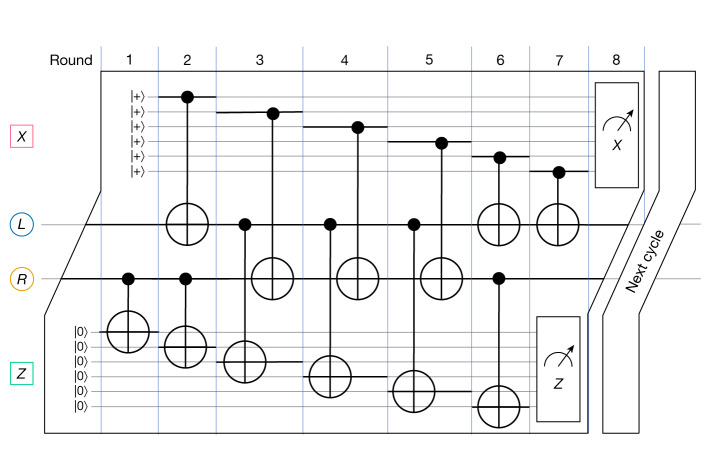
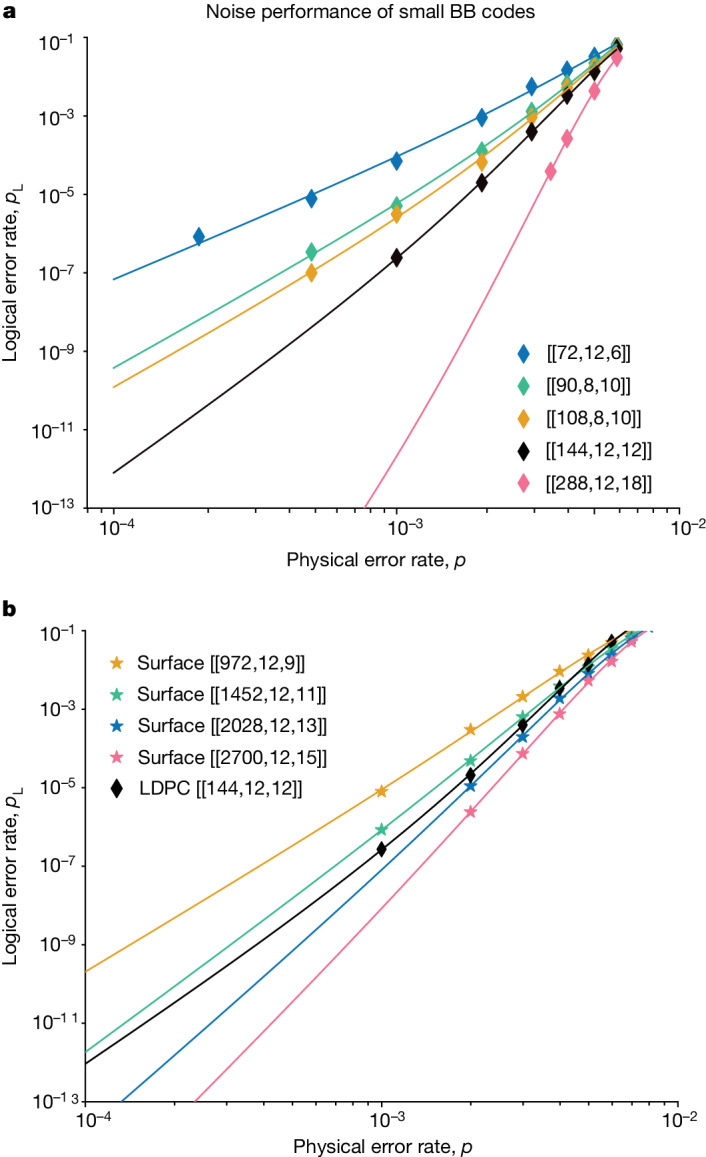
The accumulation of physical errors 1–3 prevents the execution of large-scale algorithms in current quantum computers. Quantum error correction 4 promises a solution by encoding k logical qubits onto a larger number n of physical qubits, such that the physical errors are suppressed enough to allow running a desired computation with tolerable fidelity. Quantum error correction becomes practically realizable once the physical error rate is below a threshold value that depends on the choice of quantum code, syndrome measurement circuit and decoding algorithm 5 . We present an end-to-end quantum error correction protocol that implements fault-tolerant memory on the basis of a family of low-density parity-check codes 6 . Our approach achieves an error threshold of 0.7% for the standard circuit-based noise model, on par with the surface code 7–10 that for 20 years was the leading code in terms of error threshold. The syndrome measurement cycle for a length- n code in our family requires n ancillary qubits and a depth-8 circuit with CNOT gates, qubit initializations and measurements. The required qubit connectivity is a degree-6 graph composed of two edge-disjoint planar subgraphs. In particular, we show that 12 logical qubits can be preserved for nearly 1 million syndrome cycles using 288 physical qubits in total, assuming the physical error rate of 0.1%, whereas the surface code would require nearly 3,000 physical qubits to achieve said performance. Our findings bring demonstrations of a low-overhead fault-tolerant quantum memory within the reach of near-term quantum processors.
Overview
CoChat Summary
## TL;DR
The paper presents a family of bivariate bicycle (BB) LDPC quantum codes and an end-to-end fault-tolerant memory protocol with low overhead. In numerical simulations, the authors report an error threshold/pseudo-threshold of about 0.7% and show that a 12-logical-qubit code can be preserved for nearly 1 million syndrome cycles using 288 physical qubits at physical error rate 0.1%.
## Key findings
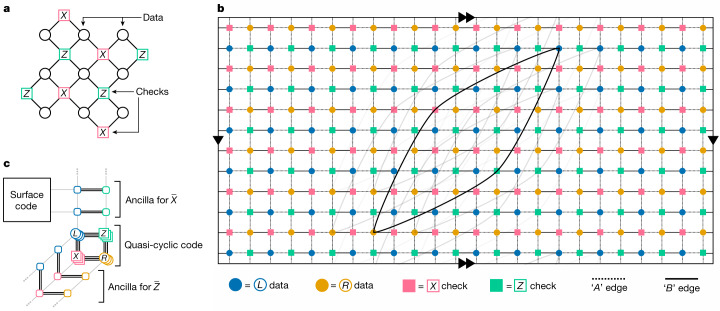
- The proposed BB codes have weight-6 check operators, degree-6 Tanner graphs, and thickness 2, meaning their connectivity can be split into two edge-disjoint planar subgraphs.
- The authors report an error threshold close to 0.7% for the standard circuit-based noise model, “on par with the surface code” and exceeding other high-rate LDPC codes known to them.
- For the [[144, 12, 12]] code, they state a net encoding rate of 1/24 and that it can preserve 12 logical qubits for nearly 1 million syndrome cycles using 288 physical qubits at physical error rate 0.1%.
- Compared with separate surface-code patches, they report about a 10× reduction in physical-qubit overhead for the distance-12 BB code in the example they analyze.
## Methods
- The paper introduces bivariate bicycle (BB) stabilizer codes defined from pairs of bivariate polynomials/matrices \(A\) and \(B\), yielding CSS codes with \(n=2\ell m\) data qubits and six-qubit check operators.
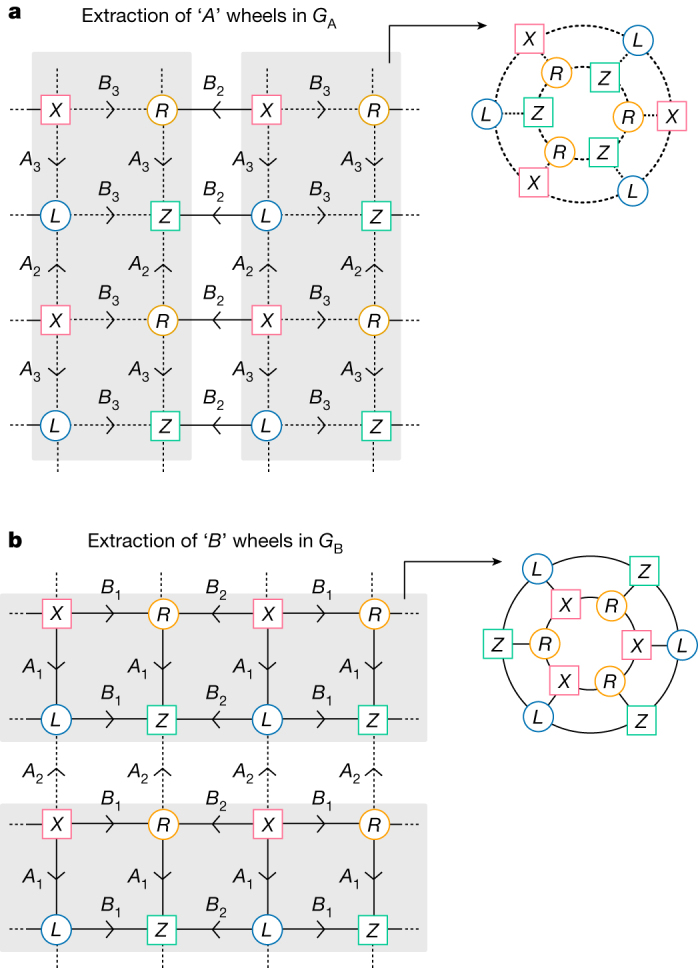
- They analyze code structure through the Tanner graph, proving results about connectivity, toric layouts, and thickness-2 planar decompositions of the graph.
- Performance is evaluated with an end-to-end fault-tolerant memory protocol under a circuit-based noise model where each operation fails independently with probability \(p\), using a BP-OSD decoder adapted to circuit noise and numerical simulations of logical error rates.
## Limitations
- The authors explicitly note that it remains unclear whether the code examples can be scaled up while retaining the high encoding rate in the limit of large code length.
- They also state that optimization of the code layout satisfying specific hardware constraints is left for future work.
- Evident from the text: the reported performance is based on numerical simulations and, for lower error rates, extrapolation/fitting, rather than a hardware demonstration.
Model-written summary. Check it against the paper before relying on it.
Integrity signals
Registry
Cites
Statistics
Figures
Verification
Claims the paper makes
12 Valid · 9 Not valid · 10 Not checked · 61 Own results and interpretations
The cited sources support only part of this claim — read each source’s verdict below.
In the paper
“on par with the surface code7–10 that for 20 years was the leading code in terms of error threshold”
- Also stated in: § Main · hedged
“which is nearly the same as the error threshold of the surface code49”
§ High-threshold and low-overhead fault-tolerant quantum memory > Abstract The accumulation of physical errors1–3 prevents the execution of large-scale algorithms in current quantum computers. Quantum error correction4 promises a solution by encoding k logical qubits onto a larger number n of physical qubits, such that the physical errors are suppressed enough to allow running a desired computation with tolerable fidelity. Quantum error correction becomes practically realizable once the physical error rate is below a threshold value that depends on the choice of quantum code, syndrome measurement circuit and decoding algorithm5. We present an end-to-end quantum error correction protocol that implements fault-tolerant memory on the basis of a family of low-density parity-check codes6. Our approach achieves an error threshold of 0.7% for the standard circuit-based noise model, on par with the surface code7–10 that for 20 years was the leading code in terms of error threshold. The syndrome measurement cycle for a length-n code in our family requires n ancillary qubits and a depth-8 circuit with CNOT gates, qubit initializations and measurements. The required qubit connectivity is a degree-6 graph composed of two edge-disjoint planar subgraphs. In particular, we show that 12 logical qubits can be preserved for nearly 1 million syndrome cycles using 288 physical qubits in total, assuming the physical error rate of 0.1%, whereas the surface code would require nearly 3,000 physical qubits to achieve said performance. Our findings bring demonstrations of a low-overhead fault-tolerant quantum memory within the reach of near-term quantum processors.
What the sources say
- Partly supportedcites [7] Kitaev, A. Y. Fault-tolerant quantum computation by anyons. Ann. Phys. 303, 2–30 (2003); preprint at 10.48550/arXiv.quant-ph/9707021 (1997). sourceExperimental — accuracy not yet measured
The section on toric codes (p. 4) says they work below an error threshold, supporting the comparison’s premise that this code has a threshold. But the Abstract (p. 1) says the threshold was not known and gives estimates from 1/300 to 10^-6; it does not establish that a 0.7% threshold is on par with it or that it led other codes for 20 years. (LLM, conf=0.82)
- Partly supportedcites [8] Bravyi, S. B. & Kitaev, A. Y. Quantum codes on a lattice with boundary. Preprint at 10.48550/arXiv.quant-ph/9811052 (1998). sourceExperimental — accuracy not yet measured
The Abstract (pp. 1–2) describes a lattice code with boundaries and local stabilizers, supporting the citation’s identification of a surface code. The copy gives code distance and the number of errors the code can correct (p. 4), but it does not give an error-rate threshold or establish that 0.7% is comparable to it. (LLM, conf=0.82)
- Partly supportedcites [9] Dennis, E., Kitaev, A., Landahl, A. & Preskill, J. Topological quantum memory. J. Math. Phys. 43, 4452–4505 (2002). 10.1063/1.1499754 sourceExperimental — accuracy not yet measured
The paper analyzes surface-code error thresholds: §F (p. 17) gives a lower bound of 1.14% when data and measurement error probabilities are equal. It does not give 0.7% as the surface-code threshold, so it supports the comparison’s subject but not the specific numerical equivalence. Its 2002 text also cannot establish the citing sentence’s retrospective claim of 20 years of leadership. (LLM, conf=0.85)
- Supportedcites [10] Fowler, A. G., Stephens, A. M. & Groszkowski, P. High-threshold universal quantum computation on the surface code. Phys. Rev. A 80, 052312 (2009). 10.1103/PhysRevA.80.052312 source
Section VIII (p. 15) reports a numerical surface-code threshold of approximately 0.6%, and the conclusion (p. 16) repeats that value. A threshold of 0.7% is therefore on par with the threshold this paper reports. (LLM, conf=0.91)
- Not matchedcites [49] Groszkowski, P., Fowler, A. & Stephens, A. M. High-threshold surface code quantum computing: threshold calculation. In Proc. APS March Meeting Abstracts W17–002 (APS, 2009).
Its entry has no title and year that we can search by.
plain- Asserted: passes — The authors put it forward as true.
- Checkable: passes — It can be checked against evidence.
- Load-bearing: passes — The paper’s conclusions depend on it.
- Based: passes — The paper gives a reason why it holds.
- Also stated in: § Main · hedged
The cited sources support only part of this claim — read each source’s verdict below.
In the paper
“The required qubit connectivity is a degree-6 graph composed of two edge-disjoint planar subgraphs.”
- Also stated in: § Main · plain
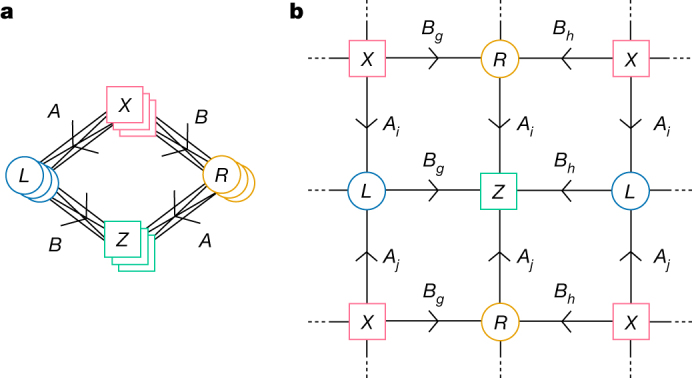
“The Tanner graph of any BB code has vertex degree six and graph thickness29 equal to two, which means it can be decomposed into two edge-disjoint planar subgraphs (Methods).”
- Also stated in: § Main · plain
“Although the qubit connectivity graph is not locally embeddable into a 2D grid, it can be decomposed into two planar degree-3 subgraphs.”
§ High-threshold and low-overhead fault-tolerant quantum memory > Abstract The accumulation of physical errors1–3 prevents the execution of large-scale algorithms in current quantum computers. Quantum error correction4 promises a solution by encoding k logical qubits onto a larger number n of physical qubits, such that the physical errors are suppressed enough to allow running a desired computation with tolerable fidelity. Quantum error correction becomes practically realizable once the physical error rate is below a threshold value that depends on the choice of quantum code, syndrome measurement circuit and decoding algorithm5. We present an end-to-end quantum error correction protocol that implements fault-tolerant memory on the basis of a family of low-density parity-check codes6. Our approach achieves an error threshold of 0.7% for the standard circuit-based noise model, on par with the surface code7–10 that for 20 years was the leading code in terms of error threshold. The syndrome measurement cycle for a length-n code in our family requires n ancillary qubits and a depth-8 circuit with CNOT gates, qubit initializations and measurements. The required qubit connectivity is a degree-6 graph composed of two edge-disjoint planar subgraphs. In particular, we show that 12 logical qubits can be preserved for nearly 1 million syndrome cycles using 288 physical qubits in total, assuming the physical error rate of 0.1%, whereas the surface code would require nearly 3,000 physical qubits to achieve said performance. Our findings bring demonstrations of a low-overhead fault-tolerant quantum memory within the reach of near-term quantum processors.
What the sources say
- Partly supportedcites [29] Tremblay, M. A., Delfosse, N. & Beverland, M. E. Constant-overhead quantum error correction with thin planar connectivity. Phys. Rev. Lett. 129, 050504 (2022). 35960553 10.1103/PhysRevLett.129.050504 sourceExperimental — accuracy not yet measured
Proposition 1 (p. 2) supports partitioning a low-degree connectivity graph into planar subgraphs. For degree 6, it guarantees a layout with at most three planar layers, not the claimed two. The passages about hypergraph product codes do not identify BB codes or establish their degree-6 connectivity. (LLM, conf=0.87)
plain- Asserted: passes — The authors put it forward as true.
- Checkable: passes — It can be checked against evidence.
- Load-bearing: passes — The paper’s conclusions depend on it.
- Based: passes — The paper gives a reason why it holds.
- Also stated in: § Main · plain
Every source the paper cites for this claim was checked and supports it.
In the paper
“Recent progress in the study of LDPC codes suggests that they can achieve quantum fault tolerance with a much higher encoding efficiency29.”
§ High-threshold and low-overhead fault-tolerant quantum memory > Main
What the sources say
- Supportedcites [29] Tremblay, M. A., Delfosse, N. & Beverland, M. E. Constant-overhead quantum error correction with thin planar connectivity. Phys. Rev. Lett. 129, 050504 (2022). 35960553 10.1103/PhysRevLett.129.050504 source
On p. 1, the paper says some quantum LDPC codes can achieve arbitrarily low logical error rates with a constant ratio of tens of physical qubits per logical qubit, potentially reducing qubit overhead by more than an order of magnitude compared with surface codes. It also reports a circuit-noise threshold for a positive-rate code family, supporting the claim's qualified statement about fault tolerance and encoding efficiency. (LLM, conf=0.93)
hedgedstates a possible cause- Asserted: passes — The authors put it forward as true.
- Checkable: passes — It can be checked against evidence.
- Load-bearing: passes — The paper’s conclusions depend on it.
- Based: passes — The paper gives a reason why it holds.
- Supported
Every source the paper cites for this claim was checked and supports it.
In the paper
“The latter were shown39,40 to be asymptotically ‘good’ in the sense of offering a constant encoding rate and linear distance: a parameter quantifying the number of correctable errors.”
§ High-threshold and low-overhead fault-tolerant quantum memory > Main
What the sources say
- Supportedcites [39] Panteleev, P. & Kalachev, G. Asymptotically good quantum and locally testable classical LDPC codes. In Proc. 54th Annual ACM SIGACT Symposium on Theory of Computing 375–388 (ACM, 2022). source
The Introduction (Theorem 2) states that for every R ∈ (0,1) and finite field F_q there is an explicit family of quantum LDPC codes with parameters [n, ⌊Rn⌋, d = Θ(n)]_q as n → ∞, i.e. constant rate and linear distance — an affirmative answer to the qLDPC conjecture. The same Introduction explains that these quantum CSS codes are built by taking the G-lifted product of expander/Tanner codes T(Γ;h) ("such codes can be used with the G-lifted product to obtain a 3-term chain complex C, which can also be considered as a quantum CSS code"), and §1.8 explicitly licenses calling Tanner complexes 'Tanner codes'. So the attributed point — quantum codes of Tanner type being asymptotically good with constant rate and linear distance — is stated by this paper. (LLM, conf=0.85)
- Supportedcites [40] Leverrier, A. & Zémor, G. Quantum Tanner codes. In Proc. 2022 IEEE 63rd Annual Symposium on Foundations of Computer Science (FOCS) 872–883 (IEEE, 2022). source
The Contributions section (p. 2) states that, under sufficient expansion and robustness conditions, the construction yields asymptotically good quantum LDPC codes with constant rate and linear minimum distance. This directly supports the attributed claim. (LLM, conf=0.95)
plainstates an association- Asserted: passes — The authors put it forward as true.
- Checkable: passes — It can be checked against evidence.
- Load-bearing: passes — The paper’s conclusions depend on it.
- Based: passes — The paper gives a reason why it holds.
- Supported
Every source the paper cites for this claim was checked and supports it.
In the paper
“As shown in Fig. 1c, extensions of the Tanner graph leveraging techniques by Cohen et al.50 enable fault-tolerant measurement operations involving an ancillary surface code.”
§ High-threshold and low-overhead fault-tolerant quantum memory > Main
What the sources say
- Supportedcites Cohen et al.50 Cohen, L. Z., Kim, I. H., Bartlett, S. D. & Brown, B. J. Low-overhead fault-tolerant quantum computing using long-range connectivity. Sci. Adv.10.1126/sciadv.abn1717 (2022). PMC10926894 35594359 source
The Results section (‘Logical CSS measurement’; page unavailable) describes extending a Tanner graph with an ancilla system to measure logical operators fault-tolerantly. The sentence attributes that technique to Cohen et al.; its reference to an ancillary surface code describes the citing authors’ application, not a claim that Cohen et al. used one. (LLM, conf=0.88)
plainstates a cause- Asserted: passes — The authors put it forward as true.
- Checkable: passes — It can be checked against evidence.
- Load-bearing: passes — The paper’s conclusions depend on it.
- Based: passes — The paper gives a reason why it holds.
- Supported
54 more claims · 2 with their cited sources checked
Create a free account to see all 92 claims and every source verdict.
- Probably not a substantial claim. 23
- It may state two separate claims as one. 12
- The quote only partly states this claim. 2
Citations
Cites
Quantum Computation and Quantum Information
Nielsen, M. A., Chuang, I., & Grover, L. K. (2002) · American Journal of Physics · doi:10.1119/1.1463744 · Cited by 21,895
Quantum supremacy using a programmable superconducting processor
Arute, F., Arya, K., Babbush, R., Bacon, D., Bardin, J. C., Barends, R., Biswas, R., Boixo, S., Brandao, F. G. S. L., Buell, D. A., et al. (2019) · Nature · doi:10.1038/s41586-019-1666-5 · Cited by 7,720 · cited 1×
“This new gate is also similar to the gates used by Google Quantum AI 57 , which have shown that a square lattice arrangement is possible.”
MethodFault-tolerant quantum computation by anyons
Kitaev, A. Y. (2003) · Annals of Physics · doi:10.1016/s0003-4916(02)00018-0 · Cited by 7,238 · cited 3×
“This resulted in the development of the surface code 7–10 that offers a high error threshold close to 1%, fast decoding algorithms and compatibility with the existing quantum processors relying on two-dimensional (2D) square lattice qubit connectivity.”
BackgroundMethodInfluentialScheme for reducing decoherence in quantum computer memory
Shor, P. W. (1995) · Physical Review A · doi:10.1103/physreva.52.r2493 · Cited by 4,479 · cited 2×
“The possibility of quantum fault tolerance is well-established 4 .”
BackgroundLloyd, S. (1996) · Science · doi:10.1126/science.273.5278.1073 · Cited by 3,088 · cited 1×
“It is believed that a scalable functioning quantum computer may help solve computational problems in such areas as scientific discovery, materials research, chemistry, and drug design, to name a few [2, 3, 4, 5].”
BackgroundGood quantum error-correcting codes exist
Calderbank, A. R., & Shor, P. W. (1996) · Physical Review A · doi:10.1103/physreva.54.1098 · Cited by 2,516 · cited 2×
“The length of the inner cycle is equal to the order of the matrix A A T 3 2 that is the transpose of A A T 3 2 considered earlier.”
BackgroundDennis, E., Kitaev, A., Landahl, A., & Preskill, J. (2002) · Journal of Mathematical Physics · doi:10.1063/1.1499754 · Cited by 1,768 · cited 1×
“The sources of noise include imperfections in qubits, materials used, controlling apparatus, state preparation and measurement errors and a variety of external factors ranging from local man-made, such as stray electromagnetic fields, to those inherent to the Universe, such as cosmic rays.”
BackgroundImproved simulation of stabilizer circuits
Aaronson, S., & Gottesman, D. (2004) · Physical Review A · doi:10.1103/physreva.70.052328 · Cited by 1,515 · cited 1×
“Since the circuit involves only Clifford operations, its action can be compactly described using stabilizer tableau [49].”
BackgroundDennis, E., Kitaev, A., Landahl, A., & Preskill, J. (2001) · CERN Document Server (European Organization for Nuclear Research) · Cited by 1,485
Quantum computations: algorithms and error correction
Kitaev, A. Y. (1997) · Russian Mathematical Surveys · doi:10.1070/rm1997v052n06abeh002155 · Cited by 1,424 · cited 1×
“The first proposals for quantum error correction, such as concatenated codes [16, 17, 18], focused on demonstrating the theoretical possibility of error suppression.”
Background
Research works printed but not linked: 1
- Groszkowski, P., Fowler, A. & Stephens, A. M. High-threshold surface code quantum computing: threshold calculation. In Proc. APS March Meeting Abstracts W17–002 (APS, 2009).
Cited by
Logical quantum processor based on reconfigurable atom arrays
Bluvstein, D., Evered, S. J., Geim, A. A., Li, S. H., Zhou, H., Manovitz, T., Ebadi, S., Cain, M., Kalinowski, M., Hangleiter, D., et al. (2024) · Nature · doi:10.1038/s41586-023-06927-3 · Cited by 1,119
“5 | Complex logical circuits using 3D codes. a , [[8,3,2]] block codes can transversally realize {CCZ, CZ, Z, CNOT} gates within each block and transversal CNOTs between blocks.”
MethodQuantum error correction below the surface code threshold
Collaborators, G. Q. A. A., Acharya, R., Abanin, D. A., Aghababaie-Beni, L., Aleiner, I., Andersen, T. I., Ansmann, M., Arute, F., Arya, K., Asfaw, A., et al. (2025) · Nature · doi:10.1038/s41586-024-08449-y · Cited by 778
Scaling and networking a modular photonic quantum computer
Aghaee Rad, H., Ainsworth, T., Alexander, R. N., Altieri, B., Askarani, M. F., Baby, R., Banchi, L., Baragiola, B. Q., Bourassa, J. E., Chadwick, R. S., et al. (2025) · Nature · doi:10.1038/s41586-024-08406-9 · Cited by 178
“To benchmark the key functionalities 1–4 listed above, 2 core experiments were carried out using the machine.”
Constant-overhead fault-tolerant quantum computation with reconfigurable atom arrays
Xu, Q., Bonilla Ataides, J. P., Pattison, C. A., Raveendran, N., Bluvstein, D., Wurtz, J., Vasić, B., Lukin, M. D., Jiang, L., & Zhou, H. (2024) · Nature Physics · doi:10.1038/s41567-024-02479-z · Cited by 157
IBM quantum computers: evolution, performance, and future directions
AbuGhanem, M. (2025) · The Journal of Supercomputing · doi:10.1007/s11227-025-07047-7 · Cited by 340
Drug design on quantum computers
(2024) · doi:10.1038/s41567-024-02411-5 · Cited by 132
IBM releases first-ever 1,000-qubit quantum chip
Castelvecchi, D. (2023) · Nature · doi:10.1038/d41586-023-03854-1 · Cited by 127
A tweezer array with 6,100 highly coherent atomic qubits
Manetsch, H. J., Nomura, G., Bataille, E., Lv, X., Leung, K. H., & Endres, M. (2025) · Nature · doi:10.1038/s41586-025-09641-4 · Cited by 491
“Most critically, QEC demands both large system sizes and exceptional fidelities: even the most resource-efficient protocols require several thousand physical qubits operating with error rates less than 10 −3 to encode more than 100 logical qubits 20,35 .”
Quantum Computing: Navigating the Future of Computation, Challenges, and Technological Breakthroughs
Memon, Q. A., Ahmad, M. A., & PECHT, M. G. (2024) · Quantum Reports · doi:10.3390/quantum6040039 · Cited by 157
Operating semiconductor quantum processors with hopping spins
Wang, C.-A., John, V., Tidjani, H., Yu, C. X., Ivlev, A., Déprez, C., van Riggelen, F., Woods, B. D., Hendrickx, N. W., Lawrie, W. I. L., et al. (2024) · Science · doi:10.1126/science.ado5915 · Cited by 109
Universal quantum operations and ancilla-based read-out for tweezer clocks
Finkelstein, R., Tsai, R. B.-S., Sun, X., Scholl, P., Direkci, S., Gefen, T., Choi, J., Shaw, A. L., & Endres, M. (2024) · Nature · doi:10.1038/s41586-024-08005-8 · Cited by 142
Advanced CMOS manufacturing of superconducting qubits on 300 mm wafers
Van Damme, J., Massar, S., Acharya, R., Ivanov, T., Perez Lozano, D., Canvel, Y., Demarets, M., Vangoidsenhoven, D., Hermans, Y., Lai, J. G., et al. (2024) · Nature · doi:10.1038/s41586-024-07941-9 · Cited by 63
“Advances in error-correcting codes 6 and quantum gate fidelities could reduce the required number of physical qubits.”
BackgroundQuantum Optimization: Potential, Challenges, and the Path Forward
Abbas, A., (NNSA), U. N. N. S. A., Ambainis, A., Augustino, B., Bärtschi, A., Buhrman, H., Coffrin, C., Cortiana, G., Dunjko, V., Egger, D., et al. (2023) · OSTI OAI (U.S. Department of Energy Office of Scientific and Technical Information) · doi:10.2172/2229681 · Cited by 67
Decoding algorithms for surface codes
deMarti iOlius, A., Fuentes, P., Orús, R., Crespo, P. M., & Etxezarreta Martinez, J. (2024) · Quantum · doi:10.22331/q-2024-10-10-1498 · Cited by 60
Beyond Bits: A Review of Quantum Embedding Techniques for Efficient Information Processing
Khan, M. A., Aman, M. N., & Sikdar, B. (2024) · IEEE Access · doi:10.1109/access.2024.3382150 · Cited by 89
“To tackle that challenge, the practical implementation of QRAM can be explored for real-world QC systems; for instance, relevant approaches are presented in [99], [156], [165], [166], and [167].”
BackgroundInfluentialCombining quantum processors with real-time classical communication
Vazquez, A. C., Tornow, C., Ristè, D., Woerner, S., Takita, M., & Egger, D. J. (2024) · Nature · doi:10.1038/s41586-024-08178-2 · Cited by 157
“A modular approach is important for scaling current noisy quantum processors 2 and for achieving the large numbers of physical qubits needed for fault tolerance 3 .”
Radnaev, A. G., Chung, W. C., Cole, D. C., Mason, D., Ballance, T. G., Bedalov, M. J., Belknap, D. A., Berman, M. R., Blakely, M., Bloomfield, I. L., et al. (2025) · PRX Quantum · doi:10.1103/66s8-jj18 · Cited by 54
Hunting for quantum-classical crossover in condensed matter problems
Yoshioka, N., Okubo, T., Suzuki, Y., Koizumi, Y., & Mizukami, W. (2024) · npj Quantum Information · doi:10.1038/s41534-024-00839-4 · Cited by 105
“Fourthly, itisinteresting to seek thepossibility of reducing thenumber of physical qubits by replacing the surface code with other quantum error-correcting codes with a better encoding rate 55 .”
A primer for quantum computing and its applications to healthcare and biomedical research
Durant, T. J. S., Knight, E., Nelson, B. G., Dudgeon, S. N., Lee, S. J., Walliman, D., Young, H. P., Ohno-Machado, L., & Schulz, W. L. (2024) · Journal of the American Medical Informatics Association · doi:10.1093/jamia/ocae149 · Cited by 56
Beyond NISQ: The Megaquop Machine
Preskill, J. P. (2025) · ACM Transactions on Quantum Computing · doi:10.1145/3723153 · Cited by 151
Liu, C.-Y., Kuo, E.-J., Abraham Lin, C.-H., Gemsun Young, J., Chang, Y.-J., Hsieh, M.-H., & Goan, H.-S. (2025) · Quantum Machine Intelligence · doi:10.1007/s42484-025-00305-0 · Cited by 40
“…practical and accessible, IBM recently presented a fault-tolerant quantum memory architecture capable of preserving 12 logical (error-corrected) qubits for nearly 1 million syndrome cycles utilizing a total of 288 physical qubits, assuming the physical error rate of 0.1% (Bravyi et al. 2024).”
InfluentialHow can quantum computing be applied in clinical trial design and optimization?
Doğa, H., Bose, A., Sahin, M. E., Bettencourt‐Silva, J. H., Pham, A., Kim, E., Andress, A., Saxena, S., Parida, L., Robertus, J. L., et al. (2024) · Trends in Pharmacological Sciences · doi:10.1016/j.tips.2024.08.005 · Cited by 64
“In parallel with that, more efficient quantum error correction methods [183] bring the arrival of fault-tolerant quantum computers closer than expected.”
Localized statistics decoding for quantum low-density parity-check codes
Hillmann, T., Berent, L., Quintavalle, A. O., Eisert, J., Wille, R., & Roffe, J. (2025) · Nature Communications · doi:10.1038/s41467-025-63214-7 · Cited by 37
“[12], and the Stim files are generated using the code in Ref.”
InfluentialConstructions and Performance of Hyperbolic and Semi-Hyperbolic Floquet Codes
Higgott, O., & Breuckmann, N. P. (2024) · PRX Quantum · doi:10.1103/prxquantum.5.040327 · Cited by 85
Modular Quantum Processor with an All-to-All Reconfigurable Router
Wu, X., Yan, H., Andersson, G., Anferov, A., Chou, M.-H., Conner, C. R., Grebel, J., Joshi, Y. J., Li, S., Miller, J. M., et al. (2024) · Physical Review X · doi:10.1103/physrevx.14.041030 · Cited by 62
Sunami, S., Tamiya, S., Inoue, R., Yamasaki, H., & Goban, A. (2025) · PRX Quantum · doi:10.1103/prxquantum.6.010101 · Cited by 73
“Compared to conventional protocols, constant-space-overhead protocols are expected to significantly reduce the overhead of FTQC [22, 23, 26, 38, 76].”
Low-overhead transversal fault tolerance for universal quantum computation
Zhou, H., Zhao, C., Cain, M., Bluvstein, D., Maskara, N., Duckering, C., Hu, H.-Y., Wang, S.-T., Kubica, A., & Lukin, M. D. (2025) · Nature · doi:10.1038/s41586-025-09543-5 · Cited by 197
“In comparison, although systems with connections based on fixed wiring can support long-range connectivity and switching 20,102 , transversal connections between multiple logical qubits probably increase the cumulative qubit degree, which may significantly increase the hardware complexity.”
Gidney, C., Newman, M., Brooks, P., & Jones, C. (2025) · Nature Communications · doi:10.1038/s41467-025-59714-1 · Cited by 85
High-fidelity single-spin shuttling in silicon
Smet, M. D., Matsumoto, Y., Zwerver, A.-M., Tryputen, L., de Snoo, S. L., Amitonov, S. V., Katiraee-Far, S. R., Sammak, A., Samkharadze, N., Gül, Ö., et al. (2025) · Nature Nanotechnology · doi:10.1038/s41565-025-01920-5 · Cited by 138
“The requirements for fault-tolerant quantum computation in terms of redundancy and error rates are generally eased when the connectivity between the qubits is stronger [17, 18].”
Entangling Four Logical Qubits beyond Break-Even in a Nonlocal Code
Hong, Y., Durso-Sabina, E., Hayes, D., & Lucas, A. (2024) · Physical Review Letters · doi:10.1103/physrevlett.133.180601 · Cited by 29
“Platforms with such capabilities may be able to significantly reduce the overhead for quantum error correction, and a number of recent proposals have been made for how to incorporate limited long-range connectivity into hardware [24–27] to ameliorate the constraints of spatial locality.”
BackgroundBenchmarking Digital Quantum Simulations Above Hundreds of Qubits Using Quantum Critical Dynamics
Miessen, A., Egger, D. J., Tavernelli, I., & Mazzola, G. (2024) · PRX Quantum · doi:10.1103/prxquantum.5.040320 · Cited by 75
“In the future, quantum error correction could potentially enable fault-tolerant simulations of many-body quantum systems on digital machines [18].”
Creating Entangled Logical Qubits in the Heavy-Hex Lattice with Topological Codes
Hetényi, B., & Wootton, J. R. (2024) · PRX Quantum · doi:10.1103/prxquantum.5.040334 · Cited by 71
“Finally, it is worth noting that non-planar coupling is also possible in solid state approaches, as would be required for high-rate LDPC codes [30].”
Toward a 2D Local Implementation of Quantum Low-Density Parity-Check Codes
Berthusen, N., Devulapalli, D., Schoute, E., Childs, A. M., Gullans, M. J., Gorshkov, A. V., & Gottesman, D. (2025) · PRX Quantum · doi:10.1103/prxquantum.6.010306 · Cited by 70
“[18], it is difficult, yet not unreasonably so, to modify the current generation of superconducting hardware to support a second layer.”
InfluentialHigh-rate quantum LDPC codes for long-range-connected neutral atom registers
Pecorari, L., Jandura, S., Brennen, G. K., & Pupillo, G. (2025) · Nature Communications · doi:10.1038/s41467-025-56255-5 · Cited by 91
“Recently, there has been intense activity benchmarking the performance of various LDPC codes both for fault-tolerant error correction [5] and quantum computing [6] with the results converging towards the idea that “ the more non-local, the better ”.”
LDPC-cat codes for low-overhead quantum computing in 2D
Ruiz, D., Guillaud, J., Leverrier, A., Mirrahimi, M., & Vuillot, C. (2025) · Nature Communications · doi:10.1038/s41467-025-56298-8 · Cited by 91
“Under a circuit-level depolarizing noise of strength ϵ and using a BP+OSD decoder, the logical error probability per code cycle and per logical qubit ϵ L is well approximated by [3] 12 ϵ where c 0 = 16 .”
InfluentialPoole, C., Graham, T., Perlin, M., Otten, M., & Saffman, M. (2024) · Physical Review A · doi:10.1103/physreva.111.022433 · Cited by 41
“[ 1, 4], and with optimized layouts found in this work (see main text for explanation). code f.o.m. IBM [1] UC [4] , 12 , 12]] code that we will examine in more detail, the maximum distance arises from the check operation which would be nearest neighbor on a torus, but stretches from one side of…”
InfluentialAdvancements in superconducting quantum computing
Jiang, Y.-Y., Deng, C., Fan, H., Li, B.-Y., Sun, L., Tan, X., Wang, W., Xue, G., Yan, F., Yu, H., et al. (2025) · National Science Review · doi:10.1093/nsr/nwaf246 · Cited by 85
“For example, using qLDPC encoding, 288 highly connected qubits can achieve the same performance as 30 0 0 nearest-neighbor coupled qubits in surface codes [111 ].”
Advancements in Quantum Computing—Viewpoint: Building Adoption and Competency in Industry
Pfaendler, S. M.-L., Konson, K., & Greinert, F. (2024) · Datenbank-Spektrum · doi:10.1007/s13222-024-00467-4 · Cited by 43
Quantum Natural Language Processing
Widdows, D., Aboumrad, W., Kim, D., Ray, S., & Mei, J. (2024) · Künstliche Intell. · doi:10.1007/s13218-024-00861-w · Cited by 59
A Spin-Optical Quantum Computing Architecture
de Gliniasty, G., Hilaire, P., Emeriau, P.-E., Wein, S. C., Salavrakos, A., & Mansfield, S. (2024) · Quantum · doi:10.22331/q-2024-07-24-1423 · Cited by 57
“Yet, using quantum emitters with long-range optical connections enables the use of non-local links which could help in reducing the FTQC footprint by us-ing high-encoding-rate LDPC codes [32, 33, 72– 74].”
MethodSuperconducting quantum computers: who is leading the future?
AbuGhanem, M. (2025) · EPJ Quantum Technology · doi:10.1140/epjqt/s40507-025-00405-7 · Cited by 61
Ollé, J., Zen, R. A. M., Puviani, M. B., & Marquardt, F. (2024) · npj Quantum Information · doi:10.1038/s41534-024-00920-y · Cited by 71
Single-Electron Spin Qubits in Silicon for Quantum Computing
Hu, G., Huang, W., Cai, R., Wang, L., Yang, C. H., Cao, G., Xue, X., Huang, P., & He, Y. (2025) · Intelligent Computing · doi:10.34133/icomputing.0115 · Cited by 33
Hybrid Stabilizer Matrix Product Operator
Mello, A. F., Santini, A., & Collura, M. (2024) · Physical Review Letters · doi:10.1103/physrevlett.133.150604 · Cited by 44
“…reasons: first, it propels scientific advancements in areas such as condensed matter physics and quantum chemistry where large, error-corrected devices are still unavailable [1]; second, it serves as a means to scrutinize the claims of quantum advantage put forth by state-of-the-art devices [2, 3].”
BackgroundSchwerdt, D., Peleg, L., Shapira, Y., Priel, N., Florshaim, Y., Gross, A., Zalic, A., Afek, G., Akerman, N., Stern, A., et al. (2024) · Physical Review X · doi:10.1103/physrevx.14.041017 · Cited by 47
“This result is intuitive as this band is a COM motional band, having a high-overlap with a uniform electric field.”
BackgroundSoteria: A Quantum-Based Device Attestation Technique for Internet of Things
Khan, M. A., Aman, M. N., & Sikdar, B. (2023) · IEEE Internet of Things Journal · doi:10.1109/jiot.2023.3346397 · Cited by 25
“Some applications, such as QEC and “Surface Code” techniques are designed to mitigate gate errors and improve overall accuracy [45], [47].”
BackgroundInfluentialBlueprint for All-to-All-Connected Superconducting Spin Qubits
Pita‐Vidal, M., Wesdorp, J. J., & Andersen, C. K. (2025) · PRX Quantum · doi:10.1103/prxquantum.6.010308 · Cited by 40
“When it comes to gate-based digital quantum computation, this enhanced qubit connectivity opens up opportunities for exploring alternative quantum error correction codes, potentially requiring fewer physical qubits per logical qubit compared to existing surface codes [30].”
Data-driven decoding of quantum error correcting codes using graph neural networks
Lange, M., Havström, P., Srivastava, B., Bengtsson, I., Bergentall, V., Hammar, K., Heuts, O., van Nieuwenburg, E., & Granath, M. (2025) · Physical Review Research · doi:10.1103/physrevresearch.7.023181 · Cited by 76
“This includes Clifford-deformed stabilizer codes [101–105], color codes [106, 107] or hexagonal stabilizer codes [108–111], where syndrome defects are not created in pairs, but potentially also Floquet type codes [112, 113].”
Demonstration of low-overhead quantum error correction codes
Wang, K., Lu, Z., Zhang, C., Liu, G., Chen, J., Wang, Y., Wu, Y., Xu, S., Zhu, X., Jin, F., et al. (2026) · Nature Physics · doi:10.1038/s41567-025-03157-4 · Cited by 124
“BB codes are a family of Calderbank–Shor–Steane quantum stabilizer codes constructed from bivariate polynomials 34 .”
Towards Early Fault Tolerance on a 2 × N Array of Qubits Equipped with Shuttling
Siegel, A. C., Strikis, A., & Fogarty, M. A. (2024) · PRX Quantum · doi:10.1103/prxquantum.5.040328 · Cited by 48
“…0 0 0 0 0 0 0 1 0 0 0 0 0 0 0 1 0 1 1 0 0 0 0 0 0 0 0 0 0 0 0 1 1 0 0 0 0 0 0 0 0 0 0 0 0 0 0 0 0 0 0 0 0 0 0 0 0 1 0 0 0 1 0 0 1 In Section IV C, we followed the same protocol with a HGP code constructed from the product of a [4,1,4] repetition code and a [7,3,4] classical code generated randomly.”
Quantum Algorithms for Quantum Molecular Systems: A Survey
Zhang, Y., Zhang, X., Sun, J., Lin, H., Huang, Y., Lv, D., & Yuan, X. (2025) · Wiley Interdisciplinary Reviews Computational Molecular Science · doi:10.1002/wcms.70020 · Cited by 38
“On the other hand, significant theoretical [24–26] and experimental [27–29] advancements have demonstrated the feasibility of quantum error correction (QEC), a cornerstone for achieving universal quantum computing.”
Quantum neural networks with data re-uploading for urban traffic time series forecasting
Schetakis, N. A., Bonfini, P., Alisoltani, N., Blazakis, K. V., Tsintzos, S. I., Askitopoulos, A., Aghamalyan, D., Fafoutellis, P., & Vlahogianni, E. I. (2025) · Scientific Reports · doi:10.1038/s41598-025-04546-8 · Cited by 43
“With this kind of target in mind, researchers at Google pioneered its Willow 100 qubit quantum chip 16 and recently achieved error correction below the error threshold.”
Chen, Y., McNeil, A. M., Park, T., Wilson, B. A., Iyer, V., Bezick, M., Choi, J.-I., Ojha, R., Mahendran, P., Singh, D. K., et al. (2025) · Nanophotonics · doi:10.1515/nanoph-2025-0049 · Cited by 31
“Quantum information science is a rapidly growing field, with recent breakthrough demonstrations accelerating enthusiasm for its potential [153], [154].”
Caesura, A., Cortes, C. L., Pol, W., Sim, S., Steudtner, M., Anselmetti, G.-L., Degroote, M., Moll, N., Santagati, R., Streif, M., et al. (2025) · PRX Quantum · doi:10.1103/yngp-5fpm · Cited by 63
Compact quantum algorithms for time-dependent differential equations
Bharadwaj, S. S., & Sreenivasan, K. R. (2025) · Physical Review Research · doi:10.1103/physrevresearch.7.023262 · Cited by 47
“The current estimates also suggest that the algorithms introduced here have a promising potential to be implemented on near-term devices [89] with improved accuracy.”
InfluentialHigh-performance fault-tolerant quantum computing with many-hypercube codes
Goto, H. (2024) · Science Advances · doi:10.1126/sciadv.adp6388 · Cited by 72
“…issue, a current standard approach to logical gates for qLDPC codes uses the teleportation between a logical qubit in a qLDPC quantum memory and another logical qubit encoded with, e.g., the surface code [39, 40], where logical gates are performed on the surface-code logical qubits.”
InfluentialConstant-Overhead Fault-Tolerant Bell-Pair Distillation Using High-Rate Codes
Ataides, J. P. B., Zhou, H., Xu, Q., Baranes, G., Li, B., Lukin, M. D., & Jiang, L. (2025) · Physical Review Letters · doi:10.1103/s39k-r2kq · Cited by 44
Distance-preserving stabilizer measurements in hypergraph product codes
Manes, A. G., & Claes, J. (2025) · Quantum · doi:10.22331/q-2025-01-30-1618 · Cited by 17
“In that work, it was found that randomly chosen stabilizer measurement circuits sharply reduced the code distance, and even optimized circuits could not fully preserve the distance [37].”
Learning how to dynamically decouple by optimizing rotational gates
Rahman, A., Egger, D. J., & Arenz, C. (2024) · Physical Review Applied · doi:10.1103/physrevapplied.22.054074 · Cited by 31
“In the long term, quantum error correction is expected to overcome this issue [1].”
Long-Range Z Z Interaction via Resonator-Induced Phase in Superconducting Qubits
Deng, X. B., Zheng, W., Liao, X., Zhou, H., Ge, Y., Zhao, J., Lan, D., Tan, X., Zhang, Y., Li, S., et al. (2025) · Physical Review Letters · doi:10.1103/physrevlett.134.020801 · Cited by 36
Machine learning message-passing for the scalable decoding of QLDPC codes
Maan, A. S., & Paler, A. (2025) · npj Quantum Information · doi:10.1038/s41534-025-01033-w · Cited by 58
“One of the recent LDPC codes are Bivariate Bicycle (BB) [41].”
Assessing the potential of quantum computing in agriculture
Pook, T., Vandenplas, J., Boschero, J. C., Aguilera, E., Leijnse, K., Chauhan, A., Bouzembrak, Y., Knapen, R., & Aldridge, M. N. (2025) · Computers and Electronics in Agriculture · doi:10.1016/j.compag.2025.110332 · Cited by 27
Pauli path simulations of noisy quantum circuits beyond average case
González-García, G., Cirac, J. I., & Trivedi, R. (2025) · Quantum · doi:10.22331/q-2025-05-05-1730 · Cited by 58
“While there has been impressive experimental progress in error correction [5, 6], current quantum devices are unable to reach the fault-tolerant regime, due to the high levels of noise and limited number of qubits.”
Efficient Formal Verification of Quantum Error Correcting Programs
Huang, Q., Zhou, L., Fang, W. S., Zhao, M., & Ying, M. (2025) · Proceedings of the ACM on Programming Languages · doi:10.1145/3729293 · Cited by 36
Logical Error Rates of XZZX and Rotated Quantum Surface Codes
Forlivesi, D., Valentini, L., & Chiani, M. (2024) · IEEE Journal on Selected Areas in Communications · doi:10.1109/jsac.2024.3380088 · Cited by 23
“We analyze codes over quantum channels assuming the different qubits in the code experience independent and identically distributed errors, a model which is commonly adopted to compare quantum error correcting codes [2], [6], [12], [17], [26], [29]–[31].”
MethodQuantum Error Correction resilient against Atom Loss
Perrin, H., Jandura, S., & Pupillo, G. (2025) · Quantum · doi:10.22331/q-2025-10-13-1884 · Cited by 42
Kobayashi, R., & Zhu, G. (2024) · PRX Quantum · doi:10.1103/prxquantum.5.020360 · Cited by 35
Fast and Parallelizable Logical Computation with Homological Product Codes
Xu, Q., Zhou, H., Zheng, G., Bluvstein, D., Ataides, J. P. B., Lukin, M. D., & Jiang, L. (2025) · Physical Review X · doi:10.1103/physrevx.15.021065 · Cited by 93
“As shown in Table II, although implementing such a sequence of PPMs using HGP data codes and lattice surgery with rateless ancil-lae [13, 14, 25] (ancillae with vanishing encoding asymptotically, e.g. surface codes) has a lower space overhead compared to using only surface codes, their space-time…”
BackgroundMethodInfluentialHe, T., Lin, W., Wang, R., Li, Y., Bei, J., Cai, J., Cao, S., Chen, D., Chen, K., Chen, X., et al. (2025) · Physical Review Letters · doi:10.1103/rqkg-dw31 · Cited by 14
Logical Operators and Fold-Transversal Gates of Bivariate Bicycle Codes
Eberhardt, J. N., & Steffan, V. (2024) · IEEE Transactions on Information Theory · doi:10.1109/tit.2024.3521638 · Cited by 57
“Recently, [BCG + 24] showed that qLDPC codes allow practical fault-tolerant memories that outperform surface codes – even for near-term quantum computers.”
BackgroundInfluentialLowering Connectivity Requirements for Bivariate Bicycle Codes Using Morphing Circuits
Shaw, M. H., & Terhal, B. M. (2025) · Physical Review Letters · doi:10.1103/physrevlett.134.090602 · Cited by 66
Hardware-aware Toffoli gate decomposition via echoed cross-resonance gates
AbuGhanem, M. (2025) · Quantum Studies Mathematics and Foundations · doi:10.1007/s40509-025-00369-4 · Cited by 21
“This vulnerability arises, because isolating quantum systems from external disturbances conflicts with the ability to control them effectively for computations, making noise an unavoidable issue [6].”
Kundu, S., Gupta, T., Sardar, A., Bandyopadhyay, A., Swain, S., & Mallik, S. (2025) · Franklin Open · doi:10.1016/j.fraope.2025.100371 · Cited by 23
Liu, A., Zhang, Q., Xu, S., Feng, H., Chen, X., & Liu, W. (2024) · Computers, materials & continua/Computers, materials & continua (Print) · doi:10.32604/cmc.2024.051233 · Cited by 21
Erasure Decoding for Quantum LDPC Codes via Belief Propagation with Guided Decimation
Gökduman, M., Yao, H., & Pfister, H. D. (2024) · Allerton Conference on Communication, Control, and Computing · doi:10.1109/allerton63246.2024.10735275 · Cited by 19
“These codes are an extension of classical LDPC codes [33], [34] and they offer promising performance for fault-tolerant quantum computing due to their low overhead relative to topological codes [1], [11], [35].”
BackgroundResultSearch for QCD axion dark matter with transmon qubits and quantum circuit
Chen, S., Fukuda, H., Inada, T., Moroi, T., Nitta, T., & Sichanugrist, T. (2024) · Physical review. D/Physical review. D. · doi:10.1103/physrevd.110.115021 · Cited by 38
“Under the presence of an axion-induced electric field, the effective Hamiltonian of transmon is given as where | g ⟩ and | e ⟩ are the ground and excited states of the transmon qubit, respectively.”
InfluentialComparative study of quantum error correction strategies for the heavy-hexagonal lattice
Benito, C., López, E., Peropadre, B., & Bermúdez, A. (2025) · Quantum · doi:10.22331/q-2025-02-06-1623 · Cited by 37
“In this respect, it should also be mentioned that important reductions in the footprint with high-threshold QEC codes that deal with several logical qubits can be achieved in architectures that combine reduced local connectivities with specific longer-range couplings [48].”
Quantum frontiers in high energy physics
Fang, Y., Gao, C., Li, Y.-Y., Shu, J., Wu, Y., Xing, H., Xu, B., Xu, L., & Zhou, C. L. (2025) · Science China Physics Mechanics and Astronomy · doi:10.1007/s11433-024-2635-4 · Cited by 32
“…delicate nature of quantum states, both hardware technologies and theoretical studies in quantum error correction are advancing (see, e.g., [150, 151]) to push the error rates of quantum devices below the thresholds [152], where reliable large-scale (fault-tolerant) quantum simulations can be…”
Malekakhlagh, M., Phung, T., Puzzuoli, D., Heya, K., Sundaresan, N., & Orcutt, J. S. (2024) · Physical Review Applied · doi:10.1103/physrevapplied.22.024006 · Cited by 19
“Modular design of quantum computers [1–3] relaxes wiring and control complexity, as well as cryogenic cooling power requirements, of the underlying Quantum Processing Units (QPU), and is the path forward for the required scaling [4–6] towards quantum error correction [7–11].”
BackgroundFault-tolerant hyperbolic Floquet quantum error correcting codes
Fahimniya, A., Dehghani, H., Bharti, K., Mathew, S., Kollár, A. J., Gorshkov, A. V., & Gullans, M. J. (2025) · Quantum · doi:10.22331/q-2025-09-05-1849 · Cited by 45
“In an LDPC-type quantum error-correcting code, each check operator acts on only a few qubits, and each qubit is part of only a few checks [20, 21, 22, 23, 24, 12, 25].”
InfluentialGraph Neural Networks for Enhanced Decoding of Quantum LDPC Codes
Gong, A., Cammerer, S., & Renes, J. M. (2024) · IEEE International Symposium on Information Theory (ISIT) · doi:10.1109/isit57864.2024.10619589 · Cited by 33
“Recent work from Bravyi et al. [5] shows how certain codes can be mapped to a bilayer hardware architecture, spurring further interest in the community and increasing the practical importance of low-complexity decoders.”
BackgroundFault-Tolerant Logical Measurements via Homological Measurement
Ide, B., Gowda, M. G., Nadkarni, P. J., & Dauphinais, G. (2025) · Physical Review X · doi:10.1103/physrevx.15.021088 · Cited by 65
“We focus on these particular code families as their distance scale with n , have constant encoding rate [23,58,63], and perform well with the photonic architecture we consider here, though we emphasize that the procedure presented in Section 3 can be used with any code.”
Nonlocal multiqubit quantum gates via a driven cavity
Jandura, S., Srivastava, V., Pecorari, L., Brennen, G. K., & Pupillo, G. (2024) · Physical Review A · doi:10.1103/physreva.110.062610 · Cited by 18
Stabilizer Entanglement Distillation and Efficient Fault-Tolerant Encoders
Shi, Y. B., Patil, A., & Guha, S. (2025) · PRX Quantum · doi:10.1103/prxquantum.6.010339 · Cited by 26
“Multi-layer architectures enable higher-dimensional connections [121, 122], and reconfigurable neutral atoms support long-range connectivity [90].”
Linear-Optical Quantum Computation with Arbitrary Error-Correcting Codes
Walshe, B. W., Baragiola, B. Q., Ferretti, H., Gefaell, J., Vasmer, M., Weil, R., Matsuura, T., Jaeken, T., Pantaleoni, G., Han, Z., et al. (2025) · Physical Review Letters · doi:10.1103/physrevlett.134.100602 · Cited by 29
“…implement non-nearest-neighbor entanglement with optical fibres, opening the door to lower-overhead non-local QEC codes with high encoding rates [6–10]; and the mapping between Clifford gates and Gaussian operations, leading to deterministic entanglement generation as well as fast gates and…”
HetEC: Architectures for Heterogeneous Quantum Error Correction Codes
Stein, S., Xu, S., Cross, A. W., Yoder, T. J., Javadi-Abhari, A., Liu, C., Liu, K., Zhou, Z., Guinn, C. R., Ding, Y., et al. (2025) · International Conference on Architectural Support for Programming Languages and Operating Systems (ASPLOS) · doi:10.1145/3676641.3716001 · Cited by 62
Self-citationRealization of High-Fidelity Perfect Entanglers between Remote Superconducting Quantum Processors
Song, J., Yang, S., Liu, P., Zhang, H., Xue, G., Mi, Z., Zhang, W.-G., Yan, F., Jin, Y., & Yu, H. (2025) · Physical Review Letters · doi:10.1103/npr7-b7kq · Cited by 49
Zhu, G., Sikander, S., Portnoy, E., Cross, A. W., & Brown, B. J. (2025) · PRX Quantum · doi:10.1103/wcxs-w69t · Cited by 82
“For instance, conventional schemes using global or fold transversal logical gates [13–18] tend to induce collective logic gates to many logical qubits in a code block.”
Self-citationToward scalable fault-tolerant photonic quantum computers
AbuGhanem, M. (2026) · The Journal of Supercomputing · doi:10.1007/s11227-025-08132-7 · Cited by 17
Grand Challenge of Quantum Applications
Babbush, R., King, R., Boixo, S., Huggins, W. J., Khattar, T., Low, G. H., McClean, J. R., O’Brien, T. E., & Rubin, N. C. (2026) · PRX Quantum · doi:10.1103/6r9l-lynr · Cited by 73
“Other architectures can realize long-range SWAP gates cheaply [162], implement transversal multiqubit gates [163], or even implement certain logical operators just by permuting the physical qubits [164].”
Improved Belief Propagation Decoding Algorithms for Surface Codes
Chen, J., Yi, Z., Liang, Z., & Wang, X. (2025) · IEEE Transactions on Quantum Engineering · doi:10.1109/tqe.2025.3577769 · Cited by 21
Akahoshi, Y., Toshio, R., Fujisaki, J., Oshima, H., Sato, S., & Fujii, K. (2025) · PRX Quantum · doi:10.1103/93zr-1ykb · Cited by 49
Trenev, D., Ollitrault, P. J., Harwood, S. M., Gujarati, T. P., Raman, S., Mezzacapo, A., & Mostame, S. (2025) · Quantum · doi:10.22331/q-2025-02-11-1630 · Cited by 20
Magic state cultivation: growing T states as cheap as CNOT gates
Gidney, C., Shutty, N., & Jones, C. (2024) · arXiv · doi:10.48550/arxiv.2409.17595 · Cited by 9
Partial Syndrome Measurement for Hypergraph Product Codes
Berthusen, N., & Gottesman, D. (2024) · Quantum · doi:10.22331/q-2024-05-14-1345 · Cited by 24
“Another option are generalized bicycle codes [40, 41], which might have favorable embeddings.”
BackgroundWang, Z., Wang, F., Li, L., Wang, Z., van der Laan, T., Leon, R. C. C., Huang, J., & Usman, M. (2025) · Advanced Science · doi:10.1002/advs.202506213 · Cited by 17
“Importantly, most state-of-the-art NISQ platforms exhibit effective depolarization rates below 0.5% 29,30 .”
InfluentialFault-Tolerant Compiling of Classically Hard Instantaneous Quantum Polynomial Circuits on Hypercubes
Hangleiter, D., Kalinowski, M., Bluvstein, D., Cain, M., Maskara, N., Gao, X., Kubica, A., Lukin, M. D., & Gullans, M. J. (2025) · PRX Quantum · doi:10.1103/prxquantum.6.020338 · Cited by 39
“[50,51], that also support native non-Clifford gates remains an important open question to further scale up quantum advantage demonstrations of the type proposed here.”
Advancing single-cell omics and cell-based therapeutics with quantum computing
Bose, A., Rhrissorrakrai, K., Utro, F., Parida, L., Basu, S., Born, J., Capponi, S., Chalkia, D., Chan, T. A.-T., Doğa, H., et al. (2026) · Nature Reviews Molecular Cell Biology · doi:10.1038/s41580-025-00918-0 · Cited by 23
A quantum computing concept for 1-D elastic wave simulation with exponential speedup
Schade, M., Bösch, C., Hapla, V., & Fichtner, A. (2024) · Geophysical Journal International · doi:10.1093/gji/ggae160 · Cited by 22
“Recent advances in quantum error correction (e.g., Sivak et al., 2023; Kim et al., 2023; Bravyi et al., 2023) and the design of larger, more modular QCs (e.g., Gibney, 2019; Gambetta, 2020; Sevilla and Riedel, 2020) are promising developments, suggesting the feasibility of quantum computation for…”
BackgroundWhy consider quantum instead classical pattern recognition techniques?
Barreto, A. G., Fanchini, F. F., Papa, J. P., & de Albuquerque, V. H. C. (2024) · Applied Soft Computing · doi:10.1016/j.asoc.2024.112096 · Cited by 18
Metadata
- Authors
- Bravyi, S., Cross, A. W., Gambetta, J. M., Maslov, D., Rall, P., & Yoder, T. J.
- Affiliations
- IBM (United States) (US)
- Corresponding author
- Maslov, Dmitri
- Venue
- Nature
- Published
- 2024-03-27
- Volume
- 627
- Issue
- 8005
- Pages
- 778-782
- ISSN
- 0028-0836 (ISSN-L)
- 1476-4687
- PMC
- PMC10972743
- OpenAlex
- W4393234688
- Cited by
- 456
- References
- 82
- Citations by year
- 2026: 150 · 2025: 223 · 2024: 76
- FWCI
- 65.98
- Type
- journal article
- Language
- en
- Open access
- hybrid
- doi.org
- Licence
- cc-by
- creativecommons.org/licenses/by/4.0 (tdm)
- creativecommons.org/licenses/by/4.0 (vor)
- Locations
- Nature (publishedVersion, cc-by)
- PubMed Central (publishedVersion, cc-by)
- PubMed (publishedVersion)
- arXiv (Cornell University) (submittedVersion)
- RePEc: Research Papers in Economics (submittedVersion)
- arXiv (Cornell University)
- Topics
- Physical Sciences › Computer Science › Artificial Intelligence › Quantum Computing Algorithms and Architecture
- Physical Sciences › Physics and Astronomy › Atomic and Molecular Physics, and Optics › Quantum Information and Cryptography
- Physical Sciences › Physics and Astronomy › Atomic and Molecular Physics, and Optics › Quantum many-body systems
- Keywords
- fault-tolerant quantum memory, quantum error correction, LDPC codes, error threshold, syndrome measurement, logical qubits, qubit connectivity, planar graphs
About these checks
Registry, retraction, Cites and statistics results are computed, not judged, with one exception: a printed reference that no index lists is read once by a model before it counts as a citation error. Claims are extracted by a model and kept only when their quote appears verbatim in the text; each cited source is then checked, with a model’s help, for whether it says what the claim relies on. Those verdicts can be wrong — read the claim’s quote and the cited source before relying on one.
The claim verdicts this report counts are experimental: their accuracy is not yet measured.
A language model drew the claims from the paper on 2026-10-10, under version 3 of the claim definition (model deepseek-v4.1-flash, prompt extract-v3).
A second model labelled each claim on 2026-10-10 (model jev-1.13-20260917, definition revision gold-guideline-v0.2).
Cited sources are checked with a language model’s help (gpt-6-sol and qwen3.8-omni-flash).
Statistics and arithmetic are recomputed, not judged.
Confidence bands are shown only for fields calibrated on our annotated test set. None is calibrated yet, so no band is shown.
What counts as a claim ›How we measure confidence ›How we check this ›
Are you an author, or do you see a problem with this page? Request a review
Data sources
Bibliographic data: Semantic Scholar, OpenAlex, Crossref.
Contains information from the Semantic Scholar Academic Graph Datasets, made available under the ODC Attribution License (ODC-BY 1.0).
Semantic Scholar’s data is described in: Kinney, R., et al. (2023). The Semantic Scholar Open Data Platform. arXiv:2301.10140.
