

High-threshold and low-overhead fault-tolerant quantum memory
Open accessThe DOI matches its Crossref record; 81 of the 82 references it cites were found in a registry or an index; 23 of the 34 sources its claims cite were checked for support.
Abstract
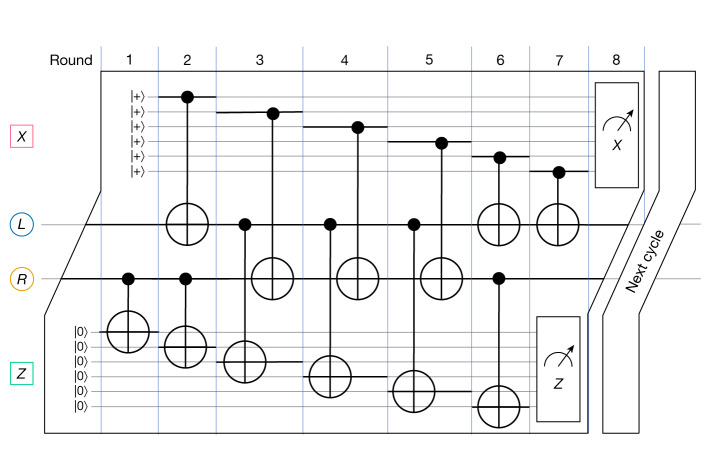
The accumulation of physical errors 1–3 prevents the execution of large-scale algorithms in current quantum computers. Quantum error correction 4 promises a solution by encoding k logical qubits onto a larger number n of physical qubits, such that the physical errors are suppressed enough to allow running a desired computation with tolerable fidelity. Quantum error correction becomes practically realizable once the physical error rate is below a threshold value that depends on the choice of quantum code, syndrome measurement circuit and decoding algorithm 5 . We present an end-to-end quantum error correction protocol that implements fault-tolerant memory on the basis of a family of low-density parity-check codes 6 . Our approach achieves an error threshold of 0.7% for the standard circuit-based noise model, on par with the surface code 7–10 that for 20 years was the leading code in terms of error threshold. The syndrome measurement cycle for a length- n code in our family requires n ancillary qubits and a depth-8 circuit with CNOT gates, qubit initializations and measurements. The required qubit connectivity is a degree-6 graph composed of two edge-disjoint planar subgraphs. In particular, we show that 12 logical qubits can be preserved for nearly 1 million syndrome cycles using 288 physical qubits in total, assuming the physical error rate of 0.1%, whereas the surface code would require nearly 3,000 physical qubits to achieve said performance. Our findings bring demonstrations of a low-overhead fault-tolerant quantum memory within the reach of near-term quantum processors.
Overview
CoChat Summary
## TL;DR
The paper presents a family of bivariate bicycle (BB) LDPC quantum codes and an end-to-end fault-tolerant memory protocol with low overhead. In numerical simulations, the authors report an error threshold/pseudo-threshold of about 0.7% and show that a 12-logical-qubit code can be preserved for nearly 1 million syndrome cycles using 288 physical qubits at physical error rate 0.1%.
## Key findings
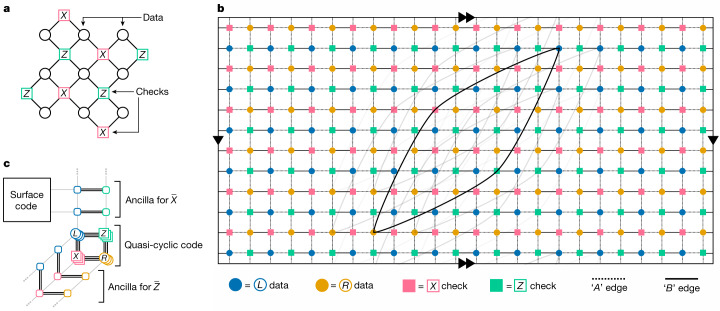
- The proposed BB codes have weight-6 check operators, degree-6 Tanner graphs, and thickness 2, meaning their connectivity can be split into two edge-disjoint planar subgraphs.
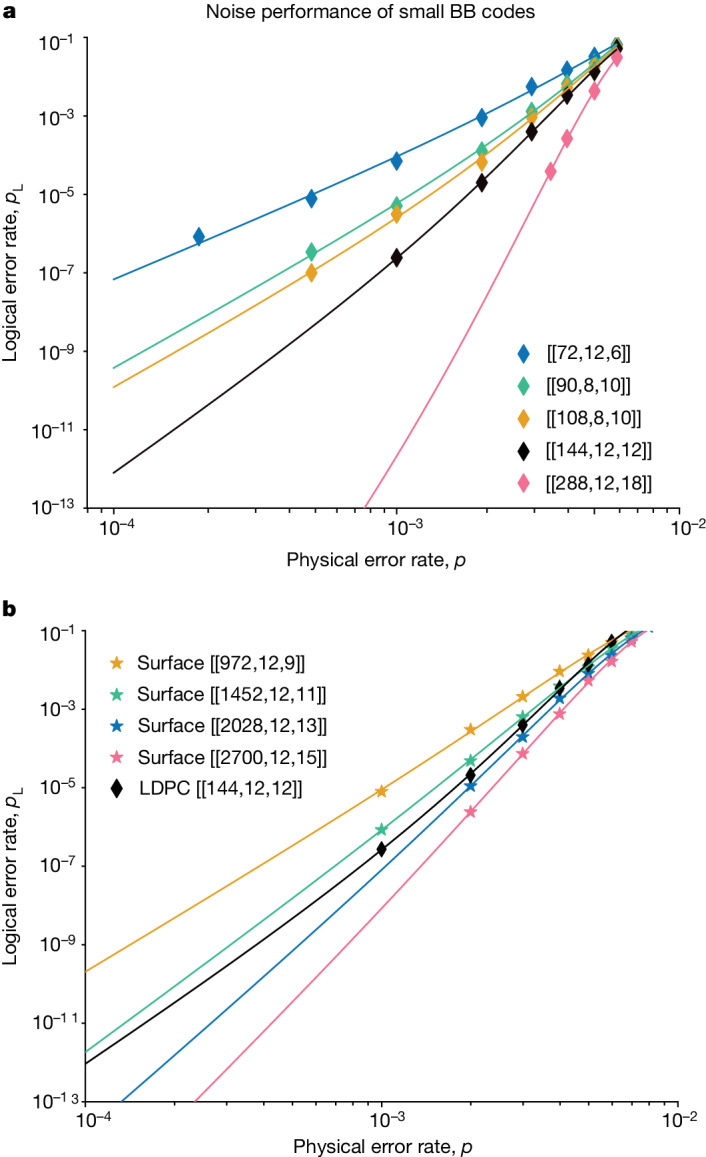
- The authors report an error threshold close to 0.7% for the standard circuit-based noise model, “on par with the surface code” and exceeding other high-rate LDPC codes known to them.
- For the [[144, 12, 12]] code, they state a net encoding rate of 1/24 and that it can preserve 12 logical qubits for nearly 1 million syndrome cycles using 288 physical qubits at physical error rate 0.1%.
- Compared with separate surface-code patches, they report about a 10× reduction in physical-qubit overhead for the distance-12 BB code in the example they analyze.
## Methods
- The paper introduces bivariate bicycle (BB) stabilizer codes defined from pairs of bivariate polynomials/matrices \(A\) and \(B\), yielding CSS codes with \(n=2\ell m\) data qubits and six-qubit check operators.
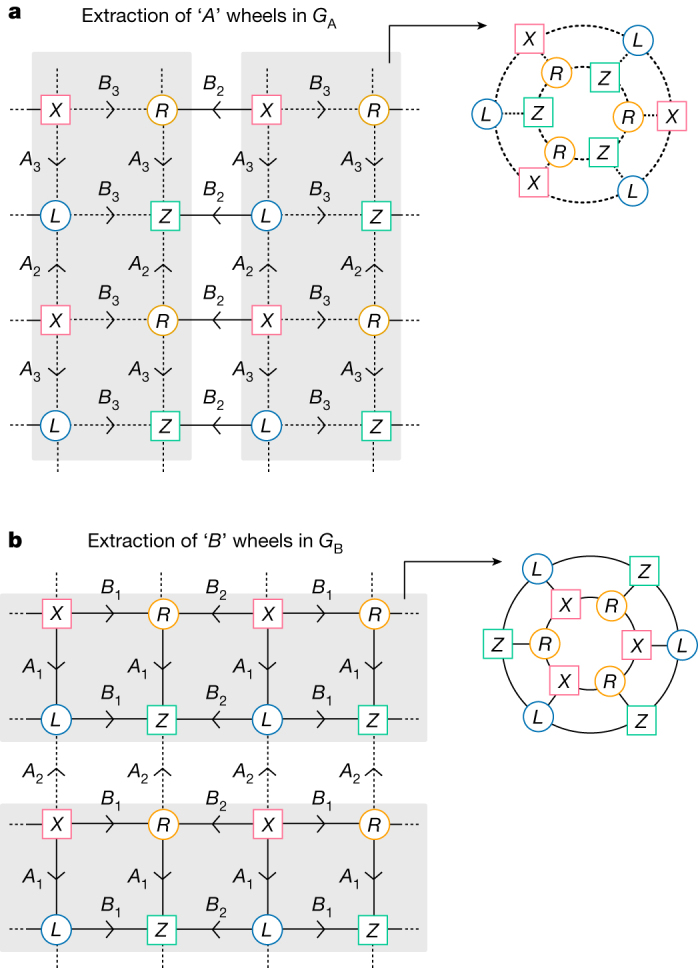
- They analyze code structure through the Tanner graph, proving results about connectivity, toric layouts, and thickness-2 planar decompositions of the graph.
- Performance is evaluated with an end-to-end fault-tolerant memory protocol under a circuit-based noise model where each operation fails independently with probability \(p\), using a BP-OSD decoder adapted to circuit noise and numerical simulations of logical error rates.
## Limitations
- The authors explicitly note that it remains unclear whether the code examples can be scaled up while retaining the high encoding rate in the limit of large code length.
- They also state that optimization of the code layout satisfying specific hardware constraints is left for future work.
- Evident from the text: the reported performance is based on numerical simulations and, for lower error rates, extrapolation/fitting, rather than a hardware demonstration.
Model-written summary. Check it against the paper before relying on it.
Integrity signals
Registry
Cites
Statistics
Figures
Verification
Claims the paper makes
12 Valid · 9 Not valid · 10 Not checked · 61 Own results and interpretations
The cited sources support only part of this claim — read each source’s verdict below.
In the paper
“on par with the surface code7–10 that for 20 years was the leading code in terms of error threshold”
- Also stated in: § Main · hedged
“which is nearly the same as the error threshold of the surface code49”
§ High-threshold and low-overhead fault-tolerant quantum memory > Abstract The accumulation of physical errors1–3 prevents the execution of large-scale algorithms in current quantum computers. Quantum error correction4 promises a solution by encoding k logical qubits onto a larger number n of physical qubits, such that the physical errors are suppressed enough to allow running a desired computation with tolerable fidelity. Quantum error correction becomes practically realizable once the physical error rate is below a threshold value that depends on the choice of quantum code, syndrome measurement circuit and decoding algorithm5. We present an end-to-end quantum error correction protocol that implements fault-tolerant memory on the basis of a family of low-density parity-check codes6. Our approach achieves an error threshold of 0.7% for the standard circuit-based noise model, on par with the surface code7–10 that for 20 years was the leading code in terms of error threshold. The syndrome measurement cycle for a length-n code in our family requires n ancillary qubits and a depth-8 circuit with CNOT gates, qubit initializations and measurements. The required qubit connectivity is a degree-6 graph composed of two edge-disjoint planar subgraphs. In particular, we show that 12 logical qubits can be preserved for nearly 1 million syndrome cycles using 288 physical qubits in total, assuming the physical error rate of 0.1%, whereas the surface code would require nearly 3,000 physical qubits to achieve said performance. Our findings bring demonstrations of a low-overhead fault-tolerant quantum memory within the reach of near-term quantum processors.
What the sources say
- Partly supportedcites [7] Kitaev, A. Y. Fault-tolerant quantum computation by anyons. Ann. Phys. 303, 2–30 (2003); preprint at 10.48550/arXiv.quant-ph/9707021 (1997). sourceExperimental — accuracy not yet measured
The section on toric codes (p. 4) says they work below an error threshold, supporting the comparison’s premise that this code has a threshold. But the Abstract (p. 1) says the threshold was not known and gives estimates from 1/300 to 10^-6; it does not establish that a 0.7% threshold is on par with it or that it led other codes for 20 years. (LLM, conf=0.82)
- Partly supportedcites [8] Bravyi, S. B. & Kitaev, A. Y. Quantum codes on a lattice with boundary. Preprint at 10.48550/arXiv.quant-ph/9811052 (1998). sourceExperimental — accuracy not yet measured
The Abstract (pp. 1–2) describes a lattice code with boundaries and local stabilizers, supporting the citation’s identification of a surface code. The copy gives code distance and the number of errors the code can correct (p. 4), but it does not give an error-rate threshold or establish that 0.7% is comparable to it. (LLM, conf=0.82)
- Partly supportedcites [9] Dennis, E., Kitaev, A., Landahl, A. & Preskill, J. Topological quantum memory. J. Math. Phys. 43, 4452–4505 (2002). 10.1063/1.1499754 sourceExperimental — accuracy not yet measured
The paper analyzes surface-code error thresholds: §F (p. 17) gives a lower bound of 1.14% when data and measurement error probabilities are equal. It does not give 0.7% as the surface-code threshold, so it supports the comparison’s subject but not the specific numerical equivalence. Its 2002 text also cannot establish the citing sentence’s retrospective claim of 20 years of leadership. (LLM, conf=0.85)
- Supportedcites [10] Fowler, A. G., Stephens, A. M. & Groszkowski, P. High-threshold universal quantum computation on the surface code. Phys. Rev. A 80, 052312 (2009). 10.1103/PhysRevA.80.052312 source
Section VIII (p. 15) reports a numerical surface-code threshold of approximately 0.6%, and the conclusion (p. 16) repeats that value. A threshold of 0.7% is therefore on par with the threshold this paper reports. (LLM, conf=0.91)
- Not matchedcites [49] Groszkowski, P., Fowler, A. & Stephens, A. M. High-threshold surface code quantum computing: threshold calculation. In Proc. APS March Meeting Abstracts W17–002 (APS, 2009).
Its entry has no title and year that we can search by.
plain- Asserted: passes — The authors put it forward as true.
- Checkable: passes — It can be checked against evidence.
- Load-bearing: passes — The paper’s conclusions depend on it.
- Based: passes — The paper gives a reason why it holds.
- Also stated in: § Main · hedged
The cited sources support only part of this claim — read each source’s verdict below.
In the paper
“The required qubit connectivity is a degree-6 graph composed of two edge-disjoint planar subgraphs.”
- Also stated in: § Main · plain
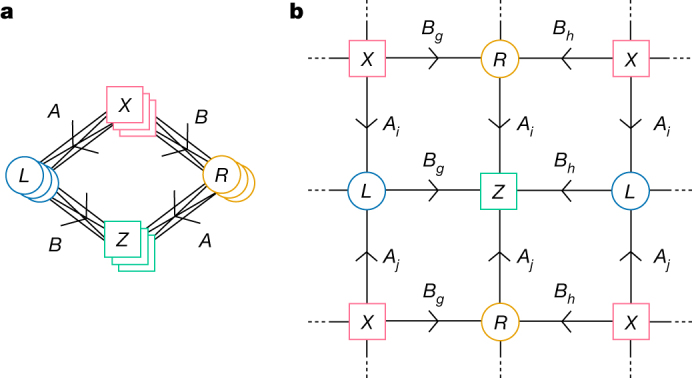
“The Tanner graph of any BB code has vertex degree six and graph thickness29 equal to two, which means it can be decomposed into two edge-disjoint planar subgraphs (Methods).”
- Also stated in: § Main · plain
“Although the qubit connectivity graph is not locally embeddable into a 2D grid, it can be decomposed into two planar degree-3 subgraphs.”
§ High-threshold and low-overhead fault-tolerant quantum memory > Abstract The accumulation of physical errors1–3 prevents the execution of large-scale algorithms in current quantum computers. Quantum error correction4 promises a solution by encoding k logical qubits onto a larger number n of physical qubits, such that the physical errors are suppressed enough to allow running a desired computation with tolerable fidelity. Quantum error correction becomes practically realizable once the physical error rate is below a threshold value that depends on the choice of quantum code, syndrome measurement circuit and decoding algorithm5. We present an end-to-end quantum error correction protocol that implements fault-tolerant memory on the basis of a family of low-density parity-check codes6. Our approach achieves an error threshold of 0.7% for the standard circuit-based noise model, on par with the surface code7–10 that for 20 years was the leading code in terms of error threshold. The syndrome measurement cycle for a length-n code in our family requires n ancillary qubits and a depth-8 circuit with CNOT gates, qubit initializations and measurements. The required qubit connectivity is a degree-6 graph composed of two edge-disjoint planar subgraphs. In particular, we show that 12 logical qubits can be preserved for nearly 1 million syndrome cycles using 288 physical qubits in total, assuming the physical error rate of 0.1%, whereas the surface code would require nearly 3,000 physical qubits to achieve said performance. Our findings bring demonstrations of a low-overhead fault-tolerant quantum memory within the reach of near-term quantum processors.
What the sources say
- Partly supportedcites [29] Tremblay, M. A., Delfosse, N. & Beverland, M. E. Constant-overhead quantum error correction with thin planar connectivity. Phys. Rev. Lett. 129, 050504 (2022). 35960553 10.1103/PhysRevLett.129.050504 sourceExperimental — accuracy not yet measured
Proposition 1 (p. 2) supports partitioning a low-degree connectivity graph into planar subgraphs. For degree 6, it guarantees a layout with at most three planar layers, not the claimed two. The passages about hypergraph product codes do not identify BB codes or establish their degree-6 connectivity. (LLM, conf=0.87)
plain- Asserted: passes — The authors put it forward as true.
- Checkable: passes — It can be checked against evidence.
- Load-bearing: passes — The paper’s conclusions depend on it.
- Based: passes — The paper gives a reason why it holds.
- Also stated in: § Main · plain
Every source the paper cites for this claim was checked and supports it.
In the paper
“Recent progress in the study of LDPC codes suggests that they can achieve quantum fault tolerance with a much higher encoding efficiency29.”
§ High-threshold and low-overhead fault-tolerant quantum memory > Main
What the sources say
- Supportedcites [29] Tremblay, M. A., Delfosse, N. & Beverland, M. E. Constant-overhead quantum error correction with thin planar connectivity. Phys. Rev. Lett. 129, 050504 (2022). 35960553 10.1103/PhysRevLett.129.050504 source
On p. 1, the paper says some quantum LDPC codes can achieve arbitrarily low logical error rates with a constant ratio of tens of physical qubits per logical qubit, potentially reducing qubit overhead by more than an order of magnitude compared with surface codes. It also reports a circuit-noise threshold for a positive-rate code family, supporting the claim's qualified statement about fault tolerance and encoding efficiency. (LLM, conf=0.93)
hedgedstates a possible cause- Asserted: passes — The authors put it forward as true.
- Checkable: passes — It can be checked against evidence.
- Load-bearing: passes — The paper’s conclusions depend on it.
- Based: passes — The paper gives a reason why it holds.
- Supported
Every source the paper cites for this claim was checked and supports it.
In the paper
“The latter were shown39,40 to be asymptotically ‘good’ in the sense of offering a constant encoding rate and linear distance: a parameter quantifying the number of correctable errors.”
§ High-threshold and low-overhead fault-tolerant quantum memory > Main
What the sources say
- Supportedcites [39] Panteleev, P. & Kalachev, G. Asymptotically good quantum and locally testable classical LDPC codes. In Proc. 54th Annual ACM SIGACT Symposium on Theory of Computing 375–388 (ACM, 2022). source
The Introduction (Theorem 2) states that for every R ∈ (0,1) and finite field F_q there is an explicit family of quantum LDPC codes with parameters [n, ⌊Rn⌋, d = Θ(n)]_q as n → ∞, i.e. constant rate and linear distance — an affirmative answer to the qLDPC conjecture. The same Introduction explains that these quantum CSS codes are built by taking the G-lifted product of expander/Tanner codes T(Γ;h) ("such codes can be used with the G-lifted product to obtain a 3-term chain complex C, which can also be considered as a quantum CSS code"), and §1.8 explicitly licenses calling Tanner complexes 'Tanner codes'. So the attributed point — quantum codes of Tanner type being asymptotically good with constant rate and linear distance — is stated by this paper. (LLM, conf=0.85)
- Supportedcites [40] Leverrier, A. & Zémor, G. Quantum Tanner codes. In Proc. 2022 IEEE 63rd Annual Symposium on Foundations of Computer Science (FOCS) 872–883 (IEEE, 2022). source
The Contributions section (p. 2) states that, under sufficient expansion and robustness conditions, the construction yields asymptotically good quantum LDPC codes with constant rate and linear minimum distance. This directly supports the attributed claim. (LLM, conf=0.95)
plainstates an association- Asserted: passes — The authors put it forward as true.
- Checkable: passes — It can be checked against evidence.
- Load-bearing: passes — The paper’s conclusions depend on it.
- Based: passes — The paper gives a reason why it holds.
- Supported
Every source the paper cites for this claim was checked and supports it.
In the paper
“As shown in Fig. 1c, extensions of the Tanner graph leveraging techniques by Cohen et al.50 enable fault-tolerant measurement operations involving an ancillary surface code.”
§ High-threshold and low-overhead fault-tolerant quantum memory > Main
What the sources say
- Supportedcites Cohen et al.50 Cohen, L. Z., Kim, I. H., Bartlett, S. D. & Brown, B. J. Low-overhead fault-tolerant quantum computing using long-range connectivity. Sci. Adv.10.1126/sciadv.abn1717 (2022). PMC10926894 35594359 source
The Results section (‘Logical CSS measurement’; page unavailable) describes extending a Tanner graph with an ancilla system to measure logical operators fault-tolerantly. The sentence attributes that technique to Cohen et al.; its reference to an ancillary surface code describes the citing authors’ application, not a claim that Cohen et al. used one. (LLM, conf=0.88)
plainstates a cause- Asserted: passes — The authors put it forward as true.
- Checkable: passes — It can be checked against evidence.
- Load-bearing: passes — The paper’s conclusions depend on it.
- Based: passes — The paper gives a reason why it holds.
- Supported
54 more claims · 2 with their cited sources checked
Create a free account to see all 92 claims and every source verdict.
- Probably not a substantial claim. 23
- It may state two separate claims as one. 12
- The quote only partly states this claim. 2
Citations
Cites
Quantum Computation and Quantum Information
Nielsen, M. A., Chuang, I., & Grover, L. K. (2002) · American Journal of Physics · doi:10.1119/1.1463744 · Cited by 21,895
Quantum supremacy using a programmable superconducting processor
Arute, F., Arya, K., Babbush, R., Bacon, D., Bardin, J. C., Barends, R., Biswas, R., Boixo, S., Brandao, F. G. S. L., Buell, D. A., et al. (2019) · Nature · doi:10.1038/s41586-019-1666-5 · Cited by 7,720 · cited 1×
“This new gate is also similar to the gates used by Google Quantum AI 57 , which have shown that a square lattice arrangement is possible.”
MethodFault-tolerant quantum computation by anyons
Kitaev, A. Y. (2003) · Annals of Physics · doi:10.1016/s0003-4916(02)00018-0 · Cited by 7,238 · cited 3×
“This resulted in the development of the surface code 7–10 that offers a high error threshold close to 1%, fast decoding algorithms and compatibility with the existing quantum processors relying on two-dimensional (2D) square lattice qubit connectivity.”
BackgroundMethodInfluentialScheme for reducing decoherence in quantum computer memory
Shor, P. W. (1995) · Physical Review A · doi:10.1103/physreva.52.r2493 · Cited by 4,479 · cited 2×
“The possibility of quantum fault tolerance is well-established 4 .”
BackgroundLloyd, S. (1996) · Science · doi:10.1126/science.273.5278.1073 · Cited by 3,088 · cited 1×
“It is believed that a scalable functioning quantum computer may help solve computational problems in such areas as scientific discovery, materials research, chemistry, and drug design, to name a few [2, 3, 4, 5].”
BackgroundGood quantum error-correcting codes exist
Calderbank, A. R., & Shor, P. W. (1996) · Physical Review A · doi:10.1103/physreva.54.1098 · Cited by 2,516 · cited 2×
“The length of the inner cycle is equal to the order of the matrix A A T 3 2 that is the transpose of A A T 3 2 considered earlier.”
BackgroundDennis, E., Kitaev, A., Landahl, A., & Preskill, J. (2002) · Journal of Mathematical Physics · doi:10.1063/1.1499754 · Cited by 1,768 · cited 1×
“The sources of noise include imperfections in qubits, materials used, controlling apparatus, state preparation and measurement errors and a variety of external factors ranging from local man-made, such as stray electromagnetic fields, to those inherent to the Universe, such as cosmic rays.”
BackgroundImproved simulation of stabilizer circuits
Aaronson, S., & Gottesman, D. (2004) · Physical Review A · doi:10.1103/physreva.70.052328 · Cited by 1,515 · cited 1×
“Since the circuit involves only Clifford operations, its action can be compactly described using stabilizer tableau [49].”
BackgroundDennis, E., Kitaev, A., Landahl, A., & Preskill, J. (2001) · CERN Document Server (European Organization for Nuclear Research) · Cited by 1,485
Quantum computations: algorithms and error correction
Kitaev, A. Y. (1997) · Russian Mathematical Surveys · doi:10.1070/rm1997v052n06abeh002155 · Cited by 1,424 · cited 1×
“The first proposals for quantum error correction, such as concatenated codes [16, 17, 18], focused on demonstrating the theoretical possibility of error suppression.”
Background
Research works printed but not linked: 1
- Groszkowski, P., Fowler, A. & Stephens, A. M. High-threshold surface code quantum computing: threshold calculation. In Proc. APS March Meeting Abstracts W17–002 (APS, 2009).
Cited by
Items 401–443 of 443
Optimal Compilation of Syndrome Extraction Circuits for General Quantum LDPC Codes
Zhang, K., Gao, D., Yang, Z., Zhou, R., Liu, F., Ji, Z., & Chen, J. (2026) · Design, Automation, and Test in Europe · doi:10.23919/date69613.2026.11539585 · Cited by 10
“Consistent with [11], [12], we define circuit depth as the number of non-overlapping CX ( CZ ) layers.”
InfluentialProtocol for purifying noisy preparation and measurements of qubits
Kim, J., Seo, S., Yun, J., Lienhard, B., & Bae, J. (2026) · Physical Review Research · doi:10.1103/z6pg-m3q6 · Cited by 1
Eriksson, A. M., Splitthoff, L. J., Upadhyay, H. V., Campana, P., Lundström, O., Narendiran, N. P., Helambe, K. D., Andersson, L., & Gasparinetti, S. (2026) · Quantum Science and Technology · doi:10.1088/2058-9565/ae7ab6 · Cited by 3
Coherent errors in a superconducting six-qubit network with beyond-nearest-neighbor connectivity
Deshmukh, J., Das, S., Nambiar, B., Chand, M., Salunkhe, K. V., Umasankar, G., Kamat, A., Bhowal, K., Agarwal, G., -, L. B., et al. (2026) · Physical Review Research · doi:10.1103/6jdh-pm39 · Cited by 1
Wayo, D. D. K., Onah, C., Goliatt, L., & Groppe, S. (2026) · Fortschritte der Physik · doi:10.1002/prop.70124
Runtime reduction in lattice surgery utilizing timelike soft information
Akahoshi, Y., Toshio, R., Fujisaki, J., Oshima, H., Sato, S., & Fujii, K. (2026) · Physical Review Research · doi:10.1103/wz3p-sgdq · Cited by 15
Quantum Monte Carlo randomized algorithm for the Feedback Arc Set problem
Kudelić, R. (2026) · Array · doi:10.1016/j.array.2026.101011
Beyond Classical Limits: Quantum Computing Advances in Post-Binary Era
Gupta, D., Gayratovich, E. N., Isaev, F., Ulugbek, U., Gulamov, I., Jurayeva, S., & Ishnazarov, A. (2026) · Advances in computational intelligence and robotics book series · doi:10.4018/979-8-2600-0156-1.ch002
Composite-dimensional topological codes with boundaries and defects
Mousa, M., Jamadagni, A., & Dumitrescu, E. (2026) · Physical Review A · doi:10.1103/qr5v-1rg6
Recent Advances in Quantum Error Correction Codes for Superconducting Quantum Computing
Wang, Z., Gao, G., & 武光明 (2026) · International Symposium on Computer Technology and Information Science (ISCTIS) · doi:10.1109/isctis70043.2026.11572651
“Bravyi et al. introduced more efficient LDPC code schemes that significantly reduce the physical qubit overhead required for fault-tolerant quantum computing [4].”
Building Hybrid Quantum–Classical Computing Ecosystems: A Survey
Bharadwaj, D., Hou, Y., Knapen, A., Kwun, G., Zhitkov, N., & Ravi, G. S. (2026) · Communications in computer and information science · doi:10.1007/978-981-95-7829-0_13 · Cited by 1
Integrated quantum memory with a single atom in a system of two resonators
Perminov, N. S., & Moiseev, S. A. (2026) · Učenye zapiski Kazanskogo gosudarstvennogo universiteta. Seriâ Fiziko-matematičeskie nauki/Učënye zapiski Kazanskogo universiteta. Seriâ Fiziko-matematičeskie nauki · doi:10.26907/2541-7746.2026.2.287-303
Game-theoretic discovery of quantum error-correcting codes through Nash equilibria
Anonymous (2026) · Physical Review A · doi:10.1103/x1ph-v78g · Cited by 4
On the Minimum Distances of Finite-Length Lifted Product Quantum LDPC Codes
Raveendran, N., Declercq, D., & Vasic, B. V. (2026) · International Conference on Communications · doi:10.1109/icc59461.2026.11587715 · Cited by 2
“Sparse stabilizer codes - referred to generally as quantum low-density parity-check (QLDPC) codes – have recently risen to the forefront of quantum error correction (QEC) research, both in terms of theoretical approaches and practical implementation aspects [1]–[3].”
Le calcul quantique à l’épreuve de l’ingénierie : La pile logicielle comme enjeu de souveraineté
Abroug, N. (2026) · Annales des Mines - Réalités industrielles · doi:10.3917/rindu1.262.0017
Tully, E., Washburn, J., & Simons, M. (2026) · Research Square · doi:10.21203/rs.3.rs-10297109/v1
The Five-Year Horizon: Quantum Computing and the Philosophy of Technical Becoming
Jurczak, C. (2026) · Philosophies · doi:10.3390/philosophies11040127
“…quantum error correc-https tion [17], Harvard’s reported fault-tolerant neutral-atom architecture with 448 qubits [18], IBM’s high-threshold code [19], and, most recently, the first experimental validations of quantum simulation of materials against independent laboratory measurements, achieved…”
Readout-Induced Degradation of Transmon Lifetimes: Interplay of TLSs and Qubit Spectral Reshaping
Huang, Z., Hung, J. S. C., Raha, M., Chou, M.-H., Levine, H., Retzker, A., Hann, C. T., Hover, D. J., Brandão, F. G. S. L., Clerk, A. A., et al. (2026) · PRX Quantum · doi:10.1103/y5ty-bd4y · Cited by 7
“Still, faster and more accurate readout is indispensable for building resource-efficient error-corrected quantum computers [11, 12].”
Quantum Computing for Molecular Systems: Part I: Quantum Circuit and Measurement
Singh, H., Majumder, S., & Mishra, S. (2026) · Resonance · doi:10.1007/s12045-026-1993-4
Simple, Efficient, and Generic Postselection Decoding for qLDPC Codes
Anonymous, Yoshioka, N., Tsubouchi, K., & Li, Y. (2026) · Physical Review Letters · doi:10.1103/sv11-f78l · Cited by 20
“We apply the method to a range of decoders, including MWPM and three variants of BP, and test it on rotated surface codes [28] as well as instances from the bivariate bicycle (BB) code family [10].”
InfluentialCui, Z., Zhang, P., & Tang, Y. (2026) · PRX Intelligence · doi:10.1103/s6zj-vzdp · Cited by 11
Developments in superconducting erasure qubits for hardware-efficient quantum error correction
Violaris, M., Henaut, L., Wills, J. R., Consani, G., Friel, J., & Vlastakis, B. (2026) · Materials for Quantum Technology · doi:10.1088/2633-4356/ae9236 · Cited by 1
“For example, IBM Quantum published research into the bivariate bicycle code [57, 58].”
In Situ Benchmarking of Fault-Tolerant Quantum Circuits: Clifford Circuits
Anonymous, Hangleiter, D., Bluvstein, D., Lukin, M. D., & Gullans, M. J. (2026) · PRX Quantum · doi:10.1103/ghn4-8y96 · Cited by 13
O3LS: Optimizing Lattice Surgery via Automatic Layout Searching and Loose Scheduling
Zhu, C., Wu, X., Chen, J., He, K., Wu, J., Wang, X., & Lao, L. (2026) · Proceedings - International Symposium on Computer Architecture/Proceedings · doi:10.1109/isca66397.2026.00149 · Cited by 7
“[45] introduces a toolbox for heterogeneous quantum architectures on superconducting devices, while [6], [46], [54] propose hybrid approaches that combine surface codes with qLDPC codes, leveraging their complementary strengths by assigning different codes to memory and computation regions.”
Chen, J., Zhu, C., Bai, G., & Wang, X. (2026) · Proceedings - International Symposium on Computer Architecture/Proceedings · doi:10.1109/isca66397.2026.00069 · Cited by 3
“Encouragingly, recent experimental progress across various platforms and QEC codes [7]–[9] is rapidly validating this approach [10]–[14].”
Distilling Magic States in the Bicycle Architecture
Xu, S., Liu, K., Rall, P., He, Z., & Ding, Y. (2026) · Proceedings - International Symposium on Computer Architecture/Proceedings · doi:10.1109/isca66397.2026.00148 · Cited by 2
“Recent advances in constructing high-rate codes [16], [35]–[37], implementing logical operations [26], [32], [38], [39], and building hardware with long-range connections [40]–[43] have established QLDPC codes as promising candidates for near-term quantum memories and FTQC.”
InfluentialSelf-citationA dataset of publications and patents on quantum error correction (1995–2025)
Barua, S., & Shemushee, H. (2026) · Data in Brief · doi:10.1016/j.dib.2026.113149
“Research activity now spans decoders, bosonic and quantum low-density parity-check codes [ 9 ], and magic-state distillation [ 10 ], and it is accompanied by a growing body of patents filed by academic and industrial organizations, classified under a dedicated patent scheme.”
Theory of spin qubits and the path to scalability
McIntyre, Z. M., Sarkar, A., & Loss, D. (2026) · New Journal of Physics · doi:10.1088/1367-2630/ae973f · Cited by 6
Naito, S., Suzuki, Y., & Tokunaga, Y. (2026) · IEEE Transactions on Quantum Engineering · doi:10.1109/tqe.2026.3722428 · Cited by 8
“In practice, however, FTQC nodes may contain a larger number of n node , or one may employ QEC codes that encode multiple logical qubits within a single code block, such as quantum low-density parity-check codes [31], [32].”
InfluentialWang, P., Lu, B.-H., Wang, T.-L., Zhang, S., Chen, Z.-Y., Zhang, H.-F., Zhao, R.-Z., Yang, X.-Y., Zhao, Z.-Y., Zhang, Z.-Z., et al. (2025) · Physical Review Letters · doi:10.1103/zywf-twfv
“However, with the continued scaling of quantum processors and the increasing demand for high-connectivity layouts tailored to efficient quantum error correction codes [32, 33], frequency collisions are becoming increasingly difficult to avoid.”
Kulkarni, R. (2026) · Quantum Reports · doi:10.3390/quantum8030097
Wu, H., & Li, Y. (2026) · Discover Internet of Things · doi:10.1007/s43926-026-00442-3
Streaming Belief Propagation on Mixed-Alphabet Tanner Graphs for Practical Quantum Memory
Kuo, K.-Y., & Lai, C. (2026) · Quantum · doi:10.22331/q-2026-09-10-2207 · Cited by 7
“Ad-ditionally, QLDPC codes may also exhibit high thresholds for fault tolerance [23–25], making them a promising alternative in FTQC.”
General construction of quantum error-correcting codes from multiple classical codes
Anonymous, Li, M.-Y., Li, C., & Zhai, H. (2026) · Physical review. B./Physical review. B · doi:10.1103/6c3l-8n19 · Cited by 2
Fazio, M., Stagno, F., Bottaro, A., Gangemi, S., & Allegra, A. (2026) · Medical Hypotheses · doi:10.1016/j.mehy.2026.112164
Kulkarni, R. (2026) · Quantum Reports · doi:10.3390/quantum8030098
Pêlαγos: An Adaptive GPU Decoder for Error Correction Simulations of Quantum LDPC Codes
Diamantopoulos, D., von Niederhäusern, L., Anghel, A. S., Pletka, R. A., Kayi, A., Müller, T., Papandreou, N., Blanuša, J., Sarafijanović, S., Gonzalez, N. M., et al. (2026) · IEEE International Conference on Quantum Software (QSW) · doi:10.1109/qsw72780.2026.00025 · Cited by 1
“…polynomial-time exact decoding by exploiting the topological structure of surface codes, but this planar structure is absent in qLDPC codes [18] such as bivariate bicycle [10], [16] or quantum Tanner codes [25], whose sparse, irregular Tanner graphs have no planarity or bounded-treewidth property.”
InfluentialSingh, P., Sahoo, P., Das, S. D., Lad, A. D., & Bandyopadhyay, A. (2026) · AIP Advances · doi:10.1063/5.0325849
García, A. M., Skipper, A. M., Ironside, D. J., Lee, D. O., Lee, M. L., Bank, S. R., & White, R. C. (2026) · Crystal Growth & Design · doi:10.1021/acs.cgd.6c00924
Model-Guided Routing Optimization of Superconducting Quantum Chips Tailored for qLDPC Codes
Ke, H. (2026) · ACM Turing Celebration Conference - China (ACM TURC) · doi:10.1145/3833142.3833185
Quantum error correction and fault tolerance: A comprehensive tutorial
Spencer, D. J., Jain, S. P., Tanggara, A., Sun, Z., Haug, T., Khu, D., & Bharti, K. (2026) · arXiv
Accelerating the Tesseract Decoder for Quantum Error Correction
Grbic, D., Beni, L. A., & Shutty, N. (2026) · arXiv · doi:10.48550/arxiv.2602.02985
“…4, 10, 21, 22] (a generalization of topological codes defined on tri-colorable lattices, offering higher encoding rates), Bivariate-Bicycle Codes [5, 35] (a code family that leverages algebraic constructions to achieve high encoding rates), and Transversal CNOT Protocols for Surface Codes [19,…”
Realization of a Quantum Streaming Algorithm on Long-lived Trapped-ion Qubits
Niroula, P., Chakrabarti, S., Kordonowy, S., Kumar, N., Omanakuttan, S., Perlin, M. A., Allman, M. S., Campora, J. P., Chernoguzov, A., Cooper, S. F., et al. (2025) · arXiv · doi:10.48550/arxiv.2511.03689
Metadata
- Authors
- Bravyi, S., Cross, A. W., Gambetta, J. M., Maslov, D., Rall, P., & Yoder, T. J.
- Affiliations
- IBM (United States) (US)
- Corresponding author
- Maslov, Dmitri
- Venue
- Nature
- Published
- 2024-03-27
- Volume
- 627
- Issue
- 8005
- Pages
- 778-782
- ISSN
- 0028-0836 (ISSN-L)
- 1476-4687
- PMC
- PMC10972743
- OpenAlex
- W4393234688
- Cited by
- 456
- References
- 82
- Citations by year
- 2026: 150 · 2025: 223 · 2024: 76
- FWCI
- 65.98
- Type
- journal article
- Language
- en
- Open access
- hybrid
- doi.org
- Licence
- cc-by
- creativecommons.org/licenses/by/4.0 (tdm)
- creativecommons.org/licenses/by/4.0 (vor)
- Locations
- Nature (publishedVersion, cc-by)
- PubMed Central (publishedVersion, cc-by)
- PubMed (publishedVersion)
- arXiv (Cornell University) (submittedVersion)
- RePEc: Research Papers in Economics (submittedVersion)
- arXiv (Cornell University)
- Topics
- Physical Sciences › Computer Science › Artificial Intelligence › Quantum Computing Algorithms and Architecture
- Physical Sciences › Physics and Astronomy › Atomic and Molecular Physics, and Optics › Quantum Information and Cryptography
- Physical Sciences › Physics and Astronomy › Atomic and Molecular Physics, and Optics › Quantum many-body systems
- Keywords
- fault-tolerant quantum memory, quantum error correction, LDPC codes, error threshold, syndrome measurement, logical qubits, qubit connectivity, planar graphs
About these checks
Registry, retraction, Cites and statistics results are computed, not judged, with one exception: a printed reference that no index lists is read once by a model before it counts as a citation error. Claims are extracted by a model and kept only when their quote appears verbatim in the text; each cited source is then checked, with a model’s help, for whether it says what the claim relies on. Those verdicts can be wrong — read the claim’s quote and the cited source before relying on one.
The claim verdicts this report counts are experimental: their accuracy is not yet measured.
A language model drew the claims from the paper on 2026-10-10, under version 3 of the claim definition (model deepseek-v4.1-flash, prompt extract-v3).
A second model labelled each claim on 2026-10-10 (model jev-1.13-20260917, definition revision gold-guideline-v0.2).
Cited sources are checked with a language model’s help (gpt-6-sol and qwen3.8-omni-flash).
Statistics and arithmetic are recomputed, not judged.
Confidence bands are shown only for fields calibrated on our annotated test set. None is calibrated yet, so no band is shown.
What counts as a claim ›How we measure confidence ›How we check this ›
Are you an author, or do you see a problem with this page? Request a review
Data sources
Bibliographic data: Semantic Scholar, OpenAlex, Crossref.
Contains information from the Semantic Scholar Academic Graph Datasets, made available under the ODC Attribution License (ODC-BY 1.0).
Semantic Scholar’s data is described in: Kinney, R., et al. (2023). The Semantic Scholar Open Data Platform. arXiv:2301.10140.
