

High-threshold and low-overhead fault-tolerant quantum memory
Open accessThe DOI matches its Crossref record; 81 of the 82 references it cites were found in a registry or an index; 23 of the 34 sources its claims cite were checked for support.
Abstract
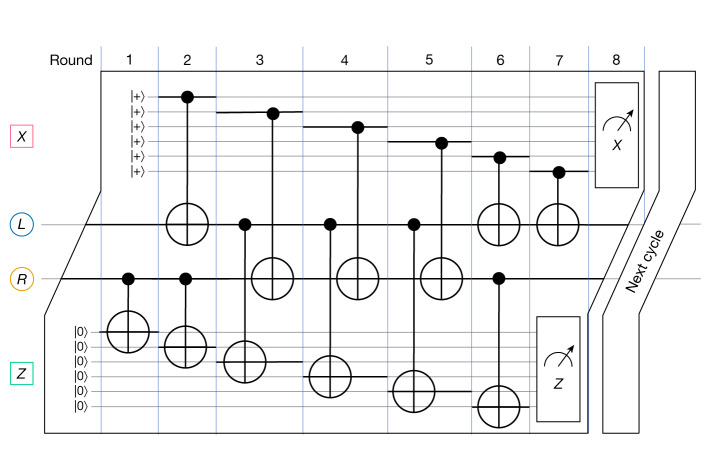
The accumulation of physical errors 1–3 prevents the execution of large-scale algorithms in current quantum computers. Quantum error correction 4 promises a solution by encoding k logical qubits onto a larger number n of physical qubits, such that the physical errors are suppressed enough to allow running a desired computation with tolerable fidelity. Quantum error correction becomes practically realizable once the physical error rate is below a threshold value that depends on the choice of quantum code, syndrome measurement circuit and decoding algorithm 5 . We present an end-to-end quantum error correction protocol that implements fault-tolerant memory on the basis of a family of low-density parity-check codes 6 . Our approach achieves an error threshold of 0.7% for the standard circuit-based noise model, on par with the surface code 7–10 that for 20 years was the leading code in terms of error threshold. The syndrome measurement cycle for a length- n code in our family requires n ancillary qubits and a depth-8 circuit with CNOT gates, qubit initializations and measurements. The required qubit connectivity is a degree-6 graph composed of two edge-disjoint planar subgraphs. In particular, we show that 12 logical qubits can be preserved for nearly 1 million syndrome cycles using 288 physical qubits in total, assuming the physical error rate of 0.1%, whereas the surface code would require nearly 3,000 physical qubits to achieve said performance. Our findings bring demonstrations of a low-overhead fault-tolerant quantum memory within the reach of near-term quantum processors.
Overview
CoChat Summary
## TL;DR
The paper presents a family of bivariate bicycle (BB) LDPC quantum codes and an end-to-end fault-tolerant memory protocol with low overhead. In numerical simulations, the authors report an error threshold/pseudo-threshold of about 0.7% and show that a 12-logical-qubit code can be preserved for nearly 1 million syndrome cycles using 288 physical qubits at physical error rate 0.1%.
## Key findings
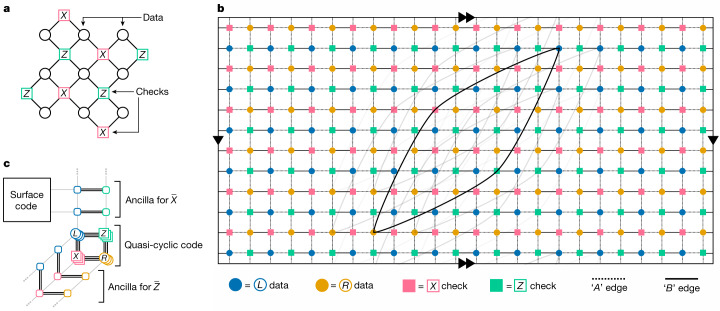
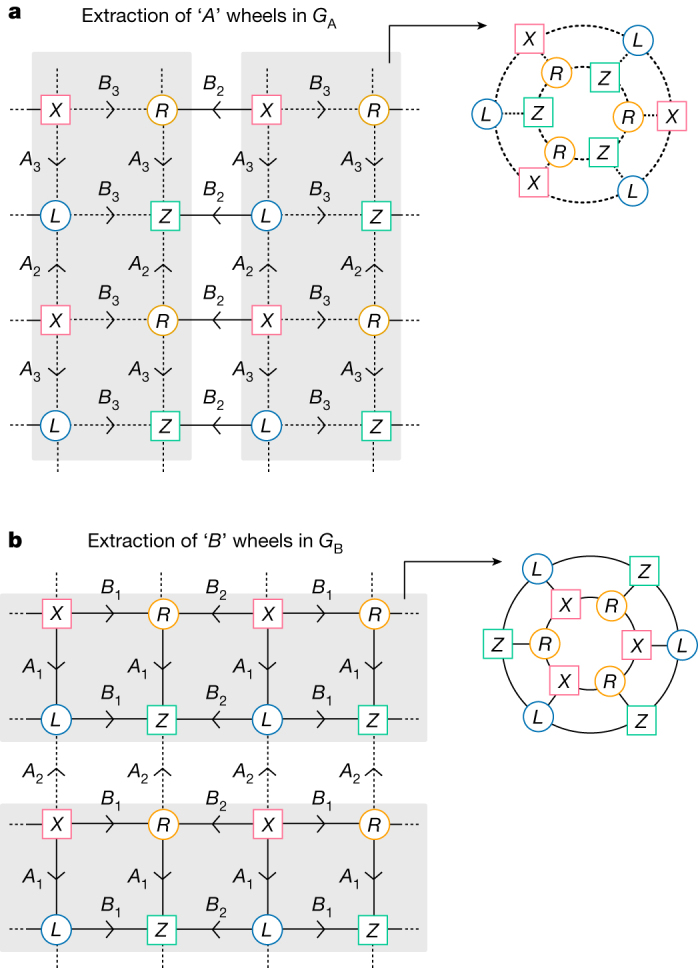
- The proposed BB codes have weight-6 check operators, degree-6 Tanner graphs, and thickness 2, meaning their connectivity can be split into two edge-disjoint planar subgraphs.
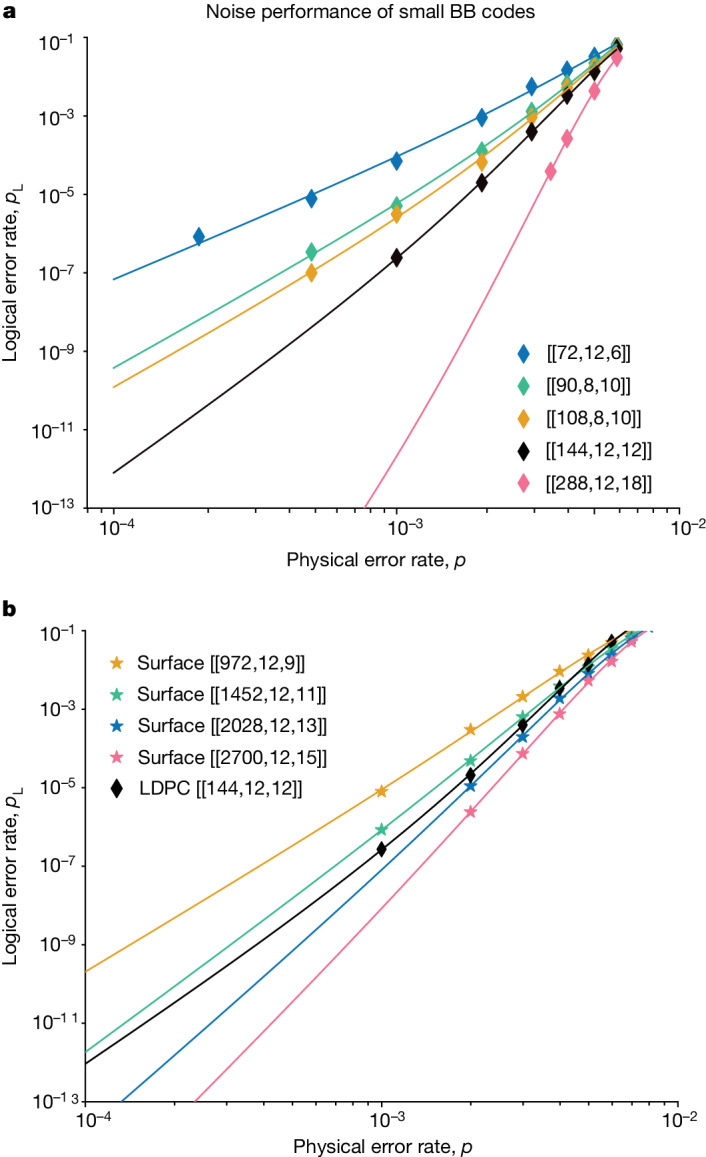
- The authors report an error threshold close to 0.7% for the standard circuit-based noise model, “on par with the surface code” and exceeding other high-rate LDPC codes known to them.
- For the [[144, 12, 12]] code, they state a net encoding rate of 1/24 and that it can preserve 12 logical qubits for nearly 1 million syndrome cycles using 288 physical qubits at physical error rate 0.1%.
- Compared with separate surface-code patches, they report about a 10× reduction in physical-qubit overhead for the distance-12 BB code in the example they analyze.
## Methods
- The paper introduces bivariate bicycle (BB) stabilizer codes defined from pairs of bivariate polynomials/matrices \(A\) and \(B\), yielding CSS codes with \(n=2\ell m\) data qubits and six-qubit check operators.
- They analyze code structure through the Tanner graph, proving results about connectivity, toric layouts, and thickness-2 planar decompositions of the graph.
- Performance is evaluated with an end-to-end fault-tolerant memory protocol under a circuit-based noise model where each operation fails independently with probability \(p\), using a BP-OSD decoder adapted to circuit noise and numerical simulations of logical error rates.
## Limitations
- The authors explicitly note that it remains unclear whether the code examples can be scaled up while retaining the high encoding rate in the limit of large code length.
- They also state that optimization of the code layout satisfying specific hardware constraints is left for future work.
- Evident from the text: the reported performance is based on numerical simulations and, for lower error rates, extrapolation/fitting, rather than a hardware demonstration.
Model-written summary. Check it against the paper before relying on it.
Integrity signals
Registry
Cites
Statistics
Figures
Verification
Claims the paper makes
12 Valid · 9 Not valid · 10 Not checked · 61 Own results and interpretations
The cited sources support only part of this claim — read each source’s verdict below.
In the paper
“on par with the surface code7–10 that for 20 years was the leading code in terms of error threshold”
- Also stated in: § Main · hedged
“which is nearly the same as the error threshold of the surface code49”
§ High-threshold and low-overhead fault-tolerant quantum memory > Abstract The accumulation of physical errors1–3 prevents the execution of large-scale algorithms in current quantum computers. Quantum error correction4 promises a solution by encoding k logical qubits onto a larger number n of physical qubits, such that the physical errors are suppressed enough to allow running a desired computation with tolerable fidelity. Quantum error correction becomes practically realizable once the physical error rate is below a threshold value that depends on the choice of quantum code, syndrome measurement circuit and decoding algorithm5. We present an end-to-end quantum error correction protocol that implements fault-tolerant memory on the basis of a family of low-density parity-check codes6. Our approach achieves an error threshold of 0.7% for the standard circuit-based noise model, on par with the surface code7–10 that for 20 years was the leading code in terms of error threshold. The syndrome measurement cycle for a length-n code in our family requires n ancillary qubits and a depth-8 circuit with CNOT gates, qubit initializations and measurements. The required qubit connectivity is a degree-6 graph composed of two edge-disjoint planar subgraphs. In particular, we show that 12 logical qubits can be preserved for nearly 1 million syndrome cycles using 288 physical qubits in total, assuming the physical error rate of 0.1%, whereas the surface code would require nearly 3,000 physical qubits to achieve said performance. Our findings bring demonstrations of a low-overhead fault-tolerant quantum memory within the reach of near-term quantum processors.
What the sources say
- Partly supportedcites [7] Kitaev, A. Y. Fault-tolerant quantum computation by anyons. Ann. Phys. 303, 2–30 (2003); preprint at 10.48550/arXiv.quant-ph/9707021 (1997). sourceExperimental — accuracy not yet measured
The section on toric codes (p. 4) says they work below an error threshold, supporting the comparison’s premise that this code has a threshold. But the Abstract (p. 1) says the threshold was not known and gives estimates from 1/300 to 10^-6; it does not establish that a 0.7% threshold is on par with it or that it led other codes for 20 years. (LLM, conf=0.82)
- Partly supportedcites [8] Bravyi, S. B. & Kitaev, A. Y. Quantum codes on a lattice with boundary. Preprint at 10.48550/arXiv.quant-ph/9811052 (1998). sourceExperimental — accuracy not yet measured
The Abstract (pp. 1–2) describes a lattice code with boundaries and local stabilizers, supporting the citation’s identification of a surface code. The copy gives code distance and the number of errors the code can correct (p. 4), but it does not give an error-rate threshold or establish that 0.7% is comparable to it. (LLM, conf=0.82)
- Partly supportedcites [9] Dennis, E., Kitaev, A., Landahl, A. & Preskill, J. Topological quantum memory. J. Math. Phys. 43, 4452–4505 (2002). 10.1063/1.1499754 sourceExperimental — accuracy not yet measured
The paper analyzes surface-code error thresholds: §F (p. 17) gives a lower bound of 1.14% when data and measurement error probabilities are equal. It does not give 0.7% as the surface-code threshold, so it supports the comparison’s subject but not the specific numerical equivalence. Its 2002 text also cannot establish the citing sentence’s retrospective claim of 20 years of leadership. (LLM, conf=0.85)
- Supportedcites [10] Fowler, A. G., Stephens, A. M. & Groszkowski, P. High-threshold universal quantum computation on the surface code. Phys. Rev. A 80, 052312 (2009). 10.1103/PhysRevA.80.052312 source
Section VIII (p. 15) reports a numerical surface-code threshold of approximately 0.6%, and the conclusion (p. 16) repeats that value. A threshold of 0.7% is therefore on par with the threshold this paper reports. (LLM, conf=0.91)
- Not matchedcites [49] Groszkowski, P., Fowler, A. & Stephens, A. M. High-threshold surface code quantum computing: threshold calculation. In Proc. APS March Meeting Abstracts W17–002 (APS, 2009).
Its entry has no title and year that we can search by.
plain- Asserted: passes — The authors put it forward as true.
- Checkable: passes — It can be checked against evidence.
- Load-bearing: passes — The paper’s conclusions depend on it.
- Based: passes — The paper gives a reason why it holds.
- Also stated in: § Main · hedged
The cited sources support only part of this claim — read each source’s verdict below.
In the paper
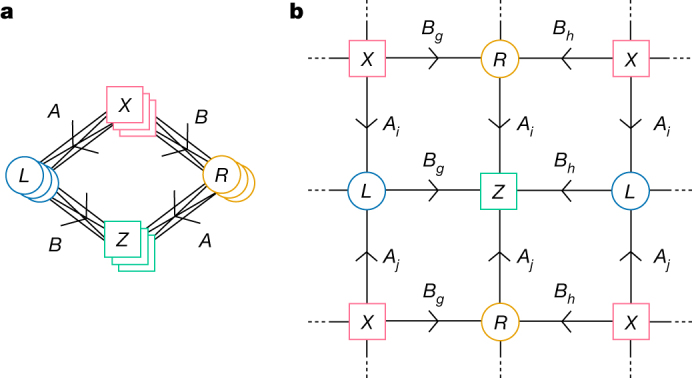
“The required qubit connectivity is a degree-6 graph composed of two edge-disjoint planar subgraphs.”
- Also stated in: § Main · plain
“The Tanner graph of any BB code has vertex degree six and graph thickness29 equal to two, which means it can be decomposed into two edge-disjoint planar subgraphs (Methods).”
- Also stated in: § Main · plain
“Although the qubit connectivity graph is not locally embeddable into a 2D grid, it can be decomposed into two planar degree-3 subgraphs.”
§ High-threshold and low-overhead fault-tolerant quantum memory > Abstract The accumulation of physical errors1–3 prevents the execution of large-scale algorithms in current quantum computers. Quantum error correction4 promises a solution by encoding k logical qubits onto a larger number n of physical qubits, such that the physical errors are suppressed enough to allow running a desired computation with tolerable fidelity. Quantum error correction becomes practically realizable once the physical error rate is below a threshold value that depends on the choice of quantum code, syndrome measurement circuit and decoding algorithm5. We present an end-to-end quantum error correction protocol that implements fault-tolerant memory on the basis of a family of low-density parity-check codes6. Our approach achieves an error threshold of 0.7% for the standard circuit-based noise model, on par with the surface code7–10 that for 20 years was the leading code in terms of error threshold. The syndrome measurement cycle for a length-n code in our family requires n ancillary qubits and a depth-8 circuit with CNOT gates, qubit initializations and measurements. The required qubit connectivity is a degree-6 graph composed of two edge-disjoint planar subgraphs. In particular, we show that 12 logical qubits can be preserved for nearly 1 million syndrome cycles using 288 physical qubits in total, assuming the physical error rate of 0.1%, whereas the surface code would require nearly 3,000 physical qubits to achieve said performance. Our findings bring demonstrations of a low-overhead fault-tolerant quantum memory within the reach of near-term quantum processors.
What the sources say
- Partly supportedcites [29] Tremblay, M. A., Delfosse, N. & Beverland, M. E. Constant-overhead quantum error correction with thin planar connectivity. Phys. Rev. Lett. 129, 050504 (2022). 35960553 10.1103/PhysRevLett.129.050504 sourceExperimental — accuracy not yet measured
Proposition 1 (p. 2) supports partitioning a low-degree connectivity graph into planar subgraphs. For degree 6, it guarantees a layout with at most three planar layers, not the claimed two. The passages about hypergraph product codes do not identify BB codes or establish their degree-6 connectivity. (LLM, conf=0.87)
plain- Asserted: passes — The authors put it forward as true.
- Checkable: passes — It can be checked against evidence.
- Load-bearing: passes — The paper’s conclusions depend on it.
- Based: passes — The paper gives a reason why it holds.
- Also stated in: § Main · plain
Every source the paper cites for this claim was checked and supports it.
In the paper
“Recent progress in the study of LDPC codes suggests that they can achieve quantum fault tolerance with a much higher encoding efficiency29.”
§ High-threshold and low-overhead fault-tolerant quantum memory > Main
What the sources say
- Supportedcites [29] Tremblay, M. A., Delfosse, N. & Beverland, M. E. Constant-overhead quantum error correction with thin planar connectivity. Phys. Rev. Lett. 129, 050504 (2022). 35960553 10.1103/PhysRevLett.129.050504 source
On p. 1, the paper says some quantum LDPC codes can achieve arbitrarily low logical error rates with a constant ratio of tens of physical qubits per logical qubit, potentially reducing qubit overhead by more than an order of magnitude compared with surface codes. It also reports a circuit-noise threshold for a positive-rate code family, supporting the claim's qualified statement about fault tolerance and encoding efficiency. (LLM, conf=0.93)
hedgedstates a possible cause- Asserted: passes — The authors put it forward as true.
- Checkable: passes — It can be checked against evidence.
- Load-bearing: passes — The paper’s conclusions depend on it.
- Based: passes — The paper gives a reason why it holds.
- Supported
Every source the paper cites for this claim was checked and supports it.
In the paper
“The latter were shown39,40 to be asymptotically ‘good’ in the sense of offering a constant encoding rate and linear distance: a parameter quantifying the number of correctable errors.”
§ High-threshold and low-overhead fault-tolerant quantum memory > Main
What the sources say
- Supportedcites [39] Panteleev, P. & Kalachev, G. Asymptotically good quantum and locally testable classical LDPC codes. In Proc. 54th Annual ACM SIGACT Symposium on Theory of Computing 375–388 (ACM, 2022). source
The Introduction (Theorem 2) states that for every R ∈ (0,1) and finite field F_q there is an explicit family of quantum LDPC codes with parameters [n, ⌊Rn⌋, d = Θ(n)]_q as n → ∞, i.e. constant rate and linear distance — an affirmative answer to the qLDPC conjecture. The same Introduction explains that these quantum CSS codes are built by taking the G-lifted product of expander/Tanner codes T(Γ;h) ("such codes can be used with the G-lifted product to obtain a 3-term chain complex C, which can also be considered as a quantum CSS code"), and §1.8 explicitly licenses calling Tanner complexes 'Tanner codes'. So the attributed point — quantum codes of Tanner type being asymptotically good with constant rate and linear distance — is stated by this paper. (LLM, conf=0.85)
- Supportedcites [40] Leverrier, A. & Zémor, G. Quantum Tanner codes. In Proc. 2022 IEEE 63rd Annual Symposium on Foundations of Computer Science (FOCS) 872–883 (IEEE, 2022). source
The Contributions section (p. 2) states that, under sufficient expansion and robustness conditions, the construction yields asymptotically good quantum LDPC codes with constant rate and linear minimum distance. This directly supports the attributed claim. (LLM, conf=0.95)
plainstates an association- Asserted: passes — The authors put it forward as true.
- Checkable: passes — It can be checked against evidence.
- Load-bearing: passes — The paper’s conclusions depend on it.
- Based: passes — The paper gives a reason why it holds.
- Supported
Every source the paper cites for this claim was checked and supports it.
In the paper
“As shown in Fig. 1c, extensions of the Tanner graph leveraging techniques by Cohen et al.50 enable fault-tolerant measurement operations involving an ancillary surface code.”
§ High-threshold and low-overhead fault-tolerant quantum memory > Main
What the sources say
- Supportedcites Cohen et al.50 Cohen, L. Z., Kim, I. H., Bartlett, S. D. & Brown, B. J. Low-overhead fault-tolerant quantum computing using long-range connectivity. Sci. Adv.10.1126/sciadv.abn1717 (2022). PMC10926894 35594359 source
The Results section (‘Logical CSS measurement’; page unavailable) describes extending a Tanner graph with an ancilla system to measure logical operators fault-tolerantly. The sentence attributes that technique to Cohen et al.; its reference to an ancillary surface code describes the citing authors’ application, not a claim that Cohen et al. used one. (LLM, conf=0.88)
plainstates a cause- Asserted: passes — The authors put it forward as true.
- Checkable: passes — It can be checked against evidence.
- Load-bearing: passes — The paper’s conclusions depend on it.
- Based: passes — The paper gives a reason why it holds.
- Supported
54 more claims · 2 with their cited sources checked
Create a free account to see all 92 claims and every source verdict.
- Probably not a substantial claim. 23
- It may state two separate claims as one. 12
- The quote only partly states this claim. 2
Citations
Cites
Quantum Computation and Quantum Information
Nielsen, M. A., Chuang, I., & Grover, L. K. (2002) · American Journal of Physics · doi:10.1119/1.1463744 · Cited by 21,895
Quantum supremacy using a programmable superconducting processor
Arute, F., Arya, K., Babbush, R., Bacon, D., Bardin, J. C., Barends, R., Biswas, R., Boixo, S., Brandao, F. G. S. L., Buell, D. A., et al. (2019) · Nature · doi:10.1038/s41586-019-1666-5 · Cited by 7,720 · cited 1×
“This new gate is also similar to the gates used by Google Quantum AI 57 , which have shown that a square lattice arrangement is possible.”
MethodFault-tolerant quantum computation by anyons
Kitaev, A. Y. (2003) · Annals of Physics · doi:10.1016/s0003-4916(02)00018-0 · Cited by 7,238 · cited 3×
“This resulted in the development of the surface code 7–10 that offers a high error threshold close to 1%, fast decoding algorithms and compatibility with the existing quantum processors relying on two-dimensional (2D) square lattice qubit connectivity.”
BackgroundMethodInfluentialScheme for reducing decoherence in quantum computer memory
Shor, P. W. (1995) · Physical Review A · doi:10.1103/physreva.52.r2493 · Cited by 4,479 · cited 2×
“The possibility of quantum fault tolerance is well-established 4 .”
BackgroundLloyd, S. (1996) · Science · doi:10.1126/science.273.5278.1073 · Cited by 3,088 · cited 1×
“It is believed that a scalable functioning quantum computer may help solve computational problems in such areas as scientific discovery, materials research, chemistry, and drug design, to name a few [2, 3, 4, 5].”
BackgroundGood quantum error-correcting codes exist
Calderbank, A. R., & Shor, P. W. (1996) · Physical Review A · doi:10.1103/physreva.54.1098 · Cited by 2,516 · cited 2×
“The length of the inner cycle is equal to the order of the matrix A A T 3 2 that is the transpose of A A T 3 2 considered earlier.”
BackgroundDennis, E., Kitaev, A., Landahl, A., & Preskill, J. (2002) · Journal of Mathematical Physics · doi:10.1063/1.1499754 · Cited by 1,768 · cited 1×
“The sources of noise include imperfections in qubits, materials used, controlling apparatus, state preparation and measurement errors and a variety of external factors ranging from local man-made, such as stray electromagnetic fields, to those inherent to the Universe, such as cosmic rays.”
BackgroundImproved simulation of stabilizer circuits
Aaronson, S., & Gottesman, D. (2004) · Physical Review A · doi:10.1103/physreva.70.052328 · Cited by 1,515 · cited 1×
“Since the circuit involves only Clifford operations, its action can be compactly described using stabilizer tableau [49].”
BackgroundDennis, E., Kitaev, A., Landahl, A., & Preskill, J. (2001) · CERN Document Server (European Organization for Nuclear Research) · Cited by 1,485
Quantum computations: algorithms and error correction
Kitaev, A. Y. (1997) · Russian Mathematical Surveys · doi:10.1070/rm1997v052n06abeh002155 · Cited by 1,424 · cited 1×
“The first proposals for quantum error correction, such as concatenated codes [16, 17, 18], focused on demonstrating the theoretical possibility of error suppression.”
Background
Research works printed but not linked: 1
- Groszkowski, P., Fowler, A. & Stephens, A. M. High-threshold surface code quantum computing: threshold calculation. In Proc. APS March Meeting Abstracts W17–002 (APS, 2009).
Cited by
Items 201–300 of 443
Feasibility of logical Bell state generation in memory assisted quantum networks
Galetsky, V., Vyas, N., Comin, A., & Nötzel, J. (2025) · Physical Review Research · doi:10.1103/rsrk-c7yg · Cited by 5
New quantum MDS codes with flexible parameters from Hermitian self-orthogonal GRS codes
Campion, O., Hernando, F., & McGuire, G. (2025) · Cryptography and Communications · doi:10.1007/s12095-025-00834-2 · Cited by 5
Reconfigurable photothermal doping filament for selective spin manipulation and addressing
Liu, Z.-W., Ma, M., Sun, B., Li, L., Jiang, W., Zang, H., Bai, Z., Dong, Y., Zhang, S.-C., Chen, X.-D., et al. (2025) · Proceedings of the National Academy of Sciences · doi:10.1073/pnas.2507587122 · Cited by 3
Digital-analog simulations of Schrödinger cat states in the Dicke-Ising model
Shapiro, D. S., Weber, Y., Bode, T., Wilhelm, F. K., & Bagrets, D. (2025) · Physical Review A · doi:10.1103/wbp6-y3vd · Cited by 9
Mitigating cosmic-ray-like correlated events with a modular quantum processor
Wu, X., Joshi, Y. J., Yan, H., Andersson, G., Anferov, A., Conner, C. R., Karimi, B., King, A. M., Li, S., Malc, H. L., et al. (2025) · Physical Review Applied · doi:10.1103/4ctq-r6w6 · Cited by 13
“Fault-tolerant quantum computing enables the implementation of complex quantum algorithms through the use of quantum error correction (QEC) codes [1–6].”
High-Speed and High-Connectivity Two-Qubit Gates in Long Chains of Trapped Ions
Savill-Brown, I., Hope, J. J., Ratcliffe, A. K., Vaidya, V., Liu, H., Haine, S. A., Viteri, C. R., & Mehdi, Z. (2026) · Physical Review Letters · doi:10.1103/45zd-f4my · Cited by 6
Qudit low-density parity-check codes
Spencer, D. J., Tanggara, A., Haug, T., Khu, D., & Bharti, K. (2026) · Quantum · doi:10.22331/q-2026-03-13-2023 · Cited by 12
Monolithic Multi-Channel SiGe Quantum Key Distribution Transmitter Chip
Honz, F., Boxleitner, W., Ramos, M. F., Hentschel, M., Walther, P. J., Hübel, H., & Schrenk, B. (2025) · Journal of Lightwave Technology · doi:10.1109/jlt.2025.3627153 · Cited by 3
“With the rise of the quantum computer [1], [2], which is able to efficiently execute prime factorization [3], the security of the widely employed public key infrastructure based on asymmetric cryptography is greatly threatened.”
Fault-Tolerant Quantum Computation with Constant Overhead for General Noise
Christandl, M., Fawzi, O., & Goswami, A. (2025) · PRX Quantum · doi:10.1103/k4cm-pp9p · Cited by 10
Matching Generalized-Bicycle Codes to Neutral Atoms for Low-Overhead Fault-Tolerance
Viszlai, J., Yang, W., Lin, S. F., Liu, J., Nottingham, N., Baker, J. M., & Chong, F. T. (2025) · IEEE International Conference on Quantum Computing and Engineering (QCE) · doi:10.1109/qce65121.2025.00080 · Cited by 21
“Notably, IBM’s recent work [11] showed that the Tanner graphs of bivariate-bicycle codes can be partitioned into two planar subgraphs.”
InfluentialQuantum Codes: A Comprehensive Survey of Techniques, Challenges, and Future Directions
Mahmud, I., & Abdelhadi, A. (2025) · IEEE Access · doi:10.1109/access.2025.3646024 · Cited by 6
Compact quantum dot models for analog microwave co-simulation
Peri, L., Gomez-Saiz, A., Ford, C. J. B., & Gonzalez-Zalba, M. F. (2025) · npj Quantum Information · doi:10.1038/s41534-025-01140-8 · Cited by 6
Quantum Maxwell Erasure Decoder for qLDPC codes
Freire, B. C. A., Régent, F.-M. L., & Leverrier, A. (2026) · IEEE International Symposium on Information Theory (ISIT) · doi:10.1109/isit62367.2026.11654048 · Cited by 5
“Quantum low-density parity-check (qLDPC) codes form a promising approach to low-overhead quantum fault tolerance [1], [2].”
22.2 A 16-Channel Low-Power Cryo-CMOS Flux Control Pulse Generator ASIC in 14nm FinFET Technology
Tien, K., Frank, D. J., Bulzacchelli, J. F., Rosno, P., Moertl, D., Timmerwilke, J., Noori, A., Underwood, D., Inoue, K., Ray, S., et al. (2026) · Digest of technical papers/Digest of technical papers - IEEE International Solid-State Circuits Conference · doi:10.1109/isscc49663.2026.11409194 · Cited by 2
InterQnet: A Heterogeneous Full-Stack Approach to Co-Designing Scalable Quantum Networks
Chung, J., Dilley, D., Eastman, E. M., Gonzales, A., Hokenstad, K., Islam, M. S., Jorapur, V., Petrullo, J., Li, A. C. Y., Li, B., et al. (2026) · IEEE Transactions on Quantum Engineering · doi:10.1109/tqe.2026.3674887 · Cited by 13
“Restrictions apply. distillation, promising schemes that apply more scalable and powerful quantum codes have recently been proposed for superconducting qubits [81], [87], as well as for trapped ions and atom arrays [82], [88], [89], [90].”
Power and Limitations of Linear Programming Decoder for Quantum LDPC Codes
Gu, S., & Soleimanifar, M. (2026) · IEEE Transactions on Information Theory · doi:10.1109/tit.2026.3715538 · Cited by 6
“[6], which have parameters [[72 , 12 , 6]], [[90 , 8 , 10]], [[108 , 8 , 10]], [[144 , 12 , 12]], [[288 , 12 , 18]], and [[784 , 24 , 24]].”
InfluentialProspects for NMR spectral prediction on fault-tolerant quantum computers
Elenewski, J. E., Camara, C. M., & Kalev, A. (2026) · Physical Review Research · doi:10.1103/km66-ltpl · Cited by 3
Pacenti, M., & Vasic, B. V. (2024) · Allerton Conference on Communication, Control, and Computing · doi:10.1109/allerton63246.2024.10735283 · Cited by 4
“Although GB codes have not the same desirable asymptotic properties of the codes presented in [2]–[4], the experiment of [5] motivates their study, as they are particularly suitable for hardware implementation, and have good minimum distance and code rate for finite blocklengths.”
BackgroundGeneralizing the matching decoder for the Chamon code
Schwartzman-Nowik, Z., & Brown, B. J. (2025) · Quantum · doi:10.22331/q-2025-06-18-1775 · Cited by 4
“Here we show the performance of the decoders we have proposed together with a standard implementation of the belief-propagation ordered statistics decoder (BP-OSD) [52, 55, 56].”
Architecting the Quantum Future: Key Devices and Layers in Quantum Network Design
Khan, M. A., Aman, M. N., & Sikdar, B. (2024) · IEEE Physical Assurance and Inspection of Electronics (PAINE) · doi:10.1109/paine62042.2024.10792827 · Cited by 2
“They temporarily hold quantum states, enabling the synchronization of quantum processes and stabilizing quantum states over time [30], [31].”
Low-density parity-check representation of fault-tolerant quantum circuits
Li, Y. (2025) · Physical Review Research · doi:10.1103/physrevresearch.7.013115 · Cited by 8
“A major avenue for constructing quantum LDPC codes lies in leveraging classical LDPC codes, which has yielded significant achievements, such as hypergraph product codes [15–23].”
Energy Barrier of Hypergraph Product Codes
Zhao, G., Doherty, A. C., & Kim, I. H. (2025) · Physical Review Letters · doi:10.1103/physrevlett.134.180601 · Cited by 9
Liao, H., Hartnett, G. S., Kakkar, A., Tan, A. T. K., Hush, M., Mundada, P., Biercuk, M. J., & Baum, Y. (2025) · PRX Quantum · doi:10.1103/prxquantum.6.020331 · Cited by 16
Quantum X Y Z cyclic codes for biased noise
Liang, Z., Yang, F., Yi, Z., & Wang, X. (2025) · Physical Review A · doi:10.1103/6qbg-xslr · Cited by 5
Closed-form expressions for unitaries of spin-adapted fermionic operators
Magoulas, I., & Evangelista, F. A. (2025) · Molecular Physics · doi:10.1080/00268976.2025.2534672 · Cited by 4
Cavity polariton blockade for non-local entangling gates with trapped atoms
Srivastava, V., Jandura, S., Brennen, G. K., & Pupillo, G. (2025) · Quantum Science and Technology · doi:10.1088/2058-9565/adfd79 · Cited by 4
Nonlocal resources for error correction in quantum low-density parity-check codes
Chandra, O., Muraleedharan, G., & Brennen, G. K. (2025) · Physical Review Research · doi:10.1103/x1rk-yg29 · Cited by 8
“Recent work demonstrates that HGP codes exhibit high error correction thresholds [16], which means they can tolerate higher error rates before failing.”
BackgroundKim, J., Cho, J., Jeong, H., Min, D., Choi, J., Hong, J., & Kim, J. (2025) · IEEE/ACM International Symposium on Microarchitecture (MICRO) · doi:10.1145/3725843.3756026 · Cited by 1
“The scaling ratios start from 1/10 × where the initial error rates are around 10 − 3 , an expected error rate for near-term FTQC machines [2, 9, 76].”
The Performance of Long Quantum LDPC Codes Based on the Hypergraph Product
Gökduman, M., Yao, H., & Pfister, H. D. (2025) · IEEE International Symposium on Information Theory (ISIT) · doi:10.1109/isit63088.2025.11195678 · Cited by 3
“Although quantum LDPC codes require long-range connectivity between qubits, this hardware requirement can be satisfied with architectures based on neutral atoms [3], [4], trapped ions [5]–[8], and potentially superconducting qubits, provided long-range couplers can be developed [9].”
Hybrid spin-phonon architecture for scalable solid-state quantum nodes
Peng, R., Wu, X., Wang, Y., Zhang, J., Geng, J., Dasari, D. B. R., Cleland, A. N., & Wrachtrup, J. (2025) · npj Quantum Information · doi:10.1038/s41534-025-01138-2 · Cited by 8
“The established individual con-trol and all-to-all connectivity of spins are important in the development of more efficient quantum error correction protocols [62, 63, 69, 70].”
Power and Limitations of Linear Programming Decoder for Quantum LDPC Codes
Gu, S., & Soleimanifar, M. (2025) · arXiv · doi:10.48550/arxiv.2508.04769 · Cited by 2
Harnessing quantum information to advance computing
(2024) · Nature Computational Science · doi:10.1038/s43588-024-00628-1 · Cited by 1
Experimental measurement and a physical interpretation of quantum shadow enumerators
Miller, D., Levi, K., Postler, L., Steiner, A., Bittel, L., White, G. A. L., Tang, Y., Kuehnke, E. J., Mele, A. A., Khatri, S., et al. (2026) · Physical Review Research · doi:10.1103/8h3b-brg1 · Cited by 22
“For modern efforts in designing quantum low-density parity-check (qLDPC) codes [72–76], Rains’ shadow enumerators provide bounds on parameters of asymptotically good qLDPC code families for which the distance d scales like c × n for a non-zero constant c > 0 [74, 75].”
Qiu, J., Wang, S., Sun, H., Han, C., Shen, Y., Hu, Y., Zhao, B., & Shan, Z. (2024) · IEEE Transactions on Electron Devices · doi:10.1109/ted.2024.3496433 · Cited by 1
Omnidirectional Shuttling to Avoid Valley Excitations in Si / Si Ge Quantum Wells
Németh, R., Bandaru, V. K., Alves, P., Brann, E., Eskandari, O. M., Soomro, H., Vivrekar, A., Eriksson, M. A., Losert, M. P., & Friesen, M. G. (2026) · PRX Quantum · doi:10.1103/615j-xjyh · Cited by 12
“However, even small improvements in connectivity can provide significant improvements in quantum error correction [50].”
Collective Bit Flipping-Based Decoding of Quantum LDPC Codes
Chytas, D., Raveendran, N., & Vasic, B. V. (2025) · IEEE Transactions on Communications · doi:10.1109/tcomm.2025.3535897 · Cited by 11
“However, QLDPC codes require long-range qubit connections, increasing noise and adding delays [3], [4], further restricting the latency available for decoding.”
Comparative Study of Numerical Modeling Methods for a Flux-Pumped Josephson Parametric Amplifier
Park, S. H., Choi, G., Kim, B., et al. (2025) · IEEE Transactions on Applied Superconductivity · doi:10.1109/tasc.2025.3546921 · Cited by 1
“F AST and high-fidelity qubit state readout has been one of the most challenging obstacles to perform practical quantum error correction protocols [1], [2], [3], [4], [5], [6].”
Application of the quantum Fourier transform in a harmonic balance solver for Burgers’ equation
Dewitte, L., Roland, J., & Eulitz, F. (2025) · Computers & Fluids · doi:10.1016/j.compfluid.2025.106619 · Cited by 4
Optimal multicore quantum computing with few interconnects
Montes, J., Borondo, F., & Carlo, G. G. (2025) · APL Quantum · doi:10.1063/5.0252348 · Cited by 1
Quantum Error Correction: Overcoming the Fragility of Qubits for Reliable Quantum Computing
Mummadi, S., & Udari, G. C. (2025) · Advances in computational intelligence and robotics book series · doi:10.4018/979-8-3693-6225-9.ch005 · Cited by 1
Solar-Blind Free-Space QKD Using Large-Core Fibers for Alignment-Tolerant Link Operation
Honz, F., Boxleitner, W., Hentschel, M., et al. (2025) · Journal of Lightwave Technology · doi:10.1109/jlt.2025.3575204 · Cited by 1
“Their computational power has reached more than 1000 physical qubits [1] while a steady increase can be observed for the efficiency of error-correcting codecs [2].”
Refining quantum fidelity: approaches in quantum error correction
Thakur, V. S., Kumar, A., & Dev, K. (2025) · Quantum Information Processing · doi:10.1007/s11128-025-04809-3 · Cited by 3
“Including these codes in the analysis allows for the assessment of fidelity methods under realistic error models, such as depolarizing noise and qubit scaling, thereby facilitating meaningful performance comparisons [36–38].”
Asymptotically Good Generalized Quantum Tanner Codes
Mostad, O. Å., Rosnes, E., & Lin, H.-Y. (2025) · IEEE Journal on Selected Areas in Information Theory · doi:10.1109/jsait.2025.3594310 · Cited by 6
“Moreover, recent work shows that quantum LDPC codes can indeed provide a high error threshold and simultaneously low overhead for fault-tolerant quantum memory [13].”
Hybrid Quantum-Classical Neural Networks for Image Classification: Challenges and Perspectives
Ioniṭă, A., & Ionescu, B. (2025) · International Symposium on Signals, Circuits and Systems · doi:10.1109/isscs66034.2025.11105660 · Cited by 1
Early IBM quantum computers: architectural analysis and performance benchmarks
AbuGhanem, M. (2026) · The Journal of Supercomputing · doi:10.1007/s11227-026-08386-9 · Cited by 4
Yamada, S., Kobayashi, T., Takahata, M., Nitta, H., Isobe, H., Kawakami, T., Yamanaka, S., Okumura, M., & Yamaguchi, K. (2025) · Chemistry · doi:10.3390/chemistry7050164 · Cited by 3
Network requirements for distributed quantum computation
Jacinto, H., Gouzien, É., & Sangouard, N. (2026) · Physical Review Research · doi:10.1103/v9ln-c4v2 · Cited by 34
“Although alternative quantum error correction protocols have been recently proposed [10–12] and various physical systems are envisioned to build a fault-tolerant quantum computer, scaling in a monolithic approach will be a daunting challenge for all of them.”
GPU-Accelerated Syndrome Decoding for Quantum LDPC Codes below the 63 μs Latency Threshold
Ferraz, O., Coutinho, B. C., Falcão, G., Gomes, M. A. C., Monteiro, F. A., & da Silva, V. M. M. (2025) · Asilomar Conference on Signals, Systems and Computers (ACSSC) · doi:10.1109/ieeeconf67917.2025.11443687 · Cited by 5
“…[[ 72 , 12 , 6 ]], [[ 108 , 8 , 10 ]], [[ 144 , 12 , 12 ]], [[ 288 , 12 , 18 ]], and [[ 784 , 24 , 24 ]] (the code parameter [[ n , k , d ]] encodes k logical qubits into n data qubits offering a code distance d [15]), as provided in [15] running ten decoding iterations without early termination.”
Enhanced Min-Sum Decoding of Quantum Codes with Iteration Dynamics Memory
Chytas, D., Raveendran, N., & Vasic, B. V. (2025) · IEEE International Symposium on Information Theory (ISIT) · doi:10.1109/isit63088.2025.11195509 · Cited by 24
“Families of non-topological QLDPC codes, such as bivariate bicycle (BB) codes, have been shown to outperform topological codes in quantum error-correction (QEC) [3], albeit at the cost of increased qubit connectivity.”
Hamiltonian learning via inverse physics-informed neural networks
Liu, J., & Wang, X. (2025) · Physical Review Research · doi:10.1103/nx97-zjdf · Cited by 2
“Such improvements are essential for realizing practical quantum error correction and for scaling up viable quantum computing architectures [6, 7].”
A Variant of the Bravyi–Terhal Bound for Arbitrary Boundary Conditions
Arnault, F., Gaborit, P., Rozendaal, W., Saussay, N., & Zémor, G. (2025) · IEEE Transactions on Information Theory · doi:10.1109/tit.2025.3629670 · Cited by 8
“For short lengths, significant e ff orts have gone into the search for good Two-Block codes, as is apparent from [4] in particular.”
InfluentialScalable low-overhead superconducting nonlocal coupler for circuit connectivity enhancement
Xiong, H., Wang, J.-H., Song, J., Yang, J., Bao, Z., Li, Y., Mi, Z., Zhang, H., Yu, H., Song, Y., et al. (2026) · Physical Review Applied · doi:10.1103/kfy3-bwgr · Cited by 13
decoder-bench: Benchmarking Decoders for Quantum Error Correction
Maurya, S., Viszlai, J., Raveendran, N., Das, P., & Tannu, S. (2025) · IEEE International Symposium on Workload Characterization · doi:10.1109/iiswc66894.2025.00032 · Cited by 8
Performance-centric roadmap for building a superconducting quantum computer
Barends, R., & Wilhelm, F. K. (2026) · EPJ Quantum Technology · doi:10.1140/epjqt/s40507-026-00495-x · Cited by 7
“Based on a system-level analysis, Bravyi et al. [57] recently stated that “the cross-resonance gate, which has been the core gate used in large quantum systems for the past few years, would not be the path forward”.”
Quantum error correction codes for truncated SU(2) lattice gauge theories
Yao, X. (2026) · Physical review. D/Physical review. D. · doi:10.1103/5yg7-6mph · Cited by 21
“Utilizing Gauss’s law opens new ways of constructing error correction codes, which may be more natural for quantum simulations of lattice gauge theories than other generic codes [50–58], some of which are proposed and tested for general-purpose fault tolerant quantum computing [59–62].”
Lattice Surgery Compilation Beyond the Surface Code
Herzog, L. S., Berent, L., Kubica, A., & Wille, R. (2025) · IEEE International Conference on Quantum Computing and Engineering (QCE) · doi:10.1109/qce65121.2025.00061 · Cited by 13
“Note that such an architecture is less hardware-demanding than the one needed to implement bivariate bicycle codes [44], [45]; as such, it may be easier to realize with superconducting qubits [46], [47], as well as neutral atoms [48], [49] or trapped ions [50], [51].”
Quantum Computing Today: A Status Overview
Liu, Y. (2025) · Computer · doi:10.1109/mc.2025.3617743 · Cited by 1
“18,19,20,21,22 Coupled with recent advances in improved QEC and fault tolerance protocols 23,24 and the development of modular quantum architectures, 25 these milestones are steadily bringing the experimental realization of fully fault-tolerant quantum computation closer to reality.”
Xu, J., Deng, X., Zheng, W., Yan, W., Zhang, T., Zhang, Z., Huang, W., Xia, X., Liao, X., Zhang, Y., et al. (2026) · Physical Review Applied · doi:10.1103/ls5b-279m · Cited by 6
Toward Self-Correcting Quantum Codes for Neutral Atom Arrays
Guo, J., Hong, Y., Kaufman, A. M., & Lucas, A. (2026) · PRX Quantum · doi:10.1103/mfmt-fwkg · Cited by 13
“For a code block encoding k logical qubits with BLER p , we estimate the single-logical-qubit error rate as p 1 = 1 − (1 − p ) 1 /k . from 31 We also simulate the performance of the (cid:74) 144 , 12 , 12 (cid:75) (BB144) and (cid:74) 288 , 12 , 18 (cid:75) (BB288) BB codes [ ] under the same…”
InfluentialScalable Decoding Protocols for Fast Transversal Logic in the Surface Code
Turner, M. L., Campbell, E. T., Crawford, O., Gillespie, N. I., & Camps, J. (2026) · PRX Quantum · doi:10.1103/nx6p-hjqy · Cited by 28
Quantum advantage for learning shallow neural networks with natural data distributions
Lewis, L., Gilboa, D., & McClean, J. R. (2025) · Nature Communications · doi:10.1038/s41467-025-68097-2 · Cited by 13
Pauli stabilizer formalism for topological quantum field theories and generalized statistics
Feng, Y., Xue, H., Kobayashi, R., Hsin, P.-S., & Chen, Y.-A. (2026) · Journal of High Energy Physics · doi:10.1007/jhep08(2026)142 · Cited by 8
“Boundaries, defects, and code design [24, 33, 72–80].”
QUITS: A modular Qldpc code circUIT Simulator
Kang, M., Lin, Y., Yao, H., Gökduman, M., Meinking, A., & Brown, K. R. (2025) · Quantum · doi:10.22331/q-2025-12-05-1931 · Cited by 19
“Note that while the circuit distance is proven to be equal to the original code distance for the HGP code [31], the reduction in circuit distance is reported for bivariate bicycle codes [6].”
InfluentialStabilizer-Assisted Inactivation Decoding of Quantum Error-Correcting Codes with Erasures
Pech, G., Gökduman, M., Yao, H., & Pfister, H. D. (2026) · IEEE International Symposium on Information Theory (ISIT) · doi:10.1109/isit62367.2026.11653654 · Cited by 5
“Other families include lifted product and balanced product codes [11]–[13], bivariate bicycle codes [9], and related generalizations [14]–[16].”
High Rate Magic State Cultivation on the Surface Code
Vaknin, Y., Jacoby, S., Grimsmo, A. L., & Retzker, A. (2026) · PRX Quantum · doi:10.1103/p8tw-6kq9 · Cited by 67
Chen, Z., Chen, M.-C., Lu, C., & Pan, J.-W. (2026) · Physical Review Letters · doi:10.1103/m7tq-9v3g · Cited by 46
Error resilience of fracton codes and near saturation of code-capacity threshold in three dimensions
Canossa, G., Pollet, L., Martin-Delgado, M. A., Song, H., & Liu, K. (2026) · Physical review. B./Physical review. B · doi:10.1103/2y2z-hgfn · Cited by 5
“Similarly, one can also expect the bivariate bicycle codes [62], which are a rich class quantum low-density parity-check codes characterized by symmetry-enriched topological order [63], also possess such an optimal error threshold.”
Magic Tricycles: Efficient Magic-State Generation with Finite Block-Length Quantum LDPC Codes
Menon, V., Ataides, J. P. B., Mehta, R., Gu, A., Tan, D. B., & Lukin, M. D. (2026) · Physical Review X · doi:10.1103/ghhp-cytl · Cited by 45
“[13], counting both initialization and measurement of check qubits as unit depth, our construction gives the following results.”
InfluentialVukšić, M., Ćelić, J., & Cuculić, A. (2026) · IEEE Access · doi:10.1109/access.2026.3670749 · Cited by 6
“In some cases, coherence times exceeding several minutes have been recorded [27].”
InfluentialZeytinoǧlu, S. (2026) · Physical Review Research · doi:10.1103/xsgf-txnq · Cited by 4
Iterative Decoding of Stabilizer Codes under Radiation-Induced Correlated Noise
Nayak, A. K., Baity, P., Love, P. J., Jeon, N., Yoon, B.-J., Hoisie, A., & Varshney, L. R. (2026) · IEEE International Symposium on Information Theory (ISIT) · doi:10.1109/isit62367.2026.11653738
“II-C, p ( ˜ E j ) = E ∈ ˜ E j p ( E ) (similar to the decoder in [17]).”
Parallel Logical Measurements via Quantum Code Surgery
Cowtan, A., He, Z., Williamson, D. J., & Yoder, T. J. (2026) · PRX Quantum · doi:10.1103/gj8x-n5gg · Cited by 80
“[6] for a recent review), which have higher rate and therefore serve as candidates for low-overhead fault-tolerant quantum memories [7,8].”
Self-citationFast quantum gates for neutral atoms separated by a few tens of micrometers
Bergonzoni, M., Riso, R. R., & Pupillo, G. (2026) · Physical Review Research · doi:10.1103/hjrh-4327 · Cited by 8
Device for MHz-rate rastering of arbitrary 2D optical potentials.
Bytyqi, E., Sinclair, J., Ramette, J., & Vuletić, V. (2026) · Optics Letters · doi:10.1364/ol.596039 · Cited by 7
“Moreover, the device could significantly accelerate atom rearrangement time scales, and its utility extends to performing geometrically non-local syndrome measurements, a critical requirement for implementing high-rate qLDPC quantum error-correcting codes [21–23].”
Singh, S., Kashiwagi, R., Tanji, K., Roga, W., Bhatti, D., Takeoka, M., & Elkouss, D. (2026) · Physical Review Applied · doi:10.1103/6mqy-sd3d · Cited by 6
Existence and Characterization of Bivariate Bicycle Codes
Postema, J. J., & Kokkelmans, S. J. J. M. F. (2026) · IEEE Transactions on Information Theory · doi:10.1109/tit.2026.3713397 · Cited by 18
“Bivariate bicycle (BB) codes have recently been proposed as a candidate for compact quantum memory [11].”
InfluentialQuantum LDPC Codes From Intersecting Subsets
Ostrev, D. (2024) · IEEE Transactions on Information Theory · doi:10.1109/tit.2024.3402091 · Cited by 6
“More recently, [30] has constructed a fault-tolerant quantum memory based on tensor product generalized bicycle codes [31].”
BackgroundOn the stabilizer formalism and its generalization
Descamps, É., & Dakić, B. (2024) · Journal of Physics A Mathematical and Theoretical · doi:10.1088/1751-8121/ad8607 · Cited by 1
“We show the following result.”
Lai, H., Li, R., Huang, Z.-R., & Wan, L. (2024) · Acta Physica Sinica · doi:10.7498/aps.73.20241382 · Cited by 3
Geometrical approach to logical qubit fidelities of neutral atom Calderbank–Shor–Steane codes
Postema, J. J., & Kokkelmans, S. J. J. M. F. (2025) · Academia quantum. · doi:10.20935/acadquant7467 · Cited by 4
Assessing the Requirements for Industry Relevant Quantum Computation
Krol, A. M., Erdmann, M., Munro, E., Luckow, A., & Al-Ars, Z. (2024) · IEEE International Conference on Quantum Computing and Engineering (QCE) · doi:10.1109/qce60285.2024.10280 · Cited by 2
“At the time of writing, no superconducting qubit quantum computer has surpassed the threshold for error correction with the surface code, in terms of all of the relevant physical error rates [7, 30, 31].”
Comparing Algorithms for Loading Classical Datasets into Quantum Memory
Miranskyy, A. V., Khan, M., & Mendes, U. C. (2024) · IEEE International Conference on Quantum Computing and Engineering (QCE) · doi:10.1109/qce60285.2024.10284 · Cited by 5
Circuit Implementation of Quantum Error Correction Codes Using Qiskit
Heng, S., & Heo, J. (2024) · International Conference on Information and Communication Technology Convergence (ICTC) · doi:10.1109/ictc62082.2024.10827186 · Cited by 1
Perfect entanglement swapping of W states
Harraz, S., Wang, Y., & Cong, S. (2025) · Communications in Theoretical Physics · doi:10.1088/1572-9494/adc7eb · Cited by 2
“Integrating entanglement swapping with entanglement pur-i fi cation [ 7 – 11 ] and quantum memory [ 12, 13 ] forms a complete quantum repeater.”
P lanar : A software for exact decoding quantum error correction codes with planar structure
Feng, D., Cao, H., & Zhang, P. (2025) · Chinese Physics B · doi:10.1088/1674-1056/adcb26 · Cited by 4
Micro-Ring Resonators as Quantum State Analyzers for DPS-QKD in the Shortwave and Telecom Bands
Honz, F., Müllner, P., Hentschel, M., et al. (2025) · Journal of Lightwave Technology · doi:10.1109/jlt.2025.3564226 · Cited by 1
Dai, S., & Li, R. (2025) · ACM Symposium on Theory of Computing (STOC) · doi:10.1145/3717823.3718113 · Cited by 14
“An [[ 𝑛,𝑘,𝑑 ]] qLDPCcodeimplemented inthestacked architectureasdefinedin[6]satisfies 𝑑 ≤ 𝑂 ( 𝑛 / ) and”
High-contrast interaction between remote superconducting qubits mediated by multimode cable coupling
Zhang, J., Chu, J., Niu, J., Zhong, Y., & Yu, D. (2025) · Applied Physics Letters · doi:10.1063/5.0280529 · Cited by 5
Quantum-enhanced neural exchange-correlation functionals
Sokolov, I. O., Both, G., Bochevarov, A. D., Dub, P. A., Levine, D. S., Brown, C. T., Acheche, S., Barkoutsos, P. K., & Elfving, V. E. (2025) · Physical Review A · doi:10.1103/m51l-fys2 · Cited by 5
Martínez, J. E., Schnabl, P., del Moral, J. O., Dastbasteh, R., Crespo, P. M., & Otxoa, R. M. (2026) · Physical Review Applied · doi:10.1103/q7w6-nljp · Cited by 10
“Many extraction schedules are valid, but generally a good schedule should aim to parallelize as many stabiliser operations as possible while trying to maximize the circuit-level distance [53].”
InfluentialAccurate Leakage Speculation for Quantum Error Correction
Mude, C. N., & Tannu, S. (2025) · IEEE/ACM International Symposium on Microarchitecture (MICRO) · doi:10.1145/3725843.3756053
“Albeit at small scales, many industry and academic labs [2, 6, 7, 45] are actively demonstrating the efficacy of different QEC protocols on a variety of quantum hardware platforms.”
Zhou, K., Lu, L., Xiang, D., Tao, C., Wu, A., Leng, J., Liu, F., Chen, M., & Yin, J. (2025) · IEEE/ACM International Symposium on Microarchitecture (MICRO) · doi:10.1145/3725843.3756084 · Cited by 6
“Even for the small BB code [[72,12,6]], BP+OSD still needs around 10 3 .”
InfluentialUniversal quantum processors in spin systems via robust local pulse sequencesPreprint
Votto, M., Zeiher, J., & Vermersch, B. (2023) · arXiv (Cornell University) · doi:10.48550/arxiv.2311.10600
“Note finally that our protocol can be naturally applied to more general quantum error correcting codes, such as the LDPC codes [66], which are raising recent interest.”
Blood donation and epilepsy: Eligibility and considerations
Saxena, R., Singh, A. P., Saxena, S., & Maurya, N. K. (2024) · International Journal of Clinical Biochemistry and Research · doi:10.18231/j.ijcbr.2024.003
Khezri, A., Wärmefjord, K., & Dantan, J. (2024) · SSRN Electronic Journal · doi:10.2139/ssrn.4876099
Solinas, P., & Gherardini, S. (2025) · Physical Review A · doi:10.1103/physreva.111.052217 · Cited by 7
“For example, it can be used (i) to characterize the quantum-to-classical transition [36–39], (ii) to monitor the stability and robustness against noise of quantum devices and computers subject to decoherence process [16, 40, 41], or (iii) to certify quantum random number generator [42].”
Enhancing Encoding Rate through Alternate Floquetification
Wang, Y., Xiao, Y., Bharti, K., & Qi, B. (2024) · Chinese Control Conference (CCC) · doi:10.23919/ccc63176.2024.10661713
“The ultimate goal is to design codes with high threshold [6], increased encoding rate [7], and reduced measurement weight [8].”
BackgroundInformed Dynamic Scheduling for QLDPC Codes
Huang, T.-H., & Ueng, Y.-L. (2026) · Quantum · doi:10.22331/q-2026-01-16-1967 · Cited by 4
“13 shows the performance on [[144 , 12 , 12]] bivariate bicycle code [3] using various sRBP-based algorithms.”
InfluentialPark, S. H., Choi, G., Kim, E., Park, G., Choi, J., Choi, J., Chong, Y., Lee, Y., & Hahn, S. (2026) · npj Quantum Information · doi:10.1038/s41534-026-01187-1 · Cited by 2
“Significant progress in superconducting qubit design 1–4 , control 5–7 , and fabrication 8–10 techniques have established superconducting quantum circuits as a promising platform for scalable quantum information processing 11–15 .”
Mechanical Wannier-Stark ladder of diamond spin-mechanical Lamb wave resonators
Andrango, P., & Wang, H. (2024) · Physical Review A · doi:10.1103/physreva.110.062603
“…development of quantum low-density parity-check (qLDPC) codes, indicate that QEC codes with long-range connectivity can overcome the high overhead of QEC codes that only have the nearest neighbor connectivity, pointing to a promising route toward low-overhead fault-tolerant quantum computers[1-6].”
Metadata
- Authors
- Bravyi, S., Cross, A. W., Gambetta, J. M., Maslov, D., Rall, P., & Yoder, T. J.
- Affiliations
- IBM (United States) (US)
- Corresponding author
- Maslov, Dmitri
- Venue
- Nature
- Published
- 2024-03-27
- Volume
- 627
- Issue
- 8005
- Pages
- 778-782
- ISSN
- 0028-0836 (ISSN-L)
- 1476-4687
- PMC
- PMC10972743
- OpenAlex
- W4393234688
- Cited by
- 456
- References
- 82
- Citations by year
- 2026: 150 · 2025: 223 · 2024: 76
- FWCI
- 65.98
- Type
- journal article
- Language
- en
- Open access
- hybrid
- doi.org
- Licence
- cc-by
- creativecommons.org/licenses/by/4.0 (tdm)
- creativecommons.org/licenses/by/4.0 (vor)
- Locations
- Nature (publishedVersion, cc-by)
- PubMed Central (publishedVersion, cc-by)
- PubMed (publishedVersion)
- arXiv (Cornell University) (submittedVersion)
- RePEc: Research Papers in Economics (submittedVersion)
- arXiv (Cornell University)
- Topics
- Physical Sciences › Computer Science › Artificial Intelligence › Quantum Computing Algorithms and Architecture
- Physical Sciences › Physics and Astronomy › Atomic and Molecular Physics, and Optics › Quantum Information and Cryptography
- Physical Sciences › Physics and Astronomy › Atomic and Molecular Physics, and Optics › Quantum many-body systems
- Keywords
- fault-tolerant quantum memory, quantum error correction, LDPC codes, error threshold, syndrome measurement, logical qubits, qubit connectivity, planar graphs
About these checks
Registry, retraction, Cites and statistics results are computed, not judged, with one exception: a printed reference that no index lists is read once by a model before it counts as a citation error. Claims are extracted by a model and kept only when their quote appears verbatim in the text; each cited source is then checked, with a model’s help, for whether it says what the claim relies on. Those verdicts can be wrong — read the claim’s quote and the cited source before relying on one.
The claim verdicts this report counts are experimental: their accuracy is not yet measured.
A language model drew the claims from the paper on 2026-10-10, under version 3 of the claim definition (model deepseek-v4.1-flash, prompt extract-v3).
A second model labelled each claim on 2026-10-10 (model jev-1.13-20260917, definition revision gold-guideline-v0.2).
Cited sources are checked with a language model’s help (gpt-6-sol and qwen3.8-omni-flash).
Statistics and arithmetic are recomputed, not judged.
Confidence bands are shown only for fields calibrated on our annotated test set. None is calibrated yet, so no band is shown.
What counts as a claim ›How we measure confidence ›How we check this ›
Are you an author, or do you see a problem with this page? Request a review
Data sources
Bibliographic data: Semantic Scholar, OpenAlex, Crossref.
Contains information from the Semantic Scholar Academic Graph Datasets, made available under the ODC Attribution License (ODC-BY 1.0).
Semantic Scholar’s data is described in: Kinney, R., et al. (2023). The Semantic Scholar Open Data Platform. arXiv:2301.10140.
