

High-threshold and low-overhead fault-tolerant quantum memory
Open accessThe DOI matches its Crossref record; 81 of the 82 references it cites were found in a registry or an index; 23 of the 34 sources its claims cite were checked for support.
Abstract
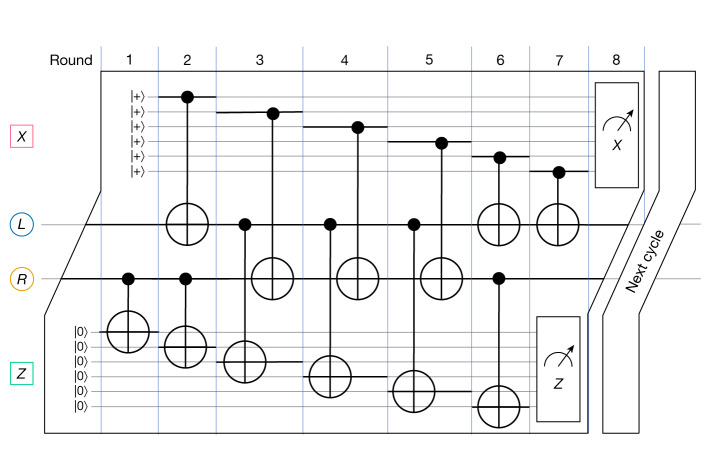
The accumulation of physical errors 1–3 prevents the execution of large-scale algorithms in current quantum computers. Quantum error correction 4 promises a solution by encoding k logical qubits onto a larger number n of physical qubits, such that the physical errors are suppressed enough to allow running a desired computation with tolerable fidelity. Quantum error correction becomes practically realizable once the physical error rate is below a threshold value that depends on the choice of quantum code, syndrome measurement circuit and decoding algorithm 5 . We present an end-to-end quantum error correction protocol that implements fault-tolerant memory on the basis of a family of low-density parity-check codes 6 . Our approach achieves an error threshold of 0.7% for the standard circuit-based noise model, on par with the surface code 7–10 that for 20 years was the leading code in terms of error threshold. The syndrome measurement cycle for a length- n code in our family requires n ancillary qubits and a depth-8 circuit with CNOT gates, qubit initializations and measurements. The required qubit connectivity is a degree-6 graph composed of two edge-disjoint planar subgraphs. In particular, we show that 12 logical qubits can be preserved for nearly 1 million syndrome cycles using 288 physical qubits in total, assuming the physical error rate of 0.1%, whereas the surface code would require nearly 3,000 physical qubits to achieve said performance. Our findings bring demonstrations of a low-overhead fault-tolerant quantum memory within the reach of near-term quantum processors.
Overview
CoChat Summary
## TL;DR
The paper presents a family of bivariate bicycle (BB) LDPC quantum codes and an end-to-end fault-tolerant memory protocol with low overhead. In numerical simulations, the authors report an error threshold/pseudo-threshold of about 0.7% and show that a 12-logical-qubit code can be preserved for nearly 1 million syndrome cycles using 288 physical qubits at physical error rate 0.1%.
## Key findings
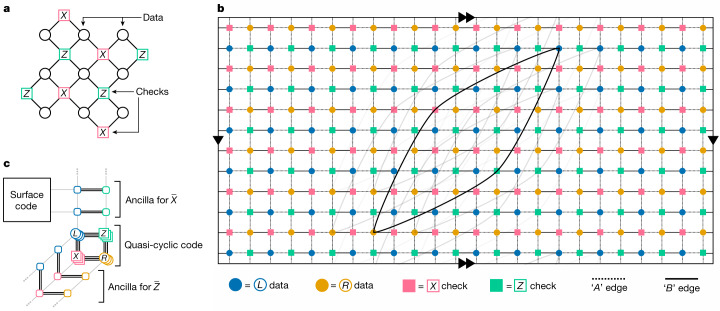
- The proposed BB codes have weight-6 check operators, degree-6 Tanner graphs, and thickness 2, meaning their connectivity can be split into two edge-disjoint planar subgraphs.
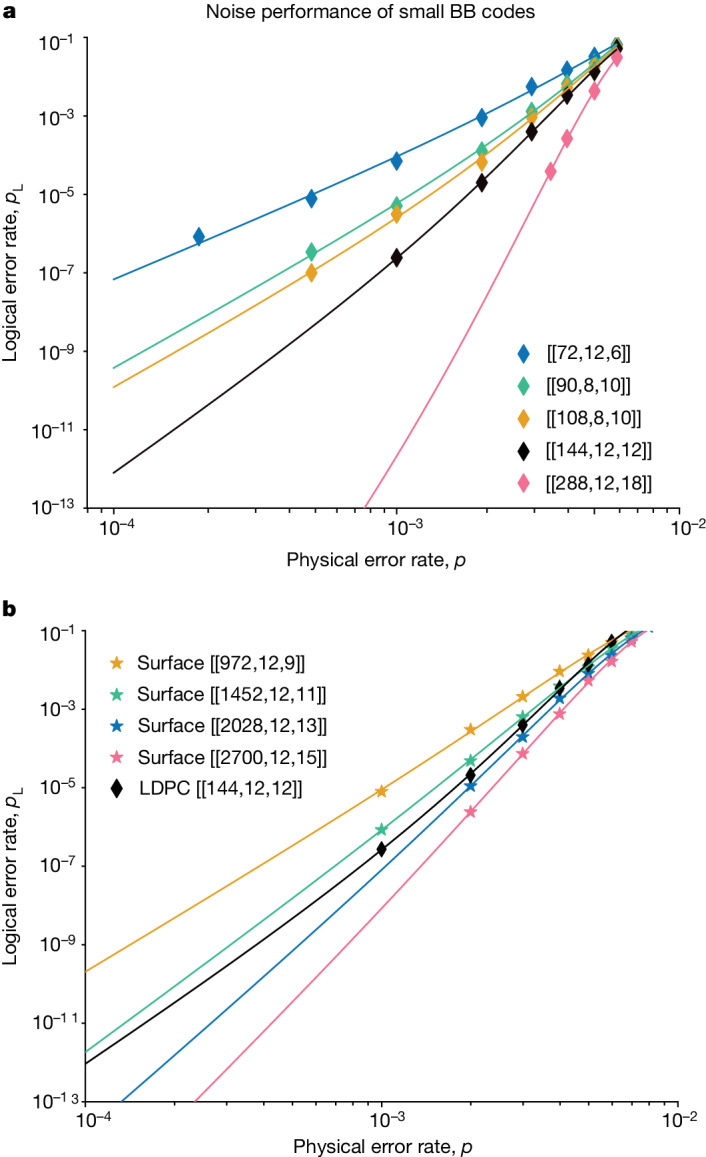
- The authors report an error threshold close to 0.7% for the standard circuit-based noise model, “on par with the surface code” and exceeding other high-rate LDPC codes known to them.
- For the [[144, 12, 12]] code, they state a net encoding rate of 1/24 and that it can preserve 12 logical qubits for nearly 1 million syndrome cycles using 288 physical qubits at physical error rate 0.1%.
- Compared with separate surface-code patches, they report about a 10× reduction in physical-qubit overhead for the distance-12 BB code in the example they analyze.
## Methods
- The paper introduces bivariate bicycle (BB) stabilizer codes defined from pairs of bivariate polynomials/matrices \(A\) and \(B\), yielding CSS codes with \(n=2\ell m\) data qubits and six-qubit check operators.
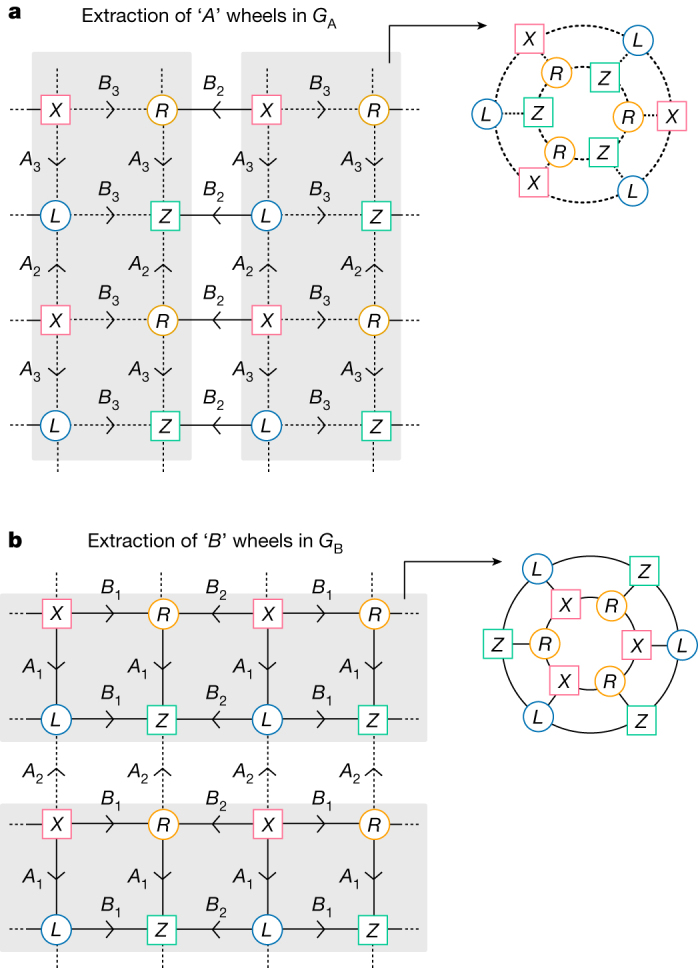
- They analyze code structure through the Tanner graph, proving results about connectivity, toric layouts, and thickness-2 planar decompositions of the graph.
- Performance is evaluated with an end-to-end fault-tolerant memory protocol under a circuit-based noise model where each operation fails independently with probability \(p\), using a BP-OSD decoder adapted to circuit noise and numerical simulations of logical error rates.
## Limitations
- The authors explicitly note that it remains unclear whether the code examples can be scaled up while retaining the high encoding rate in the limit of large code length.
- They also state that optimization of the code layout satisfying specific hardware constraints is left for future work.
- Evident from the text: the reported performance is based on numerical simulations and, for lower error rates, extrapolation/fitting, rather than a hardware demonstration.
Model-written summary. Check it against the paper before relying on it.
Integrity signals
Registry
Cites
Statistics
Figures
Verification
Claims the paper makes
12 Valid · 9 Not valid · 10 Not checked · 61 Own results and interpretations
The cited sources support only part of this claim — read each source’s verdict below.
In the paper
“on par with the surface code7–10 that for 20 years was the leading code in terms of error threshold”
- Also stated in: § Main · hedged
“which is nearly the same as the error threshold of the surface code49”
§ High-threshold and low-overhead fault-tolerant quantum memory > Abstract The accumulation of physical errors1–3 prevents the execution of large-scale algorithms in current quantum computers. Quantum error correction4 promises a solution by encoding k logical qubits onto a larger number n of physical qubits, such that the physical errors are suppressed enough to allow running a desired computation with tolerable fidelity. Quantum error correction becomes practically realizable once the physical error rate is below a threshold value that depends on the choice of quantum code, syndrome measurement circuit and decoding algorithm5. We present an end-to-end quantum error correction protocol that implements fault-tolerant memory on the basis of a family of low-density parity-check codes6. Our approach achieves an error threshold of 0.7% for the standard circuit-based noise model, on par with the surface code7–10 that for 20 years was the leading code in terms of error threshold. The syndrome measurement cycle for a length-n code in our family requires n ancillary qubits and a depth-8 circuit with CNOT gates, qubit initializations and measurements. The required qubit connectivity is a degree-6 graph composed of two edge-disjoint planar subgraphs. In particular, we show that 12 logical qubits can be preserved for nearly 1 million syndrome cycles using 288 physical qubits in total, assuming the physical error rate of 0.1%, whereas the surface code would require nearly 3,000 physical qubits to achieve said performance. Our findings bring demonstrations of a low-overhead fault-tolerant quantum memory within the reach of near-term quantum processors.
What the sources say
- Partly supportedcites [7] Kitaev, A. Y. Fault-tolerant quantum computation by anyons. Ann. Phys. 303, 2–30 (2003); preprint at 10.48550/arXiv.quant-ph/9707021 (1997). sourceExperimental — accuracy not yet measured
The section on toric codes (p. 4) says they work below an error threshold, supporting the comparison’s premise that this code has a threshold. But the Abstract (p. 1) says the threshold was not known and gives estimates from 1/300 to 10^-6; it does not establish that a 0.7% threshold is on par with it or that it led other codes for 20 years. (LLM, conf=0.82)
- Partly supportedcites [8] Bravyi, S. B. & Kitaev, A. Y. Quantum codes on a lattice with boundary. Preprint at 10.48550/arXiv.quant-ph/9811052 (1998). sourceExperimental — accuracy not yet measured
The Abstract (pp. 1–2) describes a lattice code with boundaries and local stabilizers, supporting the citation’s identification of a surface code. The copy gives code distance and the number of errors the code can correct (p. 4), but it does not give an error-rate threshold or establish that 0.7% is comparable to it. (LLM, conf=0.82)
- Partly supportedcites [9] Dennis, E., Kitaev, A., Landahl, A. & Preskill, J. Topological quantum memory. J. Math. Phys. 43, 4452–4505 (2002). 10.1063/1.1499754 sourceExperimental — accuracy not yet measured
The paper analyzes surface-code error thresholds: §F (p. 17) gives a lower bound of 1.14% when data and measurement error probabilities are equal. It does not give 0.7% as the surface-code threshold, so it supports the comparison’s subject but not the specific numerical equivalence. Its 2002 text also cannot establish the citing sentence’s retrospective claim of 20 years of leadership. (LLM, conf=0.85)
- Supportedcites [10] Fowler, A. G., Stephens, A. M. & Groszkowski, P. High-threshold universal quantum computation on the surface code. Phys. Rev. A 80, 052312 (2009). 10.1103/PhysRevA.80.052312 source
Section VIII (p. 15) reports a numerical surface-code threshold of approximately 0.6%, and the conclusion (p. 16) repeats that value. A threshold of 0.7% is therefore on par with the threshold this paper reports. (LLM, conf=0.91)
- Not matchedcites [49] Groszkowski, P., Fowler, A. & Stephens, A. M. High-threshold surface code quantum computing: threshold calculation. In Proc. APS March Meeting Abstracts W17–002 (APS, 2009).
Its entry has no title and year that we can search by.
plain- Asserted: passes — The authors put it forward as true.
- Checkable: passes — It can be checked against evidence.
- Load-bearing: passes — The paper’s conclusions depend on it.
- Based: passes — The paper gives a reason why it holds.
- Also stated in: § Main · hedged
The cited sources support only part of this claim — read each source’s verdict below.
In the paper
“The required qubit connectivity is a degree-6 graph composed of two edge-disjoint planar subgraphs.”
- Also stated in: § Main · plain
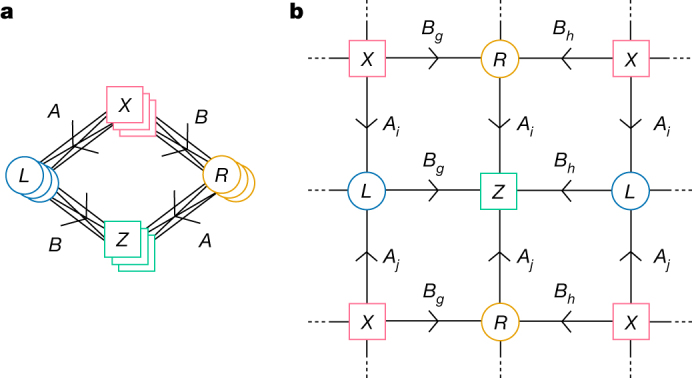
“The Tanner graph of any BB code has vertex degree six and graph thickness29 equal to two, which means it can be decomposed into two edge-disjoint planar subgraphs (Methods).”
- Also stated in: § Main · plain
“Although the qubit connectivity graph is not locally embeddable into a 2D grid, it can be decomposed into two planar degree-3 subgraphs.”
§ High-threshold and low-overhead fault-tolerant quantum memory > Abstract The accumulation of physical errors1–3 prevents the execution of large-scale algorithms in current quantum computers. Quantum error correction4 promises a solution by encoding k logical qubits onto a larger number n of physical qubits, such that the physical errors are suppressed enough to allow running a desired computation with tolerable fidelity. Quantum error correction becomes practically realizable once the physical error rate is below a threshold value that depends on the choice of quantum code, syndrome measurement circuit and decoding algorithm5. We present an end-to-end quantum error correction protocol that implements fault-tolerant memory on the basis of a family of low-density parity-check codes6. Our approach achieves an error threshold of 0.7% for the standard circuit-based noise model, on par with the surface code7–10 that for 20 years was the leading code in terms of error threshold. The syndrome measurement cycle for a length-n code in our family requires n ancillary qubits and a depth-8 circuit with CNOT gates, qubit initializations and measurements. The required qubit connectivity is a degree-6 graph composed of two edge-disjoint planar subgraphs. In particular, we show that 12 logical qubits can be preserved for nearly 1 million syndrome cycles using 288 physical qubits in total, assuming the physical error rate of 0.1%, whereas the surface code would require nearly 3,000 physical qubits to achieve said performance. Our findings bring demonstrations of a low-overhead fault-tolerant quantum memory within the reach of near-term quantum processors.
What the sources say
- Partly supportedcites [29] Tremblay, M. A., Delfosse, N. & Beverland, M. E. Constant-overhead quantum error correction with thin planar connectivity. Phys. Rev. Lett. 129, 050504 (2022). 35960553 10.1103/PhysRevLett.129.050504 sourceExperimental — accuracy not yet measured
Proposition 1 (p. 2) supports partitioning a low-degree connectivity graph into planar subgraphs. For degree 6, it guarantees a layout with at most three planar layers, not the claimed two. The passages about hypergraph product codes do not identify BB codes or establish their degree-6 connectivity. (LLM, conf=0.87)
plain- Asserted: passes — The authors put it forward as true.
- Checkable: passes — It can be checked against evidence.
- Load-bearing: passes — The paper’s conclusions depend on it.
- Based: passes — The paper gives a reason why it holds.
- Also stated in: § Main · plain
Every source the paper cites for this claim was checked and supports it.
In the paper
“Recent progress in the study of LDPC codes suggests that they can achieve quantum fault tolerance with a much higher encoding efficiency29.”
§ High-threshold and low-overhead fault-tolerant quantum memory > Main
What the sources say
- Supportedcites [29] Tremblay, M. A., Delfosse, N. & Beverland, M. E. Constant-overhead quantum error correction with thin planar connectivity. Phys. Rev. Lett. 129, 050504 (2022). 35960553 10.1103/PhysRevLett.129.050504 source
On p. 1, the paper says some quantum LDPC codes can achieve arbitrarily low logical error rates with a constant ratio of tens of physical qubits per logical qubit, potentially reducing qubit overhead by more than an order of magnitude compared with surface codes. It also reports a circuit-noise threshold for a positive-rate code family, supporting the claim's qualified statement about fault tolerance and encoding efficiency. (LLM, conf=0.93)
hedgedstates a possible cause- Asserted: passes — The authors put it forward as true.
- Checkable: passes — It can be checked against evidence.
- Load-bearing: passes — The paper’s conclusions depend on it.
- Based: passes — The paper gives a reason why it holds.
- Supported
Every source the paper cites for this claim was checked and supports it.
In the paper
“The latter were shown39,40 to be asymptotically ‘good’ in the sense of offering a constant encoding rate and linear distance: a parameter quantifying the number of correctable errors.”
§ High-threshold and low-overhead fault-tolerant quantum memory > Main
What the sources say
- Supportedcites [39] Panteleev, P. & Kalachev, G. Asymptotically good quantum and locally testable classical LDPC codes. In Proc. 54th Annual ACM SIGACT Symposium on Theory of Computing 375–388 (ACM, 2022). source
The Introduction (Theorem 2) states that for every R ∈ (0,1) and finite field F_q there is an explicit family of quantum LDPC codes with parameters [n, ⌊Rn⌋, d = Θ(n)]_q as n → ∞, i.e. constant rate and linear distance — an affirmative answer to the qLDPC conjecture. The same Introduction explains that these quantum CSS codes are built by taking the G-lifted product of expander/Tanner codes T(Γ;h) ("such codes can be used with the G-lifted product to obtain a 3-term chain complex C, which can also be considered as a quantum CSS code"), and §1.8 explicitly licenses calling Tanner complexes 'Tanner codes'. So the attributed point — quantum codes of Tanner type being asymptotically good with constant rate and linear distance — is stated by this paper. (LLM, conf=0.85)
- Supportedcites [40] Leverrier, A. & Zémor, G. Quantum Tanner codes. In Proc. 2022 IEEE 63rd Annual Symposium on Foundations of Computer Science (FOCS) 872–883 (IEEE, 2022). source
The Contributions section (p. 2) states that, under sufficient expansion and robustness conditions, the construction yields asymptotically good quantum LDPC codes with constant rate and linear minimum distance. This directly supports the attributed claim. (LLM, conf=0.95)
plainstates an association- Asserted: passes — The authors put it forward as true.
- Checkable: passes — It can be checked against evidence.
- Load-bearing: passes — The paper’s conclusions depend on it.
- Based: passes — The paper gives a reason why it holds.
- Supported
Every source the paper cites for this claim was checked and supports it.
In the paper
“As shown in Fig. 1c, extensions of the Tanner graph leveraging techniques by Cohen et al.50 enable fault-tolerant measurement operations involving an ancillary surface code.”
§ High-threshold and low-overhead fault-tolerant quantum memory > Main
What the sources say
- Supportedcites Cohen et al.50 Cohen, L. Z., Kim, I. H., Bartlett, S. D. & Brown, B. J. Low-overhead fault-tolerant quantum computing using long-range connectivity. Sci. Adv.10.1126/sciadv.abn1717 (2022). PMC10926894 35594359 source
The Results section (‘Logical CSS measurement’; page unavailable) describes extending a Tanner graph with an ancilla system to measure logical operators fault-tolerantly. The sentence attributes that technique to Cohen et al.; its reference to an ancillary surface code describes the citing authors’ application, not a claim that Cohen et al. used one. (LLM, conf=0.88)
plainstates a cause- Asserted: passes — The authors put it forward as true.
- Checkable: passes — It can be checked against evidence.
- Load-bearing: passes — The paper’s conclusions depend on it.
- Based: passes — The paper gives a reason why it holds.
- Supported
54 more claims · 2 with their cited sources checked
Create a free account to see all 92 claims and every source verdict.
- Probably not a substantial claim. 23
- It may state two separate claims as one. 12
- The quote only partly states this claim. 2
Citations
Cites
Quantum Computation and Quantum Information
Nielsen, M. A., Chuang, I., & Grover, L. K. (2002) · American Journal of Physics · doi:10.1119/1.1463744 · Cited by 21,895
Quantum supremacy using a programmable superconducting processor
Arute, F., Arya, K., Babbush, R., Bacon, D., Bardin, J. C., Barends, R., Biswas, R., Boixo, S., Brandao, F. G. S. L., Buell, D. A., et al. (2019) · Nature · doi:10.1038/s41586-019-1666-5 · Cited by 7,720 · cited 1×
“This new gate is also similar to the gates used by Google Quantum AI 57 , which have shown that a square lattice arrangement is possible.”
MethodFault-tolerant quantum computation by anyons
Kitaev, A. Y. (2003) · Annals of Physics · doi:10.1016/s0003-4916(02)00018-0 · Cited by 7,238 · cited 3×
“This resulted in the development of the surface code 7–10 that offers a high error threshold close to 1%, fast decoding algorithms and compatibility with the existing quantum processors relying on two-dimensional (2D) square lattice qubit connectivity.”
BackgroundMethodInfluentialScheme for reducing decoherence in quantum computer memory
Shor, P. W. (1995) · Physical Review A · doi:10.1103/physreva.52.r2493 · Cited by 4,479 · cited 2×
“The possibility of quantum fault tolerance is well-established 4 .”
BackgroundLloyd, S. (1996) · Science · doi:10.1126/science.273.5278.1073 · Cited by 3,088 · cited 1×
“It is believed that a scalable functioning quantum computer may help solve computational problems in such areas as scientific discovery, materials research, chemistry, and drug design, to name a few [2, 3, 4, 5].”
BackgroundGood quantum error-correcting codes exist
Calderbank, A. R., & Shor, P. W. (1996) · Physical Review A · doi:10.1103/physreva.54.1098 · Cited by 2,516 · cited 2×
“The length of the inner cycle is equal to the order of the matrix A A T 3 2 that is the transpose of A A T 3 2 considered earlier.”
BackgroundDennis, E., Kitaev, A., Landahl, A., & Preskill, J. (2002) · Journal of Mathematical Physics · doi:10.1063/1.1499754 · Cited by 1,768 · cited 1×
“The sources of noise include imperfections in qubits, materials used, controlling apparatus, state preparation and measurement errors and a variety of external factors ranging from local man-made, such as stray electromagnetic fields, to those inherent to the Universe, such as cosmic rays.”
BackgroundImproved simulation of stabilizer circuits
Aaronson, S., & Gottesman, D. (2004) · Physical Review A · doi:10.1103/physreva.70.052328 · Cited by 1,515 · cited 1×
“Since the circuit involves only Clifford operations, its action can be compactly described using stabilizer tableau [49].”
BackgroundDennis, E., Kitaev, A., Landahl, A., & Preskill, J. (2001) · CERN Document Server (European Organization for Nuclear Research) · Cited by 1,485
Quantum computations: algorithms and error correction
Kitaev, A. Y. (1997) · Russian Mathematical Surveys · doi:10.1070/rm1997v052n06abeh002155 · Cited by 1,424 · cited 1×
“The first proposals for quantum error correction, such as concatenated codes [16, 17, 18], focused on demonstrating the theoretical possibility of error suppression.”
Background
Research works printed but not linked: 1
- Groszkowski, P., Fowler, A. & Stephens, A. M. High-threshold surface code quantum computing: threshold calculation. In Proc. APS March Meeting Abstracts W17–002 (APS, 2009).
Cited by
Items 301–400 of 443
Kramers-Protected Hardware-Efficient Error Correction with Andreev Spin Qubits
Lu, H., Day, I. A., Akhmerov, A., van Heck, B., & Fatemi, V. (2025) · Physical Review Letters · doi:10.1103/lqf3-6r5z · Cited by 12
Device-independent verification of controlled non-local CNOT quantum gate
YiNing, L., NengFei, G., YueHan, T., & TieJun, W. (2025) · Zhongguo kexue. Wulixue Lixue Tianwenxue · doi:10.1360/sspma-2024-0575 · Cited by 1
Laser annealing for scalable frequency control on multiqubit quantum processors
Zhang, E. (2025) · doi:10.1117/12.3044009
“…through the IBM Quantum roadmap [6], future work will ensure compatibility of our LASIQ technology with respect to modularity and scale, both of which will be critical to efforts towards quantum error correction [8], culminating in Starling and Bluejay as part of our multi-year roadmap.”
Comparison of Classical and Hybrid Quantum Models in Secondary Structure Protein Prediction
Shubin, Q. (2025) · International journal of high school research · doi:10.36838/v7i3.14 · Cited by 1
Softer is Better: Tweaking Quantum Dropout to Enhance Quantum Neural Network Trainability
Bosco, D. L., Romanello, R., Serra, G., & Piazza, C. (2025) · International Conference on Quantum Communications, Networking, and Computing (QCNC) · doi:10.1109/qcnc64685.2025.00076
“Despite continuous hardware improvements [2], [3], classical Deep Learning still performs better on most tasks, partly due to the extensive amount of optimization techniques available [24].”
Srikara, S., Greentree, A. D., & Devitt, S. J. (2025) · Physical Review Research · doi:10.1103/physrevresearch.7.023160 · Cited by 3
“These codes offer significant advantages over traditional surface codes [28] in terms of encoding rate and resource efficiency [27, 29].”
Basic Theory and Implementations of Quantum Error Correction
Rodriguez, D. (2025) · Digital Commons - DU (University of Denver) · doi:10.56902/etdcrp.2025.40
An infinite class of quantum codes derived from duadic constacyclic codes
Dastbasteh, R., Martínez, J. E., Nemec, A., iOlius, A. D., & Crespo, P. M. (2025) · Quantum Information Processing · doi:10.1007/s11128-025-04828-0 · Cited by 5
“Degen-erate codes typically have a shorter-depth syndrome measurement circuit compared to non-degenerate codes with the same parameters, enabling more efficient and reliable syndrome measurement [10].”
Network Vulnerability Analysis via Quantum Computing
Kennedy, A. P., Dinh, T. N., & Thai, M. T. (2024) · International Conference on Meta Computing (ICMC) · doi:10.1109/icmc60390.2024.00024
“Furthermore, Bravyi et al. [22] presented an end-to-end quantum error correction protocol that implements fault-tolerant memory using a family of low-density parity-check codes.”
Monlezun, D. J. (2025) · Elsevier eBooks · doi:10.1016/b978-0-443-33353-8.00003-5
Jansen, N. D., & Hunt, K. L. C. (2025) · Entropy · doi:10.3390/e27090891 · Cited by 1
“In future work, it may be possible to take advantage of recently announced quantum computers with high fault-tolerance [108,109].”
Briegel, H. J., & Müller, T. (2025) · Synthese Library/Synthese library · doi:10.1007/978-3-031-98119-7_5
Reduced Sampling Overhead for Probabilistic Error Cancellation by Pauli Error Propagation
Scheiber, T., Haubenwallner, P., & Heller, M. (2025) · Quantum · doi:10.22331/q-2025-08-29-1840 · Cited by 13
“While recently tremendous progress in the realization of error corrected qubits has been made, both in terms of efficient encodings [5–7], and real hardware demonstrations [7–10], current quantum hardware is still far from being fault-tolerant.”
Enhancing Quantum Circuit Compilation with Modular Floorplanning
Lancellotti, G., Agosta, G., Barenghi, A., & Pelosi, G. (2025) · IEEE International Conference on Quantum Software (QSW) · doi:10.1109/qsw67625.2025.00018
“Recent advancements in hardware manufacturing [1] and error correction [2], [3] have significantly accelerated progress toward realizing fault-tolerant quantum machines with computation accuracy comparable to modern classical hardware.”
Efficient characterization of the coupler spectrum via sideband driving in superconducting qubits
Xu, J., 郭, R. 若. G., 郑, W. 文. Z., Zhang, Y., Zhao, J., Huang, Z., Wen, J., Zhang, R., Li, S., Tan, X., et al. (2025) · Chinese Physics B · doi:10.1088/1674-1056/ae00b0 · Cited by 1
Liang, Z., Wang, Z., Yi, Z., Yang, F., & Wang, X. (2025) · Entropy · doi:10.3390/e27090940 · Cited by 3
Color Code with a Logical Control- S Gate Using Transversal T Rotations
Brown, B. J. (2025) · Physical Review Letters · doi:10.1103/lwxd-fdlb · Cited by 6
Advancing Finite-Length Quantum Error Correction Using Generalized Bicycle Codes
Mostad, O. Å., Lin, H.-Y., Rosnes, E., Lee, D.-S., & Lai, C. (2025) · International Symposium on Turbo Codes and Iterative Information Processing · doi:10.1109/istc65386.2025.11154497 · Cited by 4
“BB codes are a type of GB code constructed using base matrices derived from bivariate polynomials [7].”
InfluentialQuantum LDPC Codes with Enhanced Error-Floor Performance under Min-Sum Decoding
Pacenti, M., Chytas, D., & Vasic, B. V. (2025) · International Symposium on Topics in Coding (ISTC) · doi:10.1109/istc65386.2025.11154487
“Recently, a class of codes known as bivariate bicycle (BB) codes [1] was introduced and tested in an experimental fault-tolerant setup.”
Cross-platform protected qubits from entanglement
Chakraborty, N., Moessner, R., & Douçot, B. (2025) · Physical review. B./Physical review. B · doi:10.1103/qjhp-8x6z · Cited by 3
Quantum approximate optimization of finite-state bosonic systems
Daryanoosh, S. (2026) · Physical review. E · doi:10.1103/yg66-8ypn · Cited by 1
iSwitch: QEC on Demand via In-Situ Encoding of Bare Qubits for Ion Trap Architectures
Yin, K., Fang, X., Chen, Z., Hayes, D., Kaur, E., Nejabati, R., Häffner, H., Campbell, W. C., Hudson, E. R., Palsberg, J., et al. (2026) · International Conference on Architectural Support for Programming Languages and Operating Systems (ASPLOS) · doi:10.1145/3779212.3790177 · Cited by 14
“Quantum error correction (QEC) [13], [14], [15], [16], [17] is widely regarded as the only viable path to overcome this bottleneck and enable fault-tolerant quantum computing (FTQC) [18], [19], [20], [21], which is essential for solving large-scale, practically useful problems [22], [23], [24],…”
Roughening Transition in Quantum Circuits
Ha, H., Huse, D. A., & Sommers, G. M. (2025) · Physical Review Letters · doi:10.1103/gkwd-8477 · Cited by 7
“They also support better quantum error-correcting codes to overcome strict bounds on code rate in lower dimensions [63–67].”
Transversal Architecture for Megaquop-Scale Quantum Simulation with Neutral Atoms
Ismail, R., Chen, I.-C., Zhao, C., Weiss, R., Liu, F., Zhou, H., Wang, S.-T., Sornborger, A. T., & Kornjača, M. (2026) · PRX Quantum · doi:10.1103/j2fw-ccmy · Cited by 35
“While fixed physical architectures that implement high-rate codes can be constructed [50], the large amount of task-specific architecture customizations necessitates dynamical reconfigurability.”
Mean Estimation in High-Dimensional Binary Timeinhomogeneous Markov Gaussian Mixture Models
Kadry, A. E. L., Zhang, Y., & Weinberger, N. (2025) · IEEE International Symposium on Information Theory (ISIT) · doi:10.1109/isit63088.2025.11195426
QEMOS: a scalable quantum error mitigation method to overcome qubit sensitivity
Tu, Z., Xu, J., Zhou, X., Zhu, Y., Liu, Y., Du, Q., Lian, H., & Zhou, B. (2025) · Machine Learning Science and Technology · doi:10.1088/2632-2153/ae16fc · Cited by 2
“Recently, IBM has proposed a novel error correction code termed LDPC code [20].”
Symmetry-enriched topological order and quasifractonic behavior in Z N stabilizer codes
He, S., & Song, H. S. (2026) · Physical review. B./Physical review. B · doi:10.1103/f35h-pmfn · Cited by 1
Fully Parallelized BP Decoding for Quantum LDPC Codes Can Outperform BP-OSD
Wang, M., Li, A., & Mueller, F. (2026) · IEEE International Symposium on High-Performance Computer Architecture (HPCA) · doi:10.1109/hpca68181.2026.11408621 · Cited by 20
“One of the central challenges in quantum computing is achieving fault-tolerant quantum computation (FTQC), which requires the use of quantum error correction (QEC) codes to correct errors arising from noisy quantum devices.”
InfluentialLogical Qubit Initialization and Measurement in the Heavy-Hexagonal Lattice
Özkan, A. K., Kakız, M. T., Güler, E., & Çavdar, T. (2025) · doi:10.1109/isctrkiye68593.2025.11224815
All-to-all connectivity of Rydberg-atom-based quantum processors with messenger qubits
Dudinets, I. V., Straupe, S. S., Fedorov, A. K., & Lychkovskiy, O. V. (2026) · Physical Review A · doi:10.1103/6bsx-k4m6 · Cited by 5
Feedforward suppression of readout-induced faults in quantum error correction
Shirizly, L., Meirom, D., Carroll, M. S., & Landa, H. (2025) · Physical Review A · doi:10.1103/ght4-yqmb · Cited by 7
“In the rest of this work we focus in detail on a specific code, the LDPC Gross code [70], where we provide numerical evidence indicating that this protocol could reduce logical error rates and decoding times, in particular accounting for leakage errors.”
InfluentialRaisuddin, O. M., & De, S. (2025) · Springer eBooks · doi:10.1007/978-3-032-03325-3_16
High-dimensional quantum X Y Z product codes for biased noise
Liang, Z., Yi, Z., Yang, F., Chen, J., Wang, Z., & Wang, X. (2025) · Physical Review A · doi:10.1103/rrfk-1b51 · Cited by 3
Báscones, D., García-Herrero, F., & Valls, J. (2025) · EPJ Quantum Technology · doi:10.1140/epjqt/s40507-025-00446-y · Cited by 15
“The two families we explored are surface codes [34] and bicycle bivariate codes [4], chosen for their multiple applications and distinct structures regarding quantum hardware resources and connectivity requirements.”
Efficiently decoding quantum errors with machine learning
Deng, X., & Xu, Y. (2025) · Nature Computational Science · doi:10.1038/s43588-025-00907-5
Fault-tolerant quantum computation with polylogarithmic time and constant space overheads
Tamiya, S., Koashi, M., & Yamasaki, H. (2025) · Nature Physics · doi:10.1038/s41567-025-03102-5 · Cited by 50
Logical Operations with a Dynamical Qubit in Floquet-Bacon-Shor Code
Sun, X., Li, L., Wu, Z., Guo, Z., Huang, P., Huang, W., Li, Q., Liang, Y., Liu, Y., Sun, D., et al. (2025) · Physical Review Letters · doi:10.1103/425n-6k9s · Cited by 6
“QEC codes, including surface code [7], color code [8], Bacon-Shor (BS) code [9], and quantum LDPC code [10], have made significant experimental progress across various systems in recent years [11–20].”
Turbo-Annihilation of Hook Errors in Stabilizer Measurement Circuits
Pacenti, M., Pradhan, A. K., Borah, S. K., et al. (2025) · IEEE International Conference on Quantum Computing and Engineering (QCE) · doi:10.1109/qce65121.2025.00026
“For our experiment, we consider bicycle bivariate (BB) codes [11], although our analysis extends naturally to other classes of QLDPC codes.”
Fault Tolerant Decoding of QLDPC-GKP Codes with Circuit Level Soft Information
Borah, S. K., Pradhan, A. K., Raveendran, N., Pacenti, M., & Vasic, B. V. (2025) · IEEE International Conference on Quantum Computing and Engineering (QCE) · doi:10.1109/qce65121.2025.00271 · Cited by 10
“For our simulations, we have used a bicycle bivariate code with parameters [[144 , 12 , 12]] from [36].”
InfluentialDesign and Analysis of Planar Surface and Perfect Quantum Error Correction Codes
Al-Hinai, M., & Asif, H. M. (2025) · IEEE Asia Pacific Conference on Wireless and Mobile (APWiMob) · doi:10.1109/apwimob67231.2025.11269136
“High-threshold and low-overhead fault-tolerant quantum memory using surface codes has been demonstrated, showing strong scalability and robustness under a range of idealized noise models [12].”
Honz, F., Müllner, P., Hentschel, M., et al. (2025) · European Conference on Optical Communication · doi:10.1109/ecoc66593.2025.11262979
“The security of the currently employed asymmetric cryptography schemes is threatened by the rapid development of quantum computers, which has recently surpassed >1000 physical qubits [1] at ever increasing error-correcting codecs [2].”
Dynamics in a Ring Photonic Molecule with Programmable Spectrum Topology
Perminov, N. S., & Moiseev, S. A. (2025) · Bulletin of the Russian Academy of Sciences Physics · doi:10.1134/s1062873825713650
Subsystem many-hypercube codes: High-rate concatenated codes with low-weight syndrome measurements
Nakai, R., & Goto, H. (2025) · Physical Review Applied · doi:10.1103/xbzn-vn37 · Cited by 9
“The concatenation of the [[ 6 , 4 , 2 ]] quantum error-detecting code, the resultant codes of which are referred to as the [[ 6 , 4 , 2 ]] many-hypercube (MHC) codes [8, 12, 13], has also been proposed.”
InfluentialObservation of a fault tolerance threshold with concatenated codes
Sommers, G. M., Foss‐Feig, M., Hayes, D., Huse, D. A., & Gullans, M. J. (2025) · Physical Review Research · doi:10.1103/v477-jw8l · Cited by 6
Improved energy barrier in higher-dimensional hypergraph product codes
Zhao, G. (2025) · Physical Review A · doi:10.1103/b9r5-xhcp · Cited by 1
qSIEVE: Efficient qLDPC Memory via Systolic Movement in Atom Arrays
Viszlai, J., Yang, W., Lin, S. F., Liu, J., Nottingham, N., Baker, J. M., & Chong, F. T. (2026) · ACM Transactions on Quantum Computing · doi:10.1145/3779066 · Cited by 47
Simulation of thermal-relaxation noise for quantum error correction
Garner, S. R., Myers, N. M., Wang, M., Stein, S., Liu, C., & Li, A. (2026) · Physical Review Research · doi:10.1103/hgnj-v4j7 · Cited by 2
Enconding qubits in valleytronic states in chiral lattices
Yuan, J., Deng, J., & Wang, D. (2025) · AVS Quantum Science · doi:10.1116/5.0304854
A Review of Formal Methods in Quantum Circuit VerificationPreprint
Govindankutty, A. (2025) · Qeios · doi:10.32388/h7d715
Comparison of spin-qubit architectures for quantum error-correcting codes
Gutiérrez, M., Rojas-Arias, J. S., Obando, D., & Chang, C. Y. (2026) · Physical Review A · doi:10.1103/qlw3-xk2f · Cited by 5
“…and duration values, the hybrid logical scheme even outperforms a physical LD qubit ( T ∗ 2 = 21 µ s) initialized in the | + ⟩ state and subject to de-phasing (Z) noise during the duration of the whole QEC process for both the hybrid and the all-LD schemes (green dashed-dotted lines in Fig.”
Quantum memory based on concatenating surface codes and quantum Hamming codes
Fang, M., & Su, D. (2025) · Physical Review A · doi:10.1103/8ds6-l416 · Cited by 1
Poletto, S., & Chen, A. Q. (2025) · Springer eBooks · doi:10.1007/978-3-031-90727-2_1
Low-Complexity Syndrome-Based Linear Programming Decoding of Quantum LDPC Codes
Javed, S., Colet, S., García-Herrero, F., Ruano, Ó., Maestro, J. A., Vasić, B., & Flanagan, M. F. (2025) · IEEE Transactions on Quantum Engineering · doi:10.1109/tqe.2025.3640361 · Cited by 1
“Restrictions apply. the CN degree exceeds 30 in the worst case [34], generating more than 10 9 elements in sets B i and C i .”
InfluentialMulti-Stage Bit-Flipping Decoder Design for Quantum Error-Correcting Codes
Moxom, P. J., & Flanagan, M. F. (2025) · Irish Signals and Systems Conference · doi:10.1109/issc67739.2025.11291312
“However, QEC has seen a shift towards qLDPC codes [4], which inherit the advantages of classical LDPC codes such as high fault tolerance, low complexity, and scalability, making them extremely relevant in QEC.”
Opportunities in full-stack design of low-overhead fault-tolerant quantum computation
Zhou, H., Cain, M., & Lukin, M. D. (2025) · Nature Computational Science · doi:10.1038/s43588-025-00895-6 · Cited by 15
“However, recent work has found that the interaction graph can nonetheless be embedded in as few as two planar layers with long-range couplers 91,96 .”
Sahu, S. K., & Mazumdar, K. (2026) · Studies in big data · doi:10.1007/978-3-032-00586-1_1
Realization of a quantum error detection code with a dynamically reassigned ancillary qubit
Kazmina, A. S., Polyanskiy, A. M., Egorova, E. Y., Abramov, N. N., Kalacheva, D. A., Lubsanov, V. B., Bolgar, A. N., & Simakov, I. A. (2026) · Applied Physics Letters · doi:10.1063/5.0288597
Single-Shot and Few-Shot Decoding via Stabilizer Redundancy in Bivariate Bicycle Codes
Rowshan, M. (2026) · IEEE International Symposium on Information Theory (ISIT) · doi:10.1109/isit62367.2026.11653650 · Cited by 2
“Bivariate bicycle (BB) codes, introduced by Bravyi et al. [6], form a concrete qLDPC family with weight-6 checks and a two-layer Tanner graph.”
A Review of Formal Methods in Quantum Circuit VerificationPreprint
Govindankutty, A. (2026) · Qeios · doi:10.32388/h7d715.2
Near-Optimal Decoding Algorithm for Color Codes Using Population Annealing
Martínez-García, F., Pereira, F. R. F., & Parrado-Rodríguez, P. (2026) · Entropy · doi:10.3390/e28010091 · Cited by 2
“Currently, the most prominent families of codes include surface codes [22–24], color codes [25,26] and qLDPC codes [27–32].”
Quantum3Enabled Cybercrime: A Portfolio Analysis of Cryptocurrency Theft and Double-Spending
Li, Z., & Liao, Q. (2025) · APWG Symposium on Electronic Crime Research (eCrime) · doi:10.1109/ecrime66972.2025.11327811 · Cited by 1
“As we rapidly approach the quantum computing era [1], [2], IBM has announced plans to build the world’s first large-scale, fault-tolerant quantum computer capable of running quantum circuits comprising 100 million quantum gates on 200 logical qubits by 2029 [3].”
Many-body entanglement swapping protocol: Opportunities for distributed quantum computing
Huhtanen, S., Mafi, Y., Moghaddam, A. G., & Ojanen, T. (2026) · Physical Review Research · doi:10.1103/9n1d-7jwj · Cited by 4
“Such capabilities support not only nonlocal multi-qubit gates—essential for advanced algorithms and quantum error correction [19]—but also play a foundational role in quantum simulation [20], distributed computing models, and the development of large-scale quantum supercom-puters [21].”
A Review of Formal Methods in Quantum Circuit VerificationPreprint
Govindankutty, A. (2026) · Qeios · doi:10.32388/h7d715.3
Magoulas, I., & Evangelista, F. A. (2026) · Physical Review A · doi:10.1103/y52r-pd4y · Cited by 3
A Review of Formal Methods in Quantum Circuit VerificationPreprint
Govindankutty, A. (2026) · Qeios · doi:10.32388/h7d715.4
Montes, J., Borondo, F., & Carlo, G. G. (2026) · Physical Review A · doi:10.1103/pwz2-yg3f
Fully Quantum Algorithm for the 1-Dimensional Linear Lattice Boltzmann Method
Bediche, M., van Waveren, M., Ricot, D., & Sagaut, P. (2026) · Communications in computer and information science · doi:10.1007/978-3-032-13855-2_24
“Brayyi et al [14] for example present an end-to-end quantum error correction protocol that implements fault-tolerant memory on the basis of a family of low-density parity-check codes.”
Wang, S., & Chattopadhyay, A. (2026) · Computer architecture and design methodologies · doi:10.1007/978-981-95-6039-4_2
Zhang, J., Tian-hao, W. E. I., Zhuang, X., Chen, Z., Kong, W., Wu, Y.-C., & Guo, G. (2026) · Physical Review Letters · doi:10.1103/mjsj-hxyj · Cited by 3
A Review of Formal Methods in Quantum Circuit VerificationPreprint
Govindankutty, A. (2026) · Qeios · doi:10.32388/h7d715.5
A Review of Formal Methods in Quantum Circuit VerificationPreprint
Govindankutty, A. (2026) · Qeios · doi:10.32388/h7d715.6
Impact of leakage on the dynamics of an ST 0 qubit implemented in a double quantum dot device
del Moral, J. O., Larrarte, O. S., Dastbasteh, R., Martínez, J. E., & Otxoa, R. M. (2026) · Physical review. B./Physical review. B · doi:10.1103/6p7p-w1lc · Cited by 2
Enhancing decoding performance using efficient error learning
Iyer, P. S., Jain, A., Bartlett, S. D., & Emerson, J. (2026) · Physical Review Applied · doi:10.1103/vtj7-nh6l · Cited by 6
“These include the development of new quantum error correcting codes [12, 100], and enhancing the error correction capabilities for existing ones [10, 51, 89, 108].”
Fault-tolerant threshold of quantum circuit under correlated noise
Wang, Z.-Y. (2026) · Communications in Theoretical Physics · doi:10.1088/1572-9494/ae4b15
1.2 Quantum Computing – Toward Large-Scale Fault-Tolerant Quantum Computing
Riel, H. (2026) · Digest of technical papers/Digest of technical papers - IEEE International Solid-State Circuits Conference · doi:10.1109/isscc49663.2026.11409084 · Cited by 2
“A significant breakthrough was achieved, demonstrating a fault-tolerant quantum memory based on quantum low-density parity-check (qLDPC) codes, specifically the bivariate bicycle (BB) family with low qubit overhead and high error threshold [30].”
Khan, S., Anand, A., Brown, K. R., & Baker, J. M. (2026) · IEEE International Symposium on High-Performance Computer Architecture (HPCA) · doi:10.1109/hpca68181.2026.11408498 · Cited by 4
“The quantum error correcting codes used in our study include Hypergraph Product codes found in [9], and Bivariate Bicycle codes as found in [1].”
InfluentialTsunaki, L., Dotan, M., Volkova, K., & Naydenov, B. (2026) · Physical Review A · doi:10.1103/6st7-qh12 · Cited by 2
Systematic Algebraic Method to Identify Clifford Operations for Quantum Error-Correction Codes
Liu, S.-C., Lin, Y.-X., Wang, Y.-X., & Peng, L.-Y. (2026) · Chinese Physics Letters · doi:10.1088/0256-307x/43/4/040603 · Cited by 1
Understanding Majorana braiding in superconductors with a fixed total number of particles
Martin, I., & Agarwal, K. (2026) · Physical review. B./Physical review. B · doi:10.1103/f56n-l1yr · Cited by 2
AlphaSyndrome: Tackling the Syndrome Measurement Circuit Scheduling Problem for QEC Codes
Liu, Y., Ping, S., Zhou, J., Decker, E., Kalloor, J., Weiden, M., Chen, K., Shi, Y., Javadi-Abhari, A., Iancu, C., et al. (2026) · International Conference on Architectural Support for Programming Languages and Operating Systems (ASPLOS) · doi:10.1145/3779212.3790123 · Cited by 17
Accelerating Computation in Quantum LDPC Code
Cho, J., Jeong, H., Kim, J., Choi, J., Hong, J., & Kim, J. (2026) · International Conference on Architectural Support for Programming Languages and Operating Systems (ASPLOS) · doi:10.1145/3779212.3790122 · Cited by 1
PropHunt: Automated Optimization of Quantum Syndrome Measurement Circuits
Viszlai, J., Maurya, S., Tannu, S., Martonosi, M., & Chong, F. T. (2026) · International Conference on Architectural Support for Programming Languages and Operating Systems (ASPLOS) · doi:10.1145/3779212.3790205 · Cited by 17
Reinforcement Learning for Enhanced Advanced QEC Architecture Decoding
Zhou, Y., Kong, L., Peng, Y., & Liang, Z. (2026) · Asia and South Pacific Design Automation Conference (ASP-DAC) · doi:10.1109/asp-dac66049.2026.11420491 · Cited by 1
“BB codes represent an important QLDPC family, constructed using circulant matrices with bivariate polynomials [4].”
Decoding correlated errors in quantum LDPC codes
Maan, A. S., García-Herrero, F., Paler, A., & Savin, V. (2026) · Nature Communications · doi:10.1038/s41467-026-70556-3 · Cited by 33
“These efforts have progressively advanced QLDPC code constructions 3 – 9 , resulting in asymptotically good families 10 – 12 (i.e., with non-vanishing rate and linear minimum distance), as well as practically implementable codes tailored to the constraints of speci fi c quantum technologies 13,14 .”
Abelian Multi-Cycle Codes for Single-Shot Error Correction
Lin, H.-K., Lim, P. K., Kovalev, A. A., & Pryadko, L. P. (2026) · PRX Quantum · doi:10.1103/mj28-925w · Cited by 12
“These, and more general 2BGA codes[26–28], including the bivariate-bicycle (BB) codes[29–32], have attracted attention as the family which contains short codes with relatively high rates and distances (substantially improving over the surface/toric codes) and at the same time with relatively high…”
Timing-Aware End-to-End Circuit Compilation Framework for Modular Quantum Systems
Huang, C.-Y., & Mak, W.-K. (2026) · International Symposium on Physical Design · doi:10.1145/3764386.3779586
Constraint-optimal driven allocation for scalable quantum error correction decoder scheduling
Kim, D., Seo, J., Han, Y., & Kim, Y. (2026) · Physical Review A · doi:10.1103/1zc1-wpjp
Fujita, M., & Kimura, Y. (2026) · Springer eBooks · doi:10.1007/978-3-032-09303-5_8
Design Automation Challenges in Quantum Computing
Mishra, P. (2026) · Springer eBooks · doi:10.1007/978-3-032-09303-5_1
Graph-based approach to entanglement entropy of quantum error-correcting codes
Zhao, W., Fang, M., & Su, D. (2026) · Physical Review A · doi:10.1103/jc6b-txy9 · Cited by 4
Hypergraph-based approximate maximum likelihood decoding for quantum codes under circuit-level noise
Chen, K., Zhu, M., Song, H. Y., Xie, W., & Li, X. (2026) · Physical Review Research · doi:10.1103/ydb8-vd3x · Cited by 1
García-Herrero, F., Valls, J., Vergara-Picazo, L., & Torres, V. (2026) · Quantum · doi:10.22331/q-2026-04-16-2071 · Cited by 7
“At the same time, it maintains or improves the LER when compared to BP+OSD on bivariate bicycle codes of varying lengths and distances [24].”
InfluentialAhn, C. (2026) · Elsevier eBooks · doi:10.1016/b978-0-443-34203-5.00021-8
Fault Tolerant Probabilistic VLSI Design for Reliable Deep Learning Hardware Accelerators
Komalavalli, S., Kanan, M., Shifani, S. A., et al. (2026) · International Conference on Expert Clouds and Applications (ICOECA) · doi:10.1109/icoeca68095.2026.11485195
“Providing fault tolerance in deep learning accelerators, thus, will be a crucial design consideration in the era of ubiquitous AI [4].”
High-fidelity entangling gates and nonlocal circuits with neutral atoms
Evered, S. J., Xu, M., Li, S. H., Geim, A. A., Ataides, J. P. B., Kalinowski, M., Bluvstein, D., Maskara, N., Kokail, C., Greiner, M., et al. (2026) · Science · doi:10.1126/science.aei1312 · Cited by 62
BiBiEQ: Bivariate Bicycle Codes on Erasure Qubits
Bhave, A., Choudhury, N., Nemec, A., & Basu, K. (2026) · International Conference on Quantum Communications, Networking, and Computing (QCNC) · doi:10.1109/qcnc69040.2026.00101 · Cited by 2
Dimensioning of Quantum Memories for Distilled Quantum EPR Packets
Valentini, L., Forlivesi, D., Talarico, A., et al. (2026) · International Conference on Quantum Communications, Networking, and Computing (QCNC) · doi:10.1109/qcnc69040.2026.00041
Expander quantum low density parity check codes against long-range correlated errors in memory
Kashtikar, Y. D., Mathur, P., Senthil, S., & Chatterjee, A. (2026) · Physical Review A · doi:10.1103/q4pw-zwcv · Cited by 1
A cavity-mediated reconfigurable coupling scheme for superconducting qubits
Hwang, S., Lee, S., & Kim, E. (2026) · Applied Physics Letters · doi:10.1063/5.0329318
Beam Search Decoder for Quantum Low-Density Parity-Check Codes
Ye, M., Wecker, D., & Delfosse, N. (2026) · PRX Quantum · doi:10.1103/6k5x-ztqt · Cited by 36
Metadata
- Authors
- Bravyi, S., Cross, A. W., Gambetta, J. M., Maslov, D., Rall, P., & Yoder, T. J.
- Affiliations
- IBM (United States) (US)
- Corresponding author
- Maslov, Dmitri
- Venue
- Nature
- Published
- 2024-03-27
- Volume
- 627
- Issue
- 8005
- Pages
- 778-782
- ISSN
- 0028-0836 (ISSN-L)
- 1476-4687
- PMC
- PMC10972743
- OpenAlex
- W4393234688
- Cited by
- 456
- References
- 82
- Citations by year
- 2026: 150 · 2025: 223 · 2024: 76
- FWCI
- 65.98
- Type
- journal article
- Language
- en
- Open access
- hybrid
- doi.org
- Licence
- cc-by
- creativecommons.org/licenses/by/4.0 (tdm)
- creativecommons.org/licenses/by/4.0 (vor)
- Locations
- Nature (publishedVersion, cc-by)
- PubMed Central (publishedVersion, cc-by)
- PubMed (publishedVersion)
- arXiv (Cornell University) (submittedVersion)
- RePEc: Research Papers in Economics (submittedVersion)
- arXiv (Cornell University)
- Topics
- Physical Sciences › Computer Science › Artificial Intelligence › Quantum Computing Algorithms and Architecture
- Physical Sciences › Physics and Astronomy › Atomic and Molecular Physics, and Optics › Quantum Information and Cryptography
- Physical Sciences › Physics and Astronomy › Atomic and Molecular Physics, and Optics › Quantum many-body systems
- Keywords
- fault-tolerant quantum memory, quantum error correction, LDPC codes, error threshold, syndrome measurement, logical qubits, qubit connectivity, planar graphs
About these checks
Registry, retraction, Cites and statistics results are computed, not judged, with one exception: a printed reference that no index lists is read once by a model before it counts as a citation error. Claims are extracted by a model and kept only when their quote appears verbatim in the text; each cited source is then checked, with a model’s help, for whether it says what the claim relies on. Those verdicts can be wrong — read the claim’s quote and the cited source before relying on one.
The claim verdicts this report counts are experimental: their accuracy is not yet measured.
A language model drew the claims from the paper on 2026-10-10, under version 3 of the claim definition (model deepseek-v4.1-flash, prompt extract-v3).
A second model labelled each claim on 2026-10-10 (model jev-1.13-20260917, definition revision gold-guideline-v0.2).
Cited sources are checked with a language model’s help (gpt-6-sol and qwen3.8-omni-flash).
Statistics and arithmetic are recomputed, not judged.
Confidence bands are shown only for fields calibrated on our annotated test set. None is calibrated yet, so no band is shown.
What counts as a claim ›How we measure confidence ›How we check this ›
Are you an author, or do you see a problem with this page? Request a review
Data sources
Bibliographic data: Semantic Scholar, OpenAlex, Crossref.
Contains information from the Semantic Scholar Academic Graph Datasets, made available under the ODC Attribution License (ODC-BY 1.0).
Semantic Scholar’s data is described in: Kinney, R., et al. (2023). The Semantic Scholar Open Data Platform. arXiv:2301.10140.
