

Descending networks transform command signals into population motor control
Open accessPublished version of a preprint
The DOI matches its Crossref record; 104 of the 104 references it cites were found in a registry or an index; 9 of the 47 sources its claims cite were checked for support.
Abstract
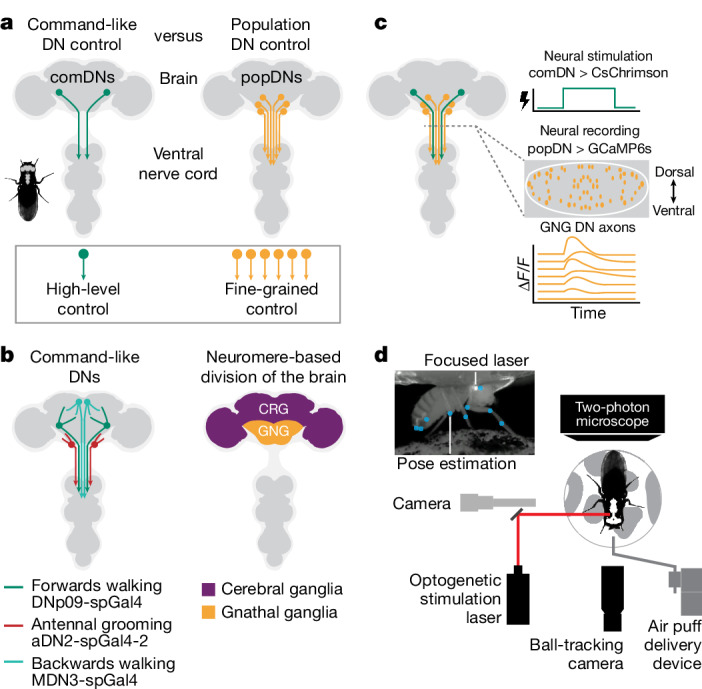
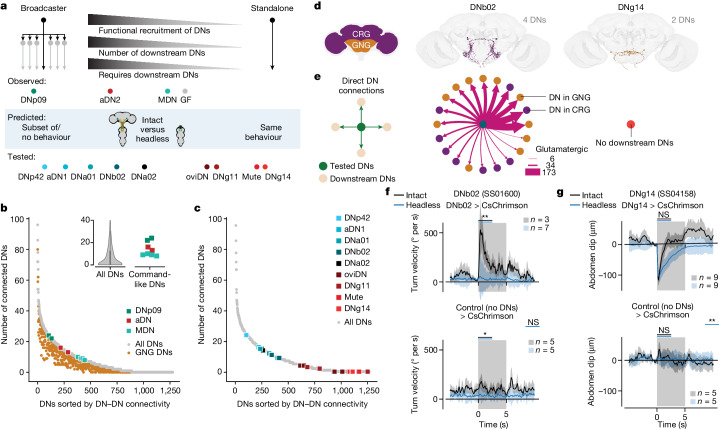
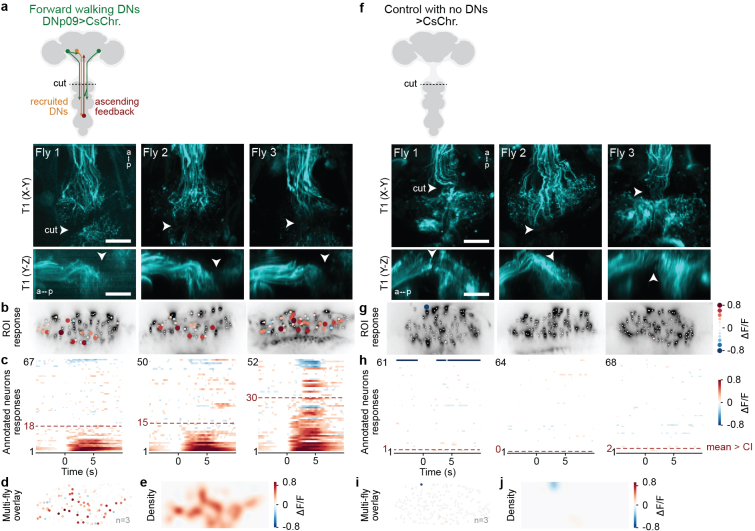
To convert intentions into actions, movement instructions must pass from the brain to downstream motor circuits through descending neurons (DNs). These include small sets of command-like neurons that are sufficient to drive behaviours 1 —the circuit mechanisms for which remain unclear. Here we show that command-like DNs in Drosophila directly recruit networks of additional DNs to orchestrate behaviours that require the active control of numerous body parts. Specifically, we found that command-like DNs previously thought to drive behaviours alone 2–4 in fact co-activate larger populations of DNs. Connectome analyses and experimental manipulations revealed that this functional recruitment can be explained by direct excitatory connections between command-like DNs and networks of interconnected DNs in the brain. Descending population recruitment is necessary for behavioural control: DNs with many downstream descending partners require network co-activation to drive complete behaviours and drive only simple stereotyped movements in their absence. These DN networks reside within behaviour-specific clusters that inhibit one another. These results support a mechanism for command-like descending control in which behaviours are generated through the recruitment of increasingly large DN networks that compose behaviours by combining multiple motor subroutines.
Overview
CoChat Summary
TL;DR
Command-like descending neurons (comDNs) in *Drosophila* recruit additional descending neuron (DN) populations through direct excitatory brain connections, rather than acting alone. The size of a comDN’s downstream DN network predicts whether that recruitment is necessary to produce a complete behaviour.
Key findings
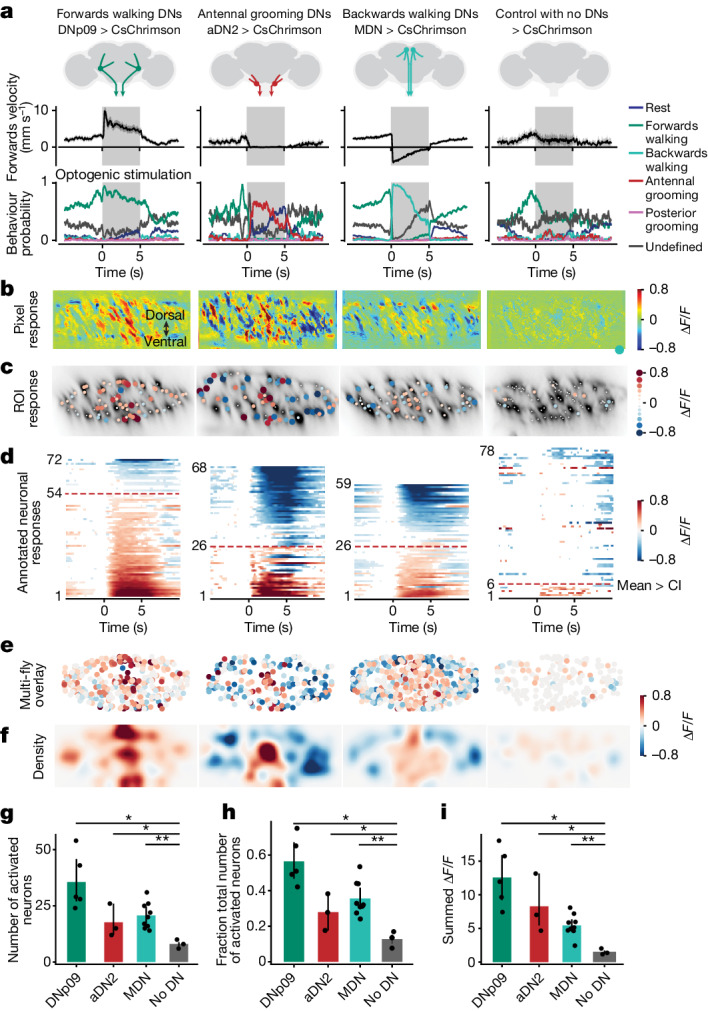
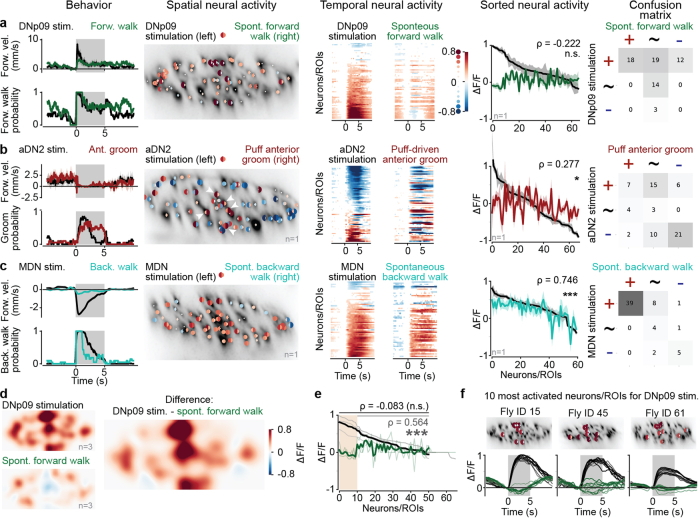
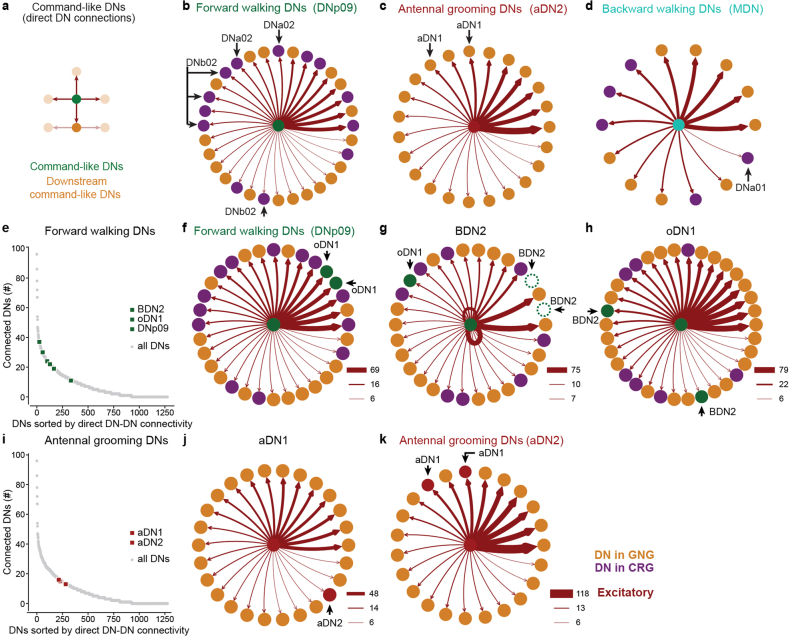
- Optogenetic activation of DNp09, aDN2 and MDN recruited GNG DN populations significantly more than controls: P = 0.018 (DNp09), P = 0.040 (aDN2) and P = 0.008 (MDN). Recruitment strength followed DNp09 > aDN2 > MDN.
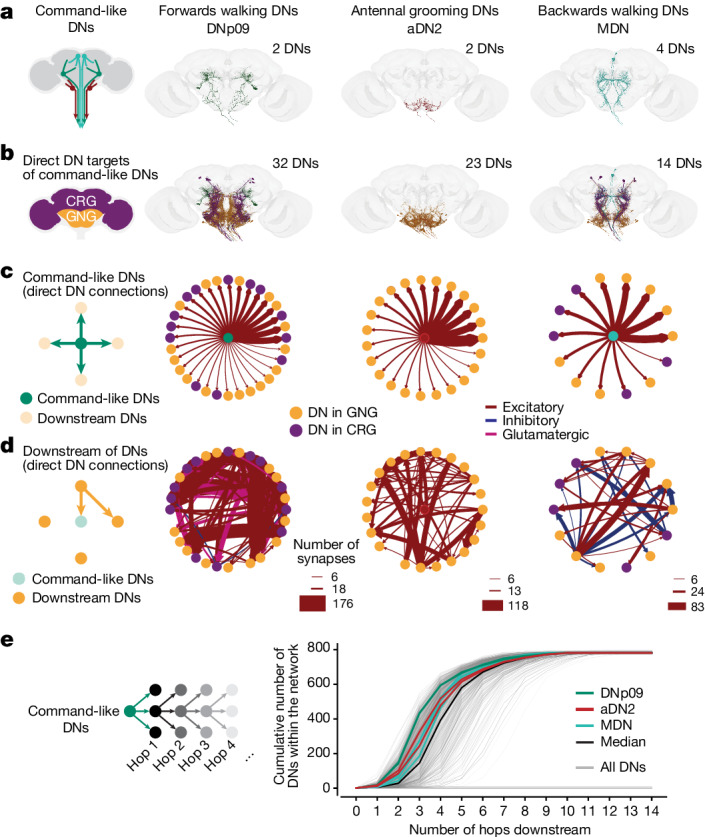
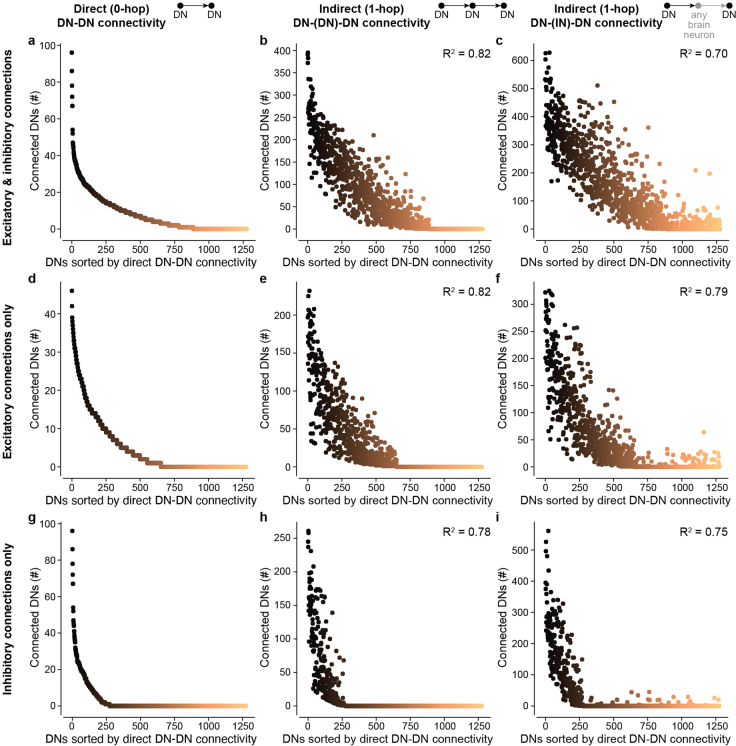
- Connectome analysis found monosynaptic downstream DN partners numbering 32 for DNp09, 23 for aDN2 and 14 for MDN, mirroring the functional recruitment gradient. Across all DNs, median connected DNs were 4; MDN 9, aDN2 15 and DNp09 23; 567 DNs (44%) targeted two or fewer DNs.
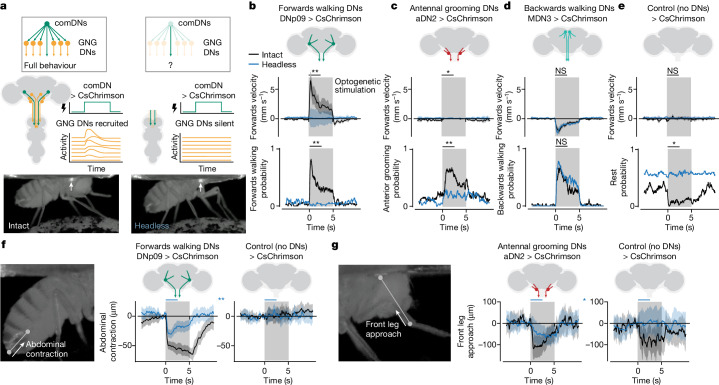
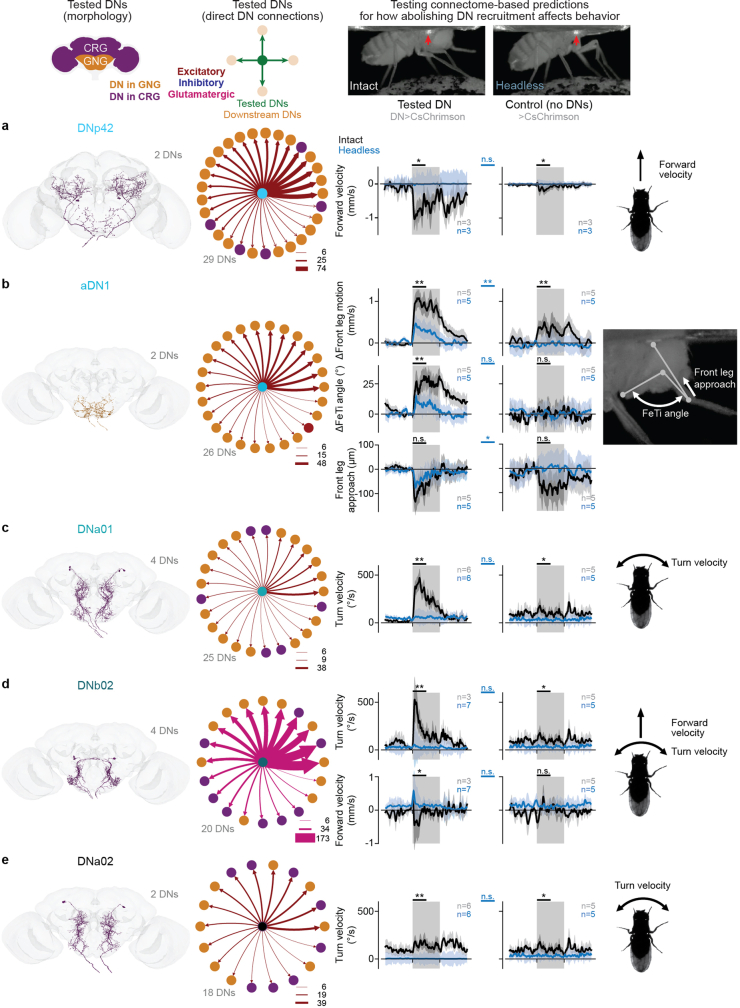
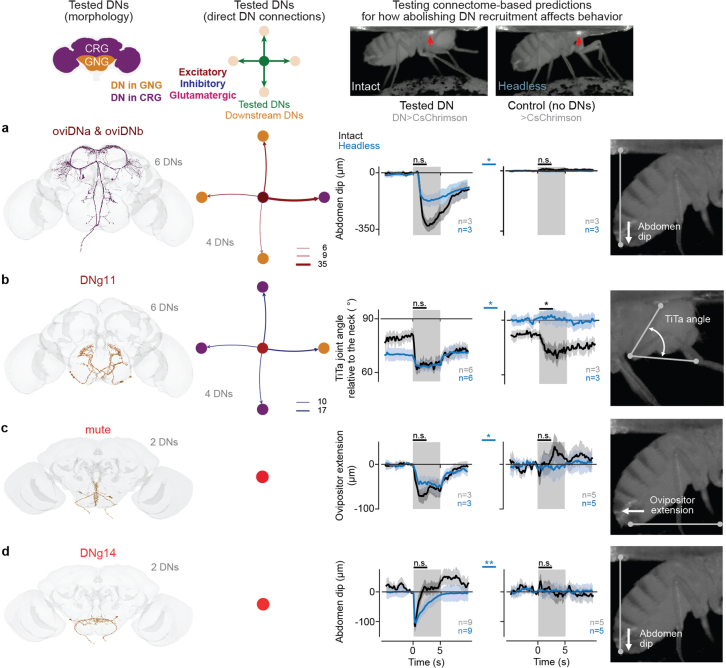
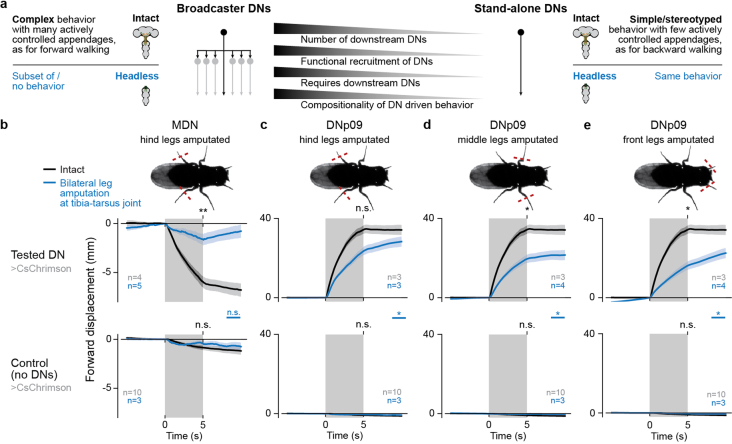
- Decapitation showed network necessity: MDN still drove backwards walking in headless flies (P = 0.265 versus intact), whereas DNp09-driven forwards walking and aDN2-driven antennal grooming were lost (P = 0.006 each). Headless DNp09 and aDN2 flies still showed stereotyped abdomen contraction (P = 0.006) and front leg approach (P = 0.030), respectively.
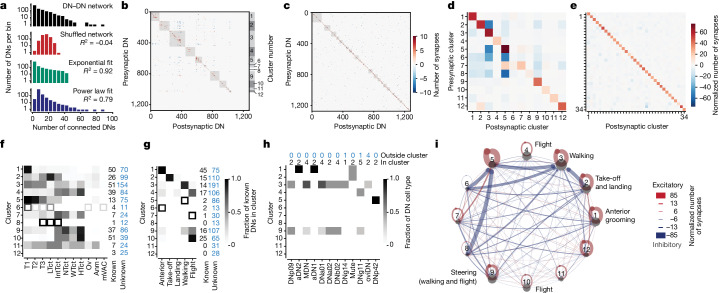
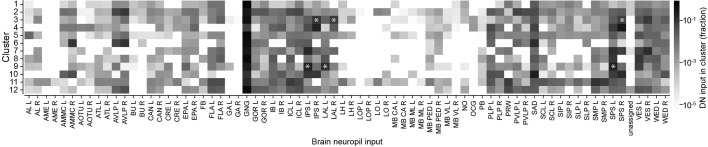
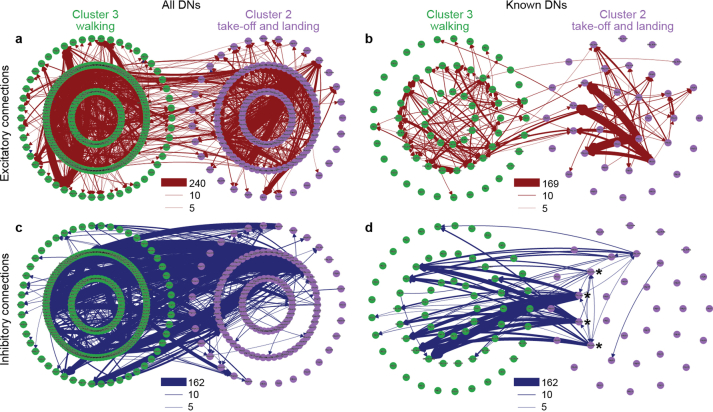
- DN networks formed behaviour-related clusters: Louvain clustering found 12 clusters in the real network versus 34 smaller clusters in a shuffled network; modularity was 0.27 for the original network and 0.12 for the shuffled network. Within clusters connectivity was predominantly excitatory, while between-cluster connectivity was dominated by inhibition.
Methods
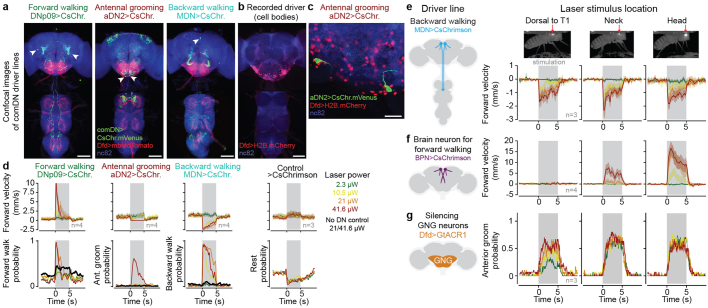
- All-optical experiments in female adult *Drosophila*: comDNs were optogenetically activated with CsChrimson while GNG DN axons in the thoracic cervical connective were imaged with two-photon calcium imaging using Dfd-LexA > GCaMP6s; behaviour was tracked on spherical or cylindrical treadmills, including intact, headless and VNC-resected preparations.
- Connectome analyses used the female adult fly brain (FAFB/FlyWire) dataset and the male adult nerve cord (MANC) dataset; connectivity was counted at ≥5 synapses, neurotransmitter identity was classified, and DN–DN networks were analysed with Louvain clustering and shuffled-network controls.
- Behavioural and neural comparisons used two-sided Mann–Whitney U-tests, with trial averaging and biological replicates as the unit for statistical comparison.
Limitations
- Stated: the Dfd driver excludes Scr-positive GNG DNs, so the study probably under-reports the number of recruited GNG DNs; Scr-based imaging was difficult because Scr expression extends into the neck and anterior VNC.
- Stated: the aDN2-spGAL4 line contains off-target neurons, and DNp09 stimulation produced variable phenotypes across studies and expression levels; GCaMP6s fluorescence does not reliably reflect inhibition, so reduced fluorescence was not interpreted as inhibition.
- Stated/evident: optogenetic stimulation may be non-ethological, and comparisons with natural behaviour showed differences for DNp09 and, to a lesser extent, aDN2; connectome analyses also rely on female brain and male VNC datasets, while functional experiments used female flies.
Model-written summary. Check it against the paper before relying on it.
Integrity signals
Registry
Cites
Statistics
Figures
Verification
Claims the paper makes
6 Valid · 2 Not valid · 22 Not checked · 148 Own results and interpretations
Every source the paper cites for this claim was checked and supports it.
In the paper
“This analysis revealed very specific projection patterns including, for example, that cluster 1 predominantly projects to a neuropil controlling the front legs (T1), cluster 2 predominantly to the lower tectulum (LTct), clusters 3 and 5 most strongly to all three leg neuropils (T1, T2 and T3), and clusters 4, 7, 9 and 10 predominantly to dorsal neuropils involved in wing, haltere and neck control”
§ Descending networks transform command signals into population motor control > Network clusters correlate with behaviour
What the sources say
- Supportedcites [13] Cheong, H. S. J. et al. Transforming descending input into behavior: the organization of premotor circuits in the Drosophila male adult nerve cord connectome. Preprint at bioRxiv10.1101/2023.06.07.543976 (2024). source
The Results section 'Identification of descending neurons' states that each DN's VNC neuropil target was assigned from its synaptic output (>80% rule) and that DNs fall into subclasses defined by specific projection patterns — DNfl (T1 front-leg neuropil), DNlt (lower tectulum), DNxl (all three leg neuropils LegNpT1–T3), and DNut (the dorsal neck/wing/haltere tectulums) — which is exactly the set of examples the citing sentence lists (Figure 3D–F, p. Results). The same section adds that 'These DN subclasses differ not only in the neuropils they target but also in the classes and subclasses of postsynaptic neurons to which they signal' (Figure 3G), confirming group-specific projection. Only the numbering ('cluster 1', 'cluster 2', …) is the citing authors' own labelling, not the source's terminology; the attributed content is in our copy. (LLM, conf=0.85)
plainstates an associationSingle case- Asserted: passes — The authors put it forward as true.
- Checkable: passes — It can be checked against evidence.
- Load-bearing: passes — The paper’s conclusions depend on it.
- Based: passes — The paper gives a reason why it holds.
- Rests on an assumption not shown here.
- Supported
Every source the paper cites for this claim was checked and supports it.
In the paper
“cluster 1 predominantly projects to a neuropil controlling the front legs (T1)”
§ Descending networks transform command signals into population motor control > Network clusters correlate with behaviour
What the sources say
- Supportedcites [13] Cheong, H. S. J. et al. Transforming descending input into behavior: the organization of premotor circuits in the Drosophila male adult nerve cord connectome. Preprint at bioRxiv10.1101/2023.06.07.543976 (2024). source
The citation sits on the identification of T1 as the neuropil controlling the front legs (the 'cluster 1 predominantly projects' part is the citing authors' own result). Our copy makes that equivalence explicit: the Results section 'Organizational logic of DNs onto leg circuits' describes 'DNs innervating the T1 leg neuropils (i.e. the DNfl subclass)' as foreleg neurons whose targets are 'MNs in the T1 leg segment', and the Materials and methods ('Motor neuron serial homology matching') equate the T1 leg MNs with '198 MN of the front legs' before transferring the identification to the middle and hind legs. Figure 15 likewise treats LegNpT1 as the front-leg neuropil. (LLM, conf=0.85)
plainstates an associationSingle case- Asserted: passes — The authors put it forward as true.
- Checkable: passes — It can be checked against evidence.
- Load-bearing: passes — The paper’s conclusions depend on it.
- Based: passes — The paper gives a reason why it holds.
- Rests on an assumption not shown here.
- Supported
Every source the paper cites for this claim was checked and supports it.
In the paper
“in control experiments, we found that activation of the head capsule, but not the thorax, could strongly elicit forwards walking in the ‘bolt protocerebral neurons’ of the brain—these neurons are known to drive robust and fast forwards walking3 (Extended Data Fig. 1f).”
§ Descending networks transform command signals into population motor control > Methods > Optogenetic stimulation system and approach
What the sources say
- Supportedcites [3] Bidaye SS Two brain pathways initiate distinct forward walking programs in Drosophila Neuron 2020 108 469 485 10.1016/j.neuron.2020.07.032 32822613 PMC9435592 source
The citation (ref. 3) is attached to the clause 'these neurons are known to drive robust and fast forwards walking', and our copy states exactly that for the Bolt Protocerebral Neurons: the Results (BPNs initiate straight forward walking) report that both split-Gal4 BPN lines 'triggered robust walking initiation in grooming flies upon optogenetic activation' and that 'BPN activation produces fast, straight, forward walking without a turning bias', and the Discussion (BPNs drive fast, straight forward walking) describes 'the ability of BPNs to drive high speed, straight forward walks (or "sprints")'. The head-capsule-versus-thorax control experiment is the citing authors' own result, not attributed to this source (our copy contains no such peripheral-stimulation control; searched 'head capsule', 'thorax'). (LLM, conf=0.90)
boostedstates a cause- Asserted: passes — The authors put it forward as true.
- Checkable: passes — It can be checked against evidence.
- Load-bearing: passes — The paper’s conclusions depend on it.
- Based: passes — The paper gives a reason why it holds.
- Rests on an assumption not shown here.
- Supported
The cited sources that could be checked couldn’t confirm or dispute this claim.
In the paper
“cluster 2 predominantly to the lower tectulum (LTct)”
§ Descending networks transform command signals into population motor control > Network clusters correlate with behaviour
What the sources say
- Could not verifycites [13] Cheong, H. S. J. et al. Transforming descending input into behavior: the organization of premotor circuits in the Drosophila male adult nerve cord connectome. Preprint at bioRxiv10.1101/2023.06.07.543976 (2024). sourceExperimental — accuracy not yet measured
Our copy never defines a 'cluster 2' of descending neurons with a lower-tectulum projection: DNs are partitioned by target-neuropil SUBCLASSES (DNlt = lower tectulum, 32 DNs; LTct-DNs = 92 DN groups with >=10% output in LTct; Identification of descending neurons / Organizational logic of DNs onto intermediate neuropil circuits), and its numbered units are Infomap COMMUNITIES, explicitly 'numbered arbitrarily' (Figure 9 legend), with LTct linked to communities 7 and 14 rather than 2. The only 'clusters' in the paper are the five hierarchical clusters of WTct/HTct (wing/haltere) DNs by input to subcommunities (Organizational logic of DNs onto wing circuits), which are not characterized as projecting to the LTct. Searched: 'cluster 2 predominantly projects to the lower tectulum', 'DN clusters classified by target neuropil LTct', 'cluster 1 cluster 2 clustering of neuron groups', 'hierarchically clustered five clusters', 'DNlt 32 DNs lower tectulum subclass' — no passage states or contradicts the claim as attributed. (LLM, conf=0.62)
plainstates an associationSingle case- Asserted: passes — The authors put it forward as true.
- Checkable: passes — It can be checked against evidence.
- Load-bearing: passes — The paper’s conclusions depend on it.
- Based: passes — The paper gives a reason why it holds.
- Rests on an assumption not shown here.
- Could not verify
The cited sources support only part of this claim — read each source’s verdict below.
In the paper
“MDN-driven backwards walking only depends on active movements of the two hindlegs57 (Extended Data Fig. 10b and Supplementary Video 6)”
§ Descending networks transform command signals into population motor control > Discussion
What the sources say
- Partly supportedcites [57] Feng K Distributed control of motor circuits for backward walking in Drosophila Nat. Commun. 2020 11 6166 10.1038/s41467-020-19936-x 33268800 PMC7710706 sourceExperimental — accuracy not yet measured
In Results (‘Joint kinematics suggest that hindlegs dominate MDN-triggered backward walking’), flies with fore- or midleg tarsal tips amputated could still walk backward, whereas flies with hindleg tips amputated could not. This supports the hindlegs as the main source of propulsion, but not the stronger claim that backward walking depends only on their active movements: the paper also reports MDN-driven changes across all three pairs of legs. (LLM, conf=0.87)
plainstates a cause- Asserted: passes — The authors put it forward as true.
- Checkable: passes — It can be checked against evidence.
- Load-bearing: passes — The paper’s conclusions depend on it.
- Based: passes — The paper gives a reason why it holds.
- Rests on an assumption not shown here.
- Partly supported
90 more claims
Create a free account to see all 178 claims and to verify the 38 references still open.
- Probably not a substantial claim. 44
- It may state two separate claims as one. 49
- The quote only partly states this claim. 3
Claims other papers make about this one
Each is checked against this paper’s own text: does it say what the citing paper says it does?
The cited source says what the claim attributes to it.
In the citing paper
“This extensive DN–DN interconnectivity in the brain suggests the possibility of coordinated action across DNs, an idea that has recently been investigated by combining our connectome data with functional studies35.”
From Comparative connectomics of Drosophila descending and ascending neurons (2025) · cites this paper as [35]
The cited source says what the claim attributes to it.
In the citing paper
“Indeed, some P9 downstream DNs (DNa02 and DNb02) were previously implicated in turning15,33,34.”
From Neural circuit mechanisms underlying context-specific halting in Drosophila (2024) · cites this paper as [34]
The cited source says what the claim attributes to it.
In the citing paper
“This shows a modularity in the descending control of turning and forward walking that is consistent with recent results from neuronal population imaging and modelling work in Drosophila12,34,57.”
From Neural circuit mechanisms underlying context-specific halting in Drosophila (2024) · cites this paper as [34]
The check wasn’t confident either way, so it gives no verdict — never disputed.
In the citing paper
“Many of these DN–DN connections are axo-axonic; whether this can result in direct excitation or inhibition of the downstream neuron or rather gates the axonal output of this neuron is unclear, although one team35 was able to show that optogenetic activation of some DNs can propagate to others.”
From Comparative connectomics of Drosophila descending and ascending neurons (2025) · cites this paper as [35]
Experimental — accuracy not yet measuredIn the citing paper
“Emerging evidence also suggests that many DNs that act like command neurons can recruit additional sets of downstream DNs when activated, which may aid in carrying out flexible behavioral output (Braun et al., 2024).”
From Organization of circuits linking descending input to motor output in the Drosophila Male Adult Nerve Cord connectome (2026) · cites this paper as Braun et al., 2024
3 more claims about this paper
Create a free account to see every claim other papers make about this one.
Self-check
Percentages, sums and reported differences re-computed from the paper’s own numbers.
Each contradiction between two passages listed here was confirmed by an independent check.
Rated minor: it would not touch a result — a value no result rests on, a p-value that stays on the same side of the significance level, or a conflict that is clerical, resolved elsewhere in the paper, or outside its own findings.
In the paper
§ Descending networks transform command signals into population motor control > Methods > Brain connectome analysis
“We only considered neurons with at least five synapses to be connected and computed the number of connected DNs based on this criterion (Figs. 3, 5b,c,e and 6a–c and Extended Data Figs. 4–9).”
§ Descending networks transform command signals into population motor control > Methods > Brain connectome analysis
“Here we only considered the binary measure of whether a neuron was connected (number of synapses > 5) and not its synaptic weight.”
Citations
Cites
Fiji: an open-source platform for biological-image analysis
Schindelin, J., Arganda-Carreras, I., Frise, E., Kaynig, V., Longair, M., Pietzsch, T., Preibisch, S., Rueden, C., Saalfeld, S., Schmid, B., et al. (2012) · Nature Methods · doi:10.1038/nmeth.2019 · Cited by 66,890
SciPy 1.0: fundamental algorithms for scientific computing in Python
Virtanen, P., Gommers, R., Oliphant, T. E., Haberland, M., Reddy, T., Cournapeau, D., Burovski, E., Peterson, P., Weckesser, W., Bright, J., et al. (2020) · Nature Methods · doi:10.1038/s41592-019-0686-2 · Cited by 38,430
Emergence of Scaling in Random Networks
Barabási, A.-L., & Albert, R. (1999) · Science · doi:10.1126/science.286.5439.509 · Cited by 36,135 · cited 1×
“A power law connectivity degree distribution is the defining feature of a scale-free network 46,47 and hints that DNs may be linked via well-connected ‘hub’ neurons.”
Fast unfolding of communities in large networks
Blondel, V. D., Guillaume, J.-L., Lambiotte, R., & Lefebvre, E. (2008) · Journal of Statistical Mechanics: Theory and Experiment · doi:10.1088/1742-5468/2008/10/p10008 · Cited by 21,424 · cited 2×
“possibility, we identified clusters of DNs in the fly brain by applying the Louvain method, a community detection algorithm 48 .”
SciPy 1.0: fundamental algorithms for scientific computing in Python
Virtanen, P., Gommers, R., Oliphant, T. E., Haberland, M., Reddy, T., Cournapeau, D., Burovski, E., Peterson, P., Weckesser, W., Bright, J., et al. (2019) · Apollo - University of Cambridge Repository · doi:10.17863/cam.64134 · Cited by 10,460
A robust layered control system for a mobile robot
Brooks, R. (1986) · IEEE Journal on Robotics and Automation · doi:10.1109/jra.1986.1087032 · Cited by 7,799 · cited 1×
“This mechanism is therefore likely also used for descending control in other species including mammals 27,52 and suggests new avenues for the design of more flexible artificial controllers in engineering and robotics 58 .”
Exploring Network Structure, Dynamics, and Function Using NetworkX
Hagberg, A. A., Schult, D. A., & Swart, P. J. (2008) · Proceedings of the Python in Science Conference · doi:10.25080/tcwv9851 · Cited by 7,477 · cited 2×
“Next, we stored the connectome as a graph using SciPy sparse matrix 74 and NetworkX DirectedGraph 76 representations.”
Ultrasensitive fluorescent proteins for imaging neuronal activity
Chen, T.-W., Wardill, T. J., Sun, Y., Pulver, S. R., Renninger, S. L., Baohan, A., Schreiter, E. R., Kerr, R. A., Orger, M. B., Jayaraman, V., et al. (2013) · Nature · doi:10.1038/nature12354 · Cited by 6,474 · cited 6×
“We generated transgenic flies expressing LexAop-opGCaMP6s (a gift from O. Akin 62 ) under the control of a Dfd-LexA driver (a gift from J. Simpson 63 ) and having a copy of UAS-CsChrimson (Bloomington ID 55135) (Supplementary Table 1, ID 1).”
InfluentialIndependent optical excitation of distinct neural populations
Klapoetke, N. C., Murata, Y., Kim, S. S., Pulver, S. R., Birdsey-Benson, A., Cho, Y. K., Morimoto, T. K., Chuong, A. S., Carpenter, E. J., Tian, Z., et al. (2014) · Nature Methods · doi:10.1038/nmeth.2836 · Cited by 2,344 · cited 8×
“For the three spGAL4 driver lines targeting comDNs (MDN, DNp09 and aDN2), we generated stable lines expressing CsChrimson (Supplementary Table 1, IDs 5, 6 and 7).”
InfluentialFrom Swimming to Walking with a Salamander Robot Driven by a Spinal Cord Model
Ijspeert, A. J., Crespi, A., Ryczko, D., & Cabelguen, J.-M. (2007) · Science · doi:10.1126/science.1138353 · Cited by 1,214
Cited by
Neural circuit mechanisms for steering control in walking Drosophila
Rayshubskiy, A., Holtz, S. L., Bates, A. S., Vanderbeck, Q. X., Capdevila, L. S., Rockwell, V., & Wilson, R. I. (2020) · doi:10.1101/2020.04.04.024703 · Cited by 64
“Indeed, while this study was in revision, several subsequent studies identified additional steering DNs, including DNg13, DNb05, and DNb06 (Yang et al., 2023), DNa11, DNae003, DNa03, and DNae014 (Feng et al., 2024), and DNb02 (Braun et al., 2024).”
InfluentialFine-grained descending control of steering in walking Drosophila
Yang, H. H., Brezovec, B. E., Serratosa Capdevila, L., Vanderbeck, Q. X., Adachi, A., Mann, R. S., & Wilson, R. I. (2024) · Cell · doi:10.1016/j.cell.2024.08.033 · Cited by 55
Fine-grained descending control of steering in walking Drosophila
Yang, H. H., Brezovec, L. E., Serratosa Capdevila, L., Vanderbeck, Q. X., Adachi, A., Mann, R. S., & Wilson, R. I. (2023) · doi:10.1101/2023.10.15.562426 · Cited by 55
“Moreover, both DNs are postsynaptic in motor-associated brain regions.”
Cheong, H. S., Eichler, K., Stürner, T., Asinof, S. K., Champion, A. S., Marin, E. C., Oram, T. B., Sumathipala, M., Venkatasubramanian, L., Namiki, S., et al. (2026) · eLife · doi:10.7554/elife.96084 · Cited by 54
Neural circuit mechanisms underlying context-specific halting in Drosophila
Sapkal, N., Mancini, N., Kumar, D. S., Spiller, N., Murakami, K., Vitelli, G., Bargeron, B., Maier, K., Eichler, K., Jefferis, G. S. X. E., et al. (2024) · Nature · doi:10.1038/s41586-024-07854-7 · Cited by 54
“This shows a modularity in the descending control of turning and forward walking that is consistent with recent results from neuronal population imaging and modelling work in Drosophila 12,34,57 .”
Neural circuit mechanisms underlying context-specific halting in Drosophila
Sapkal, N., Mancini, N., Kumar, D. S., Spiller, N., Murakami, K., Vitelli, G., Bargeron, B., Maier, K., Eichler, K., Jefferis, G. S. X. E., et al. (2023) · doi:10.1101/2023.09.25.559438 · Cited by 54
Motor control on the move: from insights in insects to general mechanisms
Büschges, A., & Ache, J. M. (2024) · Physiological Reviews · doi:10.1152/physrev.00009.2024 · Cited by 58
Comparative connectomics of Drosophila descending and ascending neurons
Stürner, T., Brooks, P., Serratosa Capdevila, L., Morris, B. J., Javier, A., Fang, S., Gkantia, M., Cachero, S., Beckett, I. R., Marin, E. C., et al. (2025) · Nature · doi:10.1038/s41586-025-08925-z · Cited by 43
The fly connectome reveals a path to the effectome
Pospisil, D. A., Aragon, M. J., Dorkenwald, S., Matsliah, A., Sterling, A. R., Schlegel, P., Yu, S.-C., McKellar, C. E., Costa, M., Eichler, K., et al. (2024) · Nature · doi:10.1038/s41586-024-07982-0 · Cited by 36
Descending control of motor sequences in Drosophila
Simpson, J. H. (2024) · Current Opinion in Neurobiology · doi:10.1016/j.conb.2023.102822 · Cited by 33
NeuroMechFly v2: simulating embodied sensorimotor control in adult Drosophila
Wang-Chen, S., Stimpfling, V. A., Lam, T. K. C., Özdil, P. G., Genoud, L., Hurtak, F., & Ramdya, P. (2024) · Nature Methods · doi:10.1038/s41592-024-02497-y · Cited by 43
Self-citationDistributed control circuits across a brain-and-cord connectome
Bates, A. S., Phelps, J. S., Kim, M., Yang, H. H., Matsliah, A., Ajabi, Z., Perlman, E., Delgado, K. M., Osman, M. A. M., Salmon, C. K., et al. (2026) · Nature · doi:10.1038/s41586-026-10735-w · Cited by 100
“Furthermore, in Drosophila , more recent work has shown that ANs can form output synapses in the VNC 10,11 , and DNs can form output synapses in the brain 15,50 .”
InfluentialNeural circuit mechanisms for steering control in walking Drosophila
Rayshubskiy, A., Holtz, S. L., Bates, A. S., Vanderbeck, Q. X., Serratosa Capdevila, L., Rockwell, V., & Wilson, R. (2025) · eLife · doi:10.7554/elife.102230 · Cited by 27
Biomaterials for neuroengineering: applications and challenges
Wu, H., Feng, E., Yin, H., Zhang, Y., Chen, G., Zhu, B., Yue, X., Zhang, H., Liu, Q., & Xiong, L. (2025) · Regenerative Biomaterials · doi:10.1093/rb/rbae137 · Cited by 29
Stürner, T., Brooks, P., Capdevila, L. S., Morris, B. J., Javier, A., Fang, S., Gkantia, M., Cachero, S., Beckett, I. R., Champion, A. S., et al. (2024) · bioRxiv (Cold Spring Harbor Laboratory) · doi:10.1101/2024.06.04.596633 · Cited by 24
“We are not currently aware of any literature reporting sex-specific or sex. dimorphic ANs, therefore all ANs we have annotated are being reported here for the first time (morphologies shown in Fig.8 - figure supplemental 1).”
Connectomic analysis of taste circuits in Drosophila
Walker, S. R., Peña-Garcia, M., & Devineni, A. V. (2025) · Scientific Reports · doi:10.1038/s41598-025-89088-9 · Cited by 24
Feng (2024) · doi:10.1101/2024.06.27.601106 · Cited by 18
Dowell, C. K., Hawkins, T. A., & Bianco, I. H. (2025) · Current Biology · doi:10.1016/j.cub.2024.12.010 · Cited by 18
“…most instances, we have an incomplete understanding of how movement diversity relates to population activity within motor pools and the circuit mechanisms by which premotor commands that encode specific kinematic variables or motor subroutines 4–7 sculpt appropriate patterns of motoneuron activity.”
Bilateral interactions of optic-flow sensitive neurons coordinate course control in flies
Pokusaeva, V. O., Satapathy, R., Symonova, O., & Joesch, M. (2024) · Nature Communications · doi:10.1038/s41467-024-53173-w · Cited by 20
“However, the picture is further complicated by the presence of interneurons modulating LPTCs and DNs and recent fi nding showing that DN act in coordination to control behaviour 68 .”
Connectome simulations identify a central pattern generator for fly walking
Pugliese, S. M., Chou, G. M., Abe, E. T. T., Turcu, D., Lancaster, J. K., Tuthill, J. C., & Brunton, B. W. (2026) · Nature · doi:10.1101/2025.09.12.675944 · Cited by 26
“Replication of the pruning screen in FANC converged to the same E1-E2-316 E4-E5-I2 circuit as the most common solution (246/1024 replicates; Fig.”
Activity of a descending neuron associated with visually elicited flight saccades in Drosophila
Buchsbaum, E., & Schnell, B. (2025) · Current Biology · doi:10.1016/j.cub.2024.12.001 · Cited by 10
“37 Given that DNp03 similarly makes synapses with other DNs, this is likely the case for the control of flight behavior as well.”
Neural circuit mechanisms for steering control in walking Drosophila
Rayshubskiy, A., Holtz, S. L., Bates, A. S., Vanderbeck, Q. X., Capdevila, L. S., Rockwell, V., & Wilson, R. I. (2025) · eLife · doi:10.7554/elife.102230.3 · Cited by 14
Inhibitory circuit motifs in Drosophila larvae generate motor program diversity and variability
Francis, J., Gibeily, C., Smith, W. V., Petropoulos, I. S., Anderson, M. C., Heitler, W. J., Prinz, A. A., & Pulver, S. R. (2025) · PLoS Biology · doi:10.1371/journal.pbio.3003094 · Cited by 9
Centralized brain networks underlie body part coordination during groomingPreprint
Özdil, P. G., Arreguit, J., Scherrer, C., Ijspeert, A. J., & Ramdya, P. P. (2024) · bioRxiv (Cold Spring Harbor Laboratory) · doi:10.1101/2024.12.17.628844 · Cited by 8
Self-citationSupraspinal commands have a modular organization that is behavioral context specific
Lau, J. Y. N., Fitzgerald, J. E., & Bianco, I. H. (2025) · Current Biology · doi:10.1016/j.cub.2025.07.066 · Cited by 10
Neural circuit mechanisms for steering control in walking Drosophila
Rayshubskiy, A., Holtz, S. L., Bates, A., Vanderbeck, Q. X., Capdevila, L. S., & Wilson, R. I. (2024) · doi:10.7554/elife.102230.1 · Cited by 5
An updated catalogue of split-GAL4 driver lines for descending neurons in Drosophila melanogaster
Zung, J. L., Namiki, S., Meissner, G. W., Cheong, H. S. J., Costa, M., Eichler, K., Stürner, T., Jefferis, G. S. X. E., Managan, C., FlyLight Project Team, et al. (2025) · doi:10.1101/2025.02.22.639679 · Cited by 4
“Activation of a single DN type has also been shown to directly recruit other DNs through collateral connections (Braun et al. 2024).”
Inhibitory control explains locomotor statistics in walking Drosophila
Gattuso, H. C., van Hassel, K. A., Freed, J. D., Nuñez, K. M., de la Rea, B., May, C. E., Ermentrout, B., Victor, J. D., & Nagel, K. I. (2025) · Proceedings of the National Academy of Sciences · doi:10.1073/pnas.2407626122 · Cited by 9
“Experiments in headless flies suggest that DNs interact within the brain to generate locomotion ( 31 ).”
InfluentialSpecialized parallel pathways for adaptive control of visual object pursuit
Collie, M. F., Jin, C., Rockwell, V., Kellogg, E. J., Vanderbeck, Q. X., Hartman, A. K., Holtz, S. L., & Wilson, R. I. (2026) · Neuron · doi:10.1016/j.neuron.2026.01.001 · Cited by 7
Inhibitory control of locomotor statistics in walking DrosophilaPreprint
Gattuso, H. C., van Hassel, K. A., Freed, J. D., Nuñez, K. M., de la Rea, B., May, C. E., Ermentrout, B., Victor, J. D., & Nagel, K. I. (2024) · bioRxiv (Cold Spring Harbor Laboratory) · doi:10.1101/2024.04.15.589655 · Cited by 4
Flexible circuits for visually guided flight control in Drosophila
Schnell, B. (2026) · Trends in Neurosciences · doi:10.1016/j.tins.2025.12.005 · Cited by 2
Functional Logic of a Cognitive Brain System for Navigation
Maimon, G., & Abbott, L. F. (2026) · Annual Review of Neuroscience · doi:10.1146/annurev-neuro-112723-062711 · Cited by 3
Zhang, Y., & Bayley, H. (2026) · Nature Reviews Bioengineering · doi:10.1038/s44222-026-00471-1 · Cited by 2
“A common approach is to use ionic and electronic conductive polymers, such as poly(3,4-ethylenedioxythiophene) (PEDOT) doped with polystyrene sulfonate (PSS) 74 , to provide electron-to-ion conversion and ionic outputs.”
Neural circuit mechanisms for steering control in walking DrosophilaPreprint
Rayshubskiy, A., Holtz, S. L., Bates, A. S., Vanderbeck, Q. X., Capdevila, L. S., Rockwell, V., & Wilson, R. I. (2025) · eLife · doi:10.7554/elife.102230.2 · Cited by 2
Control of walking direction by descending and dopaminergic neurons in DrosophilaPreprint
Dahlhoff, S., Liessem, S., Iqbal, F. M., Palacios-Muñoz, A., Cascino-Milani, F., Erginkaya, M., Diniz, A. M., Gorostiza, E. A., Büschges, A., Clemens, J., et al. (2025) · bioRxiv (Cold Spring Harbor Laboratory) · doi:10.1101/2025.07.22.666129 · Cited by 2
A dedicated brain circuit controls forward walking in DrosophilaPreprint
Dallmann, C. J., Iqbal, F. M., Liebscher, S., Erginkaya, M., Liessem, S., Sauer, E., Soyka, H., Cascino-Milani, F., Goldammer, J., Ito, K., et al. (2026) · bioRxiv (Cold Spring Harbor Laboratory) · doi:10.64898/2026.01.04.697356 · Cited by 3
GABAergic neuronal dysfunction underlies tremor in spinocerebellar ataxia 3
Banerjee, A., Chatterjee, M., Tan, K. J., Tay, S. H., Duan, K., Andiappan, A. K., Howland, S. W., Aso, Y., & Aw, S. (2025) · Disease Models & Mechanisms · doi:10.1242/dmm.052329 · Cited by 1
“Although brain signals control complex behaviours (Braun et al., 2024), headless flies can walk (Yellman et al., 1997), indicating that higher-order brain regions contribute minimally to leg movement coordination, and that the VNC contains the fundamental circuitry necessary for generating walking…”
Species-specific spectral tuning of motion vision in butterflies
Supple, J., Cerkvenik, U., Ilić, M., Pirih, P., Škorjanc, A., Gregor, B., & Krapp, H. G. (2025) · Current Biology · doi:10.1016/j.cub.2025.11.037 · Cited by 1
Guo, L., Zhang, N., Tang, P., Dolin, J., Kiassat, L., Yoshikawa, S., & Simpson, J. H. (2026) · iScience · doi:10.1016/j.isci.2026.114902 · Cited by 2
“82 Analysis of the new BANC 62 and male CNS 63 connectomes that link the brain and nerve cord should facilitate future assessment of the role of these brain projections in coordinating the grooming behavior.”
Behavioral Electrophysiology in Manduca sexta : The Explore/Exploit Framework
Sharma, V. P., & Ghosh, D. (2026) · Integrative and Comparative Biology · doi:10.1093/icb/icag148 · Cited by 1
Nair, S. R., Palacios-Muñoz, A., Martineau, S., Nasr, M., & Clemens, J. (2026) · Nature Communications · doi:10.1038/s41467-026-72057-9 · Cited by 2
Integrative models of visually guided steering in DrosophilaPreprint
Canelo, Á., Kim, H., Kim, Y., Park, J. M., & Kim, A. J. (2023) · bioRxiv (Cold Spring Harbor Laboratory) · doi:10.1101/2023.10.11.561122 · Cited by 1
“In Drosophila , descending neurons form dense lateral connections (Braun et al., 2024), offering a substrate for such competitive interactions.”
Cheong, H. S., Eichler, K., Stürner, T., Asinof, S. K., Champion, A. S., Marin, E. C., Oram, T. B., Sumathipala, M. G., Venkatasubramanian, L., Namiki, S., et al. (2025) · eLife · doi:10.7554/elife.96084.2 · Cited by 10
Integrative models of visually guided steering in DrosophilaPreprint
Canelo, Á., Kim, H., Kim, Y., Park, J. M., & Kim, A. J. (2025) · eLife · doi:10.7554/elife.93487.2 · Cited by 1
An updated catalogue of split-GAL4 driver lines for descending neurons in Drosophila melanogasterPreprint
Zung, J. L., Namiki, S., Meissner, G. W., Cheong, H. S., Costa, M., Eichler, K., Stürner, T., Jefferis, G. S. X. E., Managan, C., FlyLight Project Team, et al. (2025) · eLife · doi:10.7554/elife.107450.1 · Cited by 2
Ascending nociceptive pathways drive rapid escape and sustained avoidance in adult DrosophilaPreprint
Jones, J. M., Sustar, A., Mamiya, A., Walling-Bell, S., Chou, G. M., Cook, A. P., & Tuthill, J. C. (2025) · bioRxiv (Cold Spring Harbor Laboratory) · doi:10.1101/2025.10.28.684868 · Cited by 6
“IS35283 neurons primarily target walking control circuits, including connections to descending neurons that modulate locomotion speed and direction 48,73–75 .”
Drosophila males integrate song and pheromones using context-specific strategiesPreprint
Palacios-Muñoz, A., & Clemens, J. (2025) · bioRxiv (Cold Spring Harbor Laboratory) · doi:10.1101/2025.07.25.666755
“Finally, different multimodal integration strategies may be implemented in pre-motor circuits by specific cues gating context-specific descending pathways (Cande et al., 2018; Braun et al., 2024).”
An updated catalogue of split-GAL4 driver lines for descending neurons in Drosophila melanogasterPreprint
Zung, J. L., Namiki, S., Meissner, G. W., Cheong, H. S., Costa, M., Eichler, K., Stürner, T., Jefferis, G. S. X. E., Managan, C., FlyLight Project Team, et al. (2025) · eLife · doi:10.7554/elife.107450 · Cited by 1
Neural control of coordinated wing and leg movements during a terrestrial threat displayPreprint
Cao, S., & Anderson, D. J. (2025) · bioRxiv (Cold Spring Harbor Laboratory) · doi:10.1101/2025.10.25.684556
Drosophila DNp03 descending neurons serve as a hub within a flight saccade network
Croke, H., Jang, H., Ludlow, B. K., Leung, A., Eichler, K., Stürner, T., Costa, M., Cohen, I., Ausborn, J., & von Reyn, C. R. (2025) · Current Biology · doi:10.1016/j.cub.2025.11.035 · Cited by 2
Mechanisms that create a sequence of feeding-related behaviors in the mollusk Aplysia
Evans, C. G., Barry, M. A., Chen, Q., Reaver, C. N., Patel, P. R., Chestek, C. A., Perkins, M. H., Jing, J., & Cropper, E. C. (2026) · Journal of Neurophysiology · doi:10.1152/jn.00591.2025
Connectomes: a re-emerging hub dataset for neuroscience
Kyllmann, S., & Keesey, I. W. (2026) · Frontiers in Neuroscience · doi:10.3389/fnins.2026.1911198 · Cited by 1
Neural coordination of wing and leg movements during a terrestrial threat display
Cao, S., & Anderson, D. J. (2026) · Current Biology · doi:10.1016/j.cub.2026.09.056 · Cited by 3
Metadata
- Authors
- Braun, J., Hurtak, F., Wang-Chen, S., & Ramdya, P.
- Affiliations
- École Polytechnique Fédérale de Lausanne (CH)
- Corresponding author
- Ramdya, Pavan
- Venue
- Nature
- Published
- 2024-06-05
- Volume
- 630
- Issue
- 8017
- Pages
- 686-694
- ISSN
- 0028-0836 (ISSN-L)
- 1476-4687
- PMC
- PMC11186778
- OpenAlex
- W4399366694
- Semantic Scholar
- 7dac413bcadf61c86878b4a0f7a7492b8e124228
- Cited by
- 51
- References
- 98
- Citations by year
- 2026: 13 · 2025: 22 · 2024: 13
- FWCI
- 8.33
- Type
- journal article
- Language
- en
- Open access
- hybrid
- doi.org
- Licence
- cc-by
- creativecommons.org/licenses/by/4.0 (tdm)
- creativecommons.org/licenses/by/4.0 (vor)
- Locations
- Nature (publishedVersion, cc-by)
- bioRxiv (Cold Spring Harbor Laboratory) (acceptedVersion, cc-by-nc-nd)
- PubMed Central (publishedVersion, cc-by)
- PubMed (publishedVersion)
- RePEc: Research Papers in Economics (submittedVersion)
- Infoscience (Ecole Polytechnique Fédérale de Lausanne) (submittedVersion, cc-by-nc-nd)
- Funders
- Wellcome Trust (220343/Z/20/Z, 203261/Z/16/Z)
- Boehringer Ingelheim Fonds
- Schweizerischer Nationalfonds zur Förderung der Wissenschaftlichen Forschung (175667, 181239)
- National Institute of Mental Health (RF1MH117815, RF1MH120679)
- National Institute of Neurological Disorders and Stroke (U24NS126935)
- Topics
- Life Sciences › Neuroscience › Cellular and Molecular Neuroscience › Neurobiology and Insect Physiology Research
- Life Sciences › Neuroscience › Cognitive Neuroscience › Motor Control and Adaptation
- Life Sciences › Neuroscience › Cellular and Molecular Neuroscience › Neuroscience and Neuropharmacology Research
- Keywords
- descending neurons, motor control, Drosophila, connectome, excitatory connections, behavioral control
- MeSH terms
- Animals, Behavior, Animal, Brain, Drosophila melanogaster, Female, Motor Neurons, Movement, Nerve Net, Connectome
About these checks
Registry, retraction, Cites and statistics results are computed, not judged, with one exception: a printed reference that no index lists is read once by a model before it counts as a citation error. Claims are extracted by a model and kept only when their quote appears verbatim in the text; each cited source is then checked, with a model’s help, for whether it says what the claim relies on. Those verdicts can be wrong — read the claim’s quote and the cited source before relying on one.
The claim verdicts this report counts are experimental: their accuracy is not yet measured.
A language model drew the claims from the paper on 2026-10-07, under version 3 of the claim definition (model deepseek-v4.1-flash, prompt extract-v3).
A second model labelled each claim on 2026-10-07 (model jev-1.13-20260917, definition revision gold-guideline-v0.2).
Cited sources are checked with a language model’s help (qwen3.8-omni-flash and gpt-6-sol).
Statistics and arithmetic are recomputed, not judged.
Confidence bands are shown only for fields calibrated on our annotated test set. None is calibrated yet, so no band is shown.
What counts as a claim ›How we measure confidence ›How we check this ›
Are you an author, or do you see a problem with this page? Request a review
Data sources
Bibliographic data: Semantic Scholar, OpenAlex, Crossref.
Contains information from the Semantic Scholar Academic Graph Datasets, made available under the ODC Attribution License (ODC-BY 1.0).
Semantic Scholar’s data is described in: Kinney, R., et al. (2023). The Semantic Scholar Open Data Platform. arXiv:2301.10140.
