

The DOI matches its Crossref record; 104 of the 104 references it cites were found in a registry or an index; 9 of the 47 sources its claims cite were checked for support.
Descending networks transform command signals into population motor control
Open accessPublished version of a preprint
Abstract
To convert intentions into actions, movement instructions must pass from the brain to downstream motor circuits through descending neurons (DNs). These include small sets of command-like neurons that are sufficient to drive behaviours 1 —the circuit mechanisms for which remain unclear. Here we show that command-like DNs in Drosophila directly recruit networks of additional DNs to orchestrate behaviours that require the active control of numerous body parts. Specifically, we found that command-like DNs previously thought to drive behaviours alone 2–4 in fact co-activate larger populations of DNs. Connectome analyses and experimental manipulations revealed that this functional recruitment can be explained by direct excitatory connections between command-like DNs and networks of interconnected DNs in the brain. Descending population recruitment is necessary for behavioural control: DNs with many downstream descending partners require network co-activation to drive complete behaviours and drive only simple stereotyped movements in their absence. These DN networks reside within behaviour-specific clusters that inhibit one another. These results support a mechanism for command-like descending control in which behaviours are generated through the recruitment of increasingly large DN networks that compose behaviours by combining multiple motor subroutines.
Overview
CoChat Summary
TL;DR
Command-like descending neurons (comDNs) in *Drosophila* recruit additional descending neuron (DN) populations through direct excitatory brain connections, rather than acting alone. The size of a comDN’s downstream DN network predicts whether that recruitment is necessary to produce a complete behaviour.
Key findings
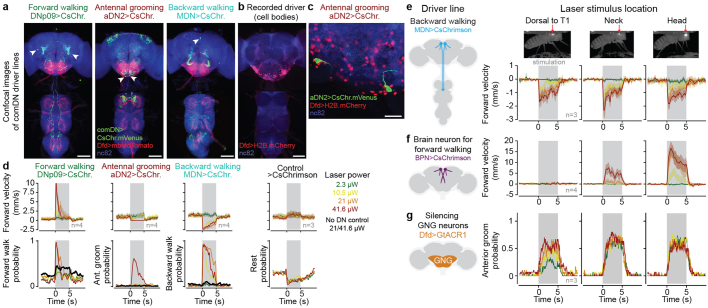
- Optogenetic activation of DNp09, aDN2 and MDN recruited GNG DN populations significantly more than controls: P = 0.018 (DNp09), P = 0.040 (aDN2) and P = 0.008 (MDN). Recruitment strength followed DNp09 > aDN2 > MDN.
- Connectome analysis found monosynaptic downstream DN partners numbering 32 for DNp09, 23 for aDN2 and 14 for MDN, mirroring the functional recruitment gradient. Across all DNs, median connected DNs were 4; MDN 9, aDN2 15 and DNp09 23; 567 DNs (44%) targeted two or fewer DNs.
- Decapitation showed network necessity: MDN still drove backwards walking in headless flies (P = 0.265 versus intact), whereas DNp09-driven forwards walking and aDN2-driven antennal grooming were lost (P = 0.006 each). Headless DNp09 and aDN2 flies still showed stereotyped abdomen contraction (P = 0.006) and front leg approach (P = 0.030), respectively.
- DN networks formed behaviour-related clusters: Louvain clustering found 12 clusters in the real network versus 34 smaller clusters in a shuffled network; modularity was 0.27 for the original network and 0.12 for the shuffled network. Within clusters connectivity was predominantly excitatory, while between-cluster connectivity was dominated by inhibition.
Methods
- All-optical experiments in female adult *Drosophila*: comDNs were optogenetically activated with CsChrimson while GNG DN axons in the thoracic cervical connective were imaged with two-photon calcium imaging using Dfd-LexA > GCaMP6s; behaviour was tracked on spherical or cylindrical treadmills, including intact, headless and VNC-resected preparations.
- Connectome analyses used the female adult fly brain (FAFB/FlyWire) dataset and the male adult nerve cord (MANC) dataset; connectivity was counted at ≥5 synapses, neurotransmitter identity was classified, and DN–DN networks were analysed with Louvain clustering and shuffled-network controls.
- Behavioural and neural comparisons used two-sided Mann–Whitney U-tests, with trial averaging and biological replicates as the unit for statistical comparison.
Limitations
- Stated: the Dfd driver excludes Scr-positive GNG DNs, so the study probably under-reports the number of recruited GNG DNs; Scr-based imaging was difficult because Scr expression extends into the neck and anterior VNC.
- Stated: the aDN2-spGAL4 line contains off-target neurons, and DNp09 stimulation produced variable phenotypes across studies and expression levels; GCaMP6s fluorescence does not reliably reflect inhibition, so reduced fluorescence was not interpreted as inhibition.
- Stated/evident: optogenetic stimulation may be non-ethological, and comparisons with natural behaviour showed differences for DNp09 and, to a lesser extent, aDN2; connectome analyses also rely on female brain and male VNC datasets, while functional experiments used female flies.
Model-written summary. Check it against the paper before relying on it.
Integrity signals
Registry
Cites
Statistics
Figures




Verification
Claims the paper makes
6 Valid · 2 Not valid · 22 Not checked · 148 Own results and interpretations
Every source the paper cites for this claim was checked and supports it.
In the paper
“This analysis revealed very specific projection patterns including, for example, that cluster 1 predominantly projects to a neuropil controlling the front legs (T1), cluster 2 predominantly to the lower tectulum (LTct), clusters 3 and 5 most strongly to all three leg neuropils (T1, T2 and T3), and clusters 4, 7, 9 and 10 predominantly to dorsal neuropils involved in wing, haltere and neck control”
§ Descending networks transform command signals into population motor control > Network clusters correlate with behaviour
What the sources say
- Supportedcites [13] Cheong, H. S. J. et al. Transforming descending input into behavior: the organization of premotor circuits in the Drosophila male adult nerve cord connectome. Preprint at bioRxiv https://doi.org/10.1101/2023.06.07.543976 (2024). source
The Results section 'Identification of descending neurons' states that each DN's VNC neuropil target was assigned from its synaptic output (>80% rule) and that DNs fall into subclasses defined by specific projection patterns — DNfl (T1 front-leg neuropil), DNlt (lower tectulum), DNxl (all three leg neuropils LegNpT1–T3), and DNut (the dorsal neck/wing/haltere tectulums) — which is exactly the set of examples the citing sentence lists (Figure 3D–F, p. Results). The same section adds that 'These DN subclasses differ not only in the neuropils they target but also in the classes and subclasses of postsynaptic neurons to which they signal' (Figure 3G), confirming group-specific projection. Only the numbering ('cluster 1', 'cluster 2', …) is the citing authors' own labelling, not the source's terminology; the attributed content is in our copy. (LLM, conf=0.85)
plainstates an associationSingle case- Asserted: passes — The authors put it forward as true.
- Checkable: passes — It can be checked against evidence.
- Load-bearing: passes — The paper’s conclusions depend on it.
- Based: passes — The paper gives a reason why it holds.
- Rests on an assumption not shown here.
- Supported
Every source the paper cites for this claim was checked and supports it.
In the paper
“cluster 1 predominantly projects to a neuropil controlling the front legs (T1)”
§ Descending networks transform command signals into population motor control > Network clusters correlate with behaviour
What the sources say
- Supportedcites [13] Cheong, H. S. J. et al. Transforming descending input into behavior: the organization of premotor circuits in the Drosophila male adult nerve cord connectome. Preprint at bioRxiv https://doi.org/10.1101/2023.06.07.543976 (2024). source
The citation sits on the identification of T1 as the neuropil controlling the front legs (the 'cluster 1 predominantly projects' part is the citing authors' own result). Our copy makes that equivalence explicit: the Results section 'Organizational logic of DNs onto leg circuits' describes 'DNs innervating the T1 leg neuropils (i.e. the DNfl subclass)' as foreleg neurons whose targets are 'MNs in the T1 leg segment', and the Materials and methods ('Motor neuron serial homology matching') equate the T1 leg MNs with '198 MN of the front legs' before transferring the identification to the middle and hind legs. Figure 15 likewise treats LegNpT1 as the front-leg neuropil. (LLM, conf=0.85)
plainstates an associationSingle case- Asserted: passes — The authors put it forward as true.
- Checkable: passes — It can be checked against evidence.
- Load-bearing: passes — The paper’s conclusions depend on it.
- Based: passes — The paper gives a reason why it holds.
- Rests on an assumption not shown here.
- Supported
Every source the paper cites for this claim was checked and supports it.
In the paper
“in control experiments, we found that activation of the head capsule, but not the thorax, could strongly elicit forwards walking in the ‘bolt protocerebral neurons’ of the brain—these neurons are known to drive robust and fast forwards walking3 (Extended Data Fig. 1f).”
§ Descending networks transform command signals into population motor control > Methods > Optogenetic stimulation system and approach
What the sources say
- Supportedcites [3] Bidaye, S. S. et al. Two brain pathways initiate distinct forward walking programs in Drosophila. Neuron 108, 469–485 (2020). source
The citation (ref. 3) is attached to the clause 'these neurons are known to drive robust and fast forwards walking', and our copy states exactly that for the Bolt Protocerebral Neurons: the Results (BPNs initiate straight forward walking) report that both split-Gal4 BPN lines 'triggered robust walking initiation in grooming flies upon optogenetic activation' and that 'BPN activation produces fast, straight, forward walking without a turning bias', and the Discussion (BPNs drive fast, straight forward walking) describes 'the ability of BPNs to drive high speed, straight forward walks (or "sprints")'. The head-capsule-versus-thorax control experiment is the citing authors' own result, not attributed to this source (our copy contains no such peripheral-stimulation control; searched 'head capsule', 'thorax'). (LLM, conf=0.90)
boostedstates a cause- Asserted: passes — The authors put it forward as true.
- Checkable: passes — It can be checked against evidence.
- Load-bearing: passes — The paper’s conclusions depend on it.
- Based: passes — The paper gives a reason why it holds.
- Rests on an assumption not shown here.
- Supported
The cited sources that could be checked couldn’t confirm or dispute this claim.
In the paper
“cluster 2 predominantly to the lower tectulum (LTct)”
§ Descending networks transform command signals into population motor control > Network clusters correlate with behaviour
What the sources say
- Could not verifycites [13] Cheong, H. S. J. et al. Transforming descending input into behavior: the organization of premotor circuits in the Drosophila male adult nerve cord connectome. Preprint at bioRxiv https://doi.org/10.1101/2023.06.07.543976 (2024). sourceExperimental — accuracy not yet measured
Our copy never defines a 'cluster 2' of descending neurons with a lower-tectulum projection: DNs are partitioned by target-neuropil SUBCLASSES (DNlt = lower tectulum, 32 DNs; LTct-DNs = 92 DN groups with >=10% output in LTct; Identification of descending neurons / Organizational logic of DNs onto intermediate neuropil circuits), and its numbered units are Infomap COMMUNITIES, explicitly 'numbered arbitrarily' (Figure 9 legend), with LTct linked to communities 7 and 14 rather than 2. The only 'clusters' in the paper are the five hierarchical clusters of WTct/HTct (wing/haltere) DNs by input to subcommunities (Organizational logic of DNs onto wing circuits), which are not characterized as projecting to the LTct. Searched: 'cluster 2 predominantly projects to the lower tectulum', 'DN clusters classified by target neuropil LTct', 'cluster 1 cluster 2 clustering of neuron groups', 'hierarchically clustered five clusters', 'DNlt 32 DNs lower tectulum subclass' — no passage states or contradicts the claim as attributed. (LLM, conf=0.62)
plainstates an associationSingle case- Asserted: passes — The authors put it forward as true.
- Checkable: passes — It can be checked against evidence.
- Load-bearing: passes — The paper’s conclusions depend on it.
- Based: passes — The paper gives a reason why it holds.
- Rests on an assumption not shown here.
- Could not verify
The cited sources support only part of this claim — read each source’s verdict below.
In the paper
“MDN-driven backwards walking only depends on active movements of the two hindlegs57 (Extended Data Fig. 10b and Supplementary Video 6)”
§ Descending networks transform command signals into population motor control > Discussion
What the sources say
- Partly supportedcites [57] Feng, K. et al. Distributed control of motor circuits for backward walking in Drosophila. Nat. Commun. 11, 6166 (2020). sourceExperimental — accuracy not yet measured
In Results (‘Joint kinematics suggest that hindlegs dominate MDN-triggered backward walking’), flies with fore- or midleg tarsal tips amputated could still walk backward, whereas flies with hindleg tips amputated could not. This supports the hindlegs as the main source of propulsion, but not the stronger claim that backward walking depends only on their active movements: the paper also reports MDN-driven changes across all three pairs of legs. (LLM, conf=0.87)
plainstates a cause- Asserted: passes — The authors put it forward as true.
- Checkable: passes — It can be checked against evidence.
- Load-bearing: passes — The paper’s conclusions depend on it.
- Based: passes — The paper gives a reason why it holds.
- Rests on an assumption not shown here.
- Partly supported
90 more claims
Create a free account to see all 178 claims and to verify the 38 references still open.
- Probably not a substantial claim. 44
- It may state two separate claims as one. 49
- The quote only partly states this claim. 3
Claims other papers make about this one
Each is checked against this paper’s own text: does it say what the citing paper says it does?
The cited source says what the claim attributes to it.
In the citing paper
“This extensive DN–DN interconnectivity in the brain suggests the possibility of coordinated action across DNs, an idea that has recently been investigated by combining our connectome data with functional studies35.”
From Comparative connectomics of Drosophila descending and ascending neurons (2025) · cites this paper as [35]
The cited source says what the claim attributes to it.
In the citing paper
“Indeed, some P9 downstream DNs (DNa02 and DNb02) were previously implicated in turning15,33,34.”
From Neural circuit mechanisms underlying context-specific halting in Drosophila (2024) · cites this paper as [34]
The cited source says what the claim attributes to it.
In the citing paper
“This shows a modularity in the descending control of turning and forward walking that is consistent with recent results from neuronal population imaging and modelling work in Drosophila12,34,57.”
From Neural circuit mechanisms underlying context-specific halting in Drosophila (2024) · cites this paper as [34]
The check wasn’t confident either way, so it gives no verdict — never disputed.
In the citing paper
“Many of these DN–DN connections are axo-axonic; whether this can result in direct excitation or inhibition of the downstream neuron or rather gates the axonal output of this neuron is unclear, although one team35 was able to show that optogenetic activation of some DNs can propagate to others.”
From Comparative connectomics of Drosophila descending and ascending neurons (2025) · cites this paper as [35]
Experimental — accuracy not yet measuredIn the citing paper
“Emerging evidence also suggests that many DNs that act like command neurons can recruit additional sets of downstream DNs when activated, which may aid in carrying out flexible behavioral output (Braun et al., 2024).”
From Organization of circuits linking descending input to motor output in the Drosophila Male Adult Nerve Cord connectome (2026) · cites this paper as Braun et al., 2024
3 more claims about this paper
Create a free account to see every claim other papers make about this one.
Self-check
Percentages, sums and reported differences re-computed from the paper’s own numbers.
Each contradiction between two passages listed here was confirmed by an independent check.
Rated minor: it would not touch a result — a value no result rests on, a p-value that stays on the same side of the significance level, or a conflict that is clerical, resolved elsewhere in the paper, or outside its own findings.
In the paper
§ Descending networks transform command signals into population motor control > Methods > Brain connectome analysis
“We only considered neurons with at least five synapses to be connected and computed the number of connected DNs based on this criterion (Figs. 3, 5b,c,e and 6a–c and Extended Data Figs. 4–9).”
§ Descending networks transform command signals into population motor control > Methods > Brain connectome analysis
“Here we only considered the binary measure of whether a neuron was connected (number of synapses > 5) and not its synaptic weight.”
Citations
Cites
Fiji: an open-source platform for biological-image analysis
Schindelin, J., Arganda-Carreras, I., Frise, E., Kaynig, V., Longair, M., Pietzsch, T., Preibisch, S., Rueden, C., Saalfeld, S., Schmid, B., et al. (2012) · Nature Methods · doi:10.1038/nmeth.2019 · Cited by 66,890
SciPy 1.0: fundamental algorithms for scientific computing in Python
Virtanen, P., Gommers, R., Oliphant, T. E., Haberland, M., Reddy, T., Cournapeau, D., Burovski, E., Peterson, P., Weckesser, W., Bright, J., et al. (2020) · Nature Methods · doi:10.1038/s41592-019-0686-2 · Cited by 38,430
Emergence of Scaling in Random Networks
Barabási, A.-L., & Albert, R. (1999) · Science · doi:10.1126/science.286.5439.509 · Cited by 36,135 · cited 1×
“A power law connectivity degree distribution is the defining feature of a scale-free network 46,47 and hints that DNs may be linked via well-connected ‘hub’ neurons.”
Fast unfolding of communities in large networks
Blondel, V. D., Guillaume, J.-L., Lambiotte, R., & Lefebvre, E. (2008) · Journal of Statistical Mechanics: Theory and Experiment · doi:10.1088/1742-5468/2008/10/p10008 · Cited by 21,424 · cited 2×
“possibility, we identified clusters of DNs in the fly brain by applying the Louvain method, a community detection algorithm 48 .”
SciPy 1.0: fundamental algorithms for scientific computing in Python
Virtanen, P., Gommers, R., Oliphant, T. E., Haberland, M., Reddy, T., Cournapeau, D., Burovski, E., Peterson, P., Weckesser, W., Bright, J., et al. (2019) · Apollo - University of Cambridge Repository · doi:10.17863/cam.64134 · Cited by 10,460
A robust layered control system for a mobile robot
Brooks, R. (1986) · IEEE Journal on Robotics and Automation · doi:10.1109/jra.1986.1087032 · Cited by 7,799 · cited 1×
“This mechanism is therefore likely also used for descending control in other species including mammals 27,52 and suggests new avenues for the design of more flexible artificial controllers in engineering and robotics 58 .”
Exploring Network Structure, Dynamics, and Function Using NetworkX
Hagberg, A. A., Schult, D. A., & Swart, P. J. (2008) · Proceedings of the Python in Science Conference · doi:10.25080/tcwv9851 · Cited by 7,477 · cited 2×
“Next, we stored the connectome as a graph using SciPy sparse matrix 74 and NetworkX DirectedGraph 76 representations.”
Ultrasensitive fluorescent proteins for imaging neuronal activity
Chen, T.-W., Wardill, T. J., Sun, Y., Pulver, S. R., Renninger, S. L., Baohan, A., Schreiter, E. R., Kerr, R. A., Orger, M. B., Jayaraman, V., et al. (2013) · Nature · doi:10.1038/nature12354 · Cited by 6,474 · cited 6×
“We generated transgenic flies expressing LexAop-opGCaMP6s (a gift from O. Akin 62 ) under the control of a Dfd-LexA driver (a gift from J. Simpson 63 ) and having a copy of UAS-CsChrimson (Bloomington ID 55135) (Supplementary Table 1, ID 1).”
InfluentialIndependent optical excitation of distinct neural populations
Klapoetke, N. C., Murata, Y., Kim, S. S., Pulver, S. R., Birdsey-Benson, A., Cho, Y. K., Morimoto, T. K., Chuong, A. S., Carpenter, E. J., Tian, Z., et al. (2014) · Nature Methods · doi:10.1038/nmeth.2836 · Cited by 2,344 · cited 8×
“For the three spGAL4 driver lines targeting comDNs (MDN, DNp09 and aDN2), we generated stable lines expressing CsChrimson (Supplementary Table 1, IDs 5, 6 and 7).”
InfluentialFrom Swimming to Walking with a Salamander Robot Driven by a Spinal Cord Model
Ijspeert, A. J., Crespi, A., Ryczko, D., & Cabelguen, J.-M. (2007) · Science · doi:10.1126/science.1138353 · Cited by 1,214
A connectome and analysis of the adult Drosophila central brain
Scheffer, L. K., Xu, C. S., Januszewski, M., Lu, Z., Takemura, S.-Y., Hayworth, K. J., Huang, G. B., Shinomiya, K., Maitlin-Shepard, J., Berg, S., et al. (2020) · eLife · doi:10.7554/elife.57443 · Cited by 1,128 · cited 1×
“Analysis of connectivity across three brain hemispheres (two brain halves from the FAFB dataset 7 and one from the hemibrain dataset 77 ) revealed that connections “stronger than ten synapses or 1.1% of the target’s inputs have a greater than 90% change to be preserved” 38 .”
InfluentialBroido, A. D., & Clauset, A. J. (2019) · CU Scholar (University of Colorado Boulder) · Cited by 957
Learning of action through adaptive combination of motor primitives
Thoroughman, K. A., & Shadmehr, R. (2000) · Nature · doi:10.1038/35037588 · Cited by 945
Broido, A. D., & Clauset, A. (2019) · Nature Communications · doi:10.1038/s41467-019-08746-5 · Cited by 875 · cited 1×
“A power law connectivity degree distribution is the defining feature of a scale-free network 46,47 and hints that DNs may be linked via well-connected ‘hub’ neurons.”
Kupfermann, I., & Weiss, K. R. (1978) · Behavioral and Brain Sciences · doi:10.1017/s0140525x00059057 · Cited by 791 · cited 1×
“One notable discovery derived using these tools is that, despite the abundance of DNs in the fly brain, artificial activation of pairs of ‘command-like’ DNs (comDNs) can be sufficient to drive a complete behaviour (but not also necessary as is required to be considered ‘command’ neurons 20 ).”
A Systematic Nomenclature for the Insect Brain
Ito, K., Shinomiya, K., Ito, M., Armstrong, J. D., Boyan, G., Hartenstein, V., Harzsch, S., Heisenberg, M., Homberg, U., Jenett, A., et al. (2014) · Neuron · doi:10.1016/j.neuron.2013.12.017 · Cited by 611
Remote Control of Behavior through Genetically Targeted Photostimulation of Neurons
Lima, S. Q., & Miesenböck, G. (2005) · Cell · doi:10.1016/j.cell.2005.02.004 · Cited by 562 · cited 2×
“DNp01 (giant fibre) activation was reported to trigger take-off in intact and headless flies 44,45 , so we did not repeat those experiments.”
Motor primitives in vertebrates and invertebrates
Flash, T., & Hochner, B. (2005) · Current Opinion in Neurobiology · doi:10.1016/j.conb.2005.10.011 · Cited by 508 · cited 2×
“Each of these individual fibres may drive distinct ‘motor primitives’—fundamental kinematic elements which, when combined, have been suggested to underlie both innate and learned behaviours in vertebrates and mammals 42,43,52–54 .”
Linear combinations of primitives in vertebrate motor control.
Mussa-Ivaldi, F. A., Giszter, S. F., & Bizzi, E. (1994) · Proceedings of the National Academy of Sciences · doi:10.1073/pnas.91.16.7534 · Cited by 443 · cited 2×
“Each of these individual fibres may drive distinct ‘motor primitives’—fundamental kinematic elements which, when combined, have been suggested to underlie both innate and learned behaviours in vertebrates and mammals 42,43,52–54 .”
The connectome of an insect brain
Winding, M., Pedigo, B. D., Barnes, C. L., Patsolic, H. G., Park, Y., Kazimiers, T., Fushiki, A., Andrade, I. V., Khandelwal, A., Valdes-Aleman, J., et al. (2023) · Science · doi:10.1126/science.add9330 · Cited by 435 · cited 1×
“…of how DNs as a population drive and coordinate behaviours, in part due to the technical difficulty of comprehensively recording and manipulating DNs in behaving mammals: there are more than 1 million in the human pyramidal tract 5 and approximately 70,000 in the mouse corticospinal tract…”
Hulse, B. K., Haberkern, H., Franconville, R., Turner-Evans, D., Takemura, S.-Y., Wolff, T., Noorman, M., Dreher, M., Dan, C., Parekh, R., et al. (2021) · eLife · doi:10.7554/elife.66039 · Cited by 392
Hulse, B. K., Haberkern, H., Franconville, R., Turner-Evans, D. B., Takemura, S., Wolff, T., Noorman, M., Dreher, M., Dan, C., Parekh, R., et al. (2020) · doi:10.1101/2020.12.08.413955 · Cited by 392
Neuronal control of Drosophila courtship song
von Philipsborn, A. C., Liu, T., Yu, J. Y., Masser, C., Bidaye, S. S., & Dickson, B. J. (2011) · Neuron · doi:10.1016/j.neuron.2011.01.011 · Cited by 374 · cited 1×
“For example, DNs have been identified whose artificial activation trigger forwards walking 3 , grooming 4,21 , backwards walking 2 , escape 16 , egg-laying 22 and components of courtship 23,24 .”
Organization and Postembryonic Development of Glial Cells in the Adult Central Brain of Drosophila
Awasaki, T., Lai, S.-L., Ito, K., & Lee, T. (2008) · The Journal of Neuroscience · doi:10.1523/jneurosci.4844-08.2008 · Cited by 345 · cited 1×
“Specifically, we observed strong expression of GCaMP in the tissues surrounding the thoracic cervical connective (potentially ensheathing glia 66 ), making it very hard to record the activity of DN axons.”
The functional organization of descending sensory-motor pathways in Drosophila
Namiki, S., Dickinson, M. H., Wong, A. M., Korff, W., & Card, G. M. (2018) · eLife · doi:10.7554/elife.34272 · Cited by 337
Interneurons commanding swimmeret movements in the crayfish, Procambarus clarki (girard)
Wiersma, C. A. G., & Ikeda, K. (1964) · Comparative Biochemistry and Physiology · doi:10.1016/0010-406x(64)90153-7 · Cited by 331 · cited 1×
“The capacity of some DNs to act as command-like neurons appears to be general across species including invertebrates 25,26 and mammals 27 .”
Quantifying behavior to understand the brain
Pereira, T. D., Shaevitz, J. W., & Murthy, M. (2020) · Nature Neuroscience · doi:10.1038/s41593-020-00734-z · Cited by 309
Flies Evade Looming Targets by Executing Rapid Visually Directed Banked Turns
Muijres, F. T., Elzinga, M. J., Melis, J. M., & Dickinson, M. H. (2014) · Science · doi:10.1126/science.1248955 · Cited by 304 · cited 5×
“4–9).”
InfluentialGlutamate is an inhibitory neurotransmitter in the Drosophila olfactory system
Liu, W. W., & Wilson, R. I. (2013) · Proceedings of the National Academy of Sciences · doi:10.1073/pnas.1220560110 · Cited by 297
FlyWire: online community for whole-brain connectomics
Dorkenwald, S., McKellar, C. E., Macrina, T., Kemnitz, N., Lee, K., Lu, R., Wu, J., Popovych, S., Mitchell, E., Nehoran, B., et al. (2022) · Nature Methods · doi:10.1038/s41592-021-01330-0 · Cited by 289 · cited 2×
“We investigated these possibilities by examining DN–DN connectivity within the female adult fly brain connectome 7,37,38 .”
Eckstein, N., Bates, A. S., Champion, A., Du, M., Yin, Y., Schlegel, P., Lu, A. K.-Y., Rymer, T., Finley-May, S., Paterson, T., et al. (2024) · Cell · doi:10.1016/j.cell.2024.03.016 · Cited by 277 · cited 2×
“5 and 6) using the neuromancer interface, and manually coloured neurons depending on whether they are in the GNG. Neurotransmitter identification was available from the connectome dataset based on classification of individual synapses with an average accuracy of 87% 39 .”
Optogenetic inhibition of behavior with anion channelrhodopsins
Mohammad, F., Stewart, J. C., Ott, S., Chlebikova, K., Chua, J. Y., Koh, T.-W., Ho, J., & Claridge-Chang, A. (2017) · Nature Methods · doi:10.1038/nmeth.4148 · Cited by 276 · cited 1×
“41)—would inhibit only a fraction of all DNs and, when tested, caused animals to groom even at low light intensities (Extended Data Fig.”
Phelps, J. S., Hildebrand, D. G. C., Graham, B. J., Kuan, A. T., Thomas, L. A., Nguyen, T. M., Buhmann, J., Azevedo, A. W., Sustar, A., Agrawal, S., et al. (2021) · Cell · doi:10.1016/j.cell.2020.12.013 · Cited by 265
Descending command neurons in the brainstem that halt locomotion
Bouvier, J., Caggiano, V., Leiras, R., Caldeira, V., Bellardita, C., Balueva, K., Fuchs, A., & Kiehn, O. (2015) · Cell · doi:10.1016/j.cell.2015.10.074 · Cited by 259 · cited 2×
“This mechanism is therefore likely also used for descending control in other species including mammals 27,52 and suggests new avenues for the design of more flexible artificial controllers in engineering and robotics 58 .”
A spike-timing mechanism for action selection
von Reyn, C. R., Breads, P., Peek, M. Y., Zheng, G. Z., Williamson, W. R., Yee, A. L., Leonardo, A., & Card, G. M. (2014) · Nature Neuroscience · doi:10.1038/nn.3741 · Cited by 254 · cited 3×
“We examined the literature 2–4, 13 , 16 , 18 , 19, 21 Analysing brain input neuropils for each DN cluster.”
Neuronal Control of Drosophila Walking Direction
Bidaye, S. S., Machacek, C., Wu, Y., & Dickson, B. J. (2014) · Science · doi:10.1126/science.1249964 · Cited by 222
A suppression hierarchy among competing motor programs drives sequential grooming in Drosophila
Seeds, A. M., Ravbar, P., Chung, P., Hampel, S., Midgley, F. M., Mensh, B. D., & Simpson, J. H. (2014) · eLife · doi:10.7554/elife.02951 · Cited by 200
Neural circuitry linking mating and egg laying in Drosophila females
Wang, F., Wang, K., Forknall, N., Patrick, C., Yang, T., Parekh, R., Bock, D., & Dickson, B. J. (2020) · Nature · doi:10.1038/s41586-020-2055-9 · Cited by 191 · cited 2×
“4,14,15,22,64 in the connectome database.”
A neural command circuit for grooming movement control
Hampel, S., Franconville, R., Simpson, J. H., & Seeds, A. M. (2015) · eLife · doi:10.7554/elife.08758 · Cited by 177 · cited 4×
“We examined the literature 2–4, 13 , 16 , 18 , 19, 21 Analysing brain input neuropils for each DN cluster.”
InfluentialCourtship behavior in Drosophila melanogaster: towards a ‘courtship connectome’
Pavlou, H. J., & Goodwin, S. F. (2012) · Current Opinion in Neurobiology · doi:10.1016/j.conb.2012.09.002 · Cited by 173 · cited 2×
“Despite this numerical simplicity, flies can generate various complex behaviours including legged locomotion 8 , flight 9 , courtship 10 and aggression 11 .”
Optogenetic dissection of descending behavioral control in Drosophila
Cande, J., Namiki, S., Qiu, J., Korff, W., Card, G. M., Shaevitz, J. W., Stern, D. L., & Berman, G. J. (2018) · eLife · doi:10.7554/elife.34275 · Cited by 163 · cited 4×
“We examined the literature 2–4, 13 , 16 , 18 , 19, 21 Analysing brain input neuropils for each DN cluster.”
InfluentialHomeotic gene action in embryonic brain development of Drosophila
Hirth, F., Hartmann, B., & Reichert, H. (1998) · Development · doi:10.1242/dev.125.9.1579 · Cited by 161
Neuronal wiring diagram of an adult brain
Dorkenwald, S., Matsliah, A., Sterling, A. R., Schlegel, P., Yu, S.-C., McKellar, C. E., Lin, A., Costa, M., Eichler, K., Yin, Y., et al. (2023) · doi:10.1101/2023.06.27.546656 · Cited by 149 · cited 6×
“On the basis of the predictions from electron microscopy images, our three sets of comDNs are cholinergic 7,39 .”
InfluentialPulses, patterns and paths: neurobiology of acoustic behaviour in crickets
Hedwig, B. (2006) · Journal of Comparative Physiology A · doi:10.1007/s00359-006-0115-8 · Cited by 141 · cited 1×
“The capacity of some DNs to act as command-like neurons appears to be general across species including invertebrates 25,26 and mammals 27 .”
FicTrac: A visual method for tracking spherical motion and generating fictive animal paths
Moore, R. J. D., Taylor, G. J., Paulk, A. C., Pearson, T., van Swinderen, B., & Srinivasan, M. V. (2014) · Journal of Neuroscience Methods · doi:10.1016/j.jneumeth.2014.01.010 · Cited by 138 · cited 1×
“As a proxy for walking velocities, we tracked rotations of the spherical treadmill using Fictrac 72 .”
Neurotransmitter identity is acquired in a lineage-restricted manner in the Drosophila CNS
Lacin, H., Chen, H.-M., Long, X., Singer, R. H., Lee, T., & Truman, J. W. (2019) · eLife · doi:10.7554/elife.43701 · Cited by 131 · cited 1×
“This was chosen as a tradeoff between harmonizing neurotransmitters for a neuron (especially GABA, acetylcholine and glutamate 78 ) and avoiding the propagation of classification errors.”
Goal-Driven Behavioral Adaptations in Gap-Climbing Drosophila
Pick, S., & Strauß, R. (2005) · Current Biology · doi:10.1016/j.cub.2005.07.022 · Cited by 128 · cited 1×
“Despite this numerical simplicity, flies can generate various complex behaviours including legged locomotion 8 , flight 9 , courtship 10 and aggression 11 .”
Neuron hemilineages provide the functional ground plan for the Drosophila ventral nervous system
Harris, R. M., Pfeiffer, B. D., Rubin, G. M., & Truman, J. W. (2015) · eLife · doi:10.7554/elife.04493 · Cited by 125 · cited 1×
“Following decapitation, flies can survive and generate behaviours for hours 40 .”
Motor primitives in space and time via targeted gain modulation in cortical networks
Stroud, J. P., Porter, M. A., Hennequin, G., & Vogels, T. P. (2018) · Nature Neuroscience · doi:10.1038/s41593-018-0276-0 · Cited by 119
Eckstein, N., Bates, A. S., Champion, A., Du, M., Yin, Y., Schlegel, P., Lu, A. K.-Y., Rymer, T., Finley-May, S., Paterson, T., et al. (2020) · doi:10.1101/2020.06.12.148775 · Cited by 115
Ache, J. M., Namiki, S., Lee, A., Branson, K., & Card, G. M. (2019) · Nature Neuroscience · doi:10.1038/s41593-019-0413-4 · Cited by 113 · cited 2×
“We examined the literature 2–4, 13 , 16 , 18 , 19, 21 Analysing brain input neuropils for each DN cluster.”
An Array of Descending Visual Interneurons Encoding Self-Motion in Drosophila
Suver, M. P., Huda, A., Iwasaki, N., Safarik, S., & Dickinson, M. H. (2016) · The Journal of Neuroscience · doi:10.1523/jneurosci.2277-16.2016 · Cited by 110
Two brain pathways initiate distinct forward walking programs in Drosophila
Bidaye, S. S., Laturney, M., Chang, A. K., Liu, Y., Bockemühl, T., Büschges, A., & Scott, K. (2020) · Neuron · doi:10.1016/j.neuron.2020.07.032 · Cited by 109
Topological and modality-specific representation of somatosensory information in the fly brain
Tsubouchi, A., Yano, T., Yokoyama, T. K., Murtin, C., Otsuna, H., & Ito, K. (2017) · Science · doi:10.1126/science.aan4428 · Cited by 108 · cited 1×
“In addition to the important role of spinal circuits in the execution of movements, a relatively small population of DNs projecting from the brain to motor circuits regulate the selection, initiation and online steering of many behaviours.”
Neural control of aggression in Drosophila
Hoopfer, E. D. (2016) · Current Opinion in Neurobiology · doi:10.1016/j.conb.2016.04.007 · Cited by 107 · cited 1×
“Despite this numerical simplicity, flies can generate various complex behaviours including legged locomotion 8 , flight 9 , courtship 10 and aggression 11 .”
Flexible neural control of motor units
Marshall, N. J., Glaser, J. I., Trautmann, E. M., Amematsro, E. A., Perkins, S. M., Shadlen, M. N., Abbott, L. F., Cunningham, J. P., & Churchland, M. M. (2022) · Nature Neuroscience · doi:10.1038/s41593-022-01165-8 · Cited by 107 · cited 1×
“Each of these individual fibres may drive distinct ‘motor primitives’—fundamental kinematic elements which, when combined, have been suggested to underlie both innate and learned behaviours in vertebrates and mammals 42,43,52–54 .”
Speed dependent descending control of freezing behavior in Drosophila melanogaster
Zacarias, R., Namiki, S., Card, G. M., Vasconcelos, M. L., & Moita, M. A. (2018) · Nature Communications · doi:10.1038/s41467-018-05875-1 · Cited by 106 · cited 1×
“Different studies have reported variable behavioural phenotypes for stimulating the DNp09-spGAL4 driver line: some saw forwards walking 3 , whereas others observed stopping or freezing 18,67 .”
Whole-brain annotation and multi-connectome cell typing quantifies circuit stereotypy in Drosophila
Schlegel, P., Yin, Y., Bates, A. S., Dorkenwald, S., Eichler, K., Brooks, P., Han, D. S., Gkantia, M., dos Santos, M., Munnelly, E. J., et al. (2023) · doi:10.1101/2023.06.27.546055 · Cited by 102 · cited 4×
“To test this hypothesis, we examined direct DN–DN connectivity across all DNs in the brain connectome 38 to identify additional broad-caster and standalone DNs.”
InfluentialThe initiation and maintenance of walking in the locust: an alternative to the command concept
Kien, J. (1983) · Proceedings of the Royal Society of London. Series B. Biological Sciences · doi:10.1098/rspb.1983.0065 · Cited by 93 · cited 1×
“This resembles the proposal drawn from work in other insects that descending fibres ‘act in consensus’ to assemble a complete behaviour 51 .”
Sterne, G. R., Otsuna, H., Dickson, B. J., & Scott, K. (2021) · eLife · doi:10.7554/elife.71679 · Cited by 93 · cited 5×
“5c, squares in colour) based on specific connectivity criteria (see Methods) and the availability of transgenic driver lines for optogenetic stimulation 14,15 .”
InfluentialA descending neuron correlated with the rapid steering maneuvers of flying Drosophila
Schnell, B., Ros, I. G., & Dickinson, M. H. (2017) · Current Biology · doi:10.1016/j.cub.2017.03.004 · Cited by 84 · cited 1×
“…connectivity of every neuron in the brain 7 and VNC 12,13 , as well as genetic tools for repeatedly targeting identified descending neurons 14,15 across individual animals for experimental recordings (electrophysiological 16 or optical 17 ) and manipulations (activation 18 or silencing 19 ).”
Imaging neural activity in the ventral nerve cord of behaving adult Drosophila
Chen, C.-L., Hermans, L., Viswanathan, M. C., Fortun, D., Aymanns, F., Unser, M., Cammarato, A., Dickinson, M. H., & Ramdya, P. (2018) · Nature Communications · doi:10.1038/s41467-018-06857-z · Cited by 84 · cited 1×
“70.”
Self-citationAkin, O., Bajar, B. T., Keleş, M. F., Frye, M. A., & Zipursky, S. L. (2018) · Neuron · doi:10.1016/j.neuron.2019.01.008 · Cited by 78
Role of the Subesophageal Zone in Sensorimotor Control of Orientation in Drosophila Larva
Tastekin, I., Riedl, J., Schilling-Kurz, V., Gómez-Marín, À., Truman, J. W., & Louis, M. (2015) · Current Biology · doi:10.1016/j.cub.2015.04.016 · Cited by 78
A population of descending neurons that regulates the flight motor of Drosophila
Namiki, S., Ros, I. G., Morrow, C., Rowell, W. J., Card, G. M., Korff, W., & Dickinson, M. H. (2022) · Current Biology · doi:10.1016/j.cub.2022.01.008 · Cited by 73 · cited 1×
“In addition, previously, we observed the co-activation of many DNs during walking 29 , and others have shown that a group of 15 DNs can modulate wing beat amplitude 30 and that the activation of individual DNs has a lower probability of eliciting take-off than the co-activation of multiple DNs 31 .”
FlyWire: Online community for whole-brain connectomicsPreprint
Dorkenwald, S., McKellar, C. E., Macrina, T., et al. (2020) · bioRxiv (Cold Spring Harbor Laboratory) · doi:10.1101/2020.08.30.274225 · Cited by 70
Distributed control of motor circuits for backward walking in Drosophila
Feng, K., Sen, R., Minegishi, R., Dübbert, M., Bockemühl, T., Büschges, A., & Dickson, B. J. (2020) · Nature Communications · doi:10.1038/s41467-020-19936-x · Cited by 69 · cited 1×
“We found that MDN-driven backwards walking only depends on active movements of the two hindlegs 57 (Extended Data Fig.”
Threshold-based ordering of sequential actions during Drosophila courtship
McKellar, C. E., Lillvis, J. L., Bath, D. E., Fitzgerald, J. E., Cannon, J. G., Simpson, J. H., & Dickson, B. J. (2019) · Current Biology · doi:10.1016/j.cub.2018.12.019 · Cited by 67 · cited 2×
“For example, DNs have been identified whose artificial activation trigger forwards walking 3 , grooming 4,21 , backwards walking 2 , escape 16 , egg-laying 22 and components of courtship 23,24 .”
Synaptic gradients transform object location to action
Dombrovski, M., Peek, M. Y., Park, J.-Y., Vaccari, A., Sumathipala, M., Morrow, C., Breads, P., Zhao, A., Kurmangaliyev, Y. Z., Sanfilippo, P., et al. (2023) · Nature · doi:10.1038/s41586-022-05562-8 · Cited by 67 · cited 1×
“In addition, previously, we observed the co-activation of many DNs during walking 29 , and others have shown that a group of 15 DNs can modulate wing beat amplitude 30 and that the activation of individual DNs has a lower probability of eliciting take-off than the co-activation of multiple DNs 31 .”
A Pair of Interneurons Influences the Choice between Feeding and Locomotion in Drosophila
Mann, K., Gordon, M. D., & Scott, K. (2013) · Neuron · doi:10.1016/j.neuron.2013.06.018 · Cited by 66 · cited 1×
“In addition to the important role of spinal circuits in the execution of movements, a relatively small population of DNs projecting from the brain to motor circuits regulate the selection, initiation and online steering of many behaviours.”
Neural circuit mechanisms for steering control in walking Drosophila
Rayshubskiy, A., Holtz, S. L., Bates, A. S., Vanderbeck, Q. X., Capdevila, L. S., Rockwell, V., & Wilson, R. I. (2020) · doi:10.1101/2020.04.04.024703 · Cited by 64
Brainstem circuits encoding start, speed, and duration of swimming in adult zebrafish
Berg, E. M., Mrowka, L., Bertuzzi, M., Madrid, D., Picton, L. D., & Manira, A. E. (2022) · Neuron · doi:10.1016/j.neuron.2022.10.034 · Cited by 64
A comparative fiber and numerical analysis of the pyramidal tract
Lassek, A. M., & Rasmussen, G. L. (1940) · The Journal of Comparative Neurology · doi:10.1002/cne.900720209 · Cited by 63 · cited 1×
“…of how DNs as a population drive and coordinate behaviours, in part due to the technical difficulty of comprehensively recording and manipulating DNs in behaving mammals: there are more than 1 million in the human pyramidal tract 5 and approximately 70,000 in the mouse corticospinal tract 6 .”
Descending neurons coordinate anterior grooming behavior in Drosophila
Guo, L., Zhang, N., & Simpson, J. H. (2022) · Current Biology · doi:10.1016/j.cub.2021.12.055 · Cited by 63 · cited 2×
“We examined the literature 2–4, 13 , 16 , 18 , 19, 21 Analysing brain input neuropils for each DN cluster.”
Ascending neurons convey behavioral state to integrative sensory and action selection brain regions
Chen, C.-L., Aymanns, F., Minegishi, R., Matsuda, V. D. V., Talabot, N., Günel, S., Dickson, B. J., & Ramdya, P. (2023) · Nature Neuroscience · doi:10.1038/s41593-023-01281-z · Cited by 58 · cited 1×
“68.”
Self-citationAimon, S., Cheng, K. Y., Gjorgjieva, J., & Kadow, I. C. G. (2023) · eLife · doi:10.7554/elife.85202 · Cited by 57
Matsuo, E., Seki, H., Asai, T., Morimoto, T., Miyakawa, H., Ito, K., & Kamikouchi, A. (2016) · Journal of Comparative Neurology · doi:10.1002/cne.23955 · Cited by 56
Rationally subdividing the fly nervous system with versatile expression reagents
Simpson, J. H. (2016) · Journal of Neurogenetics · doi:10.1080/01677063.2016.1248761 · Cited by 55 · cited 2×
“In our study, functional imaging of DNs using an Scr driver line proved difficult because Scr expression extends into the neck and anterior VNC 63 .”
Fine-grained descending control of steering in walking Drosophila
Yang, H. H., Brezovec, L. E., Serratosa Capdevila, L., Vanderbeck, Q. X., Adachi, A., Mann, R. S., & Wilson, R. I. (2023) · doi:10.1101/2023.10.15.562426 · Cited by 55 · cited 1×
“In this model, individual DNs would represent single dimensions of a high-dimensional control signal, which are combined to construct complete behaviours from simpler motor primitives.”
Fine-grained descending control of steering in walking Drosophila
Yang, H. H., Brezovec, B. E., Serratosa Capdevila, L., Vanderbeck, Q. X., Adachi, A., Mann, R. S., & Wilson, R. I. (2024) · Cell · doi:10.1016/j.cell.2024.08.033 · Cited by 55
Cheong, H. S., Eichler, K., Stürner, T., Asinof, S. K., Champion, A. S., Marin, E. C., Oram, T. B., Sumathipala, M., Venkatasubramanian, L., Namiki, S., et al. (2026) · eLife · doi:10.7554/elife.96084 · Cited by 54
Neural circuit mechanisms underlying context-specific halting in Drosophila
Sapkal, N., Mancini, N., Kumar, D. S., Spiller, N., Murakami, K., Vitelli, G., Bargeron, B., Maier, K., Eichler, K., Jefferis, G. S. X. E., et al. (2023) · doi:10.1101/2023.09.25.559438 · Cited by 54
Neural circuit mechanisms underlying context-specific halting in Drosophila
Sapkal, N., Mancini, N., Kumar, D. S., Spiller, N., Murakami, K., Vitelli, G., Bargeron, B., Maier, K., Eichler, K., Jefferis, G. S. X. E., et al. (2024) · Nature · doi:10.1038/s41586-024-07854-7 · Cited by 54
Controlling motor neurons of every muscle for fly proboscis reaching
McKellar, C. E., Siwanowicz, I., Dickson, B. J., & Simpson, J. H. (2020) · eLife · doi:10.7554/elife.54978 · Cited by 44
Huoviala, P., Dolan, M.-J., Love, F. M., Myers, P., Frechter, S., Namiki, S., Pettersson, L., Roberts, R. J. V., Turnbull, R., Mitrevica, Z., et al. (2018) · doi:10.1101/394403 · Cited by 43 · cited 2×
“(a) DNp42 has monosyaptic connections to 29 other DNs and triggers backing up in intact animals 64 .”
Descending neuron population dynamics during odor-evoked and spontaneous limb-dependent behaviors
Aymanns, F., Chen, C.-L., & Ramdya, P. (2022) · eLife · doi:10.7554/elife.81527 · Cited by 43
Self-citationDescending control and regulation of spontaneous flight turns in Drosophila
Ros, I. G., Omoto, J. J., & Dickinson, M. H. (2024) · Current Biology · doi:10.1016/j.cub.2023.12.047 · Cited by 43
Impact of descending brain neurons on the control of stridulation, walking, and flight in orthoptera
Heinrich, R. (2002) · Microscopy Research and Technique · doi:10.1002/jemt.10033 · Cited by 42 · cited 1×
“A similar distinction has been suggested for the descending control of complex (for example, forwards walking) versus simple, stereotyped (for example, stridulation) behaviours in Orthoptera 56 .”
Complex representation of taste quality by second-order gustatory neurons in Drosophila
Snell, N. J., Fisher, J. D., Hartmann, G. G., Zolyomi, B., Talay, M., & Barnea, G. (2022) · Current Biology · doi:10.1016/j.cub.2022.07.048 · Cited by 39
Marin, E. C., Morris, B. J., Stürner, T., Champion, A. S., Krzeminski, D., Badalamente, G., Gkantia, M., Dunne, C. R., Eichler, K., Takemura, S.-Y., et al. (2023) · doi:10.1101/2023.06.05.543407 · Cited by 33 · cited 1×
“…descending control in the fly including connectomes for quantifying the synaptic connectivity of every neuron in the brain 7 and VNC 12,13 , as well as genetic tools for repeatedly targeting identified descending neurons 14,15 across individual animals for experimental recordings…”
Descending control of motor sequences in Drosophila
Simpson, J. H. (2024) · Current Opinion in Neurobiology · doi:10.1016/j.conb.2023.102822 · Cited by 33
Uematsu, J., Ono, K., Yamano, T., & Shimada, M. (1996) · Brain and Development · doi:10.1016/0387-7604(95)00102-6 · Cited by 28 · cited 3×
“…of how DNs as a population drive and coordinate behaviours, in part due to the technical difficulty of comprehensively recording and manipulating DNs in behaving mammals: there are more than 1 million in the human pyramidal tract 5 and approximately 70,000 in the mouse corticospinal tract 6 .”
Codex: Connectome Data Explorer
Matsliah, A., Sterling, A. R., Dorkenwald, S., Kuehner, K., Morey, R., Seung, H. S., & Murthy, M. (2023) · doi:10.13140/rg.2.2.35928.67844 · Cited by 26
Multilevel visuomotor control of locomotion in Drosophila
Cruz, T. L., & Chiappe, M. E. (2023) · Current Opinion in Neurobiology · doi:10.1016/j.conb.2023.102774 · Cited by 20
A Direct Descending Pathway Informing Locomotor Networks about Tactile Sensor Movement
Ache, J. M., Haupt, S. S., & Dürr, V. (2015) · Journal of Neuroscience · doi:10.1523/jneurosci.3350-14.2015 · Cited by 19
Tschida, K., & Bhandawat, V. (2015) · Physiological Reports · doi:10.14814/phy2.12322 · Cited by 17
Stolz, T., Diesner, M., Neupert, S., Hess, M. E., Betancourt, E. D., Pflüger, H., & Schmidt, J. (2019) · Journal of Neurophysiology · doi:10.1152/jn.00196.2019 · Cited by 17
BIFROST: A method for registering diverse imaging datasets of the Drosophila brain
Brezovec, B. E., Berger, A. B., Hao, Y. A., Lin, A., Ahmed, O. M., Pacheco, D. A., Thiberge, S. Y., Murthy, M., & Clandinin, T. R. (2024) · Proceedings of the National Academy of Sciences · doi:10.1073/pnas.2322687121 · Cited by 17
Hermans, L., Kaynak, M., Braun, J., Ríos, V. L., Chen, C., Friedberg, A., Günel, S., Aymanns, F., Sakar, M. S., & Ramdya, P. P. (2022) · Nature Communications · doi:10.1038/s41467-022-32571-y · Cited by 14 · cited 2×
“Contrary to motion-correction procedures used before for similar data 71 , here we made use of the high baseline fluorescence seen in Dfd > LexAop-GCaMP6s animals instead of relying on an additional, red colour channel for motion correction.”
Self-citationThe role of a population of descending neurons in the optomotor response in flying Drosophila
Palmer, E. H., Omoto, J. J., & Dickinson, M. H. (2022) · bioRxiv (Cold Spring Harbor Laboratory) · doi:10.1101/2022.12.05.519224 · Cited by 10
An essential experimental control for functional connectivity mapping with optogenetics
Tadres, D., Shiozaki, H. M., Tastekin, I., Stern, D. L., & Louis, M. (2025) · Genetics · doi:10.1093/genetics/iyaf174 · Cited by 8
An essential experimental control for functional connectivity mapping with optogeneticsPreprint
Tadres, D., Shiozaki, H. M., Tastekin, I., et al. (2022) · bioRxiv · doi:10.1101/2022.05.26.493610 · Cited by 6
BIFROST: a method for registering diverse imaging datasets of the Drosophila brainPreprint
Brezovec, B. E., Berger, A. B., Hao, Y. A., et al. (2023) · bioRxiv (Cold Spring Harbor Laboratory) · doi:10.1101/2023.06.09.544408 · Cited by 6
Miesenböck, G. (2008) · Scientific American · doi:10.1038/scientificamerican1008-52 · Cited by 4
Cited by
Neural circuit mechanisms for steering control in walking Drosophila
Rayshubskiy, A., Holtz, S. L., Bates, A. S., Vanderbeck, Q. X., Capdevila, L. S., Rockwell, V., & Wilson, R. I. (2020) · doi:10.1101/2020.04.04.024703 · Cited by 64
“Indeed, while this study was in revision, several subsequent studies identified additional steering DNs, including DNg13, DNb05, and DNb06 (Yang et al., 2023), DNa11, DNae003, DNa03, and DNae014 (Feng et al., 2024), and DNb02 (Braun et al., 2024).”
InfluentialFine-grained descending control of steering in walking Drosophila
Yang, H. H., Brezovec, B. E., Serratosa Capdevila, L., Vanderbeck, Q. X., Adachi, A., Mann, R. S., & Wilson, R. I. (2024) · Cell · doi:10.1016/j.cell.2024.08.033 · Cited by 55
Fine-grained descending control of steering in walking Drosophila
Yang, H. H., Brezovec, L. E., Serratosa Capdevila, L., Vanderbeck, Q. X., Adachi, A., Mann, R. S., & Wilson, R. I. (2023) · doi:10.1101/2023.10.15.562426 · Cited by 55
“Moreover, both DNs are postsynaptic in motor-associated brain regions.”
Cheong, H. S., Eichler, K., Stürner, T., Asinof, S. K., Champion, A. S., Marin, E. C., Oram, T. B., Sumathipala, M., Venkatasubramanian, L., Namiki, S., et al. (2026) · eLife · doi:10.7554/elife.96084 · Cited by 54
Neural circuit mechanisms underlying context-specific halting in Drosophila
Sapkal, N., Mancini, N., Kumar, D. S., Spiller, N., Murakami, K., Vitelli, G., Bargeron, B., Maier, K., Eichler, K., Jefferis, G. S. X. E., et al. (2024) · Nature · doi:10.1038/s41586-024-07854-7 · Cited by 54
“This shows a modularity in the descending control of turning and forward walking that is consistent with recent results from neuronal population imaging and modelling work in Drosophila 12,34,57 .”
Metadata
- Authors
- Braun, J., Hurtak, F., Wang-Chen, S., & Ramdya, P.
- Affiliations
- École Polytechnique Fédérale de Lausanne (CH)
- Corresponding author
- Ramdya, Pavan
- Venue
- Nature
- Published
- 2024-06-05
- Volume
- 630
- Issue
- 8017
- Pages
- 686-694
- ISSN
- 0028-0836 (ISSN-L)
- 1476-4687
- PMC
- PMC11186778
- OpenAlex
- W4399366694
- Semantic Scholar
- 7dac413bcadf61c86878b4a0f7a7492b8e124228
- Cited by
- 51
- References
- 98
- Citations by year
- 2026: 13 · 2025: 22 · 2024: 13
- FWCI
- 8.33
- Type
- journal article
- Language
- en
- Open access
- hybrid
- doi.org
- Licence
- cc-by
- creativecommons.org/licenses/by/4.0 (tdm)
- creativecommons.org/licenses/by/4.0 (vor)
- Locations
- Nature (publishedVersion, cc-by)
- bioRxiv (Cold Spring Harbor Laboratory) (acceptedVersion, cc-by-nc-nd)
- PubMed Central (publishedVersion, cc-by)
- PubMed (publishedVersion)
- RePEc: Research Papers in Economics (submittedVersion)
- Infoscience (Ecole Polytechnique Fédérale de Lausanne) (submittedVersion, cc-by-nc-nd)
- Funders
- Wellcome Trust (220343/Z/20/Z, 203261/Z/16/Z)
- Boehringer Ingelheim Fonds
- Schweizerischer Nationalfonds zur Förderung der Wissenschaftlichen Forschung (175667, 181239)
- National Institute of Mental Health (RF1MH117815, RF1MH120679)
- National Institute of Neurological Disorders and Stroke (U24NS126935)
- Topics
- Life Sciences › Neuroscience › Cellular and Molecular Neuroscience › Neurobiology and Insect Physiology Research
- Life Sciences › Neuroscience › Cognitive Neuroscience › Motor Control and Adaptation
- Life Sciences › Neuroscience › Cellular and Molecular Neuroscience › Neuroscience and Neuropharmacology Research
- Keywords
- descending neurons, motor control, Drosophila, connectome, excitatory connections, behavioral control
- MeSH terms
- Animals, Behavior, Animal, Brain, Drosophila melanogaster, Female, Motor Neurons, Movement, Nerve Net, Connectome
About these checks
Registry, retraction, Cites and statistics results are computed, not judged, with one exception: a printed reference that no index lists is read once by a model before it counts as a citation error. Claims are extracted by a model and kept only when their quote appears verbatim in the text; each cited source is then checked, with a model’s help, for whether it says what the claim relies on. Those verdicts can be wrong — read the claim’s quote and the cited source before relying on one.
The claim verdicts this report counts are experimental: their accuracy is not yet measured.
A language model drew the claims from the paper on 2026-10-07, under version 3 of the claim definition (model deepseek-v4.1-flash, prompt extract-v3).
A second model labelled each claim on 2026-10-07 (model jev-1.13-20260917, definition revision gold-guideline-v0.2).
Cited sources are checked with a language model’s help (qwen3.8-omni-flash and gpt-6-sol).
Statistics and arithmetic are recomputed, not judged.
Confidence bands are shown only for fields calibrated on our annotated test set. None is calibrated yet, so no band is shown.
What counts as a claim ›How we measure confidence ›How we check this ›
Are you an author, or do you see a problem with this page? Request a review
Data sources
Bibliographic data: Semantic Scholar, OpenAlex, Crossref.
Contains information from the Semantic Scholar Academic Graph Datasets, made available under the ODC Attribution License (ODC-BY 1.0).
Semantic Scholar’s data is described in: Kinney, R., et al. (2023). The Semantic Scholar Open Data Platform. arXiv:2301.10140.
