

Larger and more instructable language models become less reliable
Open accessThe DOI matches its Crossref record; 61 of the 61 references it cites were found in a registry or an index; 2 of the 15 sources its claims cite were checked for support.
Abstract
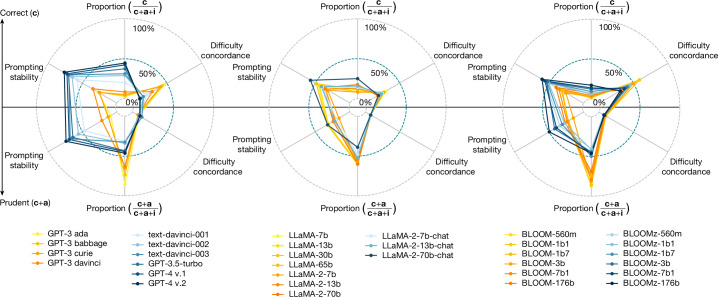
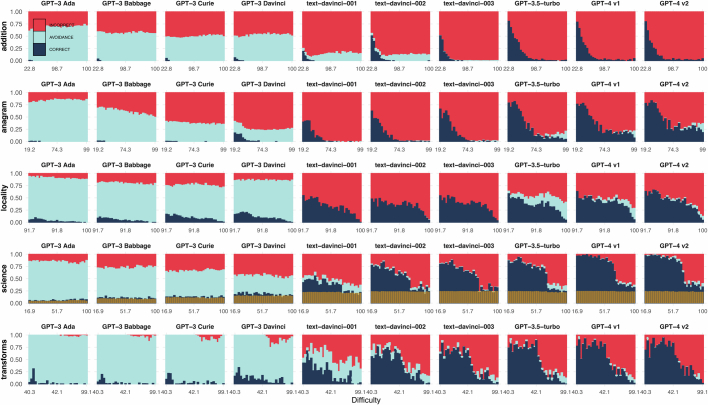
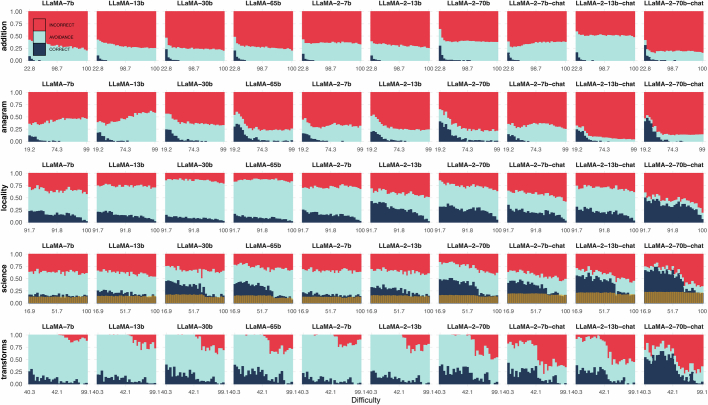
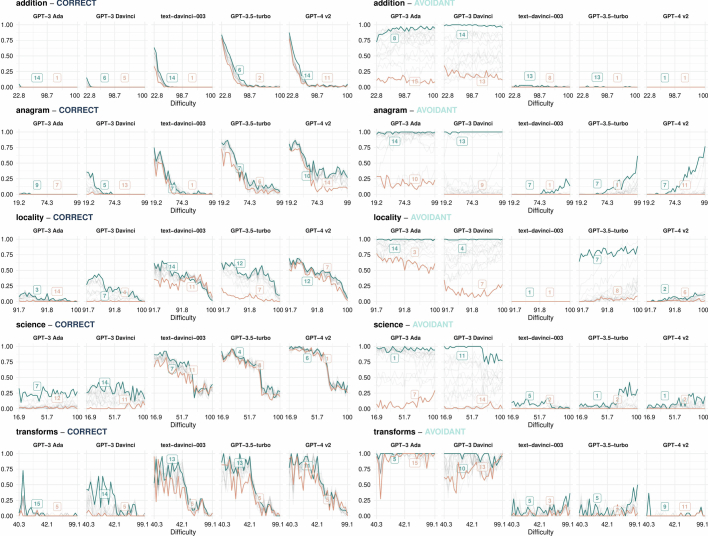
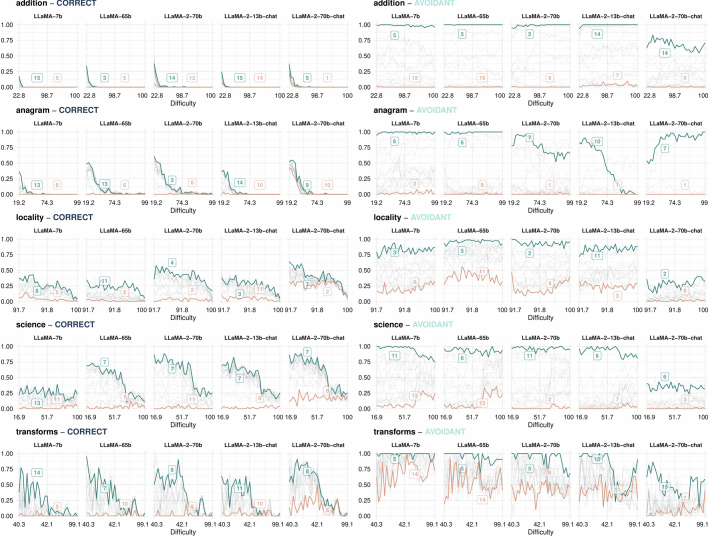
The prevailing methods to make large language models more powerful and amenable have been based on continuous scaling up (that is, increasing their size, data volume and computational resources 1 ) and bespoke shaping up (including post-filtering 2,3 , fine tuning or use of human feedback 4,5 ). However, larger and more instructable large language models may have become less reliable. By studying the relationship between difficulty concordance, task avoidance and prompting stability of several language model families, here we show that easy instances for human participants are also easy for the models, but scaled-up, shaped-up models do not secure areas of low difficulty in which either the model does not err or human supervision can spot the errors. We also find that early models often avoid user questions but scaled-up, shaped-up models tend to give an apparently sensible yet wrong answer much more often, including errors on difficult questions that human supervisors frequently overlook. Moreover, we observe that stability to different natural phrasings of the same question is improved by scaling-up and shaping-up interventions, but pockets of variability persist across difficulty levels. These findings highlight the need for a fundamental shift in the design and development of general-purpose artificial intelligence, particularly in high-stakes areas for which a predictable distribution of errors is paramount.
Overview
CoChat Summary
TL;DR
Across 32 LLMs from the GPT, LLaMA and BLOOM families on five benchmarks, scaling and instruction/alignment shaping improved correctness and prompt stability but did not create reliable low-difficulty operating regions. Shaped-up models increasingly replaced avoidance with plausible but incorrect answers, making errors harder for human supervisors to catch.
Key findings
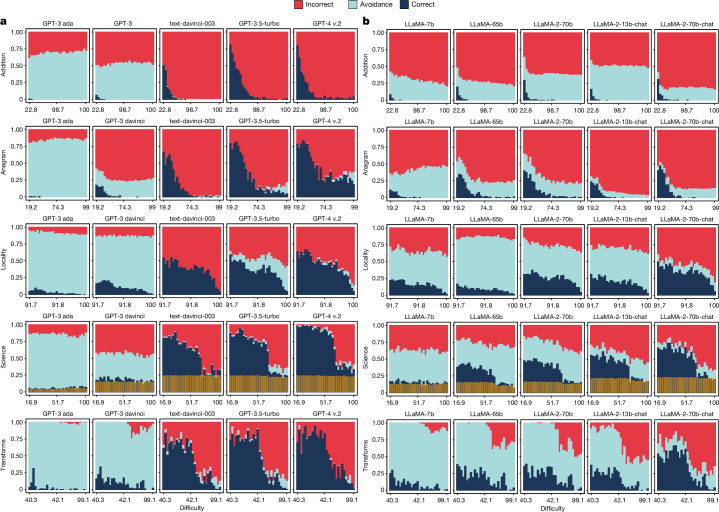
- Human difficulty proxies predicted correctness, but no error-free easy region emerged: for LLaMA, no model achieved 60% correctness at the simplest difficulty level (discounting 25% random guess for science), and only GPT-4 showed a low-difficulty science region with almost perfect results up to medium difficulty.
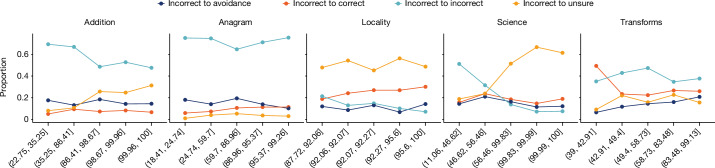
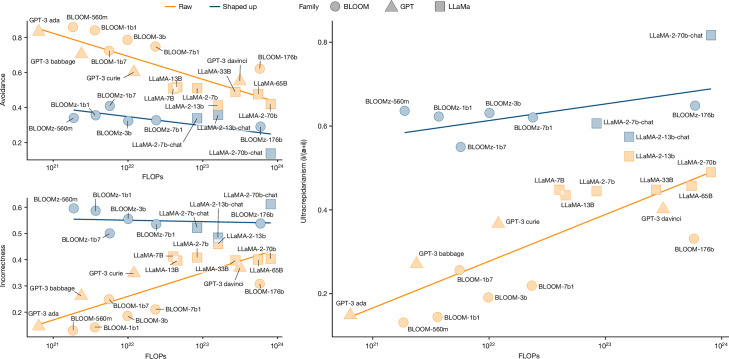
- Scaling and shaping exchanged avoidance for incorrectness: avoidance almost disappeared for GPT-4, incorrectness increased markedly from raw to shaped-up models, and ultracrepidarianism—incorrect over avoidant plus incorrect answers, i/(a + i)—rose.
- Prompting stability improved with scaling and shaping, but pockets of variability persisted across difficulty levels; raw GPT and all LLaMA models were highly prompt-sensitive even for unambiguous addition.
- Human supervision study S2 found few areas where the dangerous error of considering an incorrect answer correct was low enough to constitute a safe operating region.
Methods
- Analysed 32 models: 10 GPT, 10 LLaMA and 12 BLOOM, including raw and shaped-up versions, across five benchmarks: addition, anagram, locality, science and transforms. Each example was run with 15 natural prompt templates per benchmark, yielding approximately 4.2 million answers; temperature was set to zero and no system prompt was used.
- Data samples: 3,142 addition instances, 1,570 anagrams, 2,341 locality instances, science from 1,000 OpenBookQA questions plus 546 GPQA questions minus two over-length items, and 730 transforms items (73 tasks × 10 instances). Two human studies (S1 and S2) recruited participants via Prolific at £9 per hour.
- Difficulty was calibrated to a 0–100 human-failure scale via logistic mapping, then examples were split into 30 equal-sized difficulty bins. Analyses included Spearman rank correlations, six reliability indicators for correctness and prudence (proportion, prompting stability, difficulty concordance), and a scaling analysis using FLOPs.
Limitations
- Stated: participants were mostly non-experts, which affects calibrated difficulty values; the natural prompt sample came from diverse sources but lacked real-world prompt-frequency data; and only a sample of model families was covered, excluding LLMs that delegate to external tools or use sophisticated reasoning techniques.
- Evident: GPT models were accessed through APIs and may change over time; response scoring relied on algorithmic conditions and regular expressions, which may not capture all response nuance; calibrated difficulty values are estimates from human study S1 and should be interpreted cautiously, especially for small differences.
Model-written summary. Check it against the paper before relying on it.
Integrity signals
Registry
Cites
Statistics
Figures
Verification
Claims the paper makes
1 Valid · 0 Not valid · 9 Not checked · 58 Own results and interpretations
A result the paper reports from its own data — it cites no other source for it, so there is none to check. The quote shows it is in the paper.
In the paper
“F3b—improvement in prompt performance is not monotonic across difficulty levels.”
§ Larger and more instructable language models become less reliable > Results
plain- Asserted: passes — The authors put it forward as true.
- Checkable: passes — It can be checked against evidence.
- Load-bearing: passes — The paper’s conclusions depend on it.
- Based: passes — The paper gives a reason why it holds.
- Rests on an assumption not shown here.
A result the paper reports from its own data — it cites no other source for it, so there is none to check. The quote shows it is in the paper.
In the paper
“For the LLaMA family, no model achieves 60% correctness at the simplest difficulty level (discounting 25% random guess for ‘science’).”
§ Larger and more instructable language models become less reliable > Results
plain- Asserted: passes — The authors put it forward as true.
- Checkable: passes — It can be checked against evidence.
- Load-bearing: passes — The paper’s conclusions depend on it.
- Based: passes — The paper gives a reason why it holds.
- Rests on 2 assumptions not shown here.
A result the paper reports from its own data — it cites no other source for it, so there is none to check. The quote shows it is in the paper.
In the paper
“The percentage of avoidant answers rarely rises quicker than the percentage of incorrect ones.”
§ Larger and more instructable language models become less reliable > Results
hedged- Asserted: passes — The authors put it forward as true.
- Checkable: passes — It can be checked against evidence.
- Load-bearing: passes — The paper’s conclusions depend on it.
- Based: passes — The paper gives a reason why it holds.
- Rests on 2 assumptions not shown here.
A result the paper reports from its own data — it cites no other source for it, so there is none to check. The quote shows it is in the paper.
In the paper
“scaled-up, shaped-up models do not secure areas of low difficulty in which either the model does not err or human supervision can spot the errors”
§ Larger and more instructable language models become less reliable > Abstract
plain- Asserted: passes — The authors put it forward as true.
- Checkable: passes — It can be checked against evidence.
- Load-bearing: passes — The paper’s conclusions depend on it.
- Based: passes — The paper gives a reason why it holds.
- Rests on 2 assumptions not shown here.
A result the paper reports from its own data — it cites no other source for it, so there is none to check. The quote shows it is in the paper.
In the paper
“Supplementary Table 8 shows the correlations between correctness and the proxies for human difficulty. Except for BLOOM for addition, all of them are high.”
§ Larger and more instructable language models become less reliable > Results
plainstates an association- Asserted: passes — The authors put it forward as true.
- Checkable: passes — It can be checked against evidence.
- Load-bearing: unclear — It is unclear whether the paper’s conclusions depend on it.
- Based: passes — The paper gives a reason why it holds.
- Rests on an assumption not shown here.
18 more claims
Create a free account to see all 68 claims and to verify the 13 references still open.
- Probably not a substantial claim. 26
- It may state two separate claims as one. 27
Claims other papers make about this one
Each is checked against this paper’s own text: does it say what the citing paper says it does?
The source backs part of the claim, not all of it — or backs it for a different population, condition or comparison.
In the citing paper
“while its intrinsic fallibility, the tendency to produce confident but incorrect outputs, demands continuous human oversight.”
From Generative AI and Organizational Structure in the Knowledge Economy (2025) · cites this paper as Zhou et al. 2024
Experimental — accuracy not yet measuredThe cited source says what the claim attributes to it.
In the citing paper
“Second, they struggle with many aspects of reasoning (Shwartz, 2024;Zhou et al., 2024;Huckle and Williams, 2025).”
From There is no such thing as conscious artificial intelligence (2025) · cites this paper as Zhou et al., 2024
The cited source says what the claim attributes to it.
In the citing paper
“our result aligns with and extends recent findings that earlier LLMs were more likely to avoid answering difficult questions, whereas newer, larger, and more instructible models, instead of refusing to answer, often produced misleadingly authoritative yet flawed responses [41].”
From Generalization bias in large language model summarization of scientific research (2025) · cites this paper as [41]
The cited source says what the claim attributes to it.
In the citing paper
“Zhou et al. (2024) document that more capable language models can exhibit equal or higher hallucination rates on certain task categories”
From Generative AI and Organizational Structure in the Knowledge Economy (2025) · cites this paper as Zhou et al. (2024)
Citations
Cites
Language Models are Few-Shot Learners
Brown, T. B., Mann, B., Ryder, N., Subbiah, M., Kaplan, J., Dhariwal, P., Neelakantan, A., Shyam, P., Sastry, G., Askell, A., et al. (2020) · arXiv · doi:10.48550/arxiv.2005.14165 · Cited by 23,372 · cited 2×
“The first four models, GPT-3 ada, babbage, curie and davinci, are the original raw models in the family 14 .”
Exploring the Limits of Transfer Learning with a Unified Text-to-Text Transformer
Raffel, C., Shazeer, N., Roberts, A., Lee, K., Narang, S., Matena, M., Zhou, Y., Li, W., & Liu, P. J. (2019) · arXiv · doi:10.48550/arxiv.1910.10683 · Cited by 10,929 · cited 12×
“In Supplementary Note 13, we discuss how different groups of cells are named.”
InfluentialScaling Laws for Neural Language Models
Kaplan, J., McCandlish, S., Henighan, T., Brown, T. B., Chess, B., Child, R., Gray, S., Radford, A., Wu, J., & Amodei, D. (2020) · arXiv · doi:10.48550/arxiv.2001.08361 · Cited by 9,550
ChatGPT for Good? On Opportunities and Challenges of Large Language Models for Education
Kasneci, E., Seßler, K., Küchemann, S., Bannert, M., Dementieva, D., Fischer, F., Gasser, U., Groh, G., Günnemann, S., Hüllermeier, E., et al. (2023) · doi:10.35542/osf.io/5er8f · Cited by 7,552
ChatGPT for good? On opportunities and challenges of large language models for education
Kasneci, E., Sessler, K., Küchemann, S., Bannert, M., Dementieva, D., Fischer, F., Gasser, U., Groh, G., Günnemann, S., Hüllermeier, E., et al. (2023) · Learning and Individual Differences · doi:10.1016/j.lindif.2023.102274 · Cited by 7,326
LLaMA: Open and Efficient Foundation Language Models
Touvron, H., Lavril, T., Izacard, G., Martinet, X., Lachaux, M.-A., Lacroix, T., Rozière, B., Goyal, N., Hambro, E., Azhar, F., et al. (2023) · arXiv · doi:10.48550/arxiv.2302.13971 · Cited by 4,602
Liu, P., Yuan, W., Fu, J., Jiang, Z., Hayashi, H., & Neubig, G. (2023) · ACM Computing Surveys · doi:10.1145/3560815 · Cited by 4,361 · cited 1×
“Although this prompt sensitivity has been analysed extensively 17–20 , it is poorly understood why an over-diligent system spouts a wrong answer for 100-digit addition instead of simply answering ‘I’m afraid I can’t do that’.”
Liu, P., Yuan, W., Fu, J., Jiang, Z., Hayashi, H., & Neubig, G. (2021) · arXiv · doi:10.48550/arxiv.2107.13586 · Cited by 4,352 · cited 1×
“Although this prompt sensitivity has been analysed extensively 17–20 , it is poorly understood why an over-diligent system spouts a wrong answer for 100-digit addition instead of simply answering ‘I’m afraid I can’t do that’.”
Training language models to follow instructions with human feedback
Ouyang, L., Wu, J., Jiang, X., Almeida, D., Wainwright, C. L., Mishkin, P., Zhang, C., Agarwal, S., Slama, K., Ray, A., et al. (2022) · arXiv · doi:10.48550/arxiv.2203.02155 · Cited by 4,208
Large language models in medicine
Thirunavukarasu, A. J., Ting, D. S. J., Elangovan, K., Gutierrez, L., Tan, T. F., & Ting, D. S. W. (2023) · Nature Medicine · doi:10.1038/s41591-023-02448-8 · Cited by 3,944 · cited 12×
“In Supplementary Note 13, we discuss how different groups of cells are named.”
Influential
Research works printed but not linked: 7
- Devlin, J., Chang, M.-W., Lee, K. & Toutanova, K. Bert: Pre-training of deep bidirectional transformers for language understanding. In Proc. 2019 Conference of the North American Chapter of the Association for Computational Linguistics 4171–4186 (Association for Computational Linguistics, 2019).
- Sun, J., Shaib, C. & Wallace, B. C. Evaluating the zero-shot robustness of instruction-tuned language models. In The Twelfth International Conference on Learning Representations (2024).
- Zeidner, M. & Matthews, G. Evaluation anxiety. Handb. Competence Motiv. 141, 163 (2005).
- Kuhn, L., Gal, Y. & Farquhar, S. Semantic uncertainty: linguistic invariances for uncertainty estimation in natural language generation. In The Eleventh International Conference on Learning Representations (2023).
- Li, M. et al. Think twice before assure: confidence estimation for large language models through reflection on multiple answers. Preprint at https://arxiv.org/html/2403.09972v1 (2024).
- Villalobos, P. et al. Position: Will we run out of data? Limits of LLM scaling based on human-generated data. In Proc. 41st International Conference on Machine Learning (PMLR, 2024)
- Dettmers, T., Pagnoni, A., Holtzman, A. & Zettlemoyer, L. QLoRA: efficient finetuning of quantized LLMs. Adv. Neural Inf. Process. Syst.36, 10088–10115 (2024).
Cited by
Human-AI agency in the age of generative AI
Krakowski, S. (2025) · Information and Organization · doi:10.1016/j.infoandorg.2025.100560 · Cited by 162
Harmonizome 3.0: integrated knowledge about genes and proteins from diverse multi-omics resources
Diamant, I., Clarke, D. J. B., Evangelista, J. E., Lingam, N., & Ma’ayan, A. (2024) · Nucleic Acids Research · doi:10.1093/nar/gkae1080 · Cited by 200
Mirakhori, F., & Niazi, S. K. (2025) · Pharmaceuticals · doi:10.3390/ph18010047 · Cited by 143
“Real-world user interactions provide invaluable insights, enabling developers to enhance usability and performance [48].”
Generalization bias in large language model summarization of scientific research
Peters, U., & Chin-Yee, B. (2025) · Royal Society Open Science · doi:10.1098/rsos.241776 · Cited by 126
AI hallucinations can’t be stopped — but these techniques can limit their damage
Jones, N. (2025) · Nature · doi:10.1038/d41586-025-00068-5 · Cited by 118
IoT-LLM: A framework for enhancing large language model reasoning from real-world sensor data
An, T., Zhou, Y., Zou, H., & Yang, J. (2025) · Patterns · doi:10.1016/j.patter.2025.101429 · Cited by 77
“27,28 (3) They only evaluate their effectiveness on closed-source LLMs and lack a comprehensive study of benchmarking open-source LLMs with different parameter sizes.”
Accelerating battery innovation: AI-powered molecular discovery
Gao, Y., Chen, X., Yuan, Y., Chen, Y., Niu, Y.-L., Yao, N., Gao, Y.-B., Li, W. Z., & Zhang, Q. (2025) · Chemical Society Reviews · doi:10.1039/d5cs00053j · Cited by 68
Mitigating the risk of health inequity exacerbated by large language models
Ji, Y., Ma, W., Sivarajkumar, S., Zhang, H., Sadhu, E. M., Li, Z., Wu, X., Visweswaran, S., & Wang, Y. (2025) · npj Digital Medicine · doi:10.1038/s41746-025-01576-4 · Cited by 83
“Health inequities can manifest in numerous ways, influenced by the complex interplay of socio-demographic determinants of health (SDOH), leading to potentially unfair or harmful outcomes when models interact with sensitive information [5, 15].”
Bishwas, A. K., & Sen, M. (2024) · arXiv (Cornell University) · doi:10.48550/arxiv.2411.09995 · Cited by 62
Take caution in using LLMs as human surrogates
Gao, Y., Lee, D., Burtch, G., & Fazelpour, S. (2025) · Proceedings of the National Academy of Sciences · doi:10.1073/pnas.2501660122 · Cited by 52
Synthetic Scientific Image Generation with VAE, GAN, and Diffusion Model Architectures
Sordo, Z., Chagnon, E., Hu, Z., Donatelli, J. J., Andeer, P. F., Nico, P., Northen, T. R., & Ushizima, D. M. (2025) · Journal of Imaging · doi:10.3390/jimaging11080252 · Cited by 66
“In particular, generating accurate images of scientific phenomena that were not represented in the training data often results in hallucinations [3] or misrepresentations of fundamental physical and biological principles [4].”
Tiller, N. B., Marcon, A. R., Zenone, M. A., Kidd, K. E., Jeukendrup, A. E., Master, Z., & Caulfield, T. (2026) · BMJ Open · doi:10.1136/bmjopen-2025-112695 · Cited by 59
Shahin, M. H., Goswami, S., Lobentanzer, S., & Corrigan, B. (2025) · Clinical and Translational Science · doi:10.1111/cts.70188 · Cited by 50
“Otherwise, these systems may cause a wave of disillusionment and lack of adoption after the initial euphoria subsides [31].”
Provocations from the Humanities for Generative AI ResearchPreprint
Klein, L., Martin, M. J., Brock, A., Antoniak, M., Walsh, M., Johnson, J. M., Tilton, L., & Mimno, D. (2025) · arXiv (Cornell University) · doi:10.48550/arxiv.2502.19190 · Cited by 47
“Increasingly, studies have found that more data, more parameters, and more compute may not lead to more accurate output [123, 192].”
On Benchmarking Human-like Intelligence in Machines
Ying, L., Collins, K. M., Wong, L., Sucholutsky, I., Liu, R., Weller, A., Shu, T., Griffiths, T. L., & Tenenbaum, J. B. (2026) · Open Mind · doi:10.1162/opmi.a.385 · Cited by 41
Transforming agency: On the mode of existence of large language models
Barandiaran, X. E., & Almendros, L. S. (2025) · Phenomenology and the Cognitive Sciences · doi:10.1007/s11097-025-10094-3 · Cited by 42
“Large-scale studies show that scaling and instruction fine-tuning might not fully eliminate these weaknesses and could even make errors harder to predict (Zhou et al., 2024).”
Predictable artificial intelligence
Zhou, L., Casares, P. A. M., Martínez‐Plumed, F., Burden, J., Burnell, R., Cheke, L. G., Ferri, C. S., Marcoci, A., Mehrbakhsh, B., Moros-Daval, Y., et al. (2026) · Artificial Intelligence · doi:10.1016/j.artint.2026.104491 · Cited by 42
Self-citationSix Fallacies in Substituting Large Language Models for Human Participants
Lin, Z. (2025) · Advances in Methods and Practices in Psychological Science · doi:10.1177/25152459251357566 · Cited by 66
“Choose models based on their specific capabilities for the research question rather than assuming larger or more advanced models automatically approximate human cognition better (Zan et al., 2025; Zhou et al., 2024).”
Zhao, Y., Wang, P., Zhao, Y., Du, H., & Yang, H. (2025) · Nature Communications · doi:10.1038/s41467-025-64574-w · Cited by 48
“This adaptation raises major concerns about the trustworthiness and calibration of their predictions, which is crucial for high-stakes applications like public safety 17 .”
The extended hollowed mind: why foundational knowledge is indispensable in the age of AI
Klein, C. R., & Klein, R. (2025) · Frontiers in Artificial Intelligence · doi:10.3389/frai.2025.1719019 · Cited by 41
Chen, H., Zeng, W., Chen, C., Cai, L., Wang, F., Shi, Y., Wang, L., Zhang, W., Li, Y., Yan, H., et al. (2025) · Neural Networks · doi:10.1016/j.neunet.2025.107848 · Cited by 41
“While a low training loss suggests a good fit to the training data, it does not necessarily reflect the model’s true performance, as the generated responses may still fail to meet expectations or even diverge significantly [79].”
Reliability engineering, risk management, and trustworthiness assurance for AI systems
Zhang, X., Wang, T., Ma, L., & Mahadevan, S. (2025) · Journal of Reliability Science and Engineering · doi:10.1088/3050-2454/adcef2 · Cited by 34
Emergent language: a survey and taxonomy
Peters, J., de Puiseau, C. W., Tercan, H., Gopikrishnan, A., de Carvalho, G. A. L., Bitter, C., & Meisen, T. (2025) · Autonomous Agents and Multi-Agent Systems · doi:10.1007/s10458-025-09691-y · Cited by 38
Patient agency and large language models in worldwide encoding of equity
Armoundas, A. A., & Loscalzo, J. (2025) · npj Digital Medicine · doi:10.1038/s41746-025-01598-y · Cited by 27
Dawson, M. G., Deer, R., & Boguslawski, S. (2025) · Computers in Human Behavior Reports · doi:10.1016/j.chbr.2025.100724 · Cited by 30
Chen, L., Zhang, Y., Feng, J., Chai, H., Zhang, H., Fan, B., Ma, Y., Zhang, S., Li, N., Liu, T., et al. (2026) · Humanities and Social Sciences Communications · doi:10.1057/s41599-026-07316-7 · Cited by 37
“…prompting [93] Individual agent Trigger Attention-inspired bias intervention [124] Individual agent Trigger Bias-mitigating dialogue system Safety [195] Individual agent Trigger Overconfidence bias evaluation [145] Human-agent interaction Trigger Deception through detailed explanations [170]…”
Walls, B. W., & Linic, S. (2025) · ACS Catalysis · doi:10.1021/acscatal.5c03844 · Cited by 26
To use or not to use? Generative AI adoption in Chinese business schools
Yu, T., Dai, J., Chen, X., & Wang, C. (2025) · The International Journal of Management Education · doi:10.1016/j.ijme.2025.101323 · Cited by 39
When large language models are reliable for judging empathic communication
Kumar, A., Poungpeth, N., Yang, D., Farrell, E. L., Lambert, B. L., & Groh, M. (2026) · Nature Machine Intelligence · doi:10.1038/s42256-025-01169-6 · Cited by 43
“However, LLM-based annotations are prone to variability across runs [56], inconsistencies across contexts [57], apparently sensible yet wrong answers [58], miscalibrated confidence [59], and a series of human-like cognitive biases [60, 61].”
Generative AI and Organizational Structure in the Knowledge Economy
Xu, F., Hou, J., Chen, W., & Xie, K. (2025) · arXiv · doi:10.48550/arxiv.2506.00532 · Cited by 22
General scales unlock AI evaluation with explanatory and predictive power
Zhou, L., Pacchiardi, L., Martínez‐Plumed, F., Collins, K. M., Moros-Daval, Y., Zhang, S., Zhao, Q., Huang, Y., Sun, L., Prunty, J. E., et al. (2026) · Nature · doi:10.1038/s41586-026-10303-2 · Cited by 45
“Present general-purpose AI systems, such as LLMs, are highly unreliable and unpredictable 6,12 .”
Self-citationThere is no such thing as conscious artificial intelligence
Porębski, A., & Figura, J. (2025) · Humanities and Social Sciences Communications · doi:10.1057/s41599-025-05868-8 · Cited by 20
“Second, they struggle with many aspects of reasoning (Shwartz, 2024; Zhou et al., 2024; Huckle and Williams, 2025).”
Learning against the machine: the double edged sword of (Gen)AI in STEM education
Wulff, P., & Kubsch, M. (2025) · International Journal of STEM Education · doi:10.1186/s40594-025-00588-6 · Cited by 23
“Further, the observed behavior of GenAI systems can be unpredictable in deployed settings and oversight remains challenging (Krakauer et al., 2025; Zhou et al., 2024).”
Yang, Z., Yin, Y., Kong, C., Chi, T., Tao, W., Zhang, Y., & Xu, T. (2025) · Cell Discovery · doi:10.1038/s41421-025-00776-2 · Cited by 23
“From this search, we glean: nmm_id: nmm-0006 species_origins: Ephedra equisetina, or, Ephedra intermedia, or, Ephedra sinica This contextual information is then amalgamated with the user ’ s query and submitted to ShennongLLM to formulate an accurate response: The species origin of Ma Huang is…”
Hashjin, N. M., Amiri, M. H., & Najafabadi, M. K. (2026) · Scientific Reports · doi:10.1038/s41598-026-38715-0 · Cited by 21
“Building on these challenges, scaling LLMs paradoxically introduces additional reliability risks—larger models tend to generate 12% more clinically implausible outputs, despite better knowledge retention 18 .”
Model predictive task sampling for efficient and robust adaptation
Wang, Q., Xiao, Z., Mao, Y., Qu, Y. P., Shen, J., Lv, Y., & Ji, X. (2026) · Nature Communications · doi:10.1038/s41467-026-74004-0 · Cited by 25
“Their rapid problem-solving stems from widely adopted adaptation learning paradigms, including pretraining, meta-learning, and supervised finetuning (SFT).”
Transforming Agency. On the mode of existence of Large Language Models
Barandiaran, X. E., & Almendros, L. S. (2024) · arXiv · doi:10.48550/arxiv.2407.10735 · Cited by 18
A Weighted Byzantine Fault Tolerance Consensus Driven Trusted Multiple Large Language Models Network
Luo, H., Sun, G., Liu, Y., Zhao, D., Niyato, D., Yu, H., & Dustdar, S. (2025) · IEEE Transactions on Cognitive Communications and Networking · doi:10.1109/tccn.2025.3620286 · Cited by 27
“However, considering the diverse learning corpus, model architectures, and training goals, the answers of different LLMs to the same query will naturally differ [6], [7].”
Mantello, P. A., Ghotbi, N., Ho, T. M., & Mizutani, F. (2024) · AI & Society · doi:10.1007/s00146-024-02126-4 · Cited by 18
“For Zhou et al 2024, user trust in AI can increase from combined series of steps by users and AI creators.”
Hernández-Ramírez, R., & Ferreira, J. B. (2024) · She ji · doi:10.1016/j.sheji.2024.11.002 · Cited by 20
Leveraging Approximate Caching for Faster Retrieval-Augmented Generation
Bergman, S. A., Zhang, J., Kermarrec, A.-M., Petrescu, D., Pires, R. P., Randl, M., & de Vos, M. (2025) · Workshop on Machine Learning and Systems (EuroMLSys) · doi:10.1145/3721146.3721941 · Cited by 22
“Moreover, their responses can be inconsistent across queries, especially in complex or specialized domains, making it difficult to trust their outputs without extensive verification by domain experts [2, 5].”
Artificial Intelligence in migrant health: a critical perspective on opportunities and risks
Matlin, S. A., Claron, I. M. M., Merone, J., Netto, G., Takian, A., Zaman, M. H., & Saso, L. (2025) · The Lancet Regional Health - Europe · doi:10.1016/j.lanepe.2025.101421 · Cited by 21
“12 A worrying trend revealed in a study by Zhou et al. 13 has been that current approaches to scale-up of LLMs are resulting in them becoming less reliable and the authors called for “a fundamental shift in the design and development of general-purpose artificial intelligence, particularly in high-stake areas”.”
Application of artificial intelligence in medical education: A meta-ethnographic synthesis
Li, W., Shi, H.-Y., Chen, X.-L., Lan, J., Rehman, A.-U., Ge, M., Shen, L.-T., Hu, F., Jia, Y., Li, X., et al. (2024) · Medical Teacher · doi:10.1080/0142159x.2024.2418936 · Cited by 22
“Although large language models (such as the GPT series and LLaMA series) have made progress in handling complex issues, their performance on simple tasks still has issues, and their avoidance behavior in high-difficulty tasks has not increased [60].”
Sallam, M., Al-Mahzoum, K., & Sallam, M. (2024) · Mesopotamian Journal of Artificial Intelligence in Healthcare · doi:10.58496/mjaih/2024/019 · Cited by 19
“Such manipulation, though speculative, is not far removed from the risks already observed in other domains where genAI tools have been compromised [30, 31, 32].”
Galindez-Acosta, J. S., & Giraldo-Huertas, J. J. (2026) · Computers in Human Behavior Reports · doi:10.1016/j.chbr.2026.101024 · Cited by 20
Optimizing BFloat16 Deployment of Tiny Transformers on Ultra-Low Power Extreme Edge SoCs
Dequino, A., Bompani, L., Benini, L., & Conti, F. (2025) · Journal of Low Power Electronics and Applications · doi:10.3390/jlpea15010008 · Cited by 18
Khlaaf, H., West, S. M., & Whittaker, M. (2024) · arXiv (Cornell University) · doi:10.48550/arxiv.2410.14831 · Cited by 18
“Finally, the aforementioned policy interventions neither account for nor apply to the construction of narrowly tailored models built for specific military purposes that are more effective at a given task [2, 70].”
Rafe, A., & Das, S. (2026) · arXiv (Cornell University) · doi:10.48550/arxiv.2609.24052 · Cited by 15
“Zhou et al. (2024) report that larger and more instructable models become less reliable in the sense that they answer more and are wrong more often on hard items.”
Convergence of machine learning and genomics for precision oncology
Reardon, B. M., Culhane, A. C., & Allen, E. M. V. (2026) · Nature reviews. Cancer · doi:10.1038/s41568-025-00897-6 · Cited by 17
“This approach allows for clearer benefit characterization and minimizes the likelihood of harm 142 , especially because it has been observed that at this point in time, larger models may be less reliable 143 .”
Evaluation of large language models for providing educational information in orthokeratology care
Huang, Y., Shi, R., Chen, C., Zhou, X., Zhou, X., Hong, J., & Chen, Z. (2025) · Contact Lens and Anterior Eye · doi:10.1016/j.clae.2025.102384 · Cited by 15
Pattern Recognition or Medical Knowledge? The Problem with Multiple-Choice Questions in Medicine
Griot, M., Vanderdonckt, J., Yuksel, D., & Hemptinne, C. (2024) · arXiv · doi:10.48550/arxiv.2406.02394 · Cited by 13
Pattern Recognition or Medical Knowledge? The Problem with Multiple-Choice Questions in Medicine
Griot, M., Vanderdonckt, J., Yuksel, D., & Hemptinne, C. (2025) · Proceedings of the 63rd Annual Meeting of the Association for Computational Linguistics (Volume 1: Long Papers) · doi:10.18653/v1/2025.acl-long.266 · Cited by 13
The Promise and Pitfalls of Artificial Intelligence in the Evaluation of Synthetic “Greenness”
Nowak, P. M., Woźniakiewicz, M., Nalepa, G. J., & Grzybowski, B. A. (2025) · ChemSusChem · doi:10.1002/cssc.202500809 · Cited by 12
Harnessing AI in Secondary Education to Enhance Writing CompetencePreprint
Elstad, E., & Eriksen, H. (2024) · arXiv (Cornell University) · doi:10.48550/arxiv.2412.12117 · Cited by 14
Enhancing generative AI reliability via agentic AI in 6G-enabled edge computing
Ale, L., King, S. A., Zhang, N., & Xing, H. (2025) · Nature Reviews Electrical Engineering · doi:10.1038/s44287-025-00169-3 · Cited by 11
Empowering Entrepreneurship Education with Digital Technologies Tools
Ali, S. R., Hussain, S. J., Memon, M. I., Shuja, T. B., & Faraz, M. (2025) · Qlantic journal of social sciences. · doi:10.55737/qjss.vi-i.25305 · Cited by 12
Croskey, P., Offert, F., Jacobs, J., & Thaler, K. M. (2025) · ACM Conference on Fairness, Accountability, and Transparency (FAccT) · doi:10.1145/3715275.3732058 · Cited by 12
LLM Confidence Evaluation Measures in Zero-Shot CSS ClassificationPreprint
Farr, D., Cruickshank, I. J., Manzonelli, N., Clark, N., Starbird, K., & West, J. D. (2024) · Qeios · doi:10.32388/zdx3nv · Cited by 10
Guided and knowledgeable multi-agent debate for fact verification
Ma, X., Rao, G., Xu, L., Wang, X., Fan, Z., & Zhang, Z. (2025) · Expert Systems with Applications · doi:10.1016/j.eswa.2025.130103 · Cited by 14
Liu, Z., Hu, B., Feng, Y., Lu, C., & Tan, J. (2025) · Advanced Engineering Informatics · doi:10.1016/j.aei.2025.104264 · Cited by 11
Perez, R. M., Shimogawa, M., Chang, Y., Li, X., Phan, H. A. T., Marmorstein, J. G., Yanagawa, E. S. K., & Petersson, E. J. (2026) · Computers and Education Artificial Intelligence · doi:10.1016/j.caeai.2026.100546 · Cited by 11
Bigger AI chatbots more inclined to spew nonsense — and people don’t always realize
Jones, N. (2024) · Nature · doi:10.1038/d41586-024-03137-3 · Cited by 12
Inducing state anxiety in LLM agents reproduces human-like biases in consumer decision-making
Ben‐Zion, Z., Elyoseph, Z., Spiller, T. R., & Lazebnik, T. (2026) · npj Artificial Intelligence · doi:10.1038/s44387-026-00122-1 · Cited by 13
Ogg, M., Bose, R., Scharf, J. A., Ratto, C. R., & Wolmetz, M. E. (2026) · iScience · doi:10.1016/j.isci.2026.116400 · Cited by 9
“Our use of a continuous subjective rating task rather than assessing accuracy or performance like many LLM evaluations 54 provides a useful complement to standard practices.”
Enhancing Reasoning to Adapt Large Language Models for Domain-Specific ApplicationsPreprint
Wen, B., & Zhang, X. (2025) · arXiv (Cornell University) · doi:10.48550/arxiv.2502.04384 · Cited by 11
Gu, Z., Long, T., Wang, S., Shang, X., Shen, W., Wei, X., & Xu, K. (2025) · Smart Agricultural Technology · doi:10.1016/j.atech.2025.101094 · Cited by 10
Professional Self-Reflection in the Digital Age: Technological Tools for Managerial Development
Eidenmüller, T., Plavčan, P., Weber, M., Humpert, R. P., Beernink, L., Kampmann, I., & Ajiri, D. (2025) · Journal Of Organizational Behavior Research · doi:10.51847/8nc9k5uzeb · Cited by 9
Liang, J., Lin, Y., Liu, Y., Huang, Y., & Wu, H. (2025) · Building Simulation · doi:10.1007/s12273-025-1324-9 · Cited by 8
“5 Turbo do not shy away from complex questions; they tend to provide answers even when incorrect, rather than admitting uncertainty (Zhou et al. 2024).”
Leveraging Approximate Caching for Faster Retrieval-Augmented Generation
Bergman, S. A., Kermarrec, A.-M., Petrescu, D., Pires, R. P., Randl, M., de Vos, M., & Zhang, J. (2025) · International Middleware Conference · doi:10.1145/3721462.3770776 · Cited by 10
Energy-Aware Multilingual Evaluation of Large Language Models
de Zarzà, I., Liz, M., de Curtò, J., & Calafate, C. T. (2026) · Electronics · doi:10.3390/electronics15071395 · Cited by 10
How Generative AI Should Transform Clinical Decision Support
Liu, S. H., Peterson, J. F., & Wright, A. (2026) · JAMA · doi:10.1001/jama.2026.13187 · Cited by 9
Towards Self-cognitive Exploration: Metacognitive Knowledge Graph Retrieval Augmented Generation
Yuan, X., Di, S., Tang, J., Zheng, L., & Yin, J. P. (2026) · ACM SIGKDD Conference on Knowledge Discovery and Data Mining (KDD) · doi:10.1145/3770854.3780156 · Cited by 10
“Large Language Models (LLMs) have demonstrated remarkable capabilities [2, 28], yet their reliability is often limited by hallucinations and outdated internal knowledge [18, 20, 36].”
Quantum-Amplitude Embedded Adaptation for Parameter-Efficient Fine-Tuning in Large Language Models
Roh, E. J., & Kim, J. (2025) · ACM International Conference on Information and Knowledge Management (CIKM) · doi:10.1145/3746252.3760795 · Cited by 10
“Updating full model copies for each downstream task is impractical, especially in multi-task, low-resource, or on-device scenarios with limited memory and compute [19, 40].”
Perez, R. M., Shimogawa, M., Chang, Y., Phan, H. A. T., Marmorstein, J. G., Yanagawa, E. S. K., & Petersson, E. J. (2025) · arXiv (Cornell University) · doi:10.48550/arxiv.2502.00016 · Cited by 7
Molerov, D., Federiakin, D. A., Zlatkin‐Troitschanskaia, O., Shenavai, K., Trierweiler, L., & Nagel, M. (2026) · Unterrichtswissenschaft · doi:10.1007/s42010-026-00242-2 · Cited by 8
“Given the tendency of Large Language Models (LLMs) to generate hallucinations (Sahoo et al. 2024) and to reproduce unvetted information sources (Zhou et al. 2024; Rejeleene et al. 2024), students are exposed to a flood of unreliable, false, or unchecked information of varying quality, which they…”
Chen, C., & Jia, X.-L. (2026) · AI and Ethics · doi:10.1007/s43681-026-01039-w · Cited by 9
Application of artificial intelligence in life science: Historical review and future perspectives
Shi, L., Wang, M., & Wang, X. (2024) · Fundamental Research · doi:10.1016/j.fmre.2024.10.014 · Cited by 8
“Recently there has been evidence showing that large AI model may be more error-prone under certain circumstances [ 37 ], for some scientific questions, the traditional machine learning methods could be powerful enough or ever superior than large AI models.”
Intuitive Human–Artificial Intelligence Theranostic Complementarity
Turner, J. H. (2025) · Cancer Biotherapy and Radiopharmaceuticals · doi:10.1089/cbr.2025.0021 · Cited by 5
“33 Understanding and acknowledgment of the central role of human intuition in interaction with AI is imperative in combatting so-called “ intuitive-AI ” in which intuition would become algorithmic.”
Off‐The‐Shelf Large Language Models Are Unreliable Judges
Choi, J. H. (2026) · Journal of Empirical Legal Studies · doi:10.1111/jels.70041 · Cited by 7
Integrating generative AI with neurophysiological methods in psychiatric practice
Feng, Y., Zhou, Y., Xu, J., Lu, X., Gu, R., & Qiao, Z. (2025) · Asian Journal of Psychiatry · doi:10.1016/j.ajp.2025.104499 · Cited by 5
Ali, S. R., Memon, M. I., Hussain, S. J., Mohatram, M., & Faraz, M. (2025) · IEEE Access · doi:10.1109/access.2025.3622194 · Cited by 7
“Because most traditional model academic approaches tend to put a good amount of emphasis on theory preparation to the detriment of practice preparation [3], graduates do not have the skill set necessary to handle the very demanding nature of steering a business [4], [5].”
Pardoux, É., & Kerasidou, A. (2025) · Science and Engineering Ethics · doi:10.1007/s11948-025-00562-z · Cited by 6
“Secondly, depending on their design, there is no guarantee that such models would not make things up, as large language models do (Zhou et al. 2024) 4 .”
Evaluating the Critical Thinking of Large Language Models: Insights and Limitations
Jiang, L., Cui, Y. D., Liu, R., & Luo, F. (2025) · Journal of Pacific Rim Psychology · doi:10.1177/18344909251406111 · Cited by 8
“Studies also indicate that even advanced LLMs may fail to perform reliably in straightforward tasks, producing seemingly reasonable yet incorrect responses (Zhou et al., 2024) and generating inconsistent judgments when presented with identical prompts (Zhuang et al., 2025).”
Pan, Y., Zhang, W., Liao, B., Kong, M., Zhang, H., & Fathollahi‐Fard, A. M. (2026) · Journal of Engineering Design · doi:10.1080/09544828.2025.2597722 · Cited by 6
Drobakha, A., Kalitkin, M., Klymenko, K. O., Nayda, R., Lahuta, L., & Kostenko, O. V. (2026) · doi:10.69635/mssl.2026.2.1.31 · Cited by 5
Human-like cognitive generalization for large models via mental representation-guided supervision
Chen, J., Qi, Y., Wang, Y., & Pan, G. (2026) · Nature Communications · doi:10.1038/s41467-026-71267-5 · Cited by 5
“While expanding training dataset and model parameters has improved DNNs ’ performance in recognizing concrete concepts 11 , such abilities remain rooted in statistical correlations rather than conceptual abstraction 12,17 .”
Large language models in mechanical design of mechatronic systems: A review
Zeman, Z., Mikkola, A., Orzechowski, G., Suder, J., & Mihola, M. (2026) · Advanced Engineering Informatics · doi:10.1016/j.aei.2026.104807 · Cited by 6
Artificial intelligence reveals unbalanced sustainability domains in funded research
Varelas, P., Larosa, F., Hoyas, S., Conejero, J. A., Contino, F., Nerini, F. F., García‐Martínez, J., Garibo‐i‐Orts, Ò., Parente, A., & Vinuesa, R. (2025) · Results in Engineering · doi:10.1016/j.rineng.2025.104367 · Cited by 6
Artificial intelligence and dichotomania
McShane, B. B., Gal, D., & Duhachek, A. (2025) · Judgment and Decision Making · doi:10.1017/jdm.2025.7 · Cited by 7
Scale Efficient Training for Large Datasets
Zhou, Q., Gao, J., & Wang, Q. (2025) · IEEE Computer Society Conference on Computer Vision and Pattern Recognition/Proceedings - IEEE Computer Society Conference on Computer Vision and Pattern Recognition/Proceedings · doi:10.1109/cvpr52734.2025.01905 · Cited by 12
“This virtuous cycle between data and model scaling has consistently pushed the boundaries of deep learning capabilities [4, 9, 11, 21, 42, 45].”
Large language modeling of hallucinatory problem mitigation based on the wheel of emotions
Wang, Z., Wang, J., Zhou, L., & You, F. (2025) · Neural Networks · doi:10.1016/j.neunet.2025.107996 · Cited by 7
Self-citationEducational Evaluation with MLLMs: Framework, Dataset, and Comprehensive Assessment
Chen, Y., Li, Y., Ren, Y., Liu, Y., & Ma, Y. (2025) · Electronics · doi:10.3390/electronics14183713 · Cited by 8
GAOKAO-Eval: Does high scores truly reflect strong capabilities in LLMs?Preprint
Lei, Z., Liang, T., Hu, H., Zhang, J., Zhou, Y., Shao, Y., Li, L., Li, C., Wang, C., Yan, H., et al. (2024) · arXiv (Cornell University) · Cited by 5
Use Me Wisely: AI-Driven Assessment for LLM Prompting Skills DevelopmentPreprint
Ognibene, D., Donabauer, G., Theophilou, E., Koyutürk, C., Yavari, M., Buršić, S., Telari, A., Testa, A., Boiano, R., Taibi, D., et al. (2025) · arXiv (Cornell University) · doi:10.30191/ets.202507_28(3).sp12 · Cited by 7
Lin, Z. (2026) · Annual Review of Psychology · doi:10.1146/annurev-psych-100925-034807 · Cited by 4
“Specialized research models with curated corpora, calibrated uncertainty, and standardized settings could achieve better response stability (Zhou et al. 2024).”
InfluentialLarge Language Models as Narrative-Driven Recommenders
Eberhard, L., Ruprechter, T., & Helić, D. (2025) · International World Wide Web Conference (WWW) · doi:10.1145/3696410.3714668 · Cited by 9
Tsai, C., Lin, Y.-C., Hou, J.-U., Tsai, S., Yeh, P.-C., & Kao, C. (2025) · Digital Health · doi:10.1177/20552076251357468 · Cited by 4
“20 Since patients may struggle to recognize incorrect responses from ChatGPT, this could pose risks to their health and safety.”
Courvoisier, D. S., Buitrago‐García, D., Buclin, C. P., Bürgisser, N., Iudici, M., & Mongin, D. (2025) · Research Synthesis Methods · doi:10.1017/rsm.2025.10054 · Cited by 6
“Thissimple yet effective method addresses the issue raised by Zhou et al., 24 who highlighted that LLMs are prone to confidently generate incorrect responses, especially for larger LLMs. Requiring a minimum number of LLMs to provide concordant answers before accepting a response as valid (and…”
Prompting large language models for quality ecological statistics
Brown, C. J., & Spillias, S. (2026) · Methods in Ecology and Evolution · doi:10.1111/2041-210x.70267 · Cited by 2
Automated cardiac magnetic resonance interpretation derived from prompted large language models
Wang, L., Peng, L., Wan, Y., Li, X., Chen, Y., Wang, L., Gong, X., Zhao, X., Yu, L., Zhao, S., et al. (2025) · Cardiovascular Diagnosis and Therapy · doi:10.21037/cdt-2025-112 · Cited by 7
“Additionally, the diagnostic improvement of LLaMA + informative prompt was not as significant, which might indicate that the model’s architecture or training data may not be as amenable to informative prompt-based enhancements (32,33).”
Metadata
- Authors
- Zhou, L., Schellaert, W., Martínez-Plumed, F., Moros-Daval, Y., Ferri, C., & Hernández-Orallo, J.
- Affiliations
- University of Cambridge (GB)
- Universitat Politècnica de València (ES)
- ORCID
- Venue
- Nature
- Published
- 2024-09-25
- Volume
- 634
- Issue
- 8032
- Pages
- 61-68
- ISSN
- 0028-0836 (ISSN-L)
- 1476-4687
- PMC
- PMC11446866
- OpenAlex
- W4402827393
- Cited by
- 203
- References
- 47
- Citations by year
- 2026: 98 · 2025: 95 · 2024: 10
- FWCI
- 29.90
- Type
- journal article
- Language
- en
- Open access
- hybrid
- doi.org
- Licence
- cc-by
- creativecommons.org/licenses/by/4.0 (tdm)
- creativecommons.org/licenses/by/4.0 (vor)
- Locations
- Nature (publishedVersion, cc-by)
- PubMed Central (publishedVersion, cc-by)
- PubMed (publishedVersion)
- RiuNet (Universitat Politècnica de València) (publishedVersion, cc-by)
- Apollo (University of Cambridge) (submittedVersion, cc-by)
- RePEc: Research Papers in Economics (submittedVersion)
- Funders
- Open Philanthropy Project
- Generalitat Valenciana (CIPROM/2022/6, 952215, PID2021-122830OB-C42)
- Defense Advanced Research Projects Agency (HR00112120007)
- Horizon 2020 Framework Programme (EC H2020, 952215)
- European Regional Development Fund (MCIN/AEI/10, H2020, PID2021-122830OB-C42, MICIU/AEI/10)
- Agencia Estatal de Investigación (13039, MCIN / AEI/10, PID2021-122830OB-C42, 10.13039, H2020, AEI/10, PID2021)
- Topics
- Physical Sciences › Computer Science › Artificial Intelligence › Topic Modeling
- Physical Sciences › Computer Science › Artificial Intelligence › Natural Language Processing Techniques
- Physical Sciences › Computer Science › Artificial Intelligence › Adversarial Robustness in Machine Learning
- Keywords
- large language models, model reliability, task avoidance, scale-up, human oversight, error distribution
- MeSH terms
- Feedback, Natural Language Processing, Research Design, Reproducibility of Results
About these checks
Registry, retraction, Cites and statistics results are computed, not judged, with one exception: a printed reference that no index lists is read once by a model before it counts as a citation error. Claims are extracted by a model and kept only when their quote appears verbatim in the text; each cited source is then checked, with a model’s help, for whether it says what the claim relies on. Those verdicts can be wrong — read the claim’s quote and the cited source before relying on one.
The claim verdicts this report counts are experimental: their accuracy is not yet measured.
A language model drew the claims from the paper on 2026-10-05, under version 3 of the claim definition (model deepseek-v4.1-flash, prompt extract-v3).
A second model labelled each claim on 2026-10-05 (model jev-1.13-20260917, definition revision gold-guideline-v0.2).
Statistics and arithmetic are recomputed, not judged.
Confidence bands are shown only for fields calibrated on our annotated test set. None is calibrated yet, so no band is shown.
What counts as a claim ›How we measure confidence ›How we check this ›
Are you an author, or do you see a problem with this page? Request a review
Data sources
Bibliographic data: Semantic Scholar, OpenAlex, Crossref.
Contains information from the Semantic Scholar Academic Graph Datasets, made available under the ODC Attribution License (ODC-BY 1.0).
Semantic Scholar’s data is described in: Kinney, R., et al. (2023). The Semantic Scholar Open Data Platform. arXiv:2301.10140.
