

Larger and more instructable language models become less reliable
Open accessThe DOI matches its Crossref record; 61 of the 61 references it cites were found in a registry or an index; 2 of the 15 sources its claims cite were checked for support.
Abstract
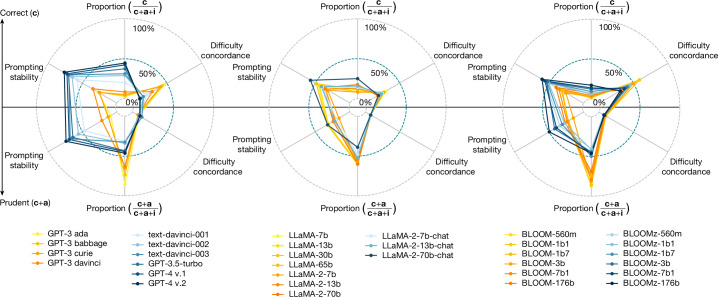
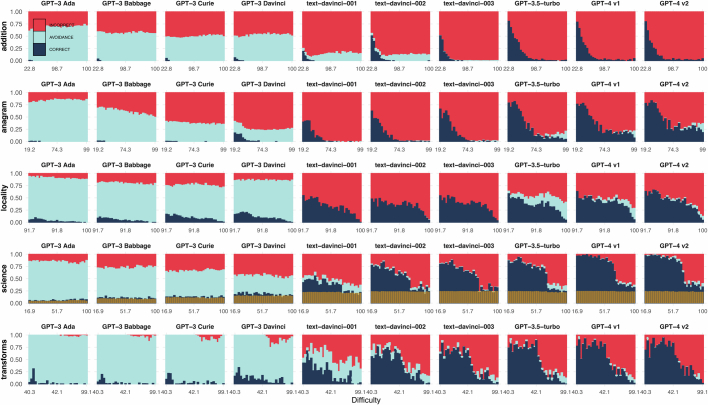
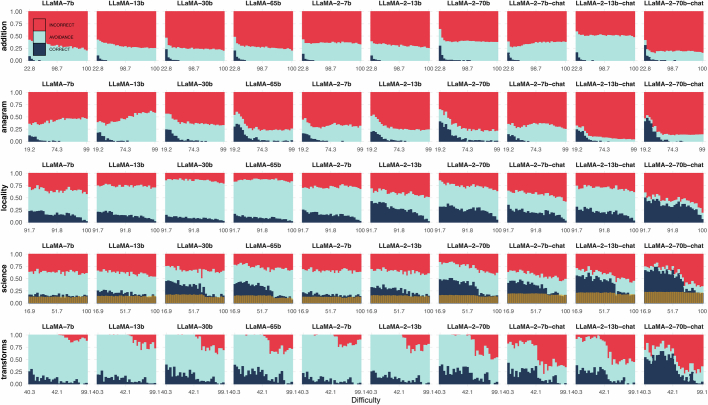
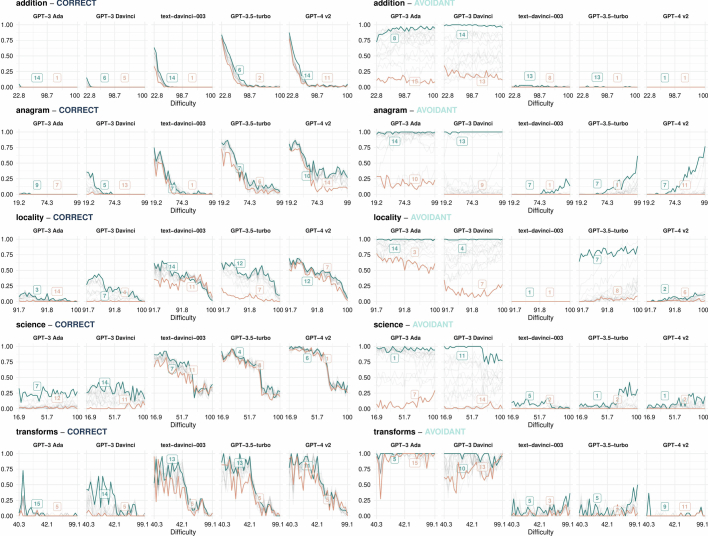
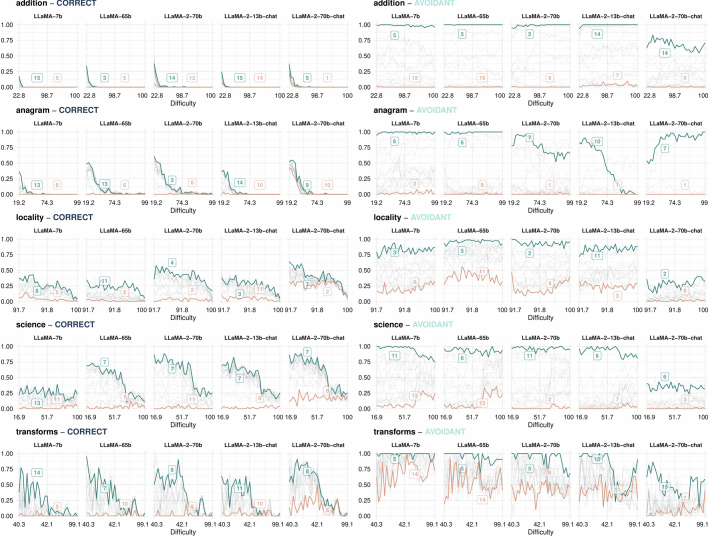
The prevailing methods to make large language models more powerful and amenable have been based on continuous scaling up (that is, increasing their size, data volume and computational resources 1 ) and bespoke shaping up (including post-filtering 2,3 , fine tuning or use of human feedback 4,5 ). However, larger and more instructable large language models may have become less reliable. By studying the relationship between difficulty concordance, task avoidance and prompting stability of several language model families, here we show that easy instances for human participants are also easy for the models, but scaled-up, shaped-up models do not secure areas of low difficulty in which either the model does not err or human supervision can spot the errors. We also find that early models often avoid user questions but scaled-up, shaped-up models tend to give an apparently sensible yet wrong answer much more often, including errors on difficult questions that human supervisors frequently overlook. Moreover, we observe that stability to different natural phrasings of the same question is improved by scaling-up and shaping-up interventions, but pockets of variability persist across difficulty levels. These findings highlight the need for a fundamental shift in the design and development of general-purpose artificial intelligence, particularly in high-stakes areas for which a predictable distribution of errors is paramount.
Overview
CoChat Summary
TL;DR
Across 32 LLMs from the GPT, LLaMA and BLOOM families on five benchmarks, scaling and instruction/alignment shaping improved correctness and prompt stability but did not create reliable low-difficulty operating regions. Shaped-up models increasingly replaced avoidance with plausible but incorrect answers, making errors harder for human supervisors to catch.
Key findings
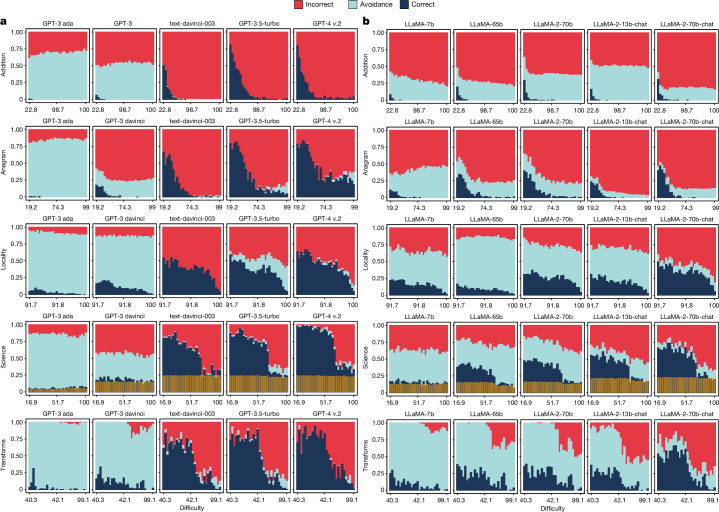
- Human difficulty proxies predicted correctness, but no error-free easy region emerged: for LLaMA, no model achieved 60% correctness at the simplest difficulty level (discounting 25% random guess for science), and only GPT-4 showed a low-difficulty science region with almost perfect results up to medium difficulty.
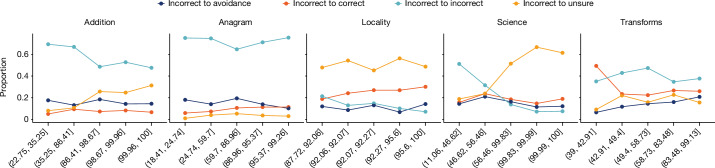
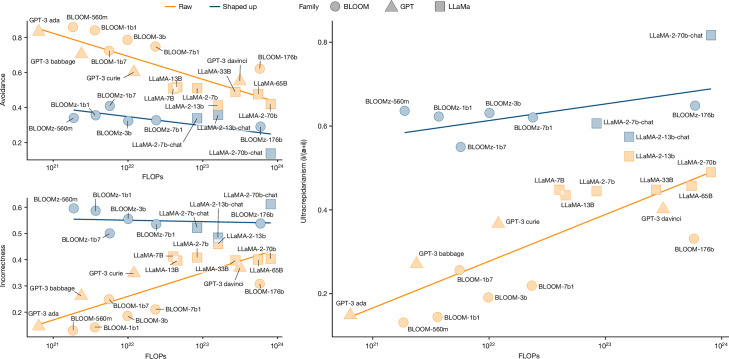
- Scaling and shaping exchanged avoidance for incorrectness: avoidance almost disappeared for GPT-4, incorrectness increased markedly from raw to shaped-up models, and ultracrepidarianism—incorrect over avoidant plus incorrect answers, i/(a + i)—rose.
- Prompting stability improved with scaling and shaping, but pockets of variability persisted across difficulty levels; raw GPT and all LLaMA models were highly prompt-sensitive even for unambiguous addition.
- Human supervision study S2 found few areas where the dangerous error of considering an incorrect answer correct was low enough to constitute a safe operating region.
Methods
- Analysed 32 models: 10 GPT, 10 LLaMA and 12 BLOOM, including raw and shaped-up versions, across five benchmarks: addition, anagram, locality, science and transforms. Each example was run with 15 natural prompt templates per benchmark, yielding approximately 4.2 million answers; temperature was set to zero and no system prompt was used.
- Data samples: 3,142 addition instances, 1,570 anagrams, 2,341 locality instances, science from 1,000 OpenBookQA questions plus 546 GPQA questions minus two over-length items, and 730 transforms items (73 tasks × 10 instances). Two human studies (S1 and S2) recruited participants via Prolific at £9 per hour.
- Difficulty was calibrated to a 0–100 human-failure scale via logistic mapping, then examples were split into 30 equal-sized difficulty bins. Analyses included Spearman rank correlations, six reliability indicators for correctness and prudence (proportion, prompting stability, difficulty concordance), and a scaling analysis using FLOPs.
Limitations
- Stated: participants were mostly non-experts, which affects calibrated difficulty values; the natural prompt sample came from diverse sources but lacked real-world prompt-frequency data; and only a sample of model families was covered, excluding LLMs that delegate to external tools or use sophisticated reasoning techniques.
- Evident: GPT models were accessed through APIs and may change over time; response scoring relied on algorithmic conditions and regular expressions, which may not capture all response nuance; calibrated difficulty values are estimates from human study S1 and should be interpreted cautiously, especially for small differences.
Model-written summary. Check it against the paper before relying on it.
Integrity signals
Registry
Cites
Statistics
Figures
Verification
Claims the paper makes
1 Valid · 0 Not valid · 9 Not checked · 58 Own results and interpretations
A result the paper reports from its own data — it cites no other source for it, so there is none to check. The quote shows it is in the paper.
In the paper
“F3b—improvement in prompt performance is not monotonic across difficulty levels.”
§ Larger and more instructable language models become less reliable > Results
plain- Asserted: passes — The authors put it forward as true.
- Checkable: passes — It can be checked against evidence.
- Load-bearing: passes — The paper’s conclusions depend on it.
- Based: passes — The paper gives a reason why it holds.
- Rests on an assumption not shown here.
A result the paper reports from its own data — it cites no other source for it, so there is none to check. The quote shows it is in the paper.
In the paper
“For the LLaMA family, no model achieves 60% correctness at the simplest difficulty level (discounting 25% random guess for ‘science’).”
§ Larger and more instructable language models become less reliable > Results
plain- Asserted: passes — The authors put it forward as true.
- Checkable: passes — It can be checked against evidence.
- Load-bearing: passes — The paper’s conclusions depend on it.
- Based: passes — The paper gives a reason why it holds.
- Rests on 2 assumptions not shown here.
A result the paper reports from its own data — it cites no other source for it, so there is none to check. The quote shows it is in the paper.
In the paper
“The percentage of avoidant answers rarely rises quicker than the percentage of incorrect ones.”
§ Larger and more instructable language models become less reliable > Results
hedged- Asserted: passes — The authors put it forward as true.
- Checkable: passes — It can be checked against evidence.
- Load-bearing: passes — The paper’s conclusions depend on it.
- Based: passes — The paper gives a reason why it holds.
- Rests on 2 assumptions not shown here.
A result the paper reports from its own data — it cites no other source for it, so there is none to check. The quote shows it is in the paper.
In the paper
“scaled-up, shaped-up models do not secure areas of low difficulty in which either the model does not err or human supervision can spot the errors”
§ Larger and more instructable language models become less reliable > Abstract
plain- Asserted: passes — The authors put it forward as true.
- Checkable: passes — It can be checked against evidence.
- Load-bearing: passes — The paper’s conclusions depend on it.
- Based: passes — The paper gives a reason why it holds.
- Rests on 2 assumptions not shown here.
A result the paper reports from its own data — it cites no other source for it, so there is none to check. The quote shows it is in the paper.
In the paper
“Supplementary Table 8 shows the correlations between correctness and the proxies for human difficulty. Except for BLOOM for addition, all of them are high.”
§ Larger and more instructable language models become less reliable > Results
plainstates an association- Asserted: passes — The authors put it forward as true.
- Checkable: passes — It can be checked against evidence.
- Load-bearing: unclear — It is unclear whether the paper’s conclusions depend on it.
- Based: passes — The paper gives a reason why it holds.
- Rests on an assumption not shown here.
18 more claims
Create a free account to see all 68 claims and to verify the 13 references still open.
- Probably not a substantial claim. 26
- It may state two separate claims as one. 27
Claims other papers make about this one
Each is checked against this paper’s own text: does it say what the citing paper says it does?
The source backs part of the claim, not all of it — or backs it for a different population, condition or comparison.
In the citing paper
“while its intrinsic fallibility, the tendency to produce confident but incorrect outputs, demands continuous human oversight.”
From Generative AI and Organizational Structure in the Knowledge Economy (2025) · cites this paper as Zhou et al. 2024
Experimental — accuracy not yet measuredThe cited source says what the claim attributes to it.
In the citing paper
“Second, they struggle with many aspects of reasoning (Shwartz, 2024;Zhou et al., 2024;Huckle and Williams, 2025).”
From There is no such thing as conscious artificial intelligence (2025) · cites this paper as Zhou et al., 2024
The cited source says what the claim attributes to it.
In the citing paper
“our result aligns with and extends recent findings that earlier LLMs were more likely to avoid answering difficult questions, whereas newer, larger, and more instructible models, instead of refusing to answer, often produced misleadingly authoritative yet flawed responses [41].”
From Generalization bias in large language model summarization of scientific research (2025) · cites this paper as [41]
The cited source says what the claim attributes to it.
In the citing paper
“Zhou et al. (2024) document that more capable language models can exhibit equal or higher hallucination rates on certain task categories”
From Generative AI and Organizational Structure in the Knowledge Economy (2025) · cites this paper as Zhou et al. (2024)
Citations
Cites
Exploring the Limits of Transfer Learning with a Unified Text-to-Text Transformer
Raffel, C., Shazeer, N., Roberts, A., Lee, K., Narang, S., Matena, M., Zhou, Y., Li, W., & Liu, P. J. (2019) · arXiv · doi:10.48550/arxiv.1910.10683 · Cited by 31,859 · cited 12×
“In Supplementary Note 13, we discuss how different groups of cells are named.”
InfluentialLanguage Models are Few-Shot Learners
Brown, T. B., Mann, B., Ryder, N., Subbiah, M., Kaplan, J., Dhariwal, P., Neelakantan, A., Shyam, P., Sastry, G., Askell, A., et al. (2020) · arXiv · doi:10.48550/arxiv.2005.14165 · Cited by 23,372 · cited 2×
“The first four models, GPT-3 ada, babbage, curie and davinci, are the original raw models in the family 14 .”
ChatGPT for good? On opportunities and challenges of large language models for education
Kasneci, E., Sessler, K., Küchemann, S., Bannert, M., Dementieva, D., Fischer, F., Gasser, U., Groh, G., Günnemann, S., Hüllermeier, E., et al. (2023) · Learning and Individual Differences · doi:10.1016/j.lindif.2023.102274 · Cited by 15,365
Scaling Laws for Neural Language Models
Kaplan, J., McCandlish, S., Henighan, T., Brown, T. B., Chess, B., Child, R., Gray, S., Radford, A., Wu, J., & Amodei, D. (2020) · arXiv · doi:10.48550/arxiv.2001.08361 · Cited by 9,550
ChatGPT for Good? On Opportunities and Challenges of Large Language Models for Education
Kasneci, E., Seßler, K., Küchemann, S., Bannert, M., Dementieva, D., Fischer, F., Gasser, U., Groh, G., Günnemann, S., Hüllermeier, E., et al. (2023) · doi:10.35542/osf.io/5er8f · Cited by 7,552
LLaMA: Open and Efficient Foundation Language Models
Touvron, H., Lavril, T., Izacard, G., Martinet, X., Lachaux, M.-A., Lacroix, T., Rozière, B., Goyal, N., Hambro, E., Azhar, F., et al. (2023) · arXiv · doi:10.48550/arxiv.2302.13971 · Cited by 4,602
Liu, P., Yuan, W., Fu, J., Jiang, Z., Hayashi, H., & Neubig, G. (2023) · ACM Computing Surveys · doi:10.1145/3560815 · Cited by 4,361 · cited 1×
“Although this prompt sensitivity has been analysed extensively 17–20 , it is poorly understood why an over-diligent system spouts a wrong answer for 100-digit addition instead of simply answering ‘I’m afraid I can’t do that’.”
Liu, P., Yuan, W., Fu, J., Jiang, Z., Hayashi, H., & Neubig, G. (2021) · arXiv · doi:10.48550/arxiv.2107.13586 · Cited by 4,352 · cited 1×
“Although this prompt sensitivity has been analysed extensively 17–20 , it is poorly understood why an over-diligent system spouts a wrong answer for 100-digit addition instead of simply answering ‘I’m afraid I can’t do that’.”
Training language models to follow instructions with human feedback
Ouyang, L., Wu, J., Jiang, X., Almeida, D., Wainwright, C. L., Mishkin, P., Zhang, C., Agarwal, S., Slama, K., Ray, A., et al. (2022) · arXiv · doi:10.48550/arxiv.2203.02155 · Cited by 4,208
Large language models in medicine
Thirunavukarasu, A. J., Ting, D. S. J., Elangovan, K., Gutierrez, L., Tan, T. F., & Ting, D. S. W. (2023) · Nature Medicine · doi:10.1038/s41591-023-02448-8 · Cited by 3,944 · cited 12×
“In Supplementary Note 13, we discuss how different groups of cells are named.”
Influential
Research works printed but not linked: 7
- Devlin, J., Chang, M.-W., Lee, K. & Toutanova, K. Bert: Pre-training of deep bidirectional transformers for language understanding. In Proc. 2019 Conference of the North American Chapter of the Association for Computational Linguistics 4171–4186 (Association for Computational Linguistics, 2019).
- Sun, J., Shaib, C. & Wallace, B. C. Evaluating the zero-shot robustness of instruction-tuned language models. In The Twelfth International Conference on Learning Representations (2024).
- Zeidner, M. & Matthews, G. Evaluation anxiety. Handb. Competence Motiv. 141, 163 (2005).
- Kuhn, L., Gal, Y. & Farquhar, S. Semantic uncertainty: linguistic invariances for uncertainty estimation in natural language generation. In The Eleventh International Conference on Learning Representations (2023).
- Li, M. et al. Think twice before assure: confidence estimation for large language models through reflection on multiple answers. Preprint at https://arxiv.org/html/2403.09972v1 (2024).
- Villalobos, P. et al. Position: Will we run out of data? Limits of LLM scaling based on human-generated data. In Proc. 41st International Conference on Machine Learning (PMLR, 2024)
- Dettmers, T., Pagnoni, A., Holtzman, A. & Zettlemoyer, L. QLoRA: efficient finetuning of quantized LLMs. Adv. Neural Inf. Process. Syst.36, 10088–10115 (2024).
Cited by
Items 201–277 of 277
Construction of Bridge Maintenance Knowledge Graph Based on Deep Learning
Zhang, Y., & Gao, H. (2026) · Applied Sciences · doi:10.3390/app16041985
Fireseed: A Prompt-Driven Self-Terminating Personality Module for Large Language Models
Pang, C., Yan, B., Zhu, Y., Xu, C., & Li, B. (2025) · International Conference on Computer, Big Data and Artificial Intelligence (ICCBD+AI) · doi:10.1109/iccbdai66607.2025.11388826
Mettiäinen, I. (2024) · Tampere University Institutional Repository (Tampere University)
Switchable Activation NetworksPreprint
Ale, L., Zhang, N., King, S. A., & Fan, P. (2026) · arXiv (Cornell University) · doi:10.48550/arxiv.2603.06601
“The recent emergence of generative AI—notably large language models (LLMs) [2, 3], large vision models (LVMs) [4, 5, 6], Vision-Language-Action (VLA) [7, 8] and Vision-Language-Action Models (VLA) [9, 10]— has pushed these advances to new levels, unlocking general-purpose reasoning, content…”
Automatic Department Performance Assessment via Strategic Prompt Engineering
Chen, L., Xu, S., & Qin, Y. (2026) · International Conference on Intelligent Control and Information Processing · doi:10.1109/icicip67436.2026.11417533
“[10] To control variables, only DeepSeek is used for performance evaluation in this study.”
Xia, W., Zhu, W., Li, T., Wang, L., Li, W., & Zhang, P. (2026) · JMIR Medical Informatics · doi:10.2196/83745 · Cited by 1
Müller, H., Steiger, D., Plass, M., & Holzinger, A. (2026) · International Journal of Human-Computer Interaction · doi:10.1080/10447318.2026.2739758 · Cited by 1
“…laboratory benchmarks into the systems and contexts in which people actually work, communicate, and seek information, a human-factors problem comes to the fore: LLMs frequently produce text that is fluent and persuasive yet factually incorrect, weakly grounded, or fabricated (Zhou et al. 2024).”
Large language models in emergency medicine: a bibliometric study
Oğuzlar, F. Ç. (2026) · Journal of Health Sciences and Medicine · doi:10.32322/jhsm.1849694
Zhu, L., Zhong, H., Bai, J., Wang, X., Huang, P., & Xu, Z. (2026) · Digital Health · doi:10.1177/20552076261438675
Lim, S., Jo, H., Lee, D., & Shin, J. (2026) · Telematics and Informatics · doi:10.1016/j.tele.2026.102395
Boosting LLM performance with generative question-answer pairs via Wh‑transformation
Wang, W.-J. P., & Liu, C.-S. L. (2026) · Concentric Studies in Linguistics · doi:10.1075/consl.24039.wan
Chen, Z., Wang, S., Chen, L., Du, W., & Wang, Y. (2026) · Science China Information Sciences · doi:10.1007/s11432-025-4913-5
“This phenomenon, known as inverse scaling, has been discussed in prior work [69,70], where enlarging a model or dataset can actually worsen performance on certain tasks, thereby challenging traditional assumptions about scaling in machine learning.”
Miok, K., Laza, A. V., Škrlj, B., Robnik‐Šikonja, M., & Pârvulescu, L. (2026) · Diversity and Distributions · doi:10.1111/ddi.70199
Xu, L. (2026) · IEEE Conference on Telecommunications, Optics and Computer Science (TOCS) · doi:10.1117/12.3108518
“After task decomposition is completed, the syntax generation module on the LLM side employs a template-guided token sampling mechanism to generate syntax structures, utilizing nested ASTs (Abstract Syntax Trees) to represent hierarchical dependencies in code[11-12].”
Flow Shop Scheduling Through Large Language Models: Results for Taillard's Instances
Barbastefano, R. G., Cavalcanti, D., Flexa, R. G. C., & Carvalho, D. (2026) · Springer proceedings in mathematics & statistics · doi:10.1007/978-3-032-19167-0_23
Teaching and Learning under Deductive ErrorsPreprint
Telle, J. A., Håvardstun, B., & Hernandez-Orallo, J. (2026) · arXiv (Cornell University) · doi:10.48550/arxiv.2605.13384
“Recent research on LLMs show reliability fluctuations that deviate from what we would expect given human criteria of difficulty, see e.g. Zhou et al. (2024).”
Park, S. (2026) · SSRN Electronic Journal · doi:10.2139/ssrn.6749799
Kuric, E., Demcak, P., & Krajcovic, M. (2026) · arXiv (Cornell University) · doi:10.48550/arxiv.2605.18302
“…that future models will bring cognitive improvements [7] although the reliability of larger models in representing intelligence has been disputed [30], we compared the baseline to a more advanced LLM than implements iterative chain-of-thought (CoT) reasoning (for details, see Participants and…”
Predicting Performance of Symbolic and Prompt Programs with ExamplesPreprint
Zheng, C., Hu, K., Liu, S., Wu, T., Ellis, K., & Pu, Y. (2026) · arXiv (Cornell University) · doi:10.48550/arxiv.2605.21515
“Prior work shows that prompting is brittle (Mizrahi et al., 2024) — small wording or style changes can cause large performance drops, and that even strong LLMs can fail on simple tasks (Zhou et al., 2024).”
Bibliotecas, archivos e inteligencia artificial generativa: Menos hype, más criterio
Arroyo-Machado, W., & Torres‐Salinas, D. (2026) · Enredadera: Revista de la Red de Bibliotecas y Archivos del CSIC · doi:10.20350/digitalcsic/18527
Can There Be Meaning Without Conscious Experience? Why Embodiment May Not Suffice for AGIPreprint
Masi, M. (2026) · Qeios · doi:10.32388/dn232y.7
Prompting Shapes the Statistical Tails of LLM ‐Generated Biomedical Data
Novák, A., Grbić, M., Ivaniček, M., & Matić, D. (2026) · Statistical Analysis and Data Mining The ASA Data Science Journal · doi:10.1002/sam.70093 · Cited by 2
The Case for Repeatable, Open, and Expert-Grounded Hallucination Benchmarks in Large Language Models
Norman, J., Rivera, M. U., & Hughes, D. A. (2026) · International Conference on Information and Computer Technologies (ICICT) · doi:10.1145/3803291.3803328 · Cited by 1
“General reasoning benchmarks evaluate reasoning capabilities across a range of broad tasks such adjudicating boardgames rule questions [22], complex geometry problems [20] and causal reasoning [21].”
InfluentialLarge Language Models for the Identification of Patients With Cardiogenic Shock Without Hypotension
Ketcham, S. W., Adie, S. K., HAMILTON, D. E., Pashun, R. A., Lu, D., Desai, K., Spagnoli, J., Sjoding, M. W., & Wong, A. (2026) · Journal of Cardiac Failure - Intersections · doi:10.1016/j.yjcafi.2026.04.013
AI in the ED: Six High‐Impact Uses for Clinical Educators
Natesan, S. M., Torres, S., Nash, C. J., Leiman, E. R., & Rivera, M. J. (2026) · AEM Education and Training · doi:10.1002/aet2.70219
“Accuracy is furthermore not guaranteed; large language models may produce biased, incomplete, or incorrect information if prompts are unclear or outputs are not critically reviewed [16, 17].”
For robust research, center values, not technology
Dingemanse, M., & Cuskley, C. F. (2026) · Behavioral and Brain Sciences · doi:10.1017/s0140525x26104816
Einarsson, H., Einarsson, H., Ólafsson, J. G., & Þorsteinsson, J. G. (2026) · arXiv (Cornell University) · doi:10.48550/arxiv.2607.05217
LLM Randomness and Creativity: An Experiment on Human-AI Collaboration
Villarreal, A., Sachdeva, A., & Brandimarte, L. (2026) · International Convention on Information and Communication Technology, Electronics and Microelectronics · doi:10.1109/mipro70003.2026.11592010
Wang, X. (2026) · Transactions in Urban Data Science and Technology · doi:10.1177/27541231261459663
“…text, LLMs may produce responses that are incomplete, inconsistent, or factually incorrect, especially when addressing domain-specific questions that require precise definitions, up-to-date evidence, or nuanced expert judgment (Azaria and Mitchell, 2023; Bang et al., 2023; Zhou et al., 2024).”
Hung, M., Ward, C., Cohen, O., Marx, J., Smit, Z., Newman, J., & Lipsky, M. S. (2026) · JMIR Medical Education · doi:10.2196/90736
“Such caution may reflect the model’s sensitivity to clinical risk, evidentiary uncertainty, or the constraints of responding without direct access to verified databases [27].”
Asghari, A., Mojahedivaraki, M., & Barzegarinezhad, A. (2026) · Mathematics · doi:10.3390/math14142509
“Despite these advantages, SLMs still face important limitations that affect their reliability in specialized tasks [3].”
Álvarez, M. P. G., & Gennaro, P. P. D. (2026) · Revista Llapanchikpaq Justicia · doi:10.51197/lj.v8i12.1693
Liu, L., Yao, S., Liu, Y. P., Wang, Y., Xia, H., & Tang, X. (2026) · Information Processing & Management · doi:10.1016/j.ipm.2026.105027
How Artificial Intelligence LLM Engines Shape the Global Conflict Information EnvironmentPreprint
Miklian, J. (2026) · arXiv (Cornell University) · doi:10.48550/arxiv.2607.14197 · Cited by 1
Matia, S. K., Hamed, M., Kambale, W. V., Choudhary, A., & Kyamakya, K. (2026) · Lecture notes in networks and systems · doi:10.1007/978-3-032-26319-3_7
VETTING: A dual-LLM framework for in-loop safety verification via policy isolation in educational AI
Li, H., Zhang, S., & Botelho, A. F. (2026) · Computers and Education Artificial Intelligence · doi:10.1016/j.caeai.2026.100646 · Cited by 1
Beyond the Limit: A Transformer-Based Approach to Analyze Wide and Non-Sparse Wireless Signals
Peng, J., Chen, Z. F., Duan, J., Yuan, H., & Gao, Y. (2026) · IEEE Transactions on Mobile Computing · doi:10.1109/tmc.2026.3715965
“Then, unlike state-of-the-art (SOTA) generative models [46], [47] that involve time-consuming iterations and struggle to preserve complex signal structures [48], [49], [50], we translate our theoretical insights into an efficient two-stage recovery framework.”
Benchmarking Large Language Models on Long-Tail Plant Taxonomic Knowledge with PTTB-600
He, J., Xiao, J., Qu, H., & Xie, L. (2026) · Diversity · doi:10.3390/d18090541
“Hallucination research likewise shows that fluent outputs can be factually unsupported, although reliability varies by task, model, and evaluation design [29–32].”
Zhang, Y., Zhang, F., & Zhang, Z. (2026) · Frontiers in Psychology · doi:10.3389/fpsyg.2026.1875025
“Although such variation does not typically undermine the overall quality of output (Shaier et al., 2024), repeated inconsistencies may exacerbate confusion regarding core concepts and ultimately diminish learners’ confidence and judgment (Zhou et al., 2024).”
Safety, Alignment, and Robustness of Large Language Models: A Review
Moradi, M. (2026) · Computers, materials & continua/Computers, materials & continua (Print) · doi:10.32604/cmc.2026.086229
pu, S., Liu, Y., & Wu, X. (2026) · Communications in computer and information science · doi:10.1007/978-981-92-0291-1_26
An Automatic Schema Standardization and Model Mapping Method for Unstructured Data Based on LLM
Zhang, P., Zhang, S., Chen, D., & Pan, T. (2026) · International Conference on Electronic Engineering and Informatics (EEI) · doi:10.1109/eei70303.2026.11640689
How well do LLMs understand code?
Xu, J., Sun, R., Ding, Z., Li, W., Han, K., Zhang, H., Wang, C., Wang, H., Wang, W. W., Sun, Y., et al. (2026) · Communications AI & Computing · doi:10.1038/s44488-026-00014-y
Grouping the Stochastic Machine: Precision, Not Capability, as the Frontier Metric for AI SystemsPreprint
Andrikopoulos, G. (2026) · arXiv (Cornell University) · doi:10.48550/arxiv.2608.19140
Estructura antes que escala: hacia la integración fiable de agentes de lenguaje en la industria
Gómez-González, P.-P., Freire-Mahía, N., Michelena, Á., Rodríguez-Olmo, D., Jove, E., & ROLLE, J. L. C. (2026) · Jornadas de Automática · doi:10.17979/ja-cea.2026.47.13835
KİLİM, O. (2026) · Yalvaç Akademi Dergisi · doi:10.57120/yalvac.2001116
薛, 海., 稲田, 真., 豐田, 隼., & 能智, 正. (2026) · Institutional Repositories DataBase (IRDB) · doi:10.15083/0002015245
Hashim, I., Maryam, Ibrahim, A., Riyaz, S., Abbas, Q., Akram, H., Mazhar, M. I., & Hussain, M. (2026) · Wah Academia Journal of Health and Nutrition · doi:10.63954/bk777w56
“[11] found maize growing 18-25% better under salinity stress, with [25] seeing maize growth responding more strongly to nutrient deficiency stress.”
Bruyne, S. D., Rommes, S., Fiers, T., Volders, P., & Maes, B. (2026) · Clinical Chemistry and Laboratory Medicine (CCLM) · doi:10.1515/cclm-2026-0887
“Moreover, Zhou et al. [10] showed that larger, more capable LLMs increasingly produce plausible yet incorrect outputs rather than decline to answer, and that these errors disproportionately occur on di ffi cult problems that human supervisors are most likely to overlook.”
Shi, J., Wang, Q., Chen, Y., & Yan, W. (2026) · Applied Economics · doi:10.1080/00036846.2026.2730529
Agathokleous, E., Loban, R., Kitao, M., Cabral, P., Kattel, G., & Yu, Z. (2026) · Journal of Forestry Research · doi:10.1007/s11676-026-02132-w
“…proper, supervised use of LLMs has many benefits, including increasing creativity of new ideas, simplifying rather complex tasks, and accelerating scientific progress (Agath-okleous et al. 2023; Lee and Chung 2024; Zhou et al. 2024; He et al. 2025; Moradi et al. 2025; Rahmani et al. 2025).”
A large language model–based method for improving decision-making in aviation
Rohani, A. S., Clarke, S. S., & Das, A. (2026) · Frontiers in Aerospace Engineering · doi:10.3389/fpace.2026.1808857
Optimizing Large Language Models for Hospital Discharge Prediction
Spagnoli, J., Guzman, N. M., Desai, K., Chang, T. H. W., Bell, A. L., Gilbert, V. L., Lehn, S., Parekh, V. I., Sjoding, M. W., & Wong, A. H. (2026) · Journal of General Internal Medicine · doi:10.1007/s11606-026-10792-x
Corpus-level behavioral intensity in human–AI conversations
Mera-Navarrete, A., Revelo-Tapia, S., Beltrán-Morales, J., & Villegas-Ch, W. E. (2026) · Frontiers in Artificial Intelligence · doi:10.3389/frai.2026.1914081
“Related evidence shows that larger and more instruction-following models may still become less reliable under specific prompting conditions, making user-facing interaction traces important for understanding how conversational systems are used beyond benchmark settings (Zhou et al., 2024).”
Bahroun, Z., & Abdeljaouad, M. A. (2026) · Foods · doi:10.3390/foods15193420
“More generally, improved aggregate benchmark performance is not sufficient evidence that a newer model will provide more dependable answers for a specific safety workflow [97,98].”
Boone, E., Loban, K., Daskalo, C., Rajasegaran, S., Guadagno, E., Haggerty, J. L., Lambert, S., & Poenaru, D. (2026) · JMIR Formative Research · doi:10.2196/96901
“…using LLMs as independent coquantitative researchers is not currently recommended, as direct human oversight, while essential for result determination, is impractical for complex pipelines and would undermine the central SIV objective of improving the feasibility of instrument development [53,54].”
Haverila, M. J., & Currie, R. (2026) · International Journal of Information and Learning Technology · doi:10.1108/ijilt-12-2025-0390
STL-QCRYPTO: Strategic Industrial Framework for Quantum-Resistant Cyber Defense
Bishwas, A. K., & Bishwas, M. S. (2026) · Communications in computer and information science · doi:10.1007/978-3-032-28460-0_16
Elmas, R., Ulutaş, M. A., & Yılmaz, M. (2026) · Journal of Biological Education · doi:10.1080/00219266.2026.2737444
Kuang, J., & Gao, Y. (2026) · Rock Art Research
Sulaima, M. F., Arora, S., Krejcar, O., Herout, L., & Namazi, H. (2026) · Energy Nexus · doi:10.1016/j.nexus.2026.100869
Secure Use of Large Language Models for Cybersecurity Decision Support
Ollila, V. (2026) · UTUPub (University of Turku)
Yahia, A. B., Harrak, E. F. E., Kadir, I., Chisembe, S., Abdallaoui, A., Hmaidi, A. E., & Dehbi, A. (2026) · Array · doi:10.1016/j.array.2026.101321
Research on Fine-tuning Methods for Model Hallucination
Xia, H., Hong, G., Xu, J., & Li, M. (2026) · International Conference on Digital Economy and Information Systems · doi:10.1145/3845872.3845912
Bevis, B. (2026) · Spiral (Imperial College London) · doi:10.25560/131926
Shao, R., Liao, G., Xingcai, Z., Zhou, J., Zhang, J., Song, X., & Xiao, L. (2026) · SSRN Electronic Journal · doi:10.2139/ssrn.7610813
顾蕴, Dong, S., & Zhuo, W. (2026) · SSRN Electronic Journal · doi:10.2139/ssrn.7655871
Flandre, N. Y. J.-P., Daumas, C., & Giabbanelli, P. J. (2026) · PLoS ONE · doi:10.1371/journal.pone.0361281
“A well-known source of variation in outputs is the prompt [3,4], which specifies the task, input representation, constraints, and optional guidance provided to the LLM (Fig 1).”
A Generative AI-Integrated Framework for Teaching Operations Management: Case-Based Projects
Ebrahimi, S., & Bridgelall, R. (2026) · INFORMS Transactions on Education · doi:10.1287/ited.2026.0224
Calculation and rejection diverge in language models tested at known mechanical limitsPreprint
Yang, S., & Wang, J. (2026) · arXiv (Cornell University) · doi:10.48550/arxiv.2610.38096 · Cited by 1
Does Recursive Knowledge Construction Help Agents Verify Consensus Claims in Science?Preprint
Ai, L., Wu, Y., Schaul, J., Küchenhoff, L., Türei, D., Carli, F., Petroni, F., Dugourd, A., & Sáez-Rodríguez, J. (2026) · arXiv (Cornell University) · doi:10.48550/arxiv.2610.40906
“As shown by our results in Section 4.3, a trained judge reading the state provides a clear advantage, and the LLM assessment may sometimes be miscalibrated (Wen et al., 2025; Zhou et al., 2024; Liu & van der Schaar, 2025).”
InfluentialMultilingual Energy-Performance Evaluation of Large Language Models
de Zarzà, I., Liz, M., de Curtò, J., Cabot, J., & Calafate, C. T. (2026) · Procedia Computer Science · doi:10.1016/j.procs.2026.09.080
Why Generative Artificial Intelligence Makes Biomedical Expertise More, Not Less, Important
Im, J. H., & Jeon, J. (2026) · Journal of Korean Medical Science · doi:10.3346/jkms.2026.41.e350
Explaining alignment between LLM classifications of political arguments and human judgments
Reveilhac, M., & Trembovelskyi, B. (2026) · Discover Computing · doi:10.1007/s10791-026-10793-8
Zhang, Z., Su, J., & Pan, W. (2026) · Smart and Sustainable Built Environment · doi:10.1108/sasbe-06-2026-0502
Metadata
- Authors
- Zhou, L., Schellaert, W., Martínez-Plumed, F., Moros-Daval, Y., Ferri, C., & Hernández-Orallo, J.
- Affiliations
- University of Cambridge (GB)
- Universitat Politècnica de València (ES)
- ORCID
- Venue
- Nature
- Published
- 2024-09-25
- Volume
- 634
- Issue
- 8032
- Pages
- 61-68
- ISSN
- 0028-0836 (ISSN-L)
- 1476-4687
- PMC
- PMC11446866
- OpenAlex
- W4402827393
- Cited by
- 203
- References
- 47
- Citations by year
- 2026: 98 · 2025: 95 · 2024: 10
- FWCI
- 29.90
- Type
- journal article
- Language
- en
- Open access
- hybrid
- doi.org
- Licence
- cc-by
- creativecommons.org/licenses/by/4.0 (tdm)
- creativecommons.org/licenses/by/4.0 (vor)
- Locations
- Nature (publishedVersion, cc-by)
- PubMed Central (publishedVersion, cc-by)
- PubMed (publishedVersion)
- RiuNet (Universitat Politècnica de València) (publishedVersion, cc-by)
- Apollo (University of Cambridge) (submittedVersion, cc-by)
- RePEc: Research Papers in Economics (submittedVersion)
- Funders
- Open Philanthropy Project
- Generalitat Valenciana (CIPROM/2022/6, 952215, PID2021-122830OB-C42)
- Defense Advanced Research Projects Agency (HR00112120007)
- Horizon 2020 Framework Programme (EC H2020, 952215)
- European Regional Development Fund (MCIN/AEI/10, H2020, PID2021-122830OB-C42, MICIU/AEI/10)
- Agencia Estatal de Investigación (13039, MCIN / AEI/10, PID2021-122830OB-C42, 10.13039, H2020, AEI/10, PID2021)
- Topics
- Physical Sciences › Computer Science › Artificial Intelligence › Topic Modeling
- Physical Sciences › Computer Science › Artificial Intelligence › Natural Language Processing Techniques
- Physical Sciences › Computer Science › Artificial Intelligence › Adversarial Robustness in Machine Learning
- Keywords
- large language models, model reliability, task avoidance, scale-up, human oversight, error distribution
- MeSH terms
- Feedback, Natural Language Processing, Research Design, Reproducibility of Results
About these checks
Registry, retraction, Cites and statistics results are computed, not judged, with one exception: a printed reference that no index lists is read once by a model before it counts as a citation error. Claims are extracted by a model and kept only when their quote appears verbatim in the text; each cited source is then checked, with a model’s help, for whether it says what the claim relies on. Those verdicts can be wrong — read the claim’s quote and the cited source before relying on one.
The claim verdicts this report counts are experimental: their accuracy is not yet measured.
A language model drew the claims from the paper on 2026-10-05, under version 3 of the claim definition (model deepseek-v4.1-flash, prompt extract-v3).
A second model labelled each claim on 2026-10-05 (model jev-1.13-20260917, definition revision gold-guideline-v0.2).
Statistics and arithmetic are recomputed, not judged.
Confidence bands are shown only for fields calibrated on our annotated test set. None is calibrated yet, so no band is shown.
What counts as a claim ›How we measure confidence ›How we check this ›
Are you an author, or do you see a problem with this page? Request a review
Data sources
Bibliographic data: Semantic Scholar, OpenAlex, Crossref.
Contains information from the Semantic Scholar Academic Graph Datasets, made available under the ODC Attribution License (ODC-BY 1.0).
Semantic Scholar’s data is described in: Kinney, R., et al. (2023). The Semantic Scholar Open Data Platform. arXiv:2301.10140.
