

Larger and more instructable language models become less reliable
Open accessThe DOI matches its Crossref record; 61 of the 61 references it cites were found in a registry or an index; 2 of the 15 sources its claims cite were checked for support.
Abstract
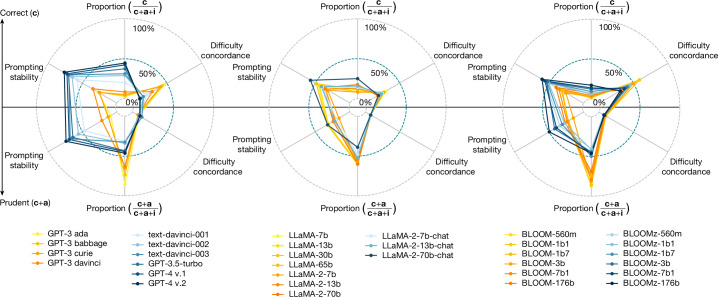
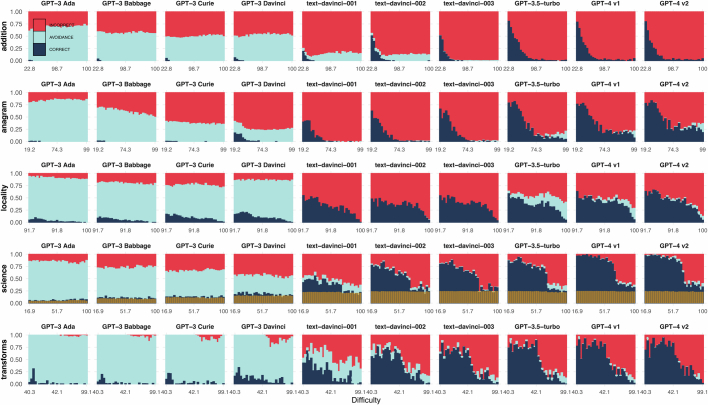
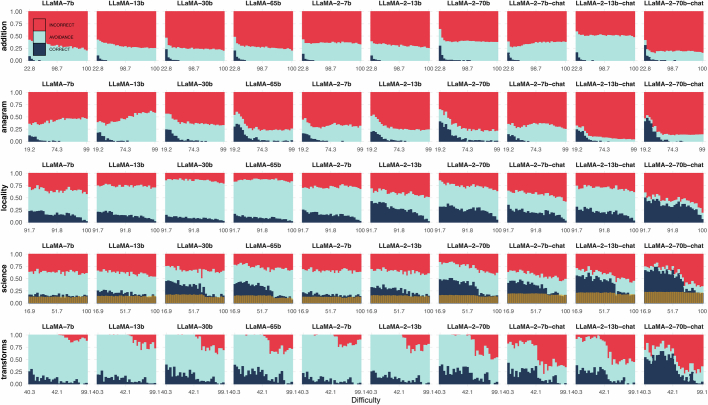
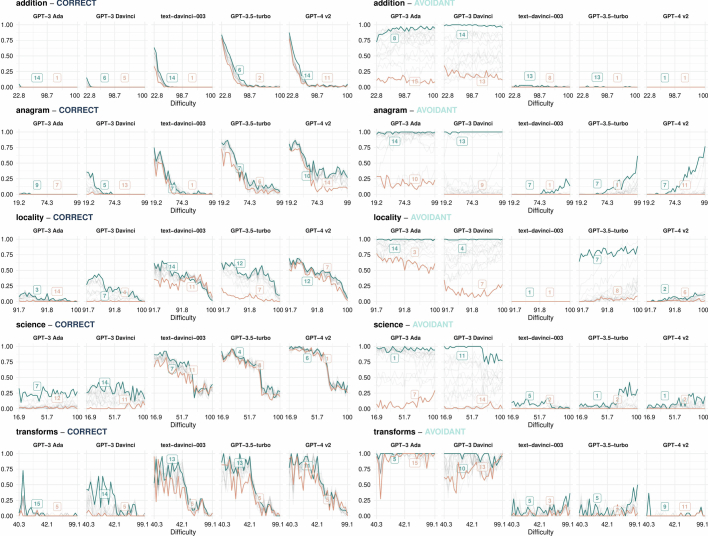
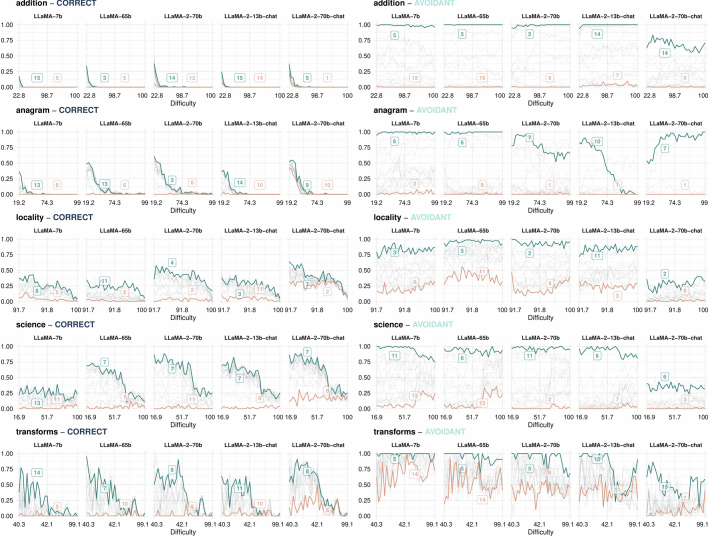
The prevailing methods to make large language models more powerful and amenable have been based on continuous scaling up (that is, increasing their size, data volume and computational resources 1 ) and bespoke shaping up (including post-filtering 2,3 , fine tuning or use of human feedback 4,5 ). However, larger and more instructable large language models may have become less reliable. By studying the relationship between difficulty concordance, task avoidance and prompting stability of several language model families, here we show that easy instances for human participants are also easy for the models, but scaled-up, shaped-up models do not secure areas of low difficulty in which either the model does not err or human supervision can spot the errors. We also find that early models often avoid user questions but scaled-up, shaped-up models tend to give an apparently sensible yet wrong answer much more often, including errors on difficult questions that human supervisors frequently overlook. Moreover, we observe that stability to different natural phrasings of the same question is improved by scaling-up and shaping-up interventions, but pockets of variability persist across difficulty levels. These findings highlight the need for a fundamental shift in the design and development of general-purpose artificial intelligence, particularly in high-stakes areas for which a predictable distribution of errors is paramount.
Overview
CoChat Summary
TL;DR
Across 32 LLMs from the GPT, LLaMA and BLOOM families on five benchmarks, scaling and instruction/alignment shaping improved correctness and prompt stability but did not create reliable low-difficulty operating regions. Shaped-up models increasingly replaced avoidance with plausible but incorrect answers, making errors harder for human supervisors to catch.
Key findings
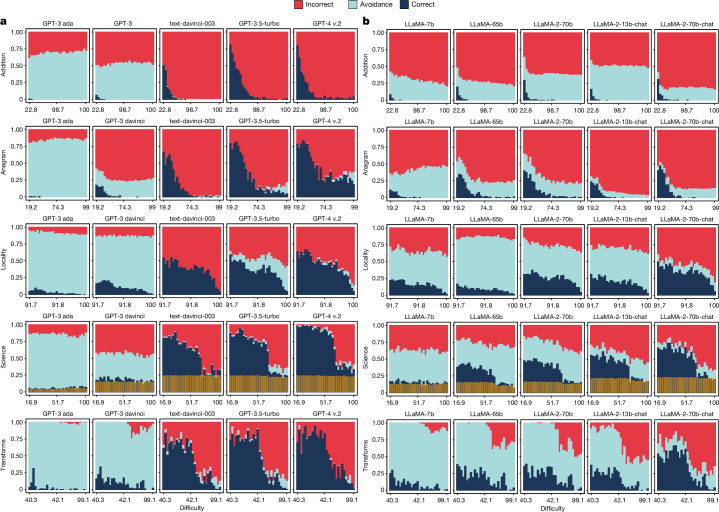
- Human difficulty proxies predicted correctness, but no error-free easy region emerged: for LLaMA, no model achieved 60% correctness at the simplest difficulty level (discounting 25% random guess for science), and only GPT-4 showed a low-difficulty science region with almost perfect results up to medium difficulty.
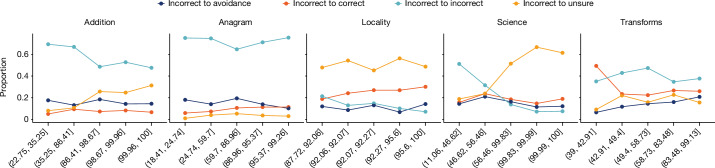
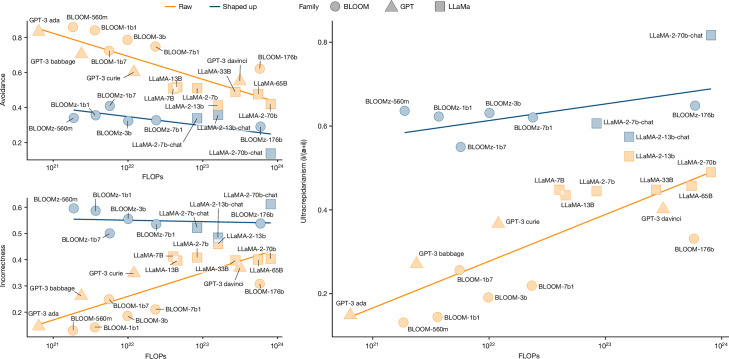
- Scaling and shaping exchanged avoidance for incorrectness: avoidance almost disappeared for GPT-4, incorrectness increased markedly from raw to shaped-up models, and ultracrepidarianism—incorrect over avoidant plus incorrect answers, i/(a + i)—rose.
- Prompting stability improved with scaling and shaping, but pockets of variability persisted across difficulty levels; raw GPT and all LLaMA models were highly prompt-sensitive even for unambiguous addition.
- Human supervision study S2 found few areas where the dangerous error of considering an incorrect answer correct was low enough to constitute a safe operating region.
Methods
- Analysed 32 models: 10 GPT, 10 LLaMA and 12 BLOOM, including raw and shaped-up versions, across five benchmarks: addition, anagram, locality, science and transforms. Each example was run with 15 natural prompt templates per benchmark, yielding approximately 4.2 million answers; temperature was set to zero and no system prompt was used.
- Data samples: 3,142 addition instances, 1,570 anagrams, 2,341 locality instances, science from 1,000 OpenBookQA questions plus 546 GPQA questions minus two over-length items, and 730 transforms items (73 tasks × 10 instances). Two human studies (S1 and S2) recruited participants via Prolific at £9 per hour.
- Difficulty was calibrated to a 0–100 human-failure scale via logistic mapping, then examples were split into 30 equal-sized difficulty bins. Analyses included Spearman rank correlations, six reliability indicators for correctness and prudence (proportion, prompting stability, difficulty concordance), and a scaling analysis using FLOPs.
Limitations
- Stated: participants were mostly non-experts, which affects calibrated difficulty values; the natural prompt sample came from diverse sources but lacked real-world prompt-frequency data; and only a sample of model families was covered, excluding LLMs that delegate to external tools or use sophisticated reasoning techniques.
- Evident: GPT models were accessed through APIs and may change over time; response scoring relied on algorithmic conditions and regular expressions, which may not capture all response nuance; calibrated difficulty values are estimates from human study S1 and should be interpreted cautiously, especially for small differences.
Model-written summary. Check it against the paper before relying on it.
Integrity signals
Registry
Cites
Statistics
Figures
Verification
Claims the paper makes
1 Valid · 0 Not valid · 9 Not checked · 58 Own results and interpretations
A result the paper reports from its own data — it cites no other source for it, so there is none to check. The quote shows it is in the paper.
In the paper
“F3b—improvement in prompt performance is not monotonic across difficulty levels.”
§ Larger and more instructable language models become less reliable > Results
plain- Asserted: passes — The authors put it forward as true.
- Checkable: passes — It can be checked against evidence.
- Load-bearing: passes — The paper’s conclusions depend on it.
- Based: passes — The paper gives a reason why it holds.
- Rests on an assumption not shown here.
A result the paper reports from its own data — it cites no other source for it, so there is none to check. The quote shows it is in the paper.
In the paper
“For the LLaMA family, no model achieves 60% correctness at the simplest difficulty level (discounting 25% random guess for ‘science’).”
§ Larger and more instructable language models become less reliable > Results
plain- Asserted: passes — The authors put it forward as true.
- Checkable: passes — It can be checked against evidence.
- Load-bearing: passes — The paper’s conclusions depend on it.
- Based: passes — The paper gives a reason why it holds.
- Rests on 2 assumptions not shown here.
A result the paper reports from its own data — it cites no other source for it, so there is none to check. The quote shows it is in the paper.
In the paper
“The percentage of avoidant answers rarely rises quicker than the percentage of incorrect ones.”
§ Larger and more instructable language models become less reliable > Results
hedged- Asserted: passes — The authors put it forward as true.
- Checkable: passes — It can be checked against evidence.
- Load-bearing: passes — The paper’s conclusions depend on it.
- Based: passes — The paper gives a reason why it holds.
- Rests on 2 assumptions not shown here.
A result the paper reports from its own data — it cites no other source for it, so there is none to check. The quote shows it is in the paper.
In the paper
“scaled-up, shaped-up models do not secure areas of low difficulty in which either the model does not err or human supervision can spot the errors”
§ Larger and more instructable language models become less reliable > Abstract
plain- Asserted: passes — The authors put it forward as true.
- Checkable: passes — It can be checked against evidence.
- Load-bearing: passes — The paper’s conclusions depend on it.
- Based: passes — The paper gives a reason why it holds.
- Rests on 2 assumptions not shown here.
A result the paper reports from its own data — it cites no other source for it, so there is none to check. The quote shows it is in the paper.
In the paper
“Supplementary Table 8 shows the correlations between correctness and the proxies for human difficulty. Except for BLOOM for addition, all of them are high.”
§ Larger and more instructable language models become less reliable > Results
plainstates an association- Asserted: passes — The authors put it forward as true.
- Checkable: passes — It can be checked against evidence.
- Load-bearing: unclear — It is unclear whether the paper’s conclusions depend on it.
- Based: passes — The paper gives a reason why it holds.
- Rests on an assumption not shown here.
18 more claims
Create a free account to see all 68 claims and to verify the 13 references still open.
- Probably not a substantial claim. 26
- It may state two separate claims as one. 27
Claims other papers make about this one
Each is checked against this paper’s own text: does it say what the citing paper says it does?
The source backs part of the claim, not all of it — or backs it for a different population, condition or comparison.
In the citing paper
“while its intrinsic fallibility, the tendency to produce confident but incorrect outputs, demands continuous human oversight.”
From Generative AI and Organizational Structure in the Knowledge Economy (2025) · cites this paper as Zhou et al. 2024
Experimental — accuracy not yet measuredThe cited source says what the claim attributes to it.
In the citing paper
“Second, they struggle with many aspects of reasoning (Shwartz, 2024;Zhou et al., 2024;Huckle and Williams, 2025).”
From There is no such thing as conscious artificial intelligence (2025) · cites this paper as Zhou et al., 2024
The cited source says what the claim attributes to it.
In the citing paper
“our result aligns with and extends recent findings that earlier LLMs were more likely to avoid answering difficult questions, whereas newer, larger, and more instructible models, instead of refusing to answer, often produced misleadingly authoritative yet flawed responses [41].”
From Generalization bias in large language model summarization of scientific research (2025) · cites this paper as [41]
The cited source says what the claim attributes to it.
In the citing paper
“Zhou et al. (2024) document that more capable language models can exhibit equal or higher hallucination rates on certain task categories”
From Generative AI and Organizational Structure in the Knowledge Economy (2025) · cites this paper as Zhou et al. (2024)
Citations
Cites
Exploring the Limits of Transfer Learning with a Unified Text-to-Text Transformer
Raffel, C., Shazeer, N., Roberts, A., Lee, K., Narang, S., Matena, M., Zhou, Y., Li, W., & Liu, P. J. (2019) · arXiv · doi:10.48550/arxiv.1910.10683 · Cited by 31,859 · cited 12×
“In Supplementary Note 13, we discuss how different groups of cells are named.”
InfluentialLanguage Models are Few-Shot Learners
Brown, T. B., Mann, B., Ryder, N., Subbiah, M., Kaplan, J., Dhariwal, P., Neelakantan, A., Shyam, P., Sastry, G., Askell, A., et al. (2020) · arXiv · doi:10.48550/arxiv.2005.14165 · Cited by 23,372 · cited 2×
“The first four models, GPT-3 ada, babbage, curie and davinci, are the original raw models in the family 14 .”
ChatGPT for good? On opportunities and challenges of large language models for education
Kasneci, E., Sessler, K., Küchemann, S., Bannert, M., Dementieva, D., Fischer, F., Gasser, U., Groh, G., Günnemann, S., Hüllermeier, E., et al. (2023) · Learning and Individual Differences · doi:10.1016/j.lindif.2023.102274 · Cited by 15,365
Scaling Laws for Neural Language Models
Kaplan, J., McCandlish, S., Henighan, T., Brown, T. B., Chess, B., Child, R., Gray, S., Radford, A., Wu, J., & Amodei, D. (2020) · arXiv · doi:10.48550/arxiv.2001.08361 · Cited by 9,550
ChatGPT for Good? On Opportunities and Challenges of Large Language Models for Education
Kasneci, E., Seßler, K., Küchemann, S., Bannert, M., Dementieva, D., Fischer, F., Gasser, U., Groh, G., Günnemann, S., Hüllermeier, E., et al. (2023) · doi:10.35542/osf.io/5er8f · Cited by 7,552
LLaMA: Open and Efficient Foundation Language Models
Touvron, H., Lavril, T., Izacard, G., Martinet, X., Lachaux, M.-A., Lacroix, T., Rozière, B., Goyal, N., Hambro, E., Azhar, F., et al. (2023) · arXiv · doi:10.48550/arxiv.2302.13971 · Cited by 4,602
Liu, P., Yuan, W., Fu, J., Jiang, Z., Hayashi, H., & Neubig, G. (2023) · ACM Computing Surveys · doi:10.1145/3560815 · Cited by 4,361 · cited 1×
“Although this prompt sensitivity has been analysed extensively 17–20 , it is poorly understood why an over-diligent system spouts a wrong answer for 100-digit addition instead of simply answering ‘I’m afraid I can’t do that’.”
Liu, P., Yuan, W., Fu, J., Jiang, Z., Hayashi, H., & Neubig, G. (2021) · arXiv · doi:10.48550/arxiv.2107.13586 · Cited by 4,352 · cited 1×
“Although this prompt sensitivity has been analysed extensively 17–20 , it is poorly understood why an over-diligent system spouts a wrong answer for 100-digit addition instead of simply answering ‘I’m afraid I can’t do that’.”
Training language models to follow instructions with human feedback
Ouyang, L., Wu, J., Jiang, X., Almeida, D., Wainwright, C. L., Mishkin, P., Zhang, C., Agarwal, S., Slama, K., Ray, A., et al. (2022) · arXiv · doi:10.48550/arxiv.2203.02155 · Cited by 4,208
Large language models in medicine
Thirunavukarasu, A. J., Ting, D. S. J., Elangovan, K., Gutierrez, L., Tan, T. F., & Ting, D. S. W. (2023) · Nature Medicine · doi:10.1038/s41591-023-02448-8 · Cited by 3,944 · cited 12×
“In Supplementary Note 13, we discuss how different groups of cells are named.”
Influential
Research works printed but not linked: 7
- Devlin, J., Chang, M.-W., Lee, K. & Toutanova, K. Bert: Pre-training of deep bidirectional transformers for language understanding. In Proc. 2019 Conference of the North American Chapter of the Association for Computational Linguistics 4171–4186 (Association for Computational Linguistics, 2019).
- Sun, J., Shaib, C. & Wallace, B. C. Evaluating the zero-shot robustness of instruction-tuned language models. In The Twelfth International Conference on Learning Representations (2024).
- Zeidner, M. & Matthews, G. Evaluation anxiety. Handb. Competence Motiv. 141, 163 (2005).
- Kuhn, L., Gal, Y. & Farquhar, S. Semantic uncertainty: linguistic invariances for uncertainty estimation in natural language generation. In The Eleventh International Conference on Learning Representations (2023).
- Li, M. et al. Think twice before assure: confidence estimation for large language models through reflection on multiple answers. Preprint at https://arxiv.org/html/2403.09972v1 (2024).
- Villalobos, P. et al. Position: Will we run out of data? Limits of LLM scaling based on human-generated data. In Proc. 41st International Conference on Machine Learning (PMLR, 2024)
- Dettmers, T., Pagnoni, A., Holtzman, A. & Zettlemoyer, L. QLoRA: efficient finetuning of quantized LLMs. Adv. Neural Inf. Process. Syst.36, 10088–10115 (2024).
Cited by
Items 101–200 of 277
Relational Agencies in Children’s Writing with Generative AI
Rice, M. F. (2025) · TechTrends · doi:10.1007/s11528-025-01063-3 · Cited by 4
“Even so, the sentience that Chat-GPT exudes is only a simulacrum of reality (Brassington, et al., 2024; Zhou et al., 2024).”
The Alignment Trap: Complexity BarriersPreprint
Yao, J. (2025) · arXiv (Cornell University) · doi:10.48550/arxiv.2506.10304 · Cited by 5
Architecture of InformationPreprint
Паржин, Ю. В. (2025) · arXiv (Cornell University) · doi:10.13140/rg.2.2.31172.74885 · Cited by 4
Drop2Sparse: Improving Dataset Distillation via Sparse Model
Huang, T.-F., & Lin, Y. (2025) · IEEE Transactions on Circuits and Systems for Video Technology · doi:10.1109/tcsvt.2025.3552047 · Cited by 3
“While there are reliability issues of large language model [16] that cannot be resolved effectively by collecting more training data.”
A Lacanian Interpretation of Artificial Intelligence Hallucination
Wang, Y. (2025) · AI & Future Society · doi:10.63802/afs.v1.i1.93 · Cited by 3
Hu, X., Lin, R., Huang, Y., Wu, X., Gong, Y., & Huang, H. (2025) · Endocrine · doi:10.1007/s12020-025-04421-6 · Cited by 3
“Hyperthyroidism is a chronic erroneous responses [7 ].”
The fools are certain; the wise are doubtful: Exploring LLM confidence in code completion
Kotti, Z., Dritsa, K., Spinellis, D. D., & Λουρίδας, Π. (2026) · Automated Software Engineering · doi:10.21203/rs.3.rs-7302683/v1 · Cited by 3
Cases and Lessons in Prompting Artificial Intelligence for Social Work
Fricker, S., Goldkind, L., Hackstein, S., & Weber, J. (2025) · IEEE International Requirements Engineering Conference Workshops (REW) · doi:10.1109/rew66121.2025.00087 · Cited by 3
“As models become more capable and fluent, these hallucinations often become more persuasive and harder to detect [28].”
Hu, Y., Cheng, Y.-Y., Lan, C.-C., Su, Y.-H., & Sung, S. (2025) · JMIR Medical Informatics · doi:10.2196/80072 · Cited by 4
“First, reliability and consistency remain major challenges [38,39].”
Lee, H., Shin, J.-S., Seo, Y., Kim, S. H., Lee, J., Shin, S. Y., & Song, S. Y. (2026) · Orthopaedic Journal of Sports Medicine · doi:10.1177/23259671251402988 · Cited by 3
“15,24 Therefore, the results of this study should be interpreted as a temporal benchmark rather than a permanent evaluation.”
Drobakha, A., Raschupkina, D., & Lahuta, L. (2026) · doi:10.69635/mssl.2026.2.2.37 · Cited by 3
Pumpo, M. D., Villani, L., Gualano, M. R., Buonsenso, D., Raffaelli, F., Donà, D., Laurenti, P., Maio, V., Boccia, S., & Ricciardi, W. (2026) · Frontiers in Public Health · doi:10.3389/fpubh.2026.1874389 · Cited by 3
“Correlation-based evaluation metrics can be misleading in the presence of variability in human judgments, and commonly used benchmarks often fail to account for inherent rating indeterminacy, thereby inflating estimates of agreement between automatic judges and human annotators (6–9).”
Farr, D. T., Ng, L. H. X., Cruickshank, I. J., Manzonelli, N., Clark, N., Starbird, K., Bastian, N. D., & West, J. D. (2025) · IEEE Access · doi:10.1109/access.2025.3585414 · Cited by 3
“As LLMs scale, they tend to become more confident and less hesitant in producing outputs [7].”
PARA UMA SOCIOLOGIA DA COMUNICAÇÃO ARTIFICIAL: CONDIÇÕES, TIPOS E IMPACTOS NA SOCIEDADE
Ocampo, S. P. (2025) · Sociologia & Antropologia · doi:10.1590/2238-38752025v1528 · Cited by 3
A Pilot Empirical Study on When and How to Use Knowledge Graphs as Retrieval Augmented Generation
Yuan, X., Liu, Y., Di, S., Wu, S., Zheng, L., Meng, R., Chen, L., Zhou, X., & Yin, J. (2026) · Lecture notes in computer science · doi:10.1007/978-981-92-0372-7_29 · Cited by 6
Cross sectional pilot study on clinical review generation using large language models
Luo, Z., Qiao, Y., Xu, X., Li, X., Xiao, M., Aijia, K., Wang, D., Pang, Y., Xie, X., Xie, S., et al. (2025) · npj Digital Medicine · doi:10.1038/s41746-025-01535-z · Cited by 7
Demonstrating Linked Battery Data to Accelerate Knowledge Flow in Battery Science
Dechent, P., Barbers, E., Clark, S., Lehner, S., Planden, B., Adachi, M., Sauer, D. U., Howey, D. A., & Paarmann, S. (2026) · Electrochimica Acta · doi:10.48550/arxiv.2410.23303 · Cited by 5
“Even though reasoning models like OpenAI o1 outperform many models on topics like maths and coding, in our study they performed worse on the RAG task, similar to [26], while also being much more computational intensive and slower to respond.”
MethodAmbiguity Collapse by LLMs: A Taxonomy of Epistemic RisksPreprint
Gur-Arieh, S., Wang, A., & Fazelpour, S. (2026) · SSRN Electronic Journal · doi:10.2139/ssrn.6118186 · Cited by 4
Do Thinking Tokens Help with Safety?Preprint
Ri, N., Panigrahi, A., & Arora, S. (2026) · arXiv (Cornell University) · doi:10.48550/arxiv.2606.25013 · Cited by 3
“…that scale alone should not be assumed to resolve safety failures as they find that larger models can remain unreliable under safety-relevant conditions, and that refusal robustness under adversarial pressure is not guaranteed by model size [Zhou et al., 2024, Anil et al., 2024, Wang, 2026].”
Shen, J., Huang, R., Min, D., Che, H., Li, B., Liu, L., Zhang, Z., Cheng, J., & Wang, S. (2025) · Chinese Science Bulletin (Chinese Version) · doi:10.1360/tb-2025-0185 · Cited by 2
Strategies for community-sourced biocuration in bioinformatics: a case study on MIBiG 4.0
Blin, K., Loureiro, C., Louwen, N. L. L., Navarro-Muñoz, J. C., Gerstmans, H., Robinson, S. L., Rutz, A., Reitz, Z. L., Doering, D. T., van der Hooft, J. J. J., et al. (2025) · Briefings in Bioinformatics · doi:10.1093/bib/bbaf659 · Cited by 2
Artificial Intelligence in Mental Health
Earnhardt, A. V., Riordan, P. A., Kahlon, C. H., Nwajei, F. I., & McCants, K. M. (2025) · Nursing Clinics of North America · doi:10.1016/j.cnur.2025.09.011 · Cited by 2
Measuring What AI Systems Might Do: Towards A Measurement Science in AI
Voudouris, K., Thalmann, M., Kipnis, A., Hernández‐Orallo, J., & Schulz, E. (2026) · Minds and Machines · doi:10.1007/s11023-026-09805-9 · Cited by 3
“Recognising the limitations of simple benchmarking, many researchers have turned to more sophisticated statistical approaches, most prominently Item Response Theory (IRT) and related latent-variable models [26, 41–44].”
Self-citationCai, J., Chen, J., Yu, T., He, L., Chen, L., Qi, H., Zhan, X., Yu, W., Huang, X., & Huang, P. (2026) · Scientific Reports · doi:10.1038/s41598-026-46766-6 · Cited by 2
“According to the guidelines 35 , it is recommended that patients continue supplementation with multivitamins after bariatric surgery and undergo lifelong monitoring of nutritional status.”
Gómez, R., Miranda, C. E., Romero-González, J.-A., Esparza, D. M. C., Alfonso-Francia, G., Chávez‐Urbiola, E. A., Ramírez-Pedraza, A., & Terven, J. R. (2026) · Machine Learning and Knowledge Extraction · doi:10.3390/make8060141 · Cited by 5
Heckmann, N. S., Papoutsi, D. G., Barbieri, M. A., Battini, V., Molgaard, S. N., Schmidt, S. O., Melskens, L., & Sessa, M. (2026) · Pharmaceutical Research · doi:10.1007/s11095-026-04121-4 · Cited by 4
“…of parameters) but they all were smaller than general purpose LLMs tested by Abate et al. As it has been widely described in the scientific literature, model size does not guarantee better causal reasoning and may, paradoxically, yield highly confident but unverified or inaccurate statements [35].”
Ambiguity Collapse by LLMs: A Taxonomy of Epistemic Risks
Gur-Arieh, S., Wang, A., & Fazelpour, S. (2026) · ACM Conference on Fairness, Accountability, and Transparency (FAccT) · doi:10.1145/3805689.3806469 · Cited by 7
A NEW APPROACH TO BUILDING ENERGY MODELS OF NEURAL NETWORKS
Parzhin, Y., Lapin, M., & Bokhan, K. (2025) · Advanced Information Systems · doi:10.20998/2522-9052.2025.4.13 · Cited by 2
“…to consider the operation of this network purely from an energetic perspective, let us note that the internal energy of the network, as we have established, corresponds to the energy of neurons (units) according to formulas (5, 6), whereas the energy of neuron interconnections remains undefined.”
Let’s Talk AI with AI Expert José Hernández-Orallo
Hernández‐Orallo, J., & Steffen, B. (2025) · Lecture notes in computer science · doi:10.1007/978-3-032-09008-9_13 · Cited by 2
Self-citationİşcan, M. (2026) · arXiv (Cornell University) · doi:10.48550/arxiv.2606.06454 · Cited by 2
“We are careful about the limits of this principle (transfer is not guaranteed in either direction (Kojima et al., 2022; Zhou et al., 2024), and capability-dependent effects in other models or tasks are not ruled out) but as a negative screen it is useful, and it organizes our two-tier design.”
Naser, M. Z. (2026) · Language Resources and Evaluation · doi:10.1007/s10579-026-09938-4 · Cited by 3
Beyond Accuracy: Rethinking Hallucination and Regulatory Response in Generative AI
Li, Z., Yi, W., & Chen, J. (2025) · arXiv · doi:10.48550/arxiv.2509.13345 · Cited by 1
“Worse still, fine-tuning through human feedback further exacerbates such flaws, as LLMs would inadvertently prioritise persuasive or rhetorically appealing responses over those that are truthful (Zhou et al. 2024).”
Internal Credit and External Blame: Self-Attribution in Operations and Supply Chain Performance
Niu, Y., Qiao, X., Wu, J., & Yang, X. (2026) · Manufacturing & Service Operations Management · doi:10.1287/msom.2025.0548 · Cited by 5
Integration of Ai Tools into an Ai-Driven Software System to Make Learning Programming Easier
Drašković, D. (2025) · IEEE Global Engineering Education Conference (EDUCON) · doi:10.1109/educon62633.2025.11016313 · Cited by 1
“Model performance can be improved through techniques such as prompt engineering, fine-tuning, and reinforcement learning with human feedback (RLHF) which help reduce biases and improve accuracy [12].”
Integration of ChatGPT into the Process of Teaching Spanish as a Foreign Language
Kargovskaia, E. A., Kuznetsova, V. V., & Lagos, C. V. S. (2025) · Педагогика и просвещение · doi:10.7256/2454-0676.2025.3.74247 · Cited by 1
Wagner, W., GASKELL, G. D., Paraschou, E., Lyu, S., Michali, M., & Vakali, A. I. (2025) · Computers in Human Behavior Artificial Humans · doi:10.1016/j.chbah.2025.100191 · Cited by 2
Pacheco, A. F., Guimar�ães, N., Torres, A., Silvano, P., & Almeida, I. F. (2025) · Revista da Associação Portuguesa de Linguística · doi:10.26334/2183-9077/rapln13ano2025a12 · Cited by 1
Tackling Distribution Shift in LLM via KILO: Knowledge-Instructed Learning for Continual Adaptation
Muttakhiroh, L., & Fevens, T. (2025) · Machine learning for signal processing ... · doi:10.1109/mlsp62443.2025.11204312 · Cited by 1
“However, instruction tuning alone has limitations: it often lacks grounding in explicit domain knowledge, making it prone to hallucinations or superficial reasoning, especially in specialized or dynamic domains [12, 13].”
SRF - A Structured Method for Enhancing Large Model Reasoning
Zhu, Q. (2025) · IEEE International Joint Conference on Neural Network · doi:10.1109/ijcnn64981.2025.11228375 · Cited by 1
Synthetic Malware at Scale: Malicious Code Generation With Code Transplanting
Wang, G., Chen, D., Gu, X., Chen, Y., & Shen, B. (2025) · IEEE Transactions on Software Engineering · doi:10.1109/tse.2025.3633280 · Cited by 1
“Although larger GPT models like GPT-4 are capable of code completion, they often suffer from more hallucinations due to their complex architectures and vast number of parameters, which introduce a higher degree of uncertainty [34], [35].”
P-MLP: Language-conditioned task planning with multimodal lexical priors over labels
Liu, Y., Sun, W. J., Zheng, Y., Liu, J., Chen, L., Zhao, Y., Zhang, G., Yu, H., & Mian, A. S. (2025) · Knowledge-Based Systems · doi:10.1016/j.knosys.2025.115094 · Cited by 2
Using Human Cumulative Prospect Theory to Understand Large Language Models Decision-Making
Zhang, G., Wu, J., Wang, P., & Tan, M. (2025) · IEEE Transactions on Computational Social Systems · doi:10.1109/tcss.2025.3636502 · Cited by 1
“W ITH the advent of increasingly capable large language models (LLMs) comes the urgency to improve our understanding of how they learn and make decisions [1].”
AI vs. MD: Benchmarking ChatGPT and Gemini for Complex Wound Management
Corradini, L., Marcaccini, G., Seth, I., Rozen, W. M., Biagiotti, C., Cuomo, R., & Giardino, F. R. (2025) · Journal of Clinical Medicine · doi:10.3390/jcm14248825 · Cited by 2
“This functionality is particularly applicable in remote triage pathways [18].”
Can large language models mimic airline passenger preferences?
Voltes-Dorta, A., & Suau-Sánchez, P. (2025) · Artificial Intelligence for Transportation · doi:10.1016/j.ait.2025.100034 · Cited by 6
Large language models for pattern recognition in text data
Kosayakova, A., Gusmanovich, K. I., Spada, L. L., Zeeshan, N., Bakyt, M., Moldamurat, K., & Abdirashev, O. (2025) · IAES International Journal of Artificial Intelligence · doi:10.11591/ijai.v14.i6.pp5311-5332 · Cited by 1
Ocampo, S. P. (2025) · Revista MAD · doi:10.5354/0719-0527.2025.82303 · Cited by 1
Shi, J., Yan, W., Jiang, K., & Sadowski, B. M. (2026) · Journal of Evolutionary Economics · doi:10.1007/s00191-025-00930-9 · Cited by 2
“Moreover, disruptive innovations in NLP enable firms to explore novel use cases, such as conversational AI and automated content generation, to which incumbents relying on traditional approaches may struggle to adapt (Zhou et al. 2024).”
The year of silent failures: AI technical debt and the crisis of verification
Korolev, Y. (2025) · AI DECISIONS · doi:10.65114/aide.gmry6g41 · Cited by 1
Liu, Y., Li, W., Wang, Y., Chen, N., & Chen, M. (2026) · Big Data and Cognitive Computing · doi:10.3390/bdcc10020056 · Cited by 1
“However, even in RAG systems utilizing long-reasoning models, the incidence of hallucinations remains significant when dealing with complex problems [12], and due to the enhancement of model performance, hallucinations may become even harder to detect.”
Bewertung von Chatbots für die Produktion
Streibel, L., Geiger, J., Bernhard, O., Wegmann, M., & Reuter, C. (2026) · Zeitschrift für wirtschaftlichen Fabrikbetrieb · doi:10.1515/zwf-2026-1012 · Cited by 1
Adiwibowo, A. S., & Wahyuni, E. T. (2026) · Information Technology and Management · doi:10.1007/s10799-026-00488-3 · Cited by 1
Ra, D., Lee, D., & Lee, S. (2026) · Chaos Solitons & Fractals · doi:10.1016/j.chaos.2026.118157 · Cited by 1
Taxi Repositioning via LLM-Driven Multi-Agent Coordination and Experience Accumulation
Yu, H., Zhang, J., Luo, X., Yin, W., Liu, Z., Huang, J., & Liu, X. (2025) · IEEE International Conference on Intelligent Transportation Systems (ITSC) · doi:10.1109/itsc60802.2025.11423831 · Cited by 1
“Unlike traditional neural models, LLMs exhibit strong generalization to unseen tasks and can rapidly adapt to new scenarios through few-shot prompting, instruction tuning, or in-context learning [17].”
Generative Artificial Intelligence-Empowered Virtual Evolution of Enzyme with the VERnet Model
Li, C., Xu, W., Yang, H., Li, Y., Zhang, L., Chen, Z., Wang, S., Xie, Y., Li, H., Liu, Y., et al. (2026) · ACS Catalysis · doi:10.1021/acscatal.6c00759 · Cited by 1
Natural language querying of biological databases with large language models
Makarov, V. A., Stroganov, O. V., Furlong, L. I., Evarts, B., van den Biggelaar, L., Goulas, A., Stolte, E., Marren, D., & Greiffenberg, L. (2026) · Drug Discovery Today · doi:10.1016/j.drudis.2026.104654 · Cited by 2
Artificial Intelligence in the Nursing Profession: Applications, Challenges, and Future Directions
Philip, R. (2026) · International Journal of Medical Pharmaceutical and Health Sciences (IJMPHS). · doi:10.62946/ijmphs/3.1.473-485 · Cited by 1
“It takes more than just memorizing facts, identifying patterns, cognitive psychologists [68] .”
Effects of Generative AI Errors on User Reliance Across Task Difficulty
Anthis, J. R., Cha, H., Barocas, S., Chouldechova, A., & Hofman, J. M. (2026) · CHI Conference Extended Abstracts on Human Factors in Computing Systems (CHI EA) · doi:10.1145/3772363.3798463 · Cited by 2
Comparative Performance of Three GPT Models on Japanese Dental Board-Style Multiple-Choice Questions
Fukuda, H., Morishita, M., Muraoka, K., Maeda, S., Nakamura, T., Habu, M., Awano, S., & Ono, K. (2026) · Computers · doi:10.3390/computers15050317 · Cited by 1
The Quality of AI-Generated CABG Counseling: A Blinded Comparison of Two Language Models
Özbakkaloğlu, A., Rahman, Ö. F., Keleş, E., Daylan, A., Cansu, D., & Bozok, Ş. (2026) · Journal of Clinical Medicine · doi:10.3390/jcm15103896 · Cited by 1
“This finding suggests that, although large language models generally produce satisfactory responses, their performance may be more variable at the level of individual questions [12,14].”
Deng, X., & Li, Y. (2026) · Behavioral Sciences · doi:10.3390/bs16050762 · Cited by 1
“Transformer-based and large language models offer strong semantic flexibility, but their outputs may be sensitive to prompts, model versions, proprietary training procedures, and computational cost (Demszky et al., 2023; Nikadon et al., 2025; Sclar et al., 2023; Zhou et al., 2024).”
MAESTRO: large language model-enabled cross-agency coordination for natural disaster early warning
Wang, J., Wang, N., Shen, Y., Lu, W., Lin, P., Ouyang, M., Wang, Y., Wang, J., Huang, X., Liang, W., et al. (2026) · npj Artificial Intelligence · doi:10.1038/s44387-026-00124-z · Cited by 2
“Recent advances in large language models (LLMs) and multi-agent architectures 41 – 43 offer preciselythiscapacity.”
Janowczyk, A. R., Merkler, D., Michielin, O. A., & Madabhushi, A. (2026) · The Lancet Digital Health · doi:10.1016/j.landig.2026.101000 · Cited by 2
A Large Language Model Pipeline for Stroke Staging Using Electronical Medical Records
Luo, X., Liu, Y., Yk, M., Li, C., Yao, M., Xiang, H., Qin, X., Liu, J., Zhan, X., Zhang, C., et al. (2026) · Journal of Evidence-Based Medicine · doi:10.1111/jebm.70159 · Cited by 1
“Larger and more instructable LLMs may less reliable, especially in a field such as medicine where accuracy requirements are very high [ 38 ].”
Sušnjak, T. (2026) · MethodsX · doi:10.1016/j.mex.2026.104041 · Cited by 2
“Larger models are often more robust, but pockets of variability persist even in stronger instruction-tuned systems [9, 10, 11].”
Small language models in medicine
Qin, Y., Yan, T., Wong, M. Y. H., Srinivasan, S., Zhou, H.-Y., Eils, R., Tham, Y. C., Shah, N. H., Wu, J., Wang, H., et al. (2026) · Nature Biomedical Engineering · doi:10.1038/s41551-026-01734-3 · Cited by 4
Çekiç, E. C., Kumru, M., Yılmaz, B., Çelikkol, B., & Tavşan, O. (2026) · Clinical and Experimental Dental Research · doi:10.1002/cre2.70416 · Cited by 2
“Zhou et al. (2024) further noted that larger and more extensively fine‐tuned models, while generally more successful in complex tasks, may also experience stability loss in certain scenarios.”
Aliaga, C. A. T., Fuentes, V. G. H., Karim, H. B. A., AlDahoul, N., & Tan, M. J. (2026) · Frontiers in Artificial Intelligence · doi:10.3389/frai.2026.1894116 · Cited by 2
On a Misleading Ethical Fluency in Language Models: Reply to Danagher
Metcalf, T. R. (2026) · Philosophy & Technology · doi:10.1007/s13347-026-01201-6 · Cited by 1
“Certainly, we must take seriously reports that language models may have made “deci-sions” that were harmful in ethically salient ways (Hill, 2025; Horwitz, 2025; Mole, 2025 ), and that they still suffer from fabrications or “hallucinations” (Jackson et al., 2025; Zhou et al., 2024).”
Del Ars Magna a la inteligencia artificial generativa
Llavori, R. B. (2025) · Revista de Senología y Patología Mamaria · doi:10.1016/j.senol.2024.100663 · Cited by 1
Guzmán-Monteza, Y., Fernández-Luna, J. M., & Ribadas, F. J. (2025) · Electronics · doi:10.3390/electronics14081676 · Cited by 1
“Zhou et al. [33] argue that there is a need for a fundamental change in the design and development of general-purpose artificial intelligence, particularly in high-risk areas for which a predictable distribution of errors is essential.”
Fung, S.-H., Zhang, Z., Wang, R., Chen, M., Wong, B. S., Li, K. Y., Hong, C., Zhou, J., Yip, K. Y., Tsui, S. K., et al. (2026) · Genome biology · doi:10.1186/s13059-026-04240-6 · Cited by 1
Fully analog end-to-end online training with real-time adaptibility on integrated photonic platformPreprint
Guo, Z., Aadhi, A. R., McCaughan, A. N., Tait, A. N., Youngblood, N., Buckley, S. M., & Shastri, B. J. (2025) · arXiv (Cornell University) · doi:10.48550/arxiv.2506.18041 · Cited by 1
Varela, I. D., Sendra-Arranz, R., Sorozábal, P., Valverde-García, J. M., Laudanski, A. F., Gutiérrez, Á., Rocón, E., & Cebrián, M. (2026) · arXiv (Cornell University) · doi:10.48550/arxiv.2606.02282 · Cited by 1
“The fundamental obstacle is the stochastic nature of these systems: their outputs are prone to hallucinations, emergent failure modes, and generalisation breakdowns that are inherently difficult to anticipate or detect [8–12].”
The Discontinuity of the Virtual Toward the Non-Living and the LivingPreprint
Bazac, A. (2024) · Qeios · doi:10.32388/u1hnvd
The Discontinuity of the Virtual Toward the Non-Living and the LivingPreprint
Bazac, A. (2024) · Qeios · doi:10.32388/u1hnvd.2
Dawson, M. G., Deer, R., & Boguslawski, S. (2024) · SSRN Electronic Journal · doi:10.2139/ssrn.5055559
No Consciousness? No Meaning (and no AGI!)Preprint
Masi, M. (2024) · Qeios · doi:10.32388/dn232y
When Can Proxies Improve the Sample Complexity of Preference Learning?Preprint
Zhu, Y., de Souza, D. A., Shi, Z., Yang, M., Minervini, P., D’Amour, A., & Kusner, M. J. (2024) · arXiv (Cornell University) · doi:10.48550/arxiv.2412.16475 · Cited by 2
“For example, humans raters tend to prefer longer answers to a question, even if the answer is less informative Zhou et al. (2024).”
Masaya, S. (2025) · The Leading Edge · doi:10.1190/tle44020114.1
Wang, X. (2025) · Research Square · doi:10.21203/rs.3.rs-6551928/v1 · Cited by 1
WITHDRAWNPreprint
(2025) · PsyArXiv (OSF Preprints) · doi:10.31234/osf.io/jy3st_v2
Scalable Tabular Dataset Labeling with Language Models
Hu, Y., Fountalis, I., Tian, J. W., & Vasiloglou, N. (2025) · International Conference on Scalable Scientific Data Management (SSDBM) · doi:10.1145/3733723.3733739
WITHDRAWNPreprint
(2025) · PsyArXiv (OSF Preprints) · doi:10.31234/osf.io/jy3st_v4
WITHDRAWNPreprint
(2025) · PsyArXiv (OSF Preprints) · doi:10.31234/osf.io/jy3st_v5
WITHDRAWNPreprint
(2025) · PsyArXiv (OSF Preprints) · doi:10.31234/osf.io/jy3st_v7
WITHDRAWNPreprint
(2025) · PsyArXiv (OSF Preprints) · doi:10.31234/osf.io/jy3st_v8
Title Generative Ai as a Fuzzy Validation Partner: A Perspective on Methodology and JudgmentPreprint
van Capelleveen, J., van de Wetering, R., Alechina, N., Janssens, G., & Wenniger, G. M. D. B. (2025) · SSRN Electronic Journal · doi:10.2139/ssrn.5402161
Generative AI’s Influence in Computer Science Classrooms: A Rapid Review MethodologyPreprint
Lin, M. P.-C., Jhajj, G., Lin, F. O., Poitras, E., Chang, D., & Ryoo, J. (2025) · EdArXiv (OSF Preprints) · doi:10.35542/osf.io/xfcek_v2
Chuanchen, D. U., ZHENG, Y., Qianqian, G. U. O., & Guoxiong, L. I. U. (2025) · Advances in Psychological Science · doi:10.3724/sp.j.1042.2025.2027 · Cited by 3
AI Influence: Mechanisms, Amplifiers, and ConsequencesPreprint
Qiu, T. A., He, Z., Lin, T., Glickman, M., Calcott, R., Wihbey, J., & Kleiman-Weiner, M. (2025) · SSRN Electronic Journal · doi:10.2139/ssrn.5756323
Ding, D., Wang, Z., Tang, J., & Xian, M. (2025) · Journal of Asian Architecture and Building Engineering · doi:10.1080/13467581.2025.2600772
High school students’ over-reliance on incorrect ChatGPT recommendations
Puppart, B. (2025) · DSpace repository (University of Tartu)
Is AIGC Technology Useful? A Comparative Analysis of Search Technologies for Online Museums
Zeng, Y., Yan, C., Li, J., Yao, J., & Sun, Z. (2025) · Proceedings of the Association for Information Science and Technology · doi:10.1002/pra2.1362
“However, there are several unsolved issues for GS, including difficulty in training (Hadi et al., 2023), hallucinations in results (Farquhar et al., 2024) and low-quality answers (Zhou et al., 2024).”
Fu, T., Song, Y., Li, K., & Zhang, H. (2025) · International Conference on Artificial Intelligence and Intelligent Information Processing (AIIIP) · doi:10.1145/3778534.3778584
“The top international scientific academic journal Nature published a new study [2], revealing serious flaws exhibited by large AI models when dealing with complex problems.”
Language Models for Disinformation Detection: To be Large or to be Small?
Kalamakis, I., Liappi, S., Papakostas, D., & Katsaros, D. (2025) · IEEE/ACS International Conference on Computer Systems and Applications (AICCSA) · doi:10.1109/aiccsa66935.2025.11315272 · Cited by 2
“As they become larger and larger, they become less reliable [26].”
Ferres, J. M. L. (2026) · Wiley eBooks · doi:10.1002/9781394413096.app1
Wu, S., Xu, C., Xue, Z., Huang, Y., Xu, G., Cui, Y., Ma, J., Ma, R., & Xie, C. (2026) · Frontiers in Earth Science · doi:10.3389/feart.2025.1695920
“Recent work further shows that GPT can pass a three-player Turing test (Jones and Bergen, 2025), underscoring that machine-generated but incorrect answers may be highly persuasive to non-expert audiences (Zhou et al., 2024).”
Component-wise independent adaptive learning and local optimization for long-term forecasting
Chen, F. C., Cheng, K., Wang, S., & Wang, Y. (2026) · Engineering Applications of Artificial Intelligence · doi:10.1016/j.engappai.2026.113845
A few notes on the scalar foundations of foundation models
Dhaliwal, R. S. (2026) · Cambridge Forum on AI Culture and Society · doi:10.1017/cfc.2025.10013
“Recent research in computer science has shown signs that larger models may not only be pro-hibitively costlier but also, in some cases, less likely to sustain their veracity and performance levels in general (Caballero et al. 2022; Kaplan et al. 2020; McKenzie et al. 2023; Zhou et al. 2024).”
An Explainable Framework for Text Generation Tasks
Petrillo, L., Martinelli, F., Santone, A., & Mercaldo, F. (2025) · IEEE International Conference on Bioinformatics and Biomedicine (BIBM) · doi:10.1109/bibm66473.2025.11356613
“Furthermore, their intricate internal mechanisms often remain obscure, which poses a threat to understanding their behavior, limitations, and potential risks [3].”
Metadata
- Authors
- Zhou, L., Schellaert, W., Martínez-Plumed, F., Moros-Daval, Y., Ferri, C., & Hernández-Orallo, J.
- Affiliations
- University of Cambridge (GB)
- Universitat Politècnica de València (ES)
- ORCID
- Venue
- Nature
- Published
- 2024-09-25
- Volume
- 634
- Issue
- 8032
- Pages
- 61-68
- ISSN
- 0028-0836 (ISSN-L)
- 1476-4687
- PMC
- PMC11446866
- OpenAlex
- W4402827393
- Cited by
- 203
- References
- 47
- Citations by year
- 2026: 98 · 2025: 95 · 2024: 10
- FWCI
- 29.90
- Type
- journal article
- Language
- en
- Open access
- hybrid
- doi.org
- Licence
- cc-by
- creativecommons.org/licenses/by/4.0 (tdm)
- creativecommons.org/licenses/by/4.0 (vor)
- Locations
- Nature (publishedVersion, cc-by)
- PubMed Central (publishedVersion, cc-by)
- PubMed (publishedVersion)
- RiuNet (Universitat Politècnica de València) (publishedVersion, cc-by)
- Apollo (University of Cambridge) (submittedVersion, cc-by)
- RePEc: Research Papers in Economics (submittedVersion)
- Funders
- Open Philanthropy Project
- Generalitat Valenciana (CIPROM/2022/6, 952215, PID2021-122830OB-C42)
- Defense Advanced Research Projects Agency (HR00112120007)
- Horizon 2020 Framework Programme (EC H2020, 952215)
- European Regional Development Fund (MCIN/AEI/10, H2020, PID2021-122830OB-C42, MICIU/AEI/10)
- Agencia Estatal de Investigación (13039, MCIN / AEI/10, PID2021-122830OB-C42, 10.13039, H2020, AEI/10, PID2021)
- Topics
- Physical Sciences › Computer Science › Artificial Intelligence › Topic Modeling
- Physical Sciences › Computer Science › Artificial Intelligence › Natural Language Processing Techniques
- Physical Sciences › Computer Science › Artificial Intelligence › Adversarial Robustness in Machine Learning
- Keywords
- large language models, model reliability, task avoidance, scale-up, human oversight, error distribution
- MeSH terms
- Feedback, Natural Language Processing, Research Design, Reproducibility of Results
About these checks
Registry, retraction, Cites and statistics results are computed, not judged, with one exception: a printed reference that no index lists is read once by a model before it counts as a citation error. Claims are extracted by a model and kept only when their quote appears verbatim in the text; each cited source is then checked, with a model’s help, for whether it says what the claim relies on. Those verdicts can be wrong — read the claim’s quote and the cited source before relying on one.
The claim verdicts this report counts are experimental: their accuracy is not yet measured.
A language model drew the claims from the paper on 2026-10-05, under version 3 of the claim definition (model deepseek-v4.1-flash, prompt extract-v3).
A second model labelled each claim on 2026-10-05 (model jev-1.13-20260917, definition revision gold-guideline-v0.2).
Statistics and arithmetic are recomputed, not judged.
Confidence bands are shown only for fields calibrated on our annotated test set. None is calibrated yet, so no band is shown.
What counts as a claim ›How we measure confidence ›How we check this ›
Are you an author, or do you see a problem with this page? Request a review
Data sources
Bibliographic data: Semantic Scholar, OpenAlex, Crossref.
Contains information from the Semantic Scholar Academic Graph Datasets, made available under the ODC Attribution License (ODC-BY 1.0).
Semantic Scholar’s data is described in: Kinney, R., et al. (2023). The Semantic Scholar Open Data Platform. arXiv:2301.10140.
