

The DOI matches its Crossref record; 67 of the 67 references it cites were found in a registry or an index; 30 of the 41 sources its claims cite were checked for support.
Scaling and logic in the colour code on a superconducting quantum processor
Open accessAbstract
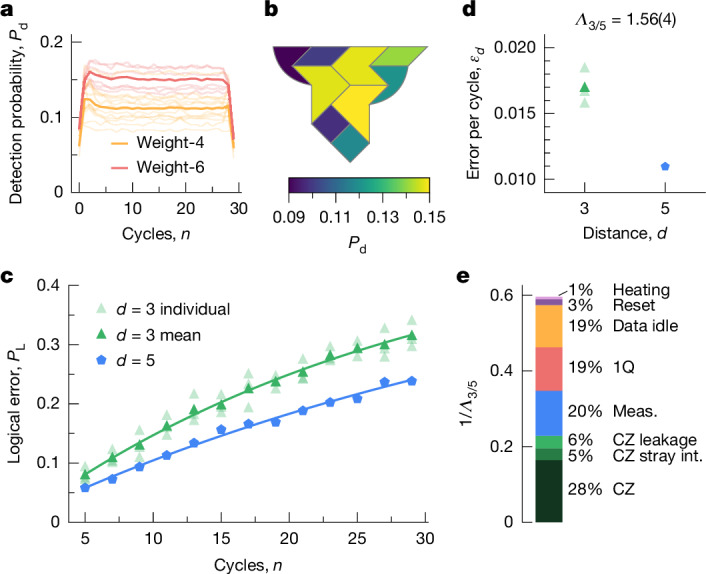
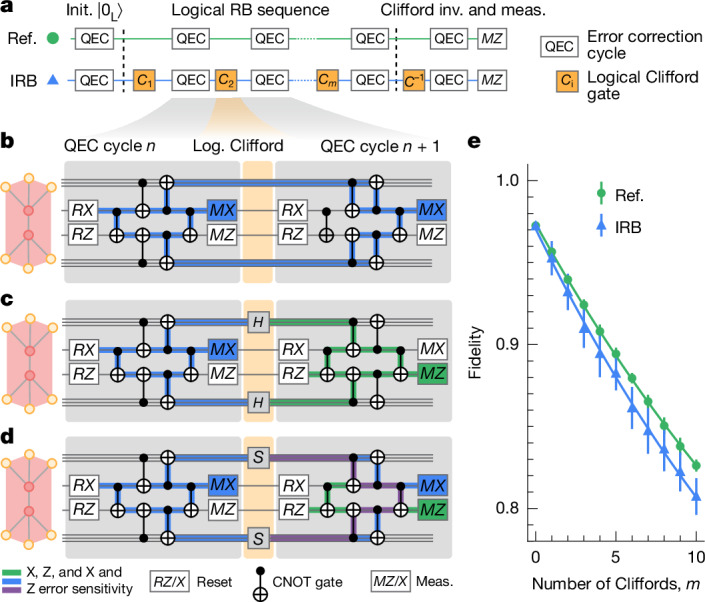
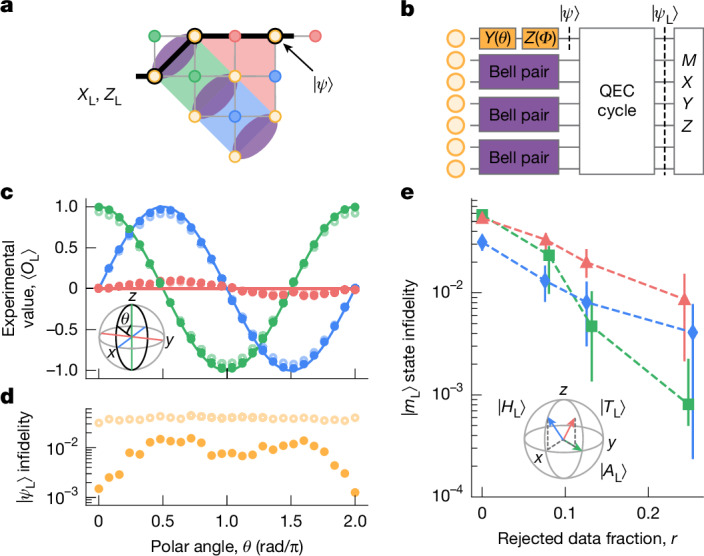
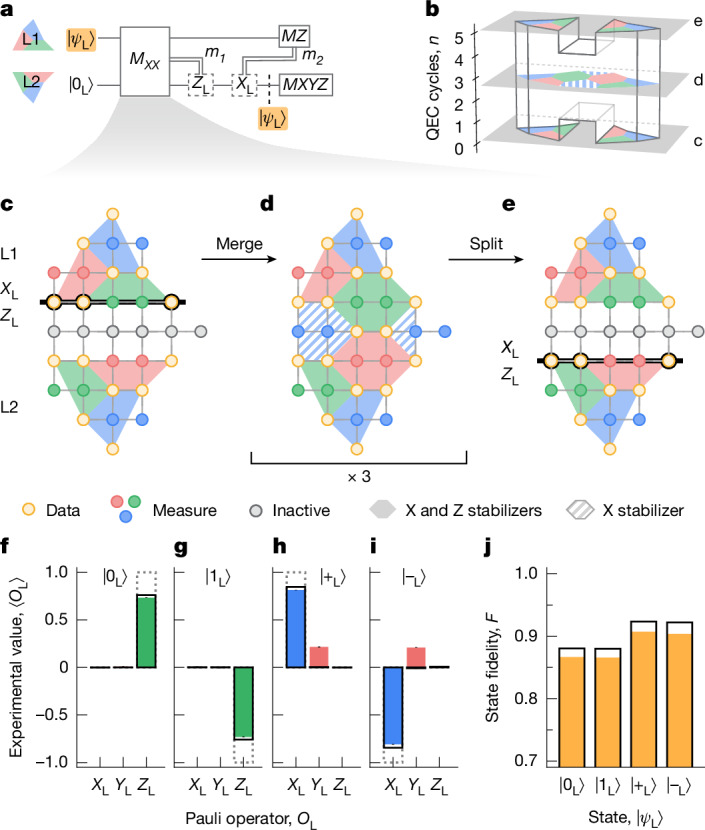
Quantum error correction [1–4] is essential for bridging the gap between the error rates of physical devices and the extremely low error rates required for quantum algorithms. Recent error-correction demonstrations on superconducting processors [5–8] have focused primarily on the surface code [9], which offers a high error threshold but poses limitations for logical operations. The color code [10] enables more efficient logic, but it requires more complex stabilizer measurements and decoding. Measuring these stabilizers in planar architectures like superconducting qubits is challenging, and realizations of color codes [11–19] have not addressed performance scaling with code size on any platform. Here, we present a comprehensive demonstration of the color code on a superconducting processor [8]. Scaling the code distance from three to five suppresses logical errors by a factor of Λ 3/5 = 1.56(4). Simulations indicate this performance is below the threshold of the color code, and the color code may become more efficient than the surface code following modest device improvements. We test transversal Clifford gates with logical randomized benchmarking [20] and inject magic states [21], a key resource for universal computation, achieving fidelities exceeding 99 % with post-selection. Finally, we teleport logical states between color codes using lattice surgery [22]. This work establishes the color code as a compelling research direction to realize fault-tolerant quantum computation on superconducting processors in the near future.
Overview
CoChat Summary
## TL;DR
The paper reports a superconducting-processor demonstration of the colour code, showing logical error suppression when scaling from distance 3 to 5 and implementing several fault-tolerant building blocks. It also characterizes transversal Clifford gates, high-fidelity magic state injection, and logical-state teleportation with lattice surgery.
## Key findings
- Scaling the colour code from distance 3 to 5 suppresses logical errors by a factor of Λ3/5 = 1.56(4); with the neural-network decoder the authors report ε5 = 0.0110(2).
- For distance-5 memory experiments, the average error-detection probability was Pd,6 = 0.149 for weight-6 stabilizers versus Pd,4 = 0.112 for boundary weight-4 stabilizers.
- Logical randomized benchmarking on a distance-3 code gives an average logical Clifford gate error of εC = 0.0027(3).
- Magic state injection achieves average infidelity 0.039(3) with the Möbius decoder and 0.009(4) with post-selection (retaining 74.8% of runs); for specific magic states, post-selection infidelities are reported with retained data fractions of 75.2%, 74.6%, and 75.7%.
- Lattice-surgery teleportation of four logical input states yields decoded fidelities between 86.5(1)% and 90.7(1)%.
## Methods
- Experimental demonstration on the 72-qubit Willow superconducting processor using a hexagonal colour-code layout embedded in a square grid, with 19 data qubits and 18 auxiliary qubits for the distance-5 logical qubit.
- Distance-scaling experiments: initialize logical states in the X and Z bases, run up to n = 29 error-correction cycles, measure final data qubits, and fit logical-error probabilities to extract per-cycle logical error and suppression factor.
- Analysis uses new decoding strategies, including a neural-network decoder (AlphaQubit) and the Möbius decoder (Chromobius), plus logical randomized benchmarking, magic-state tomography, and lattice-surgery-based teleportation protocols.
## Limitations
- The paper states that the observed performance is below the colour-code threshold; simulations suggest the colour code may only become more qubit-efficient than the surface code after modest device improvements or about a factor of four improvement in physical error rates.
- The text notes that the magic-state injection protocol is not fault-tolerant against an error on the injection data qubit, because it starts from a single physical qubit; this is an inherent protocol limitation stated in the paper.
- Evident from the text: the work demonstrates key building blocks, but does not present full large-scale fault-tolerant quantum computation; several results are limited to distance-3 or distance-5 codes and to post-selected state-injection performance.
Model-written summary. Check it against the paper before relying on it.
Integrity signals
Registry
Cites
Statistics
Figures

Verification
Claims the paper makes
17 Valid · 2 Not valid · 1 Not checked · 18 Own results and interpretations
Every source the paper cites for this claim was checked and supports it.
In the paper
“With a neural-network decoder (AlphaQubit)51, we obtain Λ3/5 = 1.56(4) and ε5 = 0.0110(2).”
§ Scaling and logic in the colour code on a superconducting quantum processor > Distance scaling
What the sources say
- Supportedcites [51] Bausch, J. et al. Learning high-accuracy error decoding for quantum processors. Nature 635, 834–840 (2024). source
The citation is attached to the identification of AlphaQubit as a neural-network decoder, not to the citing authors’ colour-code error rate. The source explicitly identifies AlphaQubit as a neural network in Methods > Model details (page unavailable). (LLM, conf=0.94)
plain- Asserted: passes — The authors put it forward as true.
- Checkable: passes — It can be checked against evidence.
- Load-bearing: passes — The paper’s conclusions depend on it.
- Based: passes — The paper gives a reason why it holds.
- Supported
The sources with a verdict support this claim; the rest weren’t checked yet, have no full text we could read, or their verdicts aren’t rated yet.
In the paper
“Nevertheless, recent advances in superconducting qubit performance8, improvements in decoding algorithms39,40,45–47 and optimized error-syndrome extraction circuits44,47 now open new possibilities for implementing the colour code on existing hardware.”
§ Scaling and logic in the colour code on a superconducting quantum processor > Main
What the sources say
- Supportedcites [8] Google Quantum AI. Quantum error correction below the surface code threshold. Nature 638, 920–926 (2025). source
The citation to this paper is attached to the phrase about advances in superconducting qubit performance, not the later claims about decoding algorithms or syndrome-extraction circuits. In “A surface code memory below threshold,” the paper reports improved operational fidelities for its superconducting transmon qubits compared with earlier processors. (LLM, conf=0.93)
- Not checked yetcites [39] Zhang, J., Wu, Y.-C. & Guo, G.-P. Facilitating practical fault-tolerant quantum computing based on color codes. Phys. Rev. Res. 6, 033086 (2024). source
Checked before — its earlier verdict is held back until a new check runs.
- Not checked yetcites [40] Lee, S.-H., Li, A. & Bartlett, S. D. Color code decoder with improved scaling for correcting circuit-level noise. Quantum 9, 1609 (2025). source
Checked before — its earlier verdict is held back until a new check runs.
plainstates a cause- Asserted: passes — The authors put it forward as true.
- Checkable: passes — It can be checked against evidence.
- Load-bearing: passes — The paper’s conclusions depend on it.
- Based: passes — The paper gives a reason why it holds.
- Supported
Every source the paper cites for this claim was checked and supports it.
In the paper
“Moreover, these colour codes require more elaborate decoding strategies, and conventional colour code syndrome extraction circuits require higher connectivity than four-nearest-neighbour architectures35,44, which is difficult to realize on superconducting devices.”
§ Scaling and logic in the colour code on a superconducting quantum processor > Main
What the sources say
- Supportedcites [35] Landahl, A. J., Anderson, J. T. & Rice, P. R. Fault-tolerant quantum computing with color codes. Preprint at https://arxiv.org/abs/1108.5738 (2011). source
In B. Syndrome extraction (p. 6), the paper says each data qubit must be checked by six different syndrome bits; its circuit description (pp. 5–6) places syndrome qubits at face centers and has data qubits interact with them. That conventional extraction scheme therefore requires more than four direct connections per data qubit, although the paper describes the connections as nearest-neighbor on its 2D geometry. (LLM, conf=0.90)
- Supportedcites [44] Takada, Y. & Fujii, K. Improving threshold for fault-tolerant color-code quantum computing by flagged weight optimization. PRX Quantum 5, 030352 (2024). source
The Conventional syndrome measurement circuit section (p. 4) says the conventional method uses one ancilla qubit to measure each stabilizer, interacting with the data qubits it acts on. The Color codes section (p. 3) describes hexagonal and octagonal faces, so measuring those faces conventionally requires an ancilla to interact with more than four data qubits. The Introduction (p. 2) also says the proposed cat-state method reduces connectivity requirements, particularly for superconducting architectures. (LLM, conf=0.88)
plainstates a cause- Asserted: passes — The authors put it forward as true.
- Checkable: passes — It can be checked against evidence.
- Load-bearing: passes — The paper’s conclusions depend on it.
- Based: passes — The paper gives a reason why it holds.
- Supported
The cited sources support only part of this claim — read each source’s verdict below.
In the paper
“Lattice surgery22,39,43,56 enables the efficient realization of multi-qubit fault-tolerant operations, such as the CNOT gate, with only nearest-neighbour interactions.”
§ Scaling and logic in the colour code on a superconducting quantum processor > State teleportation using lattice surgery
What the sources say
- Supportedcites [22] Horsman, D., Fowler, A. G., Devitt, S. & Van Meter, R. Surface code quantum computing by lattice surgery. New J. Phys. 14, 123011 (2012). source
The Introduction says lattice-surgery operations require only nearest-neighbour physical interactions, maintain full fault tolerance, and can be combined into logical gates including a CNOT. Section 4.1 constructs the fault-tolerant CNOT, while Section 7.3 describes a 53-physical-qubit implementation, supporting the efficiency characterization. (LLM, conf=0.94)
- Not checked yetcites [39] Zhang, J., Wu, Y.-C. & Guo, G.-P. Facilitating practical fault-tolerant quantum computing based on color codes. Phys. Rev. Res. 6, 033086 (2024). source
Checked before — its earlier verdict is held back until a new check runs.
- Partly supportedcites [43] Thomsen, F., Kesselring, M. S., Bartlett, S. D. & Brown, B. J. Low-overhead quantum computing with the color code. Phys. Rev. Res. 6, 043125 (2024). sourceExperimental — accuracy not yet measured
The Overview (p. 2) describes fault-tolerant logical operations performed through lattice surgery, and the Introduction (p. 1) describes a resource-efficient, two-dimensional architecture with nearest-neighbour readout. Our copy does not specifically show a CNOT gate implemented by lattice surgery using only nearest-neighbour interactions, so that example is not established by the cited paper. (LLM, conf=0.82)
plainstates a cause- Asserted: passes — The authors put it forward as true.
- Checkable: passes — It can be checked against evidence.
- Load-bearing: passes — The paper’s conclusions depend on it.
- Based: passes — The paper gives a reason why it holds.
- Supported
The cited sources support only part of this claim — read each source’s verdict below.
In the paper
“However, colour codes have a stricter error threshold than surface codes because of their higher weight stabilizer measurements35.”
§ Scaling and logic in the colour code on a superconducting quantum processor > Main
What the sources say
- Partly supportedcites [35] Landahl, A. J., Anderson, J. T. & Rice, P. R. Fault-tolerant quantum computing with color codes. Preprint at https://arxiv.org/abs/1108.5738 (2011). sourceExperimental — accuracy not yet measured
In C. Circuit-level noise model (p. 14), the paper reports a lower threshold for 4.8.8 color codes than for 4.4.4.4 surface codes and says it believes the difference arises from higher-weight stabilizers and their larger measurement circuits. The claim omits that noise-model restriction and presents the proposed explanation as certain. In A. Code capacity noise model (p. 11), the color-code threshold is instead slightly higher. (LLM, conf=0.88)
plainstates a cause- Asserted: passes — The authors put it forward as true.
- Checkable: passes — It can be checked against evidence.
- Load-bearing: unclear — It is unclear whether the paper’s conclusions depend on it.
- Based: passes — The paper gives a reason why it holds.
- Partly supported
22 more claims · 6 with their cited sources checked
Create a free account to see all 38 claims and to verify the 7 references still open.
- Probably not a substantial claim. 7
- It may state two separate claims as one. 7
- The quote only partly states this claim. 1
Claims other papers make about this one
Each is checked against this paper’s own text: does it say what the citing paper says it does?
The source backs part of the claim, not all of it — or backs it for a different population, condition or comparison.
In the citing paper
“Over the past several years, there has been vast progress made in both theory, with the introduction of novel code constructions, improvements in code parameters, and decoding algorithms, and experiment, with advancements in the quality of qubits, coherence times, and gate fidelities, and even some early demonstrations of logical error suppression below threshold and small fault-tolerant primitiv”
From Quantum error correction and fault tolerance: A comprehensive tutorial (2026) · cites this paper as [35]
Experimental — accuracy not yet measured
Citations
Cites
Teleporting an unknown quantum state via dual classical and Einstein-Podolsky-Rosen channels
Bennett, C. H., Brassard, G., Crépeau, C., Jozsa, R., Peres, A., & Wootters, W. K. (1993) · Physical Review Letters · doi:10.1103/physrevlett.70.1895 · Cited by 13,703 · cited 1×
“…we showcase the lattice surgery framework using an M XX parity measurement, which measures the two-qubit Pauli operator ˆ X L1 ˆ X L2 , along with a classical Pauli frame update to teleport [21, 76] a logical state, | Ψ L ⟩ , from one logical qubit to another, represented schemat-ically in Fig.”
Quantum Computing in the NISQ era and beyond
Preskill, J. (2018) · Quantum · doi:10.22331/q-2018-08-06-79 · Cited by 8,830
Fault-tolerant quantum computation by anyons
Kitaev, A. Y. (2003) · Annals of Physics · doi:10.1016/s0003-4916(02)00018-0 · Cited by 7,238
Scheme for reducing decoherence in quantum computer memory
Shor, P. W. (1995) · Physical Review A · doi:10.1103/physreva.52.r2493 · Cited by 4,479
Polynomial-time algorithms for prime factorization and discrete logarithms on a quantum computer
Shor, P. W. (1999) · SIAM Review · doi:10.1137/s0036144598347011 · Cited by 3,904
Lloyd, S. (1996) · Science · doi:10.1126/science.273.5278.1073 · Cited by 3,088
Surface codes: Towards practical large-scale quantum computation
Fowler, A. G., Mariantoni, M., Martinis, J. M., & Cleland, A. N. (2012) · Physical Review A · doi:10.1103/physreva.86.032324 · Cited by 3,059 · cited 2×
“For instance, the conventional syndrome extraction circuit for the color code [10–13] requires flag qubits [14] to ensure fault-tolerance.”
Self-citationEdmonds, J. (1965) · Canadian Journal of Mathematics · doi:10.4153/cjm-1965-045-4 · Cited by 2,428 · cited 1×
“As expected, weight-6 stabilizers exhibit a higher error detection prob-4 Because each data qubit in the bulk participates in three stabilizers per basis (compared to two for the surface code), efficient matching-based decoders [60–63] cannot be used directly [55].”
Circuit quantum electrodynamics
Blais, A., Grimsmo, A. L., Girvin, S. M., & Wallraff, A. (2021) · Reviews of Modern Physics · doi:10.1103/revmodphys.93.025005 · Cited by 1,931
Dennis, E., Kitaev, A., Landahl, A., & Preskill, J. (2002) · Journal of Mathematical Physics · doi:10.1063/1.1499754 · Cited by 1,768
Research works printed but not linked: 1
- Gottesman, D. Stabilizer Codes and Quantum Error Correction. PhD thesis (California Institute of Technology, 1997).
Cited by
Demonstration of low-overhead quantum error correction codes
Wang, K., Lu, Z., Zhang, C., Liu, G., Chen, J., Wang, Y., Wu, Y., Xu, S., Zhu, X., Jin, F., et al. (2026) · Nature Physics · doi:10.1038/s41567-025-03157-4 · Cited by 124
Self-citationHe, T., Lin, W., Wang, R., Li, Y., Bei, J., Cai, J., Cao, S., Chen, D., Chen, K., Chen, X., et al. (2025) · Physical Review Letters · doi:10.1103/rqkg-dw31 · Cited by 14
Self-citationLattice surgery realized on two distance-three repetition codes with superconducting qubits
Besedin, I. S., Kerschbaum, M., Knoll, J., Hesner, I., Bödeker, L., Colmenárez, L., Hofele, L., Lacroix, N., Hellings, C., Swiadek, F., et al. (2026) · Nature Physics · doi:10.1038/s41567-025-03090-6 · Cited by 64
Self-citationQuantum error correction for long chains of trapped ions
Ye, M., & Delfosse, N. (2025) · Quantum · doi:10.22331/q-2025-11-27-1920 · Cited by 42
Powering new therapeutics with precision mitochondrial editing
(2025) · Nature Biotechnology · doi:10.1038/s41587-025-02693-x · Cited by 4
Metadata
- Authors
- Lacroix, N., Bourassa, A., Heras, F. J. H., Zhang, L. M., Bausch, J., Senior, A. W., Edlich, T., Shutty, N., Sivak, V., Bengtsson, A., McEwen, M., Higgott, O., Kafri, D., Claes, J., Morvan, A., Chen, Z., Zalcman, A., Madhuk, S., Acharya, R., Aghababaie Beni, L., Aigeldinger, G., Alcaraz, R., Andersen, T. I., Ansmann, M., Arute, F., Arya, K., Asfaw, A., Atalaya, J., Babbush, R., Ballard, B., Bardin, J. C., Bilmes, A., Blackwell, S., Bovaird, J., Bowers, D., Brill, L., Broughton, M., Browne, D. A., Buchea, B., Buckley, B. B., Burger, T., Burkett, B., Bushnell, N., Cabrera, A., Campero, J., Chang, H.-S., Chiaro, B., Chih, L.-Y., Cleland, A. Y., Cogan, J., Collins, R., Conner, P., Courtney, W., Crook, A. L., Curtin, B., Das, S., Demura, S., De Lorenzo, L., Di Paolo, A., Donohoe, P., Drozdov, I., Dunsworth, A., Eickbusch, A., Elbag, A. M., Elzouka, M., Erickson, C., Ferreira, V. S., Flores Burgos, L., Forati, E., Fowler, A. G., Foxen, B., Ganjam, S., Garcia, G., Gasca, R., Genois, É., Giang, W., Gilboa, D., Gosula, R., Grajales Dau, A., Graumann, D., Greene, A., Gross, J. A., Ha, T., Habegger, S., Hansen, M., Harrigan, M. P., Harrington, S. D., Heslin, S., Heu, P., Hiltermann, R., Hilton, J., Hong, S., Huang, H.-Y., Huff, A., Huggins, W. J., Jeffrey, E., Jiang, Z., Jin, X., Joshi, C., Juhas, P., Kabel, A., Kang, H., Karamlou, A. H., Kechedzhi, K., Khaire, T., Khattar, T., Khezri, M., Kim, S., Klimov, P. V., Kobrin, B., Korotkov, A. N., Kostritsa, F., Kreikebaum, J. M., Kurilovich, V. D., Landhuis, D., Lange-Dei, T., Langley, B. W., Laptev, P., Lau, K.-M., Ledford, J., Lee, K., Lester, B. J., Le Guevel, L., Li, W. Y., Li, Y., Lill, A. T., Livingston, W. P., Locharla, A., Lucero, E., Lundahl, D., Lunt, A., Maloney, A., Mandrà, S., Martin, L. S., Martin, O., Maxfield, C., McClean, J. R., Meeks, S., Megrant, A., Miao, K. C., Molavi, R., Molina, S., Montazeri, S., Movassagh, R., Neill, C., Newman, M., Nguyen, A., Nguyen, M., Ni, C.-H., Niu, M. Y., Oas, L., Oliver, W. D., Orosco, R., Ottosson, K., Pizzuto, A., Potter, R., Pritchard, O., Quintana, C., Ramachandran, G., Reagor, M. J., Resnick, R., Rhodes, D. M., Roberts, G., Rosenberg, E., Rosenfeld, E., Rossi, E., Roushan, P., Sankaragomathi, K., Schurkus, H. F., Shearn, M. J., Shorter, A., Shvarts, V., Small, S., Smith, W. C., Springer, S., Sterling, G., Suchard, J., Szasz, A., Sztein, A., Thor, D., Tomita, E., Torres, A., Torunbalci, M. M., Vaishnav, A., Vargas, J., Vdovichev, S., Vidal, G., Vollgraff Heidweiller, C., Waltman, S., Waltz, J., Wang, S. X., Ware, B., Weidel, T., White, T., Wong, K., Woo, B. W. K., Woodson, M., Xing, C., Yao, Z. J., Yeh, P., Ying, B., Yoo, J., Yosri, N., Young, G., Zhang, Y., Zhu, N., Zobrist, N., Neven, H., Kohli, P., Davies, A., Boixo, S., Kelly, J., Jones, C., Gidney, C., & Satzinger, K. J.
- Affiliations
- Google (United States) (US)
- Google DeepMind (United Kingdom) (GB)
- Corresponding author
- Lacroix, N.
- Bourassa, A.
- Satzinger, K. J.
- ORCID
- Lacroix, N.
- Bourassa, A.
- Heras, F. J. H.
- Zhang, L. M.
- Bausch, J.
- Senior, A. W.
- Edlich, T.
- Shutty, N.
- Sivak, V.
- Bengtsson, A.
- McEwen, M.
- Higgott, O.
- Kafri, D.
- Claes, J.
- Morvan, A.
- Zalcman, A.
- Andersen, T. I.
- Ansmann, M.
- Arute, F.
- Arya, K.
- Asfaw, A.
- Atalaya, J.
- Babbush, R.
- Bardin, J. C.
- Bilmes, A.
- Bovaird, J.
- Broughton, M.
- Buckley, B. B.
- Burkett, B.
- Bushnell, N.
- Cabrera, A.
- Chang, H.-S.
- Chih, L.-Y.
- Cleland, A. Y.
- Cogan, J.
- Curtin, B.
- Das, S.
- Demura, S.
- Di Paolo, A.
- Drozdov, I.
- Dunsworth, A.
- Eickbusch, A.
- Erickson, C.
- Forati, E.
- Fowler, A. G.
- Foxen, B.
- Ganjam, S.
- Genois, É.
- Gosula, R.
- Greene, A.
- Gross, J. A.
- Habegger, S.
- Harrigan, M. P.
- Harrington, S. D.
- Hong, S.
- Huang, H.-Y.
- Huggins, W. J.
- Jeffrey, E.
- Jiang, Z.
- Juhas, P.
- Kang, H.
- Karamlou, A. H.
- Kechedzhi, K.
- Khattar, T.
- Kim, S.
- Klimov, P. V.
- Kreikebaum, J. Mark
- Kurilovich, V. D.
- Landhuis, D.
- Lester, B. J.
- Le Guevel, L.
- Lill, A. T.
- Livingston, W. P.
- Locharla, A.
- Lucero, E.
- Mandrà, S.
- Martin, L. S.
- McClean, J. R.
- Megrant, A.
- Miao, K. C.
- Montazeri, S.
- Movassagh, R.
- Neill, C.
- Newman, M.
- Nguyen, M.
- Ni, C.-H.
- Niu, M. Y.
- Oliver, W. D.
- Pizzuto, A.
- Reagor, M. J.
- Rhodes, D. M.
- Rosenberg, E.
- Rosenfeld, E.
- Roushan, P.
- Sankaragomathi, K.
- Schurkus, H. F.
- Shearn, M. J.
- Smith, W. Clarke
- Szasz, A.
- Thor, D.
- Tomita, E.
- Vargas, J.
- Vidal, G.
- Vollgraff Heidweiller, C.
- Waltman, S.
- Waltz, J.
- Wang, S. X.
- Ware, B.
- White, T.
- Woo, B. W. K.
- Woodson, M.
- Xing, C.
- Yeh, P.
- Ying, B.
- Yoo, J.
- Yosri, N.
- Zhang, Y.
- Zhu, N.
- Zobrist, N.
- Neven, H.
- Kohli, P.
- Davies, A.
- Boixo, S.
- Kelly, J.
- Satzinger, K. J.
- Venue
- Nature
- Published
- 2025-05-26
- Volume
- 645
- Issue
- 8081
- Pages
- 614-619
- ISSN
- 0028-0836 (ISSN-L)
- 1476-4687
- PMC
- PMC12443611
- OpenAlex
- W4410741913
- Cited by
- 51
- References
- 58
- Citations by year
- 2026: 34 · 2025: 17
- FWCI
- 20.30
- Type
- journal article
- Language
- en
- Open access
- hybrid
- doi.org
- Licence
- cc-by-nc-nd
- creativecommons.org/licenses/by-nc-nd/4.0 (tdm)
- creativecommons.org/licenses/by-nc-nd/4.0 (vor)
- Locations
- Nature (publishedVersion, cc-by-nc-nd)
- Europe PMC (PubMed Central) (publishedVersion, cc-by-nc-nd)
- PubMed (publishedVersion)
- PubMed Central (publishedVersion, cc-by-nc-nd)
- Repository for Publications and Research Data (ETH Zurich) (publishedVersion, cc-by-nc-nd)
- arXiv (Cornell University) (submittedVersion, cc-by)
- arXiv (Cornell University) (cc-by)
- ETH Zürich Research Collection
- Funders
- DeepMind
- Topics
- Physical Sciences › Computer Science › Artificial Intelligence › Quantum Computing Algorithms and Architecture
- Physical Sciences › Physics and Astronomy › Atomic and Molecular Physics, and Optics › Quantum Information and Cryptography
- Physical Sciences › Physics and Astronomy › Atomic and Molecular Physics, and Optics › Quantum many-body systems
- Keywords
- color codes, quantum error correction, superconducting qubits, magic state distillation, lattice surgery, fault-tolerant quantum computing
About these checks
Registry, retraction, Cites and statistics results are computed, not judged, with one exception: a printed reference that no index lists is read once by a model before it counts as a citation error. Claims are extracted by a model and kept only when their quote appears verbatim in the text; each cited source is then checked, with a model’s help, for whether it says what the claim relies on. Those verdicts can be wrong — read the claim’s quote and the cited source before relying on one.
The claim verdicts this report counts are experimental: their accuracy is not yet measured.
A language model drew the claims from the paper on 2026-10-10, under version 3 of the claim definition (model deepseek-v4.1-flash, prompt extract-v3).
A second model labelled each claim on 2026-10-10 (model jev-1.13-20260917, definition revision gold-guideline-v0.2).
Cited sources are checked with a language model’s help (gpt-6-sol).
Statistics and arithmetic are recomputed, not judged.
Confidence bands are shown only for fields calibrated on our annotated test set. None is calibrated yet, so no band is shown.
What counts as a claim ›How we measure confidence ›How we check this ›
Are you an author, or do you see a problem with this page? Request a review
How to cite
Cite CoChat for the checks on this page, and the paper for its own findings.
- This page
- CoChat. (2026). Citation check: Scaling and logic in the colour code on a superconducting quantum processor. https://app.cochat.ai/papers/10.1038/s41586-025-09061-4
- The paper
- Lacroix, N., Bourassa, A., Heras, F. J. H., Zhang, L. M., Bausch, J., Senior, A. W., Edlich, T., Shutty, N., Sivak, V., Bengtsson, A., McEwen, M., Higgott, O., Kafri, D., Claes, J., Morvan, A., Chen, Z., Zalcman, A., Madhuk, S., Acharya, R., . . . Satzinger, K. J. (2025). Scaling and logic in the colour code on a superconducting quantum processor. Nature. https://doi.org/10.1038/s41586-025-09061-4
Data sources
Bibliographic data: Semantic Scholar, OpenAlex, Crossref.
Contains information from the Semantic Scholar Academic Graph Datasets, made available under the ODC Attribution License (ODC-BY 1.0).
Semantic Scholar’s data is described in: Kinney, R., et al. (2023). The Semantic Scholar Open Data Platform. arXiv:2301.10140.
