

Learning high-accuracy error decoding for quantum processors
Open accessThe DOI matches its Crossref record; 112 of the 112 references it cites were found in a registry or an index.
Abstract
Building a large-scale quantum computer requires effective strategies to correct errors that inevitably arise in physical quantum systems 1 . Quantum error-correction codes 2 present a way to reach this goal by encoding logical information redundantly into many physical qubits. A key challenge in implementing such codes is accurately decoding noisy syndrome information extracted from redundancy checks to obtain the correct encoded logical information. Here we develop a recurrent, transformer-based neural network that learns to decode the surface code, the leading quantum error-correction code 3 . Our decoder outperforms other state-of-the-art decoders on real-world data from Google’s Sycamore quantum processor for distance-3 and distance-5 surface codes 4 . On distances up to 11, the decoder maintains its advantage on simulated data with realistic noise including cross-talk and leakage, utilizing soft readouts and leakage information. After training on approximate synthetic data, the decoder adapts to the more complex, but unknown, underlying error distribution by training on a limited budget of experimental samples. Our work illustrates the ability of machine learning to go beyond human-designed algorithms by learning from data directly, highlighting machine learning as a strong contender for decoding in quantum computers.
Overview
The claims and statistics of this paper haven’t been checked yet.
Free: it reads the open-access text and checks the first 5 claims that cite a source we can check. Create a free account to check every claim.
Integrity signals
Registry
Cites
Statistics
Figures
Verification
Claims the paper makes
The claims and statistics of this paper haven’t been checked yet.
Free: it reads the open-access text and checks the first 5 claims that cite a source we can check. Create a free account to check every claim.
Claims other papers make about this one
Each is checked against this paper’s own text: does it say what the citing paper says it does?
The source backs part of the claim, not all of it — or backs it for a different population, condition or comparison.
In the citing paper
“It requires a throughput of less than 1.1 μs per cycle compared with the 24 μs per cycle of the neural network26.”
From Quantum error correction below the surface code threshold (2025) · cites this paper as [26]
Experimental — accuracy not yet measuredThe cited source says what the claim attributes to it.
In the citing paper
“With a neural-network decoder (AlphaQubit)51, we obtain Λ3/5 = 1.56(4) and ε5 = 0.0110(2).”
From Scaling and logic in the colour code on a superconducting quantum processor (2025) · cites this paper as [51]
Self-check
Percentages, sums and reported differences re-computed from the paper’s own numbers.
The self-check needs the paper’s full text.
Citations
Cites
Breiman, L. (2001) · Machine Learning · doi:10.1023/a:1010933404324 · Cited by 133,538 · cited 1×
“It is possible to combine multiple classifiers to obtain a more accurate prediction by ensembling 27,75 .”
Vaswani, A., Shazeer, N., Parmar, N., Uszkoreit, J., Jones, L., Gomez, A. N., Kaiser, L., & Polosukhin, I. (2017) · arXiv · doi:10.48550/arxiv.1706.03762 · Cited by 120,404
Highly accurate protein structure prediction with AlphaFold
Jumper, J., Evans, R., Pritzel, A., Green, T., Figurnov, M., Ronneberger, O., Tunyasuvunakool, K., Bates, R., Žídek, A., Potapenko, A., et al. (2021) · Nature · doi:10.1038/s41586-021-03819-2 · Cited by 43,764
Self-citationFocal Loss for Dense Object Detection
Lin, T.-Y., Goyal, P., Girshick, R., He, K., & Dollar, P. (2017) · 2017 IEEE International Conference on Computer Vision (ICCV) · doi:10.1109/iccv.2017.324 · Cited by 30,581 · cited 1×
“Another approach that might improve sample efficiency is the concept of ‘hard sample mining’ 91,92 , where difficult examples are collected (for example, by finding examples whose predictions are incorrect, or not confidently correct, for some decoder) or constructed.”
Language Models are Few-Shot Learners
Brown, T. B., Mann, B., Ryder, N., Subbiah, M., Kaplan, J., Dhariwal, P., Neelakantan, A., Shyam, P., Sastry, G., Askell, A., et al. (2020) · arXiv · doi:10.48550/arxiv.2005.14165 · Cited by 23,372 · cited 1×
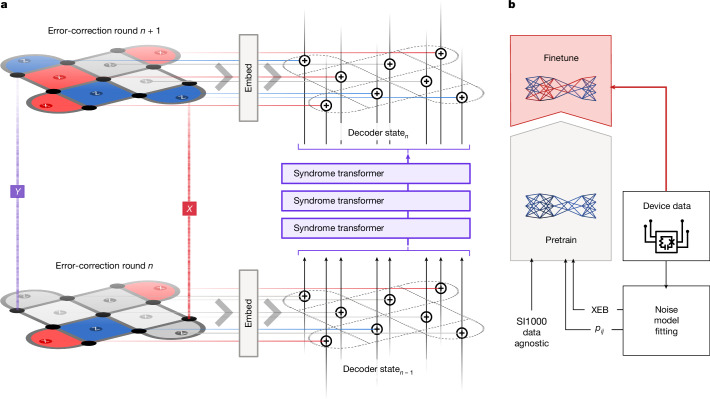
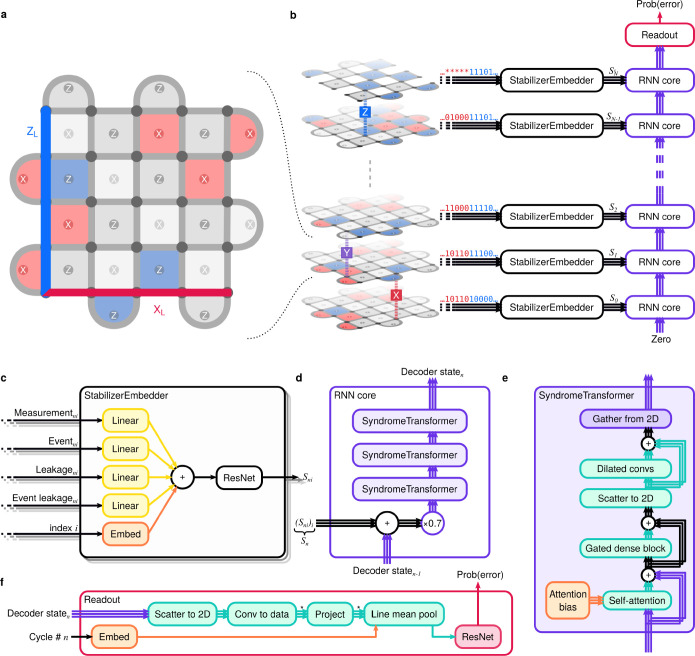
“At the heart of our RNN block architecture is the Syndrome Transformer, a self-attention architecture based on the Transformer [97] which has seen recent success in a variety of problems [17, 49].”
MobileNets: Efficient Convolutional Neural Networks for Mobile Vision Applications
Howard, A. G., Zhu, M., Chen, B., Kalenichenko, D., Wang, W., Weyand, T., Andreetto, M., & Adam, H. (2017) · arXiv · doi:10.48550/arxiv.1704.04861 · Cited by 19,015 · cited 1×
“Then we train a smaller ‘student’ network whose architecture is tuned for inference speed 81 .”
Distilling the Knowledge in a Neural Network
Hinton, G., Vinyals, O., & Dean, J. (2015) · arXiv · doi:10.48550/arxiv.1503.02531 · Cited by 14,204 · cited 1×
“Secondly, techniques such as distillation [45], lower precision inference and weight pruning can be applied to achieve similar performance with less computation.”
LoRA: Low-Rank Adaptation of Large Language Models
Hu, E. J., Shen, Y., Wallis, P., Allen-Zhu, Z., Li, Y., Wang, S., Wang, L., & Chen, W. (2021) · arXiv · doi:10.48550/arxiv.2106.09685 · Cited by 13,453
A fast quantum mechanical algorithm for database search
Grover, L. K. (1996) · Proceedings of the twenty-eighth annual ACM symposium on Theory of computing - STOC '96 · doi:10.1145/237814.237866 · Cited by 8,830 · cited 5×
“2b) and distances beyond 5, we explore the performance of our decoder on simulated data (in place of experimental samples) at code distances 3, 5, 7, 9 and 11 (17–241 physical qubits).”
InfluentialQuantum supremacy using a programmable superconducting processor
Arute, F., Arya, K., Babbush, R., Bacon, D., Bardin, J. C., Barends, R., Biswas, R., Boixo, S., Brandao, F. G. S. L., Buell, D. A., et al. (2019) · Nature · doi:10.1038/s41586-019-1666-5 · Cited by 7,720
Self-citationSimulating physics with computers
Feynman, R. P. (1982) · International Journal of Theoretical Physics · doi:10.1007/bf02650179 · Cited by 7,691 · cited 1×
“Beyond Shor’s well-known prime factoring algorithm [83] and Grover’s quadratic speedup for unstructured search [39], many potential applications in fields such as material science [59, 3, 4, 75], machine learning [8, 47, 46], and optimization [25, 86], have been proposed.”
Fault-tolerant quantum computation by anyons
Kitaev, A. Y. (2003) · Annals of Physics · doi:10.1016/s0003-4916(02)00018-0 · Cited by 7,238 · cited 1×
“One of the most promising strategies for fault-tolerant computation is based on the surface code, which has the highest-known tolerance for errors of any codes with a 2D nearest-neighbor connectivity [15, 29, 53].”
International Conference on Learning Representations (ICLR 2013)
松尾, 豊. (2013) · 人工知能学会誌 = Journal of Japanese Society for Artificial Intelligence · Cited by 6,286
Scheme for reducing decoherence in quantum computer memory
Shor, P. W. (1995) · Physical Review A · doi:10.1103/physreva.52.r2493 · Cited by 4,479 · cited 1×
“Such fault-tolerant quantum computation can be achieved through redundancy introduced by grouping multiple physical qubits into one logical qubit [82, 52].”
Polynomial-time algorithms for prime factorization and discrete logarithms on a quantum computer
Shor, P. W. (1999) · SIAM Review · doi:10.1137/s0036144598347011 · Cited by 3,904
Lloyd, S. (1996) · Science · doi:10.1126/science.273.5278.1073 · Cited by 3,088 · cited 1×
“Beyond Shor’s well-known prime factoring algorithm [83] and Grover’s quadratic speedup for unstructured search [39], many potential applications in fields such as material science [59, 3, 4, 75], machine learning [8, 47, 46], and optimization [25, 86], have been proposed.”
Surface codes: Towards practical large-scale quantum computation
Fowler, A. G., Mariantoni, M., Martinis, J. M., & Cleland, A. N. (2012) · Physical Review A · doi:10.1103/physreva.86.032324 · Cited by 3,059 · cited 9×
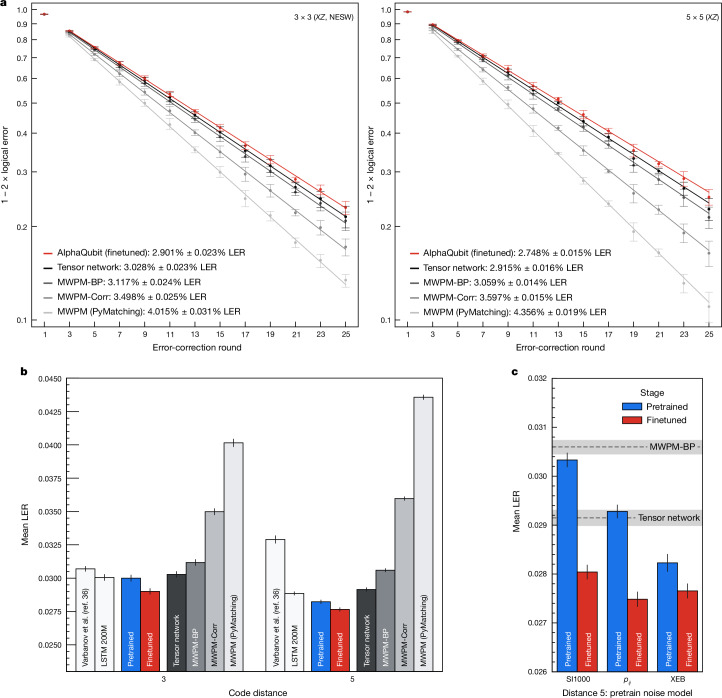
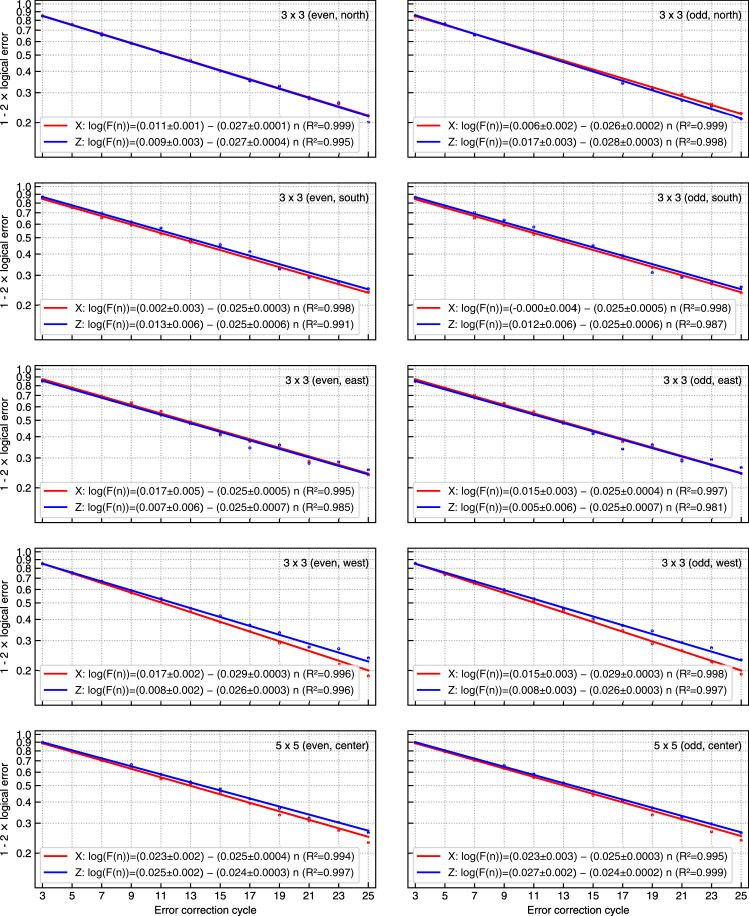
“First, on experimental data from a Sycamore quantum processor on distance-3 and distance-5 surface codes 4 , when pretraining on synthetic data modelling device noise and then finetuning on experimental samples, we observe significantly better error suppression than state-of-the-art correlated…”
InfluentialBlais, A., Huang, R.-S., Wallraff, A., Girvin, S. M., & Schoelkopf, R. J. (2004) · Physical Review A · doi:10.1103/physreva.69.062320 · Cited by 2,989 · cited 2×
“This is the case for standard dispersive measurement of superconducting qubits, where a microwave pulse probes the frequency of a superconducting resonator that is coupled to a qubit in order to infer the qubit’s state [9, 101, 48].”
Training Region-Based Object Detectors with Online Hard Example Mining
Shrivastava, A., Gupta, A., & Girshick, R. (2016) · 2016 IEEE Conference on Computer Vision and Pattern Recognition (CVPR) · doi:10.1109/cvpr.2016.89 · Cited by 2,686 · cited 1×
“Another approach that might improve sample efficiency is the concept of ‘hard sample mining’ 91,92 , where difficult examples are collected (for example, by finding examples whose predictions are incorrect, or not confidently correct, for some decoder) or constructed.”
Quantum annealing in the transverse Ising model
Kadowaki, T., & Nishimori, H. (1998) · Physical Review E · doi:10.1103/physreve.58.5355 · Cited by 2,339 · cited 1×
“Beyond Shor’s well-known prime factoring algorithm 6 and Grover’s quadratic speed-up for unstructured search 7 , many potential applications in fields such as material science 8 , machine learning 9 and optimization 10 have been proposed.”
A Quantum Adiabatic Evolution Algorithm Applied to Random Instances of an NP-Complete Problem
Farhi, E., Goldstone, J., Gutmann, S., Lapan, J., Lundgren, A., & Preda, D. (2001) · Science · doi:10.1126/science.1057726 · Cited by 2,056
Dennis, E., Kitaev, A., Landahl, A., & Preskill, J. (2002) · Journal of Mathematical Physics · doi:10.1063/1.1499754 · Cited by 1,768 · cited 1×
“Quantum error correction frequently requires different decoding methods to classical error correction 15,16 and, despite recent significant progress 4,17–21 , challenges remain.”
Dennis, E., Kitaev, A., Landahl, A., & Preskill, J. (2001) · CERN Document Server (European Organization for Nuclear Research) · Cited by 1,485
Simulated Quantum Computation of Molecular Energies
Aspuru-Guzik, A., Dutoi, A. D., Love, P. J., & Head-Gordon, M. (2005) · Science · doi:10.1126/science.1113479 · Cited by 1,418
Logical quantum processor based on reconfigurable atom arrays
Bluvstein, D., Evered, S. J., Geim, A. A., Li, S. H., Zhou, H., Manovitz, T., Ebadi, S., Cain, M., Kalinowski, M., Hangleiter, D., et al. (2024) · Nature · doi:10.1038/s41586-023-06927-3 · Cited by 1,119 · cited 1×
“As physical error rates in quantum hardware have been brought down, researchers have started to conduct error-suppression experiments on real quantum devices 4,17,18,20,21,41 .”
Suppressing quantum errors by scaling a surface code logical qubit
Google Quantum, A. I., Acharya, R., Aleiner, I., Allen, R., Andersen, T. I., Ansmann, M., Arute, F., Arya, K., Asfaw, A., Atalaya, J., et al. (2023) · Nature · doi:10.1038/s41586-022-05434-1 · Cited by 1,103
Self-citationHow to factor 2048 bit RSA integers in 8 hours using 20 million noisy qubits
Gidney, C., & Ekerå, M. (2021) · Quantum · doi:10.22331/q-2021-04-15-433 · Cited by 830 · cited 7×
“Ultimately, to perform fault-tolerant quantum computation such as the factorization of a 2,000-bit number, the logical error rate needs to be reduced to about 10 −12 per logical operation 3,11 , far below the error rates in today’s hardware that are around 10 −3 to 10 −2 per physical operation.”
InfluentialSelf-citationRealizing repeated quantum error correction in a distance-three surface code
Krinner, S., Lacroix, N., Remm, A., Di Paolo, A., Genois, E., Leroux, C., Hellings, C., Lazar, S., Swiadek, F., Herrmann, J., et al. (2022) · Nature · doi:10.1038/s41586-022-04566-8 · Cited by 686 · cited 1×
“Despite significant progress on quantum error correction [100, 60, 37, 84, 88, 55, 23, 76, 104, 40], challenges remain.”
Quantum error correction in a solid-state hybrid spin register
Waldherr, G., Wang, Y., Zaiser, S., Jamali, M., Schulte-Herbrüggen, T., Abe, H., Ohshima, T., Isoya, J., Du, J. F., Neumann, P., et al. (2014) · Nature · doi:10.1038/nature12919 · Cited by 612 · cited 1×
“Despite significant progress on quantum error correction [100, 60, 37, 84, 88, 55, 23, 76, 104, 40], challenges remain.”
Approaching Unit Visibility for Control of a Superconducting Qubit with Dispersive Readout
Wallraff, A., Schuster, D. I., Blais, A., Frunzio, L., Majer, J., Devoret, M. H., Girvin, S. M., & Schoelkopf, R. J. (2005) · Physical Review Letters · doi:10.1103/physrevlett.95.060501 · Cited by 573 · cited 2×
“The measurement is implemented as a microwave scattering experiment to probe the resonator’s frequency, which depends on the qubit state due to coupling with non-linear Josephson elements [101].”
Quantum advantage in learning from experiments
Huang, H.-Y., Broughton, M., Cotler, J., Chen, S., Li, J., Mohseni, M., Neven, H., Babbush, R., Kueng, R., Preskill, J., et al. (2022) · Science · doi:10.1126/science.abn7293 · Cited by 519 · cited 3×
“Beyond Shor’s well-known prime factoring algorithm 6 and Grover’s quadratic speed-up for unstructured search 7 , many potential applications in fields such as material science 8 , machine learning 9 and optimization 10 have been proposed.”
Self-citationFast Accurate State Measurement with Superconducting Qubits
Jeffrey, E., Sank, D., Mutus, J. Y., White, T. C., Kelly, J., Barends, R., Chen, Y., Chen, Z., Chiaro, B., Dunsworth, A., et al. (2014) · Physical Review Letters · doi:10.1103/physrevlett.112.190504 · Cited by 449 · cited 1×
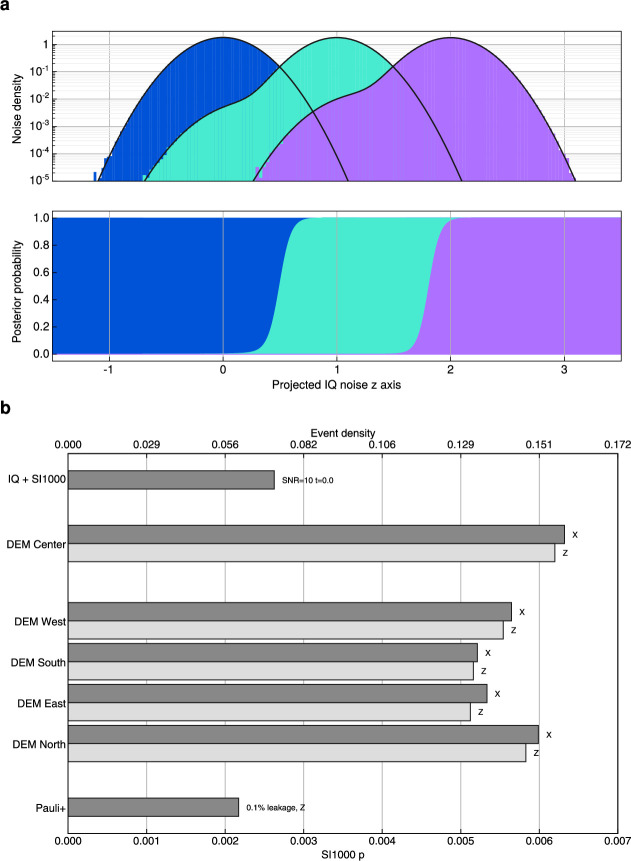
“Additionally, qubits can exhibit unwanted transitions between states during the measurement, like decaying from |1⟩ to |0⟩, which would result in an average point between the |0⟩ and |1⟩ centers in (I, Q) space [79].”
Stim: a fast stabilizer circuit simulator
Gidney, C. (2021) · Quantum · doi:10.22331/q-2021-07-06-497 · Cited by 415 · cited 27×
“The DEMs we use were previously fitted 4 to each experimental set using a generalization of the p ij method 14 .”
InfluentialSelf-citationReal-time quantum error correction beyond break-even
Sivak, V. V., Eickbusch, A., Royer, B., Singh, S., Tsioutsios, I., Ganjam, S., Miano, A., Brock, B. L., Ding, A. Z., Frunzio, L., et al. (2023) · Nature · doi:10.1038/s41586-023-05782-6 · Cited by 407 · cited 4×
“As physical error rates in quantum hardware have been brought down, researchers have started to conduct error-suppression experiments on real quantum devices 4,17,18,20,21,41 .”
InfluentialQuantum codes on a lattice with boundary
Bravyi, S. B., & Kitaev, A. Y. (1998) · arXiv · doi:10.48550/arxiv.quant-ph/9811052 · Cited by 394 · cited 1×
“One of the most promising strategies for fault-tolerant computation is based on the surface code, which has the highest-known tolerance for errors of any codes with a 2D nearest-neighbor connectivity [15, 29, 53].”
Exponential suppression of bit or phase errors with cyclic error correction
Google Quantum, A. I., Chen, Z., Satzinger, K. J., Atalaya, J., Korotkov, A. N., Dunsworth, A., Sank, D., Quintana, C., McEwen, M., Barends, R., et al. (2021) · Nature · doi:10.1038/s41586-021-03588-y · Cited by 393
Self-citationAxial Attention in Multidimensional Transformers
Ho, J., Kalchbrenner, N., Weissenborn, D., & Salimans, T. (2019) · arXiv · doi:10.48550/arxiv.1912.12180 · Cited by 370 · cited 1×
“Using faster components such as local, sparse or axial attention 78 , which restrict attention to a subset of stabilizer pairs, have the potential to deliver speed improvements.”
Fault-tolerant control of an error-corrected qubit
Egan, L., Debroy, D. M., Noel, C., Risinger, A., Zhu, D., Biswas, D., Newman, M., Li, M., Brown, K. R., Cetina, M., et al. (2021) · Nature · doi:10.1038/s41586-021-03928-y · Cited by 348 · cited 1×
“Despite significant progress on quantum error correction [100, 60, 37, 84, 88, 55, 23, 76, 104, 40], challenges remain.”
Self-citationMagic-state distillation with low overhead
Bravyi, S., & Haah, J. (2012) · Physical Review A · doi:10.1103/physreva.86.052329 · Cited by 341 · cited 1×
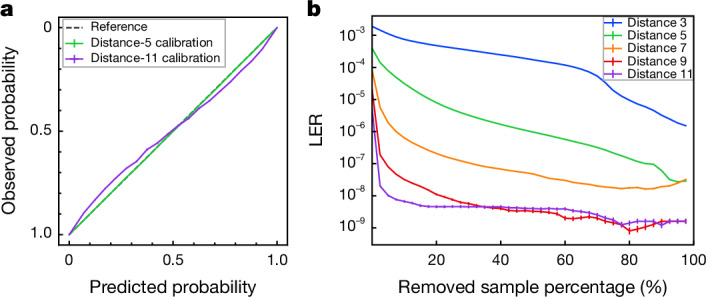
“2% of the 25-cycle experiments at distance 11, we can achieve a postselected error rate a factor of ≈ 10 lower (10% rejection gives a factor ≈ 250), which could prove useful in repeat-until-success protocols [13, 12, 18, 33, 74, 72].”
Realization of an Error-Correcting Surface Code with Superconducting Qubits
Zhao, Y., Ye, Y., Huang, H.-L., Zhang, Y., Wu, D., Guan, H., Zhu, Q., Wei, Z., He, T., Cao, S., et al. (2022) · Physical Review Letters · doi:10.1103/physrevlett.129.030501 · Cited by 321 · cited 3×
“As physical error rates in quantum hardware have been brought down, researchers have started to conduct error-suppression experiments on real quantum devices 4,17,18,20,21,41 .”
Realization of Real-Time Fault-Tolerant Quantum Error Correction
Ryan-Anderson, C., Bohnet, J. G., Lee, K., Gresh, D., Hankin, A., Gaebler, J. P., Francois, D., Chernoguzov, A., Lucchetti, D., Brown, N. C., et al. (2021) · Physical Review X · doi:10.1103/physrevx.11.041058 · Cited by 306 · cited 2×
“As physical error rates in quantum hardware have been brought down, researchers have started to conduct error-suppression experiments on real quantum devices 4,17,18,20,21,41 .”
GLU Variants Improve Transformer
Shazeer, N. (2020) · arXiv · doi:10.48550/arxiv.2002.05202 · Cited by 303 · cited 1×
“Transformers consist of multi-head attention followed by a gated dense block [81].”
Symbolic Discovery of Optimization Algorithms
Chen, X., Liang, C., Huang, D., Real, E., Wang, K., Liu, Y., Pham, H., Dong, X., Luong, T., Hsieh, C.-J., et al. (2023) · arXiv · doi:10.48550/arxiv.2302.06675 · Cited by 303
Bonilla Ataides, J. P., Tuckett, D. K., Bartlett, S. D., Flammia, S. T., & Brown, B. J. (2021) · Nature Communications · doi:10.1038/s41467-021-22274-1 · Cited by 262 · cited 2×
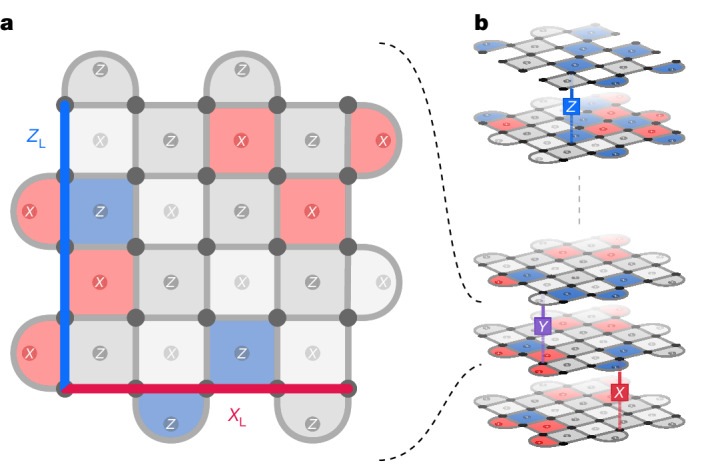
“S3 for an XZZX variant of the rotated surface code [11].”
Degenerate Quantum LDPC Codes With Good Finite Length Performance
Panteleev, P., & Kalachev, G. (2021) · Quantum · doi:10.22331/q-2021-11-22-585 · Cited by 257
Fault-Tolerant Quantum Computation with Long-Range Correlated Noise
Aharonov, D., Kitaev, A., & Preskill, J. (2006) · Physical Review Letters · doi:10.1103/physrevlett.96.050504 · Cited by 243 · cited 1×
“A decoder that recognizes these patterns can be especially valuable, since correlated errors are highly damaging to fault-tolerance [1].”
Efficient algorithms for maximum likelihood decoding in the surface code
Bravyi, S., Suchara, M., & Vargo, A. (2014) · Physical Review A · doi:10.1103/physreva.90.032326 · Cited by 214 · cited 2×
“We evaluate our machine-learning decoder on experimental data from a surface code logical qubit implemented on Google’s Sycamore quantum computer [37], and observe markedly better error suppression than state-of-the-art correlated matching and tensor network decoders [37, 43, 14, 35] by training on data directly.”
Quantum Error Correction with Imperfect Gates
Kitaev, A. Y. (1997) · Quantum Communication, Computing, and Measurement · doi:10.1007/978-1-4615-5923-8_19 · Cited by 214 · cited 2×
“Such fault-tolerant quantum computation can be achieved through redundancy introduced by grouping multiple physical qubits into one logical qubit [82, 52].”
Parallel window decoding enables scalable fault tolerant quantum computation
Skorić, L., Browne, D. E., Barnes, K. M., Gillespie, N. I., & Campbell, E. T. (2023) · Nature Communications · doi:10.1038/s41467-023-42482-1 · Cited by 208 · cited 2×
“We also note that, in principle, it is possible to achieve unbounded throughput by decomposing the matching decoding problem in an extremely parallel fashion 55,56 .”
Towards Practical Classical Processing for the Surface Code
Fowler, A. G., Whiteside, A. C., & Hollenberg, L. C. L. (2012) · Physical Review Letters · doi:10.1103/physrevlett.108.180501 · Cited by 204 · cited 1×
“Quantum error correction frequently requires different decoding methods to classical error correction 15,16 and, despite recent significant progress 4,17–21 , challenges remain.”
Improved Decoding of Circuit Noise and Fragile Boundaries of Tailored Surface Codes
Higgott, O., Bohdanowicz, T. C., Kubica, A., Flammia, S. T., & Campbell, E. T. (2023) · Physical Review X · doi:10.1103/physrevx.13.031007 · Cited by 204 · cited 2×
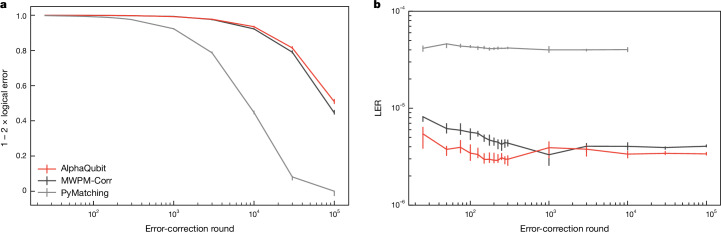
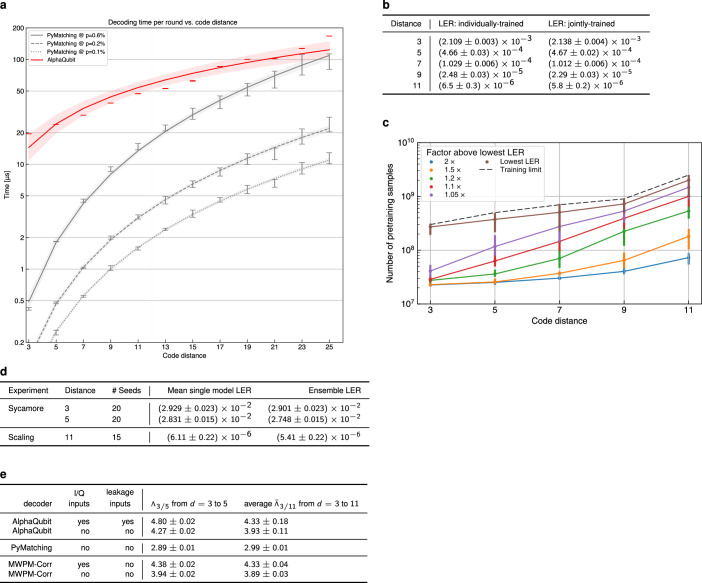
“State-of-the-art MWPM-based decoders, such as correlated matching (MWPM-Corr), matching with belief propagation (MWPM-BP) and PyMatching, an open-source implementation of MWPM 4,24,26 , lead to higher LERs than the tensor network and AlphaQubit (Fig.”
Sank, D., Chen, Z., Khezri, M., Kelly, J., Barends, R., Campbell, B., Chen, Y., Chiaro, B., Dunsworth, A., Fowler, A., et al. (2016) · Physical Review Letters · doi:10.1103/physrevlett.117.190503 · Cited by 203 · cited 2×
“Measurement can cause other problems like state transitions and unwanted dephasing, which must be carefully avoided [78, 51].”
Ataides, J. P. B., Tuckett, D. K., Bartlett, S. D., Flammia, S. T., & Brown, B. J. (2021) · RePEc: Research Papers in Economics · Cited by 201
Neural Decoder for Topological Codes
Torlai, G., & Melko, R. G. (2017) · Physical Review Letters · doi:10.1103/physrevlett.119.030501 · Cited by 194 · cited 1×
“Initial decoders used restricted Boltzmann machines [92], and many subsequent approaches use reinforcement learning [89, 27, 2, 62] or supervised learning [95, 61, 19, 22].”
Suppression of Crosstalk in Superconducting Qubits Using Dynamical Decoupling
Tripathi, V., Chen, H., Khezri, M., Yip, K.-W., Levenson-Falk, E. M., & Lidar, D. A. (2022) · Physical Review Applied · doi:10.1103/physrevapplied.18.024068 · Cited by 189 · cited 2×
“…must contend with complex noise effects that include leakage, that is, qubit excitations beyond the computational states ∣ 0⟩ and 1⟩ ∣ that are long-lived and mobile 22 ; and cross-talk, that is, unwanted interactions between qubits inducing long-range and complicated patterns of events 23 .”
Sparse blossom: correcting a million errors per core second with minimum-weight matching
Higgott, O., & Gidney, C. (2025) · Quantum · doi:10.22331/q-2025-01-20-1600 · Cited by 180
Self-citationOptimal resources for topological two-dimensional stabilizer codes: Comparative study
Bombin, H., & Martin-Delgado, M. A. (2007) · Physical Review A · doi:10.1103/physreva.76.012305 · Cited by 178 · cited 1×
“Introduced in [10], it is a variant of the surface code, which itself is a variant of Kitaev’s toric code [52].”
Machine-learning-assisted correction of correlated qubit errors in a topological code
Baireuther, P., O'Brien, T. E., Tarasinski, B., & Beenakker, C. W. J. (2018) · Quantum · doi:10.22331/q-2018-01-29-48 · Cited by 142 · cited 2×
“The conventional circuit-noise model [69, 7] is limited, failing to account for several crucial real-world effects, such as cross-talk, leakage and analog readout information.”
Removing leakage-induced correlated errors in superconducting quantum error correction
McEwen, M., Kafri, D., Chen, Z., Atalaya, J., Satzinger, K. J., Quintana, C., Klimov, P. V., Sank, D., Gidney, C., Fowler, A. G., et al. (2021) · Nature Communications · doi:10.1038/s41467-021-21982-y · Cited by 129
Self-citationA real-time, scalable, fast and resource-efficient decoder for a quantum computer
Barber, B., Barnes, K. M., Bialas, T., Buğdaycı, O., Campbell, E. T., Gillespie, N. I., Johar, K., Rajan, R., Richardson, A. W., Skorić, L., et al. (2025) · Nature Electronics · doi:10.1038/s41928-024-01319-5 · Cited by 123
Neural network decoder for topological color codes with circuit level noise
Baireuther, P., Caio, M. D., Criger, B., Beenakker, C. W. J., & O’Brien, T. E. (2019) · New Journal of Physics · doi:10.1088/1367-2630/aaf29e · Cited by 117 · cited 4×
“Varbanov et al. 36 built a recurrent-neural-network decoder based on the architecture of Baireuther et al. 32,37 .”
InfluentialEncoding a magic state with beyond break-even fidelity
Gupta, R. S., Sundaresan, N., Alexander, T., Wood, C. J., Merkel, S. T., Healy, M. B., Hillenbrand, M., Jochym-O’Connor, T., Wootton, J. R., Yoder, T. J., et al. (2024) · Nature · doi:10.1038/s41586-023-06846-3 · Cited by 115
Sundaresan, N., Yoder, T. J., Kim, Y., Li, M., Chen, E. H., Harper, G., Thorbeck, T., Cross, A. W., Córcoles, A. D., & Takita, M. (2023) · Nature Communications · doi:10.1038/s41467-023-38247-5 · Cited by 108
Deep Neural Network Probabilistic Decoder for Stabilizer Codes
Krastanov, S., & Jiang, L. (2017) · Scientific Reports · doi:10.1038/s41598-017-11266-1 · Cited by 107
Khezri, M., Opremcak, A., Chen, Z., Miao, K. C., McEwen, M., Bengtsson, A., White, T., Naaman, O., Sank, D., Korotkov, A. N., et al. (2023) · Physical Review Applied · doi:10.1103/physrevapplied.20.054008 · Cited by 107
Scalable Neural Decoder for Topological Surface Codes
Meinerz, K., Park, C.-Y., & Trebst, S. (2022) · Physical Review Letters · doi:10.1103/physrevlett.128.080505 · Cited by 102 · cited 2×
“Such scaling advantage can be combined with additional distributed decoding strategy where deep learning is applied to only local error decoding and is then combined with a deterministic decoding algorithm (such as union find) [64, 96] for global decoding.”
Overcoming leakage in quantum error correction
Miao, K. C., McEwen, M., Atalaya, J., Kafri, D., Pryadko, L. P., Bengtsson, A., Opremcak, A., Satzinger, K. J., Chen, Z., Klimov, P. V., et al. (2023) · Nature Physics · doi:10.1038/s41567-023-02226-w · Cited by 99 · cited 2×
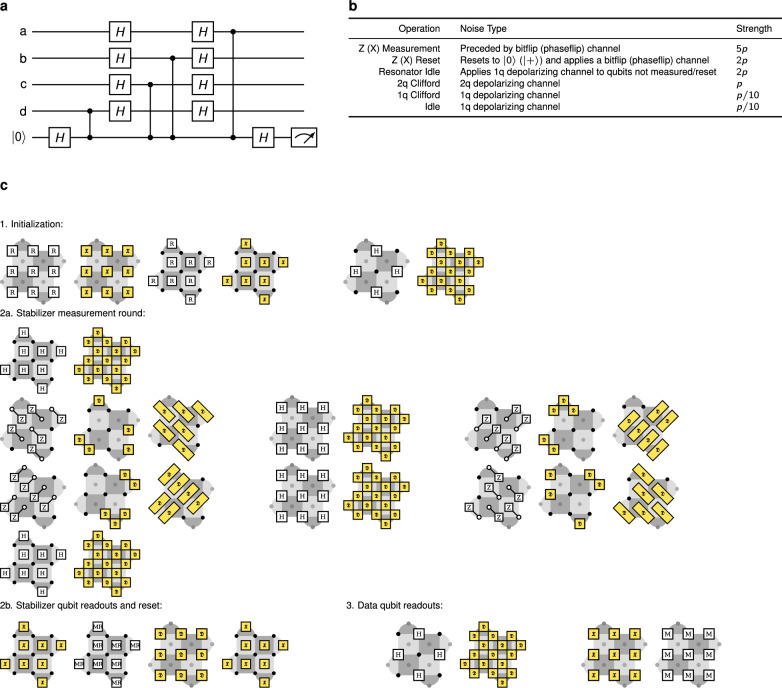
“The strength of depolarizing noise for each operation was informed by recent device characterization 4 and an estimate of how noise might improve in future devices 65 .”
Self-citationDensity-matrix simulation of small surface codes under current and projected experimental noise
O’Brien, T. E., Tarasinski, B., & DiCarlo, L. (2017) · npj Quantum Information · doi:10.1038/s41534-017-0039-x · Cited by 94 · cited 2×
“The conventional circuit-noise model [69, 7] is limited, failing to account for several crucial real-world effects, such as cross-talk, leakage and analog readout information.”
Quantum error correction for the toric code using deep reinforcement learning
Andreasson, P., Johansson, J., Liljestrand, S., & Granath, M. (2019) · Quantum · doi:10.22331/q-2019-09-02-183 · Cited by 94 · cited 1×
“Initial decoders used restricted Boltzmann machines [92], and many subsequent approaches use reinforcement learning [89, 27, 2, 62] or supervised learning [95, 61, 19, 22].”
Deep neural decoders for near term fault-tolerant experiments
Chamberland, C., & Ronagh, P. (2018) · Quantum Science and Technology · doi:10.1088/2058-9565/aad1f7 · Cited by 86 · cited 1×
“Chamberland et al. 34 trained recurrent and convolutional networks and matched look-up table performance for surface codes and colour codes with code distances up to 5.”
A scalable and fast artificial neural network syndrome decoder for surface codes
Gicev, S., Hollenberg, L. C. L., & Usman, M. (2023) · Quantum · doi:10.22331/q-2023-07-12-1058 · Cited by 85 · cited 1×
“Although previous decoders have exploited symmetries of the toric code 70 and used convolutional neural networks for processing the surface code 71 , boundary conditions of the surface code together with non-uniformity of real physical devices mean that there could be advantages to a model that…”
Gidney, C., Newman, M., Brooks, P., & Jones, C. (2025) · Nature Communications · doi:10.1038/s41467-025-59714-1 · Cited by 85 · cited 1×
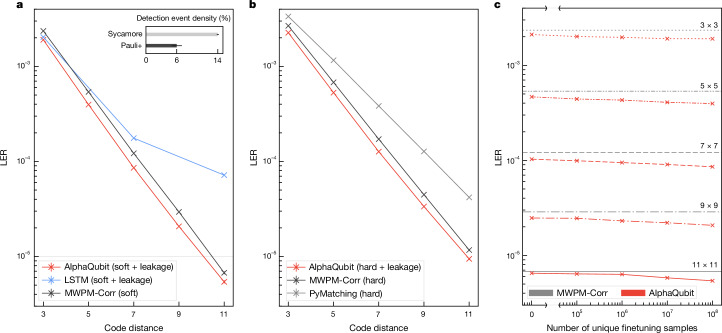
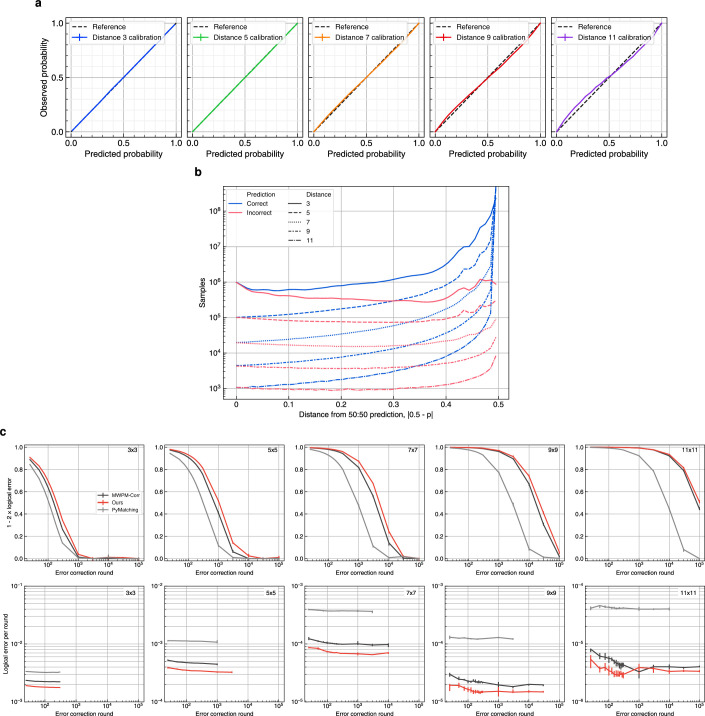
“The probabilistic output can be used as soft information in hierarchical decoding schemes 50,51 , or as a confidence measure to discard the least confident samples (Fig.”
Self-citationA Fault-Tolerant Honeycomb Memory
Gidney, C., Newman, M., Fowler, A., & Broughton, M. (2021) · Quantum · doi:10.22331/q-2021-12-20-605 · Cited by 83 · cited 2×
“SI1000 (superconducting-inspired 1,000-ns round duration) noise 44 is a circuit depolarizing noise model comprising Pauli errors of non-uniform strengths, which approximate the relative noisiness of the various circuit processes in superconducting circuits: for example, as measurements remain a…”
Self-citationRemoving leakage-induced correlated errors in superconducting quantum error correction
McEwen, M., Kafri, D., Chen, Z., Atalaya, J., Satzinger, K. J., Quintana, C., Klimov, P. V., Sank, D., Gidney, C., Fowler, A. G., et al. (2021) · RePEc: Research Papers in Economics · Cited by 82
Self-citationAdvantages of versatile neural-network decoding for topological codes
Maskara, N., Kubica, A., & Jochym-O'Connor, T. (2019) · Physical Review A · doi:10.1103/physreva.99.052351 · Cited by 77
Comparing Neural Network Based Decoders for the Surface Code
Varsamopoulos, S., Bertels, K., & Almudever, C. G. (2020) · IEEE Transactions on Computers · doi:10.1109/tc.2019.2948612 · Cited by 76 · cited 6×
“Training Data Efficiency A concern raised for ML decoders is whether the training data required scales infeasibly with the code distance [95].”
InfluentialData-driven decoding of quantum error correcting codes using graph neural networks
Lange, M., Havström, P., Srivastava, B., Bengtsson, I., Bergentall, V., Hammar, K., Heuts, O., van Nieuwenburg, E., & Granath, M. (2025) · Physical Review Research · doi:10.1103/physrevresearch.7.023181 · Cited by 76 · cited 2×
“When previous studies mention MWPM, they generally refer to its uncorrelated version 36,39,49 , which is weaker than MWPM-Corr, with an LER ≈ 4.1 × 10 −5 at distance 11 (Fig.”
InfluentialOverwater, R. W. J., Babaie, M., & Sebastiano, F. (2022) · IEEE Transactions on Quantum Engineering · doi:10.1109/tqe.2022.3174017 · Cited by 75 · cited 2×
“Other works have focused more on speed and scalability [68, 103, 66, 31], including the use of symmetries to improve performance [24, 99].”
Techniques for combining fast local decoders with global decoders under circuit-level noise
Chamberland, C., Goncalves, L., Sivarajah, P., Peterson, E., & Grimberg, S. (2023) · Quantum Science and Technology · doi:10.1088/2058-9565/ace64d · Cited by 73
Understanding the effects of leakage in superconducting quantum-error-detection circuits
Ghosh, J., Fowler, A. G., Martinis, J. M., & Geller, M. R. (2013) · Physical Review A · doi:10.1103/physreva.88.062329 · Cited by 71 · cited 1×
“They must also contend with rich noise models induced by quantum circuits that include leakage, qubit excitations beyond the computational states |0⟩ and |1⟩ that are long-lived and mobile [30]; and crosstalk, unwanted interactions between qubits inducing longrange and complicated patterns of detection events [93].”
Reinforcement learning decoders for fault-tolerant quantum computation
Sweke, R., Kesselring, M. S., van Nieuwenburg, E. P. L., & Eisert, J. (2021) · Machine Learning: Science and Technology · doi:10.1088/2632-2153/abc609 · Cited by 71 · cited 1×
“Some previous studies have used supervised learning 32 or reinforcement learning 33 to train neural-network-based decoders.”
Calibrated Decoders for Experimental Quantum Error Correction
Chen, E. H., Yoder, T. J., Kim, Y., Sundaresan, N., Srinivasan, S., Li, M., Córcoles, A. D., Cross, A. W., & Takita, M. (2022) · Physical Review Letters · doi:10.1103/physrevlett.128.110504 · Cited by 71 · cited 1×
“A further challenge for error-correcting real-world quantum devices is the difficulty in modelling errors accurately 4,14,30,31 .”
Improved quantum error correction using soft informationPreprint
Pattison, C. A., Beverland, M. E., Silva, M. P. D., & Delfosse, N. (2021) · arXiv (Cornell University) · doi:10.48550/arxiv.2107.13589 · Cited by 68 · cited 3×
“These analogue I/Q measurements and derived events are provided to AlphaQubit in the form of probabilities 40 (‘Soft measurement inputs versus soft event inputs’ and ‘Input representation’ in Methods).”
Fault-Tolerant Postselection for Low-Overhead Magic State Preparation
Bombín, H., Pant, M., Roberts, S., & Seetharam, K. (2024) · PRX Quantum · doi:10.1103/prxquantum.5.010302 · Cited by 67 · cited 1×
“…at distance 11, we can reduce the error rate by a factor of about 20 (1% rejection gives a factor of about 107, 10% a factor of about 790), which can prove useful in protocols such as magic-state distillation, a major anticipated resource cost in fault-tolerant quantum computation 52,53 .”
Fault-Tolerant Operation of a Quantum Error-Correction Code
Egan, L., Debroy, D. M., Noel, C., Risinger, A., Zhu, D., Biswas, D., Newman, M., Li, M., Brown, K. R., Cetina, M., et al. (2020) · arXiv · doi:10.48550/arxiv.2009.11482 · Cited by 65
Self-citationNeural Network Decoders for Large-Distance 2D Toric Codes
Ni, X. (2020) · Quantum · doi:10.22331/q-2020-08-24-310 · Cited by 60
Deep Q-learning decoder for depolarizing noise on the toric code
Fitzek, D., Eliasson, M., Kockum, A. F., & Granath, M. (2020) · Physical Review Research · doi:10.1103/physrevresearch.2.023230 · Cited by 59 · cited 1×
“Initial decoders used restricted Boltzmann machines [92], and many subsequent approaches use reinforcement learning [89, 27, 2, 62] or supervised learning [95, 61, 19, 22].”
Logical Blocks for Fault-Tolerant Topological Quantum Computation
Bombín, H., Dawson, C., Mishmash, R. V., Nickerson, N., Pastawski, F., & Roberts, S. (2023) · PRX Quantum · doi:10.1103/prxquantum.4.020303 · Cited by 59
Transformer-QEC: Quantum Error Correction Code Decoding with Transferable TransformersPreprint
Wang, H., Liu, P., Shao, K., Li, D., Gu, J., Pan, D. Z., Ding, Y., & Han, S. (2023) · arXiv (Cornell University) · doi:10.48550/arxiv.2311.16082 · Cited by 50
Quantum teleportation of physical qubits into logical code spaces
Luo, Y.-H., Chen, M.-C., Erhard, M., Zhong, H.-S., Wu, D., Tang, H.-Y., Zhao, Q., Wang, X.-L., Fujii, K., Li, L., et al. (2021) · Proceedings of the National Academy of Sciences · doi:10.1073/pnas.2026250118 · Cited by 45 · cited 1×
“Despite significant progress on quantum error correction [100, 60, 37, 84, 88, 55, 23, 76, 104, 40], challenges remain.”
Scalable Surface-Code Decoders with Parallelization in Time
Tan, X., Zhang, F., Chao, R., Shi, Y., & Chen, J. (2023) · PRX Quantum · doi:10.1103/prxquantum.4.040344 · Cited by 42 · cited 2×
“We also note that, in principle, it is possible to achieve unbounded throughput by decomposing the matching decoding problem in an embarrassingly parallel fashion [85, 90].”
Efficient Near-Optimal Decoding of the Surface Code through Ensembling
Shutty, N., Newman, M., & Villalonga, B. (2025) · Physical Review Letters · doi:10.48550/arxiv.2401.12434 · Cited by 42 · cited 3×
“It is possible to combine multiple classifiers to obtain a more accurate prediction by ensembling 27,75 .”
Self-citationqecGPT: decoding Quantum Error-correcting Codes with Generative Pre-trained TransformersPreprint
Cao, H., Pan, F., Wang, Y., & Zhang, P. (2023) · arXiv (Cornell University) · doi:10.48550/arxiv.2307.09025 · Cited by 42 · cited 1×
“Initial decoders used restricted Boltzmann machines [92], and many subsequent approaches use reinforcement learning [89, 27, 2, 62] or supervised learning [95, 61, 19, 22].”
Leakage suppression in the toric code
Suchara, M., Cross, A. W., & Gambetta, J. M. (2015) · 2015 IEEE International Symposium on Information Theory (ISIT) · doi:10.1109/isit.2015.7282629 · Cited by 38
Optimal complexity correction of correlated errors in the surface code
Fowler, A. G. (2013) · arXiv · doi:10.48550/arxiv.1310.0863 · Cited by 36 · cited 4×
“Model parameters are accumulated with an exponential moving average and regularly evaluated on development data to compute the LER (by fitting across rounds 3, 5, …, 25 for the Sycamore data, or by computing for 25 rounds for the scaling data).”
InfluentialChoukroun, Y., & Wolf, L. (2024) · Proceedings of the AAAI Conference on Artificial Intelligence · doi:10.1609/aaai.v38i1.27756 · Cited by 33
Symmetries for a high-level neural decoder on the toric code
Wagner, T., Kampermann, H., & Bruß, D. (2020) · Physical Review A · doi:10.1103/physreva.102.042411 · Cited by 30 · cited 1×
“Other works have focused more on speed and scalability [68, 103, 66, 31], including the use of symmetries to improve performance [24, 99].”
Performance enhancement of surface codes via recursive minimum-weight perfect-match decoding
iOlius, A. D., Martínez, J. E., Fuentes, P., & Crespo, P. M. (2023) · Physical Review A · doi:10.1103/physreva.108.022401 · Cited by 26
Convolutional neural network based decoders for surface codes
Bordoni, S., & Giagu, S. (2023) · Quantum Information Processing · doi:10.1007/s11128-023-03898-2 · Cited by 22
Pipelined correlated minimum weight perfect matching of the surface code
Paler, A., & Fowler, A. G. (2023) · Quantum · doi:10.22331/q-2023-12-12-1205 · Cited by 22
Artificial neural network syndrome decoding on IBM quantum processors
Hall, B., Gicev, S., & Usman, M. (2024) · Physical Review Research · doi:10.1103/physrevresearch.6.l032004 · Cited by 21
Zhang, M., Ren, X., Xi, G., Zhang, Z., Yu, Q., Liu, F., Zhang, H., Zhang, S., & Zheng, Y.-C. (2023) · arXiv (Cornell University) · doi:10.48550/arxiv.2305.15767 · Cited by 20 · cited 1×
“Other works have focused more on speed and scalability [68, 103, 66, 31], including the use of symmetries to improve performance [24, 99].”
The END: An Equivariant Neural Decoder for Quantum Error CorrectionPreprint
Egorov, E., Bondesan, R., & Welling, M. (2023) · arXiv (Cornell University) · doi:10.48550/arxiv.2304.07362 · Cited by 20 · cited 2×
“Other works have focused more on speed and scalability [68, 103, 66, 31], including the use of symmetries to improve performance [24, 99].”
Hierarchical memories: Simulating quantum LDPC codes with local gates
Pattison, C. A., Krishna, A., & Preskill, J. (2023) · arXiv · doi:10.48550/arxiv.2303.04798 · Cited by 20
Decoding surface codes with deep reinforcement learning and probabilistic policy reusePreprint
Matekole, E. S., Ye, E., Iyer, R., & Chen, S. Y.-C. (2022) · arXiv (Cornell University) · doi:10.48550/arxiv.2212.11890 · Cited by 16 · cited 1×
“Initial decoders used restricted Boltzmann machines [92], and many subsequent approaches use reinforcement learning [89, 27, 2, 62] or supervised learning [95, 61, 19, 22].”
Scalable Quantum Error Correction for Surface Codes using FPGA
Liyanage, N., Wu, Y., Deters, A., & Zhong, L. (2023) · IEEE International Symposium on Field-Programmable Custom Computing Machines (FCCM) · doi:10.1109/fccm57271.2023.00045 · Cited by 14
Splitting decoders for correcting hypergraph faultsPreprint
Delfosse, N., Paetznick, A., Haah, J., & Hastings, M. B. (2023) · arXiv (Cornell University) · doi:10.48550/arxiv.2309.15354 · Cited by 12
PyMatching: A Python package for decoding quantum codes with minimum-weight perfect matching
Higgott, O. (2021) · arXiv (Cornell University) · doi:10.48550/arxiv.2105.13082 · Cited by 10 · cited 21×
“Despite the data-agnostic SI1000 prior, for code distances up to 11, the pretrained model is already on par with MWPM-Corr and further improves with more finetuning examples.”
InfluentialData for "Suppressing quantum errors by scaling a surface code logical qubit"
Collaborators, G. A. Q. A. (2022) · Zenodo (CERN European Organization for Nuclear Research) · doi:10.5281/zenodo.6804039 · Cited by 9
A real-time, scalable, fast and highly resource efficient decoder for a quantum computerPreprint
Barber, B., Barnes, K. M., Bialas, T., et al. (2023) · arXiv (Cornell University) · doi:10.48550/arxiv.2309.05558 · Cited by 7
Data for "Suppressing quantum errors by scaling a surface code logical qubit"
Google AI Quantum Team (2022) · Zenodo (CERN European Organization for Nuclear Research) · doi:10.5281/zenodo.6804040 · Cited by 7
Large Batch Optimization for Deep Learning: Training BERT in 76 minutes
You, Y., Li, J., Reddi, S., Hseu, J., Kumar, S., Bhojanapalli, S., Song, X., Demmel, J., Keutzer, K., & Hsieh, C.-J. (2019) · arXiv · doi:10.48550/arxiv.1904.00962
Research works printed but not linked: 4
- Gottesman, D. E. Stabilizer Codes and Quantum Error Correction. PhD thesis, California Institute of Technology (1997).
- Varbanov, B. M., Serra-Peralta, M., Byfield, D. & Terhal, B. M. Neural network decoder for near-term surface-code experiments. Preprint at https://arxiv.org/abs/2307.03280 (2023). · arXiv
- Sank, T. Fast, Accurate State Measurement in Superconducting Qubits. PhD thesis, Univ. California, Santa Barbara (2014).
- Finn, C., Abbeel, P. & Levine, S. Model-agnostic meta-learning for fast adaptation of deep networks. In International Conference on Machine Learning Vol. 70, 1126–1135 (ACM, 2017).
Cited by
Quantum error correction below the surface code threshold
Collaborators, G. Q. A. A., Acharya, R., Abanin, D. A., Aghababaie-Beni, L., Aleiner, I., Andersen, T. I., Ansmann, M., Arute, F., Arya, K., Asfaw, A., et al. (2025) · Nature · doi:10.1038/s41586-024-08449-y · Cited by 778
“Teal: weight-4 detection probabilities (distance-7, averaged over 250 cycles). c , Logical error probability, p L , for a range of memory experiment durations.”
Self-citationScaling and logic in the colour code on a superconducting quantum processor
Lacroix, N., Bourassa, A., Heras, F. J. H., Zhang, L. M., Bausch, J., Senior, A. W., Edlich, T., Shutty, N., Sivak, V., Bengtsson, A., et al. (2025) · Nature · doi:10.1038/s41586-025-09061-4 · Cited by 51
“Therefore, we employ novel decoding strategies [42, 52, 55, 64] to infer whether logical errors have occurred; see Appendix E for an overview of the different decoders used in this work.”
Self-citationArtificial intelligence for quantum computing
Alexeev, Y., Farag, M. H., Patti, T. L., Wolf, M. E., Ares, N., Aspuru‐Guzik, A., Benjamin, S. C., Cai, Z., Cao, S., Chamberland, C., et al. (2025) · Nature Communications · doi:10.1038/s41467-025-65836-3 · Cited by 137
“The following sections explore how AI may improve the demanding decoders needed to run QEC and help accelerate the discovery of more ef fi cient QEC codes 166 .”
InfluentialArtificial Intelligence‐Driven Approaches in Semiconductor Research
Zheng, Y., Xu, H., Li, Z., Li, L., Yu, Y., Jiang, P., Shi, Y., Zhang, J., Huang, Y., Luo, Q., et al. (2025) · Advanced Materials · doi:10.1002/adma.202504378 · Cited by 65
Beyond NISQ: The Megaquop Machine
Preskill, J. P. (2025) · ACM Transactions on Quantum Computing · doi:10.1145/3723153 · Cited by 151
“Google DeepMind has shown that a decoder trained by reinforcement learning can achieve a lower logical error rate than a decoder constructed by humans [8], but it’s unclear whether that will work at scale because the cost of training rises steeply with code distance.”
Metadata
- Authors
- Bausch, J., Senior, A. W., Heras, F. J. H., Edlich, T., Davies, A., Newman, M., Jones, C., Satzinger, K., Niu, M. Y., Blackwell, S., Holland, G., Kafri, D., Atalaya, J., Gidney, C., Hassabis, D., Boixo, S., Neven, H., & Kohli, P.
- Affiliations
- Google DeepMind (United Kingdom) (GB)
- Google (United States) (US)
- Corresponding author
- Bausch, Johannes
- Senior, Andrew W.
- ORCID
- Venue
- Nature
- Published
- 2024-11-20
- Volume
- 635
- Issue
- 8040
- Pages
- 834-840
- ISSN
- 0028-0836 (ISSN-L)
- 1476-4687
- PMC
- PMC11602728
- OpenAlex
- W4404566610
- Cited by
- 106
- References
- 91
- Citations by year
- 2026: 53 · 2025: 47 · 2024: 6
- FWCI
- 15.61
- Type
- journal article
- Language
- en
- Open access
- hybrid
- doi.org
- Licence
- cc-by
- creativecommons.org/licenses/by/4.0 (tdm)
- creativecommons.org/licenses/by/4.0 (vor)
- Locations
- Nature (publishedVersion, cc-by)
- PubMed Central (publishedVersion, cc-by)
- PubMed (publishedVersion)
- arXiv (Cornell University) (submittedVersion)
- RePEc: Research Papers in Economics (submittedVersion)
- arXiv (Cornell University)
- Funders
- DeepMind
- Topics
- Physical Sciences › Computer Science › Artificial Intelligence › Quantum Computing Algorithms and Architecture
- Physical Sciences › Physics and Astronomy › Atomic and Molecular Physics, and Optics › Quantum many-body systems
- Physical Sciences › Physics and Astronomy › Atomic and Molecular Physics, and Optics › Quantum Information and Cryptography
- Keywords
- quantum error correction, surface code, error decoding, syndrome decoding, recurrent transformer, leakage, crosstalk, synthetic data training
About these checks
Registry, retraction, Cites and statistics results are computed, not judged, with one exception: a printed reference that no index lists is read once by a model before it counts as a citation error. Claims are extracted by a model and kept only when their quote appears verbatim in the text; each cited source is then checked, with a model’s help, for whether it says what the claim relies on. Those verdicts can be wrong — read the claim’s quote and the cited source before relying on one.
Statistics and arithmetic are recomputed, not judged.
Confidence bands are shown only for fields calibrated on our annotated test set. None is calibrated yet, so no band is shown.
What counts as a claim ›How we measure confidence ›How we check this ›
Are you an author, or do you see a problem with this page? Request a review
Data sources
Bibliographic data: Semantic Scholar, OpenAlex, Crossref.
Contains information from the Semantic Scholar Academic Graph Datasets, made available under the ODC Attribution License (ODC-BY 1.0).
Semantic Scholar’s data is described in: Kinney, R., et al. (2023). The Semantic Scholar Open Data Platform. arXiv:2301.10140.
