

Accurate predictions on small data with a tabular foundation model
Open accessThe DOI matches its Crossref record; 64 of the 64 references it cites were found in a registry or an index; 1 of the 31 sources its claims cite were checked for support.
Abstract
Tabular data, spreadsheets organized in rows and columns, are ubiquitous across scientific fields, from biomedicine to particle physics to economics and climate science 1,2. The fundamental prediction task of filling in missing values of a label column based on the rest of the columns is essential for various applications as diverse as biomedical risk models, drug discovery and materials science. Although deep learning has revolutionized learning from raw data and led to numerous high-profile success stories 3–5, gradient-boosted decision trees 6–9 have dominated tabular data for the past 20 years. Here we present the Tabular Prior-data Fitted Network (TabPFN), a tabular foundation model that outperforms all previous methods on datasets with up to 10,000 samples by a wide margin, using substantially less training time. In 2.8 s, TabPFN outperforms an ensemble of the strongest baselines tuned for 4 h in a classification setting. As a generative transformer-based foundation model, this model also allows fine-tuning, data generation, density estimation and learning reusable embeddings. TabPFN is a learning algorithm that is itself learned across millions of synthetic datasets, demonstrating the power of this approach for algorithm development. By improving modelling abilities across diverse fields, TabPFN has the potential to accelerate scientific discovery and enhance important decision-making in various domains.
Overview
CoChat Summary
TL;DR
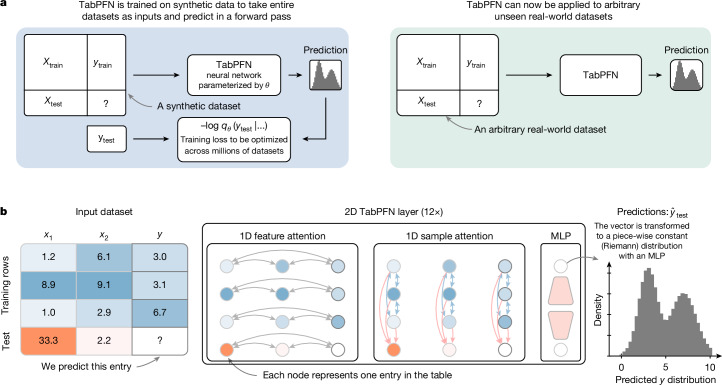
TabPFN is a tabular foundation model pretrained on millions of synthetic datasets that uses in-context learning to outperform prior methods on small- to medium-sized tabular data up to 10,000 samples and 500 features. It delivers strong classification and regression performance in a single forward pass and also supports fine-tuning, data generation, density estimation, reusable embeddings, and interpretability.
Key findings
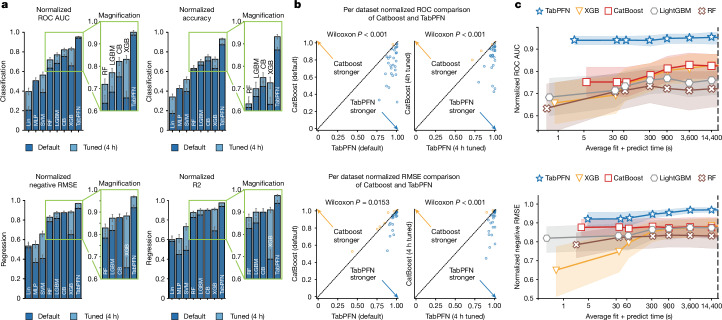
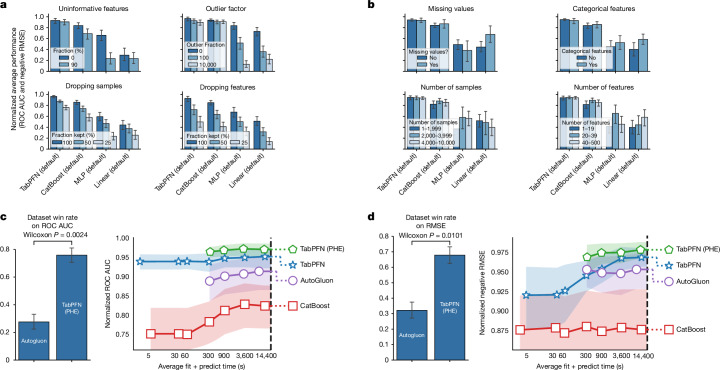
- On benchmarks with 29 classification and 28 regression datasets up to 10,000 samples, 500 features, and 10 classes, TabPFN outperformed tuned baselines. Classification normalized ROC AUC: TabPFN default 0.939 vs CatBoost default 0.752; tuned TabPFN 0.952 vs tuned CatBoost 0.822. Regression normalized RMSE: TabPFN default 0.923 vs CatBoost default 0.872; tuned TabPFN 0.968 vs tuned CatBoost 0.875.
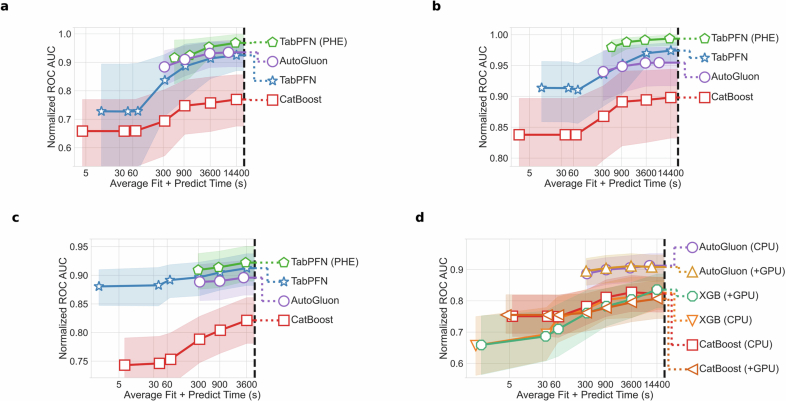
- TabPFN default took 2.8 s for classification and 4.8 s for regression on average, outperforming baselines tuned for 4 h—a speedup of 5,140× for classification and 3,000× for regression. TabPFN (PHE) reached average normalized ROC AUC 0.971 vs 0.939 for TabPFN default and 0.914 for AutoGluon; for regression, TabPFN (PHE) outperformed AutoGluon allowed 4 h after a 300 s tuning budget, a 48× speedup.
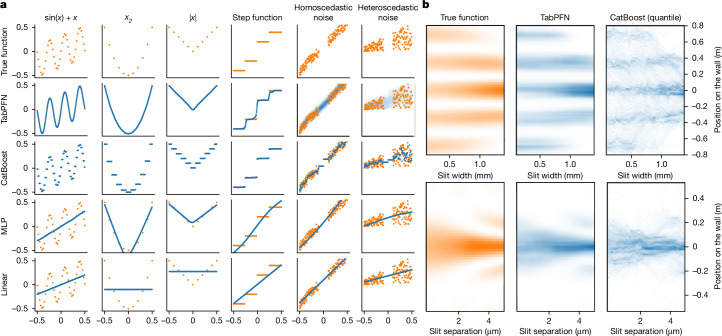
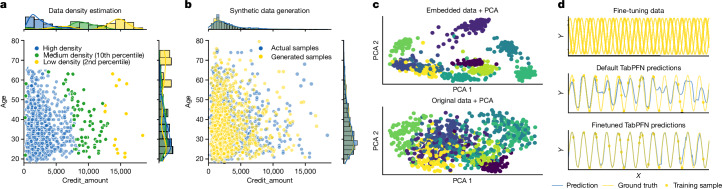
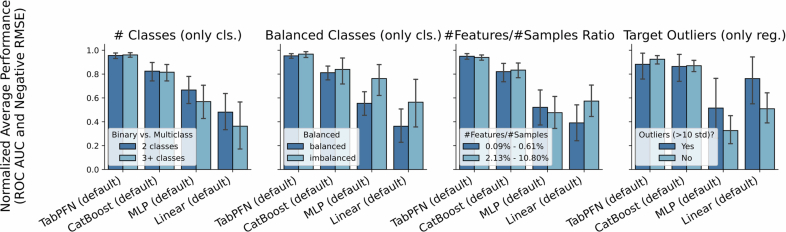
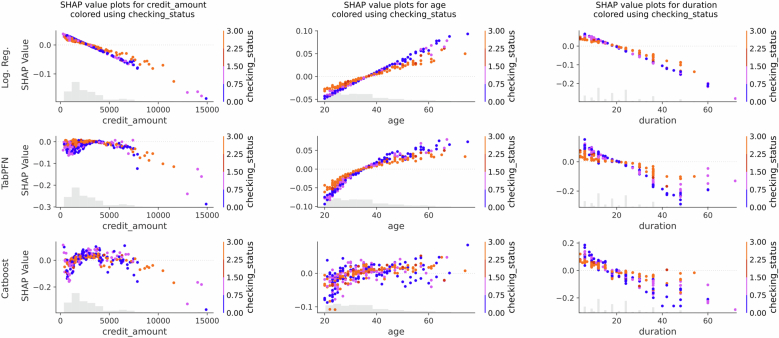
- TabPFN was robust to uninformative features and outliers, and with half the samples it performed as well as the next best method using all samples. It also demonstrated foundation-model abilities including density estimation, synthetic data generation, learned embeddings, fine-tuning, and SHAP-based feature importance.
Methods
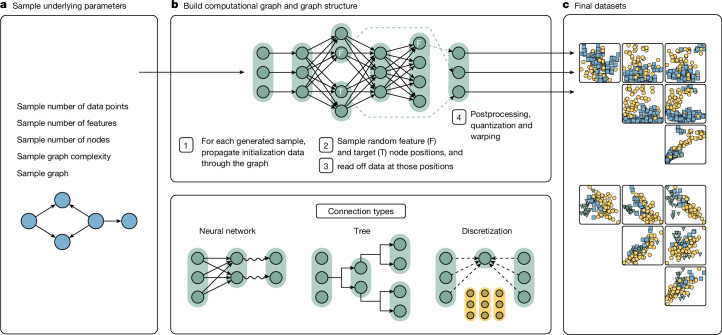
- TabPFN was pretrained on synthetic tabular datasets generated from structural causal models: around 100 million synthetic datasets per model training, with final models trained for approximately 2,000,000 steps at batch size 64 datasets, corresponding to around 130,000,000 synthetically generated datasets each.
- The architecture is a transformer encoder variant that treats each table cell as a separate position and uses two-way attention: each cell attends to other features in its row, then to the same feature across its column. At inference, training samples are provided as context and predictions are made in a single forward pass via in-context learning; train-state caching enables reuse for multiple test inferences.
- Evaluation used the AutoML Benchmark and OpenML-CTR23, with 29 classification and 28 regression datasets up to 10,000 samples, 500 features, and 10 classes. Each dataset and method was run for 10 repetitions with different random seeds and 90% train/10% test splits; hyperparameters were tuned by random search with five-fold cross-validation using time budgets from 30 s to 4 h. Metrics were ROC AUC and accuracy for classification, and R² and negative RMSE for regression, normalized per dataset.
Limitations
- The paper states that TabPFN inference may be slower than highly optimized approaches such as CatBoost; memory usage scales linearly with dataset size and can be prohibitive for very large datasets; and evaluation focused on datasets with up to 10,000 samples and 500 features, so scalability to larger datasets requires further study.
- The paper also states TabPFN is not optimized for real-time inference: for a dataset with 10,000 rows and 10 columns, it requires 0.2 s (0.6 s without GPU) to predict one sample, whereas CatBoost default can do so in 0.0002 s.
- The paper notes that for larger datasets and highly non-smooth regression datasets, CatBoost, XGBoost, or AutoGluon are likely to outperform TabPFN, and that natively the method is limited to predicting at most 10 classes unless pretrained on more classes or adapted with approaches such as one-vs-one, one-vs-rest, or ECOC.
Model-written summary. Check it against the paper before relying on it.
Integrity signals
Registry
Cites
Statistics
Figures
Verification
Claims the paper makes
1 Valid · 6 Not valid · 17 Not checked · 72 Own results and interpretations
The sources with a verdict support this claim; the rest weren’t checked yet, have no full text we could read, or their verdicts aren’t rated yet.
In the paper
“For larger datasets and highly non-smooth regression datasets, approaches such as CatBoost9, XGB7 or AutoGluon40 are likely to outperform TabPFN.”
§ Accurate predictions on small data with a tabular foundation model > Methods > User guide
What the sources say
- Check pendingcites [9] Prokhorenkova, L., Gusev, G., Vorobev, A., Dorogush, A. & Gulin, A. CatBoost: unbiased boosting with categorical features. In Proc. 30th International Conference on Advances in Neural Information Processing Systems (eds Bengio, S. et al.) 6639–6649 (Curran Associates, 2018). source
- Supportedcites [7] Chen, T. & Guestrin, C. Xgboost: A scalable tree boosting system. In Proc. 22nd ACM SIGKDD International Conference on Knowledge Discovery and Data Mining (eds Krishnapuram, B. et al.) 785–794 (ACM Press, 2016). source
The citation is offered to identify the system 'XGB' named in the citing sentence, and our copy is that system's paper: the Abstract and Introduction (KDD '16) describe XGBoost as 'a scalable end-to-end tree boosting system' that 'scales beyond billions of examples using far fewer resources than existing systems', used 'to achieve state-of-the-art results on many machine learning challenges'. The Introduction (p.1) further notes 17 of 29 Kaggle winning solutions in 2015 used XGBoost, and the evaluation sections report it running >10x faster than Spark MLLib/H2O on the 1.7-billion-example Criteo data, consistent with the 'larger datasets' framing. The head-to-head comparison against TabPFN and the 'highly non-smooth regression' qualification are the citing authors' own conclusion (TabPFN postdates this source) and are not attributed to this paper, so nothing here is unsupported for the part this citation carries. (LLM, conf=0.85)
- Check pendingcites [40] Erickson, N. et al. Autogluon-tabular: robust and accurate automl for structured data. Preprint at https://arxiv.org/abs/2003.06505 (2020). source
hedgedstates a possible cause- Asserted: passes — The authors put it forward as true.
- Checkable: passes — It can be checked against evidence.
- Load-bearing: unclear — It is unclear whether the paper’s conclusions depend on it.
- Based: passes — The paper gives a reason why it holds.
A result the paper states — it cites no source for it, so there is none to check. The quote shows it is in the paper.
In the paper
“This new supervised tabular learning method can be applied to any small- to moderate-sized dataset and yields dominant performance for datasets with up to 10,000 samples and 500 features.”
§ Accurate predictions on small data with a tabular foundation model > Main
plainstates a causen = 10,000- Asserted: passes — The authors put it forward as true.
- Checkable: passes — It can be checked against evidence.
- Load-bearing: passes — The paper’s conclusions depend on it.
- Based: passes — The paper gives a reason why it holds.
A result the paper reports from its own data — it cites no other source for it, so there is none to check. The quote shows it is in the paper.
In the paper
“We extract and visualize learned embeddings from the mfeat-factors dataset in Fig. 6c, showing improved class separation compared with the raw data on the first two principal components.”
§ Accurate predictions on small data with a tabular foundation model > Foundation model with interpretability
plainstates a cause- Asserted: passes — The authors put it forward as true.
- Checkable: passes — It can be checked against evidence.
- Load-bearing: unclear — It is unclear whether the paper’s conclusions depend on it.
- Based: passes — The paper gives a reason why it holds.
A result the paper reports from its own data — it cites no other source for it, so there is none to check. The quote shows it is in the paper.
In the paper
“we found that pre-processing inputs can help performance”
§ Accurate predictions on small data with a tabular foundation model > Methods > Details on the neural architecture
plainstates a possible cause- Asserted: passes — The authors put it forward as true.
- Checkable: passes — It can be checked against evidence.
- Load-bearing: unclear — It is unclear whether the paper’s conclusions depend on it.
- Based: passes — The paper gives a reason why it holds.
In the paper
“As our models are not fully permutation invariant, for each ensemble member, we shuffle the feature order, approximating order invariance64.”
§ Accurate predictions on small data with a tabular foundation model > Methods > Inference details
What the sources say
- Not checked yetcites [64] Murphy, R. L., Srinivasan, B., Rao, V. A. & Ribeiro, B. Janossy pooling: learning deep permutation-invariant functions for variable-size inputs. In Proc. 7th International Conference on Learning Representations (ICLR, 2019). source
plain- Asserted: passes — The authors put it forward as true.
- Checkable: passes — It can be checked against evidence.
- Load-bearing: passes — The paper’s conclusions depend on it.
- Based: passes — The paper gives a reason why it holds.
25 more claims
Create a free account to see all 96 claims and to verify the 28 references still open.
- Probably not a substantial claim. 32
- It may state two separate claims as one. 47
Self-check
Percentages, sums and reported differences re-computed from the paper’s own numbers.
Each contradiction between two passages listed here was confirmed by an independent check.
Rated minor: it would not touch a result — a value no result rests on, a p-value that stays on the same side of the significance level, or a conflict that is clerical, resolved elsewhere in the paper, or outside its own findings.
In the paper
§ Accurate predictions on small data with a tabular foundation model > Quantitative analysis > Comparison with tuned ensemble methods
“In just 2.8 s, TabPFN (default) outperforms AutoGluon for classification tasks, even if AutoGluon is allowed up to 4 h, a 5.140× speedup.”
§ Accurate predictions on small data with a tabular foundation model > Quantitative analysis > Comparison with state-of-the-art baselines
“The default of TabPFN, taking 2.8 s on average for classification and 4.8 s for regression, outperforms all baselines, even when tuning them for 4 h—a speedup of 5,140× and 3,000×, respectively.”
Rated minor: it would not touch a result — a value no result rests on, a p-value that stays on the same side of the significance level, or a conflict that is clerical, resolved elsewhere in the paper, or outside its own findings.
In the paper
§ Accurate predictions on small data with a tabular foundation model > Quantitative analysis
“TabPFN was pre-trained once using eight NVIDIA RTX 2080 GPUs over 2 weeks”
§ Accurate predictions on small data with a tabular foundation model > Methods > Training details
“One training run requires around 2 weeks on one node with eight Nvidia RTX 2080 Ti GPUs.”
Rated minor: it would not touch a result — a value no result rests on, a p-value that stays on the same side of the significance level, or a conflict that is clerical, resolved elsewhere in the paper, or outside its own findings.
In the paper
§ Accurate predictions on small data with a tabular foundation model > An architecture designed for tables
“This design enables the architecture to be invariant to the order of both samples and features”
§ Accurate predictions on small data with a tabular foundation model > Methods > Inference details
“As our models are not fully permutation invariant, for each ensemble member, we shuffle the feature order, approximating order invariance64.”
Citations
Cites
Breiman, L. (2001) · Machine Learning · doi:10.1023/a:1010933404324 · Cited by 133,538
Vaswani, A., Shazeer, N., Parmar, N., Uszkoreit, J., Jones, L., Gomez, A. N., Kaiser, L., & Polosukhin, I. (2017) · arXiv · doi:10.48550/arxiv.1706.03762 · Cited by 120,404
Distinctive Image Features from Scale-Invariant Keypoints
Lowe, D. G. (2004) · International Journal of Computer Vision · doi:10.1023/b:visi.0000029664.99615.94 · Cited by 62,647 · cited 2×
“Hand-designed features in computer vision, such as SIFT (Scale Invariant Feature Transform) 10 and HOG (Histogram of Oriented Gradients) 11 , have been replaced by learned convolutions; grammar-based approaches in natural language processing have been replaced by learned transformers 12 ; and the design of customized…”
Cortes, C., & Vapnik, V. (1995) · Machine Learning · doi:10.1007/bf00994018 · Cited by 59,421
XGBoost: A Scalable Tree Boosting System
Chen, T., & Guestrin, C. (2016) · Proceedings of the 22nd ACM SIGKDD International Conference on Knowledge Discovery and Data Mining · doi:10.1145/2939672.2939785 · Cited by 54,569
Highly accurate protein structure prediction with AlphaFold
Jumper, J., Evans, R., Pritzel, A., Green, T., Figurnov, M., Ronneberger, O., Tunyasuvunakool, K., Bates, R., Žídek, A., Potapenko, A., et al. (2021) · Nature · doi:10.1038/s41586-021-03819-2 · Cited by 43,764
Histograms of Oriented Gradients for Human Detection
Dalal, N., & Triggs, B. (2005) · 2005 IEEE Computer Society Conference on Computer Vision and Pattern Recognition (CVPR'05) · doi:10.1109/cvpr.2005.177 · Cited by 33,584
Greedy function approximation: A gradient boosting machine
Friedman, J. H. (2001) · The Annals of Statistics · doi:10.1214/aos/1013203451 · Cited by 30,731 · cited 2×
“The list of development datasets can be found in Supplementary Tables 5 and 6.”
Language Models are Few-Shot Learners
Brown, T. B., Mann, B., Ryder, N., Subbiah, M., Kaplan, J., Dhariwal, P., Neelakantan, A., Shyam, P., Sastry, G., Askell, A., et al. (2020) · arXiv · doi:10.48550/arxiv.2005.14165 · Cited by 23,372 · cited 1×
“We build on a preliminary version of TabPFN 23 , which demonstrated the applicability of in-context-learning 17 for tabular data in principle but had many limitations that rendered it inapplicable in most cases.”
Quinlan, J. R. (1986) · Machine Learning · doi:10.1007/bf00116251 · Cited by 21,439
Research works printed but not linked: 11
- van Breugel, B. & van der Schaar, M. Position: why tabular foundation models should be a research priority. In Proc. 41st International Conference on Machine Learning 48976–48993 (PMLR, 2024).
- Akyürek, E., Schuurmans, D., Andreas, J., Ma, T. & Zhou, D. What learning algorithm is in-context learning? Investigations with linear models. In Proc. The Eleventh International Conference on Learning Representations (ICLR, 2023).
- Müller, S., Hollmann, N., Pineda-Arango, S., Grabocka, J. & Hutter, F. Transformers can do Bayesian inference. In Proc.The Tenth International Conference on Learning Representations (ICLR, 2022).
- Kingma, D. & Ba, J. Adam: A method for stochastic optimization. In Proc. International Conference on Learning Representations (ICLR, 2015).
- Bahdanau, D., Cho, K. & Bengio, Y. Neural machine translation by jointly learning to align and translate. In Proc. 3rd International Conference on Learning Representations (eds Bengio, Y. & LeCun, Y.) (ICLR, 2015).
- Gorishniy, Y., Rubachev, I., Khrulkov, V. & Babenko, A. Revisiting deep learning models for tabular data. In Proc. Advances in Neural Information Processing Systems 34 (eds Ranzato, M. et al.) 18932–18943 (NeurIPS, 2021).
- Fischer, S. F., Feurer, M. & Bischl, B. OpenML-CTR23 – a curated tabular regression benchmarking suite. In Proc. AutoML Conference 2023 (Workshop) (AutoML, 2023).
- Lundberg, S. M. & Lee, S.-I. A unified approach to interpreting model predictions. In Proc.Advances in Neural Information Processing Systems (eds Guyon, I. et al.) Vol. 30, 4765–4774 (Curran Associates, 2017).
- Nagler, T. Statistical foundations of prior-data fitted networks. In Proc. 40th International Conference on Machine Learning (eds Krause, A. et al.) Vol. 202, 25660–25676 (PMLR, 2023).
- Müller, S., Feurer, M., Hollmann, N. & Hutter, F. PFNS4BO: in-context learning for Bayesian optimization. In Proc. 40th International Conference on Machine Learning 25444–25470 (PMLR, 2023).
- Loshchilov, I. & Hutter, F. SGDR: Stochastic gradient descent with warm restarts. In Proc. 5th International Conference on Learning Representations (ICLR, 2017).
Cited by
Items 1,301–1,400 of 2,324
When Less Compute Is More: Adaptive Early Exit Improves Pretrained Outlier DetectionPreprint
Zhou, T., & Akoglu, L. (2026) · arXiv (Cornell University) · doi:10.48550/arxiv.2609.32898
Vandeventer, R., Imrem, D., & Wild, D. J. (2026) · arXiv (Cornell University) · doi:10.48550/arxiv.2609.12105
Reservoir: A Large-Scale Simulated Dataset for Training and Evaluating Epidemiological ModelsPreprint
Dudley, C., Magdaleno, R., & Eisenberg, M. C. (2026) · arXiv (Cornell University) · doi:10.48550/arxiv.2608.27408
Ding, K. (2026) · arXiv (Cornell University) · doi:10.48550/arxiv.2609.20218
An Open-Source Training Dataset for Foundation Models for Hyperparameter OptimizationPreprint
Klein, A., Rakotoarison, H., Thale-Bombien, L., & Salinas, D. (2026) · arXiv (Cornell University) · doi:10.48550/arxiv.2605.23417
Reconstruction and Analysis of Tumor-Specific Gene Regulatory Networks from scRNA-seq Data
Chen, L. (2026) · Asia Conference on Algorithms, Computing and Machine Learning (CACML) · doi:10.1109/cacml68972.2026.11506714
Horf, M., & Vogel, S. (2026) · Computers and Electronics in Agriculture · doi:10.2139/ssrn.6253032
Ma, N., Xi, S., Li, K., Wang, S., Ni, M., Zhou, Z., Zhang, S., Liu, X., Jia, Y., Pu, Y., et al. (2026) · Agronomy · doi:10.3390/agronomy16151508
Kim, Y. J., Park, H. Y., Li, Z. J., & Kim, J. Y. (2026) · Journal of Industrial and Engineering Chemistry · doi:10.1016/j.jiec.2026.06.008
Weng, F., Wang, Y., Liu, J., Yu, H., Xiao, M., Cheng, H., Zhang, Y., & Han, B. (2026) · Particuology · doi:10.1016/j.partic.2026.08.007
Bui, Q.-A. T., Trinh, S. H., & Nguyen, K. M. (2026) · Journal of Engineering and Applied Science · doi:10.1186/s44147-026-01203-3
Hadi, S. U., Shah, K. S., Khan, M. Y., & Huang, L. (2026) · Transportation Infrastructure Geotechnology · doi:10.1007/s40515-026-01054-8
Almansour, N. M. (2026) · Biomedicines · doi:10.3390/biomedicines14102298
AI and Deep Learning in Cardiovascular Imaging: From Risk Stratification to Precision Phenotyping
Diao, K., Lu, J., Dimitrakakis, A., Liu, Z., Fayad, Z. A., Lee, H.-C., & Mei, X. (2026) · Arteriosclerosis Thrombosis and Vascular Biology · doi:10.1161/atvbaha.126.324762
Guo, S., Jia, D., Ji, M., Wang, R., & Zhang, D. (2026) · Frontiers in Plant Science · doi:10.3389/fpls.2026.1867593
Machine Learning Meets Photocatalytic Water Splitting for Sustainable Hydrogen Production
Yoon, H., Cho, J. H., Ong, W., & Kim, S. Y. (2026) · ChemPhotoChem · doi:10.1002/cptc.70239
Liu, Q., Zhang, J., 诸叶平, Wang, K., Zhang, C., Zhang, J., Jin, Y., Zhang, Y., Liu, Z., Guo, Y., et al. (2026) · medRxiv · doi:10.64898/2026.05.05.26352448
Recurrent In-Context Learning for Tabular Foundation ModelsPreprint
Vaidhya, T., Sahu, G., & Rish, I. (2026) · arXiv (Cornell University) · doi:10.48550/arxiv.2610.14998
LoopICL: Looping a single transformer block to solve tabular tasksPreprint
Balef, A. R., & Eggensperger, K. (2026) · arXiv (Cornell University) · doi:10.48550/arxiv.2609.36108
Miao, L., Wang, B., Liu, J., & Yang, L. (2026) · SSRN Electronic Journal · doi:10.2139/ssrn.7429835
TabiMed: Tabularizing Medical Images for Few-Shot In-Context Diagnosis
Zhou, W., Sun, Y., Ling, Y., Xing, Z., Ma, C., Tan, W., & Yan, B. (2025) · ACM International Conference on Multimedia (ACM MM) · doi:10.1145/3746027.3755867
Adaptive Graph-of-Islands Evolution for Automatic Feature Engineering with LLMsPreprint
Li, S., & Ramakrishnan, N. (2026) · arXiv (Cornell University) · doi:10.48550/arxiv.2607.23286
RecPFN: Prior-Fitted Networks for In-Context-Based Recommendations
Tan, E. Z., Lim, J. X., Chew, B. L., Ng, T. M., & Yap, B. Y. H. (2026) · International ACM SIGIR Conference on Research and Development in Information Retrieval (SIGIR) · doi:10.1145/3805712.3809696
Zhang, Y., Sun, Y., Liu, J., Shao, Y., Li, Y., & Dong, S. (2026) · Chinese Control and Decision Conference (CCDC) · doi:10.1109/ccdc69976.2026.11560067
Virk, S. S., & Virk, A. S. (2026) · Machine Learning Health · doi:10.1088/3049-477x/aeafbf
Adapting Skew-Probabilistic Neural Networks for Credit-Risk Probability Estimation
Bimoldan, M., & Kasenov, S. E. (2026) · Machine Learning and Knowledge Extraction · doi:10.3390/make8110352
Cheng, Y., Yue, X., 但文蛟, Wang, M., Ding, J., Xue, M., Zhang, J., & Zhang, Y. (2026) · Journal of Energy Storage · doi:10.1016/j.est.2026.125197
Foundation Model Forecasting of Headache Days in People With Persisting Postconcussion Symptoms
Danelakis, A., Storvig, G., Bjørk, M., Contreras, D., Matharu, M. S., Nachev, P., Winsvold, B. S., Tronvik, E., Stubberud, A., & Olsen, A. (2026) · Journal of Head Trauma Rehabilitation · doi:10.1097/htr.0000000000001206
Fault Diagnosis of Coal-Fired Power Plants Based on Multi-Scale Spatiotemporal Features and TabPFN
Ye, X., Miao, C., Jia, W., Huang, X., Wang, M., & Tan, J. (2026) · Mathematics · doi:10.3390/math14173166
Jiang, B., Zhang, X., Qi, M., Ai, X., Wang, X., & 秦新英 (2026) · Atmospheric Environment · doi:10.1016/j.atmosenv.2026.122333
A Comprehensive Evaluation of Machine Learning Pipelines for Toxic Endpoint PredictionPreprint
Rolli, L.-M., Arnaout, L., & Volkamer, A. (2026) · Research Square · doi:10.21203/rs.3.rs-10470980/v1
Zhu, W., Zheng, X., Tian, D., Yan, L., Bai, Z., Wu, J., Hu, P., & Chen, R. (2026) · doi:10.2196/preprints.112699
Mei, Z., Ryser, A., Amprimo, G., Wang, J., Vogt, J. E., & Ravi, D. K. (2026) · Journal of NeuroEngineering and Rehabilitation · doi:10.1186/s12984-026-01997-6
Sözen, Ö., Yelmen, İ., Karaköy, T., Zontul, M., Bakır, H., & Aydın, H. (2026) · Agriculture · doi:10.3390/agriculture16202197
Interpretable Prediction of Ligand–Protein Binding without Protein Structural Information
Sadagopan, A., Sodhi, A., & Gibson, W. J. (2026) · Journal of Medicinal Chemistry · doi:10.1021/acs.jmedchem.6c00249
Shen, L., Liu, Q., Zhang, W., & Lu, S. (2026) · Journal of Environmental Management · doi:10.1016/j.jenvman.2026.130541
Wang, X., & Li, Z. (2026) · Mathematics · doi:10.3390/math14183420
Rodolfo, C.-C., Vinícius, S.-R., Biondo, F., Alexandra, Y., Neil, O., James, C., & Carlos, S.-G. (2026) · Neurobiology of Aging · doi:10.1016/j.neurobiolaging.2026.10.006
The applications of artificial intelligence in liver transplantation: A comprehensive scoping review
Borakati, A., Agilinko, J., Wu, J., Hunter, S., Alhaq, A., Froghi, F., Teo, J., Bernal, W. E., Callaghan, C. J., Cerisuelo, M. C., et al. (2026) · PLoS ONE · doi:10.1371/journal.pone.0361120
Wang, T., Ji, J., Huang, Y. S., Li, J., Nadarajah, S., & Qin, S. (2026) · Water Research · doi:10.1016/j.watres.2026.126335
李, 霄. (2026) · Journal of Clinical Personalized Medicine · doi:10.12677/jcpm.2026.51084
Clos‐Garcia, M., Jain, S. Y., Naaman, C., RAGUZ, J. A., Schaefer, Z., Kaur, G., Curovic, V. R., Kirketerp‐Møller, K., Andersen, J. A., Engberg, S., et al. (2026) · medRxiv · doi:10.64898/2026.09.15.26363101
A dynamic spatiotemporal representation framework for deciphering personal brain function
Wang, X., Zou, T., Wang, H., Han, H., Chen, H., Calhoun, V. D., & Li, R. (2025) · NeuroImage · doi:10.1016/j.neuroimage.2025.121443
Lu, Y., Liang, B., Zeng, X., Zhang, S., Chen, Z., Chen, J., & Liao, H. (2026) · Research Square · doi:10.21203/rs.3.rs-10588615/v1
Joint Parkinson’s Motor Symptom Scoring and Staging via Label Distribution Learning
Huang, X., Li, S., Zhang, X., & Liang, L. (2025) · International Conference on Smart Healthcare and Wearable Intelligent Devices (SHWID) · doi:10.1145/3788112.3788125
Lin, H., Wen, H., Ma, Z., Zhao, Y. Q., Zheng, Q., He, C., Cui, L., & Zhang, Y. (2026) · Environmental Science & Technology · doi:10.1021/acs.est.6c05983
Nashat, M., Zayed, T. M., Meguid, M. A., Ali, E., Arimiyawa, D., & Yang, J. (2026) · SSRN Electronic Journal · doi:10.2139/ssrn.7451115
Machine Learning Models for Predicting Mortality in Hemodialysis Patients
Lantmann, L. L., Gauer, F. G., Reinheimer, I. C., de Souza, D. C., Bernardes, M. M., Poli-de-Figueiredo, C. E., & Musse, S. R. (2025) · SIBGRAPI Conference on Graphics, Patterns and Images (SIBGRAPI) · doi:10.5753/sibgrapi.est.2025.38297
Wu, Z., Zhou, Y., Ho, N. S. K., & Pang, J. H. L. (2026) · International Journal of Fatigue · doi:10.1016/j.ijfatigue.2026.109943
Teixeira, C. E., Tessarollo, N. G., Baptista, G., Serain, A. F., Zancanaro, H., de Paula, D. J. G., Moreeuw, L. C., Chaves, C. B. P., Viola, J. P. B., Filho, A. D. P. C., et al. (2026) · The Lancet Regional Health - Americas · doi:10.1016/j.lana.2026.101527
TabPFN: Shedding a New Light for Biomedicine With a Small Data Prediction Model
Li, M., Zhang, S., & Xu, C. (2025) · MedComm – Future Medicine · doi:10.1002/mef2.70022
Liu, J., Zhang, C., Li, S., Zhang, J., Zhang, X., Wu, H., Liang, R., You, W., & Zhou, M. (2026) · Chinese Chemical Letters · doi:10.1016/j.cclet.2026.113428
Early Detection of Ebola Virus Disease Using a Hybrid TabPFN–Kan–Mamba Model
Karthick, N., & Gayathri, M. (2026) · International Conference on Soft Computing for Security Applications (ICSCSA) · doi:10.1109/icscsa69367.2026.11707990
TabHealer: Structure-Aware Table Recovery from OCR Errors Using LLM EnsemblesPreprint
jang, Y., & Oh, H. (2025) · SSRN Electronic Journal · doi:10.2139/ssrn.5457005
FinTabLLM: Unlocking the Power of LLMs for Merger Withdrawal Prediction
Shohrab, M., Ye, Z., Liu, Y., & Yu, D. (2026) · Lecture notes in computer science · doi:10.1007/978-3-032-37667-1_5
Flores, E., Meza, D., Gonzales, R., Agudelo-Santos, C., Sosa, L., Espinoza, L. C., & Zablah, I. (2026) · Diagnostics · doi:10.3390/diagnostics16213440
Slope stability prediction using machine learning models
Geem, Z. W., Bekdaş, G., Nigdeli, S. M., Aydın, Y., Işıkdağ, Ü., & Kim, T.-H. (2026) · Elsevier eBooks · doi:10.1016/b978-0-443-41481-7.00006-7
Jia, R., Cui, X., Jia, S., Xu, M., Wang, X., Huang, N., Sun, X., Wang, L., Li, J. M., & Cui, K. (2026) · BMC Cardiovascular Disorders · doi:10.1186/s12872-026-06143-7
A New Database for the Durability of Fiber-Reinforced Polymer Rebar
Geng, X., Wang, Z., & Wu, C. (2026) · Journal of Materials in Civil Engineering · doi:10.1061/jmcee7.mteng-22581
Mendelian Randomization and Machine Learning for Anatomical Subtyping of Adolescent Sleep Apnea
Li, X., Shen, Y., Liu, Q., Xue, H., Feng, Y., Ni, X., Chen, X., & Lin, J. (2026) · International Dental Journal · doi:10.1016/j.identj.2026.111192
Barmandah, H., Bawazir, O. A., Marghalani, S. A., Shaat, M., Alkattan, A., & AlEissa, M. M. (2026) · Journal of Personalized Medicine · doi:10.3390/jpm16100531
Li, J., Guo, Z., Li, C., Zhao, W., Cai, X., Ma, Z., Zhao, H., & Ren, L. (2026) · Applied Energy · doi:10.1016/j.apenergy.2026.129031
Sachdeva, A., & Dennis, A. R. (2026) · SSRN Electronic Journal · doi:10.2139/ssrn.6149838
Kaier, K., Benadi, G., Nolde, S., Ludwig, C. T., Giuliani, C., Engel, F., Watter, M., & Binder, H. (2025) · medRxiv · doi:10.1101/2025.10.06.25337418
Clinically Contextualized State Spaces Provide Continuous Representations of SepsisPreprint
Kobara, S., Kay, M., Choudhary, T., Krishnamoorthy, V. K., Podgoreanu, M. V., Hayashi, Y., Agarwal, S., & Kamaleswaran, R. (2026) · Research Square · doi:10.21203/rs.3.rs-11221040/v1
A Comprehensive Survey of Missing Data-Handling Methods from a Machine Learning Perspective
Chao, G., Li, J., Zhu, X., & Zhu, X. (2026) · Machine Learning and Knowledge Extraction · doi:10.3390/make8100310
Tabular prior-data fitted networks for objective depression screening with portable EEG and ECG
Guo, X., Zheng, Z., Dai, A., Wang, P., Chen, M., Niu, M., Liao, X., Cheng, K., Cao, L., Cheng, Z., et al. (2026) · Biomedical Signal Processing and Control · doi:10.1016/j.bspc.2026.109598
Graser, C. J., Zhou, Z., Schürch, M., Moorhead, G., Dean, J., Lin, C., Dean, J., Kozono, D., Lahav, G., & Michor, F. (2025) · bioRxiv (Cold Spring Harbor Laboratory) · doi:10.1101/2025.07.02.662373
Domingo-Aldama, A. G., Prado, M. A. M., García-Olea, A., Gojenola, K., Goikoetxea, J., & Atutxa, A. (2025) · SSRN Electronic Journal · doi:10.2139/ssrn.5338420
Benchmarking privacy and utility in synthetic tabular cohorts for Alzheimer's disease research
Winzell, F., Arvidsson, I., Overgaard, N. C., Heyden, A., Åström, K., Karlsson, L., Vogel, J. W., Hansson, O., Mattsson, N., & Initiative, A. D. N. (2026) · Alzheimer s & Dementia Diagnosis Assessment & Disease Monitoring · doi:10.1002/dad2.70430
Floc image recognition based on multimodal fusion to provide predictive feedback in coagulation
Li, B., Lin, P., Liu, F., Liu, Z., Liu, L., & Li, K. (2026) · Journal of Water Process Engineering · doi:10.1016/j.jwpe.2026.109966
Zhao, Z., Chen, Z., Wang, Z., Chen, H., Dai, G., & Zeng, H. (2026) · SSRN Electronic Journal · doi:10.2139/ssrn.6909826
Abdullah, Bensmail, H., Johnson, J. P., & Bouhali, O. (2026) · Frontiers in Veterinary Science · doi:10.3389/fvets.2026.1809041
FuDoBa: Fusing Document and Knowledge Graph Based Representations with Bayesian Optimisation
Koloski, B., Pollak, S., Navigli, R., & Škrlj, B. (2026) · Machine Learning · doi:10.1007/s10994-026-07008-y
Pacheco, E. C. B., & Ramos, J. A. (2026) · Anais do Symposium on Knowledge Discovery, Mining and Learning (KDMiLe) · doi:10.5753/kdmile.2026.32084
Liu, P., Cao, S., wang, G., Zhao, B., Tang, Z., Sun, T., Fan, S., Yuan, S., & Pan, Y. (2026) · SSRN Electronic Journal · doi:10.2139/ssrn.6590300
Chu, C. H., Abedi, A., Julian, P., Maddiboina, D., & Khan, S. S. (2026) · Research Square · doi:10.21203/rs.3.rs-11283018/v1
Liu, K., Zhao, S. P., Du, L., Peng, Q., Duan, B., & Zhang, C. (2025) · IEEE Energy Conversion Congress and Exposition (ECCE) · doi:10.1109/ecce58356.2025.11260017
Zhai, Y., Li, Y., & Luo, W. (2026) · Complex & Intelligent Systems · doi:10.1007/s40747-026-02265-9
Li, S. W. L., Tan, D. Y. Y., Zhang, J., Mahyuddin, A. P., Ramlal, H., Illanes, S. E., Mönckeberg, M., Plaza, A., Morgan, M. L. P., Kemp, M. W., et al. (2026) · Journal of Medical Internet Research · doi:10.2196/88450
PhenoBench: Mapping What a Deeply Phenotyped Human Cohort Can Tell UsPreprint
Sapir, G., Diament, A., Wolf, A., Stupp, D., Gelbard-Solodkin, D., Azouri, D., Etzion-Fuchs, A., Lutsker, G., Segal, E., & Rossman, H. (2026) · arXiv (Cornell University) · doi:10.48550/arxiv.2609.06080
Chen, X., Quan, L., Mao, Y., Wang, S., Zhang, G., Li, S., Jiang, Y., Nie, L., Wu, T., & Lyu, Q. (2026) · Bioinformatics · doi:10.1093/bioinformatics/btag690
Liao, R., Yang, X., & Wang, Z. (2026) · IEEE Access · doi:10.1109/access.2026.3742949
Liu, J., Xie, R., Li, Z., Jia, X., Hou, J., Huang, X., Tan, J., Zhou, L., & Li, L. (2026) · Symmetry · doi:10.3390/sym18101725
Reznichenko, A., Zhilicheva, A. N., Владимирович, П. В., Валерьевна, П. Г., Chubarov, V. M., & Кирсанов, Д. (2026) · SSRN Electronic Journal · doi:10.2139/ssrn.7635820
Ibrahim, A. S. I., & Sönmez, Ö. (2026) · Chemical Engineering and Processing - Process Intensification · doi:10.2139/ssrn.6945149
Evaluating Odor Selectivity in $$\alpha $$-Synucleinopathy: ML-Based Odor Profiling
Mattjie, C., Ravazio, R., Mitchell, E., Bestwick, J. P., Kupssinskü, L. S., Noyce, A. J., Schuh, A. F. S., & Barros, R. C. (2026) · Lecture notes in computer science · doi:10.1007/978-3-032-15990-8_13
Khamitova, Z., Omarova, G., Akanova, A., Abdukarimova, A., Kadirkulov, K., Satayev, B., Beissegul, A., Kholbekov, A., Dzhiyanmuratova, G., & Amirbay, A. (2026) · Computers · doi:10.3390/computers15100723
Kajla, N. I., Caldecott, R., Urquhart, E., McNicholas, B., Pham, T. O., Heunks, L. M. A., Bellani, G., Brochard, L. J., Laffey, J., & Madden, M. G. (2026) · Research Square · doi:10.21203/rs.3.rs-10018593/v1
Physics-anchored residual learning for ship fuel consumption and carbon dioxide emission prediction
Fuyong, Z., & Liu, W. (2026) · Energy and AI · doi:10.1016/j.egyai.2026.100945
Convolutional networks with parallel structure for metastatic prostate cancer prediction
Liu, J., Zhou, S., Zang, M., Liu, C., Liu, T., & Wang, Q. (2025) · Computer Methods in Biomechanics & Biomedical Engineering · doi:10.1080/10255842.2025.2581152
Das, A., & Cui, Y. (2026) · bioRxiv (Cold Spring Harbor Laboratory) · doi:10.64898/2026.09.25.754520
Evaluating Autonomous LLM Agents Across Molecular Prediction and Optimization BenchmarksPreprint
Smbatyan, K., Ghukasyan, T., & Petrosyan, G. (2026) · bioRxiv (Cold Spring Harbor Laboratory) · doi:10.64898/2026.10.01.755314
Luo, Q., Shengfeng, Z. H. A. O., Haoran, W. A. N. G., Xingen, L. U., & Junqiang, Z. H. U. (2026) · Chinese Journal of Aeronautics · doi:10.1016/j.cja.2026.104526
CDDM: Constraint-Driven Diffusion Modeling for Tabular DataSynthesisPreprint
Merabet, M. (2026) · SSRN Electronic Journal · doi:10.2139/ssrn.7620346
Interpretable AI with Local DistillationPreprint
Craig, E., Huang, Y., & Panigrahi, S. (2026) · arXiv (Cornell University) · doi:10.48550/arxiv.2608.23538
Liu, P., Wang, H., Zhang, H., & Li, D. (2026) · SSRN Electronic Journal · doi:10.2139/ssrn.7199721
Liu, P., Wang, H., Zhang, H., & Li, D. (2026) · SSRN Electronic Journal · doi:10.2139/ssrn.7199673
Metadata
- Authors
- Hollmann, N., Müller, S., Purucker, L., Krishnakumar, A., Körfer, M., Hoo, S. B., Schirrmeister, R. T., & Hutter, F.
- Affiliations
- University of Freiburg (DE)
- Corresponding author
- Hollmann, Noah
- Müller, Samuel
- Hutter, Frank
- ORCID
- Venue
- Nature
- Published
- 2025-01-08
- Volume
- 637
- Issue
- 8045
- Pages
- 319-326
- ISSN
- 0028-0836 (ISSN-L)
- 1476-4687
- PMC
- PMC11711098
- OpenAlex
- W4406170795
- Semantic Scholar
- 6b238b17e419c7dd3912b9845449496bfb0a571a
- Cited by
- 2,323
- References
- 63
- Citations by year
- 2026: 1829 · 2025: 487
- FWCI
- 417.80
- Type
- journal article
- Language
- en
- Open access
- hybrid
- doi.org
- Licence
- cc-by
- creativecommons.org/licenses/by/4.0 (tdm)
- creativecommons.org/licenses/by/4.0 (vor)
- Locations
- Nature (publishedVersion, cc-by)
- PubMed Central (publishedVersion, cc-by)
- PubMed (publishedVersion)
- RePEc: Research Papers in Economics (submittedVersion)
- Funders
- European Commission (101045765)
- Deutsche Forschungsgemeinschaft (INST 39/963-1, “INST 39/963-1 FUGG”, SFB1597, 417962828, 39/963-1, 499552394)
- Hector Stiftung
- Topics
- Physical Sciences › Computer Science › Artificial Intelligence › Machine Learning and Data Classification
- Physical Sciences › Computer Science › Artificial Intelligence › Neural Networks and Applications
- Physical Sciences › Computer Science › Artificial Intelligence › Domain Adaptation and Few-Shot Learning
- Keywords
- tabular data, tabular foundation models, TabPFN, missing data estimation, small data, generative transformers, synthetic data, fine-tuning, density estimation, embeddings, gradient boosting decision tree, tabular data classification
About these checks
Registry, retraction, Cites and statistics results are computed, not judged, with one exception: a printed reference that no index lists is read once by a model before it counts as a citation error. Claims are extracted by a model and kept only when their quote appears verbatim in the text; each cited source is then checked, with a model’s help, for whether it says what the claim relies on. Those verdicts can be wrong — read the claim’s quote and the cited source before relying on one.
A language model drew the claims from the paper on 2026-11-24, under version 3 of the claim definition (model deepseek-v4.1-flash, prompt extract-v3).
A second model labelled each claim on 2026-11-24 (model jev-1.13-20260917, definition revision gold-guideline-v0.2).
Cited sources are checked with a language model’s help (qwen3.8-omni-flash).
Statistics and arithmetic are recomputed, not judged.
Confidence bands are shown only for fields calibrated on our annotated test set. None is calibrated yet, so no band is shown.
What counts as a claim ›How we measure confidence ›How we check this ›
Are you an author, or do you see a problem with this page? Request a review
Data sources
Bibliographic data: Semantic Scholar, OpenAlex, Crossref.
Contains information from the Semantic Scholar Academic Graph Datasets, made available under the ODC Attribution License (ODC-BY 1.0).
Semantic Scholar’s data is described in: Kinney, R., et al. (2023). The Semantic Scholar Open Data Platform. arXiv:2301.10140.
