

Accurate predictions on small data with a tabular foundation model
Open accessThe DOI matches its Crossref record; 64 of the 64 references it cites were found in a registry or an index; 1 of the 31 sources its claims cite were checked for support.
Abstract
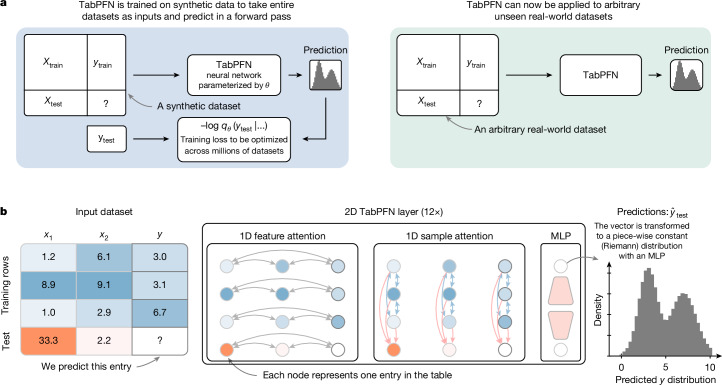
Tabular data, spreadsheets organized in rows and columns, are ubiquitous across scientific fields, from biomedicine to particle physics to economics and climate science 1,2. The fundamental prediction task of filling in missing values of a label column based on the rest of the columns is essential for various applications as diverse as biomedical risk models, drug discovery and materials science. Although deep learning has revolutionized learning from raw data and led to numerous high-profile success stories 3–5, gradient-boosted decision trees 6–9 have dominated tabular data for the past 20 years. Here we present the Tabular Prior-data Fitted Network (TabPFN), a tabular foundation model that outperforms all previous methods on datasets with up to 10,000 samples by a wide margin, using substantially less training time. In 2.8 s, TabPFN outperforms an ensemble of the strongest baselines tuned for 4 h in a classification setting. As a generative transformer-based foundation model, this model also allows fine-tuning, data generation, density estimation and learning reusable embeddings. TabPFN is a learning algorithm that is itself learned across millions of synthetic datasets, demonstrating the power of this approach for algorithm development. By improving modelling abilities across diverse fields, TabPFN has the potential to accelerate scientific discovery and enhance important decision-making in various domains.
Overview
CoChat Summary
TL;DR
TabPFN is a tabular foundation model pretrained on millions of synthetic datasets that uses in-context learning to outperform prior methods on small- to medium-sized tabular data up to 10,000 samples and 500 features. It delivers strong classification and regression performance in a single forward pass and also supports fine-tuning, data generation, density estimation, reusable embeddings, and interpretability.
Key findings
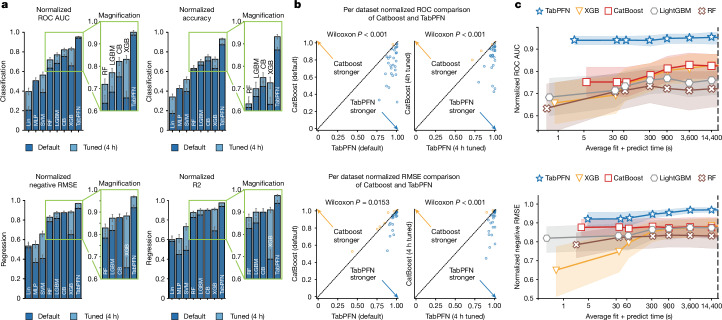
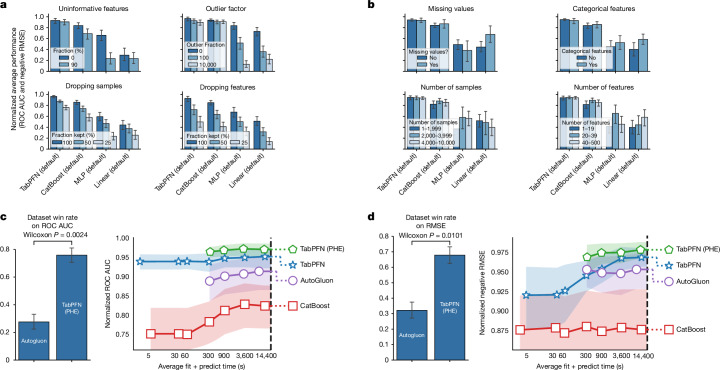
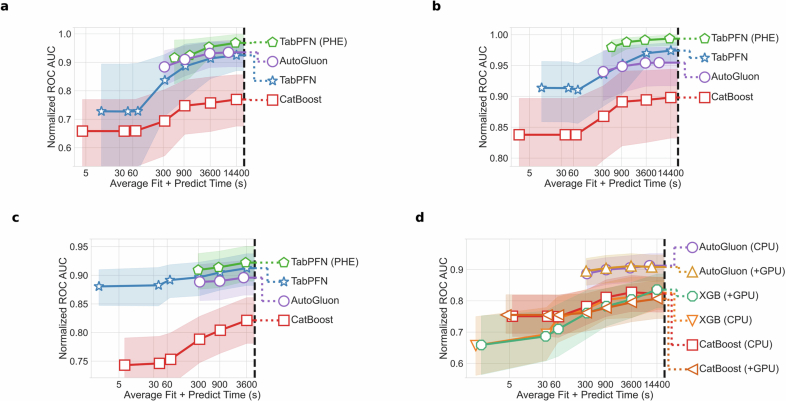
- On benchmarks with 29 classification and 28 regression datasets up to 10,000 samples, 500 features, and 10 classes, TabPFN outperformed tuned baselines. Classification normalized ROC AUC: TabPFN default 0.939 vs CatBoost default 0.752; tuned TabPFN 0.952 vs tuned CatBoost 0.822. Regression normalized RMSE: TabPFN default 0.923 vs CatBoost default 0.872; tuned TabPFN 0.968 vs tuned CatBoost 0.875.
- TabPFN default took 2.8 s for classification and 4.8 s for regression on average, outperforming baselines tuned for 4 h—a speedup of 5,140× for classification and 3,000× for regression. TabPFN (PHE) reached average normalized ROC AUC 0.971 vs 0.939 for TabPFN default and 0.914 for AutoGluon; for regression, TabPFN (PHE) outperformed AutoGluon allowed 4 h after a 300 s tuning budget, a 48× speedup.
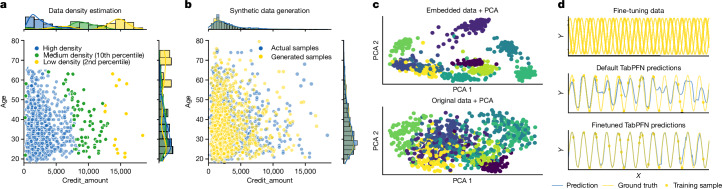
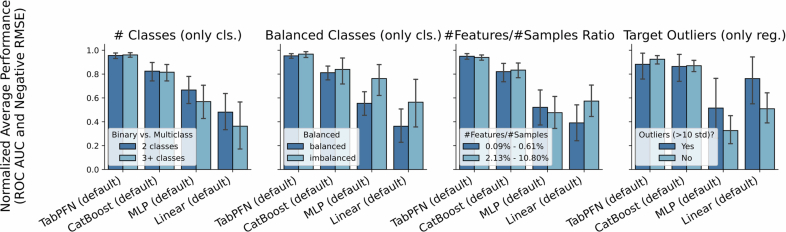
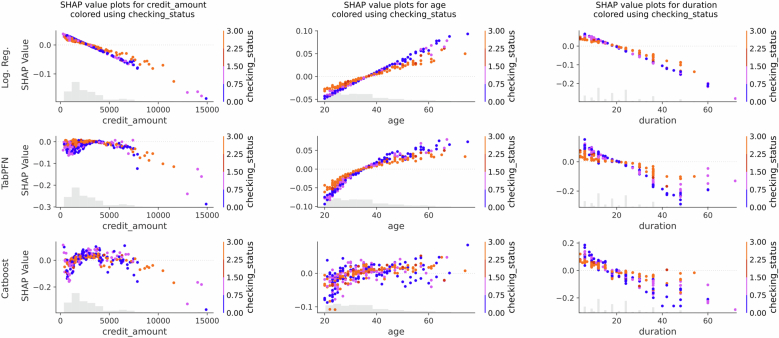
- TabPFN was robust to uninformative features and outliers, and with half the samples it performed as well as the next best method using all samples. It also demonstrated foundation-model abilities including density estimation, synthetic data generation, learned embeddings, fine-tuning, and SHAP-based feature importance.
Methods
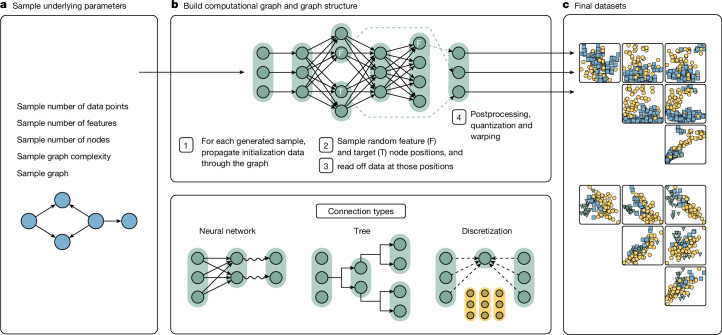
- TabPFN was pretrained on synthetic tabular datasets generated from structural causal models: around 100 million synthetic datasets per model training, with final models trained for approximately 2,000,000 steps at batch size 64 datasets, corresponding to around 130,000,000 synthetically generated datasets each.
- The architecture is a transformer encoder variant that treats each table cell as a separate position and uses two-way attention: each cell attends to other features in its row, then to the same feature across its column. At inference, training samples are provided as context and predictions are made in a single forward pass via in-context learning; train-state caching enables reuse for multiple test inferences.
- Evaluation used the AutoML Benchmark and OpenML-CTR23, with 29 classification and 28 regression datasets up to 10,000 samples, 500 features, and 10 classes. Each dataset and method was run for 10 repetitions with different random seeds and 90% train/10% test splits; hyperparameters were tuned by random search with five-fold cross-validation using time budgets from 30 s to 4 h. Metrics were ROC AUC and accuracy for classification, and R² and negative RMSE for regression, normalized per dataset.
Limitations
- The paper states that TabPFN inference may be slower than highly optimized approaches such as CatBoost; memory usage scales linearly with dataset size and can be prohibitive for very large datasets; and evaluation focused on datasets with up to 10,000 samples and 500 features, so scalability to larger datasets requires further study.
- The paper also states TabPFN is not optimized for real-time inference: for a dataset with 10,000 rows and 10 columns, it requires 0.2 s (0.6 s without GPU) to predict one sample, whereas CatBoost default can do so in 0.0002 s.
- The paper notes that for larger datasets and highly non-smooth regression datasets, CatBoost, XGBoost, or AutoGluon are likely to outperform TabPFN, and that natively the method is limited to predicting at most 10 classes unless pretrained on more classes or adapted with approaches such as one-vs-one, one-vs-rest, or ECOC.
Model-written summary. Check it against the paper before relying on it.
Integrity signals
Registry
Cites
Statistics
Figures
Verification
Claims the paper makes
1 Valid · 6 Not valid · 17 Not checked · 72 Own results and interpretations
The sources with a verdict support this claim; the rest weren’t checked yet, have no full text we could read, or their verdicts aren’t rated yet.
In the paper
“For larger datasets and highly non-smooth regression datasets, approaches such as CatBoost9, XGB7 or AutoGluon40 are likely to outperform TabPFN.”
§ Accurate predictions on small data with a tabular foundation model > Methods > User guide
What the sources say
- Check pendingcites [9] Prokhorenkova, L., Gusev, G., Vorobev, A., Dorogush, A. & Gulin, A. CatBoost: unbiased boosting with categorical features. In Proc. 30th International Conference on Advances in Neural Information Processing Systems (eds Bengio, S. et al.) 6639–6649 (Curran Associates, 2018). source
- Supportedcites [7] Chen, T. & Guestrin, C. Xgboost: A scalable tree boosting system. In Proc. 22nd ACM SIGKDD International Conference on Knowledge Discovery and Data Mining (eds Krishnapuram, B. et al.) 785–794 (ACM Press, 2016). source
The citation is offered to identify the system 'XGB' named in the citing sentence, and our copy is that system's paper: the Abstract and Introduction (KDD '16) describe XGBoost as 'a scalable end-to-end tree boosting system' that 'scales beyond billions of examples using far fewer resources than existing systems', used 'to achieve state-of-the-art results on many machine learning challenges'. The Introduction (p.1) further notes 17 of 29 Kaggle winning solutions in 2015 used XGBoost, and the evaluation sections report it running >10x faster than Spark MLLib/H2O on the 1.7-billion-example Criteo data, consistent with the 'larger datasets' framing. The head-to-head comparison against TabPFN and the 'highly non-smooth regression' qualification are the citing authors' own conclusion (TabPFN postdates this source) and are not attributed to this paper, so nothing here is unsupported for the part this citation carries. (LLM, conf=0.85)
- Check pendingcites [40] Erickson, N. et al. Autogluon-tabular: robust and accurate automl for structured data. Preprint at https://arxiv.org/abs/2003.06505 (2020). source
hedgedstates a possible cause- Asserted: passes — The authors put it forward as true.
- Checkable: passes — It can be checked against evidence.
- Load-bearing: unclear — It is unclear whether the paper’s conclusions depend on it.
- Based: passes — The paper gives a reason why it holds.
A result the paper states — it cites no source for it, so there is none to check. The quote shows it is in the paper.
In the paper
“This new supervised tabular learning method can be applied to any small- to moderate-sized dataset and yields dominant performance for datasets with up to 10,000 samples and 500 features.”
§ Accurate predictions on small data with a tabular foundation model > Main
plainstates a causen = 10,000- Asserted: passes — The authors put it forward as true.
- Checkable: passes — It can be checked against evidence.
- Load-bearing: passes — The paper’s conclusions depend on it.
- Based: passes — The paper gives a reason why it holds.
A result the paper reports from its own data — it cites no other source for it, so there is none to check. The quote shows it is in the paper.
In the paper
“We extract and visualize learned embeddings from the mfeat-factors dataset in Fig. 6c, showing improved class separation compared with the raw data on the first two principal components.”
§ Accurate predictions on small data with a tabular foundation model > Foundation model with interpretability
plainstates a cause- Asserted: passes — The authors put it forward as true.
- Checkable: passes — It can be checked against evidence.
- Load-bearing: unclear — It is unclear whether the paper’s conclusions depend on it.
- Based: passes — The paper gives a reason why it holds.
A result the paper reports from its own data — it cites no other source for it, so there is none to check. The quote shows it is in the paper.
In the paper
“we found that pre-processing inputs can help performance”
§ Accurate predictions on small data with a tabular foundation model > Methods > Details on the neural architecture
plainstates a possible cause- Asserted: passes — The authors put it forward as true.
- Checkable: passes — It can be checked against evidence.
- Load-bearing: unclear — It is unclear whether the paper’s conclusions depend on it.
- Based: passes — The paper gives a reason why it holds.
In the paper
“As our models are not fully permutation invariant, for each ensemble member, we shuffle the feature order, approximating order invariance64.”
§ Accurate predictions on small data with a tabular foundation model > Methods > Inference details
What the sources say
- Not checked yetcites [64] Murphy, R. L., Srinivasan, B., Rao, V. A. & Ribeiro, B. Janossy pooling: learning deep permutation-invariant functions for variable-size inputs. In Proc. 7th International Conference on Learning Representations (ICLR, 2019). source
plain- Asserted: passes — The authors put it forward as true.
- Checkable: passes — It can be checked against evidence.
- Load-bearing: passes — The paper’s conclusions depend on it.
- Based: passes — The paper gives a reason why it holds.
25 more claims
Create a free account to see all 96 claims and to verify the 28 references still open.
- Probably not a substantial claim. 32
- It may state two separate claims as one. 47
Self-check
Percentages, sums and reported differences re-computed from the paper’s own numbers.
Each contradiction between two passages listed here was confirmed by an independent check.
Rated minor: it would not touch a result — a value no result rests on, a p-value that stays on the same side of the significance level, or a conflict that is clerical, resolved elsewhere in the paper, or outside its own findings.
In the paper
§ Accurate predictions on small data with a tabular foundation model > Quantitative analysis > Comparison with tuned ensemble methods
“In just 2.8 s, TabPFN (default) outperforms AutoGluon for classification tasks, even if AutoGluon is allowed up to 4 h, a 5.140× speedup.”
§ Accurate predictions on small data with a tabular foundation model > Quantitative analysis > Comparison with state-of-the-art baselines
“The default of TabPFN, taking 2.8 s on average for classification and 4.8 s for regression, outperforms all baselines, even when tuning them for 4 h—a speedup of 5,140× and 3,000×, respectively.”
Rated minor: it would not touch a result — a value no result rests on, a p-value that stays on the same side of the significance level, or a conflict that is clerical, resolved elsewhere in the paper, or outside its own findings.
In the paper
§ Accurate predictions on small data with a tabular foundation model > Quantitative analysis
“TabPFN was pre-trained once using eight NVIDIA RTX 2080 GPUs over 2 weeks”
§ Accurate predictions on small data with a tabular foundation model > Methods > Training details
“One training run requires around 2 weeks on one node with eight Nvidia RTX 2080 Ti GPUs.”
Rated minor: it would not touch a result — a value no result rests on, a p-value that stays on the same side of the significance level, or a conflict that is clerical, resolved elsewhere in the paper, or outside its own findings.
In the paper
§ Accurate predictions on small data with a tabular foundation model > An architecture designed for tables
“This design enables the architecture to be invariant to the order of both samples and features”
§ Accurate predictions on small data with a tabular foundation model > Methods > Inference details
“As our models are not fully permutation invariant, for each ensemble member, we shuffle the feature order, approximating order invariance64.”
Citations
Cites
Breiman, L. (2001) · Machine Learning · doi:10.1023/a:1010933404324 · Cited by 133,538
Vaswani, A., Shazeer, N., Parmar, N., Uszkoreit, J., Jones, L., Gomez, A. N., Kaiser, L., & Polosukhin, I. (2017) · arXiv · doi:10.48550/arxiv.1706.03762 · Cited by 120,404
Distinctive Image Features from Scale-Invariant Keypoints
Lowe, D. G. (2004) · International Journal of Computer Vision · doi:10.1023/b:visi.0000029664.99615.94 · Cited by 62,647 · cited 2×
“Hand-designed features in computer vision, such as SIFT (Scale Invariant Feature Transform) 10 and HOG (Histogram of Oriented Gradients) 11 , have been replaced by learned convolutions; grammar-based approaches in natural language processing have been replaced by learned transformers 12 ; and the design of customized…”
Cortes, C., & Vapnik, V. (1995) · Machine Learning · doi:10.1007/bf00994018 · Cited by 59,421
XGBoost: A Scalable Tree Boosting System
Chen, T., & Guestrin, C. (2016) · Proceedings of the 22nd ACM SIGKDD International Conference on Knowledge Discovery and Data Mining · doi:10.1145/2939672.2939785 · Cited by 54,569 · cited 5×
“55, further optimizing TabPFN specifically for inference tasks has already been explored, resulting in four times faster inference performance compared with even XGBoost, but so far also reducing predictive quality.”
InfluentialHighly accurate protein structure prediction with AlphaFold
Jumper, J., Evans, R., Pritzel, A., Green, T., Figurnov, M., Ronneberger, O., Tunyasuvunakool, K., Bates, R., Žídek, A., Potapenko, A., et al. (2021) · Nature · doi:10.1038/s41586-021-03819-2 · Cited by 43,764 · cited 2×
“The transformer architecture is currently the favoured architecture for flexible deep learning and foundation models 4,5 .”
Histograms of Oriented Gradients for Human Detection
Dalal, N., & Triggs, B. (2005) · 2005 IEEE Computer Society Conference on Computer Vision and Pattern Recognition (CVPR'05) · doi:10.1109/cvpr.2005.177 · Cited by 33,584
Greedy function approximation: A gradient boosting machine
Friedman, J. H. (2001) · The Annals of Statistics · doi:10.1214/aos/1013203451 · Cited by 30,731 · cited 2×
“The list of development datasets can be found in Supplementary Tables 5 and 6.”
Language Models are Few-Shot Learners
Brown, T. B., Mann, B., Ryder, N., Subbiah, M., Kaplan, J., Dhariwal, P., Neelakantan, A., Shyam, P., Sastry, G., Askell, A., et al. (2020) · arXiv · doi:10.48550/arxiv.2005.14165 · Cited by 23,372 · cited 1×
“We build on a preliminary version of TabPFN 23 , which demonstrated the applicability of in-context-learning 17 for tabular data in principle but had many limitations that rendered it inapplicable in most cases.”
Quinlan, J. R. (1986) · Machine Learning · doi:10.1007/bf00116251 · Cited by 21,439
Research works printed but not linked: 11
- van Breugel, B. & van der Schaar, M. Position: why tabular foundation models should be a research priority. In Proc. 41st International Conference on Machine Learning 48976–48993 (PMLR, 2024).
- Akyürek, E., Schuurmans, D., Andreas, J., Ma, T. & Zhou, D. What learning algorithm is in-context learning? Investigations with linear models. In Proc. The Eleventh International Conference on Learning Representations (ICLR, 2023).
- Müller, S., Hollmann, N., Pineda-Arango, S., Grabocka, J. & Hutter, F. Transformers can do Bayesian inference. In Proc.The Tenth International Conference on Learning Representations (ICLR, 2022).
- Kingma, D. & Ba, J. Adam: A method for stochastic optimization. In Proc. International Conference on Learning Representations (ICLR, 2015).
- Bahdanau, D., Cho, K. & Bengio, Y. Neural machine translation by jointly learning to align and translate. In Proc. 3rd International Conference on Learning Representations (eds Bengio, Y. & LeCun, Y.) (ICLR, 2015).
- Gorishniy, Y., Rubachev, I., Khrulkov, V. & Babenko, A. Revisiting deep learning models for tabular data. In Proc. Advances in Neural Information Processing Systems 34 (eds Ranzato, M. et al.) 18932–18943 (NeurIPS, 2021).
- Fischer, S. F., Feurer, M. & Bischl, B. OpenML-CTR23 – a curated tabular regression benchmarking suite. In Proc. AutoML Conference 2023 (Workshop) (AutoML, 2023).
- Lundberg, S. M. & Lee, S.-I. A unified approach to interpreting model predictions. In Proc.Advances in Neural Information Processing Systems (eds Guyon, I. et al.) Vol. 30, 4765–4774 (Curran Associates, 2017).
- Nagler, T. Statistical foundations of prior-data fitted networks. In Proc. 40th International Conference on Machine Learning (eds Krause, A. et al.) Vol. 202, 25660–25676 (PMLR, 2023).
- Müller, S., Feurer, M., Hollmann, N. & Hutter, F. PFNS4BO: in-context learning for Bayesian optimization. In Proc. 40th International Conference on Machine Learning 25444–25470 (PMLR, 2023).
- Loshchilov, I. & Hutter, F. SGDR: Stochastic gradient descent with warm restarts. In Proc. 5th International Conference on Learning Representations (ICLR, 2017).
Cited by
Items 1,401–1,500 of 2,324
Structural causal relationship and residual adversarial transfer network in small sample data
Li, P., Zhan, D., Huang, B., Zhang, Y., Jiang, Z., & Zhang, H. (2026) · Ironmaking & Steelmaking Processes Products and Applications · doi:10.1177/03019233251394429
How Well Do Prior-Data Fitted Networks Amortize Bayesian Inference?Preprint
Hülskamp, M., Kobialka, J., Sommer, E., Nagler, T., & Rügamer, D. (2026) · arXiv (Cornell University) · doi:10.48550/arxiv.2610.13764
When Thoughts Become Memory: Unifying In-Context Learning and Fine-TuningPreprint
Chlon, L., & Huang, J. (2026) · arXiv (Cornell University) · doi:10.48550/arxiv.2610.29419
“TabPFN-v2, the public classification checkpoint with two estimators, reads the 128 rows in its context; XGBoost, with 100 trees of depth 3, trains on them.”
InfluentialHe, S., Li, L., Xiao, F., Yi, Z., Liu, Y., Wang, Y., Huang, W. M., & Jin, X. (2026) · Science China Materials · doi:10.1007/s40843-026-4256-y
“Recently, a transformer-based tabular model, TabPFN, has been introduced to improve prediction accuracy and generalization for tabular datasets [41], yet its applications in SMA systems remain largely unexplored.”
Wang, Y., Tang, Y., Cheng, X., Lin, X., Chen, Z., Wu, R., & Zhang, W. (2026) · Computer Methods and Programs in Biomedicine · doi:10.1016/j.cmpb.2026.109444
Sanches, G. B., Júnior, C. A. R., Teixeira, L. S., Schweiger, H., & Zanin, H. (2026) · Results in Engineering · doi:10.1016/j.rineng.2026.111218
Observationally Informed Adaptive Causal Experimental Design
Gao, E., Zhang, L., Fawkes, J., Zuo, A., Liu, W., Li, H., Gong, M., & Sejdinović, D. (2026) · ACM SIGKDD Conference on Knowledge Discovery and Data Mining (KDD) · doi:10.1145/3770855.3817762
“This stage is model-agnostic, permitting the use of state-of-the-art estimators M (e.g., TabPFN [31], CausalPFN [5]) to capture complex, global structural signals.”
Decoupled PFNs: Identifiable Epistemic-Aleatoric Decomposition via Structured Synthetic PriorsPreprint
Bergna, R., Depeweg, S., & Hernández-Lobato, J. M. (2026) · arXiv (Cornell University) · doi:10.48550/arxiv.2605.06413
“5 [Hollmann et al., 2025].”
Geospatial Foundation Models for Mapping Daily Reference Evapotranspiration in AfricaPreprint
Hachimi, C. E., Abbas, H., & Weng, Q. (2026) · SSRN Electronic Journal · doi:10.2139/ssrn.6854691
Ćorović, S., Cvetković, D., & Chi, M.-H. (2026) · Mathematical Modeling in Engineering · doi:10.68406/mme.2026.vol7iss1nm10:119-131
“Recent tabular foundation models have demonstrated that compact inductive biases can improve prediction on small datasets [10], while comparative tabular deep -learning studies emphasize that architecture and validation design must be matched to data scale [11].”
Zhang, X., Sheng, Y., Shen, S., Fan, D., & Liu, L. (2026) · AI · doi:10.3390/ai7080304
Yang, L. S., Dong, J., Li, H., Li, J., Li, L., Wu, D., Liu, P., Shi, X., Chen, X., & Chen, K. (2026) · Chemical Engineering Journal · doi:10.1016/j.cej.2026.179936
From Rules to Predictions: Federated Tabular Learning with LLM Reasoning
Mahanipour, A., & Khamfroush, H. (2026) · doi:10.18653/v1/2026.bionlp-1.78
“…Within each leaf l , client i fits a local mapping function ϕ · X → ) that approximates the negative gradient: (cid:1)(cid:13)(cid:13)(cid:13) is implemented as a CART model for classification tasks and as a pre-trained tabular foundation model (TabPFN (Hollmann et al., 2025)) for regression tasks.”
Xing, S., Feng, J., & Wang, C. (2026) · Sensors · doi:10.3390/s26144606
“More recently, few-shot meta-learning and tabular foundation models have also provided useful ideas for improving generalization when labeled samples are limited [35,36].”
A generative digital twin forecasts and simulates intensive care patients without task labelsPreprint
Wang, H., Ye, K., Yuan, H., Chen, W., Cai, Y., Tian, Y., Liu, T., Xu, Y., Liu, X., Pang, L., et al. (2026) · Research Square · doi:10.21203/rs.3.rs-11382527/v1
Longitudinal AI Models Predict Cancer Adverse EventsPreprint
Fu, C., Yu, J., Shi, R., Waters, M., Pavlak, M., Arfè, A., Shah, S. P., Battle, A. J., Kehl, K. L., Bot, B. M., et al. (2026) · medRxiv · doi:10.64898/2026.10.22.26364879
“TabPFN, a foundation model pretrained on large-volume tabular data 28 , performed best at predicting the rare febrile neutropenia side effect.”
Avelar, P., Ou-Yang, L., Wu, M., & Tsoka, S. (2026) · arXiv (Cornell University) · doi:10.48550/arxiv.2607.05306
“Similarly, tabular foundation models (e.g.TabPFN [Hollmann et al., 2023, 2025]) mark recent progress, but their deployment in high-dimensional omics context may face scalability challenges due to increased memory requirements and the comparatively lower dropout rates characteristic of bulk data.”
Liu, Y., Zheng, L., Qi, J., Zhu, B., Yang, W., Chen, M., Chen, J., 黃明媛, Wang, R., Cui, X., et al. (2026) · Journal of Energy Chemistry · doi:10.1016/j.jechem.2026.10.042
Greif, L., Berti, T., & Meyer, A. M. (2026) · Procedia CIRP · doi:10.1016/j.procir.2026.03.291
Zhang, Y., Liu, J., & Jia, F. (2026) · Construction and Building Materials · doi:10.1016/j.conbuildmat.2026.146774
Arachchilage, C. B., Zhao, J. L., Feng, Z., Dushyantha, N., & Liu, W. V. (2026) · Construction and Building Materials · doi:10.1016/j.conbuildmat.2026.147686
Kim, J.-C., & Lee, S. (2026) · SSRN Electronic Journal · doi:10.2139/ssrn.7078663
Benchmarking and interpreting a tabular foundation model for PISA 2022 mathematical literacy
Büşra, E. R. E. N., & Niksarlı, T. (2026) · International Journal of Assessment Tools in Education · doi:10.21449/ijate.1856645
“From an implementation perspective, TabPFN’s single-step inference reduces the overhead associated with hyperparameter tuning and can be aligned with periodic model evaluation cycles in educational data analysis (Hollmann et al ., 2023; Hollmann et al ., 2025).”
InfluentialCastellanos, M. A., MacDermott-Opeskin, H., Ainsley, J., Swain, J. A., Colby, S., West, D., Channing, G., Good, A., Bourque, É., Vogeti, L., et al. (2026) · ChemRxiv · doi:10.26434/chemrxiv.15009342/v2
Castellanos, M. A., MacDermott-Opeskin, H., Ainsley, J., Swain, J. A., Colby, S., West, D., Channing, G., Good, A., Bourque, É., Vogeti, L., et al. (2026) · ChemRxiv · doi:10.26434/chemrxiv.15009342/v3
Zhang, Q., Liang, W., Wang, S., & Sun, M. (2026) · Biomedical Signal Processing and Control · doi:10.1016/j.bspc.2026.110809
Costes, S. V., Busto, S. G., Scott, R. T., Casaletto, J. A., de Fourtou, G. B., Evarts, B., Saravia-Butler, A., Palmer, X., de Almeida, R. C., Frost, L., et al. (2026) · arXiv (Cornell University) · doi:10.48550/arxiv.2606.28856
“For example, tabular FMs such as TabPFN are relevant because they were designed for small-to-medium tabular datasets and can make strong zero-shot predictions in a single forward pass, outperforming tuned gradient-boosted decision trees in benchmark tasks 16 .”
Feature-interpretable disease prediction from tabular data via dynamic GCN and LLMs
Pang, S., Dong, Y., Wang, R., Wang, J., Lyu, H., Chen, W., Li, Q., Song, H., & Shi, X. (2026) · Pattern Recognition · doi:10.1016/j.patcog.2026.114137
Chen, C., Zhang, Y., Xiaohan, G. U., Yang, X., Shi, K., & Ge, Y. (2026) · Ecological Indicators · doi:10.1016/j.ecolind.2026.115763
Ilyas, Z. (2026) · Review of Behavioral Finance · doi:10.1108/rbf-03-2026-0158
DeXposure-Claw: An Agent System for DeFi Risk Supervision
Shu, A., Chen, B., Wu, W., Chen, C. Y., & He, F. (2026) · Workshop on Financial Technology and Natural Language Processing (FinNLP) · doi:10.18653/2026.finnlp-1.49
Wu, Y., & Wang, A. (2026) · Frontiers in Oncology · doi:10.3389/fonc.2026.1814215
“Newer approaches, including tabular Transformers (8), self-supervised pretraining by feature masking (9) and tabular foundation models pretrained on synthetic priors (10), are reported to narrow or reverse that gap.”
Machine Learning for Regional Tuberculosis Analysis in Ukraine: Regression Modeling and Clustering
Kyrylenko, O., Bazilevych, K., Parfeniuk, Y., Meniailov, I., Chumachenko, T., & Chumachenko, D. (2026) · Computation · doi:10.3390/computation14110269
Xia, M., Yao, B., Wang, Y., Liang, F., Zhao, W., Qin, L., Liu, S., Usama, M., Zhang, Z., Guo, W., et al. (2026) · Ophthalmology and Therapy · doi:10.1007/s40123-026-01482-2
“TabPFN (Tabular Prior-data Fitted Network) is a transformer-based model pretrained on millions of synthetic tabular datasets to approximate Bayesian inference [27, 28].”
Regression vs. Medical LLMs: A Comprehensive Study for CVD and Mortality Risk Prediction
Sande, S. D. K., Skórski, M., Theobald, M., SCHNEIDER, J., & März, W. (2026) · Lecture notes in computer science · doi:10.1007/978-3-032-30710-1_13
Jin, F., Bharati, R., Zhang, G., Zhang, H., Zhang, N., Zhang, Y., Liang, A., & Pokhrel, M. (2026) · iScience · doi:10.1016/j.isci.2026.117559
“Recently, TabPFN (Tabular Prior-data Fitted Network), a tabular foundation model, has been developed to improve prediction on small tabular data-sets 26 without extensive parameter tuning.”
Liu, F., Lu, J., Ding, W., & Wang, L. (2026) · Journal of Building Engineering · doi:10.1016/j.jobe.2026.117734
Zacharia, P. T., Botsis, K., Moustris, K. P., & Stergiou, C. I. (2026) · Machines · doi:10.3390/machines14101123
Chen, X., Shen, L., Huang, Y. N., Gao, Y., Chen, K., Zhang, D., Liu, J., Yuan, J., & Zhuang, S. (2026) · Environmental Science & Technology · doi:10.1021/acs.est.5c18162
Dey, S., Lu, P., Wallqvist, A., & AbdulHameed, M. D. M. (2026) · Scientific Reports · doi:10.1038/s41598-026-72163-0
A unified framework for sentiment classification and topic modeling of mHealth app reviews
Preetasha, N. N., Mohammed, N., Ahmed, S., Elahi, M. M. L., & Momen, S. (2026) · Digital Health · doi:10.1177/20552076261505919
Bandits in Prod: Hyperparameter Optimization at Inference TimePreprint
Abraham, L., Nguyen, T.-A., & Devatine, N. (2026) · arXiv (Cornell University) · doi:10.48550/arxiv.2609.01335
“We instantiate the oracle with TabPFN-3 [50], a tabular foundation model pretrained to predict a target from a table of examples with no further training required.”
Zaribaf, S. A., & Roustaei, M. (2026) · Research Square · doi:10.21203/rs.3.rs-10326626/v1
SmartInvest: Multi-view Enterprise Ranking and LLM-Assisted Investment Analysis
Zhang, J., Fang, J., Sun, X., Yuan, G., Peng, C., Wang, H., Lu, C., Wang, Z., Wang, Y., & 刘镇喜 (2026) · Lecture notes in computer science · doi:10.1007/978-981-92-6916-7_8
Kumar, S. (2026) · Environmental and Sustainability Indicators · doi:10.1016/j.indic.2026.101510
Chen, Y., & Chen, Y. (2026) · The Journal of Physical Chemistry B · doi:10.1021/acs.jpcb.6c02062
Ryu, D., & Yoo, W. (2026) · Applied Sciences · doi:10.3390/app16168270
On the Effectiveness of Kernel-Level Evidence for Agent SecurityPreprint
King, S., Zhang, Z., Kuznetsov, M., Liu, K., Coşkun, B., & Ding, W. (2026) · arXiv (Cornell University) · doi:10.48550/arxiv.2609.28915
Concept Drift from a Causal PerspectivePreprint
Barboza, E. V. L., Barddal, J. P., Sabourin, R., & Cruz, R. M. O. (2026) · arXiv (Cornell University) · doi:10.48550/arxiv.2609.25340
“To generate the target y for classification tasks, we use a prototype-based mapper, in which prototypes are randomly sampled according to the distribution of pa y , such as in other SCM generators (Hollmann et al., 2025).”
Epistemic Compression: The Case for Deliberate Ignorance in High-Stakes AIPreprint
Lukas, S. (2026) · arXiv (Cornell University) · doi:10.48550/arxiv.2603.25033
Barmandah, H., Marghalani, S. A., Bawazir, O. A., Shaat, M., Alkattan, A., & AlEissa, M. M. (2026) · AI · doi:10.3390/ai7100431
CCQ: A Multi-State Child Care Quality Dataset to Support AI for Children's Health ResearchPreprint
Li, V., Xie, Y., Dong, Z., Zhu, Q., Ma, W., Yang, C., Bai, J., Xu, H., & Lu, J. (2026) · arXiv (Cornell University) · doi:10.48550/arxiv.2610.05863
“…• Tabular Classifiers : (a.1) a majority-class baseline derived from the training set ( Dummy ); (a.2) logistic regression ( LR ); (a.3) random forest ( RF ) [12]; (a.4) XGBoost ( XGB ) [15]; (a.5) a tabular neural network ( TabNN ) [5]; and (a.6) a tabular prior-fitted network ( TabPFN ) [31].”
MARVIS: Modality Adaptive Reasoning over VISualizations
Feuer, B., Purucker, L., Elachqar, O., & Hegde, C. (2026) · ACM Conference on AI and Agentic Systems (CAIS) · doi:10.1145/3786335.3813150
Self-citationJia, Y., Gao, X., Cai, Z., & Ji, Y. (2025) · SSRN Electronic Journal · doi:10.2139/ssrn.5362968
AI Pangaea: Unifying Intelligence Islands for Adapting Myriad TasksPreprint
Chang, J., Wang, H., Dang, Z., Huang, L., Wang, Z., Cao, R., Piao, S., Li, D., Gao, D., Wang, D., et al. (2025) · arXiv (Cornell University) · doi:10.48550/arxiv.2509.17460
Stochastic neural networks for quantum devices
Rosenhahn, B., Osborne, T. J., & Hirche, C. (2026) · Quantum Machine Intelligence · doi:10.1007/s42484-026-00438-w
“Modern architectures, e.g. based on transformers [77] are used in Large Language Models [13, 52], Vision Language Models [79] and provide an impressive amount of information in foundation models [32, 42, 50, 51].”
Data-driven tabular foundation model for rock yield strength criterion
Zhao, H., Li, B., & Zhang, S. (2026) · Materials Today Communications · doi:10.1016/j.mtcomm.2026.115571
The Cycle of Experimental Design, Model Building & Review in the Context of Mathematical Modeling
Litwin, T. (2026) · FreiDok plus (Universitätsbibliothek Freiburg) · doi:10.6094/unifr/284398
Sun, Y.-X., Chen, L., Qi, Y., Hancheng, J., He, Y.-P., Shi, Y.-Q., Wang, S.-C., Feng, S.-Q., Zhao, B.-Y., & Ru-feng, D. (2026) · Petroleum Science · doi:10.1016/j.petsci.2026.07.048
Jouichat, H., & Khiari, L. (2026) · EarthArXiv (California Digital Library) · doi:10.31223/x55f73
Generative prediction of rock discontinuities with a tabular foundation model
Meng, H., Mei, G., Tian, H., Xu, N., & Peng, J. (2026) · Journal of Rock Mechanics and Geotechnical Engineering · doi:10.1016/j.jrmge.2026.06.052
Rivas, J., Hermosillo, J., Salazar, R., Terrazas-Nájera, C. A., Medina, F. R., Benedict, M. D., Carney, J. P., & Xu, F. (2026) · Metals · doi:10.3390/met16111196
Methods for imputing trait and community data in ecological and evolutionary research
Turner, M. T., Leontidis, G., Burslem, D. F. R. P., Travis, J. M. J., & Henry, R. (2026) · Environmental Data Science · doi:10.1017/eds.2026.10067
“The foundational transformer model TabPFN has recently shown state-of-the-art performance in both classification and regression tasks with small-and medium-sized datasets (Hollmann et al., 2025).”
City function matters: Identifying influential factors of urban thermal comfort
Zhang, L., Cao, Y., Zhao, C., Wei, S., Wang, Y., & Liu, P. (2026) · Computers Environment and Urban Systems · doi:10.1016/j.compenvurbsys.2026.102482
EMG Tokenization Preserves Movement Information at a Fraction of the BitratePreprint
Sîmpetru, R., Olamazadeh, A., Rohlf, D., Cnejevici, V., & Vecchio, A. D. (2026) · arXiv (Cornell University) · doi:10.48550/arxiv.2610.32674
“Tokens also allow the decoder to change without changing the wearable: frozen TabPFN [30, 31], a pretrained tabular model, decodes SPAR from labelled examples supplied as context, without training its weights on the task.”
Large Language Model-Driven Multi-Agent Simulation of Online Firestorms
Lin, C., Cao, Y., Jin, Y., Wang, Y., Fan, W., Zhao, Z., Han, X., Wang, Q., & Hu, K. (2026) · Applied Sciences · doi:10.3390/app16125870
Can Tabular Foundation Models Guide Exploration in Robot Policy Learning?Preprint
Ou, B., & Dümbgen, F. (2026) · arXiv (Cornell University) · doi:10.48550/arxiv.2604.27667
“Recent advances in tabular foundation models, particularly transformer-based pretrained regressors for tabular prediction [24], have demonstrated strong performance in low-data regimes.”
Knowledgeable Language Models as Black-Box Optimizers for Personalized Medicine
Yao, M. S., Bastani, O., Andersson, A., Biancalani, T., BenTaieb, A., & Iriondo, C. (2026) · International Conference on Learning Representations · doi:10.48550/arxiv.2509.20975
When and Why LLM Causal Priors Help: Closed-Loop Prior Selection for Amortized Causal InferencePreprint
Zhou, H. (2026) · arXiv (Cornell University) · doi:10.48550/arxiv.2609.06941
“TabPFN [8, 9] brought this paradigm to tabular supervised learning, showing that in the small-sample regime a model pretrained on synthetic tasks can match or exceed classical methods tuned per dataset.”
Do Language Models Know What Compelling Scientific Evidence Looks Like?Preprint
Igoe, C., Grand, G., Koch, Z., Bou, A., Moss, E., Hinks, M. M., Rodriques, S. G., White, A., & Narayanan, S. (2026) · arXiv (Cornell University) · doi:10.48550/arxiv.2610.41015
Entangled by Design: Spurious Intra-Variable Signal Routing in Tabular In-Context LearnersPreprint
Vlontzos, A., Papanastasiou, G., Kainz, B., & Tsaftaris, S. (2026) · arXiv (Cornell University) · doi:10.48550/arxiv.2607.25532
“For tabular data specifically, Müller et al. [2022] introduced Prior-Data Fitted Networks (PFNs), the architecture underlying TabPFN [Hollmann et al., 2025], which approximate posterior predictive distributions by meta-training on synthetic priors.”
InfluentialA Framework for Task-Agnostic Counterfactual Fairness in Transformers through Activation SteeringPreprint
Anderson, J. W., Wang, Y., & Visweswaran, S. (2026) · arXiv (Cornell University) · doi:10.48550/arxiv.2611.00298
“TabPFN [15] is a transformer-based foundation model trained over synthetic datasets sampled from structural causal models, enabling generalization across classification tasks via a single forward pass.”
Understanding Language Models: Optimization, Architecture, and Emergent Abilities
Li, Y. (2025) · Deep Blue (University of Michigan) · doi:10.7302/28182
Eo, J., Kim, J. Y., Ju, R., Jung, M., & Lee, U. (2026) · arXiv (Cornell University) · doi:10.48550/arxiv.2605.28089
Test-Time Compute for Tabular Foundation Models: Mechanisms, Gains, and LimitsPreprint
Ning, K., Biloš, M., Wilson, J., Zhang, Y., Rasul, K., Song, D., Schneider, A., & Nevmyvaka, Y. (2026) · arXiv (Cornell University) · doi:10.48550/arxiv.2610.12005
“TabPFN averages predictions across preprocessing choices and permutations (Hollmann et al., 2025; Ye et al., 2025), while greedy ensemble selection combines selected members from a model library (Caruana et al., 2004).”
Efficient Malware Detection in HWP Byte Sequences Using Pooling-Based Model
Kim, E.-J., & Jeong, Y.-S. (2025) · Applied Sciences · doi:10.3390/app152111525
Tran, H. (2025) · Tampere University Institutional Repository (Tampere University)
Efficiency of foundation models on detecting patient outcomes from clinical data
Cotugno, L. (2026) · AMS Laurea Institutional Research Repository (University of Bologna)
Adaptive Mean Estimation by In-Context Learning: A Gradient-Flow AnalysisPreprint
Eppert, M., Balasubramanian, K., Ghosh, S., Klusowski, J. M., & Tan, Y. S. (2026) · arXiv (Cornell University) · doi:10.48550/arxiv.2610.07804
Gao, W., Du, X., Chen, X., Guo, Y., Bernal, A. M. C., Luo, R., & Xu, Z. (2026) · International World Wide Web Conference (WWW) · doi:10.1145/3774904.3792998
Evolving Executable Pipeline Programs for AutoML with Language ModelsPreprint
Kitharidis, S., Veenman, C. J., van Rijn, J. N., Bäck, T., & van Stein, B. (2026) · arXiv (Cornell University) · doi:10.48550/arxiv.2608.16416
Feng, X., Torr, P. H. S., & Andreis, B. (2026) · arXiv (Cornell University) · doi:10.48550/arxiv.2609.07655
“Each of the 20 held-out worlds is a frozen, seeded structural causal model (SCM) (Pearl, 2009) inspired by TabPFN’s sampled causal-graph prior (Hollmann et al., 2025), with a deterministic response and a single global maximum.”
InfluentialLiu, D., Ren, J., Liu, R., Yin, Y., Xi, J., Ming, X., Hao, J., Zhao, T., Hu, F., & Shen, B. (2026) · Advanced Science · doi:10.1002/advs.78493
“TabPFN was additionally introduced as an independent small-sample baseline for robustness comparison [ 26 ].”
Federated learning for unpaired multimodal dataPreprint
Eklund, A. (2026) · arXiv (Cornell University) · doi:10.48550/arxiv.2601.17986
“Specifically, we will use DINOv3 [20] for image data, DNABERT [13] for genetic data, TabFPN [7] for tabular data, and Llama [24] for text data.”
A Foundation Model for Large-Scale Wireless Network Planning , Operation and OptimizationPreprint
Qin, X., Pu, W., Dong, H., Peng, B., Xue, Y., Shen, L., Yan, Q., Chang, T., & Luo, Z.-Q. T. (2026) · arXiv (Cornell University) · doi:10.48550/arxiv.2609.08482
Resen, I. A. (2026) · Journal of Scientific Reports · doi:10.58970/jsr.1240
Samuel, K. (2025) · DSpace@MIT (Massachusetts Institute of Technology)
PDE-PFN: Prior-Data Fitted Neural PDE SolverPreprint
Park, J., Mingu, K., Lee, D., Cho, W., Lee, K., Gruber, A., Hong, Y., & Park, N. (2026) · arXiv (Cornell University) · doi:10.48550/arxiv.2610.13334
“They are also fast and effective for tabular data classification [18, 19].”
Miles, S. (2026) · SSRN Electronic Journal · doi:10.2139/ssrn.6557828
MOMA: multi-expert framework with missing pattern awareness for rectal cancer neoadjuvant therapy
Wang, K., Wang, W., Lin, Y., Fei, K., Liu, B., Ai, D., Fan, J., Fu, T., Xiao, D., Li, J., et al. (2026) · Information Sciences · doi:10.1016/j.ins.2026.123663
Zhang, M., Wu, X., Hu, Y., Liu, J., Wang, D., Shen, H., & Qie, Z. (2026) · Agriculture · doi:10.3390/agriculture16111213
“…the objective upper limit of sample numbers and utilize a limited small sample capacity to construct inversion models with acceptable predictive performance and improved reliability under limited-sample conditions has perpetually remained a critical pain point in agricultural remote sensing [53].”
Lai, J., Zheng, W., Liu, Z., Tang, Z., & Wu, J. (2026) · SSRN Electronic Journal · doi:10.2139/ssrn.6854688
Titanite Trace-Element Composition as an Indicator of Ore Deposit Types: A Machine-Learning Approach
Xie, Y.-J., & Shen, W.-J. (2026) · Minerals · doi:10.3390/min16070698
“TabPFN is a pretrained foundation model for tabular classification that leverages prior learning from large numbers of synthetic tasks [71].”
Zeng, W., Huang, Z., Bie, Y., Wu, J., & Gong, J. (2026) · arXiv (Cornell University) · doi:10.48550/arxiv.2607.11349
“…convolution; ⑧ LSTM [42] uses gating to model long-range dependencies; ⑨ TFT [32] is a Transformer-based architecture for temporal feature interaction; ⑩ TabPFN [43] is a Transformer-based tabular foundation model that performs fast inference on small datasets through Bayesian meta-learning.”
A Statistical-Physical Prior-Guided Framework for Multi-Class Landslide Susceptibility MappingPreprint
Feng, H., Hu, Q., Lan, Y., Zheng, D., Xu, Y., Li, J., Wang, S., & Zhao, P. (2026) · doi:10.5194/egusphere-2026-4550
Raju, D., Skartlien, R., Ramdin, M., & Vlugt, T. J. H. (2026) · Industrial & Engineering Chemistry Research · doi:10.1021/acs.iecr.6c03388
Ma, Y., Lei, H., Xiao, L., & Lyu, H. (2026) · SSRN Electronic Journal · doi:10.2139/ssrn.7451081
FISSION: Label Augmentation for Bot DetectionPreprint
Yang, S., Nieweglowski, I., & Yaish, A. (2026) · arXiv (Cornell University) · doi:10.48550/arxiv.2609.26279
“The comparison spans linear log-odds [10], nonlinear maximum-margin classification [8], bagged and boosted trees [2, 5, 30], cosine-neighbor voting [9], a shallow MLP, and TabPFN’s pretrained tabular prior [25].”
Influential
Metadata
- Authors
- Hollmann, N., Müller, S., Purucker, L., Krishnakumar, A., Körfer, M., Hoo, S. B., Schirrmeister, R. T., & Hutter, F.
- Affiliations
- University of Freiburg (DE)
- Corresponding author
- Hollmann, Noah
- Müller, Samuel
- Hutter, Frank
- ORCID
- Venue
- Nature
- Published
- 2025-01-08
- Volume
- 637
- Issue
- 8045
- Pages
- 319-326
- ISSN
- 0028-0836 (ISSN-L)
- 1476-4687
- PMC
- PMC11711098
- OpenAlex
- W4406170795
- Semantic Scholar
- 6b238b17e419c7dd3912b9845449496bfb0a571a
- Cited by
- 2,323
- References
- 63
- Citations by year
- 2026: 1829 · 2025: 487
- FWCI
- 417.80
- Type
- journal article
- Language
- en
- Open access
- hybrid
- doi.org
- Licence
- cc-by
- creativecommons.org/licenses/by/4.0 (tdm)
- creativecommons.org/licenses/by/4.0 (vor)
- Locations
- Nature (publishedVersion, cc-by)
- PubMed Central (publishedVersion, cc-by)
- PubMed (publishedVersion)
- RePEc: Research Papers in Economics (submittedVersion)
- Funders
- European Commission (101045765)
- Deutsche Forschungsgemeinschaft (INST 39/963-1, “INST 39/963-1 FUGG”, SFB1597, 417962828, 39/963-1, 499552394)
- Hector Stiftung
- Topics
- Physical Sciences › Computer Science › Artificial Intelligence › Machine Learning and Data Classification
- Physical Sciences › Computer Science › Artificial Intelligence › Neural Networks and Applications
- Physical Sciences › Computer Science › Artificial Intelligence › Domain Adaptation and Few-Shot Learning
- Keywords
- tabular data, tabular foundation models, TabPFN, missing data estimation, small data, generative transformers, synthetic data, fine-tuning, density estimation, embeddings, gradient boosting decision tree, tabular data classification
About these checks
Registry, retraction, Cites and statistics results are computed, not judged, with one exception: a printed reference that no index lists is read once by a model before it counts as a citation error. Claims are extracted by a model and kept only when their quote appears verbatim in the text; each cited source is then checked, with a model’s help, for whether it says what the claim relies on. Those verdicts can be wrong — read the claim’s quote and the cited source before relying on one.
A language model drew the claims from the paper on 2026-11-24, under version 3 of the claim definition (model deepseek-v4.1-flash, prompt extract-v3).
A second model labelled each claim on 2026-11-24 (model jev-1.13-20260917, definition revision gold-guideline-v0.2).
Cited sources are checked with a language model’s help (qwen3.8-omni-flash).
Statistics and arithmetic are recomputed, not judged.
Confidence bands are shown only for fields calibrated on our annotated test set. None is calibrated yet, so no band is shown.
What counts as a claim ›How we measure confidence ›How we check this ›
Are you an author, or do you see a problem with this page? Request a review
Data sources
Bibliographic data: Semantic Scholar, OpenAlex, Crossref.
Contains information from the Semantic Scholar Academic Graph Datasets, made available under the ODC Attribution License (ODC-BY 1.0).
Semantic Scholar’s data is described in: Kinney, R., et al. (2023). The Semantic Scholar Open Data Platform. arXiv:2301.10140.
